EP0003048A1 - Formmassen auf der Grundlage ungesättigter Polyester, Verfahren zu ihrer Herstellung und ihre Verwendung - Google Patents
Formmassen auf der Grundlage ungesättigter Polyester, Verfahren zu ihrer Herstellung und ihre Verwendung Download PDFInfo
- Publication number
- EP0003048A1 EP0003048A1 EP78101845A EP78101845A EP0003048A1 EP 0003048 A1 EP0003048 A1 EP 0003048A1 EP 78101845 A EP78101845 A EP 78101845A EP 78101845 A EP78101845 A EP 78101845A EP 0003048 A1 EP0003048 A1 EP 0003048A1
- Authority
- EP
- European Patent Office
- Prior art keywords
- weight
- vinyl
- acid
- parts
- groups
- Prior art date
- Legal status (The legal status is an assumption and is not a legal conclusion. Google has not performed a legal analysis and makes no representation as to the accuracy of the status listed.)
- Granted
Links
Classifications
-
- C—CHEMISTRY; METALLURGY
- C08—ORGANIC MACROMOLECULAR COMPOUNDS; THEIR PREPARATION OR CHEMICAL WORKING-UP; COMPOSITIONS BASED THEREON
- C08F—MACROMOLECULAR COMPOUNDS OBTAINED BY REACTIONS ONLY INVOLVING CARBON-TO-CARBON UNSATURATED BONDS
- C08F299/00—Macromolecular compounds obtained by interreacting polymers involving only carbon-to-carbon unsaturated bond reactions, in the absence of non-macromolecular monomers
- C08F299/02—Macromolecular compounds obtained by interreacting polymers involving only carbon-to-carbon unsaturated bond reactions, in the absence of non-macromolecular monomers from unsaturated polycondensates
- C08F299/04—Macromolecular compounds obtained by interreacting polymers involving only carbon-to-carbon unsaturated bond reactions, in the absence of non-macromolecular monomers from unsaturated polycondensates from polyesters
- C08F299/0485—Macromolecular compounds obtained by interreacting polymers involving only carbon-to-carbon unsaturated bond reactions, in the absence of non-macromolecular monomers from unsaturated polycondensates from polyesters from polyesters with side or terminal unsaturations
-
- C—CHEMISTRY; METALLURGY
- C08—ORGANIC MACROMOLECULAR COMPOUNDS; THEIR PREPARATION OR CHEMICAL WORKING-UP; COMPOSITIONS BASED THEREON
- C08L—COMPOSITIONS OF MACROMOLECULAR COMPOUNDS
- C08L67/00—Compositions of polyesters obtained by reactions forming a carboxylic ester link in the main chain; Compositions of derivatives of such polymers
- C08L67/06—Unsaturated polyesters
Definitions
- the present invention relates to molding compositions based on "terminally unsaturated" urethane group-free polyesters, copolymerizable vinyl or vinylidene compounds and rubber-elastic polymers.
- Molding compositions made from polyesters with randomly distributed ethylenically unsaturated structural units, copolymerizable monomers and rubber-like polymers are known (cf. DE-AS 1 166 467; 1 241 983; US Pat. Nos. 3,231,631; 3,688,178; 3,882,078; 3,857,812; 3,674,893).
- Hardened moldings produced from these molding compositions have good dimensional accuracy, but they do not have sufficient impact strength for all purposes.
- the lack of compatibility between the rubber-like component and the resin often leads to problems with regard to the manageability of the delivery form, which either consists of two components or must contain additional additives, which can be dissolved out when the cured products come into contact with solvents, thereby reducing the cost Chemical resistance of the hardened unsaturated polyester resin compositions is prevented.
- the specific fracture surface energy of the copolymer formed from a) and b) (ie in the absence of c) has a value> 0.5. 10, preferably between 0.5. 1 0 5 and 1 0 6 , erg / cm 2 (measured according to the method of LJ Broutman, FJ Mc Garry at 25 ° C, J. Applied Polym. Sci. 9, 589 f (1965)).
- the molding compositions of the invention are relatively low-viscosity clear solutions or storage-stable dispersions. When cured, they provide moldings with considerably higher impact strength with practically unchanged heat resistance, compared to the known compositions based on polyesters with statistically distributed unsaturated structural units.
- Terminalally unsaturated urethane group-free polyesters in the sense of the invention are those in which the first dicarboxylic acid residue, counted from the two ends of the linear polymer chain, contains an ethylenically unsaturated double bond, while the remaining molecule no longer has any further copolymerizable ethylenically unsaturated double bond .
- Terminalally unsaturated urethane group-free polyesters are known (cf. DE-AS 2 052 961). Depending on their composition, they form rubber-elastic, leather-like or rigid, glass-like transparent bodies after copolymerization with vinyl or vinylidene compounds. The increase in impact strength is also paid for here by reducing the heat resistance, strength and rigidity.
- the preferred embodiment according to which the specific fracture surface energy of the copolymer of components a) and b)> 0.5. 10 5 erg / cm 2 should be obtained taking into account the constitution of a) and b) according to a few simple rules: an increase in the crosslinking density in the a / b copolymer, an increase in the proportion of aromatic and / or cycloaliphatic groups and a decrease in the number of atoms between the two double bonds in the polyester a) lead to a decrease in the specific Fracture surface energy. If these rules are known, the preferred embodiment can be produced effortlessly and reproducibly - in the case of doubt after a small number of preliminary tests - given predetermined components even simply by specifying the mixing ratio a / b.
- terminalally unsaturated urethane group-free polyesters correspond to formula I. wherein R 1 is the divalent radical of a polyester reduced by two hydroxyl groups and containing no ⁇ , ⁇ -ethylenically unsaturated groups, X, Y and R are hydrogen or C 1 -C 6 -alkyl.
- These "terminally unsaturated" urethane group-free polyesters can be prepared by a multistage process, namely by reacting 1 mol of at least one organic dicarboxylic acid
- linear polyesters containing hydroxyl groups which are preferred for the production of "terminally unsaturated” polyesters, are polycondensation products of aliphatic, cycloaliphatic and / or aromatic dicarboxylic acids with as a rule 2-16 carbon atoms or their ester-forming derivatives with at least one diol with as a rule 2 to 24 carbon atoms in question.
- These linear polyesters should have an average molecular weight (number average Mn) of 200 to 3000.
- Organic diols preferred for the preparation of the linear polyesters are e.g. Dihydroxy compounds with 2 to 24 carbon atoms such as ethylene glycol, 1,2-propanediol and -1,3, diethylene glycol, dipropylene glycol, 1,2-butanediol, 1,3 and -1,4, neopentyl glycol, 2-propanediol-2, 3, 1,6-hexanediol, 2,2-bis (4-hydroxycyclohexyl) propane, bis-oxyalkylated bisphenol A, and linear polyesters containing hydroxyl groups, which are free from copolymerizable carbon-carbon multiple bonds; preferred dicarboxylic acids are e.g.
- Compounds preferred for the production of the "terminally unsaturated" urethane group-free polyesters are ⁇ , ⁇ -ethylenically unsaturated dicarboxylic acid anhydrides or dicarboxylic acids with generally 4 to 10 carbon atoms, for example maleic anhydride, citraconic anhydride, maleic acid, fumaric acid, itaconic acid, mesaconic acid or chloromale or their half esters.
- Preferred oo p olymerisierbare vinyl and Vinylioeneducationen according to the invention are held in polyester technology common unsaturated compounds, the preferred ⁇ -substituted vinyl groups or .beta.-substituted allyl groups, preferably styrene; but also, for example, nuclear chlorinated and alkylated or -alkenylated styrenes, where the alkyl and alkenyl groups can contain 1-4 or 2-4 carbon atoms, such as vinyltoluene, divinylbenzene, oC-methylstyrene, tert-butylstyrene, chlorostyrene; Vinyl esters of carboxylic acids with 2-6 carbon atoms, preferably vinyl acetate; Vinylpyridine, vinylnaphthalene, vinylcyclohexane, acrylic acid and methacrylic acid and / or their esters (preferably vinyl, allyl and methallyl esters) with 1 to 4 carbon atom
- Preferred rubber-elastic polymers are e.g. those based on natural rubber or synthetic rubbers, e.g. Polymers from conjugated diolefins, such as butadiene, dimethylbutadiene, isoprene and its homologues or copolymers of conjugated diolefins with polymerizable vinyl and vinylidene compounds, such as styrene, ⁇ -methylstyrene, acrylonitrile, methacrylonitrile, acrylates, methacrylates, e.g.
- ABS acrylonitrile, butadiene rubbers, acrylate rubbers, chlorinated rubbers, acrylonitrile / butadiene / styrene copolymers (ABS); also polyalkylene oxides, polylactones such as polycaprolactone, polylactams such as polycaprolactam; saturated polyesters, polysilicones and polycarbonates, provided they are modified so that they have rubber-like properties; but preferably rubber-like ethylene copolymers and rubber-like polyurethanes.
- the ethylene copolymers used are preferably copolymers of ethylene and vinyl esters of aliphatic saturated monocarboxylic acids having 1 to 18 carbon atoms, in particular vinyl acetate and propionate, with a vinyl ester content of 10 to 90% by weight and a Mooney viscosity of at least 5 Mooney (measured according to DIN 53 523) and graft polymers based on these polymers.
- Suitable graft monomers are preferably vinyl and vinylidene aromatics such as vinyltoluene, a (r-methylstyrene, tert-butylstyrene, chlorostyrenes, but preferably unsubstituted Styrene itself; Vinyl acetate, (meth) acrylic acid, its nitriles and esters, the alcohol component of which can contain 1 to 8 carbon atoms, such as methyl methacrylate or ethyl acrylate, (meth) acrylonitrile, maleic anhydride, maleic acid semiesters and diesters with 1 to 8 carbon atoms in the Alcohol component, isoprene.
- vinyl and vinylidene aromatics such as vinyltoluene, a (r-methylstyrene, tert-butylstyrene, chlorostyrenes, but preferably unsubstituted Styrene itself
- Mixtures of the compounds listed can of course be used both as graft substrates and as graft monomers.
- preferred polymers are further vinyl alcohol-containing products obtained by partial saponification of ethylene V ER- listed / Vinylester-Canolymeren or graft polymers may be prepared and hydroperoxide-containing products which can be prepared by oxidation of the substances.
- the aforementioned graft polymers can be prepared by known processes.
- graft polymers of ethylene / vinyl ester copolymers with grafted-on units of a vinylaromatic and (meth) acrylonitrile e.g. according to the methods of British Patent 917 499 or German Offenlegungsschriften 1 964 479 and 2 137 780.
- the preferred graft polymers of ethylene / vinyl ester copolymers with grafted-on units of a mixture of vinyl aromatics, (meth) acrylonitrile and ⁇ -olefins with 2-18 carbon atoms can be prepared by the processes described in German Offenlegungsschriften 2 215 588 or 2 305 681.
- Suitable vinyl esters for the production of the ethylene / vinyl ester copolymer graft base are organic vinyl esters of saturated monocarboxylic acids with 1 to 18 carbon atoms which are optionally substituted by halogen, in particular by chlorine.
- halogen in particular by chlorine.
- the following may be mentioned in particular: vinyl formate, vinyl acetate, vinyl propionate, vinyl chloropropionate, vinyl butyrate, vinyl isobutyrate, vinyl capronate, vinyl laurinate, vinyl myristinate, vinyl stearate, vinyl benzoate, preferably vinyl acetate.
- the ethylene / vinyl ester copolymers are prepared by known processes of high or medium pressure synthesis, optionally in solvents such as tert-butanol.
- Nuclear-substituted alkylstyrenes having 1-5 carbon atoms in the alkyl radical such as 4-methylstyrene, oC-methylstyrene, halogenostyrenes such as 4-chlorostyrene or mixtures thereof, preferably styrene, may be mentioned as grafted vinylaromatics.
- the grafted monoolefins can have 2-18, preferably 2-8, carbon atoms.
- monoolefins ethylene, propylene, butene-1, butene-2, isobutylene, 2-methylbutene-2, 3-methylbutene-1, diisobutylene, triisobutylene, pentene-1, 4-methylpentene-1, octadecene-1, cyclopentene.
- Propylene, butene-1, isobutylene or mixtures thereof are preferred.
- the rubber-elastic polyurethanes c) are preferably linear and have average molecular weights of 10,000 to 1,000,000, preferably 20,000 to 500,000 (determined by membrane osmometry).
- the preparation can be carried out in a manner known per se by reacting a compound having at least two isocyanate-reactive hydrogen atoms, preferably a polyhydroxyl compound having a molecular weight above 600, optionally a compound having two isocyanate-reactive hydrogen atoms and a molecular weight below 600, and a polyisocyanate.
- Suitable starting components for the production of the rubber-elastic polymers c) are aliphatic, cycloaliphatic, araliphatic, aromatic and heterocyclic polyisocyanates, as described, for example, by W. Siefken in Justus Liebigs Annalen der Chemie 562, pages 75 to 136, for example ethylene -diisocyanate, 1,4-tetramethylene diisocyanate, 1,6-hexamethylene diisocyanate, 1,12-dodecane diisocyanate, cyclobutane-1,3-diisocyanate, cyclohexane-1,3- and -1,4-diisocyanate and any mixtures of these isomers, 1- Methyl-2,4-diisocyanato-cyclohexane, 1-methyl-2,6-diisocyanatocyclohexane, 1-isocyanato-3,3,5-trimethyl-5-isocyanatomethyl-cyclo
- the technically easily accessible polyisocyanates e.g. the 2,4-and 2,6-tolylene diisocyanate and any mixtures of these isomers (“TDI”), polyphenyl-polymethylene polyisocyanates, such as those produced by aniline / formaldehyde condensation and subsequent phosgenation (“crude MDI”), and carbodiimide groups , Urethane groups, allophanate groups, isocyanurate groups, urea groups or biuret groups containing polyisocyanates ("modified polyisocyanates").
- TDI 2,4-and 2,6-tolylene diisocyanate and any mixtures of these isomers
- CAMDI aniline / formaldehyde condensation and subsequent phosgenation
- carbodiimide groups Urethane groups, allophanate groups, isocyanurate groups, urea groups or biuret groups containing polyisocyanates
- Starting components which are preferably to be used are furthermore compounds having at least two isocyanate-reactive hydrogen atoms with a molecular weight of generally from 600 to 10,000.
- These include amino groups, compounds containing thiol groups or carboxyl groups, preferably polyhydroxyl compounds, in particular compounds having two to eight hydroxyl groups, especially those containing two hydroxyl groups of molecular weight 800 to 10,000, preferably 1000 to 6000, for example at least two, usually 2 to 8, but preferably 2, hydroxyl-containing polyesters, polyethers, polythioethers, polyacetals, polycarbonates, polyamides and polyesteramides, such as those used for the preparation of homogeneous and cellular poly urethanes are known per se.
- Preferred polyhydroxyl compounds with a molecular weight above 600 are, in addition to polyester amides or polyacetals, in particular linear or predominantly linear polyesters and polyethers.
- the polyesters containing hydroxyl groups are, for example, reaction products of polyhydric, preferably dihydric and optionally additionally trihydric alcohols with polybasic, preferably dibasic carboxylic acids.
- polyhydric preferably dihydric and optionally additionally trihydric alcohols with polybasic, preferably dibasic carboxylic acids.
- the corresponding polycarboxylic anhydrides or corresponding polycarboxylic esters of C 1 -C 6 alcohols or mixtures thereof can also be used to prepare the polyesters.
- the polycarboxylic acids can be aliphatic, cycloaliphatic, aromatic and / or heterocyclic in nature and optionally, for example by halogen atoms, substituted one or more times and / or unsaturated.
- succinic acid adipic acid, pimelic acid, suberic acid, azelaic acid, sebacic acid, phthalic acid, isophthalic acid, terephthalic acid, trimellitic acid, phthalic anhydride, tetrahydrophthalic anhydride, hexahydrophthalic anhydride, malefic anhydride, malethane anhydride, endetrachloride anhydride, tetrachloride anhydride, malethane anhydride, endogenous anhydride, trimeric fatty acids such as oleic acid, optionally in a mixture with monomeric fatty acids, dimethyl terephthalate and bis-glycol ester of terephthalic acid.
- Preferred polyhydric alcohols include, for example, ethylene glycol, 2-ethylpropanediol-1,3, propylene glycol (1,2) and - (1,3), diethylene and dipropylene glycol, butylene glycol- (1,4), - (1,3) and - (2,3), pentanediol-1,5, hexanediol- (1,6), octanediol- (1,8), neopentylglycol, cyclohexanedimethanol (1,4-bishydroxymethylcyclohexane), 2-methyl-1,3-propanediol , Glycerin, Trimethylolpropane, Hexantriol- (1,2,6), Butantriol- (1,2,4), Trimethyloläthan, Pentaerythrit, Methylglykosid, furthermore diethylene glycol, triethylene glycol, tetraethylene glycol, higher polyethylene glycols, polyprop
- the polyesters can have terminal carboxyl groups. Polyesters from lactones, for example C-caprolactone, or from straight-chain hydroxycarboxylic acids with at least 5 carbon atoms, for example ⁇ -hydroxycaproic acid, can also be used.
- polyesters are produced under conditions such that their end groups consist at least predominantly of hydroxyl groups.
- Polyethers such as propylene oxide or tetrahydrofuran polymers or polythioethers, such as condensation products of thiodiglycol, are also suitable yourself or other diols. These products generally have an average molecular weight of about 600-5000, preferably 1000-2500.
- the at least two, usually two to eight, preferably two, hydroxyl groups-containing polyethers which are suitable according to the invention are also of the type known per se and are, for example, by polyaddition of epoxides such as ethylene oxide, propylene oxide, butylene oxide, tetrahydrofuran, styrene oxide or epichlorohydrin itself, e.g. in the presence of BF 3 , or by the addition of these epoxides, optionally in a mixture or in succession, to starting components with reactive hydrogen atoms such as water, alcohols, ammonia or amines, e.g.
- epoxides such as ethylene oxide, propylene oxide, butylene oxide, tetrahydrofuran, styrene oxide or epichlorohydrin itself, e.g. in the presence of BF 3
- reactive hydrogen atoms such as water, alcohols, ammonia or amines, e.g.
- those polyethers are preferred which predominantly (up to 90% by weight, based on all the OH groups present in the polyether) have primary OH groups.
- Polyethers modified by vinyl polymers e.g. by polymerization of styrene and acrylonitrile in the presence of polyethers (American patents 3,383,351, 3,304,273, 3,523,093, 3,110,695, German patent 1,152,536) are suitable.
- the condensation products of thiodiglycol with themselves and / or with other glycols, dicarboxylic acids, formaldehyde, aminocarboxylic acids or amino alcohols should be mentioned in particular.
- the products are polythio ether, polythio ether ester or polythio ether ester amide.
- Preferred polyacetals include e.g. the compounds which can be prepared from glycols, such as diethylene glycol, triethylene glycol, 4,4'-dioxydiphenyldimethylmethane, hexanediol and formaldehyde.
- Polyacetals suitable according to the invention can also be prepared by polymerizing cyclic acetals.
- Preferred polycarbonates containing hydroxyl groups are those of the type known per se, which can be obtained, for example, by reacting diols such as propanediol (1,3), butanediol (1,4) and / or hexanediol (1,6), diethylene glycol, Triethylene glycol or tetraethylene glycol with diaryl carbonates, for example diphenyl carbonate, or phosgene.
- diols such as propanediol (1,3), butanediol (1,4) and / or hexanediol (1,6)
- diethylene glycol Triethylene glycol or tetraethylene glycol
- diaryl carbonates for example diphenyl carbonate, or phosgene.
- Preferred polyester amides and polyamides include e.g. the predominantly linear condensates obtained from polyvalent saturated and unsaturated carboxylic acids or their anhydrides and polyvalent saturated and unsaturated amino alcohols, diamines, polyamines and their mixtures.
- Polyhydroxyl compounds that already contain urethane or urea groups and optionally modified natural polyols, such as castor oil, carbohydrates such as starch, can also be used. Addition products of alkylene oxides on phenol / formaldehyde resins or also on urea / formaldehyde resins can also be used according to the invention.
- Compounds with at least two isocyanate-reactive hydrogen atoms with a molecular weight of 32-600 can also be used as starting components for the production of the rubber-elastic polyurethanes, which may be used according to the invention.
- These compounds generally have 2 to 8, preferably 2, hydrogen atoms which are reactive toward isocyanates.
- Compounds with at least two isocyanate-reactive hydrogen atoms and a molecular weight below 600 include not only water or simple glycols, but also glycols with urea, urethane, carbonamide or ester groups and those with tertiary nitrogen atoms. Attention is also drawn to the possibility of using glycols with aromatic ring systems, for example 1,5-naphthylene- ⁇ -dioxethyl ether or hydroquinone-B-dioxethyl ether.
- Diamines such as o-dichlorobenzidine, 2,5-dichloro-p-phenylenediamine or 3,3'-dichloro-4,4'-diaminodi- 'phenylmethane are also suitable, as are amino alcohols, such as N-allyl ethanolamine, amino or oxycarboxylic acids.
- Examples of such compounds are: water, ethylene glycol, (1,2) and - (1,3) propylene glycol, (1,4) and - (2,3) butylene glycol, (1,5) pentanediol, Hexanediol- (1.6), octanediol- (1.8), neopentylglycol, 1,4-bis-hydroxymethylcyclohexane, 2-methyl-1,3-propanediol "glycerol, trimethylolpropane, hexanetriol- (1,2,6 ), Trimethylolethane, pentaerythritol, diethylene glycol, triethylene glycol, tetraethylene glycol, polyethylene glycols with a molecular weight of up to 600, dipropylene glycol, polypropylene glycols with a molecular weight of up to 600, dibutylene glycol, polybutylene glycols with a molecular weight of up to 600, 4,4'-
- mixtures of different compounds with at least two isocyanate-reactive hydrogen atoms with a molecular weight of 32-600 can be used.
- polyhydroxyl compounds in which high molecular weight polyadducts or polycondensates are contained in finely dispersed or dissolved form.
- Such modified polyhydroxyl compounds are obtained if polyaddition reactions (for example reactions between polyisocyanates and amino-functional compounds) or polycondensation reactions (for example between formaldehyde and phenols and / or amines) are carried out directly in situ in the compounds containing hydroxyl groups mentioned above.
- the rubber-elastic polyurethane elastomers preferred for the invention can be produced by reacting the polyhydroxyl compounds with a molecular weight above 600 with less than the amount of a diisocyanate calculated on the end groups, admixing the compound with two reactive hydrogen atoms and a molecular weight below 600 and the reaction with another slide cyanate addition leads to the end.
- the procedure can also be such that the polyhydroxyl compounds are reacted with an excess of diisocyanates in excess of the amount required for the reaction with the end groups and the amount of the compound with a molecular weight below 600 is so measured that an excess over those which are still present Amount calculating isocyanate groups is present.
- the mixture of the polyhydroxyl compound with a molecular weight above 600 and the compound with a molecular weight below 600 can also be reacted with an excess of diisocyanates.
- the molding compositions according to the invention can be prepared at 20 to 80 ° C. by dispersing the rubber-elastic polymer in a mixture of the “terminally unsaturated” urethane group-free polyester and the copolymerizable vinyl or vinylidene compound. It is of course also possible to disperse the rubber-elastic polymer at 20 to 80 ° C. in the copolymerizable compound and to mix this dispersion with the dispersion of the “terminally unsaturated” polyester in the copolymerizable compound.
- customary amounts, ie 0.001 to 0.1% by weight, based on the sum of components a), b) and c), of polymerization inhibitors, for example hydroquinone and alkylated can be added to the molding compositions according to the invention
- Hydroquinones such as toluhydroquinone, dimethylhydroquinone, trimethylhydroquinone or p-tert.-butylhydroquinone, p-tert.-butylpyrocatechol, p-benzoquinone, chloroanil, naphthoquinone, copper compounds such as copper naphthenate or copper octoate, additive compounds such as Cu ( (I) Cl / triphenyl phosphite, Cu (I) CI / trimethyl phosphite, Cu (I) Cl / trischloroethyl phosphite or Cu (I) Cl / tripropyl phosphite, phenol
- customary amounts preferably 0.5-5% by weight, based on the sum of components a), b) and c), of polymerization initiators, such as, for example, diacyl peroxides such as diacetyl peroxide, dibenzoyl peroxide, di- p-chlorobenzoyl peroxide, tert-butyl peroxide, peroxy esters such as tert-butyl peroxy acetate, tert-butyl per-oxybenzoate, tert-butyl peroctoate, dicyclohexyl peroxydicarbonate or 2,5-dimethylhexane-2,5-diperoctoate, alkyl peroxides such as bis (tert .-Butylperoxybutane), dicumyl peroxide, tert-butyl cumyl peroxide, hydroperoxides such as cumene hydroperoxide, tert-butyl hydroperoxide,
- the resin compositions prepared according to the invention can absorb up to 300% by weight, preferably 50-200% by weight, based on the sum of components a), b) and c), of fillers and reinforcing materials.
- Inorganic materials such as heavy spar, calcium carbonate, silicates, clays, chalk, lime, coal, asbestos, glass, metals and organic materials such as cotton, sisal, jute, polyester, polyamides, preferably in the form of fibers, are to be regarded as such. Glass fibers in any form, in particular also in the form of mats, are preferably used as reinforcing material.
- thermoplastic polymers such as thermoplastic polymers, polycondensates or pole addition compounds
- pole addition compounds can also be added to the compositions in order to reduce the polymerization shrinkage which occurs during curing.
- the molding compositions according to the invention can be the oxides and hydroxides of the metals of the 2nd main group of the periodic table known as chemical thickeners (see SUHofmann, W. Rüdorff, Inorganic Chemistry, 16th ed., Frieder. Vieweg & Son, Braunschweig 1956, Periodic Table p.
- 152 preferably of magnesium and calcium, in amounts of 0.1-10, preferably 1.0-3.0% by weight, based on the sum of components a), b) and c), and further additives which accelerate or regulate the chemical thickening, such as 0 , 1 - 0.5% by weight of water or additives according to DE-OS 1 544 891, for example aliphatic carboxylic acids or partial phosphoric acid esters, or according to DE-OS 2 326 103, for example an organic amide in effective amounts.
- DE-OS 1 544 891 for example aliphatic carboxylic acids or partial phosphoric acid esters
- DE-OS 2 326 103 for example an organic amide in effective amounts.
- the various components of the molding compositions according to the invention are expediently mixed in kneaders, dissolvers or roller mills.
- inorganic or organic pigments, dyes, lubricants and release agents such as zinc stearate, thixotropic agents, UV absorbers, etc. can of course be added in customary amounts.
- the molding compositions according to the invention can be cured without pressure or under a pressure of 3 - 300 kp / cm 2 at approx. 70 - 180 ° C.
- curing at 15-25 ° C is possible using accelerators such as amines, especially aromatic amines or cobalt salts.
- Moldings of all types, such as containers, body parts and machine covers, can be produced from the molding compounds.
- Parts given below mean parts by weight, percentages mean percentages by weight.
- Rubber-elastic polymers A. Partially saponified ethylene / vinyl acetate copolymer of the composition
- 332 g of isophthalic acid are esterified with 318 g of diethylene glycol at 180 ° C. under nitrogen until the acid number is less than 2.
- the temperature is then reduced to 100 ° C. and 196 g of maleic anhydride and 0.15 g of hydroquinone are added.
- the reaction is continued at 100 ° C until the difference between the total acid number and the half-acid number is less than 5.
- a 44% solution of the polyester obtained in styrene is then prepared.
- 332 g of isophthalic acid are esterified with 402 g of dipropylene glycol at 180 ° C. under nitrogen until the acid number has dropped below 2.
- the temperature is then reduced to 100 ° C. and 196 g of maleic anhydride and 0.15 g of hydroquinone are added.
- the reaction is continued at 100 ° C until the difference between the total acid number and the half-acid number is less than 5.
- a 44% solution of the unsaturated polyester in styrene is then prepared.
- 332 g of isophthalic acid are esterified with 156 g of neopentyl glycol and 150 g of diethylene glycol at 180 ° C. under nitrogen until the acid number has dropped below 2.
- the temperature is then reduced to 100 ° C. and 196 g of maleic anhydride and 0.15 g of hydroquinone are added.
- the reaction is continued at 100 ° C until the difference between the total acid number and the half-acid number is less than 5.
- the unsaturated polyester is then dissolved in 44% strength in styrene.
- 332 g of isophthalic acid are esterified with 229 g of 1,3-2-ethyl propanediol and 85 g of diethylene glycol at 180 ° C. under nitrogen until the acid number has dropped below 2.
- the temperature is then reduced to 100 ° C. and 196 g of maleic anhydride and 0.15 g of hydroquinone are added.
- the reaction is continued at 100 ° C until the difference between the total acid number and the half-acid number is less than 5.
- the unsaturated polyester is then dissolved in 44% strength in styrene.
Landscapes
- Chemical & Material Sciences (AREA)
- Health & Medical Sciences (AREA)
- Chemical Kinetics & Catalysis (AREA)
- Medicinal Chemistry (AREA)
- Polymers & Plastics (AREA)
- Organic Chemistry (AREA)
- Polyurethanes Or Polyureas (AREA)
- Macromonomer-Based Addition Polymer (AREA)
- Compositions Of Macromolecular Compounds (AREA)
- Polyesters Or Polycarbonates (AREA)
Abstract
Description
- Die vorliegende Erfindung betrifft Formmassen auf der Grundlage von "endständig ungesättigten" Urethangruppen-freien Polyestern, damit copolymerisierbaren Vinyl- oder Vinylidenverbindungen und kautschukelastischen Polymeren.
- Formmassen aus Polyestern mit statistisch verteilten äthylenisch ungesättigten Struktureinheiten, copolymerisierbaren Monomeren und kautschukartigen Polymerisaten sind bekannt (vergl. DE-AS 1 166 467; 1 241 983; US-Patentschriften 3 231 631; 3 688 178; 3 882 078; 3 857 812; 3 674 893).
- Aus diesen Formmassen hergestellte gehärtete Formkörper weisen zwar gute Maßgenauigkeiten auf, besitzen aber doch eine nicht für alle Zwecke ausreichende Schlagzähigkeit. Außerdem führt die mangelnde Verträglichkeit zwischen der kautschukartigen Komponente und dem Harz häufig zu Problemen in bezug auf die Handhabbarkeit der Lieferform, die entweder aus zwei Komponenten besteht oder zusätzliche Additive enthalten muß, die bei Kontakt der gehärteten Produkte mit Lösungsmitteln herausgelöst werden können, wodurch die günstige Chemikalienbeständigkeit der gehärteten ungesättigten Polyesterharzmassen verhindert wird.
- Gegenstand der Erfindung sind härtbare Formmassen aus
- a) 5 - 77 Gew.-Teilen eines "endständig ungesättigten" Urethangruppen-freien Polyesters,
- b) 20 - 80 Gew.-Teilen einer damit copolymerisierbaren Vinyl- oder Vinylidenverbindung und
- c) 3 - 25 Gew.-Teilen eines kautschukelastischen Polymeren mit einer Glasübergangstemperatur zwischen -90 und +10°C,
- Nach einer bevorzugten Ausführungsform der Erfindung weist die spezifische Bruchflächenenergie des bei der Härtung entstehenden Copolymerisats aus a) und b) (d.h. in Abwesenheit von c) einen Wert >0,5 . 10 , vorzugsweise zwischen o,5 . 10 5 und 10 6,erg/cm2 auf (gemessen nach der Methode von L.J. Broutman, F.J. Mc Garry bei 25°C, J. Applied Polym.Sci. 9, 589 f (1965)).
- Die Formmassen der Erfindung stellen relativ niedrigviskose klare Lösungen oder lagerstabile Dispersionen dar. Bei der Härtung liefern sie Formkörper mit beträchtlich höherer Schlagzähigkeit bei praktisch unveränderter Wärmeformbeständigkeit, verglichen mit den bekannten Massen auf der Basis von Polyestern mit statistisch verteilten ungesättigten Struktureinheiten.
- "Endständig ungesättigte" Urethangruppen-freie Polyester im Sinne der Erfindung sind solche, in denen jeweils der erste Dicarbonsäurerest, von den beiden Enden der linearen Polymerkette aus gezählt, eine äthylenisch ungesättigte Doppelbindung enthält, während das restliche Molekül keine weitere copolymerisierbare äthylenisch ungesättigte Doppelbindung mehr besitzt.
- "Endständig ungesättigte" Urethangruppen-freie Polyester sind bekannt (vergl. DE-AS 2 052 961). Je nach Zusammensetzung bilden sie nach Copolymerisation mit Vinyl- oder Vinylidenverbindungen kautschukelastische, lederartige oder starre, glasartig transparente Körper. Die Erhöhung der Schlagzähigkeit wird auch hier durch Verminderung der Wärmeformbeständigkeit, der Festigkeit und der Steifigkeit erkauft.
- Der Polyester a) und das kautschukelastische Polymere c) müssen ganz bestimmte Bedingungen erfüllen, damit die gewünschten Eigenschaften der aus den Formmassen hergestellten Formkörper erreicht werden:
- Die erfindungsgemäßen Formmassen bilden vor der Härtung eine relativ niedrigviskose klare Mischung bzw. eine lagerstabile Dispersion und nach der Härtung ein zweiphasiges System mit einer Glasübergangstemperatur zwischen -90 und +10°C für die kautschukartige Phase und einer anderen Glasübergangstemperatur zwischen 50 und 250°C für die Harzphase, gekennzeichnet durch die Lage der Verlustmodulmaxima des komplexen Schubmoduls in Abhängigkeit von der Temperatur bei 1 Hz, oder durch elektronenmikroskopisch nachweisbare Teilchen mit einem mittleren Durchmesser von 0,1 bis 100µm.
- Die bevorzugte Ausführungsform, wonach die spezifische Bruchflächenenergie des Copolymerisats der Komponenten a) und b) > 0,5 . 105 erg/cm2 betragen soll, erhält man unter Berücksichtigung der Konstitution von a) und b) nach einigen einfachen Regeln: Eine Erhöhung der Vernetzungsdichte im a/b-Copolymerisat, eine Steigerung des Anteils aromatischer und/oder cycloaliphatischer Gruppen und eine Verminderung der Anzahl der Atome zwischen den beiden Doppelbindungen im Polyester a) führen zu einer Senkung der spezifischen Bruchflächenenergie. Bei Kenntnis dieser Regeln kann man - bei vorgegebenen Komponenten auch schon allein durch Festlegung des Mischungsverhältnisses a/b - im Zweifelsfall nach einer geringen Anzahl orientierender Vorversuche - die bevorzugte Ausführungsform mühelos und reproduzierbar herstellen.
- Bevorzugte "endständig ungesättigte" Urethangruppen-freie Polyester entsprechen der Formel I

- mit 1,05 - 2,0 Mol mindestens eines organischen Diols und die nachfolgende Umsetzung von 1 Mol des resultierenden Hydroxylgruppen enthaltenden gesättigten Polyesters mit der etwa äquivalenten Menge, vorzugsweise 1,9 - 2,2 Mol,mindestens eines α,β-äthylenisch ungesättigten Dicarbonsäureanhydrids, der entsprechenden ungesättigten Dicarbonsäure oder ihres Halbesters.
- Die erfindungsgemäßen Formmassen können also erhalten werden, indem man in erster Stufe 1 Mol mindestens einer organischen Dicarbonsäure mit 1,0 - 2,0 Mol mindestens eines organischen Diols, vorzugsweise in der Schmelze bei 150 - 220aC, gegebenenfalls in Anwesenheit üblicher Inhibitoren, unter Wasserabspaltung verestert und in zweiter Stufe 1 Mol des so erhaltenen, OH-Gruppen enthaltenden Vorproduktes mit der etwa äquivalenten Menge, vorzugsweise 1,9 bis 2,2 Mol, mindestens eines α,β-äthylenisch ungesättigten Dicarbonsäureanhydrids, der entsprechenden ungesättigten Dicarbonsäure oder ihres Monoesters bei etwa 60 bis 140°C in der Schmelze addiert oder, wie für die 1. Stufe beschrieben worden ist, umsetzt, und
- 5 - 77 Gew.-Teile des so erhaltenen "endständig ungesättigten" Urethangruppen-freien Polyesters a) mit
- 20 - 80 Gew.-Teilen einer damit copolymerisierbaren Vinyl- oder Vinylidenverbindung b),
- 3 - 25 Gew.-Teilen eines kautschukelastischen Polymeren c) und gegebenenfalls weiteren Hilfsmitteln und Zusätzen mischt.
- Als hydroxylgruppenhaltige lineare Polyester, die für die Herstellung "endständig ungesättigter" Polyester bevorzugt sind, kommen Polykondensationsprodukte von aliphatischen, cycloaliphatischen und/oder aromatischen Dicarbonsäuren mit in der Regel 2 - 16 C-Atomen oder deren esterbildenden Derivaten mit mindestens einem Diol mit in der Regel 2 bis 24 C-Atomen in Frage. Diese linearen Polyester sollen ein mittleres Molekulargewicht (Zahlenmittel Mn)von 200 bis 3000 besitzen.
- Für die Herstellung der linearen Polyester bevorzugte organische Diole sind z.B. Dihydroxyverbindungen mit 2 - 24 C-Atomen wie Äthylenglykol, Propandiol-1,2 und -1,3, Diäthylenglykol, Dipropylenglykol, Butandiol-1,2, -1,3 und -1,4,Neopentylglykol, 2-Äthylpropandiol-1,3, Hexandiol-1,6, 2,2-Bis-(4-hydroxycyclohexyl)-propan, bis-oxalkyliertes Bisphenol A, sowie hydroxylgruppenhaltige lineare Polyester, die frei von copolymerisierbaren Kohlenstoff-Kohlenstoff-Mehrfachbindungen sind; bevorzugte Dicarbonsäuren sind z.B. Bernsteinsäure, Adipinsäure, Sebacinsäure, Phthalsäure, Iso- und Terephthalsäure, Hexa- oder Tetrahydrophthalsäure, Endomethylentetrahydrophthalsäure, Tetrachlorphthalsäure, Hexachlor-endomethylentetrahydrophthalsäure.
- Für die Herstellung der "endständig ungesättigten" Urethangruppen-freien Polyester bevorzugte Verbindungen sind α,β-äthylenisch ungesättigte Dicarbonsäureanhydride bzw. Dicarbonsäuren mit in der Regel 4 bis 10 C-Atomen, beispielsweise Maleinsäureanhydrid, Citraconsäureanhydrid, Maleinsäure, Fumarsäure, Itaconsäure, Mesaconsäure oder Chlormaleinsäure oder deren Halbester.
- Bevorzugte oopolymerisierbare Vinyl- und Vinylioenverbindungen im Sinne der Erfindung sind in der Polyestertechnologie gebräuchliche ungesättigte Verbindungen, die bevorzugt α-substituierte Vinylgruppen oder ß-substituierte Allylgruppen tragen, vorzugsweise Styrol; aber auch beispielsweise kernchlorierte und alkylierte bzw. -alkenylierte Styrole, wobei die Alkyl- und Alkenylgruppen 1 - 4 bzw. 2 - 4 Kohlenstoffatome enthalten können, wie z.B. Vinyltoluol, Divinylbenzol,oC-Methylstyrol, tert.-Butylstyrole, Chlorstyrole; Vinylester von Carbonsäuren mit 2 - 6 Kohlenstoffatomen, bevorzugt Vinylacetat; Vinylpyridin, Vinylnaphthalin, Vinylcyclohexan, Acrylsäure und Methacrylsäure und/oder ihre Ester (vorzugsweise Vinyl-, Allyl- und Methallylester) mit 1 - 4 Kohlenstoffatomen in der Alkoholkomponente, ihre Amide und Nitrile, Maleinsäureanhydrid, -halb-und -diester mit 1 - 4 Kohlenstoffatomen in der Alkoholkomponente, -halb- und -diamide oder cyclische Imide wie N-Methylmaleinimid oder N-Cyclohexylmaleinimid; Allylverbindungen wie Allylbenzol und Allylester, wie Allylacetat, Phthalsäurediallylester, Isophthalsäurediallylester, Fumarsäurediallylester, Allylcarbonate, Diallylcarbonate, Triallylphosphat und Triallylcyanurat.
- Bevorzugte kautschukelastische Polymere sind z.B. solche auf Basis von Naturkautschuk oder synthetischen Kautschuken, z.B. Polymerisate aus konjugierten Diolefinen, wie Butadien, Dimethylbutadien, Isopren und seinen Homologen oder Mischpolymerisate konjugierter Diolefine mit polymerisierbaren Vinyl- und Vinylidenverbindungen, wie Styrol, α-Methylstyrol, Acrylnitril, Methacrylnitril, Acrylate, Methacrylate, z.B. Acrylnitril, Butadien-Kautschuke, Acrylatkautschuke, Chlorkautschuke, Acrylnitril/Butadien/Styrol-Copolymerisate (ABS); ferner Polyalkylenoxide, Polylactone wie Polycaprolacton, Polylactame wie Polycaprolactam; gesättigte Polyester, Polysilikone und Polycarbonate, sofern sie so modifiziert sind, daß sie kautschukähnliche Eigenschaften besitzen; vorzugsweise aber kautschukähnliche Äthylencopolymerisate und kautschukähnliche Polyurethane.
- Als Äthylencopolymerisate kommen vorzugsweise Copolymerisate aus Äthylen und Vinylestern von aliphatischen gesättigten Monocarbonsäuren mit 1 bis 18 C-Atomen, insbesondere Vinylacetat und -propionat, mit einem Vinylesteranteil von 10 - 90 Gew.-% und einer Mooney-Viskosität von mindestens 5 Mooney (gemessen nach DIN 53 523) sowie Pfropfpolymerisate auf Basis dieser Polymeren in Betracht.
- Als Pfropfmonomere eignen sich vorzugsweise Vinyl- und Vinylidenaromaten wie Vinyltoluol,a(r-Methylstyrol, tert.-Butylstyrol, Chlorstyrole, bevorzugt aber unsubstituiertes Styrol selbst; Vinylacetat, (Meth)Acrylsäure, ihre Nitrile und Ester, deren Alkoholkomponente 1 - 8 C-Atome enthalten können, wie z.B. Methylmethacrylat oder Äthylacrylat, (Meth)Acrylnitril, Maleinsäureanhydrid, Maleinsäurehalb- und -diester mit 1- 8 C-Atomen in der Alkoholkomponente, Isopren. Selbstverständlich können sowohl als Pfropfsubstrate als auch als Pfropfmonomere Mischungen der aufgeführten Verbindungen Verwendung finden. Zu den bevorzugten Polymerisaten gehören ferner Vinylalkohol-enthaltende Produkte, die durch teilweise Ver- seifung der aufgeführten Äthylen/Vinylester-Canolymeren bzw. der Pfropfpolymerisate hergestellt werden können und Hydroperoxidgruppen enthaltende Produkte, die durch Oxidation der aufgeführten Substanzen herstellbar sind. Die vorgenannten Pfropfpolymerisate können nach bekannten Verfahren hergestellt werden.
- So können einzusetzende Pfropfpolymerisate aus Äthylen/ Vinylester-Copolymerisaten mit aufgepfropften Einheiten eines Vinylaromaten und (Meth)Acrylnitril z.B. nach den Verfahren der britischen Patentschrift 917 499 oder den deutschen Offenlegungsschriften 1 964 479 und 2 137 780 hergestellt werden.
- Die bevorzugt einzusetzenden Pfropfpolymerisate aus Äthylen/Vinylester-Copolymerisaten mit aufgepfropften Einheiten eines Gemisches aus Vinylaromaten, (Meth)-Acrylnitril und α-Olefinen mit 2 - 18 C-Atomen können nach den Verfahren der deutschen Offenlegungsschriften 2 215 588 oder 2 305 681 hergestellt werden.
- Als Vinylester für die Herstellung der Äthylen/Vinylester-Copolymerisat-Pfropfgrundlage kommen organische Vinylester von gesättigten, ggf. durch Halogen, insbesondere durch Chlor, substituierten Monocarbonsäuren mit 1 - 18 C-Atomen in Frage. Namentlich seien genannt: Vinylformiat, Vinylacetat, Vinylpropionat, Vinylchlorpropionat, Vinylbutyrat, Vinylisobutyrat, Vinylcapronat, Vinyllaurinat, Vinylmyristinat, Vinylstearat, Vinylbenzoat, vorzugsweise Vinylacetat.
- Die Äthylen/Vinylester-Copolymerisate werden nach bekannten Verfahren der Hoch- oder Mitteldrucksynthese, ggf. in Lösungsmitteln wie tert.-Butanol, hergestellt.
- Als aufgepfropfte Vinylaromaten seien kernsubstituierte Alkylstyrole mit 1 - 5 C-Atomen im Alkylrest wie 4-Methylstyrol,oC-Methylstyrol, Halogenstyrole wie 4-Chlorstyrol oder deren Mischungen, vorzugsweise Styrol, genannt.
- Die aufgepfropften Monoolefine können 2 - 18, vorzugsweise 2 - 8 C-Atome besitzen.
- Namentlich seien folgende Monoolefine genannt: Äthylen, Propylen, Buten-1, Buten-2, Isobutylen, 2-Methylbuten-2, 3-Methylbuten-1, Diisobutylen, Triisobutylen, Penten-1, 4-Methylpenten-1, Octadecen-1, Cyclopenten. Bevorzugt sind Propylen, Buten-1, Isobutylen oder deren Mischungen.
- Die kautschukelastischen Polyurethane c) sind vorzugsweise linear aufgebaut und weisen mittlere Molekulargewichte von 10 000 bis 1 000 000, vorzugsweise 20 000 bis 500 000 auf (membranosmometrisch bestimmt). Die Herstellung kann auf an sich bekannte Weise durch Umsetzung einer Verbindung mit mindestens zwei gegenüber Isocyanaten reaktionsfähigen Wasserstoffatomen, vorzugsweise einer Polyhydroxylverbidung mit einem MolekulargEwicht über 600, ggf. einer Verbindung mit zwei Isocyanat-reaktiven Wasserstoffatomen und einem Molekulargewicht unter 600, und einem Polyisocyanat erfolgen.
- Als für die Herstellung der kautschukelastischen Polymeren c) einzusetzende Ausgangskomponenten kommen aliphatische, cycloaliphatische, araliphatische, aromatische und heterocyclische Polyisocyanate in Betracht, wie sie z.B. von W. Siefken in Justus Liebigs Annalen der Chemie 562, Seiten 75 bis 136, beschrieben werden, beispielsweise Äthylen-diisocyanat, 1,4-Tetramethylendiisocyanat, 1,6-Hexamethylendiisocyanat, 1,12-Dodecandiisocyanat, Cyclobutan-1,3-diisocyanat, Cyclohexan-1,3- und -1,4-diisocyanat sowie beliebige Gemische dieser Isomeren, 1-Methyl-2,4-diisocyanato-cyclohexan, 1-Methyl-2,6-diisocyanatocyclohexan, 1-Isocyanato-3,3,5-trimethyl-5-isocyanatomethyl-cyclohexan (DE-AS 1 202 785, US-Patentschrift 3 401 190), 2,4- und 2,6-Hexahydrotoluylendiisocyanat sowie beliebige Gemische dieser Isomeren, Hexahydro-1,3- und/oder -1,4-phenylen-diisocyanat, Perhydro-2,4'-und/oder -4,4'-diphenylmethan-diisocyanat, Perhydro-2,4'- und/oder -4,4'-diphenylmethan-diisocyanat, 1,3-und 1,4-Phenylendiisocyanat, 2,4- und 2,6-Toluylendiisocyanat sowie beliebige Gemische dieser Isomeren, Diphenylmethan-2,4'- und/oder -4,4'-diisocyanat, 4,4'-Diphenylpropandiisocyanat, Naphthylen-1,5-diisocyanat, Triphenylmethan-4,4',4"-triisocyanat, Polyphenyl-polymethylen-polyisocyanate, wie sie durch Anilin/Formaldehyd-Kondensation und anschließende Phosgenierung erhalten und z.B. in den britischen Patentschriften 874 430 und 848 671 beschrieben werden, m- und p-Isocyanatophenylsulfonyl-isocyanate gemäß der amerikanischen Patentschrift 3 454 606, perchlorierte Arylpolyisocyanate, wie sie z.B. in der deutschen Auslegeschrift 1 157 601 (amerikanische Patentschrift 3 277 138) beschrieben werden, Carbodiimidgruppen aufweisende Polyisocyanate, wie sie in der deutschen Patentschrift 1 092 007 (amerikanische Patentschrift 3 152 162) beschrieben werden, Diisocyanate, wie sie in der amerikanischen Patentschrift 3 492 330 beschrieben werden, Allophanatgruppen aufweisende Polyisocyanate, wie sie z.B. in der britischen Patentschrift 994 890, der belgischen Patentschrift 761 626 und der veröffentlichten holländischen Patentanmeldung 7 102 524 beschrieben werden, Isocyanuratgruppen aufweisende Polyisocyanate, wie sie z.B. in der amerikanischen Patentschrift 3 001 973, in den deutschen Patentschriften 1 022 789, 1 222 067 und 1 027 394 sowie in den deutschen Offenlegungsschriften 1 929 034 und 2 004 048 beschrieben werden, Urethangruppen aufweisende Polyisocyanate, wie sie z.B. in der belgischen Patentschrift 752 261 oder in der amerikanischen Patentschrift 3 394 164 beschrieben werden, acylierte Harnstoffgruppen aufweisende Polyisocyanate gemäß der deutschen Patentschrift 1 230 778, Biuretgruppen aufweisende Polyisocyanate, wie sie z.B. in der deutschen Patentschrift 1 101 394 (amerikanische Patentschriften 3 124 605 und 3 201 372) sowie in der britischen Patentschrift 889 050 beschrieben werden, durch Telomerisationsreaktionen hergestellte Polyisocyanate, wie sie z.B. in der amerikanischen Patentschrift 3 654 106 beschrieben werden, Estergruppen aufweisende Polyisocyanate, wie sie zum Beispiel in den britischen Patentschriften 965 474 und 1 072 956, in der amerikanischen Patentschrift 3 567 763 und in der deutschen Patentschrift 1 231 688 genannt werden, Umsetzungsprodukte der obengenannten Isocyanate mit Acetalen gemäß der deutschen Patentschrift 1 072 385 und polymere Fettsäurereste enthaltende Polyisocyanate gemäß der amerikanischen Patentschrift 3 455 883.
- Es ist auch möglich, die bei der technischen Isocyanatherstellung anfallenden, Isocyanatgruppen aufweisenden Destillationsrückstände, gegebenenfalls gelöst in einem oder mehreren der vorgenannten Polyisocyanate, einzusetzen. Ferner ist es möglich, beliebige Mischungen der vorgenannten Polyisocyanate zu verwenden.
- Besonders bevorzugt werden in der Regel die technisch leicht zugänglichen Polyisocyanate, z.B. das 2,4-und 2,6-Toluylendiisocyanat sowie beliebige Gemische dieser Isomeren ("TDI"), Polyphenyl-polymethylen-polyisocyanate, wie sie durch Anilin/Formaldehyd-Kondensation und anschließende Phosgenierung hergestellt werden ("rohes MDI"),und Carbodiimidgruppen, Urethangruppen, Allophanatgruppen, Isocyanuratgruppen, Harnstoffgruppen oder Biuretgruppen aufweisende Polyisocyanate ("modifizierte Polyisocyanate").
- Bevorzugt einzusetzende Ausgangskomponenten sind ferner Verbindungen mit mindestens zwei gegenüber Isocyanaten reaktionsfähigen Wasserstoffatomen mit einem Molekulargewicht in der Regel von 600 - 10 000. Hierunter versteht man neben Aminogruppen Thiolgruppen oder Carboxylgruppen aufweisenden Verbindungen, vorzugsweise Polyhydroxylverbindungen, insbesondere zwei bis acht Hydroxylgruppen aufweisende Verbindungen, speziell solche mit zwei Hydroxylgruppen vom Molekulargewicht 800 bis 10 000, vorzugsweise 1000 bis 6000, z.B. mindestens zwei, in der Regel 2 bis 8, vorzugsweise aber 2, Hydroxylgruppen aufweisende Polyester, Polyäther, Polythioäther, Polyacetale, Polycarbonate, Polyamide und Polyesteramide, wie sie für die Herstellung von homogenen und von zellförmigen Polyurethanen an sich bekannt sind.
- Bevorzugte Polyhydroxylverbindungen mit einem Molekulargewicht über 600 sind neben Polyesteramiden oder Polyacetalen insbesondere lineare oder vorwiegend lineare Polyester und Polyäther.
- Die in Frage kommenden Hydroxylgruppen aufweisenden Polyester sind z.B. Umsetzungsprodukte von mehrwertigen, vorzugsweise zweiwertigen und gegebenenfalls zusätzlich dreiwertigen Alkoholen mit mehrbasischen, vorzugsweise zweibasischen Carbonsäuren. Anstelle der freien Polycarbonsäuren können auch die entsprechenden Polycarbonsäureanhydride oder entsprechende Polycarbonsäureester von C1-C6-Alkoholen oder deren Gemische zur Herstellung der Polyester verwendet werden. Die Polycarbonsäuren können aliphatischer, cycloaliphatischer, aromatischer und/oder heterocyclischer Natur sein und gegebenenfalls, z.B. durch Halogenatome,ein- oder mehrfach substituiert und/oder ungesättigt sein.
- Als bevorzugte Beispiele hierfür seien genannt: Bernsteinsäure, Adipinsäure, Pimelinsäure, Korksäure, Azelainsäure, Sebacinsäure, Phthalsäure, Isophthalsäure, Terephthalsäure, Trimellitsäure, Phthalsäureanhydrid, Tetrahydrophthalsäureanhydrid, Hexahydrophthalsäureanhydrid, Tetrachlorphthalsäureanhydrid, Endomethylentetrahydrophthalsäureanhydrid, Glutarsäureanhydrid, Maleinsäure, Maleinsäureanhydrid, Fumarsäure, dimere und trimere Fettsäuren wie ölsäure, gegebenenfalls in Mischung mit monomeren Fettsäuren, Terephthalsäuredimethylester und Terephthalsäure-bis-glykolester. Als bevorzugte mehrwertige Alkohole kommen z.B. Äthylenglykol, 2-Äthylpropandiol-1,3, Propylenglykol-(1,2) und -(1,3), Diäthylen- und Dipropylenglykol, Butylenglykol-(1,4), -(1,3) und -(2,3), Pentandiol-1,5, Hexandiol-(1,6), Octandiol-(1,8), Neopentylglykol, Cyclohexandimethanol (1,4-Bishydroxymethylcyclohexan), 2-Methyl-1,3-propandiol, Glycerin, Trimethylolpropan, Hexantriol-(1,2,6), Butantriol-(1,2,4), Trimethyloläthan, Pentaerythrit, Methylglykosid, ferner Diäthylenglykol, Triäthylenglykol, Tetraäthylenglykol, höhere Polyäthylenglykole, Polypropylenglykole, Dibutylenglykol und höhere Polybutylenglykole in Frage. Die Polyester können endständige Carboxylgruppen aufweisen. Auch Polyester aus Lactonen, z.B. C-Caprolacton, oder aus geradkettigen Hydroxycarbonsäuren mit mindestens 5 Kohlenstoffatomen, z.B. ω-Hydroxycapronsäure, sind einsetzbar.
- Die Polyester werden unter solchen Bedingungen hergestellt, daß ihre Endgruppen zumindest zum überwiegenden Teil aus Hydroxylgruppen bestehen. Außerdem eignen sich auch Polyäther, wie Propylenoxid-oder Tetrahydrofuranpolymerisate oder Polythioäther, wie Kondensationsprodukte des Thiodiglykols mit sich selbst oder anderen Diolen. Diese Produkte besitzen im allgemeinen ein mittleres Molekulargewicht von etwa 600 - 5000, vorzugsweise von 1000 - 2500.
- Auch die erfindungsgemäß in Frage kommenden, mindestens zwei, in der Regel zwei bis acht, vorzugsweise zwei Hydroxylgruppen aufweisenden Polyäther sind solche der an sich bekannten Art und werden z.B. durch Polyaddition von Epoxiden wie Äthylenoxid, Propylenoxid, Butylenoxid, Tetrahydrofuran, Styroloxid oder Epichlorhydrin mit sich selbst, z.B. in Gegenwart von BF3, oder durch Anlagerung dieser Epoxide, gegebenenfalls im Gemisch oder nacheinander, an Startkomponenten mit reaktionsfähigen Wasserstoffatomen wie Wasser, Alkohole, Ammoniak oder Amine, z.B. Methanol, Äthanol, Äthylenglykol, Propylenglykol-(1,3) oder -(1,2) Dihydroxy-diphenylpropan, Butylenglykol-(1,4) oder -(2,3), Hexandiol-(1,6), Octandiol-(1,8), Neopentylglykol, 1,4-Bls-(hydroxymethyl)-cyclohexan, 2-Methyl-propan-1,3-diol, Glycerin, Hexantriol-(1,2,6), Butantriol-(1,2,4), Trimethyloläthan, Pentaerythrit, Phenol, Resorcin, Isononylphenol,Hydrochinon, 1,2,2-Tris-(hydroxyphenyl)-äthan, Methylamin, Äthylendiamin, Tetra- oder Hexamethylendiamin, Diäthylentriamin, Äthanolamin, Di- und Triäthanolamin, Anilin, Phenylendiamin, 2,4- und 2,6-Diaminotoluol und Polyphenylpolymethylen-polyamine, wie sie durch Anilin/Formaldehyd-Kondensation erhalten werden, hergestellt.
- Vielfach sind solche Polyäther bevorzugt, die überwiegend (bis zu 90 Gew.-%, bezogen auf alle vorhandenen OH-Gruppen im Polyäther) primäre OH-Gruppen aufweisen. Auch durch Vinylpolymerisate modifizierte Polyäther, wie sie z.B. durch Polymerisation von Styrol und Acrylnitril in Gegenwart von Polyäthern entstehen (amerikanische Patentschriften 3 383 351, 3 304 273, 3 523 093, 3 110 695, deutsche Patentschrift 1 152 536), sind geeignet.
- Unter den Polythioäthern seien insbesondere die Kondensationsprodukte von Thiodiglykol mit sich selbst und/ oder mit anderen Glykolen, Dicarbonsäuren, Formaldehyd, Aminocarbonsäuren oder Aminoalkoholen angeführt. Je nach den Co-Komponenten handelt es sich bei den Produkten um Polythiomischäther, Polythio- ätherester oder Polythioätheresteramide.
- Als bevorzugte Polyacetale kommen z.B. die aus Glykolen, wie Diäthylenglykol, Triäthylenglykol, 4,4'-Dioxydiphenyldimethylmethan, Hexandiol und Formaldehyd herstellbaren Verbindungen in Frage. Auch durch Polymerisation cyclischer Acetale lassen sich erfindungsgemäß geeignete Polyacetale herstellen.
- Als bevorzugte Hydroxylgruppen aufweisende Polycarbonate kommen solche der an sich bekannten Art in Betracht, die z.B. durch Umsetzung von Diolen wie Propandiol-(1,3), Butandiol-(1,4) und/oder Hexandiol-(1,6), Diäthylenglykol, Triäthylenglykol oder Tetraäthylenglykol mit Diarylcarbonaten, z.B. Diphenylcarbonat, oder Phosgen hergestellt werden können.
- Zu den bevorzugten Polyesteramiden und Polyamiden zählen z.B. die aus mehrwertigen gesättigten und ungesättigten Carbonsäuren bzw. deren Anhydriden und mehrwertigen gesättigten und ungesättigten Aminoalkoholen, Diaminen, Polyaminen und ihren Mischungen gewonnenen, vorwiegend linearen Kondensate.
- Auch bereits Urethan- oder Harnstoffgruppen enthaltende Polyhydroxylverbindungen sowie gegebenenfalls modifizierte natürliche Polyole, wie Ricinus- öl, Kohlenhydrate wie Stärke, sind verwendbar. Auch Anlagerungsprodukte von Alkylenoxiden an Phenol/ Formaldehyd-Harze oder auch an Harnstoff/Formaldehydharze sind erfindungsgemäß einsetzbar.
- Vertreter dieser erfindungsgemäß zu verwendenden Verbindungen sind z.B. in High Polymers, Vol.XVI, "Polyurethanes, Chemistry and Technology" verfaßt von Saunders-Frisch, Interscience Publishers, New York, London, Band I, 1962, Seiten 32-42 und Seiten 44-54 und Band II, 1964, Seiten 5-6 und 198-199, sowie im Kunststoff-Handbuch, Band VII, Vieweg-Höchtlen, Carl Hanser-Verlag, München, 1966, z.B. auf den Seiten 45-71, beschrieben.
- Selbstverständlich können Mischungen der oben genannten Verbindungen mit mindestens zwei gegenüber Isocyanaten reaktionsfähigen Wasserstoffatomen mit einem Molekulargewicht von 600 - 10 000, z.B. Mischungen von Polyäthern und Polyestern, eingesetzt werden.
- Als erfindungsgemäß gegebenenfalls einzusetzende Ausgangskomponenten für die Herstellung der Kautschukelastischen Polyurethane kommen auch Verbindungen mit mindestens zwei gegenüber Isocyanaten reaktionsfähigen Wasserstoffatomen mit einem Molekulargewicht von 32-600 in Frage. Auch in diesem Fall versteht man hierunter Hydroxylgruppen und/oder Aminogruppen und/oder Thiolgruppen und/oder Carboxylgruppen aufweisende Verbindungen, vorzugsweise Hydroxylgruppen und/oder Aminogruppen aufweisende Verbindungen, die als Kettenverlängerungsmittel dienen. Diese Verbindungen weisen in der Regel 2 bis 8, vorzugsweise 2, gegenüber Isocyanaten reaktionsfähige Wasserstoffatome auf.
- An Verbindungen mit mindestens zwei mit Isocyanaten reaktionsfähigen Wasserstoffatomen und einem Molekulargewicht unter 600 (Kettenverlängerer) seien neben Wasser oder einfachen Glykolen auch Glykole mit Harnstoff-, Urethan-, Carbonamid- oder Estergruppen sowie solche mit tertiären Stickstoffatomen genannt. Auch auf die Möglichkeit der Verwendung von Glykolen mit aromatischen Ringsystemen, beispielsweise 1,5-Naphthylen-ß-dioxäthyläther oder Hydrochinon-B-dioxäthyläther, sei hingewiesen. Weiterhin sind auch Diamine, wie o-Dichlorbenzidin, 2,5-Dichlor-p-phenylendiamin oder 3,3'-Dichlor-4,4'-diaminodi- ' phenylmethan ebenso geeignet wie Aminoalkohole, wie z.B. N-Allyläthanolamin, Amino- oder Oxycarbonsäuren.
- Als Beispiele für derartige Verbindungen seien genannt: Wasser, Äthylenglykol, Propylenglykol-(1,2) und -(1,3), Butylenglykol-(1,4) und -(2,3), Pentandiol-(1,5), Hexandiol-(1,6), Octandiol-(1,8), Neopentylglykol, 1,4-Bis-hydroxymethyl-cyclohexan, 2-Methyl-1,3-propandiol" Glycerin, Trimethylolpropan, Hexantriol-(1,2,6), Trimethyloläthan, Pentaerythrit, Diäthylenglykol, Triäthylenglykol, Tetraäthylenglykol, Polyäthylenglykole mit einem Molekulargewicht bis 600, Dipropylenglykol, Polypropylenglykole mit einem Molekulargewicht bis 600, Dibutylenglykol, Polybutylenglykole mit einem Molekulargewicht bis 600, 4,4'-Dihydroxydiphenylpropan, Bis-hydroxymethyl-hydrochinon, Äthanolamin, Diäthanolamin, Triäthanolamin, 3-Aminopropanol, Äthylendiamin, 1,3-Diaminopropan, 1-Mercapto-3-aminopropan, 4-Hydroxy- oder -Aminophthalsäure, Bernsteinsäure, Adipinsäure, Hydrazin, N,N'-Dimethylhydrazin, 4,4'-Diaminodiphenylmethan, Toluylendiamin, Methylen-bis-chloranilin, Methylen-bis-anthranilsäureester, Diaminobenzoesäureester und die isomeren Chlorphenylendiamine.
- Auch in diesem Fall können Mischungen von verschiedenen Verbindungen mit mindestens zwei gegenüber Isocyanaten reaktionsfähigen Wasserstoffatomen mit einem Molekulargewicht von 32 - 600 verwendet werden. Erfindungsgemäß können auch Polyhydroxylverbindungen eingesetzt werden, in welchen hochmolekulare Polyaddukte bzw. Polykondensate in feindisperser oder gelöster Form enthalten sind. Derartige modifizierte Polyhydroxylverbindungen werden erhalten, wenn man Polyadditionsreaktionen (z.B. Umsetzungen zwischen Polyisocyanaten und aminofunktionellen Verbindungen) bzw. Polykondensationsreaktionen (z.B. zwischen Formaldehyd und Phenolen und/oder Aminen) direkt in situ in den oben genannten Hydroxylgruppen aufweisenden Verbindungen ablaufen läßt. Derartige Verfahren sind beispielsweise in den Deutschen Auslegeschriften 1 168 075 und 1 260 142 sowie den Deutschen Offenlegungsschriften 2 324 134, 2 423 984, 2 512 385, 2 513 815, 2 550 796, 2 550 797, 2 550 833 und 2 550 862 beschrieben. Es ist aber auch möglich, gemäß US-Patent 3 869 413 bzw. Deutscher Offenlegungsschrift 2 550 860 eine fertige wässrige Polymerdispersion mit einer Polyhydroxylverbindung zu vermischen und anschließend aus dem Gemisch das Wasser zu entfernen.
- Die Herstellung der für die Erfindung bevorzugten kautschukelastischen Polyurethanelastomeren kann erfolgen, indem man die Polyhydroxylverbindungen mit einem Molekulargewicht über 600 mit weniger als der sich auf die Endgruppen berechnenden Menge eines Diisocyanats umsetzt, die Verbindung mit zwei reaktionsfähigen Wasserstoffatomen und einem Molekulargewicht unter 600 zumischt und die Reaktion mit einer weiteren Diisocyanatzugabe zu Ende führt. Man kann aber auch so verfahren, daß man die Polyhydroxylverbindungen mit einem Überschuß an Diisocyanaten über die zur Reaktion , mit den Endgruppen erforderliche Menge umsetzt und die Menge der Verbindung mit einem Molekulargewicht unter 600 so bemißt, daß ein Überschuß über die sich auf die noch vorhandenen Isocyanatgruppen berechnende Menge vorliegt. Natürlich kann man auch das Gemisch der Polyhydroxylverbindung mit einem Molekulargewicht über 600 und der Verbindung mit einem Molekulargewicht unter 600 mit einem Überschuß an Diisocyanaten umsetzen.
- Die erfindungsgemäßen Formmassen können durch Dispergieren des kautschukelastischen Polymeren in einer Mischung des "endständig ungesättigten" Urethangruppen-freien Polyesters und der copolymerisierbaren Vinyl- bzw. Vinylidenverbindung bei 20 bis 80°C hergestellt werden. Es ist selbstverständlich auch möglich, das kautschukelastische Polymere bei 20 bis 80°C in der copolymerisierbaren Verbindung zu dispergieren und diese Dispersion mit der Dispersion des "endständig ungesättigten" Polyesters in der copolymerisierbaren Verbindung zu mischen.
- Um eine vorzeitige Gelierung zu verhindern, können den erfindungsgemäßen Formmassen übliche Mengen, d.h. 0,001 bis 0,1 Gew.-%, bezogen auf die Summe der Komponenten a), b) und c), Polymerisationsinhibitoren zugesetzt werden, z.B. Hydrochinon und alkylierte Hydrochinone wie Toluhydrochinon, Dimethylhydrochinon, Trimethylhydrochinon oder p-tert.-Butylhydrochinon, p-tert.-Butylbrenzcatechin, p-Benzochinon, Chloranil, Naphthochinon, Kupferverbindungen wie z.B. Kupfernaphthenat oder Kupferoctoat, Anlagerungsverbindungen von Cu(I)halogeniden an Phosphite, wie z.B. Cu(I)Cl/Triphenylphosphit, Cu(I)CI/Trimethylphosphit, Cu(I)Cl/Trischloräthylphosphit oder Cu(I)Cl/Tripropyl- phosphit, Phenole oder Phenolderivate wie z.B. 4,4'-Bis-(2,6-di-tert.-butylphenol), 1,3,5-Trimethyl-2,4,6- tris-(3,5-di-tert.-butyl-4-hydroxy-benzyl)benzol oder 4,4'-Butyliden-bis-(6-tert.-butyl-m-kresol), sekundäre Arylamine,wie z.B. Phenyl-B-naphthylamin oder 4,4'-Bis-(α,α-dimethylbenzyl)-diphenylamin, Phenothiazine, p-Nitroso-dimethylanilin und weitere Stabilisatoren, wie sie in "Methoden der organischen Chemie" (Houben-Weyl), 4. Auflage, Band XIV/1, S. 433 - 452, 756, Georg Thieme-Verlag, Stuttgart 1961 beschrieben sind.
- Vor der Härtung können den erfindungsgemäßen Formmassen übliche Mengen, vorzugsweise 0,5 - 5 Gew.-%, bezogen auf die Summe der Komponenten a), b) und c), Polymerisationsinitiatoren zugesetzt werden, wie z.B. Diacylperoxide wie Diacetylperoxid, Dibenzoylperoxid, Di-p-chlorbenzoylperoxid, tert.-Butylperoxid, Peroxyester wie tert.-Butylperoxyacetat, tert.-Butyl-per- oxybenzoat, tert.-Butylperoctoat, Dicyclohexylperoxydicarbonat oder 2,5-Dimethylhexan-2,5-diperoctoat, Alkylperoxide wie Bis-(tert.-butylperoxybutan), Dicumylperoxid, tert.-Butylcumylperoxid, Hydroperoxide wie Cumolhydroperoxid, tert.-Butylhydroperoxid, Cyclohexanonhydroperoxid, Methyläthylketonhydroperoxid, Perketale, Acetylacetonperoxid oder Azoisobutyrodinitril.
- Die erfindungsgemäß hergestellten Harzmassen können bis zu 300 Gew.-%, vorzugsweise 50 - 200 Gew.-%, bezogen auf die Summe der Komponenten a), b) und c), Füll- und Verstärkerstoffe aufnehmen. Als solche sind anorganische Materialien wie Schwerspat, Calciumcarbonat, Silicate, Tonerden, Kreide, Kalk, Kohle, Asbest, Glas, Metalle und organische Materialien wie Baumwolle, Sisal, Jute, Polyester, Polyamide, vorzugsweise in Form von Fasern, anzusehen. Bevorzugt werden als Verstärkerstoff Glasfasern in jeglicher Form, insbesondere auch in Form von Matten, eingesetzt.
- Den Massen können auch zur Verminderung des bei der Härtung auftretenden Polymerisationsschwundes allgemein bekannte, schwundmindernde Zusätze zugesetzt werden wie thermoplastische Polymere, Polykondensate oder Poladditionsverbindungen.
- Den erfindungsgemäßen Formmassen können die als chemische Verdicker bekannten Oxide und Hydroxide der Metalle der 2. Hauptgruppe des Periodensystems (s.U.Hof- mann, W. Rüdorff, Anorganische Chemie, 16. Aufl., Friedr. Vieweg & Sohn, Braunschweig 1956, Periodensystem S. 152), bevorzugt des Magnesiums und Calciums, in Mengen von 0,1 - 10, vorzugsweise 1,0 - 3,0 Gew.-%, bezogen auf die Summe der Komponenten a), b) und c) zugesetzt werden, ferner die chemische Verdickung beschleunigende oder regelnde Zusätze, wie 0,1 - 0,5 Gew.-% Wasser oder Zusätze gemäß DE-OS 1 544 891, z.B. aliphatische Carbonsäuren oder partielle Phosphorsäureester, oder gemäß DE-OS 2 326 103, z.B. ein organisches Amid in wirksamen Mengen.
- Das Mischen der verschiedenen Komponenten der erfindungsgemäßen Formmassen erfolgt zweckmäßig in Knetern, Dissolvern oder auch Walzenstühlen.
- Außerdem können natürlich, falls erwünscht, anorganische oder organische Pigmente, Farbstoffe, Gleit- und Trennmittel wie Zinkstearat, Thixotropiermittel, UV-Absorber usw. in üblichen Mengen zugeschlagen werden.
- Die erfindungsgemäßen Formmassen können drucklos oder unter einem Druck von 3 - 300 kp/cm2 bei ca. 70 - 180°C gehärtet werden. Außerdem ist die Härtung bei 15 - 25°C unter Verwendung von Beschleunigern,wie z.B. Aminen, insbesondere aromatischen Aminen oder Kobaltsalzen, möglich. Aus den Formmassen lassen sich Formkörper aller Art, wie z.B. Behälter, Karosserieteile, Maschinenabdeckungen herstellen.
- Im folgenden angegebene Teile bedeuten Gewichtsteile, Prozente bedeuten Gewichtsprozente.
- I. Kautschukelastische Polymere A. Teilverseiftes Äthylen/Vinylacetat-Copolymerisat der Zusammensetzung
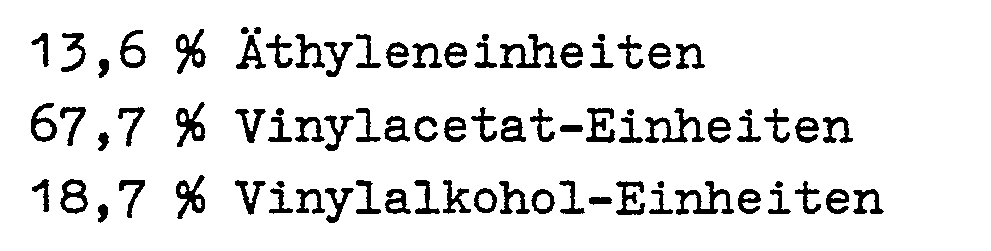
- (Mooney Viscosität ML 4' = 18; Einfriertemperatur aus Differentialthermoanalyse mit einer Aufheizzeit von 20°C/Min.: 5°C.)

- 332 g Isophthalsäure werden mit 318 g Diäthylenglykol bei 180°C unter Stickstoff verestert, bis die Säurezahl kleiner als 2 ist. Danach werden die Temperatur auf 100°C erniedrigt und 196 g Maleinsäureanhydrid und 0,15 g Hydrochinon zugefügt. Die Reaktion wird bei 100°C fortgesetzt, bis die Differenz aus Gesamtsäurezahl und Halbestersäurezahl kleiner als 5 ist. Anschließend wird eine 44 %ige Lösung des erhaltenen Polyesters in Styrol hergestellt.
- In dieser Lösung werden 12% des kautschukelastischen Polymeren unter Durchleiten von Luft bei 60°C gelöst oder dispergiert.
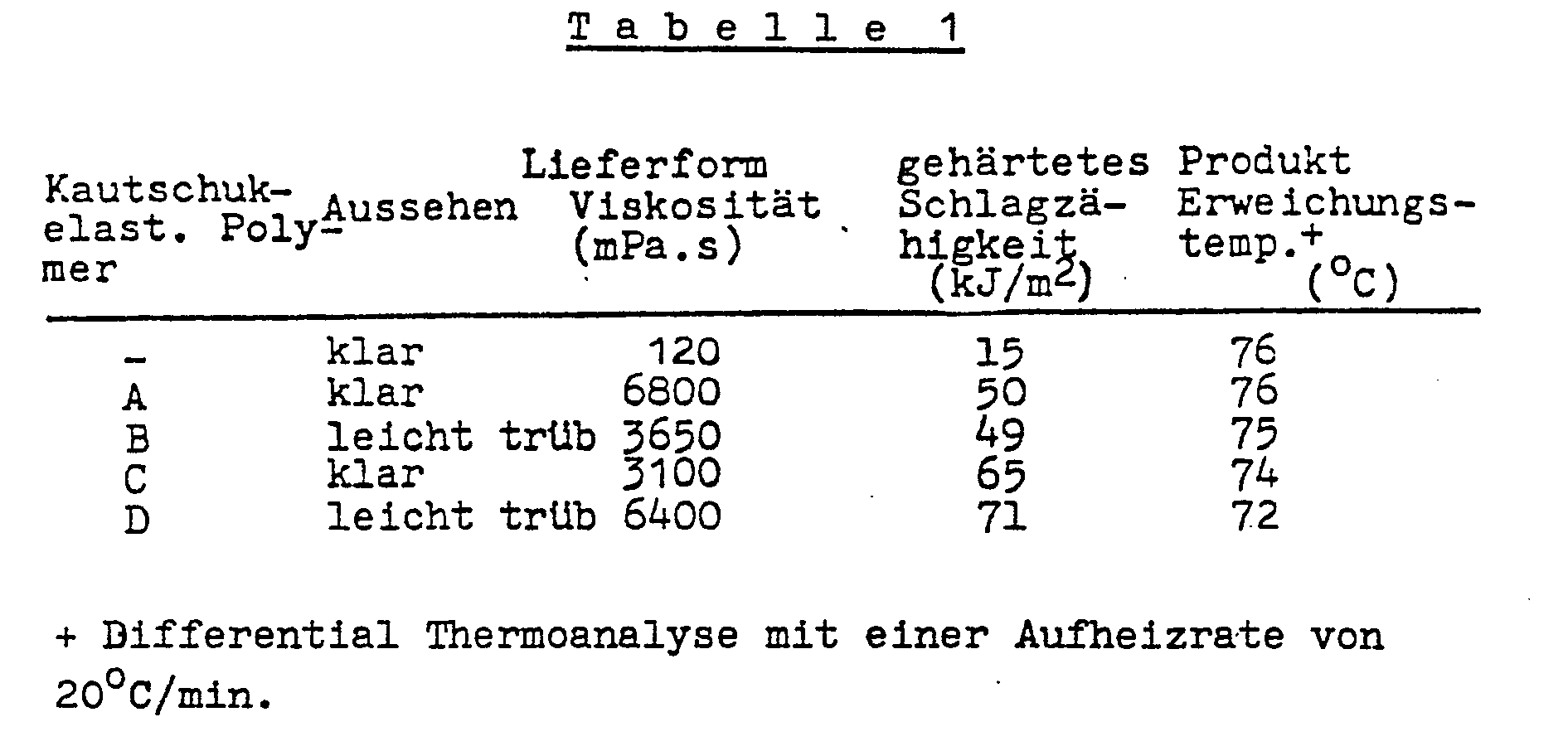
- Die erhaltene Lösung oder Dispersion wird zu Platten (20 x 20 cm) vergossen und nach Zugabe von 3 Teilen Benzoylperoxid-Paste (50%ig in Dibutylphthalat) 3 Stunden bei 75°C gehärtet. Danach wird zusätzlich 15 Stunden bei 90°C getempert. Aus den erhaltenen Platten werden Normkleinstäbe für die Messung der Schlagzähigkeit und der Erweichungstemperatur geschnitten. Die Ergebnisse zeigt die Tabelle 1.
-
- 332 g Isophthalsäure werden mit 402 g Dipropylenglycol bei 180°C unter Stickstoff verestert, bis die Säurezahl unter 2 abgesunken ist. Danach werden die Temperatur auf 100°C erniedrigt und 196 g Maleinsäureanhydrid und 0,15 g Hydrochinon zugefügt. Die Reaktion wird bei 100°C fortgesetzt, bis die Differenz aus Gesamtsäurezahl und Halbestersäurezahl kleiner als 5 ist. Anschließend wird eine 44%ige Lösung des ungesättigten Polyesters in Styrol hergestellt.
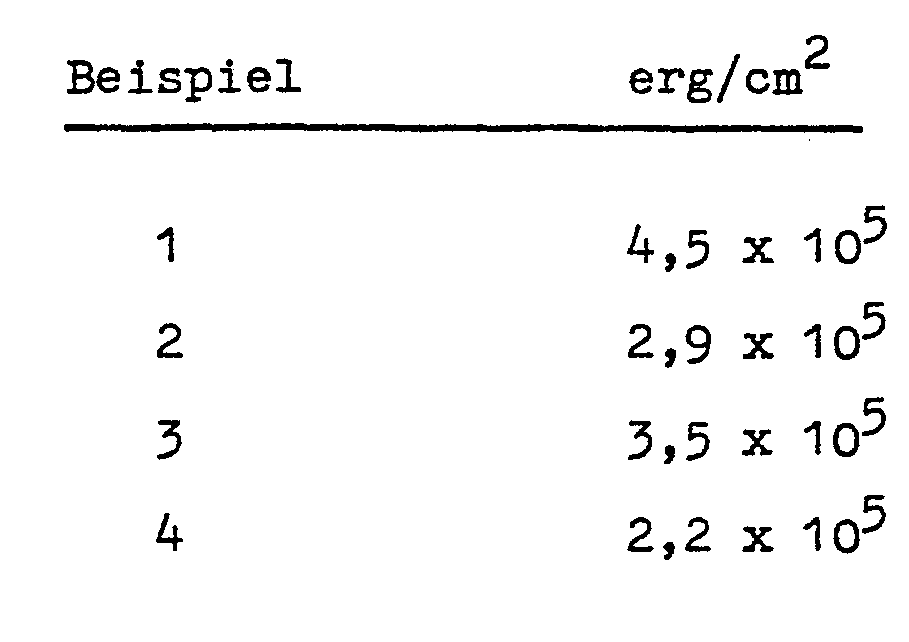
- Weitere Verarbeitung wie in Beispiel 1. Die Ergebnisse zeigt die Tabelle 2:

- 332 g IsophthaLsäure werden mit 156 g Neopentylglykol und 150 g Diäthylenglykol bei 180°C unter Stickstoff verestert, bis die Säurezahl unter 2 abgesunken ist. Danach werden die Temperatur auf 100°C erniedrigt und 196 g Maleinsäureanhydrid und 0,15 g Hydrochinon zugegeben. Die Reaktion wird bei 100°C fortgesetzt, bis die Differenz aus Gesamtsäurezahl und Halbestersäurezahl kleiner als 5 ist. Anschließend wird der ungesättigte Polyester 44 %ig in Styrol gelöst.
- Weitere Verarbeitung wie in Beispiel 1. Die Ergebnisse zeigt die Tabelle 3.

- 332 g Isophthalsäure werden mit 229 g 2-Äthylpropandiol-1,3 und 85 g Diäthylenglykol bei 180°C unter Stickstoff verestert, bis die Säurezahl unter 2 abgesunken ist. Danach werden die Temperatur auf 100°C erniedrigt und 196 g Maleinsäureanhydrid und 0,15 g Hydrochinon zugefügt. Die Reaktion wird bei 100°C fortgesetzt, bis die Differenz aus Gesamtsäurezahl und Halbestersäurezahl kleiner als 5 ist. Anschließend wird der ungesättigte Polyester 44%ig in Styrol gelöst.
- Weitere Verarbeitung wie in Beispiel 1; die Ergebnisse zeigt die Tabelle 4:

wobei sich.bei der Härtung eine zweite Phase als Teilchen mit einem mittleren Durchmesser von 0,1 bis 100 µm bilden soll.
Claims (4)
Applications Claiming Priority (4)
| Application Number | Priority Date | Filing Date | Title |
|---|---|---|---|
| DE19782800468 DE2800468A1 (de) | 1978-01-05 | 1978-01-05 | Formmassen auf der grundlage ungesaettigter polyester |
| DE2800468 | 1978-01-05 | ||
| DE2851337 | 1978-11-28 | ||
| DE19782851337 DE2851337A1 (de) | 1978-11-28 | 1978-11-28 | Formmassen auf der grundlage ungesaettigter polyester, verfahren zu ihrer herstellung und ihre verwendung |
Publications (3)
| Publication Number | Publication Date |
|---|---|
| EP0003048A1 true EP0003048A1 (de) | 1979-07-25 |
| EP0003048B1 EP0003048B1 (de) | 1981-01-28 |
| EP0003048B2 EP0003048B2 (de) | 1983-08-24 |
Family
ID=25773598
Family Applications (1)
| Application Number | Title | Priority Date | Filing Date |
|---|---|---|---|
| EP78101845A Expired EP0003048B2 (de) | 1978-01-05 | 1978-12-23 | Formmassen auf der Grundlage ungesättigter Polyester, Verfahren zu ihrer Herstellung und ihre Verwendung |
Country Status (6)
| Country | Link |
|---|---|
| US (1) | US4237244A (de) |
| EP (1) | EP0003048B2 (de) |
| JP (1) | JPS54100487A (de) |
| AT (1) | AT383135B (de) |
| DE (1) | DE2860386D1 (de) |
| ES (1) | ES476616A1 (de) |
Families Citing this family (10)
| Publication number | Priority date | Publication date | Assignee | Title |
|---|---|---|---|---|
| US4593002A (en) * | 1982-01-11 | 1986-06-03 | Salk Institute Biotechnology/Industrial Associates, Inc. | Viruses with recombinant surface proteins |
| US4559164A (en) * | 1982-03-09 | 1985-12-17 | General Electric Company | Electrically conductive poly(butylene terephthalate) moldings and compositions therefor |
| US4643969A (en) * | 1983-07-25 | 1987-02-17 | The Research Foundation Of State University Of New York | Novel cloning vehicles for polypeptide expression in microbial hosts |
| US5723292A (en) * | 1984-05-25 | 1998-03-03 | Zymogenetics, Inc. | Stable DNA constructs |
| US5380816A (en) * | 1989-05-11 | 1995-01-10 | Sullivan; Carl J. | Linear polyester diols based on isophthalic acid and 2-methyl-1,3-propanediol for thermoset coating compositions |
| JP3127961B2 (ja) * | 1990-07-30 | 2001-01-29 | 大日本インキ化学工業株式会社 | 人工大理石用不飽和ポリエステル樹脂組成物、それを用いた人工大理石及びその製造方法 |
| US5552478A (en) * | 1996-02-02 | 1996-09-03 | Ashland Inc. | Low profile additives for polyester resin systems based on asymmetric glycols and aromatic diacids |
| JP2001233924A (ja) * | 2000-02-22 | 2001-08-28 | Kao Corp | 成形材料組成物 |
| US6933333B2 (en) * | 2003-06-11 | 2005-08-23 | Bulk Molding Compounds, Inc. | Conductive adhesive sealant for bipolar fuel cell separator plate assemblies |
| DK2191001T3 (en) | 2007-04-09 | 2016-09-19 | Univ Florida | RAAV VECTOR COMPOSITIONS WITH TYROSIN MODIFIED CAPSIDE PROTEINS AND PROCEDURES FOR USE THEREOF |
Citations (3)
| Publication number | Priority date | Publication date | Assignee | Title |
|---|---|---|---|---|
| FR1228605A (fr) * | 1958-06-16 | 1960-08-31 | Rohm & Haas | Polyesters à blocs et leur procédé de fabrication |
| US3577478A (en) * | 1968-11-12 | 1971-05-04 | Hooker Chemical Corp | Graft polymer of a vinyl monomer and a polyester,and a butadiene polymer |
| DE2052961B2 (de) * | 1969-10-30 | 1976-04-15 | Produits Chimiques, Pechiney-Saint-Gobain S.A., Neuilly-sur-Seine (Frankreich) | Mischpolymerisierbare massen und verfahren zu ihrer herstellung |
Family Cites Families (1)
| Publication number | Priority date | Publication date | Assignee | Title |
|---|---|---|---|---|
| US3793400A (en) * | 1971-10-13 | 1974-02-19 | Allied Chem | Polyester-1,2 polybutadiene high impact molding compound |
-
1978
- 1978-12-23 DE DE7878101845T patent/DE2860386D1/de not_active Expired
- 1978-12-23 EP EP78101845A patent/EP0003048B2/de not_active Expired
-
1979
- 1979-01-03 US US06/000,751 patent/US4237244A/en not_active Expired - Lifetime
- 1979-01-03 AT AT0004679A patent/AT383135B/de not_active IP Right Cessation
- 1979-01-05 JP JP6479A patent/JPS54100487A/ja active Granted
- 1979-01-05 ES ES476616A patent/ES476616A1/es not_active Expired
Patent Citations (3)
| Publication number | Priority date | Publication date | Assignee | Title |
|---|---|---|---|---|
| FR1228605A (fr) * | 1958-06-16 | 1960-08-31 | Rohm & Haas | Polyesters à blocs et leur procédé de fabrication |
| US3577478A (en) * | 1968-11-12 | 1971-05-04 | Hooker Chemical Corp | Graft polymer of a vinyl monomer and a polyester,and a butadiene polymer |
| DE2052961B2 (de) * | 1969-10-30 | 1976-04-15 | Produits Chimiques, Pechiney-Saint-Gobain S.A., Neuilly-sur-Seine (Frankreich) | Mischpolymerisierbare massen und verfahren zu ihrer herstellung |
Also Published As
| Publication number | Publication date |
|---|---|
| JPS6150089B2 (de) | 1986-11-01 |
| EP0003048B2 (de) | 1983-08-24 |
| JPS54100487A (en) | 1979-08-08 |
| ATA4679A (de) | 1986-10-15 |
| AT383135B (de) | 1987-05-25 |
| US4237244A (en) | 1980-12-02 |
| ES476616A1 (es) | 1979-05-16 |
| DE2860386D1 (en) | 1981-03-19 |
| EP0003048B1 (de) | 1981-01-28 |
Similar Documents
| Publication | Publication Date | Title |
|---|---|---|
| EP0009761B2 (de) | Mischungen aus Polyurethanen und ungesättigten Polyesterharzen, Verfahren zu ihrer Herstellung und ihre Verwendung bei der Herstellung eingedickter Harzsysteme | |
| EP0136572B1 (de) | Härtbare Polyesterformmassen | |
| EP0222977B1 (de) | Phasenstabilisierte Polyesterformmassen | |
| EP0308745B1 (de) | Eingedickte Formmassen | |
| DE3333006A1 (de) | Epoxidmodifizierte montageklebstoffe mit verbessertem waermewiderstand | |
| DE2609355A1 (de) | Polymerisat-polyaetherisocyanat- vorpolymerisat-zusammensetzung, verfahren zu ihrer herstellung und ihrer verwendung | |
| DE2513255C2 (de) | Stabile organische, schwundarm härtbare Dispersionen auf Basis ungesättigter Polyesterharze und thermoplastischer Polymerer | |
| EP0003048B2 (de) | Formmassen auf der Grundlage ungesättigter Polyester, Verfahren zu ihrer Herstellung und ihre Verwendung | |
| DE4119434A1 (de) | Eingedickte haertbare formmassen aus einem vinylester- oder vinylesterurethanharz | |
| US4223099A (en) | Copolymerizable molding compositions based on unsaturated polyurethanes | |
| DE2851340C2 (de) | ||
| DE3501857A1 (de) | Verfahren zur herstellung von neuen polyisocyanat-zubereitungen, die nach dem verfahren erhaeltlichen zubereitungen und ihre verwendung bei der herstellung von kunststoffen nach dem isocyanat-polyadditionsverfahren | |
| EP0247429B1 (de) | Verfahren zur Herstellung schrumpfarmer Formkörper auf Polyesterbasis | |
| EP0092098B1 (de) | Härtbare Polyesterformmassen | |
| DE1033895B (de) | Verfahren zur Herstellung von hochvernetzten Kunststoffen | |
| DE2448929C2 (de) | Wärmehärtbare Formmassen | |
| DE2851337A1 (de) | Formmassen auf der grundlage ungesaettigter polyester, verfahren zu ihrer herstellung und ihre verwendung | |
| DE2800468A1 (de) | Formmassen auf der grundlage ungesaettigter polyester | |
| DE2402178A1 (de) | Rieselfaehige, schwundarm aushaertbare ungesaettigte polyesterformmassen | |
| DE2704424A1 (de) | Copolymerisierbare formmassen auf der grundlage ungesaettigter polyurethane | |
| CH631194A5 (de) | Polymerisations-beschleunigermischung. | |
| DE2551144C2 (de) | Verfahren zur Herstellung von bei Raumtemperaturen stabilen Dispersionen | |
| DE2646106A1 (de) | Phosphorhaltige, hydroxylgruppen aufweisende copolymere | |
| DE3807931A1 (de) | Elastomermodifizierte ungesaettigte polyesterharze | |
| DE2707230A1 (de) | Copolymerisierbare formmassen auf der grundlage ungesaettigter polyurethane |
Legal Events
| Date | Code | Title | Description |
|---|---|---|---|
| PUAI | Public reference made under article 153(3) epc to a published international application that has entered the european phase |
Free format text: ORIGINAL CODE: 0009012 |
|
| 17P | Request for examination filed | ||
| AK | Designated contracting states |
Designated state(s): DE FR GB IT NL SE |
|
| ITF | It: translation for a ep patent filed | ||
| GRAA | (expected) grant |
Free format text: ORIGINAL CODE: 0009210 |
|
| AK | Designated contracting states |
Designated state(s): DE FR GB IT NL SE |
|
| REF | Corresponds to: |
Ref document number: 2860386 Country of ref document: DE Date of ref document: 19810319 |
|
| PLBI | Opposition filed |
Free format text: ORIGINAL CODE: 0009260 |
|
| 26 | Opposition filed |
Opponent name: BASF AKTIENGESELLSCHAFT Effective date: 19810522 |
|
| PUAH | Patent maintained in amended form |
Free format text: ORIGINAL CODE: 0009272 |
|
| STAA | Information on the status of an ep patent application or granted ep patent |
Free format text: STATUS: PATENT MAINTAINED AS AMENDED |
|
| 27A | Patent maintained in amended form | ||
| AK | Designated contracting states |
Kind code of ref document: B2 Designated state(s): DE FR GB IT NL SE |
|
| ET1 | Fr: translation filed ** revision of the translation of the patent or the claims | ||
| NLR3 | Nl: receipt of modified translations in the netherlands language after an opposition procedure | ||
| PGFP | Annual fee paid to national office [announced via postgrant information from national office to epo] |
Ref country code: DE Payment date: 19841130 Year of fee payment: 7 |
|
| PGFP | Annual fee paid to national office [announced via postgrant information from national office to epo] |
Ref country code: FR Payment date: 19841210 Year of fee payment: 7 |
|
| PGFP | Annual fee paid to national office [announced via postgrant information from national office to epo] |
Ref country code: SE Payment date: 19841231 Year of fee payment: 7 |
|
| PGFP | Annual fee paid to national office [announced via postgrant information from national office to epo] |
Ref country code: NL Payment date: 19871231 Year of fee payment: 10 |
|
| PG25 | Lapsed in a contracting state [announced via postgrant information from national office to epo] |
Ref country code: GB Effective date: 19881223 |
|
| PG25 | Lapsed in a contracting state [announced via postgrant information from national office to epo] |
Ref country code: SE Effective date: 19881224 |
|
| PG25 | Lapsed in a contracting state [announced via postgrant information from national office to epo] |
Ref country code: NL Effective date: 19890701 |
|
| NLV4 | Nl: lapsed or anulled due to non-payment of the annual fee | ||
| GBPC | Gb: european patent ceased through non-payment of renewal fee | ||
| PG25 | Lapsed in a contracting state [announced via postgrant information from national office to epo] |
Ref country code: FR Free format text: LAPSE BECAUSE OF NON-PAYMENT OF DUE FEES Effective date: 19890831 |
|
| PG25 | Lapsed in a contracting state [announced via postgrant information from national office to epo] |
Ref country code: DE Effective date: 19890901 |
|
| REG | Reference to a national code |
Ref country code: FR Ref legal event code: ST |
|
| EUG | Se: european patent has lapsed |
Ref document number: 78101845.2 Effective date: 19891205 |