EP0004171B1 - Dérivés de pyrazolotriazinedione, procédé pour leur préparation et compositions herbicides les contenant - Google Patents
Dérivés de pyrazolotriazinedione, procédé pour leur préparation et compositions herbicides les contenant Download PDFInfo
- Publication number
- EP0004171B1 EP0004171B1 EP79300324A EP79300324A EP0004171B1 EP 0004171 B1 EP0004171 B1 EP 0004171B1 EP 79300324 A EP79300324 A EP 79300324A EP 79300324 A EP79300324 A EP 79300324A EP 0004171 B1 EP0004171 B1 EP 0004171B1
- Authority
- EP
- European Patent Office
- Prior art keywords
- formula
- compound
- hydrogen
- compounds
- group
- Prior art date
- Legal status (The legal status is an assumption and is not a legal conclusion. Google has not performed a legal analysis and makes no representation as to the accuracy of the status listed.)
- Expired
Links
Classifications
-
- C—CHEMISTRY; METALLURGY
- C07—ORGANIC CHEMISTRY
- C07D—HETEROCYCLIC COMPOUNDS
- C07D487/00—Heterocyclic compounds containing nitrogen atoms as the only ring hetero atoms in the condensed system, not provided for by groups C07D451/00 - C07D477/00
- C07D487/02—Heterocyclic compounds containing nitrogen atoms as the only ring hetero atoms in the condensed system, not provided for by groups C07D451/00 - C07D477/00 in which the condensed system contains two hetero rings
- C07D487/04—Ortho-condensed systems
-
- A—HUMAN NECESSITIES
- A01—AGRICULTURE; FORESTRY; ANIMAL HUSBANDRY; HUNTING; TRAPPING; FISHING
- A01N—PRESERVATION OF BODIES OF HUMANS OR ANIMALS OR PLANTS OR PARTS THEREOF; BIOCIDES, e.g. AS DISINFECTANTS, AS PESTICIDES OR AS HERBICIDES; PEST REPELLANTS OR ATTRACTANTS; PLANT GROWTH REGULATORS
- A01N43/00—Biocides, pest repellants or attractants, or plant growth regulators containing heterocyclic compounds
- A01N43/90—Biocides, pest repellants or attractants, or plant growth regulators containing heterocyclic compounds having two or more relevant hetero rings, condensed among themselves or with a common carbocyclic ring system
Definitions
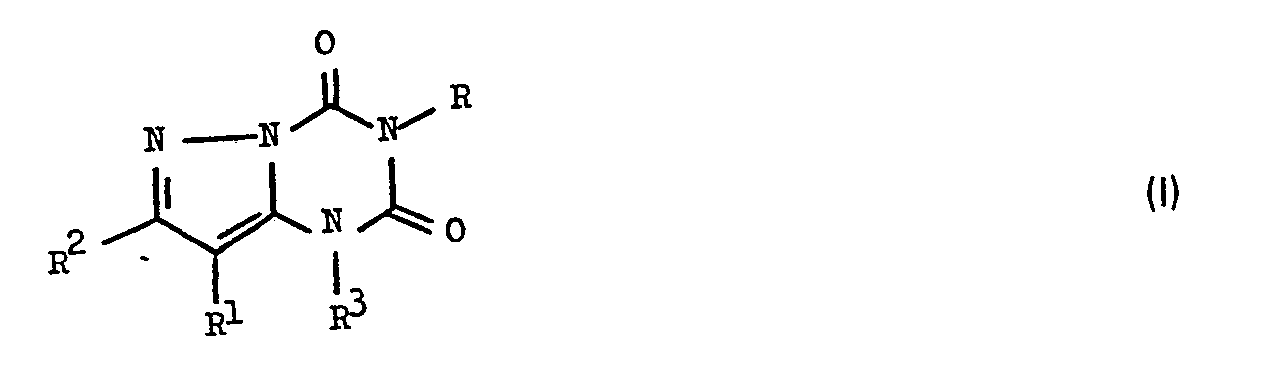
- the present invention relates to heterocyclic compounds, and in particular to novel pyrazolotriazinediones useful as herbicides.
- Pyrazolotriazinedione compounds have been described by K. Senga et al, J. Heterocyclic Chem. 1975, volume 12, pages 893-898.
- Triazolotriazinedione compounds have been described in French Patent Specification no. 2 351 118.
- R' is halogen, methyl, or cyano are preferred.
- 'lower' (alkyl, etc) we mean 'containing up to 5 carbon atoms'.
- R may be, for example isopropyl, 1-methylpropyl, isobutyl, cyclopentyl or cyc/ohexyl.
- a particular example of a compound according to the invention is the one in which R is isopropyl, R 1 is chlorine, R 2 is hydrogen, and R 3 is hydrogen. Further examples of compounds of the invention are listed in Table I.
- the compounds of the invention are potentially capable of existing in tautomeric forms.
- the compound where R is isopropyl, and R 1 , R 2 and R 3 are each hydrogen could in principle exist in the following form among others:
- the structural formula (I) given above is intended to be representative of and to embrace all tautomeric forms of the compounds of the invention.
- Acid addition salts include salts formed from mineral acids, for example hydrochloric, hydrobromic, sulphuric, nitric and phosphoric acids.
- Salts with bases include salts of metals and salts formed from ammonium and substituted ammonium cations.
- the metal salts are those in which the metal cation is an alkali metal cation for example sodium, potassium, or lithium, or an alkaline earth metal cation, for example calcium or magnesium.
- the substituted ammonium cations include mono-, di-, tri-, and tetra-substituted ammonium cations in which the substituents may be, for example, an alkyl or alkenyl radical of 1 to 20 carbon atoms optionally containing one or more hydroxy or alkoxy substituents.
- the invention further comprises a herbicidal composition
- a herbicidal composition comprising as an active ingredient a compound of formula (I) in admixture with a carrier comprising a solid or liquid diluent; and a method of inhibiting the growth of unwanted plants which comprises applying to the plants or the locus thereof a compound of the formula (I).
- Compounds according to the invention may be active against monocotyledons and dioctyledons, both pre- and post-emergence, but are usually more active against dicotyledons, particularly post-emergence. Certain of the compounds have potentially valuable selective herbicidal properties, e.g. Compounds nos 8 and 14 of Table I are expected to have utility as pre-emergence herbicides in maize.
- Some of the compounds also show fungicidal activity.
- Compounds according to the invention may be prepared by condensation of 3-amino pyrazoles with alkyl or cycloalkyl bis-chloroformylamines according to the general reaction scheme A shown below.
- the product so obtained may if required be reacted with a base and a lower alkyl halide to form compounds according to the invention in which R 3 is lower alkyl.
- Compounds in which R 1 is bromine, chlorine, iodine or nitro may also be obtained by reacting compounds of formula I wherein R' is hydrogen with a halogenating or nitrating agent.
- the 3-aminopyrazoles used as starting materials in Scheme A are in general known; where not previously described, they may be prepared by application of standard conventional methods.
- the amount of the compound to be applied will depend upon a number of factors, for example the particular plant species whose growth is to be inhibited, but in general an amount of from 0.5 to 10 kilograms per hectare is usually suitable. The skilled worker in the art will readily be able to determine suitable amounts for use by means of standardised routine tests, without undue experimentation.
- the compounds of the invention are preferably applied in the form of compositions, in which the active ingredient is mixed with a carrier comprising a solid or liquid diluent.
- a carrier comprising a solid or liquid diluent.
- the composition further comprises a surface-active agent.
- the solid compositions of the invention may be for example, in the form of dusting powders, or may take the form of granules.
- Suitable solid diluents include, for example, kaolin, bentonite, kieselguhr, dolomite, calcium carbonate, talc, powdered magnesia, and Fuller's earth.
- Solid compositions may also be in the form of dispersible powders or grains comprising in addition to the active ingredient, a wetting agent to facilitate the dispersion of the powder or grains in liquids.
- Such powders or grains may include fillers, suspending agents and the like.
- Liquid compositions include aqueous solutions, dispersions and emulsions containing the active ingredient preferably in the presence of one or more surface active agents.
- Water or organic liquids may be used to prepare solutions, dispersions, or emulsions or the active ingredient.
- the liquid compositions of the invention may also contain one or more corrosion inhibitors for example lauryl isoquinolinium bromide.
- Surface-active agents may be of the cationic, anionic or non-ionic type.
- Suitable agents of the cationic type include for example quaternary ammonium compounds, for example cetyltrimethyl ammonium bromide.
- Suitable agents of the anionic type include for example soaps, salts of aliphatic mono-esters of sulphuric acid, for example sodium lauryl sulphate; and salts of sulphonated aromatic compounds, for example sodium dodecylbenzenesulphonate, sodium, calcium and ammonium lignosulphonate, sodium butylnaphthalene sulphonate, and a mixture of the sodium salts of diisopropyl- and triisopropyl-naphthalenesulphonic acid.
- Suitable agents of the non-ionic type include, for example, the condensation products of ethylene oxide with fatty alcohols such as oleyl alcohol and cetyl alcohol, or with alkyl phenols such as octyl-phenol, nonylphenol, and octylcresol.
- Other non-ionic agents are the partial esters derived from long chain fatty acids and hexitol anhydrides, for example sorbitol monolaurate; the condensation products of the said partial esters with ethylene oxide and the lecithins.
- compositions which are to be used in the form of aqueous solutions, dispersions or emulsions are generally supplied in the form of a concentrate containing a high proportion of the active ingredient, the concentrate being diluted with water before use. These concentrates are usually required to withstand storage for prolonged periods and after such storage to be capable of dilution with water in order to form aqueous preparations which remain homogeneous for a sufficient time to enable them to be applied by conventional spray equipment. In general concentrates may conveniently contain from 10 to 85% and preferably from 25 to 60% by weight of active ingredient. Dilute preparations ready for use may contain varying amounts of the active ingredient, depending upon the purpose for which they are to be used; however, dilute preparations suitable for many uses contain between 0.01% and 10% and preferably between 0.1% and 1% by weight of the active ingredient.
- the compounds of the invention may be used in admixture with other herbicides. Accordingly the invention further provides a herbicidal composition comprising a mixture of at least one herbicide of formula (I) above with at least one other herbicide.
- the other herbicide may be any herbicide not having the formula (I). It may be a herbicide having a similar spectrum of herbicidal effect, or it may be a herbicide having a complementary action.
- herbicides which may be mixed with the compounds of the invention include the following:-
- the mixtures of the invention generally contain from 0.1 to 10 parts, conveniently from 0.2 to 2 parts by weight of herbicide of formula (I) per part by weight of the other herbicide, depending upon the relative activity of the components.
- the amount of the mixture to be applied will depend upon a number of factors, for example the particular plant species to which the mixture is to be applied, but in general an amount of from 0.1 to 5.0 kilograms per hectare will usually be suitable.
- This Example illustrates the herbicidal properties of the compounds used in the process of the invention.
- Each compound (0.12 g) was formulated for test by mixing it with 5 ml of an emulsion prepared by diluting 100 ml of a solution containing 21.8 grams per litre of Span 80 and 78.2 grams per litre of Tween 20 in methyl cyclohexanone to 500 ml with water.
- Span 80 is a Trade Mark for a surface-active agent comprising sorbitan monolaurate.
- Tween 20 is a Trade Mark for a surface-active agent comprising a condensate of twenty molar proportions of ethylene oxide with sorbitan monooleate.
- the mixture of the compound and the emulsion was shaken with glass beads and diluted to 12 ml with water.
- the spray composition so prepared was sprayed on to young pot plants (post-emergence test) of the species named in Table II below, at a rate equivalent to 1000 litres per hectare (10 kilograms of test compound per hectare). Damage to plants was assessed 14 days after spraying by comparison with untreated plants, on a scale of 0 to 3 where 0 is no effect and 3 represents 75 to 100% kill.
- seeds of the test species were placed on the surface of fibre trays of soil and were sprayed with the compositions at the rate of 1000 litres per hectare. The seeds were then covered with further soil.
- Three weeks after spraying the seedlings in the sprayed fibre trays were compared with the seedlings in unsprayed control trays, the damage being assessed on the same scale of 0 to 3.
- Table II The results are given in Table II below:-
- Example 3 illustrates the herbicidal properties of the compounds of Table I. Tests were carried out as described in Example 3. The compound was formulated by mixing an appropriate amount of the compound with 5 ml of an emulsion prepared by diluting 160 ml of a solution containing 21.8 grams per litre of Span 80 and 78.2 grams per litre of Tween 20 in methylcyclohexanone to 500 ml with water. The mixture of the compound and emulsion was shaken with glass beads and diluted to 40 ml with water. Damage to plants was assessed on a scale of 0 to 5 where 0 is 0 to 20% damage and 5 is complete kill. In the table of results, a dash (-) means that no test was made. The results are given in Table III below:-
- This Example illustrates the preparation of compound 14 of Table I.
- Compound 1 of Table I (3.0 g) was suspended in carbon tetrachloride (125 ml). Sulphuryl chloride (2.5 g) was added dropwise. When addition was complete, the mixture was heated under reflux for 4 hours, and then cooled. The solid was collected and recrystallised from toluene to give compound no 14 (1.6 g) with a melting point of 162°C.
- This Example illustrates the preparation of compound no 13 of table I.
- Compound 1 of Table I (3.0 g) was added in portions to concentrated sulphuric acid (15 g), with stirring and cooling.
- Fuming nitric acid (5 g) was added dropwise with stirring and cooling to below 1 O P C. The mixture was then stirred for 30 minutes at room temperature and then heated for 1 hour on a steam both. The resulting solution was cooled and poured on to ice. The yellow solid was recrystallised from toluene to give compound no 13 (2.5 g) with a melting point of 172°C.
- Example 2 illustrates the preparation of compound no 8 of Table I by a method alternative to that of Example 2.
- 3-Amino-4-bromopyrazole (1.62 g) was added in portions to a stirred solution of isopropyl bis- chloroformylamine (1.85 g) in dry acetonitrile. When addition was complete the mixture was heated under reflux for 2 hours. The mixture was cooled and filtered. Evaporation of the filtrate gave a solid (0.5 g) identified as compound no 8 by its melting point (214°C) and its nuclear magnetic resonance spectrum and mass spectrum.
- 3-Amino-4-cyanopyrazole (3.24 g) was added in portions with stirring at room temperature to a solution of isopropyl bis-chloroformylamine (5.6 g) in dry acetonitrile (60 ml). The mixture was then heated under reflux for 4 hours, cooled, and filtered. The filtrate was evaporated to give a gummy solid which was extracted with boiling toluene (125 ml). The extract was left overnight to cool and the crystals which separated (2.25 g) collected and identified as compound no 2 with a melting point of 132°C.
- 3-Amino-4-cyano-5-methoxypyrazole (2.0 g) was added in portions to a stirred solution of isopropyl bischloroformylamine in dry acetonitrile. After addition was complete the mixture was heated under reduced pressure and the residue triturated with ethyl acetate. The ethyl acetate solution was filtered and evaporated to give a gummy solid which was triturated with water. The solid so obtained (0.8 g) was identified as compound no 10 of Table I.
- 3-Amino-4-cyano-5-dimethylaminopyrazole (1.85 g) was added in portions to a stirred solution of isopropyl bischloroformylamine (2.3 g) in dry acetonitrile (30 ml). The mixture was heated under reflux for 2t hours, cooled, and filtered. The filtrate was evaporated. The gummy solid which remained was triturated with ether, and collected to give compound 9 (1.3 g) with a melting point of 200°C.
Landscapes
- Life Sciences & Earth Sciences (AREA)
- Organic Chemistry (AREA)
- Chemical & Material Sciences (AREA)
- Dentistry (AREA)
- Health & Medical Sciences (AREA)
- Engineering & Computer Science (AREA)
- Plant Pathology (AREA)
- General Health & Medical Sciences (AREA)
- Wood Science & Technology (AREA)
- Zoology (AREA)
- Environmental Sciences (AREA)
- Pest Control & Pesticides (AREA)
- Agronomy & Crop Science (AREA)
- Agricultural Chemicals And Associated Chemicals (AREA)
Claims (10)
Applications Claiming Priority (2)
| Application Number | Priority Date | Filing Date | Title |
|---|---|---|---|
| GB954678 | 1978-03-10 | ||
| GB954678 | 1978-03-10 |
Publications (2)
| Publication Number | Publication Date |
|---|---|
| EP0004171A1 EP0004171A1 (fr) | 1979-09-19 |
| EP0004171B1 true EP0004171B1 (fr) | 1981-02-11 |
Family
ID=9874090
Family Applications (1)
| Application Number | Title | Priority Date | Filing Date |
|---|---|---|---|
| EP79300324A Expired EP0004171B1 (fr) | 1978-03-10 | 1979-03-05 | Dérivés de pyrazolotriazinedione, procédé pour leur préparation et compositions herbicides les contenant |
Country Status (7)
| Country | Link |
|---|---|
| EP (1) | EP0004171B1 (fr) |
| AU (1) | AU4501079A (fr) |
| CA (1) | CA1092116A (fr) |
| DE (1) | DE2960144D1 (fr) |
| DK (1) | DK473279A (fr) |
| WO (1) | WO1979000733A1 (fr) |
| ZA (1) | ZA791138B (fr) |
Families Citing this family (2)
| Publication number | Priority date | Publication date | Assignee | Title |
|---|---|---|---|---|
| DE3722072A1 (de) * | 1987-07-01 | 1989-01-12 | Schering Ag | 6,7-dihydro-pyrazolo(1,5-a)(1,3,5) triazin-2-sulfonsaeureamide, verfahren zu ihrer herstellung und ihre verwendung als mittel mit herbizider und pflanzenwuchsregulierender wirkung |
| KR20150130491A (ko) * | 2013-03-13 | 2015-11-23 | 제넨테크, 인크. | 피라졸로 화합물 및 그것의 용도 |
Family Cites Families (1)
| Publication number | Priority date | Publication date | Assignee | Title |
|---|---|---|---|---|
| GB1579932A (en) * | 1976-05-12 | 1980-11-26 | Ici Ltd | Herbicidal triazolotriazines |
-
1979
- 1979-03-05 WO PCT/GB1979/000039 patent/WO1979000733A1/fr not_active Ceased
- 1979-03-05 EP EP79300324A patent/EP0004171B1/fr not_active Expired
- 1979-03-05 DE DE7979300324T patent/DE2960144D1/de not_active Expired
- 1979-03-06 CA CA322,859A patent/CA1092116A/fr not_active Expired
- 1979-03-12 ZA ZA791138A patent/ZA791138B/xx unknown
- 1979-03-13 AU AU45010/79A patent/AU4501079A/en not_active Abandoned
- 1979-11-08 DK DK473279A patent/DK473279A/da not_active Application Discontinuation
Also Published As
| Publication number | Publication date |
|---|---|
| DE2960144D1 (en) | 1981-03-26 |
| AU4501079A (en) | 1979-09-13 |
| ZA791138B (en) | 1980-07-30 |
| DK473279A (da) | 1979-11-08 |
| WO1979000733A1 (fr) | 1979-10-04 |
| CA1092116A (fr) | 1980-12-23 |
| EP0004171A1 (fr) | 1979-09-19 |
Similar Documents
| Publication | Publication Date | Title |
|---|---|---|
| US4427437A (en) | Use of 2-phenoxypyrimidines as herbicides | |
| US4285723A (en) | Selective herbicides | |
| US5125958A (en) | Herbicidal triazolinones | |
| US4675047A (en) | Substituted phenylamine- and phenyloxy-quinazolines as herbicides | |
| HU186299B (en) | Herbicide compositions and process for producing the active agents | |
| US4314065A (en) | Phenylamine substituted on amine with a benzo(oxa, thia or di) azole group | |
| US4444584A (en) | Ethyl 2[4-(7-chloroquinolin-3-yloxy)phenoxy]propionate, the N-oxide, and herbicidal compositions and methods employing them | |
| US4388472A (en) | Substituted diphenyl ethers | |
| US4302242A (en) | Herbicidal mono- or di-substituted-2-pyridinyloxy-phenoxy-lower-alkane-carbamates | |
| US4116674A (en) | Process of severely damaging or killing unwanted plants with pyrimidine compounds | |
| US4401460A (en) | Herbicidal phenoxypyridines | |
| CA1136625A (fr) | Derives de la benzo-1,2,4-triazine | |
| US4133674A (en) | Herbicidal heterocyclic compounds | |
| US4235620A (en) | Azolyl-substituted unsaturated ketones and herbicidal use thereof | |
| US4246419A (en) | Herbicidal compounds | |
| EP0004171B1 (fr) | Dérivés de pyrazolotriazinedione, procédé pour leur préparation et compositions herbicides les contenant | |
| US5298480A (en) | Herbicidal sulfonylurea derivatives | |
| CA1187090A (fr) | Composes bicycliques herbicides | |
| US4738710A (en) | Herbicidal alkane carboxylic acid derivatives | |
| US5217520A (en) | Herbicidal triazolinones | |
| US4589914A (en) | Herbicidal compounds | |
| US4310347A (en) | Herbicidal 1,2,4-benzotriazines | |
| US4956004A (en) | Herbicidal triazinediones | |
| US4454073A (en) | N-[Carboxyl(carbamoyl)carbonyl)-aminomethyl phosphonic acids | |
| EP0063873A1 (fr) | Ethers diphényliques substititués par groupements alcoxy; leur utilisation comme herbicides et dans des compositions herbicides et leurs procédés de préparation |
Legal Events
| Date | Code | Title | Description |
|---|---|---|---|
| PUAI | Public reference made under article 153(3) epc to a published international application that has entered the european phase |
Free format text: ORIGINAL CODE: 0009012 |
|
| AK | Designated contracting states |
Designated state(s): BE CH DE FR GB IT NL |
|
| 17P | Request for examination filed | ||
| ITF | It: translation for a ep patent filed | ||
| ITF | It: translation for a ep patent filed | ||
| GRAA | (expected) grant |
Free format text: ORIGINAL CODE: 0009210 |
|
| AK | Designated contracting states |
Designated state(s): BE CH DE FR GB IT NL |
|
| PG25 | Lapsed in a contracting state [announced via postgrant information from national office to epo] |
Ref country code: NL Effective date: 19810211 Ref country code: FR Free format text: THE PATENT HAS BEEN ANNULLED BY A DECISION OF A NATIONAL AUTHORITY Effective date: 19810211 |
|
| PG25 | Lapsed in a contracting state [announced via postgrant information from national office to epo] |
Ref country code: BE Effective date: 19810305 |
|
| REF | Corresponds to: |
Ref document number: 2960144 Country of ref document: DE Date of ref document: 19810326 |
|
| PG25 | Lapsed in a contracting state [announced via postgrant information from national office to epo] |
Ref country code: CH Effective date: 19810331 |
|
| NLV1 | Nl: lapsed or annulled due to failure to fulfill the requirements of art. 29p and 29m of the patents act | ||
| RAP2 | Party data changed (patent owner data changed or rights of a patent transferred) |
Owner name: IMPERIAL CHEMICAL INDUSTRIES PLC |
|
| PG25 | Lapsed in a contracting state [announced via postgrant information from national office to epo] |
Ref country code: DE Effective date: 19830201 |
|
| GBPC | Gb: european patent ceased through non-payment of renewal fee | ||
| PG25 | Lapsed in a contracting state [announced via postgrant information from national office to epo] |
Ref country code: GB Effective date: 19881117 |
|
| PLBE | No opposition filed within time limit |
Free format text: ORIGINAL CODE: 0009261 |
|
| STAA | Information on the status of an ep patent application or granted ep patent |
Free format text: STATUS: NO OPPOSITION FILED WITHIN TIME LIMIT |