EP0004299A2 - Tumor-Gallengangprothese - Google Patents
Tumor-Gallengangprothese Download PDFInfo
- Publication number
- EP0004299A2 EP0004299A2 EP79100615A EP79100615A EP0004299A2 EP 0004299 A2 EP0004299 A2 EP 0004299A2 EP 79100615 A EP79100615 A EP 79100615A EP 79100615 A EP79100615 A EP 79100615A EP 0004299 A2 EP0004299 A2 EP 0004299A2
- Authority
- EP
- European Patent Office
- Prior art keywords
- prosthesis
- tumor
- glassy carbon
- bile
- carbon
- Prior art date
- Legal status (The legal status is an assumption and is not a legal conclusion. Google has not performed a legal analysis and makes no representation as to the accuracy of the status listed.)
- Granted
Links
Images
Classifications
-
- A—HUMAN NECESSITIES
- A61—MEDICAL OR VETERINARY SCIENCE; HYGIENE
- A61L—METHODS OR APPARATUS FOR STERILISING MATERIALS OR OBJECTS IN GENERAL; DISINFECTION, STERILISATION OR DEODORISATION OF AIR; CHEMICAL ASPECTS OF BANDAGES, DRESSINGS, ABSORBENT PADS OR SURGICAL ARTICLES; MATERIALS FOR BANDAGES, DRESSINGS, ABSORBENT PADS OR SURGICAL ARTICLES
- A61L27/00—Materials for grafts or prostheses or for coating grafts or prostheses
- A61L27/02—Inorganic materials
- A61L27/08—Carbon ; Graphite
-
- A—HUMAN NECESSITIES
- A61—MEDICAL OR VETERINARY SCIENCE; HYGIENE
- A61F—FILTERS IMPLANTABLE INTO BLOOD VESSELS; PROSTHESES; DEVICES PROVIDING PATENCY TO, OR PREVENTING COLLAPSING OF, TUBULAR STRUCTURES OF THE BODY, e.g. STENTS; ORTHOPAEDIC, NURSING OR CONTRACEPTIVE DEVICES; FOMENTATION; TREATMENT OR PROTECTION OF EYES OR EARS; BANDAGES, DRESSINGS OR ABSORBENT PADS; FIRST-AID KITS
- A61F2/00—Filters implantable into blood vessels; Prostheses, i.e. artificial substitutes or replacements for parts of the body; Appliances for connecting them with the body; Devices providing patency to, or preventing collapsing of, tubular structures of the body, e.g. stents
- A61F2/02—Prostheses implantable into the body
- A61F2/04—Hollow or tubular parts of organs, e.g. bladders, tracheae, bronchi or bile ducts
-
- A—HUMAN NECESSITIES
- A61—MEDICAL OR VETERINARY SCIENCE; HYGIENE
- A61F—FILTERS IMPLANTABLE INTO BLOOD VESSELS; PROSTHESES; DEVICES PROVIDING PATENCY TO, OR PREVENTING COLLAPSING OF, TUBULAR STRUCTURES OF THE BODY, e.g. STENTS; ORTHOPAEDIC, NURSING OR CONTRACEPTIVE DEVICES; FOMENTATION; TREATMENT OR PROTECTION OF EYES OR EARS; BANDAGES, DRESSINGS OR ABSORBENT PADS; FIRST-AID KITS
- A61F2310/00—Prostheses classified in A61F2/28 or A61F2/30 - A61F2/44 being constructed from or coated with a particular material
- A61F2310/00005—The prosthesis being constructed from a particular material
- A61F2310/00161—Carbon; Graphite
Definitions
- the invention relates to a tumor bile duct prosthesis.
- Tumors in the area of the liver hilum which can originate from the bile ducts or from the liver, generally lead to a displacement of the bile ducts and to the build-up of bile.
- the build up of bile leads to progressive jaundice with severe damage to the liver and subsequent severe changes in the entire organism.
- Tumors in the area of the hepatic portal and also in the bile ducts cause a direct narrowing of the lumen and, due to the pressure exerted on the bile duct from the outside, indirectly relocate the draining bile ducts. To.
- Tumors that are still operable are removed and, if necessary, a connection to the residual main bile duct is established with an intestinal loop. Often one is However, surgical removal of the tumor is no longer possible and the closed bile section must be bridged by a tubular prosthesis.
- the use of pipes made of thermoplastic materials and silicone compounds for this purpose has not led to a satisfactory result, especially since the pipes become encrusted in a short time. Since these materials are also not well tolerated by the body, the tubular prostheses also grow insufficiently into the surrounding tissue.
- a chemically and mechanically resistant material that is compatible with the body's own tissue is carbon and graphite, which is successfully used as an implant. It is also known to use the carbon form referred to as vitreous carbon or vitreous carbon for heart valves, middle ear prostheses, numeral roots and as an implantable stimulation electrode. For each of these uses, certain properties or combinations of properties of the glassy carbon are used, whereby the usability of the glassy carbon for a certain purpose cannot be predicted based on the current state of knowledge because of the diverse requirement profiles.
- the invention is based on the object of improving the known tumor bile duct prostheses in such a way that crusting does not occur even over a long operating time and the ingrowth of the prosthesis into the surrounding tissue is promoted.
- the prosthesis consists of glassy carbon.
- Glassy carbon is obtained by pyrolysis of three-dimensionally cross-linked synthetic resins, such as phenol formal dehyde or furan resins, at a moderate heating rate.
- the carbon obtained is very hard and abrasion-resistant and has glass-like smooth surfaces and broken surfaces.
- a suitably designed casting mold is expediently filled with a hardenable resin and the resin is crosslinked by heating the mold to a temperature of about 120 to 200 ° C.
- the resin body is then carbonized by further heating to about 800 to 1200 ° C in an inert or reducing atmosphere.
- tubular shapes are produced by spinning.
- the tubular prosthesis particularly advantageously has a surface provided with groove-like depressions and / or roughened by micropores.
- the depth of the grooves is expediently 1 to 2 mm.
- the microporous surface is generally produced by strong oxidizing agents, such as an oxidizing acid, for example nitric acid, by electrochemical oxidation or by sandblasting. It is particularly useful for the formation of a roughened outer surface to temper the prosthesis in an oxidizing atmosphere, for example heating in air or in another atmosphere containing oxygen, water vapor or carbon dioxide to a temperature above 400.degree.
- the nature of the glass-like smooth surface of a tube made of glassy carbon is generally sufficient to prevent incrustations. This beneficial effect can, if necessary, be enhanced by polishing the inner surface of the tube, for example using diamond powder, chalk powder or the like as a polishing agent.
- the average roughness of polished glassy carbon surfaces is generally less than 0.1 / ⁇ m.
- the advantages achieved with the prosthesis according to the invention are, in particular, that the operation time is considerably shorter compared to the conventional methods.
- the prosthesis does not become encrusted, so that the bile fluid does not build up again and finally the tissue-compatible prosthesis exhibits excellent growth behavior.
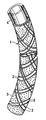
- the tumor bile duct prosthesis shown in the figure consists of a slightly curved tube 1 made of glassy carbon, the outer surface of which is provided with groove-like depressions 2 and is roughened by flat micropores 3.
- the mean depth of the grooves is about 1.5 mm and the depth of the micropores approximately 100 / um.
- the inner surface 4 of the tube 1 is finely polished.
Landscapes
- Health & Medical Sciences (AREA)
- General Health & Medical Sciences (AREA)
- Animal Behavior & Ethology (AREA)
- Public Health (AREA)
- Veterinary Medicine (AREA)
- Oral & Maxillofacial Surgery (AREA)
- Transplantation (AREA)
- Chemical & Material Sciences (AREA)
- Life Sciences & Earth Sciences (AREA)
- Epidemiology (AREA)
- Gastroenterology & Hepatology (AREA)
- Inorganic Chemistry (AREA)
- Medicinal Chemistry (AREA)
- Dermatology (AREA)
- Pulmonology (AREA)
- Cardiology (AREA)
- Engineering & Computer Science (AREA)
- Biomedical Technology (AREA)
- Heart & Thoracic Surgery (AREA)
- Vascular Medicine (AREA)
- Prostheses (AREA)
- Materials For Medical Uses (AREA)
Abstract
Description
- Die Erfindung betrifft eine Tumor-Gallengangprothese.
- Tumoren im Bereich des Leberhilus, welche von den Gallengängen oder von der Leber ausgehen können, führen im allgemeinen zu einer Verlegung der Gallengänge und zur Aufstauung der Gallenflüssigkeit. Durch den Aufstau der Gallenflüssigkeit kommt es zu einer fortschreitenden Gelbsucht mit schwerer Schädigung der Leber und nachfolgenden schweren Veränderungen am gesamten Organismus. Tumoren im Bereich der Leberpforte und auch in den Gallengängen bedingen eine direkte Verengung des Lumens und durch den von außen auf den Gallengang wirkenden Druck indirekt eine Verlegung der ableitenden Gallenwege. Zur. Ableitung der aufgestauten Gallenflüssigkeit werden Operationsverfahren angewendet, bei denen die in einem solchen Zustand erweiterten Gallengänge im Bereich der Leber in eine auf die Leber genähte Darmschlinge abeleitet werden. Mit dieser Methode kann jedoch häufig ein genügender Abfluß nicht erreicht werden und zum anderen werden insbesondere geschwächte Patienten durch den Eingriff stark belastet.
- Noch operationsfähige Tumoren werden dabei entfernt und gegebenenfalls wird eine Verbindung zum Resthauptgallengang mit einer Darmschlinge hergestellt. Häufig ist eine Entfernung des Tumors operationstechnisch jedoch nicht mehr möglich und der verschlossene Gallenabschnitt muß durch eine rohrförmige Prothese überbrückt werden. Die Verwendung von Rohren aus thermoplastischen Kunststoffen und Siliconverbindungen für diesen Zweck haben zu keinem befriedigenden Ergebnis geführt, insbesondere da die Rohre in kurzer Zeit verkrusten. Da die Körperverträglichkeit dieser Materialien ebenfalls nicht ausreicht, wachsen die rohrförmigen Prothesen zudem nur ungenügend in das sie umgebende Gewebe ein.
- Ein mit dem körpereigenen Gewebe kompatibeler, chemisch und mechanisch beständiger Werkstoff ist Kohlenstoff und Graphit, der mit Erfolg als Implantat verwendet wird. Es ist auch bekannt, die als Glaskohlenstoff oder glasartiger Kohlenstoff bezeichnete Kohlenstofform für Herzklappen, Mittelohrprothesen, Zahlwurzeln und als implantierbare Reizelektrode zu verwenden. Für jede dieser Verwendung werden bestimmte Eigenschaften oder Eigenschaftskombinationen des Glaskohlenstoffs genutzt, wobei wegen der vielfältigen Anforderungsprofile die Brauchbarkeit des Glaskohlenstoffs für einen bestimmten Zweck nach dem jetzigen Erkenntnisstand nicht vorausgesagt werden kann.
- Der Erfindung liegt nun die Aufgabe zugrunde, die bekannten Tumor-Gallengangprothesen derart zu verbessern, daß eine Verkrustung auch über eine lange Betriebszeit nicht erfolgt und das Einwachsen der Prothese in das umgebende Gewebe begünstigt wird.
- Dies wird erfindungsgemäß dadurch erreicht, daß die Prothese aus Glaskohlenstoff besteht.
- Glaskohlenstoff erhält man durch Pyrolyse dreidimensional vernetzter Kunstharze, wie beispielsweise Phenolformaldehyd- oder Furanharzen, bei einer mäßigen Aufheizgeschwindigkeit. Der erhaltene Kohlenstoff ist sehr hart und abriebfest und weist glasartige glatte Oberflächen 'und Bruchflächen auf. Zur Herstellung der vorteilhaft die Form eines durchgehenden geraden oder gekrümmten Rohrs aufweisenden Prothese füllt man zweckmäßig eine entsprechend ausgebildete Gießform mit einem härtbaren Harz und vernetzt das Harz durch Erhitzen der Form auf eine Temperatur von etwa 120 bis 200°C. Der Harzkörper wird dann durch weiteres Erhitzen auf etwa 800 bis 1200°C in einer inerten oder reduzierenden Atmosphäre carbonisiert. Nach einem anderen Verfahren werden rohrartige Formen durch Schleudern hergestellt.
- Besonders vorteilhaft weist die rohrförmige Prothese eine mit rillenartigen Vertiefungen versehene und/oder durch Mikroporen aufgerauhte Oberfläche auf. Die Tiefe der Rillen beträgt zweckmäßig 1 bis 2 mm. Die Herstellung der mikroporösen Oberfläche erfolgt im allgemeinen durch starke Oxidationsmittel, wie oxidierend wirkende Säure, z.B. Salpetersäure, durch elektrochemische Oxidation oder durch Sandstrahlen. Besonders zweckmäßig für die Ausbildung einer aufgerauhten äußeren Oberfläche ist eine Temperung der Prothese in einer oxidierenden Atmosphäre, beispielsweise das Erhitzen in Luft oder in einer anderen Sauerstoff, Wasserdampf oder Kohlendioxid enthaltenden Atmosphäre auf eine Temperatur oberhalb von 400°C. Dabei kommt es zu einem geringfügigen Abbrand an der Oberfläche und zur Ausbildung flacher Ätzgrübchen, deren Tiefe bis etwa 100 /um beträgt. Da das die Prothese umgebende Körpergewebe in die Vertiefungen der Prothesenoberfläche einwächst, wird durch die beschriebenen Maßnahmen die Haftung der Prothese wesentlich verbessert und unerwünschte Dislokationen werden mit Sicherheit ausgeschlossen.
- Die Beschaffenheit der glasartigen glatten Oberfläche eines Rohres aus Glaskohlenstoff reicht im allgemeinen aus, Verkrustungen auszuschließen. Dieser günstige Effekt kann, falls erforderlich, durch eine Politur der inneren Oberfläche des Rohres verstärkt werden, wobei beispielsweise Diamantpulver, Kreidepulver oder dergleichen als Poliermittel verwendet wird. Die mittlere Rauhtiefe polierter Glaskohlenstoff-Oberflächen beträgt im allgemeinen weniger als 0,1 /um.
- Die mit der erfindungsgemäßen Prothese erzielten Vorteile bestehen insbesondere darin, daß verglichen mit den herkömmlichen Methoden die Operationszeit erheblich kürzer ist. Die Prothese verkrustet nicht, so daß erneute Aufstauungen der Gallenflüssigkeit vermieden werden und schließlich weist die gewebskompatible Prothese ein vorzügliches Anwachsverhalten auf.
- Die Erfindung wird im folgenden anhand einer Zeichnung beispielshaft erläutert.
- Die in der Figur dargestellte Tumor-Gallengangprothese besteht aus einem leichtgekrümmten Rohr 1 aus Glaskohlenstoff, dessen äußere Oberfläche mit rillenartigen Vertiefungen 2 versehen und durch flache Mikroporen 3 aufgerauht ist. Die mittlere Tiefe der Rillen beträgt etwa 1,5 mm und die Tiefe der Mikroporen ca. 100 /um. Die innere Oberfläche 4 des Rohres 1 ist feinpoliert.
Claims (5)
dadurch gekennzeichnet,
daß die Prothese aus Glaskohlenstoff besteht.
dadurch gekennzeichnet,
daß sie aus einem geraden oder gekrümmten Glaskohlenstoff-Rohr besteht.
dadurch gekennzeichnet,
daß das Glaskohlenstoff-Rohr eine mit rillenartigen Vertiefungen versehene äußere Oberfläche aufweist.
dadurch gekennzeichnet,
daß das Glaskohlenstoff-Rohr eine durch Mikroporen aufgerauhte Oberfläche aufweist.
dadurch gekennzeichnet,
daß das Glaskohlenstoff-Rohr eine feinpolierte innere Oberfläche aufweist..
Applications Claiming Priority (2)
| Application Number | Priority Date | Filing Date | Title |
|---|---|---|---|
| DE2811591 | 1978-03-17 | ||
| DE19782811591 DE2811591C2 (de) | 1978-03-17 | 1978-03-17 | Gallengangendoprothese |
Publications (3)
| Publication Number | Publication Date |
|---|---|
| EP0004299A2 true EP0004299A2 (de) | 1979-10-03 |
| EP0004299A3 EP0004299A3 (en) | 1979-10-17 |
| EP0004299B1 EP0004299B1 (de) | 1982-02-03 |
Family
ID=6034669
Family Applications (1)
| Application Number | Title | Priority Date | Filing Date |
|---|---|---|---|
| EP19790100615 Expired EP0004299B1 (de) | 1978-03-17 | 1979-03-02 | Tumor-Gallengangprothese |
Country Status (3)
| Country | Link |
|---|---|
| EP (1) | EP0004299B1 (de) |
| AT (1) | AT371992B (de) |
| DE (1) | DE2811591C2 (de) |
Cited By (4)
| Publication number | Priority date | Publication date | Assignee | Title |
|---|---|---|---|---|
| GB2143741A (en) * | 1981-08-14 | 1985-02-20 | Bentley Lab | Angular implant device |
| US4829159A (en) * | 1985-11-08 | 1989-05-09 | U.S. Philips Corp. | Method of optimizing control of plural switched electric loads to reduce switching transients |
| FR2686252A1 (fr) * | 1992-01-20 | 1993-07-23 | Fornell Jacques | Raccord d'anastomose. |
| WO2008099023A1 (en) * | 2007-02-16 | 2008-08-21 | Cinvention Ag | Carbon stents |
Families Citing this family (2)
| Publication number | Priority date | Publication date | Assignee | Title |
|---|---|---|---|---|
| SE444640B (sv) * | 1980-08-28 | 1986-04-28 | Bergentz Sven Erik | I djur eller menniska implanterbar kerlprotes samt sett for dess framstellning |
| JPH1057496A (ja) * | 1996-06-14 | 1998-03-03 | Olympus Optical Co Ltd | 医療用留置チューブ |
Family Cites Families (4)
| Publication number | Priority date | Publication date | Assignee | Title |
|---|---|---|---|---|
| GB1165698A (en) * | 1965-11-05 | 1969-10-01 | Guinness De Laszlo M A P Henry | Improvements in or relating to Prostheses |
| US3677795A (en) * | 1969-05-01 | 1972-07-18 | Gulf Oil Corp | Method of making a prosthetic device |
| DE2156994C3 (de) * | 1971-11-17 | 1974-07-18 | Walter Prof. Dr. 6200 Wiesbaden Hartenbach | Gallengang-Endoprothese |
| DE2842318C2 (de) * | 1978-09-28 | 1985-05-23 | Siemens AG, 1000 Berlin und 8000 München | Implantierbare Kohlenstoffelektrode |
-
1978
- 1978-03-17 DE DE19782811591 patent/DE2811591C2/de not_active Expired
-
1979
- 1979-02-22 AT AT137479A patent/AT371992B/de not_active IP Right Cessation
- 1979-03-02 EP EP19790100615 patent/EP0004299B1/de not_active Expired
Cited By (4)
| Publication number | Priority date | Publication date | Assignee | Title |
|---|---|---|---|---|
| GB2143741A (en) * | 1981-08-14 | 1985-02-20 | Bentley Lab | Angular implant device |
| US4829159A (en) * | 1985-11-08 | 1989-05-09 | U.S. Philips Corp. | Method of optimizing control of plural switched electric loads to reduce switching transients |
| FR2686252A1 (fr) * | 1992-01-20 | 1993-07-23 | Fornell Jacques | Raccord d'anastomose. |
| WO2008099023A1 (en) * | 2007-02-16 | 2008-08-21 | Cinvention Ag | Carbon stents |
Also Published As
| Publication number | Publication date |
|---|---|
| DE2811591C2 (de) | 1986-08-14 |
| EP0004299B1 (de) | 1982-02-03 |
| EP0004299A3 (en) | 1979-10-17 |
| ATA137479A (de) | 1983-01-15 |
| AT371992B (de) | 1983-08-25 |
| DE2811591A1 (de) | 1979-09-20 |
Similar Documents
| Publication | Publication Date | Title |
|---|---|---|
| DE69307979T2 (de) | Ansaugkatheteranordnungen | |
| DE3421390C2 (de) | Hochdruckkatheter mit Schneide- und/oder Abrasionsvorrichtung | |
| DE69533061T2 (de) | Katheter konvertierbar vom modus "schnell austauschbar" zu "über den draht" | |
| DE10257193A1 (de) | Chirurgische Instrumente zum Behandeln von Wirbelkörpern | |
| EP1596736A1 (de) | Injektionspumpe | |
| DE2450877B2 (de) | Katheter | |
| EP0166085B1 (de) | Gelenkendoprothese | |
| EP2999492B1 (de) | Implantat aus keramik mit porenkanälen | |
| EP0004299B1 (de) | Tumor-Gallengangprothese | |
| DE69222264T2 (de) | Vaskularer Zugangskatheter | |
| EP2818138A2 (de) | Verfahren zur Herstellung von Spacern und Vorrichtung hierzu | |
| WO2014202685A1 (de) | Keramische bauteile zum ersatz von gelenksflächen | |
| DE102014109001A1 (de) | Trachealbeatmungsvorrichtung | |
| DE102015212260A1 (de) | Vollkeramische Oberflächenersatzprothese mit poröser Innenseite | |
| EP2990013A1 (de) | Künstliche Gelenkschale | |
| WO2001089620A2 (de) | Ein mit weicher spitze ausgeführter katheter zur stentimplantation | |
| DE102009039665A1 (de) | Hydroxylapatitmaterial sowie Verfahren zu dessen Herstellung | |
| EP1649834B1 (de) | Subkutanes, intramuskuläres Lager für ein starres transkutanes Implantat | |
| EP1450875B1 (de) | Gelenkimplantat sowie verfahren zum herstellen eines solchen | |
| DE661856C (de) | Werkzeug zum Vorbereiten von Zaehnen zur Aufnahme von Jacket- oder Stufenkronen | |
| EP3858269B1 (de) | Kanüle, insbesondere für die lumbalpunktion und -injektion, sowie herstellungsverfahren hierfür | |
| EP0821919A2 (de) | Harnröhrenverschluss | |
| DE102005024625B3 (de) | Stent zur Positionierung in einer Körperröhre | |
| DE3105600C2 (de) | "Verbesserter Knochengelenkersatz" | |
| DE202018104778U1 (de) | Medizinisches, spanabhebendes Werkzeug und Werkzeugset mit solchen medizinischen, spanabhebenden Werkzeugen zur Erzeugung von Knochenspänen, die für die Transplantation geeignet sind |
Legal Events
| Date | Code | Title | Description |
|---|---|---|---|
| PUAI | Public reference made under article 153(3) epc to a published international application that has entered the european phase |
Free format text: ORIGINAL CODE: 0009012 |
|
| PUAL | Search report despatched |
Free format text: ORIGINAL CODE: 0009013 |
|
| AK | Designated contracting states |
Designated state(s): CH FR GB SE |
|
| AK | Designated contracting states |
Designated state(s): CH FR GB SE |
|
| 17P | Request for examination filed | ||
| GRAA | (expected) grant |
Free format text: ORIGINAL CODE: 0009210 |
|
| AK | Designated contracting states |
Designated state(s): CH FR GB SE |
|
| PGFP | Annual fee paid to national office [announced via postgrant information from national office to epo] |
Ref country code: FR Payment date: 19840330 Year of fee payment: 6 |
|
| PGFP | Annual fee paid to national office [announced via postgrant information from national office to epo] |
Ref country code: SE Payment date: 19840331 Year of fee payment: 6 |
|
| PGFP | Annual fee paid to national office [announced via postgrant information from national office to epo] |
Ref country code: CH Payment date: 19840601 Year of fee payment: 6 |
|
| PG25 | Lapsed in a contracting state [announced via postgrant information from national office to epo] |
Ref country code: CH Effective date: 19870331 |
|
| GBPC | Gb: european patent ceased through non-payment of renewal fee | ||
| PG25 | Lapsed in a contracting state [announced via postgrant information from national office to epo] |
Ref country code: FR Free format text: LAPSE BECAUSE OF NON-PAYMENT OF DUE FEES Effective date: 19871130 |
|
| REG | Reference to a national code |
Ref country code: CH Ref legal event code: PL |
|
| REG | Reference to a national code |
Ref country code: FR Ref legal event code: ST |
|
| PG25 | Lapsed in a contracting state [announced via postgrant information from national office to epo] |
Ref country code: SE Effective date: 19880303 |
|
| PG25 | Lapsed in a contracting state [announced via postgrant information from national office to epo] |
Ref country code: GB Effective date: 19881117 |
|
| EUG | Se: european patent has lapsed |
Ref document number: 79100615.8 Effective date: 19881130 |
|
| PLBE | No opposition filed within time limit |
Free format text: ORIGINAL CODE: 0009261 |
|
| STAA | Information on the status of an ep patent application or granted ep patent |
Free format text: STATUS: NO OPPOSITION FILED WITHIN TIME LIMIT |