EP0004519A2 - Alliage d'aluminium et ses applications - Google Patents
Alliage d'aluminium et ses applications Download PDFInfo
- Publication number
- EP0004519A2 EP0004519A2 EP79420014A EP79420014A EP0004519A2 EP 0004519 A2 EP0004519 A2 EP 0004519A2 EP 79420014 A EP79420014 A EP 79420014A EP 79420014 A EP79420014 A EP 79420014A EP 0004519 A2 EP0004519 A2 EP 0004519A2
- Authority
- EP
- European Patent Office
- Prior art keywords
- alloy
- state
- aluminum
- enamel
- manufacture
- Prior art date
- Legal status (The legal status is an assumption and is not a legal conclusion. Google has not performed a legal analysis and makes no representation as to the accuracy of the status listed.)
- Granted
Links
- 229910000838 Al alloy Inorganic materials 0.000 title claims abstract description 5
- 239000000203 mixture Substances 0.000 claims abstract description 8
- 229910052782 aluminium Inorganic materials 0.000 claims abstract description 6
- XAGFODPZIPBFFR-UHFFFAOYSA-N aluminium Chemical compound [Al] XAGFODPZIPBFFR-UHFFFAOYSA-N 0.000 claims abstract description 6
- 238000004519 manufacturing process Methods 0.000 claims abstract description 5
- 229910045601 alloy Inorganic materials 0.000 claims description 16
- 239000000956 alloy Substances 0.000 claims description 16
- 210000003298 dental enamel Anatomy 0.000 claims description 9
- 239000011248 coating agent Substances 0.000 claims description 6
- 238000000576 coating method Methods 0.000 claims description 6
- 239000004922 lacquer Substances 0.000 claims 1
- 239000002966 varnish Substances 0.000 claims 1
- 239000012535 impurity Substances 0.000 abstract 1
- PXHVJJICTQNCMI-UHFFFAOYSA-N Nickel Chemical compound [Ni] PXHVJJICTQNCMI-UHFFFAOYSA-N 0.000 description 6
- -1 Aluminum-manganese Chemical compound 0.000 description 5
- 238000004534 enameling Methods 0.000 description 5
- 229920001343 polytetrafluoroethylene Polymers 0.000 description 5
- 239000004810 polytetrafluoroethylene Substances 0.000 description 5
- 238000000137 annealing Methods 0.000 description 4
- 229910052751 metal Inorganic materials 0.000 description 4
- 239000002184 metal Substances 0.000 description 4
- 229910052759 nickel Inorganic materials 0.000 description 3
- 238000011282 treatment Methods 0.000 description 3
- 238000005097 cold rolling Methods 0.000 description 2
- 230000003247 decreasing effect Effects 0.000 description 2
- 230000002349 favourable effect Effects 0.000 description 2
- FYYHWMGAXLPEAU-UHFFFAOYSA-N Magnesium Chemical compound [Mg] FYYHWMGAXLPEAU-UHFFFAOYSA-N 0.000 description 1
- 229910000914 Mn alloy Inorganic materials 0.000 description 1
- XUIMIQQOPSSXEZ-UHFFFAOYSA-N Silicon Chemical compound [Si] XUIMIQQOPSSXEZ-UHFFFAOYSA-N 0.000 description 1
- 238000005452 bending Methods 0.000 description 1
- 238000004532 chromating Methods 0.000 description 1
- 238000010411 cooking Methods 0.000 description 1
- 238000001816 cooling Methods 0.000 description 1
- 238000010438 heat treatment Methods 0.000 description 1
- 238000005098 hot rolling Methods 0.000 description 1
- 229910052749 magnesium Inorganic materials 0.000 description 1
- 239000011777 magnesium Substances 0.000 description 1
- 238000003303 reheating Methods 0.000 description 1
- 229910052710 silicon Inorganic materials 0.000 description 1
- 239000010703 silicon Substances 0.000 description 1
- 239000001488 sodium phosphate Substances 0.000 description 1
- RYFMWSXOAZQYPI-UHFFFAOYSA-K trisodium phosphate Chemical compound [Na+].[Na+].[Na+].[O-]P([O-])([O-])=O RYFMWSXOAZQYPI-UHFFFAOYSA-K 0.000 description 1
- 229910000406 trisodium phosphate Inorganic materials 0.000 description 1
- 235000019801 trisodium phosphate Nutrition 0.000 description 1
Classifications
-
- C—CHEMISTRY; METALLURGY
- C22—METALLURGY; FERROUS OR NON-FERROUS ALLOYS; TREATMENT OF ALLOYS OR NON-FERROUS METALS
- C22C—ALLOYS
- C22C21/00—Alloys based on aluminium
-
- A—HUMAN NECESSITIES
- A47—FURNITURE; DOMESTIC ARTICLES OR APPLIANCES; COFFEE MILLS; SPICE MILLS; SUCTION CLEANERS IN GENERAL
- A47J—KITCHEN EQUIPMENT; COFFEE MILLS; SPICE MILLS; APPARATUS FOR MAKING BEVERAGES
- A47J36/00—Parts, details or accessories of cooking-vessels
- A47J36/02—Selection of specific materials, e.g. heavy bottoms with copper inlay or with insulating inlay
-
- F—MECHANICAL ENGINEERING; LIGHTING; HEATING; WEAPONS; BLASTING
- F28—HEAT EXCHANGE IN GENERAL
- F28F—DETAILS OF HEAT-EXCHANGE AND HEAT-TRANSFER APPARATUS, OF GENERAL APPLICATION
- F28F21/00—Constructions of heat-exchange apparatus characterised by the selection of particular materials
- F28F21/08—Constructions of heat-exchange apparatus characterised by the selection of particular materials of metal
- F28F21/081—Heat exchange elements made from metals or metal alloys
- F28F21/084—Heat exchange elements made from metals or metal alloys from aluminium or aluminium alloys
-
- Y—GENERAL TAGGING OF NEW TECHNOLOGICAL DEVELOPMENTS; GENERAL TAGGING OF CROSS-SECTIONAL TECHNOLOGIES SPANNING OVER SEVERAL SECTIONS OF THE IPC; TECHNICAL SUBJECTS COVERED BY FORMER USPC CROSS-REFERENCE ART COLLECTIONS [XRACs] AND DIGESTS
- Y10—TECHNICAL SUBJECTS COVERED BY FORMER USPC
- Y10T—TECHNICAL SUBJECTS COVERED BY FORMER US CLASSIFICATION
- Y10T428/00—Stock material or miscellaneous articles
- Y10T428/31504—Composite [nonstructural laminate]
- Y10T428/3154—Of fluorinated addition polymer from unsaturated monomers
- Y10T428/31544—Addition polymer is perhalogenated
-
- Y—GENERAL TAGGING OF NEW TECHNOLOGICAL DEVELOPMENTS; GENERAL TAGGING OF CROSS-SECTIONAL TECHNOLOGIES SPANNING OVER SEVERAL SECTIONS OF THE IPC; TECHNICAL SUBJECTS COVERED BY FORMER USPC CROSS-REFERENCE ART COLLECTIONS [XRACs] AND DIGESTS
- Y10—TECHNICAL SUBJECTS COVERED BY FORMER USPC
- Y10T—TECHNICAL SUBJECTS COVERED BY FORMER US CLASSIFICATION
- Y10T428/00—Stock material or miscellaneous articles
- Y10T428/31504—Composite [nonstructural laminate]
- Y10T428/31678—Of metal
Definitions
- the present invention relates to an aluminum alloy with Si- ⁇ ⁇ n having improved characteristics during and after exposure to high temperature and excellent ability to enameling and other baking treatments.
- Aluminum-manganese alloys in particular 3003 according to the designation of the Aluminum Association, are used for the manufacture of enameled articles.
- the rigidity after annealing is better than for aluminum 1050 (99.5% aluminum) but the service life of the deposited enamel, measured by the SPALLTEST according to the ASTM C 486 specification is insufficient and, on the other hand, the bump resistance of finished products, for example pans, is not satisfactory.
- the mechanical characteristics of the 3003 drop very quickly as soon as the temperature rises.
- the alloy according to the invention makes it possible to significantly improve the mechanical characteristics compared to 3003 both when hot and after heat treatment of annealing or curing of a coating and ensures better service in service of the enamel deposited when 'it is used for the manufacture of enameled articles.
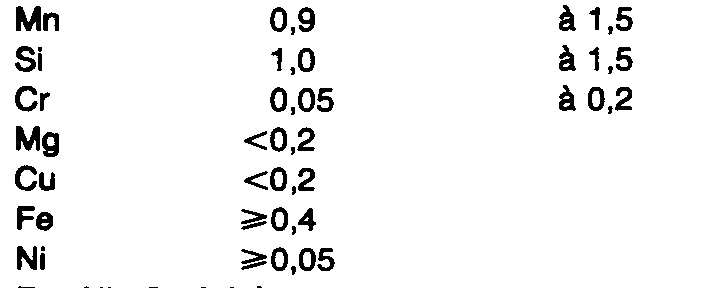
- composition of this alloy (in% by weight): and contains Fe in an amount greater than or equal to 0.4, nickel in an amount greater than or equal to 0.05%, with Fe + Ni + Co between 0.8 and 2, the other possible elements being in total amount less at 0.2%, the rest being aluminum.
- the addition of silicon contributes to obtaining a good rigidity in the annealed state and does not have the disadvantage of an addition of magnesium which plays an unfavorable role for the holding in service of the enamel layer. , except to carry out a chromating treatment which is not authorized for cookware.
- the elements of the group Fe, Ni, Co have a favorable influence on the adhesion of the enamel.
- the properties of enamel are particularly advantageous when used in the hardened quarter-hard state (state H12 according to French standard NF A 02-006). In this case, in fact, the elastic limit and the breaking load after exposure to hot are significantly improved without the elongation decreasing too much.
- the alloy according to the invention can advantageously be used either in applications where the metal is exposed to the temperature for a certain time or at repeated intervals, for example for exhaust pipes of road vehicles, temperature exchangers, in particular automobile radiators, oven walls, solar energy collectors, or in applications where the metal must undergo a hot treatment of enameling, lacquering, varnishing, non-stick coating, etc.
- the strength of the enamel was characterized by a bending test. The sample is first pickled for 5 minutes in a 5% trisodium phosphate bath, brought to 70-75 ° C, rinsed, dried and soaked in a frit; it is dried in an oven at 150-170 ° C before bringing the sample to 560-570 ° C for 10 minutes.
- the sheet is folded on itself and compared to standard samples (five qualities).
- the sample made with the alloy according to the invention meets the best quality, that is to say that the metal is always entirely covered by the enamel while the sample made with 3003 has small plates where the enamel jumped.
- the alloy according to the invention exhibits mechanical characteristics when hot significantly improved compared to those of 3003.
- the use of products in the H12 state further improves these characteristics.
- Plates of cross section of 1120 mm ⁇ 250 mm in alloy having the following composition (% by weight) were poured semi-continuously: which have been peeled, reheated for 12 hours at 600 ° C, hot rolled to 12 mm then cold to 3 mm and annealed at 450 ° C for 6 hours (2 hours at the holding temperature).
Landscapes
- Engineering & Computer Science (AREA)
- Mechanical Engineering (AREA)
- Chemical & Material Sciences (AREA)
- Food Science & Technology (AREA)
- Metallurgy (AREA)
- Organic Chemistry (AREA)
- Materials Engineering (AREA)
- Physics & Mathematics (AREA)
- Thermal Sciences (AREA)
- General Engineering & Computer Science (AREA)
- Heat Treatment Of Sheet Steel (AREA)
- Heat Treatment Of Steel (AREA)
- Laminated Bodies (AREA)
- Paints Or Removers (AREA)
Abstract
Description
- La présente invention concerne un alliage d'aluminium au Si-↑ín présentant des caractéristiques améliorées pendant et après exposition à température élevée et une excellente aptitude à l'émaillage et aux autres traitements de cuisson.
- Les alliages aluminium-manganèse, en particulier le 3003 selon la désignation de l'Aluminum Association, sont utilisés pour la fabrication d'articles émaillés. La rigidité après recuit est meilleure que pour l'aluminium 1050 (aluminium à 99,5 %) mais la tenue en service de l'émail déposé, mesurée par le SPALLTEST selon la spécification ASTM C 486 est insuffisante et, d'autre part, la résistance au bosse- lage des produits finis, par exemple les casseroles, n'est pas satisfaisante. De plus, les caractéristiques mécaniques du 3003 chutent très rapidement dès qu'on monte en température.
- L'alliage selon l'invention permet d'améliorer sensiblement les caractéristiques mécaniques par rapport au 3003 aussi bien à chaud qu'après traitement thermique de recuit ou de cuisson d'un revêtement et assure une meilleure tenue en service de l'émail déposé lorsqu'on l'utilise pour la fabrication d'articles émaillés.
- Cet alliage a pour composition (en % en poids) :

L'addition de silicium concourt à l'obtention d'une bonne rigidité à l'état recuit et n'a pas l'inconvénient d'une addition de magnésium qui joue un rôle défavorable pour la tenue en service de la couche d'émail, sauf à effectuer un traitement chromatant qui n'est pas autorisé pour les articles culinaires.
Outre leur rôle proprement métallurgique dans l'alliage, les éléments du groupe Fe, Ni, Co ont une influence favorable sur l'adhérence de l'émail. - Les propriétés de l'émail sont particulièrement intéressantes lorsqu'on l'utilise à l'état écroui quart-dur (état H12 selon la norme française NF A 02-006). Dans ce cas, en effet, la limite élastique et la charge de rupture après exposition à chaud sont nettement améliorées sans que l'allongement diminue de manière trop importante.
- L'alliage selon l'invention peut être avantageusement utilisé soit dans des applications où le métal est exposé à la température pendant un certain temps ou à des intervalles répétés, par exemple pour des pots d'échappement de véhicules routiers, des échangeurs de température, en particulier des radiateurs d'automobiles, des parois d'étuve, des collecteurs d'énergie solaire, soit dans des applications où le métal doit subir un traitement à chaud d'émaillage, laquage, vernissage, revêtement antiadhésif, etc...
- Les propriétés de l'alliage selon l'invention seront illustrées par les exemples suivants qui n'ont aucun caractère limitatif.
- On a coulé en semi-continu sous forme d'une plaque 70 x 380 x 1000 mm un alliage de composition suivante (% en poids) :

- - à l'état recuit,
- - après émaillage, la cuisson se faisant à 560°C avec montée en température de 30 mn, maintient pendant 10 minutes et refroidissement à l'air calme,
- - après revêtement de polytétrafluoréthylène (PTFE) sans émaillage,
- - après émaillage sur une face et revêtement de polytétrafluoréthylène sur l'autre face.
- Les résultats ont été rassemblés au tableau I et comparés aux résultats obtenus dans les mêmes conditions avec un alliage 3003 de composition suivante :


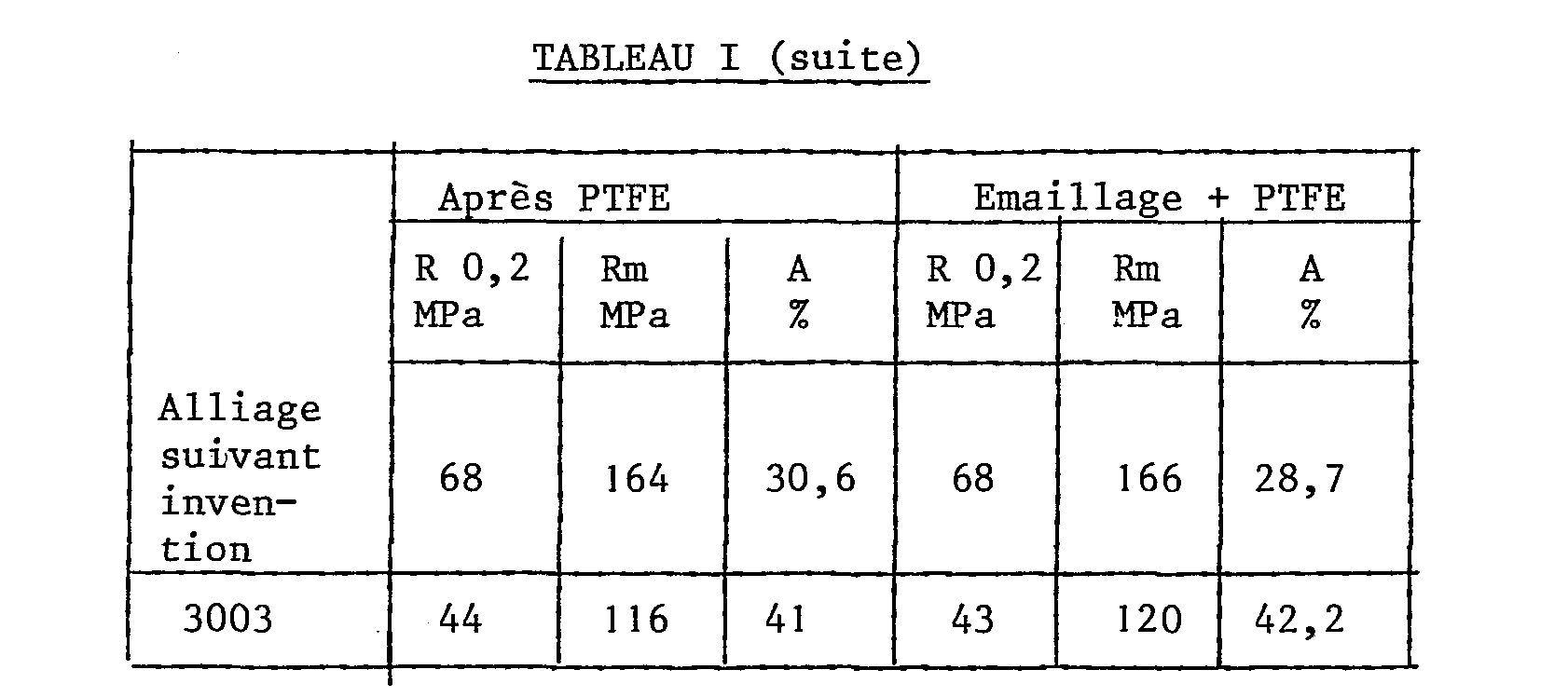
- On constate une augmentation très importante des caractéristiques mécaniques de traction tout en conservant un allongement satisfaisant. La tenue de l'émail a été caractérisée par un test de pliage. L'échantillon est d'abord décapé pendant 5 minutes dans un bain à 5 % de phosphate trisodique, porté à 70-75°C, rincé, séché et trempé dans une fritte ; on fait sécher dans une étuve à 150-170°C avant de porter l'échantillon à 560-570°C pendant 10 minutes.
- Après refroidissement des échantillons, on plie la tôle sur elle-même et on compare à des échantillons étalons (cinq qualités). L'échantillon réalisé avec l'alliage selon l'invention répond à la qualité la meilleure, c'est-à-dire que le métal est toujours entièrement recouvert par l'émail alors que l'échantillon réalisé avec le 3003 présente des petites plaques où l'émail a sauté.
- On a coulé en semi-continu une plaque de 800 x 300 x 1580 mm en alliage de composition suivante (% en poids) :

- Après un réchauffage de 8 heures à 500°C, un laminage à chaud jusqu'à 9 mm et un laminage à froid jusqu'à 3 mm, une partie du métal a été recuite pendant 7 heures (état 0) à 450°C, l'autre partie après recuit 9 heures à 460°C a subi un laminage à froid complémentaire pour ramener l'épaisseur de 3 à 2,7 mm (état H12). On obtient alors les caractéristiques suivantes :

- On constate qu'à l'état H12, après émaillage, la limite élastique est fortement améliorée sans que M'allongement diminue de façon notable. On dispose ainsi d'un moyen supplémentaire d'augmenter les caractéristiques après exposition à température élevée tout en conservant une bonne aptitude à l'emboutissage.
- Enfin, on a comparé les caractéristiques mécaniques à chaud après 100 heures de maintien à la température d'essai pour l'alliage précédent à l'état 0 et à l'état H12, et pour l'alliage 3003 mentionné dans l'exemple 1. Ces résultats sont rassemblés au tableau III.
-

- On a coulé en semi-continu des plaques de section transversale de 1120 mm x 250 mm en alliage ayant la composition suivante (%en poids):
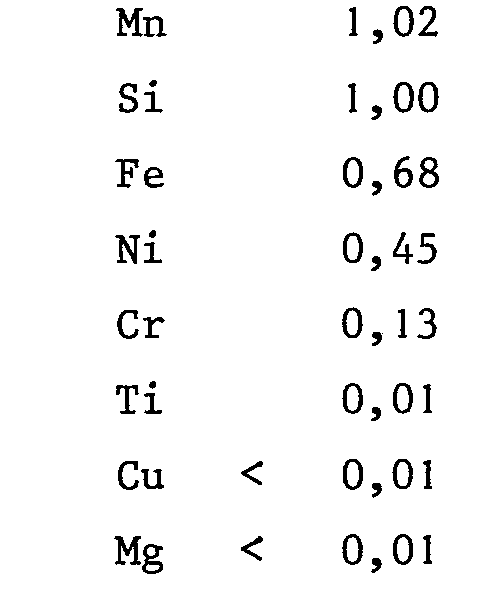
qui ont été écroûtées, réchauffées 12h à 600°C, laminées à chaud jusqu'à 12 mm puis à froid jusqu'à 3 mm et recuites à 450°C pendant 6h (2h à la température de maintien). - On a ensuite mesuré les caractéristiques mécaniques dans l'état de recuit, après émaillage et après émaillage + revêtement PTFE, effectués dans les mêmes conditions que celles utilisées à l'exemple 1. Les résultats obtenus sont les suivants :

- Un alliage de la composition suivante (% en poids) :

a été transformé dans les mêmes conditions que celles utilisées à l'exemple 3. - Les tôles obtenues à l'état recuit (état 0) ont été tractionnées à chaud après un maintien de 100 h à la température d'essai.
- Les résultats obtenus sont reportés au tableau V suivant, comparativement aux résultats obtenus pour l'alliage 3003 dans le même état 0.

Claims (3)

Applications Claiming Priority (2)
| Application Number | Priority Date | Filing Date | Title |
|---|---|---|---|
| FR7808833 | 1978-03-20 | ||
| FR7808833A FR2420577A1 (fr) | 1978-03-20 | 1978-03-20 | Alliage d'aluminium |
Publications (3)
| Publication Number | Publication Date |
|---|---|
| EP0004519A2 true EP0004519A2 (fr) | 1979-10-03 |
| EP0004519A3 EP0004519A3 (en) | 1979-10-31 |
| EP0004519B1 EP0004519B1 (fr) | 1981-03-25 |
Family
ID=9206308
Family Applications (1)
| Application Number | Title | Priority Date | Filing Date |
|---|---|---|---|
| EP79420014A Expired EP0004519B1 (fr) | 1978-03-20 | 1979-03-13 | Alliage d'aluminium et ses applications |
Country Status (14)
| Country | Link |
|---|---|
| US (1) | US4222774A (fr) |
| EP (1) | EP0004519B1 (fr) |
| JP (1) | JPS54130418A (fr) |
| AT (1) | AT364888B (fr) |
| BE (1) | BE874974A (fr) |
| BR (1) | BR7901690A (fr) |
| CA (1) | CA1113743A (fr) |
| CH (1) | CH636379A5 (fr) |
| DE (1) | DE2960209D1 (fr) |
| ES (1) | ES478667A1 (fr) |
| FR (1) | FR2420577A1 (fr) |
| GR (1) | GR66038B (fr) |
| IT (1) | IT1113312B (fr) |
| LU (1) | LU81066A1 (fr) |
Cited By (2)
| Publication number | Priority date | Publication date | Assignee | Title |
|---|---|---|---|---|
| FR2803602A1 (fr) * | 2000-01-11 | 2001-07-13 | Seb Sa | Utilisation d'un seul alliage d'aluminium pour realiser des ustensiles culinaires de finition exterieure emaillee ou anti-adherente |
| FR2898135A1 (fr) * | 2006-03-06 | 2007-09-07 | Novelis Specialites France Soc | Alliage d'aluminium pour la fabrication d'un ustensile culinaire, son utilisation, et ustensile culinaire correspondant |
Families Citing this family (6)
| Publication number | Priority date | Publication date | Assignee | Title |
|---|---|---|---|---|
| US4502900A (en) * | 1981-02-06 | 1985-03-05 | Vereinigte Deutsche Metallwerke Ag | Alloy and process for manufacturing rolled strip from an aluminum alloy especially for use in the manufacture of two-piece cans |
| JPS648239A (en) * | 1987-06-30 | 1989-01-12 | Furukawa Aluminium | Aluminum alloy and aluminum alloy clad material for heat exchanger member |
| DE19527360A1 (de) * | 1995-07-26 | 1997-01-30 | Bosch Siemens Hausgeraete | Gargutträger für einen Backofen |
| US5820015A (en) * | 1996-04-02 | 1998-10-13 | Kaiser Aluminum & Chemical Corporation | Process for improving the fillet-forming capability of brazeable aluminum articles |
| JP4434545B2 (ja) * | 2001-03-01 | 2010-03-17 | Dowaホールディングス株式会社 | 半導体実装用絶縁基板及びパワーモジュール |
| FR2846340B1 (fr) * | 2002-10-25 | 2005-06-24 | Pechiney Rhenalu | Procede de fabrication de bandes en alliage d'aluminium pour ustensiles culinaires |
Family Cites Families (4)
| Publication number | Priority date | Publication date | Assignee | Title |
|---|---|---|---|---|
| FR1348558A (fr) * | 1964-04-10 | |||
| US1579481A (en) * | 1925-01-22 | 1926-04-06 | Hybinette Victor Evers | Light aluminum alloy and method of producing same |
| FR1497831A (fr) * | 1965-11-05 | 1967-10-13 | Alusuisse | Procédé pour produire des couches d'oxyde autocolorantes grises résistantes à la lumière sur des alliages d'aluminium |
| CA962172A (en) * | 1971-05-05 | 1975-02-04 | Olin Corporation | High ductility high strength aluminum base alloys and process for obtaining same |
-
1978
- 1978-03-20 FR FR7808833A patent/FR2420577A1/fr active Granted
-
1979
- 1979-02-23 US US06/014,710 patent/US4222774A/en not_active Expired - Lifetime
- 1979-03-13 EP EP79420014A patent/EP0004519B1/fr not_active Expired
- 1979-03-13 DE DE7979420014T patent/DE2960209D1/de not_active Expired
- 1979-03-15 ES ES478667A patent/ES478667A1/es not_active Expired
- 1979-03-16 AT AT0200479A patent/AT364888B/de not_active IP Right Cessation
- 1979-03-16 CH CH248879A patent/CH636379A5/fr not_active IP Right Cessation
- 1979-03-19 GR GR58644A patent/GR66038B/el unknown
- 1979-03-19 BR BR7901690A patent/BR7901690A/pt unknown
- 1979-03-19 CA CA323,707A patent/CA1113743A/fr not_active Expired
- 1979-03-19 JP JP3217379A patent/JPS54130418A/ja active Granted
- 1979-03-19 IT IT21101/79A patent/IT1113312B/it active
- 1979-03-20 LU LU81066A patent/LU81066A1/fr unknown
- 1979-03-20 BE BE0/194118A patent/BE874974A/fr not_active IP Right Cessation
Cited By (3)
| Publication number | Priority date | Publication date | Assignee | Title |
|---|---|---|---|---|
| FR2803602A1 (fr) * | 2000-01-11 | 2001-07-13 | Seb Sa | Utilisation d'un seul alliage d'aluminium pour realiser des ustensiles culinaires de finition exterieure emaillee ou anti-adherente |
| WO2001051678A1 (fr) * | 2000-01-11 | 2001-07-19 | Seb Sa | Ustensiles culinaires fabriques d'un seul alliage d'aluminium |
| FR2898135A1 (fr) * | 2006-03-06 | 2007-09-07 | Novelis Specialites France Soc | Alliage d'aluminium pour la fabrication d'un ustensile culinaire, son utilisation, et ustensile culinaire correspondant |
Also Published As
| Publication number | Publication date |
|---|---|
| CA1113743A (fr) | 1981-12-08 |
| DE2960209D1 (en) | 1981-04-16 |
| IT1113312B (it) | 1986-01-20 |
| FR2420577B1 (fr) | 1980-08-29 |
| EP0004519A3 (en) | 1979-10-31 |
| LU81066A1 (fr) | 1979-10-30 |
| JPS5711383B2 (fr) | 1982-03-04 |
| BR7901690A (pt) | 1979-10-16 |
| FR2420577A1 (fr) | 1979-10-19 |
| EP0004519B1 (fr) | 1981-03-25 |
| BE874974A (fr) | 1979-09-20 |
| ES478667A1 (es) | 1979-06-01 |
| JPS54130418A (en) | 1979-10-09 |
| AT364888B (de) | 1981-11-25 |
| IT7921101A0 (it) | 1979-03-19 |
| US4222774A (en) | 1980-09-16 |
| CH636379A5 (fr) | 1983-05-31 |
| GR66038B (fr) | 1981-01-14 |
| ATA200479A (de) | 1981-04-15 |
Similar Documents
| Publication | Publication Date | Title |
|---|---|---|
| JP5677289B2 (ja) | 外観が改善された被覆金属ストリップを製造する方法 | |
| TWI451004B (zh) | 熱壓用鋼板及使用熱壓用鋼板的熱壓構件的製造方法 | |
| US4546051A (en) | Aluminum coated steel sheet and process for producing the same | |
| CA1103132A (fr) | Methode de fabrication | |
| CA2647687A1 (fr) | Procede de revetement par immersion en fusion d'un produit plat en acier hyperresistant | |
| CN103261466B (zh) | 具有优异抗氧化性和耐热性的镀铝钢板 | |
| EP0004519B1 (fr) | Alliage d'aluminium et ses applications | |
| JP2008523243A (ja) | 高張力鋼ストリップを溶融浸漬コーティングする方法 | |
| JP4786576B2 (ja) | 耐テンパーカラー性に優れたステンレス鋼材およびその製造法 | |
| JP2004211151A (ja) | 潤滑性に優れた高温プレス成形性用Al系めっき鋼板 | |
| JP3383119B2 (ja) | 光沢保持性、耐食性に優れた溶融アルミめっき鋼板及びその製造法 | |
| GB2122650A (en) | Aluminium coated steel sheet and process for producing the same | |
| JP3485410B2 (ja) | 耐加熱黒変性に優れた溶融アルミめっき鋼板の製造法 | |
| JPH05287492A (ja) | 耐食性、耐熱性に優れた合金化溶融アルミめっき鋼板 | |
| JP3126508B2 (ja) | 加工性に優れた溶融アルミニウムめっきクロム含有鋼板の製造方法 | |
| EP0081847B1 (fr) | Procédé d'émaillage | |
| CN111434404A (zh) | 一种耐腐蚀热冲压件的制造方法及装置 | |
| US4210446A (en) | Aluminum alloy for enamelling | |
| CN121538515A (zh) | 一种抗高温氧化的铝铁合金化镀层钢板及其制造方法与应用 | |
| JPS63293173A (ja) | ほうろうの製造方法 | |
| JPH03243755A (ja) | プレス成形性に優れた有機複合合金化溶融亜鉛めっき鋼板 | |
| JPH05311379A (ja) | 耐食性、耐熱性に優れた合金化溶融アルミめっき鋼板の製造法 | |
| WO2003047404A1 (fr) | Alliage d'aluminium pour ustensiles culinaires emailles et/ou revetus de ptfe | |
| JPH03243756A (ja) | 耐低温チッピング性及び耐穴あき腐食性に優れた自動車用外面防錆鋼板 | |
| CN121610687A (zh) | 一种铝铁合金化镀层钢板及其制造方法与应用 |
Legal Events
| Date | Code | Title | Description |
|---|---|---|---|
| PUAI | Public reference made under article 153(3) epc to a published international application that has entered the european phase |
Free format text: ORIGINAL CODE: 0009012 |
|
| PUAL | Search report despatched |
Free format text: ORIGINAL CODE: 0009013 |
|
| AK | Designated contracting states |
Designated state(s): DE GB NL SE |
|
| AK | Designated contracting states |
Designated state(s): DE GB NL SE |
|
| 17P | Request for examination filed | ||
| DET | De: translation of patent claims | ||
| GRAA | (expected) grant |
Free format text: ORIGINAL CODE: 0009210 |
|
| AK | Designated contracting states |
Designated state(s): DE GB NL SE |
|
| REF | Corresponds to: |
Ref document number: 2960209 Country of ref document: DE Date of ref document: 19810416 |
|
| PLBI | Opposition filed |
Free format text: ORIGINAL CODE: 0009260 |
|
| 26 | Opposition filed |
Opponent name: SCHWEIZERISCHE ALUMINIUM AG Effective date: 19811217 |
|
| PLAB | Opposition data, opponent's data or that of the opponent's representative modified |
Free format text: ORIGINAL CODE: 0009299OPPO |
|
| R26 | Opposition filed (corrected) |
Opponent name: SCHWEIZERISCHE ALUMINIUM AG Effective date: 19811217 |
|
| PGFP | Annual fee paid to national office [announced via postgrant information from national office to epo] |
Ref country code: NL Payment date: 19830331 Year of fee payment: 5 |
|
| PGFP | Annual fee paid to national office [announced via postgrant information from national office to epo] |
Ref country code: DE Payment date: 19840204 Year of fee payment: 6 |
|
| PGFP | Annual fee paid to national office [announced via postgrant information from national office to epo] |
Ref country code: SE Payment date: 19840331 Year of fee payment: 6 |
|
| RDAG | Patent revoked |
Free format text: ORIGINAL CODE: 0009271 |
|
| STAA | Information on the status of an ep patent application or granted ep patent |
Free format text: STATUS: PATENT REVOKED |
|
| 27W | Patent revoked |
Effective date: 19840210 |
|
| GBPR | Gb: patent revoked under art. 102 of the ep convention designating the uk as contracting state | ||
| EUG | Se: european patent has lapsed |
Ref document number: 79420014.7 Effective date: 19860128 |