EP0004547B1 - Compositions de chlorure de polyvinyle chloré ayant une résistance aux chocs modifiée - Google Patents
Compositions de chlorure de polyvinyle chloré ayant une résistance aux chocs modifiée Download PDFInfo
- Publication number
- EP0004547B1 EP0004547B1 EP79100537A EP79100537A EP0004547B1 EP 0004547 B1 EP0004547 B1 EP 0004547B1 EP 79100537 A EP79100537 A EP 79100537A EP 79100537 A EP79100537 A EP 79100537A EP 0004547 B1 EP0004547 B1 EP 0004547B1
- Authority
- EP
- European Patent Office
- Prior art keywords
- modifier
- composition
- cpvc
- pro
- block copolymer
- Prior art date
- Legal status (The legal status is an assumption and is not a legal conclusion. Google has not performed a legal analysis and makes no representation as to the accuracy of the status listed.)
- Expired
Links
- 239000004801 Chlorinated PVC Substances 0.000 title description 112
- 229920000457 chlorinated polyvinyl chloride Polymers 0.000 title description 112
- 239000000203 mixture Substances 0.000 title description 65
- 239000003607 modifier Substances 0.000 description 102
- 229920001400 block copolymer Polymers 0.000 description 76
- 239000004609 Impact Modifier Substances 0.000 description 52
- 229920001971 elastomer Polymers 0.000 description 47
- 239000005060 rubber Substances 0.000 description 43
- 229920000468 styrene butadiene styrene block copolymer Polymers 0.000 description 43
- FACXGONDLDSNOE-UHFFFAOYSA-N buta-1,3-diene;styrene Chemical compound C=CC=C.C=CC1=CC=CC=C1.C=CC1=CC=CC=C1 FACXGONDLDSNOE-UHFFFAOYSA-N 0.000 description 41
- 239000006057 Non-nutritive feed additive Substances 0.000 description 36
- 229920005989 resin Polymers 0.000 description 30
- 239000011347 resin Substances 0.000 description 30
- KAKZBPTYRLMSJV-UHFFFAOYSA-N Butadiene Chemical compound C=CC=C KAKZBPTYRLMSJV-UHFFFAOYSA-N 0.000 description 24
- 229920000642 polymer Polymers 0.000 description 23
- 239000004709 Chlorinated polyethylene Substances 0.000 description 20
- BZHJMEDXRYGGRV-UHFFFAOYSA-N Vinyl chloride Chemical compound ClC=C BZHJMEDXRYGGRV-UHFFFAOYSA-N 0.000 description 19
- PPBRXRYQALVLMV-UHFFFAOYSA-N Styrene Chemical compound C=CC1=CC=CC=C1 PPBRXRYQALVLMV-UHFFFAOYSA-N 0.000 description 18
- 239000011159 matrix material Substances 0.000 description 18
- 238000002156 mixing Methods 0.000 description 16
- -1 vinyl aromatic compound Chemical class 0.000 description 16
- 229920001577 copolymer Polymers 0.000 description 15
- 230000000694 effects Effects 0.000 description 14
- 239000002245 particle Substances 0.000 description 14
- 150000001993 dienes Chemical class 0.000 description 13
- 229920002633 Kraton (polymer) Polymers 0.000 description 12
- 229920002554 vinyl polymer Polymers 0.000 description 12
- MTAZNLWOLGHBHU-UHFFFAOYSA-N butadiene-styrene rubber Chemical compound C=CC=C.C=CC1=CC=CC=C1 MTAZNLWOLGHBHU-UHFFFAOYSA-N 0.000 description 11
- 229920000578 graft copolymer Polymers 0.000 description 11
- 239000003381 stabilizer Substances 0.000 description 11
- 239000000314 lubricant Substances 0.000 description 10
- 239000011115 styrene butadiene Substances 0.000 description 10
- 229920006385 Geon Polymers 0.000 description 9
- 239000004800 polyvinyl chloride Substances 0.000 description 9
- 238000012545 processing Methods 0.000 description 9
- 229920003048 styrene butadiene rubber Polymers 0.000 description 9
- 238000012360 testing method Methods 0.000 description 9
- 239000002174 Styrene-butadiene Substances 0.000 description 8
- 238000007906 compression Methods 0.000 description 8
- 230000006835 compression Effects 0.000 description 8
- 230000006872 improvement Effects 0.000 description 8
- 238000000034 method Methods 0.000 description 8
- 239000000178 monomer Substances 0.000 description 8
- 229920000915 polyvinyl chloride Polymers 0.000 description 8
- 230000009977 dual effect Effects 0.000 description 7
- 238000006116 polymerization reaction Methods 0.000 description 7
- 229920001169 thermoplastic Polymers 0.000 description 7
- 239000004416 thermosoftening plastic Substances 0.000 description 7
- ZAMOUSCENKQFHK-UHFFFAOYSA-N Chlorine atom Chemical compound [Cl] ZAMOUSCENKQFHK-UHFFFAOYSA-N 0.000 description 6
- RRHGJUQNOFWUDK-UHFFFAOYSA-N Isoprene Chemical compound CC(=C)C=C RRHGJUQNOFWUDK-UHFFFAOYSA-N 0.000 description 6
- 229920003347 Microthene® Polymers 0.000 description 6
- 239000005062 Polybutadiene Substances 0.000 description 6
- 229920013623 Solprene Polymers 0.000 description 6
- 229910052801 chlorine Inorganic materials 0.000 description 6
- 239000000460 chlorine Substances 0.000 description 6
- 238000009826 distribution Methods 0.000 description 6
- 229920003023 plastic Polymers 0.000 description 6
- 239000004033 plastic Substances 0.000 description 6
- 229920002857 polybutadiene Polymers 0.000 description 6
- GWEVSGVZZGPLCZ-UHFFFAOYSA-N titanium dioxide Inorganic materials O=[Ti]=O GWEVSGVZZGPLCZ-UHFFFAOYSA-N 0.000 description 6
- 239000004698 Polyethylene Substances 0.000 description 5
- 239000004793 Polystyrene Substances 0.000 description 5
- 239000000654 additive Substances 0.000 description 5
- 230000004927 fusion Effects 0.000 description 5
- 239000000155 melt Substances 0.000 description 5
- 230000000704 physical effect Effects 0.000 description 5
- 229920003229 poly(methyl methacrylate) Polymers 0.000 description 5
- 229920000573 polyethylene Polymers 0.000 description 5
- 239000004926 polymethyl methacrylate Substances 0.000 description 5
- 229920002223 polystyrene Polymers 0.000 description 5
- SDJHPPZKZZWAKF-UHFFFAOYSA-N 2,3-dimethylbuta-1,3-diene Chemical compound CC(=C)C(C)=C SDJHPPZKZZWAKF-UHFFFAOYSA-N 0.000 description 4
- LFQSCWFLJHTTHZ-UHFFFAOYSA-N Ethanol Chemical compound CCO LFQSCWFLJHTTHZ-UHFFFAOYSA-N 0.000 description 4
- JHIVVAPYMSGYDF-UHFFFAOYSA-N cyclohexanone Chemical compound O=C1CCCCC1 JHIVVAPYMSGYDF-UHFFFAOYSA-N 0.000 description 4
- 229920001519 homopolymer Polymers 0.000 description 4
- 239000004615 ingredient Substances 0.000 description 4
- 230000008569 process Effects 0.000 description 4
- 239000000047 product Substances 0.000 description 4
- 230000002195 synergetic effect Effects 0.000 description 4
- 125000000391 vinyl group Chemical group [H]C([*])=C([H])[H] 0.000 description 4
- YXFVVABEGXRONW-UHFFFAOYSA-N Toluene Chemical compound CC1=CC=CC=C1 YXFVVABEGXRONW-UHFFFAOYSA-N 0.000 description 3
- 229920000122 acrylonitrile butadiene styrene Polymers 0.000 description 3
- 230000009286 beneficial effect Effects 0.000 description 3
- 239000000806 elastomer Substances 0.000 description 3
- 238000005516 engineering process Methods 0.000 description 3
- 238000009472 formulation Methods 0.000 description 3
- 230000007246 mechanism Effects 0.000 description 3
- 238000003801 milling Methods 0.000 description 3
- 229920001485 poly(butyl acrylate) polymer Polymers 0.000 description 3
- 239000000843 powder Substances 0.000 description 3
- PMJHHCWVYXUKFD-SNAWJCMRSA-N (E)-1,3-pentadiene Chemical compound C\C=C\C=C PMJHHCWVYXUKFD-SNAWJCMRSA-N 0.000 description 2
- WAEOXIOXMKNFLQ-UHFFFAOYSA-N 1-methyl-4-prop-2-enylbenzene Chemical group CC1=CC=C(CC=C)C=C1 WAEOXIOXMKNFLQ-UHFFFAOYSA-N 0.000 description 2
- IGGDKDTUCAWDAN-UHFFFAOYSA-N 1-vinylnaphthalene Chemical compound C1=CC=C2C(C=C)=CC=CC2=C1 IGGDKDTUCAWDAN-UHFFFAOYSA-N 0.000 description 2
- OEPOKWHJYJXUGD-UHFFFAOYSA-N 2-(3-phenylmethoxyphenyl)-1,3-thiazole-4-carbaldehyde Chemical compound O=CC1=CSC(C=2C=C(OCC=3C=CC=CC=3)C=CC=2)=N1 OEPOKWHJYJXUGD-UHFFFAOYSA-N 0.000 description 2
- 239000004215 Carbon black (E152) Substances 0.000 description 2
- HEDRZPFGACZZDS-UHFFFAOYSA-N Chloroform Chemical compound ClC(Cl)Cl HEDRZPFGACZZDS-UHFFFAOYSA-N 0.000 description 2
- 229920000181 Ethylene propylene rubber Polymers 0.000 description 2
- KFZMGEQAYNKOFK-UHFFFAOYSA-N Isopropanol Chemical compound CC(C)O KFZMGEQAYNKOFK-UHFFFAOYSA-N 0.000 description 2
- VVQNEPGJFQJSBK-UHFFFAOYSA-N Methyl methacrylate Chemical compound COC(=O)C(C)=C VVQNEPGJFQJSBK-UHFFFAOYSA-N 0.000 description 2
- MZRVEZGGRBJDDB-UHFFFAOYSA-N N-Butyllithium Chemical compound [Li]CCCC MZRVEZGGRBJDDB-UHFFFAOYSA-N 0.000 description 2
- ATJFFYVFTNAWJD-UHFFFAOYSA-N Tin Chemical compound [Sn] ATJFFYVFTNAWJD-UHFFFAOYSA-N 0.000 description 2
- XTXRWKRVRITETP-UHFFFAOYSA-N Vinyl acetate Chemical compound CC(=O)OC=C XTXRWKRVRITETP-UHFFFAOYSA-N 0.000 description 2
- XECAHXYUAAWDEL-UHFFFAOYSA-N acrylonitrile butadiene styrene Chemical compound C=CC=C.C=CC#N.C=CC1=CC=CC=C1 XECAHXYUAAWDEL-UHFFFAOYSA-N 0.000 description 2
- 239000004676 acrylonitrile butadiene styrene Substances 0.000 description 2
- 230000000996 additive effect Effects 0.000 description 2
- 150000004945 aromatic hydrocarbons Chemical class 0.000 description 2
- 230000001588 bifunctional effect Effects 0.000 description 2
- 230000015556 catabolic process Effects 0.000 description 2
- 230000007423 decrease Effects 0.000 description 2
- 238000006731 degradation reaction Methods 0.000 description 2
- 239000000945 filler Substances 0.000 description 2
- 230000009477 glass transition Effects 0.000 description 2
- 229930195733 hydrocarbon Natural products 0.000 description 2
- 150000002430 hydrocarbons Chemical class 0.000 description 2
- 239000000463 material Substances 0.000 description 2
- 238000000465 moulding Methods 0.000 description 2
- 125000001979 organolithium group Chemical group 0.000 description 2
- 239000000049 pigment Substances 0.000 description 2
- PMJHHCWVYXUKFD-UHFFFAOYSA-N piperylene Natural products CC=CC=C PMJHHCWVYXUKFD-UHFFFAOYSA-N 0.000 description 2
- 229920001200 poly(ethylene-vinyl acetate) Polymers 0.000 description 2
- 229920000058 polyacrylate Polymers 0.000 description 2
- 229920000346 polystyrene-polyisoprene block-polystyrene Polymers 0.000 description 2
- 229920006216 polyvinyl aromatic Polymers 0.000 description 2
- 239000011164 primary particle Substances 0.000 description 2
- HJWLCRVIBGQPNF-UHFFFAOYSA-N prop-2-enylbenzene Chemical compound C=CCC1=CC=CC=C1 HJWLCRVIBGQPNF-UHFFFAOYSA-N 0.000 description 2
- 239000011342 resin composition Substances 0.000 description 2
- 239000007787 solid Substances 0.000 description 2
- 239000000126 substance Substances 0.000 description 2
- UKDOTCFNLHHKOF-FGRDZWBJSA-N (z)-1-chloroprop-1-ene;(z)-1,2-dichloroethene Chemical group C\C=C/Cl.Cl\C=C/Cl UKDOTCFNLHHKOF-FGRDZWBJSA-N 0.000 description 1
- MUZDXNQOSGWMJJ-UHFFFAOYSA-N 2-methylprop-2-enoic acid;prop-2-enoic acid Chemical compound OC(=O)C=C.CC(=C)C(O)=O MUZDXNQOSGWMJJ-UHFFFAOYSA-N 0.000 description 1
- NLHHRLWOUZZQLW-UHFFFAOYSA-N Acrylonitrile Chemical compound C=CC#N NLHHRLWOUZZQLW-UHFFFAOYSA-N 0.000 description 1
- XDTMQSROBMDMFD-UHFFFAOYSA-N Cyclohexane Chemical compound C1CCCCC1 XDTMQSROBMDMFD-UHFFFAOYSA-N 0.000 description 1
- VGGSQFUCUMXWEO-UHFFFAOYSA-N Ethene Chemical compound C=C VGGSQFUCUMXWEO-UHFFFAOYSA-N 0.000 description 1
- 239000005977 Ethylene Substances 0.000 description 1
- 239000004594 Masterbatch (MB) Substances 0.000 description 1
- CERQOIWHTDAKMF-UHFFFAOYSA-M Methacrylate Chemical compound CC(=C)C([O-])=O CERQOIWHTDAKMF-UHFFFAOYSA-M 0.000 description 1
- 229920000459 Nitrile rubber Polymers 0.000 description 1
- CTQNGGLPUBDAKN-UHFFFAOYSA-N O-Xylene Chemical compound CC1=CC=CC=C1C CTQNGGLPUBDAKN-UHFFFAOYSA-N 0.000 description 1
- 150000001252 acrylic acid derivatives Chemical class 0.000 description 1
- 230000002411 adverse Effects 0.000 description 1
- 238000005054 agglomeration Methods 0.000 description 1
- 230000002776 aggregation Effects 0.000 description 1
- 125000005250 alkyl acrylate group Chemical group 0.000 description 1
- 125000000217 alkyl group Chemical group 0.000 description 1
- XYLMUPLGERFSHI-UHFFFAOYSA-N alpha-Methylstyrene Chemical compound CC(=C)C1=CC=CC=C1 XYLMUPLGERFSHI-UHFFFAOYSA-N 0.000 description 1
- 125000000129 anionic group Chemical group 0.000 description 1
- 239000003963 antioxidant agent Substances 0.000 description 1
- 238000013459 approach Methods 0.000 description 1
- 150000001491 aromatic compounds Chemical group 0.000 description 1
- 230000002902 bimodal effect Effects 0.000 description 1
- 125000004432 carbon atom Chemical group C* 0.000 description 1
- 239000007795 chemical reaction product Substances 0.000 description 1
- 238000005660 chlorination reaction Methods 0.000 description 1
- 238000004587 chromatography analysis Methods 0.000 description 1
- 238000013329 compounding Methods 0.000 description 1
- 150000001875 compounds Chemical class 0.000 description 1
- 230000002153 concerted effect Effects 0.000 description 1
- 238000001816 cooling Methods 0.000 description 1
- 238000007334 copolymerization reaction Methods 0.000 description 1
- 230000001186 cumulative effect Effects 0.000 description 1
- 230000002950 deficient Effects 0.000 description 1
- AYOHIQLKSOJJQH-UHFFFAOYSA-N dibutyltin Chemical compound CCCC[Sn]CCCC AYOHIQLKSOJJQH-UHFFFAOYSA-N 0.000 description 1
- 229920003244 diene elastomer Polymers 0.000 description 1
- 239000006185 dispersion Substances 0.000 description 1
- GLVVKKSPKXTQRB-UHFFFAOYSA-N ethenyl dodecanoate Chemical compound CCCCCCCCCCCC(=O)OC=C GLVVKKSPKXTQRB-UHFFFAOYSA-N 0.000 description 1
- AFSIMBWBBOJPJG-UHFFFAOYSA-N ethenyl octadecanoate Chemical compound CCCCCCCCCCCCCCCCCC(=O)OC=C AFSIMBWBBOJPJG-UHFFFAOYSA-N 0.000 description 1
- UIWXSTHGICQLQT-UHFFFAOYSA-N ethenyl propanoate Chemical compound CCC(=O)OC=C UIWXSTHGICQLQT-UHFFFAOYSA-N 0.000 description 1
- 229920001038 ethylene copolymer Polymers 0.000 description 1
- 239000005038 ethylene vinyl acetate Substances 0.000 description 1
- 238000001125 extrusion Methods 0.000 description 1
- 238000010528 free radical solution polymerization reaction Methods 0.000 description 1
- 239000003999 initiator Substances 0.000 description 1
- 230000000977 initiatory effect Effects 0.000 description 1
- 239000004611 light stabiliser Substances 0.000 description 1
- 239000007788 liquid Substances 0.000 description 1
- WGOPGODQLGJZGL-UHFFFAOYSA-N lithium;butane Chemical compound [Li+].CC[CH-]C WGOPGODQLGJZGL-UHFFFAOYSA-N 0.000 description 1
- 230000014759 maintenance of location Effects 0.000 description 1
- 238000004519 manufacturing process Methods 0.000 description 1
- 150000002734 metacrylic acid derivatives Chemical class 0.000 description 1
- 239000003863 metallic catalyst Substances 0.000 description 1
- 230000004048 modification Effects 0.000 description 1
- 238000012986 modification Methods 0.000 description 1
- 230000003287 optical effect Effects 0.000 description 1
- 125000002524 organometallic group Chemical group 0.000 description 1
- 239000008188 pellet Substances 0.000 description 1
- 239000003208 petroleum Substances 0.000 description 1
- 239000004014 plasticizer Substances 0.000 description 1
- 230000002035 prolonged effect Effects 0.000 description 1
- 229920005604 random copolymer Polymers 0.000 description 1
- 239000012260 resinous material Substances 0.000 description 1
- 238000012552 review Methods 0.000 description 1
- 239000000779 smoke Substances 0.000 description 1
- 239000002904 solvent Substances 0.000 description 1
- 229920003051 synthetic elastomer Polymers 0.000 description 1
- 239000012815 thermoplastic material Substances 0.000 description 1
- 230000001052 transient effect Effects 0.000 description 1
- 229920001567 vinyl ester resin Polymers 0.000 description 1
- 238000004073 vulcanization Methods 0.000 description 1
- 239000008096 xylene Substances 0.000 description 1
- 239000004711 α-olefin Substances 0.000 description 1
Images
Classifications
-
- C—CHEMISTRY; METALLURGY
- C08—ORGANIC MACROMOLECULAR COMPOUNDS; THEIR PREPARATION OR CHEMICAL WORKING-UP; COMPOSITIONS BASED THEREON
- C08L—COMPOSITIONS OF MACROMOLECULAR COMPOUNDS
- C08L27/00—Compositions of homopolymers or copolymers of compounds having one or more unsaturated aliphatic radicals, each having only one carbon-to-carbon double bond, and at least one being terminated by a halogen; Compositions of derivatives of such polymers
- C08L27/22—Compositions of homopolymers or copolymers of compounds having one or more unsaturated aliphatic radicals, each having only one carbon-to-carbon double bond, and at least one being terminated by a halogen; Compositions of derivatives of such polymers modified by chemical after-treatment
- C08L27/24—Compositions of homopolymers or copolymers of compounds having one or more unsaturated aliphatic radicals, each having only one carbon-to-carbon double bond, and at least one being terminated by a halogen; Compositions of derivatives of such polymers modified by chemical after-treatment halogenated
Definitions
- CPVC chlorinated polyvinyl chloride
- CPVC resin is commercially available as a mixed polymeric structure of vinyl chloride, vinylidene chloride and 1,2-dichloroethylene.
- commercial CPVC has in excess of about 60 percent by weight (% by weight) bound chlorine, and is most conveniently prepared by the chlorination of polyvinyl chloride as described in U.S. Patents Nos. 2,996,489; 3,100,762; 3,334,077; 3,334,078; 3,506,637; and 3,534,013 inter alia.
- the term CPVC is used herein to define a chlorinated vinyl chloride polymer having in excess of about 60% by weight bound chlorine.
- a well-known undesirable characteristic of CPVC resin is that it has inherently low impact properties, a characteristic which is common to vinyl chloride homopolymers.
- Impact modifiers when used in CPVC reduce the tensile strength and heat distortion temperature (HDT) of the resin, and many reduce the processing heat stability. There are very few modifiers which yield a significant increase in impact strength or improvement in processability of the CPVC resin without vitiating the quality of the resin. Most elastomeric additives such as conjugated diene homo and copolymers or acrylic polymers which reduce the brittle temperature of vinyl chloride polymers, are ineffective when present in an amount less than about 10% by weight, and if used in a greater amount than 10% adversely affect the high temeprature stiffness of the resin.
- HDT heat distortion temperature
- Elastomer additives commonly used as conventional impact modifiers are graft copolymers containing butadiene, and other copolymers including chlorinated polyethylene (CPE), ethylene-vinyl acetate copolymers (EVA), acrylate-methacrylate (all acrylic) polymers, grafted elastomers based on vinyl chloride (VCG), nitrile rubbers (BR), styrene-butadiene rubbers, and the like.
- CPE chlorinated polyethylene
- EVA ethylene-vinyl acetate copolymers
- VCG vinyl chloride
- BR nitrile rubbers
- styrene-butadiene rubbers and the like.
- a processing aid is used in melt blending a resin composition to hasten fusion, to smooth out the otherwise rough texture of the composition and to soften the resin so that it is uniformly melt-blended within an acceptably short time. Easily melt-blended materials such as acrylonitrile-butadiene-styrene resins do not require a processing aid.
- Commercial polyvinyl chloride (PVC) is conventionally milled with a processing aid, though it can be melt-blended without one; but commercially chlorinated polyvinyl chloride (CPVC) has a high melt elasticity and therefore requires a processing aid or it cannot be acceptably melt-blended.
- melt-blended I refer to the requirement that CPVC must be melt-blended within a relatively short time, usually no more than 2 or 3 minutes, and desirably less than 2 mins. Since the fusion temperature of CPVC is relatively high, even long mixing at about 190°C can cause evolution of HCI and consequent degradation of the resin. Of course, degradation can be postponed by adding more stabilizer, usually a liquid compound containing tin, or more processing aid, both of which are expensive. However, this is not a practical solution because it increases the cost of the blend and decreases the heat distortion temperature owing to the plasticizing effect of the stabilizer or processing aid.
- a processing aid is essential to melt-blend CPVC. Since the end use product must have desirable impact strength, from a practical point of view, an impact modifier is also essential in a CPVC composition.
- CPE was unique in that it functioned as a dual function additive or modifier, functioning both as a processing aid and as an impact modifier, therefore referred to herein as a "pro-modifier".
- CPE is a more effective processing aid than impact modifier.
- CPE alone is used as an impact modifier, but where optimum impact is essential, CPE is generally used in combination with one or more of the above-mentioned conventional impact modifiers.
- ABS resins, and Cycolac L (Registered U.S.
- co-modifiers All impact modifiers and processing aids, when conventionally used in conjunction with one and another, in whatever combination, are referred to herein as "co-modifiers". It is implicit that a conventional co-modifier, when used alone at a level below about 10 phr, does not provide either sufficiently high impact strength in excess of 106 Newton (N).m/m Izod impact, or desirably processability, or both, without an undue sacrifice of HDT and other desirable physical characteristics of CPVC. For example, yield stress or tensile strength generally drops off linearly with increasing concentration of co-modifier which at relatively high levels may be desirable for improving the impact strength.
- a CPVC composition with desirable, relatively high impact strength in excess of 106 N.m/m Izod impact includes an impact modifier and a processing aid as co-modifiers
- matching the co-modifiers for compatibility is a trial and error task which is usually as time-consuming as it is essential.
- Those skilled in the art, responsible for finding matched co-modifiers have long sought, without much success, for a dual function or bifunctional modifier which will not vitiate the desirable end-use attributes of CPVC articles. This invention is the successful culmination of the long search.
- the bifunctional block copolymer is referred to herein as a "pro- modifier" because of its dual function as processing aid and impact modifier.
- SBS styrene-butadiene-styrene block copolymer
- SBS block copolymer has been used as the only impact modifier in vinyl chloride polymers, but it is difficult to blend the SBS block copolymer into the vinyl chloride polymer even with a processing aid.
- S. N. Potepalova et al in Plast. Massy. 8,41 (1973) reported that prolonged mixing was required to get a marginal improvement in impact strength when SBS was used as the sole impact modifier in PVC. It is known, that to toughen plastic synthetic resinous materials with rubber particles dispersed therein, good adhesion must exist between the rubber particles and the plastic (see "Macromolecular Reviews" by R. P. Kambour, J. Poly. Sci.
- these block copolymers may also be used as co-modifiers in conjunction with conventional co-modifiers to produce a blended CPVC resin composition which is tailored for specific properties.
- the block copolymers When so used, that is when the block copolymers are used as co-modifiers with other co-modifiers, the block copolymers produce a synergistic boost in impact effectiveness of the other co-modifier used, without any apparent reason for doing so, provided the other co-modifiers are used in a substantial amount sufficient to produce at least a 20% increase in Izod impact strength over the impact strength of matrix without an impact modifier.
- styrene-diene (SD), or styrene-diene-styrene (SDS) block copolymer performs a dual function of processing aid and impact modifier (hereafter referred to as a "pro- modifier") in chlorinated polyvinyl chloride (CPVC). Improvement in the impact properties of CPVC due to presence of the block copolymer pro-modifier is unexpectedly better than with conventional impact modifiers and processing aids, when compared on a weight basis. Modifiers and processing aids, when used either independently or in combination with one and another are referred to herein as "co-modifiers”.
- the SD or SDS block copolymer, or mixture thereof, may be used in conjunction with one more conventional impact modifiers and/or processing aids, that is, as a co-modifier to tailor the impact and processing characteristics of CPVC for any predetermined application.
- a normally rigid thermoplastic composition comprising (a) a matrix comprising a chlorinated vinyl chloride resin having at least 60% by weight chemically bound chlorine, and (b) a dual function processing aid and impact modifier, or pro-modifier, substantially consisting of a block copolymer of a vinyl aromatic compound (S) and a conjugated diene (D), wherein said vinyl aromatic compound (S) is selected from styrene, ⁇ -methyI styrene, vinyl toluene, vinyl xylene, and vinyl naphthalene, said conjugated diene (D) is selected from butadiene, isoprene, 1,3-pentadiene, and 2,3-dimethyl butadiene, and said pro-modifier is present in an amount in the range from 1 percent to 10 percent by weight based on the total resinous components of said composition.
- This novel composition provides a surprisingly advantageous combination of processability, heat stability, HOT retention and impact strength.
- a rigid CPVC plastic formulation of exceptional impact resistance comprises an easily melt-blended composition comprising (a) CPVC polymer having primary particles in the size range from 0.25,um to 2,um, and (b) an SD or SDS block copolymer pro-modifier having primary particles in the size range from 0.02pm to 1ym.
- a rigid CPVC plastic formulation with surprising impact strength and processability coupled with low shrinkage is provided in which a linear block copolymer of the styrene-butadiene-styrene (SBS) type of the styrene-butadiene (SB) type, or a radial block copolymer of the SBS type with vinyl aromatic terminal blocks, may be used as a first co-modifier with at least one other second co-modifier which is independently selected from a conventional impact modifier and a processing aid for CPVC.
- SBS styrene-butadiene-styrene
- SB styrene-butadiene
- a radial block copolymer of the SBS type with vinyl aromatic terminal blocks may be used as a first co-modifier with at least one other second co-modifier which is independently selected from a conventional impact modifier and a processing aid for CPVC.
- chlorinated polyvinyl chloride containing at least 60% by weight bound chlorine, forms the matrix, continuous phase, continuum or major phase in which is usually blended plasticizers, antioxidants, pigments, ultraviolet light stabilizers, processing aids, impact modifiers and the like.
- plasticizers antioxidants, pigments, ultraviolet light stabilizers, processing aids, impact modifiers and the like.
- the impact strength of chlorinated vinyl chloride polymers generally, and CPVC in particular, in the range from about 27 to about 106 N.m/m is known to be approximately directly correlatable to the concentration (wt%) of rubber in the CPVC.
- rubber refers to the rubbery content of an elastomer impact modifier, such as, for example, the rubber content of an overpolymerized graft copolymer in which a hard resin is grafted on a rubbery center (hence referred to herein as "hard shell” resin).
- hard shell a rubbery center
- the higher the wt% rubber the higher the impact strength.
- the impact strength obtained is approximately directly correlatable to the cumulative wt% rubber content.
- the more co-impact modifier used, the greater the impact strength, and the cost- effectiveness of a co-modifier is evaluated by comparing impact strength versus parts of co-modifier per hundred parts of vinyl chloride resin matrix.
- any comparison of co-modifiers must take into account the fact that their rubber contents vary widely. Since improved impact strength is attributable to the weight percent (wt%) rubber, and the rubber contents vary, formulations are compared at constant wt% rubber, or constant parts rubber per hundred parts resin (phr), and the total weight of resin includes CPVC, polystyrene from the SBS (say) ultra-modifier block copolymer used, and resin from grafted impact modifier.
- the invention is concerned with the use of the SD or SDS linear or radial block copolymer as the only modifier, that is as a "pro-modifier", in commercially produced CPVC.
- this invention is concerned with the use of the SD or SDS, linear or radial block copolymer conjointly with at least one other modifier, whether an impact modifier or processing aid, or both, in commercially produced CPVC.
- each of the modifiers including the block copolymer is referred to as a "co-modifier"
- the effect on impact strength and processability of the combined co-modifiers may be, and generally is, unexpectedly more beneficial than their individual and separate, essentially merely additive effects.
- Total wt% rubber is the sum of the rubbery contents of the modifiers used, whether it be the diene content of the block coplymer, of the diene or other similar rubber content of a conventional co-modifier, in parts by weight per 100 parts by weight of CPVC composition.
- an impact-modified thermoplastic composition free of conventional impact modifiers and processing aids, comprising (a) a matrix comprising a chlorinated polyvinyl chloride polymer, and (b) a block copolymer pro-modifier consisting essentially of a vinyl aromatic compound (S) and a conjugated diene (D) of the linear block, or radial block type, blocks (D) being of either lower or higher average molecular weight than those of blocks (S), component (b) being present in an amount in the range from about 1 to about 10 wt%, and preferably from about 2 to about 8 wt% of the total resinous components of the composition.
- Component (b) is typically melt-blended into the matrix and the CPVC blend so produced exhibits the same properties as conventionally modified CPVC blends, except that it has better processability and impact properties.
- the inherently excellent properties of CPVC namely, low smoke, and low flammability, may now be obtained along with excellent impact strength and processability at lower cost than prior art CPVC blends.
- a processing aid is a random copolymer of styrene and acrylonitrile, or a copolymer of (t-methyl styrene and methyl methacrylate, or polymethylmethacrylate, any one or more of which is used in an amount less than about 10% by wt, and preferably in an amount in the range from about 1 % to about 5% by wt.
- pro-modifier a small amount of pro-modifier, less than 10% by wt, contributes to the impact strength and processability of the CPVC.
- the pro-modifier contributes very small particles in the size range from about 0.02 to about 0.1 mm, as well as some larger particles in the range from 0.1 to about 1 mm.
- there is agglomeration of some rubber particles which further contributes to a broad particle size distribution in the composition.
- the glass transition temperature Tg of the polybutadiene block in the block copolymer is substantially lower than the Tg of conventional impact modifiers, and thus improves impact strength.
- Yet another factor contributing to the desirable impact and processing qualities of the pro-modified CPVC may be the inclusion of polystyrene blocks in the dispersed polybutadiene rubber particles to increase the volume of rubbery particles.
- the chlorinated polyvinyl chloride polymers (CPVC) used in this invention may be chlorinated homopolymers of vinyl chloride, or copolymers of chlorinated vinyl chloride and other monomers copolymerizable therewith, and CPVC constitutes in excess of 50% by weight of the composition of this invention. More preferably, the matrix of CPVC is present in the range from about 70% to about 95% by weight of the composition, the remainder being block copolymer pro-modifier. Other additives, not uniformly distributed within the CPVC matrix, and not used primarily for impact modification or processability, are disregarded for the purpose of this invention.
- Examples of other monomers referred to include vinyl esters such as vinyl acetate, vinyl propionate, vinyl laurate, vinyl stearate, and the like; alpha-olefins, such as ethylene, propylene, butylene and the like; and alkyl acrylates or methacrylates having up to 18 carbon atoms in the alkyl moiety.
- Preferred chlorinated polymers include polyvinyl chloride, and to the extent that they can be chlorinated, chlorinated vinyl chloride/vinyl acetate copolymers, and chlorinated vinyl chloride/ethylene copolymers, the former containing from about 5 to about 20% by weight of vinyl acetate, and the latter containing from about 0.3 to about 1.9% by weight ethylene copolymerized therein.
- Most preferred are general purpose types of commercially available CPVC produced as particularly described in U.S. Patent No. 2,946,489.
- Block copolymers of vinyl aromatic compounds and conjugated dienes are described in Kennedy et al., (Editor) "Polymer Chemistry of Synthetic Elastomers", Interscience, Vol. 23, Part II, 1969, pages 533-559; R. Zelinski and C. W. Childers “Rubber Chemistry and Technology” Vol. 41, page 161 et seq. (1968); and “Technology” Vol. 43, page 22 et seq. (1970).
- the block copolymers are of the SD or SDS type in which the relative ratios of the homopolymer blocks can vary.
- the block copolymer's blocks D will always be those of a conjugated diene, selected from butadiene; isoprene; 1,3-pentadiene; and 2,3-dimethyl-butadiene, or mixtures of the foregoing; and blocks S will always be derived from a vinyl aromatic compound selected from styrene, a-methyl styrene, vinyl toluene, vinyl xylene, and vinyl naphthalene, or mixtures of any of the foregoing.
- the block copolymer pro-modifier will have blocks S comprised of polystyrene, and blocks B comprised of polybutadiene.
- the pro-modifier necessarily has either a linear block or a radial teleblock structure, "teleblock” being used to designate copolymers with terminal block segements of one of the monomers used to produce them.
- teleblock being used to designate copolymers with terminal block segements of one of the monomers used to produce them.
- Preferred are linear blocks having polyvinyl aromatic terminal blocks, and radial trichain and tetrachain blocks having polyvinyl aromatic terminal blocks.
- linear diblocks have terminal S and D blocks, and in all the SDS copolymers the terminal blocks will be vinyl aromatic, e.g., from styrene.
- Random means a network in which the polystyrene blocks make the rubber thermoplastic (by virtue of the weight content) and association provides a network of plastic areas connected by flexible diene rubber blocks so the material has excellent mechanical properties without vulcanization. Although they are rubbery solids, the linear block and radial teleblock polymers soften and flow with heat and can be molded and extruded in the same manner as other thermoplastic materials. They can be remolded repeatedly without loss in properties. The precise structure of the block copolymer, that is, whether it is a diblock, triblock, or mixed polyblock copolymer is not critical, nor is its molecular weight, provided it is in the range specified hereinafter.
- the ratio of the co-monomers can vary broadly, and the average molecular weight (mol wt) of combined blocks (D) may be either less than or greater than that of combined terminal blocks (S). It is preferred that the mol wt of combined blocks (D) be greater than the mol wt of combined blocks (S), to introduce desirable rubber into the composition. Higher rubber content is preferred if optimum impact strength is to be contributed by the pro-modifier.
- SB styrene-butadiene
- the average mol wt of the block copolymer is in the range from about 50,000 to about 300,000, and the average wt% of the combined vinyl aromatic terminal blocks (S) will range from about 20% to about 50%.
- the aromatic compound units comprise a minor fraction by weight of the block copolymer, and the diene units the major fraction from about 60% to about 80%.
- the block copolymers are generally made by an organolithium initiated polymerization process in hydrocarbon solution using, for example, butadiene and styrene or other diene and vinyl aromatic monomers as is described in Kennedy et al, mentioned above.
- an SDS block copolymer is prepared by dissolving the conjugated diene, e.g., butadiene, in an aromatic hydrocarbon solvent, e.g., xylene, toluene, etc., and adding 0.3 to 7.5 millimoles/100 parts of monomer, of an organolithium initiator, e.g., n-butyl lithium, etc. Polymerization of the diene is completed and then the vinyl aromatic compound is added and polymerization of this is completed to form the block copolymer. The product is precipitated and deactivated, e.g., with alcohol, such as ethanol or isopropanol and purified by redissolving in hydrocarbon and reprecipitating with alcohol.
- an aromatic hydrocarbon solvent e.g., xylene, toluene, etc.
- an organolithium initiator e.g., n-butyl lithium, etc.
- the product is precipitated and deactivated, e.g.
- the block copolymer is formed using, e.g., a secondary or tertiary alkyl lithium compound at about 100-2,000 parts per million based on the total weight of the monomers and a polymerization temperature in the range from about 20°C to about 65°C.
- a secondary or tertiary alkyl lithium compound at about 100-2,000 parts per million based on the total weight of the monomers and a polymerization temperature in the range from about 20°C to about 65°C.
- styrene is dissolved in cyclohexane at 32°C, and treated with 5,530 parts per million of secondary butyl lithium.
- isoprene is injected and polymerization is continued at 55°C-57°C.
- the product can be recovered as described above.
- Monovinyl-substituted aromatic hydrocarbons and conjugated diene block copolymers are commercially available from Shell Chemical Company under the trademark KRATON. These SDS block copolymers may be prepared by anionic solution polymerization methods with organo-metallic catalysts as more fully described in U. S. Patent No. 3,265,765 and the Encyclopedia of Polymer Science and Technology, 15, pgs 508-530, Interscience Publishers, NYC (1971). The commonly used designations of SBS for styrene-butadiene-styrene and SIS for styrene-isoprene-styrene block copolymers, are used for brevity, in this specification.
- KRO-1 contains about 73.6 wt percent of pure polystyrene blocks, balance polybutadiene blocks, the polybutadiene having a substantial percent of the cis-1,4-microstructure.
- the intrinsic viscosity in a typical sample is 0.067 m 3 /Kg (in chloroform at 25°C).
- KRO-3 is a radial teleblock copolymer, like KRO-1, but the styrene content is about 75.8 wt percent and the intrinsic viscosity is slightly lower, about 0.064 m 3 /Kg. The glass transition point of the polybutadiene segments in each case is about -90°C.
- KRO-1 shows a bimodal molecular weight distribution by gel phase chromatography.
- KRO-3 has a smaller, low molecular weight peak.
- the method of forming the polymer composition is not critical, prior art blending techniques being suitable.
- the preferred method comprises melt blending the resinous components and additives in any of several ways, including providing the components in powder, granular, filamentous, or other convenient form, extruding the blend and chopping into pellets for molding to preselected shape by molding means conventionally used to mold normally solid thermoplastic compositions.
- the components of the composition may be utilized as a blend of powders which blend may be directly formed into rigid shapes, for example, by extrusion.
- the CPVC matrix is conjointly modified by melt-blending with an SD or SDS block copolymer, and a conventional graft copolymer of the hard shell resin type.
- a processing aid is also melt-blended into the matrix. Since the block copolymer is now used in conjunction with conventional modifiers, it is now referred to as a co-modifier, as are the conventional impact modifier and processing aid.
- the composition comprises (a) a matrix comprising a chlorinated polyvinyl chloride polymer, (b) an SD or SDS block copolymer co-modifier described hereinabove, and (c) a conventional impact modifier, component (b) being present in an amount in the range from about 1 to about 10 wt%, and preferably from about 2 to about 8 wt% of the total resinous components of the composition, and component (c) being present in an amount in the range from about 1 to about 10 wt%, and preferably from about 2 to about 5 wt% of the total resinous components of the composition.
- the contribution of the conventional impact modifier with respect to improving the impact strength is not critical.
- a conventional impact modifier such as a graft copolymer
- the graft copolymer is present in the matrix in an amount sufficient to contribute substantial impact strength to the rigid CPVC.
- substantial impact strength I refer to an increase in lzod impact strength of at least 20% over the impact strength of CPVC without an impact modifier.
- Suitable graft copolymers are those conventionally used as impact modifiers for vinyl chloride polymers, and for the most part, commercially available graft copolymers are preferred. These graft copolymers characteristically have a rubbery center upon which is graft copolymerized a shell of hard resin. The process for polymerization of the rubbery center and subsequent overpolymerization of the hard resin by graft copolymerization, is well known.
- Typical preferred graft copolymerized impact modifiers used for vinyl chloride polymers are those of the MBS type, commercially available as BTA-III S and BTA III N from Kureha Co.; those of the ABS type, available as Blendex (Reg. Trade Mark) 301 and 311 from Marbon; and those of the PMMA/PBA type, available as KM323B from Rohm Et Haas.
- the beneficial effect of the SDS or SD block copolymer is manifested in a lower yield stress (craze initiation) and in an increased elongation to break (plasticity).
- the net effect, assuming the optimum amount is not exceeded, is that of adding more rubber as co-modifier without actually having done so.
- the boost in impact strength attributable to the SDS block copolymer is not a transient effect such as sometimes results from frozen-in effects during rapid cooling.
- the impact strength and other desirable properties of the composition of this invention persist even after the composition is annealed below its Tg.
- the composition of this invention may be formulated in the same physical manner, utilizing the same equipment, as known conventionally impact-modified chlorinated polyvinyl chloride polymers, but with appropriate changes in the recipes to compensate for the fact that the SDS or SD block copolymers generally soften and hasten fusion of the CPVC ingredients.
- GEON (Reg. Trade Mark) 603x560 CPVC available from the B. F. Goodrich Company, is master-batched with varying amounts of KRATON (Reg. Trade Mark) 1102 pro-modifier, which is a thermoplastic linear SBS block copolymer available from Shell Chemical Co.
- KRATON (Reg. Trade Mark) 1102 pro-modifier which is a thermoplastic linear SBS block copolymer available from Shell Chemical Co.
- GEON 603x560 CPVC contains from about 65.3% to about 65.9% bound chlorine, and has an inherent viscosity in the range from about 0.90 to about 0.95 in cyclohexanone.
- Each batch of 100 parts of CPVC contains 1.125 parts lubricant, such as MICROTHENE (Reg.
- Trade Mark 510 polyethelene; 2.0 parts stabilizer, such as T-31 THERMOLITE (Reg. Trade Mark) stabilizer, which is a dibutyl tin bisisooctylthioglycollate.
- T-31 THERMOLITE (Reg. Trade Mark) stabilizer, which is a dibutyl tin bisisooctylthioglycollate.
- the polyethylene lubricant provides lubricity and prevents sticking of the resin to the rolls.
- a lubricant does not function as a processing aid in that the lubricant does not aid fusion and does not substantially smoothen out or soften the stock.
- Pigments such as Ti0 2 powder in the form of rutile, if added, impart opacity to the blend and serve as a base for coloration.
- the Izod impact strength value tabulated for each example is the average of six test pieces. Samples with no pro-modifier, that is, with zero rubber content, had an impact strength of 27
- Each batch is formulated with 100 parts GEON (Reg. U.S. Trade Mark) 605x560 CPVC and a small amount, less than 10 parts of pro-modifier which are melt-blended with 1 part MICROTHENE * 510 and 2.0 parts T-31 THERMOLITE (Reg. U.S. Trade Mark) stabilizer.
- GEON (Reg. U.S. Trade Mark) 605x560 CPVC contains about 65.7% bound chlorine and has an inherent viscosity of about 0.69 in cyclohexanone.
- Each batch is milled at 200°C for 2 minutes and compression molded into test pieces. Izod impact strengths tabulated are the averages of six test samples. * Reg. U.S. Trade Mark
- Izod impact strength values tabulated are the average of six compression molded test samples.
- thermoplastic linear triblock SBS block copolymer available as KRATON 1102 from Shell Chemical Co. is compared, on an equal weight basis, with LD-963 solution chlorinated CPE available from duPont and an MBS type co-modifier available as BTAIIIN available from Kureha Co.
- LD-963 solution chlorinated CPE available from duPont
- MBS type co-modifier available as BTAIIIN available from Kureha Co.
- Each batch was mixed on 15 cm diameter mill using 500 g of CPVC, with 30 g of co-modifier, 5.63 g of polyethylene lubricant and 10 g of a tin stabilizer. All batches were blended at 205°C, roll temperature, for 5 minutes after banding.
- the melt index of each batch is measured with a Monsanto Capillary Rheometer. The lower the value, the poorer is the flow of extruded melt. Higher values indicate good flow of extruded melt, and good flow directly results in time saving when formulating a master batch.
- Mill shrinkage is a reflection of melt elasticity and is evidenced by lateral and longitudinal shinkage of a melt-blended section of sheet as soon as the section is cut from stock on the mill, and allowed to cool.
- the heat distortion temperature (HDT) is measured at 1.82 x 10 6 Pascals (Pa) 3.18 mm thick samples. It will be evident that the inclusion of pro-modifier in the CPVC does not significantly alter the HDT of a conventional CPVC composition.
- CPVC with Kraton 1102 pro-modifier has essentially the same HDT as CPVC with either CPE or BTAIIIN, but the mill shrinkage and impact strength of CPVC with Ktraton 1102 are each better than that of either of the other compositions, and the melt index of CPVC with Kraton 1102 is close to that of CPVC with CPE.
- an SBS or SB pro-modifier may be used as a co-modifier in combination with conventional impact modifiers to tailor the physical properties of the modified CPVC composition.
- the impact strength of the combination of co-modifiers when evaluated on the basis of their rubber content (% by wt), is greater than the impact strength attributable to the same rubber content in a conventional grafted co-modifier.
- Such an unexpected improvement in impact strength is also obtained when CPVC is co- modified with a combination of SB or SBS block co-polymer co-modifier, and a CPE co-modifier which is an ungrafted impact modifier.
- GEON 603x560 CPVC is compounded to contain 6.0% by wt total rubber.
- BTAIIIN which is an MBS type of graft co-polymer
- Kraton 1102 which is a thermoplastic SBS linear block co-polymer
- each co-modifier contributes a portion of the rubber content.
- each batch is compounded with MICROTHENE polyethylene lubricant (0.5 phr), THERMOLITE T-31 stabilizer (2.5 phr), and some finely divided filler such as Ti0 2 , preferably in the uncoated rutile form.
- the components are melt-blended between 205°C rolls for 2 min after banding.
- the values tabulated for Izod impact strength are the average values of six samples compression molded at 210°C.
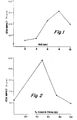
- FIG. 1 is a plot of Izod impact strength for the samples tested, the results of which are tabulated in Table VI hereinabove, showing graphically the synergistic effect of the contribution of rubber from SBS to the impact strength of the molded test strips.
- GEON 603x560 CPVC is modified individually and conjointly with KRATON 1102 SBS linear block co-polymer and KM323B which is a grafted PMMA/PBA type (66% polybutyl acrylate rubber coated with polymethyl/methacrylate) of co-polymer available from Rohm & Haas.
- KRATON 1102 SBS linear block co-polymer and KM323B which is a grafted PMMA/PBA type (66% polybutyl acrylate rubber coated with polymethyl/methacrylate) of co-polymer available from Rohm & Haas.
- Each batch is formulated by melt-blending 100 g GEON 603x560 CPVC with MICROTHENE polyethylene lubricant (1.5 g), THERMOLITE T-31 stabilizer (2.0 g) and Ti0 2 uncoated rutile (2.0 g).
- the components are melt-blended between 210°C rolls for 2 min after banding.
- the values tabulated for lzod impact strength are the average values of six samples compression molded at 210°C. The results obtained are set forth in Table VII hereinbelow.
- KRO-3 polymer which is a plastic radial SBS block copolymer and an ungrafted CPE are melt-blended individually and conjointly as co-modifiers, and the results obtained are set forth in Table VIII hereinbelow.
- Each batch is formulated by melt-blending about 100 g (adjusted as stated) of GEON 603x560 CPVC and enough co-modifier(s) to provide 4 phr rubber in the composition.
- KRO-3 SBS block copolymer is mixed with CPE the rubber content is maintained at 4 phr, and the % of rubber contributed by the SBS block copolymer is recorded.
- each batch includes MICROTHENE polyethylene lubricant (1.5 g), THERMOLITE T-31 stabilizer (2.5 g) and TiO z filler (5.0 g).
- the components are melt-blended between 205°C rolls for 2 min after banding.
- the values tabulated for Izod impact strength are the average values of six samples compression molded at 210°C.
- 5 phr Kraton 1102 polymer which is a linear block SBS copolymer, is combined for its effect, with various levels of Zerlon (Reg. U.S. Trade Mark) 150-Z27 modifier.
- Zerlon is not a conventional impact modifier as it contains no rubber, but it is methyl methacrylate/styrene (65/35) copolymer available. from Dow Chemical Co. Lubricant and stabilizer are added as above, and the components melt-blended between 200°C rolls for 120 sec after banding. Test pieces are compression molded at 210°C, and the values set forth are the averages for six samples.
- SB diblock or SBS polyblock copolymers may be used in mixed form or individually.
- the ratio of diblock to SBS polyblock, or the ratio of SBS linear polyblock to radial polyblock, or the ratio of any combinations thereof may be varied to produce a resin of desirable optical and other physical characterisitcs amongst which impact strength may be tailored for a particular purpose.
- more than one co-modifier may be used in combination with a SB or SBS block copolymer modifier in which the particle sizes and molecular weights are varied, allowing an additional degree of latitude in tailoring a resin for further desirable physical characteristics and desired impact performance.
Landscapes
- Chemical & Material Sciences (AREA)
- General Chemical & Material Sciences (AREA)
- Health & Medical Sciences (AREA)
- Chemical Kinetics & Catalysis (AREA)
- Medicinal Chemistry (AREA)
- Polymers & Plastics (AREA)
- Organic Chemistry (AREA)
- Compositions Of Macromolecular Compounds (AREA)
Claims (16)
Applications Claiming Priority (2)
| Application Number | Priority Date | Filing Date | Title |
|---|---|---|---|
| US05/889,458 US4181644A (en) | 1978-03-23 | 1978-03-23 | Impact modified polymer composition |
| US889458 | 1978-03-23 |
Publications (3)
| Publication Number | Publication Date |
|---|---|
| EP0004547A2 EP0004547A2 (fr) | 1979-10-17 |
| EP0004547A3 EP0004547A3 (en) | 1979-10-31 |
| EP0004547B1 true EP0004547B1 (fr) | 1982-03-17 |
Family
ID=25395137
Family Applications (1)
| Application Number | Title | Priority Date | Filing Date |
|---|---|---|---|
| EP79100537A Expired EP0004547B1 (fr) | 1978-03-23 | 1979-02-23 | Compositions de chlorure de polyvinyle chloré ayant une résistance aux chocs modifiée |
Country Status (7)
| Country | Link |
|---|---|
| US (1) | US4181644A (fr) |
| EP (1) | EP0004547B1 (fr) |
| JP (1) | JPS54131653A (fr) |
| AU (1) | AU526198B2 (fr) |
| CA (1) | CA1111177A (fr) |
| DE (1) | DE2962265D1 (fr) |
| NZ (1) | NZ189648A (fr) |
Families Citing this family (11)
| Publication number | Priority date | Publication date | Assignee | Title |
|---|---|---|---|---|
| KR910007599B1 (ko) * | 1983-01-27 | 1991-09-28 | 세끼스이 가세이힌 고오교오 가부시끼가이샤 | 과립상 유기할로겐화물 난연제 첨가제 |
| US4530968A (en) * | 1984-06-19 | 1985-07-23 | Swisher Gregory M | Polymer blend composition exhibiting impact resistance |
| JPH0774299B2 (ja) * | 1986-10-14 | 1995-08-09 | 三菱レイヨン株式会社 | 塩素化塩化ビニル系樹脂組成物 |
| US4974493A (en) * | 1988-12-20 | 1990-12-04 | Yeffman Paul L | Shock absorbing buffer and recoil reducer |
| US5079296A (en) * | 1989-07-21 | 1992-01-07 | Polysar Limited | Transparent toughened thermoplastics |
| US5268424A (en) * | 1990-11-29 | 1993-12-07 | The B. F. Goodrich Company | Chlorinated polyvinyl chloride/polycarbonate blend |
| US5900452A (en) | 1996-08-12 | 1999-05-04 | Tactyl Technologies, Inc. | S-EB-S block copolymer/oil aqueous dispersion and its use in forming articles |
| US6593423B1 (en) | 2000-05-03 | 2003-07-15 | Ppg Industries Ohio, Inc. | Adhesion promoting agent and coating compositions for polymeric substrates |
| US20050070663A1 (en) * | 2003-09-29 | 2005-03-31 | Fina Technology, Inc. | Impact modified polystyrene and process for preparing same |
| CN109535618A (zh) * | 2018-11-13 | 2019-03-29 | 新疆兵团现代绿色氯碱化工工程研究中心(有限公司) | 一种高稳定性cpvc管材及其配混方法 |
| CN113829704B (zh) * | 2021-09-22 | 2023-03-14 | 杭州久通塑业有限公司 | 一种抗冲改性cpvc电力电缆护套管 |
Family Cites Families (4)
| Publication number | Priority date | Publication date | Assignee | Title |
|---|---|---|---|---|
| FR2011790A1 (fr) * | 1968-06-29 | 1970-03-06 | Kanegafuchi Chemical Ind | |
| FR2117185A5 (en) * | 1970-12-02 | 1972-07-21 | Shell Int Research | Biocidal moulding compsn - comprising a pvc resin an elastomeric diene block copolymer and a phosphate plasticiser |
| US3793406A (en) * | 1971-11-21 | 1974-02-19 | Rohm & Haas | Vinyl halide polymer impact modifiers |
| US3801529A (en) * | 1973-02-12 | 1974-04-02 | Shell Oil Co | Block copolymer-polyvinyl chloride compositions |
-
1978
- 1978-03-23 US US05/889,458 patent/US4181644A/en not_active Expired - Lifetime
-
1979
- 1979-02-13 CA CA321,405A patent/CA1111177A/fr not_active Expired
- 1979-02-14 NZ NZ189648A patent/NZ189648A/xx unknown
- 1979-02-15 AU AU44268/79A patent/AU526198B2/en not_active Ceased
- 1979-02-23 EP EP79100537A patent/EP0004547B1/fr not_active Expired
- 1979-02-23 DE DE7979100537T patent/DE2962265D1/de not_active Expired
- 1979-03-23 JP JP3342179A patent/JPS54131653A/ja active Pending
Also Published As
| Publication number | Publication date |
|---|---|
| DE2962265D1 (en) | 1982-04-15 |
| EP0004547A3 (en) | 1979-10-31 |
| EP0004547A2 (fr) | 1979-10-17 |
| JPS54131653A (en) | 1979-10-12 |
| NZ189648A (en) | 1980-12-19 |
| US4181644A (en) | 1980-01-01 |
| CA1111177A (fr) | 1981-10-20 |
| AU4426879A (en) | 1979-09-27 |
| AU526198B2 (en) | 1982-12-23 |
Similar Documents
| Publication | Publication Date | Title |
|---|---|---|
| EP0170960B1 (fr) | Composition de résine thermoplastique contenant de la sciure de bois | |
| US4161472A (en) | Impact modified vinyl chloride polymer composition | |
| JPH05132603A (ja) | 硬質塩素化、ポリ塩化ビニル化合物及びそれに由来する製品 | |
| US2808387A (en) | Rigid shock-resistant vinyl halide polymer compositions and method of making same | |
| EP0004547B1 (fr) | Compositions de chlorure de polyvinyle chloré ayant une résistance aux chocs modifiée | |
| US4607080A (en) | Thermoplastic resin composition | |
| CA1134974A (fr) | Melanges polymeriques d'halogenures de vinyle resistant mieux aux chocs | |
| JP3338725B2 (ja) | パイプ形成用後塩素化ポリ塩化ビニル配合物 | |
| EP0755972A2 (fr) | Composition à base de polymère styrénique | |
| EP0055086B1 (fr) | Mélanges de résine de chlorure de polyvinyle | |
| US4469844A (en) | Blends of a rubber-modified polyvinyl chloride resin and rubber-modified polymer of a vinyl aromatic monomer and unsaturated dicarboxylic acid anhydride monomer | |
| US3954908A (en) | Flame retardant resin composition comprising an acrylonitrile-styrene base terpolymer, a different acrylonitrile-styrene-chlorinated polyethylene terpolymer and antimony trioxide | |
| US4168285A (en) | Blend of a vinyl chloride polymer and an impact modifier | |
| US2753322A (en) | Rigid vinyl halide polymer compositions adapted for vacuum forming | |
| US2719137A (en) | Tough, rigid composition of vinyl chloride polymer and rubbery diolefinacrylic ester copolymer | |
| US4647620A (en) | Polyblends of a copolymer of a vinyl aromatic monomer and an unsaturated dicarboxylic acid anhydride with a methyl methacrylate homopolymer or copolymer | |
| US4456733A (en) | Thermoplastic polyblend compositions | |
| US5603998A (en) | CPVC compounds and articles made therefrom for design stress rating above 180° C. | |
| EP0035321B1 (fr) | Compositions comprenant une résine poly(méthyl éthényl benzène) et une huile minérale | |
| US4510280A (en) | Thermoplastic PVC molding compositions | |
| US4551500A (en) | Blends of a rubber-modified vinyl chloride resin, an unmodified vinyl chloride resin, and a polymer of a vinyl aromatic monomer and an unsaturated dicarboxylic acid anhydride monomer | |
| US5003007A (en) | Copolymer blends | |
| JP2693682B2 (ja) | 塩化ビニル系樹脂組成物 | |
| US3424823A (en) | Composition of vinyl chloride polymers and copolymers of alkenyl aromatic hydrocarbons and acrylonitrile or methacrylonitrile | |
| US4460744A (en) | Blends of grafted acrylate polymers and mass-made ABS-type resins |
Legal Events
| Date | Code | Title | Description |
|---|---|---|---|
| PUAI | Public reference made under article 153(3) epc to a published international application that has entered the european phase |
Free format text: ORIGINAL CODE: 0009012 |
|
| PUAL | Search report despatched |
Free format text: ORIGINAL CODE: 0009013 |
|
| AK | Designated contracting states |
Designated state(s): BE DE FR |
|
| AK | Designated contracting states |
Designated state(s): BE DE FR |
|
| 17P | Request for examination filed | ||
| GRAA | (expected) grant |
Free format text: ORIGINAL CODE: 0009210 |
|
| AK | Designated contracting states |
Designated state(s): BE DE FR |
|
| REF | Corresponds to: |
Ref document number: 2962265 Country of ref document: DE Date of ref document: 19820415 |
|
| PGFP | Annual fee paid to national office [announced via postgrant information from national office to epo] |
Ref country code: FR Payment date: 19831213 Year of fee payment: 6 |
|
| PGFP | Annual fee paid to national office [announced via postgrant information from national office to epo] |
Ref country code: DE Payment date: 19831216 Year of fee payment: 6 |
|
| PGFP | Annual fee paid to national office [announced via postgrant information from national office to epo] |
Ref country code: BE Payment date: 19831231 Year of fee payment: 6 |
|
| PG25 | Lapsed in a contracting state [announced via postgrant information from national office to epo] |
Ref country code: BE Effective date: 19850228 |
|
| BERE | Be: lapsed |
Owner name: THE B.F. GOODRICH CY Effective date: 19850223 |
|
| PG25 | Lapsed in a contracting state [announced via postgrant information from national office to epo] |
Ref country code: FR Free format text: LAPSE BECAUSE OF NON-PAYMENT OF DUE FEES Effective date: 19851031 |
|
| PG25 | Lapsed in a contracting state [announced via postgrant information from national office to epo] |
Ref country code: DE Effective date: 19851101 |
|
| REG | Reference to a national code |
Ref country code: FR Ref legal event code: ST |
|
| PLBE | No opposition filed within time limit |
Free format text: ORIGINAL CODE: 0009261 |
|
| STAA | Information on the status of an ep patent application or granted ep patent |
Free format text: STATUS: NO OPPOSITION FILED WITHIN TIME LIMIT |