EP0005643A2 - Procédé de production de coke de haute qualité et électrode obtenue en graphitisant ledit coke - Google Patents
Procédé de production de coke de haute qualité et électrode obtenue en graphitisant ledit coke Download PDFInfo
- Publication number
- EP0005643A2 EP0005643A2 EP79300900A EP79300900A EP0005643A2 EP 0005643 A2 EP0005643 A2 EP 0005643A2 EP 79300900 A EP79300900 A EP 79300900A EP 79300900 A EP79300900 A EP 79300900A EP 0005643 A2 EP0005643 A2 EP 0005643A2
- Authority
- EP
- European Patent Office
- Prior art keywords
- premium
- coke
- fraction
- cracking
- pitch
- Prior art date
- Legal status (The legal status is an assumption and is not a legal conclusion. Google has not performed a legal analysis and makes no representation as to the accuracy of the status listed.)
- Withdrawn
Links
Images

Classifications
-
- C—CHEMISTRY; METALLURGY
- C10—PETROLEUM, GAS OR COKE INDUSTRIES; TECHNICAL GASES CONTAINING CARBON MONOXIDE; FUELS; LUBRICANTS; PEAT
- C10B—DESTRUCTIVE DISTILLATION OF CARBONACEOUS MATERIALS FOR PRODUCTION OF GAS, COKE, TAR, OR SIMILAR MATERIALS
- C10B55/00—Coking mineral oils, bitumen, tar, and the like or mixtures thereof with solid carbonaceous material
Definitions
- This invention relates to a process for upgrading a low value petroleum refinery stream, and more particularly to a process of converting petroleum residuum to distillate products and premium coke.
- HDDC hydrogen donor diluent cracking
- a hydrogen deficient oil such as vacuum residuum
- the donor diluent is an aromatic-naphthenic material having the ability to take up hydrogen in a hydrogenation zone and readily release it to hydrogen deficient hydrocarbons in a thermal cracking zone.
- the selected donor material is partially hydrogenated by conventional methods using, preferably, a sulfur insensitive catalyst such as molybdenum sulfide, nickel-molybdenum or nickel-tungsten sulfide.
- Delayed coking of vacuum residuum generally produces a coke with a coefficient of thermal expansion (CTE) greater than 20 x 10 -7 /°C.
- the CTE of the coke is a measure of its suitability for use in the manufacture of electrodes for electric arc steel furnaces.
- the lower CTE cokes produce more thermally stable electrodes.
- Coke which is suitable for manufacture of electrodes for steel furnaces is generally designated as premium or needle coke.
- the CTE value required for a coke to be designated premium coke is not precisely defined, and there are many other specifications other than CTE which must be met in order for a coke to be designated premium coke. Nevertheless, the most important characteristic, and the one most difficult to obtain, is a suitably low CTE.
- the manufacture of 61 centimeter diameter electrodes requires CTE values of less than 5 x 10 -7 /°C, and the manufacture of 41 centimeter diameter electrodes generally requires a coke having a CTE of less than 8 x 10" /°c. Delayed coking of vacuum residuum from most crudes produces a coke with a CTE of greater than 20 x 10 /°C, and such cokes, designated regular grade cokes, are not capable of producing a satisfactory large diameter electrode for use in electric arc steel furnaces.
- premium coke is used to define a coke produced.by delayed coking which, when graphitined according to known procedures, has a linear coefficient of thermal expansion of less than 8 x 10 -7 /°C.
- premium coke made according to this invention has a CTE of about 5 x 10 -7 /°C or less.
- Premium coke is produced commercially by delayed coking of certain refinery streams such as thermal tars, decant cil from a fluidized bed catalytic cracking operation for manufacture of gasoline, pyrolysis tar, blends of these materials, and these materials blended with minor amounts of vacuum residuum or other similar material.
- refinery streams such as thermal tars, decant cil from a fluidized bed catalytic cracking operation for manufacture of gasoline, pyrolysis tar, blends of these materials, and these materials blended with minor amounts of vacuum residuum or other similar material.
- Premium coke is worth several times as much as regular coke. It is accordingly apparent that any process that can produce premium coke from a low value material such as vacuum residuum is much to be desired, and prior to this invention no such process was available to the industry.
- pitch means a bottom stream from a fractionator used to separate distillates and lighter cracked products from the effluent of an HDDC unit, and the pitch typically contains the heavier effluent components along with some material in the gas oil boiling range.
- the heavy liquid hydrocarbonaceous material is preferably a vacuum reduced crude oil residuum having an initial boiling point of at least 480°C.
- a gas oil fraction or part thereof is separated from said pitch fraction and is preferably hydrogenated for reuse in the hydrogen donor diluent cracking. Moreover a portion of the gas oil fraction obtained after hydrogenation is advantageously combined with said pitch fraction prior to introduction of said pitch fraction to said delayed premium coking operation.
- the hydrogen donor diluent cracking operation is preferably effected in a two-stage cracking operation utilizing two cracking furnaces with intermediate fractionation.
- a conventional premium coker feedstock such as pyrolysis tar,thermal tar ur decant oil e.g. from a fluidized bed catalytic cracking operation is blended with the pitch from the HDDC process to provide a feedstock which produces premium coke, the amount of premium coker feedstock preferably being no greater than 80 per cent by volume of the total feed stream to the delayed coking operation.
- Vacuum residuum feedstock from line 10 is combined with a hydrogen donor diluent from line 11 and fed to a cracking furnace 12 in accordance with the basic HDDC process as known in the art.
- Furnace 12 typically operates at a temperature of from 480 to 540°C and a 2 2 pressure of 10.5 to 70 kg/cm , preferably about 28 kg/cm .
- the furnace effluent passes to a fractionator 13, where gases and distillates are taken off the upper section through lines 22 and 23:
- a gas-oil fraction is taken off the mid portion of the fractionator through line 24, combined with hydrogen from line 25, and hydrogenated in catalytic hydrotreater 14 for reuse as hydrogen donor diluent in the HDDC process.
- a portion of the hydrotreated gas-oil from hydrotreater 14 is taken through line 26, combined with the pitch from the bottom of fractionator 13, and passed to a coker furnace 15 where it is heated to coking temperature.
- Conventional premium coker feedstock can be added through line 19, if desired.
- the coker furnace effluent is.then passed to a delayed coke drum 16 operated at typical conditions suitable for formation of premium coke.
- Vapors from coke drum 16 are returned through line 27 to the fractionator 13, and premium coke is eventually withdrawn from the bottom of coke drum 16.
- premium coke suitable for electrode production for electric arc steel furnaces can be produced from vacuum residuum. Without the inclusion of the HDDC process, the coke produced from vacuum residuum would be regular grade coke, which has a much lower economic value and different physical properties than the premium coke obtainable by the process illustrated in Figure'1.
- An essential feature of this invention is that the charge to the coker furnace must contain no more than 30 volume percent of material boiling above 510°C. Much of the 510°C+ material in the vacuum residuum feedstock is cracked to lighter material in the HDDC step, and the pitch from the fractionator contains essentially all of the unconverted 510 0 C+ material as well as a considerable amount of heavy gas oil or spent donor boiling in the 340-510°C range. Sufficient donor diluent from the hydrotreater is combined with the pitch to provide a coker feed having no more than 30 volume percent 510°C+ material.
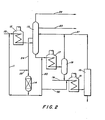
- Figure 2 illustrates a process similar to that described above with reference to Figure 1 but with the addition of a second stage cracking furnace 17 and a flash separator 18 between the second stage cracking furnace 17 and the coker furnace 15 to remove light ends from the coker feedstock which might otherwise result in a gas flow rate through the coke drum 16 which is higher than desired.
- Figure 2 also shows a line 19 for addition of a conventional premium coker feedstock to the coker furnace feed.
- a first portion of the hydrogen donor diluent after passing through the hydrotreater 14, is fed through line 20 to the second stage cracking furnace 17, and a second portion is fed through line 30 to the coker furnace 15.
- the vacuum residuum utilized as feedstock in this process is the bottoms from a vacuum distillation column such as is used to further fractionate a reduced atmospheric crude.
- the vacuum residuum includes all of the bottoms material boiling above a selected temperature, which is generally between about 480 and 565° C .
- the exact cutoff point for the vacuum residuum is influenced by the type of refinery and the needs of the various units within the refinery. Generally, everything that can be distilled'from the vacuum column is removed, such that the residuum includes only material which is not practicably distilled.
- the cutoff point may be lowered without adversely affecting the economics of the refining operation, and if the coking capacity is available the residuum might well include all of the material from the vacuum column boiling above about 480°C.
- the process of this invention is applicable to heavy hydrocarbonaceous streams other than a vacuum residuum.
- Certain heavy crude oils, tar sand bitumens, etc. which contain very little low boiling material, might be used without any pretreatment or after only a light topping operation.
- vacuum residuum and similar heavy hydrocarbonaceous material can be coked in a delayed coking operation without first subjecting the material to an HDDC step.
- the coke produced thereby would be low grade or regular coke instead of the valuable premium coke produced by the process of this invention.
- the combination of the HDDC process with a delayed coking operation permits production of a valuable premium coke from a low value vacuum residuum feedstock.
- the combination further permits blending of pitch produced from the HDDC process with conventional premium feedstock to produce premium coke which can have a graphitized CTE even lower than that of premium coke produced from conventional premium coker feedstock alone. This synergistic effect is particularly surprising as one would normally expect the CTE value of a coke produced from.a blend of materials to be between the values obtainable by the use of the constituents individually.
- the results obtainable according to the process of this invention were.demonstrated in a series of pilot plant runs. In each of these runs, the vacuum residuum was taken from a full scale commercial refinery.
- the pitch was produced using an HDDC pilot plant having two cracking stages, a hydrotreater for hydrogenating a recycle donor diluent stream, and fractionation equipment to separate distillate, recycle donor and pitch fractions from the cracking coil effluent.
- the pitch produced in the HDDC pilot plant was then coked in a pilot plant coker.
- a vacuum residuum was fed to an HDDC pilot plant having a furnace coil temperature of 510°C and a furnace coil pressure of 28 kg/cm 2 .
- a pitch fraction was obtained by fractionation of the cracking furnace effluent.
- Three coking runs were made in a coker pilot plant under identical coking conditions including a coke drum temperature of 482°C and a coke drum pressure of 1.76 kg/cm.
- the fresh feed composition to the coker was 100 percent decant oil from a fluidized bed catalytic cracking unit.
- the decant oil used is a conventional feedstock for a commercial premium coker.
- a second coker pilot plant run utilized pitch obtained from the HDDC pilot plant run described above.
- a third coker pilot plant run utilized a blend of equal parts by volume of the HDDC pitch and the decant oil.
- the C TE of the resulting cokes was within the range required for designation as premium coke.
- the CTE of the coke produced from the blend of pitch and decant oil was lower than that for either of the runs utilizing these feedstocks individually.
- the synergistic effect of utilizing the blend of pitch and decant oil is demonstrated by the fact that the CTE of the coke from this blend was lower than the value.obtained utilizing either 100 percent conventional premium coker feedstock or 100 percent HDDC pitch under identical coking conditions. Table I below illustrates this feature.
- the required feedstock to the process of this invention is heavy liquid hydrocarbonaceous material having an initial boiling point above 340°C.
- a preferred feedstock is the bottoms fraction from a petroleum refinery vacuum distillation. tower_ having an initial boiling point above 480°C.
- An optional supplemental feedstock is a conventional premium coker feedstock such as decant oil, thermal tar, pyrolysis tar or combinations of these.
- the proportion of conventional premium coker feedstock to vacuum tower bottoms in the process depends to some extent on the type of equipment available in the refinery and the coke forming capacity available. It is preferred that at least 20 volume percent, and preferably from 30 to 70 volume percent, of the coker feedstock be pitch derived from the HDDC process. However, the entire coker feedstock can be pitch from the HDDC process and a premium coke is still pro-luced as illustrated in the above example.
- the product streams from the process are gases, distillates (primarily those boiling below about 340°C), and premium coke. Some excess donor may be produced, and can be removed to keep the operation in donor balance.
- a 480°C+ bottoms stream from a vacuum distillation column is blended with an equal volume of an aromatic gas-oil fraction (hydrogen donor diluent) boiling above 340°C which has been subjected to mild hydrogenation conditions.
- the combined vacuum residuum and hydrogenated donor diluent is fed to a cracking furnace having a coil temperature of 510°C and a coil inlet pressure of 28 kg/cm 2 .
- the effluent from the cracking furnace is passed to a fractionator where gases and distillates boiling below 340°C are recovered, and a stream boiling above 340°C is removed, blended with hydrogen gas, and passed through a catalytic hydrotreater for reuse as hydrogen donor diluent.
- the pitch from the bottom of the fractionator including some 340° C + material, is blended with an equal volume of decant oil having a boiling range of from 340-480°C and the blended stream then passed to a coker furnace where it is heated to 495°C and then fed to the bottom of a coke drum.
- the coke drum is operated at an overhead outlet temperature of 460°C and a pressure of 1.8 kg/cm. Overhead vapors from the coke drum are returned to the fractionator, and premium coke is formed in the coke drum.
- the resulting coke is then removed from the coke drum, calcined and graphitized, and has a CTE of less than 5 x 10 -7 /°C.
Landscapes
- Chemical & Material Sciences (AREA)
- Oil, Petroleum & Natural Gas (AREA)
- Engineering & Computer Science (AREA)
- Organic Chemistry (AREA)
- General Chemical & Material Sciences (AREA)
- Materials Engineering (AREA)
- Chemical Kinetics & Catalysis (AREA)
- Coke Industry (AREA)
- Production Of Liquid Hydrocarbon Mixture For Refining Petroleum (AREA)
- Carbon And Carbon Compounds (AREA)
- Surgical Instruments (AREA)
- Agricultural Chemicals And Associated Chemicals (AREA)
- Medicines Containing Material From Animals Or Micro-Organisms (AREA)
Applications Claiming Priority (2)
| Application Number | Priority Date | Filing Date | Title |
|---|---|---|---|
| US05/908,333 US4178229A (en) | 1978-05-22 | 1978-05-22 | Process for producing premium coke from vacuum residuum |
| US908333 | 1978-05-22 |
Publications (2)
| Publication Number | Publication Date |
|---|---|
| EP0005643A2 true EP0005643A2 (fr) | 1979-11-28 |
| EP0005643A3 EP0005643A3 (fr) | 1979-12-12 |
Family
ID=25425611
Family Applications (1)
| Application Number | Title | Priority Date | Filing Date |
|---|---|---|---|
| EP79300900A Withdrawn EP0005643A3 (fr) | 1978-05-22 | 1979-05-21 | Procédé de production de coke de haute qualité et électrode obtenue en graphitisant ledit coke |
Country Status (17)
| Country | Link |
|---|---|
| US (1) | US4178229A (fr) |
| EP (1) | EP0005643A3 (fr) |
| JP (1) | JPS54153802A (fr) |
| AU (1) | AU525398B2 (fr) |
| BE (1) | BE74T1 (fr) |
| CA (1) | CA1127989A (fr) |
| DE (1) | DE2953190A1 (fr) |
| DK (1) | DK155437C (fr) |
| ES (1) | ES479879A1 (fr) |
| FR (1) | FR2454457A1 (fr) |
| GB (1) | GB2044797B (fr) |
| IT (1) | IT1148220B (fr) |
| NL (1) | NL7915044A (fr) |
| NO (1) | NO149893C (fr) |
| PH (1) | PH14747A (fr) |
| SE (1) | SE446988B (fr) |
| ZA (1) | ZA79659B (fr) |
Cited By (4)
| Publication number | Priority date | Publication date | Assignee | Title |
|---|---|---|---|---|
| EP0103053A1 (fr) * | 1982-08-26 | 1984-03-21 | Conoco Phillips Company | Amélioration des hydrocarbures lourds |
| EP0083143A3 (en) * | 1981-12-29 | 1984-05-30 | Union Carbide Corporation | Process for producing premium coke |
| WO2015128044A1 (fr) * | 2014-02-25 | 2015-09-03 | Saudi Basic Industries Corporation | Procédé de craquage séquentiel |
| WO2021126819A1 (fr) * | 2019-12-19 | 2021-06-24 | Saudi Arabian Oil Company | Procédé et système intégrés pour valoriser du pétrole brut |
Families Citing this family (35)
| Publication number | Priority date | Publication date | Assignee | Title |
|---|---|---|---|---|
| US4347120A (en) * | 1980-12-22 | 1982-08-31 | Conoco Inc. | Upgrading of heavy hydrocarbons |
| US4521294A (en) * | 1981-04-13 | 1985-06-04 | Nippon Oil Co., Ltd. | Starting pitches for carbon fibers |
| JPS5840386A (ja) * | 1981-06-30 | 1983-03-09 | ユニオン・カ−バイド・コ−ポレ−シヨン | 高硫黄デカントオイルから低硫黄高品位コ−クスを製造する方法 |
| US4455219A (en) * | 1982-03-01 | 1984-06-19 | Conoco Inc. | Method of reducing coke yield |
| US4430197A (en) | 1982-04-05 | 1984-02-07 | Conoco Inc. | Hydrogen donor cracking with donor soaking of pitch |
| US4551232A (en) * | 1983-02-09 | 1985-11-05 | Intevep, S.A. | Process and facility for making coke suitable for metallurgical purposes |
| US4519898A (en) * | 1983-05-20 | 1985-05-28 | Exxon Research & Engineering Co. | Low severity delayed coking |
| US4604186A (en) * | 1984-06-05 | 1986-08-05 | Dm International Inc. | Process for upgrading residuums by combined donor visbreaking and coking |
| US4737261A (en) * | 1984-10-05 | 1988-04-12 | International Coal Refining Company | Process for the production of premium grade needle coke from a hydrotreated SRC material |
| US4624775A (en) * | 1984-10-22 | 1986-11-25 | Union Carbide Corporation | Process for the production of premium coke from pyrolysis tar |
| US4762608A (en) * | 1984-12-20 | 1988-08-09 | Union Carbide Corporation | Upgrading of pyrolysis tar |
| US4604185A (en) * | 1985-07-02 | 1986-08-05 | Conoco Inc. | Co-processing of straight run vacuum resid and cracked residua |
| US4713168A (en) * | 1986-08-29 | 1987-12-15 | Conoco Inc. | Premium coking process |
| US4795548A (en) * | 1986-10-27 | 1989-01-03 | Intevep, S.A. | Process for making anode grade coke |
| US5089114A (en) * | 1988-11-22 | 1992-02-18 | Instituto Mexicano Del Petroleo | Method for processing heavy crude oils |
| US5059301A (en) * | 1988-11-29 | 1991-10-22 | Conoco | Process for the preparation of recarburizer coke |
| US5286371A (en) * | 1992-07-14 | 1994-02-15 | Amoco Corporation | Process for producing needle coke |
| US6048448A (en) * | 1997-07-01 | 2000-04-11 | The Coastal Corporation | Delayed coking process and method of formulating delayed coking feed charge |
| US5954949A (en) * | 1998-03-25 | 1999-09-21 | Unipure Corporation | Conversion of heavy petroleum oils to coke with a molten alkali metal hydroxide |
| US6168709B1 (en) | 1998-08-20 | 2001-01-02 | Roger G. Etter | Production and use of a premium fuel grade petroleum coke |
| US20020179493A1 (en) * | 1999-08-20 | 2002-12-05 | Environmental & Energy Enterprises, Llc | Production and use of a premium fuel grade petroleum coke |
| US7959888B2 (en) | 2005-12-27 | 2011-06-14 | Nippon Oil Corporation | Raw coke for electricity storage carbon material and needle coke |
| CA2669636A1 (fr) * | 2006-11-17 | 2008-05-29 | Roger G. Etter | Craquage catalytique de composants indesirables dans un procede de cokefaction |
| US9011672B2 (en) | 2006-11-17 | 2015-04-21 | Roger G. Etter | System and method of introducing an additive with a unique catalyst to a coking process |
| US8206574B2 (en) | 2006-11-17 | 2012-06-26 | Etter Roger G | Addition of a reactor process to a coking process |
| US8361310B2 (en) * | 2006-11-17 | 2013-01-29 | Etter Roger G | System and method of introducing an additive with a unique catalyst to a coking process |
| US8372264B2 (en) | 2006-11-17 | 2013-02-12 | Roger G. Etter | System and method for introducing an additive into a coking process to improve quality and yields of coker products |
| EP2166062B1 (fr) * | 2007-06-22 | 2018-09-12 | Nippon Petroleum Refining Company Limited | Procédé servant à produire du coke de pétrole |
| US9109165B2 (en) * | 2008-11-15 | 2015-08-18 | Uop Llc | Coking of gas oil from slurry hydrocracking |
| US9375656B2 (en) | 2009-01-09 | 2016-06-28 | Phillips 66 Company | Slurry oil upgrading while preserving aromatic content |
| US20100176029A1 (en) * | 2009-01-09 | 2010-07-15 | Conocophillips Company | Upgrading Slurry Oil Using Chromatographic Reactor Systems |
| US8540870B2 (en) * | 2009-06-25 | 2013-09-24 | Uop Llc | Process for separating pitch from slurry hydrocracked vacuum gas oil |
| US8202480B2 (en) | 2009-06-25 | 2012-06-19 | Uop Llc | Apparatus for separating pitch from slurry hydrocracked vacuum gas oil |
| CN105143152B (zh) * | 2013-03-15 | 2017-06-16 | 贝克特尔碳氢技术解决方案股份有限公司 | 用于外部加工来自延迟焦化工艺的闪蒸区柴油的系统和方法 |
| CN109233886B (zh) * | 2018-10-26 | 2021-10-15 | 重庆润科新材料技术有限公司 | 一种利用中低温煤焦油制备煤系针状焦的生产方法 |
Family Cites Families (12)
| Publication number | Priority date | Publication date | Assignee | Title |
|---|---|---|---|---|
| BE529891A (fr) * | 1953-07-01 | |||
| US2791541A (en) * | 1955-01-04 | 1957-05-07 | Exxon Research Engineering Co | Two-stage hydrogen donor diluent cracking process |
| US2953513A (en) * | 1956-03-05 | 1960-09-20 | Exxon Research Engineering Co | Hydrogen donor diluent cracking process |
| US2922755A (en) * | 1957-10-14 | 1960-01-26 | Jr Roy C Hackley | Manufacture of graphitizable petroleum coke |
| US3238118A (en) * | 1962-11-06 | 1966-03-01 | Exxon Research Engineering Co | Conversion of hydrocarbons in the presence of a hydrogenated donor diluent |
| US3684688A (en) * | 1971-01-21 | 1972-08-15 | Chevron Res | Heavy oil conversion |
| US3775294A (en) * | 1971-06-28 | 1973-11-27 | Marathon Oil Co | Producing coke from hydrotreated crude oil |
| US3736249A (en) * | 1972-02-22 | 1973-05-29 | Atlantic Richfield Co | Hydrocarbonaceous feed treatment |
| JPS5519277B2 (fr) * | 1973-07-02 | 1980-05-24 | ||
| JPS518642A (en) * | 1974-07-12 | 1976-01-23 | Matsushita Electric Industrial Co Ltd | Judokanetsuchoriki |
| JPS5144103A (en) * | 1974-09-25 | 1976-04-15 | Maruzen Oil Co Ltd | Sekyukookusuno seizoho |
| US4090947A (en) * | 1976-06-04 | 1978-05-23 | Continental Oil Company | Hydrogen donor diluent cracking process |
-
1978
- 1978-05-22 US US05/908,333 patent/US4178229A/en not_active Expired - Lifetime
-
1979
- 1979-01-12 AU AU43324/79A patent/AU525398B2/en not_active Ceased
- 1979-01-24 PH PH22104A patent/PH14747A/en unknown
- 1979-02-14 ZA ZA79659A patent/ZA79659B/xx unknown
- 1979-02-28 CA CA322,612A patent/CA1127989A/fr not_active Expired
- 1979-03-27 NO NO791004A patent/NO149893C/no unknown
- 1979-03-27 DK DK124379A patent/DK155437C/da not_active IP Right Cessation
- 1979-04-24 ES ES479879A patent/ES479879A1/es not_active Expired
- 1979-05-02 JP JP5354179A patent/JPS54153802A/ja active Granted
- 1979-05-21 NL NL7915044A patent/NL7915044A/nl unknown
- 1979-05-21 BE BEBTR74A patent/BE74T1/fr active
- 1979-05-21 DE DE19792953190 patent/DE2953190A1/de active Granted
- 1979-05-21 EP EP79300900A patent/EP0005643A3/fr not_active Withdrawn
- 1979-05-21 GB GB8017859A patent/GB2044797B/en not_active Expired
-
1980
- 1980-05-22 FR FR8011666A patent/FR2454457A1/fr active Granted
- 1980-07-18 IT IT86261/80A patent/IT1148220B/it active
- 1980-10-01 SE SE8006852A patent/SE446988B/sv not_active IP Right Cessation
Cited By (9)
| Publication number | Priority date | Publication date | Assignee | Title |
|---|---|---|---|---|
| EP0083143A3 (en) * | 1981-12-29 | 1984-05-30 | Union Carbide Corporation | Process for producing premium coke |
| EP0103053A1 (fr) * | 1982-08-26 | 1984-03-21 | Conoco Phillips Company | Amélioration des hydrocarbures lourds |
| WO2015128044A1 (fr) * | 2014-02-25 | 2015-09-03 | Saudi Basic Industries Corporation | Procédé de craquage séquentiel |
| CN106062144A (zh) * | 2014-02-25 | 2016-10-26 | 沙特基础工业公司 | 连续裂化方法 |
| US10160920B2 (en) | 2014-02-25 | 2018-12-25 | Saudi Basic Industries Corporation | Sequential cracking process |
| CN106062144B (zh) * | 2014-02-25 | 2019-04-19 | 沙特基础工业公司 | 连续裂化方法 |
| EA032185B1 (ru) * | 2014-02-25 | 2019-04-30 | Сауди Бейсик Индастриз Корпорейшн | Способ последовательного крекинга |
| WO2021126819A1 (fr) * | 2019-12-19 | 2021-06-24 | Saudi Arabian Oil Company | Procédé et système intégrés pour valoriser du pétrole brut |
| US11384300B2 (en) | 2019-12-19 | 2022-07-12 | Saudi Arabian Oil Company | Integrated process and system to upgrade crude oil |
Also Published As
| Publication number | Publication date |
|---|---|
| NO791004L (no) | 1979-11-23 |
| FR2454457B1 (fr) | 1981-10-23 |
| SE8006852L (sv) | 1980-10-01 |
| NO149893C (no) | 1984-07-11 |
| US4178229A (en) | 1979-12-11 |
| GB2044797B (en) | 1982-09-15 |
| BE74T1 (fr) | 1980-06-20 |
| ZA79659B (en) | 1980-03-26 |
| AU525398B2 (en) | 1982-11-04 |
| IT1148220B (it) | 1986-11-26 |
| EP0005643A3 (fr) | 1979-12-12 |
| CA1127989A (fr) | 1982-07-20 |
| DE2953190C2 (fr) | 1988-11-17 |
| NL7915044A (nl) | 1980-10-31 |
| DK155437C (da) | 1989-09-11 |
| DE2953190A1 (de) | 1980-11-06 |
| DK124379A (da) | 1979-11-23 |
| AU4332479A (en) | 1979-11-29 |
| GB2044797A (en) | 1980-10-22 |
| FR2454457A1 (fr) | 1980-11-14 |
| PH14747A (en) | 1981-11-20 |
| JPS54153802A (en) | 1979-12-04 |
| DK155437B (da) | 1989-04-10 |
| JPS6345438B2 (fr) | 1988-09-09 |
| SE446988B (sv) | 1986-10-20 |
| NO149893B (no) | 1984-04-02 |
| ES479879A1 (es) | 1979-11-16 |
| IT8086261A0 (it) | 1980-07-18 |
Similar Documents
| Publication | Publication Date | Title |
|---|---|---|
| US4178229A (en) | Process for producing premium coke from vacuum residuum | |
| US5059303A (en) | Oil stabilization | |
| US4075084A (en) | Manufacture of low-sulfur needle coke | |
| US4666585A (en) | Disposal of petroleum sludge | |
| US4686028A (en) | Upgrading of high boiling hydrocarbons | |
| EP3722392B1 (fr) | Système et procédé de production de coke anisotrope | |
| EP3683289B1 (fr) | Procédé de reformage d'huile de faible qualité | |
| US4519898A (en) | Low severity delayed coking | |
| JP2825570B2 (ja) | 低硫黄及び高硫黄コークスの調製方法 | |
| JPH04320489A (ja) | 復炭コークスの製造方法 | |
| KR0148566B1 (ko) | 중 탄화수소성 공급 원료의 전환 방법 | |
| US4534854A (en) | Delayed coking with solvent separation of recycle oil | |
| KR20000064658A (ko) | 지연된코크스제조공정에서액체생성물수율을증가시키는방법 | |
| EP0129687B1 (fr) | Fabrication de coke aciculaire | |
| US4501654A (en) | Delayed coking process with split fresh feed and top feeding | |
| US4822479A (en) | Method for improving the properties of premium coke | |
| US4720338A (en) | Premium coking process | |
| US4094781A (en) | Separation of solids from tar sands extract | |
| US4176046A (en) | Process for utilizing petroleum residuum | |
| US4514282A (en) | Hydrogen donor diluent cracking process | |
| US4492625A (en) | Delayed coking process with split fresh feed | |
| Speight et al. | The production of low-sulphur liquids and coke from Athabasca bitumen | |
| US3481863A (en) | Refining high sulfur lubricating oil charge stocks | |
| US2944958A (en) | Process of making pitch | |
| EP0156614B1 (fr) | Cokéfaction de résidu en présence d'un donneur d'hydrogène |
Legal Events
| Date | Code | Title | Description |
|---|---|---|---|
| PUAI | Public reference made under article 153(3) epc to a published international application that has entered the european phase |
Free format text: ORIGINAL CODE: 0009012 |
|
| PUAL | Search report despatched |
Free format text: ORIGINAL CODE: 0009013 |
|
| AK | Designated contracting states |
Designated state(s): BE DE FR GB IT NL SE |
|
| AK | Designated contracting states |
Designated state(s): BE DE FR GB IT NL SE |
|
| STAA | Information on the status of an ep patent application or granted ep patent |
Free format text: STATUS: THE APPLICATION IS DEEMED TO BE WITHDRAWN |
|
| 110E | Request filed for conversion into a national patent application [according to art. 135 epc] | ||
| 18D | Application deemed to be withdrawn | ||
| RIN1 | Information on inventor provided before grant (corrected) |
Inventor name: POYNOR, PAUL C. Inventor name: FRIDAY, JOHN R. Inventor name: MCCONAGHY, JAMES R. |