EP0007664A1 - Procédé de revêtement et de soudure d'articles à l'aide d'alliages de métaux durs - Google Patents
Procédé de revêtement et de soudure d'articles à l'aide d'alliages de métaux durs Download PDFInfo
- Publication number
- EP0007664A1 EP0007664A1 EP79200384A EP79200384A EP0007664A1 EP 0007664 A1 EP0007664 A1 EP 0007664A1 EP 79200384 A EP79200384 A EP 79200384A EP 79200384 A EP79200384 A EP 79200384A EP 0007664 A1 EP0007664 A1 EP 0007664A1
- Authority
- EP
- European Patent Office
- Prior art keywords
- powder
- coating material
- hard
- granular
- coating
- Prior art date
- Legal status (The legal status is an assumption and is not a legal conclusion. Google has not performed a legal analysis and makes no representation as to the accuracy of the status listed.)
- Withdrawn
Links
- 238000000576 coating method Methods 0.000 title claims abstract description 50
- 239000011248 coating agent Substances 0.000 title claims abstract description 47
- 238000005476 soldering Methods 0.000 title claims abstract description 9
- 238000000034 method Methods 0.000 title claims description 25
- 229910001092 metal group alloy Inorganic materials 0.000 title claims description 12
- 239000000463 material Substances 0.000 claims abstract description 47
- 239000000843 powder Substances 0.000 claims abstract description 30
- 239000000956 alloy Substances 0.000 claims abstract description 13
- 229910045601 alloy Inorganic materials 0.000 claims abstract description 13
- 239000000203 mixture Substances 0.000 claims abstract description 12
- 238000010438 heat treatment Methods 0.000 claims abstract description 9
- 125000006850 spacer group Chemical group 0.000 claims abstract description 7
- 229910052802 copper Inorganic materials 0.000 claims abstract description 6
- 229910000679 solder Inorganic materials 0.000 claims abstract description 6
- 239000011230 binding agent Substances 0.000 claims abstract description 3
- 229910052793 cadmium Inorganic materials 0.000 claims abstract description 3
- 229910052759 nickel Inorganic materials 0.000 claims abstract description 3
- 229910052709 silver Inorganic materials 0.000 claims abstract description 3
- 239000004033 plastic Substances 0.000 claims description 2
- 229920003023 plastic Polymers 0.000 claims description 2
- 150000003839 salts Chemical class 0.000 claims description 2
- 229910052751 metal Inorganic materials 0.000 description 4
- 239000002184 metal Substances 0.000 description 4
- 150000001247 metal acetylides Chemical class 0.000 description 4
- 239000000155 melt Substances 0.000 description 3
- 229910000676 Si alloy Inorganic materials 0.000 description 2
- 238000007654 immersion Methods 0.000 description 2
- 239000007788 liquid Substances 0.000 description 2
- 150000002739 metals Chemical class 0.000 description 2
- 239000000126 substance Substances 0.000 description 2
- 229910000831 Steel Inorganic materials 0.000 description 1
- 229910052593 corundum Inorganic materials 0.000 description 1
- 239000010431 corundum Substances 0.000 description 1
- 239000010432 diamond Substances 0.000 description 1
- 229910003460 diamond Inorganic materials 0.000 description 1
- 238000009792 diffusion process Methods 0.000 description 1
- 239000000428 dust Substances 0.000 description 1
- 230000000694 effects Effects 0.000 description 1
- 238000005516 engineering process Methods 0.000 description 1
- 230000004927 fusion Effects 0.000 description 1
- 230000005484 gravity Effects 0.000 description 1
- 230000001939 inductive effect Effects 0.000 description 1
- 229910010272 inorganic material Inorganic materials 0.000 description 1
- 239000011147 inorganic material Substances 0.000 description 1
- 229910052500 inorganic mineral Inorganic materials 0.000 description 1
- 229910001338 liquidmetal Inorganic materials 0.000 description 1
- 238000003754 machining Methods 0.000 description 1
- 238000002844 melting Methods 0.000 description 1
- 230000008018 melting Effects 0.000 description 1
- 239000011707 mineral Substances 0.000 description 1
- 150000004767 nitrides Chemical class 0.000 description 1
- 230000000704 physical effect Effects 0.000 description 1
- 229910052573 porcelain Inorganic materials 0.000 description 1
- 239000010453 quartz Substances 0.000 description 1
- 239000004576 sand Substances 0.000 description 1
- VYPSYNLAJGMNEJ-UHFFFAOYSA-N silicon dioxide Inorganic materials O=[Si]=O VYPSYNLAJGMNEJ-UHFFFAOYSA-N 0.000 description 1
- 238000005245 sintering Methods 0.000 description 1
- 239000010959 steel Substances 0.000 description 1
- 229910052721 tungsten Inorganic materials 0.000 description 1
- 239000010937 tungsten Substances 0.000 description 1
- -1 tungsten carbides Chemical class 0.000 description 1
Images

Classifications
-
- C—CHEMISTRY; METALLURGY
- C23—COATING METALLIC MATERIAL; COATING MATERIAL WITH METALLIC MATERIAL; CHEMICAL SURFACE TREATMENT; DIFFUSION TREATMENT OF METALLIC MATERIAL; COATING BY VACUUM EVAPORATION, BY SPUTTERING, BY ION IMPLANTATION OR BY CHEMICAL VAPOUR DEPOSITION, IN GENERAL; INHIBITING CORROSION OF METALLIC MATERIAL OR INCRUSTATION IN GENERAL
- C23C—COATING METALLIC MATERIAL; COATING MATERIAL WITH METALLIC MATERIAL; SURFACE TREATMENT OF METALLIC MATERIAL BY DIFFUSION INTO THE SURFACE, BY CHEMICAL CONVERSION OR SUBSTITUTION; COATING BY VACUUM EVAPORATION, BY SPUTTERING, BY ION IMPLANTATION OR BY CHEMICAL VAPOUR DEPOSITION, IN GENERAL
- C23C24/00—Coating starting from inorganic powder
- C23C24/08—Coating starting from inorganic powder by application of heat or pressure and heat
- C23C24/082—Coating starting from inorganic powder by application of heat or pressure and heat without intermediate formation of a liquid in the layer
- C23C24/085—Coating with metallic material, i.e. metals or metal alloys, optionally comprising hard particles, e.g. oxides, carbides or nitrides
-
- B—PERFORMING OPERATIONS; TRANSPORTING
- B22—CASTING; POWDER METALLURGY
- B22F—WORKING METALLIC POWDER; MANUFACTURE OF ARTICLES FROM METALLIC POWDER; MAKING METALLIC POWDER; APPARATUS OR DEVICES SPECIALLY ADAPTED FOR METALLIC POWDER
- B22F7/00—Manufacture of composite layers, workpieces, or articles, comprising metallic powder, by sintering the powder, with or without compacting wherein at least one part is obtained by sintering or compression
- B22F7/06—Manufacture of composite layers, workpieces, or articles, comprising metallic powder, by sintering the powder, with or without compacting wherein at least one part is obtained by sintering or compression of composite workpieces or articles from parts, e.g. to form tipped tools
- B22F7/08—Manufacture of composite layers, workpieces, or articles, comprising metallic powder, by sintering the powder, with or without compacting wherein at least one part is obtained by sintering or compression of composite workpieces or articles from parts, e.g. to form tipped tools with one or more parts not made from powder
Definitions
- the invention relates to a method for coating and soldering workpieces with hard metal alloys, mixtures of hard metal alloys with hard materials or soft or hard soldering in molds, by applying these alloys or mixtures in powder or granular form, optionally with the addition of binders, such as plastics, on the workpieces to be coated in the respective desired layer thickness, adjustment of this layer thickness if necessary by means of spacers and subsequent heat treatment of the whole.
- the invention has for its object to avoid these and other disadvantages of the prior art and to propose a method which allows a high hard material or carbide concentration to be effected on the upper part of the armor layer which is first exposed to wear.
- the use value and the service life of the armor should be increased and the coating material used should be fully used.
- the process should be economical and enable flawless coatings in a short time.
- This object is achieved in that the powder or granular coating material in the form brings, the workpiece to be coated and heated if necessary under pressure.
- self-flowing hard metal alloys based on Ni or Cu, mixed with B, Si and / or P, are preferably used as powder or granular coating material.
- Mixtures of hard metal alloys with hard materials can also be used to the same extent as powder or granular coating material.
- Hard materials within the scope of the invention are e.g. B. carbides such as WC, borides and nitrides. Minerals such as quartz, corundum and diamond are also suitable as hard materials. Hard materials coated with metals can also be used, as well as mixtures of different hard materials.
- soft or hard solders based on Cu, Ag, Cd and / or Pb are used as powder or granular coating material.
- One embodiment of the invention is that after the powder or granular coating material has been introduced, a layer of a material which reduces the tension is introduced.
- a powder or granular coating material having a lower hardness than the powder or granular coating material first introduced into the mold can be used.
- the whole can be heated in an oven. It can also be done inductively or used for this a salt bath. Furthermore, the heating can be carried out under an inert atmosphere.
- the workpiece can also be coated under pressure.
- solder dissimilar materials for example hard metals
- This option is important when different stresses on the workpiece require the use of materials with different chemical and physical properties.
- the cover immediately develops its wear-resistant properties and does not need to be worn down to a certain degree. This significantly increases the durability of the applied layers.
- the proposed procedure is very versatile.
- the weight of the coating material of the so-called carrier presses into the melt during the coating process and solidifies it. Due to the weight of the carrier or an additional load, liquid metal is also pressed into narrow gaps or drawn in by capillary action.
- This process which corresponds to a soldering process, not only makes it possible to coat surfaces lying horizontally, but also surfaces standing vertically and shaped in various other ways. Furthermore, all sides can flow around the liquid alloy Coating of workpieces can be effected. Another advantage is that the powder does not have any run-on problems.
- the liquid alloy does not flow off or only incompletely on the walls of the mold.
- the result is that not only is valuable coating material lost, but the mold also has to be cleaned or freed of adhering powder after each coating operation, which is time-consuming.
- the surface of the armor layer is homogeneous and smooth.
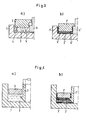
- a hard metal alloy powder 3 made of CrNiBSi with a fraction of 30 to 100 ⁇ m is loosely poured into the mold 1.
- the loose powder is pre-compacted by vibration and leveled in the process.
- the cleaned, dust and dirt-free valve seat ring is placed as workpiece 2 to be coated.
- Mold 1 and workpiece 2 are heated together in a vacuum oven for 1 1/2 hours at a temperature of 1050 C in a vacuum of 10 -2 to 10 -4 Torr. It is then cooled in the oven and the coated workpiece is removed from the mold.
- valve cones are coated, as is often the case in the fittings industry.
- Form 1 made of porcelain with a dimensionally accurate and particularly smooth inner surface the coating material 3, a Co-Cr-WB hard alloy with approx. Workpiece 2 is placed on a powder surface 3 and fixed by a guide 8, so that vertical immersion into the melt ensures is guaranteed.
- this guide takes over the function of the spacer in that it only allows immersion to a pre-calculated depth.
- the powder is melted by inductive heating in an inert atmosphere.
- a tightly tolerated coating is achieved, so that only a very fine machining is required to achieve the tightest tolerances and the highest surface smoothness.
- the highly wear-resistant hard alloy in powder form 3 consisting of a mixture with 50% by weight Ni-Cr-BrSi with approx. 60 HRc and tungsten carbides, is introduced and leveled in form 1.
- a stress-relieving Ni-Cr-B-Si alloy with 30 - 35 HRc 5 is also added as the second alloy.
- the carrier 2 is placed on this depot, which has been provided on the inside with a spacer 4 consisting of Ni-Cr-B-Si bare rods and a sand cast core.
- the fusion bonding was carried out in accordance with Example 1.
- the clamping forces are transmitted to the tough support by using a steel support 2 made of, for example, St 37.
- a steel support 2 made of, for example, St 37.
- a double or triple fill of alloys is used different chemical composition and hardness. This relieves high stresses that act on the brittle wear layer in the event of heavy impact, impact or pressure loads.
- a carrier is placed as a workpiece 2 to be coated from St 37 together with a tube 7 made of austenitic material 1.4571 onto the powder depot 3, consisting of a Ni-Cr-B-Si alloy with 60 HRc.
- the tube 7 is pressed down to the bottom of the mold. In order to prevent the powder from accumulating on the inside of the tube, it is suctioned off before it is inserted into the furnace.
- the system is now heated in a vacuum oven above the melting point of the powder.
- the carrier 2 sinks to the stop attached to the tube 7.
- the soldering gap between the carrier 2 and the tube 7 is filled with the coating material 3 and a firm connection is produced.
Landscapes
- Chemical & Material Sciences (AREA)
- Engineering & Computer Science (AREA)
- Materials Engineering (AREA)
- Mechanical Engineering (AREA)
- Composite Materials (AREA)
- Manufacturing & Machinery (AREA)
- Chemical Kinetics & Catalysis (AREA)
- Metallurgy (AREA)
- Organic Chemistry (AREA)
- Other Surface Treatments For Metallic Materials (AREA)
- Powder Metallurgy (AREA)
Applications Claiming Priority (2)
| Application Number | Priority Date | Filing Date | Title |
|---|---|---|---|
| DE2833840 | 1978-08-02 | ||
| DE19782833840 DE2833840A1 (de) | 1978-08-02 | 1978-08-02 | Verfahren zum beschichten und loeten von werkstuecken mit hartmetall-legierungen |
Publications (1)
| Publication Number | Publication Date |
|---|---|
| EP0007664A1 true EP0007664A1 (fr) | 1980-02-06 |
Family
ID=6046012
Family Applications (1)
| Application Number | Title | Priority Date | Filing Date |
|---|---|---|---|
| EP79200384A Withdrawn EP0007664A1 (fr) | 1978-08-02 | 1979-07-10 | Procédé de revêtement et de soudure d'articles à l'aide d'alliages de métaux durs |
Country Status (2)
| Country | Link |
|---|---|
| EP (1) | EP0007664A1 (fr) |
| DE (1) | DE2833840A1 (fr) |
Cited By (4)
| Publication number | Priority date | Publication date | Assignee | Title |
|---|---|---|---|---|
| EP0145108A1 (fr) * | 1983-10-17 | 1985-06-19 | Crucible Materials Corporation | Procédé pour recouvrir un article allié et montage pour ce procédé |
| EP0108877B1 (fr) * | 1982-09-16 | 1988-08-03 | Rabewerk Heinrich Clausing | Procédé d'application de revêtements résistant à l'usure sur des surfaces de travail d'outils |
| EP0257980A3 (en) * | 1986-08-21 | 1989-06-14 | Toshiba Kikai Kabushiki Kaisha | A method of forming a wear-resistant layer |
| DE19825538A1 (de) * | 1998-06-08 | 1999-12-09 | Verschleis Technik Dr Ing Hans | Winkelförmiges Kanten-Verschleißschutzteil, Verwendung desselben und Verfahren zu dessen Herstellung |
Families Citing this family (2)
| Publication number | Priority date | Publication date | Assignee | Title |
|---|---|---|---|---|
| US4606883A (en) * | 1983-10-21 | 1986-08-19 | J. Wizemann Gmbh & Co. | Method of manufacturing a metallic composite article |
| DE3434529C2 (de) * | 1983-10-21 | 1988-12-22 | J. Wizemann Gmbh U. Co, 7000 Stuttgart | Verfahren zur Herstellung eines metallischen Verbundgegenstands |
Citations (5)
| Publication number | Priority date | Publication date | Assignee | Title |
|---|---|---|---|---|
| FR38878E (fr) * | 1930-07-03 | 1931-08-08 | Thomson Houston Comp Francaise | Perfectionnements apportés aux compositions métalliques dures et à leurs procédés de fabrication |
| FR1464249A (fr) * | 1964-12-18 | 1966-12-30 | Siemens Ag | Procédé et dispositif de production de couches métalliques de revêtement sur des corps solides |
| GB1198616A (en) * | 1966-10-21 | 1970-07-15 | Johnson Matthey Co Ltd | A Method of Forming Sintered Composite Bodies. |
| DE2050276A1 (de) * | 1970-10-13 | 1972-04-20 | Sp Pk I Techno | Herstellungsverfahren für verschleißfeste Oberflächen eines stählernen zu einer Gleitpaarung gehörigen Werkstückes |
| FR2294001A1 (fr) * | 1974-12-10 | 1976-07-09 | Bluecher Wahlstatt Leichtmet | Procede d'estampage |
-
1978
- 1978-08-02 DE DE19782833840 patent/DE2833840A1/de not_active Withdrawn
-
1979
- 1979-07-10 EP EP79200384A patent/EP0007664A1/fr not_active Withdrawn
Patent Citations (5)
| Publication number | Priority date | Publication date | Assignee | Title |
|---|---|---|---|---|
| FR38878E (fr) * | 1930-07-03 | 1931-08-08 | Thomson Houston Comp Francaise | Perfectionnements apportés aux compositions métalliques dures et à leurs procédés de fabrication |
| FR1464249A (fr) * | 1964-12-18 | 1966-12-30 | Siemens Ag | Procédé et dispositif de production de couches métalliques de revêtement sur des corps solides |
| GB1198616A (en) * | 1966-10-21 | 1970-07-15 | Johnson Matthey Co Ltd | A Method of Forming Sintered Composite Bodies. |
| DE2050276A1 (de) * | 1970-10-13 | 1972-04-20 | Sp Pk I Techno | Herstellungsverfahren für verschleißfeste Oberflächen eines stählernen zu einer Gleitpaarung gehörigen Werkstückes |
| FR2294001A1 (fr) * | 1974-12-10 | 1976-07-09 | Bluecher Wahlstatt Leichtmet | Procede d'estampage |
Cited By (5)
| Publication number | Priority date | Publication date | Assignee | Title |
|---|---|---|---|---|
| EP0108877B1 (fr) * | 1982-09-16 | 1988-08-03 | Rabewerk Heinrich Clausing | Procédé d'application de revêtements résistant à l'usure sur des surfaces de travail d'outils |
| EP0145108A1 (fr) * | 1983-10-17 | 1985-06-19 | Crucible Materials Corporation | Procédé pour recouvrir un article allié et montage pour ce procédé |
| EP0257980A3 (en) * | 1986-08-21 | 1989-06-14 | Toshiba Kikai Kabushiki Kaisha | A method of forming a wear-resistant layer |
| DE19825538A1 (de) * | 1998-06-08 | 1999-12-09 | Verschleis Technik Dr Ing Hans | Winkelförmiges Kanten-Verschleißschutzteil, Verwendung desselben und Verfahren zu dessen Herstellung |
| DE19825538C2 (de) * | 1998-06-08 | 2000-05-25 | Verschleis Technik Dr Ing Hans | Winkelförmiges Kanten-Verschleißschutzteil, Verwendung desselben und Verfahren zu dessen Herstellung |
Also Published As
| Publication number | Publication date |
|---|---|
| DE2833840A1 (de) | 1980-02-21 |
Similar Documents
| Publication | Publication Date | Title |
|---|---|---|
| EP2707621B1 (fr) | Disque de frein et procédé de fabrication d'un disque de frein | |
| DE2912861C2 (de) | Verfahren zur Herstellung eines Sinterhartmetallkörpers | |
| EP2061078B1 (fr) | Corps de refroidissement | |
| DE69909506T2 (de) | Verfahren zur herstellung gesinterter teile | |
| DE102007020891A1 (de) | Bremsscheibe und Verfahren zur Herstellung einer Bremsscheibe | |
| EP0554683A1 (fr) | Procédé pour changer la surface des produits coulés par imprégnation de poudre | |
| DE2702602A1 (de) | Formwerkzeuge zum formen von formbaren materialien sowie verfahren zur herstellung solcher formwerkzeuge | |
| DE2919477C2 (de) | Verschleißfester Verbundwerkstoff, Verfahren zu seiner Herstellung und Verwendung des Verbundwerkstoffes | |
| EP2150630A2 (fr) | Élément de machine appartenant à une paire coulissante et son procédé de production | |
| DE2818364A1 (de) | Verfahren zur erzeugung einer graphitform | |
| CH667412A5 (de) | Verfahren zur herstellung einer kokille fuer stahlstranggiessanlagen. | |
| DE102010008202B4 (de) | Herstellungsverfahren für einen Reibring aus einem Verbundwerkstoff | |
| DE10261116B4 (de) | Verbundwerkstoff und Verfahren zur Herstellung desselben | |
| DE3721008A1 (de) | Schichtwerkstoff oder schichtwerkstoffelement sowie verfahren zu seiner herstellung durch vakuum-plasma-spritzen | |
| EP0007664A1 (fr) | Procédé de revêtement et de soudure d'articles à l'aide d'alliages de métaux durs | |
| EP0290052B1 (fr) | Procédé de fabrication de glissière sur pièces de moteurs d'automobile | |
| DD293754A5 (de) | Verfahren zur herstellung von partiell verschleissgeschuetzten gussstuecken | |
| EP1161569B2 (fr) | Procede et dispositif permettant de produire des surfaces resistantes a l'usure | |
| DE2165058C3 (de) | Verfahren und Vorrichtung zum Herstellen eines Verbundgußstückes aus einem Basismetall und einer harten Oberflächenschicht | |
| DE1921568C3 (de) | Verfahren zum Erzeugen scharfer Kanten beim Panzern von Werkstücken | |
| DE102016105215A1 (de) | Bauplattformsystem und Verfahren zur additiven Fertigung eines Formkörpers | |
| DE102010055791A1 (de) | Verfahren zur Fertigung von Bauteilen aus Refraktärmetallen | |
| DE2162699A1 (de) | Verfahren zur erhoehung der haftfestigkeit von durch thermisches spritzen aufgebrachten schichten | |
| DE2311400A1 (de) | Lotlegierung | |
| DE102006023398B4 (de) | Kurbelwellen-Hauptlager von Großmotoren und Verfahren zu seiner Herstellung |
Legal Events
| Date | Code | Title | Description |
|---|---|---|---|
| PUAI | Public reference made under article 153(3) epc to a published international application that has entered the european phase |
Free format text: ORIGINAL CODE: 0009012 |
|
| AK | Designated contracting states |
Designated state(s): AT BE CH DE FR GB IT LU NL SE |
|
| 17P | Request for examination filed | ||
| STAA | Information on the status of an ep patent application or granted ep patent |
Free format text: STATUS: THE APPLICATION HAS BEEN WITHDRAWN |
|
| 18W | Application withdrawn |
Withdrawal date: 19820407 |
|
| RIN1 | Information on inventor provided before grant (corrected) |
Inventor name: KRUSKE, GERHARD, ING. GRAD. |