EP0008078A1 - Procédé pour enterrer des déchets chimiques dangereux - Google Patents
Procédé pour enterrer des déchets chimiques dangereux Download PDFInfo
- Publication number
- EP0008078A1 EP0008078A1 EP79102764A EP79102764A EP0008078A1 EP 0008078 A1 EP0008078 A1 EP 0008078A1 EP 79102764 A EP79102764 A EP 79102764A EP 79102764 A EP79102764 A EP 79102764A EP 0008078 A1 EP0008078 A1 EP 0008078A1
- Authority
- EP
- European Patent Office
- Prior art keywords
- soil cement
- layer
- hazardous chemical
- film
- chemical waste
- Prior art date
- Legal status (The legal status is an assumption and is not a legal conclusion. Google has not performed a legal analysis and makes no representation as to the accuracy of the status listed.)
- Withdrawn
Links
- 239000002699 waste material Substances 0.000 title claims abstract description 31
- 239000000383 hazardous chemical Substances 0.000 title claims abstract description 23
- 238000000034 method Methods 0.000 title claims description 9
- 239000002689 soil Substances 0.000 claims abstract description 49
- 239000004568 cement Substances 0.000 claims abstract description 44
- 239000000463 material Substances 0.000 claims description 28
- -1 polyethylene Polymers 0.000 claims description 15
- 239000004698 Polyethylene Substances 0.000 claims description 10
- 239000000945 filler Substances 0.000 claims description 10
- 229920000573 polyethylene Polymers 0.000 claims description 10
- 238000007789 sealing Methods 0.000 claims 2
- 238000000151 deposition Methods 0.000 claims 1
- 238000005538 encapsulation Methods 0.000 abstract 1
- 239000010410 layer Substances 0.000 description 44
- PMZURENOXWZQFD-UHFFFAOYSA-L Sodium Sulfate Chemical compound [Na+].[Na+].[O-]S([O-])(=O)=O PMZURENOXWZQFD-UHFFFAOYSA-L 0.000 description 20
- 239000011398 Portland cement Substances 0.000 description 9
- 239000004743 Polypropylene Substances 0.000 description 4
- 239000000203 mixture Substances 0.000 description 4
- 239000002985 plastic film Substances 0.000 description 4
- 229920001155 polypropylene Polymers 0.000 description 4
- VYZAMTAEIAYCRO-UHFFFAOYSA-N Chromium Chemical compound [Cr] VYZAMTAEIAYCRO-UHFFFAOYSA-N 0.000 description 3
- 239000002585 base Substances 0.000 description 3
- 229910052804 chromium Inorganic materials 0.000 description 3
- 239000011651 chromium Substances 0.000 description 3
- 230000007613 environmental effect Effects 0.000 description 3
- 239000004615 ingredient Substances 0.000 description 3
- 238000002386 leaching Methods 0.000 description 3
- 229920006255 plastic film Polymers 0.000 description 3
- FAPWRFPIFSIZLT-UHFFFAOYSA-M Sodium chloride Chemical compound [Na+].[Cl-] FAPWRFPIFSIZLT-UHFFFAOYSA-M 0.000 description 2
- 239000000853 adhesive Substances 0.000 description 2
- 230000001070 adhesive effect Effects 0.000 description 2
- 229910052785 arsenic Inorganic materials 0.000 description 2
- RQNWIZPPADIBDY-UHFFFAOYSA-N arsenic atom Chemical compound [As] RQNWIZPPADIBDY-UHFFFAOYSA-N 0.000 description 2
- 238000000576 coating method Methods 0.000 description 2
- 230000000694 effects Effects 0.000 description 2
- 229910052938 sodium sulfate Inorganic materials 0.000 description 2
- 235000011152 sodium sulphate Nutrition 0.000 description 2
- 239000000126 substance Substances 0.000 description 2
- XLYOFNOQVPJJNP-UHFFFAOYSA-N water Substances O XLYOFNOQVPJJNP-UHFFFAOYSA-N 0.000 description 2
- 244000025254 Cannabis sativa Species 0.000 description 1
- 241000196324 Embryophyta Species 0.000 description 1
- 241001494479 Pecora Species 0.000 description 1
- 241000209504 Poaceae Species 0.000 description 1
- 229910052783 alkali metal Inorganic materials 0.000 description 1
- 239000005442 atmospheric precipitation Substances 0.000 description 1
- 239000003818 cinder Substances 0.000 description 1
- 239000011248 coating agent Substances 0.000 description 1
- 230000006866 deterioration Effects 0.000 description 1
- 239000003292 glue Substances 0.000 description 1
- 231100001261 hazardous Toxicity 0.000 description 1
- 229910001385 heavy metal Inorganic materials 0.000 description 1
- 238000004519 manufacturing process Methods 0.000 description 1
- 229910052751 metal Inorganic materials 0.000 description 1
- 239000002184 metal Substances 0.000 description 1
- 238000005065 mining Methods 0.000 description 1
- 239000008239 natural water Substances 0.000 description 1
- 239000010852 non-hazardous waste Substances 0.000 description 1
- 230000035699 permeability Effects 0.000 description 1
- 230000002085 persistent effect Effects 0.000 description 1
- 239000004033 plastic Substances 0.000 description 1
- 229920003023 plastic Polymers 0.000 description 1
- 229920000915 polyvinyl chloride Polymers 0.000 description 1
- 239000004800 polyvinyl chloride Substances 0.000 description 1
- 238000002360 preparation method Methods 0.000 description 1
- 239000004576 sand Substances 0.000 description 1
- 239000002356 single layer Substances 0.000 description 1
- 239000002893 slag Substances 0.000 description 1
- 239000011734 sodium Substances 0.000 description 1
- 239000011780 sodium chloride Substances 0.000 description 1
- 239000007787 solid Substances 0.000 description 1
- 239000007921 spray Substances 0.000 description 1
- 238000012876 topography Methods 0.000 description 1
Images


Classifications
-
- E—FIXED CONSTRUCTIONS
- E02—HYDRAULIC ENGINEERING; FOUNDATIONS; SOIL SHIFTING
- E02D—FOUNDATIONS; EXCAVATIONS; EMBANKMENTS; UNDERGROUND OR UNDERWATER STRUCTURES
- E02D31/00—Protective arrangements for foundations or foundation structures; Ground foundation measures for protecting the soil or the subsoil water, e.g. preventing or counteracting oil pollution
- E02D31/002—Ground foundation measures for protecting the soil or subsoil water, e.g. preventing or counteracting oil pollution
- E02D31/004—Sealing liners
-
- B—PERFORMING OPERATIONS; TRANSPORTING
- B09—DISPOSAL OF SOLID WASTE; RECLAMATION OF CONTAMINATED SOIL
- B09B—DISPOSAL OF SOLID WASTE NOT OTHERWISE PROVIDED FOR
- B09B1/00—Dumping solid waste
Definitions
- This invention relates to vaulting hazardous chemical waste materials for waste disposal.
- hazardous chemical waste materials have been deposited in ordinary landfills which have facilities for collecting and treating the aqueous leachate to eliminate the hazardous chemical ingredients.
- Environmental protection regulations preclude the mere dumping of hazardous chemical waste materials into the earth where the natural flow of water might permit leaching of the hazardous chemical ingredients into natural water supplies.
- the principal object of this invention is to provide economical method for vaulting hazardous chemical waste materials which satisfies environmental protection regulations and which avoids_the expense of previously practiced methods.
- the hazardous chemical waste materials are encapsulated sequentially in a water-impermeable film and in turn in a suitable soil cement composition.
- a vault area is selected wherein the natural earth is compatible with portland cement for preparation of a product known as soil cement.
- portland cement is mixed with the existing soil in the vault area to formulate a soil cement.
- the soil cement thereafter is compacted to produce a soil cement coating over the entire vault area having a thickness preferably from about 75 mm. to about 450 mm., Optimally, the first soil cement layer has a thickness of about 150 mm.
- additional soil is brought to the vault area and combined with additional portland cement to produce a second soil cement layer on top of the first soil cement layer.
- the second soil cement layer similarly has a thickness from about 75 mm. to about 450 mm., optimally about 150 mm.
- the two soil cement layers cover the entire vault area.
- a first water-impermeable film is applied to the top of the second soil cement layer.
- the water-impermeable film is polyethylene or polypropylene sheeting although other water-impermeable film such as bituminous sprayed-on coatings may be employed.
- the hazardous chemical waste material is delivered and deposited directly on top of the first water-impermeable film. After all of the hazardous chemical waste material has been deposited, the layer of hazardous chemical waste material is compacted and thereafter a second water-impermeable film is applied over the top of the compacted waste material. The edges of the second water-impermeable film and the edges of the first water-impermeable film are sealed. Where a polyethylene or polypropylene film is employed, suitable adhesives may be utilized to create an effective seal. Where bituminous sprays are employed to generate a water-impermeable film, the two films can be joined around the perimeter of the compacted waste materials.
- a third layer of soil cement is applied over the second water-impermeable film.
- this third soil cement layer has a thickness from about 75 mm. to 450 mm., optimally about 150 mm.
- a fourth soil cement layer on top of the third layer is preferred.
- suitable filler materials are deposited on top of the third (and fourth, if provided) soil cement layer and graded to conform with the geography in the area immediately surrounding the vault area.
- the filler materials preferably are locally available earth materials. However, non-hazardous waste materials such as municipal garbage may be employed in whole or in part as the filler materials.
- suitable vegetation such as trees, grasses, shrubbery can be planted on top of the earth materials.
- the resulting structure provides a permanent vaulting facility for hazardous chemical waste materials which is acceptable under environmental protection regulations.
- Hazardous chemical waste materials are usually residues of chemical plants or manufacturing or mining activities. They may contain heavy metals (e.g., chromium, arsenic) or persistent organics (e.g., halogenated aromatics) or concentrated materials which can be easily dissolved (e.g., alkali metal salts). Such wastes usually are neutralized before disposal. Some wastes are dried to a "salt cake" which can be discarded in bulk. Other wastes remain moist and may be stored in drums in which the waste is discarded. The hazardous chemical waste materials must be discarded with great care to preclude leaching of the hazardous chemical ingredients into the environment.
- heavy metals e.g., chromium, arsenic
- persistent organics e.g., halogenated aromatics
- concentrated materials which can be easily dissolved
- alkali metal salts e.g., alkali metal salts
- the hazardous chemical waste materials will be hereinafter identified as a "salt cake" to facilitate explanation.
- a typical salt cake is the waste product of a chemical refinery operation.
- One specific salt cake contains 99% sodium sulfate and 0.3 to 0.5% chromium and the balance unidentified solids.
- the chromium normally is in the form of Na 2 Cro 7 .2H 2 0,
- Another typical salt cake contains approximately 1% arsenic and the remaining 99% is a mixture of 2 parts sodium sulfate and 3 parts sodium chloride.
- Soil cement is a term applied to a product which is formed by employing the natural soil of a particular geographic location in combination with portland cement.
- the soil serves as an inert aggregate in the resulting portland cement composition.
- the preferred soil cement for the present invention contains from about 3 to 10 parts by weight portland cement for 100 parts by weight of locally available earth materials.
- the portland cement and earth materials can be mixed by means of an ordinary disk-harrow.
- the resulting soil cement should be inert with respect to the hazardous chemical waste materials and also should resist attack from the hazardous chemical waste materials.
- the art of making soil cement is well developed. Many descriptive publications are available from the Portland Cement Association.
- the earth materials include native soils (preferably low in organic content), gravel, sand, crushed materials, cinders, slag, shale. In general, the soil cement will achieve about 90% of its ultimate strength in less than 30 days.
- a topographic area is shown in cross-section having a terrain surface 10.
- the topography is prepared by establishing a vault area indicated by the arrow 11 in FIGURES 1, 2 and 3.
- the selected vault area 11 may be on a natural terrain; or may be pre-graded natural terrain; or may be an existing landfill wherein the surface has been compacted to acceptable strength.
- the vault area is covered with a first layer 12 of soil cement as shown in FIGURE 2.
- the first layer is from 75 to 450 mm. thick, optimally about 150 mm. thick.
- the soil-cement is produced by combining portland cement with the existing soil material and compacting the resulting mixture with a sheep foot roller.
- a second layer 13 of soil cement is applied on top of the first layer 12 as shown in FIGURE 3.
- the second layer 13 has a thickness from 75 to 450 mm., optimally about 150 mm.
- the combined thickness of the first and second layer 12, 13 is 225 to 375 mm.
- a water-impermeable film 14 is applied on top of the second soil cement layer 13 as shown in FIGURE 4.
- the film 14 may be polyethylene, polypropylene, PVC or a sprayed bituminous film.
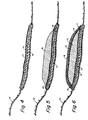
- the salt cake 15 is applied to the top of the film 14 and is suitably compacted. Optimally, the salt cake is piled to a height of about 1.8 meters if deposited in bulk. During the delivery of the salt cake 15, it is important to protect the material from exposure to wind losses and atmospheric precipitation. This can be conveniently done by covering the material with canvas tarpaulins or plastic films.
- the drums are assembled as a single layer of upright cylinders. Each layer of drums is covered with about one foot of locally available earth materials before another layer of drums is stacked on top. Many layers of assembled drums can be vaulted in this manner.
- a second film 16 is applied on top of the compacted salt cake.
- the edges of the film 16 are sealed to the edges of the film 14 around the perimeter as indicated by the arrows 17, FIGURE 6.
- a suitable adhesive may be employed.
- a polyethylene film, 0.15 mm. thick, is a preferred material for the films 14, 16.
- a layer 18 of granular locally available earth materials is applied on top of the second film to a depth of about 300 mm. to protect the film 16 from tearing.
- a third layer of soil cement 19 is applied on top of the second film 16 as shown in FIGURE 7.
- the thickness of the third layer 19 is from 75 to 450 mm., optimally about 300 mm.
- the third layer 19 is formed in two separate activities -- i.e., an initial layer of soil cement is applied and compacted. Thereafter a final layer of soil cement is applied on top of the initial layer.
- the two layers are identified herein as the third layer which has a total thickness of about 300 mm.
- the perimeter of the third layer 19 should be bonded to the perimeter of the second layer 13 to provide a secure seal for the vault.
- the vault is essentially complete as shown in FIGURE 7. Thereafter a supply of suitable filler materials 20 is applied on top of the third soil cement layer 19.
- the filler materials are contoured to conform with the geography of the surrounding terrain 10.
- the slopes of the filler materials 20 should be less than 15%.
- suitable vegetation is planted on top of the filler materials 20, for example, trees 21, grass 22.
- a vaulting assembly for 1.8 million Kg. of a salt cake employs a vault area slightly greater than 12 meters by 30 meters in area. A total of 25 centimeters of the soil cement is provided in two layers. The soil cement has a permeability less than 10 cm/sec and has an unconfined compressive strength of 200,000 - 250,000 Kg/sq meter.
- a polyethylene film, o.15 mm. thick, 12 meters wide by 30 meters long, is commercially available. That film is applied on top of the soil cement base layer.
- the salt cake is deposited in bulk within the 12 meters by 30 meters vault to a depth of 1.8 meters. The deposited salt cake is compacted by means of a bulldozer.
- a second sheet of polyethylene plastic film 12 meters by 30 meters is spread across the compacted salt cake and the two plastic films are sealed by means of watertight joint seal tape and glue.
- a layer, 25 cm. thick, of finely divided earth materials is applied on top of the second film to protect the film from tearing. polyethylene plastic sheet.
- the third soil cement layer consists of two sequentially applied layers of soil cement, each about 150 mm. thick. The third layer extends so that its perimeter engages the perimeter of the soil cement base layer.
- the resulting vault is water-impermeable, non- leaching and structurally durable. Additional covering of earth materials is applied on top of the third soil cement layer, preferably at least 600 mm. thick to receive and nurture vegetation. The earth materials are seeded with appropriate vegetation.
- the described vault will confine 4.5 million Kg. of hazardous "salt cake".
- the plastic polyethylene sheets prevent water intrusion into the salt cake. When the salt cake is buried more than 600 mm. below the surface of the surrounding terrain, high temperatures and moisture losses will not create any deterioration problems.
Landscapes
- Engineering & Computer Science (AREA)
- Environmental & Geological Engineering (AREA)
- Life Sciences & Earth Sciences (AREA)
- Hydrology & Water Resources (AREA)
- General Life Sciences & Earth Sciences (AREA)
- Mining & Mineral Resources (AREA)
- Paleontology (AREA)
- Civil Engineering (AREA)
- General Engineering & Computer Science (AREA)
- Structural Engineering (AREA)
- Processing Of Solid Wastes (AREA)
Applications Claiming Priority (2)
| Application Number | Priority Date | Filing Date | Title |
|---|---|---|---|
| US930705 | 1978-08-03 | ||
| US05/930,705 US4166709A (en) | 1978-08-03 | 1978-08-03 | Method for vaulting hazardous chemical waste materials |
Publications (1)
| Publication Number | Publication Date |
|---|---|
| EP0008078A1 true EP0008078A1 (fr) | 1980-02-20 |
Family
ID=25459634
Family Applications (1)
| Application Number | Title | Priority Date | Filing Date |
|---|---|---|---|
| EP79102764A Withdrawn EP0008078A1 (fr) | 1978-08-03 | 1979-08-01 | Procédé pour enterrer des déchets chimiques dangereux |
Country Status (4)
| Country | Link |
|---|---|
| US (1) | US4166709A (fr) |
| EP (1) | EP0008078A1 (fr) |
| JP (1) | JPS5522394A (fr) |
| CA (1) | CA1102567A (fr) |
Cited By (4)
| Publication number | Priority date | Publication date | Assignee | Title |
|---|---|---|---|---|
| EP0226880A1 (fr) * | 1985-12-21 | 1987-07-01 | Nukem GmbH | Procédé pour conditionner les déchets spéciaux solubles dans l'eau |
| AT385215B (de) * | 1983-04-28 | 1988-03-10 | Huebl Friedrich Ing | Verfahren zur deponierung von sonderabfaellen |
| AT389826B (de) * | 1987-05-14 | 1990-02-12 | Seh Sonderabfall Entsorgung Ho | Hochdeponie |
| EP0552092A1 (fr) * | 1992-01-17 | 1993-07-21 | Sarp Industries | Procédé et installation pour le stockage de déchets solidifiés |
Families Citing this family (37)
| Publication number | Priority date | Publication date | Assignee | Title |
|---|---|---|---|---|
| US4311409A (en) * | 1979-08-29 | 1982-01-19 | The United States Of America As Represented By The United States Department Of Energy | Wet powder seal for gas containment |
| US4362434A (en) * | 1980-10-28 | 1982-12-07 | Stabatrol Corporation | Permanent disposal vault for hazardous chemical waste materials |
| US4375930A (en) * | 1980-12-03 | 1983-03-08 | Stabatrol Corp. | Permanent disposal vault for containers |
| US4350461A (en) * | 1980-12-03 | 1982-09-21 | Stabatrol Corporation | Multiple waste disposal vaults |
| CA1143957A (fr) * | 1981-01-13 | 1983-04-05 | Bemalux Inc. | Produit impermeabilisant |
| US4442901A (en) * | 1982-03-08 | 1984-04-17 | Getty Synthetic Fuels, Inc. | Landfill gas recovery method |
| US5114275A (en) * | 1983-11-28 | 1992-05-19 | West Philip W | Process and waste pit liner for improved hydrophobic waste storage |
| US4784802A (en) * | 1984-07-05 | 1988-11-15 | Westinghouse Electric Corp. | Nuclear waste disposal site |
| US4681706A (en) * | 1984-07-05 | 1987-07-21 | Westinghouse Electric Corp. | Nuclear waste packaging facility |
| US4845372A (en) * | 1984-07-05 | 1989-07-04 | Westinghouse Electric Corp. | Nuclear waste packing module |
| DE3444895A1 (de) * | 1984-12-08 | 1986-06-12 | Ed. Züblin AG, 7000 Stuttgart | Vorrichtung zur abdeckung von deponien |
| US4780269A (en) * | 1985-03-12 | 1988-10-25 | Nutech, Inc. | Horizontal modular dry irradiated fuel storage system |
| US4705429A (en) * | 1986-04-10 | 1987-11-10 | Gpac, Inc. | Method of disposing of asbestos waste material |
| US4778628A (en) * | 1986-05-15 | 1988-10-18 | The United States Of America As Represented By The United States Department Of Energy | Underground waste barrier structure |
| US4842774A (en) * | 1987-08-07 | 1989-06-27 | The United States Of America As Represented By The United States Department Of Energy | Pyramiding tumuli waste disposal site and method of construction thereof |
| AT388122B (de) * | 1987-08-12 | 1989-05-10 | Alpine Bau Gmbh | Verfahren zum behandeln von deponiegut, deponiebehaelter, insbesondere zur durchfuehrung dieses verfahrens, sowie abnehmbares dach fuer deponiebehaelter |
| US4902167A (en) * | 1989-03-03 | 1990-02-20 | American Colloid Company | Land fill for waste materials and method of making the same |
| US4955983A (en) * | 1989-03-31 | 1990-09-11 | Westinghouse Electric Corp. | Side loading vault system and method for the disposal of radioactive waste |
| US4917537A (en) * | 1989-04-12 | 1990-04-17 | Jacobson Carl C | Fluid impervious, multiple panel lining system |
| US5078543A (en) * | 1990-07-11 | 1992-01-07 | Terrel Ronald L | Storage system for solid waste material |
| US5401118A (en) * | 1993-07-20 | 1995-03-28 | Kramer; Fritz | Composition and method for covering soil |
| US5833401A (en) * | 1995-04-07 | 1998-11-10 | Abeltech | Geoinsulation blanket and system for soil |
| US5769961A (en) * | 1995-05-16 | 1998-06-23 | The University Of Chicago | Remediation of arsenic-contaminated soils and groundwaters |
| US5890840A (en) * | 1995-12-08 | 1999-04-06 | Carter, Jr.; Ernest E. | In situ construction of containment vault under a radioactive or hazardous waste site |
| US6116815A (en) * | 1996-01-05 | 2000-09-12 | Chen; Youzhi | Process for preventing release of contamination from an underground storage tank field |
| US6082929A (en) * | 1997-02-06 | 2000-07-04 | Williams; Jerald R. | Waste containment system and method for the reclamation of landfill and waste areas |
| US6152653A (en) * | 1998-08-14 | 2000-11-28 | Henry; Karen S. | Geocomposite capillary barrier drain |
| RU2209271C2 (ru) * | 2001-02-05 | 2003-07-27 | Тюменская государственная архитектурно-строительная академия | Способ защиты местности от загрязнения вредными жидкими веществами при аварийных выбросах |
| KR20030014053A (ko) * | 2001-08-10 | 2003-02-15 | 주식회사 에코필 | 폐기물 매립장 외곽사면부의 마감공법 |
| US8961073B2 (en) * | 2009-12-08 | 2015-02-24 | Awt Ip, Llc | System and method for strengthening a sloped structure such as a berm, basin, levee, embankment, or the like |
| US8376657B2 (en) | 2009-12-08 | 2013-02-19 | Awt Ip, Llc | Berm and method of construction thereof |
| US8845240B2 (en) | 2009-12-08 | 2014-09-30 | Awt Ip, Llc | Berm and method of construction thereof |
| GB2478805B (en) * | 2010-06-17 | 2014-04-16 | Lichen Properties Ltd | Method of restoring contaminated land |
| CN106836171B (zh) * | 2017-03-24 | 2018-05-04 | 中国矿业大学(北京) | 露天煤矿排土场水位实时监测系统及其建立和使用方法 |
| US10145079B1 (en) | 2017-10-31 | 2018-12-04 | Awt Ip Llc | Berm and method of manufacturing a berm |
| US11633767B2 (en) * | 2021-04-13 | 2023-04-25 | Saudi Arabian Oil Company | Systems and methods for recovering landfill gas |
| AU2021445786A1 (en) * | 2021-05-18 | 2023-10-12 | Thess Pty Ltd | Method for the impermeabilisation of soils |
Citations (6)
| Publication number | Priority date | Publication date | Assignee | Title |
|---|---|---|---|---|
| FR1246848A (fr) * | 1959-10-13 | 1960-11-25 | Commissariat Energie Atomique | Procédé d'élimination de déchets radioactifs et produits obtenus suivant ce procédé |
| FR2137794A1 (fr) * | 1971-05-14 | 1972-12-29 | Egger Hans | |
| US3732697A (en) * | 1972-01-14 | 1973-05-15 | R Dickson | Waste disposal method and facility |
| DE2156315A1 (de) * | 1971-11-12 | 1973-05-24 | Georg Dipl Ing Dip Kropfhammer | Verfahren zum verhindern der umweltverschmutzung durch abgelagerte abfallprodukte und mittel zur durchfuehrung des verfahrens |
| FR2203753A1 (fr) * | 1972-10-18 | 1974-05-17 | Tezuka Kosan Kk | |
| DE2542999A1 (de) * | 1975-09-26 | 1977-04-07 | Herbert Haedrich | Muellablagerungsanlage |
Family Cites Families (4)
| Publication number | Priority date | Publication date | Assignee | Title |
|---|---|---|---|---|
| US3466873A (en) * | 1967-11-30 | 1969-09-16 | Mortimer T Present | Sanitary land fill method |
| US3586624A (en) * | 1970-03-02 | 1971-06-22 | Werner Co | Waste disposal method and system |
| DE2152172A1 (de) * | 1971-10-20 | 1973-04-26 | Hubert Franken | Giftlagerung in betonguss |
| DE2430371A1 (de) * | 1974-06-25 | 1976-01-08 | Ludwig Maurer | Verfahren zur deponierung von umweltgefaehrdenden abfaellen |
-
1978
- 1978-08-03 US US05/930,705 patent/US4166709A/en not_active Expired - Lifetime
-
1979
- 1979-05-29 CA CA328,750A patent/CA1102567A/fr not_active Expired
- 1979-06-25 JP JP8007579A patent/JPS5522394A/ja active Pending
- 1979-08-01 EP EP79102764A patent/EP0008078A1/fr not_active Withdrawn
Patent Citations (6)
| Publication number | Priority date | Publication date | Assignee | Title |
|---|---|---|---|---|
| FR1246848A (fr) * | 1959-10-13 | 1960-11-25 | Commissariat Energie Atomique | Procédé d'élimination de déchets radioactifs et produits obtenus suivant ce procédé |
| FR2137794A1 (fr) * | 1971-05-14 | 1972-12-29 | Egger Hans | |
| DE2156315A1 (de) * | 1971-11-12 | 1973-05-24 | Georg Dipl Ing Dip Kropfhammer | Verfahren zum verhindern der umweltverschmutzung durch abgelagerte abfallprodukte und mittel zur durchfuehrung des verfahrens |
| US3732697A (en) * | 1972-01-14 | 1973-05-15 | R Dickson | Waste disposal method and facility |
| FR2203753A1 (fr) * | 1972-10-18 | 1974-05-17 | Tezuka Kosan Kk | |
| DE2542999A1 (de) * | 1975-09-26 | 1977-04-07 | Herbert Haedrich | Muellablagerungsanlage |
Cited By (6)
| Publication number | Priority date | Publication date | Assignee | Title |
|---|---|---|---|---|
| AT385215B (de) * | 1983-04-28 | 1988-03-10 | Huebl Friedrich Ing | Verfahren zur deponierung von sonderabfaellen |
| EP0226880A1 (fr) * | 1985-12-21 | 1987-07-01 | Nukem GmbH | Procédé pour conditionner les déchets spéciaux solubles dans l'eau |
| AT389826B (de) * | 1987-05-14 | 1990-02-12 | Seh Sonderabfall Entsorgung Ho | Hochdeponie |
| EP0552092A1 (fr) * | 1992-01-17 | 1993-07-21 | Sarp Industries | Procédé et installation pour le stockage de déchets solidifiés |
| FR2686275A1 (fr) * | 1992-01-17 | 1993-07-23 | Sarp Ind | Procede et installation pour le stockage de dechets solidifies. |
| US5276252A (en) * | 1992-01-17 | 1994-01-04 | Sarp Industries | Method and installation for the storage of solidified wastes |
Also Published As
| Publication number | Publication date |
|---|---|
| US4166709A (en) | 1979-09-04 |
| CA1102567A (fr) | 1981-06-09 |
| JPS5522394A (en) | 1980-02-18 |
Similar Documents
| Publication | Publication Date | Title |
|---|---|---|
| US4166709A (en) | Method for vaulting hazardous chemical waste materials | |
| Suter et al. | Compacted soil barriers at abandoned landfill sites are likely to fail in the long term | |
| US4804293A (en) | Flexible layer structure for protecting earthworks, bed walls and for delimiting embedding layers | |
| US4362434A (en) | Permanent disposal vault for hazardous chemical waste materials | |
| US4375930A (en) | Permanent disposal vault for containers | |
| US4350461A (en) | Multiple waste disposal vaults | |
| US5401118A (en) | Composition and method for covering soil | |
| US5054962A (en) | Process for sealing the surface of dumps | |
| US20080317553A1 (en) | Method for recycling of synthetic material containing waste | |
| McCall et al. | Photo interpretive study of recovery of damaged lands near the metal smelters of Sudbury, Canada | |
| Cluff et al. | Water harvesting catchment and reservoir construction methods | |
| Spivey | Environment and construction management engineers | |
| RU2201949C2 (ru) | Способ захоронения отходов бурения | |
| EP0728048B1 (fr) | Traitement des dechets | |
| JPH09141225A (ja) | 産業廃棄物の遮断型最終処分場の構築方法 | |
| DE3025692A1 (de) | Begruendungs- und bewaesserungsverfahren fuer stuetz- und laermschutzwaende | |
| JPS59114316A (ja) | 埋立材並びに埋立工法 | |
| Terlecky Jr | Sanitary landfill | |
| SK7096A3 (en) | Insulation of landfill with waste plastic consolidated layer of foilic character | |
| PLAYGROUND et al. | PROJECT MANUAL | |
| GREEN et al. | Closure of an unlined evaporation pond: a case history | |
| Cluff | AT THE UNIVERSITY OF ARIZONA 1 | |
| Gerdes et al. | Simplified Sanitary Landfill Design. | |
| JP2004290014A (ja) | 雑草抑制工法 | |
| Kietzman | Solid Waste Disposal by Means of Sanitary Landfill |
Legal Events
| Date | Code | Title | Description |
|---|---|---|---|
| PUAI | Public reference made under article 153(3) epc to a published international application that has entered the european phase |
Free format text: ORIGINAL CODE: 0009012 |
|
| AK | Designated contracting states |
Designated state(s): DE FR GB IT |
|
| 17P | Request for examination filed | ||
| STAA | Information on the status of an ep patent application or granted ep patent |
Free format text: STATUS: THE APPLICATION IS DEEMED TO BE WITHDRAWN |
|
| 18D | Application deemed to be withdrawn |
Effective date: 19820408 |
|
| RIN1 | Information on inventor provided before grant (corrected) |
Inventor name: VALIGA, RICHARD E. |