EP0009232A1 - 4,5-Methano-bufadienolid-rhamnoside, Verfahren zu deren Herstellung und diese enthaltende Arzneimittel - Google Patents
4,5-Methano-bufadienolid-rhamnoside, Verfahren zu deren Herstellung und diese enthaltende Arzneimittel Download PDFInfo
- Publication number
- EP0009232A1 EP0009232A1 EP79103501A EP79103501A EP0009232A1 EP 0009232 A1 EP0009232 A1 EP 0009232A1 EP 79103501 A EP79103501 A EP 79103501A EP 79103501 A EP79103501 A EP 79103501A EP 0009232 A1 EP0009232 A1 EP 0009232A1
- Authority
- EP
- European Patent Office
- Prior art keywords
- methano
- bufa
- hydroxy
- oxy
- dienolide
- Prior art date
- Legal status (The legal status is an assumption and is not a legal conclusion. Google has not performed a legal analysis and makes no representation as to the accuracy of the status listed.)
- Granted
Links
- 239000003814 drug Substances 0.000 title claims description 4
- 238000000034 method Methods 0.000 title claims description 4
- 238000002360 preparation method Methods 0.000 title claims description 3
- 229940079593 drug Drugs 0.000 title 1
- 150000001875 compounds Chemical class 0.000 claims abstract description 24
- 125000004432 carbon atom Chemical group C* 0.000 claims abstract description 10
- 125000000217 alkyl group Chemical group 0.000 claims abstract description 9
- 125000004435 hydrogen atom Chemical group [H]* 0.000 claims abstract description 8
- 206010019280 Heart failures Diseases 0.000 claims abstract description 3
- 125000003545 alkoxy group Chemical group 0.000 claims abstract description 3
- -1 4,5-methano-bufadienolide rhamnoside Chemical class 0.000 claims description 5
- 125000002777 acetyl group Chemical group [H]C([H])([H])C(*)=O 0.000 claims description 4
- 125000005843 halogen group Chemical group 0.000 claims description 3
- 125000003236 benzoyl group Chemical group [H]C1=C([H])C([H])=C(C([H])=C1[H])C(*)=O 0.000 claims description 2
- 150000008264 rhamnoses Chemical class 0.000 claims description 2
- SHZGCJCMOBCMKK-UHFFFAOYSA-N D-mannomethylose Natural products CC1OC(O)C(O)C(O)C1O SHZGCJCMOBCMKK-UHFFFAOYSA-N 0.000 claims 1
- 125000000325 methylidene group Chemical group [H]C([H])=* 0.000 claims 1
- 229910052739 hydrogen Inorganic materials 0.000 abstract 3
- 239000001257 hydrogen Substances 0.000 abstract 3
- UFHFLCQGNIYNRP-UHFFFAOYSA-N Hydrogen Chemical compound [H][H] UFHFLCQGNIYNRP-UHFFFAOYSA-N 0.000 abstract 2
- 125000002252 acyl group Chemical group 0.000 abstract 2
- OKKJLVBELUTLKV-UHFFFAOYSA-N Methanol Chemical compound OC OKKJLVBELUTLKV-UHFFFAOYSA-N 0.000 description 66
- YMWUJEATGCHHMB-UHFFFAOYSA-N Dichloromethane Chemical compound ClCCl YMWUJEATGCHHMB-UHFFFAOYSA-N 0.000 description 31
- RTZKZFJDLAIYFH-UHFFFAOYSA-N Diethyl ether Chemical compound CCOCC RTZKZFJDLAIYFH-UHFFFAOYSA-N 0.000 description 12
- WYURNTSHIVDZCO-UHFFFAOYSA-N Tetrahydrofuran Chemical compound C1CCOC1 WYURNTSHIVDZCO-UHFFFAOYSA-N 0.000 description 10
- 239000003480 eluent Substances 0.000 description 9
- CSCPPACGZOOCGX-UHFFFAOYSA-N Acetone Chemical compound CC(C)=O CSCPPACGZOOCGX-UHFFFAOYSA-N 0.000 description 8
- 238000006243 chemical reaction Methods 0.000 description 8
- VYPSYNLAJGMNEJ-UHFFFAOYSA-N Silicium dioxide Chemical compound O=[Si]=O VYPSYNLAJGMNEJ-UHFFFAOYSA-N 0.000 description 7
- 238000002844 melting Methods 0.000 description 7
- 230000008018 melting Effects 0.000 description 7
- 239000003826 tablet Substances 0.000 description 7
- HEDRZPFGACZZDS-UHFFFAOYSA-N Chloroform Chemical compound ClC(Cl)Cl HEDRZPFGACZZDS-UHFFFAOYSA-N 0.000 description 6
- LFQSCWFLJHTTHZ-UHFFFAOYSA-N Ethanol Chemical compound CCO LFQSCWFLJHTTHZ-UHFFFAOYSA-N 0.000 description 6
- VLKZOEOYAKHREP-UHFFFAOYSA-N n-Hexane Chemical compound CCCCCC VLKZOEOYAKHREP-UHFFFAOYSA-N 0.000 description 6
- XLYOFNOQVPJJNP-UHFFFAOYSA-N water Substances O XLYOFNOQVPJJNP-UHFFFAOYSA-N 0.000 description 6
- 125000001570 methylene group Chemical group [H]C([H])([*:1])[*:2] 0.000 description 5
- 239000000203 mixture Substances 0.000 description 5
- 239000000741 silica gel Substances 0.000 description 5
- 229910002027 silica gel Inorganic materials 0.000 description 5
- YLQBMQCUIZJEEH-UHFFFAOYSA-N tetrahydrofuran Natural products C=1C=COC=1 YLQBMQCUIZJEEH-UHFFFAOYSA-N 0.000 description 5
- UIIMBOGNXHQVGW-UHFFFAOYSA-M Sodium bicarbonate Chemical compound [Na+].OC([O-])=O UIIMBOGNXHQVGW-UHFFFAOYSA-M 0.000 description 4
- 238000004587 chromatography analysis Methods 0.000 description 4
- WEVYAHXRMPXWCK-UHFFFAOYSA-N Acetonitrile Chemical compound CC#N WEVYAHXRMPXWCK-UHFFFAOYSA-N 0.000 description 3
- 229940097217 cardiac glycoside Drugs 0.000 description 3
- 239000002368 cardiac glycoside Substances 0.000 description 3
- 238000002425 crystallisation Methods 0.000 description 3
- 230000008025 crystallization Effects 0.000 description 3
- NZZFYRREKKOMAT-UHFFFAOYSA-N diiodomethane Chemical compound ICI NZZFYRREKKOMAT-UHFFFAOYSA-N 0.000 description 3
- 238000010828 elution Methods 0.000 description 3
- NLKNQRATVPKPDG-UHFFFAOYSA-M potassium iodide Chemical compound [K+].[I-] NLKNQRATVPKPDG-UHFFFAOYSA-M 0.000 description 3
- 239000011541 reaction mixture Substances 0.000 description 3
- 239000002904 solvent Substances 0.000 description 3
- 229930002534 steroid glycoside Natural products 0.000 description 3
- 150000008143 steroidal glycosides Chemical class 0.000 description 3
- 238000002560 therapeutic procedure Methods 0.000 description 3
- NLXLAEXVIDQMFP-UHFFFAOYSA-N Ammonia chloride Chemical compound [NH4+].[Cl-] NLXLAEXVIDQMFP-UHFFFAOYSA-N 0.000 description 2
- VTYYLEPIZMXCLO-UHFFFAOYSA-L Calcium carbonate Chemical compound [Ca+2].[O-]C([O-])=O VTYYLEPIZMXCLO-UHFFFAOYSA-L 0.000 description 2
- 229910021591 Copper(I) chloride Inorganic materials 0.000 description 2
- 229920002261 Corn starch Polymers 0.000 description 2
- 239000005909 Kieselgur Substances 0.000 description 2
- GUBGYTABKSRVRQ-QKKXKWKRSA-N Lactose Chemical compound OC[C@H]1O[C@@H](O[C@H]2[C@H](O)[C@@H](O)C(O)O[C@@H]2CO)[C@H](O)[C@@H](O)[C@H]1O GUBGYTABKSRVRQ-QKKXKWKRSA-N 0.000 description 2
- PMZURENOXWZQFD-UHFFFAOYSA-L Sodium Sulfate Chemical compound [Na+].[Na+].[O-]S([O-])(=O)=O PMZURENOXWZQFD-UHFFFAOYSA-L 0.000 description 2
- FAPWRFPIFSIZLT-UHFFFAOYSA-M Sodium chloride Chemical compound [Na+].[Cl-] FAPWRFPIFSIZLT-UHFFFAOYSA-M 0.000 description 2
- QAOWNCQODCNURD-UHFFFAOYSA-N Sulfuric acid Chemical compound OS(O)(=O)=O QAOWNCQODCNURD-UHFFFAOYSA-N 0.000 description 2
- HCHKCACWOHOZIP-UHFFFAOYSA-N Zinc Chemical compound [Zn] HCHKCACWOHOZIP-UHFFFAOYSA-N 0.000 description 2
- 239000002253 acid Substances 0.000 description 2
- TVZPLCNGKSPOJA-UHFFFAOYSA-N copper zinc Chemical compound [Cu].[Zn] TVZPLCNGKSPOJA-UHFFFAOYSA-N 0.000 description 2
- OXBLHERUFWYNTN-UHFFFAOYSA-M copper(I) chloride Chemical compound [Cu]Cl OXBLHERUFWYNTN-UHFFFAOYSA-M 0.000 description 2
- 239000008120 corn starch Substances 0.000 description 2
- KQTXIZHBFFWWFW-UHFFFAOYSA-L disilver;carbonate Chemical compound [Ag]OC(=O)O[Ag] KQTXIZHBFFWWFW-UHFFFAOYSA-L 0.000 description 2
- 239000000706 filtrate Substances 0.000 description 2
- 125000002485 formyl group Chemical group [H]C(*)=O 0.000 description 2
- 210000002837 heart atrium Anatomy 0.000 description 2
- 239000012442 inert solvent Substances 0.000 description 2
- FQGYCXFLEQVDJQ-UHFFFAOYSA-N mercury dicyanide Chemical compound N#C[Hg]C#N FQGYCXFLEQVDJQ-UHFFFAOYSA-N 0.000 description 2
- UKWHYYKOEPRTIC-UHFFFAOYSA-N mercury(ii) oxide Chemical compound [Hg]=O UKWHYYKOEPRTIC-UHFFFAOYSA-N 0.000 description 2
- 239000012299 nitrogen atmosphere Substances 0.000 description 2
- 235000015497 potassium bicarbonate Nutrition 0.000 description 2
- 229910000028 potassium bicarbonate Inorganic materials 0.000 description 2
- 239000011736 potassium bicarbonate Substances 0.000 description 2
- TYJJADVDDVDEDZ-UHFFFAOYSA-M potassium hydrogencarbonate Chemical compound [K+].OC([O-])=O TYJJADVDDVDEDZ-UHFFFAOYSA-M 0.000 description 2
- 229940086066 potassium hydrogencarbonate Drugs 0.000 description 2
- 238000010992 reflux Methods 0.000 description 2
- 229920006395 saturated elastomer Polymers 0.000 description 2
- 235000017557 sodium bicarbonate Nutrition 0.000 description 2
- 229910000030 sodium bicarbonate Inorganic materials 0.000 description 2
- 229910052938 sodium sulfate Inorganic materials 0.000 description 2
- 235000011152 sodium sulphate Nutrition 0.000 description 2
- 150000003431 steroids Chemical class 0.000 description 2
- 238000003756 stirring Methods 0.000 description 2
- SCYULBFZEHDVBN-UHFFFAOYSA-N 1,1-Dichloroethane Chemical compound CC(Cl)Cl SCYULBFZEHDVBN-UHFFFAOYSA-N 0.000 description 1
- WSLDOOZREJYCGB-UHFFFAOYSA-N 1,2-Dichloroethane Chemical compound ClCCCl WSLDOOZREJYCGB-UHFFFAOYSA-N 0.000 description 1
- 241000700199 Cavia porcellus Species 0.000 description 1
- WHNWPMSKXPGLAX-UHFFFAOYSA-N N-Vinyl-2-pyrrolidone Chemical compound C=CN1CCCC1=O WHNWPMSKXPGLAX-UHFFFAOYSA-N 0.000 description 1
- MYEJFUXQJGHEQK-ALRJYLEOSA-N Proscillaridin Chemical class O[C@@H]1[C@H](O)[C@@H](O)[C@H](C)O[C@H]1O[C@@H]1C=C2CC[C@H]3[C@@]4(O)CC[C@H](C5=COC(=O)C=C5)[C@@]4(C)CC[C@@H]3[C@@]2(C)CC1 MYEJFUXQJGHEQK-ALRJYLEOSA-N 0.000 description 1
- 238000006932 Simmons-Smith cyclopropanation reaction Methods 0.000 description 1
- VMHLLURERBWHNL-UHFFFAOYSA-M Sodium acetate Chemical compound [Na+].CC([O-])=O VMHLLURERBWHNL-UHFFFAOYSA-M 0.000 description 1
- 229930006000 Sucrose Natural products 0.000 description 1
- CZMRCDWAGMRECN-UGDNZRGBSA-N Sucrose Chemical compound O[C@H]1[C@H](O)[C@@H](CO)O[C@@]1(CO)O[C@@H]1[C@H](O)[C@@H](O)[C@H](O)[C@@H](CO)O1 CZMRCDWAGMRECN-UGDNZRGBSA-N 0.000 description 1
- IVHZANOQGCIPSI-UHFFFAOYSA-M [I-].[Zn+]CI Chemical compound [I-].[Zn+]CI IVHZANOQGCIPSI-UHFFFAOYSA-M 0.000 description 1
- 239000000370 acceptor Substances 0.000 description 1
- 239000004480 active ingredient Substances 0.000 description 1
- 239000013543 active substance Substances 0.000 description 1
- 235000019270 ammonium chloride Nutrition 0.000 description 1
- 230000002280 anti-androgenic effect Effects 0.000 description 1
- 239000000051 antiandrogen Substances 0.000 description 1
- CBHOOMGKXCMKIR-UHFFFAOYSA-N azane;methanol Chemical compound N.OC CBHOOMGKXCMKIR-UHFFFAOYSA-N 0.000 description 1
- 238000010009 beating Methods 0.000 description 1
- 239000011230 binding agent Substances 0.000 description 1
- 230000037396 body weight Effects 0.000 description 1
- 229910000011 cadmium carbonate Inorganic materials 0.000 description 1
- GKDXQAKPHKQZSC-UHFFFAOYSA-L cadmium(2+);carbonate Chemical compound [Cd+2].[O-]C([O-])=O GKDXQAKPHKQZSC-UHFFFAOYSA-L 0.000 description 1
- 229910000019 calcium carbonate Inorganic materials 0.000 description 1
- 239000002775 capsule Substances 0.000 description 1
- 150000004649 carbonic acid derivatives Chemical class 0.000 description 1
- 230000000747 cardiac effect Effects 0.000 description 1
- 239000003795 chemical substances by application Substances 0.000 description 1
- KRVSOGSZCMJSLX-UHFFFAOYSA-L chromic acid Substances O[Cr](O)(=O)=O KRVSOGSZCMJSLX-UHFFFAOYSA-L 0.000 description 1
- 230000008602 contraction Effects 0.000 description 1
- 238000001816 cooling Methods 0.000 description 1
- 229920001577 copolymer Polymers 0.000 description 1
- 150000001879 copper Chemical class 0.000 description 1
- 229960000978 cyproterone acetate Drugs 0.000 description 1
- UWFYSQMTEOIJJG-FDTZYFLXSA-N cyproterone acetate Chemical compound C1=C(Cl)C2=CC(=O)[C@@H]3C[C@@H]3[C@]2(C)[C@@H]2[C@@H]1[C@@H]1CC[C@@](C(C)=O)(OC(=O)C)[C@@]1(C)CC2 UWFYSQMTEOIJJG-FDTZYFLXSA-N 0.000 description 1
- 239000002270 dispersing agent Substances 0.000 description 1
- 239000003995 emulsifying agent Substances 0.000 description 1
- 239000002702 enteric coating Substances 0.000 description 1
- 238000009505 enteric coating Methods 0.000 description 1
- 238000006266 etherification reaction Methods 0.000 description 1
- 125000001495 ethyl group Chemical group [H]C([H])([H])C([H])([H])* 0.000 description 1
- 239000000945 filler Substances 0.000 description 1
- AWJWCTOOIBYHON-UHFFFAOYSA-N furo[3,4-b]pyrazine-5,7-dione Chemical compound C1=CN=C2C(=O)OC(=O)C2=N1 AWJWCTOOIBYHON-UHFFFAOYSA-N 0.000 description 1
- 239000008187 granular material Substances 0.000 description 1
- 125000002887 hydroxy group Chemical group [H]O* 0.000 description 1
- 238000001990 intravenous administration Methods 0.000 description 1
- 125000000959 isobutyl group Chemical group [H]C([H])([H])C([H])(C([H])([H])[H])C([H])([H])* 0.000 description 1
- 125000001449 isopropyl group Chemical group [H]C([H])([H])C([H])(*)C([H])([H])[H] 0.000 description 1
- 125000000686 lactone group Chemical group 0.000 description 1
- 239000007788 liquid Substances 0.000 description 1
- 238000004519 manufacturing process Methods 0.000 description 1
- HIJSSUKZLPXDPU-UHFFFAOYSA-L mercury(2+);carbonate Chemical compound [Hg+2].[O-]C([O-])=O HIJSSUKZLPXDPU-UHFFFAOYSA-L 0.000 description 1
- 229910052751 metal Inorganic materials 0.000 description 1
- 239000002184 metal Substances 0.000 description 1
- 150000002739 metals Chemical class 0.000 description 1
- 125000002496 methyl group Chemical group [H]C([H])([H])* 0.000 description 1
- 239000002808 molecular sieve Substances 0.000 description 1
- 125000004108 n-butyl group Chemical group [H]C([H])([H])C([H])([H])C([H])([H])C([H])([H])* 0.000 description 1
- 125000004123 n-propyl group Chemical group [H]C([H])([H])C([H])([H])C([H])([H])* 0.000 description 1
- 150000002825 nitriles Chemical class 0.000 description 1
- LYGJENNIWJXYER-UHFFFAOYSA-N nitromethane Chemical compound C[N+]([O-])=O LYGJENNIWJXYER-UHFFFAOYSA-N 0.000 description 1
- 238000006053 organic reaction Methods 0.000 description 1
- 230000003647 oxidation Effects 0.000 description 1
- 238000007254 oxidation reaction Methods 0.000 description 1
- 230000000737 periodic effect Effects 0.000 description 1
- 239000004014 plasticizer Substances 0.000 description 1
- 229920000191 poly(N-vinyl pyrrolidone) Polymers 0.000 description 1
- 239000000843 powder Substances 0.000 description 1
- 239000003755 preservative agent Substances 0.000 description 1
- 125000001501 propionyl group Chemical group O=C([*])C([H])([H])C([H])([H])[H] 0.000 description 1
- 230000035484 reaction time Effects 0.000 description 1
- LKZMBDSASOBTPN-UHFFFAOYSA-L silver carbonate Substances [Ag].[O-]C([O-])=O LKZMBDSASOBTPN-UHFFFAOYSA-L 0.000 description 1
- VFWRGKJLLYDFBY-UHFFFAOYSA-N silver;hydrate Chemical compound O.[Ag].[Ag] VFWRGKJLLYDFBY-UHFFFAOYSA-N 0.000 description 1
- 235000017281 sodium acetate Nutrition 0.000 description 1
- 239000001632 sodium acetate Substances 0.000 description 1
- URGAHOPLAPQHLN-UHFFFAOYSA-N sodium aluminosilicate Chemical compound [Na+].[Al+3].[O-][Si]([O-])=O.[O-][Si]([O-])=O URGAHOPLAPQHLN-UHFFFAOYSA-N 0.000 description 1
- 229910000033 sodium borohydride Inorganic materials 0.000 description 1
- 239000012279 sodium borohydride Substances 0.000 description 1
- 239000011780 sodium chloride Substances 0.000 description 1
- AKHNMLFCWUSKQB-UHFFFAOYSA-L sodium thiosulfate Chemical compound [Na+].[Na+].[O-]S([O-])(=O)=S AKHNMLFCWUSKQB-UHFFFAOYSA-L 0.000 description 1
- 235000019345 sodium thiosulphate Nutrition 0.000 description 1
- 239000007787 solid Substances 0.000 description 1
- 230000000707 stereoselective effect Effects 0.000 description 1
- 230000003637 steroidlike Effects 0.000 description 1
- 229960004793 sucrose Drugs 0.000 description 1
- 239000000725 suspension Substances 0.000 description 1
- 239000007885 tablet disintegrant Substances 0.000 description 1
- 239000000454 talc Substances 0.000 description 1
- 229910052623 talc Inorganic materials 0.000 description 1
- 230000001225 therapeutic effect Effects 0.000 description 1
- 239000000080 wetting agent Substances 0.000 description 1
Classifications
-
- C—CHEMISTRY; METALLURGY
- C07—ORGANIC CHEMISTRY
- C07J—STEROIDS
- C07J53/00—Steroids in which the cyclopenta(a)hydrophenanthrene skeleton has been modified by condensation with a carbocyclic rings or by formation of an additional ring by means of a direct link between two ring carbon atoms, including carboxyclic rings fused to the cyclopenta(a)hydrophenanthrene skeleton are included in this class
- C07J53/002—Carbocyclic rings fused
- C07J53/004—3 membered carbocyclic rings
-
- A—HUMAN NECESSITIES
- A61—MEDICAL OR VETERINARY SCIENCE; HYGIENE
- A61P—SPECIFIC THERAPEUTIC ACTIVITY OF CHEMICAL COMPOUNDS OR MEDICINAL PREPARATIONS
- A61P9/00—Drugs for disorders of the cardiovascular system
- A61P9/04—Inotropic agents, i.e. stimulants of cardiac contraction; Drugs for heart failure
Definitions
- Steroids that have a methylene bridge on two neighboring carbon atoms are already known.
- One such compound is cyproterone acetate, which is used as an antiandrogen.
- Cardiac steroids with methylene bridges have not been described so far.
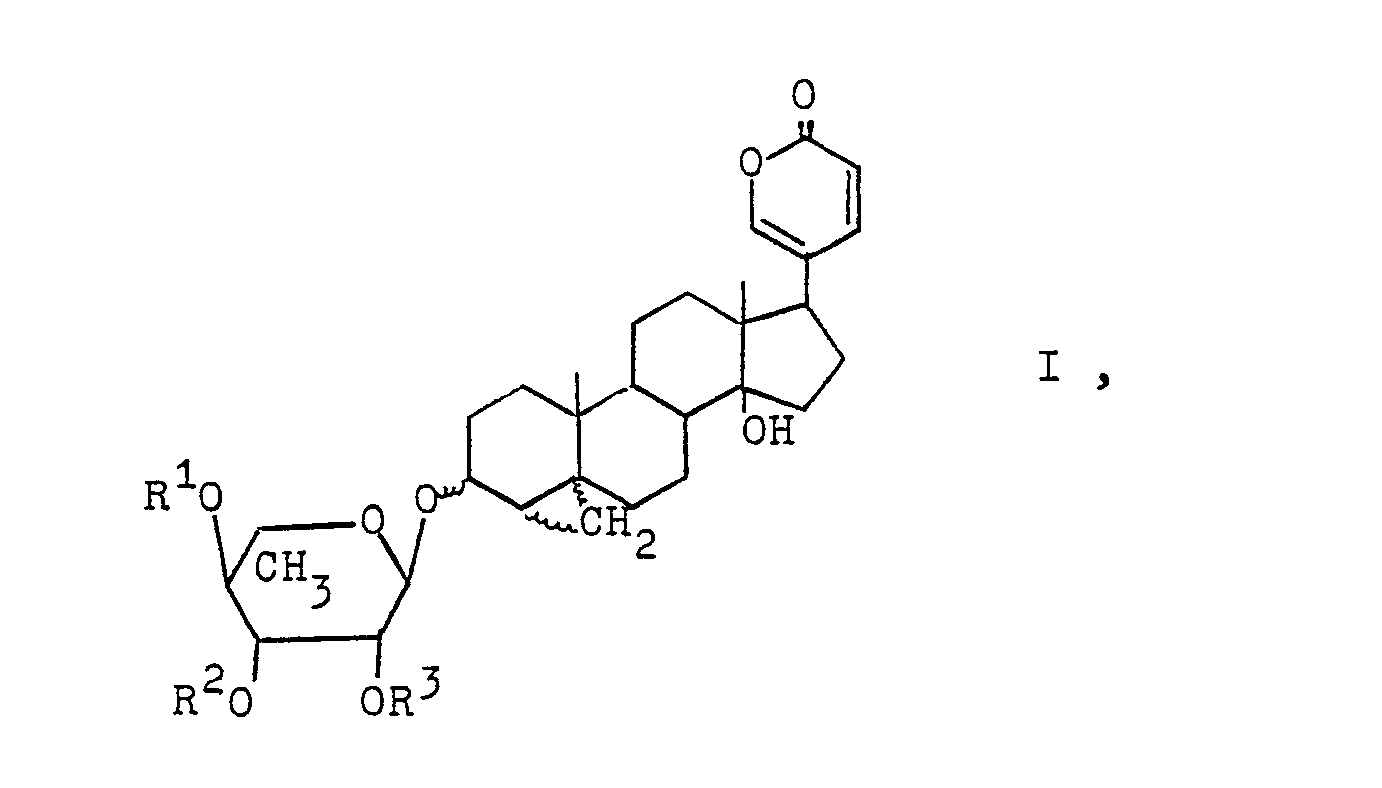
- the invention relates to new 4,5-methano-bufadienolide rhamnosides of the formula I.
- R 1 represents a hydrogen atom or an alkyl or acyl radical each having 1 to 4 carbon atoms
- R 2 and R 3 are identical or different and hydrogen atoms
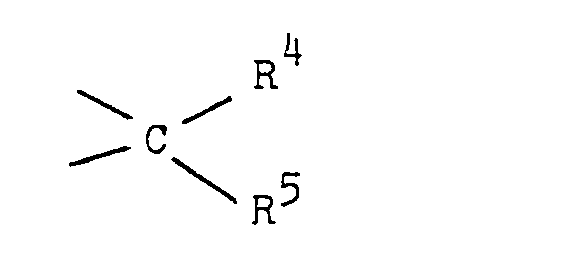
- Alkyl or acyl radical each having 1 to 4 carbon atoms or both together the rest represent in which R 4 and R 5 are the same or different and represent hydrogen atoms or alkyl or alkoxy groups each having 1 to 2 carbon atoms.
- the invention further relates to medicaments which contain a compound of the formula I.
- R 1 to R 3 can, in addition to hydrogen atoms, methyl, ethyl, n-propyl, iso-propyl, n-butyl, iso-butyl, formyl, acetyl, propionyl, n-butyryl - Or represent isobutyryl residues.
- R 4 and R 5 can be formyl, acetyl, methoxy, ethoxy, methyl or ethyl radicals.
- the steroidal aglycones II are expediently reacted with an excess (preferably 3 to 5 mol) of acylated 1-halohhamnose III.
- the reaction works well at 0 to 30 o C, so that they are carried out at room temperature can.
- Suitable inert solvents for the reaction are methylene chloride, ether, tetrahydrofuran, acetonitrile, nitromethane and preferably dichloroethane.
- the reaction time depends on the temperature and is usually 3 to 24 hours.
- the reaction is expediently carried out in the presence of acid acceptors, such as cyanides, oxides and carbonates of metals from subgroups 1 and 2 of the periodic table. Examples include silver (I) oxide, silver (I) carbonate, mercury (II) oxide, mercury (II) carbonate, cadmium carbonate and preferably mercury (II) cyanide.
- the compounds thus obtained can be deacylated in a manner known per se, preferably with methanolic ammonia at room temperature or with potassium hydrogen carbonate in aqueous methanol at 20 to 70 ° C.
- the methylene addition to the compounds IV is advantageously carried out by reacting the compounds IV with iodomethyl zinc iodide according to Simmons-Smith (cf. HE Simmons et al, Organic Reactions 20, 1, John Wiley and Sons, 1973).
- iodomethyl zinc iodide according to Simmons-Smith (cf. HE Simmons et al, Organic Reactions 20, 1, John Wiley and Sons, 1973).
- the zinc-copper pair and the diiodomethane are used in an about 2 to 30, preferably 3 to 10-fold excess.
- the methylene addition is stereospecific on the '4,5 double bond of the oscillaridine derivative in the cis position to the 3-0 function. It is very surprising that the unsaturated lactone ring is not attacked in the process.
- the new compounds increase the contractility of the heart and are suitable for the therapy of heart failure.
- the potency of the compounds of the invention i.e. the increase in contact force on the electrically irritated and spontaneously beating guinea pig atrium is 4 to 50 times greater than that of cardiac glycosides used therapeutically to date.
- the quotient of the arrhythmogenically effective dose and the dose required for the increase in contraction force in the spontaneously striking atrium is 2 to 10 times higher than for cardiac glycosides introduced into the therapy. They are also characterized by great acid stability.
- the compounds according to the invention can be administered orally or intravenously in the customary manner.
- the dosage depends on the age, condition and weight of the patient as well as the type of application. As a rule, the daily dose of active substance is between approximately 0.003 and 0.06 mg / kg body weight both with oral and intravenous administration.
- the new compounds can be used in the customary pharmaceutical application forms, solid or liquid, e.g. as tablets, capsules, powders, granules, coated tablets or solutions. These are manufactured in the usual way.
- the active ingredients can be processed with the usual pharmaceutical auxiliaries such as tablet binders, fillers, preservatives, tablet disintegrants, flow regulators, plasticizers, wetting agents, dispersants, emulsifiers and / or solvents (cf. L.G. Goodman, A. Gilman: The Pharmacologiced Basis of Therapeutics).
- the compounds of general formula II have not yet been described. They can be added to compounds of the general formula by adding methylene Manufacture in the manner described here. However, only the 3 ⁇ -hydroxy-4 ⁇ , 5-methano and the 3ß-hydroxy-4ß, 5-methano compounds are formed. However, by oxidation with chromic acid / sulfuric acid in acetone according to Jones (J. Chem. Soc. 1953, 2555) and subsequent reduction with sodium borohydride in methanol at room temperature, the 3 ⁇ -hydroxy-4ß, 5-methano- and the 3ß- Hydroxy-4 ⁇ , 5-methano compounds.
- chloroform 600 ml
- the mixture is filtered through diatomaceous earth and the filtrate is washed with 20% aqueous potassium iodide solution (2 x 150 ml) and water (2 x 100 ml), dried over sodium sulfate and evaporated.
- reaction is followed by TLC (eluent A). After 3 to 4 hours at a bath temperature of 45-55 0 C the reaction is complete.
- the reaction mixture is brought to a volume of 100 ml with tetrahydrofuran and 10 ml of a saturated aqueous ammonium chloride solution are slowly added while cooling with ice and the mixture is filtered through diatomaceous earth. The filtrate is taken up in methylene chloride (1000 ml) and washed with 10% aqueous sodium thiosulfate solution (2 x 100 ml), saturated aqueous sodium hydrogen carbonate solution (100 ml) and water (2 x 100 ml), dried over sodium sulfate and in Evaporated vacuum.
- Tablets of the following composition are pressed in a conventional manner on a tablet press:
- the core consists of 9 parts of corn starch, 3 parts of milk sugar and 1 part of Luviskol® VA 64 (vinyl pyrrolidone - vinyl acetate copolymer 60:40, see Pharm. Ind. 1962, 586).
- the saccharification mass consists of 5 parts of cane sugar, 2 parts of corn starch, 2 parts of calcium carbonate and 1 part of talc.
- the coated tablets produced in this way are then coated with an enteric coating.
Landscapes
- Health & Medical Sciences (AREA)
- Organic Chemistry (AREA)
- Chemical & Material Sciences (AREA)
- General Health & Medical Sciences (AREA)
- Engineering & Computer Science (AREA)
- Bioinformatics & Cheminformatics (AREA)
- Cardiology (AREA)
- Heart & Thoracic Surgery (AREA)
- Animal Behavior & Ethology (AREA)
- Medicinal Chemistry (AREA)
- Nuclear Medicine, Radiotherapy & Molecular Imaging (AREA)
- Chemical Kinetics & Catalysis (AREA)
- Pharmacology & Pharmacy (AREA)
- Life Sciences & Earth Sciences (AREA)
- General Chemical & Material Sciences (AREA)
- Hospice & Palliative Care (AREA)
- Public Health (AREA)
- Veterinary Medicine (AREA)
- Pharmaceuticals Containing Other Organic And Inorganic Compounds (AREA)
- Steroid Compounds (AREA)
- Saccharide Compounds (AREA)
Abstract

Description
- Steroide, die an zwei nachbarständigen Kohlenstoffatomen eine Methylenbrücke tragen, sind bereits bekannt. Eine solche Verbindung ist das Cyproteronacetat, welches als Antiandrogen verwendet wird. Herzwirksame Steroide mit Methylenbrücken sind bislang nicht beschrieben worden.
- Gegenstand der Erfindung sind neue 4,5-Methano-bufadienolid-rhamnoside der Formel I

- Gegenstand der Erfindung ist weiter ein Verfahren zur Herstellung der Verbindungen der Formel I, welches dadurch gekennzeichnet ist, daß man
- a) ein 3,14-Dihydroxy-4,5-methano-14ß-bufa-20,22--dienolid der allgemeinen Formel II

mit einem Rhamnosederivat der allgemeinen Formel III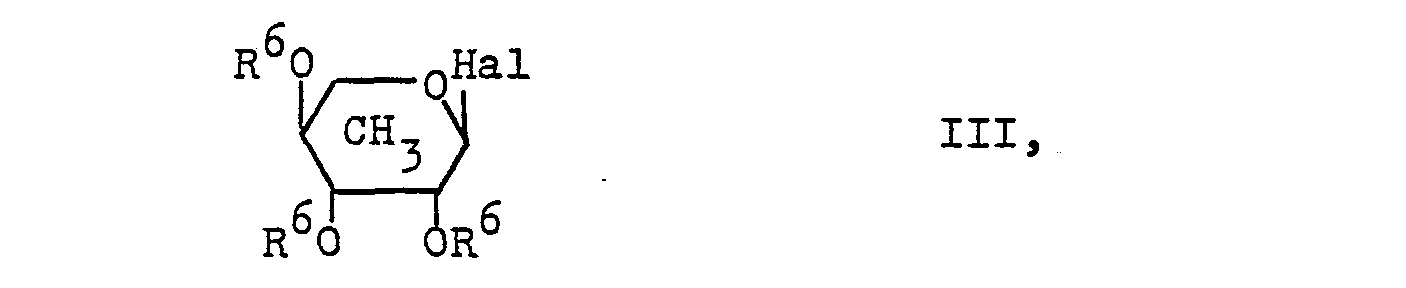
worin R6 Acetylgruppen oder Benzoylgruppen darstellen und Hal ein Halogenatom bedeutet,
umsetzt und anschließend gegebenenfalls die so erhal- tenen Verbindungen in an sich bekannter Weise verseift und danach verethert und/oder in sie den Rest
- b) - falls die Verbindung der allgemeinen Formel I ein cis-Methano-proscillaridinderivat darstellt - an eine Verbindung der allgemeinen Formel IV

- Gegenstand der Erfindung sind weiter Arzneimittel, welche eine Verbindung der Formel I enthalten.
- In den Verbindungen I können R1 bis R3 außer Wasserstoffatomen, Methyl-, Ethyl-, n-Propyl-, iso-Propyl-, n-Butyl-, iso-Butyl, Formyl-, Acetyl-, Propionyl-, n-Butyryl- oder Isobutyrylreste darstellen. R4 und R5 können Formyl-, Acetyl, Methoxy-, Ethoxy-, Methyl- oder Ethylreste sein.
- Die steroidalen Aglykone II werden zweckmäßig mit einem Überschuß (vorzugsweise 3 bis 5 Mol) an acylierter 1-Halogenrhamnose III umgesetzt. Die Reaktion gelingt gut bei 0 bis 30oC, so daß sie bei Raumtemperatur durchgeführt werden kann. Geeignete inerte Lösungsmittel für die Reaktion sind Methylenchlorid, Ether, Tetrahydrofuran, Acetonitril, Nitromethan und vorzugsweise Dichlorethan. Die Reaktionsdauer ist temperaturabhängig und beträgt in der Regel 3 bis 24 Stunden. Zweckmäßigerweise wird die Umsetzung in Gegenwart von Säureakzeptoren durchgeführt, wie Cyaniden, Oxiden und Carbonaten von Metallen der 1. und 2. Nebengruppe des Periodensystems. Beispiele dafür sind Silber(I)oxid, Siber(I)carbonat, Quecksilber(II)oxid, Quecksilber(II)carbonat, Cadmiumcarbonat und vorzugsweise Quecksilber(II)cyanid.
- Die so erhaltenen Verbindungen können in an sich bekannter Weise, vorzugsweise mit methanolischem Ammoniak bei Raumtemperatur oder mit Kaliumhydrogencarbonat in wäßrigem Methanol bei 20 bis 70°C entacyliert werden.
- Auch die Veretherung der freien OH-Gruppen und die Einführung des Restes

- Die Methylenaddition an die Verbindungen IV erfolgt zweckmäßig durch Umsetzen der Verbindungen IV mit Jodmethyl-zinkiodid nach Simmons-Smith (vgl. H.E. Simmons et al, Organic Reactions 20, 1, John Wiley and Sons, 1973). In der Praxis. wird vorzugsweise ein durch Umsetzen von Zinkstaub und Kupfersalz, insbesondere CuCl, in Ether bei Rückflußtemperatur erhaltenes Zink-Kupfer-Paar (vgl. R.J. Rawson, I.T. Harrison, J. Org. Chem. 35, 2057 (1970)) in einer Stickstoffatmosphäre nacheinander mit Diiodmethan und einer Lösung des Proscillaridinderivates in einem inerten Lösungsmittel, vorzugsweise Tetrahydrofuran, versetzt. Das Zink-Kupfer-Paar und das Diiodmethan werden in einem etwa 2- bis 30-, vorzugsweise 3- bis 10-fachen Überschuß verwendet. Die Reaktion läuft gut bei 30 bis 65°C und ist in der Regel nach 1 bis 24 Stunden beendet. L - J
- Die Methylenaddition erfolgt stereospezifisch an der ' 4,5-Doppelbindung des Proscillaridinderivates in cis-Stellung zur 3-0-Funktion. Es ist sehr überraschend, daß der ungesättigte Lactonring dabei nicht angegriffen wird.
- Die neuen Verbindungen steigern die Kontraktionskraft des Herzens und sind für die Therapie der Herzinsuffizienz geeignet.
- Im Vergleich zu den bisher in die Therapie eingeführten Herzglykosiden besitzen sie eine größere Wirkstärke und eine erhöhte therapeutische Breite.
- Die Wirkstärke der erfindungsgemäßen Verbindungen, d.h. die Konktraktionskraftzunahme am elektrisch gereizten und spontanschlagenden Vorhof des Meerschweinchens ist 4- bis 50-mal größer als bei bisher therapeutisch verwendeten Herzglykosiden.
- Der Quotient aus arrhythmogen wirksamer Dosis und der für die Kontraktionskraftzunahme am spontanschlagenden Vorhof benötigten Dosis, ist 2- bis 10-mal höher als bei in die Therapie eingeführten Herzglykosiden. Weiter zeichnen sie sich durch eine große Säurestabilität aus.
- Die erfindungsgemäßen Verbindungen können in üblicher Weise oral oder intravenös verabfolgt werden.
- Die Dosierung hängt vom Alter, Zustand und Gewicht des Patienten sowie von der Applikationsart ab. In der Regel beträgt die tägliche Wirkstoffdosis zwischen etwa 0,003 und 0,06 mg/kg Körpergewicht sowohl bei oraler als auch intravenöser Gabe.
- Die neuen Verbindungen können in den gebräuchlichen galenischen Applikationsformen fest oder flüssig angewendet werden, z.B. als Tabletten, Kapseln, Pulver, Granulate, Dragees oder Lösungen. Diese werden in üblicher Weise hergestellt. Die Wirkstoffe können dabei mit den üblichen galenischen Hilfsmitteln wie Tablettenbindern, Füllstoffen, Konservierungsmitteln, Tablettensprengmitteln, Fließreguliermitteln, Weichmachern, Netzmitteln, Dispergiermitteln, Emulgatoren und/oder Lösungsmitteln verarbeitet werden (vgl. L.G. Goodman, A. Gilman: The Pharmacologiced Basis of Therapeutics).
- Die Verbindungen der allgemeinen Formel II sind noch nicht beschrieben worden. Sie lassen sich durch Methylen-Addition an Verbindungen der allgemeinen Formel

- Die nachstehenden Beispiele erläutern die Erfindung. Die Rf-Werte wurden an Kieselgel-Fertigplatten der Fa. Merck, Darmstadt, mit Methylenchlorid/Aceton = 5 : 1 (Fließmit- tel A) und Methylenchlorid/Methanol = 10 : 1 (Fließmittel B) bestimmt.
- a) 0,8 g (2,0 mMol) 3ß,14-Dihydroxy-4ß,5-methano-5ß,14ß--bufa-20,22-dienolid (Fp = 172 bis 180°C) in 40 ml wasserfreiem 1,2-Dichlorethan werden mit 4,0 g (7,5 mMol) 2,3,4-Tri-O-benzoyl-α-L-rhamnopyranosylbromid, 4,0 g Quecksilber(II)cyanid und 5 g Molekularsieb A 4 versetzt. Das Reaktionsgemisch wird bei Raumtemperatur gerührt und der Verlauf der Reaktion mittels DC (Fließmittel A) verfolgt.
- Nach 1,5 Stunden wird mit Chloroform (600 ml) versetzt, über Kieselgur filtriert und das Filtrat mit 20 %iger wäßriger Kaliumiodid-Lösung (2 x 150 ml) und Wasser (2 x 100 ml) gewaschen, über Natriumsulfat getrocknet und eingedampft.
- Chromatographie des Rückstands an einer Kieselgelsäule (Elution mit Methylenchlorid/Aceton = 10 : 1) gab 14-Hydroxy-4ß,5-methano-3ß[(2,3,4-tri-O-benzoyl--α-L-rhamnopyranosyl)oxy]-5ß,14ß-bufa-20,22-dienolid.
- Schmelzpunkt: 153-158°C (Methylenchlorid/Ether/Hexan),

- UV (Methanol):λmax (lg ε) = 228 (4,21) 283 (3,82) 298 (3,65)
- Rf = 0,56 (Fließmittel A).
- b) 857 mg (1 mMol) der gemäß a) erhaltenen Verbindung in 50 ml Methanol werden mit 5 ml einer 5 %igen wäßrigen Kaliumhydrogencarbonat-Lösung versetzt. Nach 70 Stunden bei Raumtemperatur wird mit 300 ml Chloroform versetzt, mit wenig Wasser gewaschen und eingedampft.
- Chromatographie des Rückstands an einer Kieselgelsäule (Elution mit Methylenchlorid/Methanol 10 : 1) und Kristallisation des Rückstandes aus Ethanol/Wasser gibt 305 mg (56 %) 14-Hydroxy-4ß,5-methano-3ß-[(α-L--rhamnopyranosyl)oxy]-5ß,14ß-bufa-20,22-dienolid.
- Schmelzpunkt: 251-258°C,

- UV (Methanol): λmax (lg ε) = 297 (3,75)
- Rf = 0,17 (Fließmittel B).
- C21H4408 (544,7) Ber.: C 68,36 H 8,14 Gef.: C 67,8 H 8,2
- In einer Stickstoffatmosphäre wird eine Suspension von 6,5 g (100 gAtom) Zinkstaub und 1,0 g (10 mMol) Kupfer(I)--chlorid in 30 ml Ether unter kräftigem Rühren bei einer Badtemperatur von 40 bis 450C auf Rückflußtemperatur erwärmt. Nach 30 Minuten werden 8,1 ml (100 mMol) Diiodmethan im Verlauf von 5 bis 10 Minuten zugetropft, anschließend wird eine Lösung von 5,7 g (10 mMol) 14-Hydroxy--3ß-[(2,3,O-isopropyliden-α-L-rhamnopyranosyl)oxy]-14ß- bufa-4,20,22-trienolid (= Proscillaridin-2',3'-acetonid) in 50 ml Tetrahydrofuran langsam zugegeben.
- Die Reaktion wird mittels DC (Fließmittel A) verfolgt. Nach 3 bis 4 Stunden bei einer Badtemperatur von 45-550C ist die Umsetzung beendet. Das Reaktionsgemisch wird mit Tetrahydrofuran auf ein Volumen von 100 ml gebracht und unter Eiskühlung langsam mit 10 ml einer gesättigten wäßrigen Ammoniumchlorid-Lösung versetzt und über Kieselgur filtriert. Das Filtrat wird in Methylenchlorid (1000 ml) aufgenommen und mit 10 %iger wäßriger Natriumthiosulfat-Lösung (2 x 100 ml), gesättigter wäßriger Natriumhydrogencarbonat-Lösung (100 ml) und Wasser (2 x 100 ml) gewaschen, über Natriumsulfat getrocknet und im Vakuum eingedampft. Chromatographie des Rückstands an einer Kieselgelsäule mit Methylendichlorid/Aceton = 8 : 1 und Kristallisation der Reinfraktion aus Ethanol ergibt 2,85 g (49 %) 14-Hydroxy--4ß,5-methano-3ß-[(2,3-0-isopropyliden-α-L-rhamnopyranosyl)-oxy]-5ß,14ß-bufa-20,22-dienolid.
- Schmelzpunkt: 229-232°C,

- UV (Methanol): λmax (lgε) = 298 nm (3,75),
- Rf = 0,54 (Fließmittel B).
- C 34 H 48 0 8 (584,7) Ber.: C 69,84 H 8,27 Gef.: C 69,57 H 8,11
- Analog erhält man:
- 14-Hydroxy-4ß,5-methano-3ß-[(2,3-0-isopropyliden-4-0-methyl-α-L-rhamnopyranosyl)oxy]-5ß,14ß-bufa-20,22-dienolid, Ausbeute 46 %.
- Schmelzpunkt: 160-163°C (Methylenchlorid/Ether/Hexan),

- UV (Methanol): λmax (lg ε) = 298 nm (3,75),
- Rf = 0,47 (Fließmittel A)
- C35H50O8 (598,8) Ber.: C 70,20 H 8,42 Gef.: C 70,3 H 8,5
- 14-Hydroxy-4ß,5-methano-3ß-[(2,3-0-ethoxymethyliden-α-L--rhamnopyranosyl)oxy]-5ß,14ß-bufa-20,22-dienolid, Ausbeute 41 %.
- Schmelzpunkt: 245-250°C (Methylenchlorid/Methanol/Ether),

- UV (Methanol ) λmax (lg ε) = 2,98 nm (3,76)
- Rf = 0,43 (Fließmittel B),
- C34H48O9 (600,7) Ber.: C 67,97 H 8,05 Gef.: C 67,75 H 8,00
- 2,9 g (5,0 mMol) 14-Hydroxy-4ß,5-methano-3ß-[(2,3-0-isopropyliden-α-L-rhamnopyranosyl)oxy]-5ß,14ß-bufa-20,22-dienolid (Beispiel 2) in 100 ml Tetrahydrofuran werden unter Rühren bei Raumtemperatur mit 20 ml 1N HCl versetzt. Der Verlauf der Reaktion wird mittels DC (Fließmittel B) verfolgt. Nach 32 Stunden wird durch Zugabe von 2 g Natriumhydrogencarbonat neutralisiert. Das Reaktionsgemisch wird in 800 ml Chloroform/Methanol (10 : 1) aufgenommen, mit wenig Wasser gewaschen und im Vakuum eingedampft. Chromatographie des Rückstands an einer Kieselgelsäule (Elution mit Methylendichlorid/Methanol = 10 : 1) und anschließende Kristallisation der Reinfraktion aus Ethanol
- gibt 1,4 g (51 %) 14-Hydroxy-4ß,5-methano-3ß-[(α-L-rhamno-Pyranosyl)oxy]-5ß,14ß-bufa-20-dienolid.
- Schmelzpunkt: 249-253°C,

- UV (Methanol): λmax (lg ε) = 297 (3,75),
- Rf = 0,17 (Fließmittel B).
- Analog erhält man:
- 14-Hydroxy-4ß,5-methano-3ß-[(4-O-methyl-α-L-rhamnopyranosyl) oxy]-5ß,14ß-bufa-20,22-dienolid, Ausbeute 41 %.
- Schmelzpunkt: 220-234°C,

- UV (Methanol): λmax (lg ε) = 298 nm (3,76),
- Rf = 0,28 (Fließmittel B)
- C 32 H 46 0 6 (558,7) Ber.: C 68,79 H 8,30 Gef.: C 68,8 H 8,3
- Auf einer Tablettenpresse werden in üblicher Weise Tabletten folgender Zusammensetzung gepreßt:

- In üblicher Weise werden Dragees folgender Zusammensetzung hergestellt:

- Die Kernmasse besteht aus 9 Teilen Maisstärke, 3 Teilen Milchzucker und 1 Teil Luviskol® VA 64 (Vinylpyrrolidon--Vinylacetat-Mischpolymerisat 60 : 40, vgl. Pharm. Ind. 1962, 586). Die Verzuckerungsmasse besteht aus 5 Teilen Rohrzucker, 2 Teilen Maisstärke, 2 Teilen Calciumcarbonat und 1 Teil Talk. Die so hergestellten Dragees werden anschließend mit einem magensaftresistenten Überzug versehen.
- 1 g 14-Hydroxy-4ß,5-methano-3ß-[(4-0-methyl-α-L-rhamnopyra- nosyl)-oxy]-5ß,14ß-bufa-20,22-dienolid werden in 10 1 Wasser gelöst. Die Lösung wird mit 0,1 N Natriumacetat auf pH 3,5 eingestellt und mit Kochsalz isotonisch eingestellt. Danach wird sie in 2 ml fassende Ampullen steril abgefüllt.
Claims (9)


Priority Applications (1)
| Application Number | Priority Date | Filing Date | Title |
|---|---|---|---|
| AT79103501T ATE57T1 (de) | 1978-09-21 | 1979-09-18 | 4,5-methano-bufadienolid-rhamnoside, verfahren zu deren herstellung und diese enthaltende arzneimittel. |
Applications Claiming Priority (2)
| Application Number | Priority Date | Filing Date | Title |
|---|---|---|---|
| DE19782841074 DE2841074A1 (de) | 1978-09-21 | 1978-09-21 | 4,5-methano-bufadienolid-rhamnoside, verfahren zu deren herstellung und diese enthaltende arzneimittel |
| DE2841074 | 1978-09-21 |
Publications (2)
| Publication Number | Publication Date |
|---|---|
| EP0009232A1 true EP0009232A1 (de) | 1980-04-02 |
| EP0009232B1 EP0009232B1 (de) | 1981-05-06 |
Family
ID=6050038
Family Applications (1)
| Application Number | Title | Priority Date | Filing Date |
|---|---|---|---|
| EP79103501A Expired EP0009232B1 (de) | 1978-09-21 | 1979-09-18 | 4,5-Methano-bufadienolid-rhamnoside, Verfahren zu deren Herstellung und diese enthaltende Arzneimittel |
Country Status (7)
| Country | Link |
|---|---|
| US (1) | US4242332A (de) |
| EP (1) | EP0009232B1 (de) |
| JP (1) | JPS5545677A (de) |
| AT (1) | ATE57T1 (de) |
| DE (2) | DE2841074A1 (de) |
| DK (1) | DK392579A (de) |
| IE (1) | IE48836B1 (de) |
Families Citing this family (6)
| Publication number | Priority date | Publication date | Assignee | Title |
|---|---|---|---|---|
| US4260736A (en) * | 1978-08-14 | 1981-04-07 | Kureha Kagaku Kogyo Kabushiki Kaisha | Steroid hormone-antitumor derivatives |
| US4331802A (en) * | 1980-10-01 | 1982-05-25 | Advance Biofactures Corporation | Organometallic reagents and their use in the synthesis of cardenolides and isocardenolides |
| US4380624A (en) * | 1981-07-31 | 1983-04-19 | Advance Biofactures Corp. | Novel isomers of bufalin and resibufogenin and their preparation |
| US5144017A (en) * | 1988-07-13 | 1992-09-01 | University Of Manitoba | Compounds that bind to digitalis receptor |
| US7361478B2 (en) * | 2001-11-20 | 2008-04-22 | Allergan, Inc. | High-throughput screen for identifying selective persistent sodium channels channel blockers |
| GB0713463D0 (en) | 2007-07-11 | 2007-08-22 | Btg Int Ltd | Modulators of hypoxia inducible factor-1 and related uses |
Family Cites Families (2)
| Publication number | Priority date | Publication date | Assignee | Title |
|---|---|---|---|---|
| DE1910207C3 (de) * | 1969-02-28 | 1978-04-13 | Knoll Ag, 6700 Ludwigshafen | Verfahren zu deren Herstellung |
| BE786645A (fr) * | 1971-07-22 | 1973-01-24 | Hoechst Ag | Heterosides de 14,15 beta -epoxy-cardenolides et de 14,15 beta -epoxy bufadienolides et medicaments qui en renferment |
-
1978
- 1978-09-21 DE DE19782841074 patent/DE2841074A1/de active Pending
-
1979
- 1979-09-06 US US06/073,107 patent/US4242332A/en not_active Expired - Lifetime
- 1979-09-18 DE DE7979103501T patent/DE2960324D1/de not_active Expired
- 1979-09-18 AT AT79103501T patent/ATE57T1/de not_active IP Right Cessation
- 1979-09-18 EP EP79103501A patent/EP0009232B1/de not_active Expired
- 1979-09-20 DK DK392579A patent/DK392579A/da not_active Application Discontinuation
- 1979-09-20 JP JP12020579A patent/JPS5545677A/ja active Pending
- 1979-09-20 IE IE1781/79A patent/IE48836B1/en unknown
Non-Patent Citations (1)
| Title |
|---|
| Keine Entgegenhaltungen. * |
Also Published As
| Publication number | Publication date |
|---|---|
| IE48836B1 (en) | 1985-05-29 |
| DE2841074A1 (de) | 1980-04-03 |
| DE2960324D1 (en) | 1981-08-13 |
| JPS5545677A (en) | 1980-03-31 |
| ATE57T1 (de) | 1981-05-15 |
| US4242332A (en) | 1980-12-30 |
| EP0009232B1 (de) | 1981-05-06 |
| DK392579A (da) | 1980-03-22 |
| IE791781L (en) | 1980-03-21 |
Similar Documents
| Publication | Publication Date | Title |
|---|---|---|
| US4545938A (en) | Chemical synthesis | |
| KR970002642B1 (ko) | 안드로스탄 17-카복실산 에스테르, 이의 제조방법, 및 이를 함유하는 약제 | |
| EP0009232B1 (de) | 4,5-Methano-bufadienolid-rhamnoside, Verfahren zu deren Herstellung und diese enthaltende Arzneimittel | |
| DE2858078C2 (de) | 2-Chlorethylnitrosoharnstoffe, Verfahren zu ihrer Herstellung und diese Verbindungen enthaltende pharmazeutische Zubereitungen | |
| DE3103144C2 (de) | ||
| EP0098793A1 (de) | Neue Carbacyclinamide, Verfahren zu ihrer Herstellung und ihre Verwendung als Arzneimittel | |
| DE2337067A1 (de) | Indensaeure-glucuronide | |
| EP0313935B1 (de) | Enolether von 6-Chlor-4-hydroxy-2-methyl-N-(2-pyridyl)-2H-thieno(2,3-e)-1,2-thiazin-3-carbonsäureamid-1,1-dioxid, ein Verfahren zu ihrer Herstellung sowie ihre Verwendung | |
| US4001402A (en) | Cardenolide glycosides and method of making the same, and therapeutic composition | |
| DE3721223A1 (de) | Glycinderivate | |
| US4785103A (en) | 2-oxa- or -aza-pregnane compounds | |
| DE2949003C2 (de) | ||
| DE4330237A1 (de) | 1-Methylsubstituierte Androsta-1,4-dien-3,17-dione, Verfahren zu deren Herstellung und diese enthaltende pharmazeutische Präparate | |
| DE2421541A1 (de) | Cyclisierte benzylidensaeuren | |
| US4461763A (en) | Oximes of 3'"-dehydrocardenolide tridigitoxosides | |
| CH638817A5 (de) | Nicht-glykosidische theophyllin-zucker-derivate und verfahren zu ihrer herstellung. | |
| DE69018741T2 (de) | Konjugierte gamma-Hydroxybutenolid-Derivate und sie als aktiver Wirkstoff enthaltende Mittel gegen Magengeschwüre. | |
| DE69200900T2 (de) | 1,5-Diyn-3-cycloalkenderivate, ihr Herstellungsverfahren und diese enthaltende pharmazeutische Compositionen. | |
| DE3127972A1 (de) | "11(alpha)-amino-androstane" | |
| US3200115A (en) | 17-tetrahydropyranyl ethers of 3-desoxy-and 19-nor-3-desoxy-delta2-androstenes | |
| DE2610986A1 (de) | Neue 1-deoxyribofuranuronsaeurederivate, verfahren zu ihrer herstellung und sie enthaltende arzneimittel | |
| EP0030331B1 (de) | Neue C-3-verzweigte Cardenolid-glykoside, ihre Herstellung und Verwendung | |
| EP0019763B1 (de) | Neue Kortikoide, ihre Herstellung und Verwendung | |
| DE2743944A1 (de) | 5-alkoxy-picolinsaeuren, verfahren zur herstellung derselben und blutdrucksenkende arzneimittel, welche diese enthalten | |
| DE1768161C (de) | Äther des 1 a, 2 a-Methylen-19-nor-testosterons und seiner 18- Alkylhomologen, Verfahren zu ihrer Herstellung, diese enthaltende Arzneimittel sowie entsprechende S a-östran-Zwischenprodukte |
Legal Events
| Date | Code | Title | Description |
|---|---|---|---|
| PUAI | Public reference made under article 153(3) epc to a published international application that has entered the european phase |
Free format text: ORIGINAL CODE: 0009012 |
|
| AK | Designated contracting states |
Designated state(s): AT BE CH DE FR GB IT LU NL |
|
| 17P | Request for examination filed | ||
| ITF | It: translation for a ep patent filed | ||
| GRAA | (expected) grant |
Free format text: ORIGINAL CODE: 0009210 |
|
| AK | Designated contracting states |
Designated state(s): AT BE CH DE FR GB IT LU NL |
|
| REF | Corresponds to: |
Ref document number: 57 Country of ref document: AT Date of ref document: 19810515 Kind code of ref document: T |
|
| REF | Corresponds to: |
Ref document number: 2960324 Country of ref document: DE Date of ref document: 19810813 |
|
| PG25 | Lapsed in a contracting state [announced via postgrant information from national office to epo] |
Ref country code: LU Free format text: LAPSE BECAUSE OF NON-PAYMENT OF DUE FEES Effective date: 19810930 |
|
| PGFP | Annual fee paid to national office [announced via postgrant information from national office to epo] |
Ref country code: LU Payment date: 19830907 Year of fee payment: 5 |
|
| PGFP | Annual fee paid to national office [announced via postgrant information from national office to epo] |
Ref country code: FR Payment date: 19840821 Year of fee payment: 6 |
|
| PGFP | Annual fee paid to national office [announced via postgrant information from national office to epo] |
Ref country code: CH Payment date: 19840823 Year of fee payment: 6 |
|
| PGFP | Annual fee paid to national office [announced via postgrant information from national office to epo] |
Ref country code: DE Payment date: 19840824 Year of fee payment: 6 |
|
| PGFP | Annual fee paid to national office [announced via postgrant information from national office to epo] |
Ref country code: BE Payment date: 19840930 Year of fee payment: 6 |
|
| PGFP | Annual fee paid to national office [announced via postgrant information from national office to epo] |
Ref country code: AT Payment date: 19860819 Year of fee payment: 8 |
|
| PGFP | Annual fee paid to national office [announced via postgrant information from national office to epo] |
Ref country code: NL Payment date: 19860930 Year of fee payment: 8 |
|
| PG25 | Lapsed in a contracting state [announced via postgrant information from national office to epo] |
Ref country code: DE Effective date: 19870918 Ref country code: AT Effective date: 19870918 |
|
| PG25 | Lapsed in a contracting state [announced via postgrant information from national office to epo] |
Ref country code: CH Effective date: 19870930 Ref country code: BE Effective date: 19870930 |
|
| BERE | Be: lapsed |
Owner name: BASF A.G. Effective date: 19870930 |
|
| PG25 | Lapsed in a contracting state [announced via postgrant information from national office to epo] |
Ref country code: NL Effective date: 19880401 |
|
| NLV4 | Nl: lapsed or anulled due to non-payment of the annual fee | ||
| PG25 | Lapsed in a contracting state [announced via postgrant information from national office to epo] |
Ref country code: FR Free format text: LAPSE BECAUSE OF NON-PAYMENT OF DUE FEES Effective date: 19880531 |
|
| REG | Reference to a national code |
Ref country code: CH Ref legal event code: PL |
|
| GBPC | Gb: european patent ceased through non-payment of renewal fee | ||
| REG | Reference to a national code |
Ref country code: FR Ref legal event code: ST |
|
| PG25 | Lapsed in a contracting state [announced via postgrant information from national office to epo] |
Ref country code: GB Free format text: LAPSE BECAUSE OF NON-PAYMENT OF DUE FEES Effective date: 19881118 |
|
| PLBE | No opposition filed within time limit |
Free format text: ORIGINAL CODE: 0009261 |
|
| STAA | Information on the status of an ep patent application or granted ep patent |
Free format text: STATUS: NO OPPOSITION FILED WITHIN TIME LIMIT |