EP0010276B1 - Procédé et dispositif pour l'usinage de diamant synthétique polycristallin, et utilisation du diamant ainsi usiné - Google Patents
Procédé et dispositif pour l'usinage de diamant synthétique polycristallin, et utilisation du diamant ainsi usiné Download PDFInfo
- Publication number
- EP0010276B1 EP0010276B1 EP79103949A EP79103949A EP0010276B1 EP 0010276 B1 EP0010276 B1 EP 0010276B1 EP 79103949 A EP79103949 A EP 79103949A EP 79103949 A EP79103949 A EP 79103949A EP 0010276 B1 EP0010276 B1 EP 0010276B1
- Authority
- EP
- European Patent Office
- Prior art keywords
- diamond
- synthetic
- machining
- electrode
- polycristalline
- Prior art date
- Legal status (The legal status is an assumption and is not a legal conclusion. Google has not performed a legal analysis and makes no representation as to the accuracy of the status listed.)
- Expired
Links
- 239000010432 diamond Substances 0.000 title claims abstract description 39
- 229910003460 diamond Inorganic materials 0.000 title claims abstract description 29
- 238000000034 method Methods 0.000 title claims abstract description 15
- 238000003754 machining Methods 0.000 title claims abstract description 13
- 238000009760 electrical discharge machining Methods 0.000 claims abstract description 8
- 239000000463 material Substances 0.000 claims description 22
- 238000005520 cutting process Methods 0.000 claims description 13
- 229910052751 metal Inorganic materials 0.000 claims description 7
- 239000002184 metal Substances 0.000 claims description 7
- 239000011121 hardwood Substances 0.000 claims description 5
- 239000012809 cooling fluid Substances 0.000 claims description 3
- 239000002245 particle Substances 0.000 claims description 3
- 229920003002 synthetic resin Polymers 0.000 claims 1
- 239000000057 synthetic resin Substances 0.000 claims 1
- 239000002023 wood Substances 0.000 claims 1
- 239000003054 catalyst Substances 0.000 description 6
- 239000004033 plastic Substances 0.000 description 4
- 239000012876 carrier material Substances 0.000 description 3
- 239000007788 liquid Substances 0.000 description 3
- 238000003801 milling Methods 0.000 description 3
- OKTJSMMVPCPJKN-UHFFFAOYSA-N Carbon Chemical compound [C] OKTJSMMVPCPJKN-UHFFFAOYSA-N 0.000 description 2
- XEEYBQQBJWHFJM-UHFFFAOYSA-N Iron Chemical compound [Fe] XEEYBQQBJWHFJM-UHFFFAOYSA-N 0.000 description 2
- PXHVJJICTQNCMI-UHFFFAOYSA-N Nickel Chemical compound [Ni] PXHVJJICTQNCMI-UHFFFAOYSA-N 0.000 description 2
- 210000000481 breast Anatomy 0.000 description 2
- 239000011093 chipboard Substances 0.000 description 2
- 229910002804 graphite Inorganic materials 0.000 description 2
- 239000010439 graphite Substances 0.000 description 2
- RYGMFSIKBFXOCR-UHFFFAOYSA-N Copper Chemical compound [Cu] RYGMFSIKBFXOCR-UHFFFAOYSA-N 0.000 description 1
- ZOKXTWBITQBERF-UHFFFAOYSA-N Molybdenum Chemical compound [Mo] ZOKXTWBITQBERF-UHFFFAOYSA-N 0.000 description 1
- QCWXUUIWCKQGHC-UHFFFAOYSA-N Zirconium Chemical compound [Zr] QCWXUUIWCKQGHC-UHFFFAOYSA-N 0.000 description 1
- 229910052782 aluminium Inorganic materials 0.000 description 1
- XAGFODPZIPBFFR-UHFFFAOYSA-N aluminium Chemical compound [Al] XAGFODPZIPBFFR-UHFFFAOYSA-N 0.000 description 1
- 230000015572 biosynthetic process Effects 0.000 description 1
- 239000010941 cobalt Substances 0.000 description 1
- 229910017052 cobalt Inorganic materials 0.000 description 1
- GUTLYIVDDKVIGB-UHFFFAOYSA-N cobalt atom Chemical compound [Co] GUTLYIVDDKVIGB-UHFFFAOYSA-N 0.000 description 1
- 229910052802 copper Inorganic materials 0.000 description 1
- 239000010949 copper Substances 0.000 description 1
- 238000010586 diagram Methods 0.000 description 1
- 239000008151 electrolyte solution Substances 0.000 description 1
- 230000003628 erosive effect Effects 0.000 description 1
- 239000012530 fluid Substances 0.000 description 1
- 238000010438 heat treatment Methods 0.000 description 1
- 229910052742 iron Inorganic materials 0.000 description 1
- 238000004519 manufacturing process Methods 0.000 description 1
- 229910052750 molybdenum Inorganic materials 0.000 description 1
- 239000011733 molybdenum Substances 0.000 description 1
- 229910052759 nickel Inorganic materials 0.000 description 1
- 230000002093 peripheral effect Effects 0.000 description 1
- OANVFVBYPNXRLD-UHFFFAOYSA-M propyromazine bromide Chemical compound [Br-].C12=CC=CC=C2SC2=CC=CC=C2N1C(=O)C(C)[N+]1(C)CCCC1 OANVFVBYPNXRLD-UHFFFAOYSA-M 0.000 description 1
- 238000000926 separation method Methods 0.000 description 1
- 238000007493 shaping process Methods 0.000 description 1
- 238000005476 soldering Methods 0.000 description 1
- WFKWXMTUELFFGS-UHFFFAOYSA-N tungsten Chemical compound [W] WFKWXMTUELFFGS-UHFFFAOYSA-N 0.000 description 1
- 229910052721 tungsten Inorganic materials 0.000 description 1
- 239000010937 tungsten Substances 0.000 description 1
- 229910052726 zirconium Inorganic materials 0.000 description 1
Images
Classifications
-
- B—PERFORMING OPERATIONS; TRANSPORTING
- B23—MACHINE TOOLS; METAL-WORKING NOT OTHERWISE PROVIDED FOR
- B23H—WORKING OF METAL BY THE ACTION OF A HIGH CONCENTRATION OF ELECTRIC CURRENT ON A WORKPIECE USING AN ELECTRODE WHICH TAKES THE PLACE OF A TOOL; SUCH WORKING COMBINED WITH OTHER FORMS OF WORKING OF METAL
- B23H9/00—Machining specially adapted for treating particular metal objects or for obtaining special effects or results on metal objects
Definitions
- the invention relates to the processing of polycrystalline synthetic diamond.
- the cutting edges of the milling cutters used must have complicated profiles depending on the application, which consist, for example, of circular ring sections connected with rectangles or elliptical sections.
- such a profile can only be achieved with cutting edges that are preferably made of hard metal or HSS.
- the service life of tools with such cutting edges is often only a few hours.
- the object is achieved in that the machining of the polycrystalline synthetic diamond is carried out by spark erosion to produce any profile.
- the sparkover results in a better and cleaner shaping of the profile.
- the natural diamond is placed in an aqueous electrolyte solution in a solubilized state in order to cause a sparkover between two electrodes between which the diamond is positioned (DE-OS 2404857).
- the average person skilled in the art must therefore always assume that special treatment of the diamond is required in order to bring about electrical discharge machining.
- natural diamonds - in addition to holes - can be used to produce special profiles by electroerosive machining.
- the technique of erosive machining can also be used in the present field.
- the space network of the related polycrystalline synthetic diamonds has a metallic fraction of about 2% as a catalyst.
- This catalyst is preferably made of cobalt, but can also contain tungsten, aluminum, copper, iron, molybdenum, nickel or zirconium.
- the catalyst can be used as a material electrode opposite the tool electrode. Accordingly, no special treatment of the polycrystalline synthetic diamond is required. In particular, there is no need to convert the surface of the diamond to graphite. If, according to the invention, there is even a sparkover between the material electrode and the tool electrode, the catalyst is attacked and "washed out". At the same time, the polycrystalline particles surrounded by the catalyst are thereby released. Since the particles have extremely small dimensions and are finely divided, an extremely flawless surface is achieved when the catalyst is washed out, which does not require mechanical aftertreatment.
- EP-A-0 006 827 which falls under Article 54.3, shows that synthetic polycrystalline diamonds are generally sintered bodies with a metallic and thus electrically conductive binding material, in which machining by electro-erosion, with only the binding material being degraded per se , is possible.
- the electrodes are in a cooling fluid in the form of a dielectric liquid. This is continuously exchanged in the container receiving the electrodes in order to be able to wash away the separated materials, so that undesired spark flashes are avoided.
- the tool electrode is arranged vertically above the polycrystalline synthetic diamond (the mutually facing surfaces run parallel).
- the synthetic diamond is preferably applied to a hard metal as the carrier material.
- the material electrode itself has the negative form of the profile which is to be produced in the polycrystalline synthetic diamond.
- the basic material of the polycrystalline synthetic diamond consists of plates which have a thickness of 1.5 or 3.2 mm, for example, and are circular with a diameter of 13.7 mm. If profiles are to be produced that cannot be obtained from a single plate, several such plates can be applied adjacent to one another on a carrier material. Instead of the plates with a circular surface, rods made of polycrystalline synthetic diamond can also be used.
- the profiled polycrystalline synthetic diamonds produced with the aid of the method according to the invention can now be used as cutting edges in, for example, milling cutters for hardwood or plastic plate or chipboard processing. It has been found that the service life of corresponding milling machines is several weeks, whereas a service life of a few hours can only be achieved in comparison with tool cutting edges made of hard metal or HSS, which are processed according to the known techniques.
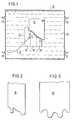
- FIG. 1 the essential parts of a device are shown schematically and in plan view, which are used in the implementation of the inventive method.
- a workpiece electrode 12 and material electrode 14 are located in a container 10.
- the material electrode 14 and the workpiece electrode 12 are arranged one above the other.
- the material consists of polycrystalline synthetic diamond, which has preferably been applied to a carrier in the form of hard metal.
- the material electrode 14 in the exemplary embodiment it consists of sections 16, 18 and 20.
- a combination of several sections in order to achieve a desired area of the material electrode 14 is necessary if the blanks made available in the form of plates are not have the desired dimensions.
- commercially available plates of circular cross-section with a diameter of, for example, 13.7 mm are offered, the thickness of which is, for example, 1.5 or 3.2 mm.
- the electrodes 12 and 14 are in a cooling fluid provided with the reference numeral 24 in the form of a dielectric liquid.
- the liquid 24 can be introduced into the container 10 via openings 26 and 28 in order to be discharged via openings 30 and 32 at opposite regions of the container 10.
- the arrow 34 indicates a targeted flow direction of the fluid in the direction of the area between the electrodes 12 and 14.
- the tool electrode 12 is designed as a positive electrode and the material electrode 14 as a negative electrode. A potential difference is generated between these two electrodes with a voltage source, not shown, which is so large that a sparkover occurs between the tool electrode 12 and the material electrode 14.
- the inventive arrangement of the tool electrode 12 above the material electrode 14 results in a direct sparkover from the edge surfaces of the tool electrode 12 to the immediately below areas of the material electrode 14.
- the tool electrode In order to now produce a desired profile in the material 14, the tool electrode must have the corresponding negative shape.
- the shape of the tool electrode 12 determines the profile of the polycrystalline synthetic diamond. Since the conductive tool electrode 12 can be machined without difficulty and the desired peripheral surfaces can be obtained, the result is that the polycrystalline synthetic diamond can also have any desired profile.
- FIG. 2 and 3 show, by way of example, profiles of polycrystalline synthetic diamonds which have been produced with the aid of electroerosive machining.
- the profile 36 of FIG. 2 is composed of circular sections and rectangles, whereas the profile 38 of FIG. 3 predominantly consists of circular sections is composed, which merge in straight lines in the edge regions of the polycrystalline material.
- the sections of the circle each have the same radius, but are partially offset with respect to their center.
- the polycrystalline synthetic diamonds profiled with the aid of the method according to the invention can now be fastened to the breast surfaces of the cutting edges by single-cutting or multi-cutting rotating tools.
- the attachment can be carried out by soldering the carrier material, which is preferably hard metal, onto the breast surfaces.
Landscapes
- Physics & Mathematics (AREA)
- Thermal Sciences (AREA)
- Engineering & Computer Science (AREA)
- Mechanical Engineering (AREA)
- Electrical Discharge Machining, Electrochemical Machining, And Combined Machining (AREA)
- Polishing Bodies And Polishing Tools (AREA)
- Crystals, And After-Treatments Of Crystals (AREA)
Claims (5)
Priority Applications (1)
| Application Number | Priority Date | Filing Date | Title |
|---|---|---|---|
| AT79103949T ATE870T1 (de) | 1978-10-13 | 1979-10-13 | Verfahren und vorrichtung zum bearbeiten eines polykristallinen synthetischen diamanten und verwendung des nach diesem verfahren bearbeiteten diamanten. |
Applications Claiming Priority (2)
| Application Number | Priority Date | Filing Date | Title |
|---|---|---|---|
| DE2844602 | 1978-10-13 | ||
| DE19782844602 DE2844602A1 (de) | 1978-10-13 | 1978-10-13 | Trennen von polykristallinem material |
Publications (2)
| Publication Number | Publication Date |
|---|---|
| EP0010276A1 EP0010276A1 (fr) | 1980-04-30 |
| EP0010276B1 true EP0010276B1 (fr) | 1982-04-21 |
Family
ID=6052076
Family Applications (1)
| Application Number | Title | Priority Date | Filing Date |
|---|---|---|---|
| EP79103949A Expired EP0010276B1 (fr) | 1978-10-13 | 1979-10-13 | Procédé et dispositif pour l'usinage de diamant synthétique polycristallin, et utilisation du diamant ainsi usiné |
Country Status (3)
| Country | Link |
|---|---|
| EP (1) | EP0010276B1 (fr) |
| AT (1) | ATE870T1 (fr) |
| DE (2) | DE2844602A1 (fr) |
Families Citing this family (6)
| Publication number | Priority date | Publication date | Assignee | Title |
|---|---|---|---|---|
| IE53484B1 (en) * | 1981-02-13 | 1988-11-23 | Redland Roof Tiles Ltd | Wire electrode spark erosion |
| DE3128403A1 (de) * | 1981-07-17 | 1983-02-03 | Lach-Spezial-Werkzeuge Gmbh, 6450 Hanau | Verfahren und vorrichtung zum nachschleifen von diemantwerkzeugen |
| JPS58501623A (ja) * | 1982-05-28 | 1983-09-29 | ラツハ−シユペツイアル−ヴエルクツオイゲ・ゲ−エムベ−ハ− | 焼結工具の精密加工法および装置 |
| US4629373A (en) * | 1983-06-22 | 1986-12-16 | Megadiamond Industries, Inc. | Polycrystalline diamond body with enhanced surface irregularities |
| US4685440A (en) * | 1986-02-24 | 1987-08-11 | Wheel Trueing Tool Company | Rotary dressing tool |
| GB8826305D0 (en) * | 1988-11-10 | 1988-12-14 | De Beers Ind Diamond | Shaping of bonded abrasive products |
Family Cites Families (4)
| Publication number | Priority date | Publication date | Assignee | Title |
|---|---|---|---|---|
| US2552582A (en) * | 1946-12-23 | 1951-05-15 | Chauncey G Peters | Dry drilling of diamonds and the like |
| DE856874C (de) * | 1949-05-25 | 1952-11-24 | Patra Patent Treuhand | Verfahren zur Erzeugung von Loechern in Diamanten u. dgl., insbesondere zur Herstellung von Ziehsteinen |
| FR1031411A (fr) * | 1951-01-25 | 1953-06-23 | Csf | Machine à percer le diamant et les matières analogues |
| FR1094969A (fr) * | 1953-11-28 | 1955-05-25 | Nouveau procédé de perçage des pierres précieuses |
-
1978
- 1978-10-13 DE DE19782844602 patent/DE2844602A1/de not_active Withdrawn
-
1979
- 1979-10-13 EP EP79103949A patent/EP0010276B1/fr not_active Expired
- 1979-10-13 DE DE7979103949T patent/DE2962582D1/de not_active Expired
- 1979-10-13 AT AT79103949T patent/ATE870T1/de active
Also Published As
| Publication number | Publication date |
|---|---|
| EP0010276A1 (fr) | 1980-04-30 |
| DE2962582D1 (en) | 1982-06-03 |
| DE2844602A1 (de) | 1980-04-17 |
| ATE870T1 (de) | 1982-05-15 |
Similar Documents
| Publication | Publication Date | Title |
|---|---|---|
| EP0076997B1 (fr) | Procédé et dispositif pour l'usinage de matière non-conductrice liée à du métal | |
| DE69823960T2 (de) | Verfahren zur Herstellung eines Löcherrasiersystems | |
| DE1690763B1 (de) | Elektroerosive Bearbeitung von metalallischen Werkstucken mittels einer Elektrode | |
| EP0481348B1 (fr) | Méthode et appareil de taillage de disques de meulage | |
| DE3223296A1 (de) | Verfahren zur elektrolytischen bzw. elektrischen entladungs-bearbeitung eines nicht-leitfaehigen werkstuecks | |
| DE69822088T2 (de) | Elektrode zum Erzeugen von hydrodynamischem Druck | |
| EP0010276A1 (fr) | Procédé et dispositif pour l'usinage de diamant synthétique polycristallin, et utilisation du diamant ainsi usiné | |
| DE1221380B (de) | Poroeser Werkstoff fuer eine Werkzeugelektrode und Verfahren zu seiner Herstellung | |
| DE1565077C3 (de) | Werkzeug-Elektrode zum elektrochemischen Senken | |
| EP4045219A1 (fr) | Procédé et électrode pour usiner des pièces par usinage électrochimique | |
| DE3150863A1 (de) | Verfahren und vorrichtung zum fraesen von schmalen nuten | |
| CH628274A5 (de) | Elektrodenplatte zum aufspannen von grafitelektroden. | |
| DE1294794B (de) | Vorrichtung zur elektrolytischen Abtragung eines langgestreckten Werktueckes | |
| DE3340388A1 (de) | Funkenerosionsverfahren und -einrichtung mit bewegter drahtelektrode | |
| EP1208943A1 (fr) | Dispositif et procédé pour dresser une meule à liaison métal | |
| DE3624695A1 (de) | Anordnung zur elektrolytischen behandlung profilierter werkstuecke | |
| EP0247022A2 (fr) | Procédé électrochimique pour usiner des outils de coupe en acier rapide ou en métaux durs | |
| DE2519427C2 (fr) | ||
| DE1958702A1 (de) | Verfahren und Einrichtung zum elektrochemischen Senken von Raumformen | |
| DE2121110C3 (de) | Vorrichtung zum elektrochemischen Entgraten | |
| DE19639453B4 (de) | Schleifvorrichtung | |
| DE2345635A1 (de) | Verfahren zur herstellung eines mit schaufeln versehenen rotors und durch dieses verfahren hergestellter rotor | |
| DE10308358A1 (de) | Vorrichtung zur elektro-chemischen Formgebung | |
| DE102004041780A1 (de) | Vorrichtung und Verfahren zum elektrochemischen Senken | |
| DE102015113373A1 (de) | Verfahren und Vorrichtung zur elektro-chemischen Bearbeitung eines metallischen Rohlings |
Legal Events
| Date | Code | Title | Description |
|---|---|---|---|
| PUAI | Public reference made under article 153(3) epc to a published international application that has entered the european phase |
Free format text: ORIGINAL CODE: 0009012 |
|
| AK | Designated contracting states |
Designated state(s): AT BE CH DE FR GB IT LU NL SE |
|
| 17P | Request for examination filed | ||
| ITF | It: translation for a ep patent filed | ||
| GRAA | (expected) grant |
Free format text: ORIGINAL CODE: 0009210 |
|
| AK | Designated contracting states |
Designated state(s): AT BE CH DE FR GB IT LU NL SE |
|
| REF | Corresponds to: |
Ref document number: 870 Country of ref document: AT Date of ref document: 19820515 Kind code of ref document: T |
|
| REF | Corresponds to: |
Ref document number: 2962582 Country of ref document: DE Date of ref document: 19820603 |
|
| PLBI | Opposition filed |
Free format text: ORIGINAL CODE: 0009260 |
|
| 26 | Opposition filed |
Opponent name: FIRMA PREKWINKEL Effective date: 19820720 |
|
| PG25 | Lapsed in a contracting state [announced via postgrant information from national office to epo] |
Ref country code: LU Free format text: LAPSE BECAUSE OF NON-PAYMENT OF DUE FEES Effective date: 19821031 |
|
| PLBI | Opposition filed |
Free format text: ORIGINAL CODE: 0009260 |
|
| PLBI | Opposition filed |
Free format text: ORIGINAL CODE: 0009260 |
|
| 26 | Opposition filed |
Opponent name: LEDERMANN GMBH + CO. Effective date: 19830118 Opponent name: N.V. PHILIPS' GLOEILAMPENFABRIEKEN Effective date: 19830117 Opponent name: FLAKO AG Effective date: 19830111 |
|
| 26 | Opposition filed |
Opponent name: AICHELE WERKZEUGE GMBH + CO. KG Effective date: 19830121 Opponent name: GENERAL ELECTRIC COMPANY Effective date: 19830119 |
|
| PGFP | Annual fee paid to national office [announced via postgrant information from national office to epo] |
Ref country code: LU Payment date: 19831003 Year of fee payment: 5 |
|
| PGFP | Annual fee paid to national office [announced via postgrant information from national office to epo] |
Ref country code: AT Payment date: 19831004 Year of fee payment: 5 |
|
| PGFP | Annual fee paid to national office [announced via postgrant information from national office to epo] |
Ref country code: CH Payment date: 19831010 Year of fee payment: 5 |
|
| PGFP | Annual fee paid to national office [announced via postgrant information from national office to epo] |
Ref country code: FR Payment date: 19831026 Year of fee payment: 5 |
|
| PGFP | Annual fee paid to national office [announced via postgrant information from national office to epo] |
Ref country code: SE Payment date: 19831031 Year of fee payment: 5 Ref country code: NL Payment date: 19831031 Year of fee payment: 5 |
|
| PGFP | Annual fee paid to national office [announced via postgrant information from national office to epo] |
Ref country code: BE Payment date: 19831130 Year of fee payment: 5 |
|
| PLAB | Opposition data, opponent's data or that of the opponent's representative modified |
Free format text: ORIGINAL CODE: 0009299OPPO |
|
| PGFP | Annual fee paid to national office [announced via postgrant information from national office to epo] |
Ref country code: DE Payment date: 19831230 Year of fee payment: 5 |
|
| R26 | Opposition filed (corrected) |
Opponent name: FIRMA PREKWINKEL * 830111 FLAKO AG * 830117 N.V. P Effective date: 19820720 |
|
| PG25 | Lapsed in a contracting state [announced via postgrant information from national office to epo] |
Ref country code: SE Effective date: 19841014 |
|
| PLBG | Opposition deemed not to have been filed |
Free format text: ORIGINAL CODE: 0009274 |
|
| 26D | Opposition deemed not to have been filed |
Opponent name: LEDERMANN GMBH + CO. Effective date: 19831027 |
|
| RDAG | Patent revoked |
Free format text: ORIGINAL CODE: 0009271 |
|
| STAA | Information on the status of an ep patent application or granted ep patent |
Free format text: STATUS: PATENT REVOKED |
|
| BERE | Be: lapsed |
Owner name: LACH-SPEZIAL-WERKZEUGE G.M.B.H. Effective date: 19841013 |
|
| 27W | Patent revoked |
Effective date: 19841125 |
|
| GBPR | Gb: patent revoked under art. 102 of the ep convention designating the uk as contracting state | ||
| REG | Reference to a national code |
Ref country code: CH Ref legal event code: PL |
|
| NLV4 | Nl: lapsed or anulled due to non-payment of the annual fee | ||
| REG | Reference to a national code |
Ref country code: FR Ref legal event code: ST |
|
| EUG | Se: european patent has lapsed |
Ref document number: 79103949.8 Effective date: 19851007 |
|
| PLAB | Opposition data, opponent's data or that of the opponent's representative modified |
Free format text: ORIGINAL CODE: 0009299OPPO |