EP0010317B1 - 6-,1- und 2-substituierte 1-Carbapen-2-em-3-Carbonsäure, Verfahren zur Herstellung solcher Verbindungen und solche Verbindungen enthaltende pharmazeutische Zusammensetzungen - Google Patents
6-,1- und 2-substituierte 1-Carbapen-2-em-3-Carbonsäure, Verfahren zur Herstellung solcher Verbindungen und solche Verbindungen enthaltende pharmazeutische Zusammensetzungen Download PDFInfo
- Publication number
- EP0010317B1 EP0010317B1 EP79104106A EP79104106A EP0010317B1 EP 0010317 B1 EP0010317 B1 EP 0010317B1 EP 79104106 A EP79104106 A EP 79104106A EP 79104106 A EP79104106 A EP 79104106A EP 0010317 B1 EP0010317 B1 EP 0010317B1
- Authority
- EP
- European Patent Office
- Prior art keywords
- carbon atoms
- phenyl
- alkyl
- compound according
- methyl
- Prior art date
- Legal status (The legal status is an assumption and is not a legal conclusion. Google has not performed a legal analysis and makes no representation as to the accuracy of the status listed.)
- Expired
Links
- 0 CC(*)C(C(C(C)C(SC*C*)S*C*)N1)C1=O Chemical compound CC(*)C(C(C(C)C(SC*C*)S*C*)N1)C1=O 0.000 description 29
- CLLJZNHANJSCIT-UHFFFAOYSA-N CC1(C)C([N+]([O-])=O)=CCCC1 Chemical compound CC1(C)C([N+]([O-])=O)=CCCC1 CLLJZNHANJSCIT-UHFFFAOYSA-N 0.000 description 1
Classifications
-
- C—CHEMISTRY; METALLURGY
- C07—ORGANIC CHEMISTRY
- C07D—HETEROCYCLIC COMPOUNDS
- C07D205/00—Heterocyclic compounds containing four-membered rings with one nitrogen atom as the only ring hetero atom
- C07D205/02—Heterocyclic compounds containing four-membered rings with one nitrogen atom as the only ring hetero atom not condensed with other rings
- C07D205/06—Heterocyclic compounds containing four-membered rings with one nitrogen atom as the only ring hetero atom not condensed with other rings having one double bond between ring members or between a ring member and a non-ring member
- C07D205/08—Heterocyclic compounds containing four-membered rings with one nitrogen atom as the only ring hetero atom not condensed with other rings having one double bond between ring members or between a ring member and a non-ring member with one oxygen atom directly attached in position 2, e.g. beta-lactams
-
- C—CHEMISTRY; METALLURGY
- C07—ORGANIC CHEMISTRY
- C07C—ACYCLIC OR CARBOCYCLIC COMPOUNDS
- C07C205/00—Compounds containing nitro groups bound to a carbon skeleton
- C07C205/39—Compounds containing nitro groups bound to a carbon skeleton the carbon skeleton being further substituted by esterified hydroxy groups
- C07C205/42—Compounds containing nitro groups bound to a carbon skeleton the carbon skeleton being further substituted by esterified hydroxy groups having nitro groups or esterified hydroxy groups bound to carbon atoms of six-membered aromatic rings of the carbon skeleton
-
- C—CHEMISTRY; METALLURGY
- C07—ORGANIC CHEMISTRY
- C07D—HETEROCYCLIC COMPOUNDS
- C07D477/00—Heterocyclic compounds containing 1-azabicyclo [3.2.0] heptane ring systems, i.e. compounds containing a ring system of the formula:, e.g. carbapenicillins, thienamycins; Such ring systems being further condensed, e.g. 2,3-condensed with an oxygen-, nitrogen- or sulphur-containing hetero ring
- C07D477/10—Heterocyclic compounds containing 1-azabicyclo [3.2.0] heptane ring systems, i.e. compounds containing a ring system of the formula:, e.g. carbapenicillins, thienamycins; Such ring systems being further condensed, e.g. 2,3-condensed with an oxygen-, nitrogen- or sulphur-containing hetero ring with hydrogen atoms, hydrocarbon or substituted hydrocarbon radicals, directly attached in position 4, and with a carbon atom having three bonds to hetero atoms with at the most one bond to halogen, e.g. an ester or nitrile radical, directly attached in position 2
- C07D477/12—Heterocyclic compounds containing 1-azabicyclo [3.2.0] heptane ring systems, i.e. compounds containing a ring system of the formula:, e.g. carbapenicillins, thienamycins; Such ring systems being further condensed, e.g. 2,3-condensed with an oxygen-, nitrogen- or sulphur-containing hetero ring with hydrogen atoms, hydrocarbon or substituted hydrocarbon radicals, directly attached in position 4, and with a carbon atom having three bonds to hetero atoms with at the most one bond to halogen, e.g. an ester or nitrile radical, directly attached in position 2 with hydrogen atoms, hydrocarbon or substituted hydrocarbon radicals, attached in position 6
- C07D477/16—Heterocyclic compounds containing 1-azabicyclo [3.2.0] heptane ring systems, i.e. compounds containing a ring system of the formula:, e.g. carbapenicillins, thienamycins; Such ring systems being further condensed, e.g. 2,3-condensed with an oxygen-, nitrogen- or sulphur-containing hetero ring with hydrogen atoms, hydrocarbon or substituted hydrocarbon radicals, directly attached in position 4, and with a carbon atom having three bonds to hetero atoms with at the most one bond to halogen, e.g. an ester or nitrile radical, directly attached in position 2 with hydrogen atoms, hydrocarbon or substituted hydrocarbon radicals, attached in position 6 with hetero atoms or carbon atoms having three bonds to hetero atoms with at the most one bond to halogen, e.g. an ester or nitrile radical, directly attached in position 3
- C07D477/20—Sulfur atoms
-
- C—CHEMISTRY; METALLURGY
- C07—ORGANIC CHEMISTRY
- C07D—HETEROCYCLIC COMPOUNDS
- C07D477/00—Heterocyclic compounds containing 1-azabicyclo [3.2.0] heptane ring systems, i.e. compounds containing a ring system of the formula:, e.g. carbapenicillins, thienamycins; Such ring systems being further condensed, e.g. 2,3-condensed with an oxygen-, nitrogen- or sulphur-containing hetero ring
- C07D477/26—Heterocyclic compounds containing 1-azabicyclo [3.2.0] heptane ring systems, i.e. compounds containing a ring system of the formula:, e.g. carbapenicillins, thienamycins; Such ring systems being further condensed, e.g. 2,3-condensed with an oxygen-, nitrogen- or sulphur-containing hetero ring with hetero atoms or carbon atoms having three bonds to hetero atoms with at the most one bond to halogen, e.g. an ester or nitrile radical, directly attached in position 4
-
- C—CHEMISTRY; METALLURGY
- C07—ORGANIC CHEMISTRY
- C07F—ACYCLIC, CARBOCYCLIC OR HETEROCYCLIC COMPOUNDS CONTAINING ELEMENTS OTHER THAN CARBON, HYDROGEN, HALOGEN, OXYGEN, NITROGEN, SULFUR, SELENIUM OR TELLURIUM
- C07F7/00—Compounds containing elements of Groups 4 or 14 of the Periodic Table
- C07F7/02—Silicon compounds
- C07F7/08—Compounds having one or more C—Si linkages
- C07F7/18—Compounds having one or more C—Si linkages as well as one or more C—O—Si linkages
- C07F7/1804—Compounds having Si-O-C linkages
-
- C—CHEMISTRY; METALLURGY
- C07—ORGANIC CHEMISTRY
- C07F—ACYCLIC, CARBOCYCLIC OR HETEROCYCLIC COMPOUNDS CONTAINING ELEMENTS OTHER THAN CARBON, HYDROGEN, HALOGEN, OXYGEN, NITROGEN, SULFUR, SELENIUM OR TELLURIUM
- C07F9/00—Compounds containing elements of Groups 5 or 15 of the Periodic Table
- C07F9/02—Phosphorus compounds
- C07F9/547—Heterocyclic compounds, e.g. containing phosphorus as a ring hetero atom
- C07F9/553—Heterocyclic compounds, e.g. containing phosphorus as a ring hetero atom having one nitrogen atom as the only ring hetero atom
- C07F9/568—Four-membered rings
Definitions
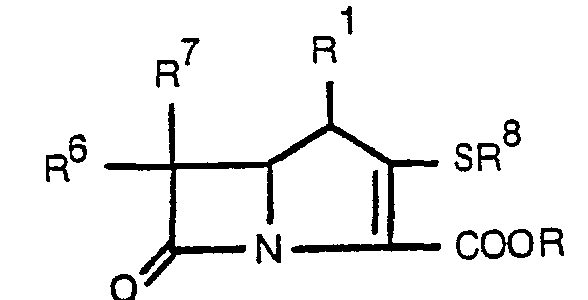
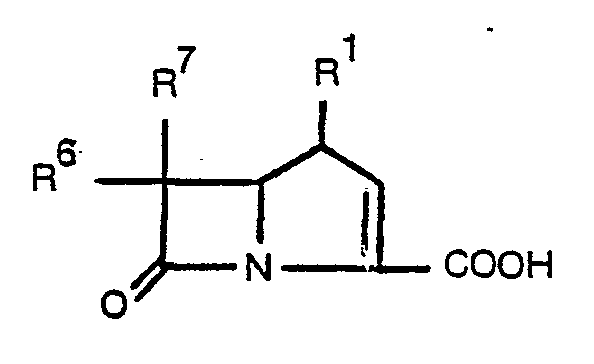
- This invention relates to 6-, 1- and 2-substituted-1-carbapen-2-em-3-carboxylic acids and derivatives thereof which are useful as antibiotics and which may be represented by the following generic structural formula (I): wherein: R° is H or -SR 8 ; R 1 , R 6 , R 7 and R 8 are indpendently selected from hydrogen (R 1 is not hydrogen), substituted and unsubstituted: alkyl, alkenyl, and alkynyl, having from 1-10 carbon atoms; cycloalkyl, cycloalkylalkyl, and alkylcycloalkyl, having 3-6 carbon atoms in the cycloalkyl ring and 1-6 carbon atoms in the alkyl moieties; phenyl; aralkyl, aralkenyl, and aralkynyl wherein the aryl moiety is phenyl and the linear chain has 1-6 carbon atoms; heterocyclyl and heterocycly
- This invention also relates to the carboxyl derivatives of I which are antibiotics and which may be represented by the following generic structure (I): wherein X' is oxygen; and R 3 is, selected from hydrogen, pharmaceutically acceptable salt and ester moieties known in the bicyclic ⁇ -lactam antibiotic art.
- This invention also relates to processes for the preparation of such compounds (I) and pharmaceutical compositions comprising such compounds.
- Preferred compounds of formula I are those wherein R 6 is H or methyl and R 7 is alkyl, phenyl, aralkyl or hydroxyl-substituted alkyl, phenyl or aralkyl.
- R S is hydrogen or methyl and R 8 is selected from: and R 7 is selected from:
- antibiotics which are useful in animal and human therapy and in inanimate systems. These antibiotics are active against a broad range of pathogens which representatively include both gram positive bacteria such as S. aureua, Strep, pyogenes, and B. subtilis, and gram negative bacteria such as E. coli, Pseudomonas, Proteus morganii, Serratia, and Klebsiella. Further objects of this invention are to provide chemical processes for the preparation of such antibiotics and their non-toxic pharmaceutically acceptable salts and pharmaceutical compositions comprising such antibiotics.
- the 4-(1,2-substituted-vinyl)azetidine-2-one, 4 starting material is prepared by reacting an R 1- and R 1 '-substituted-oxybutadiene, 1 with chlorosulfonylisocyanate 2.
- the rection is conducted without solvent or may be run in solvent such as diethyl ether, ethyl acetate, chloroform or methylene chloride; at a temperature of from -78°C to 25°C for from a few minutes to 1 hour to provide 3.
- the radical R 1 ' is an easily removable acyl blocking group such as an alkanoyl or aralkanoyl which bears no functional group or groups which might interfere with the desired course of reaction (1 + 2 ⁇ 3 ⁇ 4).
- Intermediate species 3 is converted to the sulfinamide by reduction which is then hydrolyzed to 4 at pH 6-8.
- the reaction solution comprising 3 is contacted (5-30 minutes) with an aqueous solution (at 0-25 0 C) of a reducing agent such as sodium sulfite or thiophenol, at pH 6-8 to provide 4.
- a reducing agent such as sodium sulfite or thiophenol
- the reaction 4 ⁇ 5 is a reduction, and is preferably achieved by hydrogenation in a solvent such as ethyl acetate, ether, dioxane, tetrahydrofuran (THF) or ethanol, at 0 to 25°C for from 5 minutes to 2 hours under 1 to 10 atmospheres of hydrogen in the presence of a hydrogenation catalyst such as a platinum metal or oxide thereof such as 10% Pd/C.
- a solvent such as ethyl acetate, ether, dioxane, tetrahydrofuran (THF) or ethanol
- the de-blocking reaction 5 ⁇ 6 is usually desirable when R 1 ' is acyl to permit the later alkylation, 7 ⁇ 8.
- the preferred de-blocking procedure is by alcoholysis wherein the solvent is a lower alkanol such as methanol or ethanol, in the presence of the corresponding alkali metal alkoxide, such as sodium methoxide.
- the reaction is conducted for from 5 minutes to 1 hour at a temperature of from -10° to 25°C.
- Blocking groups R 3 and R 2 are established (6 ⁇ 7) to provide a suitably protected species for alkylation (7 ⁇ 8 ⁇ 9). There is no criticality in the choice of blocking groups, provided only that they do not interfere with the intended alkylation.
- R 3 may be hydrogen, a triorganosilyl group such as trimethylsilyl or t-butyldimethylsilyl; or a cyclic ether such as 2-tetrahydropyranyl;
- R 2 may also be a cyclic ether such as 2-tetrahydropyranyl; alternatively, R 3 and R 2 may be joined together to form protected species such as 7a:
- species such as 7a are conveniently prepared by treating 6 with 2,2-dimethoxypropane in the presence of a catalyst such as boron trifluoride etherate or, toluene sulphonic acid, in a solvent such as methylene chloride, ether, chloroform or dioxane at a temperature of from -10°C to 35°C for from a few minutes to 1 hour.
- a catalyst such as boron trifluoride etherate or, toluene sulphonic acid
- Species 7 can be mono- or dialkylated at ring position 6. Alkylation of 7 provides 8. Typically, 7 is treated with a strong base such as lithium diisopropylamide, sodium hydride, phenyl lithium or butyl lithium in a solvent such as tetrahydrofuran (THF), ether or dimethoxyethane at a temperature of from -80°C to 0°C., whereupon the alkylation agent of choice, R B X, is added (R 8 is as described above and X is chloro, iodo or bromo; alternatively the alkylating agent may be R 6- tosylate, R 6- mesylate or an aldehyde or ketone such as acetaldehyde) to provide monoalkylated species 8.
- R B X alkylation agent of choice
- the alkylating agent may be R 6- tosylate, R 6- mesylate or an aldehyde or ketone such as acetal
- the de-blocking reaction 9 10 is typically conducted by acid hydrolysis such as aqueous acetic acid at a temperature of from 25°C to 75°C for from 5 minutes to 3 hours.
- the aldehyde intermediate 11 is prepared by treating 10 with an oxidizing agent such as Cr0 3 .2(pyridine) in CH 3 CN, 1:1 mixture of dimethylsulfoxide and acetic anhydride, cyclohexylcarbodiimide in DMSO or pyridinium chlorochromate in CH 2 Cl 2 at a temperature of from 0 ⁇ 25°C for from 5 minutes to 1 hour.
- the resulting species 11 in a solvent such as acetonitrile, methylene chloride or chloroform at a temperature of from -10 to 25°C is treated with an excess of the reagent HSR 8 in the presence of an acid catalyst such as boron trifluoride etherate or toluene sulphonic acid to provide 12.
- an acid catalyst such as boron trifluoride etherate or toluene sulphonic acid to provide 12.
- the reaction requires from 1 to 60 minutes.
- an olefin such as cyclo
- the vinyl sulphide species 14 is reacted with a diester of oxomalonic acid (or its monohydrate) to provide 15.
- a diester of oxomalonic acid or its monohydrate
- R 5 There is no criticality as to the identity of the ester moiety, R 5 , of the oxomalonic acid.
- R 5 may be a conventional, easily removable blocking group or it may be a pharmaceutically acceptable ester moiety.
- Suitable ester radicals R 5 are p-nitrobenzyl, benzyl, o-nitrobenzyl, t-butyl, 2,2,2-trichloroethyl.
- the reaction 14 ⁇ 15 is typically conducted in a high boiling organic solvent such as benzene, toluene or cyclohexane at a temperature of from about 50°C to reflux for from 0.5 to 6 hours.
- the halogenation reaction 15 ⁇ 16 is typically conducted in a solvent such as THF, glyme, ether, methylene chloride or chloroform in the presence of a halogenating agent such as thionyl chloride or phosphorus pentachloride in the presence of base such as pyridine at a temperature of from -20°C to 25°C for from 5 minutes to 3 hours.
- a solvent such as THF, glyme, ether, methylene chloride or chloroform
- a halogenating agent such as thionyl chloride or phosphorus pentachloride
- base such as pyridine
- the selective reduction of 15 ⁇ 17 via 16 is completed by treating 16 with tributylphosphine, triphenylphosphine, or the like in aqueous DMF or similar aqueous systems involving dioxane, THF, glyme DMSO, or acetone at a temperature of from about 0-50 0 C for from 10 minutes to 5 hours.
- Species 17 is halogenated by the previous procedure (12 ⁇ 13), but omitting the addition of the cyclohexene or other olefin, to provide the dihalo species 18.
- Species 18 is treated with a base such as triethylamine, sodium hydride or potassium hydride in a solvent such as DMF, acetonitrile, methylene chloride, chloroform or glyme at a temperature of from about -78° to 25°C for 1 to 5 hours to provide 19.
- Species 19 is converted to 20 on treatment with a strong base such as 1,5-diazabicyclo[5.4.0]-undec-5-ene(DBU) or 1,5-diazabicyclo[3.4.0]non-5-ene(DBN), in a solvent such as DMSO, acetone, chloroform, DMF, THF or glyme or on treatment with AgF in pyridine at a temperature of from 0-40 0 C for from 1/4 to 24 hours.
- a strong base such as 1,5-diazabicyclo[5.4.0]-undec-5-ene(DBU) or 1,5-diazabicyclo[3.4.0]non-5-ene(DBN)
- a solvent such as DMSO, acetone, chloroform, DMF, THF or glyme
- AgF in pyridine at a temperature of from 0-40 0 C for from 1/4 to 24 hours.
- the reaction 20 ⁇ 21 is conducted by treating 20 with an aromatic base such as pyridine, aqueous dimethylsulfoxide, s-collidine or lutidine, in the presence of a displacing agent such as lighium iodide, sodium chloride, lithium bromide or sodium bromide, at a temperature of from about 80 ⁇ 150°C for from 15 minutes to 2 hours.
- an aromatic base such as pyridine, aqueous dimethylsulfoxide, s-collidine or lutidine
- a displacing agent such as lighium iodide, sodium chloride, lithium bromide or sodium bromide
- Isomerization of the double bond 21 ⁇ 22 is accomplished by treating 21 in a solvent such as DMF, DMSO, ethyl ether, THF, glyme, methylene chloride with a strong base such as diisoprypylamine, DBU or DBN, at a temperature of from 0° to about 25°C for from a few minutes to 2 hours or until equilibrium has been established as determined by examination of sample aliquots by ultraviolet absorption or by thin layer chromatography.
- a solvent such as DMF, DMSO, ethyl ether, THF, glyme, methylene chloride
- a strong base such as diisoprypylamine, DBU or DBN
- the final reaction 22 ⁇ I (hydrogenolysis of the blocking group) is accomplished by treating 22 in a solvent such as dioxane, ethanol or THF or an aqueous mixture thereof in the presence of a platinum metal catalyst such as Pd/C under a hydrogen pressure of from 1-4 atmospheres for from 0.5 to 8 hours at a temperature of from about 0-25°C.
- a solvent such as dioxane, ethanol or THF or an aqueous mixture thereof
- a platinum metal catalyst such as Pd/C under a hydrogen pressure of from 1-4 atmospheres for from 0.5 to 8 hours at a temperature of from about 0-25°C.
- suitable alkylating agents for establishing R 8 and/or R 7 at ring position 6 (7 ⁇ 8 ⁇ 9) are:
- R 1 Relative to the compounds of the present invention I: the most preferred values for R 1 include:
- R 1 is selected from methyl, ethyl, propyl, isopropyl, cyclopropyl, phenyl, benzyl, and 2-bromoethyl.
- R° is H
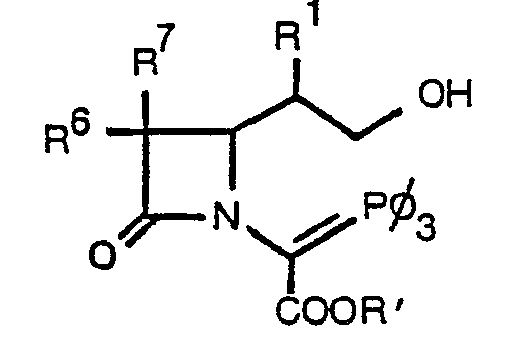
- R 6 , R 7 and R 1 are as hereinbefore defined; R and R' are readily removable blocking groups; R' may also be a pharmaceutically acceptable ester moiety.
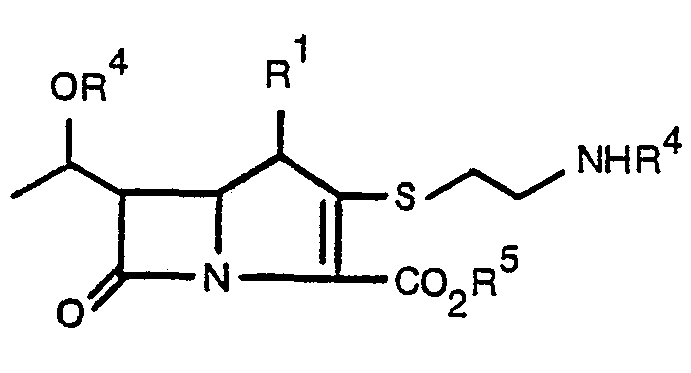
- the blocking group R is an acyl such as a lower alkanoyl or aralkylcarbonyl such as acetyl, bromo-t-butoxycarbonyl, benzyloxycarbonyl, formyl or trifluoroacetyl or a trialkylsilyl such as a trimethylsilyl or t-butyl dimethylsilyl group; and typically the blocking group R' is substituted or unsubstituted alkyl, aralkyl or alkenyl, such as benzyl, p-nitrobenzyl, o-nitrobenzyl, pivaloyloxymethyl or bromo-t-butyl.
- acyl such as a lower alkanoyl or aralkylcarbonyl such as acetyl, bromo-t-butoxycarbonyl, benzyloxycarbonyl, formyl or trifluoroacetyl or a trialkylsilyl such as a trimethyl
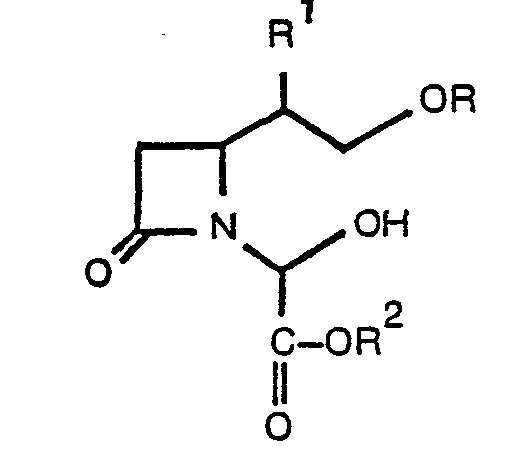
- a suitably substituted azetidinone (1) is reacted with a glyoxylate ester such as benzyl glyoxylate to form the corresponding 1-(benzyloxycarbonyl- hydroxymethyl)azetidinone (2).
- the reaction 1 ⁇ 2 is conveniently carried out in a solvent such as benzene, toluene or xylene at a temperature of from about 25°C to reflux for from 2 to 10 hours. There is no criticality as to the precise identity of the solvent, provided only that it adequately solubilizes the reactants and be inert or substantially inert to the desired course of reaction.
- the halogenation reaction 2 ⁇ 3 may be conducted by any of a variety of well-known halogenation means. Suitable reagents include: SOC1 2 , POCI 3 or oxalyl chloride.
- a preferred means of chlorination involves treating 2 in a solvent such as tetrahydrofuran (THF), ether or CH 2 Cl 2 with thionylchloride in the presence of 1 to 2 equivalents (relative to the thionylchloride) of a base such as pyridine, triethylamine or quinoline.
- THF tetrahydrofuran
- ether ether
- CH 2 Cl 2 thionylchloride
- a base such as pyridine, triethylamine or quinoline.
- the reaction is conducted at a temperature of from -30 to 25°C for from 0.5 to 1 hour.
- the resulting 1-(benzyloxycarbonylchloromethyl)-azetidinone species, 3, is isolated, if desired, by conventional procedures for later reaction 3 ⁇ 4.
- the intermediate 4 is prepared from 3 by treating 3 in a solvent such as dimethylformamide (DMF), dimethylsulfoxide (DMSO), THF or dimethoxyethane (DME) with 1 to 1.5 equivalents of a phosphine such as triphenylphosphine, tributylphosphine, triethylphosphine, tris-(2-cyanoethyl)phosphine.
- a solvent such as dimethylformamide (DMF), dimethylsulfoxide (DMSO), THF or dimethoxyethane (DME)
- a phosphine such as triphenylphosphine, tributylphosphine, triethylphosphine, tris-(2-cyanoethyl)phosphine.
- the reaction 4 ⁇ 5 may be achieved by any of a variety of well-known deblocking procedures such as hydrolysis or hydrogenolysis.
- the ring closure reaction 5 ⁇ 7 proceeds via the oxo intermediate 6 and is achieved by treating 5 with an equivalent of an oxidizing system such as 1:1 mixture of dimethylsulfoxide (DMSO) and acetic anhydride (Ac 2 0); other oxidizing systems include cyclohexylcarbodiimide in DMSO, CrO 3 .2 (pyridine) in CH 2 Cl 2 , and pyridinium chlorochromate in CH 2 CI 2 for example.
- an oxidizing system such as 1:1 mixture of dimethylsulfoxide (DMSO) and acetic anhydride (Ac 2 0);
- other oxidizing systems include cyclohexylcarbodiimide in DMSO, CrO 3 .2 (pyridine) in CH 2 Cl 2 , and pyridinium chlorochromate in CH 2 CI 2 for example.
- the closure step 5 - 7 is conducted at a temperature of from about 0 to 100°C for from 0.25 to 24 hours in the oxidative system (DMSO/Ac z O) described above or by heating from 100-160°C (after isolation of the oxo compound 6) in a solvent such as benzene, toluene, dioxane, xylene, or DMF.
- a solvent such as benzene, toluene, dioxane, xylene, or DMF.
- the carboxyl deblocking step 7 ⁇ 8 may be achieved by a number of well-known procedures such as hydrolysis, hydrogenation, or photolysis of a suitable R' group.
- Suitable hydrogenation catalysts for deblocking include the platinum metals and their oxides such as palladium on carbon; suitable solvents for the hydrogenation include methanol, dioxane/H 2 0 or ethanol/H 2 0 in the presence of hydrogen at a pressure of from 1 to 50 atmospheres; the hydrogenation is typically conducted for from 5 min. to 4 hours at a temperature of about 25°C in the optional presence of a mild base such as sodium bicarbonate.
- the glyoxylate esters 1 a used to react with 1 can be prepared by oxidation of the corresponding tartaric acid diesters with oxidants such as periodic acid or lead tetracetate in a solvent such as THF, benzene, or methylene chloride at -20 to 25° for 1/2 to 4 hours.
- the tartarate esters are prepared from dilithio tartarate or disodio tartarate by reaction with R'X wherein X is chloro, bromo or iodo and R' is as defined above in a solvent such as DMF or DMSO at 25° to 70°C. for from 4 to 48 hrs.
- R' may be a pharmaceutically acceptable ester moiety.
- Such pharmaceutically acceptable esters and amides may also be prepared from the free acid of I.
- the 4-(1-methyl-2-acetoxyvinyl)-azetidinone-2-one (3') is prepared by reacting chlorosulphonyl isocyanate and an acyloxybutadiene (1') such as 2-acetoxy-2-methylbutadiene in a solvent such as anhydrous diethyl ether at a temperature of from about -30°C to 0°C under a nitrogen atmosphere.
- the reaction intermediate 2' is converted to 3' by hydrolysis.
- the reduction of 3' to provide the 4-(1-methyl-2-acetoxyethyll-2-azetidinone (4') is conducted by any convenient means such as hydrogenation in the presence of a catalyst such as platinum, palladium or oxides thereof under a hydrogen pressure of from 1 to 20 atmospheres in a solvent such as ethanol or ethyl acetate, at a temperature of from 0° to 25°C. for from 5 minutes to 1 hour.
- a catalyst such as platinum, palladium or oxides thereof under a hydrogen pressure of from 1 to 20 atmospheres in a solvent such as ethanol or ethyl acetate, at a temperature of from 0° to 25°C. for from 5 minutes to 1 hour.
- the 4-(2-hydroxy-1-methyl-ethyl-2-azetidinone species 5' is obtained from 4' by hydrolysis.
- the 8-oxo-2,2-dimethyl-5-methyl-3-oxa-1-azabicyclo[4.2.0]octane species 6' is obtained on treatment of 5' with 2,2-dimethoxypropane in the presence of a catalyst such as boron trifluoride etherate in a solvent such as methylene chloride at a temperature of from 0° to 40°C. for from 1 to 40 minutes.
- a catalyst such as boron trifluoride etherate
- a solvent such as methylene chloride
- 5' can be treated with boron trifluoride etherate and trimethylorthoformate to give 8-oxo-2-methoxy-5-methyl-3-oxa-1-azabicyclo[4.2.0]octane which can be mono- or dialkylated following the procedures for 6' -+ 7' or 8'.
- Alkylation of 6' provides 7'.
- 6' is treated with a strong base such as lithium diisopropylamide, sodium hydride, phenyl lithium or butyl lithium in a solvent such as tetrahydrofuran (THF), ether or dimethoxyethane at a temperature of from -80°C to 0°C., whereupon the alkylating agent of choice, R 6 X is added (R 6 is as described above and X is chloro or bromo; alternatively the alkylating agent may be R 6- tosylate R 6- mesylate or an aldehyde or ketone such as acetaldehyde) to provide mono- alkylated species 7'.
- dialkylated species 8' may be obtained from 7' by repeating the alkylating procedure, 6' ⁇ 7'.
- Species 9' is obtained from 7' or 8' by acid hydrolysis.
- the desired blocked-species 1 is obtained by treating 9 with an silylating agent such as t-butyl- dimethylchlorosilane or trimethylchlorosilane in a solvent such as DMF, CH 2 Cl 2 or THF in the presence of a base such as imidazole at 0°C to 25°C for from 0.5 hr to 6 hr or with an acylating agent such as acetyl chloride, formic acetic anhydride or trifluoroacetic anhydride in a solvent such as CH 2 CI 2 , CHCI 3 or THF at a temperature of from -20° to about 25°C. for from 0.5 to about 4 hours.
- the starting material 1 may be isolated for later reaction in accordance with the procedures of the present invention for the preparation of the compounds of the present invention.
- R is acyl or triorganosilyl such as trimethylsilyl, t-butyldimethylsilyl, trifluoroacetyl or formyl
- R" is acyl or triorganosilyl such as trimethylsilyl, t-butyldimethylsilyl, trifluoroacetyl or formyl
- Starting material 1 may alternatively be prepared by the following scheme: wherein all symbolism is as previously defined.
- Reaction 5 - 5a' is accomplished by treating 5' with 2,3-dihydropyran in a solvent such as p-dioxane or benzene, in the presence of for example p-toluene-sulfonic acid or perchloric acid, at a temperature of from 0° to about 30°C.
- the intermediate 5a' may be isolated for later alkylation to obtain 7a' and 8a' by procedures analogous to previously described reactions 6' ⁇ 7' ⁇ 8'.
- Intermediate species 9' is obtained from 7a' or 8a' by mild acid hydrolysis.
- intermediate species 9a' may conveniently be prepared for later reaction in the above scheme by internal acylation according to the following reaction: wherein R is acyl, is R 1 and R° is for example, lower alkyl or acyl.
- R is acyl
- R 1 is R 1 and R° is for example, lower alkyl or acyl.
- the above reaction is conducted in a solvent such as tetrahydrofuran, ether or dimethoxyethane, in the presence of 1 to 2 equivalents of a strong base such as lithium diisopropylamide, sodium hydride or potassium hydride at a temperature of from -78 to 25°C., for from 0.5 to 24 hours.
- the substituted 1,3-butadiene reagent 1' is prepared according to known procedures, which may be summarized: wherein R 1 and R are as defined above.
- the a,j3-unsaturated aldehyde intermediate C is prepared on condensation of A and B in the presence of a base such as NaOH, at a temperature of from 0 to 100°C for from 10 min. to 2 hours. Condensation of C with the isopropenyl ester D in the presence of cupric acetate (1 to 10 mole percent relative to C) and a strong acid such as p-toluene sulfonic acid, perchloric acid or sulfuric acid (1 to 10 mole percent relative to C) provides 1'. Typically the reaction is conducted at 90 to 120°C for from 1 to 8 hours. Representative examples illustrating this preparation of 1' are given below.
- the substituents R 6 , R 7 and R 1 are preferably selected from hydrogen (R' is not H); substituted and unsubstituted: straight and branched loweralkyl having from 1 to 10 carbon atoms; cycloalkyl having from 3 to 6 carbon atoms; cycloalkylalkyl wherein the cycloalkyl moiety comprises 3 to 6 carbon atoms and the alkyl moiety comprises 1 to 10 carbon atoms; alkylcycloalkyl wherein the alkyl moiety comprises 1 to 6 carbon atoms and the cycloalkyl moiety comprises 3 to 6 carbon atoms; phenyl and naphthyl; phenylalkyl such as.
- heterocyclyl saturated and unsaturated comprising mono- and bicyclic structures having from 5 to 10 ring atoms wherein one or more of the hetero atoms is selected from oxygen, nitrogen or sulphur, such as thiophene, imidazolyl, tetrazolyl and furyl; heterocyclylalkyl which comprises the immediately preceding heterocyclyl moieties and the alkyl moiety comprises from 1 to 10 carbon atoms; the substituent (or substituents) relative to the above-named radicals is selected from amino, hydroxyl, cyano, carboxyl, nitro, chloro, bromo, fluoro, lower alkoxy having from 1 to 6 carbon atoms, mercapto, perhaloloweralkyl such as trifluoromethyl, loweralkylthio, guanidino, amidino, sulfamoyl, and N-substituted: sulfamoyl (saturated and unsaturated) comprising mono- and
- R' is alkyl having from 1-6 carbon atoms, cyclopropyl, benzyl or phenyl;
- R 6 is hydrogen and
- R 7 is alkyl having from 1-6 carbon atoms or phenylalkyl wherein the alkyl moiety has 1-6 carbon atoms substituted by hydroxyl or amino.
- R' is methyl, ethyl, isopropyl, t-butyl or phenyl and R 7 is 1-hydroxyethyl, methyl, or hydroxymethyl.
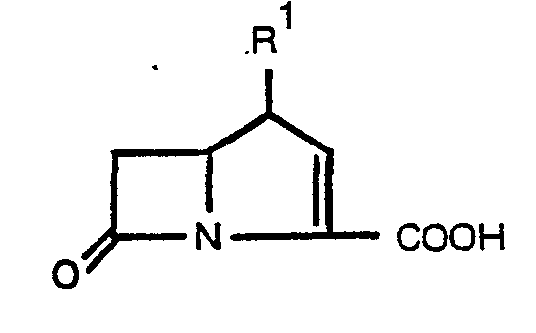
- R°, R 6 and R 7 are hydrogen and R 1 is methyl, phenyl, ethyl, cyclopropyl, propyl and isopropyl.
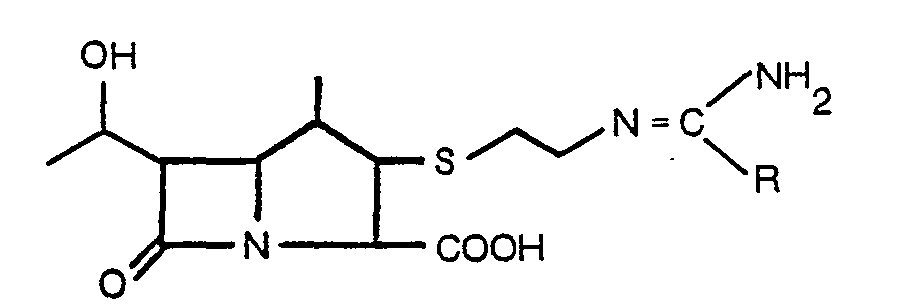
- a preferred compound of formula I is a compound having the formula: wherein R is H or CH 3 .
- a particularly preferred class of compounds (I, above) are those wherein R 7 is hydrogen, R' is selected from (I, above) substituted and unsubstituted:
- esters used as protecting groups are those where R' is benzyl, p-nitrobenzyl, o-nitrobenzyl, t-butyl, bromo-t-butyl, t-butyl-dimethylsilyl, trimethylsilyl, trichloroethyl; or R' represents pharmaceutically acceptable ester moieties such as pivaloyloxymethyl, allyl, methallyl, (2-methylthio)-ethyl, 3-methyl-2-butenyl, p-t-butylbenzyl, 5-indanyl, 3-phthalidyl.
- the compounds made available by the present invention are valuable antibiotics active against various grampositive and gram-negative bacteria and, accordingly, find utility in human and veterinary medicine.
- Such sensitive bacteria representatively include: Staphylococcus aureus, Escherichia coli, Klebsiella pneumoniae, Serratia, Salmonella typhosa, Pseudomonas and Bacterium proteus.
- the resulting compounds may further be utilized as additives to animal feed, for preserving foodstuffs, and as disinfectants.
- compositions may be employed in aqueous compositions in concentrations ranging from 0.1 to 100 parts of antibiotic per million parts of solution in order to destroy and inhibit the growth of harmful bacteria on medical and dental equipment and as bactericides in industrial applications, for example, in waterbased paints and in the white water of paper mills to inhibit the growth of harmful bacteria.
- antibiotics may be used alone or in combination as an active ingredient in any one of a variety of pharmaceutical preparations.
- These antibiotics and their corresponding salts may be employed in capsule form or as tablets, powders or liquid solutions or as suspensions or elixirs or may be administered orally, intravenously or intramuscularly.
- Tablets and capsules for oral administration may be in unit dose presentation form, and may contain conventional excipients such as binding agents, for example, syrup, acacia, gelatin, sorbitol, tragacanth, or polyvinylpyrrolidone; fillers for example, lactose, sugar, maize-starch, calcium phosphate, sorbitol or glycine; lubricants, for example, magnesium stearate, talc, polyethylene glycol, silica; disintegrants, for example, potato starch or acceptable wetting agents such as sodium lauryl sulphate.
- the tablets may be coated according to methods well known in the art.
- Oral liquid preparations may be in the form of aqueous or oily suspension, solution, emulsions, or syrups; or may be presented as a dry product, for reconstitution with water or other suitable vehicles before use.
- Such liquid preparations may contain conventional additives such as suspending agents, for example, sorbitol, syrup, methyl cellulose, glucose/sugar syrup, gelatin, hydroxyethylcellulose, carboxymethyl cellulose, aluminum stearate gel or hydrogenated edible oils, for example almond oil, fractonated coconut oil, oily esters, propylene glycol, or ethyl alcohol; preservatives, for example methyl or propyl p-hydroxybenzoates or sorbic acid.
- suspending agents for example, sorbitol, syrup, methyl cellulose, glucose/sugar syrup, gelatin, hydroxyethylcellulose, carboxymethyl cellulose, aluminum stearate gel or hydrogenated edible oils, for example almond oil, fractonated coconut oil, oily est
- compositions for injection may be presented in unit dose form in ampules, or in multidose container.
- the compositions may take such forms as suspensions, sulutions, or emulsions in oily or aqueous vehicles, and may contain formulatory agents such as suspending, stabilizing and/or dispersing agents.
- the active ingredient may be in powder form for reconstitution with a suitable vehicle, e.g., sterile, pyrogen-free water, before use.
- compositions may also be prepared in suitable forms for absorption through the mucous membranes of the nose and throat or bronchial tissues and may conveniently take the form of powder or liquid sprays or inhalants, lozenges, throat paints.
- the preparations may be presented as individual capsules, in liquid or semi-solid form, or may be used as drops.
- Topical applications may be formulated in hydrophobic or hydrophilic bases as ointments, creams, or lotions.
- the instant compositions may include other ingredients such as stabilizers, binders, antioxidants, preservatives, lubricators, suspending agents, viscosity agents or flavoring agents.
- other active ingredients such as stabilizers, binders, antioxidants, preservatives, lubricators, suspending agents, viscosity agents or flavoring agents.
- there may also be included in the compositions other active ingredients to provide a broader spectrum of antibiotic activity.
- composition may, for example, be formulated as an intramammary preparation in either long or quick-release bases.
- a daily oral dosage consists of from about 2 to about 600 mg. of active ingredient per kg. of body weight of the subject in one or more applications per day.
- a preferred daily dosage for adult humans lies in the range of from about 15 to 150 mg. of active ingredient per kg. of body weight.
- compositions may be administered in several unit dosage forms as, for example, in solid or liquid orally ingestible dosage form.
- the compositions per unit dosage, whether liquid or solid may contain from 0.1% to 99% of active material, the preferred range being from about 10-60%.
- the composition will generally contain from about 15 mg. to about 1500 mg. of the active ingredient; however, in general, it is preferably to employ a dosage amount in the range of from about 100 mg. to 1000 mg.
- the unit dosage is usually the pure compound in a slightly acidified sterile water solution or in the form of a soluble powder intended for solution.
- Especially preferred pharmaceutically acceptable salts and esters involving the carboxyl group of compounds of the present invention (I) include sodium potassium and ammonium salts and pivaloxy- methyl, p-t-butylbenzyl, 5-indanyl, 3-phthalidyl and 3-methyl-2-butenyl esters.
- R 2 is a pharmaceutically acceptable ester moiety, there is no need for the final deblocking step if it is desired to have the final product I in the form of a pharmaceutically acceptable ester.
- Especially preferred embodiments of the present invention are those, as defined above, except that any unsubstituted amino group borne on radical R 8 of Structure I is derivatized according to the teachings of Belgium Patent 848,545 (issued 5-20-77); the resulting amino group being represented thus (partial structure): wherein X and Y are defined by the publication; species wherein X is H or lower alkyl and Y is NH 2 are especially preferred.
- ⁇ , ⁇ -unsaturated aldehydes are prepared by modified procedures reported by M. B. Green and W. J. Hickinbottom in J. Chem. Soc. 3262 (1957); and W. J. Bailey and R. Barclay Jr., J. Org. Chem., 21, 328 (1956).
- To the solution is added dropwise 1 eq. of 1 N NaOH through the dropping funnel with constant stirring. After completion of the mixing, the mixture is stirred for 10 min, then poured into a beaker containing crushed ice. Extraction of the mixture with ether gives crude product.
- the desired product (C) is obtained by fractional distillation through a Widmer column.
- Isopropenyl acetate (2 eq), cupric acetate (0.002 eq) p-toluenesulfonic acid (0.008 eq.) and the ⁇ , ⁇ -unsaturated aldehyde C (1 eq.) are placed in a three-necked round-bottom flask equipped with a thermometer, a nitrogen inlet tube and a Widmer column which is attached with a distillation head. The mixture is heated at 93-1 10°C until quantitative acetone is collected. The mixture is then allowed to cool to r.t. and filtered from solids. The dark brown filtrate is mixed with triethanolamine in water at 0°C. The two layer mixture is distilled quickly under reduced pressure.
- the organic layer of the distillate is separated.
- the aqueous layer is extracted with 200 ml ether.
- the combined organic layer is washed with 10% K Z C0 3 , dried over Na Z S0 4 , and evaporated in vacuo.
- the residue so obtained is mixed with 2.0 g N-phenyl- ⁇ -naphthamine and distilled under reduced pressure to give the desired 2- substituted 1-acetoxy-1,3-butadiene (1').
- Isopropenyl acetate (182 g), cupric acetate (0.40 g), 2-methyl-2-butenal (84 g) and p-toluene- sulfonic acid (1.52 g) are placed in a 1.0-1, three-necked flask equipped with a thermometer, a nitrogen inlet tube and a 10-in. Widmer column which is attached with a distillation head. The mixture is heated at 93-110°C until 73 ml of acetone is collected. After cooling to r.t. (25°C) the mixture is filtered from solids. The dark brown filtrate is cooled in an ice-bath and mixed with 3.4 g triethanolamine in 200 ml water.
- the two layer mixture is distilled quickly at 53 mm (b.p. 54°C).
- the organic layer of the distillate is separated.
- the aqueous layer is extracted with 200 ml ether.
- the organic layers are combined and washed with 10% K 2 CO 3 , dried over Na 2 SO 4 , and evaporated in vacuo.
- the residue so obtained is mixed with 2.0 g N-phenyl- ⁇ -naphthamine and distilled under reduced pressure to give 1' (97 g), b.p. 81-91 (66 mm).
- Chlorosulfonylisocyanate (6.5 ml) (6.5 ml) is . placed in a three-necked, 100-ml flask equipped with a thermometer, a magnetic stirring bar, a nitrogen inlet tube and a 25-ml pressure-equalized dropping funnel.
- the CSI is chilled to -50°C and mixed with 12.5 ml ether through the dropping funnel.
- the etheral solution of CSI is allowed to warm up to -25°C; to the solution is added dropwise 1-acetoxyl-2-methyl-1,3-butadiene (1') (5.9 ml in 12.5 ml ether) in 30 min. The mixture is then stirred for 20 min at -20 ⁇ 3°C.
- the white precipitate formed initially is redissolved at the end of the reaction.
- the product shows following physical characteristics: ms 171 (M + ); IR(Neat) 1754 cm -1; NMR (60 MHz, CDC1 3 ): 0.96 (d), 1.01 (d), 2.06 (d, OAc), 2.75-3.80 (m), 3.99 (d) and 6.80 (broad) ppm.
- diisopropylamine (2.2 g) in 20 ml of anhydrous tetrahydrofuran is treated with n-butyllithium (1.6M in n-hexane, 14 ml) for 5 min.
- n-butyllithium 1.6M in n-hexane, 14 ml
- 8-oxo-5a,2,2-trimethyl-1-3-oxa azabicyclo[4.2.0]octane (6' ⁇ ) (3.4 g) and the mixture is stirred for 10 min.
- the resulting lithium enolate is treated with acetaldehyde (1.68 ml). The mixture is stirred for 1 min.
- the isomeric mixture trans-7" ⁇ is purified and separated by HPLC (silica gel) eluting with 40% ethylacetate/cyclohexane to give 1.2 g of S-trans-7" ⁇ and 1.0 g of R-trans-7" ⁇ .
- Steps H, I, J and K complement Steps E, Fa-d, and G for the preparation of 3-(1-p(and o)-nitrobenzylcarbonyldioxyethyl)-4-( 1-methyl-2-hydroxyethyl)azetidinone
- reaction mixture is stirred under anhydrous conditions at room temperature (25°C) for one hour. Addition of 9.6 g NaHSO 3 is followed by 5 minutes of stirring after which the reaction mixture is filtered through a mixed packed bed of 40 g silica gel and 40 g anhydrous magnesium sulfate. The bed is washed repeatedly with acetonitrile (total volume of filtrate 600 ml). The filtrate is concentrated under a N 2 stream to 130 ml volume. To this solution containing crude aldehyde at 0°C under N 2 is added 9.46 g 1-(p-nitrobenzyloxycarbonylamino)-2-propanethiol as prepared below (Step M).
- Each aqueous layer is then backwashed successively with 100 ml Et 2 0.
- the combined Et 2 0 layers are dried over anhydrous MgS0 4 , filtered, and concentrated under a N 2 stream.
- the crystalline residue is slurried in a small amount of ether, filtered, and the pale yellow crystals are dried under high vacuum to give 4.7 g product.
- Step P di(p-nitrobenzyl)ketomalonate
- a solution of 2.52 g of 14 in 20 ml THF (distilled from LAH) and 40 ml anhydrous toluene is added, and the azeotropic drying process is repeated three times.
- the solution is then refluxed under N 2 for 30 minutes. Additional toluene is then allowed to boil off yet the volume is not allowed to diminish so much that precipitation occurs. Total heating time is approximately 2 1/2 hours.
- the clear yellow reaction mixture is removed from the oil bath and placed under a stream of N 2 . After concentration to an oil, the residue is dissolved in CH 2 Cl 2 , dried over anhydrous MgSO 4 , filtered, and concentrated under a N 2 stream to give crude 15.
- a mixture of 23.4 of di-p-nitrobenzyl malonate 10 g SeO 2 , and 30 ⁇ 40 ml of xylene is stirred in a flask immersed in an oil bath. The bath temperature is raised over 1 hour to 130 ⁇ 135°. A gradual darkening of the reaction mixture is noted, and after a total of 4 hours at 130 ⁇ 135°, most of the insoluble residue is black Se°.
- the mixture is cooled, MgS0 4 is added to remove the water, and Celite (Trade Mark) is added to aid in filtration. The mixture is filtered through Celite and the cake washed with xylene and a small portion of EtOAc. Final volume: 60 ml.
- a 100 g column of Baker silica gel is prepared in benzene and 10 ml of filtrate applied, then eluted with increasing amount of EtOAc in benzene, 500 ml fractions being collected. After one 2% ethyl acetate (EtOAc)/ ⁇ H, and two 10% EtOAc/OH fractions, the third 10% and first 20% EtOAc/0H provide the bulk of the product (1.6 g from 10 ml filtrate) and judged by tic (20% EtOAc/CHCI 3 ; silica gel GF). Recrystallization from benzene, (1 g in ca. 50 ml concentrated to 1/3 volume and "spiked" with 1 ml of H 2 O saturated benzene): provides di-p-nitrobenzyl ketomalonate.
- EtOAc ethyl acetate
- a solution of 1.468 g of 15 in CH 2 Cl 2 is dried over anhydrous MgSO 4 , filtered, and concentrated under a N 2 stream, and dried further under high vacuum just prior to the following reaction.
- To a solution of 15 in 24 ml THF (freshly distilled from LAH) at ⁇ 20°C is added 0.206 ml anhydrous pyridine. With stirring under N 2 , 294 m'g of freshly distilled thionyl chloride in 5 ml THF is added dropwise. The reaction mixture is stirred for 10 minutes at -20 0 C., then 1/2 hour at 0°C and finally 1 hour at 25°C.
- the pyridine hydrochloride is filtered under N 2 and washed with 20 ml THF. The filtrate is concentrated under N 2 stream followed by pumping on high vacuum.
- the fractions containing pure 19 are combined, concentrated under a N 2 stream, and pumped on high vacuum to give 19.
- anhydrous silver fluoride is added a solution of 146 mg of 19 in 3.5 ml anhydrous pyridine.
- the stoppered reaction mixture is stirred at room temperature in the dark for one hour and then poured into 20 ml cold water - 30 ml EA. After separation of the layers, the aqueous one is extracted two times with EA and one time with CHCI 3 . Each organic layer is extracted one time with H 2 O and one time with brine.
- the combined organic layers are dried over anhydrous MgSO 4 , filtered, and concentrated under a N 2 stream followed by pumping on high vacuum to give crude 20.
- bromide (1.21 ml, .022 mmole) is added to a solution of p-nitrobenzyloxy- carbonylamino-2-propanethiol (11.28 g), in 100 ml of anhydrous tetrahydrofuran.
- the cooling bath is removed, and the cold solution is stirred for 1 5 minutes.
- the solution is then diluted with 400 ml ethyl acetate and washed with 200 ml 1 M pH7 phosphate buffer, 200 ml 1 M dibasic potassium phosphate, water (2 x 200 ml, 100 ml) and 200 ml brine. It is dried over anhydrous magnesium sulfate and filtered. The filtrate is evaporated in vacuo giving a yellow solid residue.
- This material is chromatographed on silica gel eluting with 5% ethyl acetate/chloroform to give crystalline product.
- reaction mixture is stirred at -78 0 for 15 min and allowed to warm to 25°C and stirred for 15 min.
- the reaction mixture is diluted with EtOAc, washed once with pH 7 phosphate buffer and dried and evaporated.
- the residue is chromatographed on silica gel using 25% EtOAc/C 6 H 6 as eluant to give 8-oxo-2,2,5,7-tetramethyl-3-oxa-1-azabicyclo[4.2.0]octane.
- Examples 10, 11, 12 and 13 complement Examples 6, 7, 8 and 9 for the preparation of 3 - methyl - 3 - (p - nitrobenzylcarbonyldioxymethyl) - 4 - (1 - methyl - 2 - hydroxyethyl) - 2 - azetidinone
- reaction mixture is poured into a stirred ice-cold mixture of 69 g K 2 HPO 4 ⁇ 500 ml H 2 O and 700 ml ethyl acetate (EA).
- EA ethyl acetate
- the layers are separated, and the aqueous one is saturated with NaCl and re-extracted with additional EA.
- the combined organic layers are washed twice with brine, dried over anhydrous MgS0 4 and filtered.
- the filtrate is concentrated under a N 2 stream and then pumped on high vacuum to give crude 12'.
- the ether layer is extracted with 150 ml 0.25N HCI, and then with 200 ml brine. Each aqueous layer is then backwashed successively with 100 ml Et 2 0. The combined Et 2 0 layers are dried over anhydrous MgS0 4 , filtered, and concentrated under a N 2 stream. The crystalline residue is slurried in a small amount of ether, filtered, and the pale yellow crystals are dried under high vacuum to give 4.7 g p-nitrobenzyloxycarbonylaminoethanethiol (65% yield).
- a solution of 1.468 g of 15' in CH 2 Cl 2 is dried over anhydrous MgSO 4 , filtered, concentrated under a N 2 stream, and dried further under high vacuum just prior to the following reaction.
- To a solution of 15' in 24 ml THF (freshly distilled from LAH) at ⁇ 20°C is added 0.206 ml anhydrous pyridine. With stirring under N 2 294 mg of freshly distilled thionyl chloride in 5 ml THF is added dropwise. The reaction mixture is stirred for 10 minutes at -20°C., the 1/2 hour at 0°C and finally 1 hour at 25°C.
- the pyridine hydrochloride is filtered under N 2 and washed with 20 ml THF. The filtrate is concentrated under N 2 stream followed by pumping on high vacuum.
- the ice-bath is removed, and stirring at room temperature is continued for 2 hours.
- the reaction mixture is poured into a stirred ice-cold mixture of 3.1 ml 1 M KH 2 PO 4 ⁇ 70 ml H 2 O ⁇ 100 ml EA.
- the layers are separated, and the aqueous one is saturated with NaCl and re-extracted with EA.
- the combined organic layers are washed once with brine, dried over anhydrous MgS0 4 , and filtered.
- the filtrate is concentrated under a N 2 stream and then pumped on high vacuum to give crude 19'.
- the fractions containing pure 19' are combined, concentrated under a N 2 stream, and pumped on high vacuum to give 19'.
- anhydrous silver fluoride is added a solution of 146 mg of 19' in 3.5 ml anhydrous pyridine.
- the stoppered reaction mixture is stirred at room temperature in the dark for one hour and then poured into 20 ml cold water - 30 ml EA. After separation of the layers, the aqueous one is extracted two times with EA and one time with CHCl 3 . Each organic layer is extracted one time with H 2 0 and one time with brine.
- the combined organic layers are dried over anhydrous MgS0 4 , filtered, and concentrated under a N 2 stream following by pumpiing on high vacuum to give crude 20'.
- bromine (1.21 ml., .022 mmole) is added to a solution of p-nitrobenzyloxycarbonylaminoethanethiol (11.28 g, .044 mole) in 100 ml of anhydrous tetrahydrofuran.
- the cooling bath is removed, and the cold solution is stirred for 15 minutes.
- the solution is then diluted with 400 ml ethyl acetate and washed with 200 ml 1M pH 7 phosphate buffer, 200 ml 1M dibasic potassium phosphate, water (2 x 200 ml, 100 ml) and 200 ml brine. It is dried over anhydrous magnesium sulfate and filtered.
- Example 8 Following the procedure described above for the preparation of 1,6-dimethyl-2-(2-aminoethylthio)-6-hydroxymethyl-1-carbadethiapen-2-em-3-carboxylic acid, except that in Example 8 an equivalent amount of 8-oxo-2,2,5-trimethyl-7-hydroxymethyl-3-oxa-I-azabicyclo[4.2.0]octane rather than the 2,2,5,7-tetramethyl species is taken; the title compound is obtained when the procedures of Examples 8, 9 and 14 are followed.
- Example 20 Using the procedure of Example 7 but substituting an equivalent amount of 8-oxo-2,2,5-trimethyl-7a-benzyl-3-oxa-1-azabicyclo[4.2.0]octane (Example 20) for 8-oxo-2,2,5,7-tetramethyl-3-oxa-1-azabicyclo-[4.2.0], and an equivalent amount of acetaldehyde for formaldehyde, there is obtained, upon purification by silica gel chromatography, the title compounds.
- a solution of lithium azide prepared by stirring over night a mixture of 170 mg sodium azide and 100 mg lithium chloride in 3 ml of anhydrous dimethyl sulfoxide, followed by filtration, is added to 160 mg of 8-oxo-2,2,5-trimethyl-7 ⁇ [1-mesyloxyethyl)-3-oxa-1-azabicyclo[4.2.0]octane and stirred under nitrogen at 25°C for eight hours.
- the mixture is then poured into 10 ml ice water and extracted with ethyl acetate, the combined extracts washed once with water, once with saturated sodium chloride solution, dried (MgS0 4 ) and evaporated under a nitrogen stream.
- the crude product is purified by preparative tlc to afford the title compound.
- a mixture of 107 mg of 8-oxo-2,2,5-trimethyl-7a-(1-azidoethyl)-3-oxa-1-azabicyclo[4.2.0]-octane and 50 mg of 10% Pd/C in 2 ml of anhydrous dioxane is shaken under 3 atmospheres of hydrogen for 1.5 hours.
- the mixture is filtered and concentrated to 1 ml under a nitrogen stream, then treated with 1 ml of 1 M K 2 HPO 4 and 1 ml methylene chloride.
- the mixture is stirred vigorously in an ice bath under nitrogen while a solution of 120 mg of p-nitrobenzylchloroformate in 0.5 ml methylene chloride is added dropwise over one minute.
- Example 23 When in Example 23 an equivalent solution of o-nitrobenzyl mercaptan in DMF is substituted for the lithium azide solution, the title compound is obtained.
- o-Nitrobenzyl-d-tartarate (1.8 g) is oxidized with periodic acid (0.97 g) in 18 ml of anhydrous tetrahydrofuran at 25°C for 30 min. The mixture is filtered from solids and the filtrate is allowed to evaporate in vacuo to give o-nitrobenzylglyoxylate which is then taken up in 100 ml benzene and transferred into a 250-ml round bottom flask.
- trans-3-[1 (R)-o-nitrobenzyloxycarbonyloxyethyl]-4-[1 ⁇ -methyl-2-t-butyldimethylsilyioxy)ethyl]-2-azetidinone (R-trans-1 ⁇ ) (2.0 g).
- the mixture is heated at reflux and water removed with a Dean-Stark trap packed with CaH 2 (1 g). for 6 hr.
- the mixture is cooled, filtered, evaporated and chromatographed on silica gel eluting with 30% ethylacetate/cyclohexane to give 2.
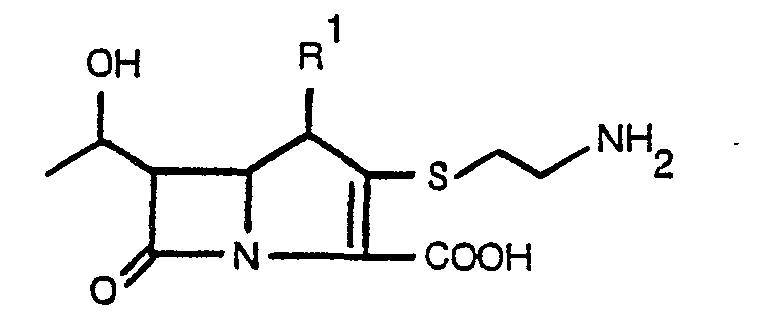
- One such unit dosage form is prepared by mixing 120 mg of 1-methyl-6-(1-hydroxyethyl)-2-(2-aminoethylthio)-1-carbadethiapen-2-em-3-carboxylic acid with 20 mg of lactose and 5 mg of magnesium stearate and placing the 145 mg. mixture into a No. 3 gelatin capsule.
- other dosage forms can be put up in No. 3 gelatin capsules and should it be necessary to mix more than 145 mg. of ingredients together larger capsules such as compressed tablets and pills can also be prepared.
- the following examples are illustrative of the preparation of pharmaceutical formulations:
- the active ingredient is blended with the dicalcium phosphate, lactose and about half of the cornstarch.
- the mixture is then granulated with 15% cornstarch paste (6 mg) and rough-screened. It is dried at 45°C and screened again through No. 16 screens.
- the balance of the cornstarch and the magnesium stearate is added and the mixture is compressed into tablets, approximately 0.5 inch in diameter each weighing 800 mg.
- the active ingredient in the above formulations may be administered alone or in combination with other biologically active ingredients as, for example, with other antibacterial agents such as lincomycin, a penicillin, streptomycin, novobiocin, gentamicin, neomycin, colistin and kanamycin, or with other therapeutic agents such as probenecid.
- other antibacterial agents such as lincomycin, a penicillin, streptomycin, novobiocin, gentamicin, neomycin, colistin and kanamycin, or with other therapeutic agents such as probenecid.
Landscapes
- Chemical & Material Sciences (AREA)
- Organic Chemistry (AREA)
- Health & Medical Sciences (AREA)
- Life Sciences & Earth Sciences (AREA)
- Biochemistry (AREA)
- General Health & Medical Sciences (AREA)
- Molecular Biology (AREA)
- Pharmaceuticals Containing Other Organic And Inorganic Compounds (AREA)
- Organic Low-Molecular-Weight Compounds And Preparation Thereof (AREA)
- Cephalosporin Compounds (AREA)
Claims (26)














Priority Applications (1)
| Application Number | Priority Date | Filing Date | Title |
|---|---|---|---|
| AT79104106T ATE5654T1 (de) | 1978-10-24 | 1979-10-23 | 6-,1- und 2-substituierte 1-carbapen-2-em-3carbons[ure, verfahren zur herstellung solcher verbindungen und solche verbindungen enthaltende pharmazeutische zusammensetzungen. |
Applications Claiming Priority (8)
| Application Number | Priority Date | Filing Date | Title |
|---|---|---|---|
| US05/954,270 US4218462A (en) | 1978-10-24 | 1978-10-24 | 6-(1-Hydroxyethyl)-2-(2-aminoethylthio)-1-substituted-1-carbade-thiapen-2-em-3-carboxylic acids |
| US954272 | 1978-10-24 | ||
| US05/954,272 US4232036A (en) | 1978-10-24 | 1978-10-24 | 6-, 1- and 2-Substituted-1-carbadethiapen-2-em-3-carboxylic acids |
| US05/954,273 US4208422A (en) | 1978-10-24 | 1978-10-24 | 1-Substituted-pen-2-em-3-carboxylic acids |
| US954273 | 1978-10-24 | ||
| US05/954,274 US4206219A (en) | 1978-10-24 | 1978-10-24 | 6- and 1-Substituted-1-carbadethiapen-2-em-3-carboxylic acid |
| US954274 | 1992-09-30 | ||
| US954270 | 1997-10-20 |
Publications (2)
| Publication Number | Publication Date |
|---|---|
| EP0010317A1 EP0010317A1 (de) | 1980-04-30 |
| EP0010317B1 true EP0010317B1 (de) | 1983-12-21 |
Family
ID=27506031
Family Applications (1)
| Application Number | Title | Priority Date | Filing Date |
|---|---|---|---|
| EP79104106A Expired EP0010317B1 (de) | 1978-10-24 | 1979-10-23 | 6-,1- und 2-substituierte 1-Carbapen-2-em-3-Carbonsäure, Verfahren zur Herstellung solcher Verbindungen und solche Verbindungen enthaltende pharmazeutische Zusammensetzungen |
Country Status (4)
| Country | Link |
|---|---|
| EP (1) | EP0010317B1 (de) |
| DE (1) | DE2966497D1 (de) |
| DK (1) | DK446179A (de) |
| IE (1) | IE51861B1 (de) |
Families Citing this family (36)
| Publication number | Priority date | Publication date | Assignee | Title |
|---|---|---|---|---|
| US4262010A (en) * | 1979-12-03 | 1981-04-14 | Merck & Co., Inc. | 6-(1-Hydroxyethyl)-2-(2-aminoethylthio)-1,1-disubstituted-1-carbadethiapen-2-em-3-carboxylic acids |
| GR72296B (de) * | 1979-12-03 | 1983-10-18 | Merck & Co Inc | |
| DK329381A (da) * | 1980-07-24 | 1982-01-25 | Takeda Chemical Industries Ltd | Fremgangsmaade til frmstilling af 1,1-disubstitueret carba-z -penem samt salte og estere deraf |
| WO1982000291A1 (en) * | 1980-07-24 | 1982-02-04 | Takeda Chemical Industries Ltd | Carba-2-penem compounds and process for preparing same |
| WO1982003218A1 (fr) * | 1981-03-19 | 1982-09-30 | Takeda Chemical Industries Ltd | Composes de carba-2-peneme et procede de preparation |
| ZA821361B (en) * | 1981-03-04 | 1983-01-26 | Beecham Group Plc | Beta-lactam antibiotics,their preparation and use |
| ES514240A0 (es) * | 1981-08-03 | 1984-04-16 | Merck & Co Inc | Un procedimiento para la prepracion de nuevos derivados de acidos 2-carbamimidoil-1-,carbadestiapen-2-en-3-carboxilados. |
| US4683301A (en) * | 1982-04-08 | 1987-07-28 | Bristol-Myers Company | Carbapenem antibiotics |
| US4642341A (en) * | 1982-04-09 | 1987-02-10 | Bristol-Myers Company | Carbapenem antibiotics |
| US4710568A (en) * | 1982-04-09 | 1987-12-01 | Bristol-Myers Company | Carbapenem antibiotics |
| US4665170A (en) * | 1982-06-18 | 1987-05-12 | Bristol-Myers Company | Carbapenem antibiotics |
| US4536335A (en) * | 1982-06-18 | 1985-08-20 | Bristol-Myers Company | Carbapenem antibiotics |
| US4640799A (en) * | 1982-06-18 | 1987-02-03 | Bristol-Myers Company | Carbapenem antibiotics |
| US4732977A (en) * | 1982-09-28 | 1988-03-22 | Bristol Myers Company | Carbapenem antibiotics |
| US4746736A (en) * | 1982-09-28 | 1988-05-24 | Bristol-Myers Company | Carbapenem antibiotics |
| EP0113101A1 (de) * | 1982-12-30 | 1984-07-11 | Merck & Co. Inc. | 6-(1-Hydroxyäthyl)-2-SR8-1-methyl-1-carbadethiapen-2-em-3-carbonsäureester |
| CA1283906C (en) * | 1983-05-09 | 1991-05-07 | Makoto Sunagawa | .beta.-LACTAM COMPOUNDS AND PRODUCTION THEREOF |
| JPS60202886A (ja) * | 1984-03-27 | 1985-10-14 | Sankyo Co Ltd | 1―置換カルバペネム―3―カルボン酸誘導体 |
| US4696923A (en) * | 1984-04-23 | 1987-09-29 | Merck & Co., Inc. | 6-[1-hydroxyethyl]-2-SR8 -1-methyl-1-carbadethiapen-2-em-3-carboxylic acids |
| DE3579888D1 (de) * | 1984-11-08 | 1990-10-31 | Sumitomo Pharma | Carbapenemverbindungen und deren herstellung. |
| US5310897A (en) * | 1984-12-27 | 1994-05-10 | Sumitomo Pharmaceuticals Co., Ltd. | Beta-lactams and their production |
| DE3678734D1 (de) * | 1985-02-19 | 1991-05-23 | Merck & Co Inc | Verfahren zur chiralen synthese von 1-beta-methyl-carbapenem-zwischenprodukten. |
| US4665169A (en) * | 1985-09-11 | 1987-05-12 | Bristol-Myers Company | Carbapenem antibiotics |
| US5075436A (en) * | 1986-01-08 | 1991-12-24 | Merck & Co., Inc. | Chiral 1-β-methyl-carbapenem intermediates |
| WO1988001619A1 (en) * | 1986-08-29 | 1988-03-10 | Sumitomo Pharmaceuticals Company, Limited | 1'-methyl-beta-lactam compounds and their production |
| GB8804058D0 (en) * | 1988-02-22 | 1988-03-23 | Fujisawa Pharmaceutical Co | 3-alkenyl-1-azabicyclo(3 2 0)hept-2-ene-2-carboxylic acid compounds |
| US5102877A (en) * | 1989-04-28 | 1992-04-07 | Fujisawa Pharmaceutical Co., Ltd. | 1-azabicyclo[3.2.0]hept-2-ene-2-carboxylic acid compounds |
| US5672701A (en) * | 1990-01-16 | 1997-09-30 | Bristol-Myers Squibb Company | 4-substituted alkyl carbapenem antibiotics |
| US5286721A (en) * | 1990-10-15 | 1994-02-15 | Fujisawa Pharmaceutical Co., Ltd. | 1-azabicyclo[3.2.0]hept-2-ene-2-carboxylic acid compounds |
| DE69432139T2 (de) * | 1993-03-12 | 2003-07-31 | Takasago International Corp., Tokio/Tokyo | Phosphin-Verbindungen, diese Phosphin-Verbindungen als ligande enthaltende Komplexe, Verfahren zur Herstellung von optisch-aktiven Aldehyden durch Mittel der Phosphin-Verbindungen oder des Komplexes |
| US5602118A (en) * | 1993-03-16 | 1997-02-11 | American Cyanamid Company | 2-thiosubstituted carbapenems |
| EP0704446A4 (de) * | 1993-06-16 | 1996-06-12 | Sumitomo Pharma | Neue beta-lactamverbindung und ein verfahren zu ihrer herstellung |
| US5496816A (en) * | 1994-03-14 | 1996-03-05 | Merck & Co., Inc. | Carbapenem antibacterial compounds, compositions containing such compounds and methods of treatment |
| US5688786A (en) * | 1994-04-01 | 1997-11-18 | Microcide Pharmaceuticals, Inc. | β-lactam antibiotics |
| AU5985596A (en) * | 1995-05-31 | 1996-12-18 | Microcide Pharmaceuticals, Inc. | Cephalosporin antibiotics |
| JPH1077285A (ja) | 1996-09-04 | 1998-03-24 | Sumitomo Pharmaceut Co Ltd | 新規なβ−ラクタム化合物およびその製造法 |
Family Cites Families (3)
| Publication number | Priority date | Publication date | Assignee | Title |
|---|---|---|---|---|
| GB1584762A (en) * | 1977-04-01 | 1981-02-18 | Beecham Group Ltd | Azabicycloheptenes |
| AU531084B2 (en) * | 1977-10-19 | 1983-08-11 | Merck & Co., Inc. | Azetidine derivatives |
| SE7805032L (sv) * | 1978-05-03 | 1979-11-03 | Merck & Co Inc | Karboxylsyror och derivat derav |
-
1979
- 1979-10-23 IE IE2027/79A patent/IE51861B1/en not_active IP Right Cessation
- 1979-10-23 DK DK446179A patent/DK446179A/da not_active Application Discontinuation
- 1979-10-23 DE DE7979104106T patent/DE2966497D1/de not_active Expired
- 1979-10-23 EP EP79104106A patent/EP0010317B1/de not_active Expired
Also Published As
| Publication number | Publication date |
|---|---|
| IE51861B1 (en) | 1987-04-15 |
| EP0010317A1 (de) | 1980-04-30 |
| DK446179A (da) | 1980-05-29 |
| DE2966497D1 (en) | 1984-01-26 |
| IE792027L (en) | 1980-04-24 |
Similar Documents
| Publication | Publication Date | Title |
|---|---|---|
| EP0010316B1 (de) | 1-, 6- und 2-substituierte 1-Carba-2-Penem-3-Carbonsäure, Verfahren zu ihrer Herstellung und sie enthaltende pharmazeutische Zusammensetzungen | |
| EP0010317A1 (de) | 6-,1- und 2-substituierte 1-Carbapen-2-em-3-Carbonsäure, Verfahren zur Herstellung solcher Verbindungen und solche Verbindungen enthaltende pharmazeutische Zusammensetzungen | |
| US4232036A (en) | 6-, 1- and 2-Substituted-1-carbadethiapen-2-em-3-carboxylic acids | |
| EP0001628B1 (de) | 3,6-Disubstituierte 7-oxo-1-azabicylo-(3.2.0.)-2-hepten-2-carbonsäure, ihre Herstellung und sie enthaltende pharmazeutische Zusammensetzungen | |
| EP0071908B1 (de) | 1- und 1,1-disubstituierte, 6-substituierte, 2-carbamimidoyl-1-carbadethiapen-2-em-3-carbonsäuren, Verfahren zur Herstellung und diese enthaltende antibiotische Zusammensetzung | |
| US4465632A (en) | Process for preparing 1-6-and 2-substituted-1-carba-2-penem-3-carboxylic acids | |
| US4312871A (en) | 6-, 1- And 2-substituted-1-carbadethiapen-2-em-3-carboxylic acids | |
| US4350631A (en) | 6- and 4-Substituted-1-azabicyclo[3.2.0]heptan-3,7-dione-2-carboxylates | |
| US4234596A (en) | 3-(2-Aminoethylthio)-6-(1-hydroxyethyl)-7-oxo-1-azabicyclo[3.2.0]hept-2-ene-2-carboxylic acid | |
| US4206219A (en) | 6- and 1-Substituted-1-carbadethiapen-2-em-3-carboxylic acid | |
| EP0001627B1 (de) | 3-Substituierte 6-(1'-Hydroxyäthyl)-7-oxo-1-azabicyclo-(3.2.0)-2-hepten-2-carbonsäure, ihre Herstellung und sie enthaltende pharmazeutische Zusammensetzungen | |
| US4218463A (en) | 3-Substituted thio-6-amido-7-oxo-1-azabicyclo[3.2.0]hept-2-ene-2-carboxylic acid | |
| US4208422A (en) | 1-Substituted-pen-2-em-3-carboxylic acids | |
| EP0030031B1 (de) | 1.1-Disubstituierte 6-(1-Hydroxyethyl)-2-(aminoethylthio)-1-carbadethiapen-2-emcarbonsäuren, Verfahren zu ihrer Herstellung, antibiotisch wirksame pharmazeutische Zusammensetzungen, die diese Verbindungen enthalten, Zwischenprodukte zu ihrer Herstellung und Verfahren zur Herstellung der in diesem Verfahren verwendbaren Zwischenprodukte | |
| US4262009A (en) | 6- And 1,1-disubstituted-1-carbadethiapen-2-em-3-carboxylic acid | |
| US4218462A (en) | 6-(1-Hydroxyethyl)-2-(2-aminoethylthio)-1-substituted-1-carbade-thiapen-2-em-3-carboxylic acids | |
| EP0038869A1 (de) | Verfahren zur Herstellung von 1-Carbapenemen und Zwischenprodukte für ihre Herstellung | |
| EP0113101A1 (de) | 6-(1-Hydroxyäthyl)-2-SR8-1-methyl-1-carbadethiapen-2-em-3-carbonsäureester | |
| US4310538A (en) | 3-Halo-1-azabicyclo[3.2.0]hept-2-en-7-one-2-carboxylic acid | |
| EP0030032B1 (de) | In 6-,1- und 2-Stellung substituierte 1-Carbadethiapen-2-em-carbonsäuren, Verfahren zu ihrer Herstellung, sie enthaltende pharmazeutische Zusammensetzungen und Zwischenprodukte | |
| EP0345827A1 (de) | Verfahren zur Herstellung von Penem-Verbindungen | |
| US4267188A (en) | 5-Substituted-1-carba-pen-2-em-3-carboxylic acid | |
| US4347367A (en) | 3-Substituted-6-(1'-hydroxyethyl)-7-oxo-1-azabicyclo[3.2.0]-hept-2-ene-2-carboxylic acid | |
| US4224336A (en) | 3-(2-Aminoethylthio)-6-amido-7-oxo-1-azabicyclo[3.2.0]-hept-2-ene-2-carboxylic acid | |
| US4347368A (en) | 3-Substituted-6-substituted-7-oxo-1-azabicyclo[3.2.0]hept-2-ene-2-carboxylic acid |
Legal Events
| Date | Code | Title | Description |
|---|---|---|---|
| PUAI | Public reference made under article 153(3) epc to a published international application that has entered the european phase |
Free format text: ORIGINAL CODE: 0009012 |
|
| AK | Designated contracting states |
Designated state(s): AT BE CH DE FR GB IT LU NL SE |
|
| 17P | Request for examination filed |
Effective date: 19801023 |
|
| ITF | It: translation for a ep patent filed | ||
| GRAA | (expected) grant |
Free format text: ORIGINAL CODE: 0009210 |
|
| AK | Designated contracting states |
Designated state(s): AT BE CH DE FR GB IT LU NL SE |
|
| REF | Corresponds to: |
Ref document number: 5654 Country of ref document: AT Date of ref document: 19840115 Kind code of ref document: T |
|
| REF | Corresponds to: |
Ref document number: 2966497 Country of ref document: DE Date of ref document: 19840126 |
|
| ET | Fr: translation filed | ||
| PLBE | No opposition filed within time limit |
Free format text: ORIGINAL CODE: 0009261 |
|
| STAA | Information on the status of an ep patent application or granted ep patent |
Free format text: STATUS: NO OPPOSITION FILED WITHIN TIME LIMIT |
|
| 26N | No opposition filed | ||
| EPTA | Lu: last paid annual fee | ||
| ITTA | It: last paid annual fee | ||
| EAL | Se: european patent in force in sweden |
Ref document number: 79104106.4 |
|
| PGFP | Annual fee paid to national office [announced via postgrant information from national office to epo] |
Ref country code: FR Payment date: 19980827 Year of fee payment: 20 |
|
| PGFP | Annual fee paid to national office [announced via postgrant information from national office to epo] |
Ref country code: SE Payment date: 19980903 Year of fee payment: 20 |
|
| PGFP | Annual fee paid to national office [announced via postgrant information from national office to epo] |
Ref country code: BE Payment date: 19980908 Year of fee payment: 20 |
|
| PGFP | Annual fee paid to national office [announced via postgrant information from national office to epo] |
Ref country code: GB Payment date: 19981002 Year of fee payment: 20 |
|
| PGFP | Annual fee paid to national office [announced via postgrant information from national office to epo] |
Ref country code: AT Payment date: 19981012 Year of fee payment: 20 |
|
| PGFP | Annual fee paid to national office [announced via postgrant information from national office to epo] |
Ref country code: LU Payment date: 19981013 Year of fee payment: 20 |
|
| PGFP | Annual fee paid to national office [announced via postgrant information from national office to epo] |
Ref country code: CH Payment date: 19981020 Year of fee payment: 20 |
|
| PGFP | Annual fee paid to national office [announced via postgrant information from national office to epo] |
Ref country code: NL Payment date: 19981030 Year of fee payment: 20 |
|
| PGFP | Annual fee paid to national office [announced via postgrant information from national office to epo] |
Ref country code: DE Payment date: 19981124 Year of fee payment: 20 |
|
| BE20 | Be: patent expired |
Free format text: 19991023 *MERCK & CO. INC. |
|
| PG25 | Lapsed in a contracting state [announced via postgrant information from national office to epo] |
Ref country code: GB Free format text: LAPSE BECAUSE OF EXPIRATION OF PROTECTION Effective date: 19991022 Ref country code: CH Free format text: LAPSE BECAUSE OF EXPIRATION OF PROTECTION Effective date: 19991022 |
|
| PG25 | Lapsed in a contracting state [announced via postgrant information from national office to epo] |
Ref country code: NL Free format text: LAPSE BECAUSE OF EXPIRATION OF PROTECTION Effective date: 19991023 Ref country code: LU Free format text: LAPSE BECAUSE OF NON-PAYMENT OF DUE FEES Effective date: 19991023 Ref country code: AT Free format text: LAPSE BECAUSE OF EXPIRATION OF PROTECTION Effective date: 19991023 |
|
| PG25 | Lapsed in a contracting state [announced via postgrant information from national office to epo] |
Ref country code: SE Free format text: LAPSE BECAUSE OF NON-PAYMENT OF DUE FEES Effective date: 19991024 |
|
| REG | Reference to a national code |
Ref country code: CH Ref legal event code: PL |
|
| REG | Reference to a national code |
Ref country code: GB Ref legal event code: PE20 Effective date: 19991022 |
|
| NLV7 | Nl: ceased due to reaching the maximum lifetime of a patent |
Effective date: 19991023 |
|
| EUG | Se: european patent has lapsed |
Ref document number: 79104106.4 |