EP0010360B1 - Dérivés du prostane, procédés pour leur préparation et leurs compositions pharmaceutiques - Google Patents
Dérivés du prostane, procédés pour leur préparation et leurs compositions pharmaceutiques Download PDFInfo
- Publication number
- EP0010360B1 EP0010360B1 EP79301956A EP79301956A EP0010360B1 EP 0010360 B1 EP0010360 B1 EP 0010360B1 EP 79301956 A EP79301956 A EP 79301956A EP 79301956 A EP79301956 A EP 79301956A EP 0010360 B1 EP0010360 B1 EP 0010360B1
- Authority
- EP
- European Patent Office
- Prior art keywords
- radical
- alkyl
- formula
- phenyl
- methyl
- Prior art date
- Legal status (The legal status is an assumption and is not a legal conclusion. Google has not performed a legal analysis and makes no representation as to the accuracy of the status listed.)
- Expired
Links
Classifications
-
- C—CHEMISTRY; METALLURGY
- C07—ORGANIC CHEMISTRY
- C07D—HETEROCYCLIC COMPOUNDS
- C07D309/00—Heterocyclic compounds containing six-membered rings having one oxygen atom as the only ring hetero atom, not condensed with other rings
- C07D309/02—Heterocyclic compounds containing six-membered rings having one oxygen atom as the only ring hetero atom, not condensed with other rings having no double bonds between ring members or between ring members and non-ring members
- C07D309/08—Heterocyclic compounds containing six-membered rings having one oxygen atom as the only ring hetero atom, not condensed with other rings having no double bonds between ring members or between ring members and non-ring members with hetero atoms or with carbon atoms having three bonds to hetero atoms with at the most one bond to halogen, e.g. ester or nitrile radicals, directly attached to ring carbon atoms
- C07D309/10—Oxygen atoms
- C07D309/12—Oxygen atoms only hydrogen atoms and one oxygen atom directly attached to ring carbon atoms, e.g. tetrahydropyranyl ethers
-
- A—HUMAN NECESSITIES
- A61—MEDICAL OR VETERINARY SCIENCE; HYGIENE
- A61P—SPECIFIC THERAPEUTIC ACTIVITY OF CHEMICAL COMPOUNDS OR MEDICINAL PREPARATIONS
- A61P1/00—Drugs for disorders of the alimentary tract or the digestive system
-
- A—HUMAN NECESSITIES
- A61—MEDICAL OR VETERINARY SCIENCE; HYGIENE
- A61P—SPECIFIC THERAPEUTIC ACTIVITY OF CHEMICAL COMPOUNDS OR MEDICINAL PREPARATIONS
- A61P13/00—Drugs for disorders of the urinary system
- A61P13/02—Drugs for disorders of the urinary system of urine or of the urinary tract, e.g. urine acidifiers
-
- A—HUMAN NECESSITIES
- A61—MEDICAL OR VETERINARY SCIENCE; HYGIENE
- A61P—SPECIFIC THERAPEUTIC ACTIVITY OF CHEMICAL COMPOUNDS OR MEDICINAL PREPARATIONS
- A61P15/00—Drugs for genital or sexual disorders; Contraceptives
-
- A—HUMAN NECESSITIES
- A61—MEDICAL OR VETERINARY SCIENCE; HYGIENE
- A61P—SPECIFIC THERAPEUTIC ACTIVITY OF CHEMICAL COMPOUNDS OR MEDICINAL PREPARATIONS
- A61P43/00—Drugs for specific purposes, not provided for in groups A61P1/00-A61P41/00
-
- C—CHEMISTRY; METALLURGY
- C07—ORGANIC CHEMISTRY
- C07C—ACYCLIC OR CARBOCYCLIC COMPOUNDS
- C07C405/00—Compounds containing a five-membered ring having two side-chains in ortho position to each other, and having oxygen atoms directly attached to the ring in ortho position to one of the side-chains, one side-chain containing, not directly attached to the ring, a carbon atom having three bonds to hetero atoms with at the most one bond to halogen, and the other side-chain having oxygen atoms attached in gamma-position to the ring, e.g. prostaglandins ; Analogues or derivatives thereof
-
- C—CHEMISTRY; METALLURGY
- C07—ORGANIC CHEMISTRY
- C07C—ACYCLIC OR CARBOCYCLIC COMPOUNDS
- C07C405/00—Compounds containing a five-membered ring having two side-chains in ortho position to each other, and having oxygen atoms directly attached to the ring in ortho position to one of the side-chains, one side-chain containing, not directly attached to the ring, a carbon atom having three bonds to hetero atoms with at the most one bond to halogen, and the other side-chain having oxygen atoms attached in gamma-position to the ring, e.g. prostaglandins ; Analogues or derivatives thereof
- C07C405/0008—Analogues having the carboxyl group in the side-chains replaced by other functional groups
- C07C405/0016—Analogues having the carboxyl group in the side-chains replaced by other functional groups containing only hydroxy, etherified or esterified hydroxy groups
Definitions
- This invention relates to prostane derivatives, and in particular it relates to prostane derivatives which possess high activity as abortifacients, cervical softeners or inducers of parturition, and also as inhibitors of the production of gastric acid in mammals.
- prostaglandins of the E-series for example prostaglandin E, prostaglandin E 2 , 15-methyl prostaglandin E 2 and 16,16-dimethyl prostaglandin E 2
- prostaglandins of the F-series such as prostaglandin F 2 ⁇ or 15-methyl prostaglandin F 2 ⁇ .
- An important disadvantage of the E-series compounds for these uses is their inherent chemical instability, involving elimination of the 11-hydroxy radical to form prostaglandins of the A-series.
- F-series prostaglandins are not susceptible to 11-hydroxy elimination.
- the present invention therefore, provides prostaglandin analogues which are chemically stable, but which possess the high activity, as abortifacients or inducers of parturition, of the E-series prostaglandins.
- a suitable value for R 6 when it is a 1-8C alkyl radical is, for example, a methyl, ethyl, propyl, butyl, pentyl, hexyl, heptyl or octyl radical.
- a suitable value for R 9 when it is a 1-10C alkyl radical is, for example, a methyl, ethyl, propyl, butyl, pentyl, hexyl, heptyl, octyl, nonyl or decyl radical.
- a suitable value for a 1-5C alkyl substituent in R 9 when it is a phenyl or naphthyl radical is, for example, a methyl, ethyl, propyl, butyl or pentyl radical.
- a suitable value for R 4 when it is a 3-8C alkyl radical is, for example, a propyl, butyl, pentyl, hexyl, heptyl or octyl radical, and particularly a straight-chain such radical.
- a suitable value for a 2-7C alkyl substituent in R 4 when it is a 4-6C cycloalkyl radical is, for example, an ethyl, propyl, butyl, pentyl, hexyl or heptyl radical.
- a suitable value for a 1-4C alkoxy substituent in R' when it is a phenyl or naphthyl radical, in R 4 when it is a phenyl, benzyl or phenylethynyl radical ora radical of the formula II as defined above, in R' 4 when it is a phenyl or naphthyl radical or in R' 5 is, for example, a methoxy, ethoxy, n-propoxy, isopropoxy, n-butoxy, s-butoxy, t-butoxy or isobutoxy radical.
- a suitable value for a 1-5C alkoxy substituent in R 9 when it is a phenyl or naphthyl radical is, for example, a methoxy, ethoxy, propoxy, butoxy or pentyloxy radical.
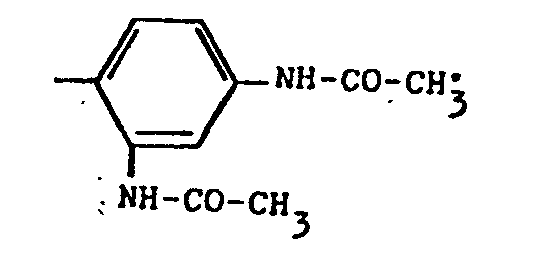
- a suitable value for a 1-4C alkanoylamino substituent in R' when it is a phenyl or naphthyl radical or in R 4 when it is a phenyl, benzyl or phenylethynyl radical is, for example, a formamido, acetamido, propionamido or butyramido radical.
- a suitable value for a 2-5C alkoxycarbonyl substituent in R' when it is a phenyl or naphthyl radical is, for example, a methoxycarbonyl, ethoxycarbonyl, propoxycarbonyl or butoxycarbonyl radical.
- a suitable value for R 5 when it is a 2-8C alkanoyl radical is, for example, an acetyl, propionyl, butyryl, valeryl, hexanoyl, heptanoyl or octanoyl radical.
- a suitable value for R 5 when it is a 4-8C cycloalkanoyl radical is a cyclopropylcarbonyl, cyclobutylcarbonyl, cyclopentylcarbonyl, cyclohexylcarbonyl or cycloheptylcarbonyl radical; and for R 6 when it is a 4-8C cycloalkyl radical is a cyclobutyl, cyclopentyl, cyclohexyl, cycloheptyl or cyclooctyl radical.
- a suitable value for R 5 when it is a 7-11 C aroyl radical is, for example, a benzoyl or naphthoyl radical, optionally substituted as defined herein.
- a suitable value for R 5 when it is a 1-7C alkylsulphonyl radical is, for example, a methylsulphonyl, ethylsulphonyl, propylsulphonyl, butylsulphonyl, pentylsulphonyl, hexylsulphonyl or heptylsulphonyl radical.
- a suitable value for R 5 when it is an arylsulphonyl radical is, for example, a phenylsulphonyl radical, optionally substituted as defined herein.
- a suitable value for R 6 when it is an ethyl radical substituted in the ⁇ -position with 1 to 3 chlorine, bromine or iodine atoms is, for example, a 2-chloroethyl or 2,2,2-trichloroethyl radical.
- a suitable value for R 9 when it is a 2-10C alkoxyalkyl radical is, for example, a methoxymethyl, ethoxymethyl, straight- or branched-chain propoxymethyl, butoxymethyl or pentyloxymethyl, 2-methoxyethyl or 2-ethoxyethyl radical.
- a suitable value for R 9 when it is a 1-10C halogenoalkyl radical is, for example, a 1 ⁇ 10C alkyl radical bearing one or more chlorine, bromine or fluorine atoms as substituents
- a suitable value for a 1-5C halogenoalkyl substituent in R 9 when it is a phenyl or naphthyl radical is, for example, a 1-5C alkyl radical bearing one or more chlorine, bromine or fluorine atoms as substituents.
- a suitable value for R 9 when it is a w-carboxy-1-6C alkyl radical is, for example, a carboxymethyl, 2-carboxyethyl, 3-carboxypropyl, 4-carboxybutyl or 5-carboxypentyl radical.
- a suitable value for a 2-4C alkenyl or alkenyloxy substituent in R 4 when it is a phenyl, benzyl, phenyl(2-4C alkyl) or phenylethynyl radical is, for example, a vinyl, allyl or allyloxy radical.
- a suitable value for a di(1-3C alkyl)amino substituent in R' or R 4 when it is a phenyl, benzyl, phenyl(2-4C alkyl) or phenylethynyl radical is, for example, a dimethylamino, diethylamino, dipropylamino or ethylmethylamino radical.
- a suitable pharmaceutically acceptable salt of a compound which contains a carboxy radical is, for example, the ammonium, alkylammonium containing 1 to 4 1-6C alkyl radicals, alkanolammonium containing 1 to 3 2-hydroxyethyl radicals, or alkali metal salt, for example the ammonium, triethylammonium, ethanolammonium, diethanolammonium, sodium or potassium salt.
- Particular compounds of the invention are 16-(3-chlorophenoxy)-11 ⁇ ,15 ⁇ -dihydroxy-16-methyl-9 ⁇ -phenoxy-18,19,20-trinor-5-cis, 13-trans-prostadienoic acid, 11 ⁇ ,15 ⁇ -dihydroxy-16,16-dimethyl-9 ⁇ -phenoxy-5-cis, 13-trans-prostadienoic acid, 9 ⁇ ,16-bis(3-chlorophenoxy)-16-methyl-18,19,20-trinor-5-cis, 13-trans-prostadien-1,11 ⁇ ,15 ⁇ -triol, 11 ⁇ ,15 ⁇ -dihydroxy-9 ⁇ -phenoxy-5-cis, 13-trans-prostadienoic acid, 9 ⁇ ,16-bis(3-chlorophenoxy)-11 ⁇ ,15 ⁇ -dihydroxy-16-methyl-18,19,20-trinor-5-cis, 13- trans-prostadienoic acid and 9 ⁇ -(5-chloropyrid-2-yloxy)-11 ⁇ ,15-di
- the prostane derivatives of the formula I may be manufactured by processes which are known in themselves for the manufacture of chemically analogous compounds. Examples of such chemical analogy processes are:
- Examples of such optional transformations on the primary products of the above process are:-(i) esterification of a carboxy-substituted compound of the formula I to give an alkoxycarbonyl- substituted compound of the formula I, for example by reacting the carboxylic acid with a diazoalkane or by reacting a salt of the carboxylic acid with an alkyl halide;
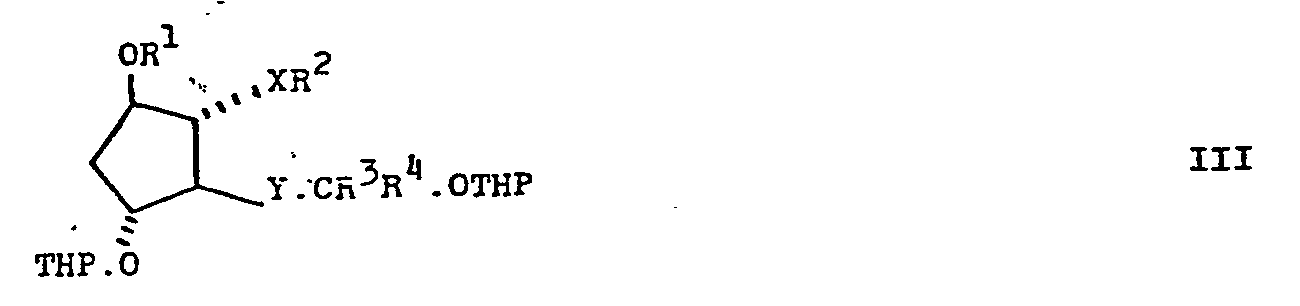
- the acid VII is reacted with diazomethane to give a methyl ester VIII, and the methyl ester VIII is treated with triphenylphosphine, diethyl azodicarboxylate and a phenol, R 1 OH, to give a starting material of the formula III in which R 2 is a methoxycarbonyl radical, R 1 , R 3 , R 4 and Y have the meanings stated above, and X is a hex-2-cis-en-1,6-diyl radical as defined above.
- Corresponding starting materials of the formula III wherein R 2 is a carboxy radical may be obtained by hydrolysis of a starting material of the formula III in which R 2 is a methoxycarbonyl radical.
- Corresponding starting materials of the formula III wherein R 2 is a radical of the formula ⁇ CONHR 5 in which R 5 is an alkanoyl, cycloalkanoyl, aroyl or substituted aroyl radical as defined above may be obtained by reacting a starting material of the formula III wherein R 2 is a carboxy radical with an isocyanate of the formula R 5 NCO.
- any starting material of the formula III wherein R 2 is a radical of the formula ⁇ CONHR 5 may be obtained by reacting a lactol VI with a phosphonium salt of the formula Ph 3 P.(CH 2 ) 4 CONHR 5 , and using the product thus obtained in place of the acid VII in the subsequent stages of the synthesis.
- Corresponding starting materials of the formula III wherein R 2 is a 5-indanyloxycarbonyl or 4-biphenylyloxycarbonyl radical, or a radical of the formula -COOR 6 or ⁇ COOR 10 as defined above, may alternatively be obtained from the starting material of the formula III wherein R 2 is a carboxy radical by reaction with 5-indanol or the appropriate alcohol or phenol in a mixed anhydride reaction, or in the presence of dicyclohexylcarbodi-imide.
- Corresponding starting materials of the formula III wherein R 2 is a radical of the formula -CO.O.CHR 7 .COR s as defined above may be obtained from the starting material of the formula III wherein R 2 is a carboxy radical by converting it to a salt, for example the sodium salt, and reacting the sodium salt with the appropriate phenacyl halide, R 8 CO.CHR 7 .O.CO.halogen.
- Corresponding starting materials of the formula III wherein R 2 is a hydroxymethyl radical may be obtained by the reduction, for example with lithium borohydride or lithium aluminium hydride, of the starting material of the formula III wherein R 2 is a methoxycarbonyl radical.
- Corresponding starting materials of the formula III wherein R 2 is a radical of the formula ⁇ CH 2 O.CO(NH) m R 9 as defined above may be obtained from the starting material of the formula III wherein R 2 is a hydroxymethyl radical by reaction thereof with an acylating agent derived from the carboxylic acid R 9 (NH) m .COOH, for example an acyl halide, an acid anhydride, a mixed anhydride or an isocyanate, R 9 .NCO.
- Corresponding starting materials of the formula III wherein X is a hex-2-trans-en-1,6-diyl radical may be obtained similarly, except that in the reaction of the lactol VI with a triphenylphosphonium salt, butyl-lithium is used as the strong base and sulpholane as the solvent to give a mixture of the cis acid VII and the corresponding trans acid, which may be separated from the mixture, for example by chromatography, and used in place of the cis acid VII in the subsequent stages of the synthesis.
- Corresponding starting materials of the formula III wherein X is a hexa-1,6-diyl radical as defined above may be obtained by selective catalytic hydrogenation of an ester VIII, and using the hydrogenated ester in place of VIII in the remaining stage of the reaction sequence described above.
- the alcohol XI is oxidised with chromium trioxide/pyridine complex to the aldehyde XII, and the aldehyde XII is reacted with a (3-carboxypropyl)-triphenylphosphonium salt, for example the iodide, in the presence of a strong base, to give a starting material of the formula III in which R 2 is a carboxy radical, R 1 , R 3 , R 4 and Y have the meanings stated above, and X is a hex-3-cis-en-1,6-diyl radical as defined above.
- Corresponding starting materials of the formula III wherein X is a hex-3-trans-en-1,6-diyl radical as described above may be obtained similarly, except that in the reaction of the aldehyde XII with a triphenylphosphonium salt, butyl-lithium is used as the strong base and sulpholane as the solvent to give a mixture of the cis starting material III and the trans isomer, from which the latter may be separated, for example by chromatography.
- the alcohol XVI is esterified with 4-phenylbenzoyl chloride to give the 4-phenylbenzoate XVII, and XVII is then hydrolysed with acid to give the aldehyde XVIII, which is reacted with a phosphonate of the formula (CH 3 O) 2 PO .
- CH 2 COR 4 to give a starting material of the formula IV in which R 2 is a methoxycarbonyl radical, R 1 , R 3 and R 4 have the meanings stated above, X is a hex-2-cis-en-1,6-diyl radical as defined above, and R" is a 4-phenylbenzoyloxy radical.
- Corresponding starting materials of the formula IV wherein R 15 is another carboxylic acyloxy radical as defined above or a silyloxy radical as defined above may be obtained by using an appropriate acylating or silylating reagent in the reaction with the alcohol XVI, in place of 4-phenylbenzoyl chloride.
- Corresponding starting materials of the formula IV wherein R 17 is a hydroxy radical may be obtained by omitting the esterification step XVI to XVII, and using the alcohol XVI in place of the phenylbenzoate XVII in the subsequent stages of the synthesis.
- Corresponding starting materials of the formula IV wherein R 2 is a radical of the formula ⁇ COOR 6 , ⁇ COOR 10 , -CONHR S or ⁇ CO.O.CHR 7 .COR 8 as defined above, or a 5-indanyloxycarbonyl or 4-biphenylyloxycarbonyl radical may be obtained by esterification or amidation of the acid XIII, or of a corresponding starting material of the formula IV wherein R 2 is a carboxy radical, in the manner described above for analogous compounds.
- Corresponding starting materials of the formula IV wherein R 2 is a carboxy radical may be obtained by hydrolysis of a starting material of the formula IV wherein R 2 is a methoxycarbonyl radical.
- Corresponding starting materials of the formula IV wherein R 2 is a radical of the formula -CH 2 O ⁇ CO(NH) m R 9 as defined above may be obtained by reduction, for example with lithium aluminium hydride, of the ester XV and esterification of the alcohol thus obtained with an acylating agent derived from the carboxylic acid R 9 (NH) m . COOH as defined above, and using the ester thus obtained in place of the methyl ester XV in the subsequent stages of the synthesis.
- Corresponding starting materials of the formula IV wherein X is a hexa-1,6-diyl radical as described above may be obtained by catalytic hydrogenation of any compound XIV to XVII, and using the hydrogenated compound in place of the corresponding compound XIV to XVII in the reaction sequence described above.
- the alcohol XXi is oxidised with Collins' reagent to the aldehyde XXII, and the aldehyde XXII is reacted with a (3-carboxypropyl)triphenylphosphonium salt in the presence of a strong base to give the acid XXIII, which is converted to the ester XXIV with diazomethane.
- ester XXIV is selectively hydrolysed to convert the acetal group to an aldehyde (XXV), and the aldehyde is reacted with a phosphonate (CH 3 O) 2 PO.CH 2 COR 4 to give a starting material of the formula IV in which R 2 is a methoxycarbonyl radical and X is a hex-3-cis-en-1,6-diyl radical, as defined above.
- Corresponding starting materials of the formula IV wherein R 2 is a radical of the formula ⁇ COOR 6 , ⁇ COOR 10 , ⁇ CONHR 5 or ⁇ CO.O.CHR 7 .COR 8 as defined above, or a 5-indanyloxycarbonyl or 4-biphenylyloxycarbonyl radical may be obtained by esterification or amidation of the acid XXIII or of a corresponding starting material of the formula III wherein R 2 is a carboxy radical, in the manner described above for analogous compounds, and using the ester or amide thus obtained in place of the acid XXIII in the remaining stages of the synthesis.
- Corresponding starting materials of the formula IV wherein R 2 is a carboxy radical may be obtained by hydrolysis of a starting material of the formula IV wherein R 2 is a methoxycarbonyl radical.
- CO(NH) m R 9 as defined above may be obtained by reduction, for example with lithium aluminium hydride, of an ester XXIV, and esterification of the alcohol thus obtained with an acylating agent derived from the carboxylic acid R 9 (NH) m COOH as defined above, and using the ester so obtained in place of the ester XXIV in the subsequent stages of the synthesis.
- Corresponding starting materials of the formula IV wherein X is a hex-3-trans-en-1,6-diyl radical as defined above may be obtained by reaction of the aldehyde XXII with a vinyl magnesium halide or vinyl-lithium to give an unsaturated alcohol XXVI which is heated with triethyl orthoacetate to give an ester XXVII. The ester XXVII is then used in place of the ester XXIV in the subsequent stages of the synthesis described above.
- an optically active prostane derivative of the invention may be obtained either by resolving the corresponding racemate, or by resolving a suitable starting material or other intermediate in the preparative reaction sequence.
- the novel prostane derivative of the invention inhibits the production of gastric acid in mammals.
- 16-(3-chiorophenoxy)-11 1 ⁇ ,15 ⁇ -dihydroxy-16-methyl-9 ⁇ -phenoxy-18,19,20-trinor-5-cis,13-trans-prostadienoic acid causes a 50% inhibition of histamine-stimulated gastric acid production at an intravenous dose of 17.0 ⁇ g./kg.
- a prostane derivative of the invention When a prostane derivative of the invention is to be used for reducing gastric acid production in man, it is to be used in substantially the same way as it is known to use prostaglandin E 2 or (15S)- or (15R)-15-methyl-prostagiandin E 2 methyl ester for similar purposes.
- Such prostaglandin analogues have been administered orally, in aqueous solution, at doses of 2.5 to 4.0 mg. for prostaglandin E 2 , and 100 to 200 ⁇ g. for (155)- and (15R)-15-methyl-prostaglandin E 2 methyl ester.
- the latter compound has been shown to promote healing of gastric ulcers in Chinese subjects when administered orally at 150 ⁇ g. in 20 ml. of water at 6 hourly intervals for 2 weeks.
- the novel prostane derivative of the invention may be used to terminate pregnancy or to induce labour or parturition.
- 16-(3-chloro- 'phenoxy)-11 ⁇ ,15 ⁇ -dihydroxy-16-methyl-9 ⁇ -phenoxy-18,19,20-trinor-5- cis,13 - trans - prostadienoic acid causes premature parturition when administered as two subcutaneous doses of 30.0 ,ug. two hours apart on day 65 of the pregnancy.
- a compound of the invention When a compound of the invention is to be used, for example for the induction of labour, it is used in the same way as it is known to use the naturally-occurring prostaglandin E 2 and F 2 ⁇ , that is to say, by administering a sterile, substantially aqueous solution containing up to 1 mg./ml. of active compound, by intraveous infusion, by transcervical extra-amniotic infusion or intra-amniotic infusion, until labour commences.
- a pharmaceutical or veterinary composition comprising a prostane derivative of the formula I as defined above, together with a pharmaceutically or veterinarily acceptable diluent or carrier.
- compositions may be in a form suitable for oral administration, for example tablets or capsules, in a form suitable for infusion, for example sterile aqueous or oily solutions or suspensions, or in the form of a suppository, suitable for anal or vaginal use.
- a preferred composition is a substantially aqueous solution containing 25 to 150 ⁇ g./ml., preferably 75 to 125 ⁇ g./ml. of the prostane derivative.
- compositions of the invention may be manufactured by conventional means, and may contain conventional pharmaceutical excipients in addition to the active constituent and the diluent or carrier.
- the compositions may be stabilised, for example by incorporation of dimethylacetamide, in known manner.
- R F values refer to thin layer chromatography on silica gel plates supplied commercially by Merck of Darmstadt, and the spots were detected either by fluorescence, or by spraying the plates with a solution of ceric ammonium nitrate in sulphuric acid.
- Preparative layer chromatography was performed on 2.0 mm. or 0.25 mm. thick silica gel plates supplied commercially by Merck of Darmstadt. 'Kieselgel 60' (trade mark) used for dry column chromatography was supplied commercially by Merck of Darmstadt.
- the methyl ester used as starting material was prepared by the process described in the second part of Example 1, using 9 ⁇ -hydroxy-16,16-dimethyl-11a,15-bis(tetrahydropyran-2-yloxy)-5-cis,13- trans-prostadienoic acid in place of 16-(3-chlorophenoxy)-9 ⁇ -hydroxy-16-methyl-11 ⁇ ,15 ⁇ -bis(tetrahydropyran-2-yloxy)-18,19,20-trinor-5-cis,13-trans-prostadienoic acid.
- the crude ester alcohol (29.5 g.) was dissolved in a mixture of anhydrous toluene (200 ml.) and pyridine (15.9 ml.) and stirred for 16 hours with 4-phenylbenzoyl chloride (20.3 g.). Water (1.8 ml.) and pyridine (8.0 ml.) were then added and stirring was continued for a further 24 hours. Ethyl acetate (200 ml.) was then added and the mixture was extracted with saturated aqueous sodium bicarbonate (5 x 200 ml.). The whole mixture was filtered through "Hyflo" (trade mark) kieselguhr when necessary during the extraction to remove precipitated sodium 4-phenylbenzoate.
- the 4-phenylbenzoate ester (900 mg.) was vigorously stirred for 20 minutes in a two-phase system consisting of 2% v/v isopropanol in chloroform (46 ml.) and concentrawted hydrochloric acid (23 ml.). The chloroform layer was separated and the aqueous layer was extracted with chloroform (46 ml.).
- the enone (200 mg.) was dissolved in 3 ml. of a 0.36M solution of di-isobornyloxyaluminium isopropoxide and left for 3 hours.
- Saturated aqueous sodium hydrogen tartrate (5 ml.) and ethyl acetate (10 ml.) were added, and the mixture was stirred vigorously for 10 minutes.
- the two phases were then separated and the aqueous phase was extracted with a further 10 ml. of ethyl acetate.
- the combined organic phases were dried and the solvent was evaporated.
- the residue was chromatographed on a silica gel M.F.C.
- the sodium phosphate B.P. was dissolved in about 80% of water, followed by the prostadienoic acid derivative, and when dissolved, the sodium acid phosphate B.P.
- the solution was made up to volume with water for injection, and the pH was checked to be between 6.7 and 7.7.
- the solution was filtered to remove particulate matter, sterilised by filtration and filled into pre-sterilised neutral glass ampoules under aseptic conditions.
- the prostane derivative may, of course, be replaced by an equivalent amount of another prostane derivative of the invention.
- Example 5 The process described in Example 5 was repeated, omitting the sodium phosphate B.P. and sodium acid phosphate B.P., to give ampoules containing a sterile aqueous solution of 16-(3-chlorophenoxy)-11 ⁇ ,15 ⁇ -dihydroxy-16-methyl-9 ⁇ -phenoxy-18,19,20-trinor-5-cis,13 - trans - prosta- dien-9 ⁇ ,11 ⁇ ,15-triol which are used in the manner described in Example 5.
- the prostane derivative may be replaced by an equivalent amount of another prostane derivative of the invention, to give other sterile aqueous solutions.
- the methyl ester used as starting material was prepared by the process described in the second part of Example 4, using dimethyl [3-(3-chlorophenoxy)-2-oxopropyl]phosphonate in place of dimethyl 2-oxoheptylphosphonate.
- the more polar C 15 epimer ofmethyl 11 ⁇ ,15-dihydroxy-16,16-dimethyl-9 ⁇ -phenoxy-4-cis,13- trans-prostadienoate used as starting material was prepared as follows:-A solution of 2 ⁇ -allyl-3 ⁇ -dimethoxymethyl-4 ⁇ -(tetrahydropyran-2-yloxy)cyclopentan-1 a-ol (10.5 g.), triphenylphosphine (18.3 g.) and phenol (6.6 g.) in anhydrous tetrahydrofuran (150 ml.) was stirred during the dropwise addition of diethyl azodicarboxylate (15.1 g., 95% pure) whilst maintaining the temperature below 30°C.
- Finely powdered (3-carboxypropyl)triphenylphosphonium iodide (7.32 g.) was heated to 100°C. under vacuum for 1 hour.
- the evacuated vessel was filled with an atmosphere of argon, the solid was dissolved in dimethyl sulphoxide (15 ml.) and the solution was cooled to room temperature.
- To this solution was added 11.15 ml. of a 2M solution of methanesulphinylmethyl sodium in dimethyl sulphoxide, followed by a solution of the aldehyde described above (1.9 g.) in dimethyl sulphoxide (20 mi.).
- the solution was stirred for 30 minutes and the solvent was evaporated under reduced pressure at a temperature below 40°C.
- the residue was shaken with water (40 ml.) and extracted with ether (5 x 40 ml.), and the extracts were discarded.
- the aqueous solution was acidified to pH 3-4 with 2N aqueous oxalic acid, and extracted with diethyl ether (4 x 120 mi.).
- the crude ester alcohol (1.28 g.) was dissolved in a mixture of anhydrous toluene (12 ml.) and pyridine (0.54 ml.) and stirred for 16 hours with 4-phenylbenzoyl chloride (728 mg.). Water (2 ml.) was then added and stirring was continued for a further one hour. Ethyl acetate (20 ml.) was then added and the mixture was extracted with saturated aqueous sodium bicarbonate (5 x 20 ml.). The whole mixture was filtered through "Hyflo" kieselguhr when necessary during the extraction to remove precipitated sodium 4-phenylbenzoate. The organic phase was then washed with brine (10 mi.) and dried, and the solvent was evaporated.
- the 4-phenylbenzoate ester (286 mg.) was vigorously stirred for 20 minutes in a two-phase system consisting of 2% v/v isopropanol in chloroform (14.7 ml.) and concentrated hydrochloric acid (7.35 ml.). The chloroform layer was separated and the aqueous layer was extracted with chloroform (15 ml.). The organic layers were combined, washed successively with aqueous saturated sodium bicarbonate (15 ml.) and brine (8 ml.) and dried.
- the enone (231 mg.) was dissolved in 5 ml. of a 0.36M solution of di-isobornyloxyaluminium isopropoxide and left for 16 hours.
- Saturated aqueous sodium hydrogen tartrate (8 ml.) and ethyl acetate (10 ml.) were added, and the mixture was stirred vigorously for 10 minutes.
- the two phases were then separated and the aqueous phase was extracted with a further 10 ml. of ethyl acetate.
- the combined organic phases were dried and the solvent was evaporated. The residue was chromatographed on a silica gel M.F.C.
- the methyl ester used as starting material was prepared by the process described in the second part of Example 8, using dimethyl [3-(3-chlorophenoxy)-3-methyl-2-oxopropyl]phosphonate in place of dimethyl 3,3-dimethyl-2-oxoheptylphosphonate.
Landscapes
- Chemical & Material Sciences (AREA)
- Organic Chemistry (AREA)
- Health & Medical Sciences (AREA)
- General Health & Medical Sciences (AREA)
- Veterinary Medicine (AREA)
- General Chemical & Material Sciences (AREA)
- Medicinal Chemistry (AREA)
- Nuclear Medicine, Radiotherapy & Molecular Imaging (AREA)
- Bioinformatics & Cheminformatics (AREA)
- Pharmacology & Pharmacy (AREA)
- Life Sciences & Earth Sciences (AREA)
- Animal Behavior & Ethology (AREA)
- Engineering & Computer Science (AREA)
- Public Health (AREA)
- Chemical Kinetics & Catalysis (AREA)
- Urology & Nephrology (AREA)
- Endocrinology (AREA)
- Reproductive Health (AREA)
- Pharmaceuticals Containing Other Organic And Inorganic Compounds (AREA)
- Organic Low-Molecular-Weight Compounds And Preparation Thereof (AREA)
- Steroid Compounds (AREA)
- Acyclic And Carbocyclic Compounds In Medicinal Compositions (AREA)
- Pyridine Compounds (AREA)
- Pyrane Compounds (AREA)
Claims (8)





Priority Applications (1)
| Application Number | Priority Date | Filing Date | Title |
|---|---|---|---|
| AT79301956T ATE1143T1 (de) | 1978-10-24 | 1979-09-20 | Prostan-derivate, verfahren zu ihrer herstellung und ihre pharmazeutischen zusammensetzungen. |
Applications Claiming Priority (2)
| Application Number | Priority Date | Filing Date | Title |
|---|---|---|---|
| GB7841771 | 1978-10-24 | ||
| GB4177178 | 1978-10-24 |
Publications (2)
| Publication Number | Publication Date |
|---|---|
| EP0010360A1 EP0010360A1 (fr) | 1980-04-30 |
| EP0010360B1 true EP0010360B1 (fr) | 1982-06-02 |
Family
ID=10500555
Family Applications (1)
| Application Number | Title | Priority Date | Filing Date |
|---|---|---|---|
| EP79301956A Expired EP0010360B1 (fr) | 1978-10-24 | 1979-09-20 | Dérivés du prostane, procédés pour leur préparation et leurs compositions pharmaceutiques |
Country Status (7)
| Country | Link |
|---|---|
| US (1) | US4338316A (fr) |
| EP (1) | EP0010360B1 (fr) |
| JP (1) | JPS5557560A (fr) |
| AT (1) | ATE1143T1 (fr) |
| AU (1) | AU5146279A (fr) |
| CA (1) | CA1152503A (fr) |
| DE (1) | DE2963017D1 (fr) |
Families Citing this family (4)
| Publication number | Priority date | Publication date | Assignee | Title |
|---|---|---|---|---|
| US4363817A (en) * | 1981-08-27 | 1982-12-14 | Miles Laboratories, Inc. | Enol acylate analogs of E1 and E2 prostaglandins |
| US5545665A (en) | 1993-12-28 | 1996-08-13 | Allergan | Cyclopentane(ene) heptenoic or heptanoic acids and derivatives thereof useful as therapeutic agents |
| US20090148527A1 (en) * | 2007-12-07 | 2009-06-11 | Robinson Michael R | Intraocular formulation |
| EP2735566A1 (fr) * | 2006-02-07 | 2014-05-28 | R-Tech Ueno, Ltd. | Procédé de préparation d'un dérivé de prostaglandine |
-
1979
- 1979-09-20 EP EP79301956A patent/EP0010360B1/fr not_active Expired
- 1979-09-20 DE DE7979301956T patent/DE2963017D1/de not_active Expired
- 1979-09-20 AT AT79301956T patent/ATE1143T1/de not_active IP Right Cessation
- 1979-09-26 US US06/079,176 patent/US4338316A/en not_active Expired - Lifetime
- 1979-10-04 AU AU51462/79A patent/AU5146279A/en not_active Abandoned
- 1979-10-05 CA CA000337161A patent/CA1152503A/fr not_active Expired
- 1979-10-24 JP JP13651279A patent/JPS5557560A/ja active Pending
Also Published As
| Publication number | Publication date |
|---|---|
| AU5146279A (en) | 1980-05-01 |
| EP0010360A1 (fr) | 1980-04-30 |
| US4338316A (en) | 1982-07-06 |
| JPS5557560A (en) | 1980-04-28 |
| ATE1143T1 (de) | 1982-06-15 |
| CA1152503A (fr) | 1983-08-23 |
| DE2963017D1 (en) | 1982-07-22 |
Similar Documents
| Publication | Publication Date | Title |
|---|---|---|
| US3954741A (en) | N-substituted prostaglandin carboxamides | |
| IE48311B1 (en) | 9-deoxy-9a-methylene isosteres of pg12 and process for their preparation | |
| HU187398B (en) | Process for producing carbocylic compounds and pharmaceutical products containing these ones | |
| JPH06145085A (ja) | カルバサイクリン類似体類 | |
| US4035414A (en) | Prostanoic acid derivatives | |
| US3883513A (en) | Tetrazoyl derivatives of naturally occurring prostaglandins | |
| JPH0355458B2 (fr) | ||
| US4268522A (en) | 13,14-Dihydro-15-alkenyl- and 13,14-dihydro-15-alkynyl prostaglandins and analogs thereof | |
| US4004020A (en) | Novel prostanoic acid derivatives and process for the preparation thereof | |
| EP0010360B1 (fr) | Dérivés du prostane, procédés pour leur préparation et leurs compositions pharmaceutiques | |
| US3984424A (en) | P-biphenyl esters of 15-substituted-ω-pentanorprostaglandins | |
| US4294849A (en) | Prostaglandin analogues | |
| IE44016B1 (en) | 11-deoxy-16-aryl-17,18,19,20-tetranorprostaglandins | |
| US4035415A (en) | Omega-nor-cycloalkyl-13,14-dehydro-prostaglandins | |
| US4338332A (en) | Fluoro-prostaglandins | |
| US4105854A (en) | Prostanoic acid derivatives | |
| US4241215A (en) | Prostane derivatives | |
| US4089896A (en) | 8,12-Diisoprostanoic acid derivatives | |
| US4078021A (en) | Dimethyl 2-oxo-6-cyanohexyl-phosphonate | |
| US4096337A (en) | Prostane derivatives | |
| IE43815B1 (en) | 11-desoxy-15-substituted-16,17,18,19,20-pentanorprostaglandins | |
| US3953466A (en) | 4(Tetrazol-5-yl)-butyltriphenylphosphonium halide compounds | |
| EP0038131A2 (fr) | Composés bicyclooctane, leur préparation, compositions les contenant et leur application thérapeutique | |
| EP0195668B1 (fr) | Dérivés de carbacyclines | |
| US4283417A (en) | Bronchodialation with 13,14-dihydro-15-alkenyl prostaglandins |
Legal Events
| Date | Code | Title | Description |
|---|---|---|---|
| PUAI | Public reference made under article 153(3) epc to a published international application that has entered the european phase |
Free format text: ORIGINAL CODE: 0009012 |
|
| AK | Designated contracting states |
Designated state(s): AT BE CH DE FR GB IT LU NL SE |
|
| 17P | Request for examination filed | ||
| ITF | It: translation for a ep patent filed | ||
| GRAA | (expected) grant |
Free format text: ORIGINAL CODE: 0009210 |
|
| AK | Designated contracting states |
Designated state(s): AT BE CH DE FR GB IT LU NL SE |
|
| REF | Corresponds to: |
Ref document number: 1143 Country of ref document: AT Date of ref document: 19820615 Kind code of ref document: T |
|
| REF | Corresponds to: |
Ref document number: 2963017 Country of ref document: DE Date of ref document: 19820722 |
|
| PG25 | Lapsed in a contracting state [announced via postgrant information from national office to epo] |
Ref country code: LU Free format text: LAPSE BECAUSE OF NON-PAYMENT OF DUE FEES Effective date: 19820930 |
|
| PGFP | Annual fee paid to national office [announced via postgrant information from national office to epo] |
Ref country code: LU Payment date: 19830826 Year of fee payment: 5 |
|
| PGFP | Annual fee paid to national office [announced via postgrant information from national office to epo] |
Ref country code: AT Payment date: 19840808 Year of fee payment: 6 |
|
| PGFP | Annual fee paid to national office [announced via postgrant information from national office to epo] |
Ref country code: CH Payment date: 19840815 Year of fee payment: 6 |
|
| PGFP | Annual fee paid to national office [announced via postgrant information from national office to epo] |
Ref country code: NL Payment date: 19840816 Year of fee payment: 6 Ref country code: FR Payment date: 19840816 Year of fee payment: 6 |
|
| PGFP | Annual fee paid to national office [announced via postgrant information from national office to epo] |
Ref country code: DE Payment date: 19840820 Year of fee payment: 6 |
|
| PGFP | Annual fee paid to national office [announced via postgrant information from national office to epo] |
Ref country code: SE Payment date: 19840930 Year of fee payment: 6 Ref country code: BE Payment date: 19840930 Year of fee payment: 6 |
|
| PG25 | Lapsed in a contracting state [announced via postgrant information from national office to epo] |
Ref country code: AT Effective date: 19850920 |
|
| PG25 | Lapsed in a contracting state [announced via postgrant information from national office to epo] |
Ref country code: SE Effective date: 19850921 |
|
| PG25 | Lapsed in a contracting state [announced via postgrant information from national office to epo] |
Ref country code: CH Effective date: 19850930 Ref country code: BE Effective date: 19850930 |
|
| BERE | Be: lapsed |
Owner name: IMPERIAL CHEMICAL INDUSTRIES P.L.C. Effective date: 19850920 |
|
| PG25 | Lapsed in a contracting state [announced via postgrant information from national office to epo] |
Ref country code: NL Effective date: 19860401 |
|
| GBPC | Gb: european patent ceased through non-payment of renewal fee | ||
| NLV4 | Nl: lapsed or anulled due to non-payment of the annual fee | ||
| PG25 | Lapsed in a contracting state [announced via postgrant information from national office to epo] |
Ref country code: FR Free format text: LAPSE BECAUSE OF NON-PAYMENT OF DUE FEES Effective date: 19860530 |
|
| REG | Reference to a national code |
Ref country code: CH Ref legal event code: PL |
|
| PG25 | Lapsed in a contracting state [announced via postgrant information from national office to epo] |
Ref country code: DE Effective date: 19860603 |
|
| REG | Reference to a national code |
Ref country code: FR Ref legal event code: ST |
|
| PG25 | Lapsed in a contracting state [announced via postgrant information from national office to epo] |
Ref country code: GB Effective date: 19881118 |
|
| EUG | Se: european patent has lapsed |
Ref document number: 79301956.3 Effective date: 19860729 |
|
| PLBE | No opposition filed within time limit |
Free format text: ORIGINAL CODE: 0009261 |
|
| STAA | Information on the status of an ep patent application or granted ep patent |
Free format text: STATUS: NO OPPOSITION FILED WITHIN TIME LIMIT |