EP0010440B1 - Diimides de l'acide pyromellitique, procédés pour leur préparation, ces composés qui sont sous la forme d'administration orale pour utilisation pour améliorer le rendement alimentaire chez les ruminants et compositions à cet effet les contenant - Google Patents
Diimides de l'acide pyromellitique, procédés pour leur préparation, ces composés qui sont sous la forme d'administration orale pour utilisation pour améliorer le rendement alimentaire chez les ruminants et compositions à cet effet les contenant Download PDFInfo
- Publication number
- EP0010440B1 EP0010440B1 EP79302278A EP79302278A EP0010440B1 EP 0010440 B1 EP0010440 B1 EP 0010440B1 EP 79302278 A EP79302278 A EP 79302278A EP 79302278 A EP79302278 A EP 79302278A EP 0010440 B1 EP0010440 B1 EP 0010440B1
- Authority
- EP
- European Patent Office
- Prior art keywords
- compound
- hydroxy
- formula
- alkyl
- pyromellitic
- Prior art date
- Legal status (The legal status is an assumption and is not a legal conclusion. Google has not performed a legal analysis and makes no representation as to the accuracy of the status listed.)
- Expired
Links
- 0 CC(c(c(*)c1C(N2*)=O)c(C(NI=C=C)=O)c(*)c1C2=O)=O Chemical compound CC(c(c(*)c1C(N2*)=O)c(C(NI=C=C)=O)c(*)c1C2=O)=O 0.000 description 6
Classifications
-
- C—CHEMISTRY; METALLURGY
- C07—ORGANIC CHEMISTRY
- C07D—HETEROCYCLIC COMPOUNDS
- C07D209/00—Heterocyclic compounds containing five-membered rings, condensed with other rings, with one nitrogen atom as the only ring hetero atom
- C07D209/02—Heterocyclic compounds containing five-membered rings, condensed with other rings, with one nitrogen atom as the only ring hetero atom condensed with one carbocyclic ring
- C07D209/44—Iso-indoles; Hydrogenated iso-indoles
- C07D209/48—Iso-indoles; Hydrogenated iso-indoles with oxygen atoms in positions 1 and 3, e.g. phthalimide
-
- A—HUMAN NECESSITIES
- A23—FOODS OR FOODSTUFFS; TREATMENT THEREOF, NOT COVERED BY OTHER CLASSES
- A23K—FODDER
- A23K20/00—Accessory food factors for animal feeding-stuffs
- A23K20/10—Organic substances
- A23K20/116—Heterocyclic compounds
- A23K20/137—Heterocyclic compounds containing two hetero atoms, of which at least one is nitrogen
-
- C—CHEMISTRY; METALLURGY
- C07—ORGANIC CHEMISTRY
- C07D—HETEROCYCLIC COMPOUNDS
- C07D307/00—Heterocyclic compounds containing five-membered rings having one oxygen atom as the only ring hetero atom
- C07D307/77—Heterocyclic compounds containing five-membered rings having one oxygen atom as the only ring hetero atom ortho- or peri-condensed with carbocyclic rings or ring systems
- C07D307/87—Benzo [c] furans; Hydrogenated benzo [c] furans
- C07D307/89—Benzo [c] furans; Hydrogenated benzo [c] furans with two oxygen atoms directly attached in positions 1 and 3
-
- C—CHEMISTRY; METALLURGY
- C07—ORGANIC CHEMISTRY
- C07D—HETEROCYCLIC COMPOUNDS
- C07D487/00—Heterocyclic compounds containing nitrogen atoms as the only ring hetero atoms in the condensed system, not provided for by groups C07D451/00 - C07D477/00
- C07D487/02—Heterocyclic compounds containing nitrogen atoms as the only ring hetero atoms in the condensed system, not provided for by groups C07D451/00 - C07D477/00 in which the condensed system contains two hetero rings
- C07D487/04—Ortho-condensed systems
-
- C—CHEMISTRY; METALLURGY
- C07—ORGANIC CHEMISTRY
- C07D—HETEROCYCLIC COMPOUNDS
- C07D491/00—Heterocyclic compounds containing in the condensed ring system both one or more rings having oxygen atoms as the only ring hetero atoms and one or more rings having nitrogen atoms as the only ring hetero atoms, not provided for by groups C07D451/00 - C07D459/00, C07D463/00, C07D477/00 or C07D489/00
- C07D491/02—Heterocyclic compounds containing in the condensed ring system both one or more rings having oxygen atoms as the only ring hetero atoms and one or more rings having nitrogen atoms as the only ring hetero atoms, not provided for by groups C07D451/00 - C07D459/00, C07D463/00, C07D477/00 or C07D489/00 in which the condensed system contains two hetero rings
- C07D491/04—Ortho-condensed systems
Definitions
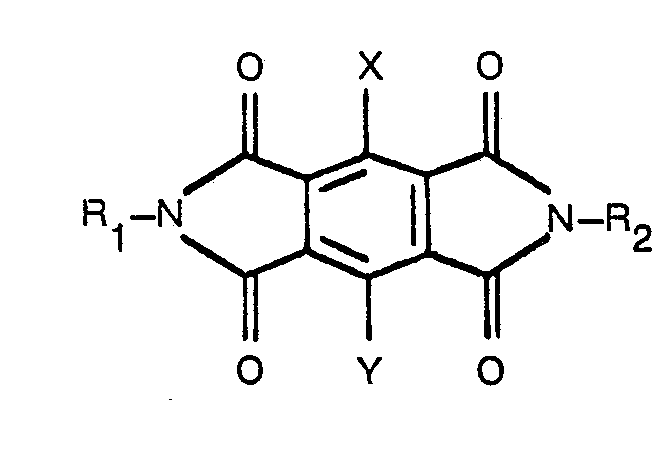
- the present invention is based on the discovery of certain novel substituted pyromellitic diimides, in which the two imide nitrogen atoms are asymmetrically substituted, and the discovery that such compounds can be administered to ruminant animals in order to increase feed efficiency, to shift the production of volatile fatty acids away from acetate with an increase in propionate and butyrate, and to suppress methane formation.
- novel assymetrically substituted pyromellitic diimides of this invention have the following structural formula: in which R 1 and R 2 are not the same and each represents hydrogen, alkyl, alkenyl, alkynyl, cycloalkyl, lower alkanoyl, benzoyl, di(lower alkyl)amino, lower alkanoylamino, benzoylamino, lower alkoxycarbonylamino, substituted phenyl having a sulfonamido, hydroxy, carboxy, nitro, methylthio, or lower hydroxyalkyl substituent; or substituted lower alkyl having one or two hydroxy, halogen, nitro, lower alkoxy, carboxy, phenyl, lower hydroxy alkoxy, lower alkanoyloxy, phenoxy, amino, lower alkylamino, di(lower alkyl)amino, mercapto, lower alkylthio, lower alkylsulfinyl, lower
- lower groups contain not more than six carbon atoms.
- loweralkyl means alkyl containing from 1 to 6 carbon atoms in either a straight or branched configuration, e.g. methyl, ethyl, propyl, isopropyl, butyl, tert-butyl, pentyl or hexyl.
- lower alkenyl means alkenyl containing a single unsaturation in a straight or branched chain length of from 2 to 6 carbon atoms, e.g. ethenyl, propenyl, butenyl, pentenyl or hexenyl.
- lower alkynyl means alkynyl containing one triple bond in a straight or branched chain of from 2-6 carbon atoms, e.g. ethynyl, propynyl, butynyl, pentynyl or hexynyl.
- cycloalkyl means C a-6 cycloalkyl groups, viz. cyclopropyl, cyclobutyl, cyclopentyl or cyclohexyl.
- lower alkanoyl means alkanoyl or straight or branched configuration containing from 2 to 6 carbon atoms, e.g. acetyl, propionyl, butyryl, isobutyryl, pentanoyl and hexanoyl.
- lower alkanoyloxy means the foregoing lower alkanoyl groups bonded to the lower alkyl pyromellitic diimide substrate through an oxygen atom.
- lower alkoxy means alkoxy containing from 1 to 6 carbon atoms in either a straight or branched configuration, e.g. methoxy, ethoxy, propoxy, isopropoxy, butoxy, tert-butoxy, pentoxy or hexoxy.
- (lower alkoxy)carbonyl means the foregoing lower alkoxy groups bonded to the pyromellitic diimide substrate through a carbonyl group.
- R 1 and R 2 are not the same and each is hydrogen, lower alkyl, lower alkenyl, lower alkanoyl, di(loweralkyl)amino, benzoylamino or substituted lower alkyl having one or two hydroxy, amino, alkylamino, di(loweralkyl)amino, lower alkoxy, carboxy, carbamoyl, phenyl, lower hydroxyalkoxy, lower hydroxyalkylthio, lower alkanoyloxy, mercapto, lower alkylthio, lower alkylsulfinyl, lower alkylsulfonyl or lower alkoxycarbonyl substituents; and X and Y are both hydrogen.
- R 1 and R 2 are not the same and each is hydrogen, lower alkyl, lower alkenyl, lower alkanoyl, di(lower alkyl)amino or substituted lower alkyl having a single hydroxy or lower alkanoyloxy, lower alkylthio, loweralkylsulfinyl, lower alkylsulfonyl, lower hydroxyalkylthio or lower hydroxyalkoxy substituent, particularly when R 1 and R 2 are not the same and each is hydrogen, lower alkyl or substituted lower alkyl having a single hydroxy, lower hydroxyalkoxy or lower hydroxyalkylthio substituent.
- novel compounds are prepared by processes outlined in the following reaction scheme.
- the preparation of the compound of this invention begins with pyromellitic dianhydride (II) which is treated with a substituted amine represented by R i NH 2 ; however, the order of reaction is not dependent upon which amine is employed and either the R 1 or R 2 amine could be reacted first.
- the reaction is carried out in the aprotic solvent such as acetone, tetrahydrofuran, dimethylformamide, dimethyl acetamide, diphenyl ether or dioxane, and is complete in about 5 minutes to 2 hours. A single molar equivalent of the amine is employed.
- the reaction is preferably maintained in an anhydrous state and anhydrous amines are preferably employed, since water will react with the anhydride at longer reaction times (greater than 2 hours).
- the pyromellitic acid anhydride monoamide (III) is then heated to form the pyromellitic imide anhydride (IV).
- the heating may take place in refluxing thionyl chloride and is complete in about 1-10 hours. No solvent is employed for heating in thionyl chloride.
- the reaction may be heated in a high boiling solvent such as dimethylformamide dimethylsulfoxide, dimethylacetamide or diphenyl ether at from about 100°C to the reflux temperature of the reaction mixture.
- the reaction is complete in about 1/2 to 1 hour.
- the reaction products (IV) are isolated following procedures known to those skilled in this art.
- the pyromellitic imide anhydride (IV) is then treated with an amine (represented by R 2 NH 2 ) in order to form the pyromellitic acid amide imide (V).
- the reaction is carried out very much in the manner of the first amine reaction (11 to IV), however, since there is only a single anhydride function to be reacted, it is possible to use more than a single mole of the amine (from 1 to 2 molar equivalents are preferred) and to increase the reaction times, the reaction is generally complete in about 10 minutes to 4 hours at from 0°C to room temperature.
- the pyromellitic imide anhydride (IV) may be reacted without isolating the intermediate (V).
- the initial reaction with one mole of the amine may be carried out in a high boiling solvent such as dimethylformamide, but at the temperature conditions above described. Then, after the prescribed reaction times the reaction mixture may be slowly brought (over a period of from 1 to 4 hours) to the reaction conditions of the second step.
- the product (I) will be isolated in the usual manner.
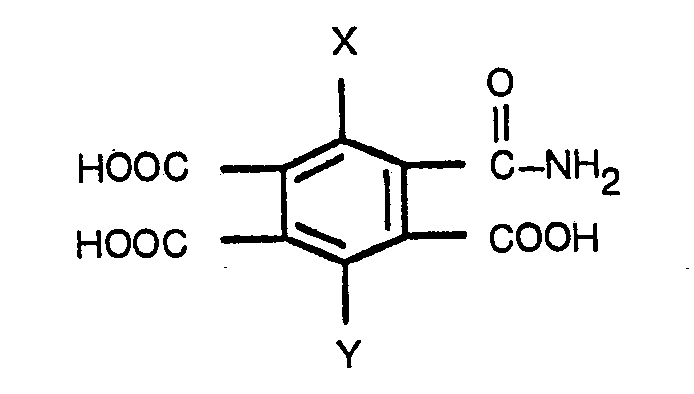
- pyromellitic dianhydride (II) is treated with ammonia to prepare the 2,4,5-tricarboxybenzene-1-carbamate (VII).
- the reaction is generally carried out in a non-polar solvent in which the starting material is soluble such as tetrahydrofuran or acetone and is complete in from 5 minutes to 2 hours at from 0°C to room temperature. Room temperature is preferred.
- Compound (VIII) is then treated with an R 1 -substituted amine to react with the anhydride portion of compound (VIII) and prepare the R 1 -carbamoyl compound (IX).
- the reaction is generally carried out in a solvent as described above and is complete in about 5 minutes to 2 hours at from about 10 to 50°C. Room temperature is preferred.
- the carbamoyl compound (IX) is heated in a high-boiling solvent as described above to prepare the R, monosubstituted pyromellitic diimide (X).
- the products are isolated using techniques known to those skilled in this art.
- the pyromellitic imide anhydride VIII may be reacted without isolating the intermediate IX as described for the reaction of IV to I.
- N,N' hydroxyalkyl or aminoalkyl pyromellitic diimides An example of such would be the reactions carried out on the N,N' hydroxyalkyl or aminoalkyl pyromellitic diimides.
- acyl derivatives it is more convenient to acylate the N,N'-hydroxyalkyl or aminoalkyl compound than to use the acylated amino compound as starting material. While it is possible to carry out the reaction either way, the later acylation avoids the possibility that the acyl group will be removed by hydrolysis during the course of the reaction.
- Such an acylation of the hydroxyalkyl, or aminoalkyl substituted pyromellitic diimide is carried out using standard acylation reagents such as the anhydride or halide of the acyl moiety.
- acylation reagents such as the anhydride or halide of the acyl moiety.
- the reagent is used as a solvent.
- a basic inert solvent such as pyridine is employed.
- the reaction is carried out at from room temperature to the reflux temperature of the reaction mixture, preferably at from 75-100°C, for from 5 minutes to 5 hours.
- the product is isolated using techniques known to those skilled in this art.
- the compounds of the instant invention wherein the R-group contains a sulfur (thio) linkage are conveniently oxidized to the sulfinyl or sulfonyl linkages. This is carried out using mild oxidizing agents, such as m-chloroperbenzoic acid. A single molar equivalent is employed for the preparation of the sulfinyl group and two equivalents are used to prepare the sulfonyl group.
- the reaction is carried out in an inert solvent such as a halogenated hydrocarbon, (methylene chloride, chloroform or carbon tetrachloride or a loweralkanol or mixtures thereof. The reaction is complete in from 10 minutes to 10 hours.
- To prepare the sulfinyl compound the temperature is generally maintained at room temperature. To prepare the sulfone, temperatures up to 100°C or the reflux temperature are employed. The products are isolated using techniques used by those skilled in the art.
- a base such as an alkali metal hydroxide, preferably sodium hydroxide.
- the reaction is carried out preferably in an aqueous solvent at from room temperature to 100°C for from 1 to 10 hours.
- the products are isolated using known techniques.
- Pyruvate is then metabolized by microbioligical processes to either acetate or propionate compounds, which may be either acids or other forms of the radicals.
- Two acetate radicals may be combined thereafter, still in the rumen, to form butyrates.
- the animal can utilize butyrate, propionate, and acetate with differing degrees of efficiency. Utilization of these compounds which are collectively known as volatile fatty acid (VFA) occurs after absorption from the gut of the animal. Butyrate is utilized most efficiently, and acetate the least efficiently. However, the relative efficiency of use to butyrate is negated by the inefficiency of the manufacture of butyrate, which must be made from acetate in the rumen.
- VFA volatile fatty acid
- carbohydrate utilization (carbohydrates being the major nutritive portion of ruminant animals' feed) can be increased by treatments which encourage the animal to produce propionate rather than acetate from the carbohydrates.
- the efficiency of feed use can be effectively monitored by observing the production and concentration of propionate compounds in the rumen. If the animal is making more propionates, it will be found to be using its feed more efficiently. This efficiency is manifested by greater weight gains per feed intake, a reduction in energy losses by methane release, and economic advantages to the animal grower when the animal is sold for consumption.
- a method of improving the feed utilization of ruminants comprises orally administering to a ruminant an effective amount of one or more of the above-described novel compounds.
- ruminant animals such as cattle, sheep and goats.
- the compounds of this invention are administered to ruminants orally at rates of from about 0.1 mg/kg/day to about 10 mg/kg/day. While the range is functional, the preferred range of rates is from about 0.5 to 5 mg/kg/day.
- the compounds of this invention increase the efficiency of feed utilization in ruminant animals.
- the easiest way to administer the compound is by mixing them in the animal's feed.
- the compounds of this invention can be usefully administered in other ways. For example, they can be incorporated into tablets, drenches, boluses, or capsules, and dosed to the animals. Formulation of the compounds in such dosage forms can be accomplished by means and methods well known in the veterinary pharmaceutical art.
- Each individual dosage unit should contain a quantity of the feed-efficiency-improving compound which has a direct relation to the proper daily dose for the animal to be treated.
- Capsules are readily produced by filling gelatin capsules with any desired form of the desired compound.
- the compound can be diluted with an inert powdered diluent, such as a sugar, starch or purified crystalline cellulose, in order to increase its volume for covenience in filling capsules.
- Tablets of the compounds useful in this novel method are made by conventional pharmaceutical processes. Manufacture of tablets is a well-known and highly-advanced art.
- a tablet usually contains a base, a disintegrator, an absorbent, a binder, and a lubricant.
- Typical bases include lactose, fine icing sugar, sodium chloride, starch and mannitol.
- Starch is also a good disintegrator as is alginic acid.
- Surface active agents such as sodium lauryl sulfate and dioctyl sodium sulphosuccinate are also sometimes used.
- Commonly used absorbents again include starch and lactose, while magnesium carbonate is also useful for oily substances.
- Frequently used binders are gelatin, gums, starch, dextrin and various cellulose derivatives.
- lubricants are magnesium stearate, talc, paraffin wax, various metallic soaps, and polyethylene glycol.
- This method of increasing the efficiency of feed utilization can also be practiced by the administration of the instant compound as a slow-pay-out bolus.
- Such boluses are made as tablets are made, except that a means to delay the dissolution of the compound is provided. Boluses are made to release for lengthy periods. The slow dissolution is assisted by choosing a highly water-insoluble form of the compound. A substance such as iron fillings is added to raise the density of the bolus and keep it static on the bottom of the rumen.
- Dissolution of the compound is delayed by use of a matrix of insoluble materials in which the drug is embedded.
- insoluble materials for example, substances such as vegetable waxes, purified mineral waxes, and water insoluble polymeric materials are useful.
- Drenches of the instant compounds are prepared most easily by choosing a water soluble or water dispersable form of the compound. If an insoluble form is desired for some reason, a suspension may be made. Alternatively, a drench may be formulated as a solution in a physiologically acceptable solvent such as a polyethylene glycol.
- Suspension of insoluble forms of the compounds can be prepared in non-solvents such as vegegable oils such as peanut, corn, or sesame oil; in a glycol such as propylene glycol or a polyethylene glycol; or in water, depending on the form of the compound chosen.
- non-solvents such as vegegable oils such as peanut, corn, or sesame oil
- glycol such as propylene glycol or a polyethylene glycol
- water depending on the form of the compound chosen.
- Suitable physiologically acceptable adjuvants are necessary in order to keep the compound suspended.
- the adjuvants can be chosen from among the thickeners, such as carboxymethylcellulose, polyvinylpyrrolidone, gelatin, and the alginates.
- Many classes of surfactants also will serve to suspend the compounds. For example, lecithin, alkylphenol polyethylene oxide aducts, naphthalene sulfonates, alkylbenzenesulfonates and the polyoxyethylene sorbitan esters are useful for making suspension in liquid nonsolvents.
- silicone antifoams, glycols, sorbitol, and sugars can be useful suspending agents.
- the suspendable compound may be offered to the animal grower as a suspension, or as a dry mixture of the compound and adjuvants to be diluted before use.
- the compounds may also be administered in the drinking water of the ruminants. Incorporation into drinking water is performed by adding a water soluble or water suspendable form of desired compound to the water in the proper amount. Formulation of the compound for addition to drinking water follows the same principles as formulation of drenches.
- the most practical way to treat animals with the compounds of this invention usable in this novel method is by the formulation of the compound into the feed supply.
- Any type of feed may be medicated with the instant compounds, including common dry feeds, liquid feeds, and pelleted feeds.
- typical drug premixes may contain from about 1 to about 400 g. of drug per pound (454 g.) of premix.
- the wide range results from the wide range of concentration of drug which may be desired in the final feed.
- Premixes may be eigher liquid or solid.
- the formulation of ruminant feeds containing the proper amounts of the instant compounds for useful treatment is mainly a matter of arithmetic. It is necessary only to calculate the amount of compound which it is desired to administer to each animal, to take into account the amount of feed per day which the animal eats, and the concentration of compound in the premix to be used, and calculate the proper concentration of the compound in the feed.
- the invention is a method of increasing the efficiency of feed utilization by ruminant animals by the oral administration of certain compounds regardless of the method of administration of the compounds.
- reaction mixture becomes thick and 200 ml. of acetone is added to increase the efficiency of the stirring.
- the solution is saturated with ammonia at 0°C and stirred an additional 20 minutes.
- the insoluble material is filtered and washed with acetone and dried affording 24.9 g. of a white solid which is identified by nuclear magnetic resonance as 2,4,5-tricarboxybenzamide.
- Example 4 Following the procedure of Example 4 using 1.09 g. of pyromellitic imide anhydride 40 mi. of acetone and 739 mg of n-propylamine there is produced 1.125 g. of white solid identified by nuclear magnetic resonance as 1-N(n-propyl) carbamoyl 2-carboxybenzene 4,5-dicarboxylic acid imide.
- Example 3 Following the procedure of Example 3 using 15.0 g. of pyromellitic imide anhydride in 520 ml. of acetone and 10.4 ml. of 2-aminoethanol dissolved in 140 ml. of acetone. There is produced 10.70 g. of an off-white solid identified by nuclear magnetic resonance as 1-N-(2-hydroxyethyl)carbamoyl 2-carboxybenzene 4,5-dicarboxylic acid imide.
- Example 8 Following the procedure of Example 8 using 10.65 g. of 1-N-(2-hydroxyethyl) carbamoyl 2-carboxybenzene 4,5-dicarboxylic acid imide in 32 ml. of dimethylformamide there is prepared 7.325 g. of an off-white solid identified by nuclear magnetic resonance as N-(2-hydroxyethyl) pyromellitic diimide.
- the total crude material from the previous example is suspended in 10 ml. of acetone and treated with ammonia gas for 5 minutes.
- the reaction mixture becomes very thick and an additional 10 ml. of acetone is added.
- the reaction mixture is filtered and the solid material washed with acetone.
- the solid material is dissolved in 20 ml. of water and treated with 2.5 N hydrochloric acid to pH 5 whereupon a precipitate results which is filtered, washed twice with water, once with ethanol and twice with ether affording 600 mg. of 1-carbamoyl 2-carboxybenzene N-ethyl 4,5-dicarboxylic acid imide m.p. 325-327°C with decomposition.
- the structure is confirmed with nuclear magnetic resonance.
- N-ethylbenzene 1,2-dicarboxylic acid imide 4,5-dicarboxylic acid anhydride 1.0 g. of N-ethylbenzene 1,2-dicarboxylic acid imide 4,5-dicarboxylic acid anhydride is dissolved in 10 ml. of acetone and treated with gaseous methylamine for 5 minutes at room temperature. The reaction mixture is stirred at room temperature for 20 minutes and evaporated to dryness in vacuo. The residue is suspended in 30 ml. of water, filtered and treated with 2.5 N hydrochloric acid affording a precipitate. The precipitate is filtered, washed twice with water and dried at 90°C in vacuo affording 1 N-methyl carbamoyl 2-carboxybenzene N-ethyl 4,5-dicarboxylic acid imide m.p. 288-289°C. The structure is confirmed by nuclear magnetic resonance.
- N-(2-methylmercaptoethyl) pyromellitic diimide 8.0 g. (27 mmole) in 700 mi. of methanol-methylenechloride (1:9) is added dropwise a solution of 85% m-chloroperoxybenzoic acid 5.6 g. (27 mmole) in 250 ml. of methylene chloride. Stirring is continued for 60 minutes longer at room temperature (23°C) and then the solution is cooled in ice. The insolubles are collected, rinsed with cold methylene chloride and dried furnishing 8.0 g. of N-(2-methylsulfinylethyl) pyromellitic diimide, m.p. 280-281 °C.
- N-Acetyl-N'-(2-acetoxyethyl) pyromellitic diimide 1.0 g., in 60 ml. of water dioxane (1:5) is stirred at reflux for 1 hour. The solution is cooled in ice, diluted with water and then concentrated under reduced pressure till crystals separate. The crystals are filtered, rinsed with cold water and air dried with suction furnishing 0.15 g. of N-(2-acetoxyethyl) pyromellitic diimide.
- Powdered pyromellitic diimide 30.3 g. (0.14 mole), is added all at once to a vigorously stirred solution of acetic anhydride, 14.5 ml. (0.154 mole), in 1.25 I. of reagent pyridine at room temperature (21°C). Stirring is continued for 2 hours. The mixture stands at room temperature overnight, 16 hours and then is cooled in ice. The insolubles are collected, rinsed with a small amount of cold pyridine, cold methanol, then thoroughly with ethyl ether and dried furnishing 26.6 g. of N-acetyl pyromellitic diimide, m.p. 268-270°C dec.
- Pyromellitic imide anhydride 2.17 g. (10 mmole) is added with stirring at room temperature (23°C) to a solution of 4-aminophenol 1.20 g. (10 mmole) in 10 ml. of dimethylformamide under nitrogen. The mixture is stirred for 30 minutes at room temperature, for 30 minutes at 50°C, for 30 minutes at 100°C and for 1 hour at 150°C and then cooled in ice and diluted with 3 volumes of ethanol. The crystals are collected, rinsed with cold ethanol and with ethyl ether furnishing 2.30 g. of N-(4-hydroxyphenyl) pyromellitic diimide, m.p. 300°C.
- N-methyl pyromellitic diimide 2.30 g. (10 mmole), is added with vigorous stirring at room temperature (23°C) to a solution of 36% formaldehyde, 5 ml., in 30 ml. of water under nitrogen followed by the addition of 10 drops of 2.5 N sodium hydroxide. The mixture is heated at 95° for 6 hours and then cooled in ice. The insolubles are collected, rinsed with cold water, ethyl ether and dried furnishing 1.98 g. of N-methyl-N'-hydroxymethyl pyromellitic diimide, m.p. > 300°C.
Landscapes
- Chemical & Material Sciences (AREA)
- Organic Chemistry (AREA)
- Polymers & Plastics (AREA)
- Life Sciences & Earth Sciences (AREA)
- Engineering & Computer Science (AREA)
- Zoology (AREA)
- Animal Husbandry (AREA)
- Food Science & Technology (AREA)
- Heterocyclic Carbon Compounds Containing A Hetero Ring Having Oxygen Or Sulfur (AREA)
- Fodder In General (AREA)
- Polymers With Sulfur, Phosphorus Or Metals In The Main Chain (AREA)
- Feed For Specific Animals (AREA)
- Nitrogen Condensed Heterocyclic Rings (AREA)
- Macromolecular Compounds Obtained By Forming Nitrogen-Containing Linkages In General (AREA)
Claims (10)




Priority Applications (1)
| Application Number | Priority Date | Filing Date | Title |
|---|---|---|---|
| AT79302278T ATE2329T1 (de) | 1978-10-23 | 1979-10-19 | Neue pyromellitsaeurediimide, verfahren zu ihrer herstellung, diese verbindungen in oral verabreichbarer form zur verwendung bei der verbesserung der futterverwertung von wiederkaeuern und dafuer geeignete zubereitungen, die sie enthalten. |
Applications Claiming Priority (2)
| Application Number | Priority Date | Filing Date | Title |
|---|---|---|---|
| US95404078A | 1978-10-23 | 1978-10-23 | |
| US954040 | 1978-10-23 |
Publications (2)
| Publication Number | Publication Date |
|---|---|
| EP0010440A1 EP0010440A1 (fr) | 1980-04-30 |
| EP0010440B1 true EP0010440B1 (fr) | 1983-01-26 |
Family
ID=25494857
Family Applications (1)
| Application Number | Title | Priority Date | Filing Date |
|---|---|---|---|
| EP79302278A Expired EP0010440B1 (fr) | 1978-10-23 | 1979-10-19 | Diimides de l'acide pyromellitique, procédés pour leur préparation, ces composés qui sont sous la forme d'administration orale pour utilisation pour améliorer le rendement alimentaire chez les ruminants et compositions à cet effet les contenant |
Country Status (10)
| Country | Link |
|---|---|
| EP (1) | EP0010440B1 (fr) |
| JP (1) | JPS5557590A (fr) |
| AT (1) | ATE2329T1 (fr) |
| AU (1) | AU530335B2 (fr) |
| CA (1) | CA1137488A (fr) |
| DE (1) | DE2964633D1 (fr) |
| DK (1) | DK444079A (fr) |
| IE (1) | IE48968B1 (fr) |
| NZ (1) | NZ191821A (fr) |
| ZA (1) | ZA795637B (fr) |
Families Citing this family (7)
| Publication number | Priority date | Publication date | Assignee | Title |
|---|---|---|---|---|
| DE3322057A1 (de) * | 1983-06-18 | 1984-12-20 | Bayer Ag, 5090 Leverkusen | Neue flammschutzmittel, ihre herstellung und ihre verwendung zur flammfestausruestung in polycarbonat |
| WO2009089283A2 (fr) | 2008-01-07 | 2009-07-16 | The Johns Hopkins University | Transistors hybrides à canal n à faible tension |
| US8269215B2 (en) | 2008-07-21 | 2012-09-18 | The Johns Hopkins University | Pyromellitic diimide organic semiconductors and devices |
| EA200802102A1 (ru) | 2008-10-31 | 2010-06-30 | Ооо "Центр Разработки И Внедрения Инновационных Технологий" | Способ проведения лотереи |
| EA013711B1 (ru) | 2008-12-05 | 2010-06-30 | Общество С Ограниченной Ответственностью "Центр Разработки И Внедрения Инновационных Технологий" | Способ проведения лотереи |
| JPWO2010073660A1 (ja) | 2008-12-25 | 2012-06-07 | パナソニック株式会社 | リード、配線部材、パッケージ部品、樹脂付金属部品及び樹脂封止半導体装置、並びにこれらの製造方法 |
| WO2022103280A1 (fr) * | 2020-11-10 | 2022-05-19 | Pastoral Greenhouse Gas Research Ltd | Inhibiteurs de méthanogène |
Family Cites Families (2)
| Publication number | Priority date | Publication date | Assignee | Title |
|---|---|---|---|---|
| DE1770840C3 (de) * | 1968-07-10 | 1978-11-23 | Veba-Chemie Ag, 4660 Gelsenkirchen- Buer | Verfahren zur Herstellung von Pyromellitsäurediimid |
| CA986522A (en) * | 1971-10-04 | 1976-03-30 | Ciba-Geigy Ag | Pyromellitic diimides of 3,5-dialkyl-4-hydroxyphenylsubstituted amines |
-
1979
- 1979-10-10 AU AU51674/79A patent/AU530335B2/en not_active Ceased
- 1979-10-10 NZ NZ191821A patent/NZ191821A/xx unknown
- 1979-10-12 CA CA000337491A patent/CA1137488A/fr not_active Expired
- 1979-10-19 DE DE7979302278T patent/DE2964633D1/de not_active Expired
- 1979-10-19 AT AT79302278T patent/ATE2329T1/de not_active IP Right Cessation
- 1979-10-19 EP EP79302278A patent/EP0010440B1/fr not_active Expired
- 1979-10-19 IE IE1999/79A patent/IE48968B1/en unknown
- 1979-10-22 DK DK444079A patent/DK444079A/da not_active Application Discontinuation
- 1979-10-22 ZA ZA00795637A patent/ZA795637B/xx unknown
- 1979-10-23 JP JP13601779A patent/JPS5557590A/ja active Pending
Also Published As
| Publication number | Publication date |
|---|---|
| AU530335B2 (en) | 1983-07-14 |
| IE48968B1 (en) | 1985-06-26 |
| EP0010440A1 (fr) | 1980-04-30 |
| AU5167479A (en) | 1980-05-01 |
| DE2964633D1 (en) | 1983-03-03 |
| ZA795637B (en) | 1981-06-24 |
| ATE2329T1 (de) | 1983-02-15 |
| NZ191821A (en) | 1982-08-17 |
| CA1137488A (fr) | 1982-12-14 |
| IE791999L (en) | 1980-04-23 |
| DK444079A (da) | 1980-05-07 |
| JPS5557590A (en) | 1980-04-28 |
Similar Documents
| Publication | Publication Date | Title |
|---|---|---|
| EP0197840B1 (fr) | (Imidazolyl-4) piperidines, leur préparation et leur application en thérapeutique | |
| KR100430207B1 (ko) | 효소억제제 | |
| KR100388345B1 (ko) | 신규헤테로시클릭유도체및이것의의약용도 | |
| US4289784A (en) | Pyromellitic diimides and method of increasing feed efficiency in ruminant animals | |
| EP3071561B1 (fr) | Composés inhibiteurs de l'autotaxine | |
| FI74468C (fi) | Foerfarande foer framstaellning av terapeutiskt aktiva 2-aminopurinderivat. | |
| EP0313724A2 (fr) | Dérivés de bis(acyloxyméthyl)imidazoles | |
| HU208811B (en) | Process for producton of biaryl-compounds and pharmaceutical compositions comprising them as medical agent | |
| EP2024335B1 (fr) | Nouveaux derives d'imidazoles, leur preparation et leur utilisation en tant que medicament | |
| JP2572115B2 (ja) | 抗増殖剤として有用な5−アミノ又は置換アミノ−1,2,3− トリアゾール類 | |
| US6451809B2 (en) | Oxo-pyridoimidazole-carboxamides: GABA brain receptor ligands | |
| HU185018B (en) | Process for the preparation of alkyl-urea derivatives, as well as pharmaceutical compositions sontaining said compounds | |
| FR2753969A1 (fr) | Nouveaux derives de flavones, leur procede de preparation et les compositions pharmaceutiques qui les contiennent | |
| EP0092458A2 (fr) | Dérives d'imidazo(1,2-a)pyridine, leur préparation et leur application en thérapeutique | |
| EP0010440A1 (fr) | Diimides de l'acide pyromellitique, procédés pour leur préparation, ces composés qui sont sous la forme d'administration orale pour utilisation pour améliorer le rendement alimentaire chez les ruminants et compositions à cet effet les contenant | |
| US4782056A (en) | 2-phenylhexahydro-1,2,4-triazine-3-,5-diones | |
| EP0010441B1 (fr) | Utilisation de diimides pyromellitiques, symétriquement substitués, comme additifs à la nourriture pour ruminants. Compositions contenant ces additifs | |
| EP0214592B1 (fr) | Pyrrolobenzimidazoles, procédé pour leur préparation et médicaments contenant ces composés | |
| EP0136198B1 (fr) | Dérivés de triazolo pyrimidine, leur procédé de préparation et leur application thérapeutique en tant que toni-cardiaques | |
| RU2195451C2 (ru) | Цианогуанидины, способы их получения и фармацевтический препарат на их основе | |
| HK1000919B (en) | Hydrazones | |
| US20240226096A1 (en) | Treatment of myeloproliferative diseases and disorders with inhibitors of bet family bdii bromodomain | |
| CH646138A5 (fr) | Amino-2-benzoyl-3-phenylacetamides et leurs homologues cycliques utiles comme medicaments et compositions pharmaceutiques les contenant. | |
| EP0015083B1 (fr) | Complexes contenant des diimides d'acide pyromellitique, leur préparation, compositions les contenant et leur utilisation pour améliorer le rendement en nourriture des ruminants | |
| EP0767167B1 (fr) | Nouveaux dérivés 2-cyano 3-hydroxy propénamides comprenant un radical trifluorométhylsulfonylphényle ou trifluorométhylsulfinylphényle, leur procédé de préparation, leur application à titre médicaments et les compositions pharmaceutiques les renfermant |
Legal Events
| Date | Code | Title | Description |
|---|---|---|---|
| PUAI | Public reference made under article 153(3) epc to a published international application that has entered the european phase |
Free format text: ORIGINAL CODE: 0009012 |
|
| AK | Designated contracting states |
Designated state(s): AT BE CH DE FR GB IT LU NL SE |
|
| 17P | Request for examination filed | ||
| ITF | It: translation for a ep patent filed | ||
| GRAA | (expected) grant |
Free format text: ORIGINAL CODE: 0009210 |
|
| AK | Designated contracting states |
Designated state(s): AT BE CH DE FR GB IT LU NL SE |
|
| REF | Corresponds to: |
Ref document number: 2329 Country of ref document: AT Date of ref document: 19830215 Kind code of ref document: T |
|
| REF | Corresponds to: |
Ref document number: 2964633 Country of ref document: DE Date of ref document: 19830303 |
|
| ET | Fr: translation filed | ||
| PGFP | Annual fee paid to national office [announced via postgrant information from national office to epo] |
Ref country code: LU Payment date: 19831012 Year of fee payment: 5 |
|
| PG25 | Lapsed in a contracting state [announced via postgrant information from national office to epo] |
Ref country code: LU Free format text: LAPSE BECAUSE OF NON-PAYMENT OF DUE FEES Effective date: 19831031 |
|
| PGFP | Annual fee paid to national office [announced via postgrant information from national office to epo] |
Ref country code: CH Payment date: 19840823 Year of fee payment: 6 |
|
| PGFP | Annual fee paid to national office [announced via postgrant information from national office to epo] |
Ref country code: FR Payment date: 19840831 Year of fee payment: 6 |
|
| PGFP | Annual fee paid to national office [announced via postgrant information from national office to epo] |
Ref country code: SE Payment date: 19840930 Year of fee payment: 6 Ref country code: BE Payment date: 19840930 Year of fee payment: 6 |
|
| PGFP | Annual fee paid to national office [announced via postgrant information from national office to epo] |
Ref country code: DE Payment date: 19841127 Year of fee payment: 6 |
|
| PGFP | Annual fee paid to national office [announced via postgrant information from national office to epo] |
Ref country code: AT Payment date: 19861002 Year of fee payment: 8 |
|
| PGFP | Annual fee paid to national office [announced via postgrant information from national office to epo] |
Ref country code: NL Payment date: 19871031 Year of fee payment: 9 |
|
| PG25 | Lapsed in a contracting state [announced via postgrant information from national office to epo] |
Ref country code: GB Effective date: 19891019 Ref country code: AT Effective date: 19891019 |
|
| PG25 | Lapsed in a contracting state [announced via postgrant information from national office to epo] |
Ref country code: SE Effective date: 19891020 |
|
| PG25 | Lapsed in a contracting state [announced via postgrant information from national office to epo] |
Ref country code: CH Effective date: 19891031 Ref country code: BE Effective date: 19891031 |
|
| BERE | Be: lapsed |
Owner name: MERCK & CO. INC. Effective date: 19891031 |
|
| PG25 | Lapsed in a contracting state [announced via postgrant information from national office to epo] |
Ref country code: NL Effective date: 19900501 |
|
| GBPC | Gb: european patent ceased through non-payment of renewal fee | ||
| NLV4 | Nl: lapsed or anulled due to non-payment of the annual fee | ||
| PG25 | Lapsed in a contracting state [announced via postgrant information from national office to epo] |
Ref country code: FR Effective date: 19900629 |
|
| REG | Reference to a national code |
Ref country code: CH Ref legal event code: PL |
|
| PG25 | Lapsed in a contracting state [announced via postgrant information from national office to epo] |
Ref country code: DE Effective date: 19900703 |
|
| REG | Reference to a national code |
Ref country code: FR Ref legal event code: ST |
|
| EUG | Se: european patent has lapsed |
Ref document number: 79302278.1 Effective date: 19900705 |
|
| PLBE | No opposition filed within time limit |
Free format text: ORIGINAL CODE: 0009261 |
|
| STAA | Information on the status of an ep patent application or granted ep patent |
Free format text: STATUS: NO OPPOSITION FILED WITHIN TIME LIMIT |