EP0010545A1 - Amorphe kohlenstofflegierungen und daraus hergestellte artikel - Google Patents
Amorphe kohlenstofflegierungen und daraus hergestellte artikel Download PDFInfo
- Publication number
- EP0010545A1 EP0010545A1 EP79900180A EP79900180A EP0010545A1 EP 0010545 A1 EP0010545 A1 EP 0010545A1 EP 79900180 A EP79900180 A EP 79900180A EP 79900180 A EP79900180 A EP 79900180A EP 0010545 A1 EP0010545 A1 EP 0010545A1
- Authority
- EP
- European Patent Office
- Prior art keywords
- alloys
- atomic
- amorphous
- alloy
- carbon
- Prior art date
- Legal status (The legal status is an assumption and is not a legal conclusion. Google has not performed a legal analysis and makes no representation as to the accuracy of the status listed.)
- Granted
Links
Images

Classifications
-
- C—CHEMISTRY; METALLURGY
- C22—METALLURGY; FERROUS OR NON-FERROUS ALLOYS; TREATMENT OF ALLOYS OR NON-FERROUS METALS
- C22C—ALLOYS
- C22C45/00—Amorphous alloys
- C22C45/008—Amorphous alloys with Fe, Co or Ni as the major constituent
-
- H—ELECTRICITY
- H01—ELECTRIC ELEMENTS
- H01F—MAGNETS; INDUCTANCES; TRANSFORMERS; SELECTION OF MATERIALS FOR THEIR MAGNETIC PROPERTIES
- H01F1/00—Magnets or magnetic bodies characterised by the magnetic materials therefor; Selection of materials for their magnetic properties
- H01F1/01—Magnets or magnetic bodies characterised by the magnetic materials therefor; Selection of materials for their magnetic properties of inorganic materials
- H01F1/03—Magnets or magnetic bodies characterised by the magnetic materials therefor; Selection of materials for their magnetic properties of inorganic materials characterised by their coercivity
- H01F1/12—Magnets or magnetic bodies characterised by the magnetic materials therefor; Selection of materials for their magnetic properties of inorganic materials characterised by their coercivity of soft-magnetic materials
- H01F1/14—Magnets or magnetic bodies characterised by the magnetic materials therefor; Selection of materials for their magnetic properties of inorganic materials characterised by their coercivity of soft-magnetic materials metals or alloys
- H01F1/147—Alloys characterised by their composition
- H01F1/153—Amorphous metallic alloys, e.g. glassy metals
Definitions
- the present invention relates to amorphous alloys and articles manufactured from said alloys and particularly to amorphous iron group alloys containing only carbon as a metalloid (amorphous alloy forming element) and articles manufactured from said alloys.
- Solid metals or alloys are generally crystal state but if a molten metal is cooled at an extremely high speed (the cooling rate depends upon the alloy composition but is approximately 10 4 -10 6 °C/sec), a solid having, a non-crystal structure, which has no periodic atomic arrangement, is obtained.
- Such metals are referred to as non-crystal metals or amorphous metals.
- this type metal is an alloy consisting of two or more elements and usually consists of a combination of a transition metal element and a metalloid element and an amount of the metalloid is about 15-30 atomic%.
- Japanese Patent Laid-Open Application No. 91,014/74 discloses novel amorphous metals and amorphous metal articles.
- the component composition of the alloys is as follows.
- the amorphous alloys have the following formula wherein M is a metal selected from the group consisting of iron, nickel, chromium, cobalt and vanadium or a mixture thereof; Y is a metalloid selected from phosphorus, carbon and boron or a mixture thereof; Z is an element selected from the group consisting of aluminum, silicon, tin, antimony, germanium, indium and beryllium or a mixture thereof; a, b, and c are about 60-90 atomic%, 10-30 atomic% and 0.1-15 atomic% respectively, a+b+c being 100.
- the amorphous alloys are ones containing 0.1-15 atomic% of an element selected from the group consisting of aluminum, silicon, tin, antimony, germanium, indium and beryllium or a mixture thereof as the essential component and have drawbacks in the cost of the starting material, the crystallizing temperature, the corrosion resistance, the embrittlement resistance and the like.
- the inventors have already discovered Fe-Cr series amorphous alloys (Japanese Patent Laid-Open Application No. 101,215/75) and filed said patent application.
- the alloys are Fe-Cr series amorphous alloys having high strength, excellent corrosion resistance and heat resistance and consist of 1-40 atomic% of chromium, not less than 2 atomic% of boron, not less than 5 atomic% of phosphorus and 15-30 atomic% of the sum of carbon or boron and phosphorus and the remainder being iron.
- these alloys contain boron, the cost of the starting material is high, and since these alloys contain phosphorus, the embrittlement resistance is low and when melting, vaporous phosphorus is generated and is harmful.
- the inventors have already discovered Fe-Cr series amorphous alloys (Japanese Patent Laid-Open Application No. 3,312/76) having high strength and filed this patent application.
- the alloys involve the following two kind of alloys.
- the above described alloys (1) and (2) are excellent in the heat resistance and high in the strength but since boron is contained, the cost of the starting material is high and the corrosion resistance is not satisfied, and since the alloys (2) contain phosphorus, the embrittlement resistance is low and when melting, the vaporous phosphorus is generated and this alloy is harmful.
- the above described alloys (1) and (2) are high in the heat resistance and the mechanical strength but since phosphorus is contained in a relatively large amount, the vaporous phosphorus is generated upon melting and these alloys are harmful.
- the inventors have found amorphous iron alloys (Japanese Patent Laid-Open Application No. 4,019/76) having high pitting corrosion resistance, crevice corrosion resistance, stress corrosion resistance and hydrogen embrittlement resistance and filed such patent application.
- the alloys are the following three kind of alloys.
- the alloys (1) and (2) contain boron and the alloys (2) and (3) contain phosphorus, so that the cost of the starting material is high or the embrittlement resistance is low and further the vaporous phosphorus is generated when melting and the alloys are harmful.
- the inventors have disclosed amorphous alloys having high permeability and having the following component composition range in Japanese Patent Laid-Open Application No. 73,920/76.
- Japanese Patent Laid-Open Application No. 5,620/77 discloses amorphous alloys containing iron group elements and boron.
- the amorphous alloys consist of the following component composition.
- At least 50% amorphous metal alloys have the following formula wherein M is at least one element of iron, cobalt and nickel, M' is at least one element selected from the group consisting of iron, cobalt and nickel, which is different from the M element, M" is at least one element selected from the group consisting of vanadium, manganese, molybdenum, tungsten, niobium and tantalum, a is about 40-85 atomic%, b is 0 to about 45 atomic%, c and d are 0-20 atomic% respectively and e is about 15-25 atomic%, provided that when M is nickel, all b, c and d do not become 0.
- the alloys contain boron as the essential component, so that there is problem in view of the cost of the starting material and the crystallizing temperature.
- amorphous iron alloys having high strength, fatigue resistance, general corrosion resistance, pitting corrosion resistance, crevice corrosion resistance, stress corrosion resistance, and hydrogen embrittlement resistance and filed a patent application (Japanese Patent Laid-Open Application No. 4,017/76). These alloys contain 1-40 atomic% of chromium, and 7-35 atomic% of at least one of phosphorus, carbon and boron as the main component and as the auxiliary component, 0.01-75 atomic% of at least one group selected from the group consisting of
- amorphous alloys are novel ones in which the strength and the heat resistant are improved and the corrosion resistance is provided by adding chromium.
- These alloys have excellent properties, for example, the fracture strength is within the range of about 1/40-1/50 of Young's modulus and is near the value of the ideal strength and in spite of the high strength, the toughness is very excellent and the fracture toughness value (K IC ) is about 5-10 times as high as the practically used high strength and tough steels (piano steel, maraging steel, PH steel and the like).
- these alloys have novel properties in view of the corrosion resistance and have high resistance against not only the general corrosion, but also the pitting corrosion, crevice corrosion and stress corrosion, which cannot be avoided in the presently used stainless steels (304 steel, 316 steel and the like), but the component composition is broad, so that against the practical and novel use the heat resistance is high, and the hardness and strength are high and the embrittling temperature is high and the production is easy.
- the cheap component composition range has never been known.
- the present invention aims to provide carbon series amorphous alloys which are easy and cheap in the production while holding the above described various properties and articles manufactured from said alloys.
- the above described object of the present invention can be attained by providing carbon series amorphous alloys characterized in that said alloys have the component composition shown by the following formula and articles manufactured from the alloys.
- X is a atomic% of at least one selected from a Fe, Co and Ni
- Cr b is b atomic%
- Mc is c atomic% of at least one selected from Cr, Mo and W
- Q d shows that carbon is contained in an amount of d atomic%
- a 14-86
- b is 0-22
- c 4-38
- d 10-26 and the sum of a, b, c and d is substantially 100
- a part of M may be at least one element selected from the group (A) consisting of V, Ta and Mn, at least one element selected from the group (B) consisting of Nb, Ti and Zr, or a combination of at least one element selected from the above described group (A) and at least one element selected from the above described group (B) and the content of the group
- iron group series alloys containing carbon (or a part of carbon is substituted with nitrogen) as the metalloid can easily form the amorphous products within a broad composition range and have excellent strength, hardness, corrosion resistance, embrittlement resistance and heat resistance, that a part of the alloys has high permeability and that a part of the alloys becomes non-magnetic, and the present invention has been accomplished.
- the well known iron group series amorphous alloys are combination of at least one of iron group elements and a metalloid of P, B, Si and C, for example, Fe 70 Co 10 P 20 , Co 80 B 20 , Fe 60 Co 20 P 12 B 8 , Fe 70 Ni 5 Si 15 B 10 , Co 60 Ni 15 Si 15 P 10 , Fe 70 Co 10 P 13 C 7 and the like.
- the metalloids which are the additives necessary for making amorphous, have the different inherent properties.
- the effects are shown in Table 1. In said table, the properties are estimated by ⁇ (excellent), o (good), x (passable).
- Ge is not preferable in all points and P is better in view of the cost of starting material and the corrosion resistance but is not preferable in the other points.
- phosphorus generates harmful gas during melting and promotes the embrittlement of .the material owing to heating, so that phosphorus is the element having many problems.
- silicon and boron are not preferable, because these elements act to lower the corrosion resistance and boron has the defect that the cost of starting material becomes higher. It has been found that carbon is the element having the preferable properties in view of all points as seen from Table 1.
- the inventors have made study in detail with respect to the iron group series amorphous alloys containing only carbon among the above described metalloids contributing to formation of amorphous alloys and the present invention has been accomplished.
- the amorphous alloys are obtained by rapidly cooling molten alloys and a variety of cooling processes have been proposed.
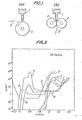
- the process wherein a molten metal is continuously ejected on an outer circumferential surface of a disc (Fig. l(a)) rotating at a high speed or between twin rolls (Fig. 1(b)) reversely rotating with each other at a high speed to rapidly cool the molten metal on the surface of the rotary disc or both rolls at a rate of about 10 5- 10 6 °C/sec. and to solidify the molten metal has been publicly known.
- the amorphous iron group series alloys of the present invention can be similarly obtained by rapidly cooling the molten metal and by the above described various processes can be produced wire-shaped or sheet-shaped amorphous alloys of the present invention.
- amorphous alloy powders of about several ⁇ m-10 ⁇ m can be produced by blowing the molten metal to a cooling copper plate by a high pressure gas (nitrogen, argon gas and the like) to rapidly cool the molten metal in fine powder form, for example, by an atomizer.
- the alloy can substitute-a part of carbon with not more than 4 atomic% of N as the metalloid.
- the expensive boron as in the conventional amorphous alloys is not used, so that the production cost is low and further the production is easy, so that the powders, wires or sheets composed of the amorphous alloys of the present invention can be advantageously produced in the commercial scale.
- the alloys of the present invention even if a small amount of impurities present in the usual industrial materials, such as P, Si, As, S, Zn, Ti, Zr, Cu, Al and the like are contained, the object of the present invention can be attained.
- the amorphous alloys according to the present invention are classified into the following groups in view of the component composition.
- N When a part of Q is substituted with N, if N is more than 4 atomic%, N separates in the alloy structure as pores upon solidification owing to rapid cooling and the shape of the alloy is degraded and the mechanical strength lowers, so that N must be not more than 4 atomic%.
- the component composition, crystallizing temperature Tx (°C), hardness Hv (DPN) and fracture strength ⁇ f (kg/mm 2 ) are shown in Tables 2 and 3.
- the amorphous alloy samples are a ribbon shape having a thickness of 0.05 mm and a breadth of 2 mm produced by the single roll process as shown in Fig. 1, (a).
- the crystallizing temperature Tx is the initial exothermic peak starting temperature in the differential thermal curve when heating at 5°C/min and Hv is the measured value of a micro Vickers hardness tester of a load of 50 g.
- the mark (-) in the table shows that no measurement is made.
- the amorphous alloys are crystallized by heating and the ductility and toughness which are the characteristics of the amorphous alloys are lost and further the other excellent properties are deteriorated, so that the alloys having high Tx are practically advantageous.
- Tx of the amorphous alloys of the present invention is about 350-650°C in the major part as seen from Tables 2.and 3 and it can be seen that as the content of Cr, Mo, W, V, Ta and Mn increases, Tx tends to rise, so that the alloys of the present invention have high Tx and are stable against heat.
- the alloys wherein a part of M in the above described alloy composition is not more than 10 atomic% of at least one element selected from the group (A) consisting of Ta, Mn and V or not more than 5 atomic% of at least one element selected from the group (B) consisting of Nb, Ti and Zr, or a combination of at least one element selected from the group (A) and at least one element selected from the group (B), have high strength, hardness and crystallizing temperature.
- the embrittling temperature shown in the table shows the temperature at which 180° bending when heating at each temperature for 30 minutes is feasible and it means that as this temperature is higher, the embrittling tendency is low.
- the alloys containing P is noticeable in the embrittlement but the major part of the alloys of the present invention have higher embrittling temperature than Fe 8o B 20 alloy which has heretofore been known as the alloy which is hardly embrittled.
- Co or Ni base amorphous alloys show higher embrittling temperatures than Fe base amorphous alloys.
- X is Ni alone or Ni and Co, not only the corrosion resistance and the toughness are more improved than the alloys wherein X is Fe alone, but also the production (forming ability) becomes more easy.
- Ni base alloys readily provide thick products and the embrittling temperature becomes higher.
- the alloys wherein X consists of Ni and/or Co and Fe and has the following formula wherein ⁇ is 0-0.30, a is 38-86, and b is 0-22, c is 4-20 and d is 10-20, are higher 150°C in the embrittling temperature than Fe base alloys and their workability, punchability and rolling ability are improved.
- the alloys having such properties do not become brittle even by raising temperature in an inevitable heat treatment and production, when said alloys are used for tool materials, such as blades, saws and the like, hard wires, such as tire cords, wire ropes and the like, composite materials of synthetic resins, such as vinyls, rubbers and the like, and composite materials to be used together with low melting metals, such as aluminum, so that.such alloys are advantageous. Furthermore, such alloys are useful for magnetic materials.
- nitrogen has substantially the same functional effect as carbon in the amorphous alloy forming ability and their properties and a part of carbon in the alloy composition of the present invention can be substituted with nitrogen.
- a part of C constructing Q of the alloys of the present invention may be substituted with not more than 4 atomic% of N.
- nitrogen is a gaseous element, so that when nitrogen is added in an amount of more than equilibrium absorbing amount of the molten alloy, nitrogen separates in the alloy structure as pores when being solidified by rapidly cooling and deteriorate the alloy shape and the mechanical strength is reduced, so that the addition of more than 4 atomic% of nitrogen is not advantageous.
- Table 5 shows the component composition and various properties of the amorphous alloys containing nitrogen.
- the alloys of the present invention are highly strong materials having surprising hardness and strength as mentioned above and are far higher than hardness of 700-800 DPN and fracture strength of 250-300 kg/mm 2 of a piano wire which is a representative of heretofore known high strength steels.
- the amorphous alloys of the present invention have a large number of uses, for example tool materials, such as blades, saws and the like, hard wire.
- materials such as tire cords, wire ropes and the like, composite materials to organic or inorganic materials, reinforcing materials for vinyls, plastics, rubbers, aluminum, concrete and the like, mix-spinning materials (safety working clothes, protective tent, ultra-high frequency wave protecting clothes, microwave absorption plate, thield sheets, conductive tape, operating clothes, antistatic stocking, carpet, belt, and the like), public nuisance preventing filter, screen, magnetic materials and the like.
- mix-spinning materials safety working clothes, protective tent, ultra-high frequency wave protecting clothes, microwave absorption plate, thield sheets, conductive tape, operating clothes, antistatic stocking, carpet, belt, and the like
- public nuisance preventing filter screen, magnetic materials and the like.
- the iron group series amorphous alloys of the present invention are more excellent in the corrosion resistance against all the solutions than the commercially available steels.
- the alloys wherein X is a combination of at least one of Co and Ni wth Fe more improve the corrosion resistance than the alloys wherein X is Fe alone.
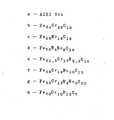
- Figs. 2 and 3 show the polarization curves with respect to several amorphous iron alloys and the comparative Fe 63 Cr 17 P 13 C 7 amorphous alloys and AISI 304 steel immersed in each of 1N aqueous solution of H 2 SO 4 and 1N aqueous solution of HCk.
- 1N aqueous solution of H 2 S0 4 at room temperature
- AISI 304 steel is high in the current density in active range and is narrow in the passivation potential, while the alloys of the present invention containing Cr are completely passivative until the potential of 1.0 V (S.C.E.) and dissolve off Cr in the alloy at the potential of more than 1.0 V and show the ideal polarization behavior.
- Fe 68 No 16 C 16 amorphous alloy of the present invention containing no Cr shows the similar behavior to AISI 304 steel, but is broad in the passivation region and is stable until the oxygen generating potential of more than 1.5 V. In IN aqueous solution of HCl in Fig. 3, the more noticeable difference can be observed.
- the amorphous alloys of the present invention are more excellent 10 3- 10 5 times as high as the commercially available high class stainless steels in the corrosion resistance and are unexpectedly higher corrosion resistant materials and can be utilized for wires and sheets to be used under severe corrosive atmosphere.
- the amorphous alloys may be used for filter or screen materials, sea water resistant materials, chemical resistant materials, electrode materials and the like instead of stainless steel fibers which have been presently broadly used.
- the alloys of the present invention have the same magnetic properties as the amorphous alloys having high permeability described on the above described Japanese Patent Laid-Open Application No. 73,920/76.
- the alloys of the present invention are low in th cost of the starting materials and are excellent in the crystallizing temperature, hardness, strength, embrittling temperature and the like and are novel alloys having high permeability.
- the alloys of the present invention having high permeability can be annealed at a temperature lower than the crystallizing temperature. Furthermore, if necessary, the above described annealing treatment can be carried out under stress and/or magnetic field. The amorphous alloys can be adjusted to the shape of the hysteresis curve by the annealing treatment depending upon the use.
- the alloys of the present invention having high permeability can be used for wire materials or sheet materials, for iron cores of transformers, motors, magnetic amplifiers, or acoustic, video and card reader magnetic cores, magnetic filters, thermal sensor and the like.
- the alloys wherein X is at least one of Fe and Co, a is 16-70, b is 0-20, c is 20-38 and d is 10-26 are non-magnetic. Also, when at least one of Fe and Co in X of these alloys is substituted with not less than 10 atomic% of Ni, non-magnetic alloys can be obtained.
- the conventional crystal alloys having the same component composition range as the above described alloy component composition range are ferromagnetic.
- the inventors have newly found that the reason why the amorphous alloys are non-magnetic and the crystal alloys are ferromagnetic, even if both the alloys have the same component composition, is based on the fact that curie temperature becomes lower than room temperature in the amorphous alloys.
- these alloys are suitable for part materials for which the influence of the magnetic field is not desired, for example, for part materials for watches, precise measuring instruments and the like.
- the magnetostriction becomes very small and the alloys having permeability of 10,000-30,000, Bs of less than 10,000 G, Hc of less than 0.10e and Hv of more than 1,000 DPN can be easily obtained and an embodiment of such alloy composition is Co 67 Fe 5 Mo 12 C 16 shown in Table 7.
- the alloys of the present invention wherein a is 0.02-0.1, a is 74-84, b is 0, c is 4-10 and d is 12-16, are particularly preferable low magnetostriction materials.
- the addition of Cr contributes to improve the magnetic stabilization and the corrosion resistance.
- the alloys wherein X is shown by the following formula in which a is 0.02-0.1, y is less than 0.12, a is 54-86, and b is 0, c is 4-20 and d is 10-26, are substantially 0 in the magnetostriction, and by containing Ni, the amorphous alloy forming ability is particularly improved.
- Blades made of carbon steels, hard stainless steels and low alloy steels have been heretofore broadly used for razors, paper cutter and the like and as the properties suitable for blades, the high hardness, corrosion resistance, elasticity and wear resistance have been required. It has been found that the alloys of the present invention are provided with the above described properties and are very excellent.
- the hardness and the weight decrease, that is the worn amount when the alloys were worn on emery papers (#400) by adding a load of 193 g for 10 minutes are shown in Table 8 by comparing with the commercially available blades. The worn amounts in this table show the results obtained by measuring twice with respect to the same sample.
- the worn amount of the blades of the alloys of the present invention is less than of that of the commercially available razor blades.
- the tensile strength required as the reinforcing material is 50-100 kg/mm 2 higher than that of piano wire and the tensile strength at high temperature and the bending fatigue limit are also higher.
- the adhesion which is required as another important property is good when using as the reinforcing material for rubber and plastics.
- steel wire, synthetic fibers and glass fibers have been heretofore used but it is difficult to more increase the fatigue strength obtained by steel wire and it has been well known that synthetic fibers and glass fibers cannot obtain the higher fatigue strength than steel wire.
- synthetic. resins mat- formed.reinforcing material obtained by mainly processing glass fibers has been heretofore used and the reinforcing material is good in the corrosion resistance but is brittle, so that the bending strength is not satisfactory.
- Concrete structures involve PC concrete using steel wires or steel ropes as the reinforcing material, concrete randomly mixing short cut steel wires and the like but any of them has defect in view of corrosion resistance.
- the alloys of the present invention are used as the reinforcing material, they can be very advantageously used as the reinforcing material for the above described rubbers, synthetic resins, concrete and the like.
- the distance of the mesh was 1 mm and the test piece is a plate 3x20x100 mm.
- the test piece was heated to about 150-180°C for 1 hour.
- the fatigue test (amplitude elongation: 1 cm) was conducted for a long time by means of a tensile type fatigue tester.
- the breakage did not occur even in 10 6 cycle and the separation of the alloy filaments from the rubber was not observed.
- Fe 62 Cr 12 Mo 8 C 18 alloy has excellent fracture strength (330 kg/mm 2 ), crystallizing temperature (565°C) and fatigue strength (82 kg/mm 2 ).
- the alloys for rubber must endure corrosion due to sulfur.
- the above described alloy filaments were embedded in an excessively vulcanized rubber and left to stand at 30°C for about one year and then the surface of the alloy filament and the strength were examined but there was substantially no variation.
- the concrete reinforced with the alloy filaments has the maximum load of about 3-4 times as large as the concrete not reinforced and the strain of about 2 times as large as the concrete not reinforced. Namely, in the strength and the strain, the concrete reinforced with the alloy filaments has the strength of 1.5-2.0 times as high as the general steel reinforced concrete.
- Fe 56 Cr 26 C 18 alloy plate according to the present invention having a breadth of 50 mm and a thickness of 0.05 mm was manufactured by means of the apparatus as shown in Fig. 1, (a) and this plate was immersed in sea water for 6 months.
- commercially available 12% Cr steel plate and 18% Cr-8% Ni stainless steel plate were used.
- 12% Cr steel was corroded and broken in about 10 days
- 18-8 steel was corroded and broken in about 50 days but the alloy of the present invention was not corroded after 6 months.
- the commercially available 12% Cr steel was general corroded due to rust and 18-8 steel caused pitting corrosion and many corroded pits and rusts were observed on the surface.
- Fe 74 Mo 8 C 18 alloy filament of the present invention having a breadth of 0.5 mm and a thickness of 0.05 mm was manufactured by means of the apparatus of Fig. 1, (a) and the filaments were packed 5 cm at the center of a quartz glass tube having a diameter of 20 mm. 2% aqueous suspension of Fe 3 0 4 powders was flowed through the quartz glass tube at a rate of 10 cc/sec while applying magnetic field of about 100 Oersted from the outer portion. By this process, 98-99% of ferro-magnetic powders in the solution was removed. That is, this alloy is useful as the filter.
- the useful non-magnetic alloy is Fe-Ni alloy containing not less than about 30% of nickel but the strength of this alloy is about 80 kg/mm 2 .
- the alloys of the present invention are non-magnetic materials having a fracture strength of about 300-400 kg/mm 2 and toughness and can be used as the materials for producing articles suitable for these properties.
- the stop and shutter materials of camera must be non-magnetic and have wear resistance.
- the alloys of the present invention are high in the hardness and strength and excellent in the fatigue limit and the corrosion resistance and may be non-magnetic and the alloys are more cheap and can be more easily produced .than the conventional amorphous alloys and can expect a large number of uses.
- the alloys of the present invention can be produced into powders, wires or sheets depending upon the use.
- the amorphous alloys of the present invention can be utilized for tools, such as blades, saws and the like, hard wires, reinforcing materials for rubber, plastics, concrete and the like, mix-spinning materials, corrosion resistant materials, magnetic materials, non-magnetic materials and the like.
- Amorphous alloys having various properties can be produced depending upon the component composition and the use is broad depending upon the properties.
Landscapes
- Chemical & Material Sciences (AREA)
- Engineering & Computer Science (AREA)
- Materials Engineering (AREA)
- Mechanical Engineering (AREA)
- Metallurgy (AREA)
- Organic Chemistry (AREA)
- Physics & Mathematics (AREA)
- Electromagnetism (AREA)
- Dispersion Chemistry (AREA)
- Power Engineering (AREA)
- Soft Magnetic Materials (AREA)
- Heat Treatment Of Steel (AREA)
- Carbon And Carbon Compounds (AREA)
Applications Claiming Priority (4)
| Application Number | Priority Date | Filing Date | Title |
|---|---|---|---|
| JP53010397A JPS6026825B2 (ja) | 1978-02-03 | 1978-02-03 | 高強度、高硬度、高結晶化温度、高脆化抵抗を有する含窒素炭素系非結晶質鉄合金 |
| JP10397/78 | 1978-02-03 | ||
| JP16097878A JPS5589451A (en) | 1978-12-28 | 1978-12-28 | Amorphous alloy containing iron group element and carbon |
| JP160978/78 | 1978-12-28 |
Publications (3)
| Publication Number | Publication Date |
|---|---|
| EP0010545A1 true EP0010545A1 (de) | 1980-05-14 |
| EP0010545A4 EP0010545A4 (de) | 1980-06-17 |
| EP0010545B1 EP0010545B1 (de) | 1983-10-05 |
Family
ID=26345655
Family Applications (1)
| Application Number | Title | Priority Date | Filing Date |
|---|---|---|---|
| EP79900180A Expired EP0010545B1 (de) | 1978-02-03 | 1979-09-21 | Amorphe kohlenstofflegierungen und daraus hergestellte artikel |
Country Status (4)
| Country | Link |
|---|---|
| US (1) | US4318738A (de) |
| EP (1) | EP0010545B1 (de) |
| DE (1) | DE2966240D1 (de) |
| WO (1) | WO1979000674A1 (de) |
Cited By (7)
| Publication number | Priority date | Publication date | Assignee | Title |
|---|---|---|---|---|
| EP0027515A1 (de) * | 1979-09-04 | 1981-04-29 | Allied Corporation | Als Bauverstärkung verwendbares amorphes Metall |
| EP0066356A1 (de) * | 1981-03-31 | 1982-12-08 | Masumoto Tsuyoshi | Verfahren zur Herstellung feiner, amorpher metalldrähte |
| EP0207759A3 (en) * | 1985-07-03 | 1988-12-14 | The Standard Oil Company | Process for the production of multi-metallic amorphous alloy coatings |
| GB2334725A (en) * | 1998-02-25 | 1999-09-01 | Toyota Motor Co Ltd | Overlaying alloys |
| US6613120B2 (en) | 1999-12-17 | 2003-09-02 | Toyota Jidosha Kabushiki Kaisha | Hard particles, wear resistant iron-based sintered alloy, method of producing wear resistant iron-based sintered alloy, valve seat, and cylinder head |
| EP2496390A4 (de) * | 2009-11-02 | 2017-12-27 | The Nanosteel Company, Inc. | Draht und methodologie zum schneiden von materialien mit dem draht |
| US10058922B2 (en) | 2014-08-22 | 2018-08-28 | Toyota Jidosha Kabushiki Kaisha | Compact for producing a sintered alloy, a wear-resistant iron-based sintered alloy, and a method for producing the same |
Families Citing this family (24)
| Publication number | Priority date | Publication date | Assignee | Title |
|---|---|---|---|---|
| JPS6030734B2 (ja) * | 1979-04-11 | 1985-07-18 | 健 増本 | 鉄族元素とジルコニウムを含む脆性が小さく熱的安定性に優れる非晶質合金 |
| EP0039169B1 (de) * | 1980-04-17 | 1985-12-27 | Tsuyoshi Masumoto | Amorphe Metallfasern und dazugehöriges Herstellungsverfahren |
| JPS5789450A (en) | 1980-11-21 | 1982-06-03 | Matsushita Electric Ind Co Ltd | Amorphous magnetic alloy |
| US4743513A (en) * | 1983-06-10 | 1988-05-10 | Dresser Industries, Inc. | Wear-resistant amorphous materials and articles, and process for preparation thereof |
| JPS6052544A (ja) * | 1983-09-01 | 1985-03-25 | Matsushita Electric Ind Co Ltd | アモルファス磁性合金 |
| US4537625A (en) * | 1984-03-09 | 1985-08-27 | The Standard Oil Company (Ohio) | Amorphous metal alloy powders and synthesis of same by solid state chemical reduction reactions |
| US4585617A (en) * | 1985-07-03 | 1986-04-29 | The Standard Oil Company | Amorphous metal alloy compositions and synthesis of same by solid state incorporation/reduction reactions |
| US4770701A (en) * | 1986-04-30 | 1988-09-13 | The Standard Oil Company | Metal-ceramic composites and method of making |
| KR920003999B1 (ko) * | 1989-03-08 | 1992-05-21 | 알프스 덴기 가부시기가이샤 | 연자성 합금막 |
| JP2635422B2 (ja) * | 1989-10-17 | 1997-07-30 | アルプス電気株式会社 | 磁気ヘッド |
| DE19815278A1 (de) * | 1998-04-06 | 1999-10-07 | Basf Ag | Multimetalloxidmassen |
| US6921497B2 (en) * | 1999-10-13 | 2005-07-26 | Electromagnetics Corporation | Composition of matter tailoring: system I |
| DE10101695A1 (de) * | 2001-01-15 | 2002-07-18 | Basf Ag | Verfahren zur heterogen katalysierten Gasphasenpartialoxidation von Vorläuferverbindungen der (Meth)acrylsäure |
| US20020162605A1 (en) * | 2001-03-05 | 2002-11-07 | Horton Joseph A. | Bulk metallic glass medical instruments, implants, and methods of using same |
| US6562156B2 (en) | 2001-08-02 | 2003-05-13 | Ut-Battelle, Llc | Economic manufacturing of bulk metallic glass compositions by microalloying |
| KR100497173B1 (ko) * | 2002-11-29 | 2005-06-28 | 주식회사 엘지화학 | 아크롤레인의 부분 산화 반응용 촉매의 제조방법 |
| US7655160B2 (en) * | 2005-02-23 | 2010-02-02 | Electromagnetics Corporation | Compositions of matter: system II |
| KR100756367B1 (ko) | 2005-09-09 | 2007-09-10 | 한국과학기술연구원 | 바이폴라 플레이트용 비정질 합금 및 그 제조 방법 |
| JP5837824B2 (ja) * | 2009-02-03 | 2015-12-24 | ザ・ナノスティール・カンパニー・インコーポレーテッド | 材料を切断する方法および製品 |
| JP5819977B2 (ja) | 2010-11-22 | 2015-11-24 | エレクトロマグネティクス コーポレーション | 物質をテーラリングするためのデバイス |
| US20140021188A1 (en) * | 2012-07-19 | 2014-01-23 | Lincoln Global, Inc. | Hot-wire consumable to provide weld with increased wear resistance |
| EP3176651B1 (de) * | 2015-12-02 | 2018-09-12 | Nivarox-FAR S.A. | Herstellungsverfahren einer spiralfeder für eine uhr |
| CN106868429B (zh) * | 2015-12-10 | 2018-09-25 | 南京理工大学 | 一种具有宽的过冷液相区的钴基非晶合金 |
| EP4547880A1 (de) * | 2022-06-30 | 2025-05-07 | Massachusetts Institute of Technology | Werkzeugstahlmaterialien zur generativen fertigung |
Family Cites Families (10)
| Publication number | Priority date | Publication date | Assignee | Title |
|---|---|---|---|---|
| US3663214A (en) * | 1970-02-16 | 1972-05-16 | William H Moore | Abrasion resistant cast iron |
| US3849078A (en) * | 1972-10-19 | 1974-11-19 | Caterpillar Tractor Co | A sealing ring of stainless iron base alloy |
| US3856513A (en) * | 1972-12-26 | 1974-12-24 | Allied Chem | Novel amorphous metals and amorphous metal articles |
| GB1505841A (en) * | 1974-01-12 | 1978-03-30 | Watanabe H | Iron-chromium amorphous alloys |
| JPS5940900B2 (ja) * | 1974-07-01 | 1984-10-03 | トウホクダイガク キンゾクザイリヨウケンキユウシヨチヨウ | 高強度、耐疲労、耐全面腐食、耐孔食、耐隙間腐食、耐応力腐食割れ、耐水素脆性用アモルフアス鉄合金 |
| JPS601370B2 (ja) * | 1974-07-20 | 1985-01-14 | 新日本製鐵株式会社 | 非晶質合金の製造方法 |
| US4144058A (en) * | 1974-09-12 | 1979-03-13 | Allied Chemical Corporation | Amorphous metal alloys composed of iron, nickel, phosphorus, boron and, optionally carbon |
| JPS5178705A (de) * | 1974-12-28 | 1976-07-08 | Tohoku Daigaku Kinzoku Zairyo | |
| US4056411A (en) * | 1976-05-14 | 1977-11-01 | Ho Sou Chen | Method of making magnetic devices including amorphous alloys |
| US4152144A (en) * | 1976-12-29 | 1979-05-01 | Allied Chemical Corporation | Metallic glasses having a combination of high permeability, low magnetostriction, low ac core loss and high thermal stability |
-
1979
- 1979-02-01 DE DE7979900180T patent/DE2966240D1/de not_active Expired
- 1979-02-01 WO PCT/JP1979/000024 patent/WO1979000674A1/ja not_active Ceased
- 1979-09-21 EP EP79900180A patent/EP0010545B1/de not_active Expired
- 1979-10-03 US US05/170,664 patent/US4318738A/en not_active Expired - Lifetime
Non-Patent Citations (1)
| Title |
|---|
| See references of WO7900674A1 * |
Cited By (9)
| Publication number | Priority date | Publication date | Assignee | Title |
|---|---|---|---|---|
| EP0027515A1 (de) * | 1979-09-04 | 1981-04-29 | Allied Corporation | Als Bauverstärkung verwendbares amorphes Metall |
| EP0066356A1 (de) * | 1981-03-31 | 1982-12-08 | Masumoto Tsuyoshi | Verfahren zur Herstellung feiner, amorpher metalldrähte |
| EP0207759A3 (en) * | 1985-07-03 | 1988-12-14 | The Standard Oil Company | Process for the production of multi-metallic amorphous alloy coatings |
| GB2334725A (en) * | 1998-02-25 | 1999-09-01 | Toyota Motor Co Ltd | Overlaying alloys |
| GB2334725B (en) * | 1998-02-25 | 2000-02-02 | Toyota Motor Co Ltd | Overlaying alloy and engine valve |
| US6248292B1 (en) | 1998-02-25 | 2001-06-19 | Toyota Jidosha Kabushiki Kaisha | Overlay welding alloy and engine valve overlayed therewith |
| US6613120B2 (en) | 1999-12-17 | 2003-09-02 | Toyota Jidosha Kabushiki Kaisha | Hard particles, wear resistant iron-based sintered alloy, method of producing wear resistant iron-based sintered alloy, valve seat, and cylinder head |
| EP2496390A4 (de) * | 2009-11-02 | 2017-12-27 | The Nanosteel Company, Inc. | Draht und methodologie zum schneiden von materialien mit dem draht |
| US10058922B2 (en) | 2014-08-22 | 2018-08-28 | Toyota Jidosha Kabushiki Kaisha | Compact for producing a sintered alloy, a wear-resistant iron-based sintered alloy, and a method for producing the same |
Also Published As
| Publication number | Publication date |
|---|---|
| DE2966240D1 (en) | 1983-11-10 |
| WO1979000674A1 (fr) | 1979-09-20 |
| EP0010545B1 (de) | 1983-10-05 |
| EP0010545A4 (de) | 1980-06-17 |
| US4318738A (en) | 1982-03-09 |
Similar Documents
| Publication | Publication Date | Title |
|---|---|---|
| EP0010545B1 (de) | Amorphe kohlenstofflegierungen und daraus hergestellte artikel | |
| US4623387A (en) | Amorphous alloys containing iron group elements and zirconium and articles made of said alloys | |
| EP2261385B1 (de) | Dünner streifen aus einer amorphen legierung, weichmagnetische nanokristalllegierung und magnetkern | |
| CA1056620A (en) | Amorphous alloys which include iron group elements and boron | |
| US8491731B2 (en) | Alloy composition, Fe-based nano-crystalline alloy and forming method of the same and magnetic component | |
| Inoue et al. | Microstructure and mechanical properties of ductile Ni3AI-type compound in Fe-(Ni, Mn)-AI-C systems rapidly quenched from melts | |
| EP0147937A1 (de) | Amorphe Legierungen auf Eisenbasis mit Ermüdungs- und Zähigkeitseigenschaften | |
| JP2002522643A5 (de) | ||
| EP0119035B1 (de) | Legierungen auf Eisenbasis mit sehr guter Bearbeitbarkeit | |
| CN109983550B (zh) | 高频下使用的磁性粉末和含有其的磁性树脂组合物 | |
| JP3623970B2 (ja) | Fe基軟磁性合金および製造方法 | |
| EP0035037A1 (de) | Mikrokristalliner dünner streifen für magnetisches material mit hoher magnetischer permeabilität | |
| EP1978122B1 (de) | Dämpfungslegierungsblech und herstellungsverfahren dafür | |
| EP4343008A1 (de) | Amorphe legierung auf eisenbasis und dünnes band aus amorpher legierung auf eisenbasis | |
| JP4268621B2 (ja) | 軟磁気特性に優れた急冷凝固薄帯 | |
| WO1992009714A1 (fr) | Alliage magnetique doux a base de fer | |
| JPH0230375B2 (de) | ||
| JPS6337177B2 (de) | ||
| DE68911223T2 (de) | Weichmagnetische, auf Eisen basierende Legierung. | |
| EP1888801A1 (de) | Rasierklingen und zusammensetzungen und verfahren zur herstellung von rasierklingen | |
| EP0026237A1 (de) | Amorphes metall, das ein element der eisenfamilie und zirkonium enthält, und daraus erhaltene artikel | |
| JPS6026825B2 (ja) | 高強度、高硬度、高結晶化温度、高脆化抵抗を有する含窒素炭素系非結晶質鉄合金 | |
| JP3580507B2 (ja) | 複合磁性部材とその製造方法および複合磁性部材用素材 | |
| JPS61235538A (ja) | 高強度、高硬度、高結晶化温度、高脆化温度を有する炭素系非晶質鉄合金 | |
| JPS58126960A (ja) | 炭素系高耐食性非晶質鉄合金 |
Legal Events
| Date | Code | Title | Description |
|---|---|---|---|
| PUAI | Public reference made under article 153(3) epc to a published international application that has entered the european phase |
Free format text: ORIGINAL CODE: 0009012 |
|
| AK | Designated contracting states |
Designated state(s): CH DE FR GB SE |
|
| DET | De: translation of patent claims | ||
| 17P | Request for examination filed | ||
| GRAA | (expected) grant |
Free format text: ORIGINAL CODE: 0009210 |
|
| AK | Designated contracting states |
Designated state(s): CH DE FR GB SE |
|
| ET | Fr: translation filed | ||
| REF | Corresponds to: |
Ref document number: 2966240 Country of ref document: DE Date of ref document: 19831110 |
|
| PLBE | No opposition filed within time limit |
Free format text: ORIGINAL CODE: 0009261 |
|
| STAA | Information on the status of an ep patent application or granted ep patent |
Free format text: STATUS: NO OPPOSITION FILED WITHIN TIME LIMIT |
|
| 26N | No opposition filed | ||
| PGFP | Annual fee paid to national office [announced via postgrant information from national office to epo] |
Ref country code: GB Payment date: 19940124 Year of fee payment: 16 |
|
| PGFP | Annual fee paid to national office [announced via postgrant information from national office to epo] |
Ref country code: DE Payment date: 19940209 Year of fee payment: 16 |
|
| PGFP | Annual fee paid to national office [announced via postgrant information from national office to epo] |
Ref country code: FR Payment date: 19940210 Year of fee payment: 16 |
|
| PGFP | Annual fee paid to national office [announced via postgrant information from national office to epo] |
Ref country code: CH Payment date: 19940215 Year of fee payment: 16 |
|
| PGFP | Annual fee paid to national office [announced via postgrant information from national office to epo] |
Ref country code: SE Payment date: 19940216 Year of fee payment: 16 |
|
| EAL | Se: european patent in force in sweden |
Ref document number: 79900180.5 |
|
| PG25 | Lapsed in a contracting state [announced via postgrant information from national office to epo] |
Ref country code: GB Effective date: 19950201 |
|
| PG25 | Lapsed in a contracting state [announced via postgrant information from national office to epo] |
Ref country code: SE Effective date: 19950202 |
|
| PG25 | Lapsed in a contracting state [announced via postgrant information from national office to epo] |
Ref country code: CH Effective date: 19950228 |
|
| GBPC | Gb: european patent ceased through non-payment of renewal fee |
Effective date: 19950201 |
|
| PG25 | Lapsed in a contracting state [announced via postgrant information from national office to epo] |
Ref country code: FR Effective date: 19951031 |
|
| PG25 | Lapsed in a contracting state [announced via postgrant information from national office to epo] |
Ref country code: DE Effective date: 19951101 |
|
| EUG | Se: european patent has lapsed |
Ref document number: 79900180.5 |
|
| REG | Reference to a national code |
Ref country code: FR Ref legal event code: ST |