EP0010552A1 - Procédé et circuit pour mesurer la qualité de réception d'un signal en ondes ultra-courtes modulé en fréquence - Google Patents
Procédé et circuit pour mesurer la qualité de réception d'un signal en ondes ultra-courtes modulé en fréquence Download PDFInfo
- Publication number
- EP0010552A1 EP0010552A1 EP78101222A EP78101222A EP0010552A1 EP 0010552 A1 EP0010552 A1 EP 0010552A1 EP 78101222 A EP78101222 A EP 78101222A EP 78101222 A EP78101222 A EP 78101222A EP 0010552 A1 EP0010552 A1 EP 0010552A1
- Authority
- EP
- European Patent Office
- Prior art keywords
- signal
- amplitude
- output
- reception quality
- frequency
- Prior art date
- Legal status (The legal status is an assumption and is not a legal conclusion. Google has not performed a legal analysis and makes no representation as to the accuracy of the status listed.)
- Granted
Links
Images

Classifications
-
- H—ELECTRICITY
- H04—ELECTRIC COMMUNICATION TECHNIQUE
- H04B—TRANSMISSION
- H04B1/00—Details of transmission systems, not covered by a single one of groups H04B3/00 - H04B13/00; Details of transmission systems not characterised by the medium used for transmission
- H04B1/06—Receivers
- H04B1/16—Circuits
- H04B1/1646—Circuits adapted for the reception of stereophonic signals
- H04B1/1661—Reduction of noise by manipulation of the baseband composite stereophonic signal or the decoded left and right channels
-
- H—ELECTRICITY
- H03—ELECTRONIC CIRCUITRY
- H03J—TUNING RESONANT CIRCUITS; SELECTING RESONANT CIRCUITS
- H03J3/00—Continuous tuning
- H03J3/02—Details
- H03J3/12—Electrically-operated arrangements for indicating correct tuning
- H03J3/14—Visual indication, e.g. magic eye
-
- H—ELECTRICITY
- H04—ELECTRIC COMMUNICATION TECHNIQUE
- H04B—TRANSMISSION
- H04B1/00—Details of transmission systems, not covered by a single one of groups H04B3/00 - H04B13/00; Details of transmission systems not characterised by the medium used for transmission
- H04B1/06—Receivers
- H04B1/10—Means associated with receiver for limiting or suppressing noise or interference
- H04B1/1027—Means associated with receiver for limiting or suppressing noise or interference assessing signal quality or detecting noise/interference for the received signal
-
- H—ELECTRICITY
- H04—ELECTRIC COMMUNICATION TECHNIQUE
- H04B—TRANSMISSION
- H04B17/00—Monitoring; Testing
- H04B17/30—Monitoring; Testing of propagation channels
- H04B17/309—Measuring or estimating channel quality parameters
-
- H—ELECTRICITY
- H04—ELECTRIC COMMUNICATION TECHNIQUE
- H04B—TRANSMISSION
- H04B1/00—Details of transmission systems, not covered by a single one of groups H04B3/00 - H04B13/00; Details of transmission systems not characterised by the medium used for transmission
- H04B1/06—Receivers
- H04B1/10—Means associated with receiver for limiting or suppressing noise or interference
- H04B1/1027—Means associated with receiver for limiting or suppressing noise or interference assessing signal quality or detecting noise/interference for the received signal
- H04B2001/1054—Means associated with receiver for limiting or suppressing noise or interference assessing signal quality or detecting noise/interference for the received signal by changing bandwidth
Definitions
- the invention relates to a method of the type specified in the preamble of claim 1 and to a device for carrying out the method. Methods and devices of this type are known (research report of the British Broadcasting Corporation BBC RD 1975/33).
- the multipath propagation of the ultra-short waves results in amplitude and phase interference modulations which impair the reception quality.
- the metrological detection of the mentioned interference modulations is therefore essential.
- the phase interference modulation cannot be detected on the LF side, since during an FM transmission it cannot be determined which phase changes are to be assigned to the useful signal and which phase changes are to be assigned to the interference signal.
- the amplitude interference modulation represents an interference effect that can be measured, since FM transmitters always emit with a constant amplitude (so-called "full control”) so that amplitude fluctuations can only be caused by interference.
- the amplitude profile of the received VHF signal is dependent on the signal frequency on a Played oscilloscope screen and read with a cross.
- the amplification of the amplitude signal which determines the ordinate position of the oscillogram curve, must be chosen so that the reference axis of the curve is congruent with the abscissa of the scale cross.
- the reference axis of the curve is an imaginary line, which corresponds to the curve when there are no reflections.
- the first step is to read the amplitude of the curve maximum on the ordinate scale calibrated in modulation degree units and the periodicity of the curve on the abscissa scale calibrated in frequency units. Then the reciprocal of the read periodicity is calculated, which corresponds to the delay of a reflected wave. Finally, a table, for example a nomogram, becomes taken from the determined values for the delay and the degree of modulation received quality of reception.
- the known method is thus tedious and time-consuming and in any case requires an experienced operator, on whose reading skill the measuring accuracy is more or less dependent. The method fails if the periodicity can no longer be recognized due to reflections that are too close or because of several simultaneous reflections.
- the object of the invention is to improve a method and a device of the type mentioned at the outset such that the degree of reception quality can be determined more easily, more precisely and more reliably.
- the subtask aimed at creating a method is solved by the features specified in the characterizing part of claim 1.
- the partial task aimed at creating a device is achieved according to the invention by the features specified in the characterizing part of claim 2.
- the invention is based on the knowledge that the extreme values of the relative rate of change of the signal amplitude A, based on the amplitude A 0 in the absence of the reflections, of a received VHF signal when passing through the signal frequency ⁇ , and thus the extreme values of the differential quotient are a direct measure of the degree of reflection-related LF interference in the FM signal and thus a direct measure of the reception quality.
- This differential quotient can be determined in a simple manner and with high accuracy and can be represented, for example, on a digital or analog display device calibrated to quality levels.
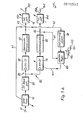
- the left half of an exemplary embodiment of the measuring device according to the invention illustrated in FIG. 1A with the aid of a block diagram largely consists of a known VHF receiver which has been supplemented for the purposes according to the invention.
- 1A has an FM tuner 10, which is fed by an antenna 11 with a frequency-modulated FM signal.
- the FM tuner 10 is followed in the usual way by an IF bandpass filter, which passes the FM signal converted to an intermediate frequency in the tuner 10.
- the output of the bandpass 20 bifurcates into two signal branches 50 and 60.
- the signal branch 50 contains an FM intermediate frequency amplifier 30, which is followed by a limiting FM discriminator 40.
- the signal branch 60 contains an AM intermediate frequency amplifier 70, the one AM demodulator 80 is connected downstream.
- the amplifier 70 is controllable, for which a controller 100 is provided, the output of which is connected via a line 101 to the control input of the amplifier 70, the actual value input of which is connected via a line 81 to the output of the demodulator 80 and the setpoint input of which is from a DC voltage source 120 and a series-connected potentiometer 110 existing setpoint adjuster is connected.
- the regulator 100 is keyed by a zero voltage detector 90, for example a window discriminator, the input of which is connected via a line 42 to the output of the discriminator 40. Furthermore, the output signal of the discriminator 40 is fed back via a line 41 to the control input of the FM tuner 10.
- the discriminator 40 and the demodulator 80 lead via lines 43 and 82 to a bandwidth-variable low-pass filter 130 and 140, respectively, at the outputs of which the instantaneous frequency swing ⁇ or one of the normalized VHF signal amplitudes related to a reference value A. corresponding signal is present, the reference value A corresponding to the amplitude of the FM signal in the absence of reflections.
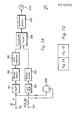
- These signals at the outputs 131 and 141 of the low-pass filters 130 and 140 are fed to the right half of the exemplary embodiment considered for the measuring device according to the invention illustrated in FIG. 1B.
- FIG. 1C the correct assembly of the block diagrams according to FIGS. 1A and 1B is shown schematically in FIG. 1C.
- the output 131 of the low pass 130 located in the signal branch 50 is connected to a differentiating element 150, which is the derivative of the frequency swing signal ⁇ forms after the time t.
- the output 141 of the low pass 140 is connected to a differentiator 160, which derives the derivative dA of the normalized amplitude signal after time t forms.
- the signal generated at the output of the differentiator 150 for the differential quotient is supplied to the first input of a divider 200 via a magnitude generator 170 consisting, for example, of a bridge rectifier and an operational amplifier and a downstream zero limiter 190, whereas the signal generated at the output of the differentiator 160 for the differential quotient via an amount generator 180 corresponding to the amount generator 170, is fed directly to the second input of the divider 200.
- the divider 200 forms the quotient
- the zero limiter 190 prevents the expression in the denominator of the quotient mentioned, to zero and the quotient becomes infinitely large.
- the output of divider 200 ent speaks in terms of the quotient sought that is, the extreme values of the output signal of the divider 200 are a direct measure of the reception quality of the interference-modulated VHF signal arriving at the antenna 11 (FIG. 1A).
- the output signal of the divider 200 is fed to an extreme value memory 210, for example an emitter follower with a capacitor, which determines the extreme values of the divider output signal and feeds it to a digital or analog display device 220, for example a voltage measuring instrument.
- the zero voltage detector 90 determines when the output signal of the discriminator 40, which is proportional to the instantaneous frequency swing u, becomes zero.
- the controller 100 is keyed in or initiated so that the signal amplitude present at its actual value input at the moment of keying in is, as required, equal to the amplitude of the IF carrier. This actual value is compared in the usual way with the setpoint set on the potentiometer 110, the resulting error signal being converted by the controller 100 into an actuating signal for the amplifier 70 in accordance with its control characteristic.
- the detector 90 detects a non-zero instantaneous frequency swing ⁇ at the output of the discriminator 40, it blanks the controller 100, as a result of which the gain setting of the amplifier 70 that is present at the time of blanking remains unchanged until the next time the controller 100 is keyed in.
- Constant control of the IF carrier and suitable selection of the controller setpoint on potentiometer 110 achieve that the reference quantity corresponding to the carrier amplitude of the function reproduced on the cathode ray oscillograph 230 or measured with the aid of the circuit parts 150 to 220 is kept constant during the entire measuring process.
- the reference variable can be made to coincide with the scale abscissa of the scale cross shown there by suitable selection of the controller setpoint on the potentiometer 110 (FIG. 2).
- the measurement accuracy achieved by the constant control of the reference quantity is further increased by the fact that the bandwidth-variable low-pass filters 130 and 140 emit low-noise signals at the inputs of the differentiators 150, 160 and at the X, Y deflection devices of the cathode-ray oscillograph 230 without the to blur the temporal correlation of both signals.
- circuit parts 10, 20, 30 and 40 of the block diagram according to FIG. 1A is known from conventional VHF receivers and requires no further explanation.
Landscapes
- Engineering & Computer Science (AREA)
- Computer Networks & Wireless Communication (AREA)
- Signal Processing (AREA)
- Quality & Reliability (AREA)
- Physics & Mathematics (AREA)
- Electromagnetism (AREA)
- Monitoring And Testing Of Transmission In General (AREA)
- Circuits Of Receivers In General (AREA)
Priority Applications (2)
| Application Number | Priority Date | Filing Date | Title |
|---|---|---|---|
| EP78101222A EP0010552B1 (fr) | 1978-10-25 | 1978-10-25 | Procédé et circuit pour mesurer la qualité de réception d'un signal en ondes ultra-courtes modulé en fréquence |
| US06/028,810 US4254505A (en) | 1978-10-25 | 1979-04-10 | Normalization method and apparatus used when quantitatively measuring the reception quality of a received frequency-modulated ultrashort-wave signal |
Applications Claiming Priority (1)
| Application Number | Priority Date | Filing Date | Title |
|---|---|---|---|
| EP78101222A EP0010552B1 (fr) | 1978-10-25 | 1978-10-25 | Procédé et circuit pour mesurer la qualité de réception d'un signal en ondes ultra-courtes modulé en fréquence |
Publications (2)
| Publication Number | Publication Date |
|---|---|
| EP0010552A1 true EP0010552A1 (fr) | 1980-05-14 |
| EP0010552B1 EP0010552B1 (fr) | 1983-08-24 |
Family
ID=8185934
Family Applications (1)
| Application Number | Title | Priority Date | Filing Date |
|---|---|---|---|
| EP78101222A Expired EP0010552B1 (fr) | 1978-10-25 | 1978-10-25 | Procédé et circuit pour mesurer la qualité de réception d'un signal en ondes ultra-courtes modulé en fréquence |
Country Status (2)
| Country | Link |
|---|---|
| US (1) | US4254505A (fr) |
| EP (1) | EP0010552B1 (fr) |
Cited By (2)
| Publication number | Priority date | Publication date | Assignee | Title |
|---|---|---|---|---|
| EP0141218A3 (en) * | 1983-09-26 | 1986-01-08 | Hans Kolbe & Co. | Detector for indicating receiving disturbances in fm broadcast reception |
| US10617415B2 (en) | 2001-10-05 | 2020-04-14 | Covidien Lp | Surgical stapling device |
Families Citing this family (5)
| Publication number | Priority date | Publication date | Assignee | Title |
|---|---|---|---|---|
| DE3326062A1 (de) * | 1983-07-20 | 1985-01-31 | Gerhard Prof. Dr.-Ing. 8012 Ottobrunn Flachenecker | Detektor zur anzeige von frequenzstoerhubspitzen |
| US4777659A (en) * | 1983-09-26 | 1988-10-11 | U.S. Philips Corporation | Detector for indicating reception disturbances during ultrashort wave broadcast reception |
| US5182882A (en) * | 1991-12-30 | 1993-02-02 | Fedco Automotive Components Co., Inc. | Heater cores having exposed surfaces burnished by wet blasting |
| US6346510B1 (en) | 1995-10-23 | 2002-02-12 | The Children's Medical Center Corporation | Therapeutic antiangiogenic endostatin compositions |
| US8223067B2 (en) * | 2009-11-02 | 2012-07-17 | Invention Planet, LLC | Noise-canceling down-converting detector |
Citations (3)
| Publication number | Priority date | Publication date | Assignee | Title |
|---|---|---|---|---|
| DE1952739B2 (de) * | 1969-10-20 | 1972-11-16 | Grundig E.M.V. Elektro-Mechanische Versuchsanstalt Max Grundig, 8510 Fürth | Verfahren und schaltungen zur durchfuehrung des verfahrens zur anzeige eines mehrwegeempfangs in einem hochfrequenzempfaenger fuer frequenzmodulierte schwingungen |
| DE2334807A1 (de) * | 1972-07-08 | 1974-01-24 | Trio Electronics Inc | Verfahren und geraet zur ermittlung des mehrfachempfangs von frequenz-modulierten rundfunk-stereowellen ("geisterempfang" bei ukw-stereo-rundfunk) |
| US3869673A (en) * | 1973-05-21 | 1975-03-04 | Magnavox Co | Method and apparatus for measuring multipath distortion |
Family Cites Families (7)
| Publication number | Priority date | Publication date | Assignee | Title |
|---|---|---|---|---|
| US2489254A (en) * | 1944-01-04 | 1949-11-29 | Otto F A Arnold | Radio system |
| US2632101A (en) * | 1950-10-23 | 1953-03-17 | Bell Telephone Labor Inc | Reduction of noise in transmission systems |
| NL276220A (fr) * | 1961-03-21 | |||
| US3699463A (en) * | 1970-11-30 | 1972-10-17 | Bell Telephone Labor Inc | Error reduction in communication systems |
| DE2714439C3 (de) * | 1977-03-31 | 1980-08-14 | Siemens Ag, 1000 Berlin Und 8000 Muenchen | System zum Empfang frequenzmodulierter digitaler Nachrichtensignale |
| DE2628997C3 (de) * | 1976-06-28 | 1978-11-30 | Siemens Ag, 1000 Berlin Und 8000 Muenchen | System zum Empfang frequenzmodulierter digitaler Nachrichtensignale |
| US4115774A (en) * | 1977-08-17 | 1978-09-19 | The Bendix Corporation | CW radar AM-noise video-cancellation system |
-
1978
- 1978-10-25 EP EP78101222A patent/EP0010552B1/fr not_active Expired
-
1979
- 1979-04-10 US US06/028,810 patent/US4254505A/en not_active Expired - Lifetime
Patent Citations (3)
| Publication number | Priority date | Publication date | Assignee | Title |
|---|---|---|---|---|
| DE1952739B2 (de) * | 1969-10-20 | 1972-11-16 | Grundig E.M.V. Elektro-Mechanische Versuchsanstalt Max Grundig, 8510 Fürth | Verfahren und schaltungen zur durchfuehrung des verfahrens zur anzeige eines mehrwegeempfangs in einem hochfrequenzempfaenger fuer frequenzmodulierte schwingungen |
| DE2334807A1 (de) * | 1972-07-08 | 1974-01-24 | Trio Electronics Inc | Verfahren und geraet zur ermittlung des mehrfachempfangs von frequenz-modulierten rundfunk-stereowellen ("geisterempfang" bei ukw-stereo-rundfunk) |
| US3869673A (en) * | 1973-05-21 | 1975-03-04 | Magnavox Co | Method and apparatus for measuring multipath distortion |
Non-Patent Citations (2)
| Title |
|---|
| AUDIO, Vol. 53, Nr. 3, Marz 1969 New York, U.S.A. L. FELDMAN: "ABZs of FM", Seiten 40, 42, 74 * Figuren 3,5 * * |
| FUNKSCHAU, Vol. 43, September 1971 Heft 17 Munchen, D. W. OPPERMANN: "UKW-Stereo-Tuner mit eingebautem Oszillografen", Seiten 549-550 * Seite 549, mittelspalte , Zeile 4 - Seite 550, rechte Spalte, Zeile 4 * * |
Cited By (2)
| Publication number | Priority date | Publication date | Assignee | Title |
|---|---|---|---|---|
| EP0141218A3 (en) * | 1983-09-26 | 1986-01-08 | Hans Kolbe & Co. | Detector for indicating receiving disturbances in fm broadcast reception |
| US10617415B2 (en) | 2001-10-05 | 2020-04-14 | Covidien Lp | Surgical stapling device |
Also Published As
| Publication number | Publication date |
|---|---|
| EP0010552B1 (fr) | 1983-08-24 |
| US4254505A (en) | 1981-03-03 |
Similar Documents
| Publication | Publication Date | Title |
|---|---|---|
| EP0319782B1 (fr) | Récepteur radio à plusieurs antennes | |
| DE19623304C2 (de) | Schaltung und Verfahren zum Messen einer Hochfrequenzleistung | |
| DE69826229T2 (de) | Verfahren zur automatischen Einstellung der Regelverstärkung in einem Regelkreis | |
| EP0010552B1 (fr) | Procédé et circuit pour mesurer la qualité de réception d'un signal en ondes ultra-courtes modulé en fréquence | |
| DE2555602B2 (de) | Schaltungsanordnung zur frequenzselektiven Auswertung der Amplituden eines oder mehrerer Signale | |
| DE69123160T2 (de) | Nachbar-Kanal-Selektivitätssignalgenerator | |
| DE2334807A1 (de) | Verfahren und geraet zur ermittlung des mehrfachempfangs von frequenz-modulierten rundfunk-stereowellen ("geisterempfang" bei ukw-stereo-rundfunk) | |
| DE4241362A1 (de) | Rundfunkempfänger | |
| DE2724376C3 (de) | Verfahren und Einrichtung zum Messen der Empfangsqualität eines frequenzmodulierten UKW-Signals | |
| DE69214703T2 (de) | Gerät zur Anzeige von entzerrten Augendiagrammen | |
| DE69024981T2 (de) | Schaltung zur Wellenformung und Empfänger, der diese Schaltung benutzt | |
| DE3114244C2 (de) | Schaltungs-Anordnung zur Messung der Intermodulationsverzerrung | |
| DE68906976T2 (de) | Messverfahren eines schwellenwertes in einem rauschsignal und automatische messanordnung dafuer. | |
| DE2724375C3 (de) | Verfahren und Einrichtung zum Messen der Empfangsqualität eines frequenzmodulierten UKW-Signals | |
| EP0010109A1 (fr) | Méthode et dispositif pour l'appréciation de la qualité de réception d'un signal en ondes ultra-courtes modulé en fréquence | |
| EP0411485B1 (fr) | Procédé pour détecter des distortions multivoies lors de la réception radio à modulation de fréquence, et montage pour réaliser ce procédé | |
| DE2327190B2 (de) | Klirrfaktormesser | |
| DE1466222C3 (de) | Verfahren zur Erhöhung der Einstellgenauigkeit eines Überlagerungsempfängers mit digitaler Anzeige | |
| DE2249928C3 (de) | Selektiver Pegelmesser mit einem trägen Anzeigeinstrument | |
| DE3114008C2 (de) | Anordnung zur Messung der Intermodulationsverzerrung eines Prüflings wahlweise nach der SMPTE- oder CCIF-Mehrton-Methode | |
| DE1516253C3 (de) | Verfahren und Schaltungsanordnung zur Messung der Phasenverzerrungen eines elektrischen Vierpols, insbesondere Übertragungssystems | |
| DE3110785A1 (de) | Bandgeraet | |
| DE3831866C2 (fr) | ||
| DE3034839C2 (de) | Verfahren zum Messen von Amplituden- und/oder Phasenverzerrungen und/oder nichtlinearen Verzerrungen eines elektrischen Nachrichtenübertragungssystems | |
| DE2109220C (de) | Fernsehantennen-Meßempfänger |
Legal Events
| Date | Code | Title | Description |
|---|---|---|---|
| PUAI | Public reference made under article 153(3) epc to a published international application that has entered the european phase |
Free format text: ORIGINAL CODE: 0009012 |
|
| AK | Designated contracting states |
Designated state(s): BE CH FR GB NL SE |
|
| 17P | Request for examination filed | ||
| GRAA | (expected) grant |
Free format text: ORIGINAL CODE: 0009210 |
|
| AK | Designated contracting states |
Designated state(s): BE CH FR GB NL SE |
|
| PG25 | Lapsed in a contracting state [announced via postgrant information from national office to epo] |
Ref country code: BE Effective date: 19830930 |
|
| PGFP | Annual fee paid to national office [announced via postgrant information from national office to epo] |
Ref country code: FR Payment date: 19831005 Year of fee payment: 6 |
|
| PGFP | Annual fee paid to national office [announced via postgrant information from national office to epo] |
Ref country code: NL Payment date: 19831027 Year of fee payment: 6 |
|
| PG25 | Lapsed in a contracting state [announced via postgrant information from national office to epo] |
Ref country code: CH Effective date: 19831031 |
|
| PGFP | Annual fee paid to national office [announced via postgrant information from national office to epo] |
Ref country code: SE Payment date: 19831031 Year of fee payment: 6 |
|
| PGFP | Annual fee paid to national office [announced via postgrant information from national office to epo] |
Ref country code: BE Payment date: 19831130 Year of fee payment: 6 |
|
| ET | Fr: translation filed | ||
| REG | Reference to a national code |
Ref country code: CH Ref legal event code: PL |
|
| PLBE | No opposition filed within time limit |
Free format text: ORIGINAL CODE: 0009261 |
|
| STAA | Information on the status of an ep patent application or granted ep patent |
Free format text: STATUS: NO OPPOSITION FILED WITHIN TIME LIMIT |
|
| 26N | No opposition filed | ||
| PG25 | Lapsed in a contracting state [announced via postgrant information from national office to epo] |
Ref country code: SE Effective date: 19841026 |
|
| BERE | Be: lapsed |
Owner name: BOSSERT THEODOR TOBIAS Effective date: 19841025 |
|
| PG25 | Lapsed in a contracting state [announced via postgrant information from national office to epo] |
Ref country code: NL Effective date: 19850501 |
|
| NLV4 | Nl: lapsed or anulled due to non-payment of the annual fee | ||
| PG25 | Lapsed in a contracting state [announced via postgrant information from national office to epo] |
Ref country code: FR Free format text: LAPSE BECAUSE OF NON-PAYMENT OF DUE FEES Effective date: 19850628 |
|
| REG | Reference to a national code |
Ref country code: FR Ref legal event code: ST |
|
| PG25 | Lapsed in a contracting state [announced via postgrant information from national office to epo] |
Ref country code: GB Effective date: 19881118 |
|
| EUG | Se: european patent has lapsed |
Ref document number: 78101222.4 Effective date: 19851007 |