EP0010560B1 - Sulfonamides à activité herbicide, leur préparation, compositions les contenant et leur utilisation - Google Patents
Sulfonamides à activité herbicide, leur préparation, compositions les contenant et leur utilisation Download PDFInfo
- Publication number
- EP0010560B1 EP0010560B1 EP78300579A EP78300579A EP0010560B1 EP 0010560 B1 EP0010560 B1 EP 0010560B1 EP 78300579 A EP78300579 A EP 78300579A EP 78300579 A EP78300579 A EP 78300579A EP 0010560 B1 EP0010560 B1 EP 0010560B1
- Authority
- EP
- European Patent Office
- Prior art keywords
- compound
- methoxy
- aminocarbonyl
- methyl
- triazin
- Prior art date
- Legal status (The legal status is an assumption and is not a legal conclusion. Google has not performed a legal analysis and makes no representation as to the accuracy of the status listed.)
- Expired
Links
- 0 Cc1nccc(*)n1 Chemical compound Cc1nccc(*)n1 0.000 description 3
Classifications
-
- C—CHEMISTRY; METALLURGY
- C07—ORGANIC CHEMISTRY
- C07D—HETEROCYCLIC COMPOUNDS
- C07D521/00—Heterocyclic compounds containing unspecified hetero rings
-
- A—HUMAN NECESSITIES
- A01—AGRICULTURE; FORESTRY; ANIMAL HUSBANDRY; HUNTING; TRAPPING; FISHING
- A01N—PRESERVATION OF BODIES OF HUMANS OR ANIMALS OR PLANTS OR PARTS THEREOF; BIOCIDES, e.g. AS DISINFECTANTS, AS PESTICIDES OR AS HERBICIDES; PEST REPELLANTS OR ATTRACTANTS; PLANT GROWTH REGULATORS
- A01N47/00—Biocides, pest repellants or attractants, or plant growth regulators containing organic compounds containing a carbon atom not being member of a ring and having no bond to a carbon or hydrogen atom, e.g. derivatives of carbonic acid
- A01N47/08—Biocides, pest repellants or attractants, or plant growth regulators containing organic compounds containing a carbon atom not being member of a ring and having no bond to a carbon or hydrogen atom, e.g. derivatives of carbonic acid the carbon atom having one or more single bonds to nitrogen atoms
- A01N47/28—Ureas or thioureas containing the groups >N—CO—N< or >N—CS—N<
- A01N47/36—Ureas or thioureas containing the groups >N—CO—N< or >N—CS—N< containing the group >N—CO—N< directly attached to at least one heterocyclic ring; Thio analogues thereof
Definitions
- This invention relates to herbicidal sulfonamides, and the preparation and use thereof in agriculture.
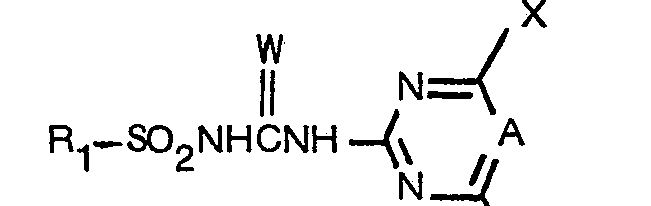
- Our DE-A-2,715,786 discloses inter alia herbicidal sulfonamides of the formula wherein W is 0 or S; R i can be optionally substituted phenyl or thienyl; X is H, Cl, Br, CH 3 , C 2 H 5 , alkoxy of 1-3 carbon atoms, trifluoromethyl, CH 3 S- or CH 3 0CH 2- ; and Z is methyl or methoxy.
- the X-substituents are entirely distinct from those envisaged by the present invention.
- herbicides A wide variety of materials useful for killing, or inhibiting (controlling) the growth of undesired vegetation is available; such materials are commonly referred to as herbicides. The need exists, however, for still more effective herbicides that destroy or retard weeds without causing significant damage to useful crops.
- compounds of Formula I and their agriculturally suitable salts suitable agricultural compositions containing them, and methods of using them as selective, as well as general herbicides having both preemergence and postemergence activity.
- These compounds are highly active herbicides. They are especially useful for controlling weeds in wheat.
- the compounds of Formula I are also useful for selective control of volunteer corn in soybeans, weeds in wheat, brush control and water hyacinth control.
- the compounds of Formula I are useful plant growth regulants, e.g. increasing sugar content in sugar cane and sorghum and suppressing seed head formation in grasses such as Bahia grass.
- the compounds of Formula I can be prepared by combining an appropriate 2-aminoheterocycle of Formula III with an appropriately substituted sulfonyl isocyanate or isothiocyanate of Formula II; R,, A, W, X and Z being as previously defined.
- reaction is best carried out in inert aprotic organic solvents such as methylene chloride, tetrahydrofuran or acetonitrile, at ambient pressure and temperature.
- aprotic organic solvents such as methylene chloride, tetrahydrofuran or acetonitrile.
- the mode of addition is not critical; however, it is often convenient to add the sulfonyl isocyanate or isothiocyanate to a stirred suspension of the aminoheterocycle. Since isocyanates and isothiocyanates usually are liquids, their addition is more easily controlled.
- the reaction is generally exothermic.
- the desired product is insoluble in the warm reaction medium and crystallizes from it in pure form.
- Products soluble in the reaction medium are isolated by evaporation of the solvent, trituration of the solid residue with solvents such as 1-chlorobutane, ethyl ether, or pentane, and filtration.
- Certain sulfonyl chlorides are best prepared by chlorosulfonation of a substituted benzene or thiophene according to the teaching of H. T. Clarke et al. Org. Synth., Coll. Vol. 1, 2nd Ed. 1941, p. 85.
- Other benzenesulfonyl chlorides are best made by diazotization of the appropriate aniline with sodium nitrite in HCI, followed by reaction of the diazonium salt with sulfur dioxide and cuprous chloride in acetic acid according to the teaching of H. L. Yale and F. Sowinski, J. Org. Chem. 25 1824 (1960).
- Sulfonyl isothiocyanates can be prepared by treatment of sulfonamides with carbon disulfide and potassium hydroxide followed by reaction of the dipotassium salt with phosgene according to the teaching of K. Hartke, Arch. Pharm., 299, 174 (1966).
- 2-Amino-1,3,5-triazines can be synthesized according to the methods described by E. M. Smolin and L. Rapaport in "s-Triazines and Derivatives", Vol. XIII, of the same series.
- Agriculturally suitable salts of compounds of Formula I are also useful herbicides and can be prepared in a number of ways known to the art.
- metal salts can be made by treating compounds of Formula I with a solution of an alkali or alkaline earth metal salt having a sufficiently basic anion (e.g. hydroxide, alkoxide, carbonate or hydride).
- Quarternary amine salts can be made by similar techniques.
- Exchange may also be effected by passing an aqueous solution of a salt of a compound of Formula I (e.g. an alkali metal or quaternary amine salt) through a column packed with a cation exchange resin containing the cation to be exchanged.
- a salt of a compound of Formula I e.g. an alkali metal or quaternary amine salt
- a cation exchange resin containing the cation to be exchanged.
- the cation of the resin is exchanged for that of the original salt and the desired product is eluted from the column. This method is particularly useful when the desired salt is water-soluble.
- Example 1 By using the procedure of Example 1 with equivalent amounts of the appropriate amino-1,3,5-triazine derivative and sulfonyl isocyanate or sulfonylisothiocyanate, the compounds of Table 1 can be prepared.
- N [(4-methoxy-6-methylamino-1,3,5-triazin-2-yl)aminocarbonyl]-2-thiophenesulfonamide was prepared melting at 208-210°.
- Useful formulations of the compounds of Formula I can be prepared in conventional ways. They include dusts, granules, pellets, solutions, suspensions, emulsions, wettable powders, emulsifiable concentrates and the like. Many of these may be applied directly. Sprayable formulations can be extended in suitable media and used at spray volumes of from a few liters to several hundred liters per hectare. High strength compositions are primarily used as intermediates for further formulations.
- the formulations broadly, contain 0.1 % to 99% by weight of active ingredient(s) and at least one of a) 0.1 % to 20% surfactant(s) and b) 1% to 99.9% solid or liquid diluent(s). More specifically, they will contain these ingredients in the following approximate proportions:
- compositions are well known. Solutions are prepared by simply mixing the ingredients. Fine solid compositions are made by blending and, usually, grinding as in a hammer or fluid energy mill. Suspensions are prepared by wet milling (see, for example, Littler, U.S. Patent 3,060,084). Granules and pellets may be made by spraying the active material upon preformed granular carriers or by agglomeration techniques. See J. E. Browning, "Agglomeration”, Chemical Engineering, Dec. 4, 1967, pp. 147ff. and “Perry's Chemical Engineer's Handbook", 4th Ed., McGraw-Hill, New York (1963), pp. 8-59 ff.
- the ingredients are blended, hammer-milled until all the solids are essentially under 50 microns, reblended and packaged.
- the ingredients are blended, coarsely hammer-milled and then air-milled to produce particles essentially all below 10 microns in diameter.
- the product is reblended before packaging.
- a slurry of wettable powder containing ⁇ 25% solids is sprayed on the surface of attapulgite granules in a double-cone blender. The granules are dried and packaged.
- the ingredients are ground together in a sand mill until the solid particles have been reduced to under about 5 microns.
- the resulting suspension may be applied directly, but preferably after being extended with oils or emulsified in water.
- the ingredients are thoroughly blended. After grinding in a hammer mill to produce particles essentially all below 100 microns, the material is reblended and sifted through a U.S.S. No. 50 sieve (0.3 mm opening) and packaged.
- the ingredients are combined and ground together in a sand mill to produce particles essentially all below 3 microns.
- the product can be used directly, extended with oils, or emulsified in water.
- the ingredients are blended and ground in a hammer mill to produce a material essentially all passing a U.S.S. No. 50 screen (0.3 mm opening).
- the concentrate may be formulated further if necessary.
- the active ingredient is dissolved in the solvent and the solution is sprayed upon dedusted granules in a rotating blender. After spraying of the solution has been completed, the blender is allowed to run for a short period and then the granules are packaged.
- the ingredients are blended and ground together in a sand mill to produce particles essentially all under 5 microns in size.
- the ingredients are blended and milled to pass through a 100 mesh screen.
- the material is then added to a fluid bed granulator, the air flow is adjusted to gently fluidize the material, and a fine spray of water is sprayed onto the fluidized material.
- the fluidization and spraying are continued until granules of the desired size range are made.
- the spraying is stopped, but fluidization is continued, optionally with heat, until the water content is reduced to the desired level, generally less than 1 %.
- the material is then discharged, screened to the desired size range, generally 14-100 mesh (1410-149 microns), and packaged for use.
- the ingredients are blended and ground in a hammer mill to produce particles essentially all below 100 microns.
- the material is sifted through a U.S.S. No. 50 screen (0.3 mm opening) and then packaged.
- the ingredients are thoroughly blended, coarsely hammer-milled and then air milled to produce particles essentially all below 10 microns in size.
- the material is reblended and then packaged.
- the compounds of Formule I are useful as herbicides. They may be applied either pre- or postemergence for the control of undesired vegetation in non-crop areas or the selective weed control in certain crops, e.g. wheat and soybeans. By properly selecting rate and time of application, compounds of this invention may be used to modify plant growth beneficially.
- the precise amount of the compound of Formula I to be used in any given situation will vary according to the particular end result desired, the use involved, the weeds to be controlled, the soil type, the formulation and mode of application, weather conditions, etc. Since so many variables play a role, it is not possible to state a rate of application suitable for all situations. Broadly speaking, the compounds of this invention are used at levels of about 0.1 to 20 kg/ha with a preferred range of 0.1 to 10 kg/ha. The lower rates of the range will generally be selected for lighter soils, for selective weed control in crops, or in situations where maximum persistence is not necessary. Some of the compounds of Formula I can be used at very low rates for plant growth modification, but higher rates may also be useful, depending on factors such as the crop being treated, timing of treatment, etc.
- the compounds of Formula I may be combined with other herbicides and are particularly useful in combination with 3-(3,4-dichlorophenyl)-1,1-dimethylurea, the triazines such as 2-chloro-4-(ethyl- amino)-6-(isopropylamino)-s-triazine, the uracils such as 5-bromo-3-sec-butyl-6-methyluracil, N-(phosphonomethyl)-glycine, 3-cyclohexyl-1-methyl-6-dimethylamino-s-triazine-2,4(1H,3H)-dione, N,N-dimethyl-2,2-diphenylacetamide, 2,4-dichlorophenoxyacetic acid (and closely related compounds), 4-chloro-2-butynyl-3-chlorophenylcarbamate, diisopropylthiolcarbamic acid, ester with 2,3-dichloroallyl alcohol, diisopropylthi
- Treated plants and controls were maintained in a greenhouse for 16 days, then all species were compared to controls and visually rated for response to treatment, using 1-3 ratings in each test.
- Two 25 cm diameter plastic bulb pans were filled with fertilized and limed Fallsington silt loam soil.
- One pan was planted with corn, sorghum and several grassy weeds.
- the other pan was planted with soybeans, purple nutsedge (Cyperus rotundus), and several broadleaf weeds.
- crabgrass Digitaria sanguinalis
- barnyardgrass Echinochloa crusgalli
- wild oats Avena fatua
- johnsongrass Sorghum halepense
- giant foxtail Setaria faberii
- Kentucky bluegrass Piergrass
- cheatgrass Bromus secalinus
- mustard Brassica arvensis
- cocklebur Xanthium pennsylvanicum
- pigweed Amaranthus retroflexus
- curly indigo Aeschynomene virginica
- morningglory Ipomoea hederacea
- cassia Caassia tora
- teaweed Sida spinosa
- velvetleaf Abutilon theophrasti
- jimsonweed Datura stramonium
Landscapes
- Chemical & Material Sciences (AREA)
- Organic Chemistry (AREA)
- Life Sciences & Earth Sciences (AREA)
- Agronomy & Crop Science (AREA)
- Pest Control & Pesticides (AREA)
- Plant Pathology (AREA)
- Health & Medical Sciences (AREA)
- Engineering & Computer Science (AREA)
- Dentistry (AREA)
- General Health & Medical Sciences (AREA)
- Wood Science & Technology (AREA)
- Zoology (AREA)
- Environmental Sciences (AREA)
- Agricultural Chemicals And Associated Chemicals (AREA)
- Plural Heterocyclic Compounds (AREA)
Claims (19)

ou ses sels utilisables en agriculture, avec la condition que, quand R2 est un groupe nitro ou trifluorométhyle, R3 ne peut pas être un groupe nitro ou trifluorométhyle.


Priority Applications (2)
| Application Number | Priority Date | Filing Date | Title |
|---|---|---|---|
| EP78300579A EP0010560B1 (fr) | 1978-11-01 | 1978-11-01 | Sulfonamides à activité herbicide, leur préparation, compositions les contenant et leur utilisation |
| DE7878300579T DE2862234D1 (en) | 1978-11-01 | 1978-11-01 | Herbicidal sulfonamides, their preparation, compositions containing them and use thereof |
Applications Claiming Priority (1)
| Application Number | Priority Date | Filing Date | Title |
|---|---|---|---|
| EP78300579A EP0010560B1 (fr) | 1978-11-01 | 1978-11-01 | Sulfonamides à activité herbicide, leur préparation, compositions les contenant et leur utilisation |
Publications (2)
| Publication Number | Publication Date |
|---|---|
| EP0010560A1 EP0010560A1 (fr) | 1980-05-14 |
| EP0010560B1 true EP0010560B1 (fr) | 1983-04-13 |
Family
ID=8186013
Family Applications (1)
| Application Number | Title | Priority Date | Filing Date |
|---|---|---|---|
| EP78300579A Expired EP0010560B1 (fr) | 1978-11-01 | 1978-11-01 | Sulfonamides à activité herbicide, leur préparation, compositions les contenant et leur utilisation |
Country Status (2)
| Country | Link |
|---|---|
| EP (1) | EP0010560B1 (fr) |
| DE (1) | DE2862234D1 (fr) |
Families Citing this family (9)
| Publication number | Priority date | Publication date | Assignee | Title |
|---|---|---|---|---|
| BR8007727A (pt) * | 1979-11-30 | 1981-06-09 | Du Pont | Composto agricola,composicao apropriada e processo para o controle do crescimento de vegetacao indesejada |
| DK465580A (da) * | 1979-11-30 | 1981-05-31 | Du Pont | Sulfonamider og deres anvendelse i prae- og postemergens-herbicider og eller plantevaekstreguleringsmidler |
| US4398939A (en) * | 1980-06-03 | 1983-08-16 | E. I. Du Pont De Nemours And Company | Herbicidal thiophenesulfonamides |
| US4579584A (en) * | 1981-10-13 | 1986-04-01 | Ciba-Geigy Corporation | N-phenylsulfonyl-N'-triazinylureas |
| US4515626A (en) * | 1982-10-06 | 1985-05-07 | Ciba Geigy Corporation | N-(Cyclopropyl-triazinyl-n'-(arylsulfonyl) ureas having herbicidal activity |
| DE3324800A1 (de) * | 1983-07-09 | 1985-01-17 | Hoechst Ag, 6230 Frankfurt | Neue heterocyclisch substituierte sulfonylharnstoffe |
| US4548638A (en) * | 1983-08-22 | 1985-10-22 | E. I. Du Pont De Nemours And Company | Herbicidal sulfonylureas |
| FR2628427A2 (fr) * | 1987-06-25 | 1989-09-15 | Rhone Poulenc Agrochimie | Herbicides de type sulfonyluree, leur preparation, les compositions les contenant et leur utilisation |
| FR2617167B1 (fr) * | 1987-06-25 | 1989-11-24 | Rhone Poulenc Agrochimie | Herbicides de type sulfonyluree, leur preparation, les compositions les contenant et leur utilisation |
Family Cites Families (1)
| Publication number | Priority date | Publication date | Assignee | Title |
|---|---|---|---|---|
| OA05625A (fr) * | 1976-04-07 | 1981-04-30 | Du Pont | N-(hétérocyclique aminocarbonyl) aryl sulfonamides herbicides, compositions les contenant et procédés les utilisant . |
-
1978
- 1978-11-01 EP EP78300579A patent/EP0010560B1/fr not_active Expired
- 1978-11-01 DE DE7878300579T patent/DE2862234D1/de not_active Expired
Also Published As
| Publication number | Publication date |
|---|---|
| DE2862234D1 (en) | 1983-05-19 |
| EP0010560A1 (fr) | 1980-05-14 |
Similar Documents
| Publication | Publication Date | Title |
|---|---|---|
| EP0004163B1 (fr) | Sulfamates herbicides, leur préparation et leur utilisation | |
| US4120691A (en) | Herbicidal sulfonamides | |
| EP0009419B1 (fr) | Sulfonamides pour l'agriculture, leur préparation et leur utilisation | |
| EP0035893B1 (fr) | Dérivés de benzène- et pyridine-sulfonamides à activité herbicide | |
| EP0051465B1 (fr) | Sulfonamides herbicides | |
| EP0001515B1 (fr) | Sulfonamides à activité herbicide, leur préparation et leur application | |
| US4190432A (en) | Herbicidal sulfonamides | |
| US4371391A (en) | Herbicidal sulfonamides | |
| EP0117014B1 (fr) | N-hydroxy N'-sulfonyl guanidines et sels internes de sulfonamides herbicides | |
| EP0094260B1 (fr) | Alcoylaminocarbonylsulfonamides hétérocycliques à activité herbicide | |
| US4348219A (en) | Herbicidal sulfonamides | |
| US4231784A (en) | Herbicidal sulfonamides | |
| EP0044210A1 (fr) | Sulfonamides à activité herbicide | |
| US4221585A (en) | N-[(2,6-Dimethoxypyrimidin-4-yl)]aminocarbonyl benzene sulfonamides and their herbicidal compositions and methods of use | |
| EP0164269B1 (fr) | Sulfonamides herbicides | |
| EP0161905B1 (fr) | Halopyrimidines herbicides | |
| EP0051466B1 (fr) | Sulfonamides herbicides | |
| EP0001485B1 (fr) | Sulfonamides herbicides, leur préparation, compositions les contenant et leur utilisation | |
| EP0073627B1 (fr) | Sulphonamides ayant une activité contre les mauvaises herbes | |
| EP0044212B1 (fr) | o-Alkylsulfonyloxy- et o-alkylsulfonylaminobenzènesulfonamides à activité herbicide | |
| EP0010560B1 (fr) | Sulfonamides à activité herbicide, leur préparation, compositions les contenant et leur utilisation | |
| EP0074282B1 (fr) | Alcoylsulfones à activité herbicide | |
| US4589909A (en) | Benzofuran and benzothiophene sulfonamides | |
| EP0113956A1 (fr) | Phénoxy esters de N-((hétérocyclique)amino-carbonyl)acide sulfamiques | |
| EP0101308A2 (fr) | Alcoylsulfonyl sulfonamides |
Legal Events
| Date | Code | Title | Description |
|---|---|---|---|
| PUAI | Public reference made under article 153(3) epc to a published international application that has entered the european phase |
Free format text: ORIGINAL CODE: 0009012 |
|
| AK | Designated contracting states |
Designated state(s): BE DE FR GB LU NL |
|
| 17P | Request for examination filed |
Effective date: 19801008 |
|
| GRAA | (expected) grant |
Free format text: ORIGINAL CODE: 0009210 |
|
| AK | Designated contracting states |
Designated state(s): BE DE FR GB LU NL |
|
| REF | Corresponds to: |
Ref document number: 2862234 Country of ref document: DE Date of ref document: 19830519 |
|
| ET | Fr: translation filed | ||
| PGFP | Annual fee paid to national office [announced via postgrant information from national office to epo] |
Ref country code: LU Payment date: 19830921 Year of fee payment: 6 |
|
| PG25 | Lapsed in a contracting state [announced via postgrant information from national office to epo] |
Ref country code: LU Free format text: LAPSE BECAUSE OF NON-PAYMENT OF DUE FEES Effective date: 19831130 |
|
| PGFP | Annual fee paid to national office [announced via postgrant information from national office to epo] |
Ref country code: FR Payment date: 19840829 Year of fee payment: 7 |
|
| PGFP | Annual fee paid to national office [announced via postgrant information from national office to epo] |
Ref country code: NL Payment date: 19840904 Year of fee payment: 7 Ref country code: DE Payment date: 19840904 Year of fee payment: 7 |
|
| PGFP | Annual fee paid to national office [announced via postgrant information from national office to epo] |
Ref country code: BE Payment date: 19840930 Year of fee payment: 7 |
|
| PG25 | Lapsed in a contracting state [announced via postgrant information from national office to epo] |
Ref country code: BE Effective date: 19851130 |
|
| BERE | Be: lapsed |
Owner name: E.I. DU PONT DE NEMOURS AND CY Effective date: 19851130 |
|
| PG25 | Lapsed in a contracting state [announced via postgrant information from national office to epo] |
Ref country code: NL Effective date: 19860601 |
|
| GBPC | Gb: european patent ceased through non-payment of renewal fee | ||
| NLV4 | Nl: lapsed or anulled due to non-payment of the annual fee | ||
| PG25 | Lapsed in a contracting state [announced via postgrant information from national office to epo] |
Ref country code: FR Free format text: LAPSE BECAUSE OF NON-PAYMENT OF DUE FEES Effective date: 19860731 |
|
| PG25 | Lapsed in a contracting state [announced via postgrant information from national office to epo] |
Ref country code: DE Effective date: 19860801 |
|
| REG | Reference to a national code |
Ref country code: FR Ref legal event code: ST |
|
| PG25 | Lapsed in a contracting state [announced via postgrant information from national office to epo] |
Ref country code: GB Effective date: 19881118 |
|
| PLBE | No opposition filed within time limit |
Free format text: ORIGINAL CODE: 0009261 |
|
| STAA | Information on the status of an ep patent application or granted ep patent |
Free format text: STATUS: NO OPPOSITION FILED WITHIN TIME LIMIT |