EP0010570A2 - Procédé et dispositif pour l'association par adaptation automatique de la charge de travail d'un système de traitement de données - Google Patents
Procédé et dispositif pour l'association par adaptation automatique de la charge de travail d'un système de traitement de données Download PDFInfo
- Publication number
- EP0010570A2 EP0010570A2 EP79102157A EP79102157A EP0010570A2 EP 0010570 A2 EP0010570 A2 EP 0010570A2 EP 79102157 A EP79102157 A EP 79102157A EP 79102157 A EP79102157 A EP 79102157A EP 0010570 A2 EP0010570 A2 EP 0010570A2
- Authority
- EP
- European Patent Office
- Prior art keywords
- cpu
- individual steps
- time
- processing unit
- threshold value
- Prior art date
- Legal status (The legal status is an assumption and is not a legal conclusion. Google has not performed a legal analysis and makes no representation as to the accuracy of the status listed.)
- Granted
Links
Images

Classifications
-
- G—PHYSICS
- G06—COMPUTING OR CALCULATING; COUNTING
- G06F—ELECTRIC DIGITAL DATA PROCESSING
- G06F9/00—Arrangements for program control, e.g. control units
- G06F9/06—Arrangements for program control, e.g. control units using stored programs, i.e. using an internal store of processing equipment to receive or retain programs
- G06F9/46—Multiprogramming arrangements
- G06F9/48—Program initiating; Program switching, e.g. by interrupt
- G06F9/4806—Task transfer initiation or dispatching
- G06F9/4812—Task transfer initiation or dispatching by interrupt, e.g. masked
- G06F9/4831—Task transfer initiation or dispatching by interrupt, e.g. masked with variable priority
- G06F9/4837—Task transfer initiation or dispatching by interrupt, e.g. masked with variable priority time dependent
Definitions
- the invention relates to a method for self-adaptive control of the workload of a data processing system according to the preamble of the main claim and a device for performing the method.
- composite systems consist of a central processing unit (CPU) and a plurality of peripheral processing units (PE) connected to it; each of these PEs is connected to the CPU via a data transmission path, e.g. B. via a single data connection between each PE and the CPU or via a common bus that connects the CPU to all PEs.
- the PE's perform simple, repetitive calculations and collect their results for periodic transfer to the CPU, where more complex calculations are performed. Since each PE distributed in the network competes for a processing time section of the CPU, processing sections of the CPU have been assigned to each PE in different ways in the previous technology. For example, each PE was simply called up sequentially and thus each PE was assigned the same amounts of the CPU processing sections in order to carry out the more complex calculations.
- the object of the present invention is therefore to provide a device and a method for improved load control for composite systems, by means of which peripheral processing units are operated with a relatively low priority even when the central processing unit is overloaded.
- the invention is intended to provide an improved method for load control in multiprogramming in order to be able to process several application programs and thus to reduce the load on a CPU during the peak load times, the application programs also being operated with a lower priority.
- the processing sections of a central processing unit are optimally assigned to several peripheral processing units (PE) under overload conditions.
- Each PE contains registers for storing the expected length of the period between successive service periods, for storing the start time of the last service period and for storing the start time of the current service period.
- Each PE also contains a comparison device in order to be able to compare the difference between the start time of the last and the current service period with the value of the expected interval between successive service periods.
- a control word generator in each PE specifies the number of processing steps to be performed by the CPU during the current service period for that PE. The number of the specified processing steps has a first value when the comparator determines that the difference between the start times is less than the expected time.
- the number of processing steps specified is reduced by the control word generator if the difference in the starting times is greater than the expected time between successive service periods.
- the control word generator contains a multiplier which multiplies the numerical value of the processing steps by a numerical value for the relative priority of the relevant PE. In this way, PEs with a relatively low priority are served by the CPU if they are overloaded.
- the method according to the invention can be applied to a load control for multiprogramming for the processing of a plurality of application programs in such a way that the load on a CPU is reduced during peak load times and nevertheless a certain operation of the executed application programs with the lowest priority is made possible.
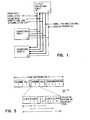
- FIG. 1 shows a network system which contains the central processing unit (CPU 2) with a relatively large computing capacity and a plurality of peripheral processing units (PE 4 and 4 ') with a relatively smaller computing capacity.
- CPU 2 central processing unit
- PE 4 and 4 ' peripheral processing units
- Each of the peripheral processing units is connected to the CPU via a transmission path which is formed by the input data bus 6, the output data bus 8, the clock bus 10, the bus 12 for the selection of processing steps and the line 14 for advancing the processing units.
- the PE 4s can perform relatively simple computing tasks independently, they often require the superior computing capacity of the CPU 2.
- the resources of the CPU 2 are therefore divided among the PEs during sequentially called operating periods that can be controlled by the CPU 2. During each service period, the CPU 2 can perform more complex processing steps for the selected PE 4 that go beyond its own capabilities.
- each PE 4 contains a memory 36 for storing the length of an expected interval between successive service periods for the relevant PE 4.
- each PE 4 contains a memory 20 for storing the start time of the last service period for the relevant PE.
- Each PE further includes a memory 22 for storing the start time of the current service period for that PE.
- the three memories 36, 22 and 20 are connected to a comparator 34 to compare the time difference between the beginning of the current service period and the beginning of the last service period with the value of the expected time interval between successive service periods.
- Each PE also includes a control word generator 24 connected to comparator 34 to indicate the number of processing steps to be performed by CPU 2 during the current service period for the PE in question.
- the number of processing steps indicated by the control word generator has a first magnitude if the comparator 34 determines that the difference in the starting times is less than the expected time, and the control word generator specifies a smaller number of processing steps if the comparator 34 determines that the Difference in start times is greater than the expected time for the PE in question.
- the various PIs can regulate the extent of the operation they require from the CPU so that the effect of the overload is distributed to the various PIs. If each PE 4 is assigned a relative priority in the operation by the CPU, a multiplier 35 can be built into the self-adaptive computer load control according to FIG. 2 in order to add a numerical value for the relative priority of the relevant PE to the number of processing steps multiply. In this way, PEs with a relatively lower priority are served by the CPU during overload.
- each PE 4 is connected to five ports of the CPU 2, namely, the input data bus 6 (IDB), the output data bus 8 (ODB), the clock bus 10 (CP), the device selection bus 12 (ESB) and the unit advance 14 (SA).
- the IDB 6 is used to transfer information from the CPU 2 to the PE's 4, specifically only to the PE 4, which is currently selected via the ESB 12.
- the ODB 8 has the opposite function to the IDB 6.
- the CP 10 provides the timing of the operator access control in the PE 4, which is currently selected by the CPU 2.
- the currently selected PE 4 of the CPU 2 indicates that its request for operation from the CPU 2 is satisfied and thus the CPU 2 can select another PE 4 and the latter can offer its service.
- the IDB 6 and ODB 8 can be regarded as paths leading to the PE 4 for the data to be processed or as paths leading away from the PE 4 for the processed data.
- the PE 4 consists of the following main parts: address selection decoder 16, operator access step switch 18, time registers 20 and 22, control memory 24 and processor 26.
- the processor 26 is the part of the PE 4 that performs the function of the PE.
- the other parts form the operator access control for the PE 4.
- the PE 4 operates as follows: When the processor 26 wishes to be operated, it sends a signal via the operating request line 28 to the input gate 30 of the ESB 12, which is connected to the address selection decoder 16. Thus, the address selection decoder can recognize the address of this PE 4 when it appears on the ESB 12. At this time, the operator access switch 18 connects the operator access device through the sequence of steps, with which it is determined how many basic tasks the CPU 2 has to carry out for the PE 4 at this switch-on time. The main operational steps are: receipt of the selected address (just described), calculation of the time difference, calculation of the task control word (TASK control word) and execution of the tasks (TASK's). The time difference is with the time registers 20th and 22 calculated.
- Register 20 contains the value for the last switch-on time (t 1 ) and register 22 contains the current cycle time (t n ).
- Register 22 is loaded by CB 10 in the first step of access control.
- the difference between the values in the registers 20 and 22 is calculated in the arithmetic and logic unit 32 (ALU) and then compared in the comparator 34 with the fixed time threshold value, which is stored in the threshold value register 36 (T l ); the result is an address (index I) of the control memory 24.
- the control memory 24 contains the maximum number of basic tasks (or a corresponding numerical value) which the CPU 2 requests when the processor 26 requests the currently selected PE 4 at the current switch-on time and can only be carried out for him. This value is the task control word that is output on line 38.
- the operator access step switch 18 is advanced to the execution of the tasks according to position 40.
- register 22, which contains the current cycle time is deleted and register 20 for the last switch-on time is loaded with the time value of CP 10.
- the processor 26 begins the data transfer via the ODB 8 to the CPU 2 in order to carry out its tasks for this switch-on time.
- the first operation that processor 26 performs is to translate the value of the task control word into the maximum number of elementary tasks N m that CPU 2 is to perform for it at this turn on time.
- the processor compares this value to the NE, which he wants to perform. If N ⁇ N E , the processor 26 has the CPU 2 perform N m tasks.
- N m > N E the CPU performs 2 N E tasks.
- the processor 26 turns off the signal on the operation request line 28, whereby the operation access step circuit 18 is reset and line SA 14 is activated.
- the CPU 2 recognizes this as an indication that it has finished the entire operation for the PE 4 at this switch-on time.
- the concept of self-adaptive computer load control can be applied to load control in multiprogramming (in which multiple application programs are processed) so as to reduce the load on a CPU during peak hours and yet to serve the application programs being executed .
- the key element of this second embodiment of the invention is that the individual application programs can sense the load on the CPU. If this load is greater than the highest desired load, the application programs can reduce their operating requirements for the CPU.
- This load control which is distributed to each application program, leads overall to the total processing load of the CPU being controlled adaptively.
- the process of multiprogramming is shown in the diagram in Fig. 3, where several application programs 'n' are to be executed in a CPU by calling each application program sequentially and either executing a predetermined number of basic steps in the application program or as many basic steps as within a predetermined switch-on period are possible. After the preselected number of steps have been carried out or the preselected time has expired, the CPU calls the next application program in the series. This process continues until all application programs have been called; thereafter the call cycle repeats itself by calling the first application program again and continuing the execution of the elementary steps at the point where execution ended during the last call cycle.
- the time between successive calls of the basic steps in a specific application program is called the call cycle; the point in time at which the execution of the basic steps in a specific application program begins is called the switch-on time.
- the period of time in which the basic steps of a particular called application program are executed is called the switch-on period.
- a specific application program can recognize a peak load or overload of the CPU within a multiprogramming system and can temporarily reduce its own demands on the CPU. This reduces the overall load on the CPU, while it can continue to operate all application programs, even if not to the former extent.
- the individual Application program detects an impending peak load for the system as a whole based on the difference between the planned and the actual execution times in a call cycle and then reduces its demands on the CPU if this time difference exceeds a certain threshold value.
- the load on a CPU which processes a plurality of application programs with multiprogramming can be reduced at peak load by one or more application programs independently temporarily reducing their need for assignment of CPU processing time.
- the timeout in the planned call cycle duration, in which it had to wait for the allocation of a CPU time under the control of the monitoring program is an indicator of the CPU load. This happens without knowledge of the monitoring program in the CPU and without reconfiguration of this monitoring program.
- the important aspect of this embodiment of the invention is that it is a more effective means of changing program calls (scheduling) than modifying a monitoring program for this purpose; the effort for interruptions in the monitoring program, which in a conventional system, namely, does not add to the overall CPU load in the construction of the present invention.
- the second exemplary embodiment can be described in connection with FIG. 3, in which the sequence of the operational steps in the system is shown.
- 'N' application programs should be in the entire call cycle.
- Any application program e.g. B. the 1st application program consists of up to 'm' basic steps. If there is no overload, all basic steps are carried out up to and including the mth basic step, beginning with the successor of the last element executed in the previous total call cycle. If the element last executed in a certain application program had the number 's', then the elements with the numbers (s + 1) modulo 'm' to number 'm' will be executed in the new switch-on period of the application program.
- Fig. 3 shows that with the invention shown here various possible subsets of elements of a given application program with the number '1' can be executed during an overall call cycle. In one case, only (m-2) elements would be executed; in another the elements with the numbers 2 to (m-1), since the element with number '1' was already executed in the previous total call cycle.
- Each element can be a special subroutine, and each of the elements, e.g. B. 'm' in the 1st application program is applied in sequence to the same file.
- each element can be a logical representation of the same subroutine that is applied to 'm' different files.
- An example of this would be an application program '1', in which an implementation of a digital filter is applied to 'm' different data channels.
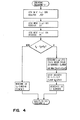
- Fig. 4 shows the operational flow of any application program, e.g. B. the lth program in multiprogramming mode under self-adaptive load control in the second embodiment of the invention.
- the 1st include three registers, one for the last processed previous element (LPEP), one for the last switch-on time (LET) and one for counting the elements (EC).
- LPEP last processed previous element
- LET last switch-on time
- EC counting the elements
- a register "running time” (PT) is available in the CPU for each application program.
- the LPEP register contains the identity of the element of the application program number '1' that was last processed when the application program was switched on previously.
- the LET register contains the time at which the application program '1' was last switched on.
- the EC register contains the number of elements that are intended for processing during the current power-on period.
- 'r' elements are to be processed during this switch-on period if (t n -t l ) > T 1 , where T 1 represents the threshold value for the application program with the number '1' . 4, the number of actual elements provided for processing can be smaller than the value 'r', depending on the identity of the last element processed in the last switch-on period.
- the principle of operation is that only a number n ⁇ r of elements for the program with the number '1' is provided for processing during this switch-on period so that the last processed element has the number 'm', if otherwise the execution of ' r 'elements would bring the processing sequence beyond element' m '(' m 'is the last element for the application program with number' 1 '). Otherwise, the full range of 'r' elements will be executed, even if this will cause some of the first elements in the next group to be executed for this application program.
- an important aspect of this second embodiment of the invention is that the self-adaptive load allocation for the CPU in multiprogramming can be applied to different degrees to the different application programs according to their different execution priority by using the values for 'r' and 'T' for each application program accordingly.
- Application programs with a higher priority can in principle have higher values for T1 and r than application programs with a lower priority, so that they do not match the need for their allocation of CPU time and the number of elements to be planned for processing by the CPU Reduce lower priority if the CPU is not overloaded.
- the number of elements of the application program with the number '1' shown in FIG. 4, which are to be executed during a given processing cycle can be selected as a function of the load on the CPU during several total call cycles and not only during one cycle, such as it is shown in Fig. 4.
- a variant would be the calculation of (tn-tl), the formation of an average with values (t n -t l ) from one or more previous cycles and then the determination of a threshold value for this average.
- Another more complex variant would be the formation of the average value (t n -t 1 ), as just described, and the weighting of this value with the number of elements of the application program with the number 1, which were processed during the previous switch-on period.
- the number 'r' of elements to be processed for the current duty cycle for the application program number '1' may be a function of the value (t n -t l ) or the weighted sum of these factors .
- the device and method shown here for adaptive load control in a computer network system enables the total processing requirement on a CPU to be reduced, both in a network system and in the case of multiprogramming. In this way, processing units or application programs with a relatively low priority cannot be frozen at peak loads, in which programs or processing units with a higher priority would otherwise take up the CPU on their own.
Landscapes
- Engineering & Computer Science (AREA)
- Software Systems (AREA)
- Theoretical Computer Science (AREA)
- Physics & Mathematics (AREA)
- General Engineering & Computer Science (AREA)
- General Physics & Mathematics (AREA)
- Multi Processors (AREA)
- Exchange Systems With Centralized Control (AREA)
Applications Claiming Priority (2)
| Application Number | Priority Date | Filing Date | Title |
|---|---|---|---|
| US05/955,562 US4262331A (en) | 1978-10-30 | 1978-10-30 | Self-adaptive computer load control |
| US955562 | 1997-10-17 |
Publications (3)
| Publication Number | Publication Date |
|---|---|
| EP0010570A2 true EP0010570A2 (fr) | 1980-05-14 |
| EP0010570A3 EP0010570A3 (en) | 1981-05-13 |
| EP0010570B1 EP0010570B1 (fr) | 1983-11-02 |
Family
ID=25497000
Family Applications (1)
| Application Number | Title | Priority Date | Filing Date |
|---|---|---|---|
| EP79102157A Expired EP0010570B1 (fr) | 1978-10-30 | 1979-06-28 | Procédé et dispositif pour l'association par adaptation automatique de la charge de travail d'un système de traitement de données |
Country Status (5)
| Country | Link |
|---|---|
| US (1) | US4262331A (fr) |
| EP (1) | EP0010570B1 (fr) |
| JP (1) | JPS5833586B2 (fr) |
| DE (1) | DE2966362D1 (fr) |
| IT (1) | IT1162550B (fr) |
Cited By (1)
| Publication number | Priority date | Publication date | Assignee | Title |
|---|---|---|---|---|
| US7195806B2 (en) | 2003-01-17 | 2007-03-27 | Fina Technology, Inc. | High gloss polyethylene articles |
Families Citing this family (20)
| Publication number | Priority date | Publication date | Assignee | Title |
|---|---|---|---|---|
| USRE37496E1 (en) * | 1981-01-21 | 2002-01-01 | Hitachi, Ltd | Method of executing a job |
| US4517641A (en) * | 1982-04-30 | 1985-05-14 | International Business Machines Corporation | Lookahead I/O device control subsystem |
| US4541064A (en) * | 1982-08-11 | 1985-09-10 | Livingston Waylon A | Process for ultrasonic testing of tubular goods |
| SE435975B (sv) * | 1983-03-18 | 1984-10-29 | Ellemtel Utvecklings Ab | Anordning i ett datorstyrt telekommunikationssystem for att vid overforing av datainformation mellan en regional processor och en central processor medelst ett kosystem utfora lastreglering |
| DE3741953A1 (de) * | 1986-12-19 | 1988-06-30 | Nippon Telegraph & Telephone | Multiprozessorsystem und verfahren zur arbeitslastverteilung bei einem solchen |
| JP2550063B2 (ja) * | 1987-04-24 | 1996-10-30 | 株式会社日立製作所 | 分散処理システムのシミユレ−シヨン方式 |
| JPS63310004A (ja) * | 1987-06-12 | 1988-12-19 | Omron Tateisi Electronics Co | プログラマブル・コントロ−ラ |
| US5239649A (en) * | 1989-10-30 | 1993-08-24 | International Business Machines Corporation | Channel path load balancing, through selection of storage volumes to be processed, for long running applications |
| CA2023998A1 (fr) * | 1989-11-13 | 1991-05-14 | Thomas F. Lewis | Appareil et methode pour assurer la synchronisation d'echantillonnage |
| US5574912A (en) * | 1990-05-04 | 1996-11-12 | Digital Equipment Corporation | Lattice scheduler method for reducing the impact of covert-channel countermeasures |
| US5210872A (en) * | 1991-06-28 | 1993-05-11 | Texas Instruments Inc. | Critical task scheduling for real-time systems |
| JP3201786B2 (ja) * | 1991-07-18 | 2001-08-27 | アジレント・テクノロジー株式会社 | ディジタル信号処理システムの制御方法 |
| US5313837A (en) * | 1991-09-26 | 1994-05-24 | Ico, Inc. | Ultrasonic thickness gage for pipe |
| US5392652A (en) * | 1992-04-07 | 1995-02-28 | Lambert, Macgill, Thomas, Inc. | Method and apparatus for inspection of metal objects utilizing variable angle ultrasonic transducer |
| US5459865A (en) * | 1993-04-05 | 1995-10-17 | Taligent Inc. | Runtime loader |
| US5826083A (en) * | 1996-06-20 | 1998-10-20 | Intel Corporation | CPU cycle consumption self-regulating method and apparatus |
| JP3175620B2 (ja) * | 1996-06-21 | 2001-06-11 | セイコーエプソン株式会社 | 印刷装置 |
| US6742064B2 (en) * | 2000-05-15 | 2004-05-25 | Goodrich Corp. | Programmable throttle circuit for each control device of a processing system |
| US7031928B1 (en) * | 2000-10-02 | 2006-04-18 | Hewlett-Packard Development Company, L.P. | Method and system for throttling I/O request servicing on behalf of an I/O request generator to prevent monopolization of a storage device by the I/O request generator |
| US7890559B2 (en) * | 2006-12-22 | 2011-02-15 | International Business Machines Corporation | Forward shifting of processor element processing for load balancing |
Family Cites Families (12)
| Publication number | Priority date | Publication date | Assignee | Title |
|---|---|---|---|---|
| US3368203A (en) * | 1963-12-23 | 1968-02-06 | Ibm | Checking system |
| US3370276A (en) * | 1965-05-05 | 1968-02-20 | Rca Corp | Computer peripheral device control |
| US3434115A (en) * | 1966-07-15 | 1969-03-18 | Ibm | Timed operation sequence controller |
| US3426331A (en) * | 1966-12-12 | 1969-02-04 | Honeywell Inc | Apparatus for monitoring the processing time of program instructions |
| US3588837A (en) * | 1968-12-30 | 1971-06-28 | Comcet Inc | Systems activity monitor |
| US3553656A (en) * | 1969-06-03 | 1971-01-05 | Gen Electric | Selector for the dynamic assignment of priority on a periodic basis |
| US3723975A (en) * | 1971-06-28 | 1973-03-27 | Ibm | Overdue event detector |
| GB1436428A (en) * | 1972-10-31 | 1976-05-19 | Ibm | Data processing apparatus |
| US3886524A (en) * | 1973-10-18 | 1975-05-27 | Texas Instruments Inc | Asynchronous communication bus |
| US3996561A (en) * | 1974-04-23 | 1976-12-07 | Honeywell Information Systems, Inc. | Priority determination apparatus for serially coupled peripheral interfaces in a data processing system |
| US4056846A (en) * | 1976-06-30 | 1977-11-01 | Ibm Corporation | Data processing system with apparatus for sharing channel background processing |
| US4161779A (en) * | 1977-11-30 | 1979-07-17 | Burroughs Corporation | Dynamic priority system for controlling the access of stations to a shared device |
-
1978
- 1978-10-30 US US05/955,562 patent/US4262331A/en not_active Expired - Lifetime
-
1979
- 1979-06-28 IT IT23940/79A patent/IT1162550B/it active
- 1979-06-28 EP EP79102157A patent/EP0010570B1/fr not_active Expired
- 1979-06-28 DE DE7979102157T patent/DE2966362D1/de not_active Expired
- 1979-06-29 JP JP54081584A patent/JPS5833586B2/ja not_active Expired
Cited By (1)
| Publication number | Priority date | Publication date | Assignee | Title |
|---|---|---|---|---|
| US7195806B2 (en) | 2003-01-17 | 2007-03-27 | Fina Technology, Inc. | High gloss polyethylene articles |
Also Published As
| Publication number | Publication date |
|---|---|
| DE2966362D1 (en) | 1983-12-08 |
| US4262331A (en) | 1981-04-14 |
| JPS5833586B2 (ja) | 1983-07-20 |
| IT7923940A0 (it) | 1979-06-28 |
| EP0010570A3 (en) | 1981-05-13 |
| JPS5561869A (en) | 1980-05-09 |
| EP0010570B1 (fr) | 1983-11-02 |
| IT1162550B (it) | 1987-04-01 |
Similar Documents
| Publication | Publication Date | Title |
|---|---|---|
| EP0010570B1 (fr) | Procédé et dispositif pour l'association par adaptation automatique de la charge de travail d'un système de traitement de données | |
| DE69322538T2 (de) | Methode und Prozessor zur Bearbeitung eines Programmes in Parallelbearbeitung | |
| DE10110504B4 (de) | Verfahren und Computersystem zur Verwaltung von Threads | |
| DE4410775C2 (de) | Steuergerät und Arbeitsverfahren eines Betriebssystems für dieses Steuergerät | |
| DE2760322C2 (fr) | ||
| DE2411963C3 (de) | Elektronische Datenverarbeitungsanlage mit einer Prioritätssteuerschaltung mit änderbaren Steuerblöcken | |
| DE3686018T2 (de) | Betriebsfuehrung von hardwaremitteln. | |
| DE69224279T2 (de) | Verfahren und Gerät zur Arbitrierung auf Basis der Verfügbarkeit von Betriebsmitteln | |
| DE2350884A1 (de) | Datenverarbeitungssystem | |
| DE2164749A1 (de) | Konflikt-Lösungsverfahren und -Lösungseinrichtung | |
| DE2556661A1 (de) | Steuerschaltung mit adressenerweiterung | |
| DE19822543A1 (de) | Verfahren zum Zuteilen von Aufträgen, Datenverarbeitssystem, Client-Datenbearbeitungsknoten und computerlesbares Speichermedium | |
| DE1424762B2 (de) | Datenverarbeitungsanlage | |
| DE102004054571A1 (de) | Verfahren zur Verteilung von Rechenzeit in einem Rechnersystem | |
| DE3400723A1 (de) | Vektorprozessor | |
| DE3507584C2 (fr) | ||
| DE2706877C2 (de) | Mikroprogramm-Steuereinrichtung | |
| DE1524181A1 (de) | Abrufsystem fuer Ein- und Ausgabegeraete einer Datenverarbeitungsanlage | |
| DE69908911T2 (de) | Zuweisungsvorrichtung für eine datenvermittlungsanlage | |
| DE2726679A1 (de) | Kanalsteuerung fuer datenverarbeitungsanlagen und verfahren zu ihrem betrieb | |
| DE2948340C2 (de) | Informationsübertragungsanordnung für die Übertragung jeweils ausgewählter Informationseinheiten | |
| WO1998049622A1 (fr) | Carte a puce avec maximisation des acces a la memoire et enregistrement | |
| EP1047990B1 (fr) | Dispositif et procede de commande de processus dans un systeme informatique | |
| DE3642003C2 (fr) | ||
| EP1248202B1 (fr) | Système de bus |
Legal Events
| Date | Code | Title | Description |
|---|---|---|---|
| PUAI | Public reference made under article 153(3) epc to a published international application that has entered the european phase |
Free format text: ORIGINAL CODE: 0009012 |
|
| AK | Designated contracting states |
Designated state(s): DE FR GB |
|
| PUAL | Search report despatched |
Free format text: ORIGINAL CODE: 0009013 |
|
| AK | Designated contracting states |
Designated state(s): DE FR GB |
|
| 17P | Request for examination filed |
Effective date: 19810331 |
|
| GRAA | (expected) grant |
Free format text: ORIGINAL CODE: 0009210 |
|
| AK | Designated contracting states |
Designated state(s): DE FR GB |
|
| REF | Corresponds to: |
Ref document number: 2966362 Country of ref document: DE Date of ref document: 19831208 |
|
| ET | Fr: translation filed | ||
| PGFP | Annual fee paid to national office [announced via postgrant information from national office to epo] |
Ref country code: FR Payment date: 19840605 Year of fee payment: 6 |
|
| PGFP | Annual fee paid to national office [announced via postgrant information from national office to epo] |
Ref country code: DE Payment date: 19840619 Year of fee payment: 6 |
|
| PLBE | No opposition filed within time limit |
Free format text: ORIGINAL CODE: 0009261 |
|
| STAA | Information on the status of an ep patent application or granted ep patent |
Free format text: STATUS: NO OPPOSITION FILED WITHIN TIME LIMIT |
|
| 26N | No opposition filed | ||
| PG25 | Lapsed in a contracting state [announced via postgrant information from national office to epo] |
Ref country code: FR Free format text: LAPSE BECAUSE OF NON-PAYMENT OF DUE FEES Effective date: 19860228 |
|
| PG25 | Lapsed in a contracting state [announced via postgrant information from national office to epo] |
Ref country code: DE Effective date: 19860301 |
|
| REG | Reference to a national code |
Ref country code: FR Ref legal event code: ST |
|
| GBPC | Gb: european patent ceased through non-payment of renewal fee | ||
| PG25 | Lapsed in a contracting state [announced via postgrant information from national office to epo] |
Ref country code: GB Effective date: 19881118 |