EP0012452A2 - Phosphorsäureester und deren Verwendung zur Herstellung von Schädlingsbekämpfungsmitteln - Google Patents
Phosphorsäureester und deren Verwendung zur Herstellung von Schädlingsbekämpfungsmitteln Download PDFInfo
- Publication number
- EP0012452A2 EP0012452A2 EP79105303A EP79105303A EP0012452A2 EP 0012452 A2 EP0012452 A2 EP 0012452A2 EP 79105303 A EP79105303 A EP 79105303A EP 79105303 A EP79105303 A EP 79105303A EP 0012452 A2 EP0012452 A2 EP 0012452A2
- Authority
- EP
- European Patent Office
- Prior art keywords
- ester
- acid
- spp
- allyl
- und
- Prior art date
- Legal status (The legal status is an assumption and is not a legal conclusion. Google has not performed a legal analysis and makes no representation as to the accuracy of the status listed.)
- Granted
Links
Classifications
-
- C—CHEMISTRY; METALLURGY
- C07—ORGANIC CHEMISTRY
- C07F—ACYCLIC, CARBOCYCLIC OR HETEROCYCLIC COMPOUNDS CONTAINING ELEMENTS OTHER THAN CARBON, HYDROGEN, HALOGEN, OXYGEN, NITROGEN, SULFUR, SELENIUM OR TELLURIUM
- C07F9/00—Compounds containing elements of Groups 5 or 15 of the Periodic Table
- C07F9/02—Phosphorus compounds
- C07F9/28—Phosphorus compounds with one or more P—C bonds
- C07F9/38—Phosphonic acids [RP(=O)(OH)2]; Thiophosphonic acids ; [RP(=X1)(X2H)2(X1, X2 are each independently O, S or Se)]
- C07F9/40—Esters thereof
- C07F9/4071—Esters thereof the ester moiety containing a substituent or a structure which is considered as characteristic
- C07F9/4078—Esters with unsaturated acyclic alcohols
-
- A—HUMAN NECESSITIES
- A01—AGRICULTURE; FORESTRY; ANIMAL HUSBANDRY; HUNTING; TRAPPING; FISHING
- A01N—PRESERVATION OF BODIES OF HUMANS OR ANIMALS OR PLANTS OR PARTS THEREOF; BIOCIDES, e.g. AS DISINFECTANTS, AS PESTICIDES OR AS HERBICIDES; PEST REPELLANTS OR ATTRACTANTS; PLANT GROWTH REGULATORS
- A01N57/00—Biocides, pest repellants or attractants, or plant growth regulators containing organic phosphorus compounds
- A01N57/02—Biocides, pest repellants or attractants, or plant growth regulators containing organic phosphorus compounds having alternatively specified atoms bound to the phosphorus atom and not covered by a single one of groups A01N57/10, A01N57/18, A01N57/26, A01N57/34
-
- A—HUMAN NECESSITIES
- A01—AGRICULTURE; FORESTRY; ANIMAL HUSBANDRY; HUNTING; TRAPPING; FISHING
- A01N—PRESERVATION OF BODIES OF HUMANS OR ANIMALS OR PLANTS OR PARTS THEREOF; BIOCIDES, e.g. AS DISINFECTANTS, AS PESTICIDES OR AS HERBICIDES; PEST REPELLANTS OR ATTRACTANTS; PLANT GROWTH REGULATORS
- A01N57/00—Biocides, pest repellants or attractants, or plant growth regulators containing organic phosphorus compounds
- A01N57/10—Biocides, pest repellants or attractants, or plant growth regulators containing organic phosphorus compounds having phosphorus-to-oxygen bonds or phosphorus-to-sulfur bonds
- A01N57/12—Biocides, pest repellants or attractants, or plant growth regulators containing organic phosphorus compounds having phosphorus-to-oxygen bonds or phosphorus-to-sulfur bonds containing acyclic or cycloaliphatic radicals
-
- C—CHEMISTRY; METALLURGY
- C07—ORGANIC CHEMISTRY
- C07F—ACYCLIC, CARBOCYCLIC OR HETEROCYCLIC COMPOUNDS CONTAINING ELEMENTS OTHER THAN CARBON, HYDROGEN, HALOGEN, OXYGEN, NITROGEN, SULFUR, SELENIUM OR TELLURIUM
- C07F9/00—Compounds containing elements of Groups 5 or 15 of the Periodic Table
- C07F9/02—Phosphorus compounds
- C07F9/06—Phosphorus compounds without P—C bonds
- C07F9/08—Esters of oxyacids of phosphorus
- C07F9/09—Esters of phosphoric acids
- C07F9/113—Esters of phosphoric acids with unsaturated acyclic alcohols
-
- C—CHEMISTRY; METALLURGY
- C07—ORGANIC CHEMISTRY
- C07F—ACYCLIC, CARBOCYCLIC OR HETEROCYCLIC COMPOUNDS CONTAINING ELEMENTS OTHER THAN CARBON, HYDROGEN, HALOGEN, OXYGEN, NITROGEN, SULFUR, SELENIUM OR TELLURIUM
- C07F9/00—Compounds containing elements of Groups 5 or 15 of the Periodic Table
- C07F9/02—Phosphorus compounds
- C07F9/28—Phosphorus compounds with one or more P—C bonds
- C07F9/30—Phosphinic acids [R2P(=O)(OH)]; Thiophosphinic acids ; [R2P(=X1)(X2H) (X1, X2 are each independently O, S or Se)]
- C07F9/32—Esters thereof
- C07F9/3205—Esters thereof the acid moiety containing a substituent or a structure which is considered as characteristic
- C07F9/3217—Esters of acyclic unsaturated acids
-
- C—CHEMISTRY; METALLURGY
- C07—ORGANIC CHEMISTRY
- C07F—ACYCLIC, CARBOCYCLIC OR HETEROCYCLIC COMPOUNDS CONTAINING ELEMENTS OTHER THAN CARBON, HYDROGEN, HALOGEN, OXYGEN, NITROGEN, SULFUR, SELENIUM OR TELLURIUM
- C07F9/00—Compounds containing elements of Groups 5 or 15 of the Periodic Table
- C07F9/02—Phosphorus compounds
- C07F9/28—Phosphorus compounds with one or more P—C bonds
- C07F9/38—Phosphonic acids [RP(=O)(OH)2]; Thiophosphonic acids ; [RP(=X1)(X2H)2(X1, X2 are each independently O, S or Se)]
- C07F9/40—Esters thereof
- C07F9/4003—Esters thereof the acid moiety containing a substituent or a structure which is considered as characteristic
- C07F9/4006—Esters of acyclic acids which can have further substituents on alkyl
-
- C—CHEMISTRY; METALLURGY
- C07—ORGANIC CHEMISTRY
- C07F—ACYCLIC, CARBOCYCLIC OR HETEROCYCLIC COMPOUNDS CONTAINING ELEMENTS OTHER THAN CARBON, HYDROGEN, HALOGEN, OXYGEN, NITROGEN, SULFUR, SELENIUM OR TELLURIUM
- C07F9/00—Compounds containing elements of Groups 5 or 15 of the Periodic Table
- C07F9/02—Phosphorus compounds
- C07F9/28—Phosphorus compounds with one or more P—C bonds
- C07F9/38—Phosphonic acids [RP(=O)(OH)2]; Thiophosphonic acids ; [RP(=X1)(X2H)2(X1, X2 are each independently O, S or Se)]
- C07F9/40—Esters thereof
- C07F9/4003—Esters thereof the acid moiety containing a substituent or a structure which is considered as characteristic
- C07F9/4015—Esters of acyclic unsaturated acids
Definitions
- the present invention relates to new insecticidal and acaricidal synergistic active substance combinations of partially known phosphorus-containing compounds and pesticidal active substances.
- synergistic mixtures of carbamates e.g. B. 2-iso-propoxyphenyl-N-methyl carbamate or phosphoric acid esters, e.g. B. O, O-diethyl-O- (2-isopropyl-4-methyl-pyrimidinyl- [6] -phosphorothioate, or of natural or synthetic pyrethroids with piperonyl ethers such as ⁇ - [2- (2-butoxy - ethoxy) -ethoxy] -4,5-methylenedloxy-2-propyl-toluene, known (see Bull, Org.-Health Org.
- the insecticidal and / or acaricidal action of the active compound combinations according to the invention is substantially higher than the action of the individual component or the sum of the actions of the individual components. It is also significantly higher than the effect of the already known combinations of active substances consisting of 2-iso-propoxy-phenyl-N-methyl-carbamate and piperonyl butoxide.
- the phosphorus-containing compounds which can be used as synergists according to the invention show excellent synergistic activity not only with one class of active substance, but with active substances from a wide variety of chemical groups.
- synergistic mixtures which contain the phosphorus-containing compounds of the formula I which can be used according to the invention are a valuable addition to the technology.
- the majority of the phosphorus-containing compounds of the formula I are known and can be obtained by customary processes.
- the phosphorus-containing compounds of the general formula I which can be used according to the invention include phosphoric acid esters, thiophosphorus acid esters, dithio and trithiophosphoric acid esters, phosphonic acid esters, thiophosphonic acid esters and dithiophosphonic acid esters, phosphinic acid esters and thiophosphinic acid esters.
- the preparation of (thio) phosphoric acid esters (thio) -phosphonic acid esters or (thio) -phosphinic acid esters is described in detail, for example, in "Houben-Weyl, Methods of Organic Chemistry, Vol. 12/1 and Vol. 12/2".
- the phosphonic acid or phosphinic acid derivatives are preferably prepared by the nickel-catalyzed Arbusow reaction from the corresponding phosphoric acid triesters or phosphoric acid diesters and (meth) allyl halide by the processes described in German Offenlegungsschriften 2,442,427, 2,442,428 and 2,601,427.
- Phosphonic esters with different ester residues, thiophosphonic acid-O, S-diester or phosphonic acid ester amides can be obtained from the phosphonic acid diesters via the intermediate stage of the phosphonic acid ester chloride.
- Phosphonic acid ester chlorides are easily formed from the diesters by the action of phosphorus pentachloride, phosgene or oxalyl chloride at (up to approx. 100 ° C, see: Houben-Weyl, Methods of Org. Chemistry, Vol. 12/1, p. 415 ff.).
- the ester chlorides can be reacted with alcohols, phenols, amines, anilines, mercaptans or thiophenols by known processes, see for example Houben-Weyl, Methods of Org. Chemistry, Vol. 12/1, pp. 423 ff, 529 ff and 577 ff.
- radicals R 1 , R 2 and R 3 must stand for a radical which is unsaturated in the 2-position; the allyl radical is particularly preferred.
- the carboxylic acid esters (group B) of the formula (III) which may also be used as mixture components include:
- Acetic acid [2,2,2-trichloro-1- (3,4-dichlorophenyl) ethyl] ester, 2,3,4,5-tetrahydrophthalimidomethyl chrysanthemate, 3-phenoxybenzyl- [2,2-dimethyl-3- ( 2,2-dichlorovinyl) cyclopropane] carboxylate and (5-benzyl-furyl) methyl 2,2-dimethyl-1-3- (2-methylpropenyl) cyclopropane carboxylate.
- the new active compound combinations of the phosphorus esters of the formula (I) which can be used according to the invention show with carbamates, carboxylic acid esters, phosphoric acid esters, halocycloalkanes and haloalkanes, an excellent increase in activity compared to the individual active ingredients or in relation to their sum.
- the weight ratios of the active ingredient groups can fluctuate in relatively large ranges.
- the phosphorus-containing compounds used as synergists are used in a ratio of 0.1: 10 to 10: 0.1 with the other active ingredients.
- Mixing ratios of 0.5: 1.0 to 3.0: 1.0 have proven to be particularly suitable.
- the active compound combinations according to the invention not only bring about a quick knock-down effect, but also bring about the sustainable killing of animal pests, in particular insects and mites, which occur in agriculture, in forests, in the protection of stored products and materials and in the hygiene sector. They are effective against normally sensitive and resistant species as well as against all or individual stages of development.
- the active substance combinations can be converted into the customary formulations, such as solutions, emulsions, wettable powders, suspensions, powders, dusting agents, foams, pastes, soluble powders, granules, aerosols, suspension emulsion concentrates.
- formulations are prepared in a known manner, e.g. B. by mixing the active ingredients.
- extenders that is to say liquid solvents, pressurized liquefied gases and / or solid carriers, if appropriate using surface-active agents, that is to say emulsifiers and / or dispersants and / or foam-generating agents.
- surface-active agents that is to say emulsifiers and / or dispersants and / or foam-generating agents.
- organic solvents can also be used as auxiliary solvents.
- aromatics such as xylene, toluene, or alkylnaphthalenes
- chlorinated aromatics or chlorinated aliphatic hydrocarbons such as chlorobenzenes, chloroethylene or methylene chloride
- aliphatic hydrocarbons such as cyclohexane or paraffins, e.g. B.
- Liquefied gaseous extenders or carriers mean those liquids which are gaseous at normal temperature and pressure, e.g. B.
- aerosol propellants such as halogenated hydrocarbons and butane, propane, nitrogen and carbon dioxide; as solid carriers: natural rock flour, such as kaolins, alumina, talc, chalk, quartz, attapulgite, montmorillonite or diatomaceous earth and synthetic Rock powders such as finely divided silica, aluminum oxide and silicates; as solid carriers for granules: broken and fractionated natural rocks such as calcite, marble, pumice, sepiolite, dolomite as well as synthetic granules from inorganic and organic flours as well as granules from organic material such as sawdust, coconut shells, corn cobs and tobacco stalks; as emulsifying and / or foam-generating agents: nonionic and anionic emulsifiers, such as polyoxyethylene fatty acid esters, polyoxyethylene fatty alcohol ether, e.g.
- Adhesives such as carboxymethyl cellulose, natural and synthetic powdery, granular or latex-shaped polymers, such as gum arabic, polyvinyl alcohol, polyvinyl acetate, can be used in the formulations.
- Dyes such as inorganic pigments, e.g. B. iron oxide, titanium oxide, ferrocyan blue and organic dyes such as alizarin. Azo metal phthalocyanine dyes and trace nutrients such as salts of iron, manganese, boron, copper, cobalt, molybdenum and zinc can be used.
- inorganic pigments e.g. B. iron oxide, titanium oxide, ferrocyan blue and organic dyes such as alizarin.
- Azo metal phthalocyanine dyes and trace nutrients such as salts of iron, manganese, boron, copper, cobalt, molybdenum and zinc can be used.
- the formulations generally contain between 0.1 and 95% by weight of active compound, preferably between 0.5 and 90%.
- the active compound combinations according to the invention are used in the form of their commercially available formulation and / or the use forms prepared from these formulations.
- the active substance content of the use forms prepared from the commercially available formulations can vary within wide ranges.
- the active substance concentration of the use form can be from 0.0000001 up to 100 wt .-% active ingredient, preferably between 0.01 and 10 wt .-%.
- the application takes place in a customary manner adapted to the application forms.
- the active substance combinations When used against hygiene pests and pests of stored products, the active substance combinations are notable for an excellent residual action on wood and clay and for good stability to alkali on limed substrates.
- Solutions are prepared from the active ingredients, synergists and mixtures of active ingredients and synergists, and 2.5 ml of these are pipetted into Petri dishes on filter paper discs with a diameter of 9.5 cm. The filter paper absorbs the solutions. The petri dishes remain open until the solvent has completely evaporated. Then 25 test animals are placed in the Petri dishes and covered with a glass lid.
- the condition of the test animals is checked continuously for up to 6 hours. The time required for a 100% knock-down effect is determined. If the LT 100 is not reached after 6 hours, the percentage of the knock-down test animals is determined.
- Solutions are prepared from the active ingredients, synergists and mixtures of active ingredients and synergists, and 2.5 ml of these are pipetted into Petri dishes on filter paper with a diameter of 9.5 cm. The filter paper absorbs the solutions. The petri dishes remain open until the solvent has completely evaporated. Then put 20 test animals in the Petri dishes and cover them with a glass lid.
- the condition of the animals is checked continuously for up to 6 hours and then after 24, 48 and 72 hours. The time required for a 100% knock-down effect is determined. If the LT 100 is not reached after 72 hours, the percentage rate of the knock-down test animals is determined.
- reaction mixture is carefully fractionated after adding 0.5 g of phenothiazine.
- the allylphosphinates (likewise the allylphosphonates) tend to isomerize to 1-propene-1-phosphinate (or phosphonate) at high temperatures. A reaction temperature of 130 ° C should therefore not be exceeded.
Landscapes
- Chemical & Material Sciences (AREA)
- Life Sciences & Earth Sciences (AREA)
- Organic Chemistry (AREA)
- Health & Medical Sciences (AREA)
- General Health & Medical Sciences (AREA)
- Biochemistry (AREA)
- Molecular Biology (AREA)
- Pest Control & Pesticides (AREA)
- Agronomy & Crop Science (AREA)
- Plant Pathology (AREA)
- Engineering & Computer Science (AREA)
- Dentistry (AREA)
- Wood Science & Technology (AREA)
- Zoology (AREA)
- Environmental Sciences (AREA)
- Agricultural Chemicals And Associated Chemicals (AREA)
Abstract
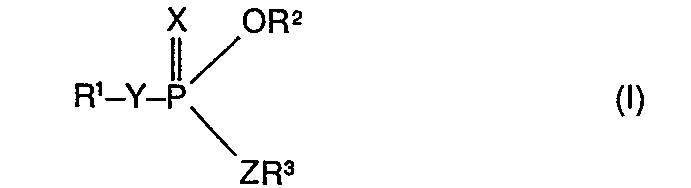
- R1 für Alkyl mit 1 bis 4 C-Atomen steht,
- X Sauerstoff oder Schwefel bedeutet und
- Y und Z für Sauerstoff und Schwefel und
- R' und R3 für Propargyl stehen
Description
- Die vorliegende Erfindung betrifft neue insektizide und akarizide synergistische Wirkstoffkombinationen aus teilweise bekannten phosphorhaltigen Verbindungen und pestiziden Wirkstoffen.
- Es ist bereits bekannt geworden, daß die folgenden Wirkstoffe bzw. Wirkstoffgruppen pestizide, insbesondere insektizide und akarizide Eigenschaften aufweisen:
- A. Carbamate, wie z. B. das 2-iso-Prophyl-phenyl-N-methyl- carbamat, 2-(1-Methyl-allyl)-phenyl-N-Methyl-carbamat, 3-iso-Propyl-4-methoxy-phenyl-N-methyl-carbamat, 2-[1,3-Dioxolan(2)yl-phenyl]-N-methyl-carbamat, 2,2-Dimethyl-1,3-benzodioxol(4)yl-N-methyl-carbamat, 2,2-Dimethyl- bzw. 2-Methyl-2,3-dihydrobenzofuran(4)yl-N-methyl-carbamat und 2,3-Dihydro-2,2-dimethylbenzofuran( )yl-N-acetyl-N-methyl- carbamat, 3,4,5-Trimethyl-phenyl-N-methylcarbamat, 1-Naphthyl-N-methyl-carbamat
- B. Carbonsäureester, wie z. B. 2,3,4,5-Tetrahydrophthalimido- methyl-chrysanthema-Essigsäure-2,2,2-trichlor-1-(3,4-dichlorphenyl)-äthylester und [3-Phenoxybenzyl] -2.2-dimethyl-3-(2,2-dichlorvinyl)-cyclopropancarboxylat
- C. Phospohorsäureester, wie z. B. O,O-Dimethyl-O-(2,2-dichlor- vinyl)-phosphorsäureester und O,O-Dimethyl-O-[3-methyl-4-methylthio-phenyl] -thionophosphorsäureester
- D. Halogencycloalkane, wie z. B. Hexachlorcyclohexan und
- E. Halogenalkane, wie z. B. 1,1,1-Trichlor-2,2-bis-(4-methoxyphenyl)-äthan.
- Weiterhin sind synergistische Mischungen von Carbamaten, z. B. 2-iso-Propoxyphenyl-N-methylcarbamat oder von Phosphorsäureestern, z. B. O,O-Diäthyl-O-(2- isopropyl-4-methyl-pyrimidinyl-[6]-phosphorthioat, oder von natürlichen oder synthetischen Pyrethroiden mit Piperonyläthern, wie z. B. α- [2-(2-Butoxy- äthoxy)-äthoxy]-4,5-methylendloxy-2-propyl-toluol, bekannt (vgl. Bull, Org.-Health Org. 1966, 35p Seiten 691-708, Schrader G.: Die Entwicklung neuer insektizider Phosphorsäureester 1963, S. 158; Perkov, W.: Die Insektizide, 1966, Seiten 516-524). Die Wirksamkeit dieser Synergisten ist nicht befriedigend, eine gewisse Bedeutung hat nur daso α-[2-(2-Butoxy-äthoxy)äthoxy] -4,5-methylendioxy-2-propyl-toluol (Piperonylbutoxyd) erlangt. Im übrigen sind die bekannten Synergisten nur aufwendig und teuer herstellbar, wodurch ihre Einsatzmöglichkeiten beschränkt werden. Das Auffinden von leicht zugänglichen und preiswerten Synergisten ist somit wünschenswert.
- Es wurde nun gefunden, daß Wirkstoffkombinationen aus phosphorhaltigen Verbindungen der allgemeinen Formel I

- R 1, R 2 und R3 unabhängig voneinander für die Reste Alkyl, Alkenyl oder Aryl stehen, welche gegebenenfalls substituiert sein können, wobei mindestens einer der Reste für einen in 2-Stellung ungesättigten gegebenenfalls substituierten Alkenylrest steht,
- X für Sauerstoff oder Schwefel steht
- Y und Z unabhängig voneinander für Sauerstoff, Schwefel oder eine einfache Bindung stehen; stehen sowohl Y als auch Z für Sauerstoff oder für Schwefel oder für eine einfache Bindung, so können R 1 und R und R 3 zusätzlich zu den oben angegebenen Resten Propargyl bedeuten; und
- A. Carbamaten, und/oder
- B. Carbonsäureestern, einschließlich der natürlichen sowie synthetischen Pyrethroide und/oder
- C. Phosphorsäureestern und/oder'
- D. Halogencycloalkanen und/oder
- E. Halogenalkanen
-

- R4 für Aryl, Heterocyclus oder einen Oximrest steht,
- R 5 für Wasserstoff oder Alkyl mit 1 bis 4 C-Atomen steht und
- R 6 für Alkyl, Alkylcarbonyl mit 1 - 6 C-Atomen im Alkylrest, der gegebenenfalls auch durch Hydroxy oder Methylthio substituiert sein kann, oder den Rest -S-W, steht, wobei für einen gegebenenfalls durch Halogen substituierten aliphatischen Rest mit 1-bis 4 C-Atomen, insbesondere CCl3 und CF3, sowie für gegebenenfalls bevorzugt durch CN, Halogen, insbesondere Chlor, Methyl, Trihalogenmethyl, Trifluormethylmercapto oder NO2 substituierten Arylrest, insbesondere Phenyl, oder für Methoxycarbonyl oder für den Rest V-S02-N-R 5 steht, wobei V für Alkyl, Halogenalkyl oder Halogen, Trihalogenmethyl, CN, Methyl oder Nitro substituierten Arylrest steht.
- Besonders bevorzugt sind Carbamate, in denen
- R 4 für Phenyl oder Naphthyl steht, die gegebenenfalls substituiert sind durch Alkyl, Alkenyl, Alkoxy, Alkylmercapto mit jeweils 1 bis 5 C-Atomen, Dialkylamino, Dialkenylamino bis zu 3 C-Atomen je Alkyl- bzw. Alkenylteil, Halogen, insbesondere Chlor, Dioxolanyl oder den Rest -N=CH-N (C1-4-Alkyl)2;
- R für 2,3-Dihydrobenzofuranyl, Benzodioxol, Benzothienyl, Pyrimidyl oder Pyrazolyl steht, die gegebenenfalls durch C1-4-Alkyl, insbesondere Methyl oder Dialkylamino mit 1 bis 4 C-Atomen je Alkylteil substituiert sind;
- Weiterhin sind besonders bevorzugt Carbamate, in denen R 4 für einen Oximrest der allgemeinen Formel (II a)

- R 7 und R8 gleich oder verschieden sind und für Alkyl, Cycloalkyl, Alkenyl, Alkinyl, Alkoxy, Alkylmercapto, Alkoxycarbonyl, Carbonylamid, Alkylmercaptoalkyl mit jeweils bis zu 5 C-Atomen, CN, Aryl, insbesondere Phenyl, Aralkyl, einen gegebenenfalls substituierten heterocyclischen Rest oder für Alkyl, das durch einen heterocyclischen Rest substituiert ist, stehen oder gemeinsam für einen gegebenenfalls durch C1-4 Alkyl substituierten Dioxolanyl oder Dithiolanylrest stehen;
- B. Carbonsäureestern der allgemeinen Formel (III)

- R 9 für Alkyl, Aralkyl, Aryl oder Cycloalkyl steht, die gegebenenfalls substituiert sein können und
- R10 für Wasserstoff, Alkyl, Halogenalkyl, Alkenyl, Alkinyl, CN steht und
- R 11 für Aryl oder einen Heterocyclus steht, oder gemeinsam mit R10 einen gegebenenfalls substituierten Cyclopentenonring bildet;
- R 9 für Alkyl mit 1 bis 6 C-Atomen, das gegebenenfalls durch gegebenenfalls halogensubstituiertes Phenyl substituiert ist, Cyclopropyl, das gegebenenfalls durch Alkyl, Alkenyl, Halogenalkyl oder Halogenalkenyl mit jeweils bis zu 6 C-Atomen substituiert ist oder für Phenyl, das gegebenenfalls durch Halogen subsituiert ist, steht;
- R10 für Wasserstoff, Alkyl mit 1 bis 6 C-Atomen, Halogenalkyl mit 1 bis 4 C-Atomen und bis zu 3 Halogenatomen, CN oder Äthinyl steht;
- R 11 für Phenyl steht, das gegebenenfalls durch C1-4-Alkyl, Halogen, insbesondere Fluor oder Chlor, gegebenenfalls halogen- oder methylsubstituiertes Phenoxy, gegebenenfalls substituiertes Benzyl substituiert ist, ferner für Furanyl, Tetrahydrophthalimido, Benzodioxol, die gegebenenfalls durch Halogen, insbesondere Chlor, Alkyl der Alkenyl mit bis zu 4 C-Atomen oder Benzyl substituiert sind, steht und ferner für Cyclopentenon steht, das gegebenenfalls durch C1-4-Alkyl, Furfuryl C1-5-Alkenyl substituiert ist;
- C. Phosphorsäureestern der allgemeinen Formel (IV)

- X unabhängig voneinander für 0 oder S stehen und
- A für O,S, NH- oder für eine direkte Bindung zwi- schen dem zentralen P-Atom und dem Rest R14 steht und
- R 12 und R13 gleich oder verschieden sind und für Alkyl oder Aryl stehen und
- R14 für Alkyl, Aryl, Heteroaryl, Aralkyl, Alkenyl, Dioxanyl oder einen Oximrest oder für den gleichen Rest steht, an das es gebunden ist; mit der Maßgabe, daß R14-A- nicht den 2-Methoxy-4-cyano-phenoxyrest bedeuten soll, wenn als Synergist Chlormethanphosphonsäuredipropargylester verwendet wird.
- R 12 und R13 gleich oder verschieden sind und für C1-4-Alkyl oder Phenyl stehen und
- R14 für Alkyl mit 1-4 C-Atomen steht, das gegebenenfalls durch Halogen, OH, CN, gegebenenfalls halogensubstituiertes Phenyl, Carbonylamid, Sulfonylalkyl, Sulfoxyalkyl, Carbonylalkyl, Alkoxy, Alkylmercapto, Alkoxycarbonyl substituiert ist; für Alkenyl mit bis zu 4 C-Atomen steht, das gegebenenfalls durch Halogen, gegebenenfalls halogensubstituiertes Phenyl oder Alkoxycarbonyl substituiert ist, oder für den Oximrest der allgemeinen Formel (II a) steht,

- R 7 und R 8 die oben angegebene Bedeutung besitzen, insbesondere jedoch für Cyan oder Phenyl stehen, oder für Dioxanyl steht, das durch denselben Rest substituiert ist, an den R14 gebunden ist, oder R 14 steht für den gleichen Rest,an den es ge-bunden ist, oder R14 steht für Phenyl, das gegebenenfalls durch Methyl, Nitro, CN, Halogen, Methylmercapto substituiert ist;
- R14 steht außerdem besonders bevorzugt für gegebenenfalls durch C1-4-Alkyl oder Halogen substituierte Heteroaromaten wie Pyridin, Chinolin, Chinoxalin, Pyrimidin, Diazinon, Benzo-1,2,4-triazin;
- D. Cycloalkane der Formel (V)

- E. Halogenalkanen der Formel (VI)

- Hal' für Chlor oder Brom
- R 15 für Wasserstoff oder Hydroxyl
- R16 und R17 gleich oder verschieden sind und für Halogen, Alkyl oder Alkoxy und
- R18 für Wasserstoff oder Halogen stehen.
- Besonders bevorzugt sind Halogenalkane, in denen
- R 15 Wasserstoff oder Hydroxyl bedeutet,
- R 16 und R 17 für gleiches Halogen, Alkyl bzw. Alkoxyl mit 1 bis 4 Kohlenstoffatomen je Alkyl bzw. Alkoxyrest stehen und
- R18 Halogen bedeutet.
- Überraschenderweise ist die insektizide und/oder akarizide Wirkung der erfindungsgemäßen Wirkstoffkombinationen wesentlich höher als die Wirkung der Einzelkomponente bzw. die Summe der Wirkungen der Einzelkomponenten. Sie ist ferner wesentlich höher als die Wirkung der bereits bekannten Wirkstoffkombinationen aus 2-iso-Propoxy-phenyl-N-methyl-carbamat und Piperonylbutoxyd. Außerdem zeigen die erfindungsgemäß als Synergisten verwendbaren phosphorhaltigen Verbindungen ausgezeichnete synergistische Wirksamkeit nicht nur bei einer Wirkstoffklasse, sondern bei Wirkstoffen aus den verschiedensten chemischen Stoffgruppen.
- Somit stellen synergistische Mischungen,die die erfindungsgemäß verwendbaren phosphorhaltigen Verbindungen der Formel I enthalten, eine wertvolle Bereicherung der Technik dar.
- Die phosphorhaltigen Verbindungen der Formel I sind größtenteils bekannt und nach üblichen Verfahren zugänglich. Zu den erfindungsgemäß verwendbaren phosphorhaltigen Verbindungen der allgemeinen Formel I gehören Phosphorsäureester, Thiophosphorsäureester, Dithio- und Trithiophosphorsäureester, Phosphonsäureester, Thiophosphonsäureester und Dithiophosphonsäureester, Phosphinsäureester und Thiophosphinsäureester. Die Herstellung von (Thio-)Phosphorsäureestern (Thio)-Phosphonsäureestern oder (Thio)-Phosphinsäureestern ist beispielsweise ausführlich in "Houben-Weyl, Methoden der Organischen Chemie, Bd. 12/1 bzw. Bd. 12/2" beschrieben.
- Die Phosphonsäure- bzw. Phosphinsäurederivate werden vorzugsweise nach den in den Deutschen Offenlegungsschriften 2 442 427, 2 442 428 und 2 601 427 beschriebenen Verfahren durch nickelkatalysierte Arbusow-Reaktion aus den entsprechenden Phosphorigsäuretriestern bzw. Phosphoriigsäurediestern und (Meth-)Allylhalogenid hergestellt. Phosphonester mit unterschiedlichen Esterresten, Thiophosphonsäure-O,S-diester oder Phosphonsäureesteramide sind aus den Phosphonsäurediestern über die Zwischenstufe des Phosphonsäureesterchlorides erhältlich. Phosphonsäureesterchloride entstehen leicht aus den Diestern durch Einwirkung von Phosphorpentachlorid,Phosgen oder Oxalylchlorid bei (bis ca. 100° C, siehe hierzu: Houben-Weyl, Methoden der Org. Chemie, Bd. 12/1, S. 415 ff).Die Esterchloride lassen sich nach bekannten Verfahren mit Alkoholen, Phenolen, Aminen, Anilinen, Mercaptanen oder Thiophenolen umsetzen, siehe beispielsweise Houben-Weyl, Methoden der Org. Chemie, Bd. 12/1, S. 423 ff, 529 ff bzw. 577 ff.
- Bevorzugt als Synergisten werden phosphorhaltige Verbindungen der allgemeinen Formel I verwendet, in denen
- R 1 für Alkyl mit 1 bis 4 C-Atomen, Alkenyl mit 2 bis 4 C-Atomen,insbesondere für Alkylsteht, die durch Halogen oder Alkoxy substituiert sein können, ferner für Phenyl steht, das durch Halogen oder Alkyl mit 1 bis 4 C-Atomen substituiert sein kann, und
- R 2 für Alkyl mit 1 bis 4 C-Atomen, insbesondere für Alkenyl mit 2 bis 4 C-Atomen, insbesondere für Alkyl, die durch Halogen oder Alkoxyreste substituiert sein können, ferner für Phenyl steht, und
- R 3 für Alkenyl mit 3 bis 4 C-Atomen steht, das in 2-Stellung eine Doppelbindung trägt und durch Methyl substituiert sein kann; insbesondere steht R3 jedoch für Alkyl;
- X steht für Sauerstoff oder Schwefel und Y und Z stehen unabhängig voneinander für Sauerstoff, Schwefel oder eine einfache Bindung.
- Mindestens einer der Reste R1, R2 und R3 muß jedoch für einen in 2-Stellung ungesättigten Rest stehen, besonders bevorzugt ist der Allylrest.
- Bevorzugt sind außerdem Verbindungen, in denen sowohl Y als auch Z für Sauerstoff oder für Schwefel oder für eine einfache Bindung stehen und R 1, R 2 und R 3 zusätzlich zu den oben angegebenen Bedeutungen für Propargyl stehen.
- Als besonders vorteilhaft als Synergisten zu verwendende phosphorhaltige Verbindungen der Formel (I) seien beispielsweise genannt:
- Allylmethylphosphinsäuremethylester
- Allylmethylphosphinsäureäthylester
- Allylmethylphosphinsäureallylester
- Allylmethylphosphinsäurepropargylester
- Allylmethylphosphinsäure-n-propylester
- Allylmethylphosphinsäure-i-propylester
- Allylmethylahosphinsäure-n-butylester
- Allylmethylphosphinsäure-i-butylester
- Allylmethylphosphinsäure-2-butylester
- Allylmethylphosphinsäure-amylester
- Allylmethylphosphinsäure-isoamylester
- Allylmethylphosphinsäure-n-hexylester
- Allylmethylphosphinsäure-2-äthylhexylester
- Allymethylphosphinsäure-2,2-dichlorvinylester
- Allylphenylphosphinsäuremethylester
- Allylphenylphosphinsäureäthylester
- Allylphenylphosphinsäureallylester
- Allylphenylphosphinsäureallylester
- Allylphenylpho sphinsäure-n-propyle ster
- Allylphenylphosphinsäure-i-propylester
- Allylphenylphosphinsäure-n-butylester
- Allylphenylphosphinsäure-i-butylester
- Allylphenylphosphinsäure-2-butylester
- Allylphenylphosphinsäure-amylester
- Allylphenylphosphinsäure-isoamylester
- Allylphenylphosphinsäure-n-hexylester
- Allylphenylphosphinsäure-2-äthylhexylester
- Allylphenylphosphinsäure-2,2-dichlorvinylester
- Allyläthylphosphinsäureäthylester
- Allyläthylphosphinsäurepropylester
- Allyläthylphosphinsäureisopropylester
- Allyläthylphosphinsäurebutylester
- Allyläthylphosphinsäureisobutylester
- Allyläthylphosphinsäure-2,2-dichlorvinylester
- Allyläthylphosphinsäuremethylester
- Allyläthylphosphinsäureäthylester
- Allyläthylphosphinsäure-2-chloräthylester
- Allyläthylphosphinsäure-2-bromäthylester
- Allyläthylphosphinsäureallylester
- Allyläthylphosphinsäurepropargylester
- Allyläthylphosphinsäure-n-propylester
- Allyläthylphosphinsäure-i-propylester
- Allyläthylphosphinsäure-n-butylester
- Allyläthylphosphinsäure-i-butylester
- Allyläthylphosphinsäure-2-butylester
- Allyläthylphosphinsäure-2-chlorpropylester
- Allyläthylphosphinsäure-2-bromäthylester
- Allylphosphonsäuredimethylester
- Allylphosphonsäurediäthylester
- Allylphosphonsäuredi-n-propylester
- Allylphosphonsäuredi-i-propylester
- Allylphosphonsäuredi-2-chlomäthylester
- Allylphosphonsäuredi-2-bromäthylester
- Allylphosphonsöuredi-2-chlorpropylester
- Allylphosphonsäuredi-2-brompropylester
- Allylphosphonsäurediallylester
- Allylphosphonsäureallyläthylester
- Allylphosphonsäureallylpropylester
- Allylphosphonsäuredibutylester
- Allylphosphonsäurediisobutylester
- Allylphosphonsäuredi-2-butylester
- Allylphosphonsäurediamylester
- Allylphosphonsäurediisoamylester
- Allylphosphonsäuredihexylester
- Allylphosphonsäure-di-2-äthylhexylester
- Allylphosphonsäuremethylbenzylester
- Allylphosphonsäureäthylbenzylester
- Allylphosphonsäurepropylbenzylester
- Allylphosphonsäuredibenzylester
- Allylphosphonsäurediphenylester
- Allylphosphonsäuremethylphenylester
- Allylphosphonsäureäthylphenylester
- Allylphosphonsäuremethyl-4-chlorphenylester
- Allylphosphonsäuremethyl-4-methoxyphenylester
- Allylphosphonsäuredi-2-chloräthylester
- Allylphosphonsäuredi-2-chlorpropylester
- Allylphosphonsäureäthylpropylester
- Allylphosphonsäurepropylbutylester
- Allylphosphonsäure-bis-2,3-dichlorpropylester
- Allylphosphonsäuremethyl-2,2-dichlorvinylester
- Allylphosphonsäureäthyl-2,2-dichlorvinylester
- Allylphosphonsäurepropyl-2,2-dichlorvinylester
- Allylphosphonsäureisopropyl-2,2-dichlorvinylester
- Allylphosphonsäurebutyl-2,2-dichlorvinylester
- Allylphosphonsäureisobutyl-2,2-dichlorvinylester
- Allylmonothiophosphonsäure-O-äthyl-S-methylester
- Allylmonothiophosphonsäure-O-propyl-S-methylester
- Allylmonothiophosphonsäure-O-butyl-S-methylester
- Allylmonothiophosphonsäüre-O-äthyl-S-butylester
- Allylmonothiophosphonsäure-C-propyl-S-butylester
- Allylmonothiophosphonsäure-O-butyl-S-butylester
- ALlylmonothiophosphonsäure-O-äthyl-C-2,2-dichlorvinylester
- Allylmonothlophosphonsäure-O-propyl-0-2,2-dichlorvinylester
- Allylmonothiophosphonsäure-O-isopropyl-0-2,2-dichlorvinylester
- Allylmonothiophosphonsäure-O-buytl-0-2,2-dichlorvinylester
- Allylmonothiophosphonsäure-O-isobutyl-0-2,2-dichlorvinylester
- Allylmonothiophosphonsäure-0,0-dimethylester
- Allylmonothiophosphonsäure-0,0-diäthylester
- Allylmonothiophosphonsäure-dichloräthylester
- Allylmonothiophosphonsäure-di-n-propylester
- Allylmonothiophosphonsäure-di-isopropylester
- Allylmonothiophosphonsäure-di-n-butylester
- Allylmonothiophosphonsäure-di-2-butylester
- Allylmonothiophosphonsäure-O,S-dimethylester
- Allylmonothiophosphonsäure-O,S-diäthylester
- Allylmonothiophosphonsäure-O-äthyl-S-2-hvdroxyäthylester
- Allyldithiophosphonsäure-O-äthyl-S-methylester
- Methanphosphonsäurediallylester
- Methanphosphonsäuremethylyllylester
- Methanphosphonsäureäthylallylester
- Methanphosphonsäurepropylallylester '
- Methanphosphonsäurebutylallylester
- Methanphosphonsäureallyl-2,3-dichlorpropylester
- Methanphosphonsäureallyl-2,3-dibrompropylester
- Chlormethanphosphonsäurediallylester
- Chlormethanphosphonsäuxemethylallylester
- Chlormethanphosphonsäureäthylallylester
- Chlormethanphosphonsäurepropylallylester
- Chlormethanphosphonsäurebutylallylester
- Chlormethanphosphonsäureallyl-2,3-dichlorpropylester
- Chlormethanphosphonsäureallyl-2,3-dibrompropylester
- 2-Buten-1-phosphonsäuredimethylester
- 2-Buten-1-phosphonsäurediäthylester
- 2-Buten-1-phosphonsäuredipropylester
- Tripropargylphosphat
- Äthanphosphonsäurediallylester
- Äthanphosphonsäuremethylallylester
- Äthanphosphonsänreäthylallylester
- Äthanphosphonsäure-n-propylallylester
- Athanphosphonsäure-i-propylallylester
- Äthanphoaphonsäure-n-butylallylester
- Äthanphosphonsäure-i-butylallylester
- Propanphosphonsäurediallylester
- Propanphosphonsäuremethylallylester
- Propanphosphonsäureäthylallylester
- Propanphosphonsäure-n-propylallylester
- Propanphosphonsäure-i-propylallylester
- Propanphosphonsäure-n-butylallylester
- Propanphosphonsäure-i-butylallylester
- Vinylphosphonsäurediallylester
- Vinylphosphonsäuremethylallylester
- Vinylphosphonsäureäthylallylester
- Vinylphosphonsäure-n-propylallylester
- Vinylphosphonsäure-i-propylallylester
- Vinylphosphonsäure-n-butylallylester
- Vinylphosphonsäure-i-butylallylester
- 1-Methylvinylphosphonsäurediallylester
- 1-Methylvinylphosphonsäuremethylallylester
- 1-Methylvinylphosphonsäureäthylallylester
- 1-Methylvinylphosphonsäure-n-propylallylester
- 1-Methylvinylphosphonsäure-i propylallylester
- 1-Methylvinylphosphonsäure-n-butylallylester
- 1-Methylvinylphosphonsäure-i-butylallylester
- 2,2-Dimethylvinylphosphonsäurediallylester
- 2,2-Dimethylvinylphosphonsäuremethyiallylester
- 2,2-Dimethylvinylphosphonsäureäthylallylester
- 2,2-Dimethylvinylphosphonsäure-n-propylallylester
- 2,2-Dimethylvinylphosphonsäure-i-propylallylester
- 2,2-Dimethylvinylphosphonsäure-n-butylallylester
- 2,2-Dimethylvinylphosphonsäure-i-butylallylester
- Benzylphosphonsäurediallylester
- Benzylphosphonsäuremethylallylester
- Benzylphoaphonsäureäthylallylester
- Benzylphosphonsäure-n-propylallylester
- Benzylphosphonsäure-i-propylallylester
- Benzylphosphonsäure-n-butylallylester
- Benzylphosphonsäure-i-butylallylester
- 2-Phenylvinylphosphonsäurediallylester
- 2-Phenylvinylphosphonsäuremethylallylester
- 2-Phenylvinylphosphonsäureäthylallylester
- 2-Phenylvinylphosphonsäure-n-propylallylester
- 2-Phenylvinylphosphonsäure-i-propylallylester
- 2-Phenylvinylphosphonsäure-n-butylallylester
- 2-Phenylvinylphosphonsäure-i-butylallylester
- Phenylphosphonsäurediallylester
- Phenylphosphonsäüremethylallylester
- Phenylphosphonsäureäthylallylester
- Phenylphosphonsäure-n-propylallylester
- Phenylphosphonsäure-i-propylallylester
- Phenylphosphonsäure-n-butylallylester
- Phenylphosphonsäure-i-butylallylester
- Phenylthiophosphonsäurediällylester
- Phenylthiophosphonsäuremethylallylester
- Phenylthiophosphonsäureäthylallylester
- Phenylthiophospnonsäure-n-propylallylester
- Phenylthiophosphonsäure-i-propylallylester
- Phenylthiophospnonsäure-n-butylallylester
- Phenylthiophosphonsäure-i-butylallylester
- 2-Äthoxyäthylenphosphonsäurediallylester
- 2-Äthoxyäthylenphosphonsäuremethylallylester
- 2-Äthoxyäthylenphosphonsäureäthylallylester
- 2-Äthoxyäthylenphosphonsäure-n-propylallylester
- 2-Äthoxyäthylenphosphonsäure-i-propylallylester
- 2-Äthoxyäthylenphosphonsäure-n-butylallylester
- 2-Äthoxyäthylenphosphonsäure-i-butylallylester
- Phosphorsäuredimethylallylester
- Phosphorsäurediäthylallylester
- Phosphorsäuredipropylallylester
- Phosphorsäurediisopropylallylester
- Phosphorsäuredibutylallylester
- Phosphorsäuredichloräthylallylester
- Phosphorsäuredibenzylallylester
- Phosphorsäuremethyldiallylester
- Phosphorsäureäthyldiallylester
- Phosphorsäurepropyldiallylestar
- Phosphorsäureisopropyldiallylester
- Phosphorsäurebutyldiallylester
- Phosphorsäurechloräthyldiallylester
- Phosphorsäureallyl-bis-2,3-dichlorpropylester
- Phosphorsäureallyl-bis-2,3-dibrompropylester
- Phosphorsäurediallyl-2,3-di-chlorpropylester
- Phosphorsäurediallyl-2,3-di-brompropylester
- Phosphorsäureallylmethyl-2,2-di-chlorvinylester
- Phosphorsäureallyläthyl-2,2-di-chlorvinylester
- Phosphorsäureallylpropyl-2,2-di-chlorvinylester
- Phosphorsäureallylisopropyl-2,2-di-chlorvinylester
- Phosphorsäureallylbutyl-2,2-di-chlorvinylester
- Phosphorsäureallylisobutyl-2,2-di-chlorvinylester
- Phosphorsäurediallyl-2,2-dichlorvinylester
- Phosphorsäureallyl-bis-2,2-dichlorvinylester
- 0,0,0-Triallylthiophosphat
- 0,0,0-Tripropyrgylthiophosphat
- Thiophosphorsäure-0-allyl-0,0-dimethylester
- Thiophosphorsäure-0-allyl-0,0-diäthylester
- Thiophosphorsäure-0-allyl-0,0-dipropylester
- Thiophosphorsäure-0-allyl-0,0-dipropylester
- Thiophosphorsäure-0-allyl-0,0-diisopropylester
- Thiophosphorsäure-0-allyl-0,0-dibutylester
- Thiiophosphorsäure-0-allyl-0,0-di-2-chloräthylester
- Thiophosphorsäure-0,0-diallyl-0-methylester
- Thiophosphorsäure-0,O-diallyl-0-äthylester
- Thiophosphorsäure-0,0-diallyl-0-propylester
- Thiophosphorsäure-0,0-diallyl-0-isopropylester
- Thiophosahorsäure-0,0-dially-dibutylester
- Thiophosphorsäure-0,0-diallyl-0-di-2-chloräthylester
- Phosphorsäuremethyldipropargylester
- Phosphorsäureäthyldipropargylester
- Phosphorsäurepropyldipropargylester
- Phosphorsäureisopropyldipropargylester
- Phosphorsäurebutyldipropargylester
- Phosphorsäureisobutyldipropargylester
- Phosphorsäureamyldipropargylester
- Phosphorsäureisoamyldipropargylester
- Phosphorsäurehexyldipropargylester
- Phosphorsäure-2-äthylhexyldipropragylester
- Zu den als Mischkomponenten zu verwendenden Carbamaten (Gruppe A) der Formel (II) gehören:
- 2-Methylphenyl-, 2-Äthylphenyl-, 2-n-Propylphenyl-, 2-Methoxyphenyl-, 2-Äthoxyphenyl-, 2-n- oder -iso-Propoxyphenyl-, 4-Methyl-phenyl-, 4-Äthylphenyl-, 4-n-Propylphenyl-, 4-Methoxyphenyl-, 4-Äthoxyphenyl-, 4-n-Propoxyphenyl-, 2-Allalphenyl-,
- 2-(1-Methylallyl)-phenyl-, 3-iso-Propyl-4-methoxyphenyl-, 3,4, 5-Trimethylphenyl-, 2,3-Dihydro-2,2-dimethylbenzufuran(7)-yl-,
- 2-[1,3-Dioxolan(2)yl-phenyl]-, 2,2-Dimethyl-1,3-benzodioxol (4)yl-, 2,2-Dimethyl- bzw. 1-Methyl-2,3-dihydro-benzofuran (4) yl-N-Methyl-carbamat, die entsprechenden
- -N-methyl-N-acetyl-, -N-methyl-N-trifluormethylthio-, -N-methyl-N-dichlormonofluormethylthio- bzw. -N-methyl-N-dimethylaminothio-carbamate. .
- Diese Verbindungen, ihre Herstellung und ihre Verwendung sind bekannt (vergleiche z. B. US-Patentschriften 3 009 855; 2 903 478 und 3 111 539).
- Zu den weiterhin als Mischungskomponenten gegebenenfalls zu verwendenden Carbonsäureestern (Gruppe B) der Formel (III) gehören:
- Essigsäure-[2,2,2-trichlor-1-(3,4-dichlorphenyl)-äthyl]-ester, 2,3,4,5-Tetrahydrophthalimidomethylchrysanthemat, 3-Phenoxybenzyl-[2,2-dimethyl-3-(2,2-dichlorvinyl)-cyclopropan]-carboxylat und (5-Benzyl-furyl)-methyl-2,2-dimethyl-1-3-(2-methylpro- penyl)-cyclopropancarboxylat.
- Die aufgezählten Verbindungen sind bekannt und größtenteils allgemein bekannte Handelsprodukte (vergleiche R. Wegler "Chemie der Pflanzenschutz- und Schädlingsbekämfungsmittel" Band 1, Seiten 87-118, Heidelberg (1970).
- Zu den weiterhin als Mischungskomponenten gegebenenfalls zu verwendenden Phosphorsäureestern (Gruppe C) der Formel (IV) gehören:
- O,O-Dimethyl- bzw. 0,0-Diäthyl-0-(2,2-dichlor- bzw. 2,2-dibrom- vinyl)-phosphorsäureester oder -thionophosphorsäureester und 0,0-Dimethyl- bzw. 0,0-Diäthyl-0-(3-methyl-4-methylthiophenyl)-phosphor- bzw. -thionophosphorsäureester.
- Die Verbindungen der Formel (IV) sind bekannt und nach literaturbekannten Verfahren gut zugänglich (vergleiche z. B. US-Patentschrift 2 956 073, Deutsche Auslegeschrift 1 167 324, Belgische Patentschrift 633 478).
- Zu den weiterhin als Mischungskomponenten gegebenenfalls zu verwendenden Cycloalkanen (Gruppe D) der Formel (V) gehört:
- 1,2,3,4,5,6-Hexachlorcyclohexan. Diese Verbindung, ihre Herstellung und ihre Verwendung ist bekannt (vergleiche z. B. US-P 2 502 258; Chem. + Industry, 1945, S. 314).
- Zu den weiterhin als Mischungskomponenten gegebenenfalls zu verwendenden Halogenalkanen (Gruppe E) der Formel (VI) gehören:
- 1,1,1-Trichlor-2,2-bis-(4-chlor-bzw. 4-methoxyphenyl)-äthan,
- 1,1,1-Trichlor-2,2-bis-(4-chlorphenyl)-2-hydroxy-äthan und
- 1,1-Dichlor-2,2-bis-(4-äthylphenyl)-äthan.
- Diese Verbindungen, ihre Herstellung und ihre Verwendung sind bekannt (vergleiche z. B. US-P 2 420 928, 2 464 600, 2 883 428 und 2 917 553).
- Wie bereits erwähnt, zeigen die neuen Wirkstoffkombinationen der erfindungsgemäß verwendbaren Phosphorester der Formel (I) mit Carbamaten, Carbonsäureestern, Phosphorsäureestern, Halogencycloalkanen und Halogenalkanen eine hervorragende Wirkungssteigerung gegenüber den Einzelwirkstoffen bzw.. gegenüber deren Summe.
- Die Gewichtsverhältnisse der Wirkstoffgruppen können dabei in relativ großen Bereichen schwanken. Im allgemeinen werden die als Synergisten verwendeten phosphorhaltigen Verbindungen mit den übrigen Wirkstoffen im Verhältnis 0,1:10 bis 10:0,1 eingesetzt. Besonders geeignet haben sich jedoch Mischungsverhältnisse von 0,5:1,0 bis 3,0:1,0 erwiesen. Die erfindungsgemäßen Wirkstoffkombinationen bewirken nicht nur eine schnelle knock-down-Wirkung, sondern bewirken auch die nachhaltige Abtötung der tierischen Schädlinge, insbesondere von Insekten und Milben, die in der Landwirtschaft, in Forsten, im Vorrats-und Materialschutz sowie auf dem Hygienesektor vorkommen. Sie sind gegen normal sensible und resistente Arten sowie gegen alle oder einzelne Entwicklungsstadien wirksam.
- Zu den oben erwähnten Schädlingen gehören:
- Aus der Ordnung der Isopoda z. B. Oniscuc asellus, Armadillidium vulgare, Porcellio scaber.
- Aus der Ordnung der Diplopoda z. B. Blaniulus guttulatus.
- Aus der Ordnung der Chilopoda z. B. Geophilus carpophagus, Scutigera spec.
- Aus der Ordnung der Symphyla z. B. Scutigerella immaculata.
- Aus der Ordnung der Thysanura z. B. Lepisma saccharina.
- Aus der Ordnung der Collembola z. B. Onychiurus armatus.
- Aus der Ordnung der Orthoptera z. B. Blatta orientalis, Periplaneta americana, Leucophaea maderae, Blatella germanica,
- Aceta demoesticus, Gryllotalpa spp., Locusta migratoria migratorioides, Melanoplus differentialis, Schistocerca gregaria.
- Aus der Ordnung der Dermaptera z. B. Forficula auricularia.
- Aus der Ordnung der Isoptera z. B. Reticulitermes spp.,
- Aus der Ordnung der Anoplura z. B. Phyllocera vastatrix, Pemphigus spp., Pediculus humanus corporis, Haematopinus spp., Linognathus spp.
- Aus der Ordnung der Mallophaga z. B. Trichodectes spp., Damalinea spp.
- Aus der Ordnung der Thysanoptera z. B. Hercinothrips femoralis, Thrips tabaci.
- Aus der Ordnung der Heteroptera z. B. Eurygaster spp., Dysdercus intermedius, Piesma quadrata, Cimex lectularius, Rhodnius prolixus, Triatoma spp.
- Aus der Ordnung der Homoptera z. B. Aleurodes brassicae, Bemisda tabaci, Trialeurodes vaporariurum, Aphis gossypii, Brevicornyne brassicae, Cryptomyzus ribis, Doralis fabae, Doralis pomi, Eriosoma lanigerum, Hyalopterus arundinis, Macorsiphum avenae, Myzus spp., Phorodon humuli, Rhopalosiphum padi, Empoasca spp., Euscelis bilobatus, Nephotettix cincticeps, Lecanium corni, Saissetia oleae, Laodelphax striatellus, Nilaparvata lugens, Aonidiella auroantii, Aspidiotus hederae, Pseudococcus spp., Psylla spp.
- Aus der Ordnung der Lepidopter3'z. B. Pectinophora gossypiella, Bupalus piniarius, Cheimatobia brumata, Lithocolletis blancardella, Hyponomeuta padella, Plutella maculipennis, Malacosoma neutria, Euproctis chrysorrhoea, Lymantria spp. Bucculatrix thurberiella, Phillocnistis citrella, Agrotis spp., Euxoa spp., Feltia spp., Earias insulana, Heliothis spp., Laphygma exigua, Mamestra brassicae, Panolis flammea, Prodenia litura, Spodoptera spp., Trichoplusia ni, Carpocapsa pomonella, Pieris sp., Chilo spp., Pyrausta nubilalis, Ephestia kuehniella, Calleria mellonella, Cacoecia podana, Capua reticulana, Choristoneura fumiferana, Clysia ambiguella, Homona magnanima, Tortrix viridana.
- Aus der Ordnung der Coleoptera z. B. Anobium punctatum, Rhizopertha dominica, Bruchidius obtectus, Acanthoscelides obtectus, Hylotrupes bajulus, Agelastica alni, Leptinotarsa decemlineata, Phaedon cochleariae, Diabrotica spp., Psylliodes chrysocephala, Epilachna varivestis, Atomaria spp., Oryzaephilus surinamensis, Anthonomus spp., Sitophilus spp., Otiorrhynchus sulcatus, Cosmopolites sordidus, Ceuthorrhynchus assimilis, Hypera postuca, Dermestes spp., Trogoderma spp., Anthrenus spp., Attagenus spp., Lyctus spp., Meligethes aeneas, Ptinus spp., Niptus hololeucus, Gibbium psylloides Tribolium spp., Tenebrio molitor, Agriotes spp., Conoderus spp.,Melolontha melolontha, Amphimallon solstitialis, Costelytra zealandica.
- Aus der Ordnung der Hymenoptera z. B. Diprion spp., Hoplocampa spp., Lasius.spp., Monomorium pharaonis, Vespa spp.
- Aus der Ordnung der Diptera z. B. Aedes spp., Anopheles spp., Culex spp., Drosophila melanogaster, Musca spp., Fannia spp., Calliphora erythrocephala, Lucilia app., Chrysomyia spp., C terebra spp., Gastrophilus spp., Hyppobosca spp., Stomocxys spp., Oestrus spp., Hypoderma spp., Tabanus spp., Tannia spp., Bibio hortulanus, Oscinella frit, Phorbia spp., Pegomyia hyoscyami, Ceratitis capitata, Dacus oleae, Tipula paludosa. Aus der Ordnung der Siphonaptera z. B. Xenopsylla cheopis, Ceratophyllus spp..
- Aus der Ordnung der Arachnida z. B. Scorpio maurus, Latrodectus mactans.
- Aus der Ordnung der Acarina z. B. Acarus siro, Argas spp.,Or- nithodoros spp., Dermanyssus gallinae, Eriophyes ribis, Phyllocoptruta oleivora, Boophilus spp., Rhipicephalus spp., Amblyomma spp., Hyalomma spp., Ixodes spp., Psoroptes spp., Chorioptes spp., Sarcoptes spp., Tarsonemus spp., Bryobia praetiosa, Panonychus spp., Tetranychus spp..
- Die Wirkstoffkombinationen können in die üblichen Formulierungen übergeführt werden, wie Lösungen, Emulsionen, Spritzpulver, Suspensionen, Pulver, Stäubermittel, Schäume, Pasten, lösliche Pulver, Granulate, Aerosole, Suspensions-Emulsionskonzentrate. Saatgutpulver, Wirkstoff-imprägnierte Natur- und synthetische Stoffe, Feinstverkapselungen in polymeren Stoffen und in Hüllmassen für Saatgut, ferner in Formulierungen mit Brennsätzen, wie Räucherpatronen, -dosen, -spiralen u. ä. sowie ULV-Kalt-und Wärmenebel-Formulierungen.
- Diese Formulierungen werden in bekannter Weise hergestellt, z. B. durch Vermischen der Wirkstoffe.mit Streckmitteln, also flüssigen Lösungsmitteln, unter Druck stehenden verflüssigten Gasen und/oder festen Trägerstoffen, gegebenenfalls unter Verwendung von oberflächenaktiven Mitteln, also Emulgiermitteln und/oder Dispergiermitteln und/oder schaumerzeugenden Mitteln. Im Falle der Benutzung von Wasser als Streckmittel können z. B. auch organische Lösungsmittel als Hilfslösungsmittel verwendet werden. Als flüssige Lösungsmittel kommen im wesentlichen infrage: Aromaten, wie Xylol, Toluol, oder Alkylnaphthaline, chlorierte Aromaten oder chlorierte aliphatische Kohlenwasserstoffe, wie Chlorbenzole, Chloräthylene oder Methylenchlorid, aliphatische Kohlenwasserstoffe, wie Cyclohexan oder Parafine, z. B. Erdölfraktionen, Alkohole, wie Butanol oder Glycol sowie deren Äther und Ester, Ketone, wie Aceton, Methyläthylketon, Methylisobutylketon oder Cyclohexanon, stark polare Lösungsmittel, wie Dimethylformamid und Dimethylsulfoxid, sowie Wasser; mit verflüssigten gasförmigen Streckmitteln oder Trägerstoffen sind solche Flüssigkeiten gemeint, welche bei normaler Temperatur und unter Normaldruck gasförmig sind, z. B. Aerosol-Treibgase, wie Halogenkohlenwasserstoffe sowie Butan, Propan, Stickstoff und Kohlendioxid; als feste Trägerstoffe: natürliche Gesteinsmehle, wie Kaoline, Tonerde, Talkum, Kreide, Quarz, Attapulgit, Montmorillonit oder Diatomeenerde und synthetische Gesteinsmehle, wie hochdisperse Kieselsäure, Aluminiumoxid und Silikate; als feste Trägerstoffe fur Granulate: gebrochene und fraktionierte natürliche Gesteine wie Calcit, Marmor, Bims, Sepiolith, Dolomit sowie synthetische Granulate aus anorganischen und organischen Mehlen sowie Granulate aus organischem Material wie Sägemehl, Kokosnußschalen, Maiskolben und Tabakstengel; als Emulgier- und/oder schaumerzeugende Mittel: nichtionogene und anionische Emulgatoren, wie Polyoxyäthylen-Fettsäure-Ester, Polyoxy-äthylen-Fettalkohol-Äther, z. B. Alkylaryl -polyglykol-äther, Alkylsulfonate, Alkylsulfate,Arylsulfonate sowie Eiweißhydrolysate; als Dispergiermittel: z. B. Lignin, Sulfitablaugen und Methylcellulose.
- Es können in den Formulierungen Haftmittel wie Carboxymethylcellulose, natürliche und synthetische pilverige, körnige oder latexförmige Polymere verwendet werden, wie Gummiarabicum, Polyvinylalkohol, Polyvinylacetat.
- Es können Farbstoffe wie anorganische Pigmente, z. B. Eisenoxid, Titanoxid, Ferrocyanblau und organische Farbstoffe, wie Alizarin-. Azo-Metallphthalocyaninfarbstoffe und Spurennährstoffe wie Salze von Eisen, Mangan, Bor, Kupfer, Kobalt, Molybdän und Zink verwendet werden.
- Die Formulierungen enthalten im allgemeinen zwischen 0,1 und 95 Gew.-% Wirkstoff, vorzugsweise zwischen 0,5 und 90%.
- Die Anwendung der erfindungsgemäßen Wirkstoffkombinationen erfolgt in Form ihrer handelsüblichen Formulierung und/oder den aus diesen Formulierungen bereiteten Anwendungsformen.
- Der Wirkstoffgehalt der aus den handelsüblichen Formulierungen bereiteten Anwendungsformen kann in weiten Bereichen variieren. Die Wirkstoffkonzentration der Anwendungsform kann von 0,0000001 bis zu 100 Gew.-% Wirkstoff, vorzugsweise zwischen 0,01 und 10 Gew.-% liegen.
- Die Anwendung geschieht in einer den Anwendungsformen angepaßten üblichen Weise.
- Bei der Anwendung gegen Hygiene- und Vorratsschädlinge zeichnen sich die Wirkstoffkombinationen durch eine hervorragende Residualwirkung auf Holz und Ton sowie durch eine gute Alkalistabilität auf gekälkten Unterlagen aus.
-
- Testtiere: Phosphorsäureesterresistente Musca domestica (Stamm Weymanns)
- Lösungsmittel: Aceton
- Von den Wirkstoffen, Synergisten und Gemischen aus Wirkstoffen und Synergisten werden Lösungen hergestellt und 2,5 ml davon in Petrischalen auf Filterpapierscheiben von 9,5 cm Durchmesser pipetiert. Das Filterpapier saugt die Lösungen auf. Die Petrischalen bleiben so lange offen stehen, bis das Lösungsmittel vollständig verdunstet ist. Anschließend gibt man 25 Testtiere in die Petrischalen und bedeckt sie mit einem Glasdeckel.
- Der Zustand der Testtiere wird:bis zu 6 Stunden laufend kontrolliert. Es wird diejenige Zeit ermittelt, die für eine 100%ige knock-down-Wirkung erforderlich ist. Wird die LT100 nach 6 Stunden nicht erreicht, wird der %-Satz der knock-down gegangenen Testtieren festgestellt.
- Konzentrationen der Wirkstoffe, Synergisten und Gemische und ihre Wirkungen gehen aus der nachfolgenden Tabelle hervor.


-
- Testtiere: Blattella germanica ♀♀ Tribolium confusum Trogoderma granarium 4. Larven
- Lösungsmittel: Aceton
- Von den Wirkstoffen, Synergisten und Gemischen aus Wirkstoffen und Synergisten werden Lösungen hergestellt und 2,5 ml davon in Petrischalen auf Filterpapier von 9,5 cm Durchmesser pipetiert. Das Filterpapier saugt die Lösungen auf. Die Petrischalen bleiben so lange offen stehen, bis das Lösungsmittel vollständig verdunstet ist. Anschließend gibt man 20 Testtiere in die Petrischalen und bedeckt sie mit einem Glasdeckel.
- Der Zustand der Tiere wird bis zu 6 Stunden fortlaufend und danach noch nach 24, 48 und 72 Stunden kontrolliert. Es wird diejenige Zeit ermittelt, die für eine 100%ige knock-down-Wirkung erforderlich ist. Wird die LT100 nach 72 Stunden nicht erreicht, wird der %-Satz-der knock down gegangenen Testtiere festgestellt.
- Konzentrationen der Wirkstoffe, Synergisten und Gemische und ihre Wirkungen gehen aus der nachfolgenden Tabelle hervor.

- Beispiele:
- Herstellung der synergistisch wirksamen Substanzen
- Allgemeine Vorschrift der Herstellung von Alkylphospinaten.
- Das Reaktionsgemisch wird nach Zugabe von 0,5 g Phenothiazin sorgfältig fraktioniert.
- Die Allylphosphinate (ebenso die Allylphosphonate) neigen bei hohen Temperaturen zur Isomerisierung zum 1-Propen-1-phosphinat (bzw. -phosphonat). Eine Reaktionstemperatur von 130° C sollte daher nicht überschritten werden.
- Die Anwesenheit von 1-Propen-1-phosphinate (bzw. -phosphonate) läßt sich NMR-spektroskopisch sehr gut nachweisen. Bewußt isomerisierter Allyläthylphosphinsäureäthylester zeigt im NMR-Spektrum das neu auftretende Vinylproton H3C-= bei 6,78 ppm (d,d,q), JPH = 13 Hz, H

- JH,H trans = 17 Hz und JH,CH
3 = 7 Hz. Der reine Allylphospinester zeigt bei >6,3 ppm keinerlei Resonanz. Alle nachstehend genannten Allylphosphinate und -phosphonate sind isomerenfrei. - Die folgende Tabelle zeigt nach dem oben angegebenen Verfahren erhältliche Verbindungen.

- 1 Mol des betreffenden Trialkylphosphits wird unter Stickstoffatmophäre zusammen mit 4 g Raney-Nickel, Nickeltetracarbonyl, π-Allylnickelchlorid oder Nickelchlorid vorgelegt. Bei 80 bis 120° C tropft man das Allylchlorid oder -bromid hinzu und destilliert das entstehende Alkylhalogenid ab. Man fraktioniert im Vakuum nach Zugabe von 1g Phenothiazin.
- Die folgende Tabelle zeigt nach dem oben angegebenen Verfahren erhältliche Verbindungen.

- 1 Mol Thiophosphorigsäure-0,0-diäthylester wird in 600 ml absolutem Benzol gelöst und unter Kühlung bei 0-5° C mit 1 Mol Natriumäthylat, in absolutem Äthanol gelöst, versetzt. Zu diesem Gemisch tropft man bei 0-5° C 1,15 Mol Allylbromid hinzu und rührt noch 2 Stdn. bei 10 bis 20° C sowie 3 Stdn. bei 40° C. Man saugt vom abgeschiedenen NaBr ab und destilliert. Ausbeute: 60 g
- Kp.: 53-54° C/0,3 torr
- nD 20: 1,4738
- In 1 Mol Propanphosphonsäurediäthylester werden bei 70-80° C 200 g Phosgen eingeleitet. Man rührt 1 Stdn. bei 70-80° C und leitet über Nacht bei 50° C einen trockenen N2-Strom durch das Reaktionsgemisch. Man entgast vollständig bei 50° C im Wasserstrahlvakuum im Rotavapor und erhält das rohe Propanphosphonsäureäthylesterchlorid. Dieses wird mit absolutem Pyridin basisch gestellt, in 300 ml Toluol gelöst und bei 20-30° C mit einer Mischung aus 1,1 Mol Pyridin und 1 Mol Allylalkohol umgesetzt. Man läßt 2 Stdn. bei 80° C nachreagieren. Die vom Hydrochlorid abgesaugte Lösung wird eingeengt und destilliert. Ausbeute: 124 g (60%)
- Kp.: 107,5 - 108,5° C/11 torr
- nD 20: 1,4348
- Analog Synergistbeispiel 16 hergestellte Allylphosphonsäure- äthylesterchlorid wird analog Beispiel 16 mit Phenol zum Allylphosphonsäureäthylphenylester umgesetzt.
- Ausbeute: 60%
- Kp.: 96-98° C/0,07
- nD 20: 1,5036
- Analog Synergistbeispiel 6 wird das Produkt aus Allylphosphonsäuredipropylester und Allylalkohol hergestellt.
- Kp: 83°C/0,1 torr
- nD 20: 1,4460
- Hergestellt durch Umsetzung von 1 Mol Chlormethanphosphonsäuredichlorid mit 2 Mol.Allylalkohol in Gegenwart von überschüssigem Pyridin in Toluol.
- Kp: 100°C/0,18 torr
- nD 20: 1,4682
- Hergestellt analog zu Synergistbeispiel 2 aus Methanphosphonsäuredichlorid und Allylalkohol.
- Kp: 55-60°C/0,07-0,13 torr
- nD 20: 1,4475
- 1 Mol Phosphorsäureäthylesterdichlorid und 2 g Phenothiazin werden in 350 ml Toluol gelöst und bei 10 - 20°C mit einem Gemisch aus 2,4 Mol Pyridin und 2 Mol Propargylalkohol versetzt. Man rührt 1 Stunde bei 20 - 30°C und 1 Stunde bei 60°C nach und filtriert vom'ausgeschiedenen Hydrochlorid ab. Das Salz wird in wenig Wasser gelöst und die Lösung mit zweimal 100 ml Methylenchlorid extrahiert.
- Vom zweiphasen Filtrat wird das Toluol abgezogen, der Rückstand wird in 500 ml Methylenchlorid gelöst und mit der Methylenchloridphase der Salzestraktion versetzt. Man wäscht diese Lösung mehrfach mit gesättigter Natriumbicarbonatlösung und Wasser und trocknet mit Natriumsulfat. Das Methylenchlorid wird abgezogen und der Rückstand fraktioniert.
- Kp: 990C/0,03 torr
- nD 20: 1,4488
- Analog Beispiel 33 setzt man 1 Mol Phosphorsäuredimethylesterchlorid mit 1 Mol Allylalkohol um.
- Kp: 73°C/2 torr
- nD 20: 1,4250
- Analog Beispiel 33 setzt man 1 Mol Phosphorsäuredimethylesterchlorid mit 1 Mol Propargylalkohol um.
- Kp: 71-72°C/0,2 torr
- nD 20: 1,4282
- 1 Mol Triäthylphosphit wird unter N2-Atmosphäre bei 120° C mit 0,9 Mol Methyl-1,2-dichloräthyläther tropfenweise versetzt. Nach 8-stündiger Reaktionszeit fraktioniert man das Gemisch. Man erhält 120 g 1-Methoxy-2-chloräthanphosphonsäurediäthyl- ester.
- Kp.: 77-79° C/O,1 torr 20
- nD : 1,4427
- 1 Mol dieser Verbindung wird in 100 ml Alkohol gelöst. Bei 20-30° C gibt man langsam eine Lösung von 1 Mol KOH in 200 ml Alkohol hinzu, durch Kühlung wird die Temperatur unter 40° C gehalten. Man saugt ab und fraktioniert nach Zugabe von 0,5 g Phenothiazin.
- Ausbeute: 140 g
- Kp.: 85° C/0,5 torr
- nD 20: 1,4412
- Hergestellt aus Allylalkohol und Phosphorsäurediphenylesterchlorid in Gegenwart von Pyridin
- Kp.: 148-50° C/0,15 mm
- nD 20: 1,5348
- Hergestellt aus POCl3 und Allylalkohol in Toluol/Triäthylamin
- Kp.: 90° C/0,15 mm
- nD 20: 1,4482
- Allgemeine Vorschriften zur Herstellung von Allyldialkylphosphaten bzw. Propargyldialkylphosphaten
- 1 Mol Dialkylphosphit, 2 Mol CC14 und 1,05 Mol Allylalkohol bzw. Propargylalkohol werden bei 20-30° C tropfenweise mit 1,2 Mol Triäthylamin versetzt. Nach Abklingen der exothermen Reaktion läßt man 3 Stdn. am Rückfluß kochen, filtriert vom Salz ab und fraktioniert.
- Die folgende Tabelle zeigt nach dem oben angegebenen Verfahren erhältliche Verbindungen:

Claims (4)

Priority Applications (1)
| Application Number | Priority Date | Filing Date | Title |
|---|---|---|---|
| DE7878100117T DE2862060D1 (en) | 1977-06-18 | 1978-06-08 | Insecticidal and acaricidal compositions, their manufacture and their use |
Applications Claiming Priority (2)
| Application Number | Priority Date | Filing Date | Title |
|---|---|---|---|
| DE2727479 | 1977-06-18 | ||
| DE19772727479 DE2727479A1 (de) | 1977-06-18 | 1977-06-18 | Insektizide und akarizide mittel |
Related Parent Applications (1)
| Application Number | Title | Priority Date | Filing Date |
|---|---|---|---|
| EP78100117.7 Division | 1978-06-08 |
Publications (3)
| Publication Number | Publication Date |
|---|---|
| EP0012452A2 true EP0012452A2 (de) | 1980-06-25 |
| EP0012452A3 EP0012452A3 (en) | 1980-07-23 |
| EP0012452B1 EP0012452B1 (de) | 1983-02-09 |
Family
ID=6011788
Family Applications (2)
| Application Number | Title | Priority Date | Filing Date |
|---|---|---|---|
| EP78100117A Expired EP0000127B1 (de) | 1977-06-18 | 1978-06-08 | Insektizide und akarizide Mischungen, deren Herstellung und Verwendung |
| EP79105303A Expired EP0012452B1 (de) | 1977-06-18 | 1978-06-08 | Phosphorsäureester und deren Verwendung zur Herstellung von Schädlingsbekämpfungsmitteln |
Family Applications Before (1)
| Application Number | Title | Priority Date | Filing Date |
|---|---|---|---|
| EP78100117A Expired EP0000127B1 (de) | 1977-06-18 | 1978-06-08 | Insektizide und akarizide Mischungen, deren Herstellung und Verwendung |
Country Status (17)
| Country | Link |
|---|---|
| US (1) | US4257987A (de) |
| EP (2) | EP0000127B1 (de) |
| JP (1) | JPS548724A (de) |
| AT (1) | AT358331B (de) |
| AU (1) | AU522512B2 (de) |
| BR (1) | BR7803843A (de) |
| CA (1) | CA1107641A (de) |
| DE (3) | DE2727479A1 (de) |
| DK (1) | DK271278A (de) |
| EG (1) | EG13871A (de) |
| IL (1) | IL54923A (de) |
| IT (1) | IT7824658A0 (de) |
| NZ (1) | NZ187577A (de) |
| PH (1) | PH15766A (de) |
| PT (1) | PT68165A (de) |
| TR (1) | TR20354A (de) |
| ZA (1) | ZA783474B (de) |
Cited By (2)
| Publication number | Priority date | Publication date | Assignee | Title |
|---|---|---|---|---|
| EP0030661A3 (de) * | 1979-12-07 | 1981-07-08 | Bayer Ag | Insektizide und akarizide Mittel enthaltend Propargylthionophosphorsäureester |
| GB2157952A (en) * | 1984-04-23 | 1985-11-06 | Kao Corp | Phosphate-activated biocides |
Families Citing this family (15)
| Publication number | Priority date | Publication date | Assignee | Title |
|---|---|---|---|---|
| DE2926652A1 (de) * | 1979-07-02 | 1981-01-22 | Bayer Ag | Verfahren zur herstellung von phosphorsaeurepropargylestern |
| DE2936037A1 (de) * | 1979-09-06 | 1981-04-09 | Bayer Ag, 5090 Leverkusen | Propargylgruppenhaltige methanphosphonsaeureester und deren verwendung in synergistischen wirkstoffkombinationen zur schaedlingsbekaempfung |
| US4472391A (en) * | 1980-11-21 | 1984-09-18 | Rhone-Poulenc Agrochimie | O-Aryl-s-(tertiary alkyl) alkylphosphonothioate insecticides and nematocides |
| US4428945A (en) | 1980-11-21 | 1984-01-31 | Rhone-Poulenc Agrochimie | O-Alkyl S-(tertiary alkyl) alkylphosphonothioate insecticides and nematocides |
| DE3166207D1 (en) * | 1980-11-25 | 1984-10-25 | Ciba Geigy Ag | Pesticide agents |
| US4472390A (en) * | 1980-12-31 | 1984-09-18 | Rhone-Poulenc Agrochimie | S-Alkyls-(tertiary alkyl) alkylphosphonodithioate insecticides and nematocides |
| JPS57134493A (en) * | 1981-02-12 | 1982-08-19 | Sankin Kogyo Kk | Phosphoric ester derivative |
| US4419350A (en) * | 1981-11-05 | 1983-12-06 | Stauffer Chemical Company | Carbofuran compositions for problem soils |
| US4933181A (en) * | 1983-11-28 | 1990-06-12 | Clemson University | Synergistic insecticidal compositions and method for use of same |
| DE3431256A1 (de) * | 1984-08-24 | 1986-03-06 | Bayer Ag, 5090 Leverkusen | Phosphorheterocyclen enthaltende schaedlingsbekaempfungsmittel |
| EP0181131A3 (de) * | 1984-11-01 | 1987-05-20 | Kent Scientific and Industrial Projects Limited | Gerät zur Bestimmung der Resonanzfrequenz von Knochen |
| US5057235A (en) * | 1988-06-23 | 1991-10-15 | Mobil Oil Corporation | Sulfur-phosphorus adducts of chromium catalyzed polyalphaolefins |
| GB0211924D0 (en) * | 2002-05-23 | 2002-07-03 | Syngenta Ltd | Composition |
| CN109942622B (zh) * | 2017-12-20 | 2021-10-15 | 张家港市国泰华荣化工新材料有限公司 | 一种含不饱和烃的磷酸酯阻燃剂的制备方法 |
| CA3188985A1 (en) * | 2020-08-10 | 2022-02-17 | Surya MOGANTY | Unsaturated additive for lithium ion battery |
Family Cites Families (24)
| Publication number | Priority date | Publication date | Assignee | Title |
|---|---|---|---|---|
| US2693483A (en) * | 1952-03-06 | 1954-11-02 | Dow Chemical Co | Propynyl phosphate compounds |
| NL103634C (de) * | 1957-09-24 | |||
| US2906661A (en) * | 1958-03-18 | 1959-09-29 | Monsanto Chemicals | Treating agricultural soils with propargyl phosphorothioates |
| US3513233A (en) * | 1967-02-15 | 1970-05-19 | Chemagro Corp | Use of allylphosphonodithioates as nematocides |
| US4028438A (en) * | 1967-05-17 | 1977-06-07 | Sumitomo Chemical Company, Limited | Phosphorothiolates |
| UST869008I4 (en) * | 1969-03-27 | 1969-12-16 | Defensive publication | |
| US3860711A (en) * | 1970-04-30 | 1975-01-14 | Johnson & Son Inc S C | Synergistic insecticidal composition containing dipropargyl phenylphosphonate |
| US3917476A (en) * | 1970-10-28 | 1975-11-04 | Gates Rubber Co | Diethyl alpha phosphonate as an (antimicrobial agent) algaecide |
| US3885031A (en) * | 1971-03-08 | 1975-05-20 | Fmc Corp | Insecticidal compositions and methods of combatting insects using cyclopropane carboxylate insecticides with a synergistic compound of mono (alkyl and alkenyl) mono omega-alkynyl arylphosphonates |
| US3862999A (en) * | 1971-03-11 | 1975-01-28 | Stauffer Chemical Co | O{3 beta alkane phosphates |
| US3783016A (en) * | 1971-06-01 | 1974-01-01 | D Randall | Method for imparting flame resistance to fibrous materials |
| DE2131402A1 (de) * | 1971-06-24 | 1972-12-28 | Basf Ag | Dithiophosphorsaeureester |
| US3780144A (en) * | 1971-09-10 | 1973-12-18 | Alelio G D | Halogenated ethylenically unsaturated phosphates |
| JPS5139212B2 (de) * | 1971-09-25 | 1976-10-26 | ||
| BE793572A (fr) * | 1971-12-30 | 1973-06-29 | Sumitomo Chemical Co | Nouveaux derives thiophosphores a activite |
| US3819756A (en) * | 1972-05-24 | 1974-06-25 | Basf Ag | Dithiophosphoric esters |
| JPS4928972A (de) * | 1972-07-13 | 1974-03-14 | ||
| US3856896A (en) * | 1973-02-09 | 1974-12-24 | Johnson & Son Inc S C | Alkyl propargyl phosphonates |
| JPS5325303B2 (de) * | 1973-05-24 | 1978-07-26 | ||
| JPS5016344A (de) * | 1973-06-15 | 1975-02-20 | ||
| JPS5016853A (de) * | 1973-06-21 | 1975-02-21 | ||
| JPS5754484B2 (de) * | 1973-10-30 | 1982-11-18 | ||
| JPS51118834A (en) * | 1975-03-28 | 1976-10-19 | Mitsubishi Chem Ind Ltd | An insecticide composition against resistant noxious insects |
| IL48428A0 (en) * | 1974-11-15 | 1976-03-31 | Fmc Corp | Synergistic insecticidal compositions containing a cyclopropane carboxylate and a phosphonate |
-
1977
- 1977-06-18 DE DE19772727479 patent/DE2727479A1/de not_active Withdrawn
-
1978
- 1978-06-08 DE DE7979105303T patent/DE2862180D1/de not_active Expired
- 1978-06-08 PH PH21242A patent/PH15766A/en unknown
- 1978-06-08 DE DE7878100117T patent/DE2862060D1/de not_active Expired
- 1978-06-08 EP EP78100117A patent/EP0000127B1/de not_active Expired
- 1978-06-08 EP EP79105303A patent/EP0012452B1/de not_active Expired
- 1978-06-12 PT PT68165A patent/PT68165A/pt unknown
- 1978-06-14 AU AU37103/78A patent/AU522512B2/en not_active Expired
- 1978-06-15 TR TR20354A patent/TR20354A/xx unknown
- 1978-06-15 NZ NZ187577A patent/NZ187577A/xx unknown
- 1978-06-15 IL IL54923A patent/IL54923A/xx unknown
- 1978-06-16 JP JP7227378A patent/JPS548724A/ja active Pending
- 1978-06-16 AT AT440378A patent/AT358331B/de not_active IP Right Cessation
- 1978-06-16 BR BR787803843A patent/BR7803843A/pt unknown
- 1978-06-16 CA CA305,680A patent/CA1107641A/en not_active Expired
- 1978-06-16 IT IT7824658A patent/IT7824658A0/it unknown
- 1978-06-16 DK DK271278A patent/DK271278A/da unknown
- 1978-06-16 ZA ZA00783474A patent/ZA783474B/xx unknown
- 1978-06-17 EG EG373/78A patent/EG13871A/xx active
-
1979
- 1979-09-17 US US06/076,053 patent/US4257987A/en not_active Expired - Lifetime
Cited By (2)
| Publication number | Priority date | Publication date | Assignee | Title |
|---|---|---|---|---|
| EP0030661A3 (de) * | 1979-12-07 | 1981-07-08 | Bayer Ag | Insektizide und akarizide Mittel enthaltend Propargylthionophosphorsäureester |
| GB2157952A (en) * | 1984-04-23 | 1985-11-06 | Kao Corp | Phosphate-activated biocides |
Also Published As
| Publication number | Publication date |
|---|---|
| ATA440378A (de) | 1980-01-15 |
| IL54923A0 (en) | 1978-08-31 |
| DK271278A (da) | 1978-12-19 |
| EP0012452A3 (en) | 1980-07-23 |
| EP0000127B1 (de) | 1982-10-20 |
| IT7824658A0 (it) | 1978-06-16 |
| AU522512B2 (en) | 1982-06-10 |
| PT68165A (en) | 1978-07-01 |
| PH15766A (en) | 1983-03-24 |
| NZ187577A (en) | 1980-05-27 |
| JPS548724A (en) | 1979-01-23 |
| CA1107641A (en) | 1981-08-25 |
| AT358331B (de) | 1980-09-10 |
| BR7803843A (pt) | 1979-02-20 |
| TR20354A (tr) | 1981-02-23 |
| US4257987A (en) | 1981-03-24 |
| AU3710378A (en) | 1979-12-20 |
| IL54923A (en) | 1982-12-31 |
| EP0012452B1 (de) | 1983-02-09 |
| EG13871A (en) | 1982-09-30 |
| EP0000127A1 (de) | 1979-01-10 |
| DE2862060D1 (en) | 1982-11-25 |
| ZA783474B (en) | 1979-06-27 |
| DE2862180D1 (en) | 1983-03-17 |
| DE2727479A1 (de) | 1979-01-04 |
Similar Documents
| Publication | Publication Date | Title |
|---|---|---|
| EP0000127B1 (de) | Insektizide und akarizide Mischungen, deren Herstellung und Verwendung | |
| EP0009566B1 (de) | 2-Cycloalkyl-pyrimidin(5)yl-(thiono)(thiol)-phosphor-(phosphon)-säureester bzw. -esteramide, Verfahren zu ihrer Herstellung sowie ihre Verwendung als Insektizide, Akarizide und Nematizide | |
| DE2642981C2 (de) | Alkoxysubstituierte Pyrimidinyl-thionophosphonsäureester, Verfahren zu ihrer Herstellung und ihre Verwendung als Insektizide und Akarizide | |
| EP0000887A1 (de) | Cyclopropylsubstituierte Pyrimidin(4)yl(thiono)-(thiol)-phosphor(phosphon)-säureester bzw. -esteramide, Verfahren zu ihrer Herstellung und ihre Verwendung als Insektizide und Akarizide | |
| EP0007501A1 (de) | Cyclopropyl-pyrimidin-(4)yl-(thiono)(thiol)-phosphor (phospon)-säureester bzw. -esteramide, Verfahren zu ihrer Herstellung, Schädlingsbekämpfungsmittel, Verfahren zu ihrer Herstellung, ihre Verwendung, Verfahren zur Bekämpfung von Schädlingen | |
| DE2450951A1 (de) | Pyrimidinyl(thiono)(thiol)phosphor (phosphon)-saeureester bzw. -esteramide, verfahren zu ihrer herstellung und ihre verwendung als insektizide, akarizide und nematizide | |
| DE2629016C2 (de) | O-(1-Fluor-2-halogen-äthyl)(thiono) phosphor(phosphon)-säureesteramide, Verfahren zu ihrer Herstellung und ihre Verwendung als Insektizide, Akarizide und Nematizide | |
| DE3110596A1 (de) | Phosphor(phosphon)-saeureesteramide, ihre herstellung und verwendung | |
| DE2630561A1 (de) | 1-fluor-2-halogen-aethyl-thionophosphor (phosphon)-saeureester, verfahren zu ihrer herstellung und ihre verwendung als insektizide, akarizide und nematizide | |
| EP0215235B1 (de) | Phosphorsäureester | |
| EP0000528A1 (de) | Neue organische Phosphorsäureester, Verfahren zu ihrer Herstellung und ihre Verwendung als Insektizide, Akarizide und Nematozide | |
| CH633805A5 (de) | Insektizides und akarizides mittel sowie verfahren zur herstellung neuer alkoxymethyl- bzw. alkylthiomethylsubstituierter pyrazolyl(thiono)(thiol)phosphor(phosphon)-saeureester bzw. -esteramide. | |
| EP0004644A2 (de) | Pyrimidin(5)yl-(thiono)(thiol)-phosphor(phosphon)-säureester bzw. -esteramide, Verfahren zu ihrer Herstellung und ihre Verwendung als Insektizide und Akarizide | |
| EP0000888A1 (de) | N-(Aminomethylen)-(mono- bzw. dithio)-phosphorsäurediesteramide, Verfahren zu ihrer Herstellung und ihre Verwendung als Insektizide, Akarizide und Nematizide | |
| DE2741086A1 (de) | Neue phosphorsaeureesteramide, verfahren zu ihrer herstellung und ihre verwendung als insektizide und akarizide | |
| CH631992A5 (de) | Verfahren zur herstellung von neuen pyrimidinyl (thiono)(thiol)-phosphor (phosphon)-saeureestern. | |
| KR820000747B1 (ko) | 살충제 및 살비제 조성물 | |
| DE2455763A1 (de) | O-vinylthiono(thiol)phosphor(phosphon)-saeureester, verfahren zu ihrer herstellung und ihre verwendung als insektizide | |
| DE2709617A1 (de) | O-(1-fluor-2-halogen-aethyl)(thiono) phosphor(phosphon)-saeureesteramide, verfahren zu ihrer herstellung und ihre verwendung als insektizide, akarizide und nematizide | |
| EP0060474A1 (de) | Phosphor(phosphon)-säureesteramide, ihre Herstellung und Verwendung | |
| CH633807A5 (de) | Carbamoyloxysubstituierte pyrimidinyl(thiono)-(thiol)-phosphor(phosphon)-saeureester bzw. -esteramide, verfahren zu ihrer herstellung und ihre verwendung als insektizide und akarizide. | |
| EP0025179A1 (de) | Verfahren zur Herstellung von propargylgruppenhaltigen Methanphosphonsäureestern | |
| EP0305840A2 (de) | Pyrimidinyl(thiono)(thiol)-phosphorsäureester | |
| EP0402709A2 (de) | (Di)(thio)phosphor(phosphon)säure(amid)ester | |
| DE2627075A1 (de) | Substituierte pyridazinyl(thiono)(thiol)-phosphor(phosphon)-saeureesterderivate, verfahren zu ihrer herstellung und ihre verwendung als insektizide und akarizide |
Legal Events
| Date | Code | Title | Description |
|---|---|---|---|
| PUAI | Public reference made under article 153(3) epc to a published international application that has entered the european phase |
Free format text: ORIGINAL CODE: 0009012 |
|
| PUAL | Search report despatched |
Free format text: ORIGINAL CODE: 0009013 |
|
| 17P | Request for examination filed | ||
| AK | Designated contracting states |
Designated state(s): BE CH DE FR GB NL SE |
|
| AK | Designated contracting states |
Designated state(s): BE CH DE FR GB NL SE |
|
| GRAA | (expected) grant |
Free format text: ORIGINAL CODE: 0009210 |
|
| STAA | Information on the status of an ep patent application or granted ep patent |
Free format text: STATUS: THE PATENT HAS BEEN GRANTED |
|
| AC | Divisional application: reference to earlier application |
Ref document number: 127 Country of ref document: EP |
|
| AK | Designated contracting states |
Designated state(s): BE CH DE FR GB NL SE |
|
| PG25 | Lapsed in a contracting state [announced via postgrant information from national office to epo] |
Ref country code: SE Effective date: 19830209 Ref country code: NL Effective date: 19830209 Ref country code: CH Effective date: 19830209 Ref country code: BE Effective date: 19830209 |
|
| REF | Corresponds to: |
Ref document number: 2862180 Country of ref document: DE Date of ref document: 19830317 |
|
| 18W | Application withdrawn |
Withdrawal date: 19830107 |
|
| ET | Fr: translation filed | ||
| REG | Reference to a national code |
Ref country code: CH Ref legal event code: PL |
|
| NLV1 | Nl: lapsed or annulled due to failure to fulfill the requirements of art. 29p and 29m of the patents act | ||
| GBPC | Gb: european patent ceased through non-payment of renewal fee | ||
| PG25 | Lapsed in a contracting state [announced via postgrant information from national office to epo] |
Ref country code: FR Free format text: LAPSE BECAUSE OF NON-PAYMENT OF DUE FEES Effective date: 19840229 |
|
| PG25 | Lapsed in a contracting state [announced via postgrant information from national office to epo] |
Ref country code: DE Effective date: 19840301 |
|
| REG | Reference to a national code |
Ref country code: FR Ref legal event code: ST |
|
| PG25 | Lapsed in a contracting state [announced via postgrant information from national office to epo] |
Ref country code: GB Effective date: 19881118 |
|
| EUG | Se: european patent has lapsed |
Ref document number: 79105303.6 Effective date: 19830124 |
|
| RIN2 | Information on inventor provided after grant (corrected) |
Inventor name: BLOCK, HANS-DIETER. DR. Inventor name: BEHRENZ, WOLFGANG, DR. Inventor name: AREND, GUENTER, DR. |