EP0014031A1 - Water-soluble monoazo dyes of the azobenzene series, their preparation and process for the colouration of polyamide textile materials - Google Patents
Water-soluble monoazo dyes of the azobenzene series, their preparation and process for the colouration of polyamide textile materials Download PDFInfo
- Publication number
- EP0014031A1 EP0014031A1 EP80300041A EP80300041A EP0014031A1 EP 0014031 A1 EP0014031 A1 EP 0014031A1 EP 80300041 A EP80300041 A EP 80300041A EP 80300041 A EP80300041 A EP 80300041A EP 0014031 A1 EP0014031 A1 EP 0014031A1
- Authority
- EP
- European Patent Office
- Prior art keywords
- alkyl
- water
- represents hydrogen
- hydrogen
- sulpho
- Prior art date
- Legal status (The legal status is an assumption and is not a legal conclusion. Google has not performed a legal analysis and makes no representation as to the accuracy of the status listed.)
- Withdrawn
Links
- QPSURQDJHKUAJR-UHFFFAOYSA-N BC1(C)C=CC(N)=CC=C1 Chemical compound BC1(C)C=CC(N)=CC=C1 QPSURQDJHKUAJR-UHFFFAOYSA-N 0.000 description 1
Classifications
-
- C—CHEMISTRY; METALLURGY
- C09—DYES; PAINTS; POLISHES; NATURAL RESINS; ADHESIVES; COMPOSITIONS NOT OTHERWISE PROVIDED FOR; APPLICATIONS OF MATERIALS NOT OTHERWISE PROVIDED FOR
- C09B—ORGANIC DYES OR CLOSELY-RELATED COMPOUNDS FOR PRODUCING DYES, e.g. PIGMENTS; MORDANTS; LAKES
- C09B29/00—Monoazo dyes prepared by diazotising and coupling
- C09B29/0003—Monoazo dyes prepared by diazotising and coupling from diazotized anilines
-
- C—CHEMISTRY; METALLURGY
- C09—DYES; PAINTS; POLISHES; NATURAL RESINS; ADHESIVES; COMPOSITIONS NOT OTHERWISE PROVIDED FOR; APPLICATIONS OF MATERIALS NOT OTHERWISE PROVIDED FOR
- C09B—ORGANIC DYES OR CLOSELY-RELATED COMPOUNDS FOR PRODUCING DYES, e.g. PIGMENTS; MORDANTS; LAKES
- C09B29/00—Monoazo dyes prepared by diazotising and coupling
- C09B29/06—Monoazo dyes prepared by diazotising and coupling from coupling components containing amino as the only directing group
- C09B29/08—Amino benzenes
- C09B29/0801—Amino benzenes containing acid groups, e.g. COOH, SO3H, PO3H2, OSO3H, OPO3H2; SO2NHSO2R or salts thereof, R being hydrocarbonyls
Definitions
- This invention relates to monoazo dyes and their application to textile materials.
- water-soluble monoazo dyes which, in the form of the free acids, have the formula: in which rings A and B may carry other substituents, X represents hydrogen, carboxy or sulpho, R represents hydrogen or an optionally substituted alkyl, aralkyl or aryl radical, R 2 represents hydrogen or an optionally substituted alkyl or aralkyl radical, R 3 represents hydrogen, halogen, C 1-4 alkyl or C 1-4 alkoxy and R 4 represents hydrogen, halogen, hydroxy, C 1-4 alkyl, acylamino, sulpho or carboxy, the substituents being such that the dye molecule contains either one or two sulpho groups.
- substituents which may be present on ring A in addition to those shown in the formula include halogen atoms, especially chlorine and bromine, C 1-9 alkyl, C 1-4 alkoxy and cycloalkyl radicals.
- substituents which may be present on ring B include halogen atoms, especially chlorine and bromine, C 1-4 alkyl, C 1-4 alkoxy, sulpho and carboxy radicals.
- Optionally substituted alkyl radicals which may be represented by R and R 2 include, in particular, optionally substituted C 1-4 alkyl radicals, suitable substituents being halogen, hydroxy, cyano, acyloxy and alkoxycarbonyl.
- Optionally substituted aralkyl radicals which may be represented by R 1 and R 2 include benzyl and 3-sulphobenzyl.
- Optionally substituted aryl radicals which may be represented by R 1 include optionally substituted phenyl radicals.
- Acylamino radicals which may be represented by R 4 include acetylamino and benzoylamino.
- the dyes of the invention preferably contain one sulphonic acid group and this is preferably X or R 4 .
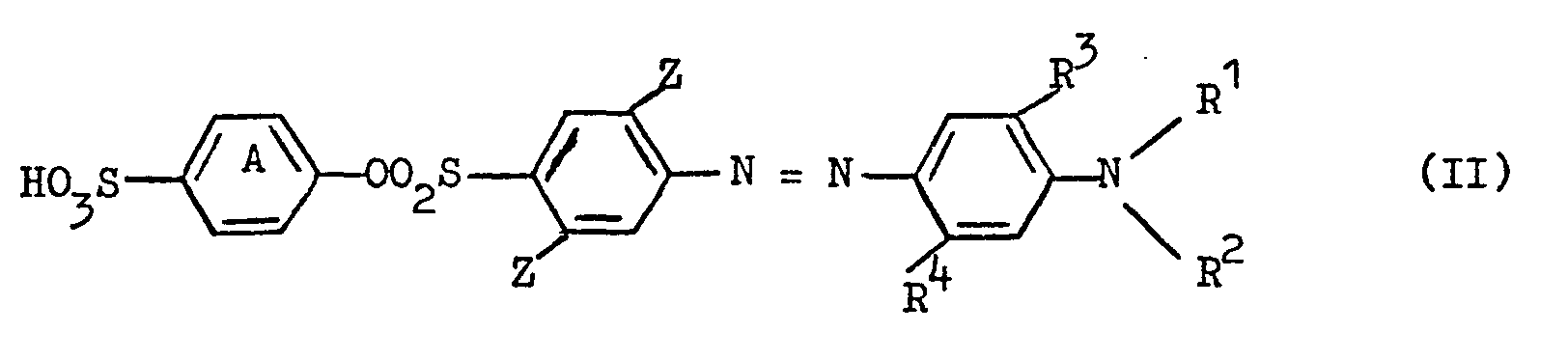
- Particularly valuable dyes within the scope of Formula I have a single sulphonic acid group and are represented by the formula: in which ring A carries no additional substituents, Z represents hydrogen or chlorine, R 1 and R 2 are optionally substituted alkyl radicals, R 3 is hydrogen or C 1-4 alkyl and R 4 is acylamino.
- the dyes of the invention may be prepared by diazotising a primary amine of the formula: and coupling the resulting diazo compound with a coupling component of the formula:
- Primary amines of Formula III may be prepared by condensing a nitro- or acylaminobenzenesulphonyl chloride of the formula: with a phenol of the formula: under alkaline conditions followed by reduction of the nitro group or acid hydrolysis of the acylamino group.
- the symbol Q represents a nitro or acylamino group and ring B may be substituted as previously stated.
- the symbol X has the meaning given above and ring A may be substituted as previously stated.
- Suitable sulphonyl chlorides of Formula V include p-acetylaminobenzenesulphonyl chloride, 2-methyl-5-acetylaminobenzenesulphonyl chloride, 3- and 4-nitrobenzenesulphonyl chlorides, 2-methoxy-5-acetylaminobenzene sulphonyl chloride and 3-chloro-4-acetylaminobenzenesulphonyl chloride.
- Suitable phenols of Formula VI include phenol, o, m and p-cresols, 2,5-dimethylphenol, 2,6-dimethylphenol, 2,4-dimethylphenol, p-tertiarybutylphenol, p-amylphenol, 4-cyclohexylphenol, 4-chlorophenol, 2-methoxyphenol, 4-methoxyphenol, phenol-4-sulphonic acid and p-hydroxybenzoic acid.
- Suitable coupling components of Formula IV include 3-acetylamino-N,N-diethylaniline, 2-methyl-5-acetylamino-N,N-diethylaniline, 3-benzoylamino-N,N-diethylaniline, 3-acetylamino-N,N-bis- ⁇ -hydroxyethylaniline, 3-benzoylamino-N,N-bis- ⁇ -cyanoethylaniline, 3-benzoylamino-N-benzyl-N-ethylaniline, 3-methyl-N,N-diethylaniline, 5-acetylamino-2-methoxy-N-ethylaniline, 5-acetylamino-2-methyl-N-benzyl-N-ethylaniline, 5-acetylamino-2-methyl-N- ⁇ -cyanoethyl-N-ethylaniline, 5-acetylamino-2-methoxy-N,N-diethy
- the reactions leading to the formation of the dyes of the invention may be performed using conditions that have been fully described in the prior art for such reactions.
- the dyes may be isolated by known methods and, as in the case of other dyes containing sulphonic acid groups, it is often convenient to isolate and use the dyes in the form of their water-soluble salts, particularly their alkali metal or ammonium salts and especially sodium salts. It is to be understood that the invention relates to both the free acids and their salts.
- the dyes of the invention are suitable for applying to polyamide textile materials such as wool and silk but especially to synthetic polyamide textile materials, for example nylon 66 and nylon 6, using any of the general methods known for the application of acid dyes to such materials.
- the dyes provide yellow to red shades which have a high degree of fastness to wet treatments and to light and exhibit little or no phototropism.
- a solution of 4.6 parts of sodium nitrite in 30 parts of water is added to a solution of 19.8 parts of 4-phenoxysulphonylaniline-4'-sulphonic acid in 600 parts of water and 8 parts of 32% sodium hydroxide at 0-5"C.
- 30 Parts of 35% hydrochloric acid are then added and stirring is continued at 0-5°C for a further 30 minutes.
- the excess nitrous acid is then destroyed and the diazo suspension is added to a stirred solution of 16.1 parts of 3-benzoylamino-N,N-diethylaniline in 600 parts of water and 12 parts of 35% hydrochloric acid at 0-5°C.
Landscapes
- Chemical & Material Sciences (AREA)
- Organic Chemistry (AREA)
- Coloring (AREA)
Abstract
Water-soluble monoazo dyes having the formula:

in which rings A and B may carry other substituents, X represents hydrogen, carboxy or sulpho, R1 represents hydrogen or an optionally substituted alkyl, aralkyl or aryl radical, R2 represents hydrogen or an optionally substituted alkyl or aralkyl radical, R3 represents hydrogen, halogen, C1-4alkyl or C1-4alkoxy and R4 represents hydrogen, halogen, hydroxy, C1-4alkyl, acylamino, sulpho or carboxy, the substituents being such that the dye molecule contains either one or two sulpho groups.
The dyes are applicable as acid dyes to natural and synthetic polyamide textiles on which they give yellow to red shades.
Description
- This invention relates to monoazo dyes and their application to textile materials.
- According to the invention, there are provided water-soluble monoazo dyes which, in the form of the free acids, have the formula:

- Other substituents which may be present on ring A in addition to those shown in the formula include halogen atoms, especially chlorine and bromine, C1-9alkyl, C1-4alkoxy and cycloalkyl radicals. Other substituents which may be present on ring B include halogen atoms, especially chlorine and bromine, C1-4alkyl, C1-4alkoxy, sulpho and carboxy radicals.
- Optionally substituted alkyl radicals which may be represented by R and R2 include, in particular, optionally substituted C1-4alkyl radicals, suitable substituents being halogen, hydroxy, cyano, acyloxy and alkoxycarbonyl. Optionally substituted aralkyl radicals which may be represented by R1 and R2 include benzyl and 3-sulphobenzyl. Optionally substituted aryl radicals which may be represented by R1 include optionally substituted phenyl radicals.
- Acylamino radicals which may be represented by R4 include acetylamino and benzoylamino. The dyes of the invention preferably contain one sulphonic acid group and this is preferably X or R4.
- Particularly valuable dyes within the scope of Formula I have a single sulphonic acid group and are represented by the formula:
- The dyes of the invention may be prepared by diazotising a primary amine of the formula:


- the symbols A, B, X, R 1, R2, R3 and R4 having the meanings given above, the primary amine and the coupling component together containing either one or two sulphonic acid groups.
- Primary amines of Formula III may be prepared by condensing a nitro- or acylaminobenzenesulphonyl chloride of the formula:


- Suitable sulphonyl chlorides of Formula V include p-acetylaminobenzenesulphonyl chloride, 2-methyl-5-acetylaminobenzenesulphonyl chloride, 3- and 4-nitrobenzenesulphonyl chlorides, 2-methoxy-5-acetylaminobenzene sulphonyl chloride and 3-chloro-4-acetylaminobenzenesulphonyl chloride.
- Suitable phenols of Formula VI include phenol, o, m and p-cresols, 2,5-dimethylphenol, 2,6-dimethylphenol, 2,4-dimethylphenol, p-tertiarybutylphenol, p-amylphenol, 4-cyclohexylphenol, 4-chlorophenol, 2-methoxyphenol, 4-methoxyphenol, phenol-4-sulphonic acid and p-hydroxybenzoic acid.
- Suitable coupling components of Formula IV include 3-acetylamino-N,N-diethylaniline, 2-methyl-5-acetylamino-N,N-diethylaniline, 3-benzoylamino-N,N-diethylaniline, 3-acetylamino-N,N-bis-β-hydroxyethylaniline, 3-benzoylamino-N,N-bis-β-cyanoethylaniline, 3-benzoylamino-N-benzyl-N-ethylaniline, 3-methyl-N,N-diethylaniline, 5-acetylamino-2-methoxy-N-ethylaniline, 5-acetylamino-2-methyl-N-benzyl-N-ethylaniline, 5-acetylamino-2-methyl-N-β-cyanoethyl-N-ethylaniline, 5-acetylamino-2-methoxy-N,N-diethylaniline, 5-acetylamino-2-methoxy-N,N-bis-p-hydroxyethylaniline, 5-benzoylamino-2-methyl-N-ethylaniline, 5-benzoylamino-2-methyl-N,N-diethylaniline, 5-benzoylamino-2-methoxy-N-benzyl-N-ethylaniline, 3-acetylamino-N-ethyl-N-p-acetoxyethylaniline, 3-acetylamino-N,N-bis-p-acetoxyethylaniline, 5-acetylamino-2-methyl-N,N-bis-p-acetoxyethylaniline, 3-acetylamino-N-ethyl-N-p-ethoxycarbonylethylaniline, 3-acetylamino-N-β-chloroethyl- aniline, 5-acetylamino-2-chloro-N-ethyl-N-P-hydroxyethylaniline, 5-acetylamino-2-methoxy-N-β-cyanoethylaniline, 3-N,N-diethyl- aminobenzoic acid, 3-N,N-diethylaminobenzenesulphonic acid, N-ethyl-N-3'-sulphobenzylaniline, 3-methyl-N-ethyl-N-3'-sulphobenzylaniline, N,N-dibenzylaniline, 3-methyl-N,N-dibenzyl- aniline, 3-methyl-N,N-dibenzylaniline, 3-chloro-N,N-bis-β-hydroxyethylaniline, diphenylamine and N-methyldiphenylamine.
- The reactions leading to the formation of the dyes of the invention may be performed using conditions that have been fully described in the prior art for such reactions. Similarly, the dyes may be isolated by known methods and, as in the case of other dyes containing sulphonic acid groups, it is often convenient to isolate and use the dyes in the form of their water-soluble salts, particularly their alkali metal or ammonium salts and especially sodium salts. It is to be understood that the invention relates to both the free acids and their salts.
- The dyes of the invention are suitable for applying to polyamide textile materials such as wool and silk but especially to synthetic polyamide textile materials, for example nylon 66 and nylon 6, using any of the general methods known for the application of acid dyes to such materials. The dyes provide yellow to red shades which have a high degree of fastness to wet treatments and to light and exhibit little or no phototropism.
- The invention is illustrated but not limited by the following Examples in which all parts and percentages are by weight.
- A solution of 4.6 parts of sodium nitrite in 30 parts of water is added to a solution of 19.8 parts of 4-phenoxysulphonylaniline-4'-sulphonic acid in 600 parts of water and 8 parts of 32% sodium hydroxide at 0-5"C. 30 Parts of 35% hydrochloric acid are then added and stirring is continued at 0-5°C for a further 30 minutes. The excess nitrous acid is then destroyed and the diazo suspension is added to a stirred solution of 16.1 parts of 3-benzoylamino-N,N-diethylaniline in 600 parts of water and 12 parts of 35% hydrochloric acid at 0-5°C. Saturated sodium acetate solution is then added to adjust the pH to 4 and stirring at 0-5°C is continued for 2 hours. 32% Sodium hydroxide solution is then added to adjust the pH to 9 and, after heating to 40°C, 60 parts of sodium chloride are added. The precipitate is filtered off, washed with 2% brine solution and dried.
- When applied to nylon 66 from a weakly acid bath, a strong scarlet shade is obtained which exhibits good wet. fastness and light fastness.
- The following Table gives further Examples of dyestuffs of the invention which may be obtained by diazotising the amine listed in the second column and coupling with the para-coupling amine listed in the third column. The shades obtained on nylon are listed in the fourth column.


Claims (6)
1. A water-soluble monoazo dye which, in the form of the free acid, has the formula:

in which rings A and B may carry other substituents, X represents hydrogen, carboxy or sulpho, R represents hydrogen or an optionally substituted alkyl, aralkyl or aryl radical, R2 represents hydrogen or an optionally substituted alkyl or aralkyl radical, R3 represents hydrogen, halogen, C1-4alkyl or C1-4alkoxy and R4 represents hydrogen, halogen, hydroxy, C1-4alkyl, acylamino, sulpho or carboxy, the substituents being such that the dye molecule contains either.one or two sulpho groups.
2. A water-soluble monoazo dye according to claim 1 wherein X is hydrogen or sulpho, ring A may optionally be substituted by one or two C1-4 alkyl groups, ring B may optionally be substituted by one or two substituents selected from chlorine and C1-4 alkyl, R1 is hydrogen, C1-4 alkyl which may be substituted by hydroxy, benzyl, sulphopenzyl or phenyl, R2 is hydrogen, C1-4 alkyl which may be substituted by hydroxy, or benzyl, R3 is hydrogen, chlorine, C1-4 alkyl or C1-4 alkoxy and R4 is hydrogen, chlorine, C1-4 alkyl, acetylamino, benzoylamino or sulpho.
3. A water-soluble monoazo dye according to claim 1 or claim 2 which contains only one sulphonic acid group.
4. A water-soluble monoazo dye according to claim 3 having the formula:

in which ring A carries no additional substituents, Z represents hydrogen or chlorine, R1 and R2 are optionally substituted alkyl radicals, R3 is hydrogen or C1-4alkyl and R4 is acylamino.
5. A method for the preparation of a water-soluble monoazo dye as defined in claim 1 which comprises diazotising a primary amine of the formula:
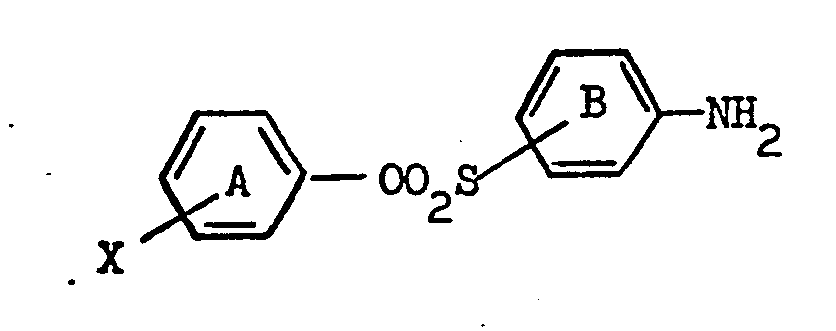
and coupling the resulting diazo compound with a coupling component of the formula:

the symbols A, B, X, R 1, R 2, R 3 and R 4 having the meanings given in claim 1, the primary amine and the coupling component together containing either one or two sulphonic acid groups.
6. A process for the coloration of polyamide textile materials which comprises applying thereto a water-soluble monoazo dye as defined in claim 1.
Applications Claiming Priority (2)
| Application Number | Priority Date | Filing Date | Title |
|---|---|---|---|
| GB7901350 | 1979-01-15 | ||
| GB7901350 | 1979-01-15 |
Publications (1)
| Publication Number | Publication Date |
|---|---|
| EP0014031A1 true EP0014031A1 (en) | 1980-08-06 |
Family
ID=10502520
Family Applications (1)
| Application Number | Title | Priority Date | Filing Date |
|---|---|---|---|
| EP80300041A Withdrawn EP0014031A1 (en) | 1979-01-15 | 1980-01-04 | Water-soluble monoazo dyes of the azobenzene series, their preparation and process for the colouration of polyamide textile materials |
Country Status (1)
| Country | Link |
|---|---|
| EP (1) | EP0014031A1 (en) |
Cited By (1)
| Publication number | Priority date | Publication date | Assignee | Title |
|---|---|---|---|---|
| US5106960A (en) * | 1980-03-28 | 1992-04-21 | Ciba-Geigy Corporation | Azo dyes and the production and use thereof |
Citations (1)
| Publication number | Priority date | Publication date | Assignee | Title |
|---|---|---|---|---|
| GB901692A (en) * | 1957-12-24 | 1962-07-25 | Cfmc | New monoazo dyestuffs containing sulphonoxy groups, their preparation and their application to dyeing |
-
1980
- 1980-01-04 EP EP80300041A patent/EP0014031A1/en not_active Withdrawn
Patent Citations (1)
| Publication number | Priority date | Publication date | Assignee | Title |
|---|---|---|---|---|
| GB901692A (en) * | 1957-12-24 | 1962-07-25 | Cfmc | New monoazo dyestuffs containing sulphonoxy groups, their preparation and their application to dyeing |
Cited By (1)
| Publication number | Priority date | Publication date | Assignee | Title |
|---|---|---|---|---|
| US5106960A (en) * | 1980-03-28 | 1992-04-21 | Ciba-Geigy Corporation | Azo dyes and the production and use thereof |
Similar Documents
| Publication | Publication Date | Title |
|---|---|---|
| US3951944A (en) | Fiber-reactive, water-soluble disazo dyes containing an N-B-sulfoethylamide group | |
| US4009156A (en) | Hydroxynaphthalene trisazo dyestuffs | |
| US3234208A (en) | Water-soluble monoazo dyestuffs and process for their manufacture | |
| US4996303A (en) | Preparation of 1:2 metal complex dyes by coupling in the presence of a metal donor in an inert gas atmosphere | |
| EP0013609A1 (en) | Water-soluble monoazo dyes of the benzene azo indole series, their preparation and their application for the colouration of polyamide textile materials | |
| US4218373A (en) | Water-soluble phenylazoaminonaphthol sulphonic acid dyestuffs | |
| US4048154A (en) | Monoazo dyestuffs derived from p-sulfo-halophenyl diazo moiety and p-amino-O-alkyl coupler moiety | |
| US2676957A (en) | Deaminated trisazo dye | |
| US2289210A (en) | Soluble azo dye | |
| US3301847A (en) | Reactive disazo dyestuffs | |
| US2216229A (en) | Manufacture of new azo dyestuffs | |
| US3200108A (en) | Basic azo dyes derived from indazole | |
| US4472308A (en) | Azo dyestuffs containing an amino or acylated amino naphthol monosulfonic acid radical and at least one reactive phosphoric or phosphonic acid group | |
| US4162249A (en) | Anthranilic acid arylester-azo-aminonaphthol sulfonic acid dyes | |
| US3932379A (en) | Water-soluble maroon and rubine sulphodiphenylazophenyl- or naphthylazoaniline dyes for polyamide fibers | |
| US3311606A (en) | Monoazo dyes | |
| US3971769A (en) | Sulfoalkyl aminophenyl disazo dyes | |
| US2263994A (en) | Disazo dyestuff | |
| US4287121A (en) | Water-soluble polyfluoro acid azo dyestuffs | |
| US3023071A (en) | Process for the coloration of nylon type 11 fibres | |
| GB2026520A (en) | Monoazo Dyes | |
| US3597412A (en) | Basic triazole containing mono-azo dyestuffs | |
| GB1559292A (en) | Diphenyl ether sulphanic acid-azo phenol dyes | |
| US3624065A (en) | Water-soluble basic trialkyl ammonium phenylazopyrimidine | |
| US2749334A (en) | Disazo dyestuffs and complex copper compounds thereof |
Legal Events
| Date | Code | Title | Description |
|---|---|---|---|
| PUAI | Public reference made under article 153(3) epc to a published international application that has entered the european phase |
Free format text: ORIGINAL CODE: 0009012 |
|
| AK | Designated contracting states |
Designated state(s): BE CH DE FR GB IT |
|
| 17P | Request for examination filed |
Effective date: 19801007 |
|
| STAA | Information on the status of an ep patent application or granted ep patent |
Free format text: STATUS: THE APPLICATION IS DEEMED TO BE WITHDRAWN |
|
| 18D | Application deemed to be withdrawn |
Effective date: 19820402 |
|
| RIN1 | Information on inventor provided before grant (corrected) |
Inventor name: HERBERT, JOHN ALBERT LESLIE Inventor name: YELLAND, MICHAEL |