EP0014408A2 - Verfahren zur Herstellung von Kosmochlorpigmenten (Natrium-Chrom-Doppelsilikat) sowie deren Verwendung - Google Patents
Verfahren zur Herstellung von Kosmochlorpigmenten (Natrium-Chrom-Doppelsilikat) sowie deren Verwendung Download PDFInfo
- Publication number
- EP0014408A2 EP0014408A2 EP80100426A EP80100426A EP0014408A2 EP 0014408 A2 EP0014408 A2 EP 0014408A2 EP 80100426 A EP80100426 A EP 80100426A EP 80100426 A EP80100426 A EP 80100426A EP 0014408 A2 EP0014408 A2 EP 0014408A2
- Authority
- EP
- European Patent Office
- Prior art keywords
- chromium
- nacrsi
- iii
- oxide
- sodium
- Prior art date
- Legal status (The legal status is an assumption and is not a legal conclusion. Google has not performed a legal analysis and makes no representation as to the accuracy of the status listed.)
- Granted
Links
- 239000000049 pigment Substances 0.000 title claims abstract description 21
- 238000004519 manufacturing process Methods 0.000 title description 2
- BPQQTUXANYXVAA-UHFFFAOYSA-N Orthosilicate Chemical compound [O-][Si]([O-])([O-])[O-] BPQQTUXANYXVAA-UHFFFAOYSA-N 0.000 title 1
- HEUMNKZPHGRBKR-UHFFFAOYSA-N [Na].[Cr] Chemical compound [Na].[Cr] HEUMNKZPHGRBKR-UHFFFAOYSA-N 0.000 title 1
- 238000006243 chemical reaction Methods 0.000 claims abstract description 15
- 238000000034 method Methods 0.000 claims abstract description 14
- 239000000203 mixture Substances 0.000 claims abstract description 13
- 239000000470 constituent Substances 0.000 claims abstract description 5
- 238000002360 preparation method Methods 0.000 claims abstract description 4
- 238000010438 heat treatment Methods 0.000 claims abstract 3
- QDOXWKRWXJOMAK-UHFFFAOYSA-N dichromium trioxide Chemical group O=[Cr]O[Cr]=O QDOXWKRWXJOMAK-UHFFFAOYSA-N 0.000 claims description 14
- ZCDOYSPFYFSLEW-UHFFFAOYSA-N chromate(2-) Chemical class [O-][Cr]([O-])(=O)=O ZCDOYSPFYFSLEW-UHFFFAOYSA-N 0.000 claims description 8
- 239000001056 green pigment Substances 0.000 claims description 7
- 239000011651 chromium Substances 0.000 claims description 5
- 150000001875 compounds Chemical class 0.000 claims description 5
- 239000011734 sodium Substances 0.000 claims description 4
- 229910052708 sodium Inorganic materials 0.000 claims description 4
- VYZAMTAEIAYCRO-UHFFFAOYSA-N Chromium Chemical compound [Cr] VYZAMTAEIAYCRO-UHFFFAOYSA-N 0.000 claims description 3
- 239000004115 Sodium Silicate Substances 0.000 claims description 3
- 229910052804 chromium Inorganic materials 0.000 claims description 3
- MOEHVXSVUJUROX-UHFFFAOYSA-M chromium(3+);oxygen(2-);hydroxide Chemical compound [OH-].[O-2].[Cr+3] MOEHVXSVUJUROX-UHFFFAOYSA-M 0.000 claims description 3
- NTHWMYGWWRZVTN-UHFFFAOYSA-N sodium silicate Chemical compound [Na+].[Na+].[O-][Si]([O-])=O NTHWMYGWWRZVTN-UHFFFAOYSA-N 0.000 claims description 3
- XUIMIQQOPSSXEZ-UHFFFAOYSA-N Silicon Chemical compound [Si] XUIMIQQOPSSXEZ-UHFFFAOYSA-N 0.000 claims description 2
- VQWFNAGFNGABOH-UHFFFAOYSA-K chromium(iii) hydroxide Chemical compound [OH-].[OH-].[OH-].[Cr+3] VQWFNAGFNGABOH-UHFFFAOYSA-K 0.000 claims description 2
- 229910052710 silicon Inorganic materials 0.000 claims description 2
- 239000010703 silicon Substances 0.000 claims description 2
- 235000012239 silicon dioxide Nutrition 0.000 claims description 2
- 229910052911 sodium silicate Inorganic materials 0.000 claims description 2
- DGAQECJNVWCQMB-PUAWFVPOSA-M Ilexoside XXIX Chemical compound C[C@@H]1CC[C@@]2(CC[C@@]3(C(=CC[C@H]4[C@]3(CC[C@@H]5[C@@]4(CC[C@@H](C5(C)C)OS(=O)(=O)[O-])C)C)[C@@H]2[C@]1(C)O)C)C(=O)O[C@H]6[C@@H]([C@H]([C@@H]([C@H](O6)CO)O)O)O.[Na+] DGAQECJNVWCQMB-PUAWFVPOSA-M 0.000 claims 3
- WGLPBDUCMAPZCE-UHFFFAOYSA-N Trioxochromium Chemical compound O=[Cr](=O)=O WGLPBDUCMAPZCE-UHFFFAOYSA-N 0.000 claims 2
- PUAQLLVFLMYYJJ-UHFFFAOYSA-N 2-aminopropiophenone Chemical compound CC(N)C(=O)C1=CC=CC=C1 PUAQLLVFLMYYJJ-UHFFFAOYSA-N 0.000 claims 1
- QTBSBXVTEAMEQO-UHFFFAOYSA-M Acetate Chemical compound CC([O-])=O QTBSBXVTEAMEQO-UHFFFAOYSA-M 0.000 claims 1
- BVKZGUZCCUSVTD-UHFFFAOYSA-L Carbonate Chemical compound [O-]C([O-])=O BVKZGUZCCUSVTD-UHFFFAOYSA-L 0.000 claims 1
- BDAGIHXWWSANSR-UHFFFAOYSA-M Formate Chemical compound [O-]C=O BDAGIHXWWSANSR-UHFFFAOYSA-M 0.000 claims 1
- 229910002651 NO3 Inorganic materials 0.000 claims 1
- NHNBFGGVMKEFGY-UHFFFAOYSA-N Nitrate Chemical compound [O-][N+]([O-])=O NHNBFGGVMKEFGY-UHFFFAOYSA-N 0.000 claims 1
- IOVCWXUNBOPUCH-UHFFFAOYSA-M Nitrite anion Chemical compound [O-]N=O IOVCWXUNBOPUCH-UHFFFAOYSA-M 0.000 claims 1
- MUBZPKHOEPUJKR-UHFFFAOYSA-N Oxalic acid Chemical compound OC(=O)C(O)=O MUBZPKHOEPUJKR-UHFFFAOYSA-N 0.000 claims 1
- 150000001447 alkali salts Chemical class 0.000 claims 1
- FEIXNIOTSKFSAZ-UHFFFAOYSA-L azane;dihydroxy(dioxo)chromium Chemical class N.N.O[Cr](O)(=O)=O FEIXNIOTSKFSAZ-UHFFFAOYSA-L 0.000 claims 1
- 150000007942 carboxylates Chemical class 0.000 claims 1
- BFGKITSFLPAWGI-UHFFFAOYSA-N chromium(3+) Chemical compound [Cr+3] BFGKITSFLPAWGI-UHFFFAOYSA-N 0.000 claims 1
- GAMDZJFZMJECOS-UHFFFAOYSA-N chromium(6+);oxygen(2-) Chemical class [O-2].[O-2].[O-2].[Cr+6] GAMDZJFZMJECOS-UHFFFAOYSA-N 0.000 claims 1
- XLYOFNOQVPJJNP-UHFFFAOYSA-M hydroxide Chemical compound [OH-] XLYOFNOQVPJJNP-UHFFFAOYSA-M 0.000 claims 1
- 150000004760 silicates Chemical class 0.000 claims 1
- KKCBUQHMOMHUOY-UHFFFAOYSA-N sodium oxide Chemical compound [O-2].[Na+].[Na+] KKCBUQHMOMHUOY-UHFFFAOYSA-N 0.000 claims 1
- 229910001948 sodium oxide Inorganic materials 0.000 claims 1
- NNBFNNNWANBMTI-UHFFFAOYSA-M brilliant green Chemical compound OS([O-])(=O)=O.C1=CC(N(CC)CC)=CC=C1C(C=1C=CC=CC=1)=C1C=CC(=[N+](CC)CC)C=C1 NNBFNNNWANBMTI-UHFFFAOYSA-M 0.000 description 6
- 238000000137 annealing Methods 0.000 description 5
- 230000035484 reaction time Effects 0.000 description 5
- BASFCYQUMIYNBI-UHFFFAOYSA-N platinum Chemical compound [Pt] BASFCYQUMIYNBI-UHFFFAOYSA-N 0.000 description 4
- HEMHJVSKTPXQMS-UHFFFAOYSA-M Sodium hydroxide Chemical compound [OH-].[Na+] HEMHJVSKTPXQMS-UHFFFAOYSA-M 0.000 description 3
- -1 chromium (III) ions Chemical class 0.000 description 3
- 238000004040 coloring Methods 0.000 description 3
- 239000013078 crystal Substances 0.000 description 3
- 239000000543 intermediate Substances 0.000 description 3
- VYPSYNLAJGMNEJ-UHFFFAOYSA-N Silicium dioxide Chemical compound O=[Si]=O VYPSYNLAJGMNEJ-UHFFFAOYSA-N 0.000 description 2
- CDBYLPFSWZWCQE-UHFFFAOYSA-L Sodium Carbonate Chemical compound [Na+].[Na+].[O-]C([O-])=O CDBYLPFSWZWCQE-UHFFFAOYSA-L 0.000 description 2
- 239000003513 alkali Substances 0.000 description 2
- 239000011230 binding agent Substances 0.000 description 2
- 210000003298 dental enamel Anatomy 0.000 description 2
- 238000000227 grinding Methods 0.000 description 2
- 238000002844 melting Methods 0.000 description 2
- 230000008018 melting Effects 0.000 description 2
- 239000004033 plastic Substances 0.000 description 2
- 229920003023 plastic Polymers 0.000 description 2
- 229910052697 platinum Inorganic materials 0.000 description 2
- VWDWKYIASSYTQR-UHFFFAOYSA-N sodium nitrate Chemical compound [Na+].[O-][N+]([O-])=O VWDWKYIASSYTQR-UHFFFAOYSA-N 0.000 description 2
- LPXPTNMVRIOKMN-UHFFFAOYSA-M sodium nitrite Chemical compound [Na+].[O-]N=O LPXPTNMVRIOKMN-UHFFFAOYSA-M 0.000 description 2
- 230000003595 spectral effect Effects 0.000 description 2
- JHWIEAWILPSRMU-UHFFFAOYSA-N 2-methyl-3-pyrimidin-4-ylpropanoic acid Chemical compound OC(=O)C(C)CC1=CC=NC=N1 JHWIEAWILPSRMU-UHFFFAOYSA-N 0.000 description 1
- PMJNEQWWZRSFCE-UHFFFAOYSA-N 3-ethoxy-3-oxo-2-(thiophen-2-ylmethyl)propanoic acid Chemical compound CCOC(=O)C(C(O)=O)CC1=CC=CS1 PMJNEQWWZRSFCE-UHFFFAOYSA-N 0.000 description 1
- 239000006004 Quartz sand Substances 0.000 description 1
- VMHLLURERBWHNL-UHFFFAOYSA-M Sodium acetate Chemical compound [Na+].CC([O-])=O VMHLLURERBWHNL-UHFFFAOYSA-M 0.000 description 1
- 239000004280 Sodium formate Substances 0.000 description 1
- AOHLSBBWKURIBX-UHFFFAOYSA-N [O-2].[Cr+3].[Ti+4].[Al+3].[Zn+2].[Ni+2].[Co+2].[O-2].[O-2].[O-2].[O-2].[O-2].[O-2].[O-2] Chemical compound [O-2].[Cr+3].[Ti+4].[Al+3].[Zn+2].[Ni+2].[Co+2].[O-2].[O-2].[O-2].[O-2].[O-2].[O-2].[O-2] AOHLSBBWKURIBX-UHFFFAOYSA-N 0.000 description 1
- VOVWNYSUDBEYSL-UHFFFAOYSA-N [Si]([O-])([O-])([O-])[O-].[Cr+3].[Ca+] Chemical compound [Si]([O-])([O-])([O-])[O-].[Cr+3].[Ca+] VOVWNYSUDBEYSL-UHFFFAOYSA-N 0.000 description 1
- JOSWYUNQBRPBDN-UHFFFAOYSA-P ammonium dichromate Chemical compound [NH4+].[NH4+].[O-][Cr](=O)(=O)O[Cr]([O-])(=O)=O JOSWYUNQBRPBDN-UHFFFAOYSA-P 0.000 description 1
- 239000001055 blue pigment Substances 0.000 description 1
- 150000001642 boronic acid derivatives Chemical class 0.000 description 1
- 239000000919 ceramic Substances 0.000 description 1
- KRVSOGSZCMJSLX-UHFFFAOYSA-L chromic acid Substances O[Cr](O)(=O)=O KRVSOGSZCMJSLX-UHFFFAOYSA-L 0.000 description 1
- IAQWMWUKBQPOIY-UHFFFAOYSA-N chromium(4+);oxygen(2-) Chemical compound [O-2].[O-2].[Cr+4] IAQWMWUKBQPOIY-UHFFFAOYSA-N 0.000 description 1
- JOPOVCBBYLSVDA-UHFFFAOYSA-N chromium(6+) Chemical compound [Cr+6] JOPOVCBBYLSVDA-UHFFFAOYSA-N 0.000 description 1
- AYTAKQFHWFYBMA-UHFFFAOYSA-N chromium(IV) oxide Inorganic materials O=[Cr]=O AYTAKQFHWFYBMA-UHFFFAOYSA-N 0.000 description 1
- 229910017052 cobalt Inorganic materials 0.000 description 1
- 239000010941 cobalt Substances 0.000 description 1
- GUTLYIVDDKVIGB-UHFFFAOYSA-N cobalt atom Chemical compound [Co] GUTLYIVDDKVIGB-UHFFFAOYSA-N 0.000 description 1
- 239000006103 coloring component Substances 0.000 description 1
- 229910052593 corundum Inorganic materials 0.000 description 1
- 239000010431 corundum Substances 0.000 description 1
- 238000002425 crystallisation Methods 0.000 description 1
- 230000008025 crystallization Effects 0.000 description 1
- 239000002612 dispersion medium Substances 0.000 description 1
- 239000000975 dye Substances 0.000 description 1
- 239000000945 filler Substances 0.000 description 1
- AWJWCTOOIBYHON-UHFFFAOYSA-N furo[3,4-b]pyrazine-5,7-dione Chemical compound C1=CN=C2C(=O)OC(=O)C2=N1 AWJWCTOOIBYHON-UHFFFAOYSA-N 0.000 description 1
- 239000002223 garnet Substances 0.000 description 1
- 150000004820 halides Chemical class 0.000 description 1
- FAHBNUUHRFUEAI-UHFFFAOYSA-M hydroxidooxidoaluminium Chemical group O[Al]=O FAHBNUUHRFUEAI-UHFFFAOYSA-M 0.000 description 1
- 229910052500 inorganic mineral Inorganic materials 0.000 description 1
- 239000001023 inorganic pigment Substances 0.000 description 1
- 150000002500 ions Chemical class 0.000 description 1
- DCYOBGZUOMKFPA-UHFFFAOYSA-N iron(2+);iron(3+);octadecacyanide Chemical compound [Fe+2].[Fe+2].[Fe+2].[Fe+3].[Fe+3].[Fe+3].[Fe+3].N#[C-].N#[C-].N#[C-].N#[C-].N#[C-].N#[C-].N#[C-].N#[C-].N#[C-].N#[C-].N#[C-].N#[C-].N#[C-].N#[C-].N#[C-].N#[C-].N#[C-].N#[C-] DCYOBGZUOMKFPA-UHFFFAOYSA-N 0.000 description 1
- 238000010902 jet-milling Methods 0.000 description 1
- MOUPNEIJQCETIW-UHFFFAOYSA-N lead chromate Chemical compound [Pb+2].[O-][Cr]([O-])(=O)=O MOUPNEIJQCETIW-UHFFFAOYSA-N 0.000 description 1
- 239000007788 liquid Substances 0.000 description 1
- 239000000155 melt Substances 0.000 description 1
- 239000011707 mineral Substances 0.000 description 1
- 238000002156 mixing Methods 0.000 description 1
- 239000012860 organic pigment Substances 0.000 description 1
- 230000003647 oxidation Effects 0.000 description 1
- 238000007254 oxidation reaction Methods 0.000 description 1
- 239000002245 particle Substances 0.000 description 1
- IEQIEDJGQAUEQZ-UHFFFAOYSA-N phthalocyanine Chemical compound N1C(N=C2C3=CC=CC=C3C(N=C3C4=CC=CC=C4C(=N4)N3)=N2)=C(C=CC=C2)C2=C1N=C1C2=CC=CC=C2C4=N1 IEQIEDJGQAUEQZ-UHFFFAOYSA-N 0.000 description 1
- 235000019353 potassium silicate Nutrition 0.000 description 1
- 230000001681 protective effect Effects 0.000 description 1
- 239000001632 sodium acetate Substances 0.000 description 1
- 235000017281 sodium acetate Nutrition 0.000 description 1
- 229910000029 sodium carbonate Inorganic materials 0.000 description 1
- 235000017550 sodium carbonate Nutrition 0.000 description 1
- PXLIDIMHPNPGMH-UHFFFAOYSA-N sodium chromate Chemical compound [Na+].[Na+].[O-][Cr]([O-])(=O)=O PXLIDIMHPNPGMH-UHFFFAOYSA-N 0.000 description 1
- KIEOKOFEPABQKJ-UHFFFAOYSA-N sodium dichromate Chemical compound [Na+].[Na+].[O-][Cr](=O)(=O)O[Cr]([O-])(=O)=O KIEOKOFEPABQKJ-UHFFFAOYSA-N 0.000 description 1
- HLBBKKJFGFRGMU-UHFFFAOYSA-M sodium formate Chemical compound [Na+].[O-]C=O HLBBKKJFGFRGMU-UHFFFAOYSA-M 0.000 description 1
- 235000019254 sodium formate Nutrition 0.000 description 1
- 235000011121 sodium hydroxide Nutrition 0.000 description 1
- 239000004317 sodium nitrate Substances 0.000 description 1
- 235000010344 sodium nitrate Nutrition 0.000 description 1
- 235000010288 sodium nitrite Nutrition 0.000 description 1
- ZNCPFRVNHGOPAG-UHFFFAOYSA-L sodium oxalate Chemical compound [Na+].[Na+].[O-]C(=O)C([O-])=O ZNCPFRVNHGOPAG-UHFFFAOYSA-L 0.000 description 1
- 229940039790 sodium oxalate Drugs 0.000 description 1
- 235000019351 sodium silicates Nutrition 0.000 description 1
- 229910052596 spinel Inorganic materials 0.000 description 1
- 239000011029 spinel Substances 0.000 description 1
- XLYOFNOQVPJJNP-UHFFFAOYSA-N water Substances O XLYOFNOQVPJJNP-UHFFFAOYSA-N 0.000 description 1
Images
Classifications
-
- C—CHEMISTRY; METALLURGY
- C09—DYES; PAINTS; POLISHES; NATURAL RESINS; ADHESIVES; COMPOSITIONS NOT OTHERWISE PROVIDED FOR; APPLICATIONS OF MATERIALS NOT OTHERWISE PROVIDED FOR
- C09C—TREATMENT OF INORGANIC MATERIALS, OTHER THAN FIBROUS FILLERS, TO ENHANCE THEIR PIGMENTING OR FILLING PROPERTIES ; PREPARATION OF CARBON BLACK ; PREPARATION OF INORGANIC MATERIALS WHICH ARE NO SINGLE CHEMICAL COMPOUNDS AND WHICH ARE MAINLY USED AS PIGMENTS OR FILLERS
- C09C1/00—Treatment of specific inorganic materials other than fibrous fillers; Preparation of carbon black
- C09C1/34—Compounds of chromium
- C09C1/343—Compounds of chromium containing silicon or associated with silicon containing material, except when silicon only occurs in a thin coating of the particles
-
- C—CHEMISTRY; METALLURGY
- C01—INORGANIC CHEMISTRY
- C01B—NON-METALLIC ELEMENTS; COMPOUNDS THEREOF; METALLOIDS OR COMPOUNDS THEREOF NOT COVERED BY SUBCLASS C01C
- C01B33/00—Silicon; Compounds thereof
- C01B33/20—Silicates
Definitions
- Unmixed, inorganic, oxidic green pigments of uniform crystal structure which contain chromium (III) ions alone or together with colorless or coloring ions in the lattice, are essentially chromium (III) oxide pigments with corundum structure, chromium (III) oxide hydroxide pigments with boehmite structure, calcium chromium (III) -silicate pigments with a garnet structure and cobalt-nickel-zinc-aluminum-titanium-chromium oxide pigments with an inverse spinel structure.
- inorganic green pigments have a beautiful, bright color, they contain a considerable proportion of cobalt, are therefore very high or have a comparison, for example with the bright green, multi-phase mixed pigments of yellow lead chromate (VI) - with phthalocyanine or Berlin blue Pigments an obtuse and unsaturated hue for many areas of application.
- the green, multi-phase mixed pigments mentioned which contain inorganic and organic components, separate very easily due to the large differences in specific weight when used in liquid dispersion media and, because of their lead and chromate (VI) content, can only be produced with special protective measures and to apply. There is therefore considerable interest in bright green, unmixed, single-phase, purely inorganic, oxidic green pigments with a uniform crystal structure which can be produced economically in a simple manner.
- the production of cosmochlor by melting a mixture of individual components corresponding to the stoichiometric composition NaCrSi 2 0 6 is according to Frondel u. Small (loc. Cit.) Not possible.
- the present invention therefore relates to a process for the preparation of cosmochlorine pigments of the composition NaCrSi206, which is characterized in that, based on the formula NaCrSi 2 0 6, stoichiometric to almost stoichiometric amounts of such components which contain at least one constituent of the formula NaCrSi 2 O 6 or when heated to the reaction temperature, optionally mixed with the addition of mineralizers and heated at least twice to a reaction temperature between 850 and 1150 ° C. with an intermediate comminution.
- stoichiometric amounts of the components are understood to mean + 10% by weight, preferably ⁇ 5% by weight, based on the calculated Cr203 content of cosmochlor of 33.46%.
- V according to the invention is particularly preferred, however, to know with stoichiometric amounts of such components in the composition, if appropriate also only when heated to the reaction temperature, the overall composition NaCrSi give 2 O 6, performed.
- mineralizers for example alkali halides or alkali borates
- mineralizers for example alkali halides or alkali borates
- individual components are sodium hydroxide, sodium carbonate, sodium nitrate, sodium nitrite, sodium formate, sodium acetate, sodium oxalate, sodium carboxylates, preferably sodium chromate (VI), sodium dichromate (VI), sodium silicates and silicas, also water glass with specific surfaces from about 0.01 to about 1000 m2 / g, quartz sand, ammonium chromate (VI), ammonium dichromate (VI), chromic acid, chromium (III) oxide, chromium (IV) oxide and oxidic intermediates in which the chromium has an oxidation number between 4 and 6, chromium (III) oxide hydroxides and amorphous to crystalline chromium (III) hydroxides or oxide adequately used.
- the compounds mentioned are individual ones which only give the desired constituents when heated or at the
- the annealing process it is necessary for the annealing process to be carried out at least twice at the reaction temperature so that the desired emerald-green pigment NaCrSi 2 0 6 is present in a homogeneous form without any proportions of water-soluble chromate (VI).
- the reaction temperature which is between 850 to 1150 ° C., preferably between 900 to 1100 ° C., is to be selected in coordination with the reaction time of at least the second and, if appropriate, the further anneals, so that the particle size of the product after the annealing is in the micron range.
- the reaction time to be complied with depends on the components used, the reaction temperature and the frequency of annealing. According to the invention, however, the starting components are annealed until the resulting chromium (VI) product is free and has a cosmochlorine structure. To a sufficient extent, this is the case with two annealing with a total reaction time of about 1.5 hours. However, a time of at least 45-90 minutes is preferably observed for each annealing. Longer reaction times of up to 10 hours in total are harmless to the cosmochlor structure and can be set.
- Strongly lattice-disturbed amorphous or crystalline silicas with a BET specific surface area of 0.01 to 1000 m 2 / g are preferably used as the silicon-containing component.
- glassy amorphous and crystalline sodium silicate is preferably used.
- the starting components described above in stoichiometric amounts are heated at least twice with an intermediate comminution after intimate mixing at the above-mentioned reaction temperatures and reaction times, and the product obtained is then finely ground.
- the present invention furthermore relates to the use of the cosmochlorine compound prepared according to the invention as a pigment, in particular for coloring transparent or opaque, also with other inorganic or organic pigments or dyes or fillers of colored inorganic, organic binders, plastics or glazes for enamel and ceramics.
- the cosmochlor pigments produced according to the invention are distinguished from commercially available green, relatively dull and unsaturated eskolaite and uwarowit pigments by a bright emerald green color with high color saturation. They are therefore particularly well suited as a single-phase, unmixed chromium (III) oxide pigment for transparent or opaque coloring of inorganic and organic binders, plastics and / or enamel layers and glazes.
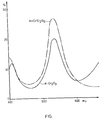
- the figure shows the spectral reflectance of a commercially available ⁇ -Cr 2 O 3 green pigment together with that of a coschloric pigment of the formula NaCrSi 2 O 6 produced by the process according to the invention.
- the cosmochlor pigment has an increased reflectance in the middle green spectral range. A remission in the long-wave red area occurs only to a minor extent compared to that of the ⁇ -Cr 2 0 3 , on which the particularly desirable emerald-green shade of the cosmochlorine pigment with the high color saturation is based.
- the emerald-green pigments of cosmochlor structure which can be obtained by the present process can be subjected to wet, dry or steam jet milling in the usual way, they can be used to improve the dis pergierici be surrounded or mixed with inorganic or organic grinding aids or dispersing aids.
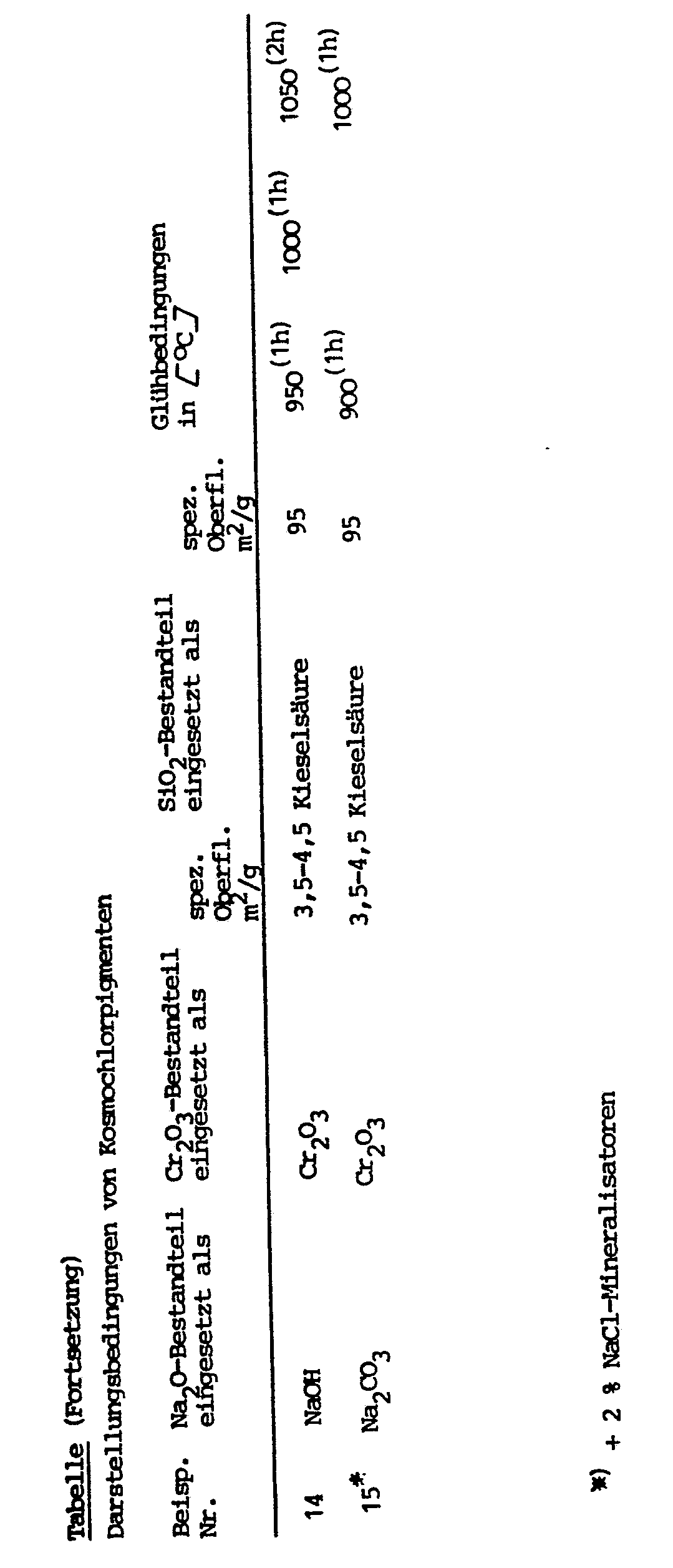
- the individual components or compounds listed in the table were ground intensively in an agate ball mill after corresponding analyzes.
- the ground mixture was air-annealed in a platinum dish at the temperatures given in the individual examples, cooled, intensively ground and then annealed in the platinum dish at the stated, usually higher temperature, cooled and ground again. This process was optionally repeated 1 to 2 times up to the specified final temperature, with a part of the sample being checked for freedom from chromate (VI) after each grinding. All samples were further annealed at the same or increasing temperature until chromate (VI) -free and pure cosmochlor lattice was present. All pigments had a bright emerald green color and the reflectance values were on the curve shown in the figure.
Landscapes
- Chemical & Material Sciences (AREA)
- Organic Chemistry (AREA)
- Inorganic Chemistry (AREA)
- Pigments, Carbon Blacks, Or Wood Stains (AREA)
- Silicates, Zeolites, And Molecular Sieves (AREA)
- Glass Compositions (AREA)
- Inorganic Compounds Of Heavy Metals (AREA)
- Organic Low-Molecular-Weight Compounds And Preparation Thereof (AREA)
Abstract
Description
- Ungemischte, anorganische, oxidische Grünpigmente einheitlicher Kristallstruktur, die Chrom(III)-ionen allein oder zusammen mit farblosen oder farbgebenden Ionen im Gitter enthalten, sind im wesentlichen Chrom(III)-oxidpigmente mit Korundstruktur, Chrom(III)-oxidhydroxidpigmente mit Böhmitstruktur, Calciumchrom(III)-silikatpigmente mit Granatstruktur und Kobalt-Nickel-Zink-Aluminium-Titan-Chromoxidpigmente mit inverser Spinellstruktur. Besitzen solche anorganischen Grünpigmente eine schöne, leuchtende Farbe, so enthalten sie einen beträchtlichen Kobaltanteil, stehen daher sehr hoch ein oder haben im Vergleich, z.B. mit den leuchtend grünen, mehrphasigen Mischpigmenten von gelbem Bleichromat(VI)- mit Phthalocyanin-oder Berliner-Blau-Pigmenten einen für viele Anwendungsgebiete unerwünschten stumpfen und ungesättigten Farbton. Die erwähnten grünen, mehrphasigen Mischpigmente, die anorganische und organische Komponenten enthalten, entmischen sich aufgrund der großen Unterschiede im spezifischen Gewicht bei der Anwendung in flüssigen Dispersionsmedien sehr leicht und sind wegen ihres Blei- und Chromat(VI)-Gehaltes nur unter besonderen Schutzmaßnahmen herzustellen und anzuwenden. Es besteht daher ein erhebliches Interesse an leuchtend grünen, ungemischten, einphasigen, rein anorganischen, oxidischen Grünpigmenten einheitlicher Kristallstruktur, die in einfacher Weise wirtschaftlich herstellbar sind.
- Ein smaragdgrünes, als farbgebenden Bestandteil nur Chrom-(III)-ionen enthaltendes Oxid wurde in dem grünen Bestandteil von Meteroiten gefunden. Dieses Mineral, NaCrSi2O6, wurde aufgrund seiner Herkunft und Farbe "Kosmochlor" genannt.
- Es ist bekannt, Frondel u. Klein, Science, Vol. 149, Seiten 742-744 (1965), Kosmochlor synthetisch einerseits durch Schmelzen einer bezogen auf die Formel NacrSi206 nichtstöchiometrischen Mischung einzelner Komponenten in einzelnen Kristallen und andererseits unter 10 kbar Druck bei 600°C herzustellen. Die Herstellung von Kosmochlor durch Schmelzen einer der stöchiometrischen Zusammensetzung NaCrSi206 entsprechenden Mischung einzelner Komponenten ist nach Frondel u. Klein (a.a.O.) nicht möglich.
- Erfindungsgemäß wurde nun überraschenderweise gefunden, daß es doch möglich ist, Kosmochlor als Pigment ohne Anwendung einer Schmelze und eines zusätzlichen Druckes herzustellen.
- Gegenstand der vorliegenden Erfindung ist daher ein Verfahren zur Herstellung von Kosmochlorpigmenten der Zusammensetzung NaCrSi206, welches dadurch gekennzeichnet ist, daß man bezogen auf die Formel NaCrSi206 stöchianetrische bis nahezu stöchiometrische Mengen solcher Komponenten, die zumindest einen Bestandteil der Formel NaCrSi2O6 enthalten bzw. beim Erhitzen auf Reaktionstemperatur ergeben, gegebenenfalls unter Zusatz von Mineralisatoren vermengt und mindestens 2 mal auf eine Reaktionstemperatur zwischen 850 und 1150°C mit einer intermediären Zerkleinerung aufheizt.
- Unter nahezu stöchiometrischen Mengen der Komponenten werden + 10 Gew.-%, wrzugsweise ± 5 Gew.-%, bezogen auf den berechneten Cr203-Gehalt von Kosmochlor von 33,46 % verstanden. Besonders bevorzugt wird das erfindungsgemäße Verfahren jedoch mit stöchiometrischen Mengen solcher Komponenten, die in ihrer Zusammensetzung, gegebenenfalls auch erst beim Erhitzen auf Reaktionstemperatur, die Bruttozusammensetzung NaCrSi2O6 ergeben, durchgeführt.
- Gegebenenfalls können einer solchen Ausgangsmischung kleine Mengen an Mineralisatoren, z.B. Alkalihalogenide oder Alkaliborate zugesetzt werden. Als einzelne Komponenten werden z.B. Natriumhydroxid, Natriumcarbonat, Natriumnitrat, Natriumnitrit, Natriumformiat, Natriumacetat, Natriumoxalat, Natriumcarboxylate, bevorzugt Natriumchromat (VI), Natriumdichromat(VI), Natriumsilikate und Kieselsäuren, auch Wasserglas mit spezifischen Oberflächen von etwa 0,01 bis etwa 1000 m2/g, Quarzsand, Ammoniumchromat(VI), Ammoniumdichromat(VI), Chromsäure, Chrom(III)-oxid, Chrom(IV)-oxid und oxidische Zwischenprodukte, in denen das Chrom eine Oxidationszahl zwischen 4 und 6 besitzt, Chrom(III)-oxidhydroxide und amorphe bis kristalline Chrom(III)-hydroxide bzw. Oxidaquate eingesetzt. Unter den genannten Verbindungen sind einzelne, die die gewünschten Bestandteile erst beim Erhitzen bzw. bei Reaktionstemperatur ergeben.
- Erfindungsgemäß ist es notwendig, daß der Glühvörgang bei Reaktionstemperatur mindestens 2 mal vorgenommen wird, damit das gewünschte smaragdgrüne Pigment NaCrSi206 in homogener Form ohne Anteile an wasserlöslichem Chromat (VI) vorliegt.
- Die Reaktionstemperatur, die zwischen 850 bis 1150 C, vorzugsweise zwischen 900 bis 1100°C liegt, ist in Abstimmung mit der Reaktionsdauer zumindest der zweiten und gegebenenfalls den weiteren Glühungen so zu wählen, daß die Teilchengröße des Produktes nach der Glühung im Mikronbereich liegt. Die einzuhaltende Reaktionsdauer richtet sich nach den eingesetzten Komponenten, der Reaktionstemperatur und der Häufigkeit der Glühungen Erfindungsgemäß werden die Ausgangskomponenten jedoch so lange geglüht, bis das entstandene Produkt Chrom(VI) frei ist und Kosmochlorstruktur aufweist. Dies ist bei einer zweimaligen Glühung bei einer gesamten Reaktionsdauer von ca. 1,5 Stunden zum ausreichenden Teil der Fall. Vorzugsweise wird jedoch bei jeder Glühung eine Zeit von mindestens 45-90 Minuten eingehalten. Auch längere Reaktionsdauern bis insgesamt z.B. 10 Stunden sind unschädlich für die Kosmochlorstruktur und können eingestellt werden.
- Vorzugsweise wird zur Herstellung der erfindungsgemäßen Kosmochlorpigmente ein Gemisch von - bezogen auf die Formel NaCrSi206 - stöchiometrischen Mengen an Si02 und Natriumdichromat, das sowohl mit als auch ohne Kristallwasser eingesetzt werden kann, verwendet. Als siliciumhaltige Komponente werden vorzugsweise stark gittergestörte amorphe oder kristalline Kieselsäuren mit einer spezifischen Oberfläche nach BET von 0,01 bis 1000 m2/g eingesetzt.
- Des weiteren wird glasig amorphes und kristallines Natriumsilikat bevorzugt verwendet.
- Die vorstehend beschriebenen Ausgangs-Komponenten in stöchiometrischen Mengen werden nach einer innigen Vermengung bei den vorstehend genannten Reaktionstemperaturen und Reaktionsdauern mindestens 2 mal mit einer intermediären Zerkleinerung aufgeheizt und das erhaltene Produkt anschließend fein gemahlen.
- Gegenstand der vorliegenden Erfindung ist ferner die Verwendung der erfindungsgemäß hergestellten Kosmochlorverbindung als Pigment, insbesondere zur Einfärbung transparenter oder deckender, auch mit anderen anorganischen oder organischen Pigmenten oder Farb- oder Füllstoffen gefärbter anorganischer, organischer Bindemittel, Kunststoffe oder von Glasuren für Email und Keramik.
- Die erfindungsgemäß hergestellten Kosmochlorpigmente zeichnen sich gegenüber handelsüblichen grünen, relativ stumpf und ungesättigt aussehenden Eskolait- und Uwarowit-Pigmenten durch einen leuchtend smaragdgrünen Farbton mit hoher Farbsättigung aus. Sie sind daher als einphasiges, unvermischtes Chrom(III)-oxidpigment zur transparenten oder deckenden Einfärbung anorganischer und organischer Bindemittel, Kunststoffe und/oder Emailschichten sowie Glasuren besonders gut geeignet.
- In der Figur ist die spektrale Remission eines handelsüblichen α-Cr2O3-Grünpigmentes zusammen mit der eines nach dem erfindungsgemäßen Verfahrens hergestellten Koschlorpigmentes der Formel NaCrSi2O6 abgebildet. Das Kosmochlorpigment weist eine erhöhte Remission im mittleren grünen Spektralbereich auf. Eine Remission im langwelligen roten Bereich tritt gegenüber der des α-Cr203 nur in untergeordnetem Maße auf, worauf der besonders erwünschte smaragdgrüne Farbton des Kosmochlorpigments mit der hohen Farbsättigung beruht.
- Die nach dem vorliegenden Verfahren erhältlichen smaragdgrünen Pigmente von Kosmochlorstruktur können in übli- ,cher Weise einer Naß-, Trocken- oder Dampfstrahlmahlung unterworfen werden, sie können zur Verbesserung der Dispergierbarkeit mit anorganischen oder organischen Mahlhilfs- oder Dispergierhilfsmitteln umgeben oder versetzt werden.
- Das vorliegende Verfahren soll nun anhand der folgenden Beispiele noch näher beschrieben werden:
- Für jeweils 30 g der gewünschten Verbindung NacrSi206 wurden die in der Tabelle angegebenen Einzelbestandteile oder Verbindungen nach entsprechenden Analysen in einer Achat-Kugelmühle intensiv gemahlen. Die gemahlene Mischung wurde in einer Platinschale bei den in den einzelnen Beispielen angegebenen Temperaturen an der Luft geglüht, abgekühlt, intensiv gemahlen und anschließend in der Platinschale bei der angegebenen, zumeist höheren Temperatur geglüht, abgekühlt und wieder gemahlen. Dieser Vorgang wurde gegebenenfalls noch 1 bis 2 mal bis zur angegebenen Endtemperatur wiederholt, wobei jeweils nach jeder Mahlung ein Teil der Probe auf Chromat(VI)-freiheit geprüft wurde. Alle Proben wurden so lange bei gleicher oder steigender Temperatur weiter geglüht, bis Chromat(VI)-freiheit und reines Kosmochlorgitter vorlag. Sämtliche Pigmente besaßen eine leuchtend smaragdgrüne Farbe, und die Remissionswerte lagen auf der in der Figur angegebenen Kurve.
-


Claims (8)
Priority Applications (1)
| Application Number | Priority Date | Filing Date | Title |
|---|---|---|---|
| AT80100426T ATE677T1 (de) | 1979-02-08 | 1980-01-28 | Verfahren zur herstellung von kosmochlorpigmenten (natrium-chrom-doppelsilikat) sowie deren verwendung. |
Applications Claiming Priority (2)
| Application Number | Priority Date | Filing Date | Title |
|---|---|---|---|
| DE2904828A DE2904828C2 (de) | 1979-02-08 | 1979-02-08 | Verfahren zur Herstellung der Kosmochlorverbindung der Zusammensetzung NaCrSi↓2↓0↓6↓ |
| DE2904828 | 1979-02-08 |
Publications (3)
| Publication Number | Publication Date |
|---|---|
| EP0014408A2 true EP0014408A2 (de) | 1980-08-20 |
| EP0014408A3 EP0014408A3 (en) | 1980-09-17 |
| EP0014408B1 EP0014408B1 (de) | 1982-02-10 |
Family
ID=6062479
Family Applications (1)
| Application Number | Title | Priority Date | Filing Date |
|---|---|---|---|
| EP80100426A Expired EP0014408B1 (de) | 1979-02-08 | 1980-01-28 | Verfahren zur Herstellung von Kosmochlorpigmenten (Natrium-Chrom-Doppelsilikat) sowie deren Verwendung |
Country Status (5)
| Country | Link |
|---|---|
| EP (1) | EP0014408B1 (de) |
| JP (1) | JPS55109218A (de) |
| AT (1) | ATE677T1 (de) |
| DE (2) | DE2904828C2 (de) |
| ES (1) | ES488338A1 (de) |
Cited By (1)
| Publication number | Priority date | Publication date | Assignee | Title |
|---|---|---|---|---|
| EP0057400A3 (de) * | 1981-02-04 | 1982-09-01 | Bayer Ag | Brillante grüne Kompositions-Pigmente |
Families Citing this family (1)
| Publication number | Priority date | Publication date | Assignee | Title |
|---|---|---|---|---|
| DE3103818A1 (de) * | 1981-02-04 | 1982-09-09 | Bayer Ag, 5090 Leverkusen | Verfahren zur herstellung cr-haltiger klinopyroxen-phasen und deren verwendung |
Family Cites Families (2)
| Publication number | Priority date | Publication date | Assignee | Title |
|---|---|---|---|---|
| SU412144A1 (de) * | 1970-07-06 | 1974-01-25 | ||
| SU676551A1 (ru) * | 1973-07-05 | 1979-07-30 | Предприятие П/Я А-7125 | Способ получени натрийхромового силиката |
-
1979
- 1979-02-08 DE DE2904828A patent/DE2904828C2/de not_active Expired
-
1980
- 1980-01-28 DE DE8080100426T patent/DE3060185D1/de not_active Expired
- 1980-01-28 AT AT80100426T patent/ATE677T1/de not_active IP Right Cessation
- 1980-01-28 EP EP80100426A patent/EP0014408B1/de not_active Expired
- 1980-02-06 JP JP1257480A patent/JPS55109218A/ja active Pending
- 1980-02-07 ES ES488338A patent/ES488338A1/es not_active Expired
Cited By (1)
| Publication number | Priority date | Publication date | Assignee | Title |
|---|---|---|---|---|
| EP0057400A3 (de) * | 1981-02-04 | 1982-09-01 | Bayer Ag | Brillante grüne Kompositions-Pigmente |
Also Published As
| Publication number | Publication date |
|---|---|
| ATE677T1 (de) | 1982-02-15 |
| EP0014408A3 (en) | 1980-09-17 |
| DE3060185D1 (en) | 1982-03-18 |
| JPS55109218A (en) | 1980-08-22 |
| DE2904828C2 (de) | 1982-09-16 |
| EP0014408B1 (de) | 1982-02-10 |
| DE2904828A1 (de) | 1980-08-14 |
| ES488338A1 (es) | 1980-09-16 |
Similar Documents
| Publication | Publication Date | Title |
|---|---|---|
| DE1951907C3 (de) | Verfahren zur Herstellung eines zeolithischen Alumosilikats mit Faujasitstruktur | |
| EP0074049B1 (de) | Wismutvanadat enthaltendes Gelbpigment und Verfahren zu seiner Herstellung | |
| DE69608771T2 (de) | Rutil-Titandioxid | |
| DE2212317A1 (de) | Neues Aluminiumphosphat und Verfahren zu seiner Herstellung | |
| DE112011100613T5 (de) | Pigment-Additive zur Verbesserung der solaren Reflexion | |
| EP0492244A1 (de) | Bismutvanadatpigmente, Verfahren zu ihrer Herstellung sowie deren Verwendung | |
| DE2401029A1 (de) | Verfahren zur herstellung von ferriten | |
| EP0014408B1 (de) | Verfahren zur Herstellung von Kosmochlorpigmenten (Natrium-Chrom-Doppelsilikat) sowie deren Verwendung | |
| DE112008000520T5 (de) | Verfahren zur Darstellung von UV-emittierenden Pentaborat-Leuchtstoffen | |
| EP2076476A2 (de) | Polykristalline korundfasern und verfahren zu deren herstellung | |
| DE69103872T2 (de) | Pollucitpulver mit niedrigen thermischen Ausdehnungskoeffizienten sowie Verfahren zu ihrer Herstellung. | |
| DE2046009A1 (de) | Herstellung von Anatas Titandioxyd pigment | |
| DE2732713A1 (de) | Farbige pigmente auf basis von titanverbindungen sowie verfahren zu deren herstellung | |
| EP0704498A1 (de) | Höchsttransparente gelbe Eisenoxidpigmente, Verfahren zu ihrer Herstellung sowie deren Verwendung | |
| EP1031536A1 (de) | Tantal(V)-nitrid-Pigmente, Verfahren zu deren Herstellung und deren Verwendung | |
| DE3221338A1 (de) | Verfahren zur herstellung von wismutvanadat enthaltenden gelbpigmenten der zusammensetzung bivo(pfeil abwaerts)4(pfeil abwaerts).x bi(pfeil abwaerts)2(pfeil abwaerts)moo(pfeil abwaerts)6(pfeil abwaerts).y bi(pfeil abwaerts)2(pfeil abwaerts)wo(pfeil abwaerts)6(pfeil abwaerts) | |
| DE2917602A1 (de) | Weicher lithium-titan-zinkferrit und damit arbeitendes magnetisches ablenkglied | |
| DE19907618A1 (de) | Verfahren zur Herstellung von gelben bis roten Pigmenten auf der Basis von Nitriden und Oxidnitriden | |
| EP0304399B1 (de) | Verfahren zur Herstellung von Wismuthvanadaten | |
| DE3429678A1 (de) | Verfahren zur herstellung eines mischphasenpigmentes auf der basis von eisenoxid und chromoxid | |
| DE3301961C2 (de) | ||
| EP1848780B1 (de) | Kompositpigment, verfahren zu dessen herstellung sowie dessen verwendung | |
| DE4119668A1 (de) | Verfahren zur herstellung von bismutvanadat-gelbpigmenten | |
| DE1667377A1 (de) | Verfahren zur Herstellung von kristallinen Zeolithen | |
| DE2439351A1 (de) | Verfahren zur herstellung von eisenoxidschwarzpigmenten (fe tief 3 o tief 4) |
Legal Events
| Date | Code | Title | Description |
|---|---|---|---|
| PUAI | Public reference made under article 153(3) epc to a published international application that has entered the european phase |
Free format text: ORIGINAL CODE: 0009012 |
|
| PUAL | Search report despatched |
Free format text: ORIGINAL CODE: 0009013 |
|
| 17P | Request for examination filed | ||
| AK | Designated contracting states |
Designated state(s): AT BE DE FR GB IT NL SE |
|
| AK | Designated contracting states |
Designated state(s): AT BE DE FR GB IT NL SE |
|
| ITF | It: translation for a ep patent filed | ||
| GRAA | (expected) grant |
Free format text: ORIGINAL CODE: 0009210 |
|
| AK | Designated contracting states |
Designated state(s): AT BE DE FR GB IT NL SE |
|
| REF | Corresponds to: |
Ref document number: 677 Country of ref document: AT Date of ref document: 19820215 Kind code of ref document: T |
|
| REF | Corresponds to: |
Ref document number: 3060185 Country of ref document: DE Date of ref document: 19820318 |
|
| PGFP | Annual fee paid to national office [announced via postgrant information from national office to epo] |
Ref country code: FR Payment date: 19830118 Year of fee payment: 4 |
|
| PGFP | Annual fee paid to national office [announced via postgrant information from national office to epo] |
Ref country code: NL Payment date: 19830128 Year of fee payment: 4 |
|
| PGFP | Annual fee paid to national office [announced via postgrant information from national office to epo] |
Ref country code: DE Payment date: 19831221 Year of fee payment: 5 |
|
| PGFP | Annual fee paid to national office [announced via postgrant information from national office to epo] |
Ref country code: BE Payment date: 19831231 Year of fee payment: 5 |
|
| PGFP | Annual fee paid to national office [announced via postgrant information from national office to epo] |
Ref country code: AT Payment date: 19840105 Year of fee payment: 5 |
|
| PGFP | Annual fee paid to national office [announced via postgrant information from national office to epo] |
Ref country code: SE Payment date: 19840331 Year of fee payment: 5 |
|
| PG25 | Lapsed in a contracting state [announced via postgrant information from national office to epo] |
Ref country code: NL Effective date: 19840801 |
|
| NLV4 | Nl: lapsed or anulled due to non-payment of the annual fee | ||
| PG25 | Lapsed in a contracting state [announced via postgrant information from national office to epo] |
Ref country code: FR Free format text: LAPSE BECAUSE OF NON-PAYMENT OF DUE FEES Effective date: 19840928 |
|
| GBPC | Gb: european patent ceased through non-payment of renewal fee | ||
| REG | Reference to a national code |
Ref country code: FR Ref legal event code: ST |
|
| PG25 | Lapsed in a contracting state [announced via postgrant information from national office to epo] |
Ref country code: AT Effective date: 19850128 |
|
| PG25 | Lapsed in a contracting state [announced via postgrant information from national office to epo] |
Ref country code: SE Effective date: 19850129 |
|
| PG25 | Lapsed in a contracting state [announced via postgrant information from national office to epo] |
Ref country code: BE Effective date: 19850131 |
|
| BERE | Be: lapsed |
Owner name: BAYER A.G. Effective date: 19850128 |
|
| PG25 | Lapsed in a contracting state [announced via postgrant information from national office to epo] |
Ref country code: DE Effective date: 19851001 |
|
| PG25 | Lapsed in a contracting state [announced via postgrant information from national office to epo] |
Ref country code: GB Effective date: 19881118 |
|
| EUG | Se: european patent has lapsed |
Ref document number: 80100426.8 Effective date: 19860129 |
|
| PLBE | No opposition filed within time limit |
Free format text: ORIGINAL CODE: 0009261 |
|
| STAA | Information on the status of an ep patent application or granted ep patent |
Free format text: STATUS: NO OPPOSITION FILED WITHIN TIME LIMIT |