EP0014664A2 - Verfahren und Vorrichtung zur Herstellung zusammengesetzter Gegenstände, insbesondere eines tablettartigen Behälters für die Lagerung verderblicher Produkte. - Google Patents
Verfahren und Vorrichtung zur Herstellung zusammengesetzter Gegenstände, insbesondere eines tablettartigen Behälters für die Lagerung verderblicher Produkte. Download PDFInfo
- Publication number
- EP0014664A2 EP0014664A2 EP80400196A EP80400196A EP0014664A2 EP 0014664 A2 EP0014664 A2 EP 0014664A2 EP 80400196 A EP80400196 A EP 80400196A EP 80400196 A EP80400196 A EP 80400196A EP 0014664 A2 EP0014664 A2 EP 0014664A2
- Authority
- EP
- European Patent Office
- Prior art keywords
- film
- polystyrene
- tray
- expanded
- strip
- Prior art date
- Legal status (The legal status is an assumption and is not a legal conclusion. Google has not performed a legal analysis and makes no representation as to the accuracy of the status listed.)
- Granted
Links
Images


Classifications
-
- B—PERFORMING OPERATIONS; TRANSPORTING
- B32—LAYERED PRODUCTS
- B32B—LAYERED PRODUCTS, i.e. PRODUCTS BUILT-UP OF STRATA OF FLAT OR NON-FLAT, e.g. CELLULAR OR HONEYCOMB, FORM
- B32B37/00—Methods or apparatus for laminating, e.g. by curing or by ultrasonic bonding
- B32B37/14—Methods or apparatus for laminating, e.g. by curing or by ultrasonic bonding characterised by the properties of the layers
- B32B37/15—Methods or apparatus for laminating, e.g. by curing or by ultrasonic bonding characterised by the properties of the layers with at least one layer being manufactured and immediately laminated before reaching its stable state, e.g. in which a layer is extruded and laminated while in semi-molten state
- B32B37/153—Methods or apparatus for laminating, e.g. by curing or by ultrasonic bonding characterised by the properties of the layers with at least one layer being manufactured and immediately laminated before reaching its stable state, e.g. in which a layer is extruded and laminated while in semi-molten state at least one layer is extruded and immediately laminated while in semi-molten state
-
- B—PERFORMING OPERATIONS; TRANSPORTING
- B65—CONVEYING; PACKING; STORING; HANDLING THIN OR FILAMENTARY MATERIAL
- B65D—CONTAINERS FOR STORAGE OR TRANSPORT OF ARTICLES OR MATERIALS, e.g. BAGS, BARRELS, BOTTLES, BOXES, CANS, CARTONS, CRATES, DRUMS, JARS, TANKS, HOPPERS, FORWARDING CONTAINERS; ACCESSORIES, CLOSURES, OR FITTINGS THEREFOR; PACKAGING ELEMENTS; PACKAGES
- B65D25/00—Details of other kinds or types of rigid or semi-rigid containers
- B65D25/14—Linings or internal coatings
-
- B—PERFORMING OPERATIONS; TRANSPORTING
- B29—WORKING OF PLASTICS; WORKING OF SUBSTANCES IN A PLASTIC STATE IN GENERAL
- B29C—SHAPING OR JOINING OF PLASTICS; SHAPING OF MATERIAL IN A PLASTIC STATE, NOT OTHERWISE PROVIDED FOR; AFTER-TREATMENT OF THE SHAPED PRODUCTS, e.g. REPAIRING
- B29C2793/00—Shaping techniques involving a cutting or machining operation
- B29C2793/0063—Cutting longitudinally
-
- B—PERFORMING OPERATIONS; TRANSPORTING
- B29—WORKING OF PLASTICS; WORKING OF SUBSTANCES IN A PLASTIC STATE IN GENERAL
- B29C—SHAPING OR JOINING OF PLASTICS; SHAPING OF MATERIAL IN A PLASTIC STATE, NOT OTHERWISE PROVIDED FOR; AFTER-TREATMENT OF THE SHAPED PRODUCTS, e.g. REPAIRING
- B29C48/00—Extrusion moulding, i.e. expressing the moulding material through a die or nozzle which imparts the desired form; Apparatus therefor
- B29C48/001—Combinations of extrusion moulding with other shaping operations
- B29C48/0013—Extrusion moulding in several steps, i.e. components merging outside the die
- B29C48/0014—Extrusion moulding in several steps, i.e. components merging outside the die producing flat articles having components brought in contact outside the extrusion die
-
- B—PERFORMING OPERATIONS; TRANSPORTING
- B29—WORKING OF PLASTICS; WORKING OF SUBSTANCES IN A PLASTIC STATE IN GENERAL
- B29C—SHAPING OR JOINING OF PLASTICS; SHAPING OF MATERIAL IN A PLASTIC STATE, NOT OTHERWISE PROVIDED FOR; AFTER-TREATMENT OF THE SHAPED PRODUCTS, e.g. REPAIRING
- B29C48/00—Extrusion moulding, i.e. expressing the moulding material through a die or nozzle which imparts the desired form; Apparatus therefor
- B29C48/001—Combinations of extrusion moulding with other shaping operations
- B29C48/0017—Combinations of extrusion moulding with other shaping operations combined with blow-moulding or thermoforming
-
- B—PERFORMING OPERATIONS; TRANSPORTING
- B29—WORKING OF PLASTICS; WORKING OF SUBSTANCES IN A PLASTIC STATE IN GENERAL
- B29C—SHAPING OR JOINING OF PLASTICS; SHAPING OF MATERIAL IN A PLASTIC STATE, NOT OTHERWISE PROVIDED FOR; AFTER-TREATMENT OF THE SHAPED PRODUCTS, e.g. REPAIRING
- B29C48/00—Extrusion moulding, i.e. expressing the moulding material through a die or nozzle which imparts the desired form; Apparatus therefor
- B29C48/001—Combinations of extrusion moulding with other shaping operations
- B29C48/0018—Combinations of extrusion moulding with other shaping operations combined with shaping by orienting, stretching or shrinking, e.g. film blowing
-
- B—PERFORMING OPERATIONS; TRANSPORTING
- B29—WORKING OF PLASTICS; WORKING OF SUBSTANCES IN A PLASTIC STATE IN GENERAL
- B29C—SHAPING OR JOINING OF PLASTICS; SHAPING OF MATERIAL IN A PLASTIC STATE, NOT OTHERWISE PROVIDED FOR; AFTER-TREATMENT OF THE SHAPED PRODUCTS, e.g. REPAIRING
- B29C48/00—Extrusion moulding, i.e. expressing the moulding material through a die or nozzle which imparts the desired form; Apparatus therefor
- B29C48/001—Combinations of extrusion moulding with other shaping operations
- B29C48/0021—Combinations of extrusion moulding with other shaping operations combined with joining, lining or laminating
-
- B—PERFORMING OPERATIONS; TRANSPORTING
- B29—WORKING OF PLASTICS; WORKING OF SUBSTANCES IN A PLASTIC STATE IN GENERAL
- B29C—SHAPING OR JOINING OF PLASTICS; SHAPING OF MATERIAL IN A PLASTIC STATE, NOT OTHERWISE PROVIDED FOR; AFTER-TREATMENT OF THE SHAPED PRODUCTS, e.g. REPAIRING
- B29C48/00—Extrusion moulding, i.e. expressing the moulding material through a die or nozzle which imparts the desired form; Apparatus therefor
- B29C48/001—Combinations of extrusion moulding with other shaping operations
- B29C48/0022—Combinations of extrusion moulding with other shaping operations combined with cutting
-
- B—PERFORMING OPERATIONS; TRANSPORTING
- B29—WORKING OF PLASTICS; WORKING OF SUBSTANCES IN A PLASTIC STATE IN GENERAL
- B29C—SHAPING OR JOINING OF PLASTICS; SHAPING OF MATERIAL IN A PLASTIC STATE, NOT OTHERWISE PROVIDED FOR; AFTER-TREATMENT OF THE SHAPED PRODUCTS, e.g. REPAIRING
- B29C48/00—Extrusion moulding, i.e. expressing the moulding material through a die or nozzle which imparts the desired form; Apparatus therefor
- B29C48/03—Extrusion moulding, i.e. expressing the moulding material through a die or nozzle which imparts the desired form; Apparatus therefor characterised by the shape of the extruded material at extrusion
- B29C48/07—Flat, e.g. panels
- B29C48/08—Flat, e.g. panels flexible, e.g. films
-
- B—PERFORMING OPERATIONS; TRANSPORTING
- B29—WORKING OF PLASTICS; WORKING OF SUBSTANCES IN A PLASTIC STATE IN GENERAL
- B29C—SHAPING OR JOINING OF PLASTICS; SHAPING OF MATERIAL IN A PLASTIC STATE, NOT OTHERWISE PROVIDED FOR; AFTER-TREATMENT OF THE SHAPED PRODUCTS, e.g. REPAIRING
- B29C48/00—Extrusion moulding, i.e. expressing the moulding material through a die or nozzle which imparts the desired form; Apparatus therefor
- B29C48/03—Extrusion moulding, i.e. expressing the moulding material through a die or nozzle which imparts the desired form; Apparatus therefor characterised by the shape of the extruded material at extrusion
- B29C48/09—Articles with cross-sections having partially or fully enclosed cavities, e.g. pipes or channels
- B29C48/10—Articles with cross-sections having partially or fully enclosed cavities, e.g. pipes or channels flexible, e.g. blown foils
-
- B—PERFORMING OPERATIONS; TRANSPORTING
- B29—WORKING OF PLASTICS; WORKING OF SUBSTANCES IN A PLASTIC STATE IN GENERAL
- B29C—SHAPING OR JOINING OF PLASTICS; SHAPING OF MATERIAL IN A PLASTIC STATE, NOT OTHERWISE PROVIDED FOR; AFTER-TREATMENT OF THE SHAPED PRODUCTS, e.g. REPAIRING
- B29C48/00—Extrusion moulding, i.e. expressing the moulding material through a die or nozzle which imparts the desired form; Apparatus therefor
- B29C48/15—Extrusion moulding, i.e. expressing the moulding material through a die or nozzle which imparts the desired form; Apparatus therefor incorporating preformed parts or layers, e.g. extrusion moulding around inserts
- B29C48/154—Coating solid articles, i.e. non-hollow articles
-
- B—PERFORMING OPERATIONS; TRANSPORTING
- B29—WORKING OF PLASTICS; WORKING OF SUBSTANCES IN A PLASTIC STATE IN GENERAL
- B29C—SHAPING OR JOINING OF PLASTICS; SHAPING OF MATERIAL IN A PLASTIC STATE, NOT OTHERWISE PROVIDED FOR; AFTER-TREATMENT OF THE SHAPED PRODUCTS, e.g. REPAIRING
- B29C48/00—Extrusion moulding, i.e. expressing the moulding material through a die or nozzle which imparts the desired form; Apparatus therefor
- B29C48/16—Articles comprising two or more components, e.g. co-extruded layers
- B29C48/18—Articles comprising two or more components, e.g. co-extruded layers the components being layers
- B29C48/21—Articles comprising two or more components, e.g. co-extruded layers the components being layers the layers being joined at their surfaces
-
- B—PERFORMING OPERATIONS; TRANSPORTING
- B29—WORKING OF PLASTICS; WORKING OF SUBSTANCES IN A PLASTIC STATE IN GENERAL
- B29K—INDEXING SCHEME ASSOCIATED WITH SUBCLASSES B29B, B29C OR B29D, RELATING TO MOULDING MATERIALS OR TO MATERIALS FOR MOULDS, REINFORCEMENTS, FILLERS OR PREFORMED PARTS, e.g. INSERTS
- B29K2025/00—Use of polymers of vinyl-aromatic compounds or derivatives thereof as moulding material
-
- Y—GENERAL TAGGING OF NEW TECHNOLOGICAL DEVELOPMENTS; GENERAL TAGGING OF CROSS-SECTIONAL TECHNOLOGIES SPANNING OVER SEVERAL SECTIONS OF THE IPC; TECHNICAL SUBJECTS COVERED BY FORMER USPC CROSS-REFERENCE ART COLLECTIONS [XRACs] AND DIGESTS
- Y10—TECHNICAL SUBJECTS COVERED BY FORMER USPC
- Y10T—TECHNICAL SUBJECTS COVERED BY FORMER US CLASSIFICATION
- Y10T156/00—Adhesive bonding and miscellaneous chemical manufacture
- Y10T156/10—Methods of surface bonding and/or assembly therefor
- Y10T156/1002—Methods of surface bonding and/or assembly therefor with permanent bending or reshaping or surface deformation of self sustaining lamina
- Y10T156/1043—Subsequent to assembly
- Y10T156/1044—Subsequent to assembly of parallel stacked sheets only
- Y10T156/1048—Subsequent to assembly of parallel stacked sheets only to form dished or receptacle-like product
-
- Y—GENERAL TAGGING OF NEW TECHNOLOGICAL DEVELOPMENTS; GENERAL TAGGING OF CROSS-SECTIONAL TECHNOLOGIES SPANNING OVER SEVERAL SECTIONS OF THE IPC; TECHNICAL SUBJECTS COVERED BY FORMER USPC CROSS-REFERENCE ART COLLECTIONS [XRACs] AND DIGESTS
- Y10—TECHNICAL SUBJECTS COVERED BY FORMER USPC
- Y10T—TECHNICAL SUBJECTS COVERED BY FORMER US CLASSIFICATION
- Y10T156/00—Adhesive bonding and miscellaneous chemical manufacture
- Y10T156/10—Methods of surface bonding and/or assembly therefor
- Y10T156/1052—Methods of surface bonding and/or assembly therefor with cutting, punching, tearing or severing
- Y10T156/1084—Methods of surface bonding and/or assembly therefor with cutting, punching, tearing or severing of continuous or running length bonded web
- Y10T156/1085—One web only
-
- Y—GENERAL TAGGING OF NEW TECHNOLOGICAL DEVELOPMENTS; GENERAL TAGGING OF CROSS-SECTIONAL TECHNOLOGIES SPANNING OVER SEVERAL SECTIONS OF THE IPC; TECHNICAL SUBJECTS COVERED BY FORMER USPC CROSS-REFERENCE ART COLLECTIONS [XRACs] AND DIGESTS
- Y10—TECHNICAL SUBJECTS COVERED BY FORMER USPC
- Y10T—TECHNICAL SUBJECTS COVERED BY FORMER US CLASSIFICATION
- Y10T428/00—Stock material or miscellaneous articles
- Y10T428/13—Hollow or container type article [e.g., tube, vase, etc.]
- Y10T428/1352—Polymer or resin containing [i.e., natural or synthetic]
- Y10T428/1355—Elemental metal containing [e.g., substrate, foil, film, coating, etc.]
- Y10T428/1359—Three or more layers [continuous layer]
-
- Y—GENERAL TAGGING OF NEW TECHNOLOGICAL DEVELOPMENTS; GENERAL TAGGING OF CROSS-SECTIONAL TECHNOLOGIES SPANNING OVER SEVERAL SECTIONS OF THE IPC; TECHNICAL SUBJECTS COVERED BY FORMER USPC CROSS-REFERENCE ART COLLECTIONS [XRACs] AND DIGESTS
- Y10—TECHNICAL SUBJECTS COVERED BY FORMER USPC
- Y10T—TECHNICAL SUBJECTS COVERED BY FORMER US CLASSIFICATION
- Y10T428/00—Stock material or miscellaneous articles
- Y10T428/249921—Web or sheet containing structurally defined element or component
- Y10T428/249953—Composite having voids in a component [e.g., porous, cellular, etc.]
- Y10T428/249982—With component specified as adhesive or bonding agent
- Y10T428/249985—Composition of adhesive or bonding component specified
-
- Y—GENERAL TAGGING OF NEW TECHNOLOGICAL DEVELOPMENTS; GENERAL TAGGING OF CROSS-SECTIONAL TECHNOLOGIES SPANNING OVER SEVERAL SECTIONS OF THE IPC; TECHNICAL SUBJECTS COVERED BY FORMER USPC CROSS-REFERENCE ART COLLECTIONS [XRACs] AND DIGESTS
- Y10—TECHNICAL SUBJECTS COVERED BY FORMER USPC
- Y10T—TECHNICAL SUBJECTS COVERED BY FORMER US CLASSIFICATION
- Y10T428/00—Stock material or miscellaneous articles
- Y10T428/249921—Web or sheet containing structurally defined element or component
- Y10T428/249953—Composite having voids in a component [e.g., porous, cellular, etc.]
- Y10T428/249987—With nonvoid component of specified composition
- Y10T428/249988—Of about the same composition as, and adjacent to, the void-containing component
-
- Y—GENERAL TAGGING OF NEW TECHNOLOGICAL DEVELOPMENTS; GENERAL TAGGING OF CROSS-SECTIONAL TECHNOLOGIES SPANNING OVER SEVERAL SECTIONS OF THE IPC; TECHNICAL SUBJECTS COVERED BY FORMER USPC CROSS-REFERENCE ART COLLECTIONS [XRACs] AND DIGESTS
- Y10—TECHNICAL SUBJECTS COVERED BY FORMER USPC
- Y10T—TECHNICAL SUBJECTS COVERED BY FORMER US CLASSIFICATION
- Y10T428/00—Stock material or miscellaneous articles
- Y10T428/249921—Web or sheet containing structurally defined element or component
- Y10T428/249953—Composite having voids in a component [e.g., porous, cellular, etc.]
- Y10T428/249987—With nonvoid component of specified composition
- Y10T428/249991—Synthetic resin or natural rubbers
- Y10T428/249992—Linear or thermoplastic
- Y10T428/249993—Hydrocarbon polymer
Definitions
- the present invention relates firstly to an article of this packaging of the tray type for perishable products, such as fresh meat and other foodstuffs, said article being designed to allow the storage and hygienic presentation of these products in a synthetic film wrapping the tray and product.
- Packaging articles of this type consist of a plastic base associated with a metallic coating associated with its internal face and intended to come into contact with the packaged product.
- This internal coating generally consists of a metal sheet placed or glued to the bottom.
- the invention provides an article of this type, inexpensive and easy to manufacture, characterized in that the metallic coating is applied to its support by vacuum spraying of metallic particles and in particular of aluminum, which allows the use of a very thin metal deposit.
- the spraying is carried out on a film intimately bonded by welding to the bottom, which is itself made of expanded polystyrene.
- a film intimately bonded by welding to the bottom which is itself made of expanded polystyrene.
- the final article obtained makes it possible to keep all the attractive freshness qualities of the packaged product.
- the method according to the invention is characterized by the fact that a thin plastic film, one side of which is metallized by any suitable known method, for example, by spraying metal particles under vacuum, and the base element is joined together by plastic material and metallized bare this film by interposing between them an intermediate film this plastic material maintained at a temperature ensuring its softening at least superficial and allowing adhesion of the film with the material of the element and with that of the film, the joining being effected under the action of at least local pressure in the joining zone.
- a metallized plastic film makes it possible to use very little metal, in a layer of only a few hundredths or thousandths of a micron, the mechanical resistance being ensured by the plastic film which, too, will be advantageously thin (for example less than 30p).
- an intermediate film recommended by the present invention makes it possible to resolve this paradox under excellent conditions. This is done so that the faces of the intermediate film are, at the time of joining, at a temperature such that the material of the film is in a pasty state at least superficially, while the surfaces of the base element and the film which are intended to come into contact with the film are heated to a temperature below the softening temperature of the material which constitutes them.
- the method of the invention can allow the continuous production of a plurality of composite articles from a plastic basic element and a metallized film (for example aluminized) in the form of strips. separate continuous.
- the basic element will be expanded polystyrene while the metallized film will consist of a polystyrene film coated with an aluminum layer, the intermediate film also being unexpanded polystyrene (impact or half-impact polystyrene).
- the means for delivering the intermediate film consist of an extruder feeding a flat die whose outlet orifice is substantially rectangular, the length of said die extending in a direction parallel to the axes of the rolls and being at least equal to the width expanded plastic tape and metallized film.
- a commercially available bi-oriented polystyrene film is used as support for the aluminum layer.
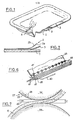
- This film is transparent and after aluminization, the aluminized film 2 is shiny on both sides. If the outer surface of the film covering the tray is scratched, the shiny aluminum layer is removed and the milky white color of the expanded polystyrene appears by transparency.
- a film of intermediate polystyrene 3 serving as filler material for securing during welding of the assembly as indicated above.
- the material of the film 3 is adherent to the polystyrene of the film.
- the internal face 4 of the detached part has, in fact, a duller whitish appearance than the natural face 2a of the film. This is a sign that the film 3 adheres well to the film 2.
- the adhesion of the film against the expanded polystyrene is less strong due to the cellular structure of the expanded polystyrene.
- depressions D in the metallized face of the tray are shaped depressions D (FIGS. 1 and 2) which constitute micro-grooves having the function of retaining the blood flows from fresh meats, juices or oozes from all products. food. By capillary action and surface tension, they retain fluids which no longer spread, without however degrading the foodstuff by their contact.
- the "absorbent" effect of these micro-grooves is such that even in the event of spillage, the fluid spilled along the latter does not move and remains “captive” of these canary channels.
- these grooves can have the form of grooves or guilloche patterns.
- the bottom of depressions D remains removed from the conditioned commodity which rests only on the protruding parts of the bottom.
- the machine shown in FIGS. 3 and 4 comprises an extruder 10, the die of which delivers an element of expanded polystyrene which, in the example shown, comes out in the form of a tube 15, the die li being tubular and a mandrel 13 carried by a frame. 12 being provided; the frame comprises, above the mandrel 13, a cutting blade 14 which opens the tube according to an upper generator, the polystyrene element then opening in the form of a flat strip 16; the outer wall 18 of the tube, smoothed by the passage in the die is therefore below and the inner wall 17, rougher, above. It is on this internal wall that the intermediate film 18 of better appearance will be welded the intermediate film serving to constitute the underside of the tray.
- the strip 16 of expanded polystyrene is pulled by a conventional traction device 19 which is followed by a calender 20 which will be described in detail below. Between the traction device and the calender is located the flat die 23: of an extruder 22 delivering the intermediate polystyrene film.
- the aluminized film 27 with a thickness of the order of 25 ⁇ (see FIG. 5) is unwound from a roller 26 mounted on an axis 25 carried by the frame of the machine, so that the aluminum layer is on the internal face 28, the polystyrene film 29 being on the outside.
- the film 27 is guided on a roller 30.
- the polystyrene film 29 of the film 27 is heated by a heating system 32 (for example infrared) to a temperature of 70.85 ° C.
- a heating system 32 for example infrared
- the outer face of the strip 16 is heated in the same way to a temperature rature from 80 to 95 ° C, temperature lower than the softening temperature of the polystyrene.
- the grille consists of three cylinders 33, 34, 35 whose axes extend horizontally in the same vertical plane.
- the cylinders are carried by the frame 36 of the machine and at least the two lower cylinders 33 and 34 are adjustable relative to each other in order to adjust the space E which separates them.
- the axes of these cylinders can be housed in bearings 37 sliding in the frame 36 under the effect of jacks 38, for example with compressed air.
- the cylinder 33 on which the strip 16 of expanded polystyrene passed turns clockwise, while the cylinder 34 on which the film 27 passes turns counter-clockwise.
- the third cylinder 35 rotates in the same direction as the cylinder 33.
- the spacing E between the cylinders 33 and 34 is adjusted so as to be slightly less than the thickness of the strip 16 in order to exert pressure on all of the strips at the time of joining.
- the pressure exerted between the cylinders in the joining zone is approximately 4 to 5 kg.
- the flat die 23 of the extruder 22 Upstream of the calender is mounted, on the frame of the machine, the flat die 23 of the extruder 22 which delivers the intermediate film 40.
- This die which has a length at least equal to that of the strip 16, comprises two lips 45, 46 substantially parallel and spaced apart by a distance "e" which, in the case of the manufacture of the tray of FIG. I, makes it possible to continuously deliver a polystyrene film of approximately 30 ⁇ m in thickness.
- the lip 46 is semi-rigid and the spacing "e" can be modified from place to place by adjustment screws 47 engaged in the threads of a fixed plate 48 and the free end of which presses on the lip 46.
- adjustment screws 47 engaged in the threads of a fixed plate 48 and the free end of which presses on the lip 46.
- the flow rate of the die in the direction of the length thereof.
- the die outlet orifice is situated in a transverse plane (substantially perpendicular) to the vertical plane passing through the axes of the calender cylinders and between the generatrices opposite the cylinders 33 and 34.
- this outlet must be as close as possible to the contact area between the strip 16 and the film 2 7 .
- this orifice is located less than 5 cm from this area and preferably between 2 and 2.5 cm. Die temperature exceeds 200 ° C and preferably is set between 225 and 240 ° C.
- the cylinder 34 is heated to a temperature between 90 and 110 ° C. depending on the thickness of the aluminized film and preferably between 94 and 104 ° C. for a film thickness of approximately 25 ⁇ .
- the cylinder 35 will also be heated to a similar temperature.
- the cylinder 33 will be cooled to remain at room temperature of around 20 to 35 ° C.
- the cylinders can be heated by circulation of coolant inside 34 ', 35' hollowed out from the cylinders.
- the cooling of the cylinder 33 can be done by circulation inside 33 ′ of a cooling fluid.
- the aluminized film is maintained by the cylinder 34 at a temperature low enough not to damage the metal.
- this temperature is not sufficient to ensure the softening of the polystyrene film necessary for bonding.
- the additional temperature is provided by the film 40 which, for its part, is in a pasty state on the surface. The supply of temperature nevertheless remains within limits preventing the deterioration of the metal because a significant part of the temperature of the film is absorbed by the expanded polystyrene 15 and by the cooled cylinder 33.
Landscapes
- Engineering & Computer Science (AREA)
- Mechanical Engineering (AREA)
- Laminated Bodies (AREA)
- Extrusion Moulding Of Plastics Or The Like (AREA)
Priority Applications (1)
| Application Number | Priority Date | Filing Date | Title |
|---|---|---|---|
| AT80400196T ATE3107T1 (de) | 1979-02-09 | 1980-02-08 | Verfahren und vorrichtung zur herstellung zusammengesetzter gegenstaende, insbesondere eines tablettartigen behaelters fuer die lagerung verderblicher produkte. |
Applications Claiming Priority (4)
| Application Number | Priority Date | Filing Date | Title |
|---|---|---|---|
| FR7903921 | 1979-02-09 | ||
| FR7903921A FR2448485A1 (fr) | 1979-02-09 | 1979-02-09 | Barquette a fond metallise pour le conditionnement des viandes et autres denrees alimentaires |
| FR7932039A FR2473418A1 (fr) | 1979-12-28 | 1979-12-28 | Procede et machine pour la fabrication d'articles composites, notamment barquette de conditionnement de produits perissables et article obtenu |
| FR7932039 | 1979-12-28 |
Publications (3)
| Publication Number | Publication Date |
|---|---|
| EP0014664A2 true EP0014664A2 (de) | 1980-08-20 |
| EP0014664A3 EP0014664A3 (en) | 1980-09-03 |
| EP0014664B1 EP0014664B1 (de) | 1983-04-20 |
Family
ID=26221025
Family Applications (1)
| Application Number | Title | Priority Date | Filing Date |
|---|---|---|---|
| EP19800400196 Expired EP0014664B1 (de) | 1979-02-09 | 1980-02-08 | Verfahren und Vorrichtung zur Herstellung zusammengesetzter Gegenstände, insbesondere eines tablettartigen Behälters für die Lagerung verderblicher Produkte. |
Country Status (4)
| Country | Link |
|---|---|
| US (1) | US4430134A (de) |
| EP (1) | EP0014664B1 (de) |
| DE (1) | DE3062798D1 (de) |
| ES (1) | ES488396A0 (de) |
Cited By (4)
| Publication number | Priority date | Publication date | Assignee | Title |
|---|---|---|---|---|
| WO1988005757A1 (fr) * | 1987-01-28 | 1988-08-11 | Gueret Jean Pierre | Barquette pour le conditionnement de produits alimentaires et procede de fabrication d'une telle barquette |
| WO1993002862A1 (en) * | 1991-07-26 | 1993-02-18 | Elopak Systems Ag | Laminate and method for manufacturing the same |
| FR2752193A1 (fr) * | 1996-08-08 | 1998-02-13 | Lorraine Laminage | Procede et installation de fabrication en continu d'une bande metallique revetue d'une couche d'un polymere |
| EP0893357A1 (de) * | 1997-07-25 | 1999-01-27 | Knauf SNC | Schale zur Konservierung von Nahrungsmitteln, insbesondere Fleisch, und Vorrichtung zu deren Herstellung |
Families Citing this family (2)
| Publication number | Priority date | Publication date | Assignee | Title |
|---|---|---|---|---|
| DE102004021715A1 (de) * | 2004-04-30 | 2005-11-24 | Gerro Plast Gmbh | Polystyrol-basierte Folie |
| ITTO20050471A1 (it) * | 2005-07-08 | 2007-01-09 | Soremartec Sa | Confezione per prodotti alimentari |
Family Cites Families (14)
| Publication number | Priority date | Publication date | Assignee | Title |
|---|---|---|---|---|
| US2494905A (en) | 1946-09-11 | 1950-01-17 | Harold F Shumann | Method and apparatus for heat sealing |
| US2808192A (en) | 1953-08-11 | 1957-10-01 | John T Raisin Corp | Food container |
| US2815308A (en) | 1954-08-26 | 1957-12-03 | Robinson Mfg Inc | Method of making a composite sheet |
| US3008862A (en) | 1956-06-29 | 1961-11-14 | Union Carbide Corp | Extruded bead sealing |
| US2993806A (en) * | 1956-12-17 | 1961-07-25 | Gen Tire & Rubber Co | Metal coating of plastics |
| FR1249532A (fr) * | 1959-11-20 | 1960-12-30 | Emballage isolant, notamment pour denrées périssables | |
| US3039911A (en) | 1959-12-15 | 1962-06-19 | Koppers Co Inc | Process for the production of shaped plastic articles |
| US3159698A (en) | 1960-12-01 | 1964-12-01 | Sweetheart Plastics | Method for making and forming plastic material |
| GB991906A (en) * | 1961-12-29 | 1965-05-12 | Bendix Electronics Ltd | Alpha probe window |
| AT296596B (de) | 1964-03-04 | 1972-02-25 | Roberto Pietrocola | Schichstoff |
| US3619344A (en) | 1969-08-07 | 1971-11-09 | Du Pont | Oriented foam laminar structures |
| FR1596713A (de) * | 1968-11-28 | 1970-06-22 | ||
| DE2350809A1 (de) * | 1973-10-10 | 1975-04-17 | Thielmann Geb Ag | Behaelter fuer die lagerung und den transport von getraenken |
| FR2279534B1 (fr) * | 1974-07-26 | 1977-01-07 | Procede pour realiser des objets thermoformes a partir d'un lamine thermoplastique et appareillage pour sa realisation |
-
1980
- 1980-02-08 EP EP19800400196 patent/EP0014664B1/de not_active Expired
- 1980-02-08 DE DE8080400196T patent/DE3062798D1/de not_active Expired
- 1980-02-08 ES ES488396A patent/ES488396A0/es active Granted
-
1981
- 1981-08-12 US US06/292,089 patent/US4430134A/en not_active Expired - Fee Related
Cited By (6)
| Publication number | Priority date | Publication date | Assignee | Title |
|---|---|---|---|---|
| WO1988005757A1 (fr) * | 1987-01-28 | 1988-08-11 | Gueret Jean Pierre | Barquette pour le conditionnement de produits alimentaires et procede de fabrication d'une telle barquette |
| WO1993002862A1 (en) * | 1991-07-26 | 1993-02-18 | Elopak Systems Ag | Laminate and method for manufacturing the same |
| EP0879694A1 (de) * | 1991-07-26 | 1998-11-25 | Elopak Systems Ag | Laminierung |
| FR2752193A1 (fr) * | 1996-08-08 | 1998-02-13 | Lorraine Laminage | Procede et installation de fabrication en continu d'une bande metallique revetue d'une couche d'un polymere |
| EP0893357A1 (de) * | 1997-07-25 | 1999-01-27 | Knauf SNC | Schale zur Konservierung von Nahrungsmitteln, insbesondere Fleisch, und Vorrichtung zu deren Herstellung |
| FR2766468A1 (fr) * | 1997-07-25 | 1999-01-29 | Knauf Snc | Barquette pour la conservation de produits alimentaires, notamment de viande et equipement pour la realisation de telles barquettes |
Also Published As
| Publication number | Publication date |
|---|---|
| ES8102966A1 (es) | 1981-02-16 |
| US4430134A (en) | 1984-02-07 |
| EP0014664A3 (en) | 1980-09-03 |
| DE3062798D1 (en) | 1983-05-26 |
| ES488396A0 (es) | 1981-02-16 |
| EP0014664B1 (de) | 1983-04-20 |
Similar Documents
| Publication | Publication Date | Title |
|---|---|---|
| EP1074482B1 (de) | Abdichtungsstruktur für einen Behälter | |
| CA1264651A (en) | Laminated material and method for manufacturing the same | |
| EP1993809B1 (de) | Verfahren zur herstellung eines mehrschichtigen films | |
| FR2464890A1 (fr) | Dispositif d'ouverture pour emballage du type boite de conserve | |
| CA2945582C (fr) | Procede et dispositif d'extrusion et etiquetage d'un tube d'emballage | |
| FR2760999A1 (fr) | Procede de fabrication d'une structure alveolaire en matiere thermofusible, et dispositif pour la mise en oeuvre de ce procede | |
| EP0135431A1 (de) | Herstellungsverfahren für Behälterverschlüsse, durch abschälen zu öffnen, und Verschlüsse die durch die Anwendung dieses Verfahrens erhalten werden | |
| FR2675123A1 (fr) | Tube de distribution, notamment de pate dentifrice. | |
| EP0014664B1 (de) | Verfahren und Vorrichtung zur Herstellung zusammengesetzter Gegenstände, insbesondere eines tablettartigen Behälters für die Lagerung verderblicher Produkte. | |
| CH621744A5 (de) | ||
| FR2503036A1 (fr) | Bande composite a couvercles pour recipients thermoplastiques et procede, dispositif et installation de fabrication d'une telle bande composite | |
| FR2561575A1 (fr) | Procede de fabrication de recipients tubulaires thermoplastiques ayant des proprietes barriere | |
| AU717816B2 (en) | Method for making tubular containers | |
| FR2704480A1 (fr) | Film stratifié et son procédé de fabrication ainsi que récipient obtenu à partir d'un tel film stratifié. | |
| EP1549564B1 (de) | Verfahren zur verpackung von verderblichen produkten und verpackung für verderbliche produkte | |
| FR2473418A1 (fr) | Procede et machine pour la fabrication d'articles composites, notamment barquette de conditionnement de produits perissables et article obtenu | |
| EP0146503B1 (de) | Schichtstoff, Verfahren zur Herstellung eines Schichtstoffes und Vorrichtung zur Ausführung dieser Herstellung | |
| FR2502288A1 (fr) | Procede pour revetir un tube et tube obtenu | |
| FR2859185A1 (fr) | Barquette absorbante avec ou sans barriere et procede de fabrication | |
| WO1998026930A1 (fr) | Procede pour realiser la jupe multicouche d'un tube souple comportant une couche a effet barriere avec motifs holographiques | |
| FR2491826A1 (fr) | Procede et installation pour l'obtention d'un materiau stratifie (ethylene, acetate de vinyle, polystyrene expanse) par extrusion et calandrage et materiau obtenu | |
| FR2858302A1 (fr) | Recipient hydrofuge et permeable a l'air et procede pour sa fabrication | |
| FR2500019A1 (fr) | Feuille d'emballage composite pour produits alimentaires, notamment fromages a pate molle et procede de realisation de cette feuille | |
| EP1424186B1 (de) | Herstellungsverfahren mittels Co-Extrusion eines absorbierenden Verpackungsmaterials aus Kunststoff, und das hergestellte Verpackungsmaterial | |
| FR2663910A1 (fr) | Bande composite et installation pour la fabrication d'emballages steriles thermoformes. |
Legal Events
| Date | Code | Title | Description |
|---|---|---|---|
| PUAI | Public reference made under article 153(3) epc to a published international application that has entered the european phase |
Free format text: ORIGINAL CODE: 0009012 |
|
| PUAL | Search report despatched |
Free format text: ORIGINAL CODE: 0009013 |
|
| AK | Designated contracting states |
Designated state(s): AT BE CH DE GB IT LU NL SE |
|
| AK | Designated contracting states |
Designated state(s): AT BE CH DE GB IT LU NL SE |
|
| 17P | Request for examination filed |
Effective date: 19810224 |
|
| ITF | It: translation for a ep patent filed | ||
| GRAA | (expected) grant |
Free format text: ORIGINAL CODE: 0009210 |
|
| AK | Designated contracting states |
Designated state(s): AT BE CH DE GB IT LU NL SE |
|
| PG25 | Lapsed in a contracting state [announced via postgrant information from national office to epo] |
Ref country code: SE Effective date: 19830420 |
|
| REF | Corresponds to: |
Ref document number: 3107 Country of ref document: AT Date of ref document: 19830515 Kind code of ref document: T |
|
| PG25 | Lapsed in a contracting state [announced via postgrant information from national office to epo] |
Ref country code: AT Effective date: 19830501 |
|
| REF | Corresponds to: |
Ref document number: 3062798 Country of ref document: DE Date of ref document: 19830526 |
|
| PG25 | Lapsed in a contracting state [announced via postgrant information from national office to epo] |
Ref country code: LU Free format text: LAPSE BECAUSE OF NON-PAYMENT OF DUE FEES Effective date: 19840229 |
|
| PG25 | Lapsed in a contracting state [announced via postgrant information from national office to epo] |
Ref country code: NL Effective date: 19840901 |
|
| NLV4 | Nl: lapsed or anulled due to non-payment of the annual fee | ||
| PGFP | Annual fee paid to national office [announced via postgrant information from national office to epo] |
Ref country code: BE Payment date: 19900215 Year of fee payment: 11 |
|
| PGFP | Annual fee paid to national office [announced via postgrant information from national office to epo] |
Ref country code: CH Payment date: 19900219 Year of fee payment: 11 |
|
| PGFP | Annual fee paid to national office [announced via postgrant information from national office to epo] |
Ref country code: GB Payment date: 19900228 Year of fee payment: 11 |
|
| PG25 | Lapsed in a contracting state [announced via postgrant information from national office to epo] |
Ref country code: GB Effective date: 19910208 |
|
| ITTA | It: last paid annual fee | ||
| PG25 | Lapsed in a contracting state [announced via postgrant information from national office to epo] |
Ref country code: CH Effective date: 19910228 Ref country code: BE Effective date: 19910228 |
|
| GBPC | Gb: european patent ceased through non-payment of renewal fee | ||
| REG | Reference to a national code |
Ref country code: CH Ref legal event code: PL |
|
| PGFP | Annual fee paid to national office [announced via postgrant information from national office to epo] |
Ref country code: DE Payment date: 19940412 Year of fee payment: 15 |
|
| PG25 | Lapsed in a contracting state [announced via postgrant information from national office to epo] |
Ref country code: DE Effective date: 19951201 |
|
| PLBE | No opposition filed within time limit |
Free format text: ORIGINAL CODE: 0009261 |
|
| STAA | Information on the status of an ep patent application or granted ep patent |
Free format text: STATUS: NO OPPOSITION FILED WITHIN TIME LIMIT |