EP0014890A2 - Verfahren zum Bedrucken von voluminösen textilen Materialien - Google Patents
Verfahren zum Bedrucken von voluminösen textilen Materialien Download PDFInfo
- Publication number
- EP0014890A2 EP0014890A2 EP80100558A EP80100558A EP0014890A2 EP 0014890 A2 EP0014890 A2 EP 0014890A2 EP 80100558 A EP80100558 A EP 80100558A EP 80100558 A EP80100558 A EP 80100558A EP 0014890 A2 EP0014890 A2 EP 0014890A2
- Authority
- EP
- European Patent Office
- Prior art keywords
- printing
- electrolyte
- printed
- dye
- voluminous
- Prior art date
- Legal status (The legal status is an assumption and is not a legal conclusion. Google has not performed a legal analysis and makes no representation as to the accuracy of the status listed.)
- Withdrawn
Links
- 238000000034 method Methods 0.000 title claims abstract description 32
- 239000004753 textile Substances 0.000 title claims abstract description 27
- 238000007639 printing Methods 0.000 title claims description 74
- 239000003792 electrolyte Substances 0.000 claims abstract description 37
- 239000002562 thickening agent Substances 0.000 claims abstract description 34
- 239000000463 material Substances 0.000 claims abstract description 31
- 150000007524 organic acids Chemical class 0.000 claims description 10
- 239000002270 dispersing agent Substances 0.000 claims description 9
- 125000000129 anionic group Chemical group 0.000 claims description 7
- 239000002253 acid Substances 0.000 claims description 6
- 150000007513 acids Chemical class 0.000 claims description 6
- -1 amine salt Chemical class 0.000 claims description 6
- 238000002360 preparation method Methods 0.000 claims description 6
- 150000007522 mineralic acids Chemical class 0.000 claims description 5
- QGZKDVFQNNGYKY-UHFFFAOYSA-O Ammonium Chemical compound [NH4+] QGZKDVFQNNGYKY-UHFFFAOYSA-O 0.000 claims 1
- 239000003513 alkali Substances 0.000 claims 1
- 230000000149 penetrating effect Effects 0.000 abstract 1
- 239000000975 dye Substances 0.000 description 32
- HEMHJVSKTPXQMS-UHFFFAOYSA-M Sodium hydroxide Chemical compound [OH-].[Na+] HEMHJVSKTPXQMS-UHFFFAOYSA-M 0.000 description 21
- 239000000243 solution Substances 0.000 description 12
- 239000000203 mixture Substances 0.000 description 11
- 229920001577 copolymer Polymers 0.000 description 10
- QGZKDVFQNNGYKY-UHFFFAOYSA-N Ammonia Chemical compound N QGZKDVFQNNGYKY-UHFFFAOYSA-N 0.000 description 9
- ZMXDDKWLCZADIW-UHFFFAOYSA-N N,N-Dimethylformamide Chemical compound CN(C)C=O ZMXDDKWLCZADIW-UHFFFAOYSA-N 0.000 description 9
- 239000004952 Polyamide Substances 0.000 description 9
- 229920002647 polyamide Polymers 0.000 description 9
- MYRTYDVEIRVNKP-UHFFFAOYSA-N 1,2-Divinylbenzene Chemical compound C=CC1=CC=CC=C1C=C MYRTYDVEIRVNKP-UHFFFAOYSA-N 0.000 description 8
- 238000001035 drying Methods 0.000 description 7
- QTBSBXVTEAMEQO-UHFFFAOYSA-N Acetic acid Chemical compound CC(O)=O QTBSBXVTEAMEQO-UHFFFAOYSA-N 0.000 description 6
- RTZKZFJDLAIYFH-UHFFFAOYSA-N Diethyl ether Chemical compound CCOCC RTZKZFJDLAIYFH-UHFFFAOYSA-N 0.000 description 6
- 150000001735 carboxylic acids Chemical class 0.000 description 6
- 229920006395 saturated elastomer Polymers 0.000 description 6
- 229920002125 Sokalan® Polymers 0.000 description 5
- 239000002585 base Substances 0.000 description 5
- 239000000835 fiber Substances 0.000 description 5
- 239000006260 foam Substances 0.000 description 5
- 239000004584 polyacrylic acid Substances 0.000 description 5
- 235000002639 sodium chloride Nutrition 0.000 description 5
- VZCYOOQTPOCHFL-UHFFFAOYSA-N trans-butenedioic acid Natural products OC(=O)C=CC(O)=O VZCYOOQTPOCHFL-UHFFFAOYSA-N 0.000 description 5
- YNAVUWVOSKDBBP-UHFFFAOYSA-N Morpholine Chemical compound C1COCCN1 YNAVUWVOSKDBBP-UHFFFAOYSA-N 0.000 description 4
- OFOBLEOULBTSOW-UHFFFAOYSA-N Propanedioic acid Natural products OC(=O)CC(O)=O OFOBLEOULBTSOW-UHFFFAOYSA-N 0.000 description 4
- 238000010521 absorption reaction Methods 0.000 description 4
- 229910021529 ammonia Inorganic materials 0.000 description 4
- 238000007646 gravure printing Methods 0.000 description 4
- NAQMVNRVTILPCV-UHFFFAOYSA-N hexane-1,6-diamine Chemical compound NCCCCCCN NAQMVNRVTILPCV-UHFFFAOYSA-N 0.000 description 4
- VZCYOOQTPOCHFL-UPHRSURJSA-N maleic acid Chemical compound OC(=O)\C=C/C(O)=O VZCYOOQTPOCHFL-UPHRSURJSA-N 0.000 description 4
- 239000011976 maleic acid Substances 0.000 description 4
- 239000000178 monomer Substances 0.000 description 4
- 235000005985 organic acids Nutrition 0.000 description 4
- 210000002268 wool Anatomy 0.000 description 4
- OAYXUHPQHDHDDZ-UHFFFAOYSA-N 2-(2-butoxyethoxy)ethanol Chemical compound CCCCOCCOCCO OAYXUHPQHDHDDZ-UHFFFAOYSA-N 0.000 description 3
- SMZOUWXMTYCWNB-UHFFFAOYSA-N 2-(2-methoxy-5-methylphenyl)ethanamine Chemical compound COC1=CC=C(C)C=C1CCN SMZOUWXMTYCWNB-UHFFFAOYSA-N 0.000 description 3
- NIXOWILDQLNWCW-UHFFFAOYSA-N 2-Propenoic acid Natural products OC(=O)C=C NIXOWILDQLNWCW-UHFFFAOYSA-N 0.000 description 3
- WSFSSNUMVMOOMR-UHFFFAOYSA-N Formaldehyde Chemical compound O=C WSFSSNUMVMOOMR-UHFFFAOYSA-N 0.000 description 3
- CERQOIWHTDAKMF-UHFFFAOYSA-N Methacrylic acid Chemical compound CC(=C)C(O)=O CERQOIWHTDAKMF-UHFFFAOYSA-N 0.000 description 3
- ZMANZCXQSJIPKH-UHFFFAOYSA-N Triethylamine Chemical compound CCN(CC)CC ZMANZCXQSJIPKH-UHFFFAOYSA-N 0.000 description 3
- 229910052783 alkali metal Inorganic materials 0.000 description 3
- 239000003795 chemical substances by application Substances 0.000 description 3
- KRKNYBCHXYNGOX-UHFFFAOYSA-N citric acid Chemical compound OC(=O)CC(O)(C(O)=O)CC(O)=O KRKNYBCHXYNGOX-UHFFFAOYSA-N 0.000 description 3
- 230000000694 effects Effects 0.000 description 3
- 238000009940 knitting Methods 0.000 description 3
- 235000012054 meals Nutrition 0.000 description 3
- 238000000059 patterning Methods 0.000 description 3
- 239000000049 pigment Substances 0.000 description 3
- 229920000642 polymer Polymers 0.000 description 3
- 239000007921 spray Substances 0.000 description 3
- 239000000126 substance Substances 0.000 description 3
- XLYOFNOQVPJJNP-UHFFFAOYSA-N water Substances O XLYOFNOQVPJJNP-UHFFFAOYSA-N 0.000 description 3
- CQJXFZWCTHXKNB-UHFFFAOYSA-N 1,2,2,3,3,4-hexamethylpiperazine Chemical compound CN1CCN(C)C(C)(C)C1(C)C CQJXFZWCTHXKNB-UHFFFAOYSA-N 0.000 description 2
- GQEKAPMWKCXNCF-UHFFFAOYSA-N 2,2-bis(ethenyl)-1,4-dioxane Chemical compound C=CC1(C=C)COCCO1 GQEKAPMWKCXNCF-UHFFFAOYSA-N 0.000 description 2
- HZAXFHJVJLSVMW-UHFFFAOYSA-N 2-Aminoethan-1-ol Chemical compound NCCO HZAXFHJVJLSVMW-UHFFFAOYSA-N 0.000 description 2
- NLXLAEXVIDQMFP-UHFFFAOYSA-N Ammonia chloride Chemical compound [NH4+].[Cl-] NLXLAEXVIDQMFP-UHFFFAOYSA-N 0.000 description 2
- KAKZBPTYRLMSJV-UHFFFAOYSA-N Butadiene Chemical compound C=CC=C KAKZBPTYRLMSJV-UHFFFAOYSA-N 0.000 description 2
- 239000004641 Diallyl-phthalate Substances 0.000 description 2
- VGGSQFUCUMXWEO-UHFFFAOYSA-N Ethene Chemical compound C=C VGGSQFUCUMXWEO-UHFFFAOYSA-N 0.000 description 2
- 239000005977 Ethylene Substances 0.000 description 2
- VZCYOOQTPOCHFL-OWOJBTEDSA-N Fumaric acid Chemical compound OC(=O)\C=C\C(O)=O VZCYOOQTPOCHFL-OWOJBTEDSA-N 0.000 description 2
- CTQNGGLPUBDAKN-UHFFFAOYSA-N O-Xylene Chemical compound CC1=CC=CC=C1C CTQNGGLPUBDAKN-UHFFFAOYSA-N 0.000 description 2
- FAPWRFPIFSIZLT-UHFFFAOYSA-M Sodium chloride Chemical compound [Na+].[Cl-] FAPWRFPIFSIZLT-UHFFFAOYSA-M 0.000 description 2
- PPBRXRYQALVLMV-UHFFFAOYSA-N Styrene Chemical compound C=CC1=CC=CC=C1 PPBRXRYQALVLMV-UHFFFAOYSA-N 0.000 description 2
- 235000011054 acetic acid Nutrition 0.000 description 2
- 239000000654 additive Substances 0.000 description 2
- WNLRTRBMVRJNCN-UHFFFAOYSA-N adipic acid Chemical compound OC(=O)CCCCC(O)=O WNLRTRBMVRJNCN-UHFFFAOYSA-N 0.000 description 2
- 150000001340 alkali metals Chemical class 0.000 description 2
- 150000001447 alkali salts Chemical class 0.000 description 2
- 229910052784 alkaline earth metal Inorganic materials 0.000 description 2
- 150000003863 ammonium salts Chemical class 0.000 description 2
- 239000011230 binding agent Substances 0.000 description 2
- 230000015572 biosynthetic process Effects 0.000 description 2
- QUDWYFHPNIMBFC-UHFFFAOYSA-N bis(prop-2-enyl) benzene-1,2-dicarboxylate Chemical compound C=CCOC(=O)C1=CC=CC=C1C(=O)OCC=C QUDWYFHPNIMBFC-UHFFFAOYSA-N 0.000 description 2
- HQABUPZFAYXKJW-UHFFFAOYSA-N butan-1-amine Chemical compound CCCCN HQABUPZFAYXKJW-UHFFFAOYSA-N 0.000 description 2
- XBDQKXXYIPTUBI-UHFFFAOYSA-N dimethylselenoniopropionate Natural products CCC(O)=O XBDQKXXYIPTUBI-UHFFFAOYSA-N 0.000 description 2
- 238000004043 dyeing Methods 0.000 description 2
- FJKIXWOMBXYWOQ-UHFFFAOYSA-N ethenoxyethane Chemical compound CCOC=C FJKIXWOMBXYWOQ-UHFFFAOYSA-N 0.000 description 2
- 239000004744 fabric Substances 0.000 description 2
- 229920001519 homopolymer Polymers 0.000 description 2
- 239000000976 ink Substances 0.000 description 2
- 239000007788 liquid Substances 0.000 description 2
- BDAGIHXWWSANSR-UHFFFAOYSA-N methanoic acid Natural products OC=O BDAGIHXWWSANSR-UHFFFAOYSA-N 0.000 description 2
- 239000010446 mirabilite Substances 0.000 description 2
- 238000006386 neutralization reaction Methods 0.000 description 2
- 239000003973 paint Substances 0.000 description 2
- 239000011780 sodium chloride Substances 0.000 description 2
- RSIJVJUOQBWMIM-UHFFFAOYSA-L sodium sulfate decahydrate Chemical compound O.O.O.O.O.O.O.O.O.O.[Na+].[Na+].[O-]S([O-])(=O)=O RSIJVJUOQBWMIM-UHFFFAOYSA-L 0.000 description 2
- JOXIMZWYDAKGHI-UHFFFAOYSA-N toluene-4-sulfonic acid Chemical compound CC1=CC=C(S(O)(=O)=O)C=C1 JOXIMZWYDAKGHI-UHFFFAOYSA-N 0.000 description 2
- OZCMOJQQLBXBKI-UHFFFAOYSA-N 1-ethenoxy-2-methylpropane Chemical compound CC(C)COC=C OZCMOJQQLBXBKI-UHFFFAOYSA-N 0.000 description 1
- RTBFRGCFXZNCOE-UHFFFAOYSA-N 1-methylsulfonylpiperidin-4-one Chemical compound CS(=O)(=O)N1CCC(=O)CC1 RTBFRGCFXZNCOE-UHFFFAOYSA-N 0.000 description 1
- VILCJCGEZXAXTO-UHFFFAOYSA-N 2,2,2-tetramine Chemical compound NCCNCCNCCN VILCJCGEZXAXTO-UHFFFAOYSA-N 0.000 description 1
- JAHNSTQSQJOJLO-UHFFFAOYSA-N 2-(3-fluorophenyl)-1h-imidazole Chemical compound FC1=CC=CC(C=2NC=CN=2)=C1 JAHNSTQSQJOJLO-UHFFFAOYSA-N 0.000 description 1
- OSWFIVFLDKOXQC-UHFFFAOYSA-N 4-(3-methoxyphenyl)aniline Chemical compound COC1=CC=CC(C=2C=CC(N)=CC=2)=C1 OSWFIVFLDKOXQC-UHFFFAOYSA-N 0.000 description 1
- JHWGFJBTMHEZME-UHFFFAOYSA-N 4-prop-2-enoyloxybutyl prop-2-enoate Chemical compound C=CC(=O)OCCCCOC(=O)C=C JHWGFJBTMHEZME-UHFFFAOYSA-N 0.000 description 1
- 241000416162 Astragalus gummifer Species 0.000 description 1
- 240000008886 Ceratonia siliqua Species 0.000 description 1
- 235000013912 Ceratonia siliqua Nutrition 0.000 description 1
- 244000303965 Cyamopsis psoralioides Species 0.000 description 1
- RPNUMPOLZDHAAY-UHFFFAOYSA-N Diethylenetriamine Chemical compound NCCNCCN RPNUMPOLZDHAAY-UHFFFAOYSA-N 0.000 description 1
- 241000196324 Embryophyta Species 0.000 description 1
- PIICEJLVQHRZGT-UHFFFAOYSA-N Ethylenediamine Chemical compound NCCN PIICEJLVQHRZGT-UHFFFAOYSA-N 0.000 description 1
- 239000004677 Nylon Substances 0.000 description 1
- SJEYSFABYSGQBG-UHFFFAOYSA-M Patent blue Chemical compound [Na+].C1=CC(N(CC)CC)=CC=C1C(C=1C(=CC(=CC=1)S([O-])(=O)=O)S([O-])(=O)=O)=C1C=CC(=[N+](CC)CC)C=C1 SJEYSFABYSGQBG-UHFFFAOYSA-M 0.000 description 1
- KWYUFKZDYYNOTN-UHFFFAOYSA-M Potassium hydroxide Chemical compound [OH-].[K+] KWYUFKZDYYNOTN-UHFFFAOYSA-M 0.000 description 1
- VMHLLURERBWHNL-UHFFFAOYSA-M Sodium acetate Chemical compound [Na+].CC([O-])=O VMHLLURERBWHNL-UHFFFAOYSA-M 0.000 description 1
- DWAQJAXMDSEUJJ-UHFFFAOYSA-M Sodium bisulfite Chemical compound [Na+].OS([O-])=O DWAQJAXMDSEUJJ-UHFFFAOYSA-M 0.000 description 1
- 239000004280 Sodium formate Substances 0.000 description 1
- 229920002472 Starch Polymers 0.000 description 1
- KDYFGRWQOYBRFD-UHFFFAOYSA-N Succinic acid Natural products OC(=O)CCC(O)=O KDYFGRWQOYBRFD-UHFFFAOYSA-N 0.000 description 1
- ULUAUXLGCMPNKK-UHFFFAOYSA-N Sulfobutanedioic acid Chemical compound OC(=O)CC(C(O)=O)S(O)(=O)=O ULUAUXLGCMPNKK-UHFFFAOYSA-N 0.000 description 1
- 229920001615 Tragacanth Polymers 0.000 description 1
- GSEJCLTVZPLZKY-UHFFFAOYSA-N Triethanolamine Chemical compound OCCN(CCO)CCO GSEJCLTVZPLZKY-UHFFFAOYSA-N 0.000 description 1
- QYKIQEUNHZKYBP-UHFFFAOYSA-N Vinyl ether Chemical class C=COC=C QYKIQEUNHZKYBP-UHFFFAOYSA-N 0.000 description 1
- 239000000980 acid dye Substances 0.000 description 1
- 125000005396 acrylic acid ester group Chemical group 0.000 description 1
- 239000001361 adipic acid Substances 0.000 description 1
- 235000011037 adipic acid Nutrition 0.000 description 1
- 229920000615 alginic acid Polymers 0.000 description 1
- 235000010443 alginic acid Nutrition 0.000 description 1
- 150000001408 amides Chemical class 0.000 description 1
- 150000001412 amines Chemical class 0.000 description 1
- 235000019270 ammonium chloride Nutrition 0.000 description 1
- JFCQEDHGNNZCLN-UHFFFAOYSA-N anhydrous glutaric acid Natural products OC(=O)CCCC(O)=O JFCQEDHGNNZCLN-UHFFFAOYSA-N 0.000 description 1
- 239000007864 aqueous solution Substances 0.000 description 1
- SRSXLGNVWSONIS-UHFFFAOYSA-N benzenesulfonic acid Chemical compound OS(=O)(=O)C1=CC=CC=C1 SRSXLGNVWSONIS-UHFFFAOYSA-N 0.000 description 1
- 229940092714 benzenesulfonic acid Drugs 0.000 description 1
- KDYFGRWQOYBRFD-NUQCWPJISA-N butanedioic acid Chemical compound O[14C](=O)CC[14C](O)=O KDYFGRWQOYBRFD-NUQCWPJISA-N 0.000 description 1
- 125000004432 carbon atom Chemical group C* 0.000 description 1
- 125000003178 carboxy group Chemical group [H]OC(*)=O 0.000 description 1
- 150000001732 carboxylic acid derivatives Chemical class 0.000 description 1
- 239000003638 chemical reducing agent Substances 0.000 description 1
- 238000009833 condensation Methods 0.000 description 1
- 230000005494 condensation Effects 0.000 description 1
- 239000006185 dispersion Substances 0.000 description 1
- 239000003995 emulsifying agent Substances 0.000 description 1
- 238000005187 foaming Methods 0.000 description 1
- 235000019253 formic acid Nutrition 0.000 description 1
- 238000009472 formulation Methods 0.000 description 1
- 239000001530 fumaric acid Substances 0.000 description 1
- 229920006158 high molecular weight polymer Polymers 0.000 description 1
- 239000012669 liquid formulation Substances 0.000 description 1
- FPYJFEHAWHCUMM-UHFFFAOYSA-N maleic anhydride Chemical compound O=C1OC(=O)C=C1 FPYJFEHAWHCUMM-UHFFFAOYSA-N 0.000 description 1
- 238000004519 manufacturing process Methods 0.000 description 1
- 239000000434 metal complex dye Substances 0.000 description 1
- 125000005397 methacrylic acid ester group Chemical group 0.000 description 1
- LVHBHZANLOWSRM-UHFFFAOYSA-N methylenebutanedioic acid Natural products OC(=O)CC(=C)C(O)=O LVHBHZANLOWSRM-UHFFFAOYSA-N 0.000 description 1
- 238000013508 migration Methods 0.000 description 1
- 150000004780 naphthols Chemical class 0.000 description 1
- 229930014626 natural product Natural products 0.000 description 1
- 239000004745 nonwoven fabric Substances 0.000 description 1
- 229920001778 nylon Polymers 0.000 description 1
- 239000007800 oxidant agent Substances 0.000 description 1
- 150000002989 phenols Chemical class 0.000 description 1
- 229920000728 polyester Polymers 0.000 description 1
- 238000006116 polymerization reaction Methods 0.000 description 1
- 238000001556 precipitation Methods 0.000 description 1
- 235000019260 propionic acid Nutrition 0.000 description 1
- IUVKMZGDUIUOCP-BTNSXGMBSA-N quinbolone Chemical compound O([C@H]1CC[C@H]2[C@H]3[C@@H]([C@]4(C=CC(=O)C=C4CC3)C)CC[C@@]21C)C1=CCCC1 IUVKMZGDUIUOCP-BTNSXGMBSA-N 0.000 description 1
- 230000035945 sensitivity Effects 0.000 description 1
- 239000001632 sodium acetate Substances 0.000 description 1
- 235000017281 sodium acetate Nutrition 0.000 description 1
- HLBBKKJFGFRGMU-UHFFFAOYSA-M sodium formate Chemical compound [Na+].[O-]C=O HLBBKKJFGFRGMU-UHFFFAOYSA-M 0.000 description 1
- 235000019254 sodium formate Nutrition 0.000 description 1
- 235000010267 sodium hydrogen sulphite Nutrition 0.000 description 1
- 159000000000 sodium salts Chemical class 0.000 description 1
- 239000007787 solid Substances 0.000 description 1
- 238000009977 space dyeing Methods 0.000 description 1
- 238000005507 spraying Methods 0.000 description 1
- 238000010186 staining Methods 0.000 description 1
- 235000019698 starch Nutrition 0.000 description 1
- 239000008107 starch Substances 0.000 description 1
- 238000010025 steaming Methods 0.000 description 1
- 125000000020 sulfo group Chemical group O=S(=O)([*])O[H] 0.000 description 1
- 229920002994 synthetic fiber Polymers 0.000 description 1
- 239000012209 synthetic fiber Substances 0.000 description 1
- 238000010345 tape casting Methods 0.000 description 1
- 238000009988 textile finishing Methods 0.000 description 1
- 230000008719 thickening Effects 0.000 description 1
- 235000010487 tragacanth Nutrition 0.000 description 1
- 239000000196 tragacanth Substances 0.000 description 1
- 229940116362 tragacanth Drugs 0.000 description 1
- 229920001567 vinyl ester resin Polymers 0.000 description 1
- 125000000391 vinyl group Chemical group [H]C([*])=C([H])[H] 0.000 description 1
- 238000005406 washing Methods 0.000 description 1
Classifications
-
- D—TEXTILES; PAPER
- D06—TREATMENT OF TEXTILES OR THE LIKE; LAUNDERING; FLEXIBLE MATERIALS NOT OTHERWISE PROVIDED FOR
- D06P—DYEING OR PRINTING TEXTILES; DYEING LEATHER, FURS OR SOLID MACROMOLECULAR SUBSTANCES IN ANY FORM
- D06P3/00—Special processes of dyeing or printing textiles, or dyeing leather, furs, or solid macromolecular substances in any form, classified according to the material treated
- D06P3/02—Material containing basic nitrogen
- D06P3/04—Material containing basic nitrogen containing amide groups
- D06P3/06—Material containing basic nitrogen containing amide groups using acid dyes
-
- D—TEXTILES; PAPER
- D06—TREATMENT OF TEXTILES OR THE LIKE; LAUNDERING; FLEXIBLE MATERIALS NOT OTHERWISE PROVIDED FOR
- D06P—DYEING OR PRINTING TEXTILES; DYEING LEATHER, FURS OR SOLID MACROMOLECULAR SUBSTANCES IN ANY FORM
- D06P1/00—General processes of dyeing or printing textiles, or general processes of dyeing leather, furs, or solid macromolecular substances in any form, classified according to the dyes, pigments, or auxiliary substances employed
- D06P1/44—General processes of dyeing or printing textiles, or general processes of dyeing leather, furs, or solid macromolecular substances in any form, classified according to the dyes, pigments, or auxiliary substances employed using insoluble pigments or auxiliary substances, e.g. binders
- D06P1/52—General processes of dyeing or printing textiles, or general processes of dyeing leather, furs, or solid macromolecular substances in any form, classified according to the dyes, pigments, or auxiliary substances employed using insoluble pigments or auxiliary substances, e.g. binders using compositions containing synthetic macromolecular substances
- D06P1/5207—Macromolecular compounds obtained by reactions involving only carbon-to-carbon unsaturated bonds
- D06P1/525—Polymers of unsaturated carboxylic acids or functional derivatives thereof
-
- D—TEXTILES; PAPER
- D06—TREATMENT OF TEXTILES OR THE LIKE; LAUNDERING; FLEXIBLE MATERIALS NOT OTHERWISE PROVIDED FOR
- D06P—DYEING OR PRINTING TEXTILES; DYEING LEATHER, FURS OR SOLID MACROMOLECULAR SUBSTANCES IN ANY FORM
- D06P5/00—Other features in dyeing or printing textiles, or dyeing leather, furs, or solid macromolecular substances in any form
- D06P5/001—Special chemical aspects of printing textile materials
Definitions
- Printing pastes are usually used for printing on textile materials, the viscosity of which is adjusted with the aid of a thickener.
- the printing pastes contain either fiber-affine dyes, which dye the material to be printed in each case, or a pigment dye and additionally a binder which firmly bonds the pigments to the textile material. After the printing process, the dyes are fixed in all cases, and the printed material is washed out and dried. In order, for example, to print woolen ridges, it is necessary to feed the ridges in a spread form to the printing device so that an acceptable through-print is achieved. Nevertheless, the achievable printing leaves something to be desired.
- the space dyeing (multicolor dyeing) of nylon carpet fibers is currently in first place after the "Knit deknit" - (knitted wind-up) procedural - ren worked.
- yarns made of textured polyamide carpet fibers are knitted into tubes or ribbons on circular or flat knitting machines and these are first impregnated with the base color using a padder and then printed without intermediate drying.
- Printing is primarily based on the Rouleau printing process; the pre-padded tapes can also be printed using the Vigoureux printing process. After the paint has been applied, the dyes are fixed to the goods by steaming, washed out in special washing baths and dried. After pulling on the knitting tapes or knitting tubes, the yarns are primarily processed into tufted carpets.
- Foam formation is extremely damaging, especially on the printing units, because the foam gets into the engravings of the printing rollers instead of the printing pastes and thus causes lighter prints or a very poor printing, since it contains significantly less dye per unit volume than the foam-free printing paste.
- the foaming can be largely suppressed by adding suitable foam dampers, but better prints and higher processing speeds are also desired here as a result of increased quality requirements for the printed material.
- the invention has for its object to provide a method for printing voluminous textile materials with printing pastes, in which you get good prints with sharp outlines and thus also achieves an increase in space-time yield with difficult to print materials.
- Voluminous textile materials within the meaning of the invention are to be understood as ridges, non-woven fabrics, yarn sheets, knitted hoses, terry towels and carpets.
- the textile materials can consist of natural and / or synthetic fibers or threads or of mixtures of fibers or threads. The process is of particular importance when printing woolen rovings, polyamide carpet yarns in the form of knitted tubes or yarn sheets as well as polyamide tufted carpets.
- the printing pastes contain either a pigment dye and additionally a binder or fiber-affine dyes which dye the material to be printed in each case, e.g. acid dyes or metal complex dyes containing sulfo groups are used when printing woolen rovings or polyamide carpet yarns, and dispersion dyes are used when printing polyester materials.
- the printing pastes can contain the usual additives, such as pH regulators, emulsifiers, dispersants, leveling agents, fixing accelerators, foam suppressants, oxidizing agents, reducing agents and agents for high textile finishing. In the latter case, the material is printed and finished at the same time.
- the textile material is first applied to the entire surface using the above (a) to (c) g treated flat preparations, in such a way that the voluminous textile material is completely impregnated.
- the voluminous textile material is prepared with a synthetic thickener based on high molecular weight polycarboxylic acids. Synthetic thickeners of this type are commercially available. For example, homopolymers and copolymers of ethylenically unsaturated carboxylic acids with 3 to 5 carbon atoms are suitable.
- polymers of acrylic acid, methacrylic acid, maleic acid, maleic anhydride, fumaric acid and itaconic acid and copolymers of the carboxylic acids mentioned with one another for example copolymers of acrylic acid with methacrylic acid in a molar ratio of 1: 1 or in a different molar ratio, and copolymers of the carboxylic acids mentioned with other copolymerizable ethylenically unsaturated monomers, such as vinyl esters, acrylic acid esters, methacrylic acid esters, ethylene, styrene, vinyl ethers and amides of ethylenically unsaturated C 3 - to C 5 -carboxylic acids.
- the copolymers contain at least 40, preferably 75 to 99.5% by weight of an ethylenically unsaturated carboxylic acid.
- the thickeners are high molecular weight polymers with a molecular weight of more than 200,000 and preferably more than one million. Particularly high molecular weight synthetic thickeners are obtained if the polymerization of the ethylenically unsaturated carboxylic acids is carried out in the presence of monomers which contain two ethylenically unsaturated double bonds. Examples of such monomers are butadiene, divinylbenzene, butanediol diacrylate, divinyldioxane and diallyl phthalate. These monomers make up approximately 0.05 to 5% by weight of the high molecular weight copolymers.
- bases are, for example, sodium hydroxide solution, potassium hydroxide solution, ammonia and amines, e.g. Triethylamine, butylamine, ethanolamine, triethanolamine, hexamethylenediamine, ethylenediamine, diethylenetriamine, triethylenetetramine and mixtures of ammonia and morpholine or hexamethylenediamine and morpholine.
- aqueous solutions of the synthetic thickeners are obtained which, at a concentration of 0.25% by weight, a temperature of 25 ° C. and a pH of 7 in accordance with DIN 53 211, measured with a Ford beaker and an outlet nozzle with a diameter of 4 mm, give an outlet time of 30 to 60 s.
- the neutralized synthetic thickeners in preparations (a) to (c) have a pH in the range from 10 to 6, preferably 9 to 7.
- the voluminous textile material is prepared by passing it through a bath that contains a dye in addition to a synthetic thickener based on high molecular weight polycarboxylic acids.
- a dye in addition to a synthetic thickener based on high molecular weight polycarboxylic acids.
- the usual aids for block staining may also be present in the bathroom, e.g. pH regulators, buffer substances and anti-migration agents.
- the dyes used for this are used in an electrolyte-free or low-electrolyte form.
- Preparations (a) and (b) are used in an electrolyte-free or low-electrolyte setting because electrolytes lower the viscosity of the preparation solutions thickened with synthetic thickeners.
- the voluminous textile material is prepared with an electrolyte-containing padding liquor or an electrolyte-containing printing paste.
- These padding liquors or printing pastes preferably contain a natural thickener and, in addition to at least one dye, one or more electrolytes, such as organic acids, alkali metal and ammonium salts or water-soluble alkaline earth metal salts of organic or inorganic acids, carboxylic acids and anionic dispersants or their alkali metal salts.
- electrolytes such as organic acids, alkali metal and ammonium salts or water-soluble alkaline earth metal salts of organic or inorganic acids, carboxylic acids and anionic dispersants or their alkali metal salts.
- Synthetic thickeners containing carboxyl groups can also be used here, but because of the drop in viscosity of the liquor after the addition of electrolytes, additional thickeners must then be used to increase the viscosity of the liquor.
- the synthetic thickeners mentioned are sensitive to electrolytes. When Glauber's salt or table salt is added, the viscosity of the thickener solution drops noticeably.
- the thickener solution can optionally contain a dye to color the textile material. Because of the sensitivity of the synthetic thickeners to electrolytes, low-electrolyte dye solutions or dye formulations are preferably used for this.
- Process steps (a) to (c) can be carried out, for example, in a padder, as well as by slapping or knife coating.
- the fleet intake is 60 to 150%.
- the already neutralized or partially neutralized Ver is used thickener because this saves one operation.
- the voluminous textile materials in preparations (a), (b) or (c), based on the dry material are loaded with 0.05 to 1% by weight, preferably 0.1 to 0.5% by weight, of solids.
- the voluminous textile materials prepared in accordance with (a) or (b) are then, optionally after intermediate drying, printed with electrolyte-containing printing pastes which preferably contain an electrolyte-insensitive thickener.
- the printing paste can be applied using the customary printing methods in gravure, film or spray printing.
- Electrolyte-insensitive thickeners are, for example, tragacanth, starch ether, core meal ether, alginates, guar meal or locust bean meal ether. These substances are primarily natural products. If electrolyte-sensitive thickeners are used, the printing paste must be thickened after the addition of the electrolyte, which causes the viscosity of the printing paste to drop, by adding a thickening agent again. 1000 g of the finished printing paste contain 2 to 20, preferably 5 to 10 g of the electrolyte-insensitive thickeners.
- the electrolyte content of the printing paste can vary within a wide range and is between 1 and 20, preferably 5 to 15 g, based on 1000 g of the finished printing paste.
- the electrolyte content is adjusted either by adding certain substances, such as organic acids, alkali salts of organic or inorganic acids, or by anionic dispersants. Because the commercially available Dyes partly contain alkali salts of anionic dispersants, in many cases a certain electrolyte content is already set in the printing paste by adding a certain commercially available dye. In some cases, this electrolyte content is sufficient to achieve the advantages of the method according to the invention.
- organic acids, alkali metal or ammonium salts of organic or inorganic acids e.g. using sodium acetate, sodium formate, ammonium chloride, common salt, Glauber's salt, water-soluble alkaline earth metal salts of organic or inorganic acids and sodium salts of anionic dispersants can be obtained, for example, in the condensation of phenols or naphthols with formaldehyde and sodium bisulfite.
- Low-molecular-weight polymers of acrylic acid or methacrylic acid in partially neutralized or completely neutralized form can be used as anionic dispersants, which also behave like an electrolyte in the printing paste.
- the polymeric dispersants have molecular weights in the range from about 500 to 10,000.
- a condition for the use of electrolytes or anionic dispersants in the printing pastes is, of course, that these additives with the other printing paste components do not result in any precipitation. However, this question can by means of a preliminary test easily ge - be clarified.
- Organic acids for example formic acid, acetic acid, propionic acid, glutaric acid, adipic acid, succinic acid, p-toluenesulfonic acid, sulfosuccinic acid, benzenesulfonic acid and citric acid, are of particular importance as electrolytes.
- the pH of the electrolyte-containing printing pastes is preferably set to values ⁇ 5.5.
- the textile materials are printed using the known printing processes. Be particularly highlighted of these printing processes, the Rouleau printing process, the Vigoureux printing and the spray printing process.
- a wool comb was passed in an undrawn form in 35 bands side by side and 6 cm thick through an aqueous bath containing 0.5 g per liter of a solution neutralized with sodium hydroxide solution and with 0.6% divinyldioxane based on the polymer, crosslinked polyacrylic acid and 0.5 g of a copolymer neutralized with sodium hydroxide solution consisting of 50 mol.% Maleic acid and 50 mol.% Vinyl isobutyl ether, which was crosslinked with 0.8% hexamethylpiperazine, contained on the padder on 100% liquor absorption, based on the weight of the textile product, squeezed off and then printed with an electrolyte-containing printing paste of the following composition using the gravure printing process without intermediate drying:
- a wool sliver which consisted of 32 ribbons and had a thickness of 6 cm, was passed through an aqueous bath in undrawn form, containing 2 g of a polyacrylic acid neutralized with sodium hydroxide solution and crosslinked with 0.5 divinylbenzene per liter, 2 g of one with ammonia neutralized copolymers of maleic acid and vinyl ethyl ether in a molar ratio of 1: 1, crosslinked with 0.6% hexamethylpiperazine and 10 g of a 25% liquid setting of dye II in equal parts of dimethylformamide and butyl diglycol. It was squeezed to a liquor intake of 100 based on the weight of the textile goods.
- the goods were then printed without intermediate drying using an electrolyte-containing printing paste of the following composition using the gravure printing process: After printing, the goods are steamed for 30 minutes at 102 ° C in saturated steam, then washed and dried as usual. You get multi-colored effects with good standing and printing.
- a knitted tube made of polyamide carpet yarns was passed through a bath on a space dye system which contained 2 g of a copolymer of 50 mol% maleic acid and 50 mol% ethylene neutralized with sodium hydroxide solution in liter water, which was mixed with 0.8 mol. % Diallyl phthalate was crosslinked, and 10 g of a low-electrolyte 20% liquid formulation of the dye CI 15 675 contained in equal parts dimethylformamide and butyl diglycol, squeezed on the pad to about 100% liquor absorption, based on the weight of the textile goods, and then without intermediate drying with a electrolytic printing paste of the following composition printed by gravure printing:
- the voluminous textile material is steamed for 5 minutes at approx. 102 ° C with saturated steam, then washed out and dried as usual.
- a knitted tube is obtained which, in addition to the sharp state of the prints, has an excellent through-print which is important for later patterning and is free from gray veils.
- a polyamide tufted carpet was pre-padded with a liquor containing 0.5 g of a high molecular weight polyacrylic acid neutralized with sodium hydroxide solution and crosslinked with 0.8% divinylbenzene in the liter of water, squeezed to a liquor absorption of 80% and then thickened slightly without intermediate drying electrolyte-containing dye liquor of the following composition applied according to the pattern by the spray printing process:
- the pH of the liquor was adjusted to 4 using acetic acid.
- the goods were then steamed for 8 minutes at approx. 102 ° C. with saturated steam, washed out and dried.
- a printed carpet product was obtained which was characterized by sharp contours and good through-printing down to the bottom of the fiber loops.
- a knitted tube made of polyamide carpet yarn was passed through a bath of the following composition on a space dye system:
- the goods were then squeezed off on the paddle to about 80% liquor absorption, based on the weight of the textile goods, and then printed without the intermediate drying using a printing paste of the following composition using the gravure printing process:
- the goods were steamed for 6 minutes at approx. 102 ° C with saturated steam, then washed out and dried as usual.
- a printed knitted tube was obtained which, in addition to the sharp state of the prints, had an excellent through-print which was important for later patterning, which is particularly important in the case of double-knitted polyamide carpet yarns.
- Example 5 is repeated with the exception that no dye is used in the printing paste. This gives so-called “negative prints”, which are characterized by lightening in the printed areas.
- a polyamide tufted carpet fabric was pre-padded with a fleet of the following composition:
- the fleet can also be poured onto the goods using a paint applicator.
Landscapes
- Engineering & Computer Science (AREA)
- Textile Engineering (AREA)
- Chemical & Material Sciences (AREA)
- Chemical Kinetics & Catalysis (AREA)
- Coloring (AREA)
Abstract
Die Erfindung betrifft ein Verfahren zum Bedrucken von voluminösen textilen Materialien, bei dem man die voluminösen textilen Materialien zunächst mit
- a) einem synthetischen Verdickungsmittel,
- b) einem Bad, das ein synthetisches Verdickungsmittel und einen Farbstoff enthält, oder
- c) einer elektrolythaltigen Klotzflotte oder einer elektrolythaltigen Druckpaste
präpariert und sie anschließend, im Fall der Anwendung der Maßnahmen a) und b) mit einer elektrolythaltigen Druckpaste und bei Anwendung der Maßnahme c) mit einer Druckpaste bedruckt, die mit einem synthetischen Verdickungsmittel verdickt ist. Man erhält auf diese Weise hervorragende Durchdrucke mit scharfstehenden Konturen.
Description
- Für das Bedrucken von textilen Materialien verwendet man üblicherweise Druckpasten, deren Viskosität mit Hilfe eines Verdickungsmittels eingestellt wird. Die Druckpasten enthalten entweder faseraffine Farbstoffe, die das jeweils zu bedruckende Material anfärben oder einen Pigmentfarbstoff und zusätzlich ein Bindemittel, das die Pigmente fest mit dem textilen Material verbindet. Nach dem Druckvorgang erfolgt in allen Fällen ein Fixieren der Farbstoffe sowie das Auswaschen und Trocknen des bedruckten Materials. Um beispielsweise Wollkammzüge zu bedrucken, ist es erforderlich, die Kammzüge in ausgebreiteter Form der Druckvorrichtung zuzuführen, damit ein annehmbarer Durchdruck erzielt wird. Dennoch läßt der erreichbare Durchdruck zu wünschen übrig.
- Bei einem anderen Druckverfahren, dem Space-Dyeing (Buntfärben) von Polyamidteppichfasern wird zur Zeit in erster Linie nach dem "Knit-Deknit"-(Strick-Aufzieh-)Verfah-ren gearbeitet. Dazu werden vor allem Garne aus texturierten Polyamidteppichfasern auf Rund- oder Flachstrickmaschinen zu Schläuchen oder Bändern verstrickt und diese zuerst mit Hilfe eines Foulards mit der Grundfarbe imprägniert und anschließend ohne Zwischentrocknung bedruckt. Beim Bedrukken arbeitet man in erster Linie nach dem Rouleaudruckverfahren; man kann die vorgeklotzten Bänder auch nach dem Vigoureuxdruckverfahren bedrucken. Nach dem Farbauftrag werden die Farbstoffe durch Dämpfen auf der Ware fixiert, in speziellen Waschbädern ausgewaschen und getrocknet. Nach dem Aufziehen der Strickbänder oder Strickschläuche werden die Garne in erster Linie zu Tuftingteppichen verarbeitet.
- Das Verfahren besitzt heute eine sehr große wirtschaftliche Bedeutung, weil auf den kontinuierlich arbeitenden Anlagen große Mengen in kurzer Zeit gefärbt werden können, wobei aufgrund des hohen Automationsgrades nur wenige Arbeitskräfte benötigt werden. Voraussetzung dafür ist ein störungsfreies Arbeiten der Anlagen.
- Eine der wichtigsten Ursachen für die Störung des Betriebs einer Space-Dye-Anlage ist die Bildung von Schaum. Vor allem an den Druckwerken ist die Schaumbildung außerordentlich schädlich, weil der Schaum anstelle der Druckpasten in die Gravuren der Druckwalzen gelangt und dadurch hellere Drucke bzw. einen sehr schlechten Durchdruck verursacht, da er wesentlich weniger Farbstoff pro Volumeneinheit enthält als die schaumfreie Druckpaste. Die Schaumbildung kann bei diesem Druckverfahren durch Zusatz geeigneter Schaumdämpfer weitgehend zurückgedrängt werden, doch sind auch hier infolge gesteigerter Qualitätsanforderungen an das bedruckte Material bessere Durchdrucke und höhere Verarbeitungsgeschwindigkeiten erwünscht.
- Der Erfindung liegt die Aufgabe zugrunde, ein Verfahren zum Bedrucken von voluminösen textilen-Materialien mit Druckpasten zur Verfügung zu stellen, bei dem man gute Durchdrucke mit trotzdem scharfstehenden Konturen erhält und somit bei schwer durchzudruckenden Materialien auch eine Erhöhung der Raum-Zeit-Ausbeute erreicht.
- Die Aufgabe wird erfindungsgemäß dadurch gelöst, daß man die voluminösen textilen Materialien zunächst mit
- (a) einem synthetischen Verdickungsmittel auf Basis hochmolekularer Polycarbonsäuren,
- (b) einem Bad, das ein synthetisches Verdickungsmittel auf Basis hochmolekularer Polycarbonsäuren und einen Farbstoff enthält, oder
- (c) einer elektrolythaltigen Klotzflotte oder einer ' elektrolythaltigen Druckpaste
- Unter voluminösen textilen Materialien im Sinne der Erfindung sollen Kammzüge, Faservliese, Garnscharen, Strickschläuche, Frottierwaren und Teppiche verstanden werden. Die textilen Materialien können aus natürlichen und/oder synthetischen Fasern oder Fäden bzw. aus Mischungen von Fasern oder Fäden bestehen. Das Verfahren hat vor allem Bedeutung beim Bedrucken von Wollkammzügen, Polyamid-Teppichgarnen in Form von Strickschläuchen oder Garnscharen sowie von Polyamid-Tufting-Teppichware.
- Die Druckpasten enthalten entweder einen Pigmentfarbstoff und zusätzlich ein Bindemittel oder faseraffine Farbstoffe, die das jeweils zu bedruckende Material anfärben, z.B. verwendet man beim Bedrucken von Wollkammzügen oder Polyamid-Teppichgarnen Säurefarbstoffe oder sulfogruppenhaltige Metallkomplex-Farbstoffe, und beim Bedrucken von Polyestermaterialien Dispersionsfarbstoffe. Die Druckpasten können die üblichen Zusätze, wie pH-Regulatoren, Emulgatoren, Dispergiermittel, Egalisiermittel, Fixierbeschleuniger, Schaumdämpfer, Oxidationsmittel, Reduktionsmittel und Mittel für die Textilhochveredlung enthalten. In letzterem Fall erfolgt ein gleichzeitiges Bedrucken und Ausrüsten des Materials.
- Das textile Material wird vor dem Bedrucken zunächst auf der gesamten Fläche mit den oben unter (a) bis (c) ange- gebenen Präparationen behandelt, und zwar in der Weise, daß das voluminöse textile Material vollständig imprägniert wird. Im Fall (a) präpariert man das voluminöse textile Material mit einem synthetischen Verdickungsmittel auf Basis hochmolekularer Polycarbonsäuren. Synthetische Verdickungsmittel dieser Art sind im Handel erhältlich. Es kommen beispielsweise Homopolymerisate und Copolymerisate von äthylenisch ungesättigten Carbonsäuren mit 3 bis 5 Kohlenstoffatomen in Betracht. Es handelt sich dabei in erster Linie um Polymerisate von Acrylsäure, Methacrylsäure, Maleinsäure, Maleinsäureanhydrid, Fumarsäure und Itaconsäure sowie Copolymerisate der genannten Carbonsäuren untereinander, z.B. Copolymerisate von Acrylsäure mit Methacrylsäure im Molverhältnis 1 : 1 oder in einem anderen Molverhältnis, sowie Copolymerisate der genannten Carbonsäuren mit anderen copolymerisierbaren äthylenisch ungesättigten Monomeren, wie Vinylestern, Acrylsäureestern, Methacrylsäureestern, Äthylen, Styrol, Vinyläthern und Amiden von äthylenisch ungesättigten C3- bis C5-Carbonsäuren. Die Copolymerisate enthalten mindestens 40, vorzugsweise 75 bis 99,5 Gew.% einer äthylenisch ungesättigten Carbonsäure. Bei den Verdickungsmitteln handelt es sich um hochmolekulare Polymerisate, deren Molekulargewicht mehr als 200000 beträgt und vorzugsweise über einer Million liegt. Besonders hochmolekulare synthetische Verdickungsmittel erhält man, wenn man die Polymerisation der äthylenisch ungesättigten Carbonsäuren in Gegenwart von Monomeren durchführt, die zwei äthylenisch ungesättigte Doppelbindungen enthalten. Solche Monomere sind beispielsweise Butadien, Divinylbenzol, Butandioldiacrylat, Divinyldioxan und Diallylphthalat. Diese Monomeren sind zu etwa 0,05 bis 5 Gew.% am Aufbau der hochmolekularen Copolymerisate beteiligt.
- Die verdickende Wirkung der Homopolymerisate bzw. Copolymerisate von äthylenisch ungesättigten Carbonsäuren tritt bei teilweiser oder vollständiger Neutralisation mit Basen ein. Als Basen eignen sich beispielsweise Natronlauge, Kalilauge, Ammoniak sowie Amine, z.B. Triäthylamin, Butylamin, Äthanolamin, Triäthanolamin, Hexamethylendiamin, Äthylendiamin, Diäthylentriamin, Triäthylentetramin sowie Mischungen aus Ammoniak und Morpholin oder Hexamethylendiamin und Morpholin. Bei der Neutralisation der synthetischen Verdickungsmittel mit den genannten Basen erhält man wäßrige Lösungen der synthetischen Verdickungsmittel, die bei einer Konzentration von 0,25 Gew.%, einer Temperatur von 25°C und einem pH von 7 nach DIN 53 211, gemessen mit Fordbecher und einer Auslaufdüse mit 4 mm Durchmesser, eine Auslaufzeit von 30 bis 60 s ergeben.
- Die neutralisierten synthetischen Verdickungsmittel haben in den Präparationen (a) bis (c) einen pH-Wert in dem Bereich von 10 bis 6, vorzugsweise 9 bis 7.
- Das voluminöse textile Material wird im Fall (b) dadurch präpariert, indem man es durch ein Bad führt, das außer einem synthetischen Verdickungsmittel auf Basis hochmolekularer Polycarbonsäuren noch einen Farbstoff enthält. Außerdem können noch die bei Klotzfärbungen üblichen Hilfsmittel im Bad vorhanden sein, z.B. pH-Regulatoren, Puffersubstanzen und Antimigrationsmittel. Die hierfür verwendeten Farbstoffe werden in elektrolytfreier bzw. elektrolytarmer Form eingesetzt. Die Präparationen (a) und (b) werden in elektrolytfreier oder elektrolytarmer Einstellung eingesetzt, weil Elektrolyte die Viskosität der mit synthetischen Verdickungsmitteln verdickten Präparationslösungen erniedrigen.
- Im Fall (c) wird das voluminöse textile Material mit einer elektrolythaltigen Klotzflotte oder einer elektrolythaltigen Druckpaste präpariert. Diese Klotzflotten oder Druckpasten enthalten vorzugsweise ein natürliches Verdickungsmittel und außer mindestens einem Farbstoff einen oder mehrere Elektrolyte, wie organische Säuren, Alkali- und Ammoniumsalze oder wasserlösliche Erdalkalisalze von organischen oder anorganischen Säuren, Carbonsäuren sowie anionische Dispergiermittel oder deren Alkalisalze. Man kann auch hier synthetische, Carboxylgruppen enthaltende Verdickungsmittel verwenden, muß dann jedoch wegen des Viskositätsabfalls der Flotte nach Zugabe von Elektrolyten weiteres Verdickungsmittel einsetzen, um die Viskosität der Flotte zu erhöhen.
- Die genannten synthetischen Verdickungsmittel sind nämlich elektrolytempfindlich. Bei Zusatz von Glaubersalz oder Kochsalz tritt eine merkliche Abnahme der Viskosität der Verdickungsmittellösung ein. Die Verdickungsmittellösung kann gegebenenfalls einen Farbstoff enthalten, um das textile Material einzufärben. Wegen der Elektrolytempfindlichkeit der synthetischen Verdickungsmittel verwendet man hierfür vorzugsweise elektrolytarme Farbstofflösungen bzw. Farbstoffeinstellungen.
- Die Verfahrensschritte (a) bis (c) können beispielsweise in einem Foulard sowie durch Aufpflatschen oder Aufrakeln durchgeführt werden. Die Flottenaufnahme beträgt 60 bis 150 %. Man kann auch so vorgehen, daß man das zu bedruk- kende Material zunächst mit der nicht neutralisierten Verdickungsmittellösursg behandelt und die Neutralisation des Verdickungsmittels auf dem Gewebe durchführt, indem man es mit Basen behandelt. Vorzugsweise setzt man jedoch das bereits neutralisierte oder teilneutralisierte Verdickungsmittel ein, weil dadurch ein Arbeitsgang eingespart wird.
- Die voluminösen textilen Materialien werden bei den Präparationen (a), (b) oder (c), bezogen auf das trockene Material, mit 0,05 bis 1 Gew.%, vorzugsweise 0,1 bis 0,5 Gew.% Feststoffen beladen.
- Die gemäß (a) oder (b) präparierten voluminösen textilen Materialien werden anschließend, gegebenenfalls nach einem Zwischentrocknen, mit elektrolythaltigen Druckpasten bedruckt, die vorzugsweise ein elektrolytunempfindliches Verdickungsmittel enthalten. Das Aufbringen der Druckpaste kann nach den üblichen Druckverfahren im Tief-, Film-oder Spritzdruck erfolgen.
- Elektrolytunempfindliche Verdickungsmittel sind beispielsweise Tragant, Stärkeäther, Kernmehläther, Alginate, Guarmehl oder Johannisbrotkernmehläther. Es handelt sich bei diesen Stoffen in erster Linie um Naturprodukte. Verwendet man elektrolytempfindliche Verdickungsmittel, so muß die Druckpaste nach der Zugabe des Elektrolyten, der einen Viskositätsabfall der Druckpaste bewirkt, durch erneute Zugabe eines Verdickungsmittels verdickt werden. 1000 g der fertigen Druckpaste enthalten 2 bis 20, vorzugsweise 5 bis 10 g der elektrolytunempfindlichen Verdickungsmittel.
- Der Elektrolytgehalt der Druckpaste kann in einem weiten Bereich schwanken und liegt zwischen 1 und 20, vorzugsweise 5 bis 15 g, bezogen auf 1000 g der fertigen Druckpaste. Der Elektrolytgehalt wird entweder durch Zugabe bestimmter Stoffe, wie organischer Säuren, Alkalisalzen von organischen oder anorganischen Säuren oder von anionischen Dispergiermitteln eingestellt. Da die handelsüblichen Farbstoffe zum Teil Alkalisalze von anionischen Dispergiermitteln enthalten, wird in vielen Fällen bereits durch Zugabe eines bestimmten handelsüblichen Farbstoffs ein bestimmter Elektrolytgehalt in der Druckpaste eingestellt. In einigen Fällen reicht bereits dieser Elektrolytgehalt aus, um die Vorteile des erfindungsgemäßen Verfahrens zu erzielen. In anderen Fällen ist es dagegen erforderlich zusätzlich noch organische Säuren, Alkali- oder Ammoniumsalze von organischen oder anorganischen Säuren zuzugeben, z.B. verwendet man Natriumacetat, Natriumformiat, Ammonchlorid, Kochsalz, Glaubersalz, wasserlösliche Erdalkalisalze von organischen oder anorganischen Säuren sowie Natriumsalze von anionischen Dispergiermitteln, die beispielsweise bei der Kondensation von Phenolen oder Naphtholen mit Formaldehyd und Natriumbisulfit erhalten werden. Als anionische Dispergiermittel, die sich ebenfalls wie ein Elektrolyt in der Druckpaste verhalten, kann man niedrigmolekulare Polymerisate von Acrylsäure oder Methacrylsäure in teilweise neutralisierter bzw. vollständig neutralisierter Form verwenden. Die polymeren Dispergiermittel haben Molekulargewichte in dem Bereich von etwa 500 bis 10 000. Bedingung für den Einsatz von Elektrolyten bzw. anionischen Dispergiermitteln in den Druckpasten ist selbstverständlich, daß diese Zusätze mit den übrigen Druckpastenbestandteilen keine Ausfällungen ergeben. Diese Frage kann jedoch mit Hilfe eines Vorversuchs leicht ge- klärt werden. Besondere Bedeutung als Elektrolyte haben organische Säuren, z.B. Ameisensäure, Essigsäure, Propionsäure, Glutarsäure, Adipinsäure, Bernsteinsäure, p-Toluolsulfonsäure, Sulfobernsteinsäure, Benzolsulfonsäure und Zitronensäure. Der pH-Wert der elektrolythaltigen Druckpasten wird vorzugsweise auf Werte <5,5 eingestellt.
- Die textilen Materialien werden mit Hilfe-der bekannten Druckverfahren bedruckt. Besonders hervorgehoben werden sollen von diesen Druckver'fahren, das Rouleaudruckverfahren, der Vigoureuxdruck sowie das Spritzdruckverfahren.
- Während es bei den bekannten Verfahren zum Färben von Wollkammzügen nur möglich ist, z.B. Wollkammzüge in ausgebreiteter Form und somit in dünner Schicht zu bedrucken, erhält man nach dem erfindungsgemäßen Verfahren auch auf Wollkammzügen in nicht ausgebreiteter Form mit einer Schichtdicke von mehr als 4 cm hervbrragende Druckdrucke mit scharfstehenden Konturen. Da man bei dem erfindungsgemäßen Verfahren die textilen Materialien in nicht ausgebreiteter Form vollständig durchdrucken kann, ist es möglich, beim Bedrucken von Wollkammzügen die Ausnutzung der bekannten Vorrichtungen um etwa das 10-fache zu erhöhen.
- Die Erfindung wird anhand der folgenden Beispiele näher erläutert. In den Beispielen wurden folgende Farbstoffe verwendet:
- Farbstoff I:
- 1 : 2 Cr-Komplex des Farbstoffs der Formel

- Farbstoff II:
- 1 : 2 Cr-Komplex von

- Farbstoff III:

- Farbstoff TV

- Ein Wollkammzug wurde in nicht ausgebreiteter Form in 35 Bändern nebeneinander und einer Dicke von 6 cm durch ein wäßriges Bad geführt, das pro Liter 0,5 g einer mit Natronlauge neutralisierten und mit 0,6 % Divinyldioxan, bezogen auf das Polymere, vernetzten Polyacrylsäure und 0,5 g eines mit Natronlauge neutralisierten Mischpolymerisates aus 50 Mol.% Maleinsäure und 50 Mol.% Vinylisobutyl- äther, das mit 0,8 % Hexamethylpiperazin vernetzt wurde, enthielt, am Foulard auf 100 % Flottenaufnahme, bezogen auf das Gewicht der Textilware, abgequetscht und anschließend ohne Zwischentrocknung mit einer elektrolythaltigen Druckpaste folgender Zusammensetzung nach dem Tiefdruckverfahren bedruckt:
-

- Nach dem Drucken wird 30 Minuten bei ca. 102°C im Sattdampf gedämpft, anschließend wie üblich ausgewaschen und getrocknet.
- Da der Wollkammzug nicht wie im Vigoureuxdruck üblich zu einer dünnen Schicht ausgebreitet werden mußte, konnte man vollkontinuierlich arbeiten und dabei die 5-'bis 10-fache Produktion gegenüber der bisher notwendigen diskontinuierlichen Arbeitsweise erreichen. Es wurde ein einwandfreier Durchdruck der 6 cm dicken Kammzugbänder erreicht und trotzdem ein Verlaufen der Farbe nach der Seite vermieden, so daß die Drucke scharf standen.
- Durch die Dicke der durchgedruckten Kammzugbänder und den scharfen Stand der Drucke ergeben sich gegenüber dem bisher üblichen Verfahren erweiterte Musterungsmöglichkeiten.
- Ein Wollkammzug, der aus 32 Bändern bestand und eine Dicke von 6 cm hatte, wurde in nicht ausgebreiteter Form durch ein wäßriges Bad geführt, das pro Liter 2 g einer mit Natronlauge neutraliserten und mit 0,5 Divinylbenzol vernetzten Polyacrylsäure, 2 g eines mit Ammoniak neutralisierten Mischpolymerisates aus Maleinsäure und Vinyläthyläther im Molverhältnis 1 : 1, vernetzt mit 0,6 % Hexamethylpiperazin und 10 g einer 25 %igen Flüssigeinstellung des Farbstoffs II in gleichen Teilen Dimethylformamid und Butyldiglykol enthielt. Es wurde auf eine Flottenaufnahme von 100 bezogen auf das Gewicht der Textilware, abgequetscht. Die Ware wurde dann ohne Zwischentrocknung mit einer elektrolythaltigen Druckpaste folgender Zusammensetzung nach dem Tiefdruckverfahren bedruckt:

- Ein Strickschlauch aus Polyamid-Teppichgarnen wurde auf einer Space-Dye-Anlage durch ein Bad geführt, das im Liter Wasser 2 g eines mit Natronlauge neutralisierten Mischpolymerisates aus 50 Mol.% Maleinsäure und 50 Mol.% Äthylen, das mit 0,8 Mol.% Diallylphthalat vernetzt wurde, sowie 10 g einer elektrolytarmen 20 %igen Flüssigeinstellung des Farbstoffes C.I. 15 675 in gleichen Teilen Dimethylformamid und Butyldiglykol enthielt, am Foulard auf ca. 100 % Flottenaufnahme, bezogen auf das Gewicht der Textilware, abgequetscht und anschließend ohne Zwischentrocknung mit einer elektrolythaltigen Druckpaste folgender Zusammensetzung nach dem Tiefdruckverfahren bedruckt:

- Nach dem Drucken wird das voluminöse textile Material 5 Minuten bei ca. 102°C mit Sattdampf gedämpft, anschließend wie üblich ausgewaschen und getrocknet.
- Man erhält einen Strickschlauch, der neben scharfem Stand der Drucke einen für die spätere Musterung wichtigen ausgezeichneten Durchdruck aufweist und grauschleierfrei ist.
- Wie beim üblichen Space-Dye-Verfahren können statt einer auch mehrere Druckfarben hintereinander aufgebracht werden, wodurch die Variationsmöglichkeiten der charakteristischen Space-Dye-Musterung noch erheblich erweitert werden.
- Eine Polyamid-Tufting-Teppichware wurde mit einer Flotte vorgeklotzt, die im Liter Wasser 0,5 g einer mit Natronlauge neutralisierten und mit 0,8 % Divinylbenzol vernetzten hochmolekularen Polyacrylsäure enthielt, auf eine Flottenaufnahme von 80 % abgequetscht und anschließend ohne Zwischentrocknung eine schwach verdickte elektrolythaltige Färbeflotte folgender Zusammensetzung nach dem Spritzdruckverfahren mustergemäß aufgetragen:

- Der pH-Wert der Flotte wurde mit Essigsäure auf 4 eingestellt.
- Anschließend wurde die Ware 8 Minuten bei ca. 102°C mit Sattdampf gedämpft, ausgewaschen und getrocknet.
- Man erhielt eine bedruckte Teppichware, die sich durch scharfe Konturen und guten Durchdruck bis zum Boden der Faserschlingen auszeichnete.
- Ein Strickschlauch aus Polyamid-Teppichgarnen wurde auf einer Space-Dye-Anlage durch ein Bad folgender Zusammensetzung geführt:

- Anschließend wurde die Ware am Foulard auf ca. 80 % Flottenaufnahme, bezogen auf das Gewicht des Textilgutes, abgequetscht und dann ohne Zwischentrocknung mit einer Druckpaste folgender Zusammensetzung nach dem Tiefdruckverfahren bedruckt:
- 20 g/kg einer ca. 25%igen Flüssigeinstellung des Farbstoffes C.I. 12 195 gelöst in gleichen Teilen Dimethylformamid und Butyldiglykol sowie
- 5 g/kg einer auf pH 5 mit Ammoniak teilneutralisierten, mit 0,5 % Dimethylbenzol vernetzten Polyacrylsäure.
- Die Ware wurde nach dem Drucken 6 Minuten bei ca. 102°C mit Sattdampf gedämpft, anschließend wie üblich ausgewaschen und getrocknet.
- Man erhielt einen bedruckten Strickschlauch, der neben scharfem Stand der Drucke einen für die spätere Musterung wichtigen ausgezeichneten Durchdruck aufwies, was besonders bei doppelt gestrickten Polyamid-Teppichgarnen von Bedeutung ist.
- Wie beim üblichen Space-Dye-Verfahren können statt einer auch mehrere Druckfarben hintereinander aufgebracht werden, wodurch die Variationsmöglichkeiten der charakteristischen Space-Dye-Musterung noch erheblich erweitert werden.
- Das Beispiel 5 wird mit der Ausnahme wiederholt, daß in der Druckpaste kein Farbstoff mitverwendet wird. Dadurch erhält man sogenannte "Negativdrucke", die sich durch eine Aufhellung an den bedruckten Stellen auszeichnen.
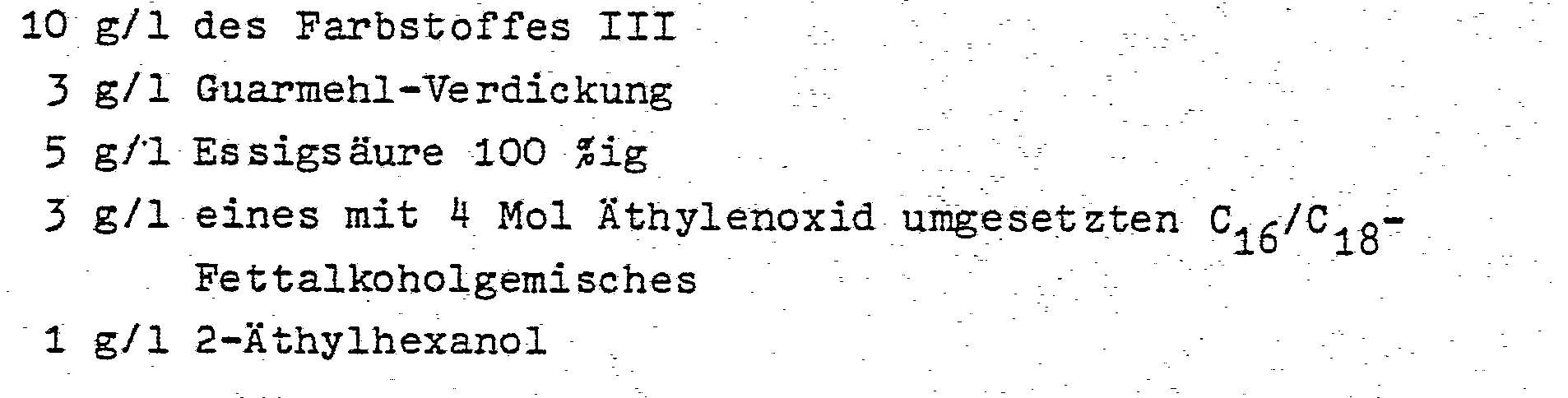
- Eine Polyamid-Tufting-Teppichware wurde mit einer Flotte folgender Zusammensetzung vorgeklotzt:
- (Die Flotte kann auch mit Hilfe eines Farbauftraggerätes auf die Ware aufgegossen werden.)
- Nach dem Klotzen bzw. Aufgießen dieser Flotte wurde sofort durch Aufspritzen oder Aufgießen eine verdickte Flotte aufgebracht, die im Liter Wasser 1 g einer mit Natronlauge neutralisierten und mit 0,8 % Divinylbenzol vernetzten hochmolekularen Polyacrylsäure enthielt. Anschließend wurde 8 Minuten bei 102°c mit Sattdampf gedämpft, ausgewaschen und getrocknet. Man erhielt eine Teppichware, die im Grund dunkel und in den Faserspitzen heller angefärbt ist. Es handelt sich dabei um besonders gewünschte Effekte.
präpariert und sie anschließend, im Fall der Anwendung der Maßnahmen (a) und (b) mit einer elektrolythaltigen Druckpaste und bei Anwendung der Maßnahme (c) mit einer Druckpaste bedruckt, die mit einem synthetischen Verdickungsmittel verdickt ist.
Claims (4)
1. Verfahren zum Bedrucken von voluminösen textilen Materialien mit Druckpasten, dadurch gekennzeichnet, daß man die voluminösen textilen Materialien zunächst mit
präpariert und sie anschließend, im Fall der Anwendung der Maßnahmen (a) und (b) mit einer elektrolythaltigen Druckpaste und bei Anwendung der Maßnahme (c) mit einer Druckpaste bedruckt, die mit einem synthetischen Verdickungsmittel verdickt ist.
a) einem synthetischen Verdickungsmittel auf Basis hochmolekularer Polycarbonsäuren,
b) einem Bad, das ein synthetisches Verdickungsmittel auf Basis hochmolekularer Polycarbonsäuren und einen Farbstoff enthält, oder
c) einer elektrolythaltigen Klotzflotte oder einer elektrolythaltigen Druckpaste
präpariert und sie anschließend, im Fall der Anwendung der Maßnahmen (a) und (b) mit einer elektrolythaltigen Druckpaste und bei Anwendung der Maßnahme (c) mit einer Druckpaste bedruckt, die mit einem synthetischen Verdickungsmittel verdickt ist.
2. Verfahren nach Anspruch 1, dadurch gekennzeichnet, daß die auf das voluminöse textile Material aufgebrachte Präparation 0,05 bis 1,0 Gew.%, bezogen auf trockenes textiles Material, beträgt.
3. Verfahren nach den Ansprüchen 1 und 2, dadurch gekennzeichnet, daß 1000 g der elektrolythaltigen Druckpasten 1 bis 20 g einer organischen Säure, eines Alkali-, Ammonium- oder Aminsalzes von organischen oder anorganischen Säuren oder von anionischen Dispergiermitteln als Elektrolyte enthalten.
4. Verfahren nach Anspruch 3, dadurch gekennzeichnet, daß die elektrolythaltigen Druckpasten mit natürlichen Verdickungsmitteln verdickt sind.
Applications Claiming Priority (2)
| Application Number | Priority Date | Filing Date | Title |
|---|---|---|---|
| DE19792904223 DE2904223A1 (de) | 1979-02-05 | 1979-02-05 | Verfahren zum bedrucken von voluminoesen textilen materialien |
| DE2904223 | 1979-02-05 |
Publications (2)
| Publication Number | Publication Date |
|---|---|
| EP0014890A2 true EP0014890A2 (de) | 1980-09-03 |
| EP0014890A3 EP0014890A3 (de) | 1981-01-07 |
Family
ID=6062158
Family Applications (1)
| Application Number | Title | Priority Date | Filing Date |
|---|---|---|---|
| EP80100558A Withdrawn EP0014890A3 (de) | 1979-02-05 | 1980-02-04 | Verfahren zum Bedrucken von voluminösen textilen Materialien |
Country Status (3)
| Country | Link |
|---|---|
| EP (1) | EP0014890A3 (de) |
| DE (1) | DE2904223A1 (de) |
| ES (1) | ES488251A1 (de) |
Cited By (2)
| Publication number | Priority date | Publication date | Assignee | Title |
|---|---|---|---|---|
| EP0054191A3 (en) * | 1980-12-12 | 1982-11-03 | Allied Corporation | Wetting solution for use in continuous dyeing of polyamide fabric |
| EP1072719A1 (de) * | 1999-07-23 | 2001-01-31 | Dainichiseika Color & Chemicals Mfg. Co. Ltd. | Verfahren zur Herstellung von bedruckten Artikeln |
Family Cites Families (4)
| Publication number | Priority date | Publication date | Assignee | Title |
|---|---|---|---|---|
| DE2304104A1 (de) * | 1972-06-28 | 1974-01-10 | Zimmer Johannes | Verfahren zur herstellung eines tiefen oder durchgehenden druckmusters bei dickem textilgut und einrichtung zu dessen durchfuehrung |
| DE2410155B2 (de) * | 1974-03-02 | 1976-11-11 | Schaumdaempfer beim space-dyeing- verfahren | |
| DE2641159A1 (de) * | 1975-09-23 | 1977-03-31 | Sandoz Ag | Verfahren zum faerben und bedrucken von textilien |
| DE2801577A1 (de) * | 1978-01-14 | 1979-07-19 | Sandoz Ag | Textilfaerbeverfahren |
-
1979
- 1979-02-05 DE DE19792904223 patent/DE2904223A1/de not_active Withdrawn
-
1980
- 1980-02-04 ES ES488251A patent/ES488251A1/es not_active Expired
- 1980-02-04 EP EP80100558A patent/EP0014890A3/de not_active Withdrawn
Cited By (3)
| Publication number | Priority date | Publication date | Assignee | Title |
|---|---|---|---|---|
| EP0054191A3 (en) * | 1980-12-12 | 1982-11-03 | Allied Corporation | Wetting solution for use in continuous dyeing of polyamide fabric |
| EP1072719A1 (de) * | 1999-07-23 | 2001-01-31 | Dainichiseika Color & Chemicals Mfg. Co. Ltd. | Verfahren zur Herstellung von bedruckten Artikeln |
| US6673394B1 (en) | 1999-07-23 | 2004-01-06 | Dainichiseika Color & Chemicals Mfg. Co., Ltd. | Process for producing printed articles |
Also Published As
| Publication number | Publication date |
|---|---|
| EP0014890A3 (de) | 1981-01-07 |
| ES488251A1 (es) | 1980-09-16 |
| DE2904223A1 (de) | 1980-08-14 |
Similar Documents
| Publication | Publication Date | Title |
|---|---|---|
| DE2700153A1 (de) | Verfahren zum faerben von textilmaterial und vorrichtung zur durchfuehrung des verfahrens | |
| DE2214377B2 (de) | Verfahren zum kontinuierlichen Färben von flächigem Textilgut | |
| DE3879276T2 (de) | Verfahren zum musterfaerben von textilmaterialien. | |
| DE2206983B2 (de) | Mittel und Verfahren zum gleichzeitigen antistatischen und schmutzabweisenden Ausrüsten von Fasermateralien | |
| EP0029804B1 (de) | Verfahren zum Bedrucken oder Klotzfärben von Textilmaterial aus Cellulosefasern in Mischung mit synthetischen Fasern sowie Druckpasten oder Klotzflotten zur Durchführung dieses Verfahrens | |
| DE2722083A1 (de) | Verfahren zur behandlung eines poroesen substrates | |
| DE2947827A1 (de) | Cellulosefasern mit verbesserter einfaerbungseigenschaft, verfahren zur herstellung einer solchen faser und verfahren zu aetzdruckbehandlung | |
| EP0014890A2 (de) | Verfahren zum Bedrucken von voluminösen textilen Materialien | |
| DE2507905A1 (de) | Faerbezusammensetzung und deren verwendung | |
| DE10126244B4 (de) | Verfahren zur Herstellung eines cellulosischen Faser- oder Flächengebildes sowie die Verwendung des danach erhaltenen Gewebes, Gestricks oder Vliesstoffs | |
| EP0418214A2 (de) | Verfahren zum Färben mit Reaktivfarbstoffen von textilen Flächengebilden | |
| DE2214409A1 (de) | Verfahren zum gleichmaessigen, frostingeffectfreien kontinuierlichen faerben von teppichware aus polyamidfasern mit traegermaterial aus hydrophoben fasern | |
| DE2938766A1 (de) | Verfahren zum bedrucken von textilmaterial | |
| DE2120692A1 (de) | Verfahren zur Herstellung gesprenkelt gefärbter Textilstoffe | |
| DE2406343A1 (de) | Ausruestungsmaterial und dessen verwendung | |
| DE3111277A1 (de) | Verfahren zum faerben von polyamidtextilmaterialien, insbesondere zum schnellfaerben von polyamiden | |
| DE1469473A1 (de) | Verfahren zur Verbesserung der Aufnahmefaehigkeit bei Cellulosefasern | |
| US3979176A (en) | Process for the continuous level processing of poly-acrylonitrile in the hydrated condition | |
| DE899638C (de) | Verfahren zum Appretieren von Fasermaterial | |
| AT522744B1 (de) | Verfahren zum Bedrucken wenigstens eines textilen Substrats | |
| DE2722082A1 (de) | Schaumpraeparat zur behandlung eines poroesen substrates | |
| DE3109373A1 (de) | Verfahren zum auftragen von flotte in verschaeumter form auf faseriges material aufweisende ware, wie stueckware oder warenbahnen | |
| DE3632795C2 (de) | ||
| DE2410155A1 (de) | Propoxylierte oder butoxylierte verzweigte fettalkohole | |
| DE2133541C3 (de) | Verfahren zur Erzeugung vielfarbiger, unregelmäßiger Drucke auf einer Textilbahn |
Legal Events
| Date | Code | Title | Description |
|---|---|---|---|
| AK | Designated contracting states |
Designated state(s): AT BE CH DE FR GB IT LU NL SE |
|
| PUAI | Public reference made under article 153(3) epc to a published international application that has entered the european phase |
Free format text: ORIGINAL CODE: 0009012 |
|
| AK | Designated contracting states |
Designated state(s): AT CH DE FR GB IT NL |
|
| PUAL | Search report despatched |
Free format text: ORIGINAL CODE: 0009013 |
|
| AK | Designated contracting states |
Designated state(s): AT CH DE FR GB IT NL |
|
| STAA | Information on the status of an ep patent application or granted ep patent |
Free format text: STATUS: THE APPLICATION HAS BEEN WITHDRAWN |
|
| 18W | Application withdrawn |
Withdrawal date: 19810204 |
|
| RIN1 | Information on inventor provided before grant (corrected) |
Inventor name: TROPSCHUH, KARL Inventor name: SCHWINDT, WOLFGANG, DR. |