EP0014955B1 - Verfahren zum Vorbereiten von Proben von mit Tritium- beziehungsweise Tritium- und C(14)-Isotopen zusammen markierten Materialien, hauptsächlich Proben von organischen Verbindungen und Materialproben biologischen Ursprunges, zur Flüssigkeitsszintillations-Radioaktivitätsmessung sowie Anordnung zu dessen Durchführung - Google Patents
Verfahren zum Vorbereiten von Proben von mit Tritium- beziehungsweise Tritium- und C(14)-Isotopen zusammen markierten Materialien, hauptsächlich Proben von organischen Verbindungen und Materialproben biologischen Ursprunges, zur Flüssigkeitsszintillations-Radioaktivitätsmessung sowie Anordnung zu dessen Durchführung Download PDFInfo
- Publication number
- EP0014955B1 EP0014955B1 EP80100730A EP80100730A EP0014955B1 EP 0014955 B1 EP0014955 B1 EP 0014955B1 EP 80100730 A EP80100730 A EP 80100730A EP 80100730 A EP80100730 A EP 80100730A EP 0014955 B1 EP0014955 B1 EP 0014955B1
- Authority
- EP
- European Patent Office
- Prior art keywords
- tritium
- samples
- carbon dioxide
- sample
- liquid scintillation
- Prior art date
- Legal status (The legal status is an assumption and is not a legal conclusion. Google has not performed a legal analysis and makes no representation as to the accuracy of the status listed.)
- Expired
Links
- YZCKVEUIGOORGS-NJFSPNSNSA-N Tritium Chemical compound [3H] YZCKVEUIGOORGS-NJFSPNSNSA-N 0.000 title claims abstract description 114
- 229910052722 tritium Inorganic materials 0.000 title claims abstract description 114
- 239000000463 material Substances 0.000 title claims abstract description 16
- 238000004519 manufacturing process Methods 0.000 title claims abstract 3
- 238000005567 liquid scintillation counting Methods 0.000 title description 13
- 239000011368 organic material Substances 0.000 title 1
- CURLTUGMZLYLDI-UHFFFAOYSA-N Carbon dioxide Chemical compound O=C=O CURLTUGMZLYLDI-UHFFFAOYSA-N 0.000 claims abstract description 136
- 239000001569 carbon dioxide Substances 0.000 claims abstract description 67
- 229910002092 carbon dioxide Inorganic materials 0.000 claims abstract description 67
- 238000010521 absorption reaction Methods 0.000 claims abstract description 63
- XLYOFNOQVPJJNP-UHFFFAOYSA-N water Substances O XLYOFNOQVPJJNP-UHFFFAOYSA-N 0.000 claims abstract description 62
- 239000007788 liquid Substances 0.000 claims abstract description 56
- HPXRVTGHNJAIIH-UHFFFAOYSA-N cyclohexanol Chemical compound OC1CCCCC1 HPXRVTGHNJAIIH-UHFFFAOYSA-N 0.000 claims abstract description 52
- 238000005259 measurement Methods 0.000 claims abstract description 22
- 238000000926 separation method Methods 0.000 claims abstract description 17
- UFHFLCQGNIYNRP-UHFFFAOYSA-N Hydrogen Chemical compound [H][H] UFHFLCQGNIYNRP-UHFFFAOYSA-N 0.000 claims abstract description 11
- 229910052739 hydrogen Inorganic materials 0.000 claims abstract description 11
- OKTJSMMVPCPJKN-UHFFFAOYSA-N Carbon Chemical compound [C] OKTJSMMVPCPJKN-UHFFFAOYSA-N 0.000 claims abstract description 10
- 229910052799 carbon Inorganic materials 0.000 claims abstract description 10
- 239000001257 hydrogen Substances 0.000 claims abstract description 10
- 150000002894 organic compounds Chemical class 0.000 claims abstract description 7
- 239000008246 gaseous mixture Substances 0.000 claims abstract 2
- 238000000034 method Methods 0.000 claims description 37
- QVGXLLKOCUKJST-UHFFFAOYSA-N atomic oxygen Chemical compound [O] QVGXLLKOCUKJST-UHFFFAOYSA-N 0.000 claims description 16
- 229910052760 oxygen Inorganic materials 0.000 claims description 16
- 239000001301 oxygen Substances 0.000 claims description 16
- 230000008569 process Effects 0.000 claims description 10
- 239000000523 sample Substances 0.000 description 79
- 230000009102 absorption Effects 0.000 description 55
- 238000002485 combustion reaction Methods 0.000 description 35
- 239000007789 gas Substances 0.000 description 20
- YXFVVABEGXRONW-UHFFFAOYSA-N Toluene Chemical compound CC1=CC=CC=C1 YXFVVABEGXRONW-UHFFFAOYSA-N 0.000 description 15
- 238000002360 preparation method Methods 0.000 description 15
- 239000000126 substance Substances 0.000 description 13
- 230000002745 absorbent Effects 0.000 description 10
- 239000002250 absorbent Substances 0.000 description 10
- LFQSCWFLJHTTHZ-UHFFFAOYSA-N Ethanol Chemical compound CCO LFQSCWFLJHTTHZ-UHFFFAOYSA-N 0.000 description 8
- 238000011161 development Methods 0.000 description 7
- 230000018109 developmental process Effects 0.000 description 7
- 230000005494 condensation Effects 0.000 description 6
- 239000000203 mixture Substances 0.000 description 6
- 238000009833 condensation Methods 0.000 description 5
- 238000001816 cooling Methods 0.000 description 5
- FAXDZWQIWUSWJH-UHFFFAOYSA-N 3-methoxypropan-1-amine Chemical compound COCCCN FAXDZWQIWUSWJH-UHFFFAOYSA-N 0.000 description 4
- OAICVXFJPJFONN-UHFFFAOYSA-N Phosphorus Chemical compound [P] OAICVXFJPJFONN-UHFFFAOYSA-N 0.000 description 4
- NINIDFKCEFEMDL-UHFFFAOYSA-N Sulfur Chemical compound [S] NINIDFKCEFEMDL-UHFFFAOYSA-N 0.000 description 4
- 238000004458 analytical method Methods 0.000 description 4
- 230000008901 benefit Effects 0.000 description 4
- 239000012159 carrier gas Substances 0.000 description 4
- 239000003054 catalyst Substances 0.000 description 4
- 238000001514 detection method Methods 0.000 description 4
- 235000019441 ethanol Nutrition 0.000 description 4
- 230000002285 radioactive effect Effects 0.000 description 4
- 239000002904 solvent Substances 0.000 description 4
- ZNOKGRXACCSDPY-UHFFFAOYSA-N tungsten trioxide Chemical compound O=[W](=O)=O ZNOKGRXACCSDPY-UHFFFAOYSA-N 0.000 description 4
- 206010053615 Thermal burn Diseases 0.000 description 3
- XLYOFNOQVPJJNP-PWCQTSIFSA-N Tritiated water Chemical compound [3H]O[3H] XLYOFNOQVPJJNP-PWCQTSIFSA-N 0.000 description 3
- 239000006096 absorbing agent Substances 0.000 description 3
- 230000008033 biological extinction Effects 0.000 description 3
- 238000004364 calculation method Methods 0.000 description 3
- 238000006243 chemical reaction Methods 0.000 description 3
- 230000003647 oxidation Effects 0.000 description 3
- 238000007254 oxidation reaction Methods 0.000 description 3
- 229910052698 phosphorus Inorganic materials 0.000 description 3
- 239000011574 phosphorus Substances 0.000 description 3
- 238000011160 research Methods 0.000 description 3
- 238000001228 spectrum Methods 0.000 description 3
- 229910052717 sulfur Inorganic materials 0.000 description 3
- 239000011593 sulfur Substances 0.000 description 3
- BQCADISMDOOEFD-UHFFFAOYSA-N Silver Chemical compound [Ag] BQCADISMDOOEFD-UHFFFAOYSA-N 0.000 description 2
- XAGFODPZIPBFFR-UHFFFAOYSA-N aluminium Chemical compound [Al] XAGFODPZIPBFFR-UHFFFAOYSA-N 0.000 description 2
- 229910052782 aluminium Inorganic materials 0.000 description 2
- 239000012472 biological sample Substances 0.000 description 2
- 239000000567 combustion gas Substances 0.000 description 2
- 150000001875 compounds Chemical class 0.000 description 2
- 238000012937 correction Methods 0.000 description 2
- 238000010586 diagram Methods 0.000 description 2
- 230000008014 freezing Effects 0.000 description 2
- 238000007710 freezing Methods 0.000 description 2
- 229910052736 halogen Inorganic materials 0.000 description 2
- 150000002367 halogens Chemical class 0.000 description 2
- 229930195733 hydrocarbon Natural products 0.000 description 2
- 150000002430 hydrocarbons Chemical class 0.000 description 2
- 150000002431 hydrogen Chemical class 0.000 description 2
- PNDPGZBMCMUPRI-UHFFFAOYSA-N iodine Chemical compound II PNDPGZBMCMUPRI-UHFFFAOYSA-N 0.000 description 2
- VUZPPFZMUPKLLV-UHFFFAOYSA-N methane;hydrate Chemical compound C.O VUZPPFZMUPKLLV-UHFFFAOYSA-N 0.000 description 2
- 238000011084 recovery Methods 0.000 description 2
- 230000000717 retained effect Effects 0.000 description 2
- 229910052709 silver Inorganic materials 0.000 description 2
- 239000004332 silver Substances 0.000 description 2
- 230000002269 spontaneous effect Effects 0.000 description 2
- 210000002268 wool Anatomy 0.000 description 2
- WKBOTKDWSSQWDR-UHFFFAOYSA-N Bromine atom Chemical compound [Br] WKBOTKDWSSQWDR-UHFFFAOYSA-N 0.000 description 1
- 239000004215 Carbon black (E152) Substances 0.000 description 1
- ZAMOUSCENKQFHK-UHFFFAOYSA-N Chlorine atom Chemical compound [Cl] ZAMOUSCENKQFHK-UHFFFAOYSA-N 0.000 description 1
- QPLDLSVMHZLSFG-UHFFFAOYSA-N Copper oxide Chemical compound [Cu]=O QPLDLSVMHZLSFG-UHFFFAOYSA-N 0.000 description 1
- 239000005751 Copper oxide Substances 0.000 description 1
- MYMOFIZGZYHOMD-UHFFFAOYSA-N Dioxygen Chemical compound O=O MYMOFIZGZYHOMD-UHFFFAOYSA-N 0.000 description 1
- 239000000654 additive Substances 0.000 description 1
- 230000000996 additive effect Effects 0.000 description 1
- 230000015572 biosynthetic process Effects 0.000 description 1
- GDTBXPJZTBHREO-UHFFFAOYSA-N bromine Substances BrBr GDTBXPJZTBHREO-UHFFFAOYSA-N 0.000 description 1
- CODNYICXDISAEA-UHFFFAOYSA-N bromine monochloride Chemical compound BrCl CODNYICXDISAEA-UHFFFAOYSA-N 0.000 description 1
- 229910052794 bromium Inorganic materials 0.000 description 1
- 239000002775 capsule Substances 0.000 description 1
- 238000007084 catalytic combustion reaction Methods 0.000 description 1
- 230000003197 catalytic effect Effects 0.000 description 1
- 230000008859 change Effects 0.000 description 1
- 229910052801 chlorine Inorganic materials 0.000 description 1
- 239000000460 chlorine Substances 0.000 description 1
- 239000000470 constituent Substances 0.000 description 1
- 229910000431 copper oxide Inorganic materials 0.000 description 1
- 238000005260 corrosion Methods 0.000 description 1
- 230000007797 corrosion Effects 0.000 description 1
- 230000009849 deactivation Effects 0.000 description 1
- 238000012217 deletion Methods 0.000 description 1
- 230000037430 deletion Effects 0.000 description 1
- 230000000694 effects Effects 0.000 description 1
- 238000005516 engineering process Methods 0.000 description 1
- 229910052740 iodine Inorganic materials 0.000 description 1
- 238000002372 labelling Methods 0.000 description 1
- 238000011068 loading method Methods 0.000 description 1
- 238000012423 maintenance Methods 0.000 description 1
- 238000000691 measurement method Methods 0.000 description 1
- 230000003446 memory effect Effects 0.000 description 1
- 150000007530 organic bases Chemical class 0.000 description 1
- TWNQGVIAIRXVLR-UHFFFAOYSA-N oxo(oxoalumanyloxy)alumane Chemical compound O=[Al]O[Al]=O TWNQGVIAIRXVLR-UHFFFAOYSA-N 0.000 description 1
- 230000001376 precipitating effect Effects 0.000 description 1
- 238000000746 purification Methods 0.000 description 1
- 239000010453 quartz Substances 0.000 description 1
- 230000001105 regulatory effect Effects 0.000 description 1
- 238000005464 sample preparation method Methods 0.000 description 1
- 230000035945 sensitivity Effects 0.000 description 1
- VYPSYNLAJGMNEJ-UHFFFAOYSA-N silicon dioxide Inorganic materials O=[Si]=O VYPSYNLAJGMNEJ-UHFFFAOYSA-N 0.000 description 1
- 238000012360 testing method Methods 0.000 description 1
- 238000012546 transfer Methods 0.000 description 1
- 238000005303 weighing Methods 0.000 description 1
Images

Classifications
-
- G—PHYSICS
- G01—MEASURING; TESTING
- G01T—MEASUREMENT OF NUCLEAR OR X-RADIATION
- G01T1/00—Measuring X-radiation, gamma radiation, corpuscular radiation, or cosmic radiation
- G01T1/16—Measuring radiation intensity
- G01T1/20—Measuring radiation intensity with scintillation detectors
- G01T1/204—Measuring radiation intensity with scintillation detectors the detector being a liquid
- G01T1/2042—Composition for liquid scintillation systems
- G01T1/2047—Sample preparation
-
- G—PHYSICS
- G01—MEASURING; TESTING
- G01T—MEASUREMENT OF NUCLEAR OR X-RADIATION
- G01T7/00—Details of radiation-measuring instruments
- G01T7/02—Collecting means for receiving or storing samples to be investigated and possibly directly transporting the samples to the measuring arrangement; particularly for investigating radioactive fluids
Definitions
- the invention relates to a method for preparing samples of materials labeled with tritium ( 3 H) or tritium and 14 C isotopes together, mainly samples of organic compounds and materials of biological origin, for liquid scintillation radioactivity measurement and an arrangement for carrying it out .
- Liquid scintillation counting is currently a widespread, almost exclusively used method for measuring the radioactivity of organic compounds and samples of organic origin labeled together with soft ß-radiating isotopes, for example with tritium or with tritium and the 14 C isotope.
- the sample preparation steps in the course of which the sample or the isotope content of the sample is transferred to a solution suitable for counting, are of fundamental importance in order to achieve corresponding analytical results. It is precisely for this reason that isotope analytical research is aimed at the development of generally applicable, easily reproducible, simple and rapid and quantitative isotope generation automatic sample preparation processes. This research is justified by the difficulties that have been experienced in the dissolving of the samples or by the need to solve the measurement problems following the sample preparation.
- radioisotope labeling technology is an important method for biological, biochemical and related other studies.
- the isotope analysis of a large number of samples which differ in their chemical-physical properties must very often be carried out.
- the analysis of a large number of samples requires a fast, automated sample preparation process.
- the tritium-containing water and the 14 C isotope-containing carbon dioxide can be obtained, among other things, as a direct oxidation product of the labeled compounds and biological samples by combustion and then the requirement for the appropriate separation of these combustion products and conversion into liquid scintillation solutions
- sample preparation methods that use sample combustion as the first stage have been developed.
- French Patent Application 2 218 026 describes a method for measuring the isotope content of substances containing tritium or tritium and 14 C isotopes, mainly organic compounds and samples of biological origin, in the gas phase by converting the hydrogen content of the samples into water and their Carbon content in a gaseous substance, preferably carbon dioxide, by simultaneous oxidation processes, separating the water and carbon dioxide formed, returning the tritium content of the water to the gas state, separately introducing the gas containing the tritium isotope and, if appropriate, the gas containing the 14 C isotope into a detection unit and Determination of the radioactivity of these gases, in which the tritium content of the water is bound to a contact catalyst which is capable of retaining or adsorbing the water and contains active hydrogen, preferably aluminum oxide and / or aluminum hydrosilicate n, whereupon the gas mixture, which also contains the 14 CO 2 when a sample containing the 14 C isotope is to be analyzed, is separated and, if appropriate
- the low sensitivity of the known methods and devices the counting efficiency depending on the physical and chemical properties of the substances to be measured, in connection with some systems on self-absorption and, in the case of homogeneous solutions, color and concentration deletion, phosphorescence and fluorescence, which result from the physical and chemical properties of the solvent and the dissolved substances and cannot be calculated in advance. It was known that the factors influencing the counting efficiency are difficult to correct and that their approximate calculation is also complicated and involves great effort. With the previous liquid scintillation counting methods, it was particularly difficult to subject the different biological substance samples generated by routine chemical research in agriculture and pharmacy to an isotope analysis. The preparation of the samples was a lengthy and laborious manual process with numerous sources of error.
- German Offenlegungsschrift 2441 314 describes a method and a device for the combustion of biological, inert or other substances which contain radioactive isotopes, in particular 14 C and tritium, in which the samples are completely burned in a stream of combustion gas and the combustion gases are extracted from them Isotopes are quantitatively absorbed and separated in two different devices, whereby the tritium-containing water formed during combustion is frozen out of the gas stream in a cooled water trap, such as a deep-frozen pipe coil, and in this way the tritium, the carbon dioxide containing 14 C-isotope, is retained on the other hand, is absorbed by an organic base, as can be seen in particular from page 5, lines 5 to 22 of said publication. In this document too there is no reference to an absorption device containing cyclohexanol.
- German patent specification 1 927 927 is a device for preparing combustible samples containing tritium and / or 14 C-labeled compounds for the measurement of their radioactivity in a liquid scintillation counter, which is a sample changer for scintillation vials loaded with scintillator solution has, with a closable inlet filled with pure oxygen combustion chamber made of temperature-resistant material, in which a holder for receiving the samples and an electrical ignition device are arranged, and with devices for completely converting the combustion products into an absorber solution and for introducing the absorption solution formed thereby known in the scintillation vials.
- US Pat. No. 3,837,807 relates to the absorption of carbon dioxide containing 14 C isotope in a primary alkoxyalkylamine, with no mention being made of water containing tritium or even its absorption.
- the invention has for its object, while eliminating the disadvantages of the prior art, a method for preparing samples of materials labeled with tritium or tritium and 14 C isotopes together, mainly samples of organic compounds and Material samples of biological origin, for liquid scintillation radioactivity measurement, which is an accurate, sensitive and fast and, if necessary, completely automatic preparation of the tritium ( 3 H isotope) or the tritium ( 3 H) and 14 C isotopes together containing substance samples for liquid scintillation radioactivity measurement and to provide a device for carrying it out.
- the invention is based on the surprising finding that the water formed during the combustion of the sample or the water introduced into the system with the sample or its tritium content by using cyclohexanol as an absorbent through the spontaneous condensation of the water and the combination of the processes between the water containing tritium remaining in the carrier gas stream and the tritium absorbent cyclohexanol (absorption and isotope exchange) can be quantitatively separated from the oxygen stream used to burn the sample at room temperature and then transferred without loss into the liquid scintillation cuvette.
- the invention is based on the finding that, if samples containing tritium and 14 C isotopes are to be analyzed together, the tritium and the carbon dioxide containing the 14 C isotope by separating the water or tritium containing the tritium in the cyclohexanol absorbent from one another can be transferred quantitatively and separately into the liquid scintillation cuvette without losses.
- the invention therefore relates to a method for preparing samples of materials labeled with tritium or tritium and 14 C isotopes together, mainly samples of organic compounds and material samples of biological origin, for liquid scintillation radioactivity measurement by burning the sample, i.e.
- the invention also relates to an arrangement for carrying out the method according to the invention with a sample holder and feed device, a combustion unit connected to it and connected to a controllable oxygen source or line, and a separation device connected to the latter and optionally one to a liquid scintillation sample holder unit Via a controllable valve, the carbon dioxide absorption device is connected in a lockable manner, which is characterized in that the separation device is a cyclohexanol-containing water containing the tritium or the tritium-binding absorption device, which, in addition to the combustion unit, has another liquid scintillation sample holder unit, advantageously via a controllable valve, and optionally lockably connected to the carbon dioxide absorption device, advantageously via another controllable valve.
- the sample holder and feed device is connected to an electrical programmer.
- the tritium is bonded according to the invention without cooling and freezing out at room temperature (by isotope exchange) by cyclohexanol. According to the invention, it is in no way a matter of precipitating the water containing tritium by cooling.
- spontaneous precondensation can also occur in the method according to the invention without cooling, which is of no importance with regard to the measurement, but whereupon the tritium enters the cyclohexanol by isotope exchange.
- the invention has the surprising advantage that, according to the invention, the two tritium exchange columns required according to the cited document are not necessary and yet complete separation of the tritium or separation of the same from the 14 C isotope is achieved.
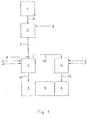
- a sample holder and feed device 1 is connected by a line 8 to a combustion unit 2 connected to an oxygen line A.
- the sample is introduced into the latter through the former.
- the combustion unit 2 which advantageously consists of a quartz tube, the hydrogen and carbon content of the sample is converted into water or carbon dioxide with the oxygen introduced through the oxygen line A.
- the phosphorus content is bound by previously added tungsten trioxide to the sample and the sulfur and halogen content by silver wool accommodated in the combustion unit 2.
- An absorption device 3 containing cyclohexanol which is connected to a cyclohexanol line C for introducing the cyclohexanol, is connected to the combustion unit 2 through a line 9.
- the in the combustion unit 2 as the products of combustion with tritium or tritium and the 14 C isotope together labeled samples of radioactive vaporous water and radioactive carbon dioxide are transferred with the oxygen carrier gas into this absorption device 3 containing cyclohexanol, in which the water containing tritium or the tritium is quantitatively produced by condensation of the former at room temperature or by its cyclohexanol is held back.
- a further absorption device namely a carbon dioxide absorption device 4, which is connected to a carbon dioxide line E for introducing the carbon dioxide, is connected to the absorption device 3 containing the cyclohexanol through a line 11.
- the gas containing the carbon dioxide is passed on from the absorption device 3 containing the cyclohexanol through line 11 into the carbon dioxide absorption device 4, in which the carbon dioxide is bound without loss by a suitable absorbent, preferably 1-amino-3-methoxypropane.
- the absorption device 3 containing the cyclohexanol is connected via a line 10 to a liquid scintillation sample holder unit 5 and the carbon dioxide absorption device 6 via a line 12 to another liquid scintillation sample holder unit 6, a cuvette changer unit 7 for loading the between the two liquid scintillation sample holder units 5, 6 the latter is arranged with cuvettes or sample holders and their removal from them.
- a line B for a water-miscible liquid, preferably ethyl alcohol, suitable for liquid scintillation counting is connected to the line 9 connecting the combustion unit 2 to the absorption device containing the cyclohexanol.
- a line D for a liquid scintillation solution, preferably a solution based on toluene, is also connected to the absorption device 3 containing cyclohexanol.
- a line F for a liquid scintillation solution, preferably a solution based on toluene, is connected to the carbon dioxide absorption device 4.
- the condensed water from the absorption device 3 containing cyclohexanol is mixed with the water-miscible liquid suitable for liquid scintillation counting, preferably ethyl alcohol, from the line B concerned and the tritium absorbent cyclohexanol and optionally the carbon dioxide absorbent present in the carbon dioxide absorption device the liquid scintillation solution, preferably the toluene-based solution, is flushed from the relevant line D or the relevant lines D and F through the line 10 or 12 into the respective liquid scintillation sample holder unit 5 and optionally 6.
- the water-miscible liquid suitable for liquid scintillation counting preferably ethyl alcohol
- connection is established by automatic valves, whose operation corresponding to the sample preparation process is controlled by the programmer Cp during the given sample preparation cycle.
- a flow and pressure regulator R and an electromagnetic valve S are installed in the oxygen line A connected to the combustion unit 2 and connected to an oxygen bottle (not shown) or other oxygen source.
- the line B for the liquid miscible liquid, preferably ethyl alcohol, suitable for liquid scintillation counting there is a pump P i for supplying this liquid
- a pump P 3 is installed to supply this solution.
- These pumps P 1 , P 2 , P 3 serve to introduce these liquids or solutions into the absorption device 3 containing cyclohexanol.
- a pump P 4 is in the carbon dioxide line E for supplying the carbon dioxide and in the line F for the liquid scintillation solution, preferably the solution Toluene based, a P 5 pump is installed to introduce this solution.
- These pumps P 4 , P 5 serve to introduce these media into the carbon dioxide absorption device 4.
- a shuttle valve V i is installed in the line 11 connecting the cyclohexanol-containing absorption device 3 and the carbon dioxide absorption device 4.
- the absorption device 3 containing cyclohexanol is replaced by the shuttle valve V, via the relevant line 11 with the carbon dioxide absorption device 4 and when preparing samples labeled only with tritium, also by the shuttle valve V i is also connected to the surrounding atmosphere via the relevant line 11.
- a one-way valve V 2 is built into the line 10 connecting the cyclohexanol containing the associated liquid scintillation sample holder unit 5, and another one-way valve V 3 is built into the line 12 connecting the carbon dioxide absorption device 4 with the associated liquid scintillation sample holder unit 6.
- the sample holder and feed device 1, the electromagnetic valve S, the pumps P 1 , P 2 , P 3 , P 4 and P 5 , the one-way valves V 2 and V 3 and the cuvette changer unit 7 are in a manner known per se, each with an outlet of the programmer Cp connected.
- the invention is illustrated by the following example.
- the preparation of each rehearsal consisted of four phases. Before the arrangement was switched on, the tritium weighed into aluminum or lead capsules and the samples containing the ' 4 C isotope were placed in the sample holder and feed device 1, and the shuttle valve V 1 and the automatic program were set in accordance with the isotope (s) to be measured.
- the programmer Cp closed the one-way valves V 2 , V 3 , opened the electromagnetic valve S and pushed the cuvettes containing the samples further by means of the cuvette changer unit 7 (in this way, new sample holders reached the sample collection points).
- certain amounts of cyclohexanol and carbon dioxide absorbent 1-amino-3-methoxypropane were then converted into the cyclohexanol by the cyclohexanol line C via the programmer Cp controlled commissioning of the pumps P 2 , P 4 in question containing absorption device 3 or through the carbon dioxide line E into the carbon dioxide absorption device 4.
- cyclohexanol was only supplied with the P 2 pump.
- the electromagnetic valve S remained open and the one-way valves V 2 and V 3 were closed.
- the sample holder and feeder 1 was put into operation by the programmer Cp and the first sample came through the line 8 in question into the combustion unit 2 heated to 1000 ° C., in which it abruptly burned in the oxygen introduced into the system through the oxygen line A.
- the phosphorus content of the sample was bound by tungsten trioxide added to the sample during weighing in, and the sulfur and halogen content of the sample were bound by silver wool housed in the combustion unit 2.
- the quantitative oxidation of the combustion products to water and carbon dioxide was ensured by a catalyst also located in the combustion unit 2, preferably by copper oxide.
- a catalyst also located in the combustion unit 2, preferably by copper oxide.
- the water vapor and the carbon dioxide obtained were conveyed with the oxygen flowing through the combustion unit 2 through the line 9 in question into the absorption device 3 containing cyclohexanol, in which the water or tritium containing tritium was obtained were retained quantitatively, while the carbon dioxide was conveyed by the oxygen flow through appropriate switching of the change-over valve V built into it, into the carbon dioxide absorption device 4 filled with a given amount of 1-amino-3-methoxypropane.
- the oxygen transporting the carbon dioxide was discharged after the outlet from the absorption device 3 containing cyclohexanol through the relevant line 11 via the change-over valve V I built into the latter by corresponding switching of the same.
- the electromagnetic valve S was closed.
- the one-way valve V 2 installed in the absorption device 3 containing the cyclohexanol with the associated liquid scintillation sample holder unit 5 and optionally the one-way valve V 3 built in the line 12 connecting the carbon dioxide absorption device 4 with the associated liquid scintillation sample holder unit 6 were opened, whereby the in of the cyclohexanol-containing absorption device 3, the tritium absorption medium cyclohexanol and, if appropriate, the carbon dioxide absorption medium 1-amino-3-methoxypropane located in the carbon dioxide absorption device 4, according to the given automatic program, got into the liquid scintillation sample holder unit (s) 5 and possibly 6.
- the tritium-containing water condensed in the cyclohexanol absorption device 3 with ethyl alcohol and the tritium absorbent cyclohexanol remaining in this absorption device 3 and the carbon dioxide absorbent 4 remaining in the carbon dioxide absorption device 4 became the 1-amino-3-methoxintillin solution solution with the liquid , 6 rinsed.
- the four phases of the sample preparation process could be repeated automatically until the samples accommodated in the sample holder and feed device 1 were processed.
- Tables 1 and 2 above also show the surprising, unforeseeable advantage that the specific radioactivity can also be measured from biological samples with very good reproducibility.
Landscapes
- High Energy & Nuclear Physics (AREA)
- Physics & Mathematics (AREA)
- Health & Medical Sciences (AREA)
- Life Sciences & Earth Sciences (AREA)
- General Physics & Mathematics (AREA)
- Molecular Biology (AREA)
- Spectroscopy & Molecular Physics (AREA)
- Analytical Chemistry (AREA)
- Chemical & Material Sciences (AREA)
- Other Investigation Or Analysis Of Materials By Electrical Means (AREA)
- Investigating Or Analysing Biological Materials (AREA)
- Organic Low-Molecular-Weight Compounds And Preparation Thereof (AREA)
- Measurement Of Radiation (AREA)
Priority Applications (1)
| Application Number | Priority Date | Filing Date | Title |
|---|---|---|---|
| AT80100730T ATE1559T1 (de) | 1979-02-14 | 1980-02-13 | Verfahren zum vorbereiten von proben von mit tritium- beziehungsweise tritium- und c(14)isotopen zusammen markierten materialien, hauptsaechlich proben von organischen verbindungen und materialproben biologischen ursprunges, zur fluessigkeitsszintillations-radioaktivitaetsmessu g sowie anordnung zu dessen durchfuehrung. |
Applications Claiming Priority (2)
| Application Number | Priority Date | Filing Date | Title |
|---|---|---|---|
| HUMA003108 | 1979-02-14 | ||
| HU79MA3108A HU177476B (en) | 1979-02-14 | 1979-02-14 | Process and equipment for the preparation of samples of materials labelled jointly with 3h,further 3h and 14c isotopes for the determination of the radioactivity with liquid scintillation method |
Publications (2)
| Publication Number | Publication Date |
|---|---|
| EP0014955A1 EP0014955A1 (de) | 1980-09-03 |
| EP0014955B1 true EP0014955B1 (de) | 1982-09-15 |
Family
ID=10999061
Family Applications (1)
| Application Number | Title | Priority Date | Filing Date |
|---|---|---|---|
| EP80100730A Expired EP0014955B1 (de) | 1979-02-14 | 1980-02-13 | Verfahren zum Vorbereiten von Proben von mit Tritium- beziehungsweise Tritium- und C(14)-Isotopen zusammen markierten Materialien, hauptsächlich Proben von organischen Verbindungen und Materialproben biologischen Ursprunges, zur Flüssigkeitsszintillations-Radioaktivitätsmessung sowie Anordnung zu dessen Durchführung |
Country Status (6)
| Country | Link |
|---|---|
| EP (1) | EP0014955B1 (cs) |
| AT (1) | ATE1559T1 (cs) |
| CS (1) | CS222681B2 (cs) |
| DD (1) | DD149118A5 (cs) |
| DE (1) | DE3060835D1 (cs) |
| HU (1) | HU177476B (cs) |
Families Citing this family (4)
| Publication number | Priority date | Publication date | Assignee | Title |
|---|---|---|---|---|
| FR2922030B1 (fr) * | 2007-10-04 | 2011-03-18 | Commissariat Energie Atomique | Procede de mesure dans un echantillon aqueux de la radioactivite emise par le carbone 14 |
| EP2439557B1 (de) * | 2010-10-08 | 2014-12-03 | Arbeitsgemeinschaft Versuchs-Reaktor (AVR) | Aktivitätsbestimmungsverfahren der ß-Aktivität des Kohlenstoffisotops C14 |
| CN113917520B (zh) * | 2021-10-22 | 2024-08-09 | 中核核电运行管理有限公司 | 一种氚和碳-14联合取样装置和方法 |
| CN113960650B (zh) * | 2021-10-22 | 2024-12-13 | 中核核电运行管理有限公司 | 一种高活度氚水中碳-14活度分析预处理装置 |
Family Cites Families (5)
| Publication number | Priority date | Publication date | Assignee | Title |
|---|---|---|---|---|
| DE1927927B1 (de) * | 1969-05-31 | 1970-10-22 | Kernforschung Gmbh Ges Fuer | Vorrichtung zum Vorbereiten von ?H- und/oder ?C-ma rkierte Verbindungen enthaltenden,verbrennbaren Pr oben fuer die Messung von deren Radioaktivitaet in einem Fluessigkeits-Szintillationszaehler |
| US3837807A (en) * | 1972-04-07 | 1974-09-24 | Packard Instrument Co Inc | Improved absorbent for carbon-14 dioxide |
| US3830628A (en) * | 1972-04-10 | 1974-08-20 | Packard Instrument Co Inc | Sample preparation method and apparatus |
| FR2218026A5 (en) * | 1973-02-09 | 1974-09-06 | Chinoin Gyogyszer Es Vegyeszet | Rado isotope analysis - of biological samples labelled with tritium and carbon-14 |
| FR2250438A5 (en) * | 1973-08-30 | 1975-05-30 | Benakis Achille | Tritium hydride and carbon-14 dioxide septn. from sample - by incineration with cooling and absorption to ppt. isotopes |
-
1979
- 1979-02-14 HU HU79MA3108A patent/HU177476B/hu not_active IP Right Cessation
-
1980
- 1980-01-29 CS CS80617A patent/CS222681B2/cs unknown
- 1980-02-12 DD DD80219013A patent/DD149118A5/de unknown
- 1980-02-13 AT AT80100730T patent/ATE1559T1/de not_active IP Right Cessation
- 1980-02-13 DE DE8080100730T patent/DE3060835D1/de not_active Expired
- 1980-02-13 EP EP80100730A patent/EP0014955B1/de not_active Expired
Also Published As
| Publication number | Publication date |
|---|---|
| DE3060835D1 (en) | 1982-11-04 |
| CS222681B2 (en) | 1983-07-29 |
| DD149118A5 (de) | 1981-06-24 |
| EP0014955A1 (de) | 1980-09-03 |
| HU177476B (en) | 1981-10-28 |
| ATE1559T1 (de) | 1982-09-15 |
Similar Documents
| Publication | Publication Date | Title |
|---|---|---|
| DE3045654C2 (de) | Vorrichtung zum Verbinden von pneumatischen und/oder hydraulischen Kreisen in der Trenntechnik | |
| DE2716276A1 (de) | Verfahren und vorrichtung zur immunologischen bestimmung von gentamycin | |
| May et al. | Standard reference materials for chemical and biological studies of complex environmental samples | |
| DE69520425T2 (de) | Verfahren zur isotopenzusammensetzungsanalyse und isotopenzusammensetzungsanalysator | |
| DE2600383C3 (de) | Analyseverfahren und -vorrichtung zur Bestimmung wenigstens einer primären und einer sekundären Aminosäure in einem Flüssigkeitsprobenstrom | |
| DE3225043A1 (de) | Verfahren zur durchfuehrung eines immunoassays ohne zentrifugierschritt | |
| Lozano et al. | Determination of radium isotopes by BaSO 4 coprecipitation for the preparation of alpha-spectrometric sources | |
| EP1143234A1 (de) | Verfahren und Vorrichtung zum Nachweisen von Quecksilber | |
| EP0014955B1 (de) | Verfahren zum Vorbereiten von Proben von mit Tritium- beziehungsweise Tritium- und C(14)-Isotopen zusammen markierten Materialien, hauptsächlich Proben von organischen Verbindungen und Materialproben biologischen Ursprunges, zur Flüssigkeitsszintillations-Radioaktivitätsmessung sowie Anordnung zu dessen Durchführung | |
| DE102010039275A1 (de) | Verfahren und Vorrichtung zur online-Bestimmung des Isotopenverhältnisses von Chlor, Brom oder Schwefel in einer organischen Probe | |
| EP2210087B1 (de) | Verfahren und vorrichtung zur isotopenverhältnisanalyse | |
| DE3510867C2 (cs) | ||
| DE69228519T2 (de) | Verfahren und Vorrichtung zur analytischen Bestimmung von Halogenen,Schwetel undPhosphor | |
| DE19735927C2 (de) | Verfahren und Vorrichtung zur automatisierten ·15·N-Bestimmung von ammonium-, nitrat- und nitrithaltigen wäßrigen Lösungen | |
| Cassidy et al. | Evaluation of dynamic ion exchanger for the isolation of metal ions for characterization by mass and. alpha.-spectrometry | |
| DE2346422A1 (de) | Verfahren und system zur feststellung von explosivstoffen | |
| DE1900981B2 (de) | Vorrichtung zur gaschromatographischen bestimmung geringer mengen von organophosphonverbindungen | |
| DE2717925B2 (de) | Verwendung eines für die Spurenanalyse durch Röntgenfluoreszenz dienenden Anreicherungsverfahrens | |
| DE3233187A1 (de) | Strahlungsdetektor | |
| DE2255180A1 (de) | Verfahren und vorrichtung zur messung der radioaktivitaet organischer substanzen | |
| DE1598539C3 (de) | Verfahren und Vorrichtung zur radiogaschromatographischen Analyse einer Mischung aus unterschiedlichen Komponenten | |
| Byrne | Neutron activation analysis using TRIGA | |
| DE2517130C3 (de) | Transportverfahren für zu analysierende Einzelproben in einem Gel | |
| Lyon | Analytical Chemistry Division annual progress report for period ending September 30, 1972. | |
| Nagy et al. | Some problems concerning the use of automated radiochemical separation systems in destructive neutron activation analysis |
Legal Events
| Date | Code | Title | Description |
|---|---|---|---|
| PUAI | Public reference made under article 153(3) epc to a published international application that has entered the european phase |
Free format text: ORIGINAL CODE: 0009012 |
|
| AK | Designated contracting states |
Designated state(s): AT CH DE FR GB NL SE |
|
| 17P | Request for examination filed |
Effective date: 19801127 |
|
| GRAA | (expected) grant |
Free format text: ORIGINAL CODE: 0009210 |
|
| AK | Designated contracting states |
Designated state(s): AT CH DE FR GB NL SE |
|
| REF | Corresponds to: |
Ref document number: 1559 Country of ref document: AT Date of ref document: 19820915 Kind code of ref document: T |
|
| REF | Corresponds to: |
Ref document number: 3060835 Country of ref document: DE Date of ref document: 19821104 |
|
| PGFP | Annual fee paid to national office [announced via postgrant information from national office to epo] |
Ref country code: FR Payment date: 19840126 Year of fee payment: 5 |
|
| PGFP | Annual fee paid to national office [announced via postgrant information from national office to epo] |
Ref country code: AT Payment date: 19840213 Year of fee payment: 5 |
|
| PGFP | Annual fee paid to national office [announced via postgrant information from national office to epo] |
Ref country code: CH Payment date: 19840228 Year of fee payment: 5 |
|
| PGFP | Annual fee paid to national office [announced via postgrant information from national office to epo] |
Ref country code: NL Payment date: 19840229 Year of fee payment: 5 |
|
| PGFP | Annual fee paid to national office [announced via postgrant information from national office to epo] |
Ref country code: SE Payment date: 19840331 Year of fee payment: 5 |
|
| PGFP | Annual fee paid to national office [announced via postgrant information from national office to epo] |
Ref country code: DE Payment date: 19840410 Year of fee payment: 5 |
|
| PG25 | Lapsed in a contracting state [announced via postgrant information from national office to epo] |
Ref country code: AT Effective date: 19850213 |
|
| PG25 | Lapsed in a contracting state [announced via postgrant information from national office to epo] |
Ref country code: SE Effective date: 19850214 |
|
| PG25 | Lapsed in a contracting state [announced via postgrant information from national office to epo] |
Ref country code: CH Effective date: 19850228 |
|
| PG25 | Lapsed in a contracting state [announced via postgrant information from national office to epo] |
Ref country code: NL Effective date: 19850901 |
|
| GBPC | Gb: european patent ceased through non-payment of renewal fee | ||
| NLV4 | Nl: lapsed or anulled due to non-payment of the annual fee | ||
| PG25 | Lapsed in a contracting state [announced via postgrant information from national office to epo] |
Ref country code: FR Free format text: LAPSE BECAUSE OF NON-PAYMENT OF DUE FEES Effective date: 19851031 |
|
| REG | Reference to a national code |
Ref country code: CH Ref legal event code: PL |
|
| PG25 | Lapsed in a contracting state [announced via postgrant information from national office to epo] |
Ref country code: DE Effective date: 19851101 |
|
| REG | Reference to a national code |
Ref country code: FR Ref legal event code: ST |
|
| PG25 | Lapsed in a contracting state [announced via postgrant information from national office to epo] |
Ref country code: GB Effective date: 19881118 |
|
| EUG | Se: european patent has lapsed |
Ref document number: 80100730.3 Effective date: 19860129 |
|
| PLBE | No opposition filed within time limit |
Free format text: ORIGINAL CODE: 0009261 |
|
| STAA | Information on the status of an ep patent application or granted ep patent |
Free format text: STATUS: NO OPPOSITION FILED WITHIN TIME LIMIT |