EP0015230A1 - Stabilisiertes organisches Polymer enthaltend als Lichtstabilisator ein 2-(2-Hydroxy-3,5-di-tert-octylphenyl)-2H-benzotriazol - Google Patents
Stabilisiertes organisches Polymer enthaltend als Lichtstabilisator ein 2-(2-Hydroxy-3,5-di-tert-octylphenyl)-2H-benzotriazol Download PDFInfo
- Publication number
- EP0015230A1 EP0015230A1 EP80810017A EP80810017A EP0015230A1 EP 0015230 A1 EP0015230 A1 EP 0015230A1 EP 80810017 A EP80810017 A EP 80810017A EP 80810017 A EP80810017 A EP 80810017A EP 0015230 A1 EP0015230 A1 EP 0015230A1
- Authority
- EP
- European Patent Office
- Prior art keywords
- stabilizer
- bis
- tert
- tetramethyl
- acid
- Prior art date
- Legal status (The legal status is an assumption and is not a legal conclusion. Google has not performed a legal analysis and makes no representation as to the accuracy of the status listed.)
- Granted
Links
- 239000004611 light stabiliser Substances 0.000 title claims abstract description 37
- XDNLOGRBAYJSMQ-UHFFFAOYSA-N 2-(benzotriazol-2-yl)-4,6-bis(2,4,4-trimethylpentan-2-yl)phenol Chemical compound CC(C)(C)CC(C)(C)C1=CC(C(C)(C)CC(C)(C)C)=CC(N2N=C3C=CC=CC3=N2)=C1O XDNLOGRBAYJSMQ-UHFFFAOYSA-N 0.000 title claims description 8
- 229920000620 organic polymer Polymers 0.000 title abstract description 3
- -1 tert-octyl Chemical group 0.000 claims abstract description 168
- 150000001875 compounds Chemical class 0.000 claims abstract description 45
- 239000001257 hydrogen Substances 0.000 claims abstract description 31
- 229910052739 hydrogen Inorganic materials 0.000 claims abstract description 31
- 239000000460 chlorine Chemical group 0.000 claims abstract description 5
- 229910052801 chlorine Chemical group 0.000 claims abstract description 5
- 125000004435 hydrogen atom Chemical group [H]* 0.000 claims abstract description 5
- ZAMOUSCENKQFHK-UHFFFAOYSA-N Chlorine atom Chemical group [Cl] ZAMOUSCENKQFHK-UHFFFAOYSA-N 0.000 claims abstract description 4
- 239000003381 stabilizer Substances 0.000 claims description 54
- 229920000642 polymer Polymers 0.000 claims description 25
- 239000004925 Acrylic resin Substances 0.000 claims description 23
- 229920000178 Acrylic resin Polymers 0.000 claims description 23
- 150000001412 amines Chemical class 0.000 claims description 20
- 229920002647 polyamide Polymers 0.000 claims description 16
- 229920005989 resin Polymers 0.000 claims description 11
- 239000011347 resin Substances 0.000 claims description 11
- 239000011368 organic material Substances 0.000 claims description 10
- 239000004952 Polyamide Substances 0.000 claims description 9
- 229920000515 polycarbonate Polymers 0.000 claims description 8
- 239000004417 polycarbonate Substances 0.000 claims description 8
- 229920000728 polyester Polymers 0.000 claims description 7
- XITRBUPOXXBIJN-UHFFFAOYSA-N bis(2,2,6,6-tetramethylpiperidin-4-yl) decanedioate Chemical compound C1C(C)(C)NC(C)(C)CC1OC(=O)CCCCCCCCC(=O)OC1CC(C)(C)NC(C)(C)C1 XITRBUPOXXBIJN-UHFFFAOYSA-N 0.000 claims description 5
- 230000014759 maintenance of location Effects 0.000 claims description 5
- 229920002635 polyurethane Polymers 0.000 claims description 5
- 239000004814 polyurethane Substances 0.000 claims description 5
- 239000002966 varnish Substances 0.000 claims description 2
- OFOBLEOULBTSOW-UHFFFAOYSA-L Malonate Chemical compound [O-]C(=O)CC([O-])=O OFOBLEOULBTSOW-UHFFFAOYSA-L 0.000 claims 1
- 239000000463 material Substances 0.000 claims 1
- 229920001059 synthetic polymer Polymers 0.000 claims 1
- 125000000217 alkyl group Chemical group 0.000 description 40
- 229920001577 copolymer Polymers 0.000 description 40
- PPBRXRYQALVLMV-UHFFFAOYSA-N Styrene Chemical compound C=CC1=CC=CC=C1 PPBRXRYQALVLMV-UHFFFAOYSA-N 0.000 description 34
- QRUDEWIWKLJBPS-UHFFFAOYSA-N benzotriazole Chemical compound C1=CC=C2N[N][N]C2=C1 QRUDEWIWKLJBPS-UHFFFAOYSA-N 0.000 description 29
- 239000012964 benzotriazole Substances 0.000 description 29
- 125000002947 alkylene group Chemical group 0.000 description 28
- GBXQPDCOMJJCMJ-UHFFFAOYSA-M trimethyl-[6-(trimethylazaniumyl)hexyl]azanium;bromide Chemical compound [Br-].C[N+](C)(C)CCCCCC[N+](C)(C)C GBXQPDCOMJJCMJ-UHFFFAOYSA-M 0.000 description 22
- 150000001565 benzotriazoles Chemical group 0.000 description 21
- 150000002431 hydrogen Chemical group 0.000 description 21
- 230000032798 delamination Effects 0.000 description 20
- 150000003254 radicals Chemical class 0.000 description 20
- 239000006096 absorbing agent Substances 0.000 description 19
- 125000003118 aryl group Chemical group 0.000 description 18
- 125000001997 phenyl group Chemical group [H]C1=C([H])C([H])=C(*)C([H])=C1[H] 0.000 description 18
- NIXOWILDQLNWCW-UHFFFAOYSA-N Acrylic acid Chemical compound OC(=O)C=C NIXOWILDQLNWCW-UHFFFAOYSA-N 0.000 description 17
- 125000001797 benzyl group Chemical group [H]C1=C([H])C([H])=C(C([H])=C1[H])C([H])([H])* 0.000 description 17
- 239000000203 mixture Substances 0.000 description 17
- 229910052757 nitrogen Inorganic materials 0.000 description 17
- 229920001187 thermosetting polymer Polymers 0.000 description 16
- 125000002496 methyl group Chemical group [H]C([H])([H])* 0.000 description 15
- 239000010408 film Substances 0.000 description 14
- UFHFLCQGNIYNRP-UHFFFAOYSA-N Hydrogen Chemical compound [H][H] UFHFLCQGNIYNRP-UHFFFAOYSA-N 0.000 description 13
- 125000003710 aryl alkyl group Chemical group 0.000 description 13
- 238000000576 coating method Methods 0.000 description 13
- 239000002253 acid Substances 0.000 description 12
- 125000000753 cycloalkyl group Chemical group 0.000 description 12
- 239000000243 solution Substances 0.000 description 12
- 125000001424 substituent group Chemical group 0.000 description 12
- 238000012545 processing Methods 0.000 description 11
- 229920001169 thermoplastic Polymers 0.000 description 11
- 239000004416 thermosoftening plastic Substances 0.000 description 11
- VGGSQFUCUMXWEO-UHFFFAOYSA-N Ethene Chemical compound C=C VGGSQFUCUMXWEO-UHFFFAOYSA-N 0.000 description 10
- XSQUKJJJFZCRTK-UHFFFAOYSA-N Urea Chemical compound NC(N)=O XSQUKJJJFZCRTK-UHFFFAOYSA-N 0.000 description 10
- 125000001589 carboacyl group Chemical group 0.000 description 10
- 125000001495 ethyl group Chemical group [H]C([H])([H])C([H])([H])* 0.000 description 10
- 229920001155 polypropylene Polymers 0.000 description 10
- 238000012360 testing method Methods 0.000 description 10
- 125000003903 2-propenyl group Chemical group [H]C([*])([H])C([H])=C([H])[H] 0.000 description 9
- OKKJLVBELUTLKV-UHFFFAOYSA-N Methanol Chemical group OC OKKJLVBELUTLKV-UHFFFAOYSA-N 0.000 description 9
- HEMHJVSKTPXQMS-UHFFFAOYSA-M Sodium hydroxide Chemical compound [OH-].[Na+] HEMHJVSKTPXQMS-UHFFFAOYSA-M 0.000 description 9
- 125000001931 aliphatic group Chemical group 0.000 description 9
- 210000003298 dental enamel Anatomy 0.000 description 9
- 125000003055 glycidyl group Chemical group C(C1CO1)* 0.000 description 9
- MUBZPKHOEPUJKR-UHFFFAOYSA-N Oxalic acid Chemical compound OC(=O)C(O)=O MUBZPKHOEPUJKR-UHFFFAOYSA-N 0.000 description 8
- 125000004450 alkenylene group Chemical group 0.000 description 8
- 125000000732 arylene group Chemical group 0.000 description 8
- 125000000113 cyclohexyl group Chemical group [H]C1([H])C([H])([H])C([H])([H])C([H])(*)C([H])([H])C1([H])[H] 0.000 description 8
- 150000002148 esters Chemical class 0.000 description 8
- 239000004922 lacquer Substances 0.000 description 8
- 239000000047 product Substances 0.000 description 8
- 125000000999 tert-butyl group Chemical group [H]C([H])([H])C(*)(C([H])([H])[H])C([H])([H])[H] 0.000 description 8
- 229910052727 yttrium Inorganic materials 0.000 description 8
- QQONPFPTGQHPMA-UHFFFAOYSA-N Propene Chemical compound CC=C QQONPFPTGQHPMA-UHFFFAOYSA-N 0.000 description 7
- HCHKCACWOHOZIP-UHFFFAOYSA-N Zinc Chemical compound [Zn] HCHKCACWOHOZIP-UHFFFAOYSA-N 0.000 description 7
- 125000003342 alkenyl group Chemical group 0.000 description 7
- 238000002845 discoloration Methods 0.000 description 7
- JDSHMPZPIAZGSV-UHFFFAOYSA-N melamine Chemical compound NC1=NC(N)=NC(N)=N1 JDSHMPZPIAZGSV-UHFFFAOYSA-N 0.000 description 7
- 125000004108 n-butyl group Chemical group [H]C([H])([H])C([H])([H])C([H])([H])C([H])([H])* 0.000 description 7
- 239000003973 paint Substances 0.000 description 7
- 125000006839 xylylene group Chemical group 0.000 description 7
- 125000004825 2,2-dimethylpropylene group Chemical group [H]C([H])([H])C(C([H])([H])[H])(C([H])([H])[*:1])C([H])([H])[*:2] 0.000 description 6
- 125000000094 2-phenylethyl group Chemical group [H]C1=C([H])C([H])=C(C([H])=C1[H])C([H])([H])C([H])([H])* 0.000 description 6
- NLHHRLWOUZZQLW-UHFFFAOYSA-N Acrylonitrile Chemical compound C=CC#N NLHHRLWOUZZQLW-UHFFFAOYSA-N 0.000 description 6
- WSFSSNUMVMOOMR-UHFFFAOYSA-N Formaldehyde Chemical compound O=C WSFSSNUMVMOOMR-UHFFFAOYSA-N 0.000 description 6
- PEDCQBHIVMGVHV-UHFFFAOYSA-N Glycerine Chemical compound OCC(O)CO PEDCQBHIVMGVHV-UHFFFAOYSA-N 0.000 description 6
- XEEYBQQBJWHFJM-UHFFFAOYSA-N Iron Chemical compound [Fe] XEEYBQQBJWHFJM-UHFFFAOYSA-N 0.000 description 6
- 229920002292 Nylon 6 Polymers 0.000 description 6
- OAICVXFJPJFONN-UHFFFAOYSA-N Phosphorus Chemical compound [P] OAICVXFJPJFONN-UHFFFAOYSA-N 0.000 description 6
- 239000004743 Polypropylene Substances 0.000 description 6
- 125000002777 acetyl group Chemical class [H]C([H])([H])C(*)=O 0.000 description 6
- 125000004432 carbon atom Chemical group C* 0.000 description 6
- 125000002993 cycloalkylene group Chemical group 0.000 description 6
- DIOQZVSQGTUSAI-UHFFFAOYSA-N decane Chemical compound CCCCCCCCCC DIOQZVSQGTUSAI-UHFFFAOYSA-N 0.000 description 6
- XNGIFLGASWRNHJ-UHFFFAOYSA-N phthalic acid Chemical compound OC(=O)C1=CC=CC=C1C(O)=O XNGIFLGASWRNHJ-UHFFFAOYSA-N 0.000 description 6
- 239000004800 polyvinyl chloride Substances 0.000 description 6
- 229920000915 polyvinyl chloride Polymers 0.000 description 6
- 125000002914 sec-butyl group Chemical group [H]C([H])([H])C([H])([H])C([H])(*)C([H])([H])[H] 0.000 description 6
- 239000000758 substrate Substances 0.000 description 6
- RSJKGSCJYJTIGS-UHFFFAOYSA-N undecane Chemical compound CCCCCCCCCCC RSJKGSCJYJTIGS-UHFFFAOYSA-N 0.000 description 6
- 229920002554 vinyl polymer Polymers 0.000 description 6
- 239000005977 Ethylene Substances 0.000 description 5
- VEXZGXHMUGYJMC-UHFFFAOYSA-N Hydrochloric acid Chemical compound Cl VEXZGXHMUGYJMC-UHFFFAOYSA-N 0.000 description 5
- OFOBLEOULBTSOW-UHFFFAOYSA-N Malonic acid Chemical compound OC(=O)CC(O)=O OFOBLEOULBTSOW-UHFFFAOYSA-N 0.000 description 5
- WNLRTRBMVRJNCN-UHFFFAOYSA-N adipic acid Chemical compound OC(=O)CCCCC(O)=O WNLRTRBMVRJNCN-UHFFFAOYSA-N 0.000 description 5
- 229920000180 alkyd Polymers 0.000 description 5
- 238000004458 analytical method Methods 0.000 description 5
- 235000013877 carbamide Nutrition 0.000 description 5
- 125000004956 cyclohexylene group Chemical group 0.000 description 5
- 239000000835 fiber Substances 0.000 description 5
- 229920000578 graft copolymer Polymers 0.000 description 5
- 229910052736 halogen Inorganic materials 0.000 description 5
- 150000002367 halogens Chemical class 0.000 description 5
- 238000004519 manufacturing process Methods 0.000 description 5
- 229910021645 metal ion Inorganic materials 0.000 description 5
- 238000000034 method Methods 0.000 description 5
- 125000001280 n-hexyl group Chemical group C(CCCCC)* 0.000 description 5
- 125000004123 n-propyl group Chemical group [H]C([H])([H])C([H])([H])C([H])([H])* 0.000 description 5
- 229920006324 polyoxymethylene Polymers 0.000 description 5
- 125000004805 propylene group Chemical group [H]C([H])([H])C([H])([*:1])C([H])([H])[*:2] 0.000 description 5
- 239000002904 solvent Substances 0.000 description 5
- 230000000087 stabilizing effect Effects 0.000 description 5
- 239000000126 substance Substances 0.000 description 5
- 239000011701 zinc Substances 0.000 description 5
- 229910052725 zinc Inorganic materials 0.000 description 5
- HJIAMFHSAAEUKR-UHFFFAOYSA-N (2-hydroxyphenyl)-phenylmethanone Chemical compound OC1=CC=CC=C1C(=O)C1=CC=CC=C1 HJIAMFHSAAEUKR-UHFFFAOYSA-N 0.000 description 4
- 125000004958 1,4-naphthylene group Chemical group 0.000 description 4
- 125000006017 1-propenyl group Chemical group 0.000 description 4
- ZMWRRFHBXARRRT-UHFFFAOYSA-N 2-(benzotriazol-2-yl)-4,6-bis(2-methylbutan-2-yl)phenol Chemical compound CCC(C)(C)C1=CC(C(C)(C)CC)=CC(N2N=C3C=CC=CC3=N2)=C1O ZMWRRFHBXARRRT-UHFFFAOYSA-N 0.000 description 4
- FJGQBLRYBUAASW-UHFFFAOYSA-N 2-(benzotriazol-2-yl)phenol Chemical class OC1=CC=CC=C1N1N=C2C=CC=CC2=N1 FJGQBLRYBUAASW-UHFFFAOYSA-N 0.000 description 4
- 125000004974 2-butenyl group Chemical group C(C=CC)* 0.000 description 4
- 125000000954 2-hydroxyethyl group Chemical group [H]C([*])([H])C([H])([H])O[H] 0.000 description 4
- QTBSBXVTEAMEQO-UHFFFAOYSA-N Acetic acid Chemical compound CC(O)=O QTBSBXVTEAMEQO-UHFFFAOYSA-N 0.000 description 4
- 239000004593 Epoxy Substances 0.000 description 4
- 229920000877 Melamine resin Polymers 0.000 description 4
- ISWSIDIOOBJBQZ-UHFFFAOYSA-N Phenol Chemical compound OC1=CC=CC=C1 ISWSIDIOOBJBQZ-UHFFFAOYSA-N 0.000 description 4
- RWRDLPDLKQPQOW-UHFFFAOYSA-N Pyrrolidine Chemical compound C1CCNC1 RWRDLPDLKQPQOW-UHFFFAOYSA-N 0.000 description 4
- BZHJMEDXRYGGRV-UHFFFAOYSA-N Vinyl chloride Chemical compound ClC=C BZHJMEDXRYGGRV-UHFFFAOYSA-N 0.000 description 4
- 238000010521 absorption reaction Methods 0.000 description 4
- 125000003647 acryloyl group Chemical group O=C([*])C([H])=C([H])[H] 0.000 description 4
- 239000000654 additive Substances 0.000 description 4
- 125000003236 benzoyl group Chemical group [H]C1=C([H])C([H])=C(C([H])=C1[H])C(*)=O 0.000 description 4
- 239000004202 carbamide Substances 0.000 description 4
- 238000006243 chemical reaction Methods 0.000 description 4
- 239000012043 crude product Substances 0.000 description 4
- 229910052751 metal Inorganic materials 0.000 description 4
- 239000002184 metal Substances 0.000 description 4
- 125000005394 methallyl group Chemical group 0.000 description 4
- COFLEVLXIIWATL-UHFFFAOYSA-N n,n'-bis(1,2,2,6,6-pentamethylpiperidin-4-yl)hexane-1,6-diamine Chemical compound C1C(C)(C)N(C)C(C)(C)CC1NCCCCCCNC1CC(C)(C)N(C)C(C)(C)C1 COFLEVLXIIWATL-UHFFFAOYSA-N 0.000 description 4
- 239000000049 pigment Substances 0.000 description 4
- 229920000647 polyepoxide Polymers 0.000 description 4
- 229920000573 polyethylene Polymers 0.000 description 4
- CXMXRPHRNRROMY-UHFFFAOYSA-N sebacic acid Chemical compound OC(=O)CCCCCCCCC(O)=O CXMXRPHRNRROMY-UHFFFAOYSA-N 0.000 description 4
- ARCGXLSVLAOJQL-UHFFFAOYSA-N trimellitic acid Chemical compound OC(=O)C1=CC=C(C(O)=O)C(C(O)=O)=C1 ARCGXLSVLAOJQL-UHFFFAOYSA-N 0.000 description 4
- XLYOFNOQVPJJNP-UHFFFAOYSA-N water Substances O XLYOFNOQVPJJNP-UHFFFAOYSA-N 0.000 description 4
- 125000004400 (C1-C12) alkyl group Chemical group 0.000 description 3
- 125000001989 1,3-phenylene group Chemical group [H]C1=C([H])C([*:1])=C([H])C([*:2])=C1[H] 0.000 description 3
- 125000001140 1,4-phenylene group Chemical group [H]C1=C([H])C([*:2])=C([H])C([H])=C1[*:1] 0.000 description 3
- WUHHVDQBQZVSJV-UHFFFAOYSA-N 2,2-dibutylpropanedioic acid Chemical compound CCCCC(C(O)=O)(C(O)=O)CCCC WUHHVDQBQZVSJV-UHFFFAOYSA-N 0.000 description 3
- DNYCICZKXQGHBJ-UHFFFAOYSA-N 2,4-bis(2,4,4-trimethylpentan-2-yl)phenol Chemical compound CC(C)(C)CC(C)(C)C1=CC=C(O)C(C(C)(C)CC(C)(C)C)=C1 DNYCICZKXQGHBJ-UHFFFAOYSA-N 0.000 description 3
- SMZOUWXMTYCWNB-UHFFFAOYSA-N 2-(2-methoxy-5-methylphenyl)ethanamine Chemical compound COC1=CC=C(C)C=C1CCN SMZOUWXMTYCWNB-UHFFFAOYSA-N 0.000 description 3
- 125000006040 2-hexenyl group Chemical group 0.000 description 3
- DPJCXCZTLWNFOH-UHFFFAOYSA-N 2-nitroaniline Chemical compound NC1=CC=CC=C1[N+]([O-])=O DPJCXCZTLWNFOH-UHFFFAOYSA-N 0.000 description 3
- 125000006024 2-pentenyl group Chemical group 0.000 description 3
- 239000004923 Acrylic lacquer Substances 0.000 description 3
- 125000002853 C1-C4 hydroxyalkyl group Chemical group 0.000 description 3
- KXDHJXZQYSOELW-UHFFFAOYSA-N Carbamic acid Chemical class NC(O)=O KXDHJXZQYSOELW-UHFFFAOYSA-N 0.000 description 3
- YMWUJEATGCHHMB-UHFFFAOYSA-N Dichloromethane Chemical compound ClCCl YMWUJEATGCHHMB-UHFFFAOYSA-N 0.000 description 3
- LFQSCWFLJHTTHZ-UHFFFAOYSA-N Ethanol Chemical compound CCO LFQSCWFLJHTTHZ-UHFFFAOYSA-N 0.000 description 3
- CERQOIWHTDAKMF-UHFFFAOYSA-N Methacrylic acid Chemical compound CC(=C)C(O)=O CERQOIWHTDAKMF-UHFFFAOYSA-N 0.000 description 3
- 239000004698 Polyethylene Substances 0.000 description 3
- 229920002367 Polyisobutene Polymers 0.000 description 3
- YXFVVABEGXRONW-UHFFFAOYSA-N Toluene Chemical compound CC1=CC=CC=C1 YXFVVABEGXRONW-UHFFFAOYSA-N 0.000 description 3
- 150000007513 acids Chemical class 0.000 description 3
- 229920000122 acrylonitrile butadiene styrene Polymers 0.000 description 3
- 125000004183 alkoxy alkyl group Chemical group 0.000 description 3
- 125000000304 alkynyl group Chemical group 0.000 description 3
- 229910052788 barium Inorganic materials 0.000 description 3
- DSAJWYNOEDNPEQ-UHFFFAOYSA-N barium atom Chemical compound [Ba] DSAJWYNOEDNPEQ-UHFFFAOYSA-N 0.000 description 3
- WPYMKLBDIGXBTP-UHFFFAOYSA-N benzoic acid Chemical compound OC(=O)C1=CC=CC=C1 WPYMKLBDIGXBTP-UHFFFAOYSA-N 0.000 description 3
- FIPAOMIQSWQHOX-UHFFFAOYSA-N bis(1,2,2,6,6-pentamethylpiperidin-4-yl) hexanedioate Chemical compound C1C(C)(C)N(C)C(C)(C)CC1OC(=O)CCCCC(=O)OC1CC(C)(C)N(C)C(C)(C)C1 FIPAOMIQSWQHOX-UHFFFAOYSA-N 0.000 description 3
- 125000004063 butyryl group Chemical group O=C([*])C([H])([H])C([H])([H])C([H])([H])[H] 0.000 description 3
- 229910052793 cadmium Inorganic materials 0.000 description 3
- BDOSMKKIYDKNTQ-UHFFFAOYSA-N cadmium atom Chemical compound [Cd] BDOSMKKIYDKNTQ-UHFFFAOYSA-N 0.000 description 3
- 230000000694 effects Effects 0.000 description 3
- 239000003822 epoxy resin Substances 0.000 description 3
- 229920001519 homopolymer Polymers 0.000 description 3
- QQVIHTHCMHWDBS-UHFFFAOYSA-N isophthalic acid Chemical compound OC(=O)C1=CC=CC(C(O)=O)=C1 QQVIHTHCMHWDBS-UHFFFAOYSA-N 0.000 description 3
- 229940056960 melamin Drugs 0.000 description 3
- VLKZOEOYAKHREP-UHFFFAOYSA-N n-Hexane Chemical compound CCCCCC VLKZOEOYAKHREP-UHFFFAOYSA-N 0.000 description 3
- 125000002801 octanoyl group Chemical group C(CCCCCCC)(=O)* 0.000 description 3
- 125000001820 oxy group Chemical group [*:1]O[*:2] 0.000 description 3
- 150000002989 phenols Chemical class 0.000 description 3
- 229910052698 phosphorus Inorganic materials 0.000 description 3
- 239000011574 phosphorus Substances 0.000 description 3
- 229920002492 poly(sulfone) Polymers 0.000 description 3
- 229920000768 polyamine Polymers 0.000 description 3
- 229920000139 polyethylene terephthalate Polymers 0.000 description 3
- 239000005020 polyethylene terephthalate Substances 0.000 description 3
- 239000004848 polyfunctional curative Substances 0.000 description 3
- 229920000193 polymethacrylate Polymers 0.000 description 3
- 238000002360 preparation method Methods 0.000 description 3
- 125000001501 propionyl group Chemical group O=C([*])C([H])([H])C([H])([H])[H] 0.000 description 3
- 239000011541 reaction mixture Substances 0.000 description 3
- 150000003839 salts Chemical class 0.000 description 3
- OLRJXMHANKMLTD-UHFFFAOYSA-N silyl Chemical compound [SiH3] OLRJXMHANKMLTD-UHFFFAOYSA-N 0.000 description 3
- 230000006641 stabilisation Effects 0.000 description 3
- 238000011105 stabilization Methods 0.000 description 3
- 125000000383 tetramethylene group Chemical group [H]C([H])([*:1])C([H])([H])C([H])([H])C([H])([H])[*:2] 0.000 description 3
- 150000003672 ureas Chemical class 0.000 description 3
- 125000000391 vinyl group Chemical group [H]C([*])=C([H])[H] 0.000 description 3
- NWPIOULNZLJZHU-UHFFFAOYSA-N (1,2,2,6,6-pentamethylpiperidin-4-yl) 2-methylprop-2-enoate Chemical compound CN1C(C)(C)CC(OC(=O)C(C)=C)CC1(C)C NWPIOULNZLJZHU-UHFFFAOYSA-N 0.000 description 2
- ZPTIVKALIXSBID-UHFFFAOYSA-N (1,2,2,6,6-pentamethylpiperidin-4-yl) 4-chlorobenzoate Chemical compound C1C(C)(C)N(C)C(C)(C)CC1OC(=O)C1=CC=C(Cl)C=C1 ZPTIVKALIXSBID-UHFFFAOYSA-N 0.000 description 2
- YEYCMBWKTZNPDH-UHFFFAOYSA-N (2,2,6,6-tetramethylpiperidin-4-yl) benzoate Chemical compound C1C(C)(C)NC(C)(C)CC1OC(=O)C1=CC=CC=C1 YEYCMBWKTZNPDH-UHFFFAOYSA-N 0.000 description 2
- JMUOXOJMXILBTE-UHFFFAOYSA-N (2,2,6,6-tetramethylpiperidin-4-yl) octadecanoate Chemical compound CCCCCCCCCCCCCCCCCC(=O)OC1CC(C)(C)NC(C)(C)C1 JMUOXOJMXILBTE-UHFFFAOYSA-N 0.000 description 2
- BUFCQVRLKYIQJP-UHFFFAOYSA-N (2,2,6,6-tetramethylpiperidin-4-yl) prop-2-enoate Chemical compound CC1(C)CC(OC(=O)C=C)CC(C)(C)N1 BUFCQVRLKYIQJP-UHFFFAOYSA-N 0.000 description 2
- DSZOTMKIKJOOPG-UHFFFAOYSA-N (2-nitrophenyl)-phenyldiazene Chemical compound [O-][N+](=O)C1=CC=CC=C1N=NC1=CC=CC=C1 DSZOTMKIKJOOPG-UHFFFAOYSA-N 0.000 description 2
- 125000006702 (C1-C18) alkyl group Chemical group 0.000 description 2
- 125000004178 (C1-C4) alkyl group Chemical group 0.000 description 2
- 125000006656 (C2-C4) alkenyl group Chemical group 0.000 description 2
- 125000002030 1,2-phenylene group Chemical group [H]C1=C([H])C([*:1])=C([*:2])C([H])=C1[H] 0.000 description 2
- 125000004955 1,4-cyclohexylene group Chemical group [H]C1([H])C([H])([H])C([H])([*:1])C([H])([H])C([H])([H])C1([H])[*:2] 0.000 description 2
- YLNHMDBXZAIRGL-UHFFFAOYSA-N 1-(2,2,6,6-tetramethyl-4-phenylmethoxypiperidin-1-yl)prop-2-en-1-one Chemical compound C1C(C)(C)N(C(=O)C=C)C(C)(C)CC1OCC1=CC=CC=C1 YLNHMDBXZAIRGL-UHFFFAOYSA-N 0.000 description 2
- IZCTUSNVXSGHST-UHFFFAOYSA-N 1-(3-aminopropyl)-2,2,6,6-tetramethylpiperidin-4-amine Chemical compound CC1(C)CC(N)CC(C)(C)N1CCCN IZCTUSNVXSGHST-UHFFFAOYSA-N 0.000 description 2
- VLTHAKKFNPUWSB-UHFFFAOYSA-N 1-benzyl-2,2,6,6-tetramethylpiperidin-4-ol Chemical compound CC1(C)CC(O)CC(C)(C)N1CC1=CC=CC=C1 VLTHAKKFNPUWSB-UHFFFAOYSA-N 0.000 description 2
- RKMGAJGJIURJSJ-UHFFFAOYSA-N 2,2,6,6-Tetramethylpiperidine Substances CC1(C)CCCC(C)(C)N1 RKMGAJGJIURJSJ-UHFFFAOYSA-N 0.000 description 2
- NPGMRAKLNOUHHI-UHFFFAOYSA-N 2,2,6,6-tetramethyl-1-[4-(2,2,6,6-tetramethylpiperidin-1-yl)but-2-enyl]piperidine Chemical compound CC1(C)CCCC(C)(C)N1CC=CCN1C(C)(C)CCCC1(C)C NPGMRAKLNOUHHI-UHFFFAOYSA-N 0.000 description 2
- NARVIWMVBMUEOG-UHFFFAOYSA-N 2-Hydroxy-propylene Natural products CC(O)=C NARVIWMVBMUEOG-UHFFFAOYSA-N 0.000 description 2
- SLWIPPZWFZGHEU-UHFFFAOYSA-N 2-[4-(carboxymethyl)phenyl]acetic acid Chemical compound OC(=O)CC1=CC=C(CC(O)=O)C=C1 SLWIPPZWFZGHEU-UHFFFAOYSA-N 0.000 description 2
- DPGCPSGJCLNQSL-UHFFFAOYSA-N 2-butyl-7,7,9,9-tetramethyl-1-oxa-3,8-diazaspiro[4.5]decan-4-one Chemical compound O1C(CCCC)NC(=O)C11CC(C)(C)NC(C)(C)C1 DPGCPSGJCLNQSL-UHFFFAOYSA-N 0.000 description 2
- XNYKZVIOOQMZGY-UHFFFAOYSA-N 2-butyl-7,7,9,9-tetramethyl-1-oxa-4,8-diazaspiro[4.5]decan-3-one Chemical compound N1C(=O)C(CCCC)OC11CC(C)(C)NC(C)(C)C1 XNYKZVIOOQMZGY-UHFFFAOYSA-N 0.000 description 2
- 125000001731 2-cyanoethyl group Chemical group [H]C([H])(*)C([H])([H])C#N 0.000 description 2
- 125000004200 2-methoxyethyl group Chemical group [H]C([H])([H])OC([H])([H])C([H])([H])* 0.000 description 2
- QNZKGCJBPSSIGR-UHFFFAOYSA-N 2-methyl-n-(1,2,2,6,6-pentamethylpiperidin-4-yl)prop-2-enamide Chemical compound CN1C(C)(C)CC(NC(=O)C(C)=C)CC1(C)C QNZKGCJBPSSIGR-UHFFFAOYSA-N 0.000 description 2
- 125000001494 2-propynyl group Chemical group [H]C#CC([H])([H])* 0.000 description 2
- YCGKJPVUGMBDDS-UHFFFAOYSA-N 3-(6-azabicyclo[3.1.1]hepta-1(7),2,4-triene-6-carbonyl)benzamide Chemical compound NC(=O)C1=CC=CC(C(=O)N2C=3C=C2C=CC=3)=C1 YCGKJPVUGMBDDS-UHFFFAOYSA-N 0.000 description 2
- AOJLKJXCHAOGTQ-UHFFFAOYSA-N 3-benzyl-7,7,9,9-tetramethyl-1,3,8-triazaspiro[4.5]decane-2,4-dione Chemical compound C1C(C)(C)NC(C)(C)CC21C(=O)N(CC=1C=CC=CC=1)C(=O)N2 AOJLKJXCHAOGTQ-UHFFFAOYSA-N 0.000 description 2
- QOXOZONBQWIKDA-UHFFFAOYSA-N 3-hydroxypropyl Chemical group [CH2]CCO QOXOZONBQWIKDA-UHFFFAOYSA-N 0.000 description 2
- PBGKNXWGYQPUJK-UHFFFAOYSA-N 4-chloro-2-nitroaniline Chemical compound NC1=CC=C(Cl)C=C1[N+]([O-])=O PBGKNXWGYQPUJK-UHFFFAOYSA-N 0.000 description 2
- UWDMKTDPDJCJOP-UHFFFAOYSA-N 4-hydroxy-2,2,6,6-tetramethylpiperidin-1-ium-4-carboxylate Chemical compound CC1(C)CC(O)(C(O)=O)CC(C)(C)N1 UWDMKTDPDJCJOP-UHFFFAOYSA-N 0.000 description 2
- JNHYOKDGAIQHJU-UHFFFAOYSA-N 4-hydroxy-2,2,6,6-tetramethylpiperidine-4-carboxamide Chemical compound CC1(C)CC(O)(C(N)=O)CC(C)(C)N1 JNHYOKDGAIQHJU-UHFFFAOYSA-N 0.000 description 2
- SXIFAEWFOJETOA-UHFFFAOYSA-N 4-hydroxy-butyl Chemical group [CH2]CCCO SXIFAEWFOJETOA-UHFFFAOYSA-N 0.000 description 2
- KWQYIBSYWGQURG-UHFFFAOYSA-N 7,7,8,9,9-pentamethyl-3-(oxiran-2-ylmethyl)-1,3,8-triazaspiro[4.5]decane-2,4-dione Chemical compound C1C(C)(C)N(C)C(C)(C)CC21C(=O)N(CC1OC1)C(=O)N2 KWQYIBSYWGQURG-UHFFFAOYSA-N 0.000 description 2
- LHSUFCAKCIVPND-UHFFFAOYSA-N 7,7,9,9-tetramethyl-2-propan-2-yl-1-oxa-3,8-diazaspiro[4.5]decan-4-one Chemical compound O1C(C(C)C)NC(=O)C11CC(C)(C)NC(C)(C)C1 LHSUFCAKCIVPND-UHFFFAOYSA-N 0.000 description 2
- JSKDIXGEDIPHPR-UHFFFAOYSA-N 7,7,9,9-tetramethyl-2-propan-2-yl-1-oxa-4,8-diazaspiro[4.5]decan-3-one Chemical compound N1C(=O)C(C(C)C)OC11CC(C)(C)NC(C)(C)C1 JSKDIXGEDIPHPR-UHFFFAOYSA-N 0.000 description 2
- NIXOWILDQLNWCW-UHFFFAOYSA-M Acrylate Chemical compound [O-]C(=O)C=C NIXOWILDQLNWCW-UHFFFAOYSA-M 0.000 description 2
- 239000005995 Aluminium silicate Substances 0.000 description 2
- IJGRMHOSHXDMSA-UHFFFAOYSA-N Atomic nitrogen Chemical compound N#N IJGRMHOSHXDMSA-UHFFFAOYSA-N 0.000 description 2
- LCFVJGUPQDGYKZ-UHFFFAOYSA-N Bisphenol A diglycidyl ether Chemical compound C=1C=C(OCC2OC2)C=CC=1C(C)(C)C(C=C1)=CC=C1OCC1CO1 LCFVJGUPQDGYKZ-UHFFFAOYSA-N 0.000 description 2
- XDTMQSROBMDMFD-UHFFFAOYSA-N C1CCCCC1 Chemical compound C1CCCCC1 XDTMQSROBMDMFD-UHFFFAOYSA-N 0.000 description 2
- 125000006374 C2-C10 alkenyl group Chemical group 0.000 description 2
- CURLTUGMZLYLDI-UHFFFAOYSA-N Carbon dioxide Chemical compound O=C=O CURLTUGMZLYLDI-UHFFFAOYSA-N 0.000 description 2
- BRLQWZUYTZBJKN-UHFFFAOYSA-N Epichlorohydrin Chemical compound ClCC1CO1 BRLQWZUYTZBJKN-UHFFFAOYSA-N 0.000 description 2
- IAYPIBMASNFSPL-UHFFFAOYSA-N Ethylene oxide Chemical compound C1CO1 IAYPIBMASNFSPL-UHFFFAOYSA-N 0.000 description 2
- OAKJQQAXSVQMHS-UHFFFAOYSA-N Hydrazine Chemical compound NN OAKJQQAXSVQMHS-UHFFFAOYSA-N 0.000 description 2
- KFZMGEQAYNKOFK-UHFFFAOYSA-N Isopropanol Chemical compound CC(C)O KFZMGEQAYNKOFK-UHFFFAOYSA-N 0.000 description 2
- 229920004142 LEXAN™ Polymers 0.000 description 2
- 239000004418 Lexan Substances 0.000 description 2
- XUMBMVFBXHLACL-UHFFFAOYSA-N Melanin Chemical compound O=C1C(=O)C(C2=CNC3=C(C(C(=O)C4=C32)=O)C)=C2C4=CNC2=C1C XUMBMVFBXHLACL-UHFFFAOYSA-N 0.000 description 2
- PXHVJJICTQNCMI-UHFFFAOYSA-N Nickel Chemical compound [Ni] PXHVJJICTQNCMI-UHFFFAOYSA-N 0.000 description 2
- CTQNGGLPUBDAKN-UHFFFAOYSA-N O-Xylene Chemical compound CC1=CC=CC=C1C CTQNGGLPUBDAKN-UHFFFAOYSA-N 0.000 description 2
- 229930040373 Paraformaldehyde Natural products 0.000 description 2
- NBIIXXVUZAFLBC-UHFFFAOYSA-N Phosphoric acid Chemical compound OP(O)(O)=O NBIIXXVUZAFLBC-UHFFFAOYSA-N 0.000 description 2
- NQRYJNQNLNOLGT-UHFFFAOYSA-N Piperidine Chemical compound C1CCNCC1 NQRYJNQNLNOLGT-UHFFFAOYSA-N 0.000 description 2
- 229920003171 Poly (ethylene oxide) Polymers 0.000 description 2
- 239000004721 Polyphenylene oxide Substances 0.000 description 2
- 229920002396 Polyurea Polymers 0.000 description 2
- 239000004372 Polyvinyl alcohol Substances 0.000 description 2
- BQCADISMDOOEFD-UHFFFAOYSA-N Silver Chemical compound [Ag] BQCADISMDOOEFD-UHFFFAOYSA-N 0.000 description 2
- KDYFGRWQOYBRFD-UHFFFAOYSA-N Succinic acid Natural products OC(=O)CCC(O)=O KDYFGRWQOYBRFD-UHFFFAOYSA-N 0.000 description 2
- 239000007983 Tris buffer Substances 0.000 description 2
- 230000002378 acidificating effect Effects 0.000 description 2
- 239000001361 adipic acid Substances 0.000 description 2
- 235000011037 adipic acid Nutrition 0.000 description 2
- 235000012211 aluminium silicate Nutrition 0.000 description 2
- 239000003963 antioxidant agent Substances 0.000 description 2
- 239000011230 binding agent Substances 0.000 description 2
- 230000015572 biosynthetic process Effects 0.000 description 2
- FQNYPONFENZBCY-UHFFFAOYSA-N bis(1,2,2,6,6-pentamethylpiperidin-4-yl) benzene-1,3-dicarboxylate Chemical compound C1C(C)(C)N(C)C(C)(C)CC1OC(=O)C1=CC=CC(C(=O)OC2CC(C)(C)N(C)C(C)(C)C2)=C1 FQNYPONFENZBCY-UHFFFAOYSA-N 0.000 description 2
- RSOILICUEWXSLA-UHFFFAOYSA-N bis(1,2,2,6,6-pentamethylpiperidin-4-yl) decanedioate Chemical compound C1C(C)(C)N(C)C(C)(C)CC1OC(=O)CCCCCCCCC(=O)OC1CC(C)(C)N(C)C(C)(C)C1 RSOILICUEWXSLA-UHFFFAOYSA-N 0.000 description 2
- QKLQIGBUQHTCAT-UHFFFAOYSA-N bis(1-acetyl-2,2,6,6-tetramethylpiperidin-4-yl) decanedioate Chemical compound C1C(C)(C)N(C(=O)C)C(C)(C)CC1OC(=O)CCCCCCCCC(=O)OC1CC(C)(C)N(C(C)=O)C(C)(C)C1 QKLQIGBUQHTCAT-UHFFFAOYSA-N 0.000 description 2
- FZYYIPTTYZNQLK-UHFFFAOYSA-N bis(1-benzyl-2,2,6,6-tetramethylpiperidin-4-yl) decanedioate Chemical compound CC1(C)CC(OC(=O)CCCCCCCCC(=O)OC2CC(C)(C)N(CC=3C=CC=CC=3)C(C)(C)C2)CC(C)(C)N1CC1=CC=CC=C1 FZYYIPTTYZNQLK-UHFFFAOYSA-N 0.000 description 2
- UROGBLCMTWAODF-UHFFFAOYSA-N bis(2,2,6,6-tetramethylpiperidin-4-yl) hexanedioate Chemical compound C1C(C)(C)NC(C)(C)CC1OC(=O)CCCCC(=O)OC1CC(C)(C)NC(C)(C)C1 UROGBLCMTWAODF-UHFFFAOYSA-N 0.000 description 2
- IISBACLAFKSPIT-UHFFFAOYSA-N bisphenol A Chemical compound C=1C=C(O)C=CC=1C(C)(C)C1=CC=C(O)C=C1 IISBACLAFKSPIT-UHFFFAOYSA-N 0.000 description 2
- KDYFGRWQOYBRFD-NUQCWPJISA-N butanedioic acid Chemical compound O[14C](=O)CC[14C](O)=O KDYFGRWQOYBRFD-NUQCWPJISA-N 0.000 description 2
- 150000001721 carbon Chemical group 0.000 description 2
- 229910052799 carbon Inorganic materials 0.000 description 2
- 150000001732 carboxylic acid derivatives Chemical class 0.000 description 2
- 229920002678 cellulose Polymers 0.000 description 2
- 239000001913 cellulose Substances 0.000 description 2
- 229920002301 cellulose acetate Polymers 0.000 description 2
- 229920001727 cellulose butyrate Polymers 0.000 description 2
- 229920006218 cellulose propionate Polymers 0.000 description 2
- 229910017052 cobalt Inorganic materials 0.000 description 2
- 239000010941 cobalt Substances 0.000 description 2
- GUTLYIVDDKVIGB-UHFFFAOYSA-N cobalt atom Chemical compound [Co] GUTLYIVDDKVIGB-UHFFFAOYSA-N 0.000 description 2
- 239000013078 crystal Substances 0.000 description 2
- 239000012954 diazonium Substances 0.000 description 2
- IJGRMHOSHXDMSA-UHFFFAOYSA-O diazynium Chemical compound [NH+]#N IJGRMHOSHXDMSA-UHFFFAOYSA-O 0.000 description 2
- 150000001991 dicarboxylic acids Chemical class 0.000 description 2
- 150000001993 dienes Chemical class 0.000 description 2
- GYZLOYUZLJXAJU-UHFFFAOYSA-N diglycidyl ether Chemical compound C1OC1COCC1CO1 GYZLOYUZLJXAJU-UHFFFAOYSA-N 0.000 description 2
- BOBNOXCLPCOMIK-UHFFFAOYSA-N dimethyl-bis[(2,2,6,6-tetramethylpiperidin-4-yl)oxy]silane Chemical compound C1C(C)(C)NC(C)(C)CC1O[Si](C)(C)OC1CC(C)(C)NC(C)(C)C1 BOBNOXCLPCOMIK-UHFFFAOYSA-N 0.000 description 2
- 229920001971 elastomer Polymers 0.000 description 2
- 239000000839 emulsion Substances 0.000 description 2
- VXNZUUAINFGPBY-UHFFFAOYSA-N ethyl ethylene Natural products CCC=C VXNZUUAINFGPBY-UHFFFAOYSA-N 0.000 description 2
- 125000004836 hexamethylene group Chemical group [H]C([H])([*:2])C([H])([H])C([H])([H])C([H])([H])C([H])([H])C([H])([H])[*:1] 0.000 description 2
- 125000002768 hydroxyalkyl group Chemical group 0.000 description 2
- 238000010348 incorporation Methods 0.000 description 2
- 229910052742 iron Inorganic materials 0.000 description 2
- 125000001449 isopropyl group Chemical group [H]C([H])([H])C([H])(*)C([H])([H])[H] 0.000 description 2
- NLYAJNPCOHFWQQ-UHFFFAOYSA-N kaolin Chemical compound O.O.O=[Al]O[Si](=O)O[Si](=O)O[Al]=O NLYAJNPCOHFWQQ-UHFFFAOYSA-N 0.000 description 2
- 125000000400 lauroyl group Chemical group O=C([*])C([H])([H])C([H])([H])C([H])([H])C([H])([H])C([H])([H])C([H])([H])C([H])([H])C([H])([H])C([H])([H])C([H])([H])C([H])([H])[H] 0.000 description 2
- 230000001795 light effect Effects 0.000 description 2
- VZCYOOQTPOCHFL-UPHRSURJSA-N maleic acid Chemical compound OC(=O)\C=C/C(O)=O VZCYOOQTPOCHFL-UPHRSURJSA-N 0.000 description 2
- 239000006078 metal deactivator Substances 0.000 description 2
- 125000004184 methoxymethyl group Chemical group [H]C([H])([H])OC([H])([H])* 0.000 description 2
- 229920000609 methyl cellulose Polymers 0.000 description 2
- 239000001923 methylcellulose Substances 0.000 description 2
- 235000010981 methylcellulose Nutrition 0.000 description 2
- UKJARPDLRWBRAX-UHFFFAOYSA-N n,n'-bis(2,2,6,6-tetramethylpiperidin-4-yl)hexane-1,6-diamine Chemical compound C1C(C)(C)NC(C)(C)CC1NCCCCCCNC1CC(C)(C)NC(C)(C)C1 UKJARPDLRWBRAX-UHFFFAOYSA-N 0.000 description 2
- WFIYJMCNWNWOCL-UHFFFAOYSA-N n-(1,2,2,6,6-pentamethylpiperidin-4-yl)acetamide Chemical compound CN1C(C)(C)CC(NC(C)=O)CC1(C)C WFIYJMCNWNWOCL-UHFFFAOYSA-N 0.000 description 2
- OOVHLFLYXBKLTN-UHFFFAOYSA-N n-(1,2,2,6,6-pentamethylpiperidin-4-yl)prop-2-enamide Chemical compound CN1C(C)(C)CC(NC(=O)C=C)CC1(C)C OOVHLFLYXBKLTN-UHFFFAOYSA-N 0.000 description 2
- BRSZLVDOXIGUSH-UHFFFAOYSA-N n-(1-acetyl-2,2,6,6-tetramethylpiperidin-4-yl)-n-cyclohexylacetamide Chemical compound C1C(C)(C)N(C(C)=O)C(C)(C)CC1N(C(=O)C)C1CCCCC1 BRSZLVDOXIGUSH-UHFFFAOYSA-N 0.000 description 2
- OWSKGHZFUXNYJC-UHFFFAOYSA-N n-benzyl-2,2,6,6-tetramethylpiperidin-4-amine Chemical compound C1C(C)(C)NC(C)(C)CC1NCC1=CC=CC=C1 OWSKGHZFUXNYJC-UHFFFAOYSA-N 0.000 description 2
- YRVUCYWJQFRCOB-UHFFFAOYSA-N n-butylprop-2-enamide Chemical compound CCCCNC(=O)C=C YRVUCYWJQFRCOB-UHFFFAOYSA-N 0.000 description 2
- 125000004433 nitrogen atom Chemical group N* 0.000 description 2
- QIQXTHQIDYTFRH-UHFFFAOYSA-N octadecanoic acid Chemical compound CCCCCCCCCCCCCCCCCC(O)=O QIQXTHQIDYTFRH-UHFFFAOYSA-N 0.000 description 2
- 235000006408 oxalic acid Nutrition 0.000 description 2
- 239000002530 phenolic antioxidant Substances 0.000 description 2
- NPLSRXKOUBVHTB-UHFFFAOYSA-N phenyl-tris[(2,2,6,6-tetramethylpiperidin-4-yl)oxy]silane Chemical compound C1C(C)(C)NC(C)(C)CC1O[Si](C=1C=CC=CC=1)(OC1CC(C)(C)NC(C)(C)C1)OC1CC(C)(C)NC(C)(C)C1 NPLSRXKOUBVHTB-UHFFFAOYSA-N 0.000 description 2
- 125000000843 phenylene group Chemical group C1(=C(C=CC=C1)*)* 0.000 description 2
- XNGIFLGASWRNHJ-UHFFFAOYSA-L phthalate(2-) Chemical compound [O-]C(=O)C1=CC=CC=C1C([O-])=O XNGIFLGASWRNHJ-UHFFFAOYSA-L 0.000 description 2
- 230000000704 physical effect Effects 0.000 description 2
- 229960003810 piperidione Drugs 0.000 description 2
- 229920003023 plastic Polymers 0.000 description 2
- 239000004033 plastic Substances 0.000 description 2
- 239000006223 plastic coating Substances 0.000 description 2
- 229920002037 poly(vinyl butyral) polymer Polymers 0.000 description 2
- 229920002401 polyacrylamide Polymers 0.000 description 2
- 229920000058 polyacrylate Polymers 0.000 description 2
- 229920002857 polybutadiene Polymers 0.000 description 2
- 229920000570 polyether Polymers 0.000 description 2
- 229920001195 polyisoprene Polymers 0.000 description 2
- 229920000098 polyolefin Polymers 0.000 description 2
- 229920002223 polystyrene Polymers 0.000 description 2
- 229920002689 polyvinyl acetate Polymers 0.000 description 2
- 229920002451 polyvinyl alcohol Polymers 0.000 description 2
- 235000019422 polyvinyl alcohol Nutrition 0.000 description 2
- 229920002620 polyvinyl fluoride Polymers 0.000 description 2
- 239000000843 powder Substances 0.000 description 2
- 230000008569 process Effects 0.000 description 2
- 230000005855 radiation Effects 0.000 description 2
- 238000011084 recovery Methods 0.000 description 2
- 239000005060 rubber Substances 0.000 description 2
- YGSDEFSMJLZEOE-UHFFFAOYSA-N salicylic acid Chemical compound OC(=O)C1=CC=CC=C1O YGSDEFSMJLZEOE-UHFFFAOYSA-N 0.000 description 2
- 229920006395 saturated elastomer Polymers 0.000 description 2
- 229940116351 sebacate Drugs 0.000 description 2
- CXMXRPHRNRROMY-UHFFFAOYSA-L sebacate(2-) Chemical compound [O-]C(=O)CCCCCCCCC([O-])=O CXMXRPHRNRROMY-UHFFFAOYSA-L 0.000 description 2
- LPXPTNMVRIOKMN-UHFFFAOYSA-M sodium nitrite Chemical compound [Na+].[O-]N=O LPXPTNMVRIOKMN-UHFFFAOYSA-M 0.000 description 2
- 239000007787 solid Substances 0.000 description 2
- 238000003756 stirring Methods 0.000 description 2
- TYFQFVWCELRYAO-UHFFFAOYSA-N suberic acid Chemical compound OC(=O)CCCCCCC(O)=O TYFQFVWCELRYAO-UHFFFAOYSA-N 0.000 description 2
- 239000013589 supplement Substances 0.000 description 2
- 239000000725 suspension Substances 0.000 description 2
- 230000035900 sweating Effects 0.000 description 2
- KKEYFWRCBNTPAC-UHFFFAOYSA-L terephthalate(2-) Chemical compound [O-]C(=O)C1=CC=C(C([O-])=O)C=C1 KKEYFWRCBNTPAC-UHFFFAOYSA-L 0.000 description 2
- 239000003017 thermal stabilizer Substances 0.000 description 2
- 239000010409 thin film Substances 0.000 description 2
- ZKNGZLPJHIIMRV-UHFFFAOYSA-N tris(1-butyl-2,2,6,6-tetramethylpiperidin-4-yl) phosphate Chemical compound C1C(C)(C)N(CCCC)C(C)(C)CC1OP(=O)(OC1CC(C)(C)N(CCCC)C(C)(C)C1)OC1CC(C)(C)N(CCCC)C(C)(C)C1 ZKNGZLPJHIIMRV-UHFFFAOYSA-N 0.000 description 2
- GPRWRDWHHCQROU-UHFFFAOYSA-N tris(2,2,6,6-tetramethyl-1-propylpiperidin-4-yl) phosphite Chemical compound C1C(C)(C)N(CCC)C(C)(C)CC1OP(OC1CC(C)(C)N(CCC)C(C)(C)C1)OC1CC(C)(C)N(CCC)C(C)(C)C1 GPRWRDWHHCQROU-UHFFFAOYSA-N 0.000 description 2
- 239000008096 xylene Substances 0.000 description 2
- JQGBDRJGBHLNFA-UHFFFAOYSA-N (1-acetyl-2,2,6,6-tetramethylpiperidin-4-yl) acetate Chemical compound CC(=O)OC1CC(C)(C)N(C(C)=O)C(C)(C)C1 JQGBDRJGBHLNFA-UHFFFAOYSA-N 0.000 description 1
- VNELDJOPKWLCJV-UHFFFAOYSA-N (1-butyl-2,2,6,6-tetramethylpiperidin-4-yl) carbamate Chemical compound CCCCN1C(C)(C)CC(OC(N)=O)CC1(C)C VNELDJOPKWLCJV-UHFFFAOYSA-N 0.000 description 1
- RSGJNCQIUIMQNW-UHFFFAOYSA-N (1-ethyl-2,2,6,6-tetramethylpiperidin-4-yl) 2-hydroxybenzoate Chemical compound C1C(C)(C)N(CC)C(C)(C)CC1OC(=O)C1=CC=CC=C1O RSGJNCQIUIMQNW-UHFFFAOYSA-N 0.000 description 1
- NWGGWLUOMBGXFI-UHFFFAOYSA-N (2,2,6,6-tetramethyl-1-propylpiperidin-4-yl) carbamate Chemical compound CCCN1C(C)(C)CC(OC(N)=O)CC1(C)C NWGGWLUOMBGXFI-UHFFFAOYSA-N 0.000 description 1
- OUBISKKOUYNDML-UHFFFAOYSA-N (2,2,6,6-tetramethylpiperidin-4-yl) 2-[bis[2-oxo-2-(2,2,6,6-tetramethylpiperidin-4-yl)oxyethyl]amino]acetate Chemical compound C1C(C)(C)NC(C)(C)CC1OC(=O)CN(CC(=O)OC1CC(C)(C)NC(C)(C)C1)CC(=O)OC1CC(C)(C)NC(C)(C)C1 OUBISKKOUYNDML-UHFFFAOYSA-N 0.000 description 1
- XVKKTGPETSQMSD-UHFFFAOYSA-N (2,2,6,6-tetramethylpiperidin-4-yl) dodecanoate Chemical compound CCCCCCCCCCCC(=O)OC1CC(C)(C)NC(C)(C)C1 XVKKTGPETSQMSD-UHFFFAOYSA-N 0.000 description 1
- OJOWICOBYCXEKR-KRXBUXKQSA-N (5e)-5-ethylidenebicyclo[2.2.1]hept-2-ene Chemical compound C1C2C(=C/C)/CC1C=C2 OJOWICOBYCXEKR-KRXBUXKQSA-N 0.000 description 1
- QGWZSQSEJMBWAF-UHFFFAOYSA-N (9-acetyl-3-ethyl-8,8,10,10-tetramethyl-1,5-dioxa-9-azaspiro[5.5]undecan-3-yl)methyl acetate Chemical compound O1CC(CC)(COC(C)=O)COC11CC(C)(C)N(C(C)=O)C(C)(C)C1 QGWZSQSEJMBWAF-UHFFFAOYSA-N 0.000 description 1
- 125000000229 (C1-C4)alkoxy group Chemical group 0.000 description 1
- PPDWEGGSUIQAJQ-KHPPLWFESA-N (Z)-4-(1-benzyl-2,2,6,6-tetramethylpiperidin-4-yl)oxy-4-oxobut-2-enoic acid Chemical compound CC1(C)CC(OC(=O)\C=C/C(O)=O)CC(C)(C)N1CC1=CC=CC=C1 PPDWEGGSUIQAJQ-KHPPLWFESA-N 0.000 description 1
- LGXVIGDEPROXKC-UHFFFAOYSA-N 1,1-dichloroethene Chemical compound ClC(Cl)=C LGXVIGDEPROXKC-UHFFFAOYSA-N 0.000 description 1
- NWHNXXMYEICZAT-UHFFFAOYSA-N 1,2,2,6,6-pentamethylpiperidin-4-ol Chemical compound CN1C(C)(C)CC(O)CC1(C)C NWHNXXMYEICZAT-UHFFFAOYSA-N 0.000 description 1
- 125000005837 1,2-cyclopentylene group Chemical group [H]C1([H])C([H])([H])C([H])([*:1])C([H])([*:2])C1([H])[H] 0.000 description 1
- OUPZKGBUJRBPGC-UHFFFAOYSA-N 1,3,5-tris(oxiran-2-ylmethyl)-1,3,5-triazinane-2,4,6-trione Chemical compound O=C1N(CC2OC2)C(=O)N(CC2OC2)C(=O)N1CC1CO1 OUPZKGBUJRBPGC-UHFFFAOYSA-N 0.000 description 1
- JDLQSLMTBGPZLW-UHFFFAOYSA-N 1-(1-hydroxyethyl)-2,2,6,6-tetramethylpiperidin-4-ol Chemical compound CC(O)N1C(C)(C)CC(O)CC1(C)C JDLQSLMTBGPZLW-UHFFFAOYSA-N 0.000 description 1
- LNYZELITTXKWGK-UHFFFAOYSA-N 1-(2-benzoyloxyethyl)-2,2,6,6-tetramethyl-4-piperidin-1-ylcyclohex-3-ene-1-carboxylic acid Chemical compound CC1(C)CC(N2CCCCC2)=CC(C)(C)C1(C(O)=O)CCOC(=O)C1=CC=CC=C1 LNYZELITTXKWGK-UHFFFAOYSA-N 0.000 description 1
- QXQAPNSHUJORMC-UHFFFAOYSA-N 1-chloro-4-propylbenzene Chemical compound CCCC1=CC=C(Cl)C=C1 QXQAPNSHUJORMC-UHFFFAOYSA-N 0.000 description 1
- XDHOEHJVXXTEDV-UHFFFAOYSA-N 1-ethoxyprop-1-ene Chemical group CCOC=CC XDHOEHJVXXTEDV-UHFFFAOYSA-N 0.000 description 1
- HECLRDQVFMWTQS-RGOKHQFPSA-N 1755-01-7 Chemical compound C1[C@H]2[C@@H]3CC=C[C@@H]3[C@@H]1C=C2 HECLRDQVFMWTQS-RGOKHQFPSA-N 0.000 description 1
- RYRJTUANWYZSIH-UHFFFAOYSA-N 2,2,6,6-tetramethyl-n-[[4-[[(2,2,6,6-tetramethylpiperidin-4-yl)amino]methyl]phenyl]methyl]piperidin-4-amine Chemical compound C1C(C)(C)NC(C)(C)CC1NCC(C=C1)=CC=C1CNC1CC(C)(C)NC(C)(C)C1 RYRJTUANWYZSIH-UHFFFAOYSA-N 0.000 description 1
- VGFUIRXULJXCIL-UHFFFAOYSA-N 2,2-bis[(3,5-ditert-butyl-4-hydroxyphenyl)methyl]propanedioic acid Chemical compound CC(C)(C)C1=C(O)C(C(C)(C)C)=CC(CC(CC=2C=C(C(O)=C(C=2)C(C)(C)C)C(C)(C)C)(C(O)=O)C(O)=O)=C1 VGFUIRXULJXCIL-UHFFFAOYSA-N 0.000 description 1
- YSZJTDBKDUARSQ-UHFFFAOYSA-N 2,2-dibenzylpropanedioic acid Chemical compound C=1C=CC=CC=1CC(C(O)=O)(C(=O)O)CC1=CC=CC=C1 YSZJTDBKDUARSQ-UHFFFAOYSA-N 0.000 description 1
- FHRDYDZUCYOCRJ-UHFFFAOYSA-N 2-(1-acetyl-2,2,6,6-tetramethylpiperidin-4-yl)acetic acid Chemical compound CC(=O)N1C(C)(C)CC(CC(O)=O)CC1(C)C FHRDYDZUCYOCRJ-UHFFFAOYSA-N 0.000 description 1
- QXDILXMDJZIIHO-UHFFFAOYSA-N 2-(2,2,6,6-tetramethylpiperidin-1-yl)acetic acid Chemical compound CC1(C)CCCC(C)(C)N1CC(O)=O QXDILXMDJZIIHO-UHFFFAOYSA-N 0.000 description 1
- OEPOKWHJYJXUGD-UHFFFAOYSA-N 2-(3-phenylmethoxyphenyl)-1,3-thiazole-4-carbaldehyde Chemical compound O=CC1=CSC(C=2C=C(OCC=3C=CC=CC=3)C=CC=2)=N1 OEPOKWHJYJXUGD-UHFFFAOYSA-N 0.000 description 1
- OEGTUMBJFRIDPZ-UHFFFAOYSA-N 2-(5-chlorobenzotriazol-2-yl)-4,6-bis(2,4,4-trimethylpentan-2-yl)phenol Chemical compound CC(C)(C)CC(C)(C)C1=CC(C(C)(C)CC(C)(C)C)=CC(N2N=C3C=C(Cl)C=CC3=N2)=C1O OEGTUMBJFRIDPZ-UHFFFAOYSA-N 0.000 description 1
- IYAZLDLPUNDVAG-UHFFFAOYSA-N 2-(benzotriazol-2-yl)-4-(2,4,4-trimethylpentan-2-yl)phenol Chemical compound CC(C)(C)CC(C)(C)C1=CC=C(O)C(N2N=C3C=CC=CC3=N2)=C1 IYAZLDLPUNDVAG-UHFFFAOYSA-N 0.000 description 1
- LBLYYCQCTBFVLH-UHFFFAOYSA-N 2-Methylbenzenesulfonic acid Chemical compound CC1=CC=CC=C1S(O)(=O)=O LBLYYCQCTBFVLH-UHFFFAOYSA-N 0.000 description 1
- KKFZEFWDPHCNGB-UHFFFAOYSA-N 2-[(2-nitrophenyl)diazenyl]-4,6-bis(2,4,4-trimethylpentan-2-yl)phenol Chemical compound [N+](=O)([O-])C1=C(C=CC=C1)N=NC1=C(C(=CC(=C1)C(C)(C)CC(C)(C)C)C(C)(C)CC(C)(C)C)O KKFZEFWDPHCNGB-UHFFFAOYSA-N 0.000 description 1
- NLFZSSKCOGCRCR-UHFFFAOYSA-N 2-[(4-chloro-2-nitrophenyl)diazenyl]-4,6-bis(2,4,4-trimethylpentan-2-yl)phenol Chemical compound ClC1=CC(=C(C=C1)N=NC1=C(C(=CC(=C1)C(C)(C)CC(C)(C)C)C(C)(C)CC(C)(C)C)O)[N+](=O)[O-] NLFZSSKCOGCRCR-UHFFFAOYSA-N 0.000 description 1
- YLDSBHUYMVPJSD-UHFFFAOYSA-N 2-n,4-n,6-n-tributyl-2-n,4-n,6-n-tris(2,2,6,6-tetramethylpiperidin-4-yl)-1,3,5-triazine-2,4,6-triamine Chemical compound N=1C(N(CCCC)C2CC(C)(C)NC(C)(C)C2)=NC(N(CCCC)C2CC(C)(C)NC(C)(C)C2)=NC=1N(CCCC)C1CC(C)(C)NC(C)(C)C1 YLDSBHUYMVPJSD-UHFFFAOYSA-N 0.000 description 1
- KOPBHQSWNOTESM-UHFFFAOYSA-N 2-n,4-n,6-n-tris[4-(2,2,6,6-tetramethylpiperidin-4-yl)butyl]-1,3,5-triazine-2,4,6-triamine Chemical compound C1C(C)(C)NC(C)(C)CC1CCCCNC1=NC(NCCCCC2CC(C)(C)NC(C)(C)C2)=NC(NCCCCC2CC(C)(C)NC(C)(C)C2)=N1 KOPBHQSWNOTESM-UHFFFAOYSA-N 0.000 description 1
- KMRSVJOEUGWWBX-UHFFFAOYSA-M 2-nitrobenzenediazonium;chloride Chemical compound [Cl-].[O-][N+](=O)C1=CC=CC=C1[N+]#N KMRSVJOEUGWWBX-UHFFFAOYSA-M 0.000 description 1
- ITBRUNDQDGTKDV-UHFFFAOYSA-N 3-(2,2,6,6-tetramethyl-1-prop-2-ynylpiperidin-4-yl)oxypropanenitrile Chemical compound CC1(C)CC(OCCC#N)CC(C)(C)N1CC#C ITBRUNDQDGTKDV-UHFFFAOYSA-N 0.000 description 1
- WPMYUUITDBHVQZ-UHFFFAOYSA-N 3-(3,5-ditert-butyl-4-hydroxyphenyl)propanoic acid Chemical group CC(C)(C)C1=CC(CCC(O)=O)=CC(C(C)(C)C)=C1O WPMYUUITDBHVQZ-UHFFFAOYSA-N 0.000 description 1
- ZAMLGGRVTAXBHI-UHFFFAOYSA-N 3-(4-bromophenyl)-3-[(2-methylpropan-2-yl)oxycarbonylamino]propanoic acid Chemical compound CC(C)(C)OC(=O)NC(CC(O)=O)C1=CC=C(Br)C=C1 ZAMLGGRVTAXBHI-UHFFFAOYSA-N 0.000 description 1
- MCSXGCZMEPXKIW-UHFFFAOYSA-N 3-hydroxy-4-[(4-methyl-2-nitrophenyl)diazenyl]-N-(3-nitrophenyl)naphthalene-2-carboxamide Chemical compound Cc1ccc(N=Nc2c(O)c(cc3ccccc23)C(=O)Nc2cccc(c2)[N+]([O-])=O)c(c1)[N+]([O-])=O MCSXGCZMEPXKIW-UHFFFAOYSA-N 0.000 description 1
- 125000004203 4-hydroxyphenyl group Chemical group [H]OC1=C([H])C([H])=C(*)C([H])=C1[H] 0.000 description 1
- ZCILGMFPJBRCNO-UHFFFAOYSA-N 4-phenyl-2H-benzotriazol-5-ol Chemical class OC1=CC=C2NN=NC2=C1C1=CC=CC=C1 ZCILGMFPJBRCNO-UHFFFAOYSA-N 0.000 description 1
- APKFLZGRWMXNNV-UHFFFAOYSA-N 6-(carboxyamino)hexylcarbamic acid Chemical compound OC(=O)NCCCCCCNC(O)=O APKFLZGRWMXNNV-UHFFFAOYSA-N 0.000 description 1
- ZLFJIVSCHHEUEF-UHFFFAOYSA-N 6-oxo-6-(1,2,2,6,6-pentamethylpiperidin-4-yl)oxyhexanoic acid Chemical compound CN1C(CC(CC1(C)C)OC(CCCCC(=O)O)=O)(C)C ZLFJIVSCHHEUEF-UHFFFAOYSA-N 0.000 description 1
- WDYVUKGVKRZQNM-UHFFFAOYSA-N 6-phosphonohexylphosphonic acid Chemical compound OP(O)(=O)CCCCCCP(O)(O)=O WDYVUKGVKRZQNM-UHFFFAOYSA-N 0.000 description 1
- 125000004648 C2-C8 alkenyl group Chemical group 0.000 description 1
- 125000000041 C6-C10 aryl group Chemical group 0.000 description 1
- XTJYYRKHFBFRJV-UHFFFAOYSA-N CC1(NC(CC(C1)C(C(=O)O)N(C(C(=O)O)C1CC(NC(C1)(C)C)(C)C)C(C(=O)O)C1CC(NC(C1)(C)C)(C)C)(C)C)C Chemical compound CC1(NC(CC(C1)C(C(=O)O)N(C(C(=O)O)C1CC(NC(C1)(C)C)(C)C)C(C(=O)O)C1CC(NC(C1)(C)C)(C)C)(C)C)C XTJYYRKHFBFRJV-UHFFFAOYSA-N 0.000 description 1
- FEYLYTBPPCYZLO-GVHYBUMESA-N C[C@H]1C(C)CC=CC1 Chemical compound C[C@H]1C(C)CC=CC1 FEYLYTBPPCYZLO-GVHYBUMESA-N 0.000 description 1
- 239000004215 Carbon black (E152) Substances 0.000 description 1
- DQEFEBPAPFSJLV-UHFFFAOYSA-N Cellulose propionate Chemical compound CCC(=O)OCC1OC(OC(=O)CC)C(OC(=O)CC)C(OC(=O)CC)C1OC1C(OC(=O)CC)C(OC(=O)CC)C(OC(=O)CC)C(COC(=O)CC)O1 DQEFEBPAPFSJLV-UHFFFAOYSA-N 0.000 description 1
- 229920001634 Copolyester Polymers 0.000 description 1
- 238000005698 Diels-Alder reaction Methods 0.000 description 1
- RPNUMPOLZDHAAY-UHFFFAOYSA-N Diethylenetriamine Chemical compound NCCNCCN RPNUMPOLZDHAAY-UHFFFAOYSA-N 0.000 description 1
- SNRUBQQJIBEYMU-UHFFFAOYSA-N Dodecane Natural products CCCCCCCCCCCC SNRUBQQJIBEYMU-UHFFFAOYSA-N 0.000 description 1
- JOYRKODLDBILNP-UHFFFAOYSA-N Ethyl urethane Chemical compound CCOC(N)=O JOYRKODLDBILNP-UHFFFAOYSA-N 0.000 description 1
- 108010010803 Gelatin Proteins 0.000 description 1
- OYHQOLUKZRVURQ-HZJYTTRNSA-N Linoleic acid Chemical compound CCCCC\C=C/C\C=C/CCCCCCCC(O)=O OYHQOLUKZRVURQ-HZJYTTRNSA-N 0.000 description 1
- YNAVUWVOSKDBBP-UHFFFAOYSA-N Morpholine Chemical group C1COCCN1 YNAVUWVOSKDBBP-UHFFFAOYSA-N 0.000 description 1
- ZSBDPRIWBYHIAF-UHFFFAOYSA-N N-acetyl-acetamide Natural products CC(=O)NC(C)=O ZSBDPRIWBYHIAF-UHFFFAOYSA-N 0.000 description 1
- 229920000571 Nylon 11 Polymers 0.000 description 1
- 229920000299 Nylon 12 Polymers 0.000 description 1
- 229920002302 Nylon 6,6 Polymers 0.000 description 1
- YIKSCQDJHCMVMK-UHFFFAOYSA-N Oxamide Chemical class NC(=O)C(N)=O YIKSCQDJHCMVMK-UHFFFAOYSA-N 0.000 description 1
- 229910019142 PO4 Inorganic materials 0.000 description 1
- QLZHNIAADXEJJP-UHFFFAOYSA-N Phenylphosphonic acid Chemical compound OP(O)(=O)C1=CC=CC=C1 QLZHNIAADXEJJP-UHFFFAOYSA-N 0.000 description 1
- YGYAWVDWMABLBF-UHFFFAOYSA-N Phosgene Chemical compound ClC(Cl)=O YGYAWVDWMABLBF-UHFFFAOYSA-N 0.000 description 1
- 239000005062 Polybutadiene Substances 0.000 description 1
- 239000002202 Polyethylene glycol Substances 0.000 description 1
- 239000004793 Polystyrene Substances 0.000 description 1
- 229920001328 Polyvinylidene chloride Polymers 0.000 description 1
- PMZURENOXWZQFD-UHFFFAOYSA-L Sodium Sulfate Chemical compound [Na+].[Na+].[O-]S([O-])(=O)=O PMZURENOXWZQFD-UHFFFAOYSA-L 0.000 description 1
- PCSMJKASWLYICJ-UHFFFAOYSA-N Succinic aldehyde Chemical compound O=CCCC=O PCSMJKASWLYICJ-UHFFFAOYSA-N 0.000 description 1
- QAOWNCQODCNURD-UHFFFAOYSA-L Sulfate Chemical compound [O-]S([O-])(=O)=O QAOWNCQODCNURD-UHFFFAOYSA-L 0.000 description 1
- ATJFFYVFTNAWJD-UHFFFAOYSA-N Tin Chemical compound [Sn] ATJFFYVFTNAWJD-UHFFFAOYSA-N 0.000 description 1
- 239000004904 UV filter Substances 0.000 description 1
- QROGIFZRVHSFLM-QHHAFSJGSA-N [(e)-prop-1-enyl]benzene Chemical compound C\C=C\C1=CC=CC=C1 QROGIFZRVHSFLM-QHHAFSJGSA-N 0.000 description 1
- QVILGJWRPLVZDT-UHFFFAOYSA-N [2,6-diethyl-2,3,6-trimethyl-1-(methylcarbamoyl)piperidin-4-yl]-methylcarbamic acid Chemical compound CCC1(C)CC(N(C)C(O)=O)C(C)C(C)(CC)N1C(=O)NC QVILGJWRPLVZDT-UHFFFAOYSA-N 0.000 description 1
- SAMOITCGMRRXJU-UHFFFAOYSA-N [3-(2-hydroxybenzoyl)phenyl]-(2-hydroxyphenyl)methanone Chemical compound OC1=CC=CC=C1C(=O)C1=CC=CC(C(=O)C=2C(=CC=CC=2)O)=C1 SAMOITCGMRRXJU-UHFFFAOYSA-N 0.000 description 1
- GVUMFKLSBZLPAD-UHFFFAOYSA-N [3-[2,3-bis(2,4,4-trimethylpentan-2-yl)phenyl]phenyl]-phenyldiazene Chemical compound C(C)(C)(CC(C)(C)C)C=1C(=C(C=CC=1)C=1C=CC=C(C=1)N=NC1=CC=CC=C1)C(C)(C)CC(C)(C)C GVUMFKLSBZLPAD-UHFFFAOYSA-N 0.000 description 1
- YIMQCDZDWXUDCA-UHFFFAOYSA-N [4-(hydroxymethyl)cyclohexyl]methanol Chemical compound OCC1CCC(CO)CC1 YIMQCDZDWXUDCA-UHFFFAOYSA-N 0.000 description 1
- 229920006221 acetate fiber Polymers 0.000 description 1
- 229940081735 acetylcellulose Drugs 0.000 description 1
- 150000003926 acrylamides Chemical class 0.000 description 1
- 150000001252 acrylic acid derivatives Chemical class 0.000 description 1
- 229920006222 acrylic ester polymer Polymers 0.000 description 1
- 230000009471 action Effects 0.000 description 1
- 239000002390 adhesive tape Substances 0.000 description 1
- WNLRTRBMVRJNCN-UHFFFAOYSA-L adipate(2-) Chemical compound [O-]C(=O)CCCCC([O-])=O WNLRTRBMVRJNCN-UHFFFAOYSA-L 0.000 description 1
- 150000001298 alcohols Chemical class 0.000 description 1
- 150000001299 aldehydes Chemical class 0.000 description 1
- 150000007933 aliphatic carboxylic acids Chemical class 0.000 description 1
- 125000006193 alkinyl group Chemical group 0.000 description 1
- 125000004419 alkynylene group Chemical group 0.000 description 1
- IYABWNGZIDDRAK-UHFFFAOYSA-N allene Chemical group C=C=C IYABWNGZIDDRAK-UHFFFAOYSA-N 0.000 description 1
- XYLMUPLGERFSHI-UHFFFAOYSA-N alpha-Methylstyrene Chemical compound CC(=C)C1=CC=CC=C1 XYLMUPLGERFSHI-UHFFFAOYSA-N 0.000 description 1
- 229910052782 aluminium Inorganic materials 0.000 description 1
- XAGFODPZIPBFFR-UHFFFAOYSA-N aluminium Chemical compound [Al] XAGFODPZIPBFFR-UHFFFAOYSA-N 0.000 description 1
- 229910000147 aluminium phosphate Inorganic materials 0.000 description 1
- 125000003277 amino group Chemical group 0.000 description 1
- 150000001450 anions Chemical group 0.000 description 1
- 239000002216 antistatic agent Substances 0.000 description 1
- 239000003849 aromatic solvent Substances 0.000 description 1
- 239000010425 asbestos Substances 0.000 description 1
- 125000004429 atom Chemical group 0.000 description 1
- QVGXLLKOCUKJST-UHFFFAOYSA-N atomic oxygen Chemical compound [O] QVGXLLKOCUKJST-UHFFFAOYSA-N 0.000 description 1
- 150000007514 bases Chemical class 0.000 description 1
- 229940090012 bentyl Drugs 0.000 description 1
- 150000001555 benzenes Chemical class 0.000 description 1
- 235000010233 benzoic acid Nutrition 0.000 description 1
- 150000001559 benzoic acids Chemical class 0.000 description 1
- IFVTZJHWGZSXFD-UHFFFAOYSA-N biphenylene Chemical group C1=CC=C2C3=CC=CC=C3C2=C1 IFVTZJHWGZSXFD-UHFFFAOYSA-N 0.000 description 1
- BMEDLUMUKAQXMT-UHFFFAOYSA-N bis(1,2,2,6,6-pentamethylpiperidin-4-yl) 2,2-dibenzylpropanedioate Chemical compound C1C(C)(C)N(C)C(C)(C)CC1OC(=O)C(C(=O)OC1CC(C)(C)N(C)C(C)(C)C1)(CC=1C=CC=CC=1)CC1=CC=CC=C1 BMEDLUMUKAQXMT-UHFFFAOYSA-N 0.000 description 1
- NEWLGVSEDBKVNS-UHFFFAOYSA-N bis(1,2,2,6,6-pentamethylpiperidin-4-yl) 2,2-dibutylpropanedioate Chemical compound C1C(C)(C)N(C)C(C)(C)CC1OC(=O)C(CCCC)(CCCC)C(=O)OC1CC(C)(C)N(C)C(C)(C)C1 NEWLGVSEDBKVNS-UHFFFAOYSA-N 0.000 description 1
- FLPKSBDJMLUTEX-UHFFFAOYSA-N bis(1,2,2,6,6-pentamethylpiperidin-4-yl) 2-butyl-2-[(3,5-ditert-butyl-4-hydroxyphenyl)methyl]propanedioate Chemical compound C1C(C)(C)N(C)C(C)(C)CC1OC(=O)C(C(=O)OC1CC(C)(C)N(C)C(C)(C)C1)(CCCC)CC1=CC(C(C)(C)C)=C(O)C(C(C)(C)C)=C1 FLPKSBDJMLUTEX-UHFFFAOYSA-N 0.000 description 1
- HXLWZWJKVOPYGS-UHFFFAOYSA-N bis(2,6-diethyl-1,2,3,6-tetramethylpiperidin-4-yl) 2,2-dibenzylpropanedioate Chemical compound CC1C(C)(CC)N(C)C(CC)(C)CC1OC(=O)C(C(=O)OC1C(C(C)(CC)N(C)C(C)(CC)C1)C)(CC=1C=CC=CC=1)CC1=CC=CC=C1 HXLWZWJKVOPYGS-UHFFFAOYSA-N 0.000 description 1
- WRMAIUJBSHAUIB-UHFFFAOYSA-N bis(2,6-diethyl-1,2,3,6-tetramethylpiperidin-4-yl) decanedioate Chemical compound CC1C(C)(CC)N(C)C(CC)(C)CC1OC(=O)CCCCCCCCC(=O)OC1C(C)C(C)(CC)N(C)C(C)(CC)C1 WRMAIUJBSHAUIB-UHFFFAOYSA-N 0.000 description 1
- XFEURJNQYBEBRQ-UHFFFAOYSA-N bis[1-(1-hydroxyethyl)-2,2,6,6-tetramethylpiperidin-4-yl] butanedioate Chemical compound C1C(C)(C)N(C(O)C)C(C)(C)CC1OC(=O)CCC(=O)OC1CC(C)(C)N(C(C)O)C(C)(C)C1 XFEURJNQYBEBRQ-UHFFFAOYSA-N 0.000 description 1
- 229920001400 block copolymer Polymers 0.000 description 1
- KGBXLFKZBHKPEV-UHFFFAOYSA-N boric acid Chemical compound OB(O)O KGBXLFKZBHKPEV-UHFFFAOYSA-N 0.000 description 1
- 239000004327 boric acid Substances 0.000 description 1
- 239000006229 carbon black Substances 0.000 description 1
- 239000001569 carbon dioxide Substances 0.000 description 1
- 229910002092 carbon dioxide Inorganic materials 0.000 description 1
- BVKZGUZCCUSVTD-UHFFFAOYSA-N carbonic acid Chemical class OC(O)=O BVKZGUZCCUSVTD-UHFFFAOYSA-N 0.000 description 1
- 239000003054 catalyst Substances 0.000 description 1
- 238000009903 catalytic hydrogenation reaction Methods 0.000 description 1
- 229920003086 cellulose ether Polymers 0.000 description 1
- 239000007795 chemical reaction product Substances 0.000 description 1
- 239000003795 chemical substances by application Substances 0.000 description 1
- 239000011248 coating agent Substances 0.000 description 1
- IFSWBZCGMGEHLE-UHFFFAOYSA-L cobalt(2+);naphthalene-2-carboxylate Chemical compound [Co+2].C1=CC=CC2=CC(C(=O)[O-])=CC=C21.C1=CC=CC2=CC(C(=O)[O-])=CC=C21 IFSWBZCGMGEHLE-UHFFFAOYSA-L 0.000 description 1
- 238000009833 condensation Methods 0.000 description 1
- 230000005494 condensation Effects 0.000 description 1
- 238000007796 conventional method Methods 0.000 description 1
- 238000001816 cooling Methods 0.000 description 1
- 230000008878 coupling Effects 0.000 description 1
- 238000010168 coupling process Methods 0.000 description 1
- 238000005859 coupling reaction Methods 0.000 description 1
- 229920006037 cross link polymer Polymers 0.000 description 1
- 239000003431 cross linking reagent Substances 0.000 description 1
- 229920003020 cross-linked polyethylene Polymers 0.000 description 1
- 239000004703 cross-linked polyethylene Substances 0.000 description 1
- 125000001511 cyclopentyl group Chemical group [H]C1([H])C([H])([H])C([H])([H])C([H])(*)C1([H])[H] 0.000 description 1
- WTVNFKVGGUWHQC-UHFFFAOYSA-N decane-2,4-dione Chemical compound CCCCCCC(=O)CC(C)=O WTVNFKVGGUWHQC-UHFFFAOYSA-N 0.000 description 1
- YWJUZWOHLHBWQY-UHFFFAOYSA-N decanedioic acid;hexane-1,6-diamine Chemical compound NCCCCCCN.OC(=O)CCCCCCCCC(O)=O YWJUZWOHLHBWQY-UHFFFAOYSA-N 0.000 description 1
- 125000002704 decyl group Chemical group [H]C([H])([H])C([H])([H])C([H])([H])C([H])([H])C([H])([H])C([H])([H])C([H])([H])C([H])([H])C([H])([H])C([H])([H])* 0.000 description 1
- 230000003111 delayed effect Effects 0.000 description 1
- 239000002274 desiccant Substances 0.000 description 1
- 150000004985 diamines Chemical class 0.000 description 1
- 150000001989 diazonium salts Chemical class 0.000 description 1
- LBVWYGNGGJURHQ-UHFFFAOYSA-N dicarbon Chemical compound [C-]#[C+] LBVWYGNGGJURHQ-UHFFFAOYSA-N 0.000 description 1
- 150000001990 dicarboxylic acid derivatives Chemical class 0.000 description 1
- GUBNMFJOJGDCEL-UHFFFAOYSA-N dicyclomine hydrochloride Chemical group [Cl-].C1CCCCC1C1(C(=O)OCC[NH+](CC)CC)CCCCC1 GUBNMFJOJGDCEL-UHFFFAOYSA-N 0.000 description 1
- GVGUFUZHNYFZLC-UHFFFAOYSA-N dodecyl benzenesulfonate;sodium Chemical compound [Na].CCCCCCCCCCCCOS(=O)(=O)C1=CC=CC=C1 GVGUFUZHNYFZLC-UHFFFAOYSA-N 0.000 description 1
- 125000003438 dodecyl group Chemical group [H]C([H])([H])C([H])([H])C([H])([H])C([H])([H])C([H])([H])C([H])([H])C([H])([H])C([H])([H])C([H])([H])C([H])([H])C([H])([H])C([H])([H])* 0.000 description 1
- 238000001035 drying Methods 0.000 description 1
- 239000000975 dye Substances 0.000 description 1
- 239000003995 emulsifying agent Substances 0.000 description 1
- 238000005516 engineering process Methods 0.000 description 1
- 230000007613 environmental effect Effects 0.000 description 1
- 150000002118 epoxides Chemical class 0.000 description 1
- 125000005448 ethoxyethyl group Chemical group [H]C([H])([H])C([H])([H])OC([H])([H])C([H])([H])* 0.000 description 1
- 125000005745 ethoxymethyl group Chemical group [H]C([H])([H])C([H])([H])OC([H])([H])* 0.000 description 1
- 239000000945 filler Substances 0.000 description 1
- 238000001914 filtration Methods 0.000 description 1
- 239000003063 flame retardant Substances 0.000 description 1
- 239000011888 foil Substances 0.000 description 1
- IVJISJACKSSFGE-UHFFFAOYSA-N formaldehyde;1,3,5-triazine-2,4,6-triamine Chemical compound O=C.NC1=NC(N)=NC(N)=N1 IVJISJACKSSFGE-UHFFFAOYSA-N 0.000 description 1
- 125000002485 formyl group Chemical group [H]C(*)=O 0.000 description 1
- 239000007789 gas Substances 0.000 description 1
- 238000004817 gas chromatography Methods 0.000 description 1
- 229920000159 gelatin Polymers 0.000 description 1
- 239000008273 gelatin Substances 0.000 description 1
- 235000019322 gelatine Nutrition 0.000 description 1
- 235000011852 gelatine desserts Nutrition 0.000 description 1
- 239000011521 glass Substances 0.000 description 1
- 239000003365 glass fiber Substances 0.000 description 1
- 229910021505 gold(III) hydroxide Inorganic materials 0.000 description 1
- 239000008187 granular material Substances 0.000 description 1
- 125000000623 heterocyclic group Chemical group 0.000 description 1
- 125000004051 hexyl group Chemical group [H]C([H])([H])C([H])([H])C([H])([H])C([H])([H])C([H])([H])C([H])([H])* 0.000 description 1
- 229930195733 hydrocarbon Natural products 0.000 description 1
- 150000002430 hydrocarbons Chemical class 0.000 description 1
- 230000002209 hydrophobic effect Effects 0.000 description 1
- 125000002887 hydroxy group Chemical group [H]O* 0.000 description 1
- ARZLUCYKIWYSHR-UHFFFAOYSA-N hydroxymethoxymethanol Chemical group OCOCO ARZLUCYKIWYSHR-UHFFFAOYSA-N 0.000 description 1
- 150000003949 imides Chemical group 0.000 description 1
- 150000002500 ions Chemical class 0.000 description 1
- 125000006229 isopropoxyethyl group Chemical group [H]C([H])([H])C([H])(OC([H])([H])C([H])([H])*)C([H])([H])[H] 0.000 description 1
- 150000003951 lactams Chemical class 0.000 description 1
- 150000002596 lactones Chemical class 0.000 description 1
- 231100001231 less toxic Toxicity 0.000 description 1
- 235000020778 linoleic acid Nutrition 0.000 description 1
- OYHQOLUKZRVURQ-IXWMQOLASA-N linoleic acid Natural products CCCCC\C=C/C\C=C\CCCCCCCC(O)=O OYHQOLUKZRVURQ-IXWMQOLASA-N 0.000 description 1
- 239000000314 lubricant Substances 0.000 description 1
- 150000002736 metal compounds Chemical class 0.000 description 1
- WSFSSNUMVMOOMR-NJFSPNSNSA-N methanone Chemical compound O=[14CH2] WSFSSNUMVMOOMR-NJFSPNSNSA-N 0.000 description 1
- YGGXZTQSGNFKPJ-UHFFFAOYSA-N methyl 2-naphthalen-1-ylacetate Chemical compound C1=CC=C2C(CC(=O)OC)=CC=CC2=C1 YGGXZTQSGNFKPJ-UHFFFAOYSA-N 0.000 description 1
- 150000007522 mineralic acids Chemical class 0.000 description 1
- 238000012986 modification Methods 0.000 description 1
- 230000004048 modification Effects 0.000 description 1
- 150000005673 monoalkenes Chemical class 0.000 description 1
- 239000000178 monomer Substances 0.000 description 1
- DVYIFKCHSJSIDE-UHFFFAOYSA-N n,n'-dibutyl-n,n'-bis(2,2,6,6-tetramethylpiperidin-4-yl)hexanediamide Chemical compound C1C(C)(C)NC(C)(C)CC1N(CCCC)C(=O)CCCCC(=O)N(CCCC)C1CC(C)(C)NC(C)(C)C1 DVYIFKCHSJSIDE-UHFFFAOYSA-N 0.000 description 1
- PSZYNBSKGUBXEH-UHFFFAOYSA-N naphthalene-1-sulfonic acid Chemical compound C1=CC=C2C(S(=O)(=O)O)=CC=CC2=C1 PSZYNBSKGUBXEH-UHFFFAOYSA-N 0.000 description 1
- 125000001624 naphthyl group Chemical group 0.000 description 1
- 125000004957 naphthylene group Chemical group 0.000 description 1
- 229920005615 natural polymer Polymers 0.000 description 1
- 229910052759 nickel Inorganic materials 0.000 description 1
- 150000002816 nickel compounds Chemical class 0.000 description 1
- MGFYIUFZLHCRTH-UHFFFAOYSA-N nitrilotriacetic acid Chemical group OC(=O)CN(CC(O)=O)CC(O)=O MGFYIUFZLHCRTH-UHFFFAOYSA-N 0.000 description 1
- 239000012299 nitrogen atmosphere Substances 0.000 description 1
- 229910000510 noble metal Inorganic materials 0.000 description 1
- 239000002667 nucleating agent Substances 0.000 description 1
- YLYBTZIQSIBWLI-UHFFFAOYSA-N octyl acetate Chemical compound CCCCCCCCOC(C)=O YLYBTZIQSIBWLI-UHFFFAOYSA-N 0.000 description 1
- 238000006384 oligomerization reaction Methods 0.000 description 1
- 230000003287 optical effect Effects 0.000 description 1
- 239000012074 organic phase Substances 0.000 description 1
- 239000001301 oxygen Substances 0.000 description 1
- 229910052760 oxygen Inorganic materials 0.000 description 1
- 125000004430 oxygen atom Chemical group O* 0.000 description 1
- 125000001037 p-tolyl group Chemical group [H]C1=C([H])C(=C([H])C([H])=C1*)C([H])([H])[H] 0.000 description 1
- 125000001312 palmitoyl group Chemical group O=C([*])C([H])([H])C([H])([H])C([H])([H])C([H])([H])C([H])([H])C([H])([H])C([H])([H])C([H])([H])C([H])([H])C([H])([H])C([H])([H])C([H])([H])C([H])([H])C([H])([H])C([H])([H])[H] 0.000 description 1
- FJKROLUGYXJWQN-UHFFFAOYSA-N papa-hydroxy-benzoic acid Natural products OC(=O)C1=CC=C(O)C=C1 FJKROLUGYXJWQN-UHFFFAOYSA-N 0.000 description 1
- NBIIXXVUZAFLBC-UHFFFAOYSA-K phosphate Chemical compound [O-]P([O-])([O-])=O NBIIXXVUZAFLBC-UHFFFAOYSA-K 0.000 description 1
- 239000010452 phosphate Substances 0.000 description 1
- AQSJGOWTSHOLKH-UHFFFAOYSA-N phosphite(3-) Chemical class [O-]P([O-])[O-] AQSJGOWTSHOLKH-UHFFFAOYSA-N 0.000 description 1
- OJMIONKXNSYLSR-UHFFFAOYSA-N phosphorous acid Chemical compound OP(O)O OJMIONKXNSYLSR-UHFFFAOYSA-N 0.000 description 1
- 239000004014 plasticizer Substances 0.000 description 1
- 229920000233 poly(alkylene oxides) Polymers 0.000 description 1
- 229920001084 poly(chloroprene) Polymers 0.000 description 1
- 229920002239 polyacrylonitrile Polymers 0.000 description 1
- 229920001748 polybutylene Polymers 0.000 description 1
- 229920001707 polybutylene terephthalate Polymers 0.000 description 1
- 229920006289 polycarbonate film Polymers 0.000 description 1
- 229920005668 polycarbonate resin Polymers 0.000 description 1
- 239000004431 polycarbonate resin Substances 0.000 description 1
- 239000004645 polyester resin Substances 0.000 description 1
- 229920001225 polyester resin Polymers 0.000 description 1
- 229920001223 polyethylene glycol Polymers 0.000 description 1
- 229920002959 polymer blend Polymers 0.000 description 1
- 229920005862 polyol Polymers 0.000 description 1
- 229920006380 polyphenylene oxide Polymers 0.000 description 1
- 229920001451 polypropylene glycol Polymers 0.000 description 1
- 239000011118 polyvinyl acetate Substances 0.000 description 1
- 239000005033 polyvinylidene chloride Substances 0.000 description 1
- 230000002035 prolonged effect Effects 0.000 description 1
- 125000006233 propoxy propyl group Chemical group [H]C([H])([H])C([H])([H])C([H])([H])OC([H])([H])C([H])([H])C([H])([H])* 0.000 description 1
- 125000005767 propoxymethyl group Chemical group [H]C([H])([H])C([H])([H])C([H])([H])[#8]C([H])([H])* 0.000 description 1
- 239000011814 protection agent Substances 0.000 description 1
- CYIDZMCFTVVTJO-UHFFFAOYSA-N pyromellitic acid Chemical group OC(=O)C1=CC(C(O)=O)=C(C(O)=O)C=C1C(O)=O CYIDZMCFTVVTJO-UHFFFAOYSA-N 0.000 description 1
- 125000000719 pyrrolidinyl group Chemical group 0.000 description 1
- 230000009467 reduction Effects 0.000 description 1
- 238000006722 reduction reaction Methods 0.000 description 1
- 238000006476 reductive cyclization reaction Methods 0.000 description 1
- 238000010992 reflux Methods 0.000 description 1
- 229910052895 riebeckite Inorganic materials 0.000 description 1
- 229960001860 salicylate Drugs 0.000 description 1
- 229960004889 salicylic acid Drugs 0.000 description 1
- 239000012266 salt solution Substances 0.000 description 1
- 229910052709 silver Inorganic materials 0.000 description 1
- 239000004332 silver Substances 0.000 description 1
- APSBXTVYXVQYAB-UHFFFAOYSA-M sodium docusate Chemical group [Na+].CCCCC(CC)COC(=O)CC(S([O-])(=O)=O)C(=O)OCC(CC)CCCC APSBXTVYXVQYAB-UHFFFAOYSA-M 0.000 description 1
- 229940080264 sodium dodecylbenzenesulfonate Drugs 0.000 description 1
- 235000010288 sodium nitrite Nutrition 0.000 description 1
- JMHCCAYJTTWMCX-QWPJCUCISA-M sodium;(2s)-2-amino-3-[4-(4-hydroxy-3,5-diiodophenoxy)-3,5-diiodophenyl]propanoate;pentahydrate Chemical compound O.O.O.O.O.[Na+].IC1=CC(C[C@H](N)C([O-])=O)=CC(I)=C1OC1=CC(I)=C(O)C(I)=C1 JMHCCAYJTTWMCX-QWPJCUCISA-M 0.000 description 1
- 239000007858 starting material Substances 0.000 description 1
- 125000003696 stearoyl group Chemical group O=C([*])C([H])([H])C([H])([H])C([H])([H])C([H])([H])C([H])([H])C([H])([H])C([H])([H])C([H])([H])C([H])([H])C([H])([H])C([H])([H])C([H])([H])C([H])([H])C([H])([H])C([H])([H])C([H])([H])C([H])([H])[H] 0.000 description 1
- 229920006132 styrene block copolymer Polymers 0.000 description 1
- 125000000547 substituted alkyl group Chemical group 0.000 description 1
- 238000006467 substitution reaction Methods 0.000 description 1
- 150000005846 sugar alcohols Polymers 0.000 description 1
- 239000004094 surface-active agent Substances 0.000 description 1
- 239000000454 talc Substances 0.000 description 1
- 229910052623 talc Inorganic materials 0.000 description 1
- 229920001897 terpolymer Polymers 0.000 description 1
- 150000000000 tetracarboxylic acids Chemical class 0.000 description 1
- 229910052718 tin Inorganic materials 0.000 description 1
- 239000012974 tin catalyst Substances 0.000 description 1
- 150000003606 tin compounds Chemical class 0.000 description 1
- KJAMZCVTJDTESW-UHFFFAOYSA-N tiracizine Chemical compound C1CC2=CC=CC=C2N(C(=O)CN(C)C)C2=CC(NC(=O)OCC)=CC=C21 KJAMZCVTJDTESW-UHFFFAOYSA-N 0.000 description 1
- VZCYOOQTPOCHFL-UHFFFAOYSA-N trans-butenedioic acid Natural products OC(=O)C=CC(O)=O VZCYOOQTPOCHFL-UHFFFAOYSA-N 0.000 description 1
- 150000003628 tricarboxylic acids Chemical class 0.000 description 1
- LENZDBCJOHFCAS-UHFFFAOYSA-N tris Chemical compound OCC(N)(CO)CO LENZDBCJOHFCAS-UHFFFAOYSA-N 0.000 description 1
- GPRLSGONYQIRFK-MNYXATJNSA-N triton Chemical compound [3H+] GPRLSGONYQIRFK-MNYXATJNSA-N 0.000 description 1
- 235000021122 unsaturated fatty acids Nutrition 0.000 description 1
- 150000004670 unsaturated fatty acids Chemical class 0.000 description 1
- 229920006305 unsaturated polyester Polymers 0.000 description 1
- 229920006337 unsaturated polyester resin Polymers 0.000 description 1
- 238000005292 vacuum distillation Methods 0.000 description 1
- 239000004711 α-olefin Substances 0.000 description 1
Classifications
-
- C—CHEMISTRY; METALLURGY
- C08—ORGANIC MACROMOLECULAR COMPOUNDS; THEIR PREPARATION OR CHEMICAL WORKING-UP; COMPOSITIONS BASED THEREON
- C08K—Use of inorganic or non-macromolecular organic substances as compounding ingredients
- C08K5/00—Use of organic ingredients
- C08K5/16—Nitrogen-containing compounds
- C08K5/34—Heterocyclic compounds having nitrogen in the ring
- C08K5/3467—Heterocyclic compounds having nitrogen in the ring having more than two nitrogen atoms in the ring
- C08K5/3472—Five-membered rings
- C08K5/3475—Five-membered rings condensed with carbocyclic rings
-
- C—CHEMISTRY; METALLURGY
- C07—ORGANIC CHEMISTRY
- C07C—ACYCLIC OR CARBOCYCLIC COMPOUNDS
- C07C245/00—Compounds containing chains of at least two nitrogen atoms with at least one nitrogen-to-nitrogen multiple bond
- C07C245/02—Azo compounds, i.e. compounds having the free valencies of —N=N— groups attached to different atoms, e.g. diazohydroxides
- C07C245/06—Azo compounds, i.e. compounds having the free valencies of —N=N— groups attached to different atoms, e.g. diazohydroxides with nitrogen atoms of azo groups bound to carbon atoms of six-membered aromatic rings
- C07C245/08—Azo compounds, i.e. compounds having the free valencies of —N=N— groups attached to different atoms, e.g. diazohydroxides with nitrogen atoms of azo groups bound to carbon atoms of six-membered aromatic rings with the two nitrogen atoms of azo groups bound to carbon atoms of six-membered aromatic rings, e.g. azobenzene
-
- C—CHEMISTRY; METALLURGY
- C07—ORGANIC CHEMISTRY
- C07D—HETEROCYCLIC COMPOUNDS
- C07D249/00—Heterocyclic compounds containing five-membered rings having three nitrogen atoms as the only ring hetero atoms
- C07D249/16—Heterocyclic compounds containing five-membered rings having three nitrogen atoms as the only ring hetero atoms condensed with carbocyclic rings or ring systems
- C07D249/18—Benzotriazoles
- C07D249/20—Benzotriazoles with aryl radicals directly attached in position 2
Definitions
- the present invention relates to 2-aryl-2H-benzotriazoles as light stabilizers for organic material, and to stabilized mixtures.
- UV absorbers of the type of o-hydroxyphenyl-2H-benzotriazoles have long enjoyed considerable economic interest as light stabilizers for organic material.
- Such compounds, their preparation and use of these valuable 2-aryl-2H-benzotriazoles are known, for example, from the following patents: US 3 004 896, US 3 055 896, US 3 072 585, US 3 074 910, US 3 189 615 and US 3,230,194.
- these stabilizers show poor compatibility in certain substrates. They have a strong tendency to exude, sublime and / or volatilize during processing into foils, films, fibers etc. at high temperatures. In this way, an inappropriately high proportion of the benzotriazole stabilizer is lost, especially in the case of extremely thin films and coatings. This is true even if the films or Ueb 2 RZU; s are exposed to during use of elevated temperature.
- the compounds according to the invention e.g. 2- (2-Hydroxy-3,5-di-tert-octylphenyl) -2H-benzotriazole, show excellent compatibility and solubility in a variety of polymers and at the same time surprisingly little loss in stabilized compositions during high temperature processing or in their end use.
- the stabilized mixtures which are exposed to constant weather and light effects as films and coatings, are protected more effectively than by other known 2-aryl-2H-benzotriazoles, which are structurally close to the compounds according to the invention.
- the invention relates to stabilized organic material containing a compound of formula I as stabilizer wherein R 1 is hydrogen or chlorine and R 2 is tert-octyl.
- R 1 is preferably hydrogen.
- the compounds according to the invention can be prepared as follows:
- X is an anion such as chlorine or sulfate.
- the starting products e.g. 2,4-Di-tert-octylphenol, o-nitroaniline and 4-chloro-2-nitroaniline are commercially available or can be easily prepared by known methods.
- the compounds according to the invention are not only effective light stabilizers, such as the 2-aryl-2H-benzotriazoles in general, but are also particularly valuable for stabilizing polymeric substrates which have to be processed at high temperatures, owing to their surprisingly low loss due to volatilization at high temperature.
- the compounds according to the invention are therefore particularly suitable for stabilizing polyesters, e.g. Polyethylene terephthalate, polybutylene terephthalate or their copolymers of polycarbonates, e.g. from bisphenol A and phosgene or their copolymers, from polysulfones, polyamides, e.g. Nylon-6, Nylon-6,6, Nylon-6/10 etc. as well as copolyamides, of thermosetting acrylic resins, of thermoplastic acrylic resins, of polyolefins, e.g. Polyethylene, polypropylene, copolyolefins etc. and other polymers that require high temperature processing and production.
- polyesters e.g. Polyethylene terephthalate, polybutylene terephthalate or their copolymers of polycarbonates, e.g. from bisphenol A and phosgene or their copolymers, from polysulfones, polyamides, e.g. Nylon-6, Nylon-6,6,
- the stabilizers of formula I are incorporated into the polymer by conventional methods, at any stage during the manufacture of molded products.
- they can be mixed as a powder, suspension or emulsion to form the polymer, which can be in the form of a powder, suspension or emulsion.
- Certain hydrophobic, non-diffusing hydroxyphenylbenzotriazoles are known as UV absorbers in photographic gelatin. (U.S. Patent 3,253,921 and U.S. 4,042,394).
- the low volatility, the good absorption properties in the UV range and the photographic inactivity make the compounds according to the invention particularly suitable for stabilizing color images.
- thermosetting and thermoplastic acrylic resins that are used for car paints. These substances are described in the Encyclopedia of Polymer Science and Technology, Interscience Publishers, New York, Volume 1 (1964), on pages 273-276 and Volume 13 (1970), on pages 530-532, and also in "Understanding Paint” by W.R. Fuller, in American Paint Journal Co., St. Louis, 1965, pages 124-135.
- the usual aluminum pigments are used in 1-10 Gew.Z based on the solvent-free binder (paint resin).
- the stabilized lacquers can be applied using conventional one-coat or two-coat processes. In the latter case, the pre-lacquer containing pigment is applied first and then coated with clear lacquer.
- additives that may be contained in paint are other common light stabilizers, phenolic antioxidants, pigments, dyes, metal deactivators, etc.
- the stabilizers used according to the invention are 0.1 to 5% by weight, preferably 0.5 to 3% by weight, based on the coating resin.
- the combination of sterically hindered amines and the stabilizers according to the invention enables both excellent glaze retention and resistance to peeling of the metallized stoving enamels based on acrylic resin for automotive top coats.
- the sterically hindered amines are effective as light stabilizers in acrylic resin coatings and are responsible for maintaining their gloss during weathering. If there is no UV absorber, however, the UV light can pass through the top layer unhindered and lead to damage in the lower epoxy ester layer. This is successfully prevented by adding the benzotriazole UV absorbers according to the invention.
- the amines used are effective in 0.1 to 5% by weight, preferably in 0.5 to 2% by weight, in particular in 0.5 to 1% by weight, based on the acrylic resin.
- the benzotriazoles according to the invention are effective in 0.1 to 5% by weight, preferably in 0.5 to 2% by weight, in particular in 0.5 to 1% by weight, based on the acrylic resin.
- the amine light stabilizers used in this invention correspond to Formula VI wherein q is 1 or 2, p is 2 to 14, G 1 , G 2 ' G 3 and G 4 are independently alkyl, or G and G 3 together form an alkylene, or each is carboalkoxy or carbophenethoxy, or G 1 and G 2 or G 3 and G 4 , independently of one another, together form an alkylene or azaalkylene; if q is 1, M is hydrogen, hydroxy, oxy, optionally substituted alkyl, alkenyl, alkynyl, aralkyl, alkanoyl, alkenoyl, benzoyl, glycidyl or -CH 2 CHOHZ, where Z is hydrogen, methyl or phenyl if q is 2, M is alkylene, alkenylene, alkynylene, arylene dialkylene, the group - (CH 2 ) 2 OOCR 18 COO (CH 2 ) 2 -, or the group -CH
- L is a divalent organic radical which supplements the N-containing ring to form a 5- to 7-ring, or means two monovalent radicals
- L 1 is a divalent organic radical which supplements the N-containing ring to form a 5- to 7-ring and which can additionally be connected to other amine groups by a connecting group.
- Suitable amines are the compounds of the following formula: wherein G 5 is hydrogen, alkyl or phenethyl and M 2 is hydrogen, H ydroxy, oxy, alkyl, 2-methoxyethyl, alkenyl or propargyl.
- 2,2,6,6-Tecraalkylpiperidin-21en are preferably used, which preferably a group of formula VIII contain, where R is hydrogen or methyl.
- any substituents are C 1 -C 12 alkyl, they are, for example, methyl, ethyl, n-propyl, n-butyl, sec-butyl, tert-butyl. n-hexyl, n-octyl, 2-ethylhexyl, n-nonyl, n-decyl, n-undecyl or n-dodecyl.
- R 'or R can represent, for example, the groups mentioned above and, for example, n-tridecyl, n-tetradecyl, n-hexadecyl or n-octadecyl.
- R ' is C 3 -C 8 alkenyl, it can be, for example, 1-propenyl, allyl, methallyl, 2-butenyl, 2-pentenyl, 2-hexenyl, 2-octenyl, 4-tert-butyl-2 -butenyl act.
- R 'as C 3 -C 8 alkynyl is preferably propargyl.
- R ' is in particular phenethyl or especially benzyl.
- R is a C 1 C 8 alkanoyl for example formyl, propionyl, butyryl, octanoyl, but preferably acetyl and as C 3 -C S alkenoyl in particular acryloyl.
- R is a monovalent radical of a carboxylic acid, it is, for example, acetic, stearic, salicylic, methacrylic, maleic, benzoic or ⁇ - (3,5-di-tert-butyl-4-hydroxyphenyl) -propionic acid residue.
- R " is a divalent radical of a dicarboxylic acid, it is, for example, an adipic acid, suberic acid, sebacic acid, phthalic acid, dibutylmalonic acid, dibenzylmalonic acid, butyl- (3,5-di-tert-butyl-4-hydroxybenzyl) -malonic or bicycloheptenedicarboxylic acid residue.
- R represents a trivalent carboxylic acid residue, it means e.g. a trimellitic acid or a nitrilotriacetic acid residue.
- mono-, di- and polyepoxides such as Bisphenol A diglycidyl ether, butanedial diglycidyl ether, tris glycidyl isocyanurate, 1,3-diglycidyl-4,4-dimethyl-hydantoin with 4-hydroxy-1,2,2,6,6-pentamethyl
- R represents a tetravalent residue of a tetracarboxylic acid, it means e.g. a pyromellitic acid residue.
- R represents a divalent radical of a dicarbamic acid, it represents, for example, a hexamethylene dicarbamic acid or a 2,4-tolylene dicarbamic acid radical.
- R has the meaning given for formula VIII, R 'has the meaning given under a), hydrogen, C 1 -C 12 alkyl, C 5 -C 7 cycloalkyl, C 7 -C 8 aralkyl
- C 8 is alkenyl, glycidyl, a group of the formula -CH 2 -CH (
- any substituents are C 3 -C 7 cycloalkyl, they are in particular cyclohexyl.
- R 3 is in particular phenethyl or especially benzyl.
- R 3 as C 2 -C 18 alkanoyl is, for example, propionyl, butyryl, octanoyl, dodecanoyl, hexadecanoyl, octadecanoyl but preferably acetyl and as C 3 -C 5 alkenoyl especially acryloyl.
- R 4 is a C 2 -C 8 alkenyl optionally substituted with a cyano, carbonyl or carbamide group, then it is, for example, 1-propenyl, allyl, methallyl, 2-butenyl, 2-pentenyl, 2-hexenyl, 2- Octenyl, 2,2-dicyanovinyl, 1-methyl-2-cyano-2-methoxycarbonyl-vinyl, 2,2-diacetylaminovinyl.
- Any C 2 -C 12 alkylene substituents are, for example, ethylene, propylene, 2,2-dimethylpropylene, tetramethylene, hexamethylene, octamethylene, decamethylene or dodecamethylene.
- Any C 6 -C 15 arylene substituents are, for example, o-, m- or p-phenylene, 1,4-naphthylene or 4,4'-diphenylene.
- X is in particular cyclohexylene.
- n denotes the numbers 1 or 2
- R has the meaning given for formula VIII
- R 5 is C 2 -C 8 alkylene or hydroxyalkylene, it is, for example, ethylene, 1-methyl-ethylene, propylene, 2-ethylpropylene, 2-ethyl-2-hydroxymethylpropylene.
- R 5 means, for example, 2-ethyl-2-acetoxymethyl-propylene.
- any substituents are C 1 -C 12 alkyl, they represent, for example, methyl, ethyl, n-propyl, n-butyl, sec-butyl, tert-butyl, n-hexyl, n-octyl, 2-ethyl-hexyl , n-nonyl, n-decyl, n-undecyl or n-dodecyl.
- C 1 -C 18 alkyl can represent, for example, the groups mentioned above and, for example, n-tridecyl, n-terradecyl, n-hexadecyl or n-octadecyl.
- any substituents are C 2 -C 6 alkoxyalkyl, they are, for example, methoxymethyl, ethoxymethyl, propoxymethyl, tert-butoxymethyl, ethoxyethyl, ethoxypropylene, n-butoxyethyl, tert-butoxyethyl, isopropoxyethyl or propoxypropyl.
- R 7 is C 3 C 5 alkenyl, it means, for example, 1-propenyl, allyl, methallyl, 2-butenyl or 2-pentenyl.
- R 7 , T 1 and T 2 are in particular phenethyl or especially benzyl and as C 5 -C 7 cycloalkyl (T and T 2 together with the carbon atom which binds them) are in particular cyclohexyl.
- R 7 is C 2 -C 4 hydroxyalkyl, it is, for example, 2-hydroxyethyl, 2-hydroxypropyl, 2-hydroxypropyl, 2-hydroxybutyl or 4-hydroxybutyl.
- R 7 , T 1 and T 2 are in particular phenyl, ⁇ or ⁇ -naphthyl, which are optionally substituted by halogen or C 1 -C 4 alkyl.
- R 7 is C 2 -C 12 alkylene, it is, for example, ethylene, propylene, 2,2-dimethylpropylene, tetramethylene, hexamethylene, octamethylene, decamethylene or dodecamethylene.
- R 7 is in particular 2-butenylene, 2-pentenylene or 3-hexenylene.
- R 7 is C 6 -C 12 arylene, it is, for example, o-, m- or p-phenylene, 1,4-naphthylene or 4,4'-diphenylene.
- Z ' is C 2 -C 12 alkanoyl, it is, for example, propionyl, butyryl, octanoyl, dodecanoyl but preferably acetyl.
- any substituents are C 1 -C 12 alkyl, they represent, for example, methyl, ethyl, n-propyl, n-butyl, sec-butyl, tert-butyl, n-bexyl, n-octyl, 2-ethylhexyl, n- Noeyl, n-decyl, avUndecyl or n-dodecyl.
- substituents are C 1 -C 4 hydroxyalkyl, they are, for example, 2-hydroxyethyl, 2-hydroxypropyl, 3-hydroxypropyl, 2-hydroxybutyl or 4-hydroxybutyl.
- AC 2 -C 6 denotes alkylene, it represents, for example, ethylea, propylene, 2,2-dimethylpropylene, tetramethylene or hexamethylene.
- R 11 and R 12 together represent C 4 -C 5 alkylene or oxaalkylene, this means, for example, tetramethylene, pentamethylea or 3-oxapentamethylene.
- R 1 , R 2 , R and R as C 1 -C 12 alkyl can be branched or unbranched alkyl radicals, for example methyl, ethyl, isopropyl, tert-butyl, hexyl, isooctyl, decyl or dodecyl.
- Lalk yl may, for example, methoxymethyl, 2-methoxyethyl, 2-ethoxyethyl, 2-Isopropoxyäthyl, 2-n-, sec-or tert.Butoxyäthyl or 2-butoxypropyl.
- R 1 , R 2 , R 3 as hydroxyalkyl can be, for example, 2-hydroxyethyl, 2-hydroxyethyl, 2-hydroxypropyl, 2-hydroxybutyl or 3-hydroxypropyl.
- R 1 , R 2 , R 3 as C 5 -C 10 cycloalkyl can be, for example, cyclopentyl, cyclohexyl, 3-methylcyclohexyl or 4-tert-butylcyclohexyl.
- R 1 , R 2 , R 3 as C 6 -C 10 aryl can be phenyl or naphthyl, with phenyl being preferred.
- R 1 , R, R as substituted phenyl can be, for example, p-tolyl, 4-hydroxyphenyl, 4-tert-butylphenyl or 3,5-di-tert-butyl-4-hydroxyphenyl.
- X as C 1 -C 4 alkylene can be, for example, methylene, ethylene, 1,3-propylene, 1,2-propylene, 1,1-dimethylethylene or 2,2-propylene.
- A, B or R 6 as alkylene can be a branched or unbranched alkylene group, such as, for example, ethylene, tri, tetra, hexa-, octa-, deca- or dodecamethylene, 2,2-dimethylpropylene-1,3, 1,2 -Butylene or 1,2-propylene.
- R 5 is a divalent aliphatic or cycloaliphatic radical, for example ethylene, 1,2-propylene, 1,2-butylene, 1,3-propylene, 1,4-butylene, 1,6-rexylene, 1,4-cyclohexylene or 3 -Oxapentylene-1.5.
- a and B as alkenylene can e.g. 1,4-buten-2-ylene or 1,6-hexen-3-ylene.
- R6als cycloalkylene may, for example 1,4-cyclohexylene or 1, 4-cyclooctylene be.
- R 6 as arylene can be phenylene, naphthylene or diphenylene.
- any substituents are C 1 -C 12 alkyl, they represent, for example, methyl, ethyl, n-propyl, n-butyl, sec-butyl, tert-butyl, n-hexyl, n-octyl, 2-ethylhexyl, n-nonyl, n-decyl, n-undecyl or n-dodecyl.
- Any substituents which are C 1 -C 18 alkyl can represent, for example, the groups mentioned above and, for example, n-tridecyl, n-tetradecyl, n-hexadecyl or n-octadecyl.
- any groups are C 2 -C 10 alkylene, they mean, for example, ethylene, propylene, 2,2-dimethylpropylene, tetramethylene, hexamethylene, octamethylene or decamethylene.
- R14 means, for example, n-butyl, sec-butyl, tert-butyl, n-hexyl, n-octyl, 2-ethylhexyl, 1,1-dimethyl-2-tert-butylethyl , n-nonyl, n-decyl, n-dodecyl, n-tridecyl, n-tetradecyl, n-hexadecyl or n-octadecyl.
- R 14 is a C 1 -C 4 alkyl substituted by -CN, it is, for example, cyanomethyl, cyanoethyl, 3-cyano-n-propyl, 4-cyano-n-butyl.
- R14 is C 4 -C 12 alkylene, it is, for example, 2,2-dimethylpropylene, tetramethylene, hexamethylene, octamethylene, decamethylene or dodecamethylene.
- R 14 is C 7 -C 12 aralkyl, it means in particular phenethyl, p-methyl-benzyl or especially benzyl.
- R 15 as C 2 -C 4 alkenyl means, for example, vinyl, 1-propenyl, allyl, methallyl, 2-butenyl.
- R 17 as C 2 -C 10 alkenyl means, for example, the groups mentioned for R 15 as alkenyl and, for example, crotyl, 2-hexenyl, 2-octenyl or 2-decenyl.
- R 17 is C 6 -C 10 aryl, it means, for example, phenyl optionally substituted in the o- or p-position with methyl, ethyl, isopropyl, n-butyl or tert-butyl.
- R 20 is C 1 -C 3 alkylene, the group -CH 2 -CH (R 23 ) -O-, wherein R 23 is hydrogen, methyl or phenyl, which Group - (CH 2 ) 3 -NH- or a single bond, R is hydrogen or methyl, R 'has the meaning given under a),
- R 21 is hydrogen or C 1 -C 18 alkyl
- R 22 is hydrogen, C 1 - C 18 alkyl, C 5 -C 7 cycloalkyl, C 7 -C 12 aralkyl, C y anethyl, C 6 -C 10 aryl, the group -CH 2 -CH (R 23 ) -OH, in which R 23 is the above Has meaning a group of formula or a group of the formula means in which R 2 can be C 2 -C 12 arylene, or R 22 is a group -R 20 -CO-NH-CR 2 -
- any substituents are C 1 -C 18 alkyl, they represent, for example, methyl, ethyl, n-propyl, n-butyl, sec-butyl, tert-butyl, n-hexyl, n-octyl, 2-ethylhexyl, n-nonyl, n-decyl, n-undecyl, n-dodecyl, n-tridecyl, n-tetradecyl, n-hexadecyl or n-octadecyl.
- any substituents are C 7 -C 12 aralkyl, they mean, for example, phenethyl or in particular benzyl.
- R 22 as C 5 -C 7 cycloalkyl, in particular cyclohexyl.
- R 22 is in particular phenyl a- or ⁇ -naphthyl, which are optionally substituted by halogen or C 1 -C 4 alkyl.
- R 20 as C 1 -C 3 alkylene, for example methylene, ethylene or propylene.
- R 24 represents as C 2 -C 6 alkylene, for example ethylene, propylene, 2,2-dimethylpropylene, tetramethylene or hexamethylene and as C 6 -C 12 arylene o-, m- or p-phenylene, 1,4-naphthylene or 4, 4'-diphenylene.
- polyalkylpiperidine light stabilizers of this class are the compounds of the following formulas, where m denotes the numbers 2-200.
- polyalkylpiperidine light stabilizers of this class are the compounds of the following formulas
- Polyalkylpiperidine derivatives of classes a) -j) can also be used which form chemical bonds with the binder of the lacquer. This is the case if the polyalkylpiperidine derivative has a reactive group suitable for this, such as, for example, a glycidyl or a methylol group.
- Examples of such compounds are the polyol piperidine derivatives of class h ) containing methylol or methylol ether groups.
- polyalkylpiperidine compounds are basic compounds, they can form salts with acids.
- acids for example, inorganic acids or organic carboxylic, sulfonic, phosphonic or phosphinic acids, such as Hydrochloric acid, boric acid, phosphoric acid, acetic acid, salicylic acid, toluenesulfonic acid or benzenephosphonic acid.
- the polyalkylpiperidine compounds can form complexes with complex-forming metal compounds, for example with zinc-II-acetate, cobalt-II-acetylacetonate, nickel-11-acetylacetonate, aluminum-III-acetylacetonate, nickel-II-benzoate or aluminum-III-benzoylacetonate.
- the compounds of the invention impart colored polyamide and copolyamide fibers, e.g. Polyamide 6, polyamide 6/6 or poly-m-phenylene-isophthalamide, also excellent light stability.
- the increased solubility allows the use of the benzotriazoles according to the invention in concentrated solutions and thus work with small volumes of solvents (which is of particular interest today, but is also interesting for environmental protection for economic reasons). It also allows the use of less toxic solvents, such as hexane, in place of aromatic solvents.
- the compounds according to the invention are surprisingly resistant to metal ions which occur in many stabilizer and hardener systems for polymers and lead to discoloration.
- Many known benzotriazole stabilizers obviously form colored metal complexes of unknown structure with ions such as cobalt, iron, barium, cadmium, tin etc.
- Such metal ions occur, for example, in polymers, such as, for example, in unsaturated polyesters, alkyds. etc. when using cobalt naphrenate for drying; in PVC or PVC copolymers with barium / cadmium or with tin compounds are stabilized; in polyurethanes containing tin catalysts; in ABS resins that are contaminated with iron.
- the benzotriazoles according to the invention can be used in all of these substrates, owing to their property of not forming any complexes with the metal ions mentioned.
- thermosetting acrylic resins that are crosslinked with melamine
- the curing is delayed by the presence of certain benzotriazoles. It has now been found that the benzotriazoles according to the invention, probably as a result of a certain unexpected configuration around the hydroxyl group, do not react with the melamine hardener and, in contrast to some known benzotriazoles, are therefore particularly suitable for thermosetting acrylic resins.
- thermosetting acrylic resin film is determined in the absence or in the presence of 1% benzotriazole stabilizer.
- the benzotriazoles according to the invention still hinder the curing of the acrylic resin system, as the maintained or even increased pendulum hardness value proves.
- the pendulum hardness value is a direct measure of the degree of hardening, and as can be seen from the table, the value supplied by the stabilizer according to the invention stands in sharp contrast to the value of the structurally closest stabilizer.
- a cold o-nitrobenzene diazonium chloride solution is made from 174.3 g (1.26 mol) of o-nitroaniline and from 87.1 g (1.26 mol) of sodium nitrite in conc. HCl produced at -5 ° C to 0 ° C. This solution is added dropwise to the reaction mixture over 11 ⁇ 2 hours and the resulting dark red to black solution is kept at 40 ° C. overnight. The temperature is then raised to 65 ° C for one hour and to 95 ° C for a further 30 minutes. After cooling to 35 ° C., the crude product, a deep red, finely divided solid, is isolated.
- the thin layer chromatogram shows a homogeneous product.
- Example 2 2- (2-Hydroxy-3,5-di-tert-octylphenyl) -2H-benzotriazole.
- the zinc residue is removed by filtration.
- the organic phase which contains the product, is washed three times with 1000 ml of water, then with 500 ml of saturated salt solution and dried over anhydrous sodium sulfate. After removing the solvent by vacuum distillation, the viscous crude product is obtained, which crystallizes on standing.
- Example 1 If, in Example 1, instead of the diazonium solution made from 2-nitroaniline, a diazonium solution made from 4-chloro-2-nitroaniline is used in an equivalent amount, 61.6% of the dark red product is obtained.
- a number of 2-aryl-2H-benzotriazoles are analyzed thermogravimetrically, both isothermally at 280 ° C to determine the time in minutes at which 10%, 50% and 100% of the stabilizer is lost, as well as by one Counting method in which the temperature was increased continuously by 10 ° C per minute until a stabilizer loss of 10% or 50% was found.
- Stabilizer 1 (from Example 2) is clearly less volatile than the other benzotriazoles. Stabilizer 1, incorporated into the polymer, would therefore offer the polymer better protection against harmful light effects and, moreover, show excellent behavior during processing.
- Example 6 Resistance of benzotriazole stabilizers in polycarbonate during film production.
- Polycarbonate resin (Lexan, General Electric) was equipped with 0.3% (weight) of various 2-aryl-2H-benzotriazole UV absorbers.
- the formulated resin was extruded into thin films at 316 ° C.
- the films obtained were dissolved in methylene chloride and the poly carbonate precipitated with methanol.
- the amount of benzotriazole stabilizer that remained in the polycarbonate film after production was determined by gas chromatography. The results are shown in Table B.
- Example 7 Resistance to loss during hardening and weathering of benzotriazole stabilizers in thermoset acrylic coatings.
- thermoset acrylic resins and an alkyd / acrylic resin system were formulated with 2% (weight) of different benzotriazole UV absorbers and cast on glass plates to form 1 p thick coatings.
- the coatings were then cured at elevated temperature for a period of time.
- the loss of benzotriazole UV absorber was then determined by UV absorption analysis of the coatings. A decrease in the absorption of the coatings can be equated to a loss of benzotriazole stabilizer during curing.
- Table C shows that the compound according to the invention suffers much less losses in the thermoset acrylic resin and alkyd / acrylic resin systems than known benzotriazoles.
- Stabilizer 1 is considerably less volatile than TINUVIN 328, which has a comparable structure.
- Example 8 Stabilization of polyethylene terephthalate.
- Example 2 0.5% of the compound from Example 2 is added as a stabilizer to molten polyethylene terephthalate at 270 ° C. with stirring and under a nitrogen atmosphere.
- the formulated polymer obtained is ground with solid carbon dioxide.
- the stabilized mixture is extruded at elevated temperature into a film with little loss of stabilizer. Then the film is subjected to UV radiation. The stabilized film retains its desired physical properties longer than the unstabilized one.
- Example 9 Stabilization of polycarbonate.
- Polycarbonate (Lexan, General Electric) is mixed in an extruder with 0.3% of the compound from Example 4.
- the stabilized mixture is extruded into a film at elevated temperature with little loss of stabilizer.
- the film retains its physical properties after UV exposure longer than that without a stabilizer.
- Example 10 Gloss and delamination values of topcoats made from thermoplastic acrylate.
- the exposed plates were placed in a constant humidity chamber at 38 ° C and 100% relative humidity for 96 hours. Then they were dried and immediately assessed using the "cross-hatch tape" adhesion test. The plates were then left at room temperature for one hour before the cross-hatch tape adhesion test was repeated elsewhere on the same plate. The samples generally show somewhat improved resistance to delamination after this one hour recovery period, compared to the delamination immediately after the moisture treatment.
- Example 11 Delamination values of top coats made of thermoset acrylic enamel.
- thermoset acrylic enamels Two silver-metallic thermoset acrylic enamels were formulated with a benzotriazole light stabilizer and then sprayed as a top coat on a primer surface made of an epoxy ester on a metal plate. This was cured for 17 minutes at 130 ° C to an initial top coat film 1.7 mil thick (42 microns, 0.0432 mm). The panel was treated for 1200 hours in the QUV weathering test according to Example 10.
- the combination of sterically hindered amine light stabilizers with the benzotriazole UV absorbers according to the invention is particularly suitable for maintaining the gloss and preventing delamination, in particular in the case of metallized thermoset acrylic amals and in the case of metallized thermoplastic acrylic lacquers for automotive topcoats.
- Example 12 Delamination values for top coats made of thermoset acrylic enamel.
- thermoset acrylic enamels Two silver-metallized thermoset acrylic enamels were formulated with a hindered amine light stabilizer and a benzotriazole UV absorber. The test panels were produced and tested as described in Example 11.
- thermoset acrylic enamel is only combined with a sterically hindered amine, such as bis (2,2,6,6-tetramethyl-4-piperidyl) sebacate or bis (1,2,2,6,6-pentamethyl) -4-piperidyl) -2-n- butyl 2- (3,5-di-tert-butyl-4-hydroxybenzyl) malonate, the delamination values are identical to the values of the unstabilized enamel. Excellent delamination values are obtained by the combination of sterically hindered amine light stabilizers and the benzotriazole UV absorber according to the invention in the enamels.
- a sterically hindered amine such as bis (2,2,6,6-tetramethyl-4-piperidyl) sebacate or bis (1,2,2,6,6-pentamethyl) -4-piperidyl) -2-n- butyl 2- (3,5-di-tert-butyl-4-hydroxybenzyl) malonate
- Example 13 Delamination and 20 ° 'gloss values of thermoplastic acrylic lacquers.
- thermoplastic acrylic resins The effectiveness of combinations of hindered amine light stabilizers with benztriazole UV absorbers according to the invention for protecting automotive topcoats is evident in thermoplastic acrylic resins, the gloss retention after prolonged exposure in South Florida being effected by the hindered amine and by the benzotriazole UV according to the invention -Absorber protects the thermoplastic acrylic topcoat from delamination.
- a silver metallic thermoplastic acrylic lacquer was formulated with both a hindered amine light stabilizer and a benzotriazole UV absorber. Test panels are made and tested as described in Example 10.
- the varnish which contained both an amine light stabilizer (as described, for example, in Example 12) and a benzotriazole stabilizer (e.g. stabilizer 1 or 2), showed excellent gloss and delamination values at 20 ° C.
- Example 14 The combination of certain benzotriazole UV absorbers with ordinary barium / cadmium thermal stabilizers for polyvinyl chloride (PVC) leads to discoloration. This discoloration therefore limits the usability of these benzotriazoles in certain PVC applications.
- PVC polyvinyl chloride
- the current benzotriazoles (stabilizer 1) have been shown to be significantly more resistant to discoloration in the presence of such PVC thermal stabilizers than e.g. 2-hydroxy-5-methylphenyl "-2H-benzotriazole ..
Landscapes
- Chemical & Material Sciences (AREA)
- Organic Chemistry (AREA)
- Health & Medical Sciences (AREA)
- Chemical Kinetics & Catalysis (AREA)
- Medicinal Chemistry (AREA)
- Polymers & Plastics (AREA)
- Compositions Of Macromolecular Compounds (AREA)
Abstract
Description
- Die vorliegende Erfindung betrifft 2-Aryl-2H-benzotriazole als Lichtschutzmittel für organisches Material, sowie stabilisierte Mischungen.
- UV-Absorber vom Typ der o-Hydroxyphenyl-2H-benzotriazolen geniessen seit langem ein erhebliches wirtschaftliches Interesse als Lichtstabilisatoren für organisches Material.
- Solche Verbindungen, deren Herstellung und Verwendung dieser wertvollen 2-Aryl-2H-benzotriazolen sind z.B. aus den folgenden Patentschriften bekannt: US 3 004 896, US 3 055 896, US 3 072 585, US 3 074 910, US 3 189 615 und US 3 230 194. Diese Stabilisatoren zeigen jedoch eine schlechte Verträglichkeit in gewissen Substraten. Sie neigen stark zum Ausschwitzen, Sublimieren und/oder zum Verflüchtigen während der Verarbeitung zu Folien, Filmen, Fasern etc. bei hohen Temperaturen. Auf diese Weise geht ein unangemessen hoher Teil des Benzotriazolstabilisators verloren, insbesondere bei extrem dünnen Filmen und Ueberzügen. Dies gilt auch, wenn die Filme oder Ueb2rzU;e während der Verwendung erhöhter Temperatur ausgesetzt sind.
- Es sind Versuche unternommen worden, durch strukturelle Abwandlung des Benzotriazols, die Verträglichkeit zu verbessern und den Stabilisatorschwund zu reduzieren.
- US-PS 3 230 194 beschreibt Benzotriazole, substituiert mit einer langkettigen Alkyl-Gruppe anstelle von Methyl-Gruppe, irsbesondere 2-[2-Hydroxy-5-tert.-octylphenyl]-2H-benzotriazol, welche ausgezeichnete Verträglichkeit und stabilisierende Wirksamkeit zeigt in Polyäthylen.
- Wieder andere Versuche, welche unternommen werden, um die Verträglichkeit der Aryl-2H-benzotriazole mit dem polymeren Substrat zu verbessern und den Stabilisatorschwund durch Verflüchtigung der Substanzen während der Verarbeitung oder Verwendung herabzusetzen, zielten auf die Substitution des Phenylringes mit Aralkylgruppen, wie Benzyl, α-Methylbenzyl oder α,α-Dimethyl-benzyl ab. Solche Verbindungen sind in US 4 127 586 und in JP Kokai 158 588/75 beschrieben.
- Die erfindungsgemässen Verbindungen, wie z.B. 2-(2-Hydroxy-3,5-di-tert.-octylphenyl)-2H-benzotriazol, zeigen eine ausgezeichnete Verträglichkeit und Löslichkeit in einer vielzahl von Polymeren und gleichzeitig einen überraschend geringen Verlust in stabilisierten Zusammensetzungen während der Hochtemperatur-Verarbeitung oder in deren Endverwendung. Die stabilisierten Mischungen, welche als Filme und Ueberzüge ständigen Witterungs- und Lichteinwirkungen ausgesetzt sind, werden wirksamer geschützt, als durch andere, bekannte 2-Aryl-2H-benzotriazolen, welche strukturell den erfindungsgemässen Verbindungen nahe stehen.
- US Patent 3 487 453 beschreibt ein anfärbbares stabilisiertes Polymergemisch, welches Polypropylen, Polyätherester, zwei phenolische Antioxidantien, einen Thiosynergisten und 2-(2-Hydroxy-3,5-dioctylpheny1)-2,1;3-benzotriazol enthält. Die exakte chemische Struktur der "Dioctyl"-Substituenten ist jedoch nicht identifiziert. Der Einfluss und die Wirksamkeit des Benzotriazols kann in dem komplexen Gemisch von Stabilisatoren und Polymeren ebenfalls nicht erkannt werden.
- In US-PS 4 041 044 ist ein verbessertes Verfahren zur Herstellung der 2-Aryl-2H-benzotriazole beschrieben, und eine Anzahl von Phenolen als Ausgangsmaterialien angegeben, von denen etwa zwölf Phenole bevorzugt werden.
- Obwohl 2,4-Di-tert.-octylphenol unter den brauchbaren Phenolen aufgezählt ist, wird weder die Herstellung von 2-(2-Hydroxy-3,5-di-tert.-octylphenyl)-2H-benzotriazol noch von 5-Chlor-2-(2-hydroxy-3,5-di-tert.-octylphenyl)-2H-benzotriazol angegeben oder als Beispiel genannt..Die ausgezeichneten Eigenschaften der erfindungsgemässen Verbindungen im Vergleich mit bekannten Benzotriazolen ist unter den unzähligen möglichen Verbindungen,welche diese Patentschrift offenbart, nicht erkannt worden.
- Die Erfindung betrifft stabilisiertes organisches Material enthaltend als Stabilisator eine Verbindung der Formel I

- Bevorzugt ist R1 Wasserstoff.
- Bevorzugt ist die Verbingung 2-[2-Hydroxy-3,5-di-tert.-octylphenyl]-2H-benzotriazol.
- Die erfindungsgemässen Verbindungen können wie folgt hergestellt werden:
- Stufe I:

- X ist ein Anion wie z.B. Chlor oder Sulfat.

- Stufe II:
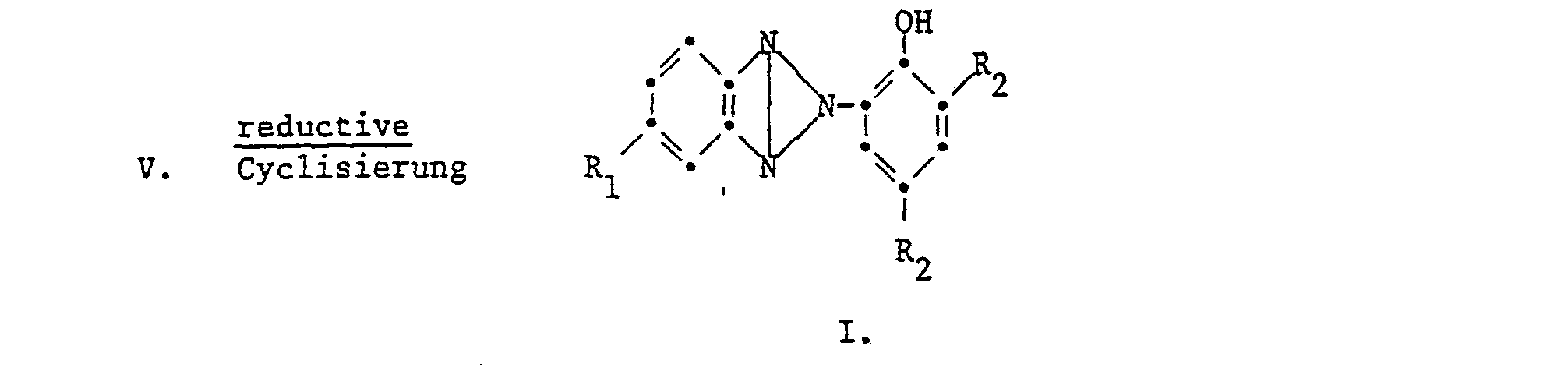
- 1. Stufe - Die Kupplung der Diazonium-Verbindung kann in saurem oder alkalischem Milieu erfolgen. Wird die Reaktion in saurem Milieu durchgeführt, so ist die Ausbeute an o-Nitroazobenzol über 70 % der Theorie.
- 2. Stufe - Die reduktive Cyclisierung von V. zu 2-Aryl-2H-benzotriazol kann durch einer der bekannten Reduktionsmethoden, wie z.B. Zink und NaOH, Hydrazin oder katalytische Hydrierung mit einem Edelmetall-Katalysator, erfolgen. Die Verwendung dieser Mittel führt zu guten Benzotriazol-Ausbeuten.
- Die Ausgangsprodukte, wie z.B. 2,4-Di-tert.-octylphenol, o-Nitroanilin und 4-Chlor-2-nitroanilin sind im Handel erhältlich oder nach bekannten Methoden auf einfache Weise herzustellen.
- Die erfindungsgemässen Verbindungen sind wirksame Lichtstabilisatoren für eine grosse Anzahl organischer Polymere. Solche Polymere sind:
- 1. Polymere, welche von Mono- oder Diolefinen stammen, z.B. gegebenenfalls vernetztes Polyäthylen, Polypropylen, Polyisobutylen, Polymethylbuten-1, Polymethylpenten-l-, Polyisopren und Polybutadien.
- 2. Gemische der Homopolymere von 1), z.B. Gemische von Polypropylen und Polyethylen, Polypropylen und Polybuten-1, Polypropylen und Polyisobutylen.
- 3. Copolymere aus den Monomeren für die Homopolymeren unter 1), z.B. Aethylen/Propylen-Copolymer, Propylen/Butene-1-Copolymer, Propylenmer/Isobutylen-Copolymer ,Aethylen/Buten-1-Copolymer sowie Terpolymere von Aethylen und Propylen mit einem Dien, z.B. Hexadin, Dicyclopentadien oder Aethyliden-Norbornen, und Copolymere von α-Olefine, z.B. Aethylen mit Acryl- oder Methacrylsäure.
- 4. Polystyrol.
- 5. Copolymere von Styrol und von a-Methylstyrol, z.B. Styrol/ Butadine-Copolymer, Styrol/Acryinitril-Copolymer, Styrol/Acrylnitril/ Methacrylate-Copolymer, Styrol/Acrylnitril-Copolymer modifiziert mit Acrylester-Polymer z.B. Styrol/Butadine/Styrtol-Block-Copolymer.
- 6. Graft-copolymere von Styrol, z.B. das Graft-polymer von Styrol zu Polybutadin, das Graft-polymer von Styrol mit Acrylnitril zu Polybutadin sowie ihre Gemische mit den Copolymeren von 5), bekannt als Acrylnitril/Butadin/Styrol oder ABS.
- 7. Halogenhaltige Vinyl-polymere,z.B. Polyvinylchlorid, Polyvinylidenchlorid, Polyvinylfluorid, Polychloropren, chloriniertes Gummi, Vinylchlorid/Vinylidenchlorid-copolymer, Vinylchlorid/ Vinylacetat-copolymer, Vinylidenchlorid/Vinylacetat-copolymer.
- 8. Polymere, welche von a,ß-ungesättigten Säuren stammen und ihre Derivate, Polyacrylate und Polymethacrylate, Polyacrylamide und Polyacrylnitril. Die erfindungsgemässenVerbindungen werden vorteilhafterweise in hitzehärtbaren Acrylharz-Lacken verwendet, welche aus einer Acrylsäure und einem Melanin-Formaldehydharz bestehen.
- 9. Polymere, hergestellt aus ungesättigten Alkoholen und Aminen und von deren Atcyl-derivativen oder Acetalen, z.B. Polyvinylalcohol, Polyvinylacetat, Polyvinylstearat, Polyvinylbenzoat, Polyvinylmaleat, Polyvinylbutyral, Polyallylphthalat, Polyallylmelamin und ihre Copolymere mit anderen Vinyl-Verbindungen z.B. Aethylen/Vinylacetat-copolymer.
- 10. Homopolymere und Copolymere hergestellt aus Epoxiden z.B. Polyäthylenoxid oder die Polymere der bis-Glycidyläther.
- 11. Polyacetale, z.B. Polyoxymethylen, sowie Polyoxymethylene welche Aethylenoxid als Comonomer enthalten.
- 12. Polyalkylenoxide z.B. Polyoxyäthylen, Polypropylenoxid oder Polyisobutylenoxid.
- 13. Polyphenylenoxide.
- 14. Polyurethane und Polyharnstoffe, wie in Urethanüberzügen.
- 15. Polycarbonate.
- 16. Polysulfone.
- 17. Polyamide und Copolyamide, hergestellt aus Diaminen und Dicarboxylsäuren und/oder aus Aminocarboxylsäuren oder deren Lactamen, z.B. Polyamid 6, Polyamid 6/6, Polyamid 6/10, Polyamid 11, Polyamid 12, Poly-m-phenylen-isophthalamid.
- 18. Polyester aus Dicarboxylsäuren und Dialkoholen und/oder aus Hydroxycarboxylsäuren oder deren Lactonen, z.B. Polyäthylenglycolterephthalat, Poly-1,4-dimethylol-cyclohexanterephthalat.
- 19. Vernetzte Polymere aus Aldehyden einerseits und aus Phenolen, Harnstoffen und Melamin, anderseits z.B. Phenol/Formaldehyd, Harnstoff/Formeldehyd und Melamin/Formaldehyd-Harz.
- 20. Alkyd-Harze z.B. Glycerol/Phthalsäure-Harze und deren Gemische mit Melamin/Formeldehyd-Harzen.
- 21. Ungesättigte Polyester-Harze aus den Copolyestern der gesättigten und ungesättigten Dicarboxylsäure mit mehrwertigen Alkoholen sowie aus Vinyl-Verbindungen als Vernetzungsmittel und deren halogenhaltigen, flammenresistenten Modifikationen.
- 22. Natürliche Polymere, z.B. Cellulose, Gummi, sowie deren chemisch modifizierten Homolog-Derivative, z.B. Celluloseacetate, Cellulosepropionate und Cellulosebutyrate und die Celluloseäther, z.B. Methylcellulose.
- Die erfindungsgemässen Verbindungen sind nicht nur wirksame Lichtschutzmittel, wie die 2-Aryl-2H-benzotriazole im allgemeinen, sondern auch besonders wertvoll zum Stabilisieren von polymeren Substraten, welche bei hohen Temperaturen verarbeitet werden müssen, dank ihres überraschend geringen Verlustes durch Verflüchtigung bei hoher Temperatur.
- Die erfindungsgemässen Verbindungen sind daher besonders geeignet zum Stabilisieren von Polyestern, wie z.B. Polyäthylenterephthalat, Polybutylenterephthalat oder deren Copolymere, von Polycarbonaten, z.B. aus Bisphenol A und Phosgen oder deren Copolymere, von Polysulfonen, Polyamiden, z.B. Nylon-6, Nylon-6,6, Nylon-6/10 etc. sowie Copolyamide, von duroplastischen Acrylharzen, von thermoplastischen Acrylharzen, von Polyolefinen, z.B. Polyäthylen, Polypropylen, Copolyolefine etc. und von anderen Polymeren, welche Hochtemperatur-Verarbeitung und -Produktion verlangen.
- Die Stabilisatoren der Formeln I werden nach den herkömmlichen Methoden in das Polymer eingearbeitet, und zwar in jeder beliebigen Phase während der Herstellung von geformten Produkten. Sie können zum Beispiel als Pulver, Suspension oder Emulsion zum Polymer gemischt werden, welches als Pulver, Suspension oder Emulsion vorliegen kann.
- Die stabilisierten polymeren Mischungen der Erfindung können gegebenenfalls 0,1 bis 5 Gew.Z, vorzugsweise 0,5 bis 3 Gew.Z der üblichen Zusatzstoffe enthalten, insbesondere Antioxydantien, Lichtstabilisatoren, oder deren Gemische. Beispiele für solche Zusatzstoffe:
- Antioxydantien, UV-Absorber und Lichtschutzmittel wie 2-(2'-Hydroxyphenyl)-benztriazole, 2,4-Bis-(2'-hydroxyphenyl)-6-alkyls-triazine, 2-Hydroxybenzophenone, 1,3-Bis-(2'hydroxybenzoyl)-benzole, Ester von gegebenenfalls substituierten Benzoesäuren, Acrylate, des weiteren Nickelverbindungen, sterisch gehinderten Amine, Oxalsäurediamide, Metalldesaktivatoren, Phosphite, peroxidzerstörende Verbindungen,Polyamidstabilisatoren, basische Co-Stabilisatoren, Nukleierungsmittel oder sonstige Zusätze wie z.B. Weichmacher, Gleitmittel, Emulgatoren, Füllstoffe, Russ, Asbest, Kaolin, Talk, Glasfasern, Pigmente, optische Aufheller, Flammschutzmittel, Antistatica.
- Gewisse hydrophobische, nicht-diffundierende Hydroxyphenylbenzotriazole sind bekannt als UV-Absorber in photographischer Gelatine. (US-PS 3 253 921 und US 4 042 394). Die erfindungsgemässen Verbindungen sind durch ihre geringe Flüchtigkeit, durch ihre guten Absorptionseigenschaften im UV-Bereich und durch ihre photographische Inaktivität besonders gut geeignet zum Stabilisieren von Farbbildern.
- Von besonderem Interesse sind die duroplastischen und thermoplastischen Acrylharze, welche für Autolackierungen verwendet werden. Diese Stoffe sind im Encyclopedia of Polymer Science and Technology, Interscience Publishers, New York, Band 1 (1964), auf Seiten 273-276 und Band 13 (1970), auf Seiten 530-532 beschrieben, ferner in "Understanding Paint" von W.R. Fuller, in American Paint Journal Co., St. Louis, 1965, Seite 124-135.
- Acrylharzlacke, welche gemäss der Erfindung gegen die Einwirkung von Licht, Sauerstoff und Feuchtigkeit stabilisiert werden, sind die üblichen Einbrennlacke, wie z.B. in H. Kittel's "Lehrbuch der Lacke und Beschichtungen", Band 1, Teil2, Seite 735 und 742 (Berlin, 1972), und in H. Wagner, E.F. Sarx, "Lackkunstharze", Seite 229-235 beschrieben.
- Von besonderem Interessse ist die Stabilisierung von Metalleffektlacken auf der Basis von heissvernetzbarem Acrylharz und Styrol mit den erfindungsgemässen Verbindungen. Aus diesen Harzen hergestellter, unstabilisierter Metalleffektlack ist trotz der ausgezeichneten physikalischen und chemischen Eigenschaften ungeeignet, da das vorhandene Styrol zur Rissbildung führt. Andere Lacke und heissvernetzbare Beschichtungen sind auf der Basis von Acrylharz, Melaninharz, Alkydharz, Polyesterharz, Epoxyharz oder deren Gemische ebenfalls interessant. Epoxyharz wird nur im Gemisch (maximal 15 Gew.-% Epoxyharz) mit anderen Harzen verwendet
- Um die Metalleffektwirkung zu erzielen, verwendet man die üblichen Aluminium-Pigmente in 1-10 Gew.Z bezogen auf das lösungsmittelfreie Bindemittel (Lackharz). Das Auftragen der stabilisierten Lacke kann nach den herkömmlichen Einschicht- oder Zweischicht-Verfahren geschehen. Im letzteren Falle, der Pigment enthaltende Vorlegelack wird zuerst aufgetragen und nachher mit Klarlack überzogen.
- Weitere Zusatzstoffe, die in Lack enthalten sein können, sind andere übliche Lichtschutzmittel, phenolische Antioxydantien, Pigmente, Farbstoffe, Metalldesaktivatoren etc.
- Im allgemeinen betragen die erfindungsgemäss verwendeten Stabilisatoren 0,1 bis 5 Gew.%, vorzugseweise 0,5 bis 3 Gew. Z, bezogen auf das Lackharz.
- - Die Kombination von sterisch gehinderten Aminen und den erfindungsgemässen Stabilisatoren ermöglicht sowohl eine ausgezeichnete Glazerhaltung als auch eine Beständigkeit gegen Abblätterung der metallisierten Einbrennlacke auf Acrylharzbasis für Automobil-Decklackierungen.
- Die sterisch-gehinderten Amine sind in den Acrylharzlacken als Lichtstabilisatoren wirksam und verantwortlich für deren Glanzerhaltung bei Bewitterung. Das UV-Licht kann jedoch die Deckschicht, falls kein UV-Absorber vorhanden, ungehindert passieren und in der unteren Epoxyesterschicht zu Schäden führen. Durch die Zugabe der erfindungsgemässen Benzotriazol-UV-Absorbern wird dies erfolgreich verhindert.
- Auf diese Weise bietet die Kombination von sterisch gehinderten Aminen mit Benzotriazolen sowohl Glanzerhaltung als auch Abblätterungsbeständigkeit in metallisierten Decklacken auf der Basis von Acryl- harzen.
- Die eingesetzten Amine sind in 0,1 bis 5 Gew.-%, vorzugsweise in 0,5 bis 2 Gew.-%, insbesondere in 0,5 bis-1 Gew.% wirksam, bezogen auf das Acrylharz.
- Die erfindungsgemässen Benzotriazole sind in 0,1 bis 5 Gew.-%, vorzugsweise in 0,5 bis 2 Gew.-%, insbesondere bei 0,5 bis 1 Gew.-% wirksam, bezogen auf das Acrylharz.
- Die Amin-Lichtstabilisatoren, die in dieser Erfindung verwendet werden entsprechen der Formel VI

- L ein zweiwertiger organischer Rest ist, welcher den N-haltigen Ring zu einem 5- bis 7-Ring ergänzt, oder zwei einwertige Radikale bedeutet, und
- L1 ein zweiwertiger organischer Rest, welcher den N-haltigen Ring zu einem 5- bis 7-Ring ergänzt und welcher zusätzlich durch eine Verbindungsgruppe mit anderen Amingruppierungen verbunden sein kann.
- Als Amine kommen die Verbindungen der folgenden Formel in Frage:

- Bevorzugt werden 2,2,6,6-Tecraalkylpiperidinverbindungen verwendet, welche vorzugsweise eine Gruppe der Formel VIII

- Zu den erfindungsgemäss zu verwendenden Lichtschutzmitteln gehören insbesondere folgende Verbindungsklassen:
- a) Lichtschutzmittel der Formel IX

- Bedeuten etwaige Substituenten C1 -C12 Alkyl, so stellen sie z.B. Methyl, Aethyl, n-Propyl, n-Butyl, sek.-Butyl, tert.-Butyl. n-Hexyl, n-Octyl, 2-Aethylhexyl, n-Nonyl, n-Decyl, n-Undecyl oder n-Dodecyl dar.
- In der Bedeutung von C1-C18 Alkyl können R' oder R" z.B. die oben angeführten Gruppen und dazu noch beispielsweise n-Tridecyl, n-Tetradecyl, n-Hexadecyl oder n-Octadecyl darstellen.
- Wenn R' C3-C8 Alkenyl-bedeutet, so kann es sich z.B. um 1-Propenyl, Allyl, Methallyl, 2-Butenyl, 2-Pentenyl, 2-Hexenyl, 2-Octenyl, 4-tert.-Butyl-2-butenyl handeln.
- R' ist als C3-C8 Alkinyl bevorzugt Propargyl.
- Als C1-C12 Aralkyl ist R' insbesondere Phenäthyl oder vor allem Benzyl.
- R, ist als C1 C8 Alkanoyl beispielsweise Formyl, Propionyl, Butyryl, Octanoyl aber bevorzugt Acetyl und als C3-CS Alkenoyl insbesondere Acryloyl.
- Bedeutet R" einen einwertigen Rest einer Carbonsäure, so stellt es beispielsweise einen Essigsäure-, Stearinsäure-, Salicylsäure-, Methacrylsäure-, Maleinsäure-, Benzoe- oder ß-(3,5-Di-tert.-butyl-4-hydroxyphenyl)-propionsäurerest dar.
- Bedeutet R" einen zweiwertigen Rest einer Dicarbonsäure, so stellt es beispielsweise einen Adipinsäure-, Suberinsäure-, Sebacinsäure-, Phthalsäure-, Dibutylmalonsäure-, Dibenzylmalonsäure-, Butyl-(3,5-di-tert.-butyl-4-hydroxybenzyl)-malonsäure- oder Bicycloheptendicarbonsäurerest dar.
- Stellt R" einen dreiwertigen Rest einer Tricarbonsäure dar, so bedeutet es z.B. einen Trimellithsäure- oder einen Nitrilotriessigsäurerest.
- R" kann auch Reste von Di- und Tricarbonsäuren bedeuten, wie sie technisch durch Oligomerisation höherer ungesättigter Fettsäuren oder durch Diels-Alder Addition von Acrylsäure an Linolsäure hergestellt werden. Ferner kann R" auch Reste bedeuten, die durch Umsetzung von Mono-, Di- und Polyepoxiden wie z.B. Bisphenol A-diglycidyläther, Butandialdiglycidyläther, Tris-glycidyl-isocyanurat, 1,3-Diglycidyl-4,4-dimethyl-hydantoin mit 4-Hydroxy-1,2,2,6,6-pentamethylpiperidin entstehen.
- Stellt R" einen vierwertigen Rest einer Tetracarbonsäure dar, so bedeutet es z.3. einen Pyromellithsäurerest.
- Bedeutet R" einen zweiwertigen Rest einer Dicarbaminsäure, so stellt es beispielsweise einen Hexamethylendicarbaminsäure- oder einen 2,4-Toluylen-dicarbaminsäurerest dar.
- Beispiele für Polyalkylpiperidin-Lichtschutzmittel dieser Klasse sind folgende Verbindungen:
- 1) 4-Hydroxy-2.,2,6,6-tetramethylpiperidn
- 2) 1-Allyl-4-hydroxy-2,2,6,6-tetramethylpiperidn
- 3) 1-Benzyl-4-hydroxy-2,2,6,6-tetramethylpiperidin
- 4) 1-(4-terr.-Butyl-2-butenyl)-4-hydroxy-2,2,6,6-tetramethylpiperidin
- 5) 4-Stearoyloxy-2,2,6,6-tetramethylpiperidin
- 6) 1-Aethyl-4-salicyloyloxy-2,2,6,6-tetramethylpiperidin
- 7) 4-Methacryloyloxy-1,2,2,6,6-pentamethylpiperidin
- 8) 1,2,2,6,6-Pentamethylpiperidin-4-eridin-4-yl-β-(3,5-di-tert.-butyl-4-hydroxyphenyl)-proprionat
- 9) 1-Benzyl-2,2,6,6-tetramethyl-4-piperidinylmaleinat
- 10) Bis-(2,2,6,6-tetramethylpiperidin-4-yl)-adipat
- 11) Bis-(2,2,6,6-tetramethylpiperidin-4-yl)-sebacat
- 12) Bis-(1,2,3,6-tetramethyl-2,6-diäthyl-piperidin-4-yl)-sebacat
- 13) Bis-(1-allyl-2,2,6,6-tetramethyl-piperidin-4-yl)-phthalat
- 14) 1-Propargyl-4-ß-cyanoäthyloxy-2,2,6,6-tetramethylpiperidin
- 15) 1-Acetyl-2,2,6,6-tetramethylpiperidin-4-yl-acetat
- 16) Trimellithsäure-tri-(2,2,6,6-tetramethylpiperidin-4-yl)-ester
- 17) 1-Acryloyl-4-benzyloxy-2,2,6,6-tetramethylpiperidin
- 18) Dibutyl-malonsäure-di-(1,2,2,6,6-pentamethylpiperidin-4-yl)-ester
- 19) Butyl-(3,5-di-tert.-butyl-4-hydroxybenzyl)-malonsäure-di-(1,2,2, 6,6-pentamethylpiperidin-4-yl)-ester
- 20) Dibenzyl-malonsäure-di-(1,2,2,6,6-pentamethylpiperidin-4-yl)-ester
- 21) Dibenzyl-malonsäure-di-(1,2,3,6-tetramethyl-2,6-diäthyi-piperidin-4-yl)-ester
- 22) Hexan-1',6'-bis-(4-carbamoyloxy-1-n-butyl-2,2,6,6-tetramethylpiperidin)
- 23) Toluol-2',4'-bis-(4-carbamoyloxy-1-n-propyl-2,2,6,6-tetramethylpiperidin)
- 24) Dimethyl-bis-(2,2,6,6-tetramethylpiperidin-4-oxy)-silan
- 25) Phenyl-tris-(2,2,6,6-tetramethylpiperidin-4-oxy)-silan
- 26) Tris-(1-propyl-2,2,6,6-tetramethylpiperidin-4-yl)-phosphit
- 27) Tris-(1-propyi-2,2,6,6-tetramethylpiperidin-4-yl)-phosphat
- 28) Phenyl-[bis-(1,2,2,6,6-pentamethylpiperidin-4-yl)]-phosphonat
- 29) Bis-(1,2,2,6,6-pentamethylpiperidin-4-yl)-sebacat
- 30) Bis-(1-benzyl-2,2,6,6-tetramethylpiperidin-4-yl)-sebacat
- 31) Bis-(1-allyl-2,2,6,6-tetramethylpiperidin-4-yl)-sebacat
- 31a) 2,2,6,6-Tetramethyl-4-hydroxy-4-carbamoyl-piperidin.
- 32) 4-Benzoyloxy-2,2,6,6-tetramethylpiperidin
- 33) 4-Acryloxy-2,2,6,6-tetramethylpiperidin
- 34) 4-(p-Chlorbenzoyloxy)-1,2,2,6,6-pentamethylpiperidin
- 35) 4-Lauroyloxy-l,2,2,6,6-pentamethylpiperidin
- 36) 1-Allyl-2,2,6,6-tetramethyl-4-piperidinyl-salicylat
- 37) 1-(2-Benzoyloxyäthyl)-2,2,6,6-tetramethyl-4-piperidinylbenzoat
- 38) Bis-(1,2,2,6,6-pentamethyl-4-piperidinyl)-isophthalat
- 39) Bis-(1,2,2,6,6-pentamethyl-4-piperidinyl)-adipat
- 40) Bis-(1-acetyl-2,2,6,6-tetramethyl-4-piperidinyl)-sebacat
- 41) Bis-(1-hydroxyäthyl-2,2,6,6-tetramethyl-4-piperidinyl)-succinat
- 42) Tris-(2,2,6,6-tetramethyl-4-piperidinyl)-nitrilotriacetat
- 43) Tris-(1-butyl-2,2,6,6-tetramethyl-4-pipetidinyl)-trimellithat
- 44) Tris-(1-butyl-2,2,6,6-tetramethyl-4-piperidinyl)-phosphat
- 45) Diphenyl-bis-(2,2,6,6-tetramethylpiperidin-4-oxy)-silanester
- 46) 0,0' -Di (2',2,6,6-tetramethyl-4-piperidinyl)-tolylen-1, 4-dicarbamat
- 47) 1-Methylcarbamoyl-2, 3, 6-trimethyl-2 , 6-diäthyl-4-piperidinyl- methylcarbamat.
-
 oder aromatischen 1,2- oder 1,3-Dicarbonsäure sein können.
- Stellen etwaige Substituenten C1-C18 Alkyl dar, so haben sie die bereits unter a) angegebene Bedeutung.
- Bedeuten etwaige Substituenten C3-C7 Cycloalkyl, so stellen sie insbesondere Cyclohexyl dar.
- Als C7-C8 Aralkyl ist R3 insbesondere Phenäthyl oder vor allem Benzyl.
- R3 ist als C2-C18 Alkanoyl beispielsweise Propionyl, Butyryl, Octanoyl, Dodecanoyl, Hexadecanoyl, Octadecanoyl aber bevorzugt Acetyl und als C3-C5 Alkenoyl insbesondere Acryloyl.
- Bedeutet R4 ein gegebenenfalls mit einer Cyano-, Carbonyl-oder Carbamidgruppe substituiertes C2-C8 Alkenyl, dann handelt es sich z.B. um 1-Propenyl, Allyl, Methallyl, 2-Butenyl, 2-Pentenyl, 2-Hexenyl, 2-Octenyl, 2,2-Dicyanovinyl, 1-Methyl-2-cyano-2-methoxycarbonyl-vinyl, 2,2-Diacetylaminovinyl.
- Stellen etwaige Substituenten C2-C12 Alkylen dar, so handelt es sich z.B. um Aethylen, Propylen, 2,2-Dimethylpropylen, Tetramethylen, Hexamethylen, Octamethylen, Decamethylen oder Dodecamethylen.
- Bedeuten etwaige Substituenten C6-C15 Arylen, so stellen sie z.B. o-, m- oder p-Phenylen, 1,4-Naphtylen oder 4,4'-Diphenylen dar.
- Als C6-C12 Cycloalkylen ist X insbesondere Cyclohexylen.
- Beispiele für Polyalkylpiperidin-Lichtschutzmittel dieser Klasse sind folgende Verbindungen:
- 48) N,N'-Bis-(2,2,6,6-tetramethylpiperidin-4-yl)-hexamethylen-1,6-diamin
- 49) N,N'-Bis-(2,2,6,6-tetrameihylpiperidin-4-yl)-hexamethylen-1,6- diacetamid
- 50) 4-Acetylamino-1,2,2,6,6-pentamethylpiperidin
- 51) 1-Benzyl-2,2,6,6-tetramethyl-4-diäthanolamino-piperidin
- 52) 4-Acrylamido-1,2,2,6,6-pentamethylpiperidin
- 53) 1-Acetyl-4-(N-cyclohexylacetamido)-2,2,6,6-tetramethylpiperidin
- 54) 4-Benzylamino-2,2,6,6-tetramethylpiperidin
- 55) N,N'-Bis-(2,2,6,6-tetramethylpiperidin-4-yl)-N,N'--dibutyl- adipamid
- 56) N,N'-Bis-(2,2,6,6-tetramethylpiperidin-4-yl)-N,N'-dicyclohexyl-(2-hydroxypropylen)
- 57) N,N'-Bis-(2,2,6,6-tetramethylpiperidin-4-yl)-p-xylylen-diamin
- 58) N,N'-Bis- (1,2,2,6,6-pentamethyl-4-piperidinyl)-1 ,6-diaminohexan.
- Die Verbindung der Formel XI

- 59) 4-(Bis-2-hydroxyäthyl)-amino-1,2,2,6,6-pantamethylpiperidin
- 60) 4-(3-Methyl-4-hydroxy-5-tert.butyl-benzoesäure-amido)-2,2,6,6-tetramethylpiperidin
- 61) 4-Methacrylamido-1,2,2,6,6-pentamethylpiperidin
- 62) α-Cyan0-ß-methyl-β-[N-(2,2,6,6- tetramethylpiperidin-4-yl)]-amino-aurylsäura-methyleter
-

- Bedeutet R5 C2-C8 Alkylen oder Hydroxyalkylen, so stellt es beispielsweise Aethylen, 1-Methyl-äthylen, Propylen, 2-Aethylpropylen, 2-Aethyl-2-hydroxymethylpropylen dar.
- Als C4-C22 Acyloxyalkylen bedeutet R5 z.B..2-Aethyl-2-acetoxymethyl-propylen.
- Beispiele für Polyalkylpiperidin-Lichtschutzmittel dieserVerbindungen:

- 63) 9-Aza-8,8,10,10-tetramethyl-l,5-dioxaspiro-[5.5] undecan
- 64) 9-Aza-8,8,10,10-tetramethyl-3-äthyl-1,5-dioxaspiro[5.5]decan
- 65) 8-Aza-2,7,7,8,9,9-hexamethyl-1,4-dioxyspiro[4.5]decan
- 66) 9-Aza-3-hydroxymethyl-3-äthyl-8,8,9,10,10-pentamethyl-1,5-dioxaspiro[5.5]undecan
- 67) 9-Aza-3-äthyl-3-acetoxymethyl-9-acetyl-8,8,10,10-tetramethyl-1,5-dioxaspiro[5.5]undecan
- 68) 2,2,6,6-Tetramethylpiperidin-4-spiro-2'-(1',3'-dioxan)-5'- spiro-5"-(1",3"-dioxan)-2"-spiro-4'"-(2'", 2"', 6"', 6"'-tetramethylpiperidin).
-
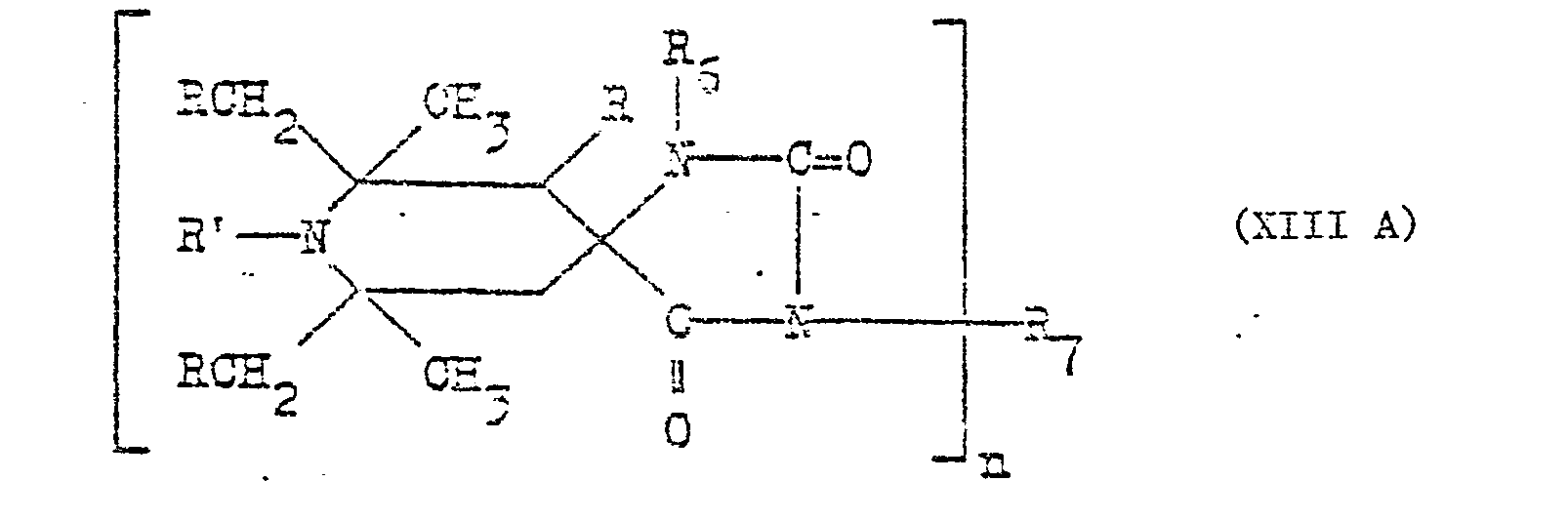


- Bedeuten etwaige Substituenten C1-C12 Alkyl, so stellen sie -z.B. Methyl, Aethyl, n-Propyl, n-Butyl, sek.-Butyl, tert.-Butyl, n-Hexyl, n-Octyl, 2-Aethyl-hexyl, n-Nonyl, n-Decyl, n-Undecyl oder n-Dodecyl dar.
- Etwaige Substituenten in der Bedeutung von C1-C18 Alkyl können z.B. die oben angeführten Gruppen und dazu noch beispielsweise n-Tridecyl, n-Terradecyl, n-Hexadecyl oder n-Octadecyl darstellen.
- Bedeuten etwaige Substituenten C2-C6 Alkoxyalkyl, so stellen sie z.B. Methoxymethyl, Aethoxymethyl, Propoxymethyl, tert.-Butoxymethyl, Aethoxyäthyl, Aethoxypropyi, n-Butoxyäthyl, tert-Butoxyäthyl, Isopropoxyäthyl oder Propoxypropyl dar.
- Stellt R7 C3 C5 Alkenyl dar, so bedeutet es z.B. 1-Propenyl, Allyl, Methallyl, 2-Butenyl oder 2-Pentenyl.
- Als C7-C9 Arlalkyl sind R7, T1 und T2 insbesondere Phenäthyl oder vor allem Benzyl und als C5-C7 Cycloalkyl (T und T2 zusammen mit dem sie bindenen C-Atom) insbesondere Cyclohexyl.
- Bedeutet R7 C2-C4 Hydroxyalkyl, so stellt es z.B. 2-Hydroxyäthyl, 2-Hydroxypropyl, 2-Hydroxypropyl, 2-Hydroxybutyl oder 4-Hydroxybutyl dar.
- Als C6-C10 Aryl bedeuten R7, T1 und T2 insbesondere Phenyl, α oder ß-Naphthyl, die gegebenenfalls mit Halogen oder C1-C4 Alkyl substituiert sind.
- Stellt R7 C2-C12 Alkylen dar, so handelt es sich z.B. um Aethylen, Propylen, 2,2-Dimethylpropylen, Tetramethylen, Hexamethylen, Octamethylen, Decamethylen oder Dodecamethylen.
- Als C4-C12 Alkenylen bedeutet R7 insbesondere 2-Butenylen, 2-Pentenylen oder 3-Hexenylen.
- Bedeutet R7 C6-C12 Arylen, so stellt es beispielsweise o-, m-oder p-Phenylen, 1,4-Naphthylen oder 4,4'-Diphenylen dar.
- Bedeutet Z' C2-C12 Alkanoyl, so stellt es beispielsweise Propionyl, Butyryl, Octanoyl, Dodecanoyl aber bevorzugt Acetyl dar.
- X hat als C2-C10Alkylen, C6-C15 Arylen oder C6-C12 Cycloalkylen die unter b) angegebene Bedeutung.
- Beispiele für Polyalkylpiperidin-Lichtschutzmittel dieser Klasse sind folgende Verbindungen:
- 69) 3-Benzyl-1,3,8-Triaza-7,7,9,9-tetramethylspiro [4.5]decan-2,4-dion
- 70) 3-n-Octyl-1,3,8,-triaza-7,7,9,9-tetramethylspiro[4.5]decan-2,4-dion
- 71) 3-Allyl-1,3,8-triaza-1,7,7,9,9-pentamethylspiro[4.5]decan-2,4-dion
- 72) 3-Glycidyl-1,3,8-triaza-7,7,8,9,9-pentamethylspiro[4.5]decan-2,4-dion
- 73) 2-iso-Propyl-7,7,9,9-tetramethyl-1-oxa-3,8-diaza-4-oxo-spiro-[4,5]decan
- 74) 2-Butyl-7,7,9,9-tetramethyl-1-oxa -3,8-diaza-4-oxo-spiro-[4,5] decan
- 75) 2-Isopropyl-7,7,9,9-tetramethyl-1-oxa-4,8-diaza-3-oxo-spiro-[4,5]decan
- 76) 2-Butyl-7,7,9,9-tetramethyl-1-oxa-4,8-diaza-3-oxo-spiro-[4,5]decan,
- sowie die folgenden Verbindungen :
- 77) 2,2,4,4-Tetramethyl-7-oxa-3,20-diaza-21-oxo-dispiro-(5,1,11,-2] -heneicosan
- 78) 1,3-Di(2,2,6,6-tetramethyl-4-piperidinyl)-imidazolidinon-2
- 79) 2,4,6-Tri[N-(2,2,6,6-tetramethyl-4-piperidinyl)-butylamino]-s-triazin
- 80) Di-[2-(2,2,6,6-tetramethyl-l-piperidino)-äthyl]-adipat
- 81) 2,2,6,6-Tetramethylpiperidin-1-essigsäure-n-octylester.
- Weitere Verbindungen der Formel:

-


- Bedeuten etwaige Substituenten C1-C12 Alkyl, so stellen sie beispielsweise Methyl, Aethyl, n-Propyl, n-Butyl, sek.-Butyl, tert.-Butyl, n-Bexyl, n-Octyl, 2-Aethylhexyl, n-Noeyl, n-Decyl, avUndecyl oder n-Dodecyl dar.
- Bedeuten etwaige Substituenten CI-C4 Hydroxyalkyl, so stellen sie z.B. 2-Hydroxyäthyl, 2-Hydroxypropyl, 3-Hydroxypropyl, 2-Hydroxybutyl oder 4-Hydroxybutyl dar.
- Bedeutet A C2-C6 Alkylen, so stellt es beispielsweise Aethylea, Propylen, 2,2-Dimethylpropylen, Tetramethylen oder Hexamethylen dar.
- Stellen R11 und R12 zusammen C4-C5 Alkylen oder Oxaalkylen dar, so bedeutet dies z.B. Tetramethylen, Pentamethylea oder 3-Oxa-pentamethylen.
- Verbindungen der Formeln XV oder XVI


- m' 2, 3 oder 4 ist, n' 2 bis 50 ist,
- X,X' und X" eine direkte Bindung, C1-C4 Alkylen oder -OCH2CH2CH2-, dessen 0 nicht an Y, Y' oder Y" gebunden ist, darstellen
- Y, Y' und Y" -0-, -S-, -NH- oder -NB3-darstellen
- R"' Wasserstoff oder C1-C4 Alkyl bedeutet,
- R1,R2 und R3 C1-C12 Alkyl, C2-C8 Alkoxyalkyl, C2 -C4 Hydroxyalkyl, C5-C10 Cycloalkyl, C6-C10 Aryl, durch 1 oder 2 C1-C8 Alkylgruppen und/oder OH und/oder C1-C4 Alkoxy substituiertes Phenyl oder eine Polyalkylpiperidinylgruppe der Formel darstellt

- R4 Wasserstoff, 0', C1-C12 Alkyl, Allyl oder Benzyl bedeutet,
- A, wenn m 2 ist, C2-C12 Alkylen, C4-C8 Alkenylen, Xylylen oder einen Rest der Formel -CH2-COO-R5-OOC-CH2-, -CH2-CH(OH)-CH2- oder -CH2CH(OH)CH2-D-CH2CH(OH)CH2- darstellt, wenn m 3 ist, eine Gruppe der Formel


- B C2-C12 Alkylen, C4-C8 Alkenylen, Xylylen oder einen Rest der Formel -CH2-COO-R5 -OOC-CR2--CH2-CH(OH)-CH2- oder -CH2CH(OH)CH2-D-CH2CH(OH)CH2- darstellt,
- R5 C2 C8 Alkylen, C4-C8 Oxaalkylen oder Cyclohexylen darstellt,
- D einen zweiwertigen Rest der Formel -O-R6-O-, -O-C(O)-R7-C(O)-O-, -OCH(R8 )CH2O-R6-OCH2CH(R8)O-oder

- R6 C2-C12 Alkylen, C6-C12 Cycloalkylen, C6-C12 Arylen oder -Phenylen-Z'-Phenylen- darstellt, worin Z1 -CH2-,

- R7 eine direkte Bindung, C1-C12 Alkylen, C2-C6 Alkenylen, C6-C12 Arylen darstellt,
- R8 und R Wasserstoff oder C1-C4 Alkyl sind,
- T' einen dreiwertigen Rest der Formeln


- R10 ein dreiwertiger aliphatischer Kohlenwasserstoffrest mit 3-10 C-Atomen ist,
- Q' einen vierwertigen Rest der Formel


- R11 einen vierwertigen aliphatischen Kohlenwasserstoffrest mit 4-10 C-Atomen bedeutet und
- E und E' Endgruppen darstellen.
- R1, R2, R und R als C1-C12 Alkyl dönnen dabei verzweigte oder unverzweigte Alkylreste sein, z.B. Methyl, Aethyl, Isopropyl, tert.Butyl, Hexyl, Isooctyl, Decyl oder Dodecyl.
- R1, R2, R3 als Alkoxylalkyl können z.B. Methoxymethyl, 2-Methoxyäthyl, 2-Aethoxyäthyl, 2-Isopropoxyäthyl, 2-n-, sec.-oder tert.Butoxyäthyl oder 2-Butoxypropyl sein.
- R1,R2, R 3 als Hydroxyalkyl können z.B. 2-Hydroxyäthyl, 2-Hydroxyäthyl, 2-Hydroxypropyl, 2-Hydroxybutyl oder 3-Hydroxypropyl sein.
- R1, R2, R3 als C5-C10 Cycloalkyl können beispielsweise Cyclopentyl, Cyclohexyl, 3-Methylcyclohexyl oder 4- tert.Butyl- cyclohexyl sein.
- R1, R2, R3 als C6-C10 Aryl können Phenyl oder Naphthyl sein, wobei Phenyl bevorzugt ist.
- R1 , R , R als substituiertes Phenyl,können z.B. p.Tolyl, 4-Hydroxyphenyl, 4-tert.-Butylphenyl oder 3,5-Di-tert.butyl-4-hydroxyphenyl sein.
- X als C1-C4 Alkylen kann beispielsweise Methylen, Aethylen, 1,3-Propylen, 1,2-Propylen, 1,1-Dimethyläthylen oder 2,2-Propylen sein.
- A, B oder R6 als Alkylen kann eine verzweigte oder unverzweigte Alkylengruppe sein, wie z.B. Aethylen, Tri-, Tetra-, Hexa-, Octa-, Deca- oder Dodecamethylen, 2,2-Dimethylpropylen-1,3, 1,2-Butylen oder 1,2-Propylen. R5 ist ein zweiwertiger aliphatischer oder cycloaliphatischer Rest, beispielsweise Aethylen, 1,2-Propylen, 1,2-Butylen, 1,3-Propylen, 1,4-Butylen, 1,6-Rexylen, 1,4-Cyclohexylen oder 3-Oxapentylen-1,5.
- A und B als Alkenylen können z.B. 1,4-Buten-2-ylen oder 1,6-Hexen-3-ylen sein.
- R6als Cycloalkylen kann z.B. 1,4-Cyclohexylen oder 1,4-Cyclooctylen sein. R6 als Arylen kann Phenylen, Naphthylen oder Diphenylen sein.
- R7 als Alkylen oder Alkenylen kann z.B. Methylen, 1,3-Propylen, Tetramethylen, 2,2-Dimethyl-1,3-propylen, Octamethylen, Dodecamethylen, Vinylen oder 1,4-Butea-2-ylen sein. R4 als cyclischer Rest kann beispielsweise 1,2-Cyclopentylen, 1,2-Cyclohexylen, 1,2-Cyclohexen-4-ylen, 3,6-Endomathylencyclohexen-4-ylen-1,2, 1,2-Phenylen, 1,4-Phenylen oder 1,4-Naphthylen sein:
- Beispiele für Polyalkylpiperidin-Lichtschutzmittel dieser Klasse sind die Verbindungen der folgenden Formeln:


-


- Bedeuten etwaige Substituenten C1-C12 Alkyl, so stellen sie z.B. Methyl, Aethyl, n-Propyl, n-Butyl, sek.-Butyl, tert.-Butyl, n-Hexyl, n-Octyl, 2-Aethyl-hexyl, n-Nonyl, n-Decyl, n-Undecyl oder n-Dodecyl dar.
- Etwaige Substituenten, die C1-C18 Alkyl bedeuten, können z.B. die die oben angeführten Gruppen und dazu noch beispielsweise n-Tridecyl, n-Tetradecyl, n-Hexadecyl oder n-Octadecyl darstellen.
- Stellen etwaige Gruppen C2-C10 Alkylen dar, so bedeuten sie beispielsweise Aethylen, Propylen, 2,2-Dimethylpropylen, Tetramethylen, Hexamethylen, Octamethylen oder Decamethylen.
- R14 bedeutet als C4-C18Alkyl z.B. n-Butyl, sek.-Butyl, tert.-Butyl, n-Hexyl, n-Octyl, 2-Aethyl-hexyl, 1,1-Dimethyl-2-tert.-butyläthyl, n-Nonyl, n-Decyl, n-Dodecyl, n-Tridecyl, n-Tetradecyl, n-Hexadecyl oder n-Octadecyl.
- Bedeutet R14 ein durch -CN substituiertes C1-C4 Alkyl, so stellt es beispielsweise Cyanomethyl, Cyanoäthyl, 3-Cyano-n-propyl, 4-Cyano-n-butyl dar.
- Bedeutet R14 C4-C12 Alkylen, so handelt es sich z.B. um 2,2-Dimethylpropylen, Tetramethylen, Hexamethylen, Octamethylen, Decamethylen oder Dodecamethylen.
- Stellt R14 C7-C12 Aralkyl dar, so bedeutet es insbesondere Phenäthyl, p-Methyl-benzyl oder vor allem Benzyl.
- R15 bedeutet als C2-C4 Alkenyl beispielsweise Vinyl, 1-Propenyl, Allyl, Methallyl, 2-Butenyl.
- R17 bedeutet als C2-C10 Alkenyl z.B. die für R15 in der Bedeutung Alkenyl angeführten Gruppen und dazu noch beispielsweise Crotyl, 2-Hexenyl, 2-Octenyl oder 2-Decenyl.
- Stellt R17 C6-C10 Aryl dar, so bedeutet es beispielsweise gegebenenfalls in o- oder p-Stellung mit Methyl, Aethyl, Isopropyl, n-Butyl oder tert.-Butyl substituiertes Phenyl.
- Beispiele für Polyalkylpiperidin-Lichtschutzmittel dieser Klasse sind folgende Verbindungen:
- 91) Bis-[ß-(2,2,6,6-tetramethylpiperidion)-äthyl]-sebacat
- 92) α-(2,2,6,6-Tetramethyl-piperidion)-essigsäure-n-octylester
- 93) 1,4-Bis-(2,2,6,6-tetramethylpiperidino)-2-buten.
-

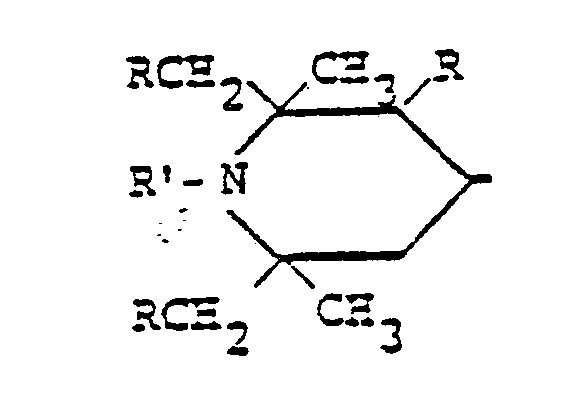

- Bedeuten etwaige Substituenten C1-C18 Alkyl, so stellen sie z.B. Methyl, Aethyl, n-Propyl, n-Butyl, sek.-Butyl, tert.-Butyl, n-Hexyl, n-Octyl, 2-Aethyl-hexyl, n-Nonyl, n-Decyl, n-Undecyl, n-Dodecyl, n-Tridecyl, n-Tetradecyl, n-Hexadecyl oder n-Octadecyl dar.
- Stellen etwaige Substitutenten C7-C12 Aralkyl dar, so bedeuten sie beispielsweise Phenäthyl oder insbesondere Benzyl.
- R22 bedeutet als C5-C7 Cycloalkyl, insbesondere Cyclohexyl.
- Als C6-C10 Aryl bedeutet R22 insbesondere Phenyl a- oder β-Naphthyl, die gegebenenfalls mit Halogen oder C1-C4 Alkyl substituiert sind. R20 bedeutet als C1-C3 Alkylen z.B. Methylen, Aethylen oder Propylen.
- R24 stellt als C2-C6 Alkylen beispielsweise Aethylen, Propylen, 2,2-Dimethylpropylen, Tetramethylen oder Hexamethylen und als C6-C12 Arylen o-, m- oder p-Phenylen, 1,4-Naphthylen oder 4,4'-Diphenylen dar.
- Beispiele für Polyalkylpiperidin-Lichtschutzmittel dieser Klasse sind folgende Verbindungen:
- 94) N-Hydroxymethyl-N'-2,2,6,6-tetramthylpiperidin-4-yl-harnstoff
- 95) N-Methoxymethyl-N'-2,2,6,6-tetramethylpiperidin-4-yl-hamstoff
- 96) N-Methoxymethyl-N'-n-dodecyl-N'-2,2,6,6-tetramethylpiperidin-4-yl-harnstoff
- 97) 0-(2,2,6,6-Tetramethylpiperidin-4-yl)-N-methoxy-methyl- urechan.
- i) Polymere Verbindungen, deren wiederkehrende Struktureinheit einen Polyalkylpiperidinrest der Formel (VIII) enthält, insbesondere Polyester, Polyäther, Polyamide, Polyamine, Polyurethane, Polyharnstoffe, Polyaminotriazine, Poly(meth)acrylate, Poly(meth) acrylamide und deren Copolymeren, die solche Reste enthalten.
- 98) Polyester aus Bernsteinsäure, Sebacinsäure, Di-butylmalonsäure, Oxalsäure oder Isophthalsäure und 1-Hydroxyäthyl-2,2,6,6-tetramethyl-4-hydroxypiperidin
- 99) Polyamid aus Bernsteinsäure, Adipinsäure oder Phthalsäure und 1-(3-Aminopropyl)-2,2,6,6-tetramethyl-4-aminopiperidin
- 100) Polyamid aus Oxalsäure oder p-Phenylendiessigsäure und N,N'- bis(1,2,2,6,6-pentamethyl-4-piperidinyl)-1,6-diaminohexan
- 101) Polyamin aus 1,2,2,6,6-Pentametbyl-4-aminopiperidin und Epichlorhydrin oder Bisphenol-A-diglycidäther
- 102) Polytriazin aus 2,4-Dichlor-6-N-(l,2,2,6,6-pentamethyl-4-piperidinyl)-äthylamino-s-triazin und N,N'-Bis(2,2,6,6-tetramethyl-4-piperidinyl)-1,6-diaminohexan
- 103) Copolymerisat aus 1-Benzyl-2,2,6,6-tertamethyl-4-acryl- amidopiperidin und N-Butylacrylamid.
- Beispiel für Polyalkylpiperidin-Lichtschutzmittel dieser Klasse sind die Verbindungen der folgenden Formeln, wobei m die Zahlen 2-200 bedeutet.


- j) Verbindungen, die in ihrem Molekül mindestens eine 2-(2'-Hydroxyphenyl)-benztriazol-Gruppe oder 2-Hydroxybenzophenon-Gruppe und mindestens eine Polyalkylpiperidingruppe enthalten.
- Beispiele für Polyalkylpiperidinlichtschutzmittel dieser Klasse sind die Verbindungen der folgenden Formeln

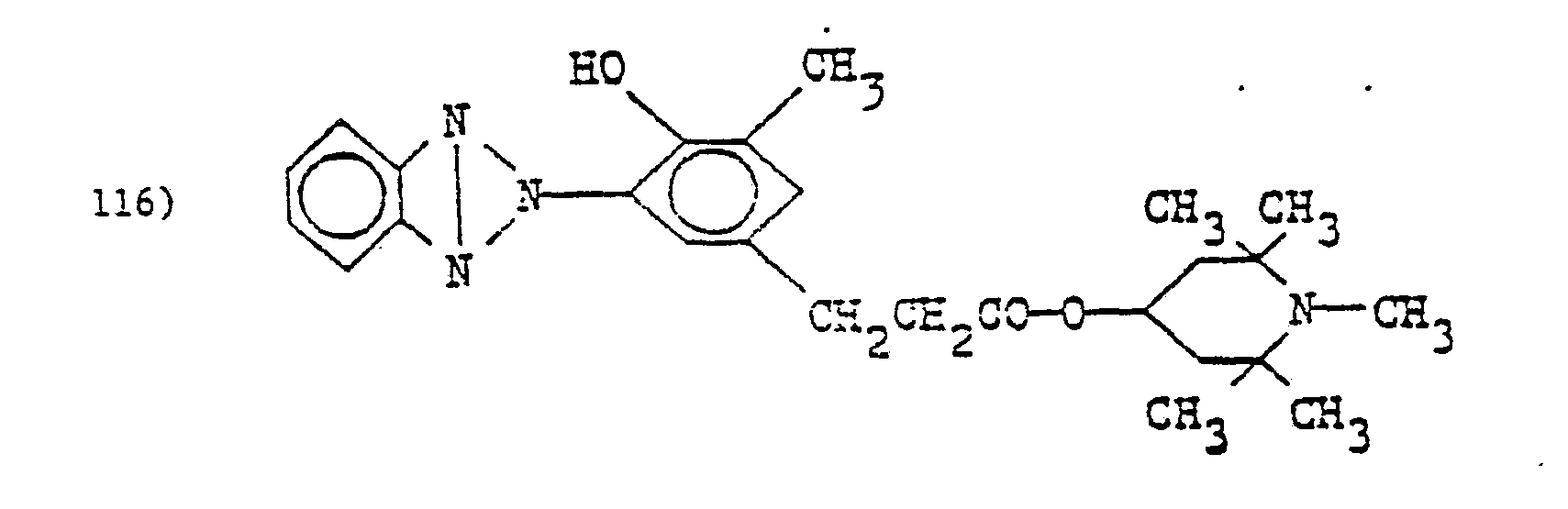


- Es können auch Polyalkylpiperidinderivate der Klassen a) - j) verwendet werden, die mit dem Bindemittel des Lackes chemische Bindungen eingehen. Dies ist der Fall, wenn das Polyalkylpiperidinderivat eine hierfür geeignete reaktive Gruppe besitzt, wie beispielsweise eine Glycidyl- oder eine Methylolgruppe.
- Beispiele solcher Verbindungen sind die Methylol- bzw. Methylol- äthergruppen enthaltende Polyalkylpiperidinderivate der Klasse h).
- . Soweit die Polyalkylpiperidinverbindungen basische Verbindungen sind, können sie mit Säuren Salze bilden. Hiefür kommen beispielsweise anorganische Säuren oder organische Carbon-, Sulfon-, Phosphon-oder Phosphinsäuren in Frage, wie z.B. Chlorwasserstoffsäure, Borsäure, Phosphorsäure, Essigsäure, Salicylsäure, Toluolsulfonsäure oder Benzolphosphonsäure.
- Die Polyalkylpiperidinverbindungen können mit komplexbildenden Metallverbindungen Komplexe bilden, beispielsweise mit Zink-II-acetat, Cobalt-II-acetylacetonat, Nickel-11-acetylacetonat, Aluminium-IIIacetylacetonat, Nickel-II-benzoat oder Aluminium-III-benzoylacetonat.
- Salz aus 1 Mol H3PO4 und 1 Mol Adipinsäure-üi-(1,2,2,6,6-pentamethyl-4-piperidinyl)-ester.
- Salz aus 2 Mol Bis(3,5-di-tert.butyl-4-hydroxybenzyl)-malonsäure und 1 Mol 2,2,6,6-Tetramethyl-4-lauroyl-oxypiperidin. 1:1-Komplex von Bis-(2,2,6,6-tetramethyl-4-piperidinyl)-sebacat und Nickel-II-acetylacetonat.
- 1:2-Komplex von Bis-(1,2,2,6,6-pentamethyl-4-piperidinyl)-adipat und Nickel-11-acetat.
- Die erfindungsgemässen Verbindungen verleihen gefärbten Polyamid- und Copolyamidfasern, wie z.B. Polyamid 6, Polyamid 6/6 oder Poly-m-phenylen-isophthalamid, ebenfalls ausgezeichnete Lichtstabilität.
- Die erfindungsgemässen Benzotriazole unterscheiden sich in vier hervorragenden Eigenschaften von den strukturell nahestehenden Benzotriazolen des Standes der Technik. Sie sind
- 1. schwerflüchtig
- 2. besser löslich in den Lösungsmitteln, welche für Kunststoffüberzüge üblicherweise verwendet werden.
- 3. vertragen sich besser mit Polyolefinen, Vinylpolymeren und Kohlenwasserstoffpolymeren.
- 4. widerstandfähig gegenüber Metallionen, welche häufig in Stabilisator- und Härtersystpmen für Polymere anzutreffen sind und zur Verfärbung vieler Benzotriazol-Stabilisatoren führen.
- Die praktischen und wirtschaftlichen Vorteile, welche aus diesen unterwarteten Eigenschaften folgen sind die folgenden:
- a) Die Schwerflüchtigkeit, insbesondere wenn mit guter Substratverträglichkeit und Löslichkeit kombiniert, erlaubt die unproblematische Einführung der erfindungsgemässen Benzotriazole in das Polymer, wo sie auch nach der Hochtemperatur-Verarbeitung verbleiben und daher dem Endprodukt die gewünschte Stabilität verleihen. Wenn aber ein Stabilisator, sei er noch so wirksam, während der Verarbeitung verloren geht, kann keine ausreichende stabilisierende Wirkung ausüben.
- b) Wie aus der folgenden Tabelle ersichtlich ist, ist die Verbindung aus Beispiel 2, 2-(2-Hydroxy-3,5-di-tert-octylphenyl)-2H-benzotriazol besser löslich in den Lösungsmitteln, welche für Kunststoffüberzüge üblicherweise verwendet werden, als 2-(2-Hydroxy-3,5-di-tert.-amylphenyl)-2H-benzotriazol (TINUVIN 328), welche die strukturell nächststehende Verbindung vom Stand der Technik ist.
-

- Die erhöhte Löslichkeit erlaubt die Verwendung der erfindungsgemässen Benzotriazolen in konzentrierten Lösungen und damit die Arbeiten mit kleinen Lösungsmittelvolumen (was heute von besonderem. Interesse ist für den Umweltschutz aber auch interessant aus wirtschaftlichen Gründen). Ferner erlaubt es die Verwendung von weniger toxischen Lösungsmitteln, wie Hexan, an Stelle von aromatischen Lösungsmitteln.
- c) die grössere Substratverträglichkeit der erfindungsgemässen Verbindungen zusammen mit der bereits diskutierten Schwerflüchtigkeit gestattet die Verarbeitung und Verwendung der stabilisierten Produkte bei höheren Temperaturen, sowie eine verlängerte Gebrauchsdauer der Produkte bei üblichen Temperaturen. Dadurch wird das unerwünschte Ausschwitzen des Stabilisators während der Verarbeitung verhindert, was sonst häufig zu kostspieligen Schädigungen der Anlage führt. Das Ausschwitzen des Stabilisators während des Gebrauchs der Faser oder des Kunststoffes, das sogenannte "blushing" wird ebenfalls vermieden. Das Ausschwitzen des Stabilisators ist einerseits unansehnlich, anderseits teuer. bedingt durch den frühzeitigen Verlust des Stabilisators und durch die verkürzte Gebrauchsdauer der Faser oder des Kunststoffes. Der Stabilisator geht verloren noch bevor er seine Funktion hätte erfüllen können.
- d) Die erfindungsgemässen Verbindungen sind überraschend resistent gegenüber Metallionen, welche in vielen Stabilisator- und Härtersystemen für Polymere vorkommen und zur Verfärbung führen. Viele bekannte Benzotriazol-Stabilisatoren formen offensichtlich farbige Metallkomplexe von unbekannter Struktur mit Ionen wie Kobalt, Eisen, Barium, Cadmium, Zinn etc. Solche Metallionen kommen zum Beispiel in Polymeren, wie z.B. in ungesättigten Polyestern, Alkyden. etc. vor, wenn man Kobaltnaphrenat zum Trocknen verwendet; in PVC oder PVC-Copolymeren welche mit Barium/Cadmium oder mit Zinn-verbindungen stabilisiert sind; in Polyurethanen, die Zinn-Katalysatoren enthalten; in ABS-Harzen, welche mit Eisen verunreinigt sind. In all diesen Substraten können die erfindungsgemässen Benzotriazole verwendet werden, dank ihrer Eigenschaft mit den erwähnten Metallionen keine Komplexe zu formen.
- Dies wird durch die Gardner Farbenzahl einer Xylol-Lösung demonstriert, welche verschiedene Benzotriazole enthält. Die Werte werden vor und nach Zugabe von zwei Tropfen 6 % Kobaltnaphtenat-Lösung (in Xylol) gemessen.
-

- Die Neigung mancher Benzotriazole mit Metallionen Komplexe zu bilden ist oft genug so nachteilig, dass man von ihrem Einsatz in metallhaltigen Systemen absehen muss. In anderen Fällen wiederum wäre die Verfärbung selber tolerierbar aber die Komplexbildung ist nachteilig, in dem es verhindert, dass das Trockenmittel als Härter wirksam wird oder dass der Stabilisator seine Wirkung entfaltet. In all diesen Fällen ist von der Verwendung der bisher bekannten Benzotriazolen abzusehen.
- e) Schliesslich, in manchen hitzehärtbaren Acryl-Harzen, welche mit Melamin vernetzt werden, ist die Härtung durch die Gegenwart gewisser Benzotriazolen verzögert. Es wurde nun gefunden, dass die erfindungsgemässen Benzotriazole, vermutlich infolge gewisser unerwarteten Konfiguration um die Hydroxyl-Gruppe herum, mit dem Melamin-Härter nicht reagieren und dadurch im Gegensatz zu manchen bekannten Benzotriazolen für hitzehärtbaren Acrjl-Harze besonders geeignet sind.
- Dies wird bestätigt wenn man den Pendel-Härtewert (pendulum hardness value) des hitzehärtbaren Acrylharz-Filmes in Abwesenheit oder in Gegenwart von 1 % Benzotriazol-Stabilisators bestimmt.
-
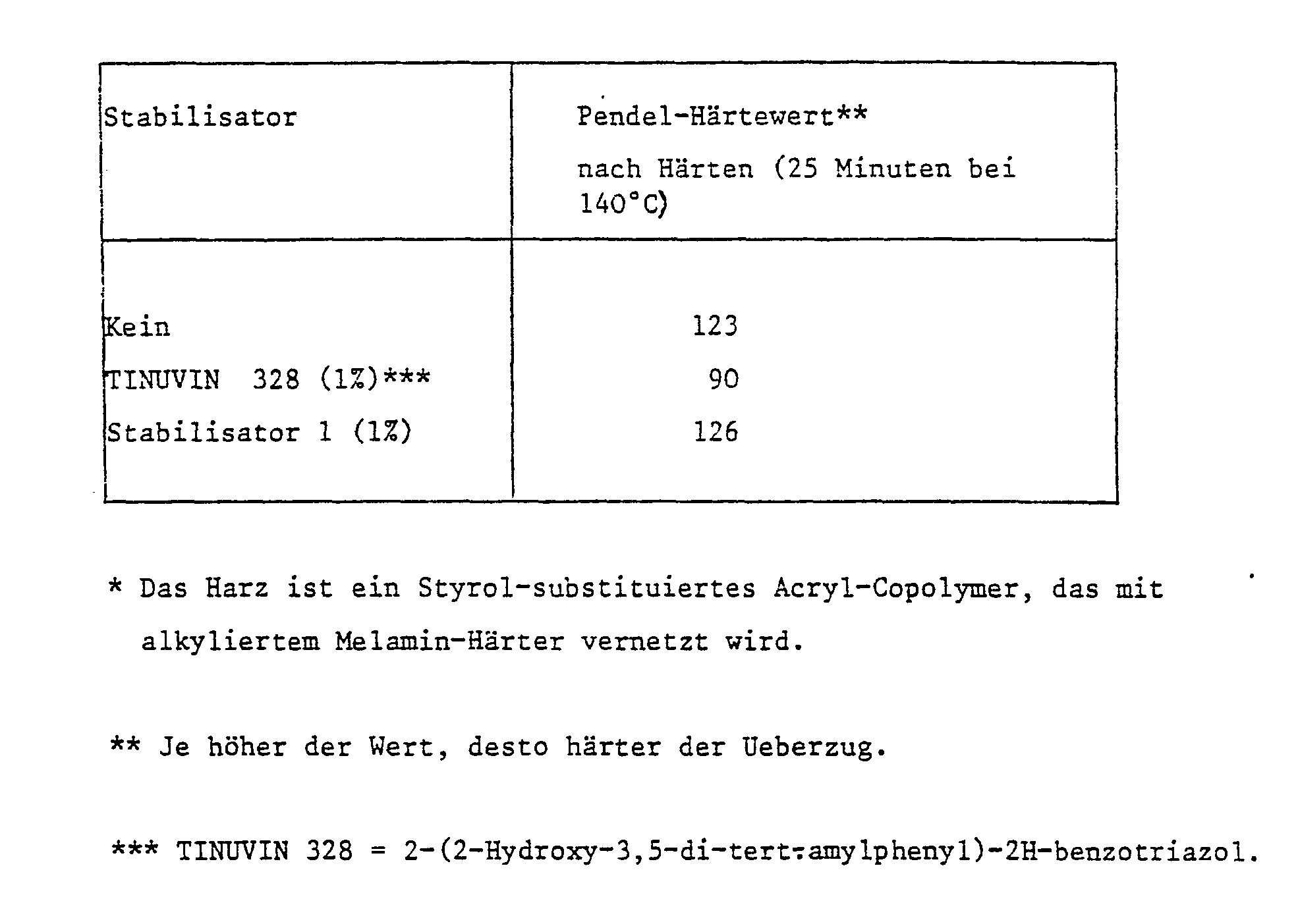
- Auf unerklärbare Weise, hindern noch beeinträchtigen die erfindungsgemässen Benzotriazole das Aushärten des Acrylharz-Systems wie der beibehaltene oder sogar erhöhte Pendel-Härtewert es beweist. Der Pendel-Härtewert ist ein direktes Mass für den Grad der Aushärtung, und wie aus der Tabelle ersichtlich ist, steht der vom erfindungsgemässen Stabilisator gelieferte Wert im scharfen Kontrast zu dem Wert des strukturell nächststehenden Stabilisators.
- Die folgenden Beispiele erläutern die Erfindung. Prozente sind Gewichtsprozente.
- In einen 5 1 Dreihals-Rundkolben mit Rührer und Thermometer gibt man 317,3 g einer 26 %igen wässrigen Naphthalinsulfonsäure-Lösung, 6,7 g Triton X-207 (nicht ionischer Oberflächenaktiver Stoff), 19,6 g Conoco AAS-90F (Natrium-dodecylbenzol-sulfonat) und 315 ml Wasser. Das Gemisch wird auf 40°C erwärmt, dann mit 393,6 g 2,4-Di- tert.-octylphenol langsam versetzt und unter kräftigem Rühren auf 40°C gehalten.
- Eine kalte o-Nitrobenzoldiazoniumchlorid-Lösung wird aus 174,3 g (1,26 Mol) o-Nitroanilin und aus 87,1 g (1,26 Mol) Natriumnitrit in conc. HCl bei -5°C bis 0°C hergestellt. Diese Lösung wird tropfenweise während 1 ½ Stunden zum Reaktionsgemisch gegeben und die resultierende dunkelrote bis schwarze Lösung über Nacht bei 40°C gehalten. Dann wird die Temperatur für eine Stunde auf 65°C und auf weitere 30 Minuten auf 95°C erhöht. Nach Abkühlen auf 35°C, wird das Rohprodukt, ein tiefroter feinverteilter Feststoff isoliert.
- Das Rohprodukt wird mit 3,5 1 Wasser zerrieben und anschliessend mit 1400 ml Methanol gerührt und abfiltriert. Man erhält 419,7 g (72,7 % der Theorie) eines feinen Granulates. Smp. 110 - 112°C.
- Der Dünnschichtchromatogramm zeigt ein homogenes Produkt.
- In einen 5 1 Dreihals-Rundkolben mit Gaseinleitung, Rührer und Rückflusskühler gibt man 400 g (0,855 Mol) o-Nitroazobenzol, hergestellt im Beispiel 1, und 1200 ml Toluol. Zu dieser Lesung fügt man 260 ml Isopropanol und 260 ml Wasser. Unter Einleiten von Stickstoff fügt man 175 ml 50,1 % Natronlauge zur Lösung. Eine Flasche mit 170,0 g (2,6 Grammatom) Zink wird an den Reaktionskolben angeschlossen. Man leitet den Zinkstaub portionsweise während 120 Minuten in das Reaktionsgemisch, und zwar so, dass die Reaktionstemperatur zwischen 70°C bleibt. Nachdem alles Zink zugefügt wurde gibt man weitere 30 ml 50,1 % Natronlauge und 20 g Zink dazu, um eine vollständige Reaktion zu sichern. Nach Beendigung der Zinkzugabe erwärmt man das Reaktionsgemisch auf 70°C 3 Stunden lang. Das Gemisch wird auf Raumtemperatur abgekühlt und mit 500 ml konz. Salzsäure angesäurert..
- Der Zink-Rückstand wird durch Filtrieren entfernt. Die organische Phase, welche das Produkt enthält, wird dreimal mit 1000 ml Wasser, dann mit 500 ml gesättigter Sälzlösung gewaschen und über wasserfreies Natriumsulfat getrocknet. Nach Enffernen des Lösungsmittels durch Vakuumdestillation erhält man das viskose Rohprodukt, das beim Stehen kristallisiert.
- Um das Rohprodukt zu reinigen rekristallisiert man es zweimal aus 1000-- 1100 ml Aethanol.
- Man erhält 253 g (67,8 % der Theorie) blass-gelbe Kristalle. (Stabilisator 1) Smp. 105 - 106°C.
- Analyse: C28H41N3O:
- berechnet C: 77,20 H: 9,49 N: 9,65
- gefunden C: 77,22 H: 9,14 N: 9,77
- Wenn man im Beispiel 1 anstelle von der Diazoniumlösung, hergestellt aus 2-Nitroanilin, eine Diazoniumlösung, hergestellt aus 4-Chloro-2-nitroanilin in äquivalenter Menge verwendet, erhält man 61,6 % vom dunkelroten Produkt.
- Wenn man im Beispiel 2 anstelle von 2-Nitro-2'-hydroxy-3',5'-di-tert.-octyl-azobenzol 4-Chloro-2-nitro-2'-hydroxy-3',5'-di-tert.-octyl-azobenzol verwendet, erhält man 71,8 % vom Produkt. Die blassgelben Kristalle schmelzen bei 121 - 122°C. (Stabilisator 2)
- Analyse: C28H40ClN3O:
- berechnet C: 71,54; H 8,58; N: 8,94
- gefunden C: 71,26; H 8,46; N: 9,03.
- Beispiel 5: Verlustwiederstand des Benzotriazols
- Eine Anzahl von 2-Aryl-2H-benzotriazolen werden thermalgravimetrisch analysiert, und zwar sowohl isothermisch bei 280°C, um die Zeit in Minuten zu ermitteln, bei welcher 10%, 50% und 100% des Stabilisators verloren geht, als auch durch eine Auszähl-Methode bei der die Temperatur kontinuierlich um 10°C pro Minute erhöht wurde bis ein Stabilisatorschwund von 10% bzw. 50% festgestellt wurde.
- Die Testergebnisse sind in der Tabelle A zusammengefasst.
- Die Ergebnisse zeigen das genaue Mass an Stabilisatorwiderstand während der Verarbeitung des Polymeres zu Folien, Filmen, Fasern etc. nicht auszuschwitzen oder zu verflüchtigen Dadurch, dass kein Stabilisator infolge Verflüchtigen oder Ausschwitzen sich auf die Anlage niederschlägt, ist die Zeit bis zur Schädigung der Anlage wesentlich erhöht. Daher ist die Verwendung der erfindungsgemässen Stabilisatoren sowohl von praktischer als auch von wirtschaftlicher Bedeutung.

- Der Stabilisator 1 (aus Beispiel 2) ist eindeutig schwerflüchtiger als die anderen Benzotriazole. Der Stabilisator 1, eingearbeitet in das Polymer, würde daher dem Polymer einen besseren Schutz gegen schädliche Lichteinwirkungen bieten und darüber hinaus ein ausgezeichnetes Verhalten während der Verarbeitung zeigen.
- Polycarbonatharz, (Lexan, General Electric) wurde mit 0.3 % (Gewicht) diverser 2-Aryl-2H-benzotriazol UV-Absorber ausgerüstet. Das formulierte Harz wurde bei 316°C zu dünnen Folien extrudiert. Die erhaltenen Folien wurden in Methylenchlorid gelöst und das Polycarbonat mit Methanol ausgefällt. Die Menge an Benzotriazol-Stabilisator, die in der Polycarbonat-Folie nach der Herstellung verblieb, wurde mittels Gaschromatographie bestimmt. Die Ergebnisse zeigt Tabelle B.
-

- Diese Daten bestätigen die Ergebnisse von Tabelle A, nämlich die geringere Flüchtigkeit des Stabilisator 1 während der Verarbeitung.
- Diverse Thermoset-Acrylharze und ein Alkyd/acrylharz-System wurden mit 2 % (Gewicht) verschiedener Benzotriazol-UV-Absorber formuliert und auf Glasplatten zu 1 p dicken Ueberzügen gegossen.
- Die Ueberzüge wurden dann bei erhöhter Temperatur eine bestimmte Zeit gehärtet. Der Verlust an Benzotriazol-UV-Absorber wurde dann durch UV-Absorptions-Analyse der Ueberzüge bestimmt. Eine Abnahme der Absorbtion der Ueberzüge kann einen Verlust an Benzotriazol-Stabilisator während des Härtens gleichgesetzt werden.
- Diese gehärteten Ueberzüge wurden dem beschleunigten (quick) Bewitterungstest (QUV) unterworfen, bei dem alternierend 4-Stunden UV-Bestrahlung bei 60°C und 4-Stunden Kondensation (Regen) bei 50°C über eine Zeitspanne von 670 Stunden einwirken. Wiederum kann eine Absorptionsabnahme der bewitterten Ueberzüge mit einem Verlust an Benzotriazol-Stabilisator während des Härtens und der Bewitterung gleichgesetzt werden. Die Ergebnisse zeigt Tabelle C.

- Tabelle C zeigt, dass die erfindungsgemässe Verbindung viel weniger Verluste in den thermoset Acryl-Harz- und Alkyd/Acrylharz-Systemen erleidet als bekannte Benzotriazole. Stabilisator 1 ist beträchtlich weniger flüchtig als TINUVIN 328 die eine vergleichbare Struktur hat.
- 0,5 % der Verbindung von Beispiel 2 wird als Stabilisator zu geschmolzenen Polyäthylen-teraphthalat bei 270°C unter Rühren und einer Stickstoffatmosphäre gegeben. Der erhaltene, formulierte Polymer wird mit festem Kohlendioxid gemahlen.
- Die stabilisierte Mischung wird bei erhöhter Temperatur zu einem Film unter geringem Stabilisatorverlust extrudiert. Dann wird der Film einer UV-Bestrahlung unterworfen. Der stabilisierte Film behält seine erwünschten physikalischen Eigenschaften länger als der unstabilisierte.
- Polycarbonat (Lexan, General Electric) wird in einem Extruder mit 0.3 % der Verbindung von Beispiel 4 gemischt. Die stabilisierte Mischung wird extrudiert zu einer Folie bei erhöhter Temperatur unter geringem Verlust an Stabilisator. Die Folie behält ihre physikalischen Eigenschaften nach UV-Belichtung länger als eine solche ohne Stabilisator.
- Die Delamination von UV-transparenten Automobil-Decklacken, aufgetragen auf Epoxy-Ester-Primer Oberflächen ist ein schwerwiegendes Problem der Automobilhersteller. Dieses Problem wird besonders relevant, wenn die Decklack-Stärke unter der Vorschrift liegt. Einarbeiten von erfindungsgemässen UV-Absorbern in den Decklack schützt diesen vor Delamination und vor Glanzverlust.
- Ein silbermetall-thermoplastischer Acryllack wurde formuliert mit einem Benzotriazol-UV-Absorber und dann als Decklack auf eine Primer-Oberfläche aus einem Epoxy-Ester auf Metallplatten gesprüht. Das Ganze wurde 10 Minuten bei 48°C und dann 30 Minuten bei 155°C erhitzt. Die ursprüngliche Decklackschichtdicke war 2.0 b 2.2 mils (50 bis 55 Micron, 0.0508 bis 0.0559 mm).
- Die Platten wurden ein Jahr in Süd-Florida in einem ungeheizten schwarzen Kasten bei einem Winkel von 5° zur Sonne belichtet.
- Die belichteten Platten wurden 96 Stunden in eine Kammer konstanter Feuchtigkeit bei 38°C und 100 % relativer Feuchte gegeben. Dann wurden sie abgetrocknet und sofort begutachtet mittels des "cross-hatch tape" Adhäsionstests. Dann wurden die Platten eine Stunde bei Raumtemperatur belassen, bevor der "cross-hatch Tape" Adhäsionstest an einer andern Stelle der selben Platte wiederholt wurde. Die Proben zeigen allgemein eine etwas verbesserte Delaminazionsbeständigkeit nach dieser einstündigen Erhölungspause, gegenüber der Delamination sofort nach der Feuchtigkeitsbehandlung.
- Beim "cross-hatch tape" Adhäsionstest wird ein Mehrschneidemesser benutzt, um Schnitte durch den Decklack auf der Platte anzubringen. Ein Acetatfaser-Klebeband wird über die Schnittstellen geklebt und dann abgezogen. Der Decklack wird visuell beurteilt, ob und wieviel abgezogen wurde. Dies ergibt eine relative Beurteilung der Delamination von 0 (keine "cross-hatch" Delamination) bis 5 (vollständige "cross-hatch" Delamination). Die Ergebnisse zeigen Tabellen D und E
-


- Die Daten der Tabelle D bestätigen, dass der Stabilisator 1 und 2 ausgezeichneten Schutz gegen Verluste während längerer Belichtuzg im Süd-Florida Black Box Test bewirken, verglichen mit anderen Benzotriazol-Lichtschutzmitteln.
- Die Daten der Tabelle E zeigen, dass die erfindungsgemässen Verbindungen, insbesondere Stabilisator 2, einen thermoplastischen Acryl-Decklack vor Delamination nach 1 Jahr Süd-Florida Black Box Belichtung unter strengsten Testbedingungen mit sorfort nachfolgender Feutigkeitsbehandlung schützen.
- Zwei silber-metallic thermoset Acryl-Emailles wurden mit einem Benzotriazol-Lichtschutzmittel formuliert und dann als Decklack auf eine Primeroberfläche aus einem Epoxy-Ester auf einer Metallplatte gesprüht. 17 Minuten lang wurde dieser bei 130°C zu einem Anfangsdecklackfilm von 1.7 mil Dicke (42 Micron, 0.0432 mm) gehärtet. Die Platte wurde 1200 Stunden in dem QUV Bewitterungstest gemäss Beispiel 10 behandelt.
- Nach QUV-Belichtung wurden die Platten feutigkeitbehandelt und dann die Delamination bestimmt, dann eine Stunde Erholung eingeschaltet, worauf erneut die Delaminationsbeständigkeit gemäss Beispiel 10 bestimmt wurde. Die Ergebnisse zeigt Tabelle F.


- Die Kombination von sterisch gehinderten Amin-Lichtschutzmitteln mit den erfindungsgemässen Benztriazol-UV-Absorbern ist besonders geeignet, den Glanz zu erhalten und Delamination zu verhindern, insbesondere bei metallisierten thermoset Acryl-Amaillen und bei metallisierter thermoplastischen Acryllacken für Automobildecklacken.
- Die gehinderten Amine schützen die thermoset Acryl-Emaille und den thermoplastischen Acryllack selbst bei niedriger Konzentration gegen Glanzverluste, wirken aber nicht als UV-Filter. Demgemäss kann UV-Licht durch den Acryldecklack treten, falls kein UV-Absorber vorhanden ist, wie die erfindungsgemässen Benztriazole, und kann Schaden anrichten in der Epoxy-Ester-Primeroberfläche unter dem Decklack. Einarbeiten von selbst niedrigen Konzentrationen (0.5 % Gewicht) eines Benztriazols in Kombination mit einem gehinderten Amin bewirkt sowohl Glanzerhaltnng als auch Widerstandsfähigkeit gegen Delamination für metallisierte Acryl-Decklacke.
- Zwei silber-metallisierte thermoset Acryl-Emaillen wurden formuliert sowohd mit einem gehinderten Amin Lichtschutzmittel als auch einem Benzotriazol-UV-Absorber. Die Testplatten wurden wie im Beispiel 11 beschrieben hergestellt und getestet.
- Wird der thermoset Acryl-Emaille nur mit einem sterisch gehinderten Amin kombiniert, wie z.B. Bis-(2,2,6,6-tetramethyl-4-piperidyl)-sebacat oder Bis-(1,2,2,6,6-pentamethyl-4-piperidyl)-2-n-butyl-2-(3,5-di-tert.-butyl-4-hydroxybenzyl)-malonat, so sind die Delaminationswerte identisch mit den Werten des unstabilisierten Emaille. Ausgezeichnete Delaminationswerte erhält man durch die Kombination von sterisch gehinderten Amin-Lichtstabilisatoren und der erfindungsgemässen Benzotriazol-UV-Absorber in den Emaillen.
- Die Wirksamkeit von Kombinationen von gehinderten Amin-Lichtschutzmitteln mit erfindungsgemässen Benztriazol-UV-Absorber zum Schutz von Automobildecklacken zeigt sich bei thermoplastischen Acrylharzen, wobei sowohl Glanzerhalt nach längerer Belichtung in Süd-Florida durch das gehinderte Amin erfolgt, als auch durch die erfindungsgemässen Benztriazol-UV-Absorber Schuzt des thermoplastischen Acryl-Decklackes vor Delamination. Ein silber-metallic thermoplastischer Acryl-Lack wurde formuliert sowohl mit einem gehinderten Amin-Lichtschutzmittel, als auch einem Benztriazol-UV-Absorber. Testplatten werden hergestellt und getestet wie in Beispiel 10 beschrieben.
- Der Lack, welcher sowohl ein Amin-Lichtschutzmittel (wie z.B. im Beispiel 12 beschrieben) als auch einen Benzotriazöl-Stabilisator enthielt (z.B. Stabilisator 1 oder 2) zeigte ausgezeichnete Glanz- und Delaminationswerte bei 20°C.
- Beispiel 14: Die Kombination von gewissen Benzotriazol-UV-Absorbern mit gewöhnlichen Barium/Cadmium-Thermostabilisatoren für Polyvinylchlorid (PVC) führt zur Verfärbung. Diese Verfärbung beschränkt daher die Brauchbarkeit dieser Benzotriazolen in gewissen PVC-Applikationen.
- Die gegenwärtigen Benzotriazole (Stabilisator 1) zeigten sich wesentlich widerstandsfähiger gegenüber Verfärbung in Gegenwart von solchen PVC-Thermostabilisatoren als z.B. 2-Hydroxy-5-methylphenyl"-2H-benzotriazol..
Claims (9)

Applications Claiming Priority (4)
| Application Number | Priority Date | Filing Date | Title |
|---|---|---|---|
| US639179A | 1979-01-25 | 1979-01-25 | |
| US6391 | 1979-01-25 | ||
| US100400 | 1979-12-17 | ||
| US06/100,400 US4278590A (en) | 1979-08-20 | 1979-12-17 | 2-[2-Hydroxy-3,5-di-tert-octylphenyl]-2H-Benzotriazole and stabilized compositions |
Publications (2)
| Publication Number | Publication Date |
|---|---|
| EP0015230A1 true EP0015230A1 (de) | 1980-09-03 |
| EP0015230B1 EP0015230B1 (de) | 1983-02-23 |
Family
ID=26675567
Family Applications (1)
| Application Number | Title | Priority Date | Filing Date |
|---|---|---|---|
| EP80810017A Expired EP0015230B1 (de) | 1979-01-25 | 1980-01-21 | Stabilisiertes organisches Polymer enthaltend als Lichtstabilisator ein 2-(2-Hydroxy-3,5-di-tert-octylphenyl)-2H-benzotriazol |
Country Status (2)
| Country | Link |
|---|---|
| EP (1) | EP0015230B1 (de) |
| DE (1) | DE3062090D1 (de) |
Cited By (6)
| Publication number | Priority date | Publication date | Assignee | Title |
|---|---|---|---|---|
| EP0180991A3 (de) * | 1984-11-07 | 1987-10-14 | ADEKA ARGUS CHEMICAL CO., Ltd. | Lackzusammensetzungen mit Lichtstabilität auf Basis wärmehärtbarer synthetischer Harze |
| EP0180992A3 (en) * | 1984-11-07 | 1987-10-21 | Adeka Argus Chemical Co., Ltd. | Stabilizer compositions for synthetic resins imparting improved light stability |
| EP0188236A3 (en) * | 1985-01-14 | 1987-10-28 | Adeka Argus Chemical Co., Ltd. | Polyacetal resin compositions having improved resistance to deterioration when exposed to light and containing alkylidene bis(benzotriazolyl phenols) |
| FR2601365A1 (fr) * | 1986-01-10 | 1988-01-15 | Oreal | Nouveaux derives d'acrylamide, leur preparation et leur utilisation dans la realisation de polymeres absorbant les radiations ultraviolettes. |
| FR2604441A1 (fr) * | 1986-09-25 | 1988-04-01 | Ciba Geigy Ag | Procede pour stabiliser des feuilles en polyethylene, et feuilles ainsi stabilisees |
| WO2000017271A1 (en) * | 1998-09-18 | 2000-03-30 | Idemitsu Petrochemical Co., Ltd. | Polycarbonate resin composition and products of sheet forming thereof |
Citations (3)
| Publication number | Priority date | Publication date | Assignee | Title |
|---|---|---|---|---|
| US3230194A (en) * | 1961-12-22 | 1966-01-18 | American Cyanamid Co | 2-(2'-hydroxy-5'-tertiary-octylphenyl)-benzotriazole and polyolefins stabilized therewith |
| US4041044A (en) * | 1974-11-25 | 1977-08-09 | Ciba-Geigy Corporation | Process for the production of 2-aryl-2H-benzotriazoles |
| FR2364947A1 (fr) * | 1976-09-20 | 1978-04-14 | Stamicarbon | Procede de stabilisation de matieres plastiques resistant au choc |
-
1980
- 1980-01-21 EP EP80810017A patent/EP0015230B1/de not_active Expired
- 1980-01-21 DE DE8080810017T patent/DE3062090D1/de not_active Expired
Patent Citations (3)
| Publication number | Priority date | Publication date | Assignee | Title |
|---|---|---|---|---|
| US3230194A (en) * | 1961-12-22 | 1966-01-18 | American Cyanamid Co | 2-(2'-hydroxy-5'-tertiary-octylphenyl)-benzotriazole and polyolefins stabilized therewith |
| US4041044A (en) * | 1974-11-25 | 1977-08-09 | Ciba-Geigy Corporation | Process for the production of 2-aryl-2H-benzotriazoles |
| FR2364947A1 (fr) * | 1976-09-20 | 1978-04-14 | Stamicarbon | Procede de stabilisation de matieres plastiques resistant au choc |
Cited By (7)
| Publication number | Priority date | Publication date | Assignee | Title |
|---|---|---|---|---|
| EP0180991A3 (de) * | 1984-11-07 | 1987-10-14 | ADEKA ARGUS CHEMICAL CO., Ltd. | Lackzusammensetzungen mit Lichtstabilität auf Basis wärmehärtbarer synthetischer Harze |
| EP0180992A3 (en) * | 1984-11-07 | 1987-10-21 | Adeka Argus Chemical Co., Ltd. | Stabilizer compositions for synthetic resins imparting improved light stability |
| EP0188236A3 (en) * | 1985-01-14 | 1987-10-28 | Adeka Argus Chemical Co., Ltd. | Polyacetal resin compositions having improved resistance to deterioration when exposed to light and containing alkylidene bis(benzotriazolyl phenols) |
| FR2601365A1 (fr) * | 1986-01-10 | 1988-01-15 | Oreal | Nouveaux derives d'acrylamide, leur preparation et leur utilisation dans la realisation de polymeres absorbant les radiations ultraviolettes. |
| FR2604441A1 (fr) * | 1986-09-25 | 1988-04-01 | Ciba Geigy Ag | Procede pour stabiliser des feuilles en polyethylene, et feuilles ainsi stabilisees |
| WO2000017271A1 (en) * | 1998-09-18 | 2000-03-30 | Idemitsu Petrochemical Co., Ltd. | Polycarbonate resin composition and products of sheet forming thereof |
| US6350847B1 (en) * | 1998-09-18 | 2002-02-26 | Idemitsu Petrochemical Co., Ltd. | Polycarbonate resin composition and products of sheet forming thereof |
Also Published As
| Publication number | Publication date |
|---|---|
| EP0015230B1 (de) | 1983-02-23 |
| DE3062090D1 (en) | 1983-03-31 |
Similar Documents
| Publication | Publication Date | Title |
|---|---|---|
| EP0309402B2 (de) | N-substituierte sterisch gehinderte Amin-Stabilisatoren | |
| CA1146948A (en) | 2-¬2-HYDROXY-3,5-DI-(.alpha.,.alpha.-DI-METHYLBENZYL) PHENYL|- 2H-BENZOTRIAZOLES AND STABILIZED COMPOSITIONS | |
| DE69030362T2 (de) | Stabilisiertes organisches Material | |
| DE69026747T2 (de) | Nichtwandernde 1-Hydrocarbyloxy-gehinderte Amineverbindungen als Polymerstabilisatoren | |
| US4278590A (en) | 2-[2-Hydroxy-3,5-di-tert-octylphenyl]-2H-Benzotriazole and stabilized compositions | |
| US4315848A (en) | 2-[2-Hydroxy-3,5-di-(α,α-dimethylbenzyl)-phenyl]-2H-benzotriazole and stabilized compositions | |
| DE3851931T2 (de) | Stabilisierung einer Beschichtung mit sterisch gehinderten N-hydroxysubstituierten Aminen. | |
| DE69433641T2 (de) | Mit uv-absorbierenden s-triazinenstabilisierte elektrotauch/grundschicht/klarlack aufweisende lackschichten | |
| US4278589A (en) | 2-[2-Hydroxy-3,5-di-(α,α-dimethylbenzyl)phenyl]-2H-benzotriazole and stabilized compositions | |
| DE3888065T2 (de) | N-Acyloxy-substituierte sterisch gehinderte Aminstabilisatoren. | |
| HK1004562B (en) | Stabilized organic material | |
| DE60026177T2 (de) | Stabilisatormischung | |
| HK1000211B (en) | N-substituted hindered amine stabilizers | |
| DE69012615T2 (de) | Äthylenisch ungesättigte Verbindungen, die 1-Hydrocarbyloxy-2,2,6,6-tetramethylpiperidine-Teile enthalten, und Polymere, Copolymere und stabilisierte Zusammensetzungen. | |
| DE19712277A1 (de) | Hydroxyphenyltriazine | |
| DE19601213A1 (de) | Stabilisatorkombination | |
| EP0010516A1 (de) | Neue Polyalkylpiperidinderivate, ihre Verwendung als Lichtschutzmittel und damit stabilisierte Polymere | |
| KR19990072904A (ko) | 입체장애아민에테르의제조 | |
| EP0053775A2 (de) | Poly-bis-triazinylamine, Verfahren zu ihrer Herstellung, ihre Verwendung zum Stabilisieren von synthetischen Polymeren und die so stabilisierten Polymeren | |
| EP0044499B1 (de) | Triazinylaminotriazine, ihre Herstellung, ihre Verwendung zum Stabilisieren von synthetischen Polymeren sowie die mit ihnen stabilisierten Produkte | |
| EP0214102B1 (de) | 5-Aralkylsubstituierte 2H-Benztriazole und stabilisierte Zusammensetzungen | |
| EP0006564B1 (de) | 2-(2-Hydroxy-3.5-disubstituiertes-phenyl)-2H-benzotriazol und damit stabilisierte Mischungen | |
| EP0434619B1 (de) | Verfahren zum Einbau von O-Hydroxyphenyl-S-triazinen in organische Polymere | |
| DE69013547T2 (de) | N-Hydroxycarbyloxy-gehinderte, phosphorsubstituierte Amine verwendbar als Stabilisatoren gegen Lichteinwirkung. | |
| EP0015230B1 (de) | Stabilisiertes organisches Polymer enthaltend als Lichtstabilisator ein 2-(2-Hydroxy-3,5-di-tert-octylphenyl)-2H-benzotriazol |
Legal Events
| Date | Code | Title | Description |
|---|---|---|---|
| PUAI | Public reference made under article 153(3) epc to a published international application that has entered the european phase |
Free format text: ORIGINAL CODE: 0009012 |
|
| 17P | Request for examination filed | ||
| AK | Designated contracting states |
Designated state(s): DE FR GB IT NL |
|
| ITF | It: translation for a ep patent filed | ||
| GRAA | (expected) grant |
Free format text: ORIGINAL CODE: 0009210 |
|
| AK | Designated contracting states |
Designated state(s): DE FR GB IT NL |
|
| REF | Corresponds to: |
Ref document number: 3062090 Country of ref document: DE Date of ref document: 19830331 |
|
| ET | Fr: translation filed | ||
| PGFP | Annual fee paid to national office [announced via postgrant information from national office to epo] |
Ref country code: NL Payment date: 19890131 Year of fee payment: 12 |
|
| PG25 | Lapsed in a contracting state [announced via postgrant information from national office to epo] |
Ref country code: NL Effective date: 19900801 |
|
| NLV4 | Nl: lapsed or anulled due to non-payment of the annual fee | ||
| ITTA | It: last paid annual fee | ||
| PGFP | Annual fee paid to national office [announced via postgrant information from national office to epo] |
Ref country code: FR Payment date: 19961125 Year of fee payment: 18 |
|
| PGFP | Annual fee paid to national office [announced via postgrant information from national office to epo] |
Ref country code: DE Payment date: 19961205 Year of fee payment: 18 |
|
| PGFP | Annual fee paid to national office [announced via postgrant information from national office to epo] |
Ref country code: GB Payment date: 19961223 Year of fee payment: 18 |
|
| REG | Reference to a national code |
Ref country code: GB Ref legal event code: 732E |
|
| PG25 | Lapsed in a contracting state [announced via postgrant information from national office to epo] |
Ref country code: GB Free format text: LAPSE BECAUSE OF NON-PAYMENT OF DUE FEES Effective date: 19980121 |
|
| PG25 | Lapsed in a contracting state [announced via postgrant information from national office to epo] |
Ref country code: FR Free format text: THE PATENT HAS BEEN ANNULLED BY A DECISION OF A NATIONAL AUTHORITY Effective date: 19980131 |
|
| GBPC | Gb: european patent ceased through non-payment of renewal fee |
Effective date: 19980121 |
|
| PG25 | Lapsed in a contracting state [announced via postgrant information from national office to epo] |
Ref country code: DE Free format text: LAPSE BECAUSE OF NON-PAYMENT OF DUE FEES Effective date: 19981001 |
|
| REG | Reference to a national code |
Ref country code: FR Ref legal event code: ST |
|
| PLBE | No opposition filed within time limit |
Free format text: ORIGINAL CODE: 0009261 |
|
| STAA | Information on the status of an ep patent application or granted ep patent |
Free format text: STATUS: NO OPPOSITION FILED WITHIN TIME LIMIT |