EP0015541B1 - Verfahren zur Herstellung von Organolithiumverbindungen neben Lithiumhydrid; Katalysatoren - Google Patents
Verfahren zur Herstellung von Organolithiumverbindungen neben Lithiumhydrid; Katalysatoren Download PDFInfo
- Publication number
- EP0015541B1 EP0015541B1 EP80101095A EP80101095A EP0015541B1 EP 0015541 B1 EP0015541 B1 EP 0015541B1 EP 80101095 A EP80101095 A EP 80101095A EP 80101095 A EP80101095 A EP 80101095A EP 0015541 B1 EP0015541 B1 EP 0015541B1
- Authority
- EP
- European Patent Office
- Prior art keywords
- lithium
- metals
- thf
- process according
- compounds
- Prior art date
- Legal status (The legal status is an assumption and is not a legal conclusion. Google has not performed a legal analysis and makes no representation as to the accuracy of the status listed.)
- Expired
Links
- WHXSMMKQMYFTQS-UHFFFAOYSA-N Lithium Chemical compound [Li] WHXSMMKQMYFTQS-UHFFFAOYSA-N 0.000 title claims abstract description 75
- 239000003054 catalyst Substances 0.000 title claims abstract description 31
- 229910000103 lithium hydride Inorganic materials 0.000 title claims abstract description 28
- 150000002900 organolithium compounds Chemical class 0.000 title claims description 31
- 238000000034 method Methods 0.000 title claims description 26
- 238000002360 preparation method Methods 0.000 title description 8
- 150000003623 transition metal compounds Chemical class 0.000 claims abstract description 9
- 150000001336 alkenes Chemical class 0.000 claims abstract description 8
- 238000004519 manufacturing process Methods 0.000 claims abstract description 6
- NINIDFKCEFEMDL-UHFFFAOYSA-N Sulfur Chemical compound [S] NINIDFKCEFEMDL-UHFFFAOYSA-N 0.000 claims abstract description 5
- 229910052760 oxygen Inorganic materials 0.000 claims abstract description 5
- 239000001301 oxygen Substances 0.000 claims abstract description 5
- QVGXLLKOCUKJST-UHFFFAOYSA-N atomic oxygen Chemical compound [O] QVGXLLKOCUKJST-UHFFFAOYSA-N 0.000 claims abstract description 4
- 125000003367 polycyclic group Chemical group 0.000 claims abstract description 4
- 229910052717 sulfur Inorganic materials 0.000 claims abstract description 4
- 239000011593 sulfur Substances 0.000 claims abstract description 4
- WYURNTSHIVDZCO-UHFFFAOYSA-N Tetrahydrofuran Chemical compound C1CCOC1 WYURNTSHIVDZCO-UHFFFAOYSA-N 0.000 claims description 121
- 229910052744 lithium Inorganic materials 0.000 claims description 70
- YLQBMQCUIZJEEH-UHFFFAOYSA-N tetrahydrofuran Natural products C=1C=COC=1 YLQBMQCUIZJEEH-UHFFFAOYSA-N 0.000 claims description 59
- 239000000203 mixture Substances 0.000 claims description 30
- XEEYBQQBJWHFJM-UHFFFAOYSA-N Iron Chemical compound [Fe] XEEYBQQBJWHFJM-UHFFFAOYSA-N 0.000 claims description 22
- 238000006243 chemical reaction Methods 0.000 claims description 20
- KDLHZDBZIXYQEI-UHFFFAOYSA-N palladium Substances [Pd] KDLHZDBZIXYQEI-UHFFFAOYSA-N 0.000 claims description 18
- 229910052751 metal Inorganic materials 0.000 claims description 14
- 239000002184 metal Substances 0.000 claims description 14
- BASFCYQUMIYNBI-UHFFFAOYSA-N platinum Chemical compound [Pt] BASFCYQUMIYNBI-UHFFFAOYSA-N 0.000 claims description 14
- ZUOUZKKEUPVFJK-UHFFFAOYSA-N diphenyl Chemical compound C1=CC=CC=C1C1=CC=CC=C1 ZUOUZKKEUPVFJK-UHFFFAOYSA-N 0.000 claims description 12
- 150000002739 metals Chemical class 0.000 claims description 12
- UFWIBTONFRDIAS-UHFFFAOYSA-N Naphthalene Chemical compound C1=CC=CC2=CC=CC=C21 UFWIBTONFRDIAS-UHFFFAOYSA-N 0.000 claims description 10
- 239000010949 copper Substances 0.000 claims description 10
- 229910052742 iron Inorganic materials 0.000 claims description 10
- 229910052763 palladium Inorganic materials 0.000 claims description 10
- 230000000737 periodic effect Effects 0.000 claims description 9
- RYGMFSIKBFXOCR-UHFFFAOYSA-N Copper Chemical compound [Cu] RYGMFSIKBFXOCR-UHFFFAOYSA-N 0.000 claims description 8
- MWPLVEDNUUSJAV-UHFFFAOYSA-N anthracene Chemical compound C1=CC=CC2=CC3=CC=CC=C3C=C21 MWPLVEDNUUSJAV-UHFFFAOYSA-N 0.000 claims description 8
- 125000003118 aryl group Chemical group 0.000 claims description 8
- 229910052802 copper Inorganic materials 0.000 claims description 8
- -1 palladium halides Chemical class 0.000 claims description 8
- HCHKCACWOHOZIP-UHFFFAOYSA-N Zinc Chemical compound [Zn] HCHKCACWOHOZIP-UHFFFAOYSA-N 0.000 claims description 7
- 229910052697 platinum Inorganic materials 0.000 claims description 7
- 229910052725 zinc Inorganic materials 0.000 claims description 7
- 239000011701 zinc Substances 0.000 claims description 7
- PXHVJJICTQNCMI-UHFFFAOYSA-N Nickel Chemical compound [Ni] PXHVJJICTQNCMI-UHFFFAOYSA-N 0.000 claims description 6
- 125000000217 alkyl group Chemical group 0.000 claims description 6
- 235000010290 biphenyl Nutrition 0.000 claims description 6
- 239000004305 biphenyl Substances 0.000 claims description 6
- 125000000753 cycloalkyl group Chemical group 0.000 claims description 6
- 229910052703 rhodium Inorganic materials 0.000 claims description 6
- 239000010948 rhodium Substances 0.000 claims description 6
- MHOVAHRLVXNVSD-UHFFFAOYSA-N rhodium atom Chemical compound [Rh] MHOVAHRLVXNVSD-UHFFFAOYSA-N 0.000 claims description 6
- 239000002904 solvent Substances 0.000 claims description 6
- 125000003710 aryl alkyl group Chemical group 0.000 claims description 5
- 239000007795 chemical reaction product Substances 0.000 claims description 5
- 150000001993 dienes Chemical class 0.000 claims description 5
- 229910052739 hydrogen Inorganic materials 0.000 claims description 5
- 229910017052 cobalt Inorganic materials 0.000 claims description 4
- 239000010941 cobalt Substances 0.000 claims description 4
- GUTLYIVDDKVIGB-UHFFFAOYSA-N cobalt atom Chemical compound [Co] GUTLYIVDDKVIGB-UHFFFAOYSA-N 0.000 claims description 4
- 150000001875 compounds Chemical class 0.000 claims description 4
- VYZAMTAEIAYCRO-UHFFFAOYSA-N Chromium Chemical compound [Cr] VYZAMTAEIAYCRO-UHFFFAOYSA-N 0.000 claims description 3
- ZOKXTWBITQBERF-UHFFFAOYSA-N Molybdenum Chemical compound [Mo] ZOKXTWBITQBERF-UHFFFAOYSA-N 0.000 claims description 3
- RTAQQCXQSZGOHL-UHFFFAOYSA-N Titanium Chemical compound [Ti] RTAQQCXQSZGOHL-UHFFFAOYSA-N 0.000 claims description 3
- QCWXUUIWCKQGHC-UHFFFAOYSA-N Zirconium Chemical compound [Zr] QCWXUUIWCKQGHC-UHFFFAOYSA-N 0.000 claims description 3
- 125000001931 aliphatic group Chemical group 0.000 claims description 3
- 229910052793 cadmium Inorganic materials 0.000 claims description 3
- BDOSMKKIYDKNTQ-UHFFFAOYSA-N cadmium atom Chemical compound [Cd] BDOSMKKIYDKNTQ-UHFFFAOYSA-N 0.000 claims description 3
- 229910052804 chromium Inorganic materials 0.000 claims description 3
- 239000011651 chromium Substances 0.000 claims description 3
- 125000004122 cyclic group Chemical group 0.000 claims description 3
- PCHJSUWPFVWCPO-UHFFFAOYSA-N gold Chemical compound [Au] PCHJSUWPFVWCPO-UHFFFAOYSA-N 0.000 claims description 3
- 229910052737 gold Inorganic materials 0.000 claims description 3
- 239000010931 gold Substances 0.000 claims description 3
- 239000001257 hydrogen Substances 0.000 claims description 3
- 229910052741 iridium Inorganic materials 0.000 claims description 3
- GKOZUEZYRPOHIO-UHFFFAOYSA-N iridium atom Chemical compound [Ir] GKOZUEZYRPOHIO-UHFFFAOYSA-N 0.000 claims description 3
- WPBNNNQJVZRUHP-UHFFFAOYSA-L manganese(2+);methyl n-[[2-(methoxycarbonylcarbamothioylamino)phenyl]carbamothioyl]carbamate;n-[2-(sulfidocarbothioylamino)ethyl]carbamodithioate Chemical compound [Mn+2].[S-]C(=S)NCCNC([S-])=S.COC(=O)NC(=S)NC1=CC=CC=C1NC(=S)NC(=O)OC WPBNNNQJVZRUHP-UHFFFAOYSA-L 0.000 claims description 3
- 229910052750 molybdenum Inorganic materials 0.000 claims description 3
- 239000011733 molybdenum Substances 0.000 claims description 3
- 229910052759 nickel Inorganic materials 0.000 claims description 3
- 229910052762 osmium Inorganic materials 0.000 claims description 3
- SYQBFIAQOQZEGI-UHFFFAOYSA-N osmium atom Chemical compound [Os] SYQBFIAQOQZEGI-UHFFFAOYSA-N 0.000 claims description 3
- 229910052715 tantalum Inorganic materials 0.000 claims description 3
- GUVRBAGPIYLISA-UHFFFAOYSA-N tantalum atom Chemical compound [Ta] GUVRBAGPIYLISA-UHFFFAOYSA-N 0.000 claims description 3
- 229910052719 titanium Inorganic materials 0.000 claims description 3
- 239000010936 titanium Substances 0.000 claims description 3
- WFKWXMTUELFFGS-UHFFFAOYSA-N tungsten Chemical compound [W] WFKWXMTUELFFGS-UHFFFAOYSA-N 0.000 claims description 3
- 229910052721 tungsten Inorganic materials 0.000 claims description 3
- 239000010937 tungsten Substances 0.000 claims description 3
- 229910052720 vanadium Inorganic materials 0.000 claims description 3
- GPPXJZIENCGNKB-UHFFFAOYSA-N vanadium Chemical compound [V]#[V] GPPXJZIENCGNKB-UHFFFAOYSA-N 0.000 claims description 3
- 229910052726 zirconium Inorganic materials 0.000 claims description 3
- 239000004721 Polyphenylene oxide Substances 0.000 claims description 2
- 125000005842 heteroatom Chemical group 0.000 claims description 2
- 229910052758 niobium Inorganic materials 0.000 claims description 2
- 239000010955 niobium Substances 0.000 claims description 2
- GUCVJGMIXFAOAE-UHFFFAOYSA-N niobium atom Chemical compound [Nb] GUCVJGMIXFAOAE-UHFFFAOYSA-N 0.000 claims description 2
- 229920000570 polyether Polymers 0.000 claims description 2
- 125000004435 hydrogen atom Chemical class [H]* 0.000 claims 2
- 125000000391 vinyl group Chemical group [H]C([*])=C([H])[H] 0.000 claims 1
- 238000006138 lithiation reaction Methods 0.000 abstract description 11
- 230000003197 catalytic effect Effects 0.000 abstract description 8
- 229910052783 alkali metal Inorganic materials 0.000 abstract description 4
- 150000001340 alkali metals Chemical class 0.000 abstract description 4
- 239000004711 α-olefin Substances 0.000 abstract description 4
- 230000000707 stereoselective effect Effects 0.000 abstract description 2
- 150000002894 organic compounds Chemical class 0.000 abstract 1
- QQONPFPTGQHPMA-UHFFFAOYSA-N Propene Chemical compound CC=C QQONPFPTGQHPMA-UHFFFAOYSA-N 0.000 description 69
- 239000000243 solution Substances 0.000 description 28
- 239000000725 suspension Substances 0.000 description 27
- UHOVQNZJYSORNB-UHFFFAOYSA-N Benzene Chemical compound C1=CC=CC=C1 UHOVQNZJYSORNB-UHFFFAOYSA-N 0.000 description 22
- OFBQJSOFQDEBGM-UHFFFAOYSA-N Pentane Chemical compound CCCCC OFBQJSOFQDEBGM-UHFFFAOYSA-N 0.000 description 22
- 239000000706 filtrate Substances 0.000 description 22
- OKKJLVBELUTLKV-UHFFFAOYSA-N Methanol Chemical compound OC OKKJLVBELUTLKV-UHFFFAOYSA-N 0.000 description 18
- IJOOHPMOJXWVHK-UHFFFAOYSA-N chlorotrimethylsilane Chemical compound C[Si](C)(C)Cl IJOOHPMOJXWVHK-UHFFFAOYSA-N 0.000 description 18
- VXNZUUAINFGPBY-UHFFFAOYSA-N 1-Butene Chemical compound CCC=C VXNZUUAINFGPBY-UHFFFAOYSA-N 0.000 description 16
- VGGSQFUCUMXWEO-UHFFFAOYSA-N Ethene Chemical compound C=C VGGSQFUCUMXWEO-UHFFFAOYSA-N 0.000 description 15
- 239000005977 Ethylene Substances 0.000 description 15
- 239000004576 sand Substances 0.000 description 15
- 238000003756 stirring Methods 0.000 description 14
- 239000007789 gas Substances 0.000 description 12
- PGOLTJPQCISRTO-UHFFFAOYSA-N vinyllithium Chemical compound [Li]C=C PGOLTJPQCISRTO-UHFFFAOYSA-N 0.000 description 11
- XFAOKAPNQBVYFX-UHFFFAOYSA-N cyclopenta[c]dithiine-3-thione Chemical compound S1SC(=S)C=C2C=CC=C21 XFAOKAPNQBVYFX-UHFFFAOYSA-N 0.000 description 10
- 238000000425 proton nuclear magnetic resonance spectrum Methods 0.000 description 10
- RTZKZFJDLAIYFH-UHFFFAOYSA-N Diethyl ether Chemical compound CCOCC RTZKZFJDLAIYFH-UHFFFAOYSA-N 0.000 description 9
- 239000005051 trimethylchlorosilane Substances 0.000 description 9
- 229920006395 saturated elastomer Polymers 0.000 description 8
- 230000007062 hydrolysis Effects 0.000 description 7
- 238000006460 hydrolysis reaction Methods 0.000 description 7
- 239000002244 precipitate Substances 0.000 description 7
- 239000011541 reaction mixture Substances 0.000 description 7
- KWKAKUADMBZCLK-UHFFFAOYSA-N 1-octene Chemical compound CCCCCCC=C KWKAKUADMBZCLK-UHFFFAOYSA-N 0.000 description 6
- YXFVVABEGXRONW-UHFFFAOYSA-N Toluene Chemical compound CC1=CC=CC=C1 YXFVVABEGXRONW-UHFFFAOYSA-N 0.000 description 6
- 239000013078 crystal Substances 0.000 description 6
- 238000004821 distillation Methods 0.000 description 6
- 239000000047 product Substances 0.000 description 6
- SRYTYXMHFJHYIZ-UHFFFAOYSA-N 3,7-diphenyl-1$l^{4},2,8-trithiabicyclo[3.3.0]octa-1(5),3,6-triene Chemical compound S1C(C=2C=CC=CC=2)=CC(C=2)=S1SC=2C1=CC=CC=C1 SRYTYXMHFJHYIZ-UHFFFAOYSA-N 0.000 description 5
- 230000035484 reaction time Effects 0.000 description 5
- XWJBRBSPAODJER-UHFFFAOYSA-N 1,7-octadiene Chemical compound C=CCCCCC=C XWJBRBSPAODJER-UHFFFAOYSA-N 0.000 description 4
- 125000004429 atom Chemical group 0.000 description 4
- ORTQZVOHEJQUHG-UHFFFAOYSA-L copper(II) chloride Chemical compound Cl[Cu]Cl ORTQZVOHEJQUHG-UHFFFAOYSA-L 0.000 description 4
- 238000002474 experimental method Methods 0.000 description 4
- KWGKDLIKAYFUFQ-UHFFFAOYSA-M lithium chloride Chemical compound [Li+].[Cl-] KWGKDLIKAYFUFQ-UHFFFAOYSA-M 0.000 description 4
- SIAPCJWMELPYOE-UHFFFAOYSA-N lithium hydride Chemical compound [LiH] SIAPCJWMELPYOE-UHFFFAOYSA-N 0.000 description 4
- VCPPTNDHEILJHD-UHFFFAOYSA-N lithium;prop-1-ene Chemical compound [Li+].[CH2-]C=C VCPPTNDHEILJHD-UHFFFAOYSA-N 0.000 description 4
- YWAKXRMUMFPDSH-UHFFFAOYSA-N pentene Chemical compound CCCC=C YWAKXRMUMFPDSH-UHFFFAOYSA-N 0.000 description 4
- 150000004756 silanes Chemical class 0.000 description 4
- 239000007787 solid Substances 0.000 description 4
- IIWSLXWOGWUDPL-UHFFFAOYSA-N trimethyl(prop-1-en-2-yl)silane Chemical compound CC(=C)[Si](C)(C)C IIWSLXWOGWUDPL-UHFFFAOYSA-N 0.000 description 4
- HYWCXWRMUZYRPH-UHFFFAOYSA-N trimethyl(prop-2-enyl)silane Chemical compound C[Si](C)(C)CC=C HYWCXWRMUZYRPH-UHFFFAOYSA-N 0.000 description 4
- UDYJJCZCPMQSQG-AATRIKPKSA-N trimethyl-[(e)-prop-1-enyl]silane Chemical compound C\C=C\[Si](C)(C)C UDYJJCZCPMQSQG-AATRIKPKSA-N 0.000 description 4
- 229910013372 LiC 4 Inorganic materials 0.000 description 3
- 101150003085 Pdcl gene Proteins 0.000 description 3
- 150000005840 aryl radicals Chemical class 0.000 description 3
- 230000015572 biosynthetic process Effects 0.000 description 3
- 238000001460 carbon-13 nuclear magnetic resonance spectrum Methods 0.000 description 3
- 238000002425 crystallisation Methods 0.000 description 3
- 230000008025 crystallization Effects 0.000 description 3
- 238000001704 evaporation Methods 0.000 description 3
- 230000008020 evaporation Effects 0.000 description 3
- 238000004817 gas chromatography Methods 0.000 description 3
- TVMXDCGIABBOFY-UHFFFAOYSA-N n-Octanol Natural products CCCCCCCC TVMXDCGIABBOFY-UHFFFAOYSA-N 0.000 description 3
- QYZLKGVUSQXAMU-UHFFFAOYSA-N penta-1,4-diene Chemical compound C=CCC=C QYZLKGVUSQXAMU-UHFFFAOYSA-N 0.000 description 3
- 239000000843 powder Substances 0.000 description 3
- 238000003786 synthesis reaction Methods 0.000 description 3
- 238000010626 work up procedure Methods 0.000 description 3
- OWXJKYNZGFSVRC-NSCUHMNNSA-N (e)-1-chloroprop-1-ene Chemical compound C\C=C\Cl OWXJKYNZGFSVRC-NSCUHMNNSA-N 0.000 description 2
- 0 *c1c[s]s2c1cc(*)[s]2 Chemical compound *c1c[s]s2c1cc(*)[s]2 0.000 description 2
- LIKMAJRDDDTEIG-UHFFFAOYSA-N 1-hexene Chemical compound CCCCC=C LIKMAJRDDDTEIG-UHFFFAOYSA-N 0.000 description 2
- 125000003903 2-propenyl group Chemical group [H]C([*])([H])C([H])=C([H])[H] 0.000 description 2
- XKRFYHLGVUSROY-UHFFFAOYSA-N Argon Chemical compound [Ar] XKRFYHLGVUSROY-UHFFFAOYSA-N 0.000 description 2
- PAZCNUDKTKBYHK-UHFFFAOYSA-N C(C(C1=CC=CC=C1)S1)=C2[S+]1SC(C1=CC=CC=C1)=C2 Chemical compound C(C(C1=CC=CC=C1)S1)=C2[S+]1SC(C1=CC=CC=C1)=C2 PAZCNUDKTKBYHK-UHFFFAOYSA-N 0.000 description 2
- LQAHWDDDURVRNM-UHFFFAOYSA-N C(C(C1=CC=CC=C1)S1)=C2[S+]1SC=C2C1=CC=CC=C1 Chemical compound C(C(C1=CC=CC=C1)S1)=C2[S+]1SC=C2C1=CC=CC=C1 LQAHWDDDURVRNM-UHFFFAOYSA-N 0.000 description 2
- BEAHIJLFCSRCOX-UHFFFAOYSA-N C[Si](C)(C)CC([Si](C)(C)C)=CC=C[Si](C)(C)C Chemical class C[Si](C)(C)CC([Si](C)(C)C)=CC=C[Si](C)(C)C BEAHIJLFCSRCOX-UHFFFAOYSA-N 0.000 description 2
- 229910021592 Copper(II) chloride Inorganic materials 0.000 description 2
- 229910003923 SiC 4 Inorganic materials 0.000 description 2
- ZSVVUYSSPNFVDR-UHFFFAOYSA-N [Li]\C=C\CCC Chemical compound [Li]\C=C\CCC ZSVVUYSSPNFVDR-UHFFFAOYSA-N 0.000 description 2
- HSFWRNGVRCDJHI-UHFFFAOYSA-N alpha-acetylene Natural products C#C HSFWRNGVRCDJHI-UHFFFAOYSA-N 0.000 description 2
- 238000004458 analytical method Methods 0.000 description 2
- 229910052799 carbon Inorganic materials 0.000 description 2
- 239000003153 chemical reaction reagent Substances 0.000 description 2
- 239000012043 crude product Substances 0.000 description 2
- 125000002534 ethynyl group Chemical group [H]C#C* 0.000 description 2
- VXNJNMSEJLGMFP-UHFFFAOYSA-N isopropenyllithium Chemical compound [Li]C(C)=C VXNJNMSEJLGMFP-UHFFFAOYSA-N 0.000 description 2
- 239000012452 mother liquor Substances 0.000 description 2
- JRZJOMJEPLMPRA-UHFFFAOYSA-N olefin Natural products CCCCCCCC=C JRZJOMJEPLMPRA-UHFFFAOYSA-N 0.000 description 2
- 150000002896 organic halogen compounds Chemical class 0.000 description 2
- KIDHWZJUCRJVML-UHFFFAOYSA-N putrescine Chemical compound NCCCCN KIDHWZJUCRJVML-UHFFFAOYSA-N 0.000 description 2
- 150000003254 radicals Chemical class 0.000 description 2
- 150000003839 salts Chemical class 0.000 description 2
- 238000006884 silylation reaction Methods 0.000 description 2
- 125000000383 tetramethylene group Chemical group [H]C([H])([*:1])C([H])([H])C([H])([H])C([H])([H])[*:2] 0.000 description 2
- ZZMNTYSYNAPGHP-ZHACJKMWSA-N trimethyl-[(1e)-octa-1,7-dienyl]silane Chemical compound C[Si](C)(C)\C=C\CCCCC=C ZZMNTYSYNAPGHP-ZHACJKMWSA-N 0.000 description 2
- 238000005160 1H NMR spectroscopy Methods 0.000 description 1
- KZDCMKVLEYCGQX-UDPGNSCCSA-N 2-(diethylamino)ethyl 4-aminobenzoate;(2s,5r,6r)-3,3-dimethyl-7-oxo-6-[(2-phenylacetyl)amino]-4-thia-1-azabicyclo[3.2.0]heptane-2-carboxylic acid;hydrate Chemical compound O.CCN(CC)CCOC(=O)C1=CC=C(N)C=C1.N([C@H]1[C@H]2SC([C@@H](N2C1=O)C(O)=O)(C)C)C(=O)CC1=CC=CC=C1 KZDCMKVLEYCGQX-UDPGNSCCSA-N 0.000 description 1
- LZENMJMJWQSSNJ-UHFFFAOYSA-N 3H-1,2-dithiole-3-thione Chemical class S=C1C=CSS1 LZENMJMJWQSSNJ-UHFFFAOYSA-N 0.000 description 1
- 238000006418 Brown reaction Methods 0.000 description 1
- UTPMRESHYKQVCF-UHFFFAOYSA-N C1S[S+]2SC=CC2=C1 Chemical class C1S[S+]2SC=CC2=C1 UTPMRESHYKQVCF-UHFFFAOYSA-N 0.000 description 1
- VYBVBAVHGUGFGD-CLFYSBASSA-N C[ClH]P1S=C(/C=C2\SSC(C=S)=C2)c2ccccc12 Chemical compound C[ClH]P1S=C(/C=C2\SSC(C=S)=C2)c2ccccc12 VYBVBAVHGUGFGD-CLFYSBASSA-N 0.000 description 1
- 101100116570 Caenorhabditis elegans cup-2 gene Proteins 0.000 description 1
- VEXZGXHMUGYJMC-UHFFFAOYSA-M Chloride anion Chemical compound [Cl-] VEXZGXHMUGYJMC-UHFFFAOYSA-M 0.000 description 1
- 239000005749 Copper compound Substances 0.000 description 1
- VMQMZMRVKUZKQL-UHFFFAOYSA-N Cu+ Chemical compound [Cu+] VMQMZMRVKUZKQL-UHFFFAOYSA-N 0.000 description 1
- MYMOFIZGZYHOMD-UHFFFAOYSA-N Dioxygen Chemical compound O=O MYMOFIZGZYHOMD-UHFFFAOYSA-N 0.000 description 1
- 101100116572 Drosophila melanogaster Der-1 gene Proteins 0.000 description 1
- VEXZGXHMUGYJMC-UHFFFAOYSA-N Hydrochloric acid Chemical compound Cl VEXZGXHMUGYJMC-UHFFFAOYSA-N 0.000 description 1
- UFHFLCQGNIYNRP-UHFFFAOYSA-N Hydrogen Chemical compound [H][H] UFHFLCQGNIYNRP-UHFFFAOYSA-N 0.000 description 1
- 229910021578 Iron(III) chloride Inorganic materials 0.000 description 1
- 229910008293 Li—C Inorganic materials 0.000 description 1
- KWYHDKDOAIKMQN-UHFFFAOYSA-N N,N,N',N'-tetramethylethylenediamine Chemical compound CN(C)CCN(C)C KWYHDKDOAIKMQN-UHFFFAOYSA-N 0.000 description 1
- 229910002666 PdCl2 Inorganic materials 0.000 description 1
- KJTLSVCANCCWHF-UHFFFAOYSA-N Ruthenium Chemical compound [Ru] KJTLSVCANCCWHF-UHFFFAOYSA-N 0.000 description 1
- MIGJSZGTNIFSCC-UHFFFAOYSA-N S=C1SSc2c1cccc2 Chemical compound S=C1SSc2c1cccc2 MIGJSZGTNIFSCC-UHFFFAOYSA-N 0.000 description 1
- AUKXLNUGPJFWQM-VOTSOKGWSA-N [(e)-but-1-enyl]-trimethylsilane Chemical compound CC\C=C\[Si](C)(C)C AUKXLNUGPJFWQM-VOTSOKGWSA-N 0.000 description 1
- JARYEVBSCNFXFN-AATRIKPKSA-N [(e)-but-2-enyl]-trimethylsilane Chemical compound C\C=C\C[Si](C)(C)C JARYEVBSCNFXFN-AATRIKPKSA-N 0.000 description 1
- BZEZSORUWZUMNU-UHFFFAOYSA-N [Li]CCCC[Li] Chemical compound [Li]CCCC[Li] BZEZSORUWZUMNU-UHFFFAOYSA-N 0.000 description 1
- MXFRWBNCSXHXRE-UHFFFAOYSA-N [Li]\C=C\C Chemical compound [Li]\C=C\C MXFRWBNCSXHXRE-UHFFFAOYSA-N 0.000 description 1
- IZVXZTXACRSIFM-UHFFFAOYSA-N [Li]\C=C\CC Chemical compound [Li]\C=C\CC IZVXZTXACRSIFM-UHFFFAOYSA-N 0.000 description 1
- 238000010521 absorption reaction Methods 0.000 description 1
- HXGDTGSAIMULJN-UHFFFAOYSA-N acetnaphthylene Natural products C1=CC(C=C2)=C3C2=CC=CC3=C1 HXGDTGSAIMULJN-UHFFFAOYSA-N 0.000 description 1
- 125000004423 acyloxy group Chemical group 0.000 description 1
- 238000010539 anionic addition polymerization reaction Methods 0.000 description 1
- 125000005428 anthryl group Chemical group [H]C1=C([H])C([H])=C2C([H])=C3C(*)=C([H])C([H])=C([H])C3=C([H])C2=C1[H] 0.000 description 1
- 229910052786 argon Inorganic materials 0.000 description 1
- 125000001797 benzyl group Chemical group [H]C1=C([H])C([H])=C(C([H])=C1[H])C([H])([H])* 0.000 description 1
- 238000009835 boiling Methods 0.000 description 1
- AUKXLNUGPJFWQM-UHFFFAOYSA-N but-1-enyl(trimethyl)silane Chemical compound CCC=C[Si](C)(C)C AUKXLNUGPJFWQM-UHFFFAOYSA-N 0.000 description 1
- IAQRGUVFOMOMEM-UHFFFAOYSA-N butene Natural products CC=CC IAQRGUVFOMOMEM-UHFFFAOYSA-N 0.000 description 1
- 239000006227 byproduct Substances 0.000 description 1
- 229940126543 compound 14 Drugs 0.000 description 1
- 238000007796 conventional method Methods 0.000 description 1
- 238000001816 cooling Methods 0.000 description 1
- 150000001880 copper compounds Chemical class 0.000 description 1
- 230000008878 coupling Effects 0.000 description 1
- 238000010168 coupling process Methods 0.000 description 1
- 238000005859 coupling reaction Methods 0.000 description 1
- NKDDWNXOKDWJAK-UHFFFAOYSA-N dimethoxymethane Chemical compound COCOC NKDDWNXOKDWJAK-UHFFFAOYSA-N 0.000 description 1
- 238000009826 distribution Methods 0.000 description 1
- 238000001914 filtration Methods 0.000 description 1
- 238000002290 gas chromatography-mass spectrometry Methods 0.000 description 1
- 239000011521 glass Substances 0.000 description 1
- 229910052736 halogen Inorganic materials 0.000 description 1
- UQEAIHBTYFGYIE-UHFFFAOYSA-N hexamethyldisiloxane Chemical compound C[Si](C)(C)O[Si](C)(C)C UQEAIHBTYFGYIE-UHFFFAOYSA-N 0.000 description 1
- 229930195733 hydrocarbon Natural products 0.000 description 1
- 150000002430 hydrocarbons Chemical class 0.000 description 1
- 150000002431 hydrogen Chemical class 0.000 description 1
- 239000003999 initiator Substances 0.000 description 1
- RBTARNINKXHZNM-UHFFFAOYSA-K iron trichloride Chemical compound Cl[Fe](Cl)Cl RBTARNINKXHZNM-UHFFFAOYSA-K 0.000 description 1
- 238000002955 isolation Methods 0.000 description 1
- 150000002642 lithium compounds Chemical class 0.000 description 1
- YNXURHRFIMQACJ-UHFFFAOYSA-N lithium;methanidylbenzene Chemical class [Li+].[CH2-]C1=CC=CC=C1 YNXURHRFIMQACJ-UHFFFAOYSA-N 0.000 description 1
- 150000002736 metal compounds Chemical class 0.000 description 1
- GICWIDZXWJGTCI-UHFFFAOYSA-I molybdenum pentachloride Chemical group Cl[Mo](Cl)(Cl)(Cl)Cl GICWIDZXWJGTCI-UHFFFAOYSA-I 0.000 description 1
- 150000005673 monoalkenes Chemical class 0.000 description 1
- 125000001624 naphthyl group Chemical group 0.000 description 1
- 125000002524 organometallic group Chemical group 0.000 description 1
- 150000002940 palladium Chemical class 0.000 description 1
- PIBWKRNGBLPSSY-UHFFFAOYSA-L palladium(II) chloride Chemical compound Cl[Pd]Cl PIBWKRNGBLPSSY-UHFFFAOYSA-L 0.000 description 1
- 125000005561 phenanthryl group Chemical group 0.000 description 1
- 125000001997 phenyl group Chemical group [H]C1=C([H])C([H])=C(*)C([H])=C1[H] 0.000 description 1
- 125000000286 phenylethyl group Chemical group [H]C1=C([H])C([H])=C(C([H])=C1[H])C([H])([H])C([H])([H])* 0.000 description 1
- 125000004805 propylene group Chemical group [H]C([H])([H])C([H])([*:1])C([H])([H])[*:2] 0.000 description 1
- 230000001681 protective effect Effects 0.000 description 1
- 238000000746 purification Methods 0.000 description 1
- 150000003284 rhodium compounds Chemical class 0.000 description 1
- 229910052707 ruthenium Inorganic materials 0.000 description 1
- 239000010414 supernatant solution Substances 0.000 description 1
- 125000003944 tolyl group Chemical group 0.000 description 1
- 231100000331 toxic Toxicity 0.000 description 1
- 230000002588 toxic effect Effects 0.000 description 1
- UFUHTHNESOEDRH-BQYQJAHWSA-N trimethyl-[(e)-pent-1-enyl]silane Chemical compound CCC\C=C\[Si](C)(C)C UFUHTHNESOEDRH-BQYQJAHWSA-N 0.000 description 1
- 125000000026 trimethylsilyl group Chemical group [H]C([H])([H])[Si]([*])(C([H])([H])[H])C([H])([H])[H] 0.000 description 1
- AAAQKTZKLRYKHR-UHFFFAOYSA-N triphenylmethane Chemical compound C1=CC=CC=C1C(C=1C=CC=CC=1)C1=CC=CC=C1 AAAQKTZKLRYKHR-UHFFFAOYSA-N 0.000 description 1
- 150000003752 zinc compounds Chemical class 0.000 description 1
Classifications
-
- C—CHEMISTRY; METALLURGY
- C07—ORGANIC CHEMISTRY
- C07F—ACYCLIC, CARBOCYCLIC OR HETEROCYCLIC COMPOUNDS CONTAINING ELEMENTS OTHER THAN CARBON, HYDROGEN, HALOGEN, OXYGEN, NITROGEN, SULFUR, SELENIUM OR TELLURIUM
- C07F1/00—Compounds containing elements of Groups 1 or 11 of the Periodic Table
- C07F1/02—Lithium compounds
-
- B—PERFORMING OPERATIONS; TRANSPORTING
- B01—PHYSICAL OR CHEMICAL PROCESSES OR APPARATUS IN GENERAL
- B01J—CHEMICAL OR PHYSICAL PROCESSES, e.g. CATALYSIS OR COLLOID CHEMISTRY; THEIR RELEVANT APPARATUS
- B01J31/00—Catalysts comprising hydrides, coordination complexes or organic compounds
- B01J31/16—Catalysts comprising hydrides, coordination complexes or organic compounds containing coordination complexes
- B01J31/22—Organic complexes
- B01J31/2204—Organic complexes the ligands containing oxygen or sulfur as complexing atoms
- B01J31/2208—Oxygen, e.g. acetylacetonates
- B01J31/2213—At least two complexing oxygen atoms present in an at least bidentate or bridging ligand
-
- B—PERFORMING OPERATIONS; TRANSPORTING
- B01—PHYSICAL OR CHEMICAL PROCESSES OR APPARATUS IN GENERAL
- B01J—CHEMICAL OR PHYSICAL PROCESSES, e.g. CATALYSIS OR COLLOID CHEMISTRY; THEIR RELEVANT APPARATUS
- B01J31/00—Catalysts comprising hydrides, coordination complexes or organic compounds
- B01J31/16—Catalysts comprising hydrides, coordination complexes or organic compounds containing coordination complexes
- B01J31/22—Organic complexes
- B01J31/2204—Organic complexes the ligands containing oxygen or sulfur as complexing atoms
- B01J31/226—Sulfur, e.g. thiocarbamates
-
- B—PERFORMING OPERATIONS; TRANSPORTING
- B01—PHYSICAL OR CHEMICAL PROCESSES OR APPARATUS IN GENERAL
- B01J—CHEMICAL OR PHYSICAL PROCESSES, e.g. CATALYSIS OR COLLOID CHEMISTRY; THEIR RELEVANT APPARATUS
- B01J31/00—Catalysts comprising hydrides, coordination complexes or organic compounds
- B01J31/16—Catalysts comprising hydrides, coordination complexes or organic compounds containing coordination complexes
- B01J31/22—Organic complexes
- B01J31/2282—Unsaturated compounds used as ligands
- B01J31/2295—Cyclic compounds, e.g. cyclopentadienyls
-
- C—CHEMISTRY; METALLURGY
- C07—ORGANIC CHEMISTRY
- C07D—HETEROCYCLIC COMPOUNDS
- C07D339/00—Heterocyclic compounds containing rings having two sulfur atoms as the only ring hetero atoms
- C07D339/02—Five-membered rings
- C07D339/04—Five-membered rings having the hetero atoms in positions 1 and 2, e.g. lipoic acid
-
- C—CHEMISTRY; METALLURGY
- C07—ORGANIC CHEMISTRY
- C07D—HETEROCYCLIC COMPOUNDS
- C07D495/00—Heterocyclic compounds containing in the condensed system at least one hetero ring having sulfur atoms as the only ring hetero atoms
- C07D495/02—Heterocyclic compounds containing in the condensed system at least one hetero ring having sulfur atoms as the only ring hetero atoms in which the condensed system contains two hetero rings
- C07D495/04—Ortho-condensed systems
-
- C—CHEMISTRY; METALLURGY
- C07—ORGANIC CHEMISTRY
- C07F—ACYCLIC, CARBOCYCLIC OR HETEROCYCLIC COMPOUNDS CONTAINING ELEMENTS OTHER THAN CARBON, HYDROGEN, HALOGEN, OXYGEN, NITROGEN, SULFUR, SELENIUM OR TELLURIUM
- C07F7/00—Compounds containing elements of Groups 4 or 14 of the Periodic Table
- C07F7/02—Silicon compounds
- C07F7/08—Compounds having one or more C—Si linkages
- C07F7/0803—Compounds with Si-C or Si-Si linkages
- C07F7/0805—Compounds with Si-C or Si-Si linkages comprising only Si, C or H atoms
-
- B—PERFORMING OPERATIONS; TRANSPORTING
- B01—PHYSICAL OR CHEMICAL PROCESSES OR APPARATUS IN GENERAL
- B01J—CHEMICAL OR PHYSICAL PROCESSES, e.g. CATALYSIS OR COLLOID CHEMISTRY; THEIR RELEVANT APPARATUS
- B01J2531/00—Additional information regarding catalytic systems classified in B01J31/00
- B01J2531/10—Complexes comprising metals of Group I (IA or IB) as the central metal
- B01J2531/16—Copper
-
- B—PERFORMING OPERATIONS; TRANSPORTING
- B01—PHYSICAL OR CHEMICAL PROCESSES OR APPARATUS IN GENERAL
- B01J—CHEMICAL OR PHYSICAL PROCESSES, e.g. CATALYSIS OR COLLOID CHEMISTRY; THEIR RELEVANT APPARATUS
- B01J2531/00—Additional information regarding catalytic systems classified in B01J31/00
- B01J2531/80—Complexes comprising metals of Group VIII as the central metal
- B01J2531/82—Metals of the platinum group
- B01J2531/824—Palladium
-
- B—PERFORMING OPERATIONS; TRANSPORTING
- B01—PHYSICAL OR CHEMICAL PROCESSES OR APPARATUS IN GENERAL
- B01J—CHEMICAL OR PHYSICAL PROCESSES, e.g. CATALYSIS OR COLLOID CHEMISTRY; THEIR RELEVANT APPARATUS
- B01J2531/00—Additional information regarding catalytic systems classified in B01J31/00
- B01J2531/80—Complexes comprising metals of Group VIII as the central metal
- B01J2531/84—Metals of the iron group
- B01J2531/842—Iron
Definitions
- the invention relates to a catalytic process for the preparation of organolithium compounds from lithium and olefins, an equimolar amount of lithium hydride being obtained as a further reaction product.
- Allyl or benzyllithium compounds can be produced by cleaving the corresponding ether or acyloxy derivatives with lithium metal (JA Katzenellenbogen, RS Lenox, J. Org. Chem., 38, 326 [1973]; U. Schöllkopf in «Methods of Organic Chemistry » Houben-Weyl, XIII / 1, p. 161; JJ Eisch, AM Jacobs, J. Org. Chem., 28, 2145 [1973]):
- organolithium compounds can be made from the organolithium compounds prepared in this way by metal-H exchange: or metal-halogen exchange (D. Seebach. K.-H. Geiss in “New Applications of Organometallic Reagents in Organic Synthesis”, p. 1, Elsevier, 1976): represent.
- lithium reacts with 1-alkynes in the absence of a solvent to give 1-alkynyl lithium compounds and lithium hydride: with 1-lithio-1-alkenes occurring as by-products of the reaction in very low yields.
- 1-lithium thio-1-hexene was obtained from lithium and 1-hexene at boiling temperature in 9% yield.
- a-olefins and ⁇ , ⁇ -diolefins can be reacted with metallic lithium in the presence of suitable catalysts, the reaction products being largely uniform organolithium compounds in addition to lithium hydride.
- the reaction between lithium and olefins is conveniently carried out in a cyclic or open-chain mono- or polyether - preferably in tetrahydrofuran (THF) as solvent - at temperatures between -100 and + 100 ° C - preferably between -20 and + 50 ° C and at partial pressures carried out under 1 and at 1 to 100 bar pressure.
- THF tetrahydrofuran
- Aryl radicals include aromatic radicals such as phenyl, naphthyl, anthryl, phenanthryl, tolyl or similar, aryl radicals substituted by aryl groups, such as benzyl, phenylethyl or similar radicals.
- Subgroup of the periodic table i.a. for example copper, gold, zinc, cadmium, titanium, zirconium, vanadium, niobium, tantalum, chromium, molybdenum, tungsten, manganese, iron, cobalt, nickel, ruthenium, rhodium, palladium, osmium, iridium and platinum. Of these are currently Copper, iron, zinc, palladium, platinum or rhodium are preferred.
- the catalyst can also be formed in such a way that the compounds of the general formulas III, IV, V, VI and VII - which are also described in DE-OS 2 722 221.5 - with alkali metals, in particular lithium and optionally with a metal compound of Metals of the 1st, II, IV., V., VI., VII. And VIII.
- Subgroup of the periodic table are mixed in a suitable solvent, optionally in the presence of the a-olefin or ⁇ , ⁇ -diolefin.
- the vinyl lithium soluble in THF can be separated from the insoluble lithium hydride and used further in solution or isolated in crystalline form.
- the yields of vinyl lithium, depending on the catalyst, are 60 to over 70% of the amount calculated according to (7).
- the selectivity of this reaction with regard to the formation of individual isomers can be controlled by the choice of the catalyst.
- the trans-1-propenyllithium 9 is produced in the presence of the catalyst using iron, copper, cobalt or zinc compounds with a high selectivity.
- the catalyst can be prepared using palladium, platinum or Rhodium compounds control the catalytic lithiation of propene in such a way that allyllithium 12 is predominantly formed.
- the palladium complex (6) which can be used to obtain allyllithium with a selectivity of 85-90%, has proven to be a special catalyst which acts selectively in this sense.
- 1-octene can be lithiated using the above-mentioned catalyst from 2,5-diphenyl-1,6,6a-tri-thiapentalene and ZnCl 2 with a selectivity of> 96% in the 1-trans position.
- R CH 3 , C 2 H 5 , nC 3 H 7 , nC 6 H 11 , - (CH 2 ) n - etc.
- trans-1-lithio-1-alkenes can optionally be isolated in analytically pure, crystalline form.
- the proportion of trans-1-lithio-1-alkene is generally increased by crystallization.
- the present process thus enables a selective production of trans-l-alkenyl or allyllithium compounds from a-olefins or diolefins and lithium.
- the catalytic lithiation of ⁇ -olefins or ⁇ , ⁇ -diolefins according to the invention represents a new production method for the production of organolithium compounds which are not or difficultly accessible in other ways. Instead of the more expensive and sometimes toxic and mostly difficult to access organohalogen compounds, the present process uses commercially available olefins. In addition, when the conventional method is used, half of the lithium used is obtained in the form of lithium halide and is therefore lost for further reactions. In addition to the organolithium compound, the process according to the invention provides highly reactive, technically valuable lithium hydride. All of the lithium used is converted into high-quality lithium compounds.
- the present method allows a regio- or stereoselective synthesis of organolithium compounds, it being possible to control the reaction by suitable choice of the catalyst or the reaction conditions in such a way that different organolithium compounds can be obtained as required from a starting olefin.
- organolithium compounds which can be prepared by the present process can be used as initiators for anionic polymerizations of mono- or diolefins, or as reagents for introducing organic, unsaturated residues and for reduction in organic synthesis.
- the dark brown reaction mixture takes up 6.0 s of propene (1 bar, 20 ° C.) to saturation within 49 hours (68.5% of theory).
- the suspension is filtered at 0 ° C., the precipitate is washed with THF and dried at 0.27 mbar.
- the suspension is stirred, the propene pressure is kept at 1.1-1.2 bar and the temperature is kept at 0 to + 2 ° C.
- the reaction mixture takes up 3.8 s of propene (1 bar, 20 ° C.) within 71 hours until saturation.
- the suspension is filtered and lithium hydride washed with THF. 8.0 ml of a total of 114.0 ml of the filtrate are hydrolyzed as described in Example 1, 351 ml of gas (1 bar, 20 ° C.) with the composition propene 75.7%, THF 7.8%, H 2 8.7% and acetylene 2.7% is free.
- the amount of propene is calculated according to Eq.
- the lithium hydride obtained in the filtration is dried at 0.27 mbar in Example 32, 4.1 g of a gray powder with 46.7% Li being obtained.
- 0.158 g of this powder yield 0.158 g of this powder yield: HD 7.50%, D2 6.3%, H 2 6.3%, C 2 H 3 D 2.1% and THF 1; 3%.
- the amount of HD is calculated according to Eq. 7 a yield of LiH of 69%.
- Example 1 Analogously to Example 34, 41.4 g (0.74 mol) of 1-butene are left in the presence of 2.15 g (4.75 mmol) of complex 13 (Example 1) as a catalyst with 5.60 g (0.81 Mol) react lithium sand in 150 ml THF for 10 days at 0 ° C. The mixture is filtered and the solid (LiH + Li) washed with THF. After evaporation of the THF and subsequent hydrolysis, 5.0 ml of the filtrate (of a total of 186 ml) yield 191 ml of gas (20 ° C., 1 bar) with 80% 1-butene (remainder: THF, H 2 and C 2 H 2 ) ; from this is calculated according to GI.
- a yield of LiC 4 H 7 of 40.7% is calculated from the amount of butene.
- a mixture of the isomeric silanes (H 3 C) 3 SiC 4 H 7 is obtained , which is 1 H-NMR spectrum or GC Analysis mainly involves a mixture of cis and trans-1-trimethylsilyl-2-butene.
- Example 1 Analogously to Example 34, 21.6 g (0.20 mol) of 1,7-octadiene are left in the presence of 1.25 g (2.76 mmol) of complex 13 (Example 1) as a catalyst with 5.82 g (0 , 84 mol) of lithium sand in 150 ml of THF react for 11 days at 0 ° C. The suspension is filtered and lithium hydride washed with THF. According to the acidimetric determination, 5.0 ml of the filtrate (of a total of 172 ml) contain 6.94 g of atom lithium, corresponding to a total yield of organolithium compounds of 57%.
- the organolithium compounds in solution are characterized in the form of their trimethylsilyl derivatives. 77 ml (of a total of 172 ml) of the solution are reacted with trimethylchlorosilane as described in Example 1. Working up or distillation gives 7.67 g of a fraction bp. 55-63 ° C / 0.93 mbar and 1.55 g of a fraction bp. 54-55 ° C / 1.33 x 10- 3 mbar.
- the first fraction consists of trans-1-trimethylsilyl-1,7-octadiene (19) and the second fraction essentially consists of bis-1,8- (trans) -trimethylsilyl-1,7- octadiene (20), i.e. that even in the case of 1,7-otadiene, the lithiation takes place with a high selectivity in the trans-1 position.
- the organolithium compound 14 crystallized out in the form of brown-colored, coarse crystals.
- the crystals are separated from the mother liquor at -78 ° C., washed with a little THF -78 ° C., half an hour at 0 ° C. and half an hour at 20 ° C. in vacuo (0.27 mbar).
- 11.1 g of product with a proportion of 9.61% of lithium (calculated for C 4 H 5 Li 3. (THF) 2 9.0% of Li) are obtained.
- structure 14 is assigned to the organolithium compound.
- the reaction mixture takes up 2.28 l of ethylene (1 bar, 20 ° C.) within 6 hours.
- the suspension is filtered from lithium hydride and lithium hydride is washed with THF. After evaporation of the THF, 50 ml of a total of 81.0 ml of the filtrate provide 126 ml of gas (20 ° C., 1 bar) which, according to the MS analysis, consists of 84.8 mol% of ethylene. From the amount of ethylene obtained in the hydrolysis, a vinyl lithium yield of 76% (based on ethylene) is calculated according to equation 7.
- the lithium content in the samples is 4.2, 4.6 and 5.4 mmol, corresponding to a lithium addition to lithium octenyl and lithium hydride according to equation 9, of 75.83 and 97%, respectively.
- the mixture is filtered and lithium hydride is washed with THF. 47.0 of a total of 167.0 ml of the filtrate are, as described in Example 1, reacted with 11.0 g (0.10 mol) of trimethylchlorosilane.
- the result is lithiated using the method described with a selectivity of 96% in the trans-1 position.
Landscapes
- Chemical & Material Sciences (AREA)
- Organic Chemistry (AREA)
- Engineering & Computer Science (AREA)
- Materials Engineering (AREA)
- Inorganic Chemistry (AREA)
- Chemical Kinetics & Catalysis (AREA)
- Catalysts (AREA)
- Organic Low-Molecular-Weight Compounds And Preparation Thereof (AREA)
Description
- Die Erfindung betrifft ein katalytisches Verfahren zur Herstellung von Organolithiumverbindungen aus Lithium und Olefinen, wobei als weiteres Reaktionsprodukt eine äquimolare Menge Lithiumhydrid anfällt.
- Die herkömmliche technische Methode zur Herstellung von Organolithiumverbindungen (Kirk-Othmer, «Enc. Chem. Tech.», Vol. 12, S. 547, 1967) beruht auf der Reaktion von Lithiummetall mit organischen Halogenverbindungen bei der Organolithiumverbindungen neben Lithiumhalogeniden entstehen:

- Allyl- bzw. Benzyllithiumverbindungen lassen sich u.a. durch die Spaltung der entsprechenden Äther- bzw. Acyloxyderivate mit Lithiummetall darstellen (J.A. Katzenellenbogen, R.S. Lenox, J. Org. Chem., 38, 326 [1973]; U. Schöllkopf in «Methoden der Organischen Chemie», Houben-Weyl, XIII/1, S. 161; J.J. Eisch, A.M. Jacobs, J. Org. Chem., 28, 2145 [1973]):

- Aus den so hergestellten Organolithiumverbindungen lassen sich zahlreiche weitere Organolithiumverbindungen durch Metall-H-Austausch:


- Nur in Ausnahmefällen war es bisher möglich, Organolithiumverbindungen unmittelbar aus Lithiummetall und Kohlenwasserstoffen zu synthetisieren. So lassen sich z. B. 1-Alkine (H. Ogura, H. Takahashi, Synth. Commun., 3, 135 [1973]), Triphenylmethan oder Acenaphtylen (B.J. Wakefield, «The Chemistry of Organolithium Compounds», S. 70, Pergamon Press, 1974), mit Lithiummetall lithiieren. Nach D. L. Skinner et al. (J. Org. Chem., 32, 105 [1967]) reagiert Lithium mit 1-Alkinen in Abwesenheit eines Lösungsmittels zu 1-Alkinyllithiumverbindungen und Lithiumhydrid:

- Ein Verfahren zur Herstellung von Organolithiumverbindungen aus Lithium und Äthylen in Dimethoxymethan oder THF in Gegenwart von Biphenyl und gegebenenfalls Naphthalin wurde kürzlich bekannt (V. Rautenstrauch [Firmenich S.A., Genf], Schweiz. Pat. 585 760, 20.05.1974; V. Rautenstrauch, Angew. Chem., 87, 254 [1975]).
- Die Ausbeuten an Organolithiumverbindungen nach diesem Verfahren liegen äusserst niedrig. Da die Reaktionsprodukte ausserdem in Form eines Gemisches von Vinyllithium und 1,4-Dilithiobutan anfallen, erscheint dieses Verfahren für technische Zwecke kaum geeignet.
- Es wurde nun überraschenderweise gefunden, dass man a-Olefine und α,ω-Diolefine mit metallischem Lithium in Gegenwart geeigneter Katalysatoren zur Reaktion bringen kann, wobei als Reaktionsprodukte weitgehend einheitliche Organolithiumverbindungen neben Lithiumhydrid entstehen. Die Reaktion zwischen Lithium und Olefinen wird zweckmässigerweise in einem cyciischen oder offenkettigen Mono- oder Polyäther - bevorzugt in Tetrahydrofuran (THF) als Lösungsmittel - bei Temperaturen zwischen -100 und +100°C - vorzugsweise zwischen -20 und +50°C und bei Partialdrucken unter 1 sowie bei 1 bis 100 bar Druck durchgeführt.
- Die Erfindung betrifft dementsprechend ein Verfahren zur Herstellung von Organolithiumverbindungen neben Lithiumhydrid, das dadurch gekennzeichnet ist, dass man
- a) Lithium in Gegenwart eines Katalysators, hergestellt aus polycyclischen Aromaten wie Anthracen, Naphthalin und Biphenyl und einem Alkalimetall in Gegenwart einer Übergangs- Metallverbindung von Metallen der 1., II, IV., V., VI., VII. und VIII. Nebengruppe des Periodensystems, oder
- b) Lithium in Gegenwart eines Katalysators aus einer Mischung von Hetero-Verbindungen der allgemeinen Formeln I bis V


- Die Erfindung betrifft ferner Katalysatoren aus
- a) Komplexen von polycyclischen Aromaten wie Anthracen, Naphthalin und Biphenyl und einem Alkalimetall mit
- b) einer Übergangs-Metallverbindung von Metallen der I, II, IV., V., VI., VII. und VIII. Nebengruppe des Periodensystems.
- Als Arylreste gelten dabei aromatische Reste wie Phenyl-, Naphthyl-, Anthryl-, Phenanthryl-, Tolyl- oder ähnliche, als Aralkylreste durch ArylGruppen substituierte Alkylreste, wie Benzyl-, Phenylethyl- oder ähnliche Reste.
- Als Metalle der I, II, IV., V., VI., VII. und VIII. Nebengruppe des Periodensystems können u.a. beispielsweise Kupfer, Gold, Zink, Cadmium, Titan, Zirkon, Vanadin, Niob, Tantal, Chrom, Molybdän, Wolfram, Mangan, Eisen, Kobalt, Nickel, Ruthenium, Rhodium, Palladium, Osmium, Iridium und Platin genannt werden. Von diesen werden z.Zt. Kupfer, Eisen, Zink, Palladium, Platin oder Rhodium bevorzugt.
- Die Katalysatorbildung kann auch in der Weise erfolgen, dass man die Verbindungen der allgemeinen Formeln III, IV, V, VI und VII - die auch in der DE-OS 2 722 221.5 beschrieben sind - mit Alkalimetallen, insbesondere Lithium und gegebenenfalls mit einer Metallverbindung von Metallen der 1., II, IV., V., VI., VII. und VIII. Nebengruppe des Periodensystems in einem geeigneten Lösungsmittel, ggf. in Gegenwart des a-Olefins oder α,ω -Diolefins mischt. Ein besonders aktives und selektiv wirkendes Katalysatorsystem im Sinne des vorliegenden Verfahrens entsteht, wenn 2,5-Diphenyl-1,6,6a-trithiapentalen (V, R1=R4=C6H5, R2=R3=H) in Kombination mit
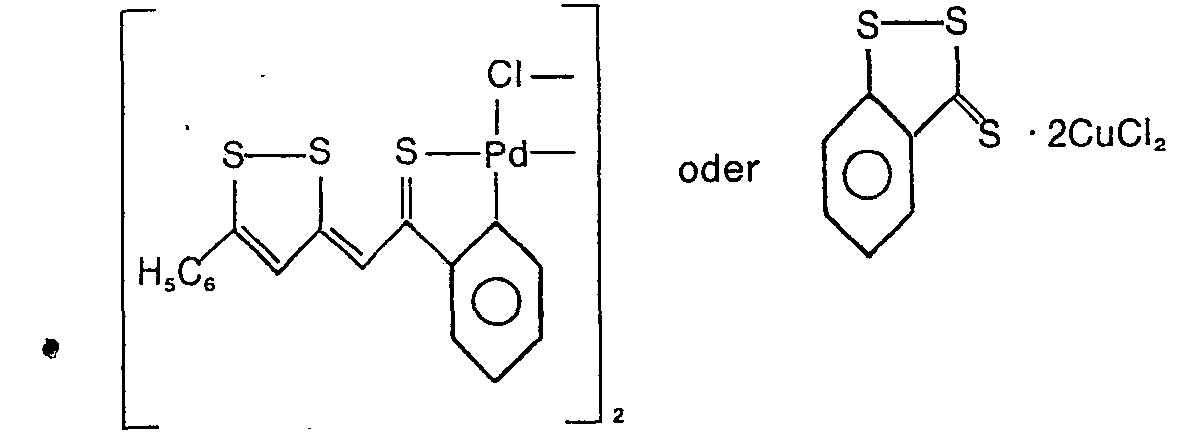
Z inkchlorid in Gegenwart von a-Olefinen bzw. α,ω-Diolefinen in THF mit Lithium umgesetzt wird (vergleiche Beispiele 40-42). - Schliesslich kann man auch isolierbare Addukte zwischen Verbindungen der oben unter b) angegebenen allg. Formeln III-VII und Übergangsmetallverbindungen der I., II., IV., V., VI., VII. und VIII. Nebengruppe des Periodensystems als Katalysatoren auf das Lithium und Olefin bzw. Diolefin einwirken lassen. So bilden z.B. Eisen(III)-, Kupfer(I)- und -(11) sowie Molybdän (V)-chlorid mit 1,2-Dithiol-3-thionen bzw. 1,6,6a-Trithiapentälenen 2:1 Addukte, die anstelle eines Gemisches beider Komponenten zur Herstellung der Katalysatoren eingesetzt werden können. Auch der aus 2,5-Diphenyl-1,6,6a-Trithiapentalen und PdCl2 herstellbare Komplex
-

- Die katalytische Lithiierung des Äthylens mit Hilfe der erfindungsgemässen Katalysatoren, in z.B. THF, führt zu Vinyllithium und Lithiumhydrid;

- Das in THF lösliche Vinyllithium kann von dem unlöslichen Lithiumhydrid getrennt und in Lösung weiterverwendet oder in kristalliner Form isoliert werden. Die Ausbeuten an Vinyllithium liegen, je nach Katalysator, bei 60 bis über 70% der nach (7) berechneten Menge.
- Bei der katalytischen Lithiierung des Propens nach dem erfindungsgemässen Verfahren entstehen im allgemeinen vier isomere Organolithiumverbindungen: trans-1-propenyllithium (9), cis-1-Propenyllithium (10), Isopropenyllithium (11) und Allyllithium (12) neben Lithiumhydrid:

- Die Selektivität dieser Reaktion in bezug auf die Bildung einzelner Isomerer lässt sich durch die Wahl des Katalysators steuern. So entsteht in Gegenwart des Katalysatoren hergestellt unter Verwendung von Eisen-, Kupfer-, Kobalt- bzw. Zinkverbindungen mit einer hohen Selektivität das trans-1-Propenyllithium 9. Dahingegen lässt sich mit Hilfe der Katalysatoren hergestellt unter Verwendung von Palladium-, Platin- bzw. Rhodiumverbindungen die katalytische Lithiierung des Propens so steuern, dass überwiegend das Allyllithium 12 entsteht. Als ein besonderer in diesem Sinne selektiv wirkender Katalysator erweist sich der Palladium-Komplex (6), mit dessen Hilfe Allyllithium mit einer Selektivität von 85-90% erhalten werden kann. Am Beispiel der Lithiierung von 1-Buten mit diesem Palladium-Komplex als Katalysator wird gezeigt, dass auch höhere a-Olefine selektiv in der Allyl-Position lithiiert werden können. Anderseits lassen sich mit Hilfe der Katalysatoren, hergestellt unter Verwendung von Zink-, Eisen- bzw. Kupferverbindungen, auch höhere 1-Alkene wie 1-Buten, 1-Penten, 1-Okten und 1,7-Oktadien selektiv in der trans-1-Stellung lithiieren. So z.B. lässt sich 1-Okten mit Hilfe des oben erwähnten Katalysators aus 2,5-Diphenyl-1,6,6a-tri- thiapentalen und ZnCI2 mit einer Selektivität von > 96% in der 1-trans-Stellung lithiieren.

- Die trans-1-Lithio-1-alkene lassen sich ggf. in analysenreiner, kristalliner Form isolieren. Durch Kristallisation wird im allgemeinen der Anteil an trans-1-Lithio-1-alken erhöht. Das vorliegende Verfahren ermöglicht somit eine selektive Herstellung von trans-l-Alkenyl- bzw. Allyllithiumverbindungen aus a-Olefinen bzw. Diolefinen und Lithium.
- Bei der katalytischen Lithiierung von 1,4-Pentadien in Gegenwart des 4,5-Benzo-1,2-dithiol-3-thion·2CuCl2-Komplexes entsteht eine bisher unbekannte Organolithiumverbindung mit der Struktur:

- Ausgangsprodukte für die Herstellung von Organolithiumverbindungen gemäss vorliegender Erfindung sind a-Olefine der allgemeinen Formel CH,=CHR, in der R = H, Alkyl, Aryl, Cycloalkyl oder Aralkyl sein kann, oder Diolefine der allgemeinen Formel CH2=CH-(CHR)n-CH=CH2, in der R die gleiche Bedeutung wie oben hat und n = 1-6 ist.
- Die katalytische Lithiierung von a-Olefinen bzw. α,ω-Diolefinen gemäss der Erfindung stellt eine neue Herstellungsmethode dar zur Herstellung lithiumorganischer Verbindungen, die auf anderem Wege nicht oder schwierig zugänglich sind. Anstelle der teuereren und teils giftigen sowie meist schwierig zugänglichen Organohalogenverbindungen benutzt das vorliegende Verfahren handelsübliche Olefine. Darüber hinaus fällt bei Anwendung der herkömmlichen Methode die Hälfte des eingesetzten Lithiums in Form von Lithiumhalogenid an und geht damit für weitere Umsetzungen verloren. Das erfindungsgemässe Verfahren liefert neben der Organolithiumverbindung hoch reaktives, technisch wertvolles Lithiumhydrid. Das gesamte eingesetzte Lithium wird zu hochwertigen Lithiumverbindungen umgesetzt.
- Das vorliegende Verfahren gestattet eine regio- bzw. stereoselektive Synthese von Organolithiumverbindungen, wobei die Möglichkeit gegeben ist, durch geeignete Wahl des Katalysators bzw. der Reaktionsbedingungen die Reaktion so zu steuern, dass je nach Bedarf aus einem Ausgangsolefin verschiedene Organolithiumverbindungen erhalten werden können.
- Die nach dem vorliegenden Verfahren herstellbaren Organolithiumverbindungen können als Initiatoren für anionische Polymerisationen von Mono- bzw. Diolefinen, bzw. als Reagenzien zur Einführung von organischen, ungesättigten Resten sowie zur Reduktion in der organischen Synthese angewendet werden.
- Die Erfindung wird in den Beispielen erläutert.
- Sämtliche Versuche zur Darstellung lithiumorganischer Verbindungen werden in einer Schutzgasatmosphäre (z. B. Argon) durchgeführt.
-

- Zur Darstellung des 4,5-Benzo-1,2-dithiol-3-thion·2CuCl2-Komplexes (13) werden 2,83 g (21,05 mMol) wasserfreies Kupfer(II)-chlorid in 100 ml Benzol suspendiert, mit 2,00 g (10,85 mMol) 4,5-Benzo-1,2-dithiol-3-thion versetzt und die Mischung 18 Std. bei Raumtemperatur gerührt. Die Suspension wird filtriert, der Niederschlag mit Benzol gewaschen und bei 1,33 x 10⁻³ mbar getrocknet. Man erhält 3,58 g (75% d. Th.) des Komplexes 13. C7H4S3Cu2Cl4 (453,16);

- Eine Lösung von 1,40 g (3,09 mMol) des Komplexes 13 in 100 ml abs. THF wird bei 0°C mit Propen (1 bar) gesättigt und anschliessend wird der Lösung in Propenatmosphäre bei 0°C und unter Rühren 5,07 g (0,73 Mol) Lithiumsand zugegeben (Molverh. 13:Li = 1:236). Nach einem vorübergehenden Temperaturanstieg beginnt nach 10-15 Min. die Propenaufnahme, deren Geschwindigkeit mit Hilfe einer an das Reaktionsgefäss angeschlossenen Gasbürette gemessen wird. Während der Propenaufnahme wird die Suspension gerührt, der Propendruck bei 1,1-1,2 bar und die Temperatur bei 0 -+2°C gehalten. Das dunkelbraune Reaktionsgemisch nimmt bis zur Sättigung innerhalb von 49 Std. 6,0 I Propen (1 bar, 20°C) auf (68,5% d. Th.). Die Suspension wird bei 0°C filtriert, der Niederschlag mit THF gewaschen und bei 0,27 mbar getrocknet. Man erhält 4,41 Lithiumhydrid im Gemisch mit wenig Lithium (0,135 g des Gemisches liefern mit D20 257 ml Gas (1 bar, 20°C), bestehend aus HD (70%), D2 (19%) und H2 (11%). Zur Analyse der in der Lösung befindlichen Organolithiumverbindungen wird ein aliquoter Teil der Lösung (8,0 ml von insgesamt 142,0 ml) im Vakuum (0,2 Torr) eingedampft und der feste Rückstand hydrolysiert; die dabei entwickelte Gasmenge beträgt 335,5 ml (1 bar, 20 °C) und besteht aus Propen (84,9%), THF (4,6%), H2 (3,5%) und Acetylen (1,4%). Aus der Propenmenge errechnet sich nach Gl. 8 eine Ausbeute an Organolithiumverbindungen LiC3H5 von 57,7%. Zur Bestimmung der Isomerenverteilung werden 58,0 ml der Lösung im Vakuum (0,2 Torr) eingedampft, der Rückstand in 60 ml Äther gelöst, bei 0°C mit 18,9 g (174 mMol) Trimethylchlorsilan versetzt und das Gemisch 12 Std. bei 20°C gerührt. Die Hydrolyse bzw. Aufarbeitung und Destillation liefert neben Hexamethyldisiloxan 7,3 g eines Gemisches der isomeren Silane (CH3)3 SiC3He (Sdp. 87-89°C/1,01 bar), bestehend aus trans-1-Prope- nyltrimethylsilan 74,5%, cis-1-Propenyltrimethyl- silan 1,7%, Isopropenyltrimethylsilan 8,1% und Allyltrimethylsilan 15,3%.
- Zur Isolierung des trans-1-Propenyllithiums (9) werden der Lösung 74,0 ml entnommen, im Vakuum (0,27 mbar) auf 33,0 ml eingeengt, mit 50 ml Pentan versetzt, 10 Min. gerührt und filtriert. Zur Kristallisation von (9) wir das Filtrat 3 Std. bei -40°C und anschliessend 12 Std. bei -78°C gehalten; die Kristalle von (9) werden bei -78°C filtriert, dreimal mit je 40 ml kalten Pentans gewaschen, eine halbe Stunde bei -30°C, eine halbe Stunde bei 0°C und eine Stunde bei 20°C im Vakuum (0,27 mbar) getrocknet. Man erhält 9,25 g des trans-1-Propenyllithium-Tetrahydrofuranad- duktes in Form schwach braun gefärbter Kristalle (Li-Gehalt 6,51; Ausbeute 45,6% d. Th., bezogen auf Lithium). Das 1H-NMR-Spektrum des Produktes

- τ = 3,39 d (H°), 3,78 m (H②), 6,17 m (H④), 8,10 m (H⑤), 8,18 d (H③); J12 = 21 Hz) stimmt mit dem von D. Seyferth und L.G. Vaughan (J. Organomet. Chem. 1, 201 [1963]) aus trans-1-Chlor-1-propen und Lithium dargestellten (9) überein.
- Zur weiteren Reinigung werden 9,0 g des Rohproduktes aus einem Gemisch von 18 ml THF und 32 ml Pentan, wie oben beschrieben, umkristallisiert. Man erhält 6,5 g trans-1-Propenyllithium-Tetrahydrofuranaddukt in Form farbloser Kristalle. C3H5Li·C4H8O (MG = 120,0); ber. 5,78% Li; gef. 5,75 Li. Die Umsetzung von 6,0 g (49,7 mMol) dieses Produktes mit Trimethylchlorsilan, wie oben beschrieben, liefert 5,43 g (CH3)3SiC3H5 mit der Zusammensetzung: trans-1-Propenyltri- methylsilan 93,4%, cis-1-Propenyltrimethylsilan 0,4%,Isopropenyltrimethylsilan 1,3% und Allyltrimethylsilan 4,9%.
-

- Eine Lösung von 0,90 g (4,9 mMol) 4,5-Benzo-1,2-dithiol-3-thion (BDT) (3a) und 1,63 g (9,8 mMol) FeCl3 in 100 ml THF wird bei 0°C mit Propen (1 bar) gesättigt und anschliessend wird der Lösung in Propenatmosphäre bei 0°C und unter Rühren 4,87 g (0,70 Mol) Lithiumsand zugegeben (Molverh. 3a:FeCl3:Li=1:2:143). Nach einem vorübergehenden Temperaturanstieg beginnt nach 10-15 Min. die Propenaufnahme. Während der Propenaufnahme wird die Suspension gerührt, der Propendruck bei 1,1-1,2 bar und die Temperatur bei 0 bis +2°C gehalten. Das Reaktionsgemisch nimmt bis zur Sättigung innerhalb von 71 Std. 3,8 I Propen (1 bar, 20 °C) auf. Die Suspension wird filtriert und Lithiumhydrid mit THF gewaschen. 8,0 ml von insgesamt 114,0 ml des Filtrates werden, wie im Beispiel 1 beschrieben, hydrolysiert, wobei 351 ml Gas (1 bar, 20°C) mit der Zusammensetzung Propen 75,7%, THF 7,8%, H2 8,7% und Acetylen 2,7% frei wird. Aus der Propenmenge errechnet sich nach Gl. 8 eine Gesamtausbeute an LiC3H5 von 45%. Bei der Silylierung eines aliquoten Teils des Filtrates, wie im Beispiel 1 beschrieben, erhält man ein Gemisch isomerer Silane (CH3)3SiC3H5 folgender Zusammensetzung: trans-1-Propenyltrimethylsilan 83,8%, cis-1-Propenyltrimethylsilan 1,3%, Isopropenyltrimethylsilan 10,3% und Allyltrimethylsilan 4,6%. Dieses Ergebnis bedeutet, dass im vorliegenden Fall die katalytische Lithiierung von Propen mit einer Selektivität von 83,8% in der trans-1-Stellung des Propens erfolgt.
- Zur Darstellung des 2,4-Diphenyl-1,6,6a-trithia- pentalen·2CuCl2-Komplexes (15) (Beispiel 6) werden 3,09 g (23,0 mMol) wasserfreies


- Durchführung der Beispiele 3-12 (Tabelle 1): Die Katalysatorbestandteile werden in THF vorgelegt, die Suspension gegebenenfalls 12 Std. bei 20°C gerührt, anschliessend werden die Ansätze bei der jeweiligen Reaktionstemperatur mit Propen (1 bar) gesättigt und Lithiumsand in Propenatmosphäre unter Rühren zugegeben. Die nach bestimmten Reaktionszeiten aufgenommenen Propenmengen (in I, 1 bar, 20°C) sowie die Ausbeuten an LiC3H5 und die Isomerenverhältnisse (9:10:11:12) sind in der Tabelle 1 angegeben. Die Bestimmung der Ausbeuten und der lsomerenverhältnisse erfolgt, wie im Beispiel 1 beschrieben.


- Durchführung der Beispiele 13-24 (Tabelle 2):
- 4,5-Benzo-1,2-dithiol-3-thion (BDT) (3a) und das jeweilige Metallsalz (Molverh. BDT:Metallsalz 1:2) werden in 60 ml THF 12 Std. bei 20°C gerührt, anschliessend wird der Ansatz bei 0 °C mit Propen (1 bar) gesättigt und in Propenatmosphäre und unter Rühren Lithiumsand zugegeben. Die nach bestimmten Reaktionszeiten aufgenommenen Propenmengen (in I, 1 bar, 20°C) sowie die Ausbeuten an LiC3H5 und die Isomerenverhältnisse (9:10:11:12) sind in der Tabelle 2 angegeben. Die Bestimmung der Ausbeuten und der Isomerenverhältnisse erfolgt, wie im Beispiel 1 beschrieben.
- Darstellung des ortho-Chlorpalladio-2,5-diphenyl-1,6,6a-trithiapentalen-Komplexes (8) (Beispiel 25):
- Zu der Suspension von 3,10 g (9,94 mMol) 2,5-Diphenyl-1,6,6a-trithiapentalen in einem Gemisch von 230 ml Methanol und 25 ml Benzol gibt man 1,76 g (9,92 mMol) PdCl2 und darauf 1,33 g (31,3 mMol)LiCl gelöst und 20 ml Methanol. Die Suspension wird 3 Std. unter Rühren am Rückfluss gekocht und nach Abkühlen auf Raumtemperatur durch einen G-3-Glasfiltertiegel filtriert. In der Mutterlauge wurden 93,6% des abgespaltenen HCI acidimetrisch bestimmt. Der Niederschlag wird mit Methanol und Äther gewaschen und bei 1,33·10-3 mbar getrocknet; Die Ausbeute an (8) (Schmp. 304°C, Zers.) beträgt 4,38 g (97%). C17H11S3PdCl (453,8);
- Durchführung der Beispiele 25-27 (Tabelle 3):

- Die Lösung bzw. die Suspension des Katalysators in THF wird bei 0°C mit Propen (1 bar) gesättigt und anschliessend wird in Propenatmosphäre und unter Rühren Lithiumsand zugegeben. Die nach bestimmten Zeiten aufgenommenen Propenmengen (in I, 1 bar, 20 °C) sowie die Ausbeuten an LiC3H5 und die Isomerenverhältnisse (9:10:11:12) sind in der Tabelle 3 angegeben. Die Bestimmung der Ausbeuten und der Isomerenverhältnisse erfolgt, wie im Beispiel 1 beschrieben.
-

-

- Darstellung des 4,5-Benzo-1,2-dithiol-3-thion. 2FeCl3-Komplexes (16) (Beispiel 29):
- Zu der Suspension von 1,89 g (11,6 mMol) des wasserfreien FeCl3 in 80 ml Benzol wird unter Rühren die Lösung von 1.07 g (5,8 mMol) 4,5-Ben- zo-1,2-dithiol-3-thion (3a) in 70 ml Benzol zugetropft, anschliessend wird die Mischung 24 Std. bei 20 °C gerührt. Die Suspension wird filtriert, der Niederschlag mit Benzol gewaschen und bei 1,33 x 10⁻³ mbar getrocknet. Man erhält 2,36 g (80% d. Th.) des Komplexes (16). C7H4S3Fe2Cl6 (508,7);

- Durchführung der Beispiele 28-33 (Tabelle 4):
- Die Katalysatoren werden in THF vorgelegt, die Lösung bei 0°C mit Äthylen (1 bar) gesättigt und anschliessend wird bei 0°C und unter Rühren in Äthylenatmosphäre Lithiumsand zugegeben. Die nach bestimmten Reaktionszeiten aufgenommenen Äthylenmengen (in I, 1 bar und 20°C) sind in der Tabelle 4 angegeben. Die Suspensionen werden filtriert und Lithiumhydrid wird mit THF gewaschen. Zur Bestimmung der Ausbeute an Vinyllithium im Filtrat werden aliquote Teile der Filtrate im Vakuum eingedampft und die Rückstände hydrolisiert. Aus den entwickelten Äthylenmengen und aufgrund der Gl. 7 werden die in der Tabelle 4 angegebenen Ausbeuten an Vinyllithium errechnet.
- Zur Isolierung des Vinyllithiums werden im Beispiel 28 85 ml von insgesamt 90 ml des Filtrates im Vakuum (0,27 mbar) eingedampft, der Rückstand mit 50 ml Pentan 30 Min. gerührt, die Suspension filtriert und der Festkörper viermal mit je 10 ml Pentan gewaschen. Beim Kühlen des Filtrates auf - 40 °C kristallisiert Vinyllithium-Tetrahydrofuranaddukt(2,72 g) in Form farbloser Kristalle. C6H11OLi (106.1):

- Zur Bestimmung des Lithiumhydrids wird im Beispiel 32 das bei der Filtration gewonnene Lithiumhydrid bei 0,27 mbar getrocknet, wobei man 4,1 g eines grauen Pulvers mit 46,7% Li erhält. 0,158 g dieses Pulvers liefern bei der Zersetzung:HD 7,50%, D2 6,3%, H2 6,3%, C2H3D 2,1% und THF 1;3%. Aus der Menge von HD errechnet sich nach Gl. 7 eine Ausbeute an LiH von 69%.

- In 100 ml abs. THF werden nacheinander 0,78 g (4,2 mMol) 4,5-Benzo-1,2-dithiol-3-thion (3a) 1,38 g (8,5 mMol) des wasserfreien FeCI3 und bei 0°C 24,2 g (0,43 Mol) 1-Buten gelöst und anschliessend wird die Lösung bei 0°C und unter Rühren mit 7,30 g (1,05 Mol) Lithiumsand versetzt. Das Reaktionsgemisch wird insgesamt 7 Tage bei 0°C gerührt. Während dieser Zeit werden der Lösung jeweils 5,0 ml Proben entnommen, filtriert und ihr Lithiumgehalt acidimetrisch bestimmt. Nach 17 bzw. 70 Std. Reaktionszeit findet man in den Proben 6,75 bzw. 10,6 g Atom Lithium, entsprechend einem Lithiumumsatz zu Lithiumbutenyl und Lithiumhydrid gemäss Gleichung 9 von 26 bzw. 40%. Nach 7 Tagen Reaktionszeit wird das Reaktionsgemisch bei 0°C von Lithiumhydrid und nicht umgesetztem Lithium abfiltriert und der Niederschlag mit THF gewaschen. Eine 4,5 ml Probe des Filtrates (von insgesamt 138 ml) liefert bei der Hydrolyse 218 ml Gas (20 °C, 1 bar) mit 62,5 Vol.-% Buten-1; daraus errechnet sich nach Gl. 9 eine Ausbeute an LiC4H7 von 40%.
- Zur Charakterisierung des Lithiumbutenyls wird die restliche Menge mit überschüssigem Trimethylchlorsilan in Äther, wie im Beispiel 1 beschrieben, umgesetzt. Man erhält 26,2 g eines Gemisches der vier isomeren Verbindungen (CH3)3SiC4H7 (Sdp. 95-109°C/1,10 bar), von denen die Hauptkomponente laut Gaschromatogramm zu 87,9% vertreten ist. Nach dem 1H-NMR-Spektrum handelt es sich bei der Hauptkomponente um

- Analog dem Beispiel 34 lässt man 41,4 g (0,74 Mol) 1-Buten in Gegenwart von 2,15 g (4,75 mMol) des Komplexes 13 (Beispiel 1) als Katalysator mit 5,60 g (0,81 Mol) Lithiumsand in 150 ml THF 10 Tage bei 0°C reagieren. Das Gemisch wird filtriert und der Feststoff (LiH + Li) mit THF gewaschen. 5,0 ml des Filtrates (von insgesamt 186 ml) liefern nach Abdampfen des THF und anschliessender Hydrolyse 191 ml Gas (20°C, 1 bar) mit 80% 1-Buten (Rest: THF, H2 und C2H2); daraus errechnet sich nach GI. 9 eine Ausbeute an LiC4H7 von 58% (bez. auf Li). Zur Isolierung des trans-1-Lithio-1-butens wird von dem restlichen Filtrat 110 ml THF im Vakuum (0,27 mbar) abdestilliert, 100 ml Pentan zugegeben und das Gemisch bei 0°C von Katalysatorresten filtriert. Beim Stehen des Filtrats bei -78°C über Nacht werden weitere Reste des Katalysators ausgeschieden. Die überstehende Lösung wird im Vakuum (0,27 mbar) vollständig eingedampft, der Rückstand mehrere Std. bei 1,33 x 10⁻³ mbar getrocknet, in 120 ml Pentan aufgenommen, kurzzeitig gerührt und filtriert. Der weisse Frittenrückstand wird mit Pentan gewaschen und bei 0,2 Torr getrocknet. Man erhält 7,8 g trans-1-Lithium-1-buten mit einem Anteil von 9,48% Li. Nach der Sylilierung dieses Produktes mit Trimethylchlorsilan, Aufarbeitung und Destillation, wie im Beispiel 1 beschrieben, gewinnt man 97%iges trans-1-Trimethylsilyl-1-buten (nach GC-Analyse), das 1H-NMR-spektroskopisch identifiziert wird.
- In einer Suspension von 0,58 g (1,28 mMol) 8 (s. Beispiele 25-27) in 20 ml THF wird 1,81 I (76 mMol) gasförmiges 1-Buten gelöst und anschliessend wird die Suspension bei 0° unter Rühren mit 0,92 g (0,13 Mol) Lithiumsand versetzt. Nach 50stündigem Rühren bei 0° wird filtriert und Lithiumhydrid mit THF gewaschen. Ein aliquoter Teil der Lösung (4,0 ml von insgesamt 43,6 ml) liefert nach Abdampfen des THF und Hydrolyse 200 ml Gas (20°C, 1 bar) mit insgesamt 30,0% Butenen. Aus der Butenmenge errechnet sich eine Ausbeute an LiC4H7 von 40,7%. Bei der Umsetzung eines aliquoten Teils der Lösung mit Trimethylchlorsilan, wie im Beispiel 1 beschrieben, erhält man ein Gemisch der isomeren Silane (H3C)3SiC4H7, bei dem es sich nach 1H-NMR-Spektrum bzw. GC-Analyse überwiegend um ein Gemisch aus cis- und trans-1-Trimethylsilyl-2-buten handelt.
- Einer Suspension von 6,29 g (0,91 Mol) Lithiumsand in 100 ml THF werden bei 0°C und unter Rühren nacheinander 33,8 g (0,48 Mol) 1-Penten und 1,45 g (2,85 mMol) des Komplexes 16 (Beispiele 28-33) zugegeben. Das Gemisch wird 5 Tage bei 0°C gerührt, anschliessend wird filtriert und der Feststoff (LiH) mit THF gewaschen. 2,50 ml des Filtrates (von insgesamt 169 ml) enthalten nach der acidimetrischen Lithiumbestimmung 4,30 gAtom Li, entsprechend einer Ausbeute an LiC5H9 von 64%.
- Zur Charakterisierung der Organolithiumverbindung LiCH9 werden 86,5 ml des Filtrates, wie im Beispiel 1 beschrieben, mit überschüssigem Trimethylchlorsilan umgesetzt. Die Aufarbeitung bzw. Destillation liefert u.a. 10,6 g einer Fraktion (Sdp. 133°C/1,01 bar), bei der sich nach 1H-NMR-Spektrum (80 MHz, 15% in CDCI3; τ 3 = 0,96 m

- Zur Isolierung des trans-1-Lithio-1-penten werden 80 ml des Filtrates im Vakuum auf 20 ml eingeengt, mit 80 ml Pentan versetzt und filtriert. Das Filtrat wird 12 Std. bei -78°C gehalten und danach bei -78°C von den ausgeschiedenen Katalysatorresten abgehebert. Die erhaltene Lösung wird im Vakuum vollständig eingedampft, der Rückstand bei 20°C und 1,33 x 10⁻³ bar bis zur Gewichtskonstanz getrocknet, in 100 ml Pentan aufgenommen, eine halbe Stunde gerührt und filtriert. Der weisse Niederschlag wird mit Pentan gewaschen und bei 0,27 mbar getrocknet. Man erhält 3,14 g des trans-1-Lithio-1-penten in Form eines weissen Pulvers. LiC5H9 (MG = 75,9);
- ber. 9,32% Li;
- gef. 9,29% Li.
- Analog dem Beispiel 34 lässt man 21,6 g (0,20 Mol) 1,7-Octadien in Gegenwart von 1,25 g (2,76 mMol) des Komplexes 13 (Beispiel 1) als Katalysator mit 5,82 g (0,84 Mol) Lithiumsand in 150 ml THF 11 Tage bei 0°C reagieren. Die Suspension wird filtriert und Lithiumhydrid mit THF gewaschen. 5,0 ml des Filtrates (von insgesamt 172 ml) enthalten nach der acidimetrischen Bestimmung 6,94 g Atom Lithium, entsprechend einer Gesamtausbeute an Organolithiumverbindungen von 57%.
- Die in Lösung befindlichen Organolithiumverbindungen werden in Form ihrer Trimethylsilylderivate charakterisiert. Dazu werden 77 ml (von insgesamt 172 ml) der Lösung, wie im Beispiel 1 beschrieben mit Trimethylchlorsilan umgesetzt. Die Aufarbeitung bzw. Destillation liefert 7,67 g einer Fraktion Sdp. 55-63°C/0,93 mbar sowie 1,55 g einer Fraktion Sdp. 54-55°C/ 1,33 x 10⁻³ mbar. Nach dem 1H-NMR-Spektren besteht die erste Fraktion aus trans-1-Trimethylsilyl-1,7-octadien (19) und die zweite Fraktion im wesentlichen aus Bis-1,8-(trans)-trimethylsilyl-1,7-octadien (20), d. h.

- In 150 ml abs. THF werden nacheinander 1,79 g (3,95 mMol) des Komplexes 13 (Beispiel 1), sowie 13,0 g (0,19 Mol) 1,4-Pentadien suspendiert bzw. gelöst und anschliessend der Suspension bei 0°C unter Rühren 11,1 g (1,60 Mol) Lithiumsand zugegeben. Das Reaktionsgemisch wird 74 Std. bei 0°C gerührt. Nach dieser Zeit enthält eine 5,0-ml-Probe der Lösung 9,41 mg Atom Lithium. Die Suspension wird mit 50 ml THF verdünnt, bei 0°C filtriert und LiH mit THF gewaschen. Während des 48stündigen Stehens der Lösung bei -78°C kristallisierte die Organolithiumverbindung 14 in Form braungefärbter, derber Kristalle aus. Die Kristalle werden bei -78°C von der Mutterlauge getrennt, mit wenig -78 °C kaltem THF gewaschen, eine halbe Stunde bei 0°C und eine halbe Stunde bei 20°C im Vakuum (0,27 mbar) getrocknet. Man erhält 11,1 g Produkt mit einem Anteil von 9,61% Lithium (ber. für C4H5Li3·(THF)2 9,0% Li). Aufgrund der 1H- bzw. 13C-NMR-Spektren in Kombination mit Spin-Spin-Entkopplungsexperimenten, sowie der Silylierung (s. unten), wird der Organolithiumverbindung die Struktur 14 zugeordnet. Für die Aufnahme des 1H-NMR-Spektrums wird das Produkt mit 9,61% Li zweimal aus einem 1:1-THF/Tetramethyläthylendiamin-Gemisch umkristallisiert (Kristallisation jeweils bei -78°C). Das 1H-NMR-Spektrum von 14 (15%ig in d8-THF; 270 MHz; 27 °C; d-THF als interner Standard): δ = 7,54 dd (H①), 5,37 d (H③), 4,79 d (H④), 3,03 d (H⑤), 2,95 d (②), 3,54 m und 1,68 m (THF), 2,21 s und 2,06 s (Tetramethylendiamin); J12 = 16,3 Hz, J13 = 5,4 Hz, J45 = 4,2 Hz.
-

- Für die Aufnahme des 13C-NMR-Spektrums wird das Rohprodukt aus THF umkristallisiert (Kristallisation bei -78°C). Das 13C-NMR-Spektrum von 14 (100 MHz; 10%ig in d8-THF, bei 25°C): 8 (ppm) = 84,6 t (C5), 97,6 (breit) (C1), 100,4 d (C3), 153,9 d (C2), 187,7 (breit) (C4). Die Verbreiterung der Signale der 13C1- und 13C4-Kerne zeigt das Vorhandensein zweier Li-C-Bindungen an. Bei der Reaktion von 1,07 g 14 mit Trimethylchlorsilan, wie im Beispiel 1 beschrieben, erhält man nach Aufarbeitung bzw. Destillation 0,85 g einer Fraktion Sdp. 45-47°C/1,33 x 10-4 mbar, bei der es sich gemäss dem 1H-NMR-Spektrum um ein Gemisch der drei stereoisomeren 1,4,5-Tris(trimethylsilyl)-1,3-pentadiene (21) (65%), (22) (33%) und (23) (2%) handelt.

-

- Eine Lösung von 0,34 g (1,1 mMol) 2,5-Diphenyl-1,6,6a-trithiapentalen 24 und 0,30 g (2,2 mMol) ZnCI2 (wasserfrei) in 50 ml abs. THF wird bei 0°C mit Ethylen (1 bar) gesättigt und anschliessend wird der Ansatz in Ethylenatmosphäre bei 0°C und unter Rühren mit 1,45 g (0,21 Mol) Lithiumsand versetzt. Nach einem leichten Temperaturanstieg beginnt nach 10-15 Minuten die Ethylenaufnahme, deren Geschwindigkeit mit Hilfe einer an das Reaktionsgefäss angeschlossenen Gasbürette gemessen wird. Während der Ethylenaufnahme wird die Suspension kräftig geführt und die Temperatur bei 0°C gehalten. Bis zur Beendigung der Reaktion nimmt das Reaktionsgemisch innerhalb von 6 Stunden 2,28 1 Ethylen (1 bar, 20 °C) auf. Die Suspension wird von Lithiumhydrid filtriert und Lithiumhydrid mit THF gewaschen. 50 ml von insgesamt 81,0 ml des Filtrats liefern nach Abdampfen des THF bei der Hydrolyse 126 ml Gas (20 °C, 1 bar), das nach der MS-Analyse zu 84,8 Mol% aus Ethylen besteht. Aus der bei der Hydrolyse erhaltenen Ethylenmenge errechnet sich nach der Gleichung 7 eine Vinyllithiumausbeute von 76% (bez. auf Ethylen).
- Eine Lösung von 1,61 g (5,2 mMol) 2,5-Diphenyl-1,6,61-trithiapentalen (24) und 1,21 g (8,9 mMol) ZnCl2 (wasserfrei) in 100 ml abs. THF wird bei 0°C mit Propen (1 bar) gesättigt und anschliessend wird der Ansatz in Propenatmosphäre bei 0°C und unter Rühren mit 5,47 g (0,79 Mol) Lithiumsand versetzt. Die weitere Durchführung des Versuches erfolgt wie im Beispiel 40 für Ethylen beschrieben. Bis zur Beendigung der Reaktion nimmt das Reaktionsgemisch innerhalb von 12 Stunden 7,9 I Propen (20 °C, 1 bar) auf. Die Suspension wird filtriert und Lithiumhydrid mit THF gewaschen. 7,0 ml von insgesamt 167,0 ml des Filtrates liefern bei der Hydrolyse 372 ml Gas (20°C, 1 bar), das zu 88,8 Mol% aus Propen besteht (Rest: THF, H2). Aus der bei der Hydrolyse enthaltenen Propenmenge errechnet sich nach Gleichung 8 eine Ausbeute an Organolithiumverbindungen LiC3H5 von 99,7% (bezogen auf Propen). Die Umsetzung von 40 ml des Filtrates mit Trimethylchlorsilan und die anschliessende Aufarbeitung und Destillation, wie in Beispiel 1 beschrieben, liefern 11,9 g der isomeren Silane (CH3)3SiC3H5 der Zusammensetzung:trans-1-Propenyltrimethylsilan 80,0%, cis-1-Propenyl-trimethylsilan 0,4%, Isopropenyltrimethylsilan 15,0% und Allyltrimethylsilan 4,6%. Die Isolierung der Organolithiumverbindungen LiC3H5 aus der THF-Lösung, wie in Beispiel 1 beschrieben, liefert ein Produkt, das zu 91,3% aus trans-Propenyl-lithium besteht.
- Zu einer Lösung von 25,1 g (0,22 Mol) 1-Okten und 1,23 g (4,0 mMol) 2,5-Diphenyl-1,6,6a-trithia- pentalen (24) in 100 ml abs. THF werden bei 0°C und unter Rühren nacheinander 1,15 g (8,5 mMol) ZnCI2 (wasserfrei) und in kleinen Portionen 3,09 g (0,45 Mol) Lithiumsand gegeben. Der Ansatz wird insgesamt 22 Stunden bei 0°C gerührt. Während dieser Zeit werden der Lösung jeweils 2,5 ml Proben entnommen, filtriert und der Lithiumgehalt in den Filtraten acidimetrisch bestimmt. Nach 3,5, 6 bzw. 22 Stunden beträgt der Lithiumgehalt in den Proben 4,2, 4,6 bzw. 5,4 mMol, entsprechend einem Lithiumsatz zu Lithiumoktenyl und Lithiumhydrid gemäss Gleichung 9 von 75,83 bzw. 97%. Der Ansatz wird filtriert und Lithiumhydrid mit THF gewaschen. 47,0 von insgesamt 167,0 ml des Filtrats werden, wie im Beispiel 1 beschrieben, mit 11,0 g (0,10 Mol) Trimethylchlorsilan umgesetzt. Die Aufarbeitung bzw. Destillation liefert 6,13 g einer Fraktion Sdp. 35-43 °C/0,27 mbar, die nach der GC-Analyse bzw. GC-MS-Kopplungsanalyse und 1H-NMR-Spektrum zu 96,6% aus dem trans-1-Trimethyl-silyl-1-ikten (25) besteht. Nach diesem
-

- Ergebnis wird 1-Okten nach der beschriebenen Methode mit einer Selektivität 96% in der trans-1-Stellung lithiert.

Claims (13)





Priority Applications (1)
| Application Number | Priority Date | Filing Date | Title |
|---|---|---|---|
| AT80101095T ATE6516T1 (de) | 1979-03-07 | 1980-03-05 | Verfahren zur herstellung von organolithiumverbindungen neben lithiumhydrid; katalysatoren. |
Applications Claiming Priority (2)
| Application Number | Priority Date | Filing Date | Title |
|---|---|---|---|
| DE2908928 | 1979-03-07 | ||
| DE19792908928 DE2908928A1 (de) | 1979-03-07 | 1979-03-07 | Verfahren zur herstellung von organolithiumverbindungen neben lithiumhydrid |
Publications (3)
| Publication Number | Publication Date |
|---|---|
| EP0015541A2 EP0015541A2 (de) | 1980-09-17 |
| EP0015541A3 EP0015541A3 (en) | 1981-04-22 |
| EP0015541B1 true EP0015541B1 (de) | 1984-03-07 |
Family
ID=6064739
Family Applications (1)
| Application Number | Title | Priority Date | Filing Date |
|---|---|---|---|
| EP80101095A Expired EP0015541B1 (de) | 1979-03-07 | 1980-03-05 | Verfahren zur Herstellung von Organolithiumverbindungen neben Lithiumhydrid; Katalysatoren |
Country Status (13)
| Country | Link |
|---|---|
| US (2) | US4354982A (de) |
| EP (1) | EP0015541B1 (de) |
| JP (2) | JPS55127394A (de) |
| AT (1) | ATE6516T1 (de) |
| AU (1) | AU542103B2 (de) |
| BR (1) | BR8001346A (de) |
| CA (1) | CA1148924A (de) |
| DD (1) | DD149368A5 (de) |
| DE (2) | DE2908928A1 (de) |
| DK (1) | DK92180A (de) |
| ES (1) | ES489233A1 (de) |
| IE (1) | IE50308B1 (de) |
| MX (1) | MX154740A (de) |
Families Citing this family (7)
| Publication number | Priority date | Publication date | Assignee | Title |
|---|---|---|---|---|
| DE2722221A1 (de) * | 1977-05-17 | 1978-11-23 | Studiengesellschaft Kohle Mbh | Alkalimetallkomplexverbindungen, verfahren zu ihrer herstellung und ihre verwendung zur hydrierung und nitridierung von alkalimetallen |
| DE3247361A1 (de) * | 1982-12-22 | 1984-06-28 | Studiengesellschaft Kohle mbH, 4330 Mülheim | Verfahren zur abtrennung und reinigung von wasserstoff |
| DE2908928A1 (de) * | 1979-03-07 | 1980-09-18 | Studiengesellschaft Kohle Mbh | Verfahren zur herstellung von organolithiumverbindungen neben lithiumhydrid |
| DE3247362A1 (de) * | 1982-12-22 | 1984-06-28 | Studiengesellschaft Kohle mbH, 4330 Mülheim | Verfahren zur herstellung von silicium-wasserstoff-verbindungen, insbesondere des silans |
| US5626798A (en) * | 1996-01-05 | 1997-05-06 | Fmc Corporation | Aryllithium products and processes |
| CN103435634B (zh) * | 2013-07-30 | 2015-09-30 | 上虞华伦化工有限公司 | 一种正己基锂的制备方法 |
| MA41837A (fr) | 2015-04-02 | 2018-02-06 | Albemarle Germany Gmbh | Procédé de production de composés organométalliques |
Family Cites Families (10)
| Publication number | Priority date | Publication date | Assignee | Title |
|---|---|---|---|---|
| US2816916A (en) * | 1953-01-26 | 1957-12-17 | Nat Distillers Chem Corp | Dimerization process |
| DE1177157B (de) * | 1960-11-21 | 1964-09-03 | Phillips Petroleum Co | Verfahren zur Herstellung von lithiumorganischen Verbindungen |
| US3848008A (en) * | 1971-11-26 | 1974-11-12 | First National City Bank | Dilithium initiators from certain conjugated dienes yielding delocaliized chain ends |
| US3903168A (en) * | 1973-11-23 | 1975-09-02 | Du Pont | Stable anionic polymerization initiator |
| JPS533791B2 (de) * | 1974-05-15 | 1978-02-09 | ||
| CH585760A5 (en) * | 1974-05-20 | 1977-03-15 | Firmenich & Cie | Vinyl-lithium prepn. by reacting ethylene with lithium suspension - in dimethoxymethane or tetrahydrofuran, using charge transfer catalyst |
| FR2313389A1 (fr) * | 1975-06-06 | 1976-12-31 | Anvar | Nouveaux amorceurs de polymerisation organolithiens bi-fonctionnels et leurs applications, en particulier pour l'obtention d'elastomeres thermoplastiques |
| US4031147A (en) * | 1975-08-01 | 1977-06-21 | Hooker Chemicals & Plastics Corporation | Process for directed chlorination of alkylbenzenes |
| DE2722221A1 (de) * | 1977-05-17 | 1978-11-23 | Studiengesellschaft Kohle Mbh | Alkalimetallkomplexverbindungen, verfahren zu ihrer herstellung und ihre verwendung zur hydrierung und nitridierung von alkalimetallen |
| DE2908928A1 (de) * | 1979-03-07 | 1980-09-18 | Studiengesellschaft Kohle Mbh | Verfahren zur herstellung von organolithiumverbindungen neben lithiumhydrid |
-
1979
- 1979-03-07 DE DE19792908928 patent/DE2908928A1/de not_active Withdrawn
-
1980
- 1980-03-04 DK DK92180A patent/DK92180A/da not_active Application Discontinuation
- 1980-03-04 US US06/127,011 patent/US4354982A/en not_active Expired - Lifetime
- 1980-03-05 AT AT80101095T patent/ATE6516T1/de not_active IP Right Cessation
- 1980-03-05 CA CA000347087A patent/CA1148924A/en not_active Expired
- 1980-03-05 EP EP80101095A patent/EP0015541B1/de not_active Expired
- 1980-03-05 DD DD80219464A patent/DD149368A5/de not_active IP Right Cessation
- 1980-03-05 DE DE8080101095T patent/DE3066791D1/de not_active Expired
- 1980-03-06 ES ES489233A patent/ES489233A1/es not_active Expired
- 1980-03-06 BR BR8001346A patent/BR8001346A/pt unknown
- 1980-03-06 MX MX181451A patent/MX154740A/es unknown
- 1980-03-06 IE IE464/80A patent/IE50308B1/en unknown
- 1980-03-06 AU AU56212/80A patent/AU542103B2/en not_active Ceased
- 1980-03-07 JP JP2972880A patent/JPS55127394A/ja active Granted
-
1982
- 1982-02-02 US US06/344,907 patent/US4454243A/en not_active Expired - Fee Related
-
1985
- 1985-07-22 JP JP60162796A patent/JPS6182846A/ja active Granted
Also Published As
| Publication number | Publication date |
|---|---|
| US4454243A (en) | 1984-06-12 |
| DE2908928A1 (de) | 1980-09-18 |
| IE800464L (en) | 1980-09-07 |
| ES489233A1 (es) | 1980-08-16 |
| ATE6516T1 (de) | 1984-03-15 |
| JPH0418895B2 (de) | 1992-03-30 |
| US4354982A (en) | 1982-10-19 |
| DD149368A5 (de) | 1981-07-08 |
| EP0015541A3 (en) | 1981-04-22 |
| BR8001346A (pt) | 1980-11-11 |
| DE3066791D1 (en) | 1984-04-12 |
| IE50308B1 (en) | 1986-04-02 |
| JPS55127394A (en) | 1980-10-02 |
| AU542103B2 (en) | 1985-02-07 |
| JPS6221799B2 (de) | 1987-05-14 |
| MX154740A (es) | 1987-12-08 |
| DK92180A (da) | 1980-09-08 |
| CA1148924A (en) | 1983-06-28 |
| AU5621280A (en) | 1980-09-11 |
| JPS6182846A (ja) | 1986-04-26 |
| EP0015541A2 (de) | 1980-09-17 |
Similar Documents
| Publication | Publication Date | Title |
|---|---|---|
| EP0638575A2 (de) | Verfahren zur Herstellung von Diorganodialkoxysilanen | |
| EP0263259B1 (de) | Verfahren und Katalysatorsystem zur Trimerisierung von Acetylen und Acetylenverbindungen | |
| EP0620229B1 (de) | Verfahren zur Herstellung von Übergangsmetallkomplexen mit monosubstituierten Cyclopentadienyl-Liganden | |
| DE2035582A1 (de) | Organometallverbindungen und Verfahren zu ihrer Herstellung | |
| EP1414833B1 (de) | Neue übergangsmetall-komplexe und deren einsatz in übergangsmetall-katalysierten reaktionen | |
| EP0015541A2 (de) | Verfahren zur Herstellung von Organolithiumverbindungen neben Lithiumhydrid; Katalysatoren | |
| EP0014983B1 (de) | Verfahren zur Herstellung von Diorganomagnesiumverbindungen | |
| US6015916A (en) | Constrained geometry metallocene catalyst complexes | |
| DE2024093A1 (de) | Verfahren zur Herstellung von Katalysatoren sowie deren Anwendung bei der dimerisation und Codimerisation von Olefinen | |
| DE2701143C2 (de) | Doppelylid-Komplexe von Metallen sowie Verfahren zu ihrer Herstellung und deren Verwendung | |
| DE69131944T2 (de) | Verfahren zur Herstellung von höheren Kuprat-Komplexen | |
| EP0592779A1 (de) | Verfahren zur Herstellung von Distannanen | |
| DE4415725C2 (de) | Nickel (II) Komplexe, Verfahren zur Herstellung von Komplexen des Nickel(II), enthaltend einen heterodifunktionellen Chelatliganden und Verwendung der derart erhaltenen Komplexe zur Polymerisation von Ethylen | |
| DE102010028170B4 (de) | Verfahren zur Herstellung metallierter Hydridosilanverbindungen | |
| DE3108602A1 (de) | "verfahren zur herstellung von eine perfluorkohlenstoffgruppe enthaltenden aldehyden" | |
| DE2350195C2 (de) | Verfahren zur Herstellung von Derivaten dimerisierter konjugierter Diene | |
| DE10016802C1 (de) | Verfahren zur Herstellung von Alkalimetallmonohydrido-boranaten und -aluminaten und deren Verwendung | |
| EP2297101A1 (de) | Verfahren zur herstellung von magnesiumamiden | |
| EP3455230A1 (de) | Kationische silicium(ii)-verbindungen und verfahren zu ihrer herstellung | |
| EP0212708B1 (de) | Verfahren zur Hydroborierung von Alkenen und Alkinen | |
| DE2148925C3 (de) | Verfahren zur Herstellung von Ubergangsmetallkomplexen | |
| CA1144533A (en) | Procedure for the preparation of organolithium compounds together with lithium hydride | |
| WO1999033844A1 (de) | Herstellung von organomagnesium-verbindungen unter einsatz von katalysatoren | |
| DE102007055732A1 (de) | Verfahren zur Herstellung von Silanen aus Dislanen | |
| DE2831353C2 (de) |
Legal Events
| Date | Code | Title | Description |
|---|---|---|---|
| PUAI | Public reference made under article 153(3) epc to a published international application that has entered the european phase |
Free format text: ORIGINAL CODE: 0009012 |
|
| AK | Designated contracting states |
Designated state(s): AT BE CH DE FR GB IT LU NL SE |
|
| PUAL | Search report despatched |
Free format text: ORIGINAL CODE: 0009013 |
|
| AK | Designated contracting states |
Designated state(s): AT BE CH DE FR GB IT LU NL SE |
|
| 17P | Request for examination filed |
Effective date: 19810610 |
|
| ITF | It: translation for a ep patent filed | ||
| GRAA | (expected) grant |
Free format text: ORIGINAL CODE: 0009210 |
|
| AK | Designated contracting states |
Designated state(s): AT BE CH DE FR GB IT LU NL SE |
|
| PG25 | Lapsed in a contracting state [announced via postgrant information from national office to epo] |
Ref country code: SE Effective date: 19840307 |
|
| REF | Corresponds to: |
Ref document number: 6516 Country of ref document: AT Date of ref document: 19840315 Kind code of ref document: T |
|
| REF | Corresponds to: |
Ref document number: 3066791 Country of ref document: DE Date of ref document: 19840412 |
|
| ET | Fr: translation filed | ||
| PLBE | No opposition filed within time limit |
Free format text: ORIGINAL CODE: 0009261 |
|
| STAA | Information on the status of an ep patent application or granted ep patent |
Free format text: STATUS: NO OPPOSITION FILED WITHIN TIME LIMIT |
|
| 26N | No opposition filed | ||
| PGFP | Annual fee paid to national office [announced via postgrant information from national office to epo] |
Ref country code: GB Payment date: 19910218 Year of fee payment: 12 Ref country code: DE Payment date: 19910218 Year of fee payment: 12 |
|
| PGFP | Annual fee paid to national office [announced via postgrant information from national office to epo] |
Ref country code: CH Payment date: 19910219 Year of fee payment: 12 |
|
| PGFP | Annual fee paid to national office [announced via postgrant information from national office to epo] |
Ref country code: FR Payment date: 19910220 Year of fee payment: 12 Ref country code: BE Payment date: 19910220 Year of fee payment: 12 |
|
| PGFP | Annual fee paid to national office [announced via postgrant information from national office to epo] |
Ref country code: AT Payment date: 19910226 Year of fee payment: 12 |
|
| PGFP | Annual fee paid to national office [announced via postgrant information from national office to epo] |
Ref country code: LU Payment date: 19910228 Year of fee payment: 12 |
|
| ITTA | It: last paid annual fee | ||
| PGFP | Annual fee paid to national office [announced via postgrant information from national office to epo] |
Ref country code: NL Payment date: 19910331 Year of fee payment: 12 |
|
| EPTA | Lu: last paid annual fee | ||
| PG25 | Lapsed in a contracting state [announced via postgrant information from national office to epo] |
Ref country code: LU Free format text: LAPSE BECAUSE OF NON-PAYMENT OF DUE FEES Effective date: 19920305 Ref country code: GB Effective date: 19920305 Ref country code: AT Effective date: 19920305 |
|
| PG25 | Lapsed in a contracting state [announced via postgrant information from national office to epo] |
Ref country code: CH Effective date: 19920331 Ref country code: BE Effective date: 19920331 |
|
| BERE | Be: lapsed |
Owner name: STUDIEN-G. KOHLE M.B.H. Effective date: 19920331 |
|
| PG25 | Lapsed in a contracting state [announced via postgrant information from national office to epo] |
Ref country code: NL Effective date: 19921001 |
|
| GBPC | Gb: european patent ceased through non-payment of renewal fee | ||
| NLV4 | Nl: lapsed or anulled due to non-payment of the annual fee | ||
| PG25 | Lapsed in a contracting state [announced via postgrant information from national office to epo] |
Ref country code: FR Effective date: 19921130 |
|
| REG | Reference to a national code |
Ref country code: CH Ref legal event code: PL |
|
| PG25 | Lapsed in a contracting state [announced via postgrant information from national office to epo] |
Ref country code: DE Effective date: 19921201 |
|
| REG | Reference to a national code |
Ref country code: FR Ref legal event code: ST |