EP0015546A2 - Aktive, hydroxyl- und halogenhaltige polymere Phosphornitride, Verfahren zu deren Herstellung und deren Verwendung - Google Patents
Aktive, hydroxyl- und halogenhaltige polymere Phosphornitride, Verfahren zu deren Herstellung und deren Verwendung Download PDFInfo
- Publication number
- EP0015546A2 EP0015546A2 EP80101111A EP80101111A EP0015546A2 EP 0015546 A2 EP0015546 A2 EP 0015546A2 EP 80101111 A EP80101111 A EP 80101111A EP 80101111 A EP80101111 A EP 80101111A EP 0015546 A2 EP0015546 A2 EP 0015546A2
- Authority
- EP
- European Patent Office
- Prior art keywords
- weight
- phosphorus
- halogen
- ammonium chloride
- contain
- Prior art date
- Legal status (The legal status is an assumption and is not a legal conclusion. Google has not performed a legal analysis and makes no representation as to the accuracy of the status listed.)
- Granted
Links
Images

Classifications
-
- C—CHEMISTRY; METALLURGY
- C01—INORGANIC CHEMISTRY
- C01B—NON-METALLIC ELEMENTS; COMPOUNDS THEREOF; METALLOIDS OR COMPOUNDS THEREOF NOT COVERED BY SUBCLASS C01C
- C01B21/00—Nitrogen; Compounds thereof
- C01B21/082—Compounds containing nitrogen and non-metals and optionally metals
- C01B21/097—Compounds containing nitrogen and non-metals and optionally metals containing phosphorus atoms
-
- D—TEXTILES; PAPER
- D06—TREATMENT OF TEXTILES OR THE LIKE; LAUNDERING; FLEXIBLE MATERIALS NOT OTHERWISE PROVIDED FOR
- D06M—TREATMENT, NOT PROVIDED FOR ELSEWHERE IN CLASS D06, OF FIBRES, THREADS, YARNS, FABRICS, FEATHERS OR FIBROUS GOODS MADE FROM SUCH MATERIALS
- D06M15/00—Treating fibres, threads, yarns, fabrics, or fibrous goods made from such materials, with macromolecular compounds; Such treatment combined with mechanical treatment
- D06M15/19—Treating fibres, threads, yarns, fabrics, or fibrous goods made from such materials, with macromolecular compounds; Such treatment combined with mechanical treatment with synthetic macromolecular compounds
- D06M15/37—Macromolecular compounds obtained otherwise than by reactions only involving carbon-to-carbon unsaturated bonds
- D06M15/667—Macromolecular compounds obtained otherwise than by reactions only involving carbon-to-carbon unsaturated bonds containing phosphorus in the main chain
- D06M15/673—Macromolecular compounds obtained otherwise than by reactions only involving carbon-to-carbon unsaturated bonds containing phosphorus in the main chain containing phosphorus and nitrogen in the main chain
-
- Y—GENERAL TAGGING OF NEW TECHNOLOGICAL DEVELOPMENTS; GENERAL TAGGING OF CROSS-SECTIONAL TECHNOLOGIES SPANNING OVER SEVERAL SECTIONS OF THE IPC; TECHNICAL SUBJECTS COVERED BY FORMER USPC CROSS-REFERENCE ART COLLECTIONS [XRACs] AND DIGESTS
- Y10—TECHNICAL SUBJECTS COVERED BY FORMER USPC
- Y10S—TECHNICAL SUBJECTS COVERED BY FORMER USPC CROSS-REFERENCE ART COLLECTIONS [XRACs] AND DIGESTS
- Y10S428/00—Stock material or miscellaneous articles
- Y10S428/92—Fire or heat protection feature
- Y10S428/921—Fire or flameproofing
-
- Y—GENERAL TAGGING OF NEW TECHNOLOGICAL DEVELOPMENTS; GENERAL TAGGING OF CROSS-SECTIONAL TECHNOLOGIES SPANNING OVER SEVERAL SECTIONS OF THE IPC; TECHNICAL SUBJECTS COVERED BY FORMER USPC CROSS-REFERENCE ART COLLECTIONS [XRACs] AND DIGESTS
- Y10—TECHNICAL SUBJECTS COVERED BY FORMER USPC
- Y10T—TECHNICAL SUBJECTS COVERED BY FORMER US CLASSIFICATION
- Y10T442/00—Fabric [woven, knitted, or nonwoven textile or cloth, etc.]
- Y10T442/20—Coated or impregnated woven, knit, or nonwoven fabric which is not [a] associated with another preformed layer or fiber layer or, [b] with respect to woven and knit, characterized, respectively, by a particular or differential weave or knit, wherein the coating or impregnation is neither a foamed material nor a free metal or alloy layer
- Y10T442/2631—Coating or impregnation provides heat or fire protection
- Y10T442/2639—Coated or impregnated asbestos fabric
-
- Y—GENERAL TAGGING OF NEW TECHNOLOGICAL DEVELOPMENTS; GENERAL TAGGING OF CROSS-SECTIONAL TECHNOLOGIES SPANNING OVER SEVERAL SECTIONS OF THE IPC; TECHNICAL SUBJECTS COVERED BY FORMER USPC CROSS-REFERENCE ART COLLECTIONS [XRACs] AND DIGESTS
- Y10—TECHNICAL SUBJECTS COVERED BY FORMER USPC
- Y10T—TECHNICAL SUBJECTS COVERED BY FORMER US CLASSIFICATION
- Y10T442/00—Fabric [woven, knitted, or nonwoven textile or cloth, etc.]
- Y10T442/40—Knit fabric [i.e., knit strand or strip material]
- Y10T442/419—Including strand precoated with other than free metal or alloy
Definitions
- the invention relates to active, hydroxyl- and halogen-containing polymeric phosphorus nitrides, halogen atoms and hydroxyl groups being bonded to the phosphorus atoms of the phosphorus nitrides present in the spatial network structure, and to a process for their preparation.
- a process for the preparation of phosphorus nitrides of the general formula PN x in which x is a number from 0.9 to 1.7, is also known, phosphorus halides with excess ammonia in the gas phase, preferably at a temperature between the boiling or sublimation point of the phosphorus halides and 200 ° C, and then the resulting reaction product is reheated to temperatures of up to 950 ° C until no more ammonia escapes from the reaction product.
- DE-OS 2 516 915 which is described in DE-OS 2 608 018 and relates to the production of phosphorus nitrides with a high bulk density, provides for the hot reaction products to be quenched with water and the phosphorus nitride from the suspension obtained cut off.
- the ammonolysis of the phosphorus halide is complete in the processes of DE-OS 2 516 915 and 2 608.018, so that the process product is exclusively a phosphorus nitride of the general formula mentioned.
- the invention now relates to active, hydroxyl- and halogen-containing polymeric phosphoronitrides, the halogen atoms and hydroxyl groups of which are bonded to phosphorus and which are characterized in that they contain about 35 to 54% by weight of phosphorus, about .35 to 47% by weight of nitrogen, about 1- Contain 20 wt% oxygen and about 0.1 to 8 wt% chlorine.
- the phosphorus nitrides according to the invention preferably contain 37 to 45% by weight of phosphorus, 39 to 46% by weight of nitrogen, 3 to 12% by weight of oxygen and 0.3 to 5% by weight of chlorine.
- the invention further relates to the process for the preparation of active, hydroxyl- and halogen-containing polymeric phosphoronitrides, the halogen atoms and hydroxyl groups of which are bonded to phosphorus and which contain about 35 to 54% by weight of phosphorus, about 35 to 47% by weight of nitrogen and about 1 to 20 % By weight of oxygen and about 0.1 to 8% by weight of chlorine, which is characterized in that vaporous phosphorus nitrides are reacted with excess ammonia gas at a temperature of 250-500 ° C.
- halogen-containing phosphorus nitride and ammonium chloride from the reaction mixture obtained approximately 5 to 85% by weight of the ammonium chloride present is sublimed at the temperature mentioned, the remaining reaction product is cooled to about 0 to 100 ° C., treated with water to dissolve residual ammonium chloride and for the partial hydrolysis of the halogen-containing phosphorus nitride, and the phosphorus nitride is filtered off and dried.
- the reaction of the phosphorus chloride with the ammonia gas is preferably carried out at a temperature of 300-450 ° C., after which 20-70% by weight of the ammonium chloride formed is sublimed at a temperature of 350-490 ° C. from the reaction mixture obtained.
- reaction product it has proven advantageous to cool the reaction product to 20-60 ° C. and then to treat it with water for 5-50 minutes, preferably for 15-30 minutes.
- Treatment of the reaction product with water at 0-100 ° C., preferably 20-80 ° C. can be carried out by digesting the reaction product in water and then filtering it, or by washing the reaction product with water.
- the reaction product can be dried, for example, at 100.degree.
- the halogen atoms and the hydroxyl groups are predominantly present as unbranched, terminal side chains, bonded to the phosphorus atoms of the polymeric, space-crosslinked phosphorus nitride.
- hydroxyl- and halogen-containing phosphorus nitrides according to the invention are well suited for the flame-retardant finishing of cellulose fibers, in particular for flame-knitting knitted fabrics, ie. H. very light fabrics.
- flame retardant based on phosphorus nitride for the latter cellulose fiber products, since the pure phosphorus nitrides known as flame retardants for cellulose fibers only proved to be suitable for use in normal and heavy fabrics.
- the phosphorus nitride sample to be tested is heated in finely divided form on a thermal balance in moist air with a constant rise in temperature. While there is practically no change in weight of the sample up to 100 ° C, depending on the activity of the phosphonitride, a spontaneous weight gain can be registered in the temperature range of 110 - 190 ° C, with the start of the spontaneous weight gain or the reaction temperature measured at this point in time, which as RT value is designated for which the degree of activity of the sample is characteristic.
- the weight gain is due to the implementation of the Phosphorus nitride with the oxygen and water vapor in the air, the nitride being converted to ammonium polyphosphate.
- the change in the weight of a sample according to the invention used in the thermal balance as a function of the temperature can be seen from FIG. 1.
- the RT value of this sample is 155 ° C.
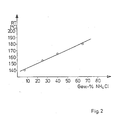
- the relationship between the RT value of the phosphorus nitrides according to the invention and the amount of ammonium chloride sublimed from the reaction product of vaporous phosphorus chloride with ammonia gas is shown in FIG. 2.
- the degree of activity of the phosphoronitride then decreases with increasing amount of the sublimed ammonium chloride.
- the phosphorus nitrides according to the invention have the advantage over the known phosphorus nitrides that they are used not only for flame-retarding light fabrics made of regenerated cellulose fibers, but also for. normal and heavy tissues are suitable.
- PCl 5 was evaporated in a nitrogen stream and fed with enough NH 3 gas into a coolable reactor that free NH 3 was always detectable in the exhaust gas.
- the reaction temperature was 300 ° C.
- the reaction product obtained as loose powder was reheated in a rotary tube gassed with N 2 at 350 ° C. until about 7% by weight of the ammonium chloride formed had been sublimed.
- Sufficient water was then added to this intermediate product in a stirred kettle such that any ammonium chloride still present was completely dissolved.
- the insoluble residue was filtered off and washed. After drying the residue at 100 ° C., the colorless end product had a content of 37% by weight P, 39% by weight N, 12% by weight 0 and 10% by weight Cl.
- the yield based on P was 90% by weight.
- the activity of the product or its RT value was 140 ° C.
- a light knitted fabric made from regenerated cellulose fibers and finished with the product obtained was tested in accordance with DIN specification 53 906. The demands made were fully met.
- PCl 5 was evaporated in a stream of N 2 and fed into a coolable reaction vessel with enough NH 3 that free NH 3 could always be detected in the exhaust gas.
- the reaction temperature was kept in the gas phase in the reactor by cooling between 180-200 ° C.
- the reheating was carried out in a heated rotary valve in a stream of N 2 / H 2 at 700 ° C.
- the resulting, completely colorless phosphorus nitride had 55% by weight of P and 43% by weight of N.
- the yield based on P was 98% by weight.
- the activity of the product or its RT value was 200 ° C.
- the conditions according to DIN specification 53 906 were only met to a limited extent.
- the procedure was analogous to Example 1, but the reaction temperature was 350 ° C., the reheating temperature was 400 ° C. and the amount of sublimed ammonium chloride was about 25% by weight.
- the hydrolysis was carried out for 40 minutes at 30 ° C.
- the dried end product had a content of 40% by weight P, 41% by weight N, 10% by weight 0 and 8% by weight Cl.
- the procedure was analogous to Example 1, but the reaction temperature was 400 ° C., the reheating temperature 450 ° C. and the amount of sublimed ammonium chloride were about 40% by weight.
- the hydrolysis was carried out for 25 minutes at 60 ° C.
- the dried end product had a content of 42% by weight P, 44% by weight N, 8% by weight 0 and 4% by weight Cl.
- the procedure was analogous to Example 1, but the reaction temperature was 450 ° C., the reheating temperature 490 ° C. and the amount of sublimed ammonium chloride were about 65% by weight.
- the hydrolysis was carried out for 20 minutes at 70 ° C.
- the dried end product had a content of 48% by weight P, 43% by weight N, 4% by weight 0 and 2% by weight Cl.
Landscapes
- Chemical & Material Sciences (AREA)
- Organic Chemistry (AREA)
- Inorganic Chemistry (AREA)
- Chemical Kinetics & Catalysis (AREA)
- Engineering & Computer Science (AREA)
- Textile Engineering (AREA)
- Polymers With Sulfur, Phosphorus Or Metals In The Main Chain (AREA)
- Addition Polymer Or Copolymer, Post-Treatments, Or Chemical Modifications (AREA)
- Polyesters Or Polycarbonates (AREA)
- Chemical Or Physical Treatment Of Fibers (AREA)
- Graft Or Block Polymers (AREA)
Abstract
Description
- Die Erfindung betrifft aktive, hydroxyl- und halogenhaltige polymere Phosphornitride, wobei Halogenatome und Hydroxylgruppen an die Phosphoratome der in Raumnetzstruktur vorliegenden Phosphornitride gebunden sind, sowie ein Verfahren zu ihrer Herstellung.
- Die Herstellung von hydroxyl- und halogenhaltigen Phosphornitriden ist bereits von J. R. VAN WAZER in "Phosphorus and its Compounds", Verlag Interscience Publishers, Inc., New York, Vol. I, Seiten 309 und 320 beschrieben. Danach werden Ammoniak oder Ammoniumchlorid unter Druck bei 150 - 200° C oder ohne Anwendung von Druck in Gegenwart eines Lösungsmittels und einer Temperatur von 135° C zu Phosphornitrilchlorid der Formel (PNCl2)3 umgesetzt und letzteres durch milde Hydrolyse mit Wasser zu einem Produkt der Formel P3N3Cl4(OH)2 partiell hydrolysiert. In vorgenannter Verbindung beträgt der Halogengehalt 41,4 Gew% und der Sauerstoffgehalt 9,46 Gew%.
- Nach der DE-OS 2 516 915 ist außerdem ein Verfahren zur Herstellung von Phosphornitriden der allgemeinen Formel PNx, in welcher x eine Zahl von 0,9 bis 1,7 bedeutet, bekannt, wobei man Phosphorhalogenide mit überschüssigen Ammoniak in der Gasphase, vorzugsweise bei einer Temperatur zwischen dem Siede- bzw. Sublimationspunkt der Phosphorhalogenide und 200° C, umsetzt und anschließend das anfallende Reaktionsprodukt so lange auf Temperaturen bis 950° C nacherhitzt, bis aus dem Reakticnsprodukt kein Ammoniak mehr entweicht.
- Eine weitere Ausführungsform des Verfahrens der DE-OS 2 516 915, welche in der DE-OS 2 608 018 beschrieben ist und die Herstellung von Phosphornitriden mit hohem Schüttgewicht betrifft, sieht vor, die heißen Reaktionsprodukte mit Wasser abzuschrecken und aus der erhaltenen Suspension das Phosphornitrid abzutrennen. Die Ammonolyse des Phosphorhalogenids ist bei den Verfahren der DE-OS 2 516 915 und 2 608.018 vollständig, so daß das Verfahrensprodukt ausschließlich ein Phosphornitrid der genannten allgemeinen Formel darstellt.
- Gegenstand der Erfindung sind nunmehr aktive, hydroxyl-und halogenhaltige polymere Phosphornitride, deren Halogenatome und Hydroxylgruppen an Phosphor gebunden sind und welche dadurch gekennzeichnet sind, daß sie etwa 35 bis 54 Gew% Phosphor, etwa .35 bis 47 Gew% Stickstoff, etwa 1 - 20 Gew% Sauerstoff und etwa 0,1 bis 8 Gew% Chlor enthalten.
- Vorzugsweise enthalten die erfindungsgemäßen Phosphornitride 37 bis 45 Gew% Phosphor, 39 bis 46 Gew% Stickstoff, 3 bis 12 Gew% Sauerstoff und 0,3 bis 5 Gew% Chlor.
- Ein weiterer Gegenstand der Erfindung ist das Verfahren zur Herstellung von aktiven, hydroxyl- und halogenhaltigen polymeren Phosphornitriden, deren Halogenatome und Hydroxylgruppen an Phosphor gebunden sind und welche etwa 35 bis 54 Gew% Phosphor, etwa 35 bis 47 Gew% Stickstoff, etwa 1 bis 20 Gew% Sauerstoff und etwa 0,1 bis 8 Gew% Chlor enthalten, welches dadurch gekennzeichnet ist, daß man dampfförmige Phosphornitride mit überschüssigem Ammoniakgas bei einer Temperatur von 250 - 500° C unter Bildung von halogenhaltigem Phosphornitrid und Ammoniumchlorid umsetzt, aus dem erhaltenen Reaktionsgemisch etwa 5 bis 85 Gew% des vorhandenen Ammoniumchlorids bei der genannten Temperatur absublimiert, das verbleibende Reaktionsprodukt auf etwa 0 bis 100° C abkühlt, zur Lösung von restlichem Ammoniumchlorid sowie zur partiellen Hydrolyse des halogenhaltigen Phosphornitrids mit Wasser behandelt, das Phosphornitrid abfiltriert und trocknet.
- Die Umsetzung des Phosphorchlorids mit dem Ammoniakgas erfolgt vorzugsweise bei einer Temperatur von 300 - 450° C, wonach aus dem anfallenden Reaktionsgemisch 20 - 70 Gew% des entstandenen Ammoniumchlorids bei einer Temperatur von 350 - 490° C absublimiert werden.
- Schließlich hat es sich als vorteilhaft erwiesen, das Reaktionsprodukt auf 20 - 60° C abzukühlen und anschließend mit Wasser während 5 - 50 Minuten, vorzugsweise 15 - 30 Minuten, zu behandeln. Das Behandeln des Reaktionsproduktes mit Wasser von 0 - 100° C, vorzugsweise 20 - 80° C, kann derart erfolgen, daß man das Reaktionsprodukt in Wasser digeriert und danach filtriert, oder indem man das Reaktionsprodukt mit Wasser auswäscht. Die Trocknung des Reaktionsproduktes kann beispielsweise bei 100° C durchgeführt werden.
- In dem als Endprodukt erhaltenen polymeren Nitrid liegen die Halogenatome sowie die Hydroxylgruppen vorwiegend als unverzweigte, endständige Seitenketten, gebunden an die Phosphoratome des polymeren, raumvernetzten Phosphornitrids, vor.
- Die erfindungsgemäßen hydroxyl- und halogenhaltigen Phosphornitride eignen sich gut zur flammhemmenden Ausrüstung von Cellulosefasern, insbesondere zum'Flammfcstmachen von Gewirken, d. h. sehr leichten Geweben. Für letztgenannte Cellulosefaser-Produkte gab es bisher keinen auf Basis Phosphornitrid befriedigenden Flammschutz, da die als Flammschutzmittel für Cellulosefasern:bekannten reinen Phosphornitride sich nur für den Einsatz in normalen und schweren Geweben als geeignet erwiesen.
- Zur Vermeidung langwieriger Testversuche zwecks Beurteilung der Verwendbarkeit der erfindungsgemäßen Phosphornitride als Flammschutzmittel für Celluloseregeneratfasern, insbesondere leichten Geweben, wurde ein zu grob orientierenden Ergebnissen führender Screening-Test entwickelt, der es ermöglicht, reproduzierbar eine Vorauswahl unter den untersuchten Proben zu treffen.
- Zur Durchführung dieses Testes wird die zu prüfende Phosphornitridprobe in feinverteilter Form auf einer Thermowaage in feuchter Luft bei stetigem Temperaturanstieg erhitzt. Während bis zu 100° C praktisch keine Gewichtsänderung der Probe eintritt, kann je nach Aktivität des Phosphornitrids im Temperaturbereich von 110 - 190° C eine spontane Gewichtszunahme registriert werden, wobei der Beginn der spontanen Gewichtszunahme bzw. die zu diesem Zeitpunkt gemessene Reaktionstemperatur, welche als RT-Wert bezeichnet wird, für den Aktivitätsgrad der Probe charakteristisch ist. Die Gewichtszunahme ist auf die Umsetzung des Phosphornitrids mit dem Sauerstoff und dem Wasserdampf der Luft zurückzuführen, wobei das Nitrid zu Ammoniumpolyphosphat umgesetzt wird. Die Änderung des Gewichtes einer in der Thermowaage eingesetzten erfindungsgemäßen Probe in Abhängigkeit von der Temperatur ist aus Figur 1 ersichtlich. Der RT-Wert dieser Probe liegt bei 155° C.
- Bezüglich der Verwendbarkeit der erfindungsgemäßen Phosphornitride als Flammschutzmittel für leichte Gewebe aus Celluloseregeneratfasern hat sich nunmehr gezeigt, daß die nach DIN-Vorschrift Nr. 53 906 an das Flammschutzmittel gestellten Anforderungen nur von solchen Phosphornitriden erfüllt werden, deren RT-Wert 140 - 180° C, vorzugsweise 155 - 165° C,beträgt. Produkte mit einem RT-Wert <140° C bewirken einen Kettenabbau des Cellulosemoleküls, während solche mit einem RT-Wert >180° C als inaktive Phosphornitride zu bezeichnen sind, welche normalen und schweren Geweben eiren ausreichenden, leichten Geweben jedoch einen unbefriedigenden Flammschutz vermitteln.
- Der Zusammenhang zwischen RT-Wert der erfindungsgemäßen Phosphornitride und der aus dem Umsetzungsprodukt aus dampfförmigem Phosphorchlorid mit Ammoniakgas absublimierten Menge Ammoniumchlorid ergibt sich aus Figur 2. Danachnimmt der Aktivitätsgrad des Phosphornitrids mit zunehmender Menge des absublimierten Ammoniumchlorids ab.
- Die erfindungsgemäßen Phosphornitride besitzen gegenüber den bekannten Phosphornitriden den Vorteil, daß sie nicht nur zum Flammfestmachen von leichten Geweben aus Celluloseregeneratfasern, sondern auch von. normalen und schweren Geweben geeignet sind.
- PCl5 wurde im Stickstoffstrom verdampft und mit soviel NH3-Gas in einen kühlbaren Reaktor eingespeist, daß im Abgas stets freies NH3 nachweisbar war. Die Umsetzungstemperatur betrug 300° C. Die Nacherhitzung des als lockeres Pulver anfallenden Reaktionsproduktes erfolgte in einem mit N2 begasten Drehrohr solange bei 350° C, bis ca. 7 Gew% des gebildeten Ammoniumchlorids absublimiert waren. Anschließend wurde dieses Zwischenprodukt in einem Rührkessel mit soviel Wasser versetzt, daß sich noch vorhandenes Ammoniumchlorid restlos auflöste. Der unlösliche Rückstand wurde abiltriert und gewaschen. Nach Trocknung des Rückstandes boi 100° C besaß das farblose Endprodukt einen Gehalt von 37 Gew% P, 39 Gew% N, 12 Gew% 0 und 10 Gew% Cl. Die auf P bezogene Ausbeute betrug 90 Gew%. Die Aktivität des Produktes bzw. dessen RT-Wert betrug 140° C.
- Ein mit dem erhaltenen Produkt ausgerüstetes leichtes Gewirke aus Celluloseregeneratfasern wurde nach DIN-Vorschrift 53 906 geprüft. Die gestellten Forderungen wurden uneingeschränkt erfüllt.
- Bei Nichterfüllung von nur einer der nach DIN-Vorschrift 53 906 gestellten Bedingungen, wie z. B. Brenndauer oder Einreißlänge des Gewirkes bei 3 bzw. 15 Sekunden Beflammungszeit, lautet die Bewertung:
- "Bedingungen eingeschränkt erfüllt".
- PCl5 wurde im N2-Strom verdampft und mit soviel NH3 in ein kühlbares Reaktionsgefäß eingespeist, daß im Abgas stets freies NH3 nachgewiesen werden konnte. Die Reaktionstemperatur wurde in der Gasphase im Reaktor durch Kühlung zwischen 180 - 200° C gehalten. Die Nacherhitzung erfolgte in einem beheizten Drehrchr im N2/H2-Strom bei 700° C. Das anfallende, völlig farblose Phosphornitrid hatte 55 Gew% P- und 43 Gew% N-Gehalt. Die auf P bezogene Ausbeute betrug 98 Gew%. Die Aktivität des Produktes bzw. dessen RT-Wert betrug 200° C. Die Bedingungen nach DIN-Vorschrift 53 906 wurden nur eingeschränkt erfüllt.
- Es wurde analog Beispiel 1 verfahren, wobei jedoch die Umsetzungstemperatur'350° C, die Nacherhitzungstemperatur 400° C und die Menge des absublimierten Ammoniumchlorids etwa 25 Gew% betrugen. Die Hydrolyse erfolgte 40 Minuten bei 30° C. Das getrocknete Endprodukt besaß einen Gehalt von 40 Gew% P, 41 Gew% N, 10 Gew% 0 und 8 Gew% Cl. Die auf P bezogene Ausbeute betrug 92 Gew% und die Aktivität des Produktes RT = 155° C. Nach dem Prüfungsergebnis gemäß DIN-Vorschrift 53 906 erfüllt das flammhemmend ausgerüstete Gewirke die gestellten Bedingungen uneingeschränkt.
- Es wurde analog Beispiel 1 verfahren, wobei jedoch die Umsetzungstemperatur 400° C, die Nacherhitzungstempentur 450° C und die Menge des absublimierten Ammoniumchlorids etwa 40 Gew% betrugen. Die Hydrolyse erfolgte 25 Minuten bei 60° C. Das getrocknete Endprodukt besaß einen Gehalt von 42 Gew% P, 44 Gew% N, 8 Gew% 0 und 4 Gew% Cl. Die auf P bezogene Ausbeute betrug 93 Gew% und die Aktivität des Produktes RT = 165° C. Nach dem Prüfungsergebnis gemäß DIN-Vorschrift 53 906 erfüllt das flammhemmend ausgerüstete Gewirke die gestellten Bedingungen uneingeschränkt.
- Es wurde analog Beispiel 1 verfahren, wobei jedoch die Umsetzungstemperatur 450° C, die Nacherhitzungstemperatur 490° C und die Menge des absublimierten Ammoniumchlorids etwa 65 Gew% betrugen. Die Hydrolyse erfolgte 20 Minuten bei 70° C. Das getrocknete Endprodukt besaß einen Gehalt von 48 Gew% P, 43 Gew% N, 4 Gew% 0 und 2 Gew% Cl. Die auf P bezogene Ausbeute betrug 91 Gew% und die Aktivität des Produktes RT = 180° C. Nach dem Prüfungsergebnis gemäß DIN-Vorschrift 53 906 erfüllt das flammhemmend ausgerüstete Gewirke die gesteilten Bedingungen uneingeschränkt.
Claims (9)
Priority Applications (1)
| Application Number | Priority Date | Filing Date | Title |
|---|---|---|---|
| AT80101111T ATE847T1 (de) | 1979-03-12 | 1980-03-10 | Aktive, hydroxyl- und halogenhaltige polymere phosphornitride, verfahren zu deren herstellung und deren verwendung. |
Applications Claiming Priority (2)
| Application Number | Priority Date | Filing Date | Title |
|---|---|---|---|
| DE2909600 | 1979-03-12 | ||
| DE19792909600 DE2909600A1 (de) | 1979-03-12 | 1979-03-12 | Aktive hydroxyl- und halogenhaltige phosphornitride und verfahren zur herstellung |
Publications (3)
| Publication Number | Publication Date |
|---|---|
| EP0015546A2 true EP0015546A2 (de) | 1980-09-17 |
| EP0015546A3 EP0015546A3 (en) | 1981-01-21 |
| EP0015546B1 EP0015546B1 (de) | 1982-04-14 |
Family
ID=6065116
Family Applications (1)
| Application Number | Title | Priority Date | Filing Date |
|---|---|---|---|
| EP80101111A Expired EP0015546B1 (de) | 1979-03-12 | 1980-03-10 | Aktive, hydroxyl- und halogenhaltige polymere Phosphornitride, Verfahren zu deren Herstellung und deren Verwendung |
Country Status (8)
| Country | Link |
|---|---|
| US (1) | US4276343A (de) |
| EP (1) | EP0015546B1 (de) |
| AT (1) | ATE847T1 (de) |
| BR (1) | BR8001454A (de) |
| CA (1) | CA1128287A (de) |
| DD (1) | DD149793A5 (de) |
| DE (2) | DE2909600A1 (de) |
| SU (1) | SU1056892A3 (de) |
Cited By (1)
| Publication number | Priority date | Publication date | Assignee | Title |
|---|---|---|---|---|
| WO1999044937A1 (en) * | 1998-03-05 | 1999-09-10 | International Business Machines Corporation | Material with reduced optical absorption |
Families Citing this family (2)
| Publication number | Priority date | Publication date | Assignee | Title |
|---|---|---|---|---|
| DE2918940C2 (de) * | 1979-05-10 | 1984-08-09 | Max Planck Gesellschaft zur Förderung der Wissenschaften e.V., 3400 Göttingen | Festes Ionenleitermaterial, seine Verwendung und Verfahren zu seiner Herstellung |
| US4741971A (en) * | 1986-05-23 | 1988-05-03 | The Dow Chemical Company | Method for imparting flame resistance to wood surfaces |
Family Cites Families (9)
| Publication number | Priority date | Publication date | Assignee | Title |
|---|---|---|---|---|
| FR1225073A (fr) * | 1959-02-13 | 1960-06-29 | Cfmc | Nouveaux composés du phosphore, leurs procédés de préparation et leurs applications dans l'ignifugation |
| US3669633A (en) * | 1970-08-19 | 1972-06-13 | Continuous process for the preparation of phosphonitrilic chloride cyclic polymers | |
| DE2159431A1 (de) * | 1971-12-01 | 1973-06-07 | Knapsack Ag | Verfahren zur herstellung von phospham |
| US3869294A (en) * | 1973-03-05 | 1975-03-04 | Ethyl Corp | Phosphonitrile polymer |
| AT333932B (de) * | 1974-08-20 | 1976-12-27 | Chemiefaser Lenzing Ag | Verfahren zur herstellung flammfester celluloseregeneratfasern |
| DE2608018C2 (de) * | 1976-02-27 | 1982-04-15 | Hoechst Ag, 6000 Frankfurt | Verfahren zur Herstellung von Phosphornitriden |
| GB1527153A (en) * | 1975-04-17 | 1978-10-04 | Hoechst Ag | Production of phosphorous nitrides |
| DE2516915C3 (de) * | 1975-04-17 | 1981-09-03 | Hoechst Ag, 6000 Frankfurt | Verfahren zur Herstellung von Phosphornitriden |
| US4175113A (en) * | 1978-04-20 | 1979-11-20 | The Firestone Tire & Rubber Company | Purification of crude chlorophosphazene compounds by treatment with water |
-
1979
- 1979-03-12 DE DE19792909600 patent/DE2909600A1/de not_active Withdrawn
-
1980
- 1980-03-10 US US06/128,385 patent/US4276343A/en not_active Expired - Lifetime
- 1980-03-10 DD DD80219565A patent/DD149793A5/de unknown
- 1980-03-10 AT AT80101111T patent/ATE847T1/de not_active IP Right Cessation
- 1980-03-10 DE DE8080101111T patent/DE3060287D1/de not_active Expired
- 1980-03-10 EP EP80101111A patent/EP0015546B1/de not_active Expired
- 1980-03-12 BR BR8001454A patent/BR8001454A/pt unknown
- 1980-03-12 SU SU802893255A patent/SU1056892A3/ru active
- 1980-03-12 CA CA347,483A patent/CA1128287A/en not_active Expired
Cited By (1)
| Publication number | Priority date | Publication date | Assignee | Title |
|---|---|---|---|---|
| WO1999044937A1 (en) * | 1998-03-05 | 1999-09-10 | International Business Machines Corporation | Material with reduced optical absorption |
Also Published As
| Publication number | Publication date |
|---|---|
| DE2909600A1 (de) | 1980-09-18 |
| EP0015546B1 (de) | 1982-04-14 |
| CA1128287A (en) | 1982-07-27 |
| DD149793A5 (de) | 1981-07-29 |
| US4276343A (en) | 1981-06-30 |
| SU1056892A3 (ru) | 1983-11-23 |
| EP0015546A3 (en) | 1981-01-21 |
| DE3060287D1 (en) | 1982-05-27 |
| BR8001454A (pt) | 1980-11-11 |
| ATE847T1 (de) | 1982-04-15 |
Similar Documents
| Publication | Publication Date | Title |
|---|---|---|
| DE2755530C3 (de) | Verfahren zur Herstellung von Polyfluoralkylphosphaten | |
| EP0471416B1 (de) | Wässrige Dispersionen von fluorhaltigen Polymeren | |
| DE2104569A1 (de) | Halogenierte Phosphorsaurepolyester, Verfahren zu ihrer Herstellung und ihre Verwendung | |
| EP1672116A1 (de) | Zusammensetzungen für die flammhemmende Ausrüstung von Fasermaterialien | |
| DE1148969B (de) | Verfahren zur Flammschutz-Ausruestung | |
| DE2413970C3 (de) | Polyfluoralkyl-Hydroxypropyl-Phosphate, ihre Herstellung und Verwendung | |
| EP0015546B1 (de) | Aktive, hydroxyl- und halogenhaltige polymere Phosphornitride, Verfahren zu deren Herstellung und deren Verwendung | |
| EP0057668A2 (de) | Phosphonsäuresalze, deren Herstellung und Verwendung zum Flammfestmachen von organischem Fasermaterial | |
| DE2036587A1 (de) | ||
| DD276685A5 (de) | Verfahren zur herstellung von urethanen aus aliphatischen fluoralkoholen, isocyanaten und substituierten aromatischen verbindungen | |
| US2648597A (en) | Chemical process | |
| EP2112123B1 (de) | Verfahren zur Herstellung von Flammschutzmitteln und ihre Verwendung in Textilien | |
| EP0656438A1 (de) | Zusammensetzung für die flammhemmende Ausrüstung von Fasermaterialien | |
| DE2427879C3 (de) | Verfahren zur Herstellung von Phosphornitrilatpolymerisaten und ihre Verwendung als feuerhemmende Mittel | |
| DE4101539A1 (de) | Zusammensetzung zur flammfestausruestung von fasermaterialien | |
| DE60005539T2 (de) | Herstellung oligomerischer organophosphorzusammensetzungen mit verbesserten farben | |
| EP0392349B1 (de) | Verfahren zur Herstellung wässriger Lösungen von N-Methylolethers. | |
| DE2311041A1 (de) | Fluessige phosphazengemische, verfahren zu deren herstellung und deren verwendung zum flammfestausruesten von textilien aus regenerierter cellulose | |
| DE2326053A1 (de) | Feuerhemmende polymere und verfahren zu ihrer herstellung | |
| DE1933479B2 (de) | Phosphonopropionsaeureamide, verfahren zu deren herstellung und ihre verwendung | |
| DE2458114C3 (de) | Verfahren zur Herstellung eines, als feuerhemmendes Mittel für Cellulosefasern o.dgl. wirksamen Phosphornitrilpolymererisates | |
| DE2615962B2 (de) | Verfahren zum Flammfestmachen von Fasersubstraten | |
| DE2351886A1 (de) | Wasserunloesliche amidpolyphosphate, verfahren zu ihrer herstellung und ihre verwendung zum flammfestausruesten von cellulosematerial | |
| DE918031C (de) | Verfahren zur Herstellung von Umsetzungsprodukten von Cyanurchlorid mit Ammoniak in der Gasphase | |
| DE2118953B2 (de) | Verfahren zum Flammfestmachen von Fasermischungen aus Polyester und Cellulose |
Legal Events
| Date | Code | Title | Description |
|---|---|---|---|
| PUAI | Public reference made under article 153(3) epc to a published international application that has entered the european phase |
Free format text: ORIGINAL CODE: 0009012 |
|
| AK | Designated contracting states |
Designated state(s): AT BE CH DE FR GB IT NL SE |
|
| PUAL | Search report despatched |
Free format text: ORIGINAL CODE: 0009013 |
|
| AK | Designated contracting states |
Designated state(s): AT BE CH DE FR GB IT NL SE |
|
| 17P | Request for examination filed |
Effective date: 19810212 |
|
| RAP1 | Party data changed (applicant data changed or rights of an application transferred) |
Owner name: HOECHST AKTIENGESELLSCHAFT |
|
| ITF | It: translation for a ep patent filed | ||
| GRAA | (expected) grant |
Free format text: ORIGINAL CODE: 0009210 |
|
| AK | Designated contracting states |
Designated state(s): AT BE CH DE FR GB IT NL SE |
|
| REF | Corresponds to: |
Ref document number: 847 Country of ref document: AT Date of ref document: 19820415 Kind code of ref document: T |
|
| REF | Corresponds to: |
Ref document number: 3060287 Country of ref document: DE Date of ref document: 19820527 |
|
| PGFP | Annual fee paid to national office [announced via postgrant information from national office to epo] |
Ref country code: NL Payment date: 19840217 Year of fee payment: 5 Ref country code: CH Payment date: 19840217 Year of fee payment: 5 |
|
| PGFP | Annual fee paid to national office [announced via postgrant information from national office to epo] |
Ref country code: FR Payment date: 19840222 Year of fee payment: 5 |
|
| PGFP | Annual fee paid to national office [announced via postgrant information from national office to epo] |
Ref country code: AT Payment date: 19840224 Year of fee payment: 5 |
|
| PGFP | Annual fee paid to national office [announced via postgrant information from national office to epo] |
Ref country code: SE Payment date: 19840331 Year of fee payment: 5 Ref country code: BE Payment date: 19840331 Year of fee payment: 5 |
|
| PGFP | Annual fee paid to national office [announced via postgrant information from national office to epo] |
Ref country code: DE Payment date: 19840413 Year of fee payment: 5 |
|
| PG25 | Lapsed in a contracting state [announced via postgrant information from national office to epo] |
Ref country code: AT Effective date: 19850310 |
|
| PG25 | Lapsed in a contracting state [announced via postgrant information from national office to epo] |
Ref country code: SE Effective date: 19850311 |
|
| PG25 | Lapsed in a contracting state [announced via postgrant information from national office to epo] |
Ref country code: CH Effective date: 19850331 Ref country code: BE Effective date: 19850331 |
|
| BERE | Be: lapsed |
Owner name: HOECHST A.G. Effective date: 19850310 |
|
| PG25 | Lapsed in a contracting state [announced via postgrant information from national office to epo] |
Ref country code: NL Effective date: 19851001 |
|
| GBPC | Gb: european patent ceased through non-payment of renewal fee | ||
| PG25 | Lapsed in a contracting state [announced via postgrant information from national office to epo] |
Ref country code: FR Free format text: LAPSE BECAUSE OF NON-PAYMENT OF DUE FEES Effective date: 19851129 |
|
| REG | Reference to a national code |
Ref country code: CH Ref legal event code: PL |
|
| PG25 | Lapsed in a contracting state [announced via postgrant information from national office to epo] |
Ref country code: DE Effective date: 19851203 |
|
| NLV4 | Nl: lapsed or anulled due to non-payment of the annual fee | ||
| REG | Reference to a national code |
Ref country code: FR Ref legal event code: ST |
|
| PG25 | Lapsed in a contracting state [announced via postgrant information from national office to epo] |
Ref country code: GB Effective date: 19881118 |
|
| EUG | Se: european patent has lapsed |
Ref document number: 80101111.5 Effective date: 19860128 |
|
| PLBE | No opposition filed within time limit |
Free format text: ORIGINAL CODE: 0009261 |
|
| STAA | Information on the status of an ep patent application or granted ep patent |
Free format text: STATUS: NO OPPOSITION FILED WITHIN TIME LIMIT |