EP0016358A1 - Procédé et dispositif de fabrication de revêtements muraux textiles ou analogues au textile - Google Patents
Procédé et dispositif de fabrication de revêtements muraux textiles ou analogues au textile Download PDFInfo
- Publication number
- EP0016358A1 EP0016358A1 EP80100946A EP80100946A EP0016358A1 EP 0016358 A1 EP0016358 A1 EP 0016358A1 EP 80100946 A EP80100946 A EP 80100946A EP 80100946 A EP80100946 A EP 80100946A EP 0016358 A1 EP0016358 A1 EP 0016358A1
- Authority
- EP
- European Patent Office
- Prior art keywords
- carrier
- auxiliary carrier
- threads
- thread
- weft
- Prior art date
- Legal status (The legal status is an assumption and is not a legal conclusion. Google has not performed a legal analysis and makes no representation as to the accuracy of the status listed.)
- Withdrawn
Links
- 239000004753 textile Substances 0.000 title claims abstract description 29
- 238000000034 method Methods 0.000 title claims abstract description 21
- 238000004519 manufacturing process Methods 0.000 title claims abstract description 9
- 239000000463 material Substances 0.000 title claims description 5
- 239000000853 adhesive Substances 0.000 claims description 18
- 230000001070 adhesive effect Effects 0.000 claims description 15
- 239000011248 coating agent Substances 0.000 claims description 5
- 238000000576 coating method Methods 0.000 claims description 5
- 238000009826 distribution Methods 0.000 claims description 4
- 230000000717 retained effect Effects 0.000 claims description 3
- 238000007664 blowing Methods 0.000 description 6
- 230000000694 effects Effects 0.000 description 5
- 239000000835 fiber Substances 0.000 description 5
- 229920001944 Plastisol Polymers 0.000 description 4
- 239000004999 plastisol Substances 0.000 description 4
- 239000004033 plastic Substances 0.000 description 3
- 229920003023 plastic Polymers 0.000 description 3
- 239000000969 carrier Substances 0.000 description 2
- 239000004744 fabric Substances 0.000 description 2
- 239000002184 metal Substances 0.000 description 2
- 238000000059 patterning Methods 0.000 description 2
- -1 polyethylene Polymers 0.000 description 2
- 229920000098 polyolefin Polymers 0.000 description 2
- 239000011148 porous material Substances 0.000 description 2
- 229920001169 thermoplastic Polymers 0.000 description 2
- 239000004416 thermosoftening plastic Substances 0.000 description 2
- 239000004604 Blowing Agent Substances 0.000 description 1
- 235000011777 Corchorus aestuans Nutrition 0.000 description 1
- 240000004792 Corchorus capsularis Species 0.000 description 1
- 235000010862 Corchorus capsularis Nutrition 0.000 description 1
- 229920000742 Cotton Polymers 0.000 description 1
- 239000004698 Polyethylene Substances 0.000 description 1
- 239000004743 Polypropylene Substances 0.000 description 1
- 230000001154 acute effect Effects 0.000 description 1
- 239000011888 foil Substances 0.000 description 1
- 239000003292 glue Substances 0.000 description 1
- 229920000573 polyethylene Polymers 0.000 description 1
- 229920001155 polypropylene Polymers 0.000 description 1
- 230000008707 rearrangement Effects 0.000 description 1
- 238000003860 storage Methods 0.000 description 1
- 210000002268 wool Anatomy 0.000 description 1
Images



Classifications
-
- D—TEXTILES; PAPER
- D04—BRAIDING; LACE-MAKING; KNITTING; TRIMMINGS; NON-WOVEN FABRICS
- D04H—MAKING TEXTILE FABRICS, e.g. FROM FIBRES OR FILAMENTARY MATERIAL; FABRICS MADE BY SUCH PROCESSES OR APPARATUS, e.g. FELTS, NON-WOVEN FABRICS; COTTON-WOOL; WADDING ; NON-WOVEN FABRICS FROM STAPLE FIBRES, FILAMENTS OR YARNS, BONDED WITH AT LEAST ONE WEB-LIKE MATERIAL DURING THEIR CONSOLIDATION
- D04H3/00—Non-woven fabrics formed wholly or mainly of yarns or like filamentary material of substantial length
- D04H3/08—Non-woven fabrics formed wholly or mainly of yarns or like filamentary material of substantial length characterised by the method of strengthening or consolidating
- D04H3/12—Non-woven fabrics formed wholly or mainly of yarns or like filamentary material of substantial length characterised by the method of strengthening or consolidating with filaments or yarns secured together by chemical or thermo-activatable bonding agents, e.g. adhesives, applied or incorporated in liquid or solid form
-
- D—TEXTILES; PAPER
- D04—BRAIDING; LACE-MAKING; KNITTING; TRIMMINGS; NON-WOVEN FABRICS
- D04H—MAKING TEXTILE FABRICS, e.g. FROM FIBRES OR FILAMENTARY MATERIAL; FABRICS MADE BY SUCH PROCESSES OR APPARATUS, e.g. FELTS, NON-WOVEN FABRICS; COTTON-WOOL; WADDING ; NON-WOVEN FABRICS FROM STAPLE FIBRES, FILAMENTS OR YARNS, BONDED WITH AT LEAST ONE WEB-LIKE MATERIAL DURING THEIR CONSOLIDATION
- D04H3/00—Non-woven fabrics formed wholly or mainly of yarns or like filamentary material of substantial length
- D04H3/005—Synthetic yarns or filaments
- D04H3/007—Addition polymers
-
- D—TEXTILES; PAPER
- D04—BRAIDING; LACE-MAKING; KNITTING; TRIMMINGS; NON-WOVEN FABRICS
- D04H—MAKING TEXTILE FABRICS, e.g. FROM FIBRES OR FILAMENTARY MATERIAL; FABRICS MADE BY SUCH PROCESSES OR APPARATUS, e.g. FELTS, NON-WOVEN FABRICS; COTTON-WOOL; WADDING ; NON-WOVEN FABRICS FROM STAPLE FIBRES, FILAMENTS OR YARNS, BONDED WITH AT LEAST ONE WEB-LIKE MATERIAL DURING THEIR CONSOLIDATION
- D04H3/00—Non-woven fabrics formed wholly or mainly of yarns or like filamentary material of substantial length
- D04H3/02—Non-woven fabrics formed wholly or mainly of yarns or like filamentary material of substantial length characterised by the method of forming fleeces or layers, e.g. reorientation of yarns or filaments
- D04H3/04—Non-woven fabrics formed wholly or mainly of yarns or like filamentary material of substantial length characterised by the method of forming fleeces or layers, e.g. reorientation of yarns or filaments in rectilinear paths, e.g. crossing at right angles
-
- D—TEXTILES; PAPER
- D04—BRAIDING; LACE-MAKING; KNITTING; TRIMMINGS; NON-WOVEN FABRICS
- D04H—MAKING TEXTILE FABRICS, e.g. FROM FIBRES OR FILAMENTARY MATERIAL; FABRICS MADE BY SUCH PROCESSES OR APPARATUS, e.g. FELTS, NON-WOVEN FABRICS; COTTON-WOOL; WADDING ; NON-WOVEN FABRICS FROM STAPLE FIBRES, FILAMENTS OR YARNS, BONDED WITH AT LEAST ONE WEB-LIKE MATERIAL DURING THEIR CONSOLIDATION
- D04H3/00—Non-woven fabrics formed wholly or mainly of yarns or like filamentary material of substantial length
- D04H3/02—Non-woven fabrics formed wholly or mainly of yarns or like filamentary material of substantial length characterised by the method of forming fleeces or layers, e.g. reorientation of yarns or filaments
- D04H3/04—Non-woven fabrics formed wholly or mainly of yarns or like filamentary material of substantial length characterised by the method of forming fleeces or layers, e.g. reorientation of yarns or filaments in rectilinear paths, e.g. crossing at right angles
- D04H3/045—Non-woven fabrics formed wholly or mainly of yarns or like filamentary material of substantial length characterised by the method of forming fleeces or layers, e.g. reorientation of yarns or filaments in rectilinear paths, e.g. crossing at right angles for net manufacturing
-
- D—TEXTILES; PAPER
- D04—BRAIDING; LACE-MAKING; KNITTING; TRIMMINGS; NON-WOVEN FABRICS
- D04H—MAKING TEXTILE FABRICS, e.g. FROM FIBRES OR FILAMENTARY MATERIAL; FABRICS MADE BY SUCH PROCESSES OR APPARATUS, e.g. FELTS, NON-WOVEN FABRICS; COTTON-WOOL; WADDING ; NON-WOVEN FABRICS FROM STAPLE FIBRES, FILAMENTS OR YARNS, BONDED WITH AT LEAST ONE WEB-LIKE MATERIAL DURING THEIR CONSOLIDATION
- D04H3/00—Non-woven fabrics formed wholly or mainly of yarns or like filamentary material of substantial length
- D04H3/08—Non-woven fabrics formed wholly or mainly of yarns or like filamentary material of substantial length characterised by the method of strengthening or consolidating
- D04H3/14—Non-woven fabrics formed wholly or mainly of yarns or like filamentary material of substantial length characterised by the method of strengthening or consolidating with bonds between thermoplastic yarns or filaments produced by welding
-
- D—TEXTILES; PAPER
- D04—BRAIDING; LACE-MAKING; KNITTING; TRIMMINGS; NON-WOVEN FABRICS
- D04H—MAKING TEXTILE FABRICS, e.g. FROM FIBRES OR FILAMENTARY MATERIAL; FABRICS MADE BY SUCH PROCESSES OR APPARATUS, e.g. FELTS, NON-WOVEN FABRICS; COTTON-WOOL; WADDING ; NON-WOVEN FABRICS FROM STAPLE FIBRES, FILAMENTS OR YARNS, BONDED WITH AT LEAST ONE WEB-LIKE MATERIAL DURING THEIR CONSOLIDATION
- D04H3/00—Non-woven fabrics formed wholly or mainly of yarns or like filamentary material of substantial length
- D04H3/08—Non-woven fabrics formed wholly or mainly of yarns or like filamentary material of substantial length characterised by the method of strengthening or consolidating
- D04H3/14—Non-woven fabrics formed wholly or mainly of yarns or like filamentary material of substantial length characterised by the method of strengthening or consolidating with bonds between thermoplastic yarns or filaments produced by welding
- D04H3/153—Mixed yarns or filaments
-
- D—TEXTILES; PAPER
- D06—TREATMENT OF TEXTILES OR THE LIKE; LAUNDERING; FLEXIBLE MATERIALS NOT OTHERWISE PROVIDED FOR
- D06N—WALL, FLOOR, OR LIKE COVERING MATERIALS, e.g. LINOLEUM, OILCLOTH, ARTIFICIAL LEATHER, ROOFING FELT, CONSISTING OF A FIBROUS WEB COATED WITH A LAYER OF MACROMOLECULAR MATERIAL; FLEXIBLE SHEET MATERIAL NOT OTHERWISE PROVIDED FOR
- D06N7/00—Flexible sheet materials not otherwise provided for, e.g. textile threads, filaments, yarns or tow, glued on macromolecular material
- D06N7/0002—Wallpaper or wall covering on textile basis
-
- D—TEXTILES; PAPER
- D21—PAPER-MAKING; PRODUCTION OF CELLULOSE
- D21H—PULP COMPOSITIONS; PREPARATION THEREOF NOT COVERED BY SUBCLASSES D21C OR D21D; IMPREGNATING OR COATING OF PAPER; TREATMENT OF FINISHED PAPER NOT COVERED BY CLASS B31 OR SUBCLASS D21G; PAPER NOT OTHERWISE PROVIDED FOR
- D21H27/00—Special paper not otherwise provided for, e.g. made by multi-step processes
- D21H27/18—Paper- or board-based structures for surface covering
- D21H27/20—Flexible structures being applied by the user, e.g. wallpaper
-
- D—TEXTILES; PAPER
- D21—PAPER-MAKING; PRODUCTION OF CELLULOSE
- D21H—PULP COMPOSITIONS; PREPARATION THEREOF NOT COVERED BY SUBCLASSES D21C OR D21D; IMPREGNATING OR COATING OF PAPER; TREATMENT OF FINISHED PAPER NOT COVERED BY CLASS B31 OR SUBCLASS D21G; PAPER NOT OTHERWISE PROVIDED FOR
- D21H15/00—Pulp or paper, comprising fibres or web-forming material characterised by features other than their chemical constitution
- D21H15/02—Pulp or paper, comprising fibres or web-forming material characterised by features other than their chemical constitution characterised by configuration
- D21H15/06—Long fibres, i.e. fibres exceeding the upper length limit of conventional paper-making fibres; Filaments
Definitions
- the present invention relates to a method for producing textile wallpapers or textile-like wallpapers using a carrier and weft and / or longitudinal or warp threads in the form of continuous threads, which are applied to an auxiliary carrier before application to the carrier and subsequently continuously by the auxiliary carrier are transferred or applied to the carrier, before, during or after the transfer or application of the weft threads to the carrier a union with the longitudinal or warp threads takes place by superimposing and / or underlaying.
- the invention further relates to a device for producing textile wallpapers or textile-like wallpapers, consisting of a transport device for transporting the carrier web, preferably a paper web, a coating device for applying Be Layering material, in particular adhesive, at least one thread application device for applying the textile threads, at least one guide device for thread guidance, and an auxiliary carrier (1) for receiving the threads, which consists of one or more edges, belts, rollers, chains, hollow cylinders and / or the like Support surfaces (4, 5).
- the method and the device are intended to allow the weft and / or longitudinal or warp threads to be viewed beforehand in their thread arrangement and, if necessary, to be corrected or changed. Storage of several different thick fabrics with different patterns, which are subsequently glued to the carrier, should not be necessary.
- this object can be achieved within a process for the production of textile wallpapers or textile-like wallpapers using a carrier and weft and / or longitudinal or warp threads in the form of continuous threads if the weft before application to the carrier and / or longitudinal or warp threads are applied to an auxiliary carrier and then continuously from the auxiliary carrier to the carrier are transferred or applied, before, during or after the transfer or application of the weft threads to the carrier, a union with the longitudinal or warp threads takes place by overlaying and / or underlaying.
- the weft and / or longitudinal or warp threads can be viewed by this method in their thread arrangement, their structure and the like on this auxiliary carrier and can be corrected or changed by new adjustment, for example in the structure.
- the weft and / or longitudinal or warp threads are largely fixed or held in position with the use of one or more needle chains and / or guides and / or guided at a certain distance.
- the use of one or more needle chains and / or guides makes it easier to maintain certain thread spacings and / or to guide the threads.
- the weft threads are sucked onto the carrier prior to application or are applied to the auxiliary carrier with the use of negative pressure and / or are largely fixed or held in position on the auxiliary carrier or in one using one or more needle chains certain distance and subsequently transferred or applied while largely maintaining the thread arrangement on the carrier, wherein before, during or after the transfer or application of the weft threads on the carrier a union with the longitudinal or warp threads by overlaying and / or underlaying he follows.
- the weft threads (11) are preferred diagonally or vertically to the direction of movement of a moving auxiliary carrier and / or at least one moving needle chain of at least one carriage (10) during a constant back and forth movement of the carriage (s) (10), which are moved or move diagonally or vertically to the direction of movement of the auxiliary carrier and / or at least one needle chain, dispensed and applied in the form of a plurality of thread lines to the auxiliary carrier or applied with the use of an underpressure and / or using one or more moving needle chains in their position largely fixed or held and at a certain distance guided or transported and subsequently transferred or applied while largely maintaining the thread arrangement on the carrier, wherein before, during or after the transfer or application of the weft threads to the carrier a union with the longitudinal or warp threads by overlaying and / or underlaying he follows.
- the present invention enables. that the weft and / or longitudinal or warp threads are brought into a certain distance by guide devices and that by the set thread spacing, by the speed of the auxiliary carrier or the moved needle chains and by the speed of the weft threads to be applied and, if appropriate, by the speed of the carried carrier the pattern setting or thread distribution takes place. In this way, it is possible to loosely manufacture any thread structures or tissue-like structures and subsequently transfer them to the carrier.
- the weft threads (11) are attached to the auxiliary carrier with the use of at least one that moves in the direction of movement of the auxiliary carrier or moves with the auxiliary carrier, is separately attached to the longitudinal side of the auxiliary carrier, or is fastened laterally on the auxiliary carrier
- the needle chain is largely fixed in its position or largely held and transported or guided at a certain distance and subsequently transferred or applied to the carrier while largely maintaining the thread arrangement, with one before, during or after the transfer or application of the weft threads to the carrier Union with the longitudinal or warp threads takes place by overlaying and / or underlaying.
- the carrier in particular on the side receiving the textile or textile-like flat structure, and / or the textile or textile-like flat structure or the weft and / or warp threads, is or are coated with an adhesive or an adhesive adhesive mass pretreated or coated before and / or during and / or after the union of the backing with the textile or textile-like sheet or with the weft and / or warp threads, so that a during or after the application of the textile or textile-like sheet Liability takes place on the carrier.
- the textile or textile-like sheet-like structure or the weft and warp threads are or are loosely applied to the carrier and by an adhesive or adhesive agent which was applied beforehand and / or subsequently to the carrier and / or to the textile or textile-like fabrics are applied, preferably sprayed on, rolled on or sprayed on, subsequently attached.
- the textile or textile-like sheet-like structure or the weft and / or warp threads and / or the carrier are pretreated or coated with an adhesive or adhesive agent or an adhesive mass on the receiving side before being combined.
- the textile or textile-like sheet-like structure applied to the carrier using an adhesive is expediently pressed onto the carrier at the time of application or subsequently.
- the weft threads arranged on the auxiliary carrier and / or the longitudinal or warp threads arranged on the auxiliary carrier or fed separately from the auxiliary carrier are pneumatically and / or mechanically and / or electrostatically transferred or applied to the carrier. This is done in such a way that, according to one embodiment, a suction and / or blowing device is mounted in, on, under, above or to the side of the thread-dispensing part, through which the thread structure is easily lifted off the auxiliary carrier.
- Taking off the thread structure can also be carried out using a plate, a sheet metal or a similar flat or curved device, so that the thread structure slides further from the auxiliary carrier onto the plate, onto the sheet metal or onto the flat and / or curved device, held or transported or deflected and is subsequently placed on the carrier. Electrostatic lifting or transfer of the thread structure is also possible.
- the transfer of the thread structure or the weft threads from the auxiliary carrier to the carrier is preferably carried out while largely maintaining the thread arrangement.
- the longitudinal or warp threads can be applied to the carrier so that they are overlaid by the weft threads (as the top thread layer).
- the longitudinal or warp threads can either be applied to the carrier or to the auxiliary carrier or can be fed in laterally.
- the weft threads applied to the auxiliary carrier and transferred to the carrier are preferred by the longitudinal or warp threads (as the top thread layer) overlaid.
- the longitudinal or warp threads are fed in laterally or from above as continuous threads or are applied to the auxiliary carrier or are superimposed over the weft threads after or during the application of the weft threads to the carrier.
- the guide devices for the weft and / or longitudinal or warp threads are set so that the weft threads in a density of 1/3 to 12 threads / cm, preferably 1/2 to 4 threads / cm and the Longitudinal or warp threads with a density of 1/8 to 8 threads / cm, preferably 1/4 to 3 threads / cm, are applied.
- the invention further relates to a device for producing textile wallpapers or textile-like wallpapers, consisting of a transport device for transporting the carrier web, preferably a paper web, a coating device for applying coating material, in particular adhesive, a thread application device for applying the textile threads, a guide device for thread guidance and an auxiliary carrier for taking up the threads.
- the auxiliary carrier (1) for receiving the threads is arranged below and / or to the side of the thread application device and consists of one or more Belts, belts, rollers, chains, hollow cylinders and / or similar support surfaces (3, '4, 5), the auxiliary carrier itself and / or at least one belt, a belt, a roller, a chain, a hollow cylinder or similar support surface being movable is formed and is directly or indirectly connected to a drive device (6) and that the part (2) of the auxiliary carrier (1) which emits the thread structure or the threads is at a short distance from that by at least one transport device (15) and / or at least one guide device (14) is passed or arranged past the carrier or is connected to the carrier via a device (26) for transmitting the thread structure.
- the continuous threads are applied to the belts, belts, rollers, chains, hollow cylinders and / or similar support surfaces; the auxiliary carrier itself and / or at least one belt, a belt, a roller, a chain, a hollow cylinder or similar support surface is designed to be movable and is in direct or indirect connection with a drive device (6) so that the threads applied to the thread-releasing part of the auxiliary carrier can be transported and from there can be transferred directly or indirectly to the carrier.
- auxiliary carrier (1) on the movably arranged auxiliary carrier (1) itself and / or on min at least a movably arranged belt, a belt, a roller, a chain, a hollow cylinder or on a similar movably arranged support surface (4, 5) pins, needles or similar devices (16) for holding and / or transporting the continuous threads.
- pins, needles or similar devices allow the threads to be held and / or transported at a certain distance.
- the set thread spacing or the image of the thread structure can largely be retained even during transport.
- the pins, needles or similar devices (16) for holding the weft threads are fastened laterally on the movably arranged auxiliary carrier (1) and / or on at least one movably arranged band, a belt, a roller, a chain, a Hollow cylinder and / or a similarly movably arranged support surface (4, 5) attached to the side of the movably arranged or permanently installed auxiliary carrier (1), the movably arranged auxiliary carrier (1) and provided with the pins, needles or similar devices / or movably arranged belts, belts, rollers, chains, hollow cylinders and / or similarly movably arranged support surfaces (4, 5) with a drive device (6) is or are directly or indirectly connected.
- the drive device (6) is generally set so that the movably arranged support surfaces (4, 5), belts, rollers, chains, belts and the like have approximately the same speed as the carrier passed by, so that the thread structure is approximately the same Speed can be transmitted. According to another embodiment, however, different speeds for auxiliary carriers and carriers are also possible.
- the auxiliary carrier (1) for receiving the threads is arranged below and / or to the side of the thread application device and consists of one or more belts, belts, rollers, chains, hollow cylinders and / or similar support surfaces (3, 4 and / or 5), the auxiliary carrier itself and / or at least one belt, a belt, a roller, a chain, a hollow cylinder or similar support surface (4, 5) is designed to be movable and is provided with a suction device (8) which is underneath and / or is arranged between the surface or surfaces of the auxiliary carrier (1) receiving the continuous threads and which largely fixes or holds the delivered weft and / or longitudinal threads or warp threads in position on at least part of the auxiliary carrier surface. Through the suction device (8) it succeeds in holding the continuous threads on the auxiliary carrier, so that the thread arrangement can largely be retained even during transport.
- the thread application device is attached to the side (in front), above or below the auxiliary support (1) and consists of a movably arranged carriage (10) or a gripper (20) which has eyelet, ring, hook, slot-shaped or other guides (19 ) or thread delivery devices for the weft threads, the carriage (10) being movably arranged on a guide rod or rail (9) and being operated indirectly or directly by a drive device (22) or the gripper (20) on a pivotable or rotatable one Rod or another rotatable or pivotable device (21) is attached, which is moved, rotated or pivoted indirectly or directly by a drive device (23).
- the auxiliary carrier (1) used to hold the textile thread structure consists of a hollow cylinder or a roller, which is preferably movable about the longitudinal axis.
- the hollow cylinder or roller carries pins (16), needles or pin-like holding and guiding devices, which are preferably attached laterally, for the weft threads or the loops of the weft threads, or it consists of a centrally arranged roller or hollow cylinder, which is fixedly arranged (3) or movable (4) and of two laterally mounted movably arranged rollers, cylinder disks or hollow cylinders (5) is surrounded, which are directly or indirectly connected to a drive device (6).
- rollers The laterally attached, movably arranged and operated rollers, cylinder disks, hollow cylinders (5) and the like are provided in one embodiment with pins (16), needles or pin-like holding and guiding devices for the weft threads or loops of the weft threads.
- the auxiliary carrier consists of a hollow cylinder or of a centrally arranged hollow cylinder, which is arranged laterally by a movably arranged and indirectly or directly driven roller or a movably arranged roller and indirectly or directly driven hollow cylinder (4 or 5) is surrounded, wherein the centrally arranged hollow cylinder is fixedly or movably attached or can be driven and has approximately uniformly distributed perforations or air-permeable pores.
- a suction device (8) is attached, which sucks in the continuous filaments, holds them in place and enables the filaments to be transported even during transport can largely retain their position, if desired.
- a blowing or air pressure device (24) for the pneumatic lifting of the thread structure is additionally mounted in the hollow cylinder serving as auxiliary carrier (1) in the thread structure delivering or transmitting part (2) of the auxiliary carrier.
- the opening or openings of the suction device (8) and the opening or openings of the blowing or air pressure device (24) are opposite or arranged at an angle to one another.
- the auxiliary carrier (1) consists of one band or several bands.
- the use of endless belts (7) is particularly useful.
- the endless belt is tensioned or arranged between the rollers, cylinders or hollow cylinders (17) of the auxiliary carrier, of which at least one is preferably directly or indirectly connected to and is driven by a drive device.
- the endless belt carries pins (16), needles or pin-like holding and guiding devices, which are preferably attached to the side, for the weft threads or loops of the weft threads.
- the endless belt is fixed (3) or movable (ie driven or moving) and is surrounded by two laterally attached movably arranged belts, chains or belts (5), which can be driven indirectly or with a drive device (6) directly connected.
- the laterally attached, movably arranged and operated belts, chains, bands (5) and the like are provided with pins (16), needles or pin-like holding and guiding devices for the weft threads or loops of the weft threads.
- the endless belt has evenly distributed perforations or air-permeable pores.
- a suction device (8) is attached in or under the endless belt, which serves as an auxiliary support, which sucks in the continuous threads, holds them in place and enables them to retain their position as far as possible even when the threads are being transported.
- a blowing or air pressure is present in the hollow cylinder serving as the auxiliary carrier (1) in the part (2) which delivers or transmits the thread structure direction (24) for pneumatic lifting of the thread structure attached.
- the endless belt is preferably air-permeable or perforated or has a foam-like or sponge-like, somewhat roughened surface.
- the known plastic-coated and / or reinforced paper supports, plastic foils or plastic supports provided with paper layers and other known support materials used for wallpaper production can be used as supports for receiving the textile thread structure.
- a paper carrier is used which consists of two or more paper layers of different density and / or different surface properties.
- the paper support or a layer of the paper support contains 5 to 90% by weight, preferably 10 to 80% by weight, polyolefin fibers with a fiber length of 1 to 10 mm, a specific surface area of 5 to 70 m 2 / g and / or fiber strength of 5 to 30 kg / mm 2 .
- the basis weight of the carrier should be adapted to the weight of the thread structure to be applied.
- the weight of the carrier is approximately 50 to approximately 900 g / m 2, preferably 80 to 200 g / m 2.
- the natural or artificial continuous threads used for the textile wallpapers e.g. Jute threads, wool threads, cotton threads, synthetic threads and the like can be used.
- a plastisol preferably PVC plastisol, can be used.
- a plastisol containing blowing agent is used, so that in addition to the thread structure, spatial structural effects or color effects can also be achieved when the plastisol is foamed.
- the weft threads are preferably first applied to the auxiliary carrier and only subsequently the longitudinal or warp threads are placed over the weft threads, the longitudinal or warp being applied threads over the weft threads on the auxiliary carrier or only at a later time, for example only on the carrier.
- the longitudinal or warp threads are first arranged on the auxiliary carrier and are continuously transported there to the carrier, while the weft threads are superimposed on the longitudinal or warp threads arranged on the auxiliary carrier.
- the thread structure can get onto the carrier in the same way as it was previously on the auxiliary carrier (positive form) or a rearrangement can also take place, so that the superimposed threads are stored as the bottom layer on the carrier.
- a part of the longitudinal or warp threads (13) is already applied to the carrier beforehand, so that the weft threads subsequently emitted by the auxiliary carrier overlap these longitudinal or warp threads and at another point the remaining longitudinal or Warp threads are stored over the weft threads.
- a tissue-like structure is obtained. Every second, third or ... nth longitudinal or warp thread is underlaid, every first, second or ... nth longitudinal or warp threads overlay the weft threads.
- the thread count was set so that the second longitudinal or warp thread was overlaid by the weft threads and the first or subsequent longitudinal or warp thread in turn overlapped the weft threads.
- the adhesive can also be replaced by using a paper containing a thermoplastic carrier or thermoplastic threads, preferably polyolefin fibers (in this respect polyethylene or polypropylene fibers), which is heated to a certain temperature, for example to about 130 to 160 ° C, which picks up continuous filaments on its sticky surface without the use of glue.
- a thermoplastic carrier or thermoplastic threads preferably polyolefin fibers (in this respect polyethylene or polypropylene fibers), which is heated to a certain temperature, for example to about 130 to 160 ° C, which picks up continuous filaments on its sticky surface without the use of glue.
- loops or threads protruding laterally from the carrier in particular loops of weft threads, are cut off during assembly.
- auxiliary carrier (1) consists of the cylinders or rollers (17), the endless belt (7) and at least one in the intermediate space of the endless belt and / or in the cylinder (17), which also has the thread-releasing surface (2) Suction device (8).
- the weft threads (11) are delivered in the form of the continuous threads from the carriage (10) with at least one thread-dispensing device (19).
- the carriage (10) moves back and forth on the guide rod or guide rail (9), which is preferably attached above the auxiliary carrier (1), dispenses the continuous threads and thus brings the continuous threads onto the surface of the moving endless belt.
- a gripper which is provided with at least one thread-dispensing device (19) and which can be moved back and forth by means of a rotatable or pivotable device over a surface part of the endless belt, as a thread-dispensing device, preferably for the weft threads, serve.
- the longitudinal or warp threads (13) are guided to the auxiliary carrier (1) by at least one guide device (12) or thread spacing and thread holding device according to the embodiment schematically produced in FIG. 1.
- the guide can be done so that the longitudinal or warp threads (13) in one acute angles are applied to the endless belt, so that there is already an overlay or underlay of the warp threads with the weft threads on the upper surface of the endless belt.
- the longitudinal or warp threads (13) are guided and transported at an angle of 0 to 180 ° to the upper surface of the endless belt (7).
- the longitudinal or warp threads (13) are fed separately from the auxiliary carrier, so that the superimposition or underlaying with the weft threads takes place outside the auxiliary carrier, preferably only on the carrier.
- the carrier (18) is guided over transport devices, transport rollers (14, 15). From the thread-releasing surface (2) of the auxiliary carrier, the weft threads and / or longitudinal or warp threads (the thread structure), possibly using the blowing device (24) and / or a thread-transmitting mechanical device (26), reach the carrier (18).
- FIG. 2 also schematically shows a section through the auxiliary carrier (1), the supplied carrier (18) and the transport devices for the carrier.
- the auxiliary carrier (1) consists only of one or more hollow cylinders (5 or 3, 4, 5).
- the suction device (8) is mounted in the hollow cylinder.
- the weft threads (11) are even after this embodiment in the form of the continuous threads from the carriage (10) with at least one thread-dispensing device (19).
- the carriage (10) moves back and forth on the guide rod or guide rail, which is preferably attached above the auxiliary carrier (1), releases the continuous threads and thus brings the continuous threads onto the surface of the moving endless belt.
- a gripper which is provided with at least one thread-dispensing device (19) and which can be moved back and forth by means of a rotatable or pivotable device over a surface part of the endless belt, as a thread-dispensing device, preferably for the weft threads, serve.
- the longitudinal or warp threads (13) are guided by at least one guide device (12) or thread spacing and thread holding device according to the embodiment shown schematically in FIG. 2 with the interposition of the roller (25) to the carrier (18) and there overlay the weft threads , which were previously applied to the carrier from the thread-releasing surface (2), preferably using a blowing device.
- a cylinder with pins, needles or the like is used instead of the suction device (8) Devices (16) used to hold and / or to transport the continuous filaments.
- the suction devices and the rollers, chains or hollow cylinders provided with pins, needles or similar devices (16) are used in combination.
- auxiliary carrier the supplied carrier and the transport device for the carrier is shown schematically in perspective.
- the application of the weft threads (11) in the form of continuous threads to the auxiliary carrier, which consists of the cylinders or rollers and the endless belt, can be seen from this drawing, as is the thread guidance of the longitudinal or warp threads (13) with the use of a guide device ( 12) for the longitudinal or warp threads.
- the suction device or suction devices (8) and / or pins (16) for holding and / or transporting the weft threads are attached to the auxiliary carrier.
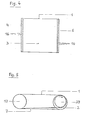
- FIG. 1 A top view of the auxiliary carrier (1) is shown schematically in FIG.
- the endless belt (3) is designed as a fixed or movable or moving support surface.
- the chains, belts or belts (4, 5) are preferably movably arranged and driven directly or indirectly.
- the pins (16) can ver sets must be arranged, but are preferably attached at regular intervals.
- FIG. 1 A section through the auxiliary carrier (1) is shown schematically in FIG.
- FIG. 1 A section through the auxiliary carrier (1) is shown schematically in FIG. The arrangement corresponds essentially to that of FIG. 1, but according to this embodiment the longitudinal or warp threads (13) are fed separately and pass under via the rollers (25). Interposition of a guide device or comb-like device (12) for the longitudinal or warp threads, by means of which the spacing of the longitudinal or warp threads can be maintained at the same time, on the deflection roller (14) on the carrier carrying the weft threads on the surface and superimpose the weft threads.
- a guide device or comb-like device (12) for the longitudinal or warp threads by means of which the spacing of the longitudinal or warp threads can be maintained at the same time, on the deflection roller (14) on the carrier carrying the weft threads on the surface and superimpose the weft threads.
- part of the longitudinal or warp threads (13) (for example every second, third or ... nth warp thread) is placed on the carrier in the vicinity of the transport roller (15 ) applied and preferably attached to the carrier with adhesive.
- the weft threads specified below by the auxiliary carrier overlap these longitudinal or warp threads.
- the remaining longitudinal or warp threads are applied in the vicinity of the deflection roller (14) and overlay the weft threads. A tissue-like structure is obtained in this way.
Landscapes
- Engineering & Computer Science (AREA)
- Textile Engineering (AREA)
- Chemical & Material Sciences (AREA)
- Chemical Kinetics & Catalysis (AREA)
- General Chemical & Material Sciences (AREA)
- Treatment Of Fiber Materials (AREA)
Applications Claiming Priority (4)
| Application Number | Priority Date | Filing Date | Title |
|---|---|---|---|
| DE7907250 | 1979-03-15 | ||
| DE2910163 | 1979-03-15 | ||
| DE19792910163 DE2910163A1 (de) | 1979-03-15 | 1979-03-15 | Verfahren und vorrichtung zur herstellung von textiltapeten oder textilaehnlichen tapeten |
| DE7907250U | 1979-03-15 |
Publications (1)
| Publication Number | Publication Date |
|---|---|
| EP0016358A1 true EP0016358A1 (fr) | 1980-10-01 |
Family
ID=25778235
Family Applications (1)
| Application Number | Title | Priority Date | Filing Date |
|---|---|---|---|
| EP80100946A Withdrawn EP0016358A1 (fr) | 1979-03-15 | 1980-02-26 | Procédé et dispositif de fabrication de revêtements muraux textiles ou analogues au textile |
Country Status (1)
| Country | Link |
|---|---|
| EP (1) | EP0016358A1 (fr) |
Citations (3)
| Publication number | Priority date | Publication date | Assignee | Title |
|---|---|---|---|---|
| FR2107243A5 (fr) * | 1970-09-04 | 1972-05-05 | Renhurst Ind Prop | |
| FR2373627A1 (fr) * | 1976-12-13 | 1978-07-07 | Hellenic Plastics Rubber | Procede et appareil de fabrication de tulle non tisse pour armature |
| FR2378128A1 (fr) * | 1977-01-25 | 1978-08-18 | Codetep Sa | Procede de fabrication de revetements muraux textiles et machine pour la mise en oeuvre du procede |
-
1980
- 1980-02-26 EP EP80100946A patent/EP0016358A1/fr not_active Withdrawn
Patent Citations (3)
| Publication number | Priority date | Publication date | Assignee | Title |
|---|---|---|---|---|
| FR2107243A5 (fr) * | 1970-09-04 | 1972-05-05 | Renhurst Ind Prop | |
| FR2373627A1 (fr) * | 1976-12-13 | 1978-07-07 | Hellenic Plastics Rubber | Procede et appareil de fabrication de tulle non tisse pour armature |
| FR2378128A1 (fr) * | 1977-01-25 | 1978-08-18 | Codetep Sa | Procede de fabrication de revetements muraux textiles et machine pour la mise en oeuvre du procede |
Similar Documents
| Publication | Publication Date | Title |
|---|---|---|
| DE1292549B (de) | Verfahren zur Herstellung von Faservliesen sowie Flortaefler zum Durchfuehren des Verfahrens | |
| DE896291C (de) | Verfahren und Vorrichtung zum Ausbreiten von fortlaufenden Faser- oder Fadengebildenin willkuerlichen Mustern auf eine sich bewegende Oberflaeche, insbesondere Papierbahn, zum Verstaerken derselben | |
| DE2848058C2 (de) | Glasfasermatten in Form von Spinnvliesen | |
| WO2009156385A2 (fr) | Procédé de réalisation d'une structure de fils multiaxiale, couches fibreuses unidirectionnelles et leur procédé de réalisation, structure de fils multiaxiale et pièce composite comprenant une matrice | |
| DE2018501A1 (de) | Verfahren zum Herstellen von Samtstoffen od.dgl | |
| DE1913128C3 (de) | Verfahren zum Mustern einer ungewebten Texülstoffbahn. Ausscheidung in: 1966624 | |
| DE1157513B (de) | Verfahren zur Herstellung einer Matte aus endlosen Faeden oder Stapelfasern | |
| DE1560712A1 (de) | Durchscheinende Bahn aus gekraeuselten kontinuierlichen Faeden und Verfahren zu ihrer Herstellung | |
| DE1292126B (de) | Verfahren und Vorrichtung zur Herstellung von Florware | |
| DE2726944B2 (de) | Verfahren zur Herstellung eines nichtgewebten Florstoffes und Vorrichtung zur Ausübung des Verfahrens | |
| EP0390890B1 (fr) | Installation de fabrication de corps textiles plats | |
| EP0016358A1 (fr) | Procédé et dispositif de fabrication de revêtements muraux textiles ou analogues au textile | |
| DE3044361C2 (fr) | ||
| EP0016356A1 (fr) | Procédé et dispositif de fabrication de revêtements muraux textiles ou analogues au textile | |
| DE2910163A1 (de) | Verfahren und vorrichtung zur herstellung von textiltapeten oder textilaehnlichen tapeten | |
| DE3235098C2 (de) | Verfahren und Vorrichtung zur Herstellung einer geklebten Polware, insbesondere Teppichware | |
| DE2633693C3 (de) | Verfahren zum Herstellen eines nichtgewebten Schichtstoffes aus breiten Kett- und Schußbahnen | |
| DE2164667A1 (de) | Armierung fuer gummireifen | |
| DE2910162A1 (de) | Verfahren und vorrichtung zur herstellung von textiltapeten oder textilaehnlichen tapeten | |
| DE19736424C2 (de) | Schneidunterlage für eine Schneidemaschine sowie diese verwendende Schneidemaschine | |
| DE1729718A1 (de) | Cordlage zur Armierung von flaechigen Koerpern aus elastischem Kunststoff oder Gummi | |
| DE3049260A1 (de) | Vorrichtung und verfahren zum ueberfuehren einer endlosen fasermatte von einer mattenbildungseinrichtung in eine verfestigungsstation | |
| DE3204703A1 (de) | Zuschneidbare waermedaemmeinlage | |
| DE2061173A1 (de) | Verbindung von zwei uebereinanderliegenden textilen Flaechengebilden und Verfahren zu ihrer Herstellung | |
| DE2542184A1 (de) | Papiermacherfilz sowie verfahren und vorrichtung zur herstellung desselben |
Legal Events
| Date | Code | Title | Description |
|---|---|---|---|
| PUAI | Public reference made under article 153(3) epc to a published international application that has entered the european phase |
Free format text: ORIGINAL CODE: 0009012 |
|
| AK | Designated contracting states |
Designated state(s): AT BE CH DE FR GB IT LU NL SE |
|
| 17P | Request for examination filed |
Effective date: 19801020 |
|
| STAA | Information on the status of an ep patent application or granted ep patent |
Free format text: STATUS: THE APPLICATION HAS BEEN WITHDRAWN |
|
| 18W | Application withdrawn |
Withdrawal date: 19821221 |
|
| RIN1 | Information on inventor provided before grant (corrected) |
Inventor name: MOHR, ERNST |