EP0016455A1 - Contenant isolant pour boîtes de boisson, en particulier boîtes de bière - Google Patents
Contenant isolant pour boîtes de boisson, en particulier boîtes de bière Download PDFInfo
- Publication number
- EP0016455A1 EP0016455A1 EP80101405A EP80101405A EP0016455A1 EP 0016455 A1 EP0016455 A1 EP 0016455A1 EP 80101405 A EP80101405 A EP 80101405A EP 80101405 A EP80101405 A EP 80101405A EP 0016455 A1 EP0016455 A1 EP 0016455A1
- Authority
- EP
- European Patent Office
- Prior art keywords
- jacket
- insulating jacket
- cans
- jacket according
- insulating
- Prior art date
- Legal status (The legal status is an assumption and is not a legal conclusion. Google has not performed a legal analysis and makes no representation as to the accuracy of the status listed.)
- Granted
Links
Images

Classifications
-
- B—PERFORMING OPERATIONS; TRANSPORTING
- B65—CONVEYING; PACKING; STORING; HANDLING THIN OR FILAMENTARY MATERIAL
- B65D—CONTAINERS FOR STORAGE OR TRANSPORT OF ARTICLES OR MATERIALS, e.g. BAGS, BARRELS, BOTTLES, BOXES, CANS, CARTONS, CRATES, DRUMS, JARS, TANKS, HOPPERS, FORWARDING CONTAINERS; ACCESSORIES, CLOSURES, OR FITTINGS THEREFOR; PACKAGING ELEMENTS; PACKAGES
- B65D81/00—Containers, packaging elements, or packages, for contents presenting particular transport or storage problems, or adapted to be used for non-packaging purposes after removal of contents
- B65D81/38—Containers, packaging elements, or packages, for contents presenting particular transport or storage problems, or adapted to be used for non-packaging purposes after removal of contents with thermal insulation
- B65D81/3876—Containers, packaging elements, or packages, for contents presenting particular transport or storage problems, or adapted to be used for non-packaging purposes after removal of contents with thermal insulation insulating sleeves or jackets for cans, bottles, barrels, etc.
Definitions
- the invention relates to an insulating jacket, preferably in the form of a bulbous barrel dummy, for cans containing beverages, in particular beer, with a capacity of several liters, the insulating jacket being open at the top (upper opening) and an inserted can at its top Encloses edge with little play.
- Beer consumption from large cans with contents of 3.8 or 4.0 or 5.0 liters is widespread and is becoming increasingly popular.
- the box is usually used in an insulating jacket, which is designed as a dummy dummy.
- a tap fitting is attached to the can, which contains a carbon dioxide cartridge, so that the contents of the can can be pressurized and the beer is thereby pushed up out of the can.
- the cans are stored in a refrigerator, which is still possible with the specified can size.
- the insulating jacket ensures that the beer (or other drink) that has cooled in the refrigerator remains cool for several hours.
- Known German utility model 67 52 193 is an insulating jacket to which a base is molded. The cans are inserted into this insulating jacket from above. The clear width of the upper opening is adapted to a certain can size. If a larger gap between the opening and the can is to be avoided, only cylindrical cans of a certain size, e.g. 3.8 liter cans to be used in the cooling jacket, but not cans with different sizes, e.g. 3.8 liter cans and 5 liter cans.
- insulating jacket for receiving a liquor bottle (CH-PS 502 243), which is drawn in in its upper region to adapt to the shape of the bottle and which has a detachable bottom.
- CH-PS 502 243 a liquor bottle
- the bottle to be kept cool is pushed into the container with the base removed, after which the base is attached to the container jacket.
- This well-known insulating jacket is only suitable for the special bottle shape and size for which it is intended.
- the invention has for its object to provide an insulating jacket that is suitable for cans of different sizes without the need to replace parts of the insulating jacket.
- the upper opening should be closely adapted to the upper diameter of the can.
- an insulating jacket of the type mentioned in that the jacket has a lower opening, the inside diameter of which is larger than the inside diameter of the upper opening and that the lower opening is closed with a removable bottom which is reversible and in two layers can be locked on the jacket, the support surfaces for a can sitting on the floor being of different heights in the two layers.
- larger cans can be introduced into the cooling jacket from below after the base has been removed.
- smaller cans can be used from above.
- 3.8 liter cans, 4.0 liter cans and 5.0 liter cans have the peculiarity that they have the same diameter at their upper ends.
- the cans with a larger volume, in particular 5.0 liter cans are curved in order to increase the capacity, so that the largest diameter of the can is larger than the diameter at the upper end of the can. If one wanted to use such cans from above, the upper opening would have to be made much larger than the diameter of the upper end of the can.
- a bayonet lock according to claim 2 is particularly advantageous since such locks can be easily produced on plastic parts and can be fastened without auxiliary tools.
- the total height of the insulating jacket does not change even when the lid is turned over, so that this insulating jacket ge in the different can sizes in the same drip tray can be put.
- the embodiment of the floor according to claim 4 has the advantage that the relatively large weight of the can does not have to be transferred to the jacket, but is supported directly on the stand on the floor. Centering rims on the bottom allow the cans to be fixed precisely at their lower ends and thus precisely aligned with the cooling jacket. Grip holes arranged in the bottom according to claim 6 facilitate the insertion and detachment of the bottom. Instead of grip holes, other handling aids could also be provided, for example projections.
- the jacket and possibly also the bottom preferably consist of structural foam.
- Structural foam has good insulating properties because the plastic contains cavities.
- Structural foam has the further property that the outer areas are pore-free, so that great strength is achieved and there is also a surface suitable for hygienic care of the jacket.
- This has significant advantages for use compared to insulating sleeves with foamed polystyrene inserts, e.g. styrofoam. Such material is not very strong and crumbles over time. Cleaning styrofoam parts is difficult. All of these disadvantages are avoided by the formation of the shell from structural foam.
- the floor since it has no significant insulation task, can be designed as a molded plastic part.
- cutouts can be present on the upper edge according to claim 11, which allows the use of tap fittings with a downwardly directed outlet pipe.
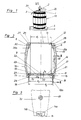
- the insulating jacket is designated overall by M. Inside the insulating jacket there is a box 1 on which a tap fitting 2 with an outlet pipe 3 inclined downward is arranged. The insulating jacket stands in a recess 4 of a drip tray 5. The nature of the insulating jacket 5 will be considered below with reference to the other figures.
- the insulating jacket M consists of a jacket 6 and a bottom 7.
- the jacket 6 is made of structural foam. Structural foam is known to have the property that walls made of structural foam have a central porous layer and essentially pore-free edge layers. As a result, parts made of structural foam have good insulating properties and yet have high strength and a dense surface.
- the jacket 6 is composed of two identical shells which are connected to one another along vertical joints, preferably by gluing.
- the jacket 6 is designed as a dummy dummy and has a correspondingly bulbous shape. Rings 8 to 11 are formed on the outside. These rings are intended to symbolize barrel hoops. Structural foam is also well suited for imitation of wood, so that the jacket M can be designed as a wooden barrel dummy, as indicated in FIG. 1.
- the jacket 6 has an upper opening 12 with a diameter d 1 and a lower opening 13 with a diameter d 2 .
- the diameter d 2 is larger than the diameter d 1 .
- the opening 13 can be closed with the bottom 7, a bayonet lock being provided for locking.
- This bayonet catch consists of angular channels 14 on the inside of the jacket 6 and of projections 15 (see FIG. 5) on the bottom 7.
- the angular channels 7 have a wide insertion part 14a and a narrow locking part 14b.
- the width of the insertion part 14a is equal to the width of the protrusions 15, while the width of the locking part 14 is equal to the thickness of the protrusions 15.
- the projections 15 are located in the middle of the height of the bottom 7.
- the floor 7 has two standing surfaces, namely a narrow annular standing surface 16 and a circular standing surface 17.
- the standing surface 16 is surrounded by a centering edge 18 which has the diameter d 3 .
- the standing surface 17 is surrounded by a centering edge 19 which has the diameter d 4 .
- the height distance h 1 of the standing area 16 from the floor edge 20 is greater than the height distance h 2 of the standing area 17 from the floor edge 21.
- the standing surface 17 is located on a wall 22 in which handle holes 23 and 24 are arranged. This wall is surrounded by a ring 25, which in turn is seated on a ring 26.
- the bottom 7 can be designed as a molded plastic part.
- a label is preferably formed in the wall 22.
- direction of rotation arrows can be attached, which indicate the rotary movements for releasing and for sealing the bottom 7 (see FIG. 5).
- cutouts 27 and 28 for the passage of a nozzle.
- the opening 12 is surrounded by a horizontal wall 29, which can be supported by ribs.
- the cutouts 27, 28 are also supported by ribs 30, 31, the end surfaces 30a and 31a of which end in the edge of the opening 12 without a step.
- On the inside of the jacket there is a circular elevation 32 into which a company emblem 33 is molded.
- the insulation jacket is used as follows.
- the bottom 7 is used as shown in Fig. 2, i.e. such that the base 17 is turned upwards.
- the can 1 is inserted into the jacket 6 from above. It is centered with its lower edge on the centering edge 19 of the base. Its upper side 1a is then at the level of the upper edge of the jacket 6.
- the diameter of the upper opening 12 is adapted to the standardized diameter of the box 1 so that there is no appreciable gap between the box and the upper horizontal wall 29.
- the tap fitting 2 After insertion, the tap fitting 2 is put on.
- the cooling jacket is placed in a drip tray 5, after which the B can ierkonsum begin.
- the weight of the can 1 is supported directly on the drip tray 5 via the base 7, ie the jacket 6 is not loaded with the weight of the can. This is achieved in that the lower edge 20 of the base lies in the same plane or a little lower than the lower edge of the jacket 6.
- Box 1 is used in a well-cooled state. Since the jacket 6 made of structural foam is well insulated, the beer remains cold for several hours.
- Fig. 4 the state is shown when a large can, e.g. a 5 liter can 34 is inserted into the jacket 6.
- the bottom 7 has been turned over in relation to the situation according to FIG. in this case the narrow footprint 16 is turned upwards.
- This area is lower than the standing area 17 in the situation according to FIG. 2, so that a somewhat longer box can also be accommodated in such a way that its upper side 34a is in any case at the level of the upper edge of the jacket 6.
- the can 34 is bulged, but its upper diameter is the same as the upper diameter of the smaller can 1.
- the lower diameter d 5 of the can 34 is larger than the upper diameter and also larger than the diameter d 1 of the opening 12 . Otherwise, the largest diameter of the can is present in the region of the curvature of the can jacket 34b. The can therefore cannot be inserted from above through the opening 12. It is inserted from below with the base 7 detached. Thanks to the rib surfaces 30a and 31a (see FIG. 2) the can is guided into the area of the opening 12. When the can is inserted, the lid 7 is put on and "tightened” by a rotary movement in the direction of the arrow (see FIG. 5). Tightening and loosening of the floor is easily possible by engaging the grip holes 23 and 24 with your thumb and index finger or middle finger.
Landscapes
- Engineering & Computer Science (AREA)
- Mechanical Engineering (AREA)
- Packages (AREA)
- Details Of Rigid Or Semi-Rigid Containers (AREA)
Priority Applications (1)
| Application Number | Priority Date | Filing Date | Title |
|---|---|---|---|
| AT80101405T ATE807T1 (de) | 1979-03-22 | 1980-03-18 | Isolierbehaelter fuer getraenkedosen, insbesondere bierdosen. |
Applications Claiming Priority (2)
| Application Number | Priority Date | Filing Date | Title |
|---|---|---|---|
| DE2911200 | 1979-03-22 | ||
| DE2911200A DE2911200C2 (de) | 1979-03-22 | 1979-03-22 | Isoliermantel für Getränkedosen, insbesondere Bierdosen |
Publications (2)
| Publication Number | Publication Date |
|---|---|
| EP0016455A1 true EP0016455A1 (fr) | 1980-10-01 |
| EP0016455B1 EP0016455B1 (fr) | 1982-04-07 |
Family
ID=6066079
Family Applications (1)
| Application Number | Title | Priority Date | Filing Date |
|---|---|---|---|
| EP80101405A Expired EP0016455B1 (fr) | 1979-03-22 | 1980-03-18 | Contenant isolant pour boîtes de boisson, en particulier boîtes de bière |
Country Status (3)
| Country | Link |
|---|---|
| EP (1) | EP0016455B1 (fr) |
| AT (1) | ATE807T1 (fr) |
| DE (2) | DE2911200C2 (fr) |
Cited By (2)
| Publication number | Priority date | Publication date | Assignee | Title |
|---|---|---|---|---|
| DE29619616U1 (de) * | 1996-11-12 | 1997-03-20 | Flieger, Helmut, 94486 Osterhofen | Vorrichtung zum Thermoisolieren und zur Verbesserung der Standfestigkeit von Behältern |
| CN108110605A (zh) * | 2017-06-23 | 2018-06-01 | 青岛海信宽带多媒体技术有限公司 | 一种硅基激光器 |
Families Citing this family (3)
| Publication number | Priority date | Publication date | Assignee | Title |
|---|---|---|---|---|
| DE3347481C2 (de) * | 1983-01-31 | 1985-10-17 | Rotpunkt Dr. Anso Zimmermann, 6434 Niederaula | Isolierkanne |
| DE3640512A1 (de) * | 1986-11-27 | 1988-06-01 | Barbara Eitel | Aufbewahrungs- und ausgiessgefaess fuer eine getraenkedose |
| DE4038682A1 (de) * | 1990-12-05 | 1992-06-11 | Joachim Mogler | Isoliermantel fuer getraenkedosen |
Citations (5)
| Publication number | Priority date | Publication date | Assignee | Title |
|---|---|---|---|---|
| US2837232A (en) * | 1956-04-30 | 1958-06-03 | Parfour Inc | Thermal container for bottles and other containers |
| FR1165988A (fr) * | 1956-12-06 | 1958-10-31 | Rayonne Soc Ind Pour La | Enveloppe isotherme pour bouteilles |
| DE1429857A1 (de) * | 1965-06-23 | 1968-11-21 | Cornelius Co | Flasche mit waermeisolierendem Mantel |
| CH502243A (de) * | 1969-08-28 | 1971-01-31 | Doornkaat Ag | Isolierbehälter zur Aufnahme einer Spirituosenflasche |
| DE2018018A1 (de) * | 1970-04-15 | 1971-11-04 | Ober, Josef, 8200 Rosenheim | Isolierbehalter fur Verbrauchsguter |
Family Cites Families (2)
| Publication number | Priority date | Publication date | Assignee | Title |
|---|---|---|---|---|
| DE6752193U (de) * | 1968-08-17 | 1969-04-03 | Christian Meyer | Thermosbehaelter mit schmutz- und feuchtigskeitsabweisender auskleidung fuer dosen. |
| DE1809418C3 (de) * | 1968-11-16 | 1978-06-29 | Telefunken Patentverwertungsgesellschaft Mbh, 7900 Ulm | Schaltungsanordnung zum Entzerren von durch Echos verzerrten modulierten Signalen |
-
1979
- 1979-03-22 DE DE2911200A patent/DE2911200C2/de not_active Expired
-
1980
- 1980-03-18 DE DE8080101405T patent/DE3060272D1/de not_active Expired
- 1980-03-18 AT AT80101405T patent/ATE807T1/de not_active IP Right Cessation
- 1980-03-18 EP EP80101405A patent/EP0016455B1/fr not_active Expired
Patent Citations (5)
| Publication number | Priority date | Publication date | Assignee | Title |
|---|---|---|---|---|
| US2837232A (en) * | 1956-04-30 | 1958-06-03 | Parfour Inc | Thermal container for bottles and other containers |
| FR1165988A (fr) * | 1956-12-06 | 1958-10-31 | Rayonne Soc Ind Pour La | Enveloppe isotherme pour bouteilles |
| DE1429857A1 (de) * | 1965-06-23 | 1968-11-21 | Cornelius Co | Flasche mit waermeisolierendem Mantel |
| CH502243A (de) * | 1969-08-28 | 1971-01-31 | Doornkaat Ag | Isolierbehälter zur Aufnahme einer Spirituosenflasche |
| DE2018018A1 (de) * | 1970-04-15 | 1971-11-04 | Ober, Josef, 8200 Rosenheim | Isolierbehalter fur Verbrauchsguter |
Cited By (2)
| Publication number | Priority date | Publication date | Assignee | Title |
|---|---|---|---|---|
| DE29619616U1 (de) * | 1996-11-12 | 1997-03-20 | Flieger, Helmut, 94486 Osterhofen | Vorrichtung zum Thermoisolieren und zur Verbesserung der Standfestigkeit von Behältern |
| CN108110605A (zh) * | 2017-06-23 | 2018-06-01 | 青岛海信宽带多媒体技术有限公司 | 一种硅基激光器 |
Also Published As
| Publication number | Publication date |
|---|---|
| ATE807T1 (de) | 1982-04-15 |
| DE2911200C2 (de) | 1982-01-28 |
| EP0016455B1 (fr) | 1982-04-07 |
| DE2911200A1 (de) | 1980-09-25 |
| DE3060272D1 (en) | 1982-05-19 |
Similar Documents
| Publication | Publication Date | Title |
|---|---|---|
| DE19535953A1 (de) | Behälter für einen Bauspielsatz | |
| DE2911200C2 (de) | Isoliermantel für Getränkedosen, insbesondere Bierdosen | |
| DE2840709A1 (de) | Verschlusseinheit fuer einen behaelter | |
| DE2152110A1 (de) | Kunststoff-Behaelter,insbesondere fuer Flaschen u.dgl. | |
| DE4330005A1 (de) | Vorrichtung zur Aufnahme und Abgabe von Flüssigkeiten | |
| DE29707656U1 (de) | Behältnis | |
| DE2745643A1 (de) | Servierplattenanordnung | |
| EP4479315A1 (fr) | Dispositif de stockage | |
| DE69006566T2 (de) | Wärme isolierender behälter. | |
| EP0586822A2 (fr) | Caisse de transport en matière plastique | |
| DE3240681C2 (de) | Mehrteiliger Serviersatz | |
| DE2104389A1 (de) | Gleichzeitig als Flaschenträger und Stapelkasten ausgebildeter Flaschenkasten | |
| DE9414617U1 (de) | Stapelbarer Teller | |
| DE7908033U1 (de) | Isoliermantel fuer Getraenkedosen insbesondere Bierdosen | |
| EP0268798A2 (fr) | Récipient de conservation d'une boîte métallique permettant de verser le contenu de la boîte | |
| DE4304160A1 (de) | Transportbehälter | |
| DE3913643C2 (fr) | ||
| DE1199687B (de) | Transport- oder Aufbewahrungsbehaelter | |
| DE2335041A1 (de) | Eishaube | |
| DE8808824U1 (de) | Quaderförmiger Behälter zum Befördern, Lagern und Ordnen | |
| EP0023977A1 (fr) | Dispositif pour ranger des objets, notamment des cassettes à bande d'enregistrement | |
| DE68922942T2 (de) | Isolierter Behälter für den Transport und die Ausgabe von Flüssigkeiten. | |
| DE69009997T2 (de) | Stapelbarer kasten. | |
| DE8901631U1 (de) | Zapfvorrichtung für Getränke | |
| DE69412061T2 (de) | Bierbehälter |
Legal Events
| Date | Code | Title | Description |
|---|---|---|---|
| PUAI | Public reference made under article 153(3) epc to a published international application that has entered the european phase |
Free format text: ORIGINAL CODE: 0009012 |
|
| AK | Designated contracting states |
Designated state(s): AT BE CH DE FR GB IT LU NL SE |
|
| 17P | Request for examination filed |
Effective date: 19801111 |
|
| GRAA | (expected) grant |
Free format text: ORIGINAL CODE: 0009210 |
|
| AK | Designated contracting states |
Designated state(s): AT BE CH DE FR GB IT LU NL SE |
|
| PG25 | Lapsed in a contracting state [announced via postgrant information from national office to epo] |
Ref country code: SE Effective date: 19820407 Ref country code: NL Effective date: 19820407 Ref country code: IT Free format text: LAPSE BECAUSE OF FAILURE TO SUBMIT A TRANSLATION OF THE DESCRIPTION OR TO PAY THE FEE WITHIN THE PRESCRIBED TIME-LIMIT;WARNING: LAPSES OF ITALIAN PATENTS WITH EFFECTIVE DATE BEFORE 2007 MAY HAVE OCCURRED AT ANY TIME BEFORE 2007. THE CORRECT EFFECTIVE DATE MAY BE DIFFERENT FROM THE ONE RECORDED. Effective date: 19820407 Ref country code: FR Free format text: THE PATENT HAS BEEN ANNULLED BY A DECISION OF A NATIONAL AUTHORITY Effective date: 19820407 Ref country code: BE Effective date: 19820407 |
|
| REF | Corresponds to: |
Ref document number: 807 Country of ref document: AT Date of ref document: 19820415 Kind code of ref document: T |
|
| REF | Corresponds to: |
Ref document number: 3060272 Country of ref document: DE Date of ref document: 19820519 |
|
| NLV1 | Nl: lapsed or annulled due to failure to fulfill the requirements of art. 29p and 29m of the patents act | ||
| PGFP | Annual fee paid to national office [announced via postgrant information from national office to epo] |
Ref country code: CH Payment date: 19830302 Year of fee payment: 4 |
|
| PG25 | Lapsed in a contracting state [announced via postgrant information from national office to epo] |
Ref country code: AT Effective date: 19830318 |
|
| PG25 | Lapsed in a contracting state [announced via postgrant information from national office to epo] |
Ref country code: LU Free format text: LAPSE BECAUSE OF NON-PAYMENT OF DUE FEES Effective date: 19830331 |
|
| PG25 | Lapsed in a contracting state [announced via postgrant information from national office to epo] |
Ref country code: CH Effective date: 19840331 |
|
| PGFP | Annual fee paid to national office [announced via postgrant information from national office to epo] |
Ref country code: DE Payment date: 19840421 Year of fee payment: 5 |
|
| REG | Reference to a national code |
Ref country code: CH Ref legal event code: PL |
|
| GBPC | Gb: european patent ceased through non-payment of renewal fee | ||
| PG25 | Lapsed in a contracting state [announced via postgrant information from national office to epo] |
Ref country code: GB Effective date: 19881118 |
|
| PG25 | Lapsed in a contracting state [announced via postgrant information from national office to epo] |
Ref country code: DE Effective date: 19881201 |
|
| PLBE | No opposition filed within time limit |
Free format text: ORIGINAL CODE: 0009261 |
|
| STAA | Information on the status of an ep patent application or granted ep patent |
Free format text: STATUS: NO OPPOSITION FILED WITHIN TIME LIMIT |