EP0016863A1 - Verfahren zur Herstellung von Mischgranulat aus Russ und hellem silikatischem Füllstoff und dieses Mischgranulat enthaltende Kautschukmischung - Google Patents
Verfahren zur Herstellung von Mischgranulat aus Russ und hellem silikatischem Füllstoff und dieses Mischgranulat enthaltende Kautschukmischung Download PDFInfo
- Publication number
- EP0016863A1 EP0016863A1 EP79104897A EP79104897A EP0016863A1 EP 0016863 A1 EP0016863 A1 EP 0016863A1 EP 79104897 A EP79104897 A EP 79104897A EP 79104897 A EP79104897 A EP 79104897A EP 0016863 A1 EP0016863 A1 EP 0016863A1
- Authority
- EP
- European Patent Office
- Prior art keywords
- carbon black
- filler
- dispersion
- soot
- composite granulate
- Prior art date
- Legal status (The legal status is an assumption and is not a legal conclusion. Google has not performed a legal analysis and makes no representation as to the accuracy of the status listed.)
- Granted
Links
- 239000008187 granular material Substances 0.000 title claims abstract description 32
- 239000000945 filler Substances 0.000 title claims abstract description 29
- 229920001971 elastomer Polymers 0.000 title claims abstract description 13
- 239000005060 rubber Substances 0.000 title claims abstract description 13
- 239000006229 carbon black Substances 0.000 title claims description 21
- 239000000203 mixture Substances 0.000 title claims description 19
- 238000004519 manufacturing process Methods 0.000 title claims description 9
- 239000002131 composite material Substances 0.000 title 2
- BPQQTUXANYXVAA-UHFFFAOYSA-N Orthosilicate Chemical compound [O-][Si]([O-])([O-])[O-] BPQQTUXANYXVAA-UHFFFAOYSA-N 0.000 title 1
- 239000006185 dispersion Substances 0.000 claims description 28
- 238000000034 method Methods 0.000 claims description 16
- VYPSYNLAJGMNEJ-UHFFFAOYSA-N Silicium dioxide Chemical compound O=[Si]=O VYPSYNLAJGMNEJ-UHFFFAOYSA-N 0.000 abstract description 32
- 239000004071 soot Substances 0.000 abstract description 20
- 239000000377 silicon dioxide Substances 0.000 abstract description 14
- 239000007900 aqueous suspension Substances 0.000 abstract 1
- 239000011049 pearl Substances 0.000 description 19
- 239000000126 substance Substances 0.000 description 12
- 239000011324 bead Substances 0.000 description 9
- 239000007787 solid Substances 0.000 description 8
- 239000012065 filter cake Substances 0.000 description 6
- 239000007921 spray Substances 0.000 description 6
- XLYOFNOQVPJJNP-UHFFFAOYSA-N water Substances O XLYOFNOQVPJJNP-UHFFFAOYSA-N 0.000 description 5
- 238000001035 drying Methods 0.000 description 4
- 238000005029 sieve analysis Methods 0.000 description 4
- YKTSYUJCYHOUJP-UHFFFAOYSA-N [O--].[Al+3].[Al+3].[O-][Si]([O-])([O-])[O-] Chemical compound [O--].[Al+3].[Al+3].[O-][Si]([O-])([O-])[O-] YKTSYUJCYHOUJP-UHFFFAOYSA-N 0.000 description 3
- DNEHKUCSURWDGO-UHFFFAOYSA-N aluminum sodium Chemical compound [Na].[Al] DNEHKUCSURWDGO-UHFFFAOYSA-N 0.000 description 3
- 150000001875 compounds Chemical class 0.000 description 3
- 241000872198 Serjania polyphylla Species 0.000 description 2
- 238000006243 chemical reaction Methods 0.000 description 2
- 238000010586 diagram Methods 0.000 description 2
- 238000005469 granulation Methods 0.000 description 2
- 230000003179 granulation Effects 0.000 description 2
- 238000002347 injection Methods 0.000 description 2
- 239000007924 injection Substances 0.000 description 2
- 238000004073 vulcanization Methods 0.000 description 2
- 239000010457 zeolite Substances 0.000 description 2
- OYPRJOBELJOOCE-UHFFFAOYSA-N Calcium Chemical compound [Ca] OYPRJOBELJOOCE-UHFFFAOYSA-N 0.000 description 1
- LFQSCWFLJHTTHZ-UHFFFAOYSA-N Ethanol Chemical compound CCO LFQSCWFLJHTTHZ-UHFFFAOYSA-N 0.000 description 1
- 241000237858 Gastropoda Species 0.000 description 1
- 238000005299 abrasion Methods 0.000 description 1
- 239000002253 acid Substances 0.000 description 1
- 239000000654 additive Substances 0.000 description 1
- 239000000853 adhesive Substances 0.000 description 1
- 230000001070 adhesive effect Effects 0.000 description 1
- 229910052910 alkali metal silicate Inorganic materials 0.000 description 1
- XAGFODPZIPBFFR-UHFFFAOYSA-N aluminium Chemical compound [Al] XAGFODPZIPBFFR-UHFFFAOYSA-N 0.000 description 1
- 229910052782 aluminium Inorganic materials 0.000 description 1
- 230000005587 bubbling Effects 0.000 description 1
- 239000011575 calcium Substances 0.000 description 1
- 229910052791 calcium Inorganic materials 0.000 description 1
- 239000004927 clay Substances 0.000 description 1
- 238000010924 continuous production Methods 0.000 description 1
- 239000000428 dust Substances 0.000 description 1
- 238000005516 engineering process Methods 0.000 description 1
- 238000002474 experimental method Methods 0.000 description 1
- 239000000391 magnesium silicate Substances 0.000 description 1
- 235000012243 magnesium silicates Nutrition 0.000 description 1
- 238000005259 measurement Methods 0.000 description 1
- 239000012764 mineral filler Substances 0.000 description 1
- 229920003052 natural elastomer Polymers 0.000 description 1
- 229920001194 natural rubber Polymers 0.000 description 1
- 229920000642 polymer Polymers 0.000 description 1
- 229920002959 polymer blend Polymers 0.000 description 1
- 239000000047 product Substances 0.000 description 1
- 238000004062 sedimentation Methods 0.000 description 1
- 238000005204 segregation Methods 0.000 description 1
- 150000004760 silicates Chemical class 0.000 description 1
- RMAQACBXLXPBSY-UHFFFAOYSA-N silicic acid Chemical compound O[Si](O)(O)O RMAQACBXLXPBSY-UHFFFAOYSA-N 0.000 description 1
- 235000012239 silicon dioxide Nutrition 0.000 description 1
- 229910052665 sodalite Inorganic materials 0.000 description 1
- 238000001228 spectrum Methods 0.000 description 1
- 238000003860 storage Methods 0.000 description 1
- 229920003051 synthetic elastomer Polymers 0.000 description 1
- 239000005061 synthetic rubber Substances 0.000 description 1
- 239000003760 tallow Substances 0.000 description 1
- 238000011144 upstream manufacturing Methods 0.000 description 1
Classifications
-
- C—CHEMISTRY; METALLURGY
- C09—DYES; PAINTS; POLISHES; NATURAL RESINS; ADHESIVES; COMPOSITIONS NOT OTHERWISE PROVIDED FOR; APPLICATIONS OF MATERIALS NOT OTHERWISE PROVIDED FOR
- C09C—TREATMENT OF INORGANIC MATERIALS, OTHER THAN FIBROUS FILLERS, TO ENHANCE THEIR PIGMENTING OR FILLING PROPERTIES ; PREPARATION OF CARBON BLACK ; PREPARATION OF INORGANIC MATERIALS WHICH ARE NO SINGLE CHEMICAL COMPOUNDS AND WHICH ARE MAINLY USED AS PIGMENTS OR FILLERS
- C09C1/00—Treatment of specific inorganic materials other than fibrous fillers; Preparation of carbon black
- C09C1/44—Carbon
- C09C1/48—Carbon black
- C09C1/56—Treatment of carbon black ; Purification
- C09C1/58—Agglomerating, pelleting, or the like by wet methods
-
- C—CHEMISTRY; METALLURGY
- C08—ORGANIC MACROMOLECULAR COMPOUNDS; THEIR PREPARATION OR CHEMICAL WORKING-UP; COMPOSITIONS BASED THEREON
- C08K—Use of inorganic or non-macromolecular organic substances as compounding ingredients
- C08K3/00—Use of inorganic substances as compounding ingredients
- C08K3/02—Elements
- C08K3/04—Carbon
-
- C—CHEMISTRY; METALLURGY
- C01—INORGANIC CHEMISTRY
- C01P—INDEXING SCHEME RELATING TO STRUCTURAL AND PHYSICAL ASPECTS OF SOLID INORGANIC COMPOUNDS
- C01P2004/00—Particle morphology
- C01P2004/60—Particles characterised by their size
- C01P2004/61—Micrometer sized, i.e. from 1-100 micrometer
-
- C—CHEMISTRY; METALLURGY
- C01—INORGANIC CHEMISTRY
- C01P—INDEXING SCHEME RELATING TO STRUCTURAL AND PHYSICAL ASPECTS OF SOLID INORGANIC COMPOUNDS
- C01P2006/00—Physical properties of inorganic compounds
- C01P2006/10—Solid density
-
- C—CHEMISTRY; METALLURGY
- C01—INORGANIC CHEMISTRY
- C01P—INDEXING SCHEME RELATING TO STRUCTURAL AND PHYSICAL ASPECTS OF SOLID INORGANIC COMPOUNDS
- C01P2006/00—Physical properties of inorganic compounds
- C01P2006/12—Surface area
-
- C—CHEMISTRY; METALLURGY
- C01—INORGANIC CHEMISTRY
- C01P—INDEXING SCHEME RELATING TO STRUCTURAL AND PHYSICAL ASPECTS OF SOLID INORGANIC COMPOUNDS
- C01P2006/00—Physical properties of inorganic compounds
- C01P2006/19—Oil-absorption capacity, e.g. DBP values
Definitions
- the invention relates to a method for producing mixed granules from carbon black and light filler in a spiked screw granulator.
- Carbon black or light fillers are used to reinforce natural or synthetic rubber.
- mixtures of carbon black and light fillers so-called “black Veiss mixtures” are also used.
- black and white mixtures result in good rubber technology values in the manufacture of vehicle tires.
- Particularly good technical rubber values are obtained for rubber articles that are subject to dynamic stress.
- black and white mixtures it is also possible to achieve a high degree of filling, whereby the properties of the filled polymer can be positively influenced in a targeted manner depending on the mixing ratio.
- the known method according to DE-AS 11 46 6o6 has the further disadvantage that the production of a homogeneous and defined mixture only takes place batchwise and with considerable effort Apparatus and energy is possible because the water-containing filter cake batter of the precipitated filler to be mixed with soot is produced in the filter press in the form of irregularly shaped, large-scale clods. The actual granulation can then only be carried out in a second step.
- DE-OS 15 92 861 states that the barbed screw granulator normally used for the production of soot beads is not suitable for the production of mixed granules.
- the invention relates to a process for producing mixed granules from carbon black and light filler by means of a barbed screw granulator, which is characterized in that the bright filler in the form of an aqueous dispersion continuously sprayed in the spiked screw granulator onto continuously supplied carbon black, this mixture was simultaneously bubbled and the mixed granules thus obtained dried.
- Silica precipitated from alkali silicate by reaction with acid can be used as the light filler. This can e.g. after drying to produce an aqueous dispersion redispersed in water.
- the aqueous dispersion of the precipitated silica can be prepared from the filter cake of the precipitated silica using the process known from DE-PS 24 47 613.
- Usable natural fillers are e.g. Kaolinites, clays, pebbles, chalks, modified mineral fillers, zeolites, etc.
- usable synthetic fillers are amorphous precipitated calcium, aluminum or magnesium silicates and zeolites of the types A, X, Y, P or sodalite.
- the solids content of the filler dispersion can be between 0.5 and 60% by weight.
- soot can be used as soot (cf. Ullmann's Encyclopedia of Industrial Chemistry, 3rd edition, 14th volume, page 793 ff (1963).
- spike screw pelletizers can be used as the peg screw pelletizer. So you can use soot beading machines, for example, like them. be described in DE-PS 21 47 5 03 or DE_PS 10 81 167.
- the mixed granules obtained are uniformly shaped and, because of their pearl-like character, are very easy to pour. They can be metered readily and excellent in rubber compounds incorporate or e disperse. In addition, when using the preferred embodiment of the inventive method according to DE-PS 24 47 613, they are particularly low-grit.
- the mixed granules according to the invention are low in dust and have low bead abrasion. They are defined in terms of their composition and do not separate when added.
- a thin dispersion is produced from the filter cake of this silica filler by means of the process described in DE-PS 24 47 613.
- the solids content of this dispersion is 20% by weight and the pH 2.9.
- a horizontally positioned barbed screw granulator (pearl machine), which is equipped with a barbed roller in the axis, is used to produce the mixed granulate.
- the total length of the barbed pelletizer is 1,6oo mm, the effective length is 1o8o mm (from the point of water injection or dispersion injection to failure from the pearl trough).
- the inside diameter of the barbed pelletizer is 2oo mm.
- the speed is set to 75o rpm.
- the mixed granulate beads have the following physico-chemical characteristics:
- the mixed granulate beads have excellent flow properties.
- the pearls are largely spherical. They can be easily incorporated and dispersed in polymer mixtures.
- the individual bead hardness is measured as follows:
- the pearl-shaped granulate is sieved through two sieves with 1.4 and 1.6 mm mesh sizes.
- the beads remaining on the 1.4 mm sieve are sieved again on a 1.5 mm sieve.
- the pearls in the mesh which are exactly 1.5 mm in diameter, are used to examine the individual pearl hardness.
- these beads are individually placed on the bowl of an electronic scale and loaded with a feed of approx. 1 mm / min by a pressure sensor.
- the electronic scale registers the weight load in a line diagram. When the pearl breaks, the pressure is relieved, the pressure sensor is started up and the individual pearl hardness is read in grams from the line diagram. The average of 20 measurements is given as the measured value.
- a carbon black with the physico-chemical characteristics according to example 1 is used.
- the dispersion according to Example 1 is used as the silica dispersion.
- the barbed pelletizer described in Example 1 is used.
- the speed of the spiked shaft is 75o rpm.
- 30 kg / h soot is continuously fed into the barbed pelletizer.
- 60 kg / h of the silica dispersion are sprayed onto the soot through a nozzle.
- the pre-pressure on the spray can is 8 bar. After the wet pearls have been removed from the pearl machine, they are dried. The following test values are determined on the dried mixed granules:
- a thin-bodied dispersion with a solids content of 20%, as described in Example 1, is produced from the filter cake of this silica filler.
- 25 kg / h carbon black are continuously introduced, 62 kg / h of the silica dispersion are sprayed onto the carbon black and the pearling is carried out.
- the pre-pressure on the spray can is 7 bar.
- the wet pearls thus obtained are dried at approx. 150 ° C.
- the mixed granulate beads have the following physico-chemical characteristics:
- the carbon black according to Example 1 is used. To achieve different mixing ratios / carbon black silica fillers, dispersions with different solids contents are used. The silica according to Example 1 is used. The dispersions produced therefrom have the following properties: 25 kg / h soot are metered into the spiked screw granulator according to Example 1 by a screw. So much dispersion is added via a spray nozzle. until good pearls are created. Dispersion 1 requires: 38.0 kg / h, dispersion 2 requires: 50.o kg / h, dispersion 3 requires: 60.o kg / h and dispersion 4 75.0 kg / h H. The speed of the barbed snail is 75o rpm.
- All mixed granules have a spherical shape and are extremely free-flowing. They are well dispersible in rubber compounds.
- a sodium aluminum silicate with the following characteristics is used as a light filler used.
- This sodium aluminum silicate is used on the one hand as an aqueous dispersion with approx. 48% solids content without further additives (A) and on the other hand as a 48% dispersion with the addition of 1.5% tallow alcohol (B) as a sedimentation retarder.
- the wet pearls are dried.
- the resulting mixed granules have a composition of 40% carbon black and 60% sodium aluminum silicate and the following physico-chemical characteristics:
- the mixed granules have excellent flow properties.
- a natural aluminum silicate (clay) with the following characteristics is used as a natural filler used.
- a mixed granulate, produced according to Example 3, is used in a rubber mixture.
- the rubber mixture has the following composition:
Landscapes
- Chemical & Material Sciences (AREA)
- Organic Chemistry (AREA)
- Health & Medical Sciences (AREA)
- Chemical Kinetics & Catalysis (AREA)
- Medicinal Chemistry (AREA)
- Polymers & Plastics (AREA)
- Compositions Of Macromolecular Compounds (AREA)
- Pigments, Carbon Blacks, Or Wood Stains (AREA)
- Glanulating (AREA)
- Silicates, Zeolites, And Molecular Sieves (AREA)
- Processes Of Treating Macromolecular Substances (AREA)
- Adornments (AREA)
Abstract
Description
- Verfahren zur Herstellung von Mischgranulat aus Russ und hellem Füllstoff
- Die Erfindung betrifft ein Verfahren zur Herstellung von Mischgranulat aus Russ und hellem Füllstoff in einem Stachelschneckengranulator.
- Russ bzw. helle Füllstoffe werden zur Verstärkung von natürlichem oder synthetischem Kautschuk verwendet. Zur Vereinfachung der Zugabe zu Kautschukmischungen werden auch Gemische von Russ und hellen Füllstoffen, sogenannte "Schwarz-Veiss-Mischungen" verwendet. Diese "Schwarz-Weiss-Mischungen" ergeben beispielsweise bei der Herstellung von Fahrzeugreifen gute gummitechnische Werte. Besonders gute gummitechnische Werte werden bei Gummiartikeln erhalten, welche einer dynamischen Beanspruchung unterliegen. Bei der Verwendung von Schwarz-Weiss-Mischungen ist es zudem möglich, einen hohen Füllungsgrad zu erzielen, wobei die Eigenschaften des gefüllten Polymeren je nach Mischungsverhältnis in gezielter Weise positiv beeinflusst werden können.
- Gewisse Schwierigkeiten bereitet jedoch die Zugabe der beiden Füllstoffkomponenten in Form einer sogenannten Schwarz-Weiss-Mischung zur Kautschukmischung, weil während der Zugabe der Füllstoffkomponenten mit einem festen Mischungsverhältnis aus dem Vorratsbunker auf die Walze oder in den Kneter stets die Gefahr einer Entmischung und damit einer ungenauen Dosierung besteht.
- Es ist bekannt zur besseren Handhabung und zur Vermeidung einer ungenauen Dosierung der Schwarz-Weiss-Mischung aus Russ und hellem Füllstoff, Mischgranulate aus beiden Komponenten herzustellen, indem man trockenen, ungeperlten Russ bis zur Bildung einer möglichst homogenen Masse in einen Filterkuchenteig eines gefällten Füllstoffes einmischt, unter Verwendung von Granuliervorrichtungen, wie z.B. Lochwalzen, Vollwalzen oder Trommelgranulatoren granuliert und trocknet (DE-AS 11 46 606).
- Dieses Verfahren weist jedoch den Nachteil auf, dass die erhaltenen Mischgranulate unregelmässig geformt, relativ grobteilig, schlecht rieselfähig und damit ungenau dosierbar sind.
- Das bekannte Verfahren gemäss DE-AS 11 46 6o6 hat weiterhin den Nachteil, dass die Herstellung einer homogenen und definiert zusammengesetzten Mischung nur batchweise und unter erheblichem Aufwand an Apparaten und Energie möglich ist, weil der mit Russ zu nischende, wasserhaltige Filterkuchenteig des gefällten Füllstoffes in der Filterpresse in Form unregelmässig geformter, grossteiliger Schollen anfällt. Die eigentliche Granulierung kann anschliessend erst in einem zweiten Schritt durchgeführt werden.
- Aus der DE-OS 15 92 861 ist ein Verfahren bekannt, mit welchem pulverförmiger Russ und luftgetrocknete, pulverförmige, gefällte Kieselsäure mit Wasser, welches noch ein Klebemittel enthält, in einer speziellen Vorrichtung nassverperlt und anschliessend das gebildete Granulat getrocknet.
- Nachteile des bekannten Verfahrens ergeben sich daraus, dass nur eine chargenweise Granulierung in speziellen Apparaturen möglich und darüber hinaus eine teilweise doppelte Trocknung der Kieselsäure notwendig ist.
- Aus der DE-OS 15 92 861 ist ein weiteres Verfahren bekannt, welches einen Stachelschneckengranulator verwendet.
- Hierzu wird jedoch in der DE-OS 15 92 861 ausgeführt, dass der zur Herstellung von Russperlen üblicherweise verwendete Stachelschneckengranulator zur Herstellung von Mischgranulaten nicht geeignet sei.
- Es besteht daher ein Bedürfnis, ein regelmässig geformtes perlförmiges und gut rieselfähiges und damit gut dosierbares Mischgranulat nach einem kontinuierlichen, energiesparenden Verfahren mit bekannten Vorrichtungen herzustellen.
- Gegenstand der Erfindung ist ein Verfahren zur Herstellung von Mischgranulat aus Russ und hellem Füllstoff mittels eines Stachelschneckengranulators, welches dadurch gekennzeichnet ist, dass man den hellen Füllstoff in Form einer wässrigen Dispersion kontinuierlich in dem Stachelschneckengranulator auf kontinuierlich zugeführten Russ aufsprüht, diese Mischung gleichzeitig verperlt und das so erhaltene Mischgranulat trocknet.
- Als heller Füllstoff kann aus Alkalisilikat durch Umsetzung mit Säure gefällte Kieselsäure verwendet werden. Diese kann z.B. nach dem Trocknen zur Herstellung einer wässrigen Dispersion in Wasser redispergiert werden.
- In einer bevorzugten Ausführungsform kann die wässrige Dispersion der gefällten Kieselsäure aus dem Filterkuchen der gefällten Kieselsäure mittels dem aus der DE-PS 24 47 613 bekannten Verfahren hergestellt werden.
- Als helle Füllstoffe können neben gefällten Kieselsäuren auch andere Füllstoffe natürlicher oder synthetischer Provenienz verwendet werden.
- Verwendbare natürliche Füllstoffe sind z.B. Kaolinite, Clays, Kieselkreiden, Kreiden, modifizierte minerali sche Füllstoffe, Zeolithe u.a.
- Verwendbare synthetische Füllstoffe sind ausser gefällter Kieselsäure amorphe gefällte Calcium-, Aluminium- oder Magnesiumsilikate sowie Zeolithe vom Typ A, X, Y, P oder Sodalith.
- Der Feststoffgehalt der Füllstoffdispersion kann zwischen o,5 und 6o Gew.-% liegen.
- Als Russ können alle bekannten Russtypen (vgl. Ullmann's Enzyklopädie der technischen Chemie, 3. Auflage, 14. Band, Seite 793 ff (1963) verwendet werden.
- Als Stachelschneckengranulator können alle als Verperlungsmaschinen bekannten Vorrichtungen vom Typ Stachelschneckenverperler verwendet werden. So kann man beispielsweise Russperlmaschinen verwenden, wie sie. in der DE-PS 21 47 503 oder DE_PS 10 81 167 beschrieben werden.
- Die Vorteile des erfindungsgemässen Verfahrens liegen in der kontinuierlichen Verfahrensführung, wobei die an sich bekannten Stachelschneckengranulatoren ohne zusätzliche Umbauten dafür einsetzbar sind.
- Weitere Vorteile ergeben sich daraus, dass Vermischung und Verperlung in einem Verfahrensschritt vorgenommen werden können, wobei vorteilhafterweise die bei der Füllstoffherstellung als Zwischenprodukt anfallende wässrige Dispersion direkt eingesetzt werden kann.
- Hierdurch kann man zusätzlich Energie einsparen, weil ein aufwendiger Trocknungsschritt entfällt.
- Die erhaltenen Mischgranulate sind gleichmässig geformt und wegen ihres perlartigen Charakters sehr gut rieselfähig. Sie lassen sich gut dosieren und ausgezeichnet in Kautschukmischungen einarbeiten bzwe dispergieren. Ausserdem sind sie bei Anwendung der bevorzugten Ausführungsform des erfindungsgemässen Verfahrens gemäss DE-PS 24 47 613 besonders gritarm.
- Die erfindungsgemässen Mischgranulate sind staubarm und weisen einen niedrigen Perlabrieb auf. Sie sind in Hinblick auf ihre Zusammensetzungdefiniert und entmischen sich nicht bei der Zugabe..
- Das erfindungsgemässe Verfahren wird anhand der folgenden Beispiele häher erläutert und beschrieben:
- In diesem Beispiel werden eingesetzt:
- Russ, mit den folgenden physikalisch-chemischen Kenndaten:

- Kieselsäure mit den folgenden physikalisch-chemischen Kenndaten (ermittelt nach Trocknung aus Filterkuchen):

- Aus dem Filterkuchen dieses Kieselsäurefüllstoffes wird eine dünnflüssige Dispersion mittels des in der DE-PS 24 47 613 beschriebenen Verfahrens hergestellt. Der Feststoffgehalt dieser Dispersion beträgt 2o Gew.-% und der pH-Wert 2,9.
- Es wird ein waagerecht liegender Stachelschneckengranulator (Perlmaschine), welcher mit einer Stachelwalze in der Achse ausgerüstet ist, zur Herstellung des Mischgranulates verwendet. Die Gesamtlänge des Stachelschneckengranulators beträgt 1.6oo mm, die wirksame Länge 1.o8o mm (vom Punkt der Wassereinspritzung bzw. Dispersionseinspritzung bis zum Ausfall aus dem Perltrog). Der Innendurchmesser des Stachelschneckengranulators beträgt 2oo mm. Die Drehzahl wird auf 75o UpM eingestellt.
- 25 kg/h Russ werden kontinuierlich mittels einer regelbaren Schnecke in den Stachelschneckengranulator eingetragen, 65 kg/h der Kieselsäuredispersion auf den Russ aufgesprüht und die Verperlung durchgeführt. Der Vordruck an der Sprühdüse beträgt 8 bar. Die so erhaltenen nassen Perlen werden getrocknet. Die Mischgranulatperlen weisen die folgenden physikalisch-chemischen Kenndaten auf:

-

- Die Mischgranulatperlen weisen eine ausgezeichnete Rieselfähigkeit auf. Die Perlen sind weitgehend kugelförmig. Sie können gut in Polymermischungen eingearbeitet und dispergiert werden.
- Die Messung der Einzelperlhärte wird wie folgt durchgeführt:
- Das perlförmige Granulat wird durch zwei-Siebe mit 1,4 und 1,6 mm lichter Maschenweite gesiebt. Die auf dem 1,4 mm Sieb zurückbleibenden Perlen werden nochmals auf einem 1,5 mm Sieb gesiebt. Die gerade in den Maschen steckenden Perlen, welche exakt 1,5 mm Durchmesser haben, werden für die Untersuchung der Einzelperlhärte verwendet. Dazu werden diese Perlen einzeln auf die Schale einer elektronischen Waage gelegt und mit einem Vorschub von ca. 1 mm/min durch einen Druckgeber belastet. Die elektronische Waage registriert in einem Strichdiagramm die Gewichtsbelastung. Bei dem Bruch der Perle tritt eine Entlastung ein, der Druckgeber wird hochgefahren und die Einzelperlhärte in Gramm aus dem Strichdiagramm abgelesen. Als Messwert wird der Mittelwert aus 2o Messungen angegeben.
- Es wird ein Russ mit den physikalisch-chemischen Kenndaten gemäss Beispiel 1 verwendet.
- Als Kieselsäuredispersion wird die Dispersion gemäss Beispiel 1 verwendet. Es wird der in Beispiel 1 beschriebene Stachelschneckengranulator benutzt. Die Drehzahl der Stachelwelle beträgt 75o UpM. Mit einer regelbaren Schnecke werden 3o kg/h Russ kontinuierlich in den Stachelschneckengranulator eingetragen. 6o kg/h der Kieselsäuredispersion werden durch eine Düse auf den Russ aufgeprüht. Der Vordruck an der Sprühdose beträgt 8 bar. Nach Austrag der nassen Perlen aus der Perlmaschine werden diese getrocknet. An dem getrockneten Mischgranulat werden folgende Prüfwerte ermittelt:
-

-

- In diesem Beispiel wird ein Russ benutzt, der deutlich grobteiliger war als der in Beispiel 1 und 2 eingesetzte Russ.
- Der hier verwendete Russ hat die folgenden physikalisch-chemischen Kenndaten:

- Die eingesetzte Kieselsäure hat die folgenden an der Trockensubstanz gemessenen physikalisch-chemischen Kenndaten:

- Aus dem Filterkuchen dieses Kieselsäurefüllstoffes wird eine dünnflüssige Dispersion mit 20% Feststoffgehalt, wie in Beispiel 1 beschrieben, hergestellt. In den in Beispiel 1 beschriebenen Stachelschnerikengranulator werden kontinuierlich 25 kg/h Russ eingetragen, 62 kg/h der Kieselsäuredispersion auf den Russ aufgesprüht und die Verperlung durchgeführt. Der Vordruck an der Sprühdose beträgt dabei 7 bar. Die so erhaltenen Nassperlen werden bei ca. 150°C getrocknet. Die Mischgranulatperlen haben die folgenden physikalisch-chemischen Kenndaten:

-

- Es wird der Russ gemäss Beispiel 1 verwendet. Zur Erreichung verschiedener Mischungsverhältnisse/ Russ-Kieselsäurefüllstoff werden Dispersionen mit verschiedenen Feststoffgehalten eingesetzt. Es wird dabei die Kieselsäure gemäss Beispiel 1 verwendet. Die daraus hergestellten Dispersionen haben die folgenden Eigenschaften:

- Es ist leicht zu erkennen, dass für die gleiche Russmenge eine um so grössere Menge an Dispersion eingesetzt werden muss, je höher der Feststoffgehalt der Dispersion ist. Dies ist durch den absinkenden Wassergehalt der Dispersion zu erkläreno Nach der Trocknung der Mischgranulatperlen werden an den-hergestellten Produkten folgende Prüfwerte festgestellt:

-

- Aus diesem Beispiel ist zu entnehmen, dass durch Verwendung von Kieselsäure-Dispersionen mit unterschiedlichem Feststoffgehalt ein weites Spektrum der Zusammensetzung von Mischgranulaten aus gefällter Kieselsäure und Russ hergestellt werden kann..
- Es wird ein Russ mit den folgenden physikalisch-chemischen Kenndaten eingesetzt:

- Als heller Füllstoff wird ein Natriumaluminiumsilikat mit den folgenden Kenndaten

- Dieses Natriumaluminiumsilikat wird einerseits als wässrige Dispersion mit ca. 48 % Feststoffgehalt ohne weitere Zusätze (A) und andererseits als 48%ige Dispersion mit einem Zusatz von 1,5 % Talgalkohol (B) als Sedimentationsverzögerer eingesetzt.
- In den in Beispiel 1 beschriebenen Stachelperlengranulator werden 25 kg/h Russ kontinuierlich eingetragen und 77,5 kg/h der Dispersion A bei einem Sprühdruck von 6,5 bar auf den Russ aufgesprüht. Die Drehzahl beträgt 75o UpM.
- Der gleiche Versuch wird mit der Dispersion B ausgeführt.
- Die nassen Perlen werden getrocknet.
- Die entstandenen Mischgranulate weisen eine Zusammensetzung von 40 % Russ und 60 % Natriumaluminiumsilikat und die folgenden physikalisch-chemischen Kenndaten auf:

- Die Mischgranulate weisen eine ausgezeichnete Rieselfähigkeit auf.
- Es wird ein Russ mit den folgenden physikalisch-chemischen Kenndaten verwendet:

- Als natürlicher Füllstoff wird ein natürliches Aluminiumsilikat (Clay) mit den folgenden Kenndaten

- Aus diesem Silikat wird eine wässrige Dispersion mit 35 % Feststoffgehalt hergestellt.
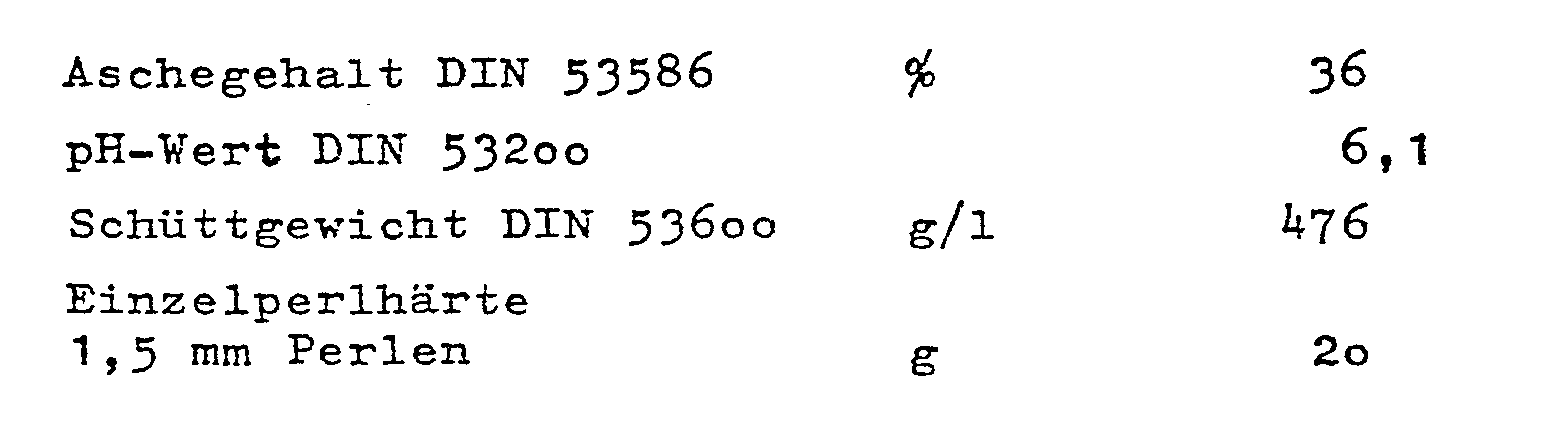
- In dem in Beispiel 1 beschriebenen Stachelschneckengranulator und bei den dort beschriebenen Einstelldaten des Stachelschneckengranulators werden 3o kg/h Russ kontinuierlich eingetragen. Hierauf werden 57 kg/h der Dispersion des Aluminiumsilikates aufgesprüht, wobei der Sprühdruck an der Düse 7,5 bar beträgt. Nach Auswurf der nassen Perlen werden diese getrocknet. An dem hierbei entstandenen Mischgranulat mit 60% Russ und 40 % Aluminiumsilikat werden die folgenden physikalisch-chemischen Daten ermittelt:
- Ein Mischgranulat, hergestellt nach Beispiel 3, wird in einer Kautschukmischung eingesetzt.
- Die Kautschukmischung hat die folgende Zusammensetzung:

- Nach einer Vulkanisation bei 145°C ergeben sich folgende Vulkanisatdaten:
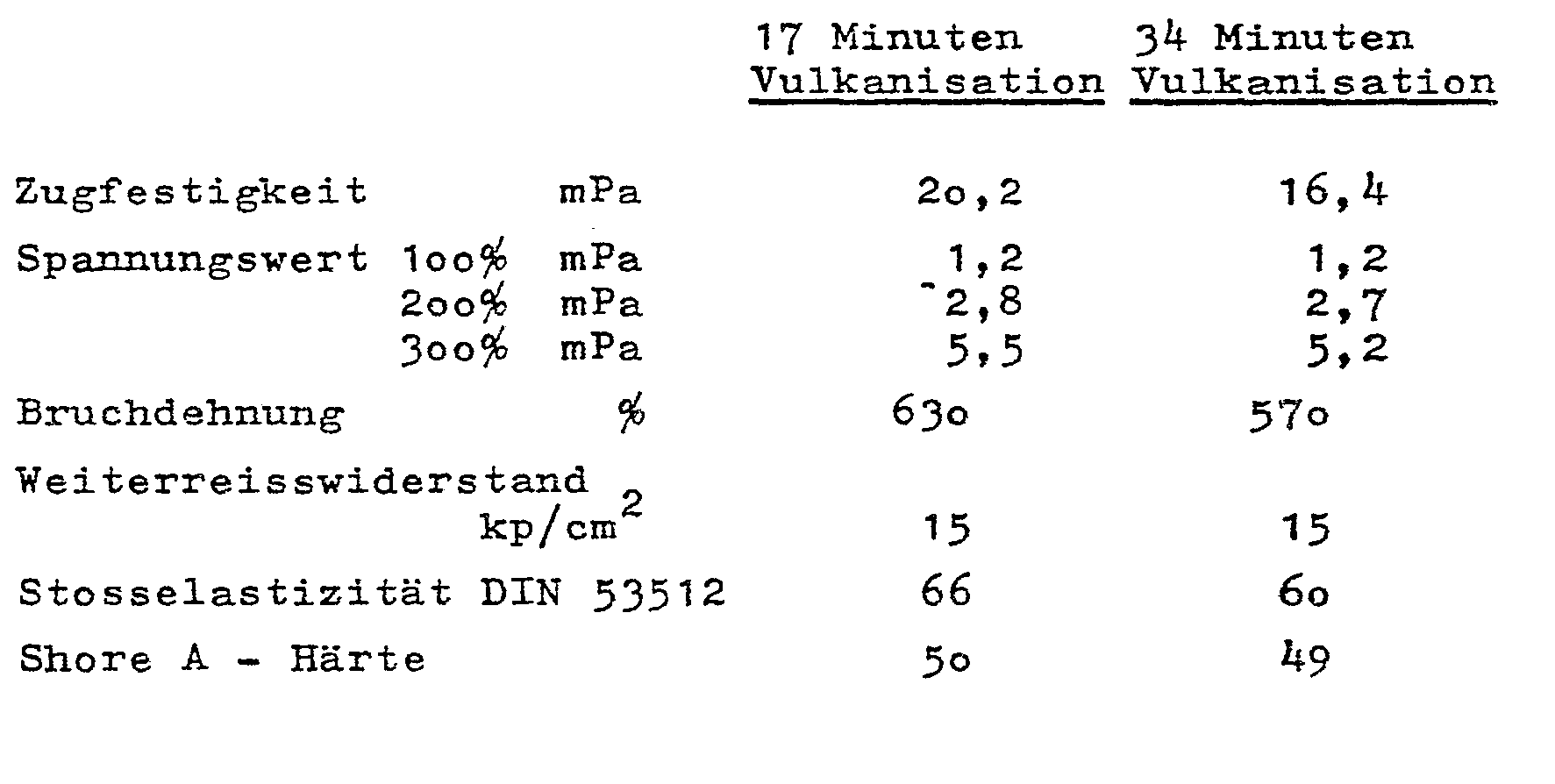
- Aus diesen Prüfwerten ist bei Vergleich der Spannungswerte für 17 und 34 Minuten Vulkanisation eine ausgezeichnete Reversionsbeständigkeit zu erkennen. Die hohe Bruchdehnung und der gute Veiterreisswiderstand weisen das Mischgranulat als besonders geeignet für dynamisch beanspruchte Kautschukmischungen aus.
Claims (2)
Priority Applications (1)
| Application Number | Priority Date | Filing Date | Title |
|---|---|---|---|
| AT79104897T ATE803T1 (de) | 1979-03-21 | 1979-12-04 | Verfahren zur herstellung von mischgranulat aus russ und hellem silikatischem fuellstoff und dieses mischgranulat enthaltende kautschukmischung. |
Applications Claiming Priority (2)
| Application Number | Priority Date | Filing Date | Title |
|---|---|---|---|
| DE2910991A DE2910991C3 (de) | 1979-03-21 | 1979-03-21 | Verfahren zur Herstellung von Mischgranulat aus Russ, Wasser und hellem Füllstoff sowie dessen Verwendung |
| DE2910991 | 1979-03-21 |
Publications (2)
| Publication Number | Publication Date |
|---|---|
| EP0016863A1 true EP0016863A1 (de) | 1980-10-15 |
| EP0016863B1 EP0016863B1 (de) | 1982-03-31 |
Family
ID=6065957
Family Applications (1)
| Application Number | Title | Priority Date | Filing Date |
|---|---|---|---|
| EP79104897A Expired EP0016863B1 (de) | 1979-03-21 | 1979-12-04 | Verfahren zur Herstellung von Mischgranulat aus Russ und hellem silikatischem Füllstoff und dieses Mischgranulat enthaltende Kautschukmischung |
Country Status (14)
| Country | Link |
|---|---|
| US (1) | US4430280A (de) |
| EP (1) | EP0016863B1 (de) |
| JP (1) | JPS55129456A (de) |
| AR (1) | AR223517A1 (de) |
| AT (1) | ATE803T1 (de) |
| BE (1) | BE882254A (de) |
| BR (1) | BR8001609A (de) |
| CA (1) | CA1137360A (de) |
| DE (2) | DE2910991C3 (de) |
| ES (1) | ES486531A1 (de) |
| FR (1) | FR2451933A1 (de) |
| GB (1) | GB2044741B (de) |
| IT (1) | IT7969350A0 (de) |
| NL (1) | NL7908269A (de) |
Cited By (1)
| Publication number | Priority date | Publication date | Assignee | Title |
|---|---|---|---|---|
| EP0278061A3 (de) * | 1987-02-11 | 1990-06-13 | Degussa Aktiengesellschaft | Aktivkohlegranulate sowie Verfahren zu ihrer Herstellung |
Families Citing this family (22)
| Publication number | Priority date | Publication date | Assignee | Title |
|---|---|---|---|---|
| DE3404271A1 (de) * | 1984-02-03 | 1985-08-08 | Mannesmann AG, 4000 Düsseldorf | Feinkorngemisch |
| US6028137A (en) | 1995-05-22 | 2000-02-22 | Cabot Corporation | Elastomeric compounds incorporating silicon-treated carbon blacks |
| US5869550A (en) | 1995-05-22 | 1999-02-09 | Cabot Corporation | Method to improve traction using silicon-treated carbon blacks |
| US5877238A (en) * | 1995-05-22 | 1999-03-02 | Cabot Corporation | Elastomeric compounds incorporating silicon-treated carbon blacks and coupling agents |
| US5830930A (en) * | 1995-05-22 | 1998-11-03 | Cabot Corporation | Elastomeric compounds incorporating silicon-treated carbon blacks |
| US6323273B1 (en) | 1995-05-22 | 2001-11-27 | Cabot Corporation | Elastomeric compounds incorporating silicon-treated carbon blacks |
| US5622557A (en) * | 1995-05-22 | 1997-04-22 | Cabot Corporation | Mineral binders colored with silicon-containing carbon black |
| BR9609289A (pt) | 1995-05-22 | 1999-05-11 | Cabot Corp | Compostos elastoméricos incorporando negros de fumo parcialmente revestidos |
| US6008272A (en) * | 1995-05-22 | 1999-12-28 | Cabot Corporation | Elastomeric compounds incorporating silicon-treated carbon blacks |
| US5948835A (en) * | 1995-09-15 | 1999-09-07 | Cabot Corporation | Silicon-treated carbon black/elastomer formulations and applications |
| US6020402A (en) | 1995-09-15 | 2000-02-01 | Cabot Corporation | Silicone rubber compositions incorporating silicon-treated carbon blacks |
| BR9710978A (pt) | 1996-06-14 | 2000-10-31 | Cabot Corp | Adsorventes de carbono modificado e processos para adsorção usando os mesmos. |
| US5747562A (en) | 1996-06-14 | 1998-05-05 | Cabot Corporation | Ink and coating compositions containing silicon-treated carbon black |
| WO1998013418A1 (en) | 1996-09-25 | 1998-04-02 | Cabot Corporation | Pre-coupled silicon-treated carbon blacks |
| CA2266897A1 (en) | 1996-09-25 | 1998-04-02 | Cabot Corporation | Silica coated carbon blacks |
| US5919855A (en) | 1997-02-11 | 1999-07-06 | Cabot Corporation | Use of modified carbon black in gas-phase polymerizations |
| US6017980A (en) | 1997-03-27 | 2000-01-25 | Cabot Corporation | Elastomeric compounds incorporating metal-treated carbon blacks |
| US5904762A (en) | 1997-04-18 | 1999-05-18 | Cabot Corporation | Method of making a multi-phase aggregate using a multi-stage process |
| US6962952B2 (en) * | 1997-04-30 | 2005-11-08 | The Yokohama Rubber Co., Ltd. | Process for production of modified carbon black for rubber reinforcement and process of production of rubber composition containing modified carbon black |
| WO2000005312A1 (en) | 1998-07-24 | 2000-02-03 | Cabot Corporation | Methods for preparing silica-coated carbon products |
| DE19846774A1 (de) * | 1998-10-10 | 2000-04-20 | Cognis Deutschland Gmbh | Additive für die Verarbeitung von Kunststoffen |
| US7247669B2 (en) * | 2005-08-11 | 2007-07-24 | The Goodyear Tire & Rubber Company | Rubber prepared with precipitated silica and carbon black pellet composites of controlled hardness and tire with component derived therefrom |
Citations (4)
| Publication number | Priority date | Publication date | Assignee | Title |
|---|---|---|---|---|
| GB729381A (en) * | 1953-03-13 | 1955-05-04 | Huber Corp J M | Water dispersible carbon black |
| FR1465337A (fr) * | 1965-02-10 | 1967-01-06 | Continental Carbon Co | Granulés de noir de carbone utilisés dans le mixtionnage du caoutchouc |
| US3390006A (en) * | 1965-08-30 | 1968-06-25 | Huber Corp J M | Method of making carbon black/silica pigment |
| DE1592861A1 (de) * | 1966-09-28 | 1971-02-18 | Degussa | Verfahren zur Herstellung von russhaltigen Gemischen in Perlform |
Family Cites Families (3)
| Publication number | Priority date | Publication date | Assignee | Title |
|---|---|---|---|---|
| DE1146606B (de) | 1961-12-18 | 1963-04-04 | Degussa | Verfahren zur Herstellung von Mischgranulaten aus Russ und hellen, nassgefaellten Fuellstoffen |
| US4182736A (en) | 1976-06-28 | 1980-01-08 | Phillips Petroleum Company | Method for pelleting carbon black |
| US4166722A (en) | 1977-11-08 | 1979-09-04 | Phillips Petroleum Company | Pinned shaft and carbon black pelleter |
-
1979
- 1979-03-21 DE DE2910991A patent/DE2910991C3/de not_active Expired
- 1979-11-12 NL NL7908269A patent/NL7908269A/nl not_active Application Discontinuation
- 1979-12-03 ES ES486531A patent/ES486531A1/es not_active Expired
- 1979-12-04 EP EP79104897A patent/EP0016863B1/de not_active Expired
- 1979-12-04 AT AT79104897T patent/ATE803T1/de not_active IP Right Cessation
- 1979-12-04 DE DE7979104897T patent/DE2962402D1/de not_active Expired
- 1979-12-06 IT IT7969350A patent/IT7969350A0/it unknown
-
1980
- 1980-02-29 GB GB8006980A patent/GB2044741B/en not_active Expired
- 1980-03-12 CA CA000347476A patent/CA1137360A/en not_active Expired
- 1980-03-14 BE BE6/47107A patent/BE882254A/fr not_active IP Right Cessation
- 1980-03-18 US US06/131,533 patent/US4430280A/en not_active Expired - Lifetime
- 1980-03-18 BR BR8001609A patent/BR8001609A/pt unknown
- 1980-03-20 AR AR280374A patent/AR223517A1/es active
- 1980-03-21 JP JP3480880A patent/JPS55129456A/ja active Granted
- 1980-03-21 FR FR8006411A patent/FR2451933A1/fr active Granted
Patent Citations (4)
| Publication number | Priority date | Publication date | Assignee | Title |
|---|---|---|---|---|
| GB729381A (en) * | 1953-03-13 | 1955-05-04 | Huber Corp J M | Water dispersible carbon black |
| FR1465337A (fr) * | 1965-02-10 | 1967-01-06 | Continental Carbon Co | Granulés de noir de carbone utilisés dans le mixtionnage du caoutchouc |
| US3390006A (en) * | 1965-08-30 | 1968-06-25 | Huber Corp J M | Method of making carbon black/silica pigment |
| DE1592861A1 (de) * | 1966-09-28 | 1971-02-18 | Degussa | Verfahren zur Herstellung von russhaltigen Gemischen in Perlform |
Cited By (1)
| Publication number | Priority date | Publication date | Assignee | Title |
|---|---|---|---|---|
| EP0278061A3 (de) * | 1987-02-11 | 1990-06-13 | Degussa Aktiengesellschaft | Aktivkohlegranulate sowie Verfahren zu ihrer Herstellung |
Also Published As
| Publication number | Publication date |
|---|---|
| DE2910991C3 (de) | 1982-01-21 |
| FR2451933B1 (de) | 1983-10-14 |
| CA1137360A (en) | 1982-12-14 |
| AR223517A1 (es) | 1981-08-31 |
| IT7969350A0 (it) | 1979-12-06 |
| GB2044741B (en) | 1982-12-22 |
| DE2910991B2 (de) | 1981-04-16 |
| ES486531A1 (es) | 1980-06-16 |
| BE882254A (fr) | 1980-09-15 |
| NL7908269A (nl) | 1980-09-23 |
| BR8001609A (pt) | 1980-11-18 |
| ATE803T1 (de) | 1982-04-15 |
| DE2910991A1 (de) | 1980-10-02 |
| JPS55129456A (en) | 1980-10-07 |
| GB2044741A (en) | 1980-10-22 |
| US4430280A (en) | 1984-02-07 |
| DE2962402D1 (en) | 1982-05-06 |
| FR2451933A1 (fr) | 1980-10-17 |
| JPS5742662B2 (de) | 1982-09-09 |
| EP0016863B1 (de) | 1982-03-31 |
Similar Documents
| Publication | Publication Date | Title |
|---|---|---|
| EP0016863B1 (de) | Verfahren zur Herstellung von Mischgranulat aus Russ und hellem silikatischem Füllstoff und dieses Mischgranulat enthaltende Kautschukmischung | |
| DE2135266C3 (de) | Verfahren zur Herstellung rieselfähiger, pulverförmiger, fuUstoffhaltiger Kautschuk-Mischungen aus Kautschuk-Lösungen | |
| DE69601317T2 (de) | Für Laufflächen geeignete Gummimischung enthaltend mit Aluminium dotiertes Fallungssilica | |
| DE69816233T2 (de) | Fällungskieselsäure verwendbar als verstärkender füllstoff in elastomeren | |
| DE3650430T2 (de) | Anorganische Füllstoffe. | |
| DE69833279T2 (de) | Kieselsäure enthaltende Gummimischung für Reifen für Automobile mit einem verbesserten Rollwiderstand | |
| DE3014007A1 (de) | Pigment auf der basis von kieselsaeure, seine herstellung und verwendung | |
| DE1146606B (de) | Verfahren zur Herstellung von Mischgranulaten aus Russ und hellen, nassgefaellten Fuellstoffen | |
| DE3723213C2 (de) | ||
| EP0003217B1 (de) | Fällungskieselsäuregranulate, ihre Herstellung und ihre Anwendung | |
| EP0651031B1 (de) | Verfahren zur Einfärbung von organischen Medien | |
| DE4231874A1 (de) | Verfahren zur Herstellung eines Aluminiumhydroxids Al(OH)¶3¶ mit abgerundeter Kornoberfläche | |
| DE3036874C2 (de) | ||
| DE2365184A1 (de) | Kautschuke | |
| EP1064331B1 (de) | Russgranulate | |
| DE2030172C3 (de) | Verfahren zur Herstellung von Mischungen aus natürlichem oder synthetischem Kautschuk und gefällter Kieselsäure | |
| DE2251935B1 (de) | Dispersionsmittel und verfahren zur trockenvermahlung von mineralien | |
| EP0333999A1 (de) | Verfahren zur Herstellung pulverförmiger, rieselfähiger Kautschuk-Füllstoff-Mischungen ausgehend von Kautschuk-Lösungen | |
| DE2346653C3 (de) | Verfahren zur Herstellung von pulverförmigen Elastomer-Mischungen mit Kieselsäuren und Silikaten | |
| DE1592861B2 (de) | Verfahren zum Naßverperlen von RuB mit weißen Füllstoffen und/oder Flüssigkeiten | |
| DE1770442A1 (de) | Verfahren zur Herstellung von pulverfoermigen Elastomer- und Polymer-Mischungen | |
| DE1795222C3 (de) | Verfahren zur Herstellung pulverförmiger Kautschukmischungen mit Russ | |
| DE1041930B (de) | Verfahren zur Herstellung eines Verstaerkerfuellstoffes auf der Basis hydratisierterKieselsaeure | |
| DE2531964A1 (de) | Verfahren zur herstellung von rieselfaehigen kautschukpulvern | |
| DE2355570C3 (de) | Verfahren zur Herstellung von freifließenden, gut dispergierbaren Kieselsäureperlen mit niedriger Einzelperlhärte |
Legal Events
| Date | Code | Title | Description |
|---|---|---|---|
| PUAI | Public reference made under article 153(3) epc to a published international application that has entered the european phase |
Free format text: ORIGINAL CODE: 0009012 |
|
| AK | Designated contracting states |
Designated state(s): AT BE DE FR GB IT NL |
|
| 17P | Request for examination filed | ||
| ITF | It: translation for a ep patent filed | ||
| GRAA | (expected) grant |
Free format text: ORIGINAL CODE: 0009210 |
|
| AK | Designated contracting states |
Designated state(s): AT BE DE FR GB IT NL |
|
| REF | Corresponds to: |
Ref document number: 803 Country of ref document: AT Date of ref document: 19820415 Kind code of ref document: T |
|
| REF | Corresponds to: |
Ref document number: 2962402 Country of ref document: DE Date of ref document: 19820506 |
|
| PGFP | Annual fee paid to national office [announced via postgrant information from national office to epo] |
Ref country code: AT Payment date: 19911210 Year of fee payment: 13 |
|
| PG25 | Lapsed in a contracting state [announced via postgrant information from national office to epo] |
Ref country code: AT Effective date: 19921204 |
|
| ITTA | It: last paid annual fee | ||
| PGFP | Annual fee paid to national office [announced via postgrant information from national office to epo] |
Ref country code: GB Payment date: 19961113 Year of fee payment: 18 |
|
| PGFP | Annual fee paid to national office [announced via postgrant information from national office to epo] |
Ref country code: BE Payment date: 19961114 Year of fee payment: 18 |
|
| PGFP | Annual fee paid to national office [announced via postgrant information from national office to epo] |
Ref country code: FR Payment date: 19961118 Year of fee payment: 18 |
|
| PGFP | Annual fee paid to national office [announced via postgrant information from national office to epo] |
Ref country code: DE Payment date: 19961120 Year of fee payment: 18 |
|
| PGFP | Annual fee paid to national office [announced via postgrant information from national office to epo] |
Ref country code: NL Payment date: 19961128 Year of fee payment: 18 |
|
| PG25 | Lapsed in a contracting state [announced via postgrant information from national office to epo] |
Ref country code: GB Free format text: LAPSE BECAUSE OF NON-PAYMENT OF DUE FEES Effective date: 19971204 |
|
| PG25 | Lapsed in a contracting state [announced via postgrant information from national office to epo] |
Ref country code: FR Free format text: THE PATENT HAS BEEN ANNULLED BY A DECISION OF A NATIONAL AUTHORITY Effective date: 19971231 Ref country code: BE Free format text: LAPSE BECAUSE OF NON-PAYMENT OF DUE FEES Effective date: 19971231 |
|
| BERE | Be: lapsed |
Owner name: DEGUSSA A.G. Effective date: 19971231 |
|
| PG25 | Lapsed in a contracting state [announced via postgrant information from national office to epo] |
Ref country code: NL Free format text: LAPSE BECAUSE OF NON-PAYMENT OF DUE FEES Effective date: 19980701 |
|
| GBPC | Gb: european patent ceased through non-payment of renewal fee |
Effective date: 19971204 |
|
| NLV4 | Nl: lapsed or anulled due to non-payment of the annual fee |
Effective date: 19980701 |
|
| PG25 | Lapsed in a contracting state [announced via postgrant information from national office to epo] |
Ref country code: DE Free format text: LAPSE BECAUSE OF NON-PAYMENT OF DUE FEES Effective date: 19980901 |
|
| REG | Reference to a national code |
Ref country code: FR Ref legal event code: ST |
|
| PLBE | No opposition filed within time limit |
Free format text: ORIGINAL CODE: 0009261 |
|
| STAA | Information on the status of an ep patent application or granted ep patent |
Free format text: STATUS: NO OPPOSITION FILED WITHIN TIME LIMIT |