EP0017112B1 - Polyester amides and their use as melt adhesives - Google Patents
Polyester amides and their use as melt adhesives Download PDFInfo
- Publication number
- EP0017112B1 EP0017112B1 EP80101521A EP80101521A EP0017112B1 EP 0017112 B1 EP0017112 B1 EP 0017112B1 EP 80101521 A EP80101521 A EP 80101521A EP 80101521 A EP80101521 A EP 80101521A EP 0017112 B1 EP0017112 B1 EP 0017112B1
- Authority
- EP
- European Patent Office
- Prior art keywords
- weight
- polyester amides
- caprolactam
- component
- equivalents
- Prior art date
- Legal status (The legal status is an assumption and is not a legal conclusion. Google has not performed a legal analysis and makes no representation as to the accuracy of the status listed.)
- Expired
Links
- 229920006149 polyester-amide block copolymer Polymers 0.000 title claims description 22
- 239000000853 adhesive Substances 0.000 title claims description 7
- 230000001070 adhesive effect Effects 0.000 title claims description 7
- JBKVHLHDHHXQEQ-UHFFFAOYSA-N epsilon-caprolactam Chemical compound O=C1CCCCCN1 JBKVHLHDHHXQEQ-UHFFFAOYSA-N 0.000 claims description 31
- QQVIHTHCMHWDBS-UHFFFAOYSA-N isophthalic acid Chemical compound OC(=O)C1=CC=CC(C(O)=O)=C1 QQVIHTHCMHWDBS-UHFFFAOYSA-N 0.000 claims description 23
- 239000000203 mixture Substances 0.000 claims description 23
- NAQMVNRVTILPCV-UHFFFAOYSA-N hexane-1,6-diamine Chemical compound NCCCCCCN NAQMVNRVTILPCV-UHFFFAOYSA-N 0.000 claims description 16
- WNLRTRBMVRJNCN-UHFFFAOYSA-N adipic acid Chemical compound OC(=O)CCCCC(O)=O WNLRTRBMVRJNCN-UHFFFAOYSA-N 0.000 claims description 12
- 229920001223 polyethylene glycol Polymers 0.000 claims description 10
- 239000004952 Polyamide Substances 0.000 claims description 7
- 239000002202 Polyethylene glycol Substances 0.000 claims description 7
- 229920002647 polyamide Polymers 0.000 claims description 7
- 125000001931 aliphatic group Chemical group 0.000 claims description 6
- 235000011037 adipic acid Nutrition 0.000 claims description 5
- 239000001361 adipic acid Substances 0.000 claims description 5
- 229920001515 polyalkylene glycol Polymers 0.000 claims description 5
- 239000002994 raw material Substances 0.000 claims description 5
- DZIHTWJGPDVSGE-UHFFFAOYSA-N 4-[(4-aminocyclohexyl)methyl]cyclohexan-1-amine Chemical compound C1CC(N)CCC1CC1CCC(N)CC1 DZIHTWJGPDVSGE-UHFFFAOYSA-N 0.000 claims description 4
- ZZTCPWRAHWXWCH-UHFFFAOYSA-N diphenylmethanediamine Chemical compound C=1C=CC=CC=1C(N)(N)C1=CC=CC=C1 ZZTCPWRAHWXWCH-UHFFFAOYSA-N 0.000 claims description 4
- 125000003118 aryl group Chemical group 0.000 claims description 3
- 238000006243 chemical reaction Methods 0.000 claims description 3
- 235000014113 dietary fatty acids Nutrition 0.000 description 10
- 239000000194 fatty acid Substances 0.000 description 10
- 229930195729 fatty acid Natural products 0.000 description 10
- 150000004665 fatty acids Chemical class 0.000 description 10
- 239000004831 Hot glue Substances 0.000 description 8
- 239000002253 acid Substances 0.000 description 8
- 150000004985 diamines Chemical class 0.000 description 8
- 239000000155 melt Substances 0.000 description 5
- 229920006122 polyamide resin Polymers 0.000 description 5
- 229920000642 polymer Polymers 0.000 description 5
- XLYOFNOQVPJJNP-UHFFFAOYSA-N water Substances O XLYOFNOQVPJJNP-UHFFFAOYSA-N 0.000 description 5
- KKEYFWRCBNTPAC-UHFFFAOYSA-N Terephthalic acid Chemical compound OC(=O)C1=CC=C(C(O)=O)C=C1 KKEYFWRCBNTPAC-UHFFFAOYSA-N 0.000 description 4
- 150000001991 dicarboxylic acids Chemical class 0.000 description 4
- KEIQPMUPONZJJH-UHFFFAOYSA-N dicyclohexylmethanediamine Chemical class C1CCCCC1C(N)(N)C1CCCCC1 KEIQPMUPONZJJH-UHFFFAOYSA-N 0.000 description 4
- RLSSMJSEOOYNOY-UHFFFAOYSA-N m-cresol Chemical compound CC1=CC=CC(O)=C1 RLSSMJSEOOYNOY-UHFFFAOYSA-N 0.000 description 4
- 239000000178 monomer Substances 0.000 description 4
- -1 polyethylene Polymers 0.000 description 4
- PEDCQBHIVMGVHV-UHFFFAOYSA-N Glycerine Chemical compound OCC(O)CO PEDCQBHIVMGVHV-UHFFFAOYSA-N 0.000 description 3
- ZMXDDKWLCZADIW-UHFFFAOYSA-N N,N-Dimethylformamide Chemical compound CN(C)C=O ZMXDDKWLCZADIW-UHFFFAOYSA-N 0.000 description 3
- 239000000654 additive Substances 0.000 description 3
- 150000001412 amines Chemical class 0.000 description 3
- 238000000605 extraction Methods 0.000 description 3
- 239000012943 hotmelt Substances 0.000 description 3
- 238000004519 manufacturing process Methods 0.000 description 3
- 239000012299 nitrogen atmosphere Substances 0.000 description 3
- 238000006068 polycondensation reaction Methods 0.000 description 3
- 229920000728 polyester Polymers 0.000 description 3
- 229920001169 thermoplastic Polymers 0.000 description 3
- 239000004416 thermosoftening plastic Substances 0.000 description 3
- 239000013638 trimer Substances 0.000 description 3
- IJGRMHOSHXDMSA-UHFFFAOYSA-N Atomic nitrogen Chemical compound N#N IJGRMHOSHXDMSA-UHFFFAOYSA-N 0.000 description 2
- 239000004698 Polyethylene Substances 0.000 description 2
- 150000001298 alcohols Chemical class 0.000 description 2
- 229910052799 carbon Inorganic materials 0.000 description 2
- 125000004432 carbon atom Chemical group C* 0.000 description 2
- 239000000539 dimer Substances 0.000 description 2
- 239000002184 metal Substances 0.000 description 2
- 238000000034 method Methods 0.000 description 2
- BDJRBEYXGGNYIS-UHFFFAOYSA-N nonanedioic acid Chemical compound OC(=O)CCCCCCCC(O)=O BDJRBEYXGGNYIS-UHFFFAOYSA-N 0.000 description 2
- 229920000573 polyethylene Polymers 0.000 description 2
- 238000006116 polymerization reaction Methods 0.000 description 2
- 239000002904 solvent Substances 0.000 description 2
- WMRCTEPOPAZMMN-UHFFFAOYSA-N 2-undecylpropanedioic acid Chemical compound CCCCCCCCCCCC(C(O)=O)C(O)=O WMRCTEPOPAZMMN-UHFFFAOYSA-N 0.000 description 1
- RNLHGQLZWXBQNY-UHFFFAOYSA-N 3-(aminomethyl)-3,5,5-trimethylcyclohexan-1-amine Chemical compound CC1(C)CC(N)CC(C)(CN)C1 RNLHGQLZWXBQNY-UHFFFAOYSA-N 0.000 description 1
- IGSBHTZEJMPDSZ-UHFFFAOYSA-N 4-[(4-amino-3-methylcyclohexyl)methyl]-2-methylcyclohexan-1-amine Chemical compound C1CC(N)C(C)CC1CC1CC(C)C(N)CC1 IGSBHTZEJMPDSZ-UHFFFAOYSA-N 0.000 description 1
- 0 CC(CC(*)CC1*C(CC(*)C[C@]2*)C[C@@]2N)*1N Chemical compound CC(CC(*)CC1*C(CC(*)C[C@]2*)C[C@@]2N)*1N 0.000 description 1
- IAYPIBMASNFSPL-UHFFFAOYSA-N Ethylene oxide Chemical compound C1CO1 IAYPIBMASNFSPL-UHFFFAOYSA-N 0.000 description 1
- PIICEJLVQHRZGT-UHFFFAOYSA-N Ethylenediamine Chemical compound NCCN PIICEJLVQHRZGT-UHFFFAOYSA-N 0.000 description 1
- 244000043261 Hevea brasiliensis Species 0.000 description 1
- JHWNWJKBPDFINM-UHFFFAOYSA-N Laurolactam Chemical compound O=C1CCCCCCCCCCCN1 JHWNWJKBPDFINM-UHFFFAOYSA-N 0.000 description 1
- OFOBLEOULBTSOW-UHFFFAOYSA-N Malonic acid Chemical compound OC(=O)CC(O)=O OFOBLEOULBTSOW-UHFFFAOYSA-N 0.000 description 1
- 239000004721 Polyphenylene oxide Substances 0.000 description 1
- GOOHAUXETOMSMM-UHFFFAOYSA-N Propylene oxide Chemical compound CC1CO1 GOOHAUXETOMSMM-UHFFFAOYSA-N 0.000 description 1
- ZJCCRDAZUWHFQH-UHFFFAOYSA-N Trimethylolpropane Chemical compound CCC(CO)(CO)CO ZJCCRDAZUWHFQH-UHFFFAOYSA-N 0.000 description 1
- 150000007513 acids Chemical class 0.000 description 1
- 125000002947 alkylene group Chemical group 0.000 description 1
- 125000005263 alkylenediamine group Chemical group 0.000 description 1
- 239000011248 coating agent Substances 0.000 description 1
- 238000000576 coating method Methods 0.000 description 1
- 238000009833 condensation Methods 0.000 description 1
- 230000005494 condensation Effects 0.000 description 1
- 239000000356 contaminant Substances 0.000 description 1
- 238000001816 cooling Methods 0.000 description 1
- 239000012153 distilled water Substances 0.000 description 1
- GTZOYNFRVVHLDZ-UHFFFAOYSA-N dodecane-1,1-diol Chemical compound CCCCCCCCCCCC(O)O GTZOYNFRVVHLDZ-UHFFFAOYSA-N 0.000 description 1
- 238000001704 evaporation Methods 0.000 description 1
- 230000008020 evaporation Effects 0.000 description 1
- 238000001879 gelation Methods 0.000 description 1
- 239000011521 glass Substances 0.000 description 1
- 239000008187 granular material Substances 0.000 description 1
- 238000010438 heat treatment Methods 0.000 description 1
- 238000007731 hot pressing Methods 0.000 description 1
- 238000005984 hydrogenation reaction Methods 0.000 description 1
- 230000001771 impaired effect Effects 0.000 description 1
- 238000010409 ironing Methods 0.000 description 1
- 150000003951 lactams Chemical class 0.000 description 1
- 239000000463 material Substances 0.000 description 1
- 239000006224 matting agent Substances 0.000 description 1
- 238000002844 melting Methods 0.000 description 1
- 238000013508 migration Methods 0.000 description 1
- 230000005012 migration Effects 0.000 description 1
- ZETYUTMSJWMKNQ-UHFFFAOYSA-N n,n',n'-trimethylhexane-1,6-diamine Chemical compound CNCCCCCCN(C)C ZETYUTMSJWMKNQ-UHFFFAOYSA-N 0.000 description 1
- 229920003052 natural elastomer Polymers 0.000 description 1
- 229920001194 natural rubber Polymers 0.000 description 1
- 229910052757 nitrogen Inorganic materials 0.000 description 1
- 239000006072 paste Substances 0.000 description 1
- 235000011837 pasties Nutrition 0.000 description 1
- 239000000049 pigment Substances 0.000 description 1
- 239000004014 plasticizer Substances 0.000 description 1
- 229920001281 polyalkylene Polymers 0.000 description 1
- 229920000768 polyamine Polymers 0.000 description 1
- 229920000570 polyether Polymers 0.000 description 1
- 229920000151 polyglycol Polymers 0.000 description 1
- 239000010695 polyglycol Substances 0.000 description 1
- 229920001451 polypropylene glycol Polymers 0.000 description 1
- 239000000843 powder Substances 0.000 description 1
- 238000003825 pressing Methods 0.000 description 1
- 230000035484 reaction time Effects 0.000 description 1
- 229920005989 resin Polymers 0.000 description 1
- 239000011347 resin Substances 0.000 description 1
- 239000003381 stabilizer Substances 0.000 description 1
- 150000005846 sugar alcohols Polymers 0.000 description 1
- 239000004753 textile Substances 0.000 description 1
Classifications
-
- C—CHEMISTRY; METALLURGY
- C09—DYES; PAINTS; POLISHES; NATURAL RESINS; ADHESIVES; COMPOSITIONS NOT OTHERWISE PROVIDED FOR; APPLICATIONS OF MATERIALS NOT OTHERWISE PROVIDED FOR
- C09J—ADHESIVES; NON-MECHANICAL ASPECTS OF ADHESIVE PROCESSES IN GENERAL; ADHESIVE PROCESSES NOT PROVIDED FOR ELSEWHERE; USE OF MATERIALS AS ADHESIVES
- C09J177/00—Adhesives based on polyamides obtained by reactions forming a carboxylic amide link in the main chain; Adhesives based on derivatives of such polymers
- C09J177/12—Polyester-amides
-
- C—CHEMISTRY; METALLURGY
- C08—ORGANIC MACROMOLECULAR COMPOUNDS; THEIR PREPARATION OR CHEMICAL WORKING-UP; COMPOSITIONS BASED THEREON
- C08G—MACROMOLECULAR COMPOUNDS OBTAINED OTHERWISE THAN BY REACTIONS ONLY INVOLVING UNSATURATED CARBON-TO-CARBON BONDS
- C08G69/00—Macromolecular compounds obtained by reactions forming a carboxylic amide link in the main chain of the macromolecule
- C08G69/44—Polyester-amides
-
- Y—GENERAL TAGGING OF NEW TECHNOLOGICAL DEVELOPMENTS; GENERAL TAGGING OF CROSS-SECTIONAL TECHNOLOGIES SPANNING OVER SEVERAL SECTIONS OF THE IPC; TECHNICAL SUBJECTS COVERED BY FORMER USPC CROSS-REFERENCE ART COLLECTIONS [XRACs] AND DIGESTS
- Y10—TECHNICAL SUBJECTS COVERED BY FORMER USPC
- Y10T—TECHNICAL SUBJECTS COVERED BY FORMER US CLASSIFICATION
- Y10T428/00—Stock material or miscellaneous articles
- Y10T428/31504—Composite [nonstructural laminate]
- Y10T428/31725—Of polyamide
-
- Y—GENERAL TAGGING OF NEW TECHNOLOGICAL DEVELOPMENTS; GENERAL TAGGING OF CROSS-SECTIONAL TECHNOLOGIES SPANNING OVER SEVERAL SECTIONS OF THE IPC; TECHNICAL SUBJECTS COVERED BY FORMER USPC CROSS-REFERENCE ART COLLECTIONS [XRACs] AND DIGESTS
- Y10—TECHNICAL SUBJECTS COVERED BY FORMER USPC
- Y10T—TECHNICAL SUBJECTS COVERED BY FORMER US CLASSIFICATION
- Y10T428/00—Stock material or miscellaneous articles
- Y10T428/31504—Composite [nonstructural laminate]
- Y10T428/31786—Of polyester [e.g., alkyd, etc.]
Definitions
- the invention relates to ester-modified polyamides and their use as hot melt adhesives.
- Bonding is usually carried out with the help of solvent-based adhesives or with so-called polymerization adhesives. In both cases, a certain «open time for the evaporation of the solvent or the polymerization is required until the bond has reached its full strength.
- Suitable hot melt adhesives are e.g. Various types of thermoplastic, such as high-pressure polyethylene, low-pressure polyethylene, polyester and also copolyamides, which are selected depending on the desired field of application and applied in the form of powders, pastes or melts to the objects and materials to be bonded.
- thermoplastic such as high-pressure polyethylene, low-pressure polyethylene, polyester and also copolyamides, which are selected depending on the desired field of application and applied in the form of powders, pastes or melts to the objects and materials to be bonded.
- powdered hot melt adhesives are preferably applied, which bring about the bonding by hot pressing or by an ironing process.
- the hot melt adhesives used for this are applied as a melt which is subjected to a brief pressure load when it cools down and which must bring about immediate, permanent bonding.
- Hot melt raw materials based on thermoplastic polyesters and polyamide resins are preferably used for this application.
- the principally suitable products based on polyester generally have the disadvantage that they have to be processed at temperatures above 200 ° C and also allow only a little elastic bonding, which can easily break when subjected to kink loads.
- Polyamide resins based on polymer fatty acids and diamines are e.g. is known from US Pat. No. 2,886,543.
- the polyamides described there made from polymeric fatty acids and mixtures of alkylene diamines and polyalkylene polyamines have a lack of cohesion and are also surface-tacky at room temperature.
- polyamide resins are known which are produced from mixtures of polymer fatty acids and other polyvalent acids and also 1,2-diaminoethane. Although these resins have good tensile strength, they have practically no expansion and are largely unusable as adhesive raw materials without further elasticizing additives.
- a general disadvantage of these polyamide resins is the insufficient degree of purity of the technical dimer fatty acids, which contain high proportions of monomer and trimer fatty acids due to the manufacturing process.
- DE-OS 2 542 467 describes polyesteramides made from lactams, primary diamines, polyhydric alcohols with 2-12 carbon atoms and dicarboxylic acids, which can be used as hot-melt adhesives, but usually have too high softening points for processing from the melt and / or are not elastic enough.
- polyester amides produced from caprolactam, C 6 -C 12 dicarboxylic acids and certain polyether alcohols are known as migration-resistant plasticizers for polyamides.
- these pasty products are not suitable as hot-melt adhesives because they cannot be poured, the setting time is much too long, and both the elasticity and the adhesiveness are inadequate.
- estermod e polyamides of caprolactam, C 6 -C, o-dicarboxylic acids, C 6 -C 25 primary diamines and polyalkylene glycols represent high-quality hot-melt adhesives which do not have the abovementioned disadvantages.
- Suitable dicarboxylic acid components are aliphatic and aromatic C 6 -C 10 dicarboxylic acids, such as adipic acid, azelaic acid, isophthalic acid and terephthalic acid or mixtures thereof.
- Isophthalic acid which can contain up to 10% by weight of terephthalic acid, or adipic acid is preferably used.
- Suitable polyalkylene glycols are e.g. Polyethylene glycols, polypropylene glycols and polyalkylene glycols obtained from ethylene oxide and propylene oxide with molecular weights of 200-1,000, preferably 200-600.
- Suitable diamine components are primary aliphatic and cycloaliphatic C 6 -C 25 diamines, such as hexamethylene diamine, trimethylhexamethylene diamine, isophorone diamine and diamine diamines of the formula (1) in which R is an alkylene or alkylidene radical having 1 to 4 carbon atoms and preferably and R 1 and R 2 are identical or different and are H or C 1 -C 3 alkyl and preferably H or CH 3 .
- diamine diamines examples include 4,4'-diamino-3,3'-dimethyl-dicyclohexylmethane, 4,4'-diamino-3,3 ', 5,5'-tetramethyl-dicyclohexylmethane, 4,4'-diamino-dicycyohexylpropane and preferably 4,4'-diamino-dicyclohexylmethane and diaminodicyclohexylmethane isomer mixtures which consist of at least 75% of the 4,4'-isomer. Mixtures of the diamines mentioned are of course also suitable.
- Hexamethylenediamine and / or hydrogenation products of technical diaminodiphenylmethane mixtures are particularly preferably used, which, due to the production process, can contain up to 10 mol% of trinuclear triamines of the formula (2)
- polyester amides By using up to 10 mol% of the trinuclear triamines of the formula (I), an optimal flowability of the polyester amides can be achieved.
- suitable trifunctional alcohols such as trimethylolpropane and glycerol, can also be used in the polycondensation.
- the products according to the invention have acid numbers of 5-20, preferably 8-15, and relative viscosities (1% by weight solution in m-cresol at 25 ° C.) of 1.4-2.2, preferably 1.6 -2.0.
- Their softening range is between 100 and 180 ° C, preferably between 120 and 160 ° C, their melt viscosity at 200 ° C is 0.5 to 100 Pa.s, preferably 1 to 50 Pa.s.
- polyesteramides contain a higher than the proportion of built-in CHCO (CH 2 ) 5 NH groups according to the invention, the melt viscosity increases undesirably strongly, with a lower proportion the products are sticky on the surface even at temperatures below 100 ° C.
- the polyesteramides according to the invention can be prepared in a manner known per se in autoclaves by condensation of the starting components.
- the monomer mixture is gradually heated to 200-300 ° C., preferably to 220-250 ° C., and polycondensed in this temperature range under a nitrogen atmosphere until the desired molecular weight is reached. The progress of the reaction can easily be followed by determining the acid number.
- the polymer melt is cooled to 120-200 ° C, depending on the product composition, pressed out of the autoclave by means of nitrogen pressure as a ribbon or as a strand and comminuted in a suitable manner, e.g. chopped, cut or granulated.
- the free-flowing product obtained can be freed of unreacted caprolactam by extraction with water without the good elasticity of the polyesteramides being impaired.
- the products obtainable by extraction of the monomeric caprolactam are characterized by increased viscosity stability and a further shortened setting time.
- the products according to the invention can contain conventional additives, such as e.g. Pigments, matting agents or stabilizers. These additives can be incorporated before, during or after the polycondensation.
- ester-modified polyamides according to the invention can be used for the elasticization of other thermoplastics, but are particularly suitable as high-quality hot melt raw materials, preferably in the field of the shoe industry.
- the softening range of the slightly yellowish product is 115-130 ° C; the relative viscosity (1% solution in m-cresol, 20 ° C) is 1.4.
- a polyester amide obtained according to Example 1 is treated with distilled water at 40 ° C. for 6 hours, 6.3% by weight of caprolactam being extracted.
- the polyester amide thus obtained has one Softening range from 125-140 ° C.
- the application data are also listed in Table 1 .
- the product is spun from the melt, which has cooled to about 200 ° C., through a water bath and granulated, then extracted with water as described in Example 2.
- the almost colorless product has a softening range of 135-140 ° C (before extraction 120-130 ° C), a relative viscosity of 1.6 and an acid number of 11.0 mgKOH / g.
- the application test results are listed in Table 1.
- the almost colorless product has an acid number of 9.5 mg KOH / g, a relative viscosity of 1.5, and a softening range of 155-165 ° C.
- the light yellow transparent product After a reaction time of 13 hours at 250 ° C., the light yellow transparent product has an acid number of 12 mg KOH / g, a relative viscosity of 1.6 and a softening range of 110-120 ° C.
- test specimen is pressed by hand onto the side coated with polymer melt.
- the time is determined in seconds after which the bond resists the internal stress of the test specimen and no longer comes off.
Landscapes
- Chemical & Material Sciences (AREA)
- Chemical Kinetics & Catalysis (AREA)
- Organic Chemistry (AREA)
- Health & Medical Sciences (AREA)
- Medicinal Chemistry (AREA)
- Polymers & Plastics (AREA)
- Polyamides (AREA)
- Adhesives Or Adhesive Processes (AREA)
Description
Gegenstand der Erfindung sind estermodifizierte Polyamide sowie deren Verwendung als Schmelzkleber.The invention relates to ester-modified polyamides and their use as hot melt adhesives.
Verklebungen werden meist mit Hilfe von lösungsmittelhaltigen Klebern oder mit sogenannten Polymerisationsklebern durchgeführt. In beiden Fällen ist eine gewisse « offene Zeit zur Abdunstung des Lösungsmittels bzw. der Polymerisation erforderlich, bis die Verklebung ihre volle Stärke erreicht hat.Bonding is usually carried out with the help of solvent-based adhesives or with so-called polymerization adhesives. In both cases, a certain «open time for the evaporation of the solvent or the polymerization is required until the bond has reached its full strength.
Moderne zeitsparende Arbeitstechniken erfordern eine möglichst kurze Abbindezeit der Klebung, die durch den Einsatz von Schmelzklebstoffen in vielen Fällen erreicht werden kann.Modern time-saving work techniques require the shortest possible setting time for the bond, which can be achieved in many cases by using hot melt adhesives.
Als Schmelzkleber geeignet sind z.B. thermoplastische kunststoffe verschiedener Art, wie Hochdruck-Polyethylen, Niederdruck-Polyethylen, Polyester und auch Copolyamide, die je nach dem gewünschten Einsatzgebiet ausgewählt und in Form von Pulvern, Pasten oder Schmelzen auf die zu verklebenden Gegenstände und Materialien aufgebracht werden.Suitable hot melt adhesives are e.g. Various types of thermoplastic, such as high-pressure polyethylene, low-pressure polyethylene, polyester and also copolyamides, which are selected depending on the desired field of application and applied in the form of powders, pastes or melts to the objects and materials to be bonded.
Zur Verklebung von Textilien werden vorzugsweise pulverförmige Schmelzklebstoffe aufgebracht, die durch Heißpressen oder durch einen Bügelvorgang die Verklebung bewirken.For the bonding of textiles, powdered hot melt adhesives are preferably applied, which bring about the bonding by hot pressing or by an ironing process.
In der Schuhindustrie werden, insbesondere zum Spitzen- und Fersenzwicken, die dafür verwendeten Schmelzklebstoffe als Schmelze aufgebracht, die beim Abkühlen einer kurzzeitigen Druckbelastung unterworfen wird und eine sofortige, dauerhafte Verklebung bewirken muß.In the shoe industry, especially for toe and heel pinch, the hot melt adhesives used for this are applied as a melt which is subjected to a brief pressure load when it cools down and which must bring about immediate, permanent bonding.
Für diesen Einsatzbereich werden vorzugsweise Schmelzklebrohstoffe auf Basis von thermoplastischen Polyestern und Polyamidharzen verwendet.Hot melt raw materials based on thermoplastic polyesters and polyamide resins are preferably used for this application.
Die prinzipiell geeigneten Produkte auf Polyesterbasis haben allgemein den Nachteil, daß sie bei Temperaturen über 200 °C verarbeitet werden müssen und zudem eine nur wenig elastische Verklebung ermöglichen, die unter Knickbelastung leicht brechen kann.The principally suitable products based on polyester generally have the disadvantage that they have to be processed at temperatures above 200 ° C and also allow only a little elastic bonding, which can easily break when subjected to kink loads.
Polyamidharze auf Basis von Polymerfettsäuren und Diaminen sind z.B. bekannt aus der US-Patentschrift 2 886 543. Die dort beschriebenen Polyamide aus polymeren Fettsäuren und Gemischen aus Alkylendiaminen und Polyalkylenpolyaminen haben jedoch mangelnde Kohäsion und sind zudem bei Zimmertemperatur oberflächlich klebrig.Polyamide resins based on polymer fatty acids and diamines are e.g. is known from US Pat. No. 2,886,543. However, the polyamides described there made from polymeric fatty acids and mixtures of alkylene diamines and polyalkylene polyamines have a lack of cohesion and are also surface-tacky at room temperature.
Aus der US-PS 2 450 940 sind Polyamidharze bekannt, die aus Gemischen von Polymerfettsäuren und anderen mehrwertigen Säuren sowie 1,2-Diaminoethan hergestellt sind. Diese Harze weisen zwar eine gute Zugfestigkeit, aber praktisch keine Dehnüng auf und sind ohne weitere elastifizierende Zusätze als Klebstoffrohstoffe weitgehend unbrauchbar.From US Pat. No. 2,450,940, polyamide resins are known which are produced from mixtures of polymer fatty acids and other polyvalent acids and also 1,2-diaminoethane. Although these resins have good tensile strength, they have practically no expansion and are largely unusable as adhesive raw materials without further elasticizing additives.
Ein genereller Nachteil dieser Polyamidharze ist der ungenügende Reinheitsgrad der technischen Dimerfettsäuren, die durch das Herstellverfahren bedingte hohe Anteile an Monomer- und Trimerfettsäuren enthalten.A general disadvantage of these polyamide resins is the insufficient degree of purity of the technical dimer fatty acids, which contain high proportions of monomer and trimer fatty acids due to the manufacturing process.
Erst durch Verwendung von Polymerfettsäuren mit einem Gehalt an Dimertettsäuren von über 90 %, vorzugsweise von über 95 %, lassen sich Produkte mit befriedigender Elastizität und Klebefestigkeit herstellen, wenn zusätzlich gewährleistet ist, daß die Verunreinigungen an Monomer- und Trimerfettsäuren in definierten Verhältnissen vorliegen (DE-OS 1 520 933, DE-AS 1 594 008).Only with the use of polymer fatty acids with a dimer fatty acid content of more than 90%, preferably more than 95%, can products with satisfactory elasticity and adhesive strength be produced if it is additionally guaranteed that the contaminants of monomer and trimer fatty acids are present in defined proportions (DE -OS 1 520 933, DE-AS 1 594 008).
So verursacht ein zu hoher Gehalt an Trimerfettsäuren leicht eine zu hohe Schmelzviskosität bzw. sogar Gelierung, ein zu hoher Gehalt an Monomerfettsäure dagegen Produkte, die spröde und unbiegsam sind.Too high a content of trimer fatty acids easily causes a too high melt viscosity or even gelation, while an excessive content of monomer fatty acid, on the other hand, causes products that are brittle and inflexible.
Ein weiterer Nachteil dieser Polyamidharze ist die Tatsache, daß sie bei den erforderlichen Verarbeitungstemperaturen von bis zu 200 °C im Kontakt mit Luft zu Viskositätserhöhung und zum Nachdunkeln neigen (Coating, 8, 218, 1971).Another disadvantage of these polyamide resins is the fact that they tend to increase viscosity and darken in contact with air at the required processing temperatures of up to 200 ° C. (Coating, 8, 218, 1971).
Die obengenannten Nachteile gelten analog für die in der DE-OS 1 520 002 beschriebenen Polyesteramide, die durch Mitverwendung von Alkanolaminen erhalten werden.The above-mentioned disadvantages apply analogously to the polyester amides described in DE-OS 1 520 002, which are obtained by using alkanolamines.
In der DE-OS 2 542 467 werden Polyesteramide aus Lactamen, primären Diaminen, mehrwertigen Alkoholen mit 2-12 C-Atomen und Dicarbonsäuren beschrieben, die als Schmelzkleber verwendet werden können, jedoch meist für eine Verarbeitung aus der Schmelze zu hohe Erweichungspunkte haben und/oder zu wenig elastisch sind.DE-OS 2 542 467 describes polyesteramides made from lactams, primary diamines, polyhydric alcohols with 2-12 carbon atoms and dicarboxylic acids, which can be used as hot-melt adhesives, but usually have too high softening points for processing from the melt and / or are not elastic enough.
Im allgemeinen genügen lediglich aus Laurinlactam als Hauptkomponente unter Mitverwendung von Dodecandicarbonsäure oder Dodecandiol hergestellte Produkte bezüglich Elastizität und Verarbeitbarkeit höheren Anforderungen. Nachteilig ist neben der schwierigen Zugänglichkeit dieser Ausgangsprodukte insbesondere das zweistufige Herstellungsverfahren für diese Polyesteramide, wobei in der ersten Stufe unter Druck und in der zweiten Stufe unter Vakuum gearbeitet werden muß.In general, products made from laurolactam as the main component with the use of dodecanedicarboxylic acid or dodecanediol meet higher requirements with regard to elasticity and processability. In addition to the difficult accessibility of these starting products, the two-stage production process for these polyesteramides is a disadvantage, with the first stage being operated under pressure and the second stage under vacuum.
Aus der DDR-Patentschrift 87888 sind aus Caprolactam, C6-C12-Dicarbonsäuren und bestimmten Polyetheralkoholen hergestellte Polyesteramide als wanderungsbeständige Weichmacher für Polyamide bekannt. Als Schmelzkleber sind diese pastenförmigen Produkte jedoch nicht geeignet, da sie nicht rieseffähig sind, die Abbindezeit viel zu lang, und sowohl die Elastizität als auch die Klebefähigkeit ungenügend ist.From the GDR patent 87888 polyester amides produced from caprolactam, C 6 -C 12 dicarboxylic acids and certain polyether alcohols are known as migration-resistant plasticizers for polyamides. However, these pasty products are not suitable as hot-melt adhesives because they cannot be poured, the setting time is much too long, and both the elasticity and the adhesiveness are inadequate.
Überraschend wurde nun gefunden, daß estermodifizierte Polyamide aus Caprolactam, C6-C,o-Dicarbonsäuren, primären C6-C25-Diaminen und Polyalkylenglykolen hochwertige Schmelzkleber darstellen, die die obengenannten Nachteile nicht aufweisen.Surprisingly, it has now been found that estermodifizierte polyamides of caprolactam, C 6 -C, o-dicarboxylic acids, C 6 -C 25 primary diamines and polyalkylene glycols represent high-quality hot-melt adhesives which do not have the abovementioned disadvantages.
Gegenstand der Erfindung sind estermodifizierte Polyamide, die 50-80 Gew.-% an ―HN―(CH2)5―CO―Einheiten enthalten, erhalten durch Umsetzung von
- I. 50-80 Gew.-% e-Caprolactam und
- II. 20-50 Gew.-% eines Gemisches aus
- a) aliphatischen oder aromatischen C6-C10-Dicarbonsäuren,
- b) primären aliphatischen und/oder cycloaliphatischen C6-C25-Diaminen und
- c) Polyalkylenglykolen mit einem Molgewicht von 200 bis 1 000,
- I. 50-80 wt .-% e-caprolactam and
- II. 20-50% by weight of a mixture
- a) aliphatic or aromatic C 6 -C 10 dicarboxylic acids,
- b) primary aliphatic and / or cycloaliphatic C 6 -C 25 diamines and
- c) polyalkylene glycols with a molecular weight of 200 to 1,000,
Als Dicarbonsäurekomponente sind aliphatische und aromatische C6-C10-Dicarbonsäuren geeignet, wie Adipinsäure, Azelainsäure, Isophthalsäure und Terephthalsäure oder deren Gemische. Vorzugsweise wird Isophthalsäure, die bis zu 10 Gew.-% an Terephthalsäure enthalten kann, oder Adipinsäure eingesetzt.Suitable dicarboxylic acid components are aliphatic and aromatic C 6 -C 10 dicarboxylic acids, such as adipic acid, azelaic acid, isophthalic acid and terephthalic acid or mixtures thereof. Isophthalic acid, which can contain up to 10% by weight of terephthalic acid, or adipic acid is preferably used.
Als Polyalkylenglykole eignen sich z.B. Polyethylenglykole, Polypropylenglykole sowie aus Ethylenoxid und Propylenoxid erhaltene Polyalkylenglykole mit Molgewichten von 200-1 000, vorzugsweise von 200-600.Suitable polyalkylene glycols are e.g. Polyethylene glycols, polypropylene glycols and polyalkylene glycols obtained from ethylene oxide and propylene oxide with molecular weights of 200-1,000, preferably 200-600.
Als Diaminkomponente eignen sich primäre aliphatische und cycloaliphatische C6-C25-Diamine, wie Hexamethylendiamin, Trimethylhexamethylendiamine, Isophorondiamin und Zweikerndiamine der Formel (1)


Beispiele für derartige Zweikerndiamine sind 4,4'-Diamino-3,3'-dimethyl-dicyclohexylmethan, 4,4'-Diamino-3,3',5,5'-tetramethyl-dicyclohexylmethan, 4,4'-Diamino-dicycyohexylpropan und vorzugsweise 4,4'-Diamino-dicyclohexylmethan und Diaminodicyclohexylmethan-Isomerengemische, die zu mindestens 75 % aus dem 4,4'-Isomeren bestehen. Selbstverständlich sind auch Gemische der genannten Diamine geeignet.Examples of such diamine diamines are 4,4'-diamino-3,3'-dimethyl-dicyclohexylmethane, 4,4'-diamino-3,3 ', 5,5'-tetramethyl-dicyclohexylmethane, 4,4'-diamino-dicycyohexylpropane and preferably 4,4'-diamino-dicyclohexylmethane and diaminodicyclohexylmethane isomer mixtures which consist of at least 75% of the 4,4'-isomer. Mixtures of the diamines mentioned are of course also suitable.
Besonders bevorzugt werden Hexamethylendiamin und/oder Hydrierungsprodukte technischer Diaminodiphenylmethan-Gemische verwendet, die herstellungsbedingt bis zu 10 Mol-% an Dreikerntriaminen der Formel (2) enthalten können
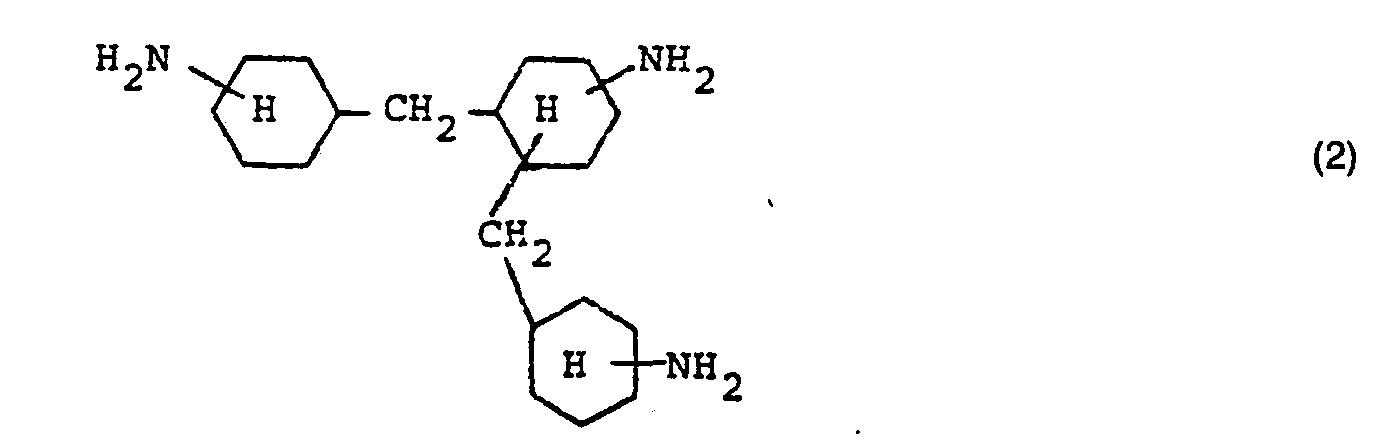
Bevorzugt sind Polyesteramide gemäß vorliegender Erfindung aus
- I. 55-70 Gew.-% e-Caprolactam und
- II. 30-45 Gew.-% eines Gemisches aus
- a) Isophthalsäure und/oder Adipinsäure,
- b) Hexamethylendiamin und/oder hydrierten technischen Diaminodiphenylmethan-Gemischen, die mindestens 75 % 4,4'-Diaminodicyclohexylmethane enthalten und bis zu 10 Mol-% an Dreikerntriaminen der Formel (I) enthalten können und
- c) Polyethylenglykolen mit einem Molgewicht von 200-600.
- I. 55-70 wt .-% e-caprolactam and
- II. 30-45 wt .-% of a mixture
- a) isophthalic acid and / or adipic acid,
- b) hexamethylenediamine and / or hydrogenated technical diaminodiphenylmethane mixtures which contain at least 75% 4,4'-diaminodicyclohexylmethane and up to 10 mol% trinuclear triami NEN of formula (I) can contain and
- c) polyethylene glycols with a molecular weight of 200-600.
Besonders bevorzugt sind Polyesteramide aus
- I. 60-70 Gew.-% e-Caprolactam und
- II. 30-40 Gew.-% eines Gemisches aus
- a) 1 Äquivalent Isophthalsäure,
- b) 0,5-0,9 Äquivalenten eines Diaminodicyclohexylmethan-Gemisches, das mindestens 75 % der 4,4'-lsomeren enthält und
- c) 0,1-0,5 Äquivalenten Polyethylenglykol mit einem Molgewicht von 200-400
wobei die Summe von b) und c) 1 Äquivalent beträgt.
- I. 60-70 wt .-% e-caprolactam and
- II. 30-40% by weight of a mixture
- a) 1 equivalent of isophthalic acid,
- b) 0.5-0.9 equivalents of a diaminodicyclohexylmethane mixture which contains at least 75% of the 4,4'-isomers and
- c) 0.1-0.5 equivalents of polyethylene glycol with a molecular weight of 200-400
where the sum of b) and c) is 1 equivalent.
Durch Mitverwendung von bis zu 10 Mol-% der Dreikerntriamine der Formel (I) kann eine optimale Rieselfähigkeit der Polyesteramide erzielt werden. Zu diesem Zweck können auch geeignete trifunktionelle Alkohole, wie Trimethylolpropan und Glycerin, bei der Polykondensation mit eingesetzt werden.By using up to 10 mol% of the trinuclear triamines of the formula (I), an optimal flowability of the polyester amides can be achieved. For this purpose, suitable trifunctional alcohols, such as trimethylolpropane and glycerol, can also be used in the polycondensation.
Die erfindungsgemäßen Produkte haben Säurezahlen von 5-20, vorzugsweise von 8-15, und relative Viskositäten (1 Gew.-%ige Lösung in m-Kresol bei 25°C) von 1,4-2,2, vorzugsweise von 1,6-2,0. Ihr Erweichungsbereich liegt zwischen 100 und 180°C, vorzugsweise zwischen 120 und 160 °C, ihre Schmelzviskosität beträgt bei 200 °C 0,5 bis 100 Pa.s, vorzugsweise 1 bis 50 Pa.s.The products according to the invention have acid numbers of 5-20, preferably 8-15, and relative viscosities (1% by weight solution in m-cresol at 25 ° C.) of 1.4-2.2, preferably 1.6 -2.0. Their softening range is between 100 and 180 ° C, preferably between 120 and 160 ° C, their melt viscosity at 200 ° C is 0.5 to 100 Pa.s, preferably 1 to 50 Pa.s.
Enthalten die Polyesteramide einen höheren als den erfindungsgemäßen Anteil an eingebauten ―CO(CH2)5NH-Gruppen, so steigt die Schmelzviskosität unerwünscht stark an, bei geringerem Anteil sind die Produkte auch bei Temperaturen unter 100 °C an der Oberfläche klebrig.If the polyesteramides contain a higher than the proportion of built-in CHCO (CH 2 ) 5 NH groups according to the invention, the melt viscosity increases undesirably strongly, with a lower proportion the products are sticky on the surface even at temperatures below 100 ° C.
Ohne die Polyglykolkomponente erhält man hochviskose und hochschmelzende Produkte, die für einen Einsatz als Schmelzklebrohstoff ebenfalls ungeeignet sind. Ohne die Diaminkomponente erhält man, wie in der DDR-Patentschrift 87888 beschrieben, weiche, klebrige Produkte, die nicht rieselfähig sind und infolge mangelnder Erstarrungsneigung keinerlei Klebefestigkeit aufweisen.Without the polyglycol component, highly viscous and high-melting products are obtained which are also unsuitable for use as hot-melt raw materials. Without the diamine component, soft, sticky products are obtained, as described in the GDR patent 87888, which are not free-flowing and have no adhesive strength due to a lack of tendency to solidify.
Die Herstellung der erfindungsgemäßen Polyesteramide kann in an sich bekannter Weise in Autoklaven durch Kondensation der Ausgangskomponenten erfolgen. Das Monomergemisch wird dazu allmählich auf 200-300 °C, vorzugsweise auf 220-250 °C, aufgeheizt und bei diesem Temperaturbereich unter Stickstoffatmosphäre bis zum Erreichen des gewünschten Molgewichts polykondensiert. Der Fortgang der Reaktion kann durch Bestimmung der Säurezahl leicht verfolgt werden. Nach beendeter Polykondensation wird die Polymerschmelze je nach Produktzusammensetzung auf 120-200 °C abgekühlt, aus dem Autoklaven mittels Stickstoffüberdruck als Band oder als Strang ausgepreßt und in geeigneter Weise zerkleinert, z.B. zerhackt, geschnitten oder granuliert.The polyesteramides according to the invention can be prepared in a manner known per se in autoclaves by condensation of the starting components. For this purpose, the monomer mixture is gradually heated to 200-300 ° C., preferably to 220-250 ° C., and polycondensed in this temperature range under a nitrogen atmosphere until the desired molecular weight is reached. The progress of the reaction can easily be followed by determining the acid number. After the polycondensation has ended, the polymer melt is cooled to 120-200 ° C, depending on the product composition, pressed out of the autoclave by means of nitrogen pressure as a ribbon or as a strand and comminuted in a suitable manner, e.g. chopped, cut or granulated.
Das erhaltene rieselfähige Produkt kann durch Extraktion mit Wasser von nicht umgesetztem Caprolactam befreit werden, ohne daß die gute Elastizität der Polyesteramide beeinträchtigt wird. Zusätzlich zeichnen sich die durch Extraktion des monomeren Caprolactams erhältlichen Produkte durch erhöhte Viskositätsstabilität und nochmals verkürzte Abbindezeit aus.The free-flowing product obtained can be freed of unreacted caprolactam by extraction with water without the good elasticity of the polyesteramides being impaired. In addition, the products obtainable by extraction of the monomeric caprolactam are characterized by increased viscosity stability and a further shortened setting time.
Die erfindungsgemäßen Produkte können übliche Zusatzstoffe enthalten, wie z.B. Pigmente, Mattierungsmittel oder Stabilisatoren. Diese Zusatzstoffe können vor, während oder nach der Polykondensation eingearbeitet werden.The products according to the invention can contain conventional additives, such as e.g. Pigments, matting agents or stabilizers. These additives can be incorporated before, during or after the polycondensation.
Die erfindungsgemäßen estermodifizierten Polyamide können zur Elastifizierung von anderen Thermoplasten Verwendung finden, sind jedoch besonders als hochwertige Schmelzklebrohstoffe, vorzugsweise im Bereich der Schuhindustrie geeignet.The ester-modified polyamides according to the invention can be used for the elasticization of other thermoplastics, but are particularly suitable as high-quality hot melt raw materials, preferably in the field of the shoe industry.
Die Erfindung ist nachstehend anhand von Beispielen näher erläutert. Die angegebenen Teile und Prozentsätze beziehen sich stets auf das Gewicht.The invention is explained in more detail below with the aid of examples. The parts and percentages given always relate to the weight.
7,8 kg e-Caprolactam, 2,21 kg (13,3 Mol) Isophthalsäure, 1,37 kg (3,43 Mol) Polyethylenglykol (Molgewicht 400) und 1,16 kg (10,0 Mol) Hexamethylendiamin werden in einem geschlossenen Autoklaven unter N2-Atmosphäre auf 200 °C erhitzt und 2 Stunden bei 200 °C vorkondensiert. Nach vorsichtigem Entspannen wird auf 250 °C aufgeheizt und noch 5 Stunden auskondensiert (Säurezahl des Produkts : 14 mg KOH/g, gemessen in Dimethylformamid). Das Produkt wird auf ca. 200 °C abgekühlt und dann als Strang über ein Metallband ausgetragen und granuliert.7.8 kg of e-caprolactam, 2.21 kg (13.3 mol) of isophthalic acid, 1.37 kg (3.43 mol) of polyethylene glycol (molecular weight 400) and 1.16 kg (10.0 mol) of hexamethylene diamine are combined in one closed autoclave heated to 200 ° C under an N 2 atmosphere and precondensed at 200 ° C for 2 hours. After careful relaxation, the mixture is heated to 250 ° C. and condensed for a further 5 hours (acid number of the product: 14 mg KOH / g, measured in dimethylformamide). The product is cooled to approx. 200 ° C. and then discharged as a strand over a metal belt and granulated.
Der Erweichungsbereich des schwach gelbstichigen Produktes liegt bei 115-130°C; die relative Viskosität (1 %ige Lösung in m-Kresol, 20°C) beträgt 1,4.The softening range of the slightly yellowish product is 115-130 ° C; the relative viscosity (1% solution in m-cresol, 20 ° C) is 1.4.
Die anwendungstechnischen Daten des Produktes sind in Tabelle 1 aufgeführt.The application data of the product are listed in Table 1.
Ein gemäß Beispiel 1 erhaltenes Polyesteramid wird 6 Stunden mit destilliertem Wasser von 40 °C behandelt, wobei 6,3 Gew.-% Caprolactam extrahiert werden. Das so erhaltene Polyesteramid hat einen Erweichungsbereich von 125-140 °C. Die anwendungstechnischen Daten sind ebenfalls in Tabelle 1 aufgeführt.A polyester amide obtained according to Example 1 is treated with distilled water at 40 ° C. for 6 hours, 6.3% by weight of caprolactam being extracted. The polyester amide thus obtained has one Softening range from 125-140 ° C. The application data are also listed in Table 1 .
7,60 kg ε-Caprolactam, 1,53 kg (9,22 Mol) Isophthalsäure, 1,83 kg (4,57 Mol) Polyethylenglykol (Molgewicht 400) und 1,03 kg (4,9 Mol) eines Amingemisches folgender Zusammensetzung
- 95 Gew.-% isomere Diaminodicyclohexylmethane entsprechend der Formel (1) (davon ca. 95 % 4,4'-lsomeres,
- ca. 5 % 2,4'-lsomeres,
- < 1 % 2,2'-lsomeres).
- 95% by weight isomeric diaminodicyclohexylmethanes corresponding to formula (1) (thereof approx. 95% 4,4'-isomer,
- approx. 5% 2,4'-isomer,
- <1% 2,2'-isomer).
5 Gew.-% isomere Dreikerntriamine entsprechend der Formel (2) werden wie in Beispiel 1 beschrieben, zu einem Polyesteramid polykondensiert.5% by weight of isomeric trinuclear triamines corresponding to formula (2) are polycondensed as described in Example 1 to give a polyester amide.
Das Produkt wird aus der auf ca. 200 °C abgekühlten Schmelze durch ein Wasserbad abgesponnen und granuliert, anschließend mit Wasser wie in Beispiel 2 beschrieben, extrahiert. Das fast farblose Produkt hat einen Erweichungsbereich von 135-140 °C (vor der Extraktion 120-130°C), eine relative Viskosität von 1,6 und eine Säurezahl von 11,0 mgKOH/g. Die anwendungstechnischen Prüfergebnisse sind in Tabelle 1 aufgeführt.The product is spun from the melt, which has cooled to about 200 ° C., through a water bath and granulated, then extracted with water as described in Example 2. The almost colorless product has a softening range of 135-140 ° C (before extraction 120-130 ° C), a relative viscosity of 1.6 and an acid number of 11.0 mgKOH / g. The application test results are listed in Table 1.
950 g ε-Caprolactam, 192 g (1,15 Mol) Isophthalsäure, 36 g (0,31 Mol) Hexamethylendiamin, 65 g (0,31 Mol) des in Beispiel 3 beschriebenen Amin-Gemisches und 230 g (0,575 Mol) Polyethylenglykol (Molgewicht 400) werden in einer 4 I-Glasapparatur unter N2-Atmosphäre auf 200 °C aufgeheizt, 2 Stunden bei 200°C vorkondensiert und nach dem Aufheizen auf 250°C 6 Stunden zu Ende kondensiert. Das hellgelbe Produkt wird auf ein Blech ausgegossen, nach dem Erkalten zu Granulat zerhackt und, wie in Beispiel 2 beschrieben, mit Wasser extrahiert. Das Produkt hat eine relative Viskosität von 1,7, eine Säurezahl von 9 mg KOH/g und einen Erweichungsbereich von 145-155 °C. Die anwendungstechnischen Daten sind in Tabelle 1 aufgeführt.950 g of ε-caprolactam, 192 g (1.15 mol) of isophthalic acid, 36 g (0.31 mol) of hexamethylene diamine, 65 g (0.31 mol) of the amine mixture described in Example 3 and 230 g (0.575 mol) of polyethylene glycol (Mol. Weight 400) are heated to 200 ° C. in a 4 l glass apparatus under an N 2 atmosphere, precondensed for 2 hours at 200 ° C. and, after heating to 250 ° C., finally condensed for 6 hours. The light yellow product is poured onto a metal sheet, chopped into granules after cooling and, as described in Example 2, extracted with water. The product has a relative viscosity of 1.7, an acid number of 9 mg KOH / g and a softening range of 145-155 ° C. The application data are listed in Table 1.
Wie in Beispiel 4 beschrieben, wird ein Polyesteramid hergestellt aus
- 900 g ε-Caprolactam
- 240 g (1,64 Mol) Adipinsäure
- 116 g (1,0 Mol) Hexamethylendiamin
- 280 g (0,7 Mol) Polyethylenglykol (Molgewicht 400)
- 900 g ε-caprolactam
- 240 g (1.64 mol) adipic acid
- 116 g (1.0 mol) of hexamethylene diamine
- 280 g (0.7 mol) of polyethylene glycol (molecular weight 400)
Das fast farblose Produkt hat eine Säurezahl von 9,5 mg KOH/g, eine relative Viskosität von 1,5, und einen Erweichungsbereich von 155-165 °C.The almost colorless product has an acid number of 9.5 mg KOH / g, a relative viscosity of 1.5, and a softening range of 155-165 ° C.
Die anwendungstechnischen Daten des Produktes sind in Tabelle 1 zusammengefaßt.The application data of the product are summarized in Table 1.
Wie in Beispiel 4 beschrieben, wird ein Polyesteramid hergestellt aus
- 800 g e-Caprolactam,
- 202 g (1,22 Mol) Isophthalsäure,
- 135 g (0,64 Mol) Amingemisch von Beispiel 3 und
- 120 g (0,6 Mol) Polyethylenglykol (Molgewicht 200).
- 800 g e-caprolactam,
- 202 g (1.22 mol) isophthalic acid,
- 135 g (0.64 mol) of amine mixture from Example 3 and
- 120 g (0.6 mol) of polyethylene glycol (molecular weight 200).
Das hellgelbe transparente Produkt hat nach einer Reaktionszeit von 13 Stunden bei 250 °C eine Säurezahl von 12 mg KOH/g, eine relative Viskosität von 1,6 und einen Erweichungsbereich von 110-120 °C.After a reaction time of 13 hours at 250 ° C., the light yellow transparent product has an acid number of 12 mg KOH / g, a relative viscosity of 1.6 and a softening range of 110-120 ° C.
Die anwendungstechnischen Daten sind in Tabelle 1 aufgeführt.The application data are listed in Table 1.
Die Fixierungszeit wurde wie folgt gemessen :
- 1 Tropfen der auf 200 °C erhitzten Produktschmelze wird auf ein Ende eines 100 x 20 x 3 mm großen Prüfkörpers gegeben, der aus einem mit Schleifband der Körnung 40 in Längsrichtung gerauhten handelsüblichen Naturkautschuk-Vulkanisat mit der Shore-Härte 92 besteht.
- 1 drop of the product melt heated to 200 ° C is placed on one end of a 100 x 20 x 3 mm test specimen which consists of a commercially available natural rubber vulcanizate with Shore hardness 92 roughened in the longitudinal direction with sanding belt 40.
Unmittelbar danach wird das andere Ende des Prüfkörpers von Hand auf die mit Polymerschmelze beschichtete Seite gepreßt.Immediately afterwards, the other end of the test specimen is pressed by hand onto the side coated with polymer melt.
Durch Herstellung mehrerer Klebungen bei unterschiedlich langen Preßzeiten wird die Zeit in Sekunden bestimmt, nach welcher die Klebung der Eigenspannung des Prüfkörpers widersteht und sich nicht mehr ablöst.

Claims (7)
wherein the sum of I and II = 100 % by weight and, based on component a), from 0.5 to 0.9 equivalents of component b) and from 0.1 to 0.5 equivalents of component c) are used, and the sum of components b) and c) is 0.95 to 1.05 equivalents.
wherein the sum of b) and c) is one equivalent and the sum of I and II is 100 % by weight.
Applications Claiming Priority (2)
| Application Number | Priority Date | Filing Date | Title |
|---|---|---|---|
| DE19792913460 DE2913460A1 (en) | 1979-04-04 | 1979-04-04 | ESTERMODIFIED POLYAMID |
| DE2913460 | 1979-04-04 |
Publications (2)
| Publication Number | Publication Date |
|---|---|
| EP0017112A1 EP0017112A1 (en) | 1980-10-15 |
| EP0017112B1 true EP0017112B1 (en) | 1982-10-13 |
Family
ID=6067372
Family Applications (1)
| Application Number | Title | Priority Date | Filing Date |
|---|---|---|---|
| EP80101521A Expired EP0017112B1 (en) | 1979-04-04 | 1980-03-22 | Polyester amides and their use as melt adhesives |
Country Status (5)
| Country | Link |
|---|---|
| US (1) | US4307227A (en) |
| EP (1) | EP0017112B1 (en) |
| JP (1) | JPS55135137A (en) |
| CA (1) | CA1147890A (en) |
| DE (2) | DE2913460A1 (en) |
Families Citing this family (13)
| Publication number | Priority date | Publication date | Assignee | Title |
|---|---|---|---|---|
| FR2497518A1 (en) * | 1981-01-05 | 1982-07-09 | Ato Chimie | THERMOFUSIBLE ADHESIVE COMPOSITIONS BASED ON COPOLYETHERAMIDE SEQUENCES |
| DE3247755A1 (en) * | 1982-12-23 | 1984-06-28 | Plate Bonn Gmbh, 5300 Bonn | COPOLYETHERESTERAMIDES, METHOD FOR THE PRODUCTION THEREOF AND THEIR USE FOR HOT SEALING TEXTILES |
| US4550157A (en) * | 1984-05-07 | 1985-10-29 | The Dow Chemical Company | Polyamide block copolymer from lactam and azetidine-2,4-dione |
| US4656242A (en) * | 1985-06-07 | 1987-04-07 | Henkel Corporation | Poly(ester-amide) compositions |
| US5066843A (en) * | 1989-01-18 | 1991-11-19 | Cem Corporation | Heat resistant and light weight container for materials to be ashed, and process for manufacture thereof |
| DE3909215A1 (en) * | 1989-02-11 | 1990-08-23 | Bayer Ag | POLYETHERAMIDE MELT ADHESIVES |
| FR2672053B1 (en) * | 1991-01-30 | 1993-04-23 | Atochem | POLYETHER BLOCK AMIDES, THEIR SYNTHESIS PROCESS. |
| DE4205860A1 (en) * | 1992-02-26 | 1993-09-02 | Atochem Elf Deutschland | Reactive hot-melt adhesive and coating material - comprises mixt. of amino-terminated co:polyamide(s) and bis-maleimide(s) |
| DE19546657A1 (en) * | 1995-12-14 | 1997-06-19 | Giulini Chemie | New hydrolysis-resistant aliphatic polyester amides, their production and use |
| CN1080752C (en) * | 1997-10-28 | 2002-03-13 | 四川省大邑热缩制品厂 | Thermal state high strength hot melt adhesive with polyamide or polyester amide structure |
| EP2892966A4 (en) | 2011-09-06 | 2016-06-15 | Flint Trading Inc | ANTI-FOAMING AGENTS FOR THERMOFUSIBLE ADHESIVES |
| EP3971565B8 (en) * | 2019-06-14 | 2024-11-06 | Mitsubishi Generator Co., Ltd. | Device for inspecting wedge looseness of rotary electric machine, system for inspecting wedge looseness of rotary electric machine, and method for inspecting wedge looseness of rotary electric machine |
| JP2025524982A (en) | 2022-08-05 | 2025-08-01 | インジェヴィティ ユーケー リミテッド | Bio-based polyols for high performance polyurethane applications |
Family Cites Families (5)
| Publication number | Priority date | Publication date | Assignee | Title |
|---|---|---|---|---|
| US2450940A (en) * | 1944-04-20 | 1948-10-12 | John C Cowan | Polyamides from polymeric fat acids |
| US2886543A (en) * | 1954-08-17 | 1959-05-12 | Gen Mills Inc | Polyamide resin |
| US3546178A (en) * | 1968-12-23 | 1970-12-08 | Eastman Kodak Co | Preparation of linear poly(ester-amides) |
| JPS5119034A (en) * | 1974-08-08 | 1976-02-16 | Toray Industries | HOTSUTOMERUTOSETSUCHAKUZAI |
| DE2542467C2 (en) * | 1975-09-24 | 1983-05-05 | Chemische Werke Hüls AG, 4370 Marl | Process for the production of thermoplastically processable, colorless or practically colorless polyester amides |
-
1979
- 1979-04-04 DE DE19792913460 patent/DE2913460A1/en not_active Withdrawn
-
1980
- 1980-03-22 DE DE8080101521T patent/DE3060934D1/en not_active Expired
- 1980-03-22 EP EP80101521A patent/EP0017112B1/en not_active Expired
- 1980-03-31 US US06/135,884 patent/US4307227A/en not_active Expired - Lifetime
- 1980-04-02 CA CA000349095A patent/CA1147890A/en not_active Expired
- 1980-04-03 JP JP4293180A patent/JPS55135137A/en active Granted
Also Published As
| Publication number | Publication date |
|---|---|
| DE2913460A1 (en) | 1980-10-16 |
| DE3060934D1 (en) | 1982-11-18 |
| CA1147890A (en) | 1983-06-07 |
| JPS6333492B2 (en) | 1988-07-05 |
| EP0017112A1 (en) | 1980-10-15 |
| JPS55135137A (en) | 1980-10-21 |
| US4307227A (en) | 1981-12-22 |
Similar Documents
| Publication | Publication Date | Title |
|---|---|---|
| DE3247755C2 (en) | ||
| EP0027852B1 (en) | Transparent copolyamides and their use in the production of transparent impact-resistent moulded articles | |
| DE3723688A1 (en) | Partly aromatic copolyamides having a reduced triamine content | |
| CH667462A5 (en) | TRANSPARENT COPOLYAMIDES, METHOD FOR THE PRODUCTION THEREOF AND THEIR USE FOR THE PRODUCTION OF MOLDED BODIES. | |
| EP0017112A1 (en) | Polyester amides and their use as melt adhesives | |
| DE2949064C2 (en) | Use of copolyether ester amides as hot melt adhesives for heat sealing textiles | |
| JPS6136858B2 (en) | ||
| DE4318047A1 (en) | Use of copolyamides for heat sealing | |
| DE10259048A1 (en) | copolyamides | |
| EP0012931B1 (en) | Copolyamides based on a mixture of cycloaliphatic amines and moulded articles thereof | |
| EP0002431B1 (en) | Transparent polyamides and their use for making mouldings | |
| EP0384163A2 (en) | Polyetheramide hot melt adhesives | |
| DE69213457T2 (en) | Copolyadipinamide containing ethyl tetramethylene adipinamide units and products made from them | |
| DE69213455T2 (en) | Copolyadipinamide containing trimethylhexamethylene adipinamide units and products made from them | |
| EP0001039B1 (en) | Transparent polyamide | |
| EP0182957A1 (en) | Polyamides | |
| EP0000492B1 (en) | Transparent polyamides and their use for the manufacture of moulds | |
| DE1520924A1 (en) | Process for the production of polyamides | |
| EP0504784B1 (en) | Polyetheresteramides, process for their preparation and their use | |
| CH668600A5 (en) | METHOD FOR THE PRODUCTION OF THERMOPLASTICALLY PROCESSABLE BLOCK POLYURETHANAMIDES WITH POLYURETHANE AND POLYAMIDE SEGMENTS LINKED BY ESTER BONDING AND THE USE THEREOF. | |
| CH630932A5 (en) | METHOD FOR PRODUCING NEW TRANSPARENT POLYAMIDES. | |
| EP0503235B1 (en) | Polyamide and polyesteramide based on trimerised fatty acids-process of production and application for glues | |
| DE2814566A1 (en) | COPOLYAMIDE RESINS, PROCESS FOR THEIR MANUFACTURE AND USE FOR ADHESIVE PURPOSES | |
| DE3315529A1 (en) | Use of copolyamides for the heat-sealing of textiles | |
| DE4205860A1 (en) | Reactive hot-melt adhesive and coating material - comprises mixt. of amino-terminated co:polyamide(s) and bis-maleimide(s) |
Legal Events
| Date | Code | Title | Description |
|---|---|---|---|
| PUAI | Public reference made under article 153(3) epc to a published international application that has entered the european phase |
Free format text: ORIGINAL CODE: 0009012 |
|
| 17P | Request for examination filed | ||
| AK | Designated contracting states |
Designated state(s): BE DE FR GB IT NL |
|
| ITF | It: translation for a ep patent filed | ||
| GRAA | (expected) grant |
Free format text: ORIGINAL CODE: 0009210 |
|
| AK | Designated contracting states |
Designated state(s): BE DE FR GB IT NL |
|
| REF | Corresponds to: |
Ref document number: 3060934 Country of ref document: DE Date of ref document: 19821118 |
|
| PLBE | No opposition filed within time limit |
Free format text: ORIGINAL CODE: 0009261 |
|
| STAA | Information on the status of an ep patent application or granted ep patent |
Free format text: STATUS: NO OPPOSITION FILED WITHIN TIME LIMIT |
|
| 26N | No opposition filed | ||
| PGFP | Annual fee paid to national office [announced via postgrant information from national office to epo] |
Ref country code: FR Payment date: 19910226 Year of fee payment: 12 |
|
| PGFP | Annual fee paid to national office [announced via postgrant information from national office to epo] |
Ref country code: GB Payment date: 19910311 Year of fee payment: 12 |
|
| PGFP | Annual fee paid to national office [announced via postgrant information from national office to epo] |
Ref country code: BE Payment date: 19910327 Year of fee payment: 12 |
|
| ITTA | It: last paid annual fee | ||
| PGFP | Annual fee paid to national office [announced via postgrant information from national office to epo] |
Ref country code: NL Payment date: 19910331 Year of fee payment: 12 |
|
| PGFP | Annual fee paid to national office [announced via postgrant information from national office to epo] |
Ref country code: DE Payment date: 19920221 Year of fee payment: 13 |
|
| PG25 | Lapsed in a contracting state [announced via postgrant information from national office to epo] |
Ref country code: GB Effective date: 19920322 |
|
| PG25 | Lapsed in a contracting state [announced via postgrant information from national office to epo] |
Ref country code: BE Effective date: 19920331 |
|
| BERE | Be: lapsed |
Owner name: BAYER A.G. Effective date: 19920331 |
|
| PG25 | Lapsed in a contracting state [announced via postgrant information from national office to epo] |
Ref country code: NL Effective date: 19921001 |
|
| NLV4 | Nl: lapsed or anulled due to non-payment of the annual fee | ||
| GBPC | Gb: european patent ceased through non-payment of renewal fee | ||
| PG25 | Lapsed in a contracting state [announced via postgrant information from national office to epo] |
Ref country code: FR Effective date: 19921130 |
|
| REG | Reference to a national code |
Ref country code: FR Ref legal event code: ST |
|
| PG25 | Lapsed in a contracting state [announced via postgrant information from national office to epo] |
Ref country code: DE Effective date: 19931201 |