EP0018515A2 - Verfahren zur Herstellung von Chenodeoxycholsäure und Zwischenprodukte dazu - Google Patents
Verfahren zur Herstellung von Chenodeoxycholsäure und Zwischenprodukte dazu Download PDFInfo
- Publication number
- EP0018515A2 EP0018515A2 EP80101893A EP80101893A EP0018515A2 EP 0018515 A2 EP0018515 A2 EP 0018515A2 EP 80101893 A EP80101893 A EP 80101893A EP 80101893 A EP80101893 A EP 80101893A EP 0018515 A2 EP0018515 A2 EP 0018515A2
- Authority
- EP
- European Patent Office
- Prior art keywords
- formula
- compound
- product
- alkyl
- diol
- Prior art date
- Legal status (The legal status is an assumption and is not a legal conclusion. Google has not performed a legal analysis and makes no representation as to the accuracy of the status listed.)
- Granted
Links
- 0 C[C@](*)C(CC1)C(C)(CC*2C(C)(*)CC3)C1C2C(*O)CCCC3O Chemical compound C[C@](*)C(CC1)C(C)(CC*2C(C)(*)CC3)C1C2C(*O)CCCC3O 0.000 description 2
- WXOOEFUQDFYJPQ-ADQCSAOJSA-N C[C@@H](C(CC1)C(C)(CCC2C(C)(CC[C@H](C3)O)C3(CC=[IH])C3)C1C2[C@@H]3O)N Chemical compound C[C@@H](C(CC1)C(C)(CCC2C(C)(CC[C@H](C3)O)C3(CC=[IH])C3)C1C2[C@@H]3O)N WXOOEFUQDFYJPQ-ADQCSAOJSA-N 0.000 description 1
- ZNWOYQVXPIEQRC-HAGDTCALSA-N C[C@H](CO)C(CC1)C(C)(CC2)C1C(CC1)C2C(C)(CC2)C1=CC2=O Chemical compound C[C@H](CO)C(CC1)C(C)(CC2)C1C(CC1)C2C(C)(CC2)C1=CC2=O ZNWOYQVXPIEQRC-HAGDTCALSA-N 0.000 description 1
Classifications
-
- C—CHEMISTRY; METALLURGY
- C07—ORGANIC CHEMISTRY
- C07J—STEROIDS
- C07J9/00—Normal steroids containing carbon, hydrogen, halogen or oxygen substituted in position 17 beta by a chain of more than two carbon atoms, e.g. cholane, cholestane, coprostane
- C07J9/005—Normal steroids containing carbon, hydrogen, halogen or oxygen substituted in position 17 beta by a chain of more than two carbon atoms, e.g. cholane, cholestane, coprostane containing a carboxylic function directly attached or attached by a chain containing only carbon atoms to the cyclopenta[a]hydrophenanthrene skeleton
-
- C—CHEMISTRY; METALLURGY
- C07—ORGANIC CHEMISTRY
- C07J—STEROIDS
- C07J31/00—Normal steroids containing one or more sulfur atoms not belonging to a hetero ring
- C07J31/006—Normal steroids containing one or more sulfur atoms not belonging to a hetero ring not covered by C07J31/003
-
- C—CHEMISTRY; METALLURGY
- C07—ORGANIC CHEMISTRY
- C07J—STEROIDS
- C07J9/00—Normal steroids containing carbon, hydrogen, halogen or oxygen substituted in position 17 beta by a chain of more than two carbon atoms, e.g. cholane, cholestane, coprostane
-
- C—CHEMISTRY; METALLURGY
- C12—BIOCHEMISTRY; BEER; SPIRITS; WINE; VINEGAR; MICROBIOLOGY; ENZYMOLOGY; MUTATION OR GENETIC ENGINEERING
- C12P—FERMENTATION OR ENZYME-USING PROCESSES TO SYNTHESISE A DESIRED CHEMICAL COMPOUND OR COMPOSITION OR TO SEPARATE OPTICAL ISOMERS FROM A RACEMIC MIXTURE
- C12P33/00—Preparation of steroids
- C12P33/06—Hydroxylating
Definitions
- the present invention relates to a process for the preparation of chenodeoxycholic acid of the formula from 3-keto-bisnorcholenol (22-hydroxy-23,24-bisnorchol-4-en-3-one), a compound of the formula which is easily obtainable by microbiological degradation of the commercially available ⁇ -sitosterol by known methods.
- the invention relates to a process for the preparation of chenodeoxycholic acid, which is characterized in that (5 ⁇ ) -24-Nocholan-3a, 7a-diol-23,23-dicarboxylic acid is thermally decarboxylated.
- 3-keto-bisnorcholenol is microbiologically hydroxylated in the 7-position, 7 ⁇ -hydroxy-3-keto-bisnorcholenol (7a, 22-dihydroxy-23,24-bisnorchol-4-en-3-one ) is obtained.
- the microorganisms can be used in the form of the culture solution, the mycelium or an enzyme extract thereof.
- the culture solution can be prepared by inoculating the organism with a suitable medium.
- the culture medium can contain carbon sources, nitrogen sources / inorganic salts and other nutrients suitable for the growth of the microorganism.
- carbon sources are glucose, sucrose, dextrin, mannose, starch, lactose or glycerin;
- Nitrogen sources are, for example, nitrogenous substances such as peptones, meat extract, yeast extract, grain steepliquor or casein or nitrogenous inorganic compounds such as nitrates or inorganic ammonium salts.
- inorganic salts are phosphates and mineral salts such as sodium, potassium, magnesium manganese, iron and copper salts.
- Submerged cultures shake cultures or stationary cultures can be used as the cultivation method. Since aerobic conditions are required for the organisms used in the present invention, it is preferable to cultivate under conditions that promote aeration.
- the hydroxylation according to the invention it is also possible to use a mycelium isolated from the culture solution of the microorganism or a crude enzyme extract which has been prepared from the culture solution or the mycelium in a manner known per se and to bring it into contact with the substrate under suitable conditions .
- the 7 ⁇ -hydroxylation can expediently be carried out in aqueous solution such as in a buffer solution, in physiological saline, in fresh nutrient medium or in water.
- the substrate can be added in powder form or as a solution in a hydrophilic solvent such as acetone, dimethyl sulfoxide, methanol, ethanol, ethylene glycol, propylene glycol or dioxane.
- a surfactant or dispersant can be added to a substrate suspension in water.
- the substrate can be finely suspended using ultrasound.
- the fermentation process uses conventional working techniques.
- the microorganism can be grown in an Edamin broth (the same as the fermentation medium, see below) for 18 to 72 hours at about 15-35 ° C.
- the fermentation is initiated by inoculating a conventional fermentation medium with 1 to 10 weight percent biomass.
- the fermentation conditions can be the same as when growing the inoculum.
- the substrate is added either as a solution, preferably in absolute ethanol, or as a solution prepared under sonication in 0.1% Tween 80® (polyoxyethylene sorbitan monoleate).
- the fermentation can be continued up to 120 hours after adding the substrate.
- a suitable fermentation medium is obtained, for example, by mixing the following constituents: 20 g Edamin® (a product of the Sheffield Chemical Co. produced by enzymatic degradation of lactalbumin) 3 g cornsteepliquor, 50 g dextrose and distilled water to one liter.
- the pH of the medium is adjusted to about 4 to 7, preferably pH 5, before sterilization (which can be carried out e.g. by autoclaving).
- the isolation of the 7 ⁇ -hydroxy-3-keto-bisnorcholenol from the fermentation medium can easily be carried out by methods known per se.
- the entire culture solution can thus be extracted with an immiscible organic solvent, such as preferably ethyl acetate.
- the solvent fractions can then be analyzed by gel chromatography, e.g. Silica gel G-60, and subsequent crystallization.
- a number of methods can be used to optimize the yield of fermentation product. Examples include the addition of a chelating agent, such as 2,2'-dipyridyl in a final concentration of 0.5 ⁇ 10 -4 to 0.75 ⁇ 10 -3 mol, simultaneous addition of glucose or sucrose with the substrate in a final concentration of about 5 %, Reduction of the fermentation temperature to about 24 ° C after addition of the substrate and application of a substrate concentration of 5% in 0.1% Tween 80®. An even greater increase in yield is possible by adding adsorbents to the fermentation medium.
- a chelating agent such as 2,2'-dipyridyl in a final concentration of 0.5 ⁇ 10 -4 to 0.75 ⁇ 10 -3 mol
- polymeric resin adsorbents such as Amberlit XAD7® (a polymeric acrylic acid methyl ester from Rohm & Haas Co.) are added in a concentration of 0.3 to 0.6 percent by weight to a fermentation medium in which the substrate is added in a Concentration of up to about 1 g per liter is present. Best yields were achieved with a concentration of about 0.6 percent by weight of adsorbent.
- the 7 ⁇ -hydroxy-3-keto-bisnorcholenol thus produced is then catalytically hydrogenated to (5 ⁇ ) -7a, 22-dihydro-23,24-bis-norcholan-3-one.
- a suitable catalyst for this hydrogenation is palladium, preferably on a solid support, in particular 5% palladium on carbon.
- the reaction is convenient sig in a non-aqueous polar solvent such as dimethylformamide and at a temperature of about 0-50 ° C, preferably at room temperature and normal pressure.
- the reaction product can be isolated in the same manner as described above for the fermentation, ie isolated by gel chromatography and crystallization.
- the (5 ⁇ ) -7 ⁇ , 22-dihydro-23,24-bisnorcholan-3-one is then reacted with a p-tolyl or methylsulfonyl halide in the range from -78 to 0 ° C., preferably at -10 ° C.
- the reaction is conveniently carried out in a nitrogen-containing organic solvent, such as pyridine.
- a preferred reagent for this reaction is p-toluenesulfochloride.
- the reaction product, a compound of the formula V ER- can be isolated in the same manner as described for the above compounds.
- a preferred compound III is (5 ⁇ ) -7a-hydroxy-22 - ([4-methylphenyl] sulfonyl-oxy) -23,24-bisnorcholan-3-one.
- the compound of the formula III with sodium di-C 1-3 -alkylmalonate, preferably dimethylmalonate is expediently in a polar non-aqueous solvent such as dimethylformamide at temperatures between 0 and 100 ° C., preferably at 50 ° C, with exclusion of moisture in an inert gas atmosphere.
- the sodium di-C1-3 alkyl malo- nat can be prepared in situ by adding the malonate to a solution of sodium hydride in dimethylformamide and stirring at 40-50 ° C.
- a preferred compound of the formula is (5 ⁇ ) -24-norcholan-7 ⁇ -ol-3-one-23,24-dicarboxylic acid dimethyl ester.
- the compound of formula IV then becomes the 3-hydroxy compound of the formula , for example reduced to (5ß) -24-norcholan-3a, 7a-diol-23,23-dicarboxylic acid dimethyl ester.
- the reduction is expediently carried out using a conventional chemical reducing agent, such as sodium borohydride, in an aqueous C 1-3 alkanol as solvent, such as, for example, 95% ethanol, at 0-50 ° C., preferably at room temperature carried out under an inert gas atmosphere.
- a conventional chemical reducing agent such as sodium borohydride
- an aqueous C 1-3 alkanol as solvent such as, for example, 95% ethanol
- the diol of formula V is then refluxed in the presence of a strong base e.g. Barium hydroxide saponifies and provides the (5ß) -24-norcholan-3 ⁇ , 7 ⁇ -diol-23,24-dicarboxylic acid after work-up and acidification.
- a strong base e.g. Barium hydroxide saponifies and provides the (5ß) -24-norcholan-3 ⁇ , 7 ⁇ -diol-23,24-dicarboxylic acid after work-up and acidification.
- the last stage of the V 3 process according to the invention is that the dicarboxylic acid is thermally decarboxylated, for example by heating to 190-205 ° C. under an inert gas atmosphere, giving chenodeoxycholic acid.
- a compound of the formula III can be inert with a chemical reducing agent, such as lithium aluminum alkoxy hydride, preferably lithium aluminum tri-t-butoxy hydride, at from about -78 ° C. to room temperature, preferably at about -10 ° C. organic solvents, such as a cyclic ether, preferably tetrahydrofuran, under an inert gas atmosphere to give a diol of the formula be reduced.
- a chemical reducing agent such as lithium aluminum alkoxy hydride, preferably lithium aluminum tri-t-butoxy hydride
- a preferred compound of formula VI is 2,2 - ([4-methylphenylsulfonyl] oxy) -23,24-bisnorcholan-3 ⁇ , 7 ⁇ -diol.
- acylating agent which is known in steroid chemistry for protecting hydroxyl groups, and gives the corresponding diacyl compound.
- Suitable acylating agents are C 2-6 lower alkanecarboxylic acid anhydrides, preferably acetic anhydride.
- the acylation is conveniently carried out in a suitable organic solvent, such as pyridine, in the presence of an amine base, such as 4-dimethylaminopyridine, using the diacyl derivative of the formula eg 22 - ([(4-methylphenyl) sulfonyl] oxy) -23,24-bisnorcholane-3a, 7a-diol-3,7-diacetate.
- a suitable organic solvent such as pyridine
- an amine base such as 4-dimethylaminopyridine
- the diacyl compound of formula VII is then treated with a sodium di-C 1-3 alkyl malonate, preferably diethyl malonate, in analogy to the reaction of the compound of formula III described above to a compound IV, whereby a compound of formula For example, 3a, 7a- (diacetoxy) -24-norcholan-23,23-diearbonic acid diethyl ester is obtained.
- Conversion of a compound of formula VIII to the (5 ⁇ ) -24-norcholan-3a, 7a-diol-23,23-dicarboxylic acid is accomplished by saponification with a strong base such as an alkali metal hydroxide solution, preferably potassium hydroxide at elevated temperature, preferably at the reflux temperature.
- a strong base such as an alkali metal hydroxide solution, preferably potassium hydroxide at elevated temperature, preferably at the reflux temperature.
- the reaction can be carried out in the presence of a lower alkanol as a solvent such as e.g. Methanol, isopropanol or mixtures thereof can be run.
- Fermentation process The cultures were kept on the following media: Bacteria: glucose, nutrient agar. Mushrooms: Sabouraud Dextrose Agar (SD) (Difco). Actinomycetes: starch-casein agar.
- Bacteria glucose, nutrient agar.
- Mushrooms Sabouraud Dextrose Agar (SD) (Difco).
- Actinomycetes starch-casein agar.
- Vegetative inoculum was prepared either in Sabouraud dextrose broth (Difco) or in the medium used in the fermentation. The latter was composed as follows: Edamin® (Sheffield Chemical Co.), 20 g; Cornsteep liquor (Corn Products Co.) 3 g; Dextrose 50 g, distilled water to a liter. The pH was adjusted to 5.0 by adding HC1 prior to autoclaving. The fermentations were carried out in either 250 or 500 ml Erlenmeyer flasks containing 50 or 100 ml medium.
- the flasks were inoculated with 5% biomass from cultures that had been prepared on a rotary shaker at 250 rpm (5 cm eccentricity) in the material used for the preparation of the inoculum medium for 72 hours at 28 0 C. Unless otherwise stated, these conditions were also used in the fermentation.
- 3-Keto-bisnorcholenol was 48 hours after the incubation either as a solution in ethanol or as a 5% suspension in a 0.1% solution of Tween 80® (Atlas Chemical Industries) which had been prepared by sonication (Bronson Sonifier Cell Disruptor 200) added. Incubation was carried out up to 120 hours after adding the substrate.
- the quantitative analyzes were carried out by thin layer chromatography. These were carried out with ethyl acetate extracts from fermentation samples. The extracts were evaporated to dryness at 40 ° C. and dissolved in an amount of ethanol 10 times less than the original volume. Chromatography was carried out on silica gel Tief 254 thin-layer plates (E. Merck, Darmstadt) under development with ethyl acetate. The developed plates were air dried and the spots under short-wave UV (254 nm) made visible. The RF values in this thin film system were 0.75 and 0.36 for substrate and product. Small amounts of products with RF values lower than 0.36 were seen in the chromatogram; separation from the desired product could be improved by repeated development using the same solvent system.
- Quantitative determinations of the substances contained in the stains were carried out by carefully transferring the material forming the stain into a test tube and eluting with 5 ml of ethanol overnight. The absorption of the eluate was measured at 240 nm in a Gilford 250 spectrophotometer and compared with values obtained from standard preparations. Fluorescence measurements of the spots were also carried out for quantitative determination.
- High pressure liquid chromatography analyzes were carried out on a silica gel column (SR-I-10) under development with 20% dioxane in methylene chloride, UV light of 254 nm being used as the detector.
- This product was recrystallized from hexane / ethyl acetate and gave in a first fraction 0.086 g (76%) of a product which had the same spectral properties as authentic chenodeoxycholic acid and gave no melting point depression.
- An analytical preparation was obtained by chromatography on silica gel 60 and elution with methylene chloride / methanol / hexane (2: 1: 1) and recrystallization from ethyl acetate.
Landscapes
- Chemical & Material Sciences (AREA)
- Organic Chemistry (AREA)
- Health & Medical Sciences (AREA)
- General Health & Medical Sciences (AREA)
- Life Sciences & Earth Sciences (AREA)
- Engineering & Computer Science (AREA)
- Zoology (AREA)
- Wood Science & Technology (AREA)
- General Chemical & Material Sciences (AREA)
- Microbiology (AREA)
- Chemical Kinetics & Catalysis (AREA)
- Biotechnology (AREA)
- Biochemistry (AREA)
- Bioinformatics & Cheminformatics (AREA)
- General Engineering & Computer Science (AREA)
- Genetics & Genomics (AREA)
- Steroid Compounds (AREA)
- Preparation Of Compounds By Using Micro-Organisms (AREA)
Abstract
Description
- Die vorliegende Erfindung betrifft ein Verfahren zur Herstellung von Chenodeoxycholsäure der Formel


- In einer Beziehung betrifft die Erfindung ein Verfahren zur Herstellung von Chenodeoxycholsäure, welches dadurch gekennzeichnet ist, dass man (5ß)-24-Nocholan-3a,7a-diol-23,23-dicarbonsäure thermisch decarboxyliert.
- Ein weiterer Aspekt der Erfindung betrifft ein Verfahren zur Herstellung von (5ß)-24-Norcholan-3α,7α-diol-23,23-dicarbonsäure aus 3-Keto-bis-norcholenol, welches Verfahren dadurch gekennzeichnet ist, dass man
- A) 3-Keto-bisnorcholenol mittels eines Mikroorganismus der Gruppe Botryodiplodia theobromae IFO 6469, DSM 62-678; DSM 62-679; Lasiodiplodia theobromae ATCC 28570; Botryosphaeria ribis ATCC 22802, B. berengeriana ATCC 12557, B. rhodina CBS 374.54, CBS 287.47 und CBS 306.58 oder einem Enzymextrakt davon zu 7α-Hydroxy-3-keto-bis- norcholenol hydrolysiert;
- B) das 7α-Hydroxy-3-keto-bisnorcholenol in Gegenwart eines Palladiumkatalysators zu (5ß)-7a,22-dihydroxy-23,24-bisnorcholan-3-on hydriert,
- C) das (5ß)-7α-22,Dihydroxy-23,24-bisnorcholan-3-on mit einem Methyl- oder p-Tolylsulfonylhalid zu einer Verbindung der Formel

- D) das Produkt von Stufe C) mit einem Natrium-di-C1-3-alkyl-malonat zu einer Verbindung der Formel

- E) das Produkt der Stufe D) mit einem chemischen Reduktionsmittel behandelt, um eine Verbindung der Formel

- F) das Produkt der Stufe E) mit einer starken Base zu (5ß)-24-Norcholan-3α,7α-diol,23,23-dicarbonsäure verseift; oder
- G) das Produkt der Stufe C) mit einem chemischen Reduktionsmittel behandelt, um eine Verbindung der Formel

- H) das Produkt der Stufe G) mit einem mehr als zweifachen molaren Ueberschuss eines in der Steroidchemie zum Schutze von Hydroxygruppen üblichen Acylierungsmittels zu einer Verbindung der Formel

- I) das Produkt der Stufe H) mit einem Natrium-di-C1-3-al- kylmalonat zu einer Verbindung der Formel

- J) das Produkt der Stufe I) mit einer starken Base zu (5ß)-24-Norcholan-3a,7a-diol-23,23-dicarbonsäure verseift.
- In der ersten Verfahrensstufe der vorliegenden Erfindung wird 3-Keto-bisnorcholenol in 7-Stellung mikrobiologisch hydroxyliert, wobei 7α-Hydroxy-3-keto-bisnorcholenol(7a,22-dihydroxy-23,24-bisnorchol-4-en-3-on) erhalten wird.
- Unerwarteterweise wurde gefunden, dass von 152 Kulturen, die auf 7α-Hydroxylierung geprüft wurden und die 92 Spezies in 41 Genera repräsentierten, wovon vielen die Fähigkeit zur 7-Alphahydroxylierung der verschiedenen oben aufgezählten Verbindungen zugeschrieben worden war, nur 9 sehr nahe verwandte Kulturen, nämlich Botryodiplodia theobromae IFO 6469, ATCC 28570, DSM 62-678, DSM 62-679; Botryosphaeria'ribis ATCC 22802, B. berengeriana ATCC 12557, B. rhodina CBS 374.54, CBS 287.47 und CBS 306.58 in der Lage sind die gewünschte 7α-Hydroxylierung dieses Steroidsubstrats durchzuführen.
- Die Mikroorganismen können in Form der Kulturlösung, des Mycels oder eines Enzymextraktes daraus angewendet werden. Die Kulturlösung kann durch Beimpfen.eines geeigneten Mediums mit dem Organismus hergestellt werden. Das Kulturmedium kann Kohlenstoffquellen, Stickstoffquellen/anorganische Salze und andere für das Wachstum des Mikroorganismus geeignete Nährstoffe enthalten. Kohlenstoffquellen sind beispielsweise Glukose, Sucrose, Dextrin, Mannose, Stärke, Lactose oder Glycerin; Stickstoffquellen sind beispielsweise stickstoffhaltige Substanzen wie Peptone, Fleischextrakt, Hefeextrakt, Kornsteepliquor oder Casein oder stickstoffhaltige anorganische Verbindungen wie Nitrate oder anorganische Ammoniumsalze. Beispiele anorganischer Salze sind Phosphate und Mineralsalze wie Natrium, Kalium, Magnesium Mangan, Eisen-und Kupfersalze.
- Als Kultivierungsmethode können Submerskulturen, Schüttelkulturen oder stationäre Kulturen verwendet werden. Da aerobe Bedingungen für die erfindungsgemäss verwendeten Organismen erforderlich sind, ist es vorzuziehen, unter Bedingungen zu kultivieren, die die Belüftung fördern.
- Es ist bei der erfindungsgemässen Hydroxylierung auch möglich, ein von der Kulturlösung des Mikroorganismus isoliertes Mycel oder einen rohen Enzymextrakt der aus der Kulturlösung oder dem Mycel in an sich bekannter Weise hergestellt worden ist, zu verwenden und unter geeigneten Bedingungen mit dem Substrat in Kontakt zu bringen. In einem solchen Fall kann die 7α-Hydroxylierung zweckmässig in wässriger Lösung wie in einer Pufferlösung,in physiologischer Kochsalzlösung, in frischem Nährmedium oder in Wassser durchgeführt werden.
- Das Substrat kann in Pulverform oder als Lösung in einem hydrophilen Lösungsmittel wie Aceton, Dimethylsulfoxid, Methanol, Aethanol, Aethylenglykol, Propylenglykol oder Dioxan zugesetzt werden. Einer Substratsuspension in Wasser kann ein oberflächenaktives oder Dispersionsmittel zugesetzt werden. Weiterhin kann das Substrat mittels Ultraschall fein suspendiert werden.
- Das Fermentierungsverfahren verwendet konventionelle Arbeitstechniken. So kann der Mikroorganismus in einer Edaminbrühe (die gleiche wie das Fermentationsmedium, siehe unten) während 18 bis 72 Stunden bei etwa 15-35°C angezüchtet werden. Die Fermentation wird eingeleitet, indem man ein konventionelles Fermentationsmedium mit 1 bis 10 Gewichtsprozent Biomasse beimpft. Die Fermentationsbedingungen können die gleichen sein wie bei der Anzucht des Inoculums. Nach einer Inkubationsperiode von 18 bis 96 Stunden wird das Substrat entweder als Lösung, vorzugsweise in absolutem Aethanol, oder als unter Beschallung hergestellte Lösung in 0,1% Tween 80®(Polyoxy- äthylen-sorbitan-monoleat) zugegeben. Die Fermentation kann bis zu 120 Stunden nach Zugabe des Substrats fortgesetzt werden. Ein geeignetes Fermentationsmedium wird beispielsweise durch Mischen folgender Bestandteile er-' halten: 20 g Edamin®(ein durch enzymatischen Abbau von Lactalbumin hergestelltes Produkt der Sheffield Chemical Co.) 3 g Cornsteepliquor, 50 g Dextrose und destilliertes Wasser zu einem Liter. Das pH des Mediums wird auf etwa 4 bis 7, vorzugsweise auf pH 5, vor der Sterilisierung (die z.B. durch Autoklavieren durchgeführt werden kann) eingestellt.
- Die Isolierung des 7α-Hydroxy-3-keto-bisnorcholenol aus dem Fermentationsmedium kann leicht nach an sich bekannten Verfahren durchgeführt werden. So kann die gesamte Kulturlösung mit einem nicht mischbaren organischen Lösungsmittel, wie vorzugsweise Aethylacetat, extrahiert werden. Die Lösungsmittelfraktionen können dann mittels Gelchromatographie, z.B. Silicagel G-60, und anschliessende Kristallisation gereinigt werden.
- Es wurde weiter gefunden, dass eine Anzahl von Verfahren zur Optimierung der Ausbeute an Fermentationsprodukt angewandt werden kann. Beispiele dafür sind der Zusatz eineschelatbildners, wie 2,2'-Dipyridyl in einer Endkonzentration von 0,5 x 10 -4 bis 0,75 x 10 -3 Mol, gleichzeitiger Zusatz von Glukose oder Sucrose mit dem Substrat in einer Endkonzentration von etwa 5%, Herabsetzung der Fermentationstemperatur auf etwa 24°C nach Zusatz des Substrats und Anwendung einer Substratkonzentration von 5% in 0,1% Tween 80®. Eine noch grössere Ausbeutesteigerung ist möglich durch Zusatz von Adsorbentien zum Fermentationsmedium. Beispielsweise wird eine Verbesserung der Ausbeute erreicht, wenn polymere Harz-Adsorbentien wie Amberlit XAD7®(ein polymerer Acrylsäuremethylester der Rohm & Haas Co.) in einer Konzentration von 0,3 bis 0,6 Gewichtsprozent einem Fermentationsmedium zugesetzt wird in dem das Substrat in einer Konzentration von bis etwa 1 g pro Liter anwesend ist. Beste Ausbeuten wurden erreicht mit einer Konzentration von etwa 0,6 Gewichtsprozenten an Adsorptionsmittel.
- Das so hergestellte 7α-Hydroxy-3-keto-bisnorcholenol wird dann katalytisch zu (5ß)-7a,22-dihydro-23,24-bis- norcholan-3-on hydriert.
- Ein geeigneter Katalysator für diese Hydrierung ist Palladium, vorzugsweise auf einem festen Träger, insbesondere 5% Palladium auf Kohle. Die Reaktion wird zweckmässig in einem nicht wässrigen polaren Lösungsmittel wie Dimethylformamid und bei einer Temperatur von etwa 0-50°C, vorzugsweise bei Raumtemperatur und Normaldruck, ausgeführt. Das Reaktionsprodukt kann in der gleichen Weise wie oben bei der Fermentation beschrieben, d.h. durch Gelchromatographie und Kristallisation isoliert werden.
- Das (5ß)-7α,22-Dihydro-23,24-bisnorcholan-3-on wird dann mit einem p-Tolyl oder Methylsulfonylhalid zweckmässig im Bereich von -78 bis 0°C, vorzugsweise bei -10°C, umgesetzt. Die Reaktion wird zweckmässig in einem stickstoffhaltigen organischen Lösungsmittel, wie Pyridin, ausgeführt. Ein bevorzugtes Reagens für diese Umsetzung ist p-Toluolsulfochlorid. Das Reaktionsprodukt, eine Ver- bindung der Formel

- Eine bevorzugte Verbindung III ist (5ß)-7a-Hydroxy-22-([4-methylphenyl]sulfonyl-oxy)-23,24-bisnorcholan-3-on.
- Im nächsten Schritt des erfindungsgemässen Verfahrens wird die Verbindung der Formel III mit Natrium-di-C1-3-al- kylmalonat, vorzugsweise Dimethylmalonat, zweckmässig in einem polaren nicht wässrigen Lösungsmittel wie Dimethylformamid bei Temperaturen zwischen 0 und 100°C, vorzugsweise bei 50°C, unter Feuchtigkeitsausschluss in Inertgasatmosphäre, umgesetzt. Das Natrium-di-C1-3-Alkylmalo- nat kann in situ durch Zusatz des Malonats zu einer Lösung von Natriumhydrid in Dimethylformamid und Rühren bei 40-50°C hergestellt werden. Die Isolierung des Verfahrensproduktes, einer Verbindung der Formel
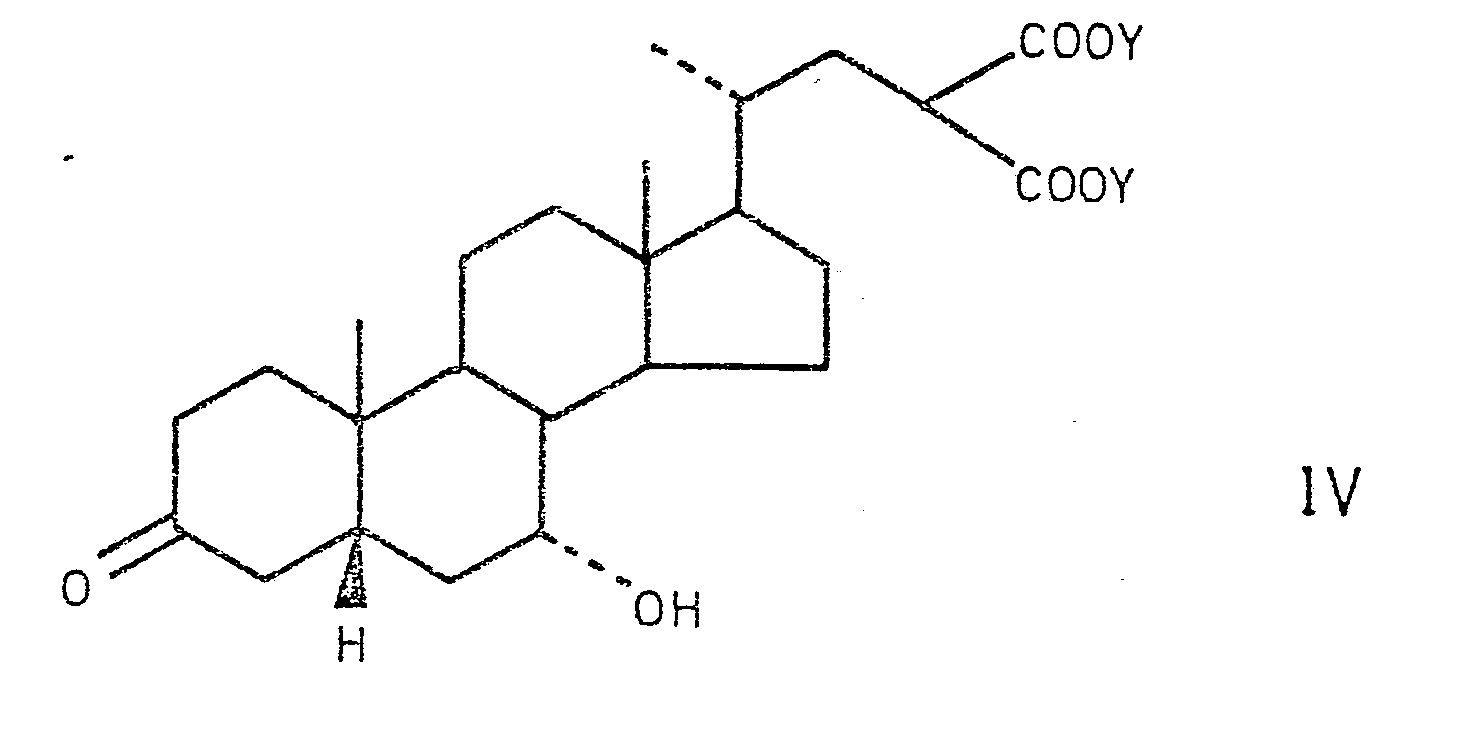
- Die Verbindung der Formel IV wird dann zur 3-Hydroxyverbindung der Formel

- Die Reduktion wird zweckmässig mit einem konventionellen chemischen Reduktionsmittel wie Natriumborhydrid, in einem wässrigen C1-3-Alkanol als Lösungsmittel, wie z.B. 95%-igem Aethanol, bei 0-50°C, vorzugsweise bei Raumtemperatur unter Inertgasatmosphäre, ausgeführt. Das Reaktionsprodukt kann aus dem Reaktionsgemisch durch Ansäuern und Extraktion mit einem halogenierten Kohlenwasserstoff, wie Dichloräthan, isoliert werden. Entfernung des Lösungsmittels liefert das Produkt in roher Form in der es ohne weitere Reinigung weiter verwendet werden kann.
- Das Diol der Formel V wird dann durch Rückflusserhitzen in Gegenwart einer starken Base z.B. Bariumhydroxid verseift und liefert nach Aufarbeitung und Ansäuern die (5ß)-24-Norcholan-3α,7α-diol-23,24-dicarbonsäure.
- Die letzte Stufe des erfindungsgemässen V3rfahrens besteht darin, dass die Dicarbonsäure thermisch decarboxyliert wird, z.B. durch Erhitzen auf 190-205°C unter Inertgasatmosphäre wobei Chenodeoxycholsäure erhalten wird.
- In einer alternativen Ausführungsform des erfindungsgemässen Verfahrens kann eine Verbindung der Formel III mit einem chemischen Reduktionsmittel, wie Lithiumaluminiumalkoxyhydrid, vorzugsweise Lithiumaluminum-tri-t-butoxyhydrid, bei etwa -78°C bis Raumtemperatur, vorzugsweise bei etwa -10°C, in einem inerten organischen Lösungsmittel, wie einem cyclischen Aether, vorzugsweise Tetrahydrofuran, unter Inertgasatmosphäre zu einem Diol der Formel

- Eine bevorzugte Verbindung der Formel VI ist 2,2-([4-Methylphenylsulfonyl]oxy)-23,24-bisnorcholan-3α,7α-diol.
- Die Verbindung der Formel VI wird dann mit einem mehr als zweifachen molaren Ueberschuss eines Acylierungsmittels, das zum Schutz von Hydroxygruppen in der Steroidchemie geläufig ist, umgesetzt und liefert die entsprechende Diacylverbindung. Geeignete Acylierungsmittel sind C2-6 Niederalkancarbonsäureanhydride, vorzugsweise Acetanhydrid. Die Acylierung wird zweckmässig in einem geeigneten organischen Lösungsmittel, wie Pyridin, in Gegenwart einer Aminbase, wie 4-Dimethylaminopyridin, ausgeführt wobei man das Diacylderivat der Formel

- Die Diacylverbindung der Formel VII wird dann mit einem Natrium-di-C1-3-alkylmalonat, vorzugsweise Diäthylmalonat, in Analogie zu der oben beschriebenen Umsetzung der Verbindung der Formel III zu einer Verbindung IV behandelt, wobei man eine Verbindung der Formel

- Umwandlung einer Verbindung der Formel VIII in die (5ß)-24-Norcholan-3a,7a-diol-23,23-dicarbonsäure wird durch Verseifung mit einer starken Base wie einer Alkalimetallhydroxidlösung vorzugsweise Kaliumhydroxid bei erhöhter Temperatur vorzugsweise bei Rückflusstemperatur bewerkstelligt. Die Reaktion kann in Gegenwart von einem niederen Alkanol als Lösungsmittel wie z.B. Methanol, Isopropanol oder Gemischen davon ausgeführt werden.
- Die erfindungsgemässen Verfahren und Zwischenprodukte werden durch die nachfolgenden Beispiele weiter erläutert.
- Fermentationsverfahren: Die Kulturen wurden auf folgenden Medien gehalten: Bakterien: Glukose, Nähragar. Pilze: Sabouraud Dextroseagar (SD) (Difco). Actinomyceten: Stärke-Casein-Agar.
- Vegetatives Inoculum wurde entweder in Sabouraud Dextrosebrühe (Difco) oder in dem bei der Fermentation benützten Medium hergestellt. Letzteres war wie folgt zusammengesetzt: Edamin®(Sheffield Chemical Co.), 20 g; Cornsteep liquor (Corn Products Co.) 3 g; Dextrose 50 g, destilliertes Wasser zu einem Liter. Das pH wurde durch Zusatz von HC1 vor der durch Autoclavieren durchgeführten Sterilisierung auf 5,0 eingestellt. Die Fermentationen wurden entweder in 250 oder 500 ml-Erlenmeyerkolben je 50 bzw. 100 ml Medium enthielten, ausgeführt. Die Kolben wurden mit 5% Biomasse aus Kulturen beimpft, die in dem für die Herstellung des Inoculums verwendeten Medium 72 Stunden bei 280C auf einer Rotationsschüttelmaschine bei 250 UPM (5 cm Exzentrik) hergestellt worden waren. Sofern nicht anders angegeben, wurden diese Bedingungen auch bei der Fermentation angewandt. 3-Keto-bisnorcholenol wurde 48 Stunden nach der Inkubation entweder als Lösung in Aethanol oder als 5%-ige Suspension in einer 0,1%-igen Lösung von Tween 80®(Atlas Chemical Industries) die durch Beschallung hergestellt worden war (Bronson Sonifier Cell Disruptor 200) zugegeben. Die Inkubation wurde bis zu 120 Stunden nach Zusatz des Substrates durchgeführt.
- 75 Spezies von Pilzen, die 32 Genera repräsentierten; 6 Spezies von Actinomyceten, die 5 Genera repräsentier- ten; 8 Spezies von Gram-negativen Bakterien, die zu 3 Genera gehörten und 3 Spezies von Gram-positiven Bakterien eines Genus (insgesamt 152 Kulturen) wurden auf ihre Fähigkeit, 3-Keto-bisnorcholenol in 7α-Hydroxy-3-keto-bisnorcholenol umzuwandeln, geprüft. Nur 9 Kulturen wurden als geeignet befunden, die gewünschte Umwandlung durchzuführen. Andere Glieder der gleichen Genera und in manchen Fällen andere Stämme der gleichen Spezies schienen nicht in der Lage, das Substrat zum gewünschten Produkt umzuwandeln (Tabelle 1).

- Experimente mit Botryodiplodia theobromae IFO 6469 zeigten, dass die Ausbeuten an Produkt durch Zusatz von 2,2'-Dipyridyl in Endkonzentrationen von 0,5 x 10⁻⁴ Mol bis 0,75 x 10⁻³ Mol erhöht wurden.
- Es wurde auch festgestellt, dass 48 Stunden nach der Zugabe des Substrats der ursprüngliche Glukosegehalt der Kultur erschöpft war. Zusatz von Glucose oder Sucrose (Endkonzentration 5%) zu diesem Zeitpunkt schien den Abbau von 3-Keto-bisnorcholenol und 7α-Hydroxy-3-keto-bisnorcholenol zu verlangsamen. Andere kleine Verbesserungen der Ausbeute wurden durch Herabsetzung der Temperatur auf 240C zum 48 Stunden-Zeitpunkt unter Verwendung einer 5%-igen Substratsuspension, die durch Schallbehandlung in 0,1% Tween 80®hergestellt worden war, erzielt. Durch Kombination aller dieser verbessernden Bedingungen wurde eine 2'5%-ige Umwandlung von 3-Ketc-bis-norcholenol in das 7α-Hydroxyderivat erreicht, wobei 46% nicht umgesetztes Ausgangsmaterial gefunden wurde (Analyse durch Hochdruck-Flüssigchromatographie).
- Die eindrücklichste Ausbeuteverbesserung ergab sich als Resultat des Zusatzes von Adsorptionsmittel zum Fermentationsmedium. Wenn Amberlite XAD-®zu 0,3-0,6% dem Fermentationsansatz mit Botryodiplodia theobromae IFO 6469 zugesetzt wurde, resultierte eine wesentliche Ausbeuteerhöhung an 7α-Hydroxy-3-keto-bisnorcholenol. Eine Ausbeuteerhöhung war sichtbar bei Konzentrationen von 3-Keto-bisnorcholenol von bis zu einem Gramm pro Liter, bei höheren Substratkonzentrationen war das XAD-7 ohne Einfluss. In ähnlicher Weise wurden keine Verbesserung der Ausbeute erreicht wenn XAD-7 in Mengen von mehr als 0,6% anwesend war. Vor der Verwendung wurde das XAD-7 Harz zweieinhalb Stunden in Aceton am Rückfluss erhitzt, wiederholt mit destilliertem Wasser gewaschen, bis alle Aceton- und Farbspuren vorschwunden waren und bei 40 C getrocknet.
- Die 7α-Hydroxylierung von 3-Keto-bisnorcholenol wurde auch mit dem erwähnten Lasiodiplodia theobromae- Stamm mit geringeren Modifikationen des Fermentationsverfahren durchgeführt. Hochdruck-Flüssigchromatographie eines Fermentationsextraktes zeigt eine Ausbeute von 25% bei 22% nicht umgesetztem Substrat.
- Die Identifizierung des Umwandlungsproduktes von 3-Keto-bisnorcholenol wurde mit aus beiden Kulturen erhaltenem Material wie unten beschrieben durchgeführt:
- 2 Liter der gesamten Kulturbrühe des Fermentationsansatzes, der mit 1 g Substrat beschickt worden war, wurden zweimal mit je einem Liter Aethylacetat extrahiert. Die Extrakte wurden vereinigt, auf 0,5 Liter konzentriert und durch Glasnolle filtriert. Das Filtrat wurde zur Trockene eingedampft und der Rückstand in 150 ml heissem Aethylacetat gelöst. Nach Abkühlen auf Raumtemperatur wurde Unlösliches abfiltriert. Das Filtrat wurde durch Eindampfen auf 35 ml konzentriert und auf eine Säule mit 200 g Silicagel 60 (Durchmesser 29 mm) gegeben. Die Säule wurde mit Aethylacetat entwickelt und die das 7α-Hydroxy-3-ke- to-bisnoreholenol enthaltenden Fraktionen vereinigt, konzentriert und erneut an Silicagel G-60 chromatographiert, wobei mit Methylenchlorid, Aethylacetat, Hexan (1:1) entwickelt wurde. Die das Produkt enthaltendenen Fraktionen wurden erneut vereinigt, das Lösungsmittel durch Abdampfen entfernt und der Rückstand aus einem kleinen Volumen Aethylacetat (220 ml bei Botryodiplodia, 185 ml bei Lasiodiplodia-Kulturen) umkristallisiert. Die Identität des 7α-Hydro- xy-3-keto-bisnorcholenols wurde durch Vergleich mit einem authentischem Präparat nachgewiesen. Smp. 199-200°C (authentisches Präparat 197,5-200°C), Mischschmelzpunkt unverändert, NMR, Massenspektrum und spezifische Drehung: entsprechend.
- Falls nicht anders angegeben, wurden die quantitativen Analysen durch Dünnschichtchromatographie durchgeführt. Diese wurden mit Aethylacetat-Extrakten von Fermentationsproben ausgeführt. Die Extrakte wurden bei 40°C zur Trockene eingedampft und in einem 10 mal geringeren als dem ursprünglichen Volumen entsprechenden Menge Aethanol gelöst. Chromatographiert wurde auf Silicagel Tief 254 Dünnschichtplatten (E. Merck, Darmstadt) unter Entwicklung mit Aethylacetat. Die entwickelten Platten wurden luftgetrocknet und die Flecken unter kurzwelligem UV (254 nm) sichtbar gemacht. Die RF-Werte in diesem Dünnschichtsystem waren 0,75 bzw. 0,36 für Substrat bzw. Produkt. Geringe Mengen von Produkten mit RF-Werten niedriger als 0,36 waren im Chromatogramm zu sehen; die Abtrennung vom gewünschten Produkt konnte durch eine wiederholte Entwicklung mit dem gleichen Lösungsmittelsystem verbessert werden.
- Quantitative Bestimmungen der in den Flecken enthaltenen Stoffen wurden durch sorgfältiges Ueberführen des den Fleck bildenden Materials in ein Teströhrchen und Elution mit 5 ml Aethanol über Nacht ausgeführt. Die Absorption des Eluates wurde bei 240 nm in einem Gilford 250-Spectrophotometer gemessen und mit von Standardpräparaten erhaltenen Werten verglichen. Zur quantitativen Bestimmungen wurden weiterhin Fluoreszenzmessungen der Flecken vorgenommen.
- Hochdruck-Flüssigchromatographie-Analysen wurden an einer Silicagelsäule (SR-I-10) unter Entwicklung mit 20% Dioxan in Methylenchlorid vorgenommen, wobei als Detektor UV-Licht von 254 nm verwendet wurde.
- Zu 1,92 g 7a,22-Dihydroxy-23,24-bisnorchol-4-en-3- on in 25 ml frisch destilliertem trockenem Dimethylformamid wurden 0,19 g 5%-iger Palladiumkohlekatalysator gegeben. Die Suspension wurde bei Raumtemperatur 5,5 Stunden unter Wasserstoff gerührt. Die Wasserstoffaufnahme hörte nach 108 ml auf (theoretisch 124 ml). Der Katalysator wurde abfiltriert und mit 200 ml Aethylacetat gewaschen. Das Filtrat wurde in 1 Liter Wasser gegossen und mit 5 x 250 ml Aethylacetat unter Zusatz von gesättigter Kochsalzlösung zum Brechen von Emulsionen extrahiert. Die vereinigten Aethylacetatextrakte wurden mit 5 x 250 ml Wasser und anschliessend 2 x 250 ml gesättigter Kochsalzlösung gewaschen. Die Aethylacetatlösung wurde über Natriumsulfat getrocknet und unter vermindertem Druck eingedampft und lieferte 2,13 g rohes (5ß)-7a,22-Dihydroxy-23,24-bisnorcholan-3-on. Das gesamte Material wurde an 150 g Silicagel 60 chromatographiert und mit Aethylacetat eluiert. Die das Produkt (1,7 g) enthaltende Fraktion wurde an 300 g Silicagel 60 chromatographiert, wobei als Elutionsmittel ein Gemisch von Aethylacetat-Methylenchlorid (2:1) verwendet wurde. Man erhielt 1,29 g (67%) (5ß)-7a,22-Dihydroxy-23,24-bisnorcholan-3-on. Ein Analysenpräparat wurde aus Aethylacetat umkristallisiert und zeigte einen Smp. von 132-133oC.

- Zu 1 g (5ß)-7a,22-Dihydroxy-23,24-bisnorcholan-3-on in 30 ml absolutem Pyridin wurden unter Kühlung auf -10°C 2,18 g p-Toluolsulfochlorid gegeben. Die Lösung wurde 1 Stunde bei -10°C gerührt und dann über Nacht in den Kühlschrank gestellt. Das Reaktionsgemisch wurde dann in 400 ml 0,25N Natriumbicarbonatlösung gegossen und mit 4 x 100 ml Aethylacetat extrahiert. Die vereinigten Extrakte wurden nacheinander mit 3 x 100 ml 1N Natriumbicarbonat, 3 x 100 ml Wasser, 3 x 100 ml 1N Salzsäure und schliesslich mit Wasser bis zur Neutralität gewaschen. Nach Trocknen über Natriumsulfat wurde das Aethylacetat abgedampft, wobei 1,54 g Rohprodukt erhalten wurden, dass an 150 g Silicagel 60 chromatographiert wurde. Elution mit Benzol/Aethylacetat (4:1) lieferte 1,15 g (80%) (5ß)-7a-Hydroxy-22-([(4-methylphenyl)sulfonyll-oxy)-23,24- bisnorcholan-3-on. Ein Analysenpräparat zeigte nach Umkristallisieren aus Toluol/Heptan ein Smp. von 157-160°C

- Zu 3 ml trockenem Dimethylformamid wurden unter Argonatmosphäre bei Raumtemperatur 30 mg 57%-iges Natriumhydrid und anschliessend 0,066 g Dimethylmalonat, gelöst in 1 ml Dimethylformamid, gegeben. Nach 1,5-stündigem Rühren bei 40-50°C wurden 0,251 g (5ß)-7a-Hydroxy-22-([(4-methylphenyl)sulfonyl]-oxy)-23,24-bisnorcholan-3-on zugesetzt. Das Reaktionsgemisch wurde 1 Stunde bei Raumtemperatur gerührt, auf 50°C 18 Stunden in einem Oelbad erwärmt und dann in 25 ml Wasser gegossen. Extraktion mit 4 x 10 ml Aethylacetat und anschliessendes Waschen mit Wasser und gesättigter Kochsalzlösung gaben nach Trocknen über Natriumsulfat und Eindampfen 0,20 g Rohprodukt. Nach Chromatographie an 20 g Silicagel 60 und Elution mit einem Gemisch von Dichlormethan/Aethylacetat (2:1) wurden 0,041 g (17%) (5ß)-24-Norcholan-7a-ol-3-on-23,23-di- carbonsäuredimethylester erhalten.
- Zu einer Lösung von 0,195 g (5ß)-24-Norcholan-3-on-23,23-dicarbonsäuredimethylester in 12 ml 95%-igem Aethanol wurden bei Raumtemperatur unter Argonatmosphäre 0,025 g Natriumborhydrid gegeben. Das Reaktionsgemisch wurde 2 Stunden gerührt, dann in 50 ml Wasser gegossen das ml 1N Salzsäure enthielt. Die wässrige Lösung wurde mit Dichlormethan extrahiert und die vereinigten Extrakte über Natriumsulfat getrocknet und eingedampft. Man erhielt 0,195 g (5β)-24-Norcholan-3α,7α-diol-23,23-dicarbonsäuredimethyl- ester als Rohprodukt.
- Zu einer Lösung von 0,195 g rohem (5ß)-24-Norcholan-3a,7a-diol-23,23-dicarbonsäuredimethylester in 5 Ml Aethanol wurden 2 ml Wasser und anschliessend 0,80 g Bariumhydroxid gegeben. Die Lösung wurde 3 Stunden zum Rückfluss erhitzt, auf Raumtemperatur gekühlt und durch Zusatz von 1N Salzsäure angesäuert. Nach Extraktion mit Dichlormethan und Trocknen und Abdampfen des Lösungsmittels wurden 0,135 g (5β)-24-Noreholan-3α,α-diol-23,23-dicarbonsäure erhalten.
- In einem Rundkolben wurden unter Argon 0,135 g (5ß)-24-Norcholan-3a,7a-diol-23,23-dicarbonsäure 10 Minuten auf 190-205°C erwärmt. Dabei wurde Gasentwicklung beobachtet. Nach Kühlen wurde der Rückstand an 10 g Silicagel 60 chromatographiert, wobei mit 10% Aethanol in Aethylacetat eluiert wurde. Man erhielt 0,045 g Chenodeoxycholsäure als Glas. Dünnschichtchromatogramm und NMR-Spektrum entsprachen dem eines authentischen Präparats.
- Zu 0,350 g (5ß)-7a-Hydroxy-22-([(4-methylphenyl)sulfonyl]-oxy)-23,24-bisnorcholan-3-on in 10 ml trockenen Tetrahydrofuran wurden unter Argon bei -10°C tropfenweise 0,391 g Lithiumaluminium-tri-t-butoxyhydrid, gelöst in 5 ml trockenem Tetrahydrofuran, gegeben. Nach 1 1/2 Stunden wurde die Reaktion durch Zusatz von 2 ml 1N Salzsäure abgestoppt. Das Tetrahydrofuran wurde unter vermindertem Druck entfernt, der Rückstand in 50 ml Wasser aufgenommen und mit 3 x 40 ml Aethylacetat extrahiert. Die vereinigten Aethylacetatextrakte wurden mit Wasser neutral gewaschen und über wasserfreiem Natriumsulfat getrocknet. Das Gemisch wurde filtriert und das Lösungsmittel unter vermindertem Druck entfernt. Man erhielt 0,374 g Rohprodukt, das an 37 g Silicagel 60 mit Aethylacetat chromatographiert wurde und 0,290 g (88%)
22-([(4-Methylphenyl)sulfonyl]oxy)-23,24-bisnorcholan-3a,7a-d iol lieferte. Ein Analysenpräparat wurde aus Isopropanol-Wasser umkristallisiert. Smp. 87-89oC
- Ein Gemisch von 0,290 g 22-8[(4-Methylphenyl)sulfo- nylloxy)-23,24-bisnorcholan-3a,7a-diol, 0,6 ml Acetanhydrid, 0,6 ml trockenes Pyridin, 0,003 g 4-Dimethylaminopyridin und 10 ml trockenes Toluol wurden über Nacht unter Argon gerührt. Das Gemisch wurde mit 50 ml 0,5N Salzsäure angesäuert und mit 3 x 20 ml Aethylacetat extrahiert. Die Aethylacetatextrakte wurden mit Wasser neutral gewaschen und über Natriumsulfat getrocknet. Das Gemisch wurde filtriert und unter vermindertem Druck eingeengt und lieferte 0,311 g Rohprodukt, das aus Methanol umkristallisiert wurde. Aus einer ersten Fraktion wurden 0,2577 g (76%) 22-([(4-Methylphenyl)sulfonyloxy)-23,24- bisnorcholan-3a,7a-diol-3,7-diacetat erhalten. Die Mutterlauge lieferte nach Eindampfen 0,065 g (19%) Produkt, das gemäss Dünnschichtchromatographie mehr als 95% rein schien. Ein Analysenpräparat wurde aus Methanol umkristallisiert, Smp. 174-175oC

- 0,264 g einer 50%igen öligen Dispersion von Natriumhydrid wurde unter Argonatmosphäre mit 3 x 3 ml trockenem Pentan gewaschen. Dann wurden 7,5 ml trockenes Toluol zugegeben. Sodann wurden 1,056 g D'iäthylmalonat in 5 ml trockenem Toluol tropfenweise zugegeben, es wurde zum Rückfluss erhitzt und 1,1776 g 22([(4-Methylphenyl)sul- fonylloxy)-23,24-bisnorcholan-3a,7a-diol-3,7-diacetat in 10 ml trockenem Toluol wurden tropfenweise zugesetzt. Das Reaktionsgemisch wurde 20 Stunden zum Rückfluss erhitzt. Danach wurden zusätzliche 0,49 g Diäthylmalonat und 0,050 g mit Pentan gewaschenes Natriumhydrid zugesetzt und das Gemisch zum Rückflusssieden erhitzt. Nach 5 Stunden wurde das abgekühlte Gemisch in 100 ml Wasser gegossen und mit 3 x 60 ml Aethylacetat extrahiert. Die vereinigten Aethylacetatextrakte wurden mit Wasser neutral gewaschen und über Natriumsulfat getrocknet. Das Gemisch wurde filtriert und das Lösungsmittel unter vermindertem Druck entfernt, wobei 1,114 g Rückstand zurückblieben. Der Rückstand wurde auf 100 g Silicagel 60 chromatographiert, wobei mit Methylenchlorid/Aethylacetat (9:1) eluiert wurde. Man erhielt 0,849 g (76%) 3a,7a-(Dia- cetoxy)-24-norcholan-23,23-dicarbonsäurediäthylester. Ein Analysenpräparat wurde aus Methanol/Wasser umkristallisiert. Smp. 121,5-123°C

- Zu einer Lösung von 3 ml Methanol, 5 ml Isopropanol und 0,779 g Kaliumhydroxid wurden 0,350 g 3a,7a-(Diace- toxy)-24-norcholan-23,23-dicarbonsäurediäthylester gegeben. Das Gemisch wurde 4 Stunden unter Argon zum Rückfluss erhitzt und über Nacht bei Raumtemperatur gerührt. Die Lösungsmittel wurden unter vermindertem Druck entfernt und das Produkt in 50 ml Wasser gegossen und mit 3 x 25 ml Diäthyläther gewaschen. Die wässrige Phase wurde angesäuert, der Niederschlag abgesaugt. Man erhielt 0,252 g (96%) rohe 3a,7a-Dihydroxy-24-norcholan-23,23-dicarbonsäure, Smp. 203°C (Zers.). Dieses Produkt wurde ohne weitere Reinigung im nächsten Schritt eingesetzt.
- Ein Gemisch von 0,8125 g 3a,7a-Dihydroxy-24-norcholan-23,23-dicarbonsäure, 5 ml Xylol und 1 ml trockenes Pyridin wurde 1 Stunde zum Rückfluss erhitzt. Das Gemisch wurde gekühlt, die Lösungsmittel unter vermindertem Druck abgedampft und der Rückstand in 25 ml Aethylacetat gelöst. Die Aethylacetatlösung wurde mit 3 x 10 ml 1N Salzsäure und dann mit Wasser neutral gewaschen. Nach Trocknen des Extraktes über Natriumsulfat, Filtrieren und Entfernung des Lösungsmittels erhielt man 0,111 g Rohprodukt. Dieses Produkt wurde aus Hexan/Aethylacetat umkristallisiert und lieferte in einer ersten Fraktion 0,086 g (76%) eines Produktes, das die gleichen spektralen Eigenschaften wie autentische Chenodeoxycholsäure hatte und keine Schmelzpunktdepression gab. Ein Analysenpräparat wurde durch Chromatographie auf Silicagel 60 und Elution mit Methylenchlorid/Methanol/Hexan (2:1:1) und Umkristallisation aus Aethylacetat erhalten.
Claims (16)


Priority Applications (1)
| Application Number | Priority Date | Filing Date | Title |
|---|---|---|---|
| AT80101893T ATE1710T1 (de) | 1979-04-12 | 1980-04-09 | Verfahren zur herstellung von chenodeoxycholsaeure und zwischenprodukte dazu. |
Applications Claiming Priority (2)
| Application Number | Priority Date | Filing Date | Title |
|---|---|---|---|
| US29420 | 1979-04-12 | ||
| US06/029,420 US4230625A (en) | 1979-04-12 | 1979-04-12 | Process for chenodeoxycholic acid and intermediates therefore |
Publications (3)
| Publication Number | Publication Date |
|---|---|
| EP0018515A2 true EP0018515A2 (de) | 1980-11-12 |
| EP0018515A3 EP0018515A3 (en) | 1981-01-07 |
| EP0018515B1 EP0018515B1 (de) | 1982-10-27 |
Family
ID=21848928
Family Applications (1)
| Application Number | Title | Priority Date | Filing Date |
|---|---|---|---|
| EP80101893A Expired EP0018515B1 (de) | 1979-04-12 | 1980-04-09 | Verfahren zur Herstellung von Chenodeoxycholsäure und Zwischenprodukte dazu |
Country Status (5)
| Country | Link |
|---|---|
| US (1) | US4230625A (de) |
| EP (1) | EP0018515B1 (de) |
| JP (1) | JPS568399A (de) |
| AT (1) | ATE1710T1 (de) |
| DE (1) | DE3060991D1 (de) |
Cited By (3)
| Publication number | Priority date | Publication date | Assignee | Title |
|---|---|---|---|---|
| WO2001079255A1 (en) * | 2000-04-12 | 2001-10-25 | Genaera Corporation | A process for the preparation of 7.alpha.-hydroxy 3-aminosubstituted sterols using intermediates with an unprotected 7.alpha.-hydroxy group |
| WO2002020552A1 (en) * | 2000-09-08 | 2002-03-14 | Kuraray Co., Ltd. | Process for the preparation of pregnane derivatives |
| EP3331896A4 (de) * | 2015-08-07 | 2019-08-14 | Intercept Pharmaceuticals, Inc. | Verfahren zur herstellung von gallensäure und derivaten davon |
Families Citing this family (10)
| Publication number | Priority date | Publication date | Assignee | Title |
|---|---|---|---|---|
| US4507242A (en) * | 1984-04-10 | 1985-03-26 | Progenics, Inc. | Manufacture of androstandione |
| US5541348A (en) * | 1994-03-10 | 1996-07-30 | National Research Council Of Canada | Bile acids for biological and chemical applications and processes for the production thereof |
| US6080543A (en) * | 1997-12-08 | 2000-06-27 | E. & J. Gallo Winery | Detection of fungal pathogens |
| US6248519B1 (en) | 1998-03-11 | 2001-06-19 | E & J Gallo Winery | Detection of fermentation-related microorganisms |
| US6287779B1 (en) | 2000-01-20 | 2001-09-11 | E. & J. Gallo Winery | Detection of fermentation-related microorganisms |
| JPWO2005095431A1 (ja) * | 2004-03-31 | 2008-02-21 | 株式会社クラレ | 5α−プレグナン誘導体の製造方法 |
| US20070149494A1 (en) * | 2004-03-31 | 2007-06-28 | Kuraray Co., Ltd. | Method for producing 5alpha-pregnane derivative |
| CN100509839C (zh) * | 2004-03-31 | 2009-07-08 | 可乐丽股份有限公司 | 制备5α-孕烷衍生物的方法 |
| US20070203106A1 (en) * | 2005-03-31 | 2007-08-30 | Kuraray Co., Ltd. | Method for Producing 5Alpha-Pregnane Derivative |
| CN113621016B (zh) * | 2021-09-06 | 2022-05-17 | 北京泛球生物科技有限公司 | 一种地屈孕酮关键中间体的合成方法 |
Family Cites Families (4)
| Publication number | Priority date | Publication date | Assignee | Title |
|---|---|---|---|---|
| US3655650A (en) * | 1970-06-01 | 1972-04-11 | Hoffmann La Roche | Processes for the preparation of 5beta-h-6-keto steroids |
| US3891681A (en) * | 1972-11-16 | 1975-06-24 | Intellectual Property Dev Corp | Synthesis of steroids |
| US3856780A (en) * | 1973-06-18 | 1974-12-24 | T Narwid | Synthesis of 25-hydroxycholesterol and derivatives thereof |
| FR2342338A1 (fr) * | 1976-02-25 | 1977-09-23 | Intellectual Property Dev Corp | Procede microbiologique de preparation de 12-dihydrosteroides |
-
1979
- 1979-04-12 US US06/029,420 patent/US4230625A/en not_active Expired - Lifetime
-
1980
- 1980-04-09 AT AT80101893T patent/ATE1710T1/de not_active IP Right Cessation
- 1980-04-09 EP EP80101893A patent/EP0018515B1/de not_active Expired
- 1980-04-09 DE DE8080101893T patent/DE3060991D1/de not_active Expired
- 1980-04-11 JP JP4793680A patent/JPS568399A/ja active Pending
Cited By (5)
| Publication number | Priority date | Publication date | Assignee | Title |
|---|---|---|---|---|
| WO2001079255A1 (en) * | 2000-04-12 | 2001-10-25 | Genaera Corporation | A process for the preparation of 7.alpha.-hydroxy 3-aminosubstituted sterols using intermediates with an unprotected 7.alpha.-hydroxy group |
| US6933383B2 (en) | 2000-04-12 | 2005-08-23 | Genaera Corporation | Regioselective and stereoselective oxidation of fused ring systems useful for the preparation of aminosterols |
| US7728157B2 (en) | 2000-04-12 | 2010-06-01 | Ohr Pharmaceutical Inc. | Regioselective and stereoselective oxidation of fused ring systems useful for the preparation of aminosterols |
| WO2002020552A1 (en) * | 2000-09-08 | 2002-03-14 | Kuraray Co., Ltd. | Process for the preparation of pregnane derivatives |
| EP3331896A4 (de) * | 2015-08-07 | 2019-08-14 | Intercept Pharmaceuticals, Inc. | Verfahren zur herstellung von gallensäure und derivaten davon |
Also Published As
| Publication number | Publication date |
|---|---|
| JPS568399A (en) | 1981-01-28 |
| DE3060991D1 (en) | 1982-12-02 |
| EP0018515A3 (en) | 1981-01-07 |
| ATE1710T1 (de) | 1982-11-15 |
| EP0018515B1 (de) | 1982-10-27 |
| US4230625A (en) | 1980-10-28 |
Similar Documents
| Publication | Publication Date | Title |
|---|---|---|
| KELLER-JUSLÉN et al. | Tetronomycin, a novel polyether of unusual structure | |
| EP0018515B1 (de) | Verfahren zur Herstellung von Chenodeoxycholsäure und Zwischenprodukte dazu | |
| EP0051143B1 (de) | Verfahren zur Herstellung von 3-beta,7-beta-Dihydroxy-delta-5-steroiden | |
| DE3883973T2 (de) | 1-2-dehydrierung von steroid-21-estern mit a. simplex. | |
| DE3876769T2 (de) | Mikrobiologische herstellung von 9-alpha-hydroxy-17-keto-steroiden. | |
| US4301246A (en) | Process for chenodeoxycholic acid production | |
| CH618704A5 (de) | ||
| AT396480B (de) | Verfahren zur herstellung von 9alpha-hydroxy-4-androsten-3,17-dion | |
| DE2660114C2 (de) | Verfahren zur Herstellung neuer 7 a ß-Methylhexahydro-l,(5>-indan (di)on-Verbindungen unter Verwendung von Mikroorganismus-Mutanten | |
| DE3884777T2 (de) | Verfahren zur Herstellung von Pregneno-Oxazolinen. | |
| US4603013A (en) | Estrane derivatives | |
| EP0014991A1 (de) | Mikrobiologisches Verfahren zur Herstellung 7-alpha-hydroxylierter Steroide | |
| EP0114984B1 (de) | Verfahren zur Herstellung von 3,11-alpha-Dihydroxy-1,3,5(10)-östratrien-Derivaten | |
| DE2712861A1 (de) | Hydroxylierte 1 alpha, 2 alpha-methylensteroide | |
| EP0027829B1 (de) | Verfahren zur Herstellung von 9-Alpha-hydroxy-4-androsten-3,17-dion | |
| EP0014971B1 (de) | Verfahren zur Herstellung von 1-alpha-Hydroxydehydroepiandrosteron | |
| Hanson | Hydroxylation of aromadendrane derivatives by Mucor plumbeus | |
| USRE29163E (en) | 1,2,3,4,10,19-Hexanor-9-oxo-5,9-seco-25D-spirostan-5-oic acid | |
| DD139859A5 (de) | Verfahren zur herstellung von 21-hydroxy-20-methylpregnanen | |
| DE1904544B2 (de) | Verfahren zur mikrobiologischen umwandlung von 3 beta-hydroxy-5,6- epoxysteroiden in 6-hydroxy-3-keto delta hoch 1,4 -steroide | |
| DE2008819A1 (de) | Spirostanderivat | |
| EP0019162B1 (de) | 12-alpha-Hydroxysteroide und deren Herstellung | |
| DE2038926A1 (de) | Mikrobiologische Reduktion | |
| DE69528296T2 (de) | Mikrobiologisches Verfahren zur Transformation von 17-beta-Carboxy-substituierten 3-Oxo-4-Azasteroiden und die Verwendung solcher Produkte als Inhibitoren des Enzyms 5-alpha-Reduktase | |
| DE2450106C2 (de) | Neue 1 α-Hydroxysteroide, Verfahren zu ihrer Herstellung und diese enthaltende Arzneimittel |
Legal Events
| Date | Code | Title | Description |
|---|---|---|---|
| PUAI | Public reference made under article 153(3) epc to a published international application that has entered the european phase |
Free format text: ORIGINAL CODE: 0009012 |
|
| PUAL | Search report despatched |
Free format text: ORIGINAL CODE: 0009013 |
|
| 17P | Request for examination filed | ||
| AK | Designated contracting states |
Designated state(s): AT BE CH DE FR GB IT NL |
|
| AK | Designated contracting states |
Designated state(s): AT BE CH DE FR GB IT NL |
|
| ITF | It: translation for a ep patent filed | ||
| GRAA | (expected) grant |
Free format text: ORIGINAL CODE: 0009210 |
|
| AK | Designated contracting states |
Designated state(s): AT BE CH DE FR GB IT NL |
|
| REF | Corresponds to: |
Ref document number: 1710 Country of ref document: AT Date of ref document: 19821115 Kind code of ref document: T |
|
| REF | Corresponds to: |
Ref document number: 3060991 Country of ref document: DE Date of ref document: 19821202 |
|
| PGFP | Annual fee paid to national office [announced via postgrant information from national office to epo] |
Ref country code: CH Payment date: 19821207 Year of fee payment: 4 |
|
| PGFP | Annual fee paid to national office [announced via postgrant information from national office to epo] |
Ref country code: DE Payment date: 19821213 Year of fee payment: 4 |
|
| PGFP | Annual fee paid to national office [announced via postgrant information from national office to epo] |
Ref country code: FR Payment date: 19821220 Year of fee payment: 4 |
|
| ET | Fr: translation filed | ||
| PGFP | Annual fee paid to national office [announced via postgrant information from national office to epo] |
Ref country code: AT Payment date: 19830429 Year of fee payment: 4 |
|
| PGFP | Annual fee paid to national office [announced via postgrant information from national office to epo] |
Ref country code: NL Payment date: 19830430 Year of fee payment: 4 |
|
| PGFP | Annual fee paid to national office [announced via postgrant information from national office to epo] |
Ref country code: BE Payment date: 19830630 Year of fee payment: 4 |
|
| PG25 | Lapsed in a contracting state [announced via postgrant information from national office to epo] |
Ref country code: AT Effective date: 19840409 |
|
| PG25 | Lapsed in a contracting state [announced via postgrant information from national office to epo] |
Ref country code: LI Effective date: 19840430 Ref country code: CH Effective date: 19840430 Ref country code: BE Effective date: 19840430 |
|
| BERE | Be: lapsed |
Owner name: F. HOFFMANN-LA ROCHE & CO. A.G. Effective date: 19840409 |
|
| PG25 | Lapsed in a contracting state [announced via postgrant information from national office to epo] |
Ref country code: NL Effective date: 19841101 |
|
| GBPC | Gb: european patent ceased through non-payment of renewal fee | ||
| NLV4 | Nl: lapsed or anulled due to non-payment of the annual fee | ||
| PG25 | Lapsed in a contracting state [announced via postgrant information from national office to epo] |
Ref country code: FR Free format text: LAPSE BECAUSE OF NON-PAYMENT OF DUE FEES Effective date: 19841228 |
|
| REG | Reference to a national code |
Ref country code: CH Ref legal event code: PL |
|
| PG25 | Lapsed in a contracting state [announced via postgrant information from national office to epo] |
Ref country code: DE Effective date: 19850101 |
|
| REG | Reference to a national code |
Ref country code: FR Ref legal event code: ST |
|
| PG25 | Lapsed in a contracting state [announced via postgrant information from national office to epo] |
Ref country code: GB Effective date: 19881118 |
|
| PLBE | No opposition filed within time limit |
Free format text: ORIGINAL CODE: 0009261 |
|
| STAA | Information on the status of an ep patent application or granted ep patent |
Free format text: STATUS: NO OPPOSITION FILED WITHIN TIME LIMIT |