EP0019042A1 - Oberschenkelteil einer Hüftgelenkendoprothese - Google Patents
Oberschenkelteil einer Hüftgelenkendoprothese Download PDFInfo
- Publication number
- EP0019042A1 EP0019042A1 EP80101207A EP80101207A EP0019042A1 EP 0019042 A1 EP0019042 A1 EP 0019042A1 EP 80101207 A EP80101207 A EP 80101207A EP 80101207 A EP80101207 A EP 80101207A EP 0019042 A1 EP0019042 A1 EP 0019042A1
- Authority
- EP
- European Patent Office
- Prior art keywords
- prosthesis
- thread
- shaft
- hip joint
- femur
- Prior art date
- Legal status (The legal status is an assumption and is not a legal conclusion. Google has not performed a legal analysis and makes no representation as to the accuracy of the status listed.)
- Granted
Links
- 210000000689 upper leg Anatomy 0.000 title claims abstract description 15
- 210000004394 hip joint Anatomy 0.000 title claims abstract description 9
- OKTJSMMVPCPJKN-UHFFFAOYSA-N Carbon Chemical compound [C] OKTJSMMVPCPJKN-UHFFFAOYSA-N 0.000 claims abstract description 9
- 229910052799 carbon Inorganic materials 0.000 claims abstract description 8
- 229920000049 Carbon (fiber) Polymers 0.000 claims description 4
- 239000004917 carbon fiber Substances 0.000 claims description 4
- 210000000988 bone and bone Anatomy 0.000 abstract description 18
- 230000008878 coupling Effects 0.000 abstract 1
- 238000010168 coupling process Methods 0.000 abstract 1
- 238000005859 coupling reaction Methods 0.000 abstract 1
- 230000035882 stress Effects 0.000 description 10
- 239000000463 material Substances 0.000 description 9
- 238000004873 anchoring Methods 0.000 description 3
- 239000002639 bone cement Substances 0.000 description 3
- 239000011295 pitch Substances 0.000 description 3
- 230000001054 cortical effect Effects 0.000 description 2
- 239000004744 fabric Substances 0.000 description 2
- 239000000835 fiber Substances 0.000 description 2
- 239000011347 resin Substances 0.000 description 2
- 229920005989 resin Polymers 0.000 description 2
- 230000008961 swelling Effects 0.000 description 2
- 241000309551 Arthraxon hispidus Species 0.000 description 1
- 238000005299 abrasion Methods 0.000 description 1
- 230000032683 aging Effects 0.000 description 1
- 238000005452 bending Methods 0.000 description 1
- 230000005540 biological transmission Effects 0.000 description 1
- 229910010293 ceramic material Inorganic materials 0.000 description 1
- 239000011280 coal tar Substances 0.000 description 1
- 239000002131 composite material Substances 0.000 description 1
- 238000006073 displacement reaction Methods 0.000 description 1
- 230000005021 gait Effects 0.000 description 1
- 229910002804 graphite Inorganic materials 0.000 description 1
- 239000010439 graphite Substances 0.000 description 1
- 210000001503 joint Anatomy 0.000 description 1
- 239000011159 matrix material Substances 0.000 description 1
- VNWKTOKETHGBQD-UHFFFAOYSA-N methane Chemical compound C VNWKTOKETHGBQD-UHFFFAOYSA-N 0.000 description 1
- TWNQGVIAIRXVLR-UHFFFAOYSA-N oxo(oxoalumanyloxy)alumane Chemical compound O=[Al]O[Al]=O TWNQGVIAIRXVLR-UHFFFAOYSA-N 0.000 description 1
- 239000004033 plastic Substances 0.000 description 1
- 230000036316 preload Effects 0.000 description 1
- 230000002265 prevention Effects 0.000 description 1
- 230000003014 reinforcing effect Effects 0.000 description 1
- 238000007634 remodeling Methods 0.000 description 1
- 239000000126 substance Substances 0.000 description 1
- 229920003002 synthetic resin Polymers 0.000 description 1
- 239000000057 synthetic resin Substances 0.000 description 1
- 239000004753 textile Substances 0.000 description 1
- 229920001169 thermoplastic Polymers 0.000 description 1
- 229920001187 thermosetting polymer Polymers 0.000 description 1
- 239000004416 thermosoftening plastic Substances 0.000 description 1
Images

Classifications
-
- A—HUMAN NECESSITIES
- A61—MEDICAL OR VETERINARY SCIENCE; HYGIENE
- A61F—FILTERS IMPLANTABLE INTO BLOOD VESSELS; PROSTHESES; DEVICES PROVIDING PATENCY TO, OR PREVENTING COLLAPSING OF, TUBULAR STRUCTURES OF THE BODY, e.g. STENTS; ORTHOPAEDIC, NURSING OR CONTRACEPTIVE DEVICES; FOMENTATION; TREATMENT OR PROTECTION OF EYES OR EARS; BANDAGES, DRESSINGS OR ABSORBENT PADS; FIRST-AID KITS
- A61F2/00—Filters implantable into blood vessels; Prostheses, i.e. artificial substitutes or replacements for parts of the body; Appliances for connecting them with the body; Devices providing patency to, or preventing collapsing of, tubular structures of the body, e.g. stents
- A61F2/02—Prostheses implantable into the body
- A61F2/30—Joints
- A61F2/32—Joints for the hip
- A61F2/36—Femoral heads ; Femoral endoprostheses
-
- A—HUMAN NECESSITIES
- A61—MEDICAL OR VETERINARY SCIENCE; HYGIENE
- A61F—FILTERS IMPLANTABLE INTO BLOOD VESSELS; PROSTHESES; DEVICES PROVIDING PATENCY TO, OR PREVENTING COLLAPSING OF, TUBULAR STRUCTURES OF THE BODY, e.g. STENTS; ORTHOPAEDIC, NURSING OR CONTRACEPTIVE DEVICES; FOMENTATION; TREATMENT OR PROTECTION OF EYES OR EARS; BANDAGES, DRESSINGS OR ABSORBENT PADS; FIRST-AID KITS
- A61F2/00—Filters implantable into blood vessels; Prostheses, i.e. artificial substitutes or replacements for parts of the body; Appliances for connecting them with the body; Devices providing patency to, or preventing collapsing of, tubular structures of the body, e.g. stents
- A61F2/02—Prostheses implantable into the body
- A61F2/30—Joints
- A61F2/3094—Designing or manufacturing processes
- A61F2/30965—Reinforcing the prosthesis by embedding particles or fibres during moulding or dipping
-
- A—HUMAN NECESSITIES
- A61—MEDICAL OR VETERINARY SCIENCE; HYGIENE
- A61B—DIAGNOSIS; SURGERY; IDENTIFICATION
- A61B17/00—Surgical instruments, devices or methods
- A61B17/56—Surgical instruments or methods for treatment of bones or joints; Devices specially adapted therefor
- A61B17/58—Surgical instruments or methods for treatment of bones or joints; Devices specially adapted therefor for osteosynthesis, e.g. bone plates, screws or setting implements
- A61B17/68—Internal fixation devices, including fasteners and spinal fixators, even if a part thereof projects from the skin
- A61B17/84—Fasteners therefor or fasteners being internal fixation devices
- A61B17/86—Pins or screws or threaded wires; nuts therefor
-
- A—HUMAN NECESSITIES
- A61—MEDICAL OR VETERINARY SCIENCE; HYGIENE
- A61F—FILTERS IMPLANTABLE INTO BLOOD VESSELS; PROSTHESES; DEVICES PROVIDING PATENCY TO, OR PREVENTING COLLAPSING OF, TUBULAR STRUCTURES OF THE BODY, e.g. STENTS; ORTHOPAEDIC, NURSING OR CONTRACEPTIVE DEVICES; FOMENTATION; TREATMENT OR PROTECTION OF EYES OR EARS; BANDAGES, DRESSINGS OR ABSORBENT PADS; FIRST-AID KITS
- A61F2/00—Filters implantable into blood vessels; Prostheses, i.e. artificial substitutes or replacements for parts of the body; Appliances for connecting them with the body; Devices providing patency to, or preventing collapsing of, tubular structures of the body, e.g. stents
- A61F2/02—Prostheses implantable into the body
- A61F2/30—Joints
- A61F2/32—Joints for the hip
- A61F2/36—Femoral heads ; Femoral endoprostheses
- A61F2/3609—Femoral heads or necks; Connections of endoprosthetic heads or necks to endoprosthetic femoral shafts
-
- A—HUMAN NECESSITIES
- A61—MEDICAL OR VETERINARY SCIENCE; HYGIENE
- A61F—FILTERS IMPLANTABLE INTO BLOOD VESSELS; PROSTHESES; DEVICES PROVIDING PATENCY TO, OR PREVENTING COLLAPSING OF, TUBULAR STRUCTURES OF THE BODY, e.g. STENTS; ORTHOPAEDIC, NURSING OR CONTRACEPTIVE DEVICES; FOMENTATION; TREATMENT OR PROTECTION OF EYES OR EARS; BANDAGES, DRESSINGS OR ABSORBENT PADS; FIRST-AID KITS
- A61F2/00—Filters implantable into blood vessels; Prostheses, i.e. artificial substitutes or replacements for parts of the body; Appliances for connecting them with the body; Devices providing patency to, or preventing collapsing of, tubular structures of the body, e.g. stents
- A61F2/02—Prostheses implantable into the body
- A61F2/30—Joints
- A61F2/32—Joints for the hip
- A61F2/36—Femoral heads ; Femoral endoprostheses
- A61F2/3662—Femoral shafts
- A61F2/3676—Distal or diaphyseal parts of shafts
-
- A—HUMAN NECESSITIES
- A61—MEDICAL OR VETERINARY SCIENCE; HYGIENE
- A61F—FILTERS IMPLANTABLE INTO BLOOD VESSELS; PROSTHESES; DEVICES PROVIDING PATENCY TO, OR PREVENTING COLLAPSING OF, TUBULAR STRUCTURES OF THE BODY, e.g. STENTS; ORTHOPAEDIC, NURSING OR CONTRACEPTIVE DEVICES; FOMENTATION; TREATMENT OR PROTECTION OF EYES OR EARS; BANDAGES, DRESSINGS OR ABSORBENT PADS; FIRST-AID KITS
- A61F2/00—Filters implantable into blood vessels; Prostheses, i.e. artificial substitutes or replacements for parts of the body; Appliances for connecting them with the body; Devices providing patency to, or preventing collapsing of, tubular structures of the body, e.g. stents
- A61F2/02—Prostheses implantable into the body
- A61F2/30—Joints
- A61F2002/30001—Additional features of subject-matter classified in A61F2/28, A61F2/30 and subgroups thereof
- A61F2002/30316—The prosthesis having different structural features at different locations within the same prosthesis; Connections between prosthetic parts; Special structural features of bone or joint prostheses not otherwise provided for
- A61F2002/30329—Connections or couplings between prosthetic parts, e.g. between modular parts; Connecting elements
- A61F2002/30383—Connections or couplings between prosthetic parts, e.g. between modular parts; Connecting elements made by laterally inserting a protrusion, e.g. a rib into a complementarily-shaped groove
- A61F2002/30387—Dovetail connection
-
- A—HUMAN NECESSITIES
- A61—MEDICAL OR VETERINARY SCIENCE; HYGIENE
- A61F—FILTERS IMPLANTABLE INTO BLOOD VESSELS; PROSTHESES; DEVICES PROVIDING PATENCY TO, OR PREVENTING COLLAPSING OF, TUBULAR STRUCTURES OF THE BODY, e.g. STENTS; ORTHOPAEDIC, NURSING OR CONTRACEPTIVE DEVICES; FOMENTATION; TREATMENT OR PROTECTION OF EYES OR EARS; BANDAGES, DRESSINGS OR ABSORBENT PADS; FIRST-AID KITS
- A61F2/00—Filters implantable into blood vessels; Prostheses, i.e. artificial substitutes or replacements for parts of the body; Appliances for connecting them with the body; Devices providing patency to, or preventing collapsing of, tubular structures of the body, e.g. stents
- A61F2/02—Prostheses implantable into the body
- A61F2/30—Joints
- A61F2/30767—Special external or bone-contacting surface, e.g. coating for improving bone ingrowth
- A61F2/30771—Special external or bone-contacting surface, e.g. coating for improving bone ingrowth applied in original prostheses, e.g. holes or grooves
- A61F2002/3085—Special external or bone-contacting surface, e.g. coating for improving bone ingrowth applied in original prostheses, e.g. holes or grooves with a threaded, e.g. self-tapping, bone-engaging surface, e.g. external surface
-
- A—HUMAN NECESSITIES
- A61—MEDICAL OR VETERINARY SCIENCE; HYGIENE
- A61F—FILTERS IMPLANTABLE INTO BLOOD VESSELS; PROSTHESES; DEVICES PROVIDING PATENCY TO, OR PREVENTING COLLAPSING OF, TUBULAR STRUCTURES OF THE BODY, e.g. STENTS; ORTHOPAEDIC, NURSING OR CONTRACEPTIVE DEVICES; FOMENTATION; TREATMENT OR PROTECTION OF EYES OR EARS; BANDAGES, DRESSINGS OR ABSORBENT PADS; FIRST-AID KITS
- A61F2/00—Filters implantable into blood vessels; Prostheses, i.e. artificial substitutes or replacements for parts of the body; Appliances for connecting them with the body; Devices providing patency to, or preventing collapsing of, tubular structures of the body, e.g. stents
- A61F2/02—Prostheses implantable into the body
- A61F2/30—Joints
- A61F2/3094—Designing or manufacturing processes
- A61F2002/30968—Sintering
-
- A—HUMAN NECESSITIES
- A61—MEDICAL OR VETERINARY SCIENCE; HYGIENE
- A61F—FILTERS IMPLANTABLE INTO BLOOD VESSELS; PROSTHESES; DEVICES PROVIDING PATENCY TO, OR PREVENTING COLLAPSING OF, TUBULAR STRUCTURES OF THE BODY, e.g. STENTS; ORTHOPAEDIC, NURSING OR CONTRACEPTIVE DEVICES; FOMENTATION; TREATMENT OR PROTECTION OF EYES OR EARS; BANDAGES, DRESSINGS OR ABSORBENT PADS; FIRST-AID KITS
- A61F2220/00—Fixations or connections for prostheses classified in groups A61F2/00 - A61F2/26 or A61F2/82 or A61F9/00 or A61F11/00 or subgroups thereof
- A61F2220/0025—Connections or couplings between prosthetic parts, e.g. between modular parts; Connecting elements
Landscapes
- Health & Medical Sciences (AREA)
- Orthopedic Medicine & Surgery (AREA)
- Engineering & Computer Science (AREA)
- Heart & Thoracic Surgery (AREA)
- Cardiology (AREA)
- Oral & Maxillofacial Surgery (AREA)
- Transplantation (AREA)
- Biomedical Technology (AREA)
- Vascular Medicine (AREA)
- Life Sciences & Earth Sciences (AREA)
- Animal Behavior & Ethology (AREA)
- General Health & Medical Sciences (AREA)
- Public Health (AREA)
- Veterinary Medicine (AREA)
- Manufacturing & Machinery (AREA)
- Prostheses (AREA)
Abstract
- a) der Elastizitätsmodul des Prothesenschafts ist zwei- bis dreimal größer als der Modul des Femurs,
- b) das Verhältnis Gewindesteigung P zu, Gewindekopfbreite M

- c) der Flankenwinkel a ist kleiner als 15°.
Description
- Die Erfindung betrifft den Oberschenkelteil einer Hüftgelenkendoprothese, mit einem ein Gewinde aufweisenden in den Femur einsetzbaren Prothesenschaft und einer mit dem Schaft lösbar verbundenen Gelenkkugel.
- Als Ersatz für funktionsuntüchtig gewordene Gelenke, besonders für Hüftgelenke, sind Endoprothesen aus einer Vielzahl von Werkstoffen vorgeschlagen worden, die in der Regel mit Knochenzement in einer Ausnehmung des Knochens, z.B. des Femurs, verankert sind. Diese Art der Verankerung befriedigt nicht immer, da Volumenänderungen des überwiegend aus einem Kunstharz bestehenden Knochenzements während der Härtung des Harzes, Alterungsvorgänge im Harz, die verschiedene Elastizität oder Steifigkeit von Knochen und Prothesenschaft und die unphysiologische Krafteinleitung in das körpereigene Knochengewebe nach einem mehr oder weniger kurzen Zeitabschnitt zu einer Lockerung der Prothese führen. Es ist auch bekannt, den stielartigen Schaft einer Hüftgelenkendoprothese mit einem Gewinde zu versehen und in eine ein Gewinde aufweisende Ausnehmung des Femurs zu schrauben. Die Verwendung eines besonderen Knochenzements ist bei dieser Ausführung nicht nötig. Durch die Verwendung von Werkstoffen für den Prothesenschaft, welche die gleiche oder wenigstens eine angenähert gleiche Elastizität wie das Knochengewebe aufweisen, kann darüberhinaus die unphysiologische Dehnungshinderung des Knochens vermindert werden. Die zementfreie Verankerung der Prothese, die Verwendung isoelastischer Werkstoffe und die Kombination dieser Maßnahmen genügen jedoch nicht, den strukturellen Umbau des Knochengewebes nach dem Wolffschen Gesetz und die dadurch bedingte allmähliche Lockerung der Prothese zu verhindern. Die strukturelle Umbildung oder Rückbildung des Knochengewebes wird besonders durch schwellende Zugspannungen und Mikrobewegungen im Bereich der Gewindeauflageflächen und auch durch Zugspannungen am medialen, proximalen Ende des Femurs verursacht. Eine weitere Ursache der ebenfalls unbefriedigenden Lebensdauer dieser Prothesenverankerungen ist die große Variabilität der Knochenelastizität, so daß die Elastizitätsmoduln von Knochen und Prothesenwerkstoff höchstens zufällig übereinstimmen. Bei verschiedenen Moduln ist aber der Spannungsaufbau in der Verbindung nicht konstant und es resultiert eine inkonstante Spannungsverteilung über die Gangbreite des Gewindes. Die bekannte Gewindeform für Kortikalis- und Spongiaschrauben nach DIN 58 810 löst zudem in der Schraubverbindung hohe besonders bei Dauerbelastungen unter schwellenden Lasten nachteilige Kerbspannungsspitzen aus.
- Bei einem intramedulär in den Markraum eingeschnittenen Gewinde nimmt der kortikale Knochen die Funktion des Muttergewindes wahr. Die Art der Kraftübertragung in den Gewindegängen wird neben den Eigenschaften des Prothesenwerkstoffs im wesentlichen von der Gewindeform bestimmt und der Erfindung liegt daher die Aufgabe zugrunde, den Kraftfluß zwischen Prothese und Knochen so zu vergleichmäßigen, daß innerhalb eines möglichst breiten Belastungsbereichs die unvermeidbaren Differenzen im elastischen Verhalten von Prcthesenwerkstoff und Knochen soweit ausgeglichen werden können, daß Mikrobewegungen im Bereich der Gewindeauflageflächen vermieden werden und die Lebensdauer der Prothesenverankerung wesentlich verlängert wird. Weitere Aufgaben sind die Verminderung der an den Knochen anliegenden Radial-und Kerbspannungen.
- Die Aufgabe wird mit einer Prothese der eingangs genannten Art gelöst, deren Schaft einen zwei bis drei mal größeren Elastizitätsmodul als der Femur aufweist, mit dem der Prothesenschaft verschraubt ist, und dessen Gewinde ein Verhältnis von Steigung P zur Gewindekopfbreite M

- Die erfindungsgemäße Prothese ermöglicht es, permanente Vorspannungen auf den mit dem Prothesenschaft verschraubten Femur aufzubringen. Ein wesentlicher Vorteil der neuen Prothesenverankerung besteht darin, daß die eingebrachte Vorspannkraft der Schraube bei überlagernd auftretenden dynamischen Beanspruchungen kein Abheben der Trennfuge, keine merklichen plastischen Deformationsverschiebungen und keine Zugdehnungen im Knochen zuläßt. Besonders bei der Verwendung von Prothesenschäften aus kohlenstoffaserverstärktem Kohlenstoff (CFC) kommt als weiterer Vorteil die stärkere Belastung der Gewindegänge aus Kohlenstoff durch Biegespannungen und die stärkere Belastung des Knochens durch Scherspannungen zum Tragen in Übereinstimmung und unter Ausnutzung der verschiedenen Festigkeitswerte dieser Stoffe, die beispielsweise

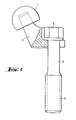
- Im folgenden wird die Erfindung anhand von Zeichnungen beispielhaft erläutert:
- Fig. 1 zeigt in einem Schnitt den Oberschenkelteil einer Hüftgelenkendoprothese, deren Schaft über einen Teil ihrer Länge mit einem Gewinde versehen ist und
- Fig. 2 zeigt einen Schnitt durch einen Teil des Prothesenschafts.
- Der Gelenkkopf 1, der beispielsweise aus gesintertem Aluminiumoxid oder einem anderen abriebfesten keramischen Stoff besteht, ist auf den an seinem oberen Ende konisch ausgebildeten kragenförmigen Prothesenteil 2 axial aufgeschoben. Dieser eine schwalbenschwanzförmige oder kreisförmige Ausnehmung aufweisende Teil 2 ist auf den Prothesenschaft 3 geschoben und mit diesem durch den Schraubenkopf 5 kraft- oder formschlüssig verbunden. Der untere Teil des Prothesenschafts weist ein Gewinde 4 auf, und greift in eine zeichnerisch nicht dargestellte mit einem Gegengewinde versehene Ausnehmung des Femurs ein.
- Wenigstens der Prothesenschaft, zweckmäßig auch der kragenförmige Teil der Prothese bestehen aus einem Werkstoff, dessen Elastizitätsmodul zwei bis drei mal größer als der Modul des Knochens ist, z.B. aus-mit Kohlenstoffasern verstärktem Kohlenstoff. Unter diesem Begriff sind Verbundwerkstoffe zu verstehen, die als Matrix carbonisierte Duro- oder Thermoplaste oder auch Steinkohlenteerpeche und als Verstärkungselemente Kohlenstoff- oder Graphitfasern in Form von Filamenten, Kurzschnittfasern, Matten und anderen textilen Flächengebilden enthalten und eine vorzügliche Gewebeverträglichkeit aufweisen.
- In der Darstellung nach Fig. 2 sind
- D = Außendurchmesser, dk = Kerndurchmesser
- P = Steigung, M = Gewindekopfbreite und α = Flankenwinkel,
- R, r = Krümmungsradien des Gewindes, das folgenden Bedingungen genügt:


- Es folgen zwangsläufig einige andere Beziehungen, z.B.

- Die Auslegung des Gewindes in Abhängigkeit vom Außendurchmesser D ist in der Tabelle beispielhaft dargestellt.


- Der Flankenwinkel α betrug bei diesem Beispiel 11,6°. Zur Vermeidung von Kerbspannungen im Gewindegrund sollten die Krümmungsradien R - 0,5 bis 1,10 und r - 0,3 bis 0,8 betragen.
Claims (4)
dadurch gekennzeichnet,
daß

dadurch gekennzeichnet,
daß das Verhältnis von Gewindehöhe h zur Gewindekopfbreite M kleiner als 1 ist.
dadurch gekennzeichnet,
daß wenigstens der Prothesenschaft aus mit Kohlenstofffasern verstärktem Kohlenstoff besteht.
dadurch gekennzeichnet,
daß auf dem mit dem Femur verschraubten Prothesenschaft eine Druckvorspannung aufgebracht ist.
Priority Applications (1)
| Application Number | Priority Date | Filing Date | Title |
|---|---|---|---|
| AT80101207T ATE4279T1 (de) | 1979-05-19 | 1980-03-10 | Oberschenkelteil einer hueftgelenkendoprothese. |
Applications Claiming Priority (2)
| Application Number | Priority Date | Filing Date | Title |
|---|---|---|---|
| DE2920354 | 1979-05-19 | ||
| DE19792920354 DE2920354A1 (de) | 1979-05-19 | 1979-05-19 | Hueftgelenkendoprothese |
Publications (2)
| Publication Number | Publication Date |
|---|---|
| EP0019042A1 true EP0019042A1 (de) | 1980-11-26 |
| EP0019042B1 EP0019042B1 (de) | 1983-07-27 |
Family
ID=6071197
Family Applications (1)
| Application Number | Title | Priority Date | Filing Date |
|---|---|---|---|
| EP80101207A Expired EP0019042B1 (de) | 1979-05-19 | 1980-03-10 | Oberschenkelteil einer Hüftgelenkendoprothese |
Country Status (3)
| Country | Link |
|---|---|
| EP (1) | EP0019042B1 (de) |
| AT (1) | ATE4279T1 (de) |
| DE (1) | DE2920354A1 (de) |
Cited By (5)
| Publication number | Priority date | Publication date | Assignee | Title |
|---|---|---|---|---|
| US4693724A (en) * | 1985-01-31 | 1987-09-15 | Rhenter Jean L | Total hip prosthesis with primary fixation |
| EP0291103A1 (de) * | 1987-05-13 | 1988-11-17 | Nobelpharma AB | Vorrichtung für die Befestigung eines einzelnen Ersatzzahnes |
| EP0649642A1 (de) * | 1993-10-21 | 1995-04-26 | Allo Pro Ag | Bausatz für eine modulare Femurkopfprothese, insbesondere eine Reoperationsprothese, und Femurkopfprothese aus einem derartigen Bausatz |
| US5549702A (en) * | 1994-10-25 | 1996-08-27 | Smith & Nephew Richards Inc. | Flexible orthopaedic stem apparatus |
| EP1267733A4 (de) * | 2000-02-03 | 2005-06-01 | Alphatec Mfg Inc | Intramodulare vebindungsschraube |
Families Citing this family (1)
| Publication number | Priority date | Publication date | Assignee | Title |
|---|---|---|---|---|
| DE4027183A1 (de) * | 1990-08-28 | 1992-03-05 | Baumgart Rainer | Prothese |
Citations (3)
| Publication number | Priority date | Publication date | Assignee | Title |
|---|---|---|---|---|
| FR2360295A1 (fr) * | 1976-08-04 | 1978-03-03 | Sigri Elektrographit Gmbh | Prothese articulaire |
| DE2621384B2 (de) * | 1976-05-14 | 1978-04-06 | Pfaudler-Werke Ag, 6830 Schwetzingen | Medizinisches Befestigungselement und Verfahren zu seiner Herstellung |
| AT351152B (de) * | 1975-06-06 | 1979-07-10 | David Thomas | Knochengelenkprothese |
Family Cites Families (1)
| Publication number | Priority date | Publication date | Assignee | Title |
|---|---|---|---|---|
| US3707006A (en) * | 1970-08-26 | 1972-12-26 | Gulf Oil Corp | Orthopedic device for repair or replacement of bone |
-
1979
- 1979-05-19 DE DE19792920354 patent/DE2920354A1/de not_active Withdrawn
-
1980
- 1980-03-10 AT AT80101207T patent/ATE4279T1/de not_active IP Right Cessation
- 1980-03-10 EP EP80101207A patent/EP0019042B1/de not_active Expired
Patent Citations (3)
| Publication number | Priority date | Publication date | Assignee | Title |
|---|---|---|---|---|
| AT351152B (de) * | 1975-06-06 | 1979-07-10 | David Thomas | Knochengelenkprothese |
| DE2621384B2 (de) * | 1976-05-14 | 1978-04-06 | Pfaudler-Werke Ag, 6830 Schwetzingen | Medizinisches Befestigungselement und Verfahren zu seiner Herstellung |
| FR2360295A1 (fr) * | 1976-08-04 | 1978-03-03 | Sigri Elektrographit Gmbh | Prothese articulaire |
Cited By (7)
| Publication number | Priority date | Publication date | Assignee | Title |
|---|---|---|---|---|
| US4693724A (en) * | 1985-01-31 | 1987-09-15 | Rhenter Jean L | Total hip prosthesis with primary fixation |
| EP0291103A1 (de) * | 1987-05-13 | 1988-11-17 | Nobelpharma AB | Vorrichtung für die Befestigung eines einzelnen Ersatzzahnes |
| EP0649642A1 (de) * | 1993-10-21 | 1995-04-26 | Allo Pro Ag | Bausatz für eine modulare Femurkopfprothese, insbesondere eine Reoperationsprothese, und Femurkopfprothese aus einem derartigen Bausatz |
| EP0845251A1 (de) * | 1993-10-21 | 1998-06-03 | Sulzer Orthopädie AG | Bausatz für eine modulare Femurkapfprothese, insbesondere eine Reoperationsprothese, und Femurkopfprothese aus einem derartigen Bausatz |
| US5931871A (en) * | 1993-10-21 | 1999-08-03 | Allo Pro Ag | Kit of parts for a modular femur head prosthesis, in particular, a reoperation prosthesis, and a femur head prosthesis from such a kit of parts |
| US5549702A (en) * | 1994-10-25 | 1996-08-27 | Smith & Nephew Richards Inc. | Flexible orthopaedic stem apparatus |
| EP1267733A4 (de) * | 2000-02-03 | 2005-06-01 | Alphatec Mfg Inc | Intramodulare vebindungsschraube |
Also Published As
| Publication number | Publication date |
|---|---|
| EP0019042B1 (de) | 1983-07-27 |
| ATE4279T1 (de) | 1983-08-15 |
| DE2920354A1 (de) | 1980-11-27 |
Similar Documents
| Publication | Publication Date | Title |
|---|---|---|
| EP0144574B1 (de) | Hüftendoprothese in Verbundbauweise | |
| DE2344569C3 (de) | Schultergelenk-Endoprothese | |
| EP0943297B1 (de) | Femorale Hüftgelenkprothese | |
| DE3909182C1 (de) | ||
| EP0845251B1 (de) | Bausatz für eine modulare Femurkapfprothese, insbesondere eine Reoperationsprothese, und Femurkopfprothese aus einem derartigen Bausatz | |
| DE8903850U1 (de) | Oberschenkelteil für eine Hüftendoprothese | |
| DE69228190T2 (de) | Femorales hüftimplantat mit verringerter steifheit | |
| AT391264B (de) | Hueftgelenkendoprothesen-oberschenkelteil | |
| DE4009360A1 (de) | Kniegelenk-endoprothese | |
| CH668694A5 (de) | Chirurgisches implantat. | |
| DE3301415A1 (de) | Endoprothesenschaft | |
| DE9390076U1 (de) | Orthopädisches Verbundimplantat | |
| DE2529669A1 (de) | Bandprothese, insbesondere kreuzbandprothese | |
| DE9014705U1 (de) | Selbstverrriegelndes Gelenkverbindungsteil | |
| EP0565216A2 (de) | Marknagel | |
| DE3524020A1 (de) | Verfahren zur behandlung von knochenersatz-implantaten | |
| DE2454181B2 (de) | Keramisches Implantat | |
| DE2805305A1 (de) | Kuenstliches hueftgelenk | |
| EP0321389A1 (de) | Implantierbare Prothese | |
| EP0019044B1 (de) | Schaftteil einer Hüftgelenkendoprothese und Verfahren zur Herstellung desselben | |
| EP0019042B1 (de) | Oberschenkelteil einer Hüftgelenkendoprothese | |
| EP1112722B1 (de) | Implantat-Element mit selbstschneidendem Gewinde | |
| EP0339320B1 (de) | Prothesenschaft | |
| DE69514110T2 (de) | Endoprothese | |
| DE2444668B2 (de) | Gelenkprothese |
Legal Events
| Date | Code | Title | Description |
|---|---|---|---|
| PUAI | Public reference made under article 153(3) epc to a published international application that has entered the european phase |
Free format text: ORIGINAL CODE: 0009012 |
|
| AK | Designated contracting states |
Designated state(s): AT CH FR GB |
|
| 17P | Request for examination filed |
Effective date: 19801210 |
|
| GRAA | (expected) grant |
Free format text: ORIGINAL CODE: 0009210 |
|
| AK | Designated contracting states |
Designated state(s): AT CH FR GB |
|
| REF | Corresponds to: |
Ref document number: 4279 Country of ref document: AT Date of ref document: 19830815 Kind code of ref document: T |
|
| ET | Fr: translation filed | ||
| PGFP | Annual fee paid to national office [announced via postgrant information from national office to epo] |
Ref country code: FR Payment date: 19840330 Year of fee payment: 5 |
|
| PLBE | No opposition filed within time limit |
Free format text: ORIGINAL CODE: 0009261 |
|
| STAA | Information on the status of an ep patent application or granted ep patent |
Free format text: STATUS: NO OPPOSITION FILED WITHIN TIME LIMIT |
|
| PGFP | Annual fee paid to national office [announced via postgrant information from national office to epo] |
Ref country code: CH Payment date: 19840601 Year of fee payment: 5 |
|
| 26N | No opposition filed | ||
| PGFP | Annual fee paid to national office [announced via postgrant information from national office to epo] |
Ref country code: AT Payment date: 19860224 Year of fee payment: 7 |
|
| PG25 | Lapsed in a contracting state [announced via postgrant information from national office to epo] |
Ref country code: CH Effective date: 19860331 |
|
| GBPC | Gb: european patent ceased through non-payment of renewal fee | ||
| PG25 | Lapsed in a contracting state [announced via postgrant information from national office to epo] |
Ref country code: FR Free format text: LAPSE BECAUSE OF NON-PAYMENT OF DUE FEES Effective date: 19861128 |
|
| REG | Reference to a national code |
Ref country code: CH Ref legal event code: PL |
|
| REG | Reference to a national code |
Ref country code: FR Ref legal event code: ST |
|
| PG25 | Lapsed in a contracting state [announced via postgrant information from national office to epo] |
Ref country code: AT Effective date: 19870310 |
|
| PG25 | Lapsed in a contracting state [announced via postgrant information from national office to epo] |
Ref country code: GB Effective date: 19881118 |