EP0019111A1 - Verfahren zur Herstellung von Phosphonomaleinsäureestern - Google Patents
Verfahren zur Herstellung von Phosphonomaleinsäureestern Download PDFInfo
- Publication number
- EP0019111A1 EP0019111A1 EP80102178A EP80102178A EP0019111A1 EP 0019111 A1 EP0019111 A1 EP 0019111A1 EP 80102178 A EP80102178 A EP 80102178A EP 80102178 A EP80102178 A EP 80102178A EP 0019111 A1 EP0019111 A1 EP 0019111A1
- Authority
- EP
- European Patent Office
- Prior art keywords
- acid
- ester
- chloro
- acid esters
- mol
- Prior art date
- Legal status (The legal status is an assumption and is not a legal conclusion. Google has not performed a legal analysis and makes no representation as to the accuracy of the status listed.)
- Withdrawn
Links
- 238000000034 method Methods 0.000 title claims abstract description 16
- RNIIXUQHKLCPMW-OWOJBTEDSA-N (e)-2-phosphonobut-2-enedioic acid Chemical class OC(=O)\C=C(/C(O)=O)P(O)(O)=O RNIIXUQHKLCPMW-OWOJBTEDSA-N 0.000 title claims abstract description 14
- 238000002360 preparation method Methods 0.000 title claims abstract description 9
- -1 substituted alkyl radical Chemical class 0.000 claims abstract description 29
- 125000004432 carbon atom Chemical group C* 0.000 claims abstract description 13
- 125000000217 alkyl group Chemical group 0.000 claims abstract description 6
- 150000005840 aryl radicals Chemical class 0.000 claims abstract description 5
- 229910052739 hydrogen Inorganic materials 0.000 claims abstract description 5
- 239000001257 hydrogen Substances 0.000 claims abstract description 5
- 125000003107 substituted aryl group Chemical group 0.000 claims abstract description 5
- ZAMOUSCENKQFHK-UHFFFAOYSA-N Chlorine atom Chemical compound [Cl] ZAMOUSCENKQFHK-UHFFFAOYSA-N 0.000 claims description 11
- 229910052801 chlorine Inorganic materials 0.000 claims description 9
- 239000000460 chlorine Substances 0.000 claims description 9
- WKBOTKDWSSQWDR-UHFFFAOYSA-N Bromine atom Chemical compound [Br] WKBOTKDWSSQWDR-UHFFFAOYSA-N 0.000 claims description 6
- UFHFLCQGNIYNRP-UHFFFAOYSA-N Hydrogen Chemical compound [H][H] UFHFLCQGNIYNRP-UHFFFAOYSA-N 0.000 claims description 5
- GDTBXPJZTBHREO-UHFFFAOYSA-N bromine Substances BrBr GDTBXPJZTBHREO-UHFFFAOYSA-N 0.000 claims description 4
- 229910052794 bromium Inorganic materials 0.000 claims description 4
- 239000003063 flame retardant Substances 0.000 claims description 4
- 239000002318 adhesion promoter Substances 0.000 claims description 2
- RNFJDJUURJAICM-UHFFFAOYSA-N 2,2,4,4,6,6-hexaphenoxy-1,3,5-triaza-2$l^{5},4$l^{5},6$l^{5}-triphosphacyclohexa-1,3,5-triene Chemical compound N=1P(OC=2C=CC=CC=2)(OC=2C=CC=CC=2)=NP(OC=2C=CC=CC=2)(OC=2C=CC=CC=2)=NP=1(OC=1C=CC=CC=1)OC1=CC=CC=C1 RNFJDJUURJAICM-UHFFFAOYSA-N 0.000 claims 1
- 150000002431 hydrogen Chemical group 0.000 claims 1
- 125000004435 hydrogen atom Chemical class [H]* 0.000 abstract 1
- YXFVVABEGXRONW-UHFFFAOYSA-N Toluene Chemical compound CC1=CC=CC=C1 YXFVVABEGXRONW-UHFFFAOYSA-N 0.000 description 57
- YMWUJEATGCHHMB-UHFFFAOYSA-N Dichloromethane Chemical compound ClCCl YMWUJEATGCHHMB-UHFFFAOYSA-N 0.000 description 48
- 239000002253 acid Substances 0.000 description 46
- OKKJLVBELUTLKV-UHFFFAOYSA-N Methanol Chemical compound OC OKKJLVBELUTLKV-UHFFFAOYSA-N 0.000 description 39
- 239000002585 base Substances 0.000 description 27
- 239000000243 solution Substances 0.000 description 25
- 150000002148 esters Chemical class 0.000 description 24
- 238000006243 chemical reaction Methods 0.000 description 18
- OJURWUUOVGOHJZ-UHFFFAOYSA-N methyl 2-[(2-acetyloxyphenyl)methyl-[2-[(2-acetyloxyphenyl)methyl-(2-methoxy-2-oxoethyl)amino]ethyl]amino]acetate Chemical compound C=1C=CC=C(OC(C)=O)C=1CN(CC(=O)OC)CCN(CC(=O)OC)CC1=CC=CC=C1OC(C)=O OJURWUUOVGOHJZ-UHFFFAOYSA-N 0.000 description 16
- FAPWRFPIFSIZLT-UHFFFAOYSA-M Sodium chloride Chemical compound [Na+].[Cl-] FAPWRFPIFSIZLT-UHFFFAOYSA-M 0.000 description 14
- 239000002904 solvent Substances 0.000 description 13
- WQDUMFSSJAZKTM-UHFFFAOYSA-N Sodium methoxide Chemical compound [Na+].[O-]C WQDUMFSSJAZKTM-UHFFFAOYSA-N 0.000 description 12
- 239000007789 gas Substances 0.000 description 12
- XLYOFNOQVPJJNP-UHFFFAOYSA-N water Substances O XLYOFNOQVPJJNP-UHFFFAOYSA-N 0.000 description 12
- 238000004587 chromatography analysis Methods 0.000 description 11
- 125000000118 dimethyl group Chemical group [H]C([H])([H])* 0.000 description 11
- 239000000047 product Substances 0.000 description 11
- 239000011541 reaction mixture Substances 0.000 description 11
- 239000000203 mixture Substances 0.000 description 10
- AWRHWNOHAWSTFE-AATRIKPKSA-N dimethyl (e)-2-bis(methylperoxy)phosphorylbut-2-enedioate Chemical compound COOP(=O)(OOC)C(\C(=O)OC)=C\C(=O)OC AWRHWNOHAWSTFE-AATRIKPKSA-N 0.000 description 9
- 238000004821 distillation Methods 0.000 description 9
- LFQSCWFLJHTTHZ-UHFFFAOYSA-N Ethanol Chemical compound CCO LFQSCWFLJHTTHZ-UHFFFAOYSA-N 0.000 description 7
- 238000004061 bleaching Methods 0.000 description 7
- 239000012074 organic phase Substances 0.000 description 7
- 239000012071 phase Substances 0.000 description 7
- 239000011780 sodium chloride Substances 0.000 description 7
- ZMANZCXQSJIPKH-UHFFFAOYSA-N Triethylamine Chemical compound CCN(CC)CC ZMANZCXQSJIPKH-UHFFFAOYSA-N 0.000 description 6
- 239000007864 aqueous solution Substances 0.000 description 6
- YKZJECOUNGZSKO-UHFFFAOYSA-N dimethyl 2-bis(methylperoxy)phosphorylbutanedioate Chemical compound COC(=O)CC(C(=O)OC)P(=O)(OOC)OOC YKZJECOUNGZSKO-UHFFFAOYSA-N 0.000 description 6
- KMDMOMDSEVTJTI-UHFFFAOYSA-N 2-phosphonobutanedioic acid Chemical class OC(=O)CC(C(O)=O)P(O)(O)=O KMDMOMDSEVTJTI-UHFFFAOYSA-N 0.000 description 5
- 150000001875 compounds Chemical class 0.000 description 5
- 150000003839 salts Chemical class 0.000 description 5
- 238000003756 stirring Methods 0.000 description 5
- 239000000126 substance Substances 0.000 description 5
- VZCYOOQTPOCHFL-UHFFFAOYSA-N trans-butenedioic acid Natural products OC(=O)C=CC(O)=O VZCYOOQTPOCHFL-UHFFFAOYSA-N 0.000 description 5
- GQHTUMJGOHRCHB-UHFFFAOYSA-N 2,3,4,6,7,8,9,10-octahydropyrimido[1,2-a]azepine Chemical compound C1CCCCN2CCCN=C21 GQHTUMJGOHRCHB-UHFFFAOYSA-N 0.000 description 4
- 150000001298 alcohols Chemical class 0.000 description 4
- NEHMKBQYUWJMIP-UHFFFAOYSA-N chloromethane Chemical compound ClC NEHMKBQYUWJMIP-UHFFFAOYSA-N 0.000 description 4
- 239000012433 hydrogen halide Substances 0.000 description 4
- 229910000039 hydrogen halide Inorganic materials 0.000 description 4
- 238000005160 1H NMR spectroscopy Methods 0.000 description 3
- VZCYOOQTPOCHFL-OWOJBTEDSA-N Fumaric acid Natural products OC(=O)\C=C\C(O)=O VZCYOOQTPOCHFL-OWOJBTEDSA-N 0.000 description 3
- HEMHJVSKTPXQMS-UHFFFAOYSA-M Sodium hydroxide Chemical compound [OH-].[Na+] HEMHJVSKTPXQMS-UHFFFAOYSA-M 0.000 description 3
- 150000001408 amides Chemical class 0.000 description 3
- 239000007844 bleaching agent Substances 0.000 description 3
- 238000009835 boiling Methods 0.000 description 3
- 150000004820 halides Chemical class 0.000 description 3
- 229910052736 halogen Inorganic materials 0.000 description 3
- 230000026030 halogenation Effects 0.000 description 3
- 238000005658 halogenation reaction Methods 0.000 description 3
- 150000002367 halogens Chemical class 0.000 description 3
- 239000007788 liquid Substances 0.000 description 3
- 125000001476 phosphono group Chemical group [H]OP(*)(=O)O[H] 0.000 description 3
- CYTQBVOFDCPGCX-UHFFFAOYSA-N trimethyl phosphite Chemical compound COP(OC)OC CYTQBVOFDCPGCX-UHFFFAOYSA-N 0.000 description 3
- VGUWZCUCNQXGBU-UHFFFAOYSA-N 3-[(4-methylpiperazin-1-yl)methyl]-5-nitro-1h-indole Chemical compound C1CN(C)CCN1CC1=CNC2=CC=C([N+]([O-])=O)C=C12 VGUWZCUCNQXGBU-UHFFFAOYSA-N 0.000 description 2
- OTZAAFXPWHLKRY-UHFFFAOYSA-N CC(CC(=O)OC)(C(=O)OC)P(=O)(OOC)OOC Chemical compound CC(CC(=O)OC)(C(=O)OC)P(=O)(OOC)OOC OTZAAFXPWHLKRY-UHFFFAOYSA-N 0.000 description 2
- UBOHYNQWXPBFBK-UHFFFAOYSA-N COOP(=O)(C(CC(=O)O)C(=O)OP(=O)(OOC)OOC)OOC Chemical compound COOP(=O)(C(CC(=O)O)C(=O)OP(=O)(OOC)OOC)OOC UBOHYNQWXPBFBK-UHFFFAOYSA-N 0.000 description 2
- PXGOKWXKJXAPGV-UHFFFAOYSA-N Fluorine Chemical compound FF PXGOKWXKJXAPGV-UHFFFAOYSA-N 0.000 description 2
- VRKDQUWCWZAUBM-UHFFFAOYSA-N OC(=O)CC(P(O)(O)=O)C(=O)OP(O)(O)=O Chemical compound OC(=O)CC(P(O)(O)=O)C(=O)OP(O)(O)=O VRKDQUWCWZAUBM-UHFFFAOYSA-N 0.000 description 2
- 229910019142 PO4 Inorganic materials 0.000 description 2
- OFOBLEOULBTSOW-UHFFFAOYSA-N Propanedioic acid Natural products OC(=O)CC(O)=O OFOBLEOULBTSOW-UHFFFAOYSA-N 0.000 description 2
- CDBYLPFSWZWCQE-UHFFFAOYSA-L Sodium Carbonate Chemical compound [Na+].[Na+].[O-]C([O-])=O CDBYLPFSWZWCQE-UHFFFAOYSA-L 0.000 description 2
- QAOWNCQODCNURD-UHFFFAOYSA-N Sulfuric acid Chemical compound OS(O)(=O)=O QAOWNCQODCNURD-UHFFFAOYSA-N 0.000 description 2
- 239000000370 acceptor Substances 0.000 description 2
- 150000007513 acids Chemical class 0.000 description 2
- 125000003545 alkoxy group Chemical group 0.000 description 2
- 150000001450 anions Chemical class 0.000 description 2
- 230000015572 biosynthetic process Effects 0.000 description 2
- BVKZGUZCCUSVTD-UHFFFAOYSA-N carbonic acid Chemical class OC(O)=O BVKZGUZCCUSVTD-UHFFFAOYSA-N 0.000 description 2
- 239000000470 constituent Substances 0.000 description 2
- 238000001816 cooling Methods 0.000 description 2
- 230000007797 corrosion Effects 0.000 description 2
- 238000005260 corrosion Methods 0.000 description 2
- 239000003814 drug Substances 0.000 description 2
- 125000001301 ethoxy group Chemical group [H]C([H])([H])C([H])([H])O* 0.000 description 2
- 239000000706 filtrate Substances 0.000 description 2
- 238000001914 filtration Methods 0.000 description 2
- 239000001530 fumaric acid Substances 0.000 description 2
- 238000004817 gas chromatography Methods 0.000 description 2
- JGJLWPGRMCADHB-UHFFFAOYSA-N hypobromite Chemical compound Br[O-] JGJLWPGRMCADHB-UHFFFAOYSA-N 0.000 description 2
- 239000003112 inhibitor Substances 0.000 description 2
- VZCYOOQTPOCHFL-UPHRSURJSA-N maleic acid Chemical compound OC(=O)\C=C/C(O)=O VZCYOOQTPOCHFL-UPHRSURJSA-N 0.000 description 2
- 239000011976 maleic acid Substances 0.000 description 2
- 125000000956 methoxy group Chemical group [H]C([H])([H])O* 0.000 description 2
- 229940050176 methyl chloride Drugs 0.000 description 2
- 125000002496 methyl group Chemical group [H]C([H])([H])* 0.000 description 2
- 150000002825 nitriles Chemical class 0.000 description 2
- 229910017464 nitrogen compound Inorganic materials 0.000 description 2
- 150000002830 nitrogen compounds Chemical class 0.000 description 2
- 239000000575 pesticide Substances 0.000 description 2
- 235000021317 phosphate Nutrition 0.000 description 2
- 150000003013 phosphoric acid derivatives Chemical class 0.000 description 2
- 150000003018 phosphorus compounds Chemical class 0.000 description 2
- 238000000425 proton nuclear magnetic resonance spectrum Methods 0.000 description 2
- 239000003352 sequestering agent Substances 0.000 description 2
- 239000007858 starting material Substances 0.000 description 2
- 238000003786 synthesis reaction Methods 0.000 description 2
- 238000005809 transesterification reaction Methods 0.000 description 2
- 238000005292 vacuum distillation Methods 0.000 description 2
- 238000005406 washing Methods 0.000 description 2
- ZQTHBFAGBKEDFN-UHFFFAOYSA-N (1,4-dimethoxy-2-methyl-1,4-dioxobutan-2-yl)-methylperoxyphosphinic acid Chemical compound CC(CC(=O)OC)(C(=O)OC)P(=O)(O)OOC ZQTHBFAGBKEDFN-UHFFFAOYSA-N 0.000 description 1
- 239000004808 2-ethylhexylester Substances 0.000 description 1
- MITBIQFAQUPFQE-PLNGDYQASA-N C/C(=C/C(=O)O)/C(=O)OP(=O)(OOC)OOC Chemical compound C/C(=C/C(=O)O)/C(=O)OP(=O)(OOC)OOC MITBIQFAQUPFQE-PLNGDYQASA-N 0.000 description 1
- WFPWKGWLCLLRKO-UHFFFAOYSA-N CCC(C)OOP(=O)(C(CC(=O)O)C(=O)O)OOC(C)CC Chemical compound CCC(C)OOP(=O)(C(CC(=O)O)C(=O)O)OOC(C)CC WFPWKGWLCLLRKO-UHFFFAOYSA-N 0.000 description 1
- PBCRNZUUOAUKDX-UHFFFAOYSA-N CCOC(=O)CC(C(=O)OCC)P(=O)(OOCC)OOCC Chemical compound CCOC(=O)CC(C(=O)OCC)P(=O)(OOCC)OOCC PBCRNZUUOAUKDX-UHFFFAOYSA-N 0.000 description 1
- LXSXZCARFWCUHS-UHFFFAOYSA-N CCOOP(=O)(C(CC(=O)OC)C(=O)OC)OOCC Chemical compound CCOOP(=O)(C(CC(=O)OC)C(=O)OC)OOCC LXSXZCARFWCUHS-UHFFFAOYSA-N 0.000 description 1
- CLZYIEVBBZEPRJ-UHFFFAOYSA-N COOP(=O)(C(CC(=O)O)C(=O)O)OOC Chemical compound COOP(=O)(C(CC(=O)O)C(=O)O)OOC CLZYIEVBBZEPRJ-UHFFFAOYSA-N 0.000 description 1
- KXDHJXZQYSOELW-UHFFFAOYSA-N Carbamic acid Chemical class NC(O)=O KXDHJXZQYSOELW-UHFFFAOYSA-N 0.000 description 1
- DGAQECJNVWCQMB-PUAWFVPOSA-M Ilexoside XXIX Chemical compound C[C@@H]1CC[C@@]2(CC[C@@]3(C(=CC[C@H]4[C@]3(CC[C@@H]5[C@@]4(CC[C@@H](C5(C)C)OS(=O)(=O)[O-])C)C)[C@@H]2[C@]1(C)O)C)C(=O)O[C@H]6[C@@H]([C@H]([C@@H]([C@H](O6)CO)O)O)O.[Na+] DGAQECJNVWCQMB-PUAWFVPOSA-M 0.000 description 1
- NBIIXXVUZAFLBC-UHFFFAOYSA-N Phosphoric acid Chemical class OP(O)(O)=O NBIIXXVUZAFLBC-UHFFFAOYSA-N 0.000 description 1
- ABLZXFCXXLZCGV-UHFFFAOYSA-N Phosphorous acid Chemical class OP(O)=O ABLZXFCXXLZCGV-UHFFFAOYSA-N 0.000 description 1
- 229920000388 Polyphosphate Polymers 0.000 description 1
- CZPWVGJYEJSRLH-UHFFFAOYSA-N Pyrimidine Chemical compound C1=CN=CN=C1 CZPWVGJYEJSRLH-UHFFFAOYSA-N 0.000 description 1
- FZNCGRZWXLXZSZ-CIQUZCHMSA-N Voglibose Chemical compound OCC(CO)N[C@H]1C[C@](O)(CO)[C@@H](O)[C@H](O)[C@H]1O FZNCGRZWXLXZSZ-CIQUZCHMSA-N 0.000 description 1
- ZVQOOHYFBIDMTQ-UHFFFAOYSA-N [methyl(oxido){1-[6-(trifluoromethyl)pyridin-3-yl]ethyl}-lambda(6)-sulfanylidene]cyanamide Chemical compound N#CN=S(C)(=O)C(C)C1=CC=C(C(F)(F)F)N=C1 ZVQOOHYFBIDMTQ-UHFFFAOYSA-N 0.000 description 1
- 239000004480 active ingredient Substances 0.000 description 1
- 239000013543 active substance Substances 0.000 description 1
- 238000007259 addition reaction Methods 0.000 description 1
- 239000003463 adsorbent Substances 0.000 description 1
- 229910052783 alkali metal Inorganic materials 0.000 description 1
- 150000001340 alkali metals Chemical class 0.000 description 1
- 125000005907 alkyl ester group Chemical group 0.000 description 1
- 150000004645 aluminates Chemical class 0.000 description 1
- 150000001412 amines Chemical class 0.000 description 1
- 150000003863 ammonium salts Chemical class 0.000 description 1
- 238000004458 analytical method Methods 0.000 description 1
- 239000008346 aqueous phase Substances 0.000 description 1
- 150000004982 aromatic amines Chemical class 0.000 description 1
- 239000007853 buffer solution Substances 0.000 description 1
- 230000003139 buffering effect Effects 0.000 description 1
- 229950010691 butonate Drugs 0.000 description 1
- 150000004649 carbonic acid derivatives Chemical class 0.000 description 1
- 125000003178 carboxy group Chemical group [H]OC(*)=O 0.000 description 1
- 150000001735 carboxylic acids Chemical class 0.000 description 1
- 238000005119 centrifugation Methods 0.000 description 1
- 150000008280 chlorinated hydrocarbons Chemical class 0.000 description 1
- 238000007796 conventional method Methods 0.000 description 1
- 239000012043 crude product Substances 0.000 description 1
- 239000013078 crystal Substances 0.000 description 1
- 230000020335 dealkylation Effects 0.000 description 1
- 238000006900 dealkylation reaction Methods 0.000 description 1
- 230000006735 deficit Effects 0.000 description 1
- DMCOKJZTBYEHAP-UHFFFAOYSA-N dibutyl 2-bis(butylperoxy)phosphorylbutanedioate Chemical compound CCCCOC(=O)CC(C(=O)OCCCC)P(=O)(OOCCCC)OOCCCC DMCOKJZTBYEHAP-UHFFFAOYSA-N 0.000 description 1
- 235000014113 dietary fatty acids Nutrition 0.000 description 1
- LXCYSACZTOKNNS-UHFFFAOYSA-N diethoxy(oxo)phosphanium Chemical compound CCO[P+](=O)OCC LXCYSACZTOKNNS-UHFFFAOYSA-N 0.000 description 1
- LCEUINUZFZTBID-MDZDMXLPSA-N diethyl (E)-2-bis(ethylperoxy)phosphorylbut-2-enedioate Chemical compound C(C)OC(\C(=C/C(=O)OCC)\P(=O)(OOCC)OOCC)=O LCEUINUZFZTBID-MDZDMXLPSA-N 0.000 description 1
- 125000004177 diethyl group Chemical group [H]C([H])([H])C([H])([H])* 0.000 description 1
- LDCRTTXIJACKKU-ARJAWSKDSA-N dimethyl maleate Chemical compound COC(=O)\C=C/C(=O)OC LDCRTTXIJACKKU-ARJAWSKDSA-N 0.000 description 1
- CZHYKKAKFWLGJO-UHFFFAOYSA-N dimethyl phosphite Chemical compound COP([O-])OC CZHYKKAKFWLGJO-UHFFFAOYSA-N 0.000 description 1
- 239000002270 dispersing agent Substances 0.000 description 1
- 125000004185 ester group Chemical group 0.000 description 1
- 230000032050 esterification Effects 0.000 description 1
- 238000005886 esterification reaction Methods 0.000 description 1
- 150000002170 ethers Chemical class 0.000 description 1
- 125000004494 ethyl ester group Chemical group 0.000 description 1
- 239000000284 extract Substances 0.000 description 1
- 239000000194 fatty acid Substances 0.000 description 1
- 229930195729 fatty acid Natural products 0.000 description 1
- 150000004665 fatty acids Chemical class 0.000 description 1
- 229910052731 fluorine Inorganic materials 0.000 description 1
- 239000011737 fluorine Substances 0.000 description 1
- 125000005843 halogen group Chemical group 0.000 description 1
- 238000010438 heat treatment Methods 0.000 description 1
- 229930195733 hydrocarbon Natural products 0.000 description 1
- 150000002430 hydrocarbons Chemical class 0.000 description 1
- 150000004679 hydroxides Chemical class 0.000 description 1
- 125000002887 hydroxy group Chemical group [H]O* 0.000 description 1
- 239000007791 liquid phase Substances 0.000 description 1
- 150000002689 maleic acids Chemical class 0.000 description 1
- 229910052751 metal Inorganic materials 0.000 description 1
- 239000002184 metal Substances 0.000 description 1
- 150000002739 metals Chemical class 0.000 description 1
- 125000005341 metaphosphate group Chemical group 0.000 description 1
- 230000004048 modification Effects 0.000 description 1
- 238000012986 modification Methods 0.000 description 1
- 239000000178 monomer Substances 0.000 description 1
- 229910052757 nitrogen Inorganic materials 0.000 description 1
- IJGRMHOSHXDMSA-UHFFFAOYSA-N nitrogen Substances N#N IJGRMHOSHXDMSA-UHFFFAOYSA-N 0.000 description 1
- 238000005580 one pot reaction Methods 0.000 description 1
- 125000004043 oxo group Chemical group O=* 0.000 description 1
- 239000003444 phase transfer catalyst Substances 0.000 description 1
- AQSJGOWTSHOLKH-UHFFFAOYSA-N phosphite(3-) Chemical class [O-]P([O-])[O-] AQSJGOWTSHOLKH-UHFFFAOYSA-N 0.000 description 1
- 150000003008 phosphonic acid esters Chemical class 0.000 description 1
- ZJAOAACCNHFJAH-UHFFFAOYSA-N phosphonoformic acid Chemical class OC(=O)P(O)(O)=O ZJAOAACCNHFJAH-UHFFFAOYSA-N 0.000 description 1
- 229920000768 polyamine Polymers 0.000 description 1
- 239000001205 polyphosphate Substances 0.000 description 1
- 235000011176 polyphosphates Nutrition 0.000 description 1
- 239000002244 precipitate Substances 0.000 description 1
- 238000001556 precipitation Methods 0.000 description 1
- 150000003254 radicals Chemical class 0.000 description 1
- 238000001953 recrystallisation Methods 0.000 description 1
- 230000000717 retained effect Effects 0.000 description 1
- 229920006395 saturated elastomer Polymers 0.000 description 1
- 150000004760 silicates Chemical class 0.000 description 1
- 229910052708 sodium Inorganic materials 0.000 description 1
- 239000011734 sodium Substances 0.000 description 1
- 229910000029 sodium carbonate Inorganic materials 0.000 description 1
- QDRKDTQENPPHOJ-UHFFFAOYSA-N sodium ethoxide Chemical compound [Na+].CC[O-] QDRKDTQENPPHOJ-UHFFFAOYSA-N 0.000 description 1
- CRWJEUDFKNYSBX-UHFFFAOYSA-N sodium;hypobromite Chemical compound [Na+].Br[O-] CRWJEUDFKNYSBX-UHFFFAOYSA-N 0.000 description 1
- 239000007790 solid phase Substances 0.000 description 1
- 239000003381 stabilizer Substances 0.000 description 1
- 125000005402 stannate group Chemical group 0.000 description 1
- 125000001424 substituent group Chemical group 0.000 description 1
- 239000000725 suspension Substances 0.000 description 1
- 125000005270 trialkylamine group Chemical group 0.000 description 1
- NRTLTGGGUQIRRT-UHFFFAOYSA-N triethylazanium;bromide Chemical compound [Br-].CC[NH+](CC)CC NRTLTGGGUQIRRT-UHFFFAOYSA-N 0.000 description 1
- ILWRPSCZWQJDMK-UHFFFAOYSA-N triethylazanium;chloride Chemical compound Cl.CCN(CC)CC ILWRPSCZWQJDMK-UHFFFAOYSA-N 0.000 description 1
Classifications
-
- C—CHEMISTRY; METALLURGY
- C08—ORGANIC MACROMOLECULAR COMPOUNDS; THEIR PREPARATION OR CHEMICAL WORKING-UP; COMPOSITIONS BASED THEREON
- C08K—Use of inorganic or non-macromolecular organic substances as compounding ingredients
- C08K5/00—Use of organic ingredients
- C08K5/49—Phosphorus-containing compounds
- C08K5/51—Phosphorus bound to oxygen
- C08K5/53—Phosphorus bound to oxygen bound to oxygen and to carbon only
- C08K5/5317—Phosphonic compounds, e.g. R—P(:O)(OR')2
- C08K5/5333—Esters of phosphonic acids
-
- C—CHEMISTRY; METALLURGY
- C07—ORGANIC CHEMISTRY
- C07F—ACYCLIC, CARBOCYCLIC OR HETEROCYCLIC COMPOUNDS CONTAINING ELEMENTS OTHER THAN CARBON, HYDROGEN, HALOGEN, OXYGEN, NITROGEN, SULFUR, SELENIUM OR TELLURIUM
- C07F9/00—Compounds containing elements of Groups 5 or 15 of the Periodic Table
- C07F9/02—Phosphorus compounds
- C07F9/28—Phosphorus compounds with one or more P—C bonds
- C07F9/30—Phosphinic acids [R2P(=O)(OH)]; Thiophosphinic acids ; [R2P(=X1)(X2H) (X1, X2 are each independently O, S or Se)]
- C07F9/32—Esters thereof
- C07F9/3205—Esters thereof the acid moiety containing a substituent or a structure which is considered as characteristic
- C07F9/3217—Esters of acyclic unsaturated acids
-
- C—CHEMISTRY; METALLURGY
- C07—ORGANIC CHEMISTRY
- C07F—ACYCLIC, CARBOCYCLIC OR HETEROCYCLIC COMPOUNDS CONTAINING ELEMENTS OTHER THAN CARBON, HYDROGEN, HALOGEN, OXYGEN, NITROGEN, SULFUR, SELENIUM OR TELLURIUM
- C07F9/00—Compounds containing elements of Groups 5 or 15 of the Periodic Table
- C07F9/02—Phosphorus compounds
- C07F9/28—Phosphorus compounds with one or more P—C bonds
- C07F9/38—Phosphonic acids [RP(=O)(OH)2]; Thiophosphonic acids ; [RP(=X1)(X2H)2(X1, X2 are each independently O, S or Se)]
- C07F9/40—Esters thereof
- C07F9/4003—Esters thereof the acid moiety containing a substituent or a structure which is considered as characteristic
- C07F9/4015—Esters of acyclic unsaturated acids
-
- C—CHEMISTRY; METALLURGY
- C08—ORGANIC MACROMOLECULAR COMPOUNDS; THEIR PREPARATION OR CHEMICAL WORKING-UP; COMPOSITIONS BASED THEREON
- C08K—Use of inorganic or non-macromolecular organic substances as compounding ingredients
- C08K5/00—Use of organic ingredients
- C08K5/49—Phosphorus-containing compounds
- C08K5/51—Phosphorus bound to oxygen
- C08K5/53—Phosphorus bound to oxygen bound to oxygen and to carbon only
- C08K5/5317—Phosphonic compounds, e.g. R—P(:O)(OR')2
Definitions
- the phosphonomaleic acid esters are highly reactive monomers that are capable of a large number of reactions, of which the addition reactions occupy an outstanding position due to the double bond present in the molecule. They are suitable for the synthesis of active ingredients such as sequestering agents, corrosion inhibitors, stabilizers, flame retardants, pharmaceuticals and pesticides. Appropriate means are described for example in US-PS 3579570, US-PS 3933 944 or D E-OS 2819112. In addition to the compounds / in which R 1 to R 4 are methyl, of particular interest are also those compounds with higher radicals; thus from C 2 to C 12 , where the individual substituents can be the same and also different.
- the method according to the invention for the preparation of phosphonomaleic acid esters is surprising in that so far only from 2-chloro- or 2-bromoalkanephosphonic acid esters, but not from 1-bromo- or 1-chloroalkanephosphonic acid esters, as used in the 1-halogeno-1-phosphonosuccinic acid esters - hereinafter referred to as 1-Halogenphosphonosuccinic acid ester abbreviated - available, made with bases unsaturated phosphonic acid esters could become. Even from 1,2-dibromo or 1,2-dichloroalkanephosphonic acid esters, only the ⁇ -position halogen atom as hydrogen halide is split off with bases, but never the ⁇ -halogen atom.
- the phosphonosuccinic acid esters are easily accessible substances by known methods, some of which are already technically manufactured (see e.g. Journal of General Chemistry of the USSR, 24, S 121-124 (1954)). They are prepared by addition of dialkyl or Alkylphosphoniten of maleic or fumaric acid ester or by esterification of Phosphonobernsteinklastern as they arise, for example in the implementation of trialkyl or Dialkylphosphoniten mitFumarchure or maleic acids, or by reaction of trialkyl or Dialkylphosphoniten with maleic or fumaric acid monoalkyl esters.
- suitable bases belong to the group of basic nitrogen compounds and phosphorus compounds as well as the class of ionically structured compounds with basic anion.
- Suitable basic nitrogen compounds are e.g. Amines, e.g. Trialkylamines, arylamines, alkylarylamines and associated polyamines and saturated and unsaturated .. five-, six- and seven-membered nitrogen heterocycles and amides and nitriles.
- Suitable basic phosphorus compounds are e.g. Trialkylphosphines, hydroxylalkylphosphines, trialkylphosphites, alkylarylphosphites, alkylphosphonites, alkylphosphinites.
- Suitable ionic substances with basic anions include e.g. Hydroxides, oxides, amides, alcoholates, phenates, carbonates, hydrogen carbonates, phosphates, hydrogen phosphates, monoalkyl phosphates, phosphites, polyphosphates, metaphosphates, phosphonates, silicates, hydroxyl and oxo complexes of metals such as zincates, aluminates, stannates, preferably in the form of their alkali metal, Alkaline earth and ammonium salts and also the salts of carboxylic acids, for example Fatty acids, polycarboxylic acids, aminocarboxylic acids, hydroxycarboxylic acids, phosphonocarboxylic acids. Mixtures of different bases can also be used and the action of the bases can also be modified by adding substances with a buffering action.
- the base used, the 1-halophosphonosuccinic acid ester to be reacted and the other reaction conditions must ensure an optimal reaction result are coordinated with one another so that, in particular, the dealkylation of the 1-halophosphonosuccinic acid ester and the fhosphonomaleic acid ester formed therefrom by the base and by the base hydrohalide or by the halide formed from base and split off hydrogen halide is prevented.
- 1-Halophosphonosuccinic acid ester and base are preferably used in a molar ratio of approx. 1: 1. If desired, an excess of base can also be used, while a deficit of base results in an incomplete reaction. Larger deviations from the 1: 1 molar ratio generally offer no advantages.
- the process according to the invention can be carried out in the presence or in the absence of solvents. There in both single-phase liquid and two-phase liquid systems with or without a solid phase can occur.
- the solvent can also be identical to the base used.
- the solvents that can be used include, for example, water, alcohols, ethers, hydrocarbons and chlorinated hydrocarbons, acid amides and nitriles.
- alcohols as solvents and especially alcoholates as bases in alcohols as solvents
- phase transfer catalysts can be added.
- the process according to the invention can be carried out in a wide temperature range from approximately -80 ° C. to approximately 150 ° C., a range from -10 ° C. to approximately 100 ° C. is preferred.
- the method according to the invention can be designed both continuously and discontinuously.
- the base is preferably added to the 1-halophosphonosuccinic acid ester initially introduced, but it is also possible to introduce base and 1-halophosphonosuccinic acid ester simultaneously into the reaction space and it is also possible to add 1-halophosphonosuccinic acid ester to the initially introduced base.
- the solvent or solvents can both the base and the 1- Halophosphonosuccinic acid esters as well as both are added or can be metered independently.
- the process according to the invention is carried out at atmospheric pressure, but it is also possible to work under increased or reduced pressure, an increased pressure being able to offer advantages, in particular because of the reduced volatility of the bases and / or the solvents. Changes in pressure can also be used to adjust the boiling point of the system e.g. for an evaporative cooling in an optimal area.
- the phosphonomaleic acid esters produced by the process according to the invention can be isolated by conventional methods.
- the base hydrohalides or the halides formed from the bases can be removed, for example, by filtration, centrifugation, etc. or by washing with water or aqueous solutions, or the phosphonomaleic acid ester itself is extracted with a solvent, if appropriate after adding water beforehand.
- Solvents and unreacted bases can be completely or partially removed, for example by distillation, before or after the base hydrohalide or the halide formed from the base has been separated off.
- the phosphonomaleic acid esters according to the invention can be further purified as a crude product, as in solution, by washing with water or aqueous solutions of acids or bases or by contacting with adsorbents and, after removal of the solvent, if appropriate also by distillation.
- 1,2-diphosphonosuccinic acid esters are versatile substances that e.g. can be used as flame retardants and adhesion promoters and are valuable starting materials for the synthesis of active substances containing several phosphono groups, such as, for example, sequestering agents, corrosion inhibitors, flame retardants, dispersants, pharmaceuticals and pesticides (see, for example, US Pat. No. 3,579,570, US Pat. No. 3,933,944 or DE-OS 28 19 112).
- 530 ml of a bleaching solution containing 86 g of active chlorine are added dropwise at 0 ° C. to 254 g of dimethoxyphosphonosuccinic acid dimethyl ester in 500 ml of water in the course of 5 minutes.
- part of the product separates out of the initially homogeneous reaction solution as a second liquid phase.
- 500 ml of methylene chloride are added to collect the product, the organic phase is then separated off in a separating funnel and the aqueous phase is extracted three more times with 200 ml of methylene chloride each time. After concentration in vacuo, 149 g of residue from the combined organic phases remain.
- the proportion of 1-chloro-1-dimethoxyphosphonosuccinic acid dimethyl ester in the residue is 98.0%.
- a sodium hypobromite solution prepared from 190 g of bromine, 88 g of sodium hydroxide and 450 ml of water is added dropwise at 0 ° C. to 254 g of dimethoxyphosphonosuccinic acid dimethyl ester in 1000 ml of methylene chloride in the course of one hour.
- the reaction mixture is stirred intensively and cooled from the outside. After completion the hypobromite addition, the reaction mixture is transferred to a separatory funnel.
- the specifically heavier methylene chloride phase is taken and the remaining aqueous solution is extracted again with 300 ml of methylene chloride.
- the combined organic phases are concentrated and the residue is then freed from volatile constituents at 100 ° C. in vacuo using a water jet pump (14 Torr).
- the residue which weighs 302 g after this treatment, consists, according to gas chromatographic analysis, of 94.8% dimethyl 1-bromo-1-dimethoxyphosphonosuccinate and dimethyl 2.9% dimethoxyphosphonosuccinate.
- the 1-bromo-1-dimethoxyphosphonosuccinic acid dimethyl ester crystallizes to colorless needle-like crystals of high purity.
- the distillate contains 98.2% of the desired dimethoxyphosphonomaleic acid ester.
- the 1 H-NMR examination shows that 88% of the product in the cis form (phosphonomaleic acid form) and 12% of the product in the trans form (phesphonofumaric acid form).
- Example 1 The procedure of Example 1 is repeated except that the reaction is carried out at 40 ° C. 234 g of crude 1-chloro-l-dimethoxyphosphonosuccinic acid dimethyl ester with a purity of 96.8% determined by gas chromatography are obtained.
- Example 2 The procedure of Example 1 is repeated with the modification that only 500 ml of methylene chloride are used as the solvent. There are obtained 249 g of crude 1-chloro-1-dimethoxyphosphonosuccinic acid dimethyl ester with a purity of 97.3% determined by gas chromatography.
- the precipitated sodium chloride is filtered off and washed with 150 ml of methanol. Methanol is removed from the solution at reduced pressure up to 100 ° C / 12 torr distilled off. The residue weighs 293 g. 251 g of 99.8% dimethoxyphosphonomaleic acid dimethyl ester are obtained therefrom by distillation in vacuo.
- diethyl 1-chloro-1-diethoxyphosphonosuccinate (1.0 mol) - prepared from diethoxyphosphonosuccinic acid diethyl ester and bleaching liquor in an analogous manner to Example 1 - 520 ml of 1 in 500 ml of ethanol at 25 ° C. over the course of one hour.
- 92 M ethanolic sodium ethylate (1.0 mol) was added dropwise.
- the precipitated sodium chloride is filtered off and washed with 150 ml of ethanol.
- Ethanol is distilled off from the solution at reduced pressure. When distilled in vacuo, the residue gives 259 g of diethoxyphosphonomaleic acid diethyl ester (bp 1 : 169 ° C.).
- Toluene is distilled off from the solution at 120 ° C./2 torr under reduced pressure.
- the residue weighs 423 g, according to gas chromatographic analysis it consists of 96.9% pure di-i-butoxyphosphonomaleic acid di-i-butyl ester.
- the residue which weighs 205 g after this treatment, consists of 58% 1-chloro-1-dimethoxyphosphono-2-methylsuccinic acid dimethyl ester and 42% of the isomeric methyl dimethoxyphosphonosuccinic acid dimethyl ester according to gas chromatographic analysis.
- the distillate (Rp 1 : 134-148 ° C) weighs 84 g and according to 1 H-NMR analysis consists of 54% 1-dimethoxyphosphono-2-methylmaleic acid dimethyl ester and 46% of the isomeric methyl-dimethoxyphosphonosuccinic acid dimethyl ester, among which the 1-methyl- 1-phosphono isomers predominate very strongly.
- the combined organic phases are concentrated and the residue is then freed from volatile components at 100 ° C. in vacuo using a water jet pump (14 Torr).
- the residue which weighs 285 g after this treatment, consists of 90.1% 1-chloro-1-phosphonosuccinic acid ester and 2.8% phosphonosuccinic acid ester according to gas chromatographic analysis. From the gas chromatogram it can be seen that, instead of the expected uniform 1-chloro-1-diethoxyphosphonosuccinic acid dimethyl ester, there is a mixture of products which is formed by exchanging the methyl and ethyl ester groups.
- the 1 H-NMR spectrum also indicates that in addition to C 2 H 5 -0-P groups, CH 3 -0-P groups are also present in almost the same molar amount.
- the volatile part consists essentially of Di methyl phosphite and trimethyl phosphite.
- the residue is subjected to vacuum distillation at 1 torr.
- the distillate (bp 1 : 136-138 ° C) from dimethoxyphosphonomaleic acid dimethyl ester weighs 86 g.
- the proportion of the 1,2-bis-dimethoxyphosphonosuccinic acid dimethyl ester in the volatile fractions is 95.5% according to gas chromatographic analysis. Recrystallization of this residue twice from toluene gives a product (mp. 75 ° C.) which is 1,2-bis-dimethoxyphosphonosuccinic acid dimethyl ester in over 99% purity.
Landscapes
- Chemical & Material Sciences (AREA)
- Organic Chemistry (AREA)
- Health & Medical Sciences (AREA)
- Life Sciences & Earth Sciences (AREA)
- Biochemistry (AREA)
- General Health & Medical Sciences (AREA)
- Molecular Biology (AREA)
- Chemical Kinetics & Catalysis (AREA)
- Medicinal Chemistry (AREA)
- Polymers & Plastics (AREA)
Abstract
Die vorliegende Erfindung betrifft Phosphonomaleinsäureester der allgemeinen Formel <IMAGE> wobei R¹ für einen gegebenenfalls substituierten Alkylrest mit 1-16 C-Atomen und - falls n = o - auch für einen gegebenfalls substituierten Arylrest, R², R³, R<4> unabhängig voneinander für einen gegebenenfalls substituierten Alkylrest mit 1-16 C-Atomen, R<5> für Wasserstoff, einen Alkyl- oder Arylrest mit 1-7 C-Atomen und n für 0 oder 1 steht sowie ein Verfahren zu deren Herstellung.
Description
- Die vorliegende Erfindung betrifft Phosphonomaleinsäureester der allgemeinen Formel

- R1 für einen gegebenenfalls substituierten Alkylrest mit 1-16 C-Atomen und, falls n = o, auch für einen gegebenenfalls substituierten Arylrest,
- R , R3, R unabhängig voneinander für einen gegebenenfalls substituierten Alkylrest mit 1-16 C-Atomen
- R5 für Wasserstoff oder für einen Alkyl- oder Arylrest mit 1- 7 C-Atomen und
- n für die Zahlen 0 oder 1 steht.
- Ferner betrifft die vorliegende Erfindung ein Verfahren zur Herstellung der Phosphonomaleinsäureester der allgemeinen Formel I, welches dadurch gekennzeichnet ist, daß 1-Halogen-1-phosphonobernsteinsäureester der Formel

- Hal für Fluor, Chlor oder Brom,
- R1 für einen gegebenenfalls substituierten Alkylrest mit 1-16 C-Atomen und, falls n = 0, auch für einen gegebenenfalls substituierten Arylrest,
- R 2, R 3, R 4 unabhängig voneinander für eine Alkylrest mit 1-16 C-Atomen
- R 5 vorzugsweise für Wasserstoff sowie für einen Alkyl- oder Arylrest und
- n für die Zahlen 0 oder 1 steht,
- mit Basen umgesetzt werden.
- Die Phosphonomaleinsäureester sind hochreaktive Monomere, die zu einer großen Zahl von Reaktionen befähigt sind, unter denen wegen der im Molekül vorhandenen Doppelbindung die Additionsreaktionen eine herausragende Stellung einnehmen. Sie sind geeignet zur Synthese von Wirkstoffen wie z.B. Sequestriermitteln, Korrosionsschutzmitteln, Stabilisatoren, Flammschutzmitteln, Pharmaceutica und Pestiziden. Entsprechende Mittel sind z.B. in US-PS 3579570, US-PS 3933 944 oder DE-OS 2819112 beschrieben. Von besonderem Interesse sind neben den Verbindungen/in denen R1 bis R4 für Methyl steht, insbesondere auch solche Verbindungen mit höheren Resten; also von C2 bis C12, wobei die einzelnen Substituenten gleich und auch verschieden sein können.
- Die erfindungsgemäße Methode zur Herstellung von Phosphonomaleinsäureestern ist insofern überraschend, als bislang nur aus 2-Chlor- oder 2-Bromalkanphosphonsäureestern, nicht jedoch aus 1-Brom- oder 1-Chloralkanphosphonsäureestern, wie sie in den 1-Halogen-1-phosphonobersteinsäureestern - nachfolgend als 1-Halogenphosphonobernsteinsäureester abgekürzt - vorliegen, mit Basen ungesättigte Phosphonsäureester hergestellt werden konnten. Auch aus 1,2-Dibrom- oder 1,2-Dichloralkanphosphonsäureestern wird mit Basen immer nur das β-ständige Halogenatom als Halogenwasserstoff abgespalten, aber nie das α-Halogenatom.
- Ausgangsmaterialien für die erfindungsgemäße Darstellung der Phosphonomaleinester der Formel I sind die 1-Halogenphosphonobernsteinsäureester der Formel II, die ihrerseits leicht durch Halogenierung von Phosphonobernsteinsäureestern der Formel
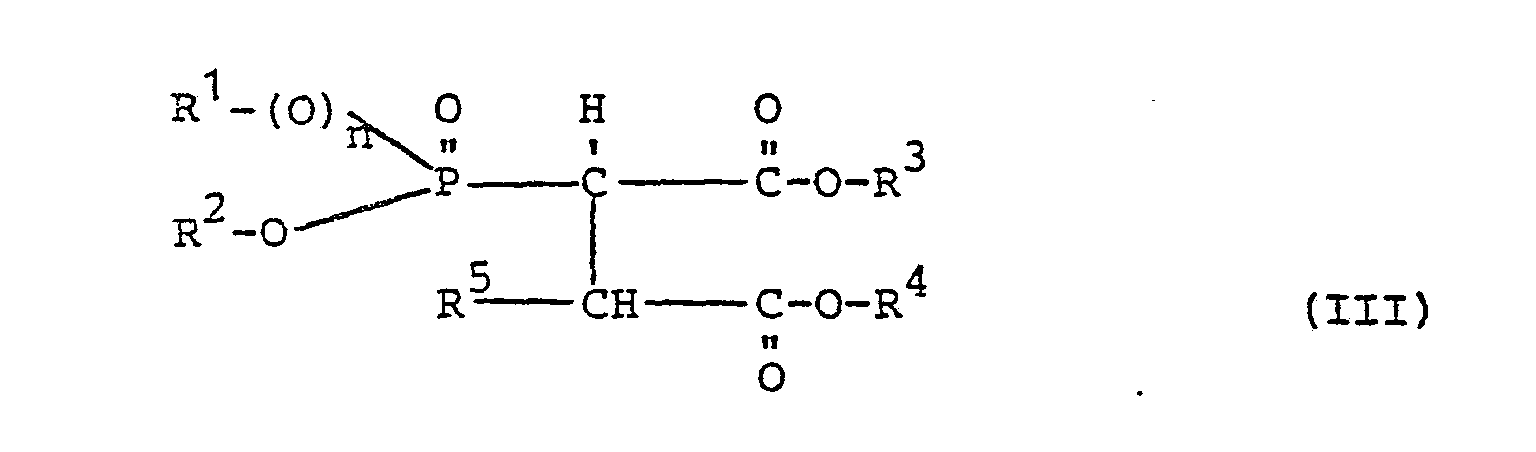
- R 1, R2, R3, R , R n die gleiche Bedeutung wie in Formel I haben, dargestellt werden können. Die Halogenierung kann mit Hypohalogeniten sowie mit den elementaren Halogenen Chlor und Brom, mit Interhalogenverbindungen, mit Halogen-abgebenden Stoffen z.B. elementares Halogen enthaltenden Käfigverbindungen, in Gegenwart von Halogenwasserstoff-Akzeptoren gegebenenfalls in Gegenwart von Lösungsmitteln und gegebenenfalls bei Anwesenheit eines Puffersystems ausgeführt werden.
- Für die Herstellung der in das erfindungsgemäße Verfahren einzusetzenden 1-Halogen-phosphonobernsteinsäureester geeignete Phosphonobernsteinsäureester sind z.B.:
- Dimethoxyphosphonobernsteinsäuredimethylester Diäthoxyphosphcnobernsteinsäurediäthylester Di-n-butoxyphosphonobernsteinsäure-di-n-butylester Di-i-butoxyphosphonobernsteinsäure-di-i-butylester Di-sek-butoxyphosphonobernsteinsäure-di-sek-butylester Di-2-äthylhexylphosphonobernsteinsäure-di-2-äthyl- hexylester Di-dodecyloxyphosphonobernsteinsäure-di-dodecylester Diäthoxyphosphonobernsteinsäure-di-butylester Dimethoxyphosphonobernsteinsäure-di-2-butoxyäthylester Dimethoxyphosphonobernsteinsäure-di-cyclohexylester Dimethoxyphosphonobernsteinsäure-bis-triäthylenglykolester Dimethoxyphosphonobernsteinsäure-bis-2-chloräthylester Bis-2-äthoxyäthoxyphosphonobernsteinsäuredimethylester Methyl-methoxyphosphonobernsteinsäuredimethylester Methyl-äthoxyphosphonobernsteinsäurediäthylester Äthyl-methoxyphosphonobernsteinsäuredimethylester Phenyl-methoxyphosphonobernsteinsäuredimethylester Dimethylphosphonobernsteinsäuredimethylester 2-Methyl-1-dimethoxyphosphonobernsteinsäuredimethylester bzw. deren Mischester, wie sie sich zumeist spontan und freiwillig durch Umesterung aus Phosphonobernsteinsäureestern mit unterschiedlichen Alkoxyresten im Molekül bilden.
- Die Benennung der voranstehend als Beispiele aufgeführten Phosphonobernsteinsäureester und der anschließend als Beispiele genannten 1-Halogenphosphonobernsteinsäureester ist in der Weise vorgenommen worden, daß die an die Gruppe P=0 (Phosphonogruppe) gebundenen Alkoxy- oder Alkylreste der Phosphonogruppe als Präfixe vorangestellt sind, während die an die Carboxylgruppen als Ester gebundenen Alkohole dem Säurenamen nachgestellt sind.
- Die Phosphonobernsteinsäureester sind nach bekannten Methoden gut zugängliche Substanzen, die z.T. bereits technisch hergestellt werden (vgl. z.B. Journal of General Chemistry of the USSR, 24, S 121-124 (1954)). Ihre Herstellung erfolgt durch Addition von Dialkylphosphiten oder Alkylphosphoniten an Malein- oder Fumarsäureester oder auch durch Veresterung von Phosphonobernsteinsäureteilestern, wie sie beispielsweise bei der Umsetzung von Trialkylphosphiten oder Dialkylphosphoniten mitFumarsäure oder Maleinsäuren entstehen, oder auch durch Umsetzung von Trialkylphosphiten oder Dialkylphosphoniten mit Malein- oder Fumarsäuremonoalkylestern.
- Für das erfindungsgemäße Verfahren geeignete 1-Halogenphosphonobernsteinsäureester sind z.B.:
- 1-Chlar-disnathoxyphosphonobernsteinsäuredimethylester 1-Chlor-diäthoxyphosphonobernsteinsäurediäthylester 1-Chlor-di-n-butoxyphosphonobernsteinsäure-di-n-butylester 1-Chlor-di-i-butoxyphosphonobernsteinsäure-di-i-butylester 1-Chlor-di-sek-butoxyphosphonobernsteinsäure-di-sek-butylester 1-Chlor-di-2-äthylhexylphosphonobernsteinsäure-di-2-äthyl- hexylester 1-Chlor-di-dodecyloxyphosphonobernsteinsäure-di-dodecylester 1-Chlor-diäthoxyphosphonobernsteinsäuredi-butylester 1-Chlcr-dimethoxyphosphonobernsäaredi-2-butoxy- äthylester 1-Chlor-dimethoxyphosphonobernsteinsäuredi-cyclohexylester 1-Chlor-dimethoxyphosphonobernsteinsäurebis-triäthylen glykolester 1-chlor-dimethoxyphosphonobernsteinsäure-bis-2-chloräthylester 1-Chlor-bis-2-äthoxyäthoxy-phosphonobernsteinsäuredi- methylester 1-Chlor-methyl-methoxyphosphcnobernsteinsäuredimethylester 1-Chlor-methyl-äthoxyphosphonobernsteinsäurediäthylester 1-Chlor-äthyl-methoxyphosphonobernsteinsäuredimethylester 1-Chlor-phenyl-methoxyphosphonobernsteinsäuredimethylester 1-Chlor-dimethylphosphonobernsteinsäuredimethylester 1-Brom-dimethoxyphosphonobernsteinsäuredimethylester 1-Brom-diäthoxyphosphonobernsteinsäurediäthylester 1-Brom-methyl-methoxyphosphonobernsteinsäuredimethylester i-Fluor-dimethoxyphosphonobernsteinsäuredimethylester 1-Chlor-2-methyl-1-dimethox-lrphosphonobeinsteinsäure- dimethylester
- Für die Umwandlung der Halogenphosphonobernsteinsäureester in Phosphonomaleinsäureester geeignete Basen gehören sowohl der Gruppe basisch wirkender Stickstoff-Verbindungen und PhosphorVerbindungen wie auch der Klasse ionisch aufgebauter Verbindungen mit basisch wirkendem Anion an.
- Geeignete basische Stickstoffverbindungen sind z.B. Amine, z.B. Trialkylamine, Arylamine, Alkylarylamine und zugehörige Polyamine und gesättigte und ungesättig-.. te fünf-, sechs- und sieben-gliedrige Stickstoff-Heterocyclen sowie Amide und Nitrile. Geeignete basische Phosphorverbindungen sind z.B. Trialkylphosphine, Hydroxylalkylphosphine, Trialkylphosphite, Alkylarylphosphite, Alkylphosphonite, Alkylphosphinite.
- Geeignete ionisch aufgebaute Stoffe mit basisch wirkenden Anionen umfassen z.B. Hydroxide, Oxide, Amide, Alkoholate, Phenolate, Carbonate, Hydrogencarbonate, Phosphate, Hydrogenphosphate, Monoalkylphosphate, Phosphite, Polyphosphate, Metaphosphate, Phosphonate, Silikate, Hydroxy- und Oxokomplexe der Metalle wie Zinkate, Aluminate, Stannate, vorzugsweise in Form ihrer Alkali-, Erdalkali- und Ammonium-Salze sowie weiterhin die Salze von Carbonsäuren, z.B. Fettsäuren, Polycarbonsäuren, Aminocarbonsäuren, Hydroxycarbonsäuren, Phosphonocarbonsäuren. Es können auch Gemische verschiedener Basen eingesetzt werden und die Wirkung der Basen kann auch durch Zusatz puffernd wirkender Stoffe modifiziert werden.
- Die verwendete Base, der umzusetzende 1-Halogenphosphonobernsteinsäureester und die sonstigen Reaktionsbedingungen müssen für ein optimales Reaktionsergebnis aufeinander abgestimmt werden, so daß insbesondere die Entalkylierung des 1-Halogenphosphonoberstein- säureesters und des daraus gebildeten Fhosphonomaleinsäureesters durch die Base und durch das Basenhydrohalogenid bzw. durch das aus Base und abgespaltenen Halogenwasserstoff gebildete Halogenid hintangehalten wird.
- 1-Halogenphosphonobernsteinsäureester und Base werden vorzugsweise im Molverhältnis von ca. 1:1 eingesetzt. Gewünschtenfalls kann auch mit einem Überschuß Base gearbeitet werden, während ein Unterschuß Base unvollständige Reaktion zur Folge hat. Größere Abweichungen vom Molverhältnis 1:1 bieten im allgemeinen keine Vorteile.
- Selbstverständlich ist es auch möglich, die Halogenierung des Phosphonobernsteinsäureesters der Formel III zum 1-Halogenphosphonobernsteinsäureester der Formel II und die Umwandlung des 1-Halogenphosphonobernsteinsäureesters der Formel II in den Phosphono- maleinsäureester der Formel I als Eintopfreaktion auszuführen, wobei der Halogenwasserstoff-Akzeptor der erstgenannten Reaktion und die Base der letztgenannten Reaktion gleich oder verschieden sein können und die beiden Reaktionsschritte sowohl zeitlich nebeneinander wie auch zeitlich nacheinander ablaufen können.
- Das erfindungsgemäße Verfahren kann in Gegenwart oder in Abwesenheit von Lösungsmitteln ausgeführt werden. Dabei können sowohl einphasige flüssige wie auch zweiphasige flüssige Systeme mit oder ohne feste Phase auftreten. Das Lösungsmittel kann auch mit der verwendeten Base identisch sein. Zu den verwendbaren Lösungsmitteln gehören beispielsweise Wasser, Alkohole, Äther, Kohlenwasserstoffe und Chlorkohlenwasserstoffe, Säureamide und Nitrile. Bei Verwendung von Alkoholen als Lösungsmittel sowie besonders von Alkoholaten als Basen in Alkoholen als Lösungsmittel ist es bevorzugt, die Bestandteile Alkohol und Alkoholat auf die im umzusetzenden 1-Halogenphosphonobernsteinsäureester verestert enthaltenen Alkohole abzustimmen und möglichst gleich zu machen. Bei Arbeiten in zweiphasigen flüssigen Systemen können Phasentransfer-Katalysatoren zugesetzt werden.
- Das erfindungsgemäße Verfahren kann in einem weiten Temperaturbereich von ca. -80°C bis ca. 150°C ausgeübt werden, bevorzugt ist ein Bereich von -10°C bis ca. 100°C.
- Das erfindungsgemäße Verfahren kann sowohl kontinuierlich wie auch diskontinuierlich gestaltet werden. Bei der diskontinuierlichen Verfahrensweise wird vorzugsweise die Base dem vorgelegten 1-Halogenphosphonobernsteinsäureester hinzugefügt, jedoch ist es auch möglich, Base und 1-Halogenphosphonobernsteinsäureester gleichzeitig in den Reaktionsraum einzugeben und es ist auch möglich, 1-Halogenphosphonobernsteinsäureester zu vorgelegter Base hinzuzugeben. Das oder die Lösungsmittel können sowohl der Base wie dem 1-Halogenphosphonobernsteinsäureester wie auch beiden zugesetzt werden oder aber unabhängig dosiert werden.
- Im allgemeinen wird das erfindungsgemäße Verfahren bei Normaldruck ausgeführt, doch kann auch unter erhöhtem oder vermindertem Druck gearbeitet werden, wobei ein erhöhter Druck wegen der dadurch verminderten Flüchtigkeit insbesondere der Basen und/oder der Lösungsmittel Vorteile bieten kann. Druckveränderungen können auch benutzt werden, um den Siedepunkt des Systems z.B. für eine Siedekühlung in einen optimalen Bereich zu verlagern.
- Die Isolierung der nach dem erfindungsgemäßen Verfahren hergestellten Phosphonomaleinsäureester kann nach herkömmlichen Methoden erfolgen. Die Entfernung der Basenhydrohalogenide oder der aus den Basen entstandenen Halogenide kann z.B. durch Filtrieren, Zentrifugieren etc. oder durch Auswaschen mit Wasser oder wäßrigen Lösungen vorgenommen werden, oder der Phosphonomaleinsaureester selbst wird mit einem Lösungsmittel gegebenenfalls nach vorherigem Zusatz von Wasser extrahiert. Lösungsmittel und nicht umgesetzte Basen können vor oder nach Abtrennung des Basenhydrohalogenides bzw. des aus der Base entstandenen Halogenides z.B. durch Destillation ganz oder teilweise entfernt werden. Die erfindungsgemäß dargestellten Phosphonomaleinsäureesters können als Rohprodukt wie in Lösung weiter gereinigt werden durch Waschen mit Wasser oder wäßrigen Lösungen von Säuren oder Basen oder durch Kontaktieren mit Adsorbentien und nach Entfernen des Lösungsmittels gegebenenfalls auch durch Destillation.
- Durch Alkali-katalysierte Addition von Dialkylphosphiten an die Dialkoxyphosphonomaleinsäuredialkylester entstehen Alkylester der 1,2-Diphosphonobernsteinsäure.
- 1,2-Diphosphonobernsteinsäureester sind vielseitig verwendbare Stoffe, die z.B. als Flammschutzmittel und Haftvermittler verwendet werden können und die wertvolle Ausgangsstoffe für die Synthese von mehrere Phosphonogruppen enthaltenden Wirkstoffen wie beispielsweise Sequestriermitteln, Korrosionsschutzmitteln, Flammschutzmitteln, Dispergiermitteln, Pharmaceutica und Pestiziden darstellen (vgl. z.B. US-PS 3 579 570, US-PS 3 933 944 oder DE-OS 28 19 112).
- Die Erfindung wird durch die nachfolgenden Beispiele näher erläutert.
- Zu 254 g Dimethoxyphosphonobernsteinsäuredimethylester in 500 ml Wasser werden bei 0 C im Verlauf von 5 Minuten 530 ml einer Bleichlauge-Lösung mit einem Gehalt von 86 g Aktiv-Chlor zugetropft. Aus der zunächst homogenen Reaktionslösung scheidet sich im Verlauf der Reaktion ein Teil des Produktes als zweite flüssige Phase ab. Nach Beendigung der Bleichlauge-Zugabe werden für die Sammlung des Produktes 500 ml Methylenchlcrid zugesetzt, die organische Phase wird dann im Scheidetrichter abgetrennt und die wäßrige Phase noch dreimal mit je 200 ml Methylenchlorid extrahiert. Nach dem Einengen im Vakuum hinterbleiben 149 g Rückstand aus den vereinigten organischen Phasen. Der Anteil des 1-Chlor-1-dimethoxyphosphonobernsteinsäure- dimethylesters im Rückstand beträgt 98,0 %.
- Zu 254 g Dimethoxyphosphonobernsteinsäuredimethylester in 1000 ml Methylenchlorid wird bei 0°C im Verlauf einer Stunde eine aus 190 g Brom, 88 g Natriumhydroxid und 450 ml Wasser hergestellte NatriumhypobromitLösung zugetropft. Die Reaktionsmischung wird intensiv gerührt und von außen gekühlt. Nach Beendigung der Hypobromit-Zugabe wird die Reaktionsmischung in einen Scheidetrichter überführt. Die spezifisch schwerere Methylenchiorid-Phase wird ahgenommen und die verbleibende wäßrige Lösung noch einmal mit 300 ml Methylenchlorid extrahiert. Die vereinigten organischen Phasen werden eingeengt und der Rückstand wird dann bei 100°C im Vakuum an der Wasserstrahlpumpe (14 Torr) von flüchtigen Anteilen befreit. Der Rückstand, der nach dieser Behandlung 302 g wiegt, besteht nach gaschromatographischer Analyse aus 94,8 % 1-Brom-1-dimethoxyphosphonobernsteinsäuredimethylester und 2,9 % Dimethoxyphosphonobernsteinsäuredimethylester. Beim Stehenlassen kristallisiert der 1-Brom-1-dimethoxyphosphonobernsteinsäuredimethylester zu farblosen nadeligen Kristallen hoher Reinheit.
- Zu 288,5 g 1-Chlor-l-dimethoxyphosphonobernsteinsäuredimethylester (1,0 Mol) in 500 ml Toluol werden bei 20-250C innerhalb einer Stunde 111 g Triethylamin (1,1 Mol) hinzugetropft. Nach weiteren 2 Stunden Rühren wird das ausgefallene Triethylammoniumchlorid abgesaugt und mit 250 ml Toluol ausgewaschen. Aus der Lösung wird Toluol im Vakuum bei 14 Torr abgezogen. Der Rückstand wiegt 249 g. Bei der anschließenden Destillation werden 123 g Destillat (Xp1: 137°C) und 100 g undestillierbarer Sumpf erhalten. Das Destillat enthält nach gaschromatographischer Analyse 98,2 % des erwünschten Dimethoxyphosphonomaleinsäureesters. Die 1H-NMR-Untersuchung zeigt, daß 88 % des Produktes in der cis-Form (Phosphonomaleinsäure-Form) und 12 % des Produktes in der trans-Form (Phesphonofumarsäure-Feorm) vorliegen.
- Nochmalige Destillation im Vakuum liefert ein hochreines, über 99 %iges Produkt.
- Zu 167 g 1-Brom-1-dimethoxyphosphonobernsteinsäuredimethylester (0,5 Mol) in 300 ml Toluol werden bei 20-25°C im Verlauf einer halben Stunde 51 g Triethylamin (0,5 Mol) hinzugetropft. Nach weiteren 50 Minuten Rühren wird das ausgefallene Triethylammoniumbromid abgesaugt und mit 200 ml Toluol ausgewaschen. Toluol wird bei reduziertem Druck (bis 80°C/2 Torr) aus der Lösung abdestilliert. Der Rückstand wiegt 122 g. Schonende Destillation durch langsames Eintropfen dieses Rückstandes in den erhitzten Kolben einer Vakuumdestillationsapparatur ergibt 84 g Dimethoxyphosphonomaleinsäuredimethylester.
- Zu 254 g Dimethoxyphosphonobernsteinsäuredimethylester (1,0 Mol) in 1000 ml Methylenchlorid werden bei 00C im Verlaufe von 4 Minuten 530 ml einer Bleichlauge-Lösung mit einem Gehalt von 86 g (1,2 Mol) Aktiv-Chlor zugetropft. Die Reaktionsmischung wird intensiv gerührt und von außen gekühlt. Nach Beendigung der Bleichlauge-Zugabe wird die Reaktionsmischung in einen Scheidetrichter überführt. Die spezifisch schwerere Methylenchlorid-Phase wird abgenommen und die verbleibende wäßrige Lösung noch einmal mit 100 ml Methylencnlorid extranlert. Die vereinigten organischen Phasen werden eingeengt und der Rückstand wird dann bei 100°C im Vakuum an der Wasserstrahlpumpe (14 Torr) von flüchtigen Anteilen befreit. Der Rückstand, der nach dieser Behandlung 268 g wiegt, besteht nach gaschromatographischer Analyse aus 96,3 % 1-Chlor-1-dimethoxyphosphonobernsteinsäure-dimethylester und 2,6 % Dimethoxyphosphonobernsteinsäuredimethylester.
- Die Verfahrensweise von Beispiel 1 wird wiederholt mit der Abänderung, daß die Reaktion bei 40°C durchgeführt wird. Es werden 234 g roher 1-Chlor-l-dimethoxyphosphonobernsteinsäuredimethylester mit einer gaschromatographisch bestimmten Reinheit von 96,8 % erhalten.
- Die Verfahrensweise von Beispiel 1 wird wiederholt mit der Abänderung, daß nur 500 ml Methylenchlorid als Lösungsmittel eingesetzt werden. Es werden 249 g rohes 1-Chlor-1-dimethoxyphosphonobernsteinsäuredimethylester mit einer gaschromatographisch bestimmten Reinheit von 97,3 % erhalten.
- Zu 288,5 g 1-Chlor-l-dimethoxyphosphonobernsteinsäuredimethylester (1,0 Mol) in 600 ml Toluol werden bei 15 - 20°C im Verlauf einer Stunde 125 g DBN (2,3,4-6,7,8-Hexahydropyrrolo[1,2-a]-pyrimidin) (1,0 Mol) hinzugetropft. Nach weiteren 10 Minuten Rühren wird das ausgefallene Salz abgesauct und mit 300 ml Toluol ausgewaschen. Toluol wird bei reduziertem Druck aus der Lösung bis 80°C/2 Torr abdestilliert. Der Rückstand wiegt 258 g, der Gehalt an Dimethoxyphosphonomaleinsäuredimethylester beträgt 94,6 %.
- Zu 288,5 g 1-Chlor-1-dimethoxyphosphonobernsteinsäuredimethylester (1,0 Mol) in 600 ml Toluol werden bei 20-250C im Verlauf von 1,5 Stunden 152 g DBU (2,3,4,6,7,8,9,10-Oktahydropyrimido[1,2-a]azepin) (1,0 Mol) hinzugetropft. Nach weiteren 30 Minuten Rühren wird das ausgefallene Salz abgesaugt und mit 300 ml Toluol ausgewaschen. Toluol wird bei reduziertem Druck aus der Lösung bis 80°C/2 Torr abdestilliert. Der Rückstand wiegt 261 g, nach gaschromatographischer Analyse besteht er aus 96,2 % reinem Dimethoxyphosphonomaleinsäuredimethylester.
- Zu 288,5 g 1-Chlor-1-dimethoxyphosphonobernsteinsäuredimethylester (1,0 Mol) in 2.50 ml Methanol werden bei 25°C im Verlauf einer Stunde 232 ml 4,3 m methanolisches Natriummethylat (1,0 Mol) hinzugetropft.
- Das ausgefallene Natriumchlorid wird abgesaugt und mit 150 ml Methanol ausgewaschen. Methanol wird bei reduziertem Druck aus der Lösung bis 100°C/12 Torr abdestilliert. Der Rückstand wiegt 293 g. Durch Destillation im Vakuum werden daraus 251 g 99,8 %iger Dimethoxyphosphonomaleinsäuredimethylester erhalten.
- Zu 288,5 g 1-Chlor-1-dimethoxyphosphonobernsteinsäuredimethylester (1,0 Mol) werden im Verlauf einer Stunde 2320 ml 0,43 m methanolisches Natriummethylat (1,0 Mol) hinzugetropft. Das ausgefallene Natriumchlorid wird abgesaugt und mit 150 ml Methanol ausgewaschen. Methanol wird zum größten Teil abdestilliert. Eine Nachfällung von Natriumchlorid wird abfiltriert. Das restliche Methanol wird im Vakuum abgezogen. Destillation im Vakuum ergibt 221 g Dimethoxyphosphonomaleinsäuredimethylester.
- Zu 344,5 g 1-Chlor-1-diethoxyphosphonobernsteinsäure- diethylester (1,0 Mol) - hergestellt aus Diethoxyphosphonobernsteinsäurediethylester und Bleichlauge in analoger Weise zu Beispiel 1 - in 500 ml Ethanol werden bei 25°C im Verlauf einer Stunde 520 ml 1,92 m ethanolisches Natriumethylat (1,0 Mol) hinzugetropft. Das ausgefallene Natriumchlorid wird abgesaugt und mit 150 ml Ethanol ausgewaschen. Ethanol wird bei reduziertem Druck aus der Lösung abdestilliert. Der Rückstand ergibt bei der Destillation im Vakuum 259 g Diethoxyphosphonomaleins-äurediethylester (Kp1:169°C).
- Zu 456,5 g 1-Chlor-1-di-i-butoxyphosphonobernsteinsäure-di-i-butylester (1,0 Mol) - hergestellt aus Di-i-butoxyphosphonobernsteinsäuredi-i-butylester und Bleichlauge in analoger Weise zu Beispiel 1 - in 1000 ml Toluol werden bei 20-25°C im Verlauf einer Stunde 152 g DBU (2,3,4,6,7,8,9,10-Oktahydropyrimido[1,2-a]-azepin) (1,0 Mol) hinzugetropft. Nach weiteren 60 Minuten Rühren wird das ausgefallene Salz abgesaugt und mit 500 ml Toluol ausgewaschen. Toluol wird bei reduziertem Druck aus der Lösung bis 120°C/2 Torr abdestilliert. Der Rückstand wiegt 423 g, nach gaschromatographischer Analyse besteht er aus 96,9 % reinem Di-i-butoxyphosphonomaleinsäuredi-i-butylester.
- Zu 268 g einer Mischung von 1-Methyl-1-(dimethoxyphosphono)bernsteinsäuredimethylester (40 %) und 2-Methyl-1-dimethoxyphosphonobernsteinsäuredimethylester (60 % entsprechend 0,6 Mol) werden 64 g Natriumcarbonat (0,6 Mol) und 300 g Wasser hinzugefügt. In diese Mischung werden bei 20°C im Verlaufe einer halben Stunde 43 g Chlor (0,6 Mol) gasförmig eingeleitet. Die Reaktionsmischung wird intensiv gerührt und von außen gekühlt. Nach Beendigung der Chlor-Zugabe wird die Reaktionsmischung in einem Scheidetrichter dreimal 5 mit je 200 ml Methylchlorid extrahiert. Die vereinigten organischen Phasen werden wie in Beispiel 1 beschrieben aufgearbeitet. Der Rückstand, der nach dieser Behandlung 205 g wiegt, besteht nach gaschromatographischer Analyse aus 58 % 1-Chlor-1-dimethoxyphosphono-2-methylbernsteinsäure-di- methylester und 42 % der isomeren Methyl-dimethoxyphosphonobernsteinsäuredimethylester.
- 104 g dieser Mischung, enthaltend ca. 62 g entsprechend 0,2 Mol 1-Chlor-1-dimethoxyphosphono-2-methyl- bernsteinsäuredimethylester, werden mit 200 ml Methanol vorgelegt. Bei 250C werden im Verlauf einer halben Stunde 47 ml 4,3 m methanolisches Natriummethylat (0,2 Mol) zugetropft. Ausgefallenes Natriumchlorid wird abgesaugt, mit wenig Methanol gewaschen und die Lösung wird im Vakuum eingeengt. Der Rückstand wird destilliert. Das Destillat (Rp1: 134-148°C) wiegt 84 g und besteht nach 1H-NMR-Analyse aus 54 % 1-Dimethoxyphosphono-2-methylmaleinsäuredimethylester und 46 % der isomeren Methyl-dimethoxyphosphonobernsteinsäuredimethylester, unter denen das 1-Methyl-1-phosphono-Isomere sehr stark überwiegt.
- Zu 238 g Methyl-methoxyphosphonobernsteinsäuredimethylester (1,0 Mol) in 1000 ml Methylenchlorid werden bei 0°C im Verlaufe von 5 Minuten 530 ml einer Bleichlauge-Lösung mit einem Gehalt von 86 g (1,2 Mol) Aktiv-Chlor zugetropft. Die Reaktionsmischung wird intensiv gerührt und von außen gekühlt. Nach Beendigung der Bleichlauge-Zugabe wird die Reaktionsmischung in einen Scheidetrichter überführt. Die spezifisch schwerere Methylenchlorid-Phase wird abgenommen und die verbleibende wäßrige Lösung nochmals mit 300 ml Methylenchlorid extrahiert. Die vereinigten organischen Phasen werden eingeengt und der Rückstand wird dann bei 1000C im Vakuum an der Wasserstrahlpumpe (14 Torr) von flüchtigen Anteilen befreit. Der Rückstand, der nach dieser Behandlung 244 g wiegt, besteht nach gaschromatographischer Analyse aus 82 % 1-Chlor-1-(methyl-methoxyphosphono)-bernsteinsäuredimethylester und 13,2 % Methyl-methoxyphosphonobernsteinsäuredimethylester.
- 133 g dieser Mischung, enthaltend ca. 109 g entsprechend 0,4 Mol 1-Chlor-1-(methyl-methoxyphosphono)-bernstein- säuredimethylester, werden mit 300 ml Methanol vorgelegt. Bei 25°C werden im Verlauf von 10 Minuten 94 ml 4,3 m methanolisches Natriummethylat (0,4 Mol) zugetropft. Ausgefallenes Natriumchlorid wird abgesaugt, mit Methanol ausgewaschen, und das Filtrat wird eingeengt. Die Destillation ergibt 103 g Produkt (Kp1: 130-135°C), das nach gaschromatographischer Analyse aus 88,5 % 1-(Methyl-methoxyphosphono)-maleinsäuredimethylester und 10,6 % 1-(Methylmethoxyphosphono)-bernsteinsäuredimethylester besteht.
- Zu 282 g Diethoxyphosphonobernsteinsäuredimethylester (1,0 Mol), hergestellt durch Addition von Diäthylphosphit an Maleinsäuredimethylester, in 800 ml Methylenchlorid werden bei 0°C im Verlaufe von 5 Minuten 530 ml einer Bleichlauge-Lösung mit einem Gehalt von 86 g (1,2 Mol) Aktiv-Chlor zugetropft. Die Reaktionsmischung wird intensiv gerührt und von außen gekühlt. Nach Beendigung der Bleichlauge-Zugabe wird die Reaktionsmischung in einen Scheidetrichter überführt. Die spezifisch schwerere Methylenchlorid-Phase wird abgenommen und die verbleibende wäßrige Lösung noch zweimal mit je 300 ml Methylenchlorid extrahiert. Die vereinigten organischen Phasen werden eingeengt und der Rückstand wird dann bei 100°C im Vakuum an der Wasserstrahlpumpe (14 Torr) von flüchtigen Anteilen befreit. Der Rückstand, der nach dieser Behandlung 285 g wiegt, besteht nach gaschromatographischer Analyse aus 90,1 % 1-Chlor-1-phosphonobernsteinsäureester und 2,8 % Phosphonobernsteinsäureester. Aus dem Gaschromatogramm ist ersichtlich, daß statt des erwarteten einheitlichen 1-Chlor-1-diethoxyphosphonobernsteinsäuredimethylesters ein Gemisch von Produkten vorliegt, das durch Austausch der Methyl- und Ethylester-Gruppen entstanden ist. Auch das 1H-NMR-Spektrum weist darauf hin, daß neben C2H5-0-P-Gruppen auch CH3-0-P-Gruppen in nahezu gleicher molarer Menge vorhanden sind.
- 175 g dieses Produktes, enthaltend ca. 158 g 1-Chlor-1-phosphonobernsteinsäureester mit je 2 Methoxygruppen und 2 Ethoxygruppen im statistischen Mittel als Estergruppen pro Molekül - das entspricht ca. 0,5 Mol-werden mit 200 ml Methanol vorgelegt. Bei 20°C werden im Verlauf einer halben Stunde 140 ml methanolische Natriummethylat-Lösung (0,6 Mol) zugetrcpft. Danach wird das Reaktionsgemisch durch Abziehen des
- Methanols im Vakuum bei nicht mehr als 20°C eingedickt. 100 ml Wasser werden hinzugefügt, die Lösung mit Schwefelsäure neutral gestellt und sodann wird die Lösung dreimal mit 150 ml Methylenchlorid extrahiert. Die vereinigten organischen Extrakte werden eingeengt und der Rückstand wird destilliert. Das Destillat (Rp1: 135-145°C)wiegt 111 g. Nach gaschromatographischer Analyse enthält es 78,7 % Dimethoxyphosphonomaleinsäuredimethylester sowie insgesamt 19,8 % leicht höher siedender Komponenten. Das 1H-NMR-Spektrum zeigt, daß Methoxygruppen und Ethoxygruppen im Verhältnis 88 : 12 im Destillat vorhanden sind. Daraus ergibt sich, daß es sich bei den höher siedenden Komponenten um gemischte Methyl-Ethyl-ester der Phosphonomaleinsäure handelt.
- Zu 288,5 g 1-Chlor-1-dimethoxyphosphonobernsteinsäuredimethylester (1,0 Mol) werden bei 100°C rasch 250 g Trimethylphosphit (2,0 Mol) hinzugefügt. Diese Mischung wird 3 Stunden am Rückfluß sieden gelassen. Während dieser Zeit entweicht Methylchlorid, das durch Abkühlung kondensiert werden kann. Anschließend werden die flüchtigen Teile im Vakuum bis 140°C/13 Torr abgezogen.
- Der flüchtige Anteil besteht im wesentlichen aus Dimethylphosphit und Trimethylphosphit. Der Rückstand wird einer Destillation im Vakuum bei 1 Torr unterworfen. Das Destillat (Kp1: 136-138°C) aus Dimethoxyphosphonomaleinsäuredimethylester wiegt 86 g.
- 4,6 g Natrium (0,20 Mol) werden in 200 ml Toluol mit Hilfe eines Ultraturrax fein verteilt. Zu der Suspension werden bei 30 - 35°C 51 g Dimethoxyphosphonobernsteinsäuredimethylester (0,2 Mol) langsam zugetropft. In exothermer Reaktion entsteht eine klare, leicht gelbe Lösung von Dimethoxyphosphonobernsteinsäuredimethylester-Natriumsalz.
- Zugabe dieser Lösung zu einer bei 25 - 300C gehaltenen Lösung von 58 g 1-Chlor-1-dimethoxyphosphonobernsteinsäuredimethylester in 200 ml Toluol führt zu einer Natriumchlorid-Ausfällung. Nach Abfiltrieren des Salzes wird aus dem Filtrat das Toluol im Vakuum abgezogen. Der Rückstand liefert bei der Destillation 88 g Destillat, das nach 1H-NMR-spektroskopischer Untersuchung ein annähernd äquimolares Gemisch von Dimethoxyphosphonobernsteinsäuredimethylester und Dimethoxyphosphonomaleinsäuredimethylester darstellt.
- 252 g Dimethoxyphosphonomaleinsäuredimethylester (1,0 Mol) und 110 g Dimethylphosphit werden als Mischung vorgelegt. Bei 20 - 250C werden tropfenweise insgesamt 10 ml einer 4,3 m Lösung von Natriummethylat in Methanol zugesetzt. Schon nach den ersten Tropfen beginnt eine deutlich exotherme Reaktion, so daß die weitere Zugabe vorsichtig immer dann erfolgt, wenn die exotherme Reaktion nachläßt. Nach Ende der erkennbaren Reaktion läßt man noch weitere 8 Stunden stehen und evakuiert dann unter Erwärmen auf 1200C bis 2 Torr. Der kristalline Rückstand wiegt 365 g. Der
- Der Anteil des 1,2-Bis-dimethoxyphosphonobernsteinsäuredimethylesters an den flüchtigen Anteilen beträgt nach gaschromatographischer Analyse 95,5 %. Zweimaliges Umkristallisieren dieses Rückstandes aus Toluol ergibt ein Produkt (Fp. 750C), das 1,2-Bis-dimethoxyphosphonobernsteinsäuredimethylester in über 99 %iger Reinheit darstellt.
bzw. deren Mischester, wie sie sich zumeist spontan und freiwillig durch Umesterung aus Phosphonobernsteinsäureestern mit unterschiedlichen Alkoxyresten im Molekül bilden.
Claims (4)
1. Phosphonomaleinsäureester der allgemeinen Formel

wobei
R 1 für einen gegebenenfalls substituierten Alkylrest mit 1-16 C-Atomen und - falls n = o - auch für einen gegebenenfalls substituierten Arylrest,
R2,R3,R4 unabhängig voneinander für einen gegebenenfalls substituierten Alkylrest mit 1-16 C-Atomen,
R für Wasserstoff, einen Alkyl- oder Arylrest mit 1- 7 C-Atomen und
n für 0 oder 1 steht.
2. Verfahren zur Herstellung von Phosphonomaleinsäureestern gemäß Anspruch 1, dadurch gekennzeichnet, daß 1-Halogen-1-phosphonobernsteinsäureester der allgemeinen Formel

worin
mit Basen umgesetzt werden.
Hal für Chlor oder Brom,
R 1 für einen gegebenenfalls substituierten Alkylrest mit 1-16 C-Atomen und, falls n = o, auch für einen gegebenenfalls substituierten Arylrest,
R 2,R3,R4 unabhängig voneinander für einen Alkylrest mit 1-16 C-Atomen,
R5 vorzugsweise für Wasserstoff sowie für einen Alkyl- oder Arylrest und
n für die Zahlen 0 oder 1 steht,
mit Basen umgesetzt werden.
3) Verwendung von Phosphonomaleinsäureestern gemäß Anspruch 1 als Flammschutzmittel.
4) Verwendung von Phosphonomaleinsäureestern gemäß Anspruch 1 als Haftvermittler.
Applications Claiming Priority (2)
| Application Number | Priority Date | Filing Date | Title |
|---|---|---|---|
| DE2918161 | 1979-05-05 | ||
| DE19792918161 DE2918161A1 (de) | 1979-05-05 | 1979-05-05 | Phosphonomaleinsaeureester sowie verfahren zu deren herstellung |
Publications (1)
| Publication Number | Publication Date |
|---|---|
| EP0019111A1 true EP0019111A1 (de) | 1980-11-26 |
Family
ID=6070016
Family Applications (1)
| Application Number | Title | Priority Date | Filing Date |
|---|---|---|---|
| EP80102178A Withdrawn EP0019111A1 (de) | 1979-05-05 | 1980-04-23 | Verfahren zur Herstellung von Phosphonomaleinsäureestern |
Country Status (3)
| Country | Link |
|---|---|
| US (1) | US4307040A (de) |
| EP (1) | EP0019111A1 (de) |
| DE (1) | DE2918161A1 (de) |
Cited By (3)
| Publication number | Priority date | Publication date | Assignee | Title |
|---|---|---|---|---|
| EP0530692A3 (en) * | 1991-09-06 | 1993-03-31 | Basf Aktiengesellschaft | Halogen-free flame resistant thermoplastic moulding masses based on polyphenylenether and polystyrene |
| WO1994021724A1 (en) * | 1993-03-23 | 1994-09-29 | Courtaulds Plc | Phosphorus-containing flame retardants |
| US5444123A (en) * | 1991-09-06 | 1995-08-22 | Basf Aktiengesellschaft | Halogen-free flameproofed thermoplastic molding materials based on polyphenylene ethers and polystyrene |
Families Citing this family (4)
| Publication number | Priority date | Publication date | Assignee | Title |
|---|---|---|---|---|
| US4738870A (en) * | 1986-03-27 | 1988-04-19 | The Dow Chemical Company | Adherent photopolymerizable compositions |
| US5077366A (en) * | 1987-08-07 | 1991-12-31 | The Dow Chemical Company | Novel phosphonic acid compounds and method of preparation |
| US4758384A (en) * | 1987-08-07 | 1988-07-19 | The Dow Chemical Company | Novel phosphonic acid compounds and method of preparation |
| US5047578A (en) * | 1987-08-07 | 1991-09-10 | The Dow Chemical Company | Novel phosphonic acid compounds and method of preparation |
Citations (4)
| Publication number | Priority date | Publication date | Assignee | Title |
|---|---|---|---|---|
| US3562166A (en) * | 1968-12-24 | 1971-02-09 | Procter & Gamble | Built detergent compositions |
| US3584124A (en) * | 1968-12-24 | 1971-06-08 | Procter & Gamble | Compositions for inhibiting anomalous deposition and mobilization of calcium phosphate in animal tissue |
| DE2449466A1 (de) * | 1974-10-19 | 1976-04-29 | Hoechst Ag | Neue ungesaettigte phosphorhaltige carbonsaeurederivate |
| US4024207A (en) * | 1974-07-04 | 1977-05-17 | Societe Nationale Des Poudres Et Explosifs | Diethyl hydroxymethylphosphonate esters, their preparation and use |
Family Cites Families (7)
| Publication number | Priority date | Publication date | Assignee | Title |
|---|---|---|---|---|
| US2888434A (en) * | 1955-04-04 | 1959-05-26 | Du Pont | Acrylonitrile polymer composition containing the recurring unit of a polymerized bis(2-chloroethyl) vinyl phosphonate |
| US2959609A (en) * | 1956-11-06 | 1960-11-08 | Hoechst Ag | Process for preparing vinyl-phosphonic-acid-bis-(beta-chlorethyl)-ester |
| US3064030A (en) * | 1958-06-18 | 1962-11-13 | Monsanto Chemicals | Method of preparing vinyl and substituted vinyl phosphonates by dehydro-halogenation |
| BE605637A (de) * | 1960-09-27 | |||
| US3579570A (en) * | 1968-12-24 | 1971-05-18 | Procter & Gamble | Ethane-1,2 - dicarboxy - 1,2-dihydroxy-1,2-diphosphonic acid,lower alkyl esters,alkali metal salts thereof and process for preparing same |
| US3933944A (en) * | 1972-12-04 | 1976-01-20 | The United States Of America As Represented By The Secretary Of Agriculture | αα'-Bis-(phosphono)dicarboxylic acid derivatives |
| US4113861A (en) * | 1977-05-02 | 1978-09-12 | The Procter & Gamble Company | Phosphonate pharmaceutical composition |
-
1979
- 1979-05-05 DE DE19792918161 patent/DE2918161A1/de not_active Withdrawn
-
1980
- 1980-04-16 US US06/140,891 patent/US4307040A/en not_active Expired - Lifetime
- 1980-04-23 EP EP80102178A patent/EP0019111A1/de not_active Withdrawn
Patent Citations (4)
| Publication number | Priority date | Publication date | Assignee | Title |
|---|---|---|---|---|
| US3562166A (en) * | 1968-12-24 | 1971-02-09 | Procter & Gamble | Built detergent compositions |
| US3584124A (en) * | 1968-12-24 | 1971-06-08 | Procter & Gamble | Compositions for inhibiting anomalous deposition and mobilization of calcium phosphate in animal tissue |
| US4024207A (en) * | 1974-07-04 | 1977-05-17 | Societe Nationale Des Poudres Et Explosifs | Diethyl hydroxymethylphosphonate esters, their preparation and use |
| DE2449466A1 (de) * | 1974-10-19 | 1976-04-29 | Hoechst Ag | Neue ungesaettigte phosphorhaltige carbonsaeurederivate |
Non-Patent Citations (1)
| Title |
|---|
| CHEMICAL ABSTRACTS Band 77, Nr. 23, 4. Dezember 1972 Columbus, Ohio, USA R.K. HUFF et al. "Nonadrides. VI. Dimerization of the C-unit in vivo and in vitro" Seite 356, rechte Spalte, Abstract Nr. 151408e & J. Chem. Soc., Perkin Trans. 1, Nr. 20, 1972, Seiten 2584 bis 2590 (Eng) in Verbindung mit 9. collective Formel Register, Seite 5882 F, Spalte 3, Mitte (C12H21O7P). * |
Cited By (3)
| Publication number | Priority date | Publication date | Assignee | Title |
|---|---|---|---|---|
| EP0530692A3 (en) * | 1991-09-06 | 1993-03-31 | Basf Aktiengesellschaft | Halogen-free flame resistant thermoplastic moulding masses based on polyphenylenether and polystyrene |
| US5444123A (en) * | 1991-09-06 | 1995-08-22 | Basf Aktiengesellschaft | Halogen-free flameproofed thermoplastic molding materials based on polyphenylene ethers and polystyrene |
| WO1994021724A1 (en) * | 1993-03-23 | 1994-09-29 | Courtaulds Plc | Phosphorus-containing flame retardants |
Also Published As
| Publication number | Publication date |
|---|---|
| DE2918161A1 (de) | 1980-11-13 |
| US4307040A (en) | 1981-12-22 |
Similar Documents
| Publication | Publication Date | Title |
|---|---|---|
| DE3025657C2 (de) | ||
| EP0034239A1 (de) | Verfahren zur Herstellung von Alkanphosphonsäurediarylestern und bzw Alkanphosphinsäurearylestern | |
| DE2918161A1 (de) | Phosphonomaleinsaeureester sowie verfahren zu deren herstellung | |
| DE1033200B (de) | Verfahren zur Herstellung von N-substituierten Amidophosphorsaeuredialkylestern | |
| EP0026737B1 (de) | Verfahren zur Herstellung von 2,3,5,6-Tetrachlorpyridin | |
| DE2338007B2 (de) | Verfahren zur Herstellung von Tetrakis-(2-halogenalky))-alkylendiphosphaten | |
| DE2643474C2 (de) | Verfahren zur Herstellung von Phosphitchloriden | |
| DE4100856C2 (de) | Verfahren zur Herstellung von N-alkylsubstituierten Aminomethylphosphonsäurederivaten | |
| CH620223A5 (en) | Process for the preparation of N-phosphonomethylglycine | |
| DE2643442A1 (de) | Verfahren zur herstellung von phosphitchloriden | |
| EP0061106B1 (de) | Verfahren zur Herstellung von Oligophosphonsäuren bzw. Oligophosphinsäuren, ihren Salzen und/oder Estern sowie neue Phosphonsäurederivate | |
| DD201600A5 (de) | Verfahren zur herstellung von vinylphosphonsaeuredichlorid und 2-chlorethanphosphonsaeuredichlorid | |
| HU194257B (en) | Process for preparing n-(phosphonomethyl)-glycine | |
| DE3881103T2 (de) | Verfahren zur Herstellung von 1,3,2-Oxazaphosphorinan. | |
| DE2918160A1 (de) | Verfahren zur herstellung von 1.2-diphosphonobernsteinsaeureestern | |
| DE2238921C3 (de) | Verfahren zur Herstellung von 0,0-Dialkyl-0-(2,2-dichlorvinyl)-thionophosphorsäureestern | |
| EP0227918A1 (de) | Verfahren zur Herstellung von Phosphonsäuredichloriden | |
| DE2627709C2 (de) | Malonsäure-pentachlorphenylester und deren Herstellung | |
| DE4000237A1 (de) | Verfahren zur synthese von methyl-(2-carboalkoxy-ethyl)-phosphinsaeurealkylestern | |
| US5290944A (en) | Method for producing dichloromethylpyridines | |
| DE2461906B2 (de) | Phosphinoxide mit polyfluorierter Kette und Verfahren zu ihrer Herstellung | |
| EP0047461A1 (de) | Verfahren zur Herstellung von Vinylphosphonsäurederivaten | |
| DE1024944B (de) | Verfahren zur Herstellung von Phosphorigsaeureestern | |
| DE1163813B (de) | Verfahren zur Herstellung von sekundaeren Dithiophosphinsaeuren, deren Estern und Salzen | |
| DE1153373B (de) | Verfahren zur Herstellung von Pyrophosphorsaeureestern, Phosphorsaeureestern, -amiden oder -carbonsaeureanhydriden |
Legal Events
| Date | Code | Title | Description |
|---|---|---|---|
| PUAI | Public reference made under article 153(3) epc to a published international application that has entered the european phase |
Free format text: ORIGINAL CODE: 0009012 |
|
| 17P | Request for examination filed | ||
| AK | Designated contracting states |
Designated state(s): BE CH DE FR GB |
|
| STAA | Information on the status of an ep patent application or granted ep patent |
Free format text: STATUS: THE APPLICATION HAS BEEN WITHDRAWN |
|
| 18W | Application withdrawn |
Withdrawal date: 19820820 |
|
| RIN1 | Information on inventor provided before grant (corrected) |
Inventor name: SCHLIEBS, REINHARD, DR. Inventor name: SCHWOCHOW, FRIEDRICH, DR. Inventor name: BLOCK, HANS-DIETER, DR. |