EP0019132A1 - Verfahren zur Herstellung von alpha-Halogencyclobutanonen - Google Patents
Verfahren zur Herstellung von alpha-Halogencyclobutanonen Download PDFInfo
- Publication number
- EP0019132A1 EP0019132A1 EP80102291A EP80102291A EP0019132A1 EP 0019132 A1 EP0019132 A1 EP 0019132A1 EP 80102291 A EP80102291 A EP 80102291A EP 80102291 A EP80102291 A EP 80102291A EP 0019132 A1 EP0019132 A1 EP 0019132A1
- Authority
- EP
- European Patent Office
- Prior art keywords
- cyclobutanone
- dimethyl
- dichlorovinyl
- cyclobutanon
- mol
- Prior art date
- Legal status (The legal status is an assumption and is not a legal conclusion. Google has not performed a legal analysis and makes no representation as to the accuracy of the status listed.)
- Withdrawn
Links
- 238000000034 method Methods 0.000 title claims description 18
- 238000002360 preparation method Methods 0.000 title claims description 5
- 229910052736 halogen Inorganic materials 0.000 title description 6
- SHQSVMDWKBRBGB-UHFFFAOYSA-N cyclobutanone Chemical compound O=C1CCC1 SHQSVMDWKBRBGB-UHFFFAOYSA-N 0.000 claims abstract description 66
- 239000003085 diluting agent Substances 0.000 claims abstract description 9
- 239000003054 catalyst Substances 0.000 claims abstract description 6
- 238000011065 in-situ storage Methods 0.000 claims abstract description 6
- 150000003863 ammonium salts Chemical class 0.000 claims abstract description 4
- XEKOWRVHYACXOJ-UHFFFAOYSA-N Ethyl acetate Chemical compound CCOC(C)=O XEKOWRVHYACXOJ-UHFFFAOYSA-N 0.000 claims description 30
- JUJWROOIHBZHMG-UHFFFAOYSA-O pyridinium Chemical compound C1=CC=[NH+]C=C1 JUJWROOIHBZHMG-UHFFFAOYSA-O 0.000 claims description 13
- 229910052794 bromium Inorganic materials 0.000 claims description 12
- WKBOTKDWSSQWDR-UHFFFAOYSA-N Bromine atom Chemical compound [Br] WKBOTKDWSSQWDR-UHFFFAOYSA-N 0.000 claims description 11
- GDTBXPJZTBHREO-UHFFFAOYSA-N bromine Substances BrBr GDTBXPJZTBHREO-UHFFFAOYSA-N 0.000 claims description 10
- 239000003795 chemical substances by application Substances 0.000 claims description 10
- 230000002140 halogenating effect Effects 0.000 claims description 10
- ZAMOUSCENKQFHK-UHFFFAOYSA-N Chlorine atom Chemical compound [Cl] ZAMOUSCENKQFHK-UHFFFAOYSA-N 0.000 claims description 5
- 125000004432 carbon atom Chemical group C* 0.000 claims description 5
- 125000003710 aryl alkyl group Chemical group 0.000 claims description 4
- 239000000460 chlorine Substances 0.000 claims description 4
- 229910052801 chlorine Inorganic materials 0.000 claims description 4
- 125000003342 alkenyl group Chemical group 0.000 claims description 3
- 125000003118 aryl group Chemical group 0.000 claims description 3
- 125000000753 cycloalkyl group Chemical group 0.000 claims description 3
- 125000004429 atom Chemical group 0.000 claims description 2
- 125000002837 carbocyclic group Chemical group 0.000 claims description 2
- 239000001257 hydrogen Substances 0.000 claims description 2
- 229910052739 hydrogen Inorganic materials 0.000 claims description 2
- 125000000547 substituted alkyl group Chemical group 0.000 claims description 2
- 229920002554 vinyl polymer Polymers 0.000 claims description 2
- BDAGIHXWWSANSR-UHFFFAOYSA-N methanoic acid Natural products OC=O BDAGIHXWWSANSR-UHFFFAOYSA-N 0.000 claims 4
- OSWFIVFLDKOXQC-UHFFFAOYSA-N 4-(3-methoxyphenyl)aniline Chemical compound COC1=CC=CC(C=2C=CC(N)=CC=2)=C1 OSWFIVFLDKOXQC-UHFFFAOYSA-N 0.000 claims 2
- 235000019253 formic acid Nutrition 0.000 claims 2
- 125000004435 hydrogen atom Chemical class [H]* 0.000 claims 1
- 238000006243 chemical reaction Methods 0.000 description 17
- 239000000243 solution Substances 0.000 description 17
- CPELXLSAUQHCOX-UHFFFAOYSA-N Hydrogen bromide Chemical compound Br CPELXLSAUQHCOX-UHFFFAOYSA-N 0.000 description 12
- YXFVVABEGXRONW-UHFFFAOYSA-N Toluene Chemical compound CC1=CC=CC=C1 YXFVVABEGXRONW-UHFFFAOYSA-N 0.000 description 12
- 238000005658 halogenation reaction Methods 0.000 description 12
- -1 vinyl-substituted cyclobutanones Chemical class 0.000 description 12
- IJGRMHOSHXDMSA-UHFFFAOYSA-N Atomic nitrogen Chemical compound N#N IJGRMHOSHXDMSA-UHFFFAOYSA-N 0.000 description 11
- RTZKZFJDLAIYFH-UHFFFAOYSA-N Diethyl ether Chemical compound CCOCC RTZKZFJDLAIYFH-UHFFFAOYSA-N 0.000 description 11
- 230000026030 halogenation Effects 0.000 description 10
- DOPFCVBSOPCWAQ-UHFFFAOYSA-N 2,2-dimethylcyclobutan-1-one Chemical compound CC1(C)CCC1=O DOPFCVBSOPCWAQ-UHFFFAOYSA-N 0.000 description 9
- 239000000203 mixture Substances 0.000 description 9
- 239000003921 oil Substances 0.000 description 9
- XBDQKXXYIPTUBI-UHFFFAOYSA-M Propionate Chemical compound CCC([O-])=O XBDQKXXYIPTUBI-UHFFFAOYSA-M 0.000 description 6
- 239000007789 gas Substances 0.000 description 6
- 229910000042 hydrogen bromide Inorganic materials 0.000 description 6
- SYSQUGFVNFXIIT-UHFFFAOYSA-N n-[4-(1,3-benzoxazol-2-yl)phenyl]-4-nitrobenzenesulfonamide Chemical class C1=CC([N+](=O)[O-])=CC=C1S(=O)(=O)NC1=CC=C(C=2OC3=CC=CC=C3N=2)C=C1 SYSQUGFVNFXIIT-UHFFFAOYSA-N 0.000 description 6
- 229910052757 nitrogen Inorganic materials 0.000 description 6
- 125000003003 spiro group Chemical group 0.000 description 6
- LFQSCWFLJHTTHZ-UHFFFAOYSA-N Ethanol Chemical compound CCO LFQSCWFLJHTTHZ-UHFFFAOYSA-N 0.000 description 5
- VEXZGXHMUGYJMC-UHFFFAOYSA-N Hydrochloric acid Chemical compound Cl VEXZGXHMUGYJMC-UHFFFAOYSA-N 0.000 description 5
- 238000004587 chromatography analysis Methods 0.000 description 5
- 150000002367 halogens Chemical class 0.000 description 5
- BBFCIBZLAVOLCF-UHFFFAOYSA-N pyridin-1-ium;bromide Chemical compound Br.C1=CC=NC=C1 BBFCIBZLAVOLCF-UHFFFAOYSA-N 0.000 description 5
- 239000000047 product Substances 0.000 description 4
- VZGDMQKNWNREIO-UHFFFAOYSA-N tetrachloromethane Chemical compound ClC(Cl)(Cl)Cl VZGDMQKNWNREIO-UHFFFAOYSA-N 0.000 description 4
- NPZOKVBXEGNHEG-UHFFFAOYSA-N 2,2,3-trimethyl-3-phenylcyclobutan-1-one Chemical compound CC1(C)C(=O)CC1(C)C1=CC=CC=C1 NPZOKVBXEGNHEG-UHFFFAOYSA-N 0.000 description 3
- NCGDDEBOIDIGKD-UHFFFAOYSA-N 2,2-dibromo-4,4-dimethylcyclobutan-1-one Chemical compound CC1(C)CC(Br)(Br)C1=O NCGDDEBOIDIGKD-UHFFFAOYSA-N 0.000 description 3
- CFNFXNFZPYSEHY-UHFFFAOYSA-N 4-bromo-2,2-dimethylcyclobutan-1-one Chemical compound CC1(C)CC(Br)C1=O CFNFXNFZPYSEHY-UHFFFAOYSA-N 0.000 description 3
- YMWUJEATGCHHMB-UHFFFAOYSA-N Dichloromethane Chemical compound ClCCl YMWUJEATGCHHMB-UHFFFAOYSA-N 0.000 description 3
- FAPWRFPIFSIZLT-UHFFFAOYSA-M Sodium chloride Chemical compound [Na+].[Cl-] FAPWRFPIFSIZLT-UHFFFAOYSA-M 0.000 description 3
- HEMHJVSKTPXQMS-UHFFFAOYSA-M Sodium hydroxide Chemical compound [OH-].[Na+] HEMHJVSKTPXQMS-UHFFFAOYSA-M 0.000 description 3
- KXKVLQRXCPHEJC-UHFFFAOYSA-N acetic acid trimethyl ester Natural products COC(C)=O KXKVLQRXCPHEJC-UHFFFAOYSA-N 0.000 description 3
- 230000015572 biosynthetic process Effects 0.000 description 3
- 239000012230 colorless oil Substances 0.000 description 3
- WBJINCZRORDGAQ-UHFFFAOYSA-N formic acid ethyl ester Natural products CCOC=O WBJINCZRORDGAQ-UHFFFAOYSA-N 0.000 description 3
- 229910000039 hydrogen halide Inorganic materials 0.000 description 3
- 239000012433 hydrogen halide Substances 0.000 description 3
- AOJFQRQNPXYVLM-UHFFFAOYSA-N pyridin-1-ium;chloride Chemical compound [Cl-].C1=CC=[NH+]C=C1 AOJFQRQNPXYVLM-UHFFFAOYSA-N 0.000 description 3
- 239000002904 solvent Substances 0.000 description 3
- 238000003756 stirring Methods 0.000 description 3
- 125000000391 vinyl group Chemical group [H]C([*])=C([H])[H] 0.000 description 3
- KGANAERDZBAECK-UHFFFAOYSA-N (3-phenoxyphenyl)methanol Chemical compound OCC1=CC=CC(OC=2C=CC=CC=2)=C1 KGANAERDZBAECK-UHFFFAOYSA-N 0.000 description 2
- FLWOPBVTWAAMFT-UHFFFAOYSA-N 2,2,3,3-tetramethylcyclobutan-1-one Chemical compound CC1(C)CC(=O)C1(C)C FLWOPBVTWAAMFT-UHFFFAOYSA-N 0.000 description 2
- XCNUTNIUANPMKW-UHFFFAOYSA-N 2,2,3-trimethylcyclobutan-1-one Chemical compound CC1CC(=O)C1(C)C XCNUTNIUANPMKW-UHFFFAOYSA-N 0.000 description 2
- QWJVGOPQOXGVSW-UHFFFAOYSA-N 2,2-diethylcyclobutan-1-one Chemical compound CCC1(CC)CCC1=O QWJVGOPQOXGVSW-UHFFFAOYSA-N 0.000 description 2
- HONILENCRRETDI-UHFFFAOYSA-N 2,2-diphenylcyclobutan-1-one Chemical compound O=C1CCC1(C=1C=CC=CC=1)C1=CC=CC=C1 HONILENCRRETDI-UHFFFAOYSA-N 0.000 description 2
- NWEOWTVLWOTWDJ-UHFFFAOYSA-N 2-ethyl-2-methylcyclobutan-1-one Chemical compound CCC1(C)CCC1=O NWEOWTVLWOTWDJ-UHFFFAOYSA-N 0.000 description 2
- 125000003903 2-propenyl group Chemical group [H]C([*])([H])C([H])=C([H])[H] 0.000 description 2
- BQCJUFFLFBQKMG-UHFFFAOYSA-N 3-ethenyl-2,2-diethylcyclobutan-1-one Chemical compound CCC1(CC)C(C=C)CC1=O BQCJUFFLFBQKMG-UHFFFAOYSA-N 0.000 description 2
- QJMXJJSAYDGTPB-UHFFFAOYSA-N 3-ethenyl-2,2-dimethylcyclobutan-1-one Chemical compound CC1(C)C(C=C)CC1=O QJMXJJSAYDGTPB-UHFFFAOYSA-N 0.000 description 2
- QGZKDVFQNNGYKY-UHFFFAOYSA-O Ammonium Chemical compound [NH4+] QGZKDVFQNNGYKY-UHFFFAOYSA-O 0.000 description 2
- VTYYLEPIZMXCLO-UHFFFAOYSA-L Calcium carbonate Chemical compound [Ca+2].[O-]C([O-])=O VTYYLEPIZMXCLO-UHFFFAOYSA-L 0.000 description 2
- HEDRZPFGACZZDS-UHFFFAOYSA-N Chloroform Chemical compound ClC(Cl)Cl HEDRZPFGACZZDS-UHFFFAOYSA-N 0.000 description 2
- OIFBSDVPJOWBCH-UHFFFAOYSA-N Diethyl carbonate Chemical compound CCOC(=O)OCC OIFBSDVPJOWBCH-UHFFFAOYSA-N 0.000 description 2
- LCGLNKUTAGEVQW-UHFFFAOYSA-N Dimethyl ether Chemical compound COC LCGLNKUTAGEVQW-UHFFFAOYSA-N 0.000 description 2
- PCLIMKBDDGJMGD-UHFFFAOYSA-N N-bromosuccinimide Chemical compound BrN1C(=O)CCC1=O PCLIMKBDDGJMGD-UHFFFAOYSA-N 0.000 description 2
- WYURNTSHIVDZCO-UHFFFAOYSA-N Tetrahydrofuran Chemical compound C1CCOC1 WYURNTSHIVDZCO-UHFFFAOYSA-N 0.000 description 2
- 239000003513 alkali Substances 0.000 description 2
- 125000000217 alkyl group Chemical group 0.000 description 2
- 239000002585 base Substances 0.000 description 2
- YOUGRGFIHBUKRS-UHFFFAOYSA-N benzyl(trimethyl)azanium Chemical compound C[N+](C)(C)CC1=CC=CC=C1 YOUGRGFIHBUKRS-UHFFFAOYSA-N 0.000 description 2
- 238000009835 boiling Methods 0.000 description 2
- 230000031709 bromination Effects 0.000 description 2
- 238000005893 bromination reaction Methods 0.000 description 2
- 244000309464 bull Species 0.000 description 2
- DKPFZGUDAPQIHT-UHFFFAOYSA-N butyl acetate Chemical compound CCCCOC(C)=O DKPFZGUDAPQIHT-UHFFFAOYSA-N 0.000 description 2
- NMJJFJNHVMGPGM-UHFFFAOYSA-N butyl formate Chemical compound CCCCOC=O NMJJFJNHVMGPGM-UHFFFAOYSA-N 0.000 description 2
- 238000006352 cycloaddition reaction Methods 0.000 description 2
- YMGUBTXCNDTFJI-UHFFFAOYSA-N cyclopropanecarboxylic acid Chemical class OC(=O)C1CC1 YMGUBTXCNDTFJI-UHFFFAOYSA-N 0.000 description 2
- 238000004821 distillation Methods 0.000 description 2
- 238000004508 fractional distillation Methods 0.000 description 2
- CATSNJVOTSVZJV-UHFFFAOYSA-N heptan-2-one Chemical compound CCCCCC(C)=O CATSNJVOTSVZJV-UHFFFAOYSA-N 0.000 description 2
- 238000004519 manufacturing process Methods 0.000 description 2
- TZIHFWKZFHZASV-UHFFFAOYSA-N methyl formate Chemical compound COC=O TZIHFWKZFHZASV-UHFFFAOYSA-N 0.000 description 2
- 230000007935 neutral effect Effects 0.000 description 2
- HNJBEVLQSNELDL-UHFFFAOYSA-N pyrrolidin-2-one Chemical compound O=C1CCCN1 HNJBEVLQSNELDL-UHFFFAOYSA-N 0.000 description 2
- 150000003254 radicals Chemical class 0.000 description 2
- 238000010992 reflux Methods 0.000 description 2
- 239000000725 suspension Substances 0.000 description 2
- 238000003786 synthesis reaction Methods 0.000 description 2
- ZNEOHLHCKGUAEB-UHFFFAOYSA-N trimethylphenylammonium Chemical compound C[N+](C)(C)C1=CC=CC=C1 ZNEOHLHCKGUAEB-UHFFFAOYSA-N 0.000 description 2
- XLYOFNOQVPJJNP-UHFFFAOYSA-N water Substances O XLYOFNOQVPJJNP-UHFFFAOYSA-N 0.000 description 2
- JIAARYAFYJHUJI-UHFFFAOYSA-L zinc dichloride Chemical compound [Cl-].[Cl-].[Zn+2] JIAARYAFYJHUJI-UHFFFAOYSA-L 0.000 description 2
- QHZJYDNPXMNLMV-UHFFFAOYSA-N 1,1-dichloro-3,3-dimethylpenta-1,4-diene Chemical compound C=CC(C)(C)C=C(Cl)Cl QHZJYDNPXMNLMV-UHFFFAOYSA-N 0.000 description 1
- RYHBNJHYFVUHQT-UHFFFAOYSA-N 1,4-Dioxane Chemical compound C1COCCO1 RYHBNJHYFVUHQT-UHFFFAOYSA-N 0.000 description 1
- CXBDYQVECUFKRK-UHFFFAOYSA-N 1-methoxybutane Chemical compound CCCCOC CXBDYQVECUFKRK-UHFFFAOYSA-N 0.000 description 1
- NFDQIQMYBRMEMR-UHFFFAOYSA-N 4-bromo-2,2,3-trimethyl-3-phenylcyclobutan-1-one Chemical compound CC1(C)C(=O)C(Br)C1(C)C1=CC=CC=C1 NFDQIQMYBRMEMR-UHFFFAOYSA-N 0.000 description 1
- 101150041968 CDC13 gene Proteins 0.000 description 1
- VEXZGXHMUGYJMC-UHFFFAOYSA-M Chloride anion Chemical compound [Cl-] VEXZGXHMUGYJMC-UHFFFAOYSA-M 0.000 description 1
- DKMROQRQHGEIOW-UHFFFAOYSA-N Diethyl succinate Chemical compound CCOC(=O)CCC(=O)OCC DKMROQRQHGEIOW-UHFFFAOYSA-N 0.000 description 1
- ZAFNJMIOTHYJRJ-UHFFFAOYSA-N Diisopropyl ether Chemical compound CC(C)OC(C)C ZAFNJMIOTHYJRJ-UHFFFAOYSA-N 0.000 description 1
- MUXOBHXGJLMRAB-UHFFFAOYSA-N Dimethyl succinate Chemical compound COC(=O)CCC(=O)OC MUXOBHXGJLMRAB-UHFFFAOYSA-N 0.000 description 1
- UFHFLCQGNIYNRP-UHFFFAOYSA-N Hydrogen Chemical compound [H][H] UFHFLCQGNIYNRP-UHFFFAOYSA-N 0.000 description 1
- DGAQECJNVWCQMB-PUAWFVPOSA-M Ilexoside XXIX Chemical compound C[C@@H]1CC[C@@]2(CC[C@@]3(C(=CC[C@H]4[C@]3(CC[C@@H]5[C@@]4(CC[C@@H](C5(C)C)OS(=O)(=O)[O-])C)C)[C@@H]2[C@]1(C)O)C)C(=O)O[C@H]6[C@@H]([C@H]([C@@H]([C@H](O6)CO)O)O)O.[Na+] DGAQECJNVWCQMB-PUAWFVPOSA-M 0.000 description 1
- RJUFJBKOKNCXHH-UHFFFAOYSA-N Methyl propionate Chemical compound CCC(=O)OC RJUFJBKOKNCXHH-UHFFFAOYSA-N 0.000 description 1
- FXHOOIRPVKKKFG-UHFFFAOYSA-N N,N-Dimethylacetamide Chemical compound CN(C)C(C)=O FXHOOIRPVKKKFG-UHFFFAOYSA-N 0.000 description 1
- 238000005481 NMR spectroscopy Methods 0.000 description 1
- VYPSYNLAJGMNEJ-UHFFFAOYSA-N Silicium dioxide Chemical compound O=[Si]=O VYPSYNLAJGMNEJ-UHFFFAOYSA-N 0.000 description 1
- CDBYLPFSWZWCQE-UHFFFAOYSA-L Sodium Carbonate Chemical compound [Na+].[Na+].[O-]C([O-])=O CDBYLPFSWZWCQE-UHFFFAOYSA-L 0.000 description 1
- PMZURENOXWZQFD-UHFFFAOYSA-L Sodium Sulfate Chemical compound [Na+].[Na+].[O-]S([O-])(=O)=O PMZURENOXWZQFD-UHFFFAOYSA-L 0.000 description 1
- UIIMBOGNXHQVGW-UHFFFAOYSA-M Sodium bicarbonate Chemical class [Na+].OC([O-])=O UIIMBOGNXHQVGW-UHFFFAOYSA-M 0.000 description 1
- HEDRZPFGACZZDS-MICDWDOJSA-N Trichloro(2H)methane Chemical compound [2H]C(Cl)(Cl)Cl HEDRZPFGACZZDS-MICDWDOJSA-N 0.000 description 1
- CIUQDSCDWFSTQR-UHFFFAOYSA-N [C]1=CC=CC=C1 Chemical compound [C]1=CC=CC=C1 CIUQDSCDWFSTQR-UHFFFAOYSA-N 0.000 description 1
- 239000002253 acid Substances 0.000 description 1
- 150000007513 acids Chemical class 0.000 description 1
- 239000012670 alkaline solution Substances 0.000 description 1
- 150000001336 alkenes Chemical class 0.000 description 1
- 150000004703 alkoxides Chemical class 0.000 description 1
- 125000004390 alkyl sulfonyl group Chemical group 0.000 description 1
- RMRFFCXPLWYOOY-UHFFFAOYSA-N allyl radical Chemical compound [CH2]C=C RMRFFCXPLWYOOY-UHFFFAOYSA-N 0.000 description 1
- 150000001408 amides Chemical class 0.000 description 1
- 150000001412 amines Chemical class 0.000 description 1
- 239000007864 aqueous solution Substances 0.000 description 1
- 150000007514 bases Chemical class 0.000 description 1
- 125000001797 benzyl group Chemical group [H]C1=C([H])C([H])=C(C([H])=C1[H])C([H])([H])* 0.000 description 1
- 150000001649 bromium compounds Chemical class 0.000 description 1
- 229910000019 calcium carbonate Inorganic materials 0.000 description 1
- MOIPGXQKZSZOQX-UHFFFAOYSA-N carbonyl bromide Chemical compound BrC(Br)=O MOIPGXQKZSZOQX-UHFFFAOYSA-N 0.000 description 1
- 239000007795 chemical reaction product Substances 0.000 description 1
- 239000003153 chemical reaction reagent Substances 0.000 description 1
- 150000001875 compounds Chemical class 0.000 description 1
- 238000001816 cooling Methods 0.000 description 1
- 238000002425 crystallisation Methods 0.000 description 1
- 230000008025 crystallization Effects 0.000 description 1
- 125000004093 cyano group Chemical group *C#N 0.000 description 1
- 150000003997 cyclic ketones Chemical class 0.000 description 1
- 150000001991 dicarboxylic acids Chemical class 0.000 description 1
- IEJIGPNLZYLLBP-UHFFFAOYSA-N dimethyl carbonate Chemical compound COC(=O)OC IEJIGPNLZYLLBP-UHFFFAOYSA-N 0.000 description 1
- 125000000118 dimethyl group Chemical group [H]C([H])([H])* 0.000 description 1
- 150000002148 esters Chemical class 0.000 description 1
- 125000001495 ethyl group Chemical group [H]C([H])([H])C([H])([H])* 0.000 description 1
- 238000004817 gas chromatography Methods 0.000 description 1
- 125000001475 halogen functional group Chemical group 0.000 description 1
- 125000005843 halogen group Chemical group 0.000 description 1
- 150000002431 hydrogen Chemical class 0.000 description 1
- IXCSERBJSXMMFS-UHFFFAOYSA-N hydrogen chloride Substances Cl.Cl IXCSERBJSXMMFS-UHFFFAOYSA-N 0.000 description 1
- 229910000041 hydrogen chloride Inorganic materials 0.000 description 1
- 230000007062 hydrolysis Effects 0.000 description 1
- 238000006460 hydrolysis reaction Methods 0.000 description 1
- SMWDFEZZVXVKRB-UHFFFAOYSA-O hydron;quinoline Chemical compound [NH+]1=CC=CC2=CC=CC=C21 SMWDFEZZVXVKRB-UHFFFAOYSA-O 0.000 description 1
- 239000002917 insecticide Substances 0.000 description 1
- 239000000543 intermediate Substances 0.000 description 1
- 229940017219 methyl propionate Drugs 0.000 description 1
- 150000002763 monocarboxylic acids Chemical class 0.000 description 1
- QJGQUHMNIGDVPM-UHFFFAOYSA-N nitrogen group Chemical group [N] QJGQUHMNIGDVPM-UHFFFAOYSA-N 0.000 description 1
- 238000000655 nuclear magnetic resonance spectrum Methods 0.000 description 1
- 239000012074 organic phase Substances 0.000 description 1
- 239000003960 organic solvent Substances 0.000 description 1
- RLLPVAHGXHCWKJ-UHFFFAOYSA-N permethrin Chemical compound CC1(C)C(C=C(Cl)Cl)C1C(=O)OCC1=CC=CC(OC=2C=CC=CC=2)=C1 RLLPVAHGXHCWKJ-UHFFFAOYSA-N 0.000 description 1
- 229960000490 permethrin Drugs 0.000 description 1
- 239000012071 phase Substances 0.000 description 1
- 125000001997 phenyl group Chemical group [H]C1=C([H])C([H])=C(*)C([H])=C1[H] 0.000 description 1
- 125000000286 phenylethyl group Chemical group [H]C1=C([H])C([H])=C(C([H])=C1[H])C([H])([H])C([H])([H])* 0.000 description 1
- 229920000642 polymer Polymers 0.000 description 1
- 239000000376 reactant Substances 0.000 description 1
- 239000011541 reaction mixture Substances 0.000 description 1
- 238000007142 ring opening reaction Methods 0.000 description 1
- 229920006395 saturated elastomer Polymers 0.000 description 1
- 238000000926 separation method Methods 0.000 description 1
- 239000000741 silica gel Substances 0.000 description 1
- 229910002027 silica gel Inorganic materials 0.000 description 1
- 239000011734 sodium Substances 0.000 description 1
- 229910052708 sodium Inorganic materials 0.000 description 1
- 239000011780 sodium chloride Substances 0.000 description 1
- 159000000000 sodium salts Chemical class 0.000 description 1
- 125000005504 styryl group Chemical group 0.000 description 1
- 125000001424 substituent group Chemical group 0.000 description 1
- 125000005017 substituted alkenyl group Chemical group 0.000 description 1
- 125000003107 substituted aryl group Chemical group 0.000 description 1
- YBBRCQOCSYXUOC-UHFFFAOYSA-N sulfuryl dichloride Chemical compound ClS(Cl)(=O)=O YBBRCQOCSYXUOC-UHFFFAOYSA-N 0.000 description 1
- JRMUNVKIHCOMHV-UHFFFAOYSA-M tetrabutylammonium bromide Chemical compound [Br-].CCCC[N+](CCCC)(CCCC)CCCC JRMUNVKIHCOMHV-UHFFFAOYSA-M 0.000 description 1
- YLQBMQCUIZJEEH-UHFFFAOYSA-N tetrahydrofuran Natural products C=1C=COC=1 YLQBMQCUIZJEEH-UHFFFAOYSA-N 0.000 description 1
- 238000005406 washing Methods 0.000 description 1
- 238000010626 work up procedure Methods 0.000 description 1
- 239000011592 zinc chloride Substances 0.000 description 1
- 235000005074 zinc chloride Nutrition 0.000 description 1
Classifications
-
- C—CHEMISTRY; METALLURGY
- C07—ORGANIC CHEMISTRY
- C07C—ACYCLIC OR CARBOCYCLIC COMPOUNDS
- C07C49/00—Ketones; Ketenes; Dimeric ketenes; Ketonic chelates
- C07C49/587—Unsaturated compounds containing a keto groups being part of a ring
- C07C49/687—Unsaturated compounds containing a keto groups being part of a ring containing halogen
- C07C49/697—Unsaturated compounds containing a keto groups being part of a ring containing halogen containing six-membered aromatic rings
-
- C—CHEMISTRY; METALLURGY
- C07—ORGANIC CHEMISTRY
- C07C—ACYCLIC OR CARBOCYCLIC COMPOUNDS
- C07C45/00—Preparation of compounds having >C = O groups bound only to carbon or hydrogen atoms; Preparation of chelates of such compounds
- C07C45/61—Preparation of compounds having >C = O groups bound only to carbon or hydrogen atoms; Preparation of chelates of such compounds by reactions not involving the formation of >C = O groups
- C07C45/63—Preparation of compounds having >C = O groups bound only to carbon or hydrogen atoms; Preparation of chelates of such compounds by reactions not involving the formation of >C = O groups by introduction of halogen; by substitution of halogen atoms by other halogen atoms
-
- C—CHEMISTRY; METALLURGY
- C07—ORGANIC CHEMISTRY
- C07C—ACYCLIC OR CARBOCYCLIC COMPOUNDS
- C07C49/00—Ketones; Ketenes; Dimeric ketenes; Ketonic chelates
- C07C49/385—Saturated compounds containing a keto group being part of a ring
- C07C49/457—Saturated compounds containing a keto group being part of a ring containing halogen
-
- C—CHEMISTRY; METALLURGY
- C07—ORGANIC CHEMISTRY
- C07C—ACYCLIC OR CARBOCYCLIC COMPOUNDS
- C07C49/00—Ketones; Ketenes; Dimeric ketenes; Ketonic chelates
- C07C49/587—Unsaturated compounds containing a keto groups being part of a ring
- C07C49/687—Unsaturated compounds containing a keto groups being part of a ring containing halogen
- C07C49/693—Unsaturated compounds containing a keto groups being part of a ring containing halogen polycyclic
-
- C—CHEMISTRY; METALLURGY
- C07—ORGANIC CHEMISTRY
- C07C—ACYCLIC OR CARBOCYCLIC COMPOUNDS
- C07C51/00—Preparation of carboxylic acids or their salts, halides or anhydrides
Definitions
- the invention relates to a process for the preparation of ⁇ -halocyclobutanones by halogenation of cyclobutanones with substituted ammonium perhalides.
- d-halocyclobutanones are formed by cycloaddition of ci-haloketenes, for example ⁇ -chloroketenes, onto olefins.
- ci-haloketenes for example ⁇ -chloroketenes
- ⁇ -chloroketenes it is necessary to generate the ⁇ -chloroketene in situ (DE-OS 2 539 048 and 2 813 337).
- Another method uses the known ⁇ -halogenation of cyclic ketones. Thereafter, for example, cyclobutanone and its methylated derivatives are converted into the corresponding ⁇ -bromocyclobutanones by bromination in chloroform in the presence of hydrogen bromide (Bull. Soc. Chim. Fr. 1964, 1957; 773).
- a disadvantage of the reaction of vinyl-substituted cyclobutanones with halogens can also be that the halogen preferably reacts with the vinyl group and the desired ⁇ -halogenation is suppressed or even suppressed.
- the halogen preferably reacts with the vinyl group and the desired ⁇ -halogenation is suppressed or even suppressed.
- the ⁇ -halogenocyclobutanones are obtained in good yield and high purity by the process according to the invention. Halogenation of the double bond, allyl halogenation and formation of the ⁇ , ⁇ -dihalide are suppressed or even suppressed. This was surprising.
- cyclobutanones of the formula (II) which are suitable for the halogenation by the process according to the invention are known or are obtained by known processes. (see D. Seebach in Houben-Weyl, Methods of Organic Chemistry, Vol. 4/4, G. Thieme, Stuttgart 1971; J. Am. Chem. Soc. 94, 2870 (1972); Angew. Chem. 86, 272 (1974); Angew. Chem. 87, 552 (1975); DOS 2 654 062; DOS 2 813 337).
- radicals R 1- R 5 are optionally substituted straight-chain or branched alkyl having up to 12, preferably up to 8, in particular 1 and 2, carbon atoms, optionally Substituted alkenyl having 2-12, preferably 2-6, carbon atoms, in particular the vinyl and allyl radical, furthermore for optionally substituted aryl with up to 14 carbon atoms, in particular the phenyl radical, and for aralkyl, in particular benzyl and phenylethyl, and for optionally substituted styryl.
- substituents for the optionally substituted radicals R 1 to R 5 are: cyano, halogen, in particular chlorine or bromine, alkoxy radicals, alkylsulfonyl, phenyl, which is optionally substituted by halogen.
- ammonium perhalides used as halogenating agents are known. Are particularly preferred Pyridinium perbromide (pyridine hydrobromide perbromide); Phenyltrimethylammonium perbromide; Benzyl trimethyl ammonium perbromide; Quinolinium perbromide; a perbromide of pyrrolidone, hydrogen bromide and bromine (J. Org. Chem. 28, 573 (1963); a benzyl-trimethylammonium perbromide linked to a polymer (Synthesis 1979, 64) pyridinium chloride / chlorine; pyridinium chloride / bromine.
- esters of mono- and dicarboxylic acids e.g. Ethyl acetate, methyl acetate, methyl propionate, diethyl succinate, n-butyl formate, methyl formate, ethyl formate, dimethyl carbonate, dimethyl succinate or ether, such as e.g. Diethyl ether, di-isopropyl ether, dioxane, tetrahydrofuran, dimethyl ether, methyl butyl ether, or amides, such as e.g. Dimethylacetamide.
- esters of mono- and dicarboxylic acids e.g. Ethyl acetate, methyl acetate, methyl propionate, diethyl succinate, n-butyl formate, methyl formate, ethyl formate, dimethyl carbonate, dimethyl succinate or ether, such as e.g. Diethyl ether, di-isopropyl ether,
- Preferred catalysts which can optionally be used to carry out the reaction according to the invention are hydrohalic acids such as hydrogen bromide and hydrogen chloride; Called tetrabutylammonium bromide, pyridinium bromide, pyridinium chloride.
- the reaction temperature of the halogenation can be selected within a relatively wide range.
- the reaction according to the invention is preferably carried out in such a way that the cyclobutanone is initially introduced together with a catalyst in a diluent and the halogenating agent is introduced into the solution in portions, the rate of addition depending on the conversion of the halogenating agent, i.e. a further amount of halogenating agent is not added until the halogenating agent previously introduced has reacted.
- Another method is to combine the reactants (cyclobutanone derivative and halogenating agent, solvent and optionally catalyst) and to react at 20 to 50 °.
- Another variant is that part of the hydrogen halide formed during the reaction is driven out of the reaction solution with nitrogen or by reaction with a basic compound,. such as. Calcium carbonate or soda is removed.
- the halogenation can also be carried out in such a way that the cyclobutanone and a substituted ammonium halide are placed in a suitable diluent and the perhalide is generated in situ by adding the halogen.
- the reaction solution can be worked up in such a way that the hydrogen halide is driven off with nitrogen or air and the reaction solution is optionally used directly in the reaction with an aqueous alkali base to form the corresponding cyclopropanecarboxylic acid ester of this lower alcohol after removal of the excess halogenating agent and the hydrohalide of the tertiary nitrogen base .
- the crude ⁇ -halo ketone can be obtained free of hydrogen halide by washing the reaction solution with water, if appropriate with the addition of a water-immiscible solvent, and isolated in pure form by crystallization or distillation.
- the hydrohalide of tert formed in the reaction according to the process of the invention which is often insoluble or sparingly soluble in the solution.
- Amines can easily be filtered off and, after halogenation (L.F. Fieser and M. Fieser, Reagents for Organic Synthesis, 1967, 967), converted back into the perhalide (e.g. pyridinium perbromide).
- the tetrasubstituted ammonium halides can be converted into the tetrasubstituted ammonium perhalides (in particular bromides) after separation by halogenation, in particular bromination.
- the l ⁇ -halogenocyclobutanones which are easily accessible by the process according to the invention, in particular the ⁇ -bromocyclobutanones of the general formula (I) Intermediates for the production of insecticidal agents.
- the 4-bromo-2,2-dimethyl-3- (ß, ß-dichlorovinyl) cyclobutanone can be smoothly mixed with the sodium salt of m-phenoxybenzyl alcohol in toluene to give m-phenoxybenzyl ester of 2,2-dimethyl-3 - Implement (ß, ß-dichlorovinyl) -cyclopropanecarboxylic acid (permethrin).
- Example 1 11.06 g (0.05 mol) 2,2-diethyl-3- (ß, ß-dichlorovinyl) -cyclobutanon in 150 ml of ethyl formate with 16.0 g (0.05 mol) of pyridinium perbromide at 20 0 implemented.
- Work-up provides 16.2 g of yellowish oil with a boiling range of 90-95 0 / 0.3-0.4 Torr.
- Gas chromatographic analysis of the distillate shows a content of 92% 2,2-diethyl-3- (ß, ß-dichlorovinyl) -4-bromocyclobutanone mixture of isomers.
- Example 1 9.65 g (0.05 mol) of 2,2-dimethyl 3- (ß, ß-dichlorovinyl) -cyclobutanone in 180 ml of methyl acetate at 20 ° with 18.8 g (0.05 mol) of phenyl-trimethylammonium perbromide. This gives 12.6 g of a light yellow oil of bp 0.3 80 °, more than 95% of which consists of 4-bromo-2,2-dimethyl-3- ( ⁇ , ⁇ -dichlorovinyl) cyclobutanone.
- Example 1 9.65 g (0.05 mol) of 2,2-dimethyl-3- ( ⁇ , ⁇ -dichlorovinyl) cyclobutanone in 180 ml of diethyl carbonate are reacted with 16.0 g (0.05 mol) of pyridinium perbromide.
- M an receives 11.8 g of colorless oil of bp 0.2-0.3 70-78 °, which consists of 85% 4-bromo-2,2-dimethyl-3- (ß, ß-dichlorovinyl) cyclobutanone and 15% 4,4-dibromo-2,2-dimethyl-3- ( contains ⁇ , ß-dichlorovinyl) -cyclobutanone.
Landscapes
- Chemical & Material Sciences (AREA)
- Organic Chemistry (AREA)
- Engineering & Computer Science (AREA)
- Oil, Petroleum & Natural Gas (AREA)
- Chemical Kinetics & Catalysis (AREA)
- Organic Low-Molecular-Weight Compounds And Preparation Thereof (AREA)
Abstract
Die vorliegende Erfindung betrifft ein Verfahren zur Herstellung von a-Halogencyclobutanonen der allgemeinen Formel (I)

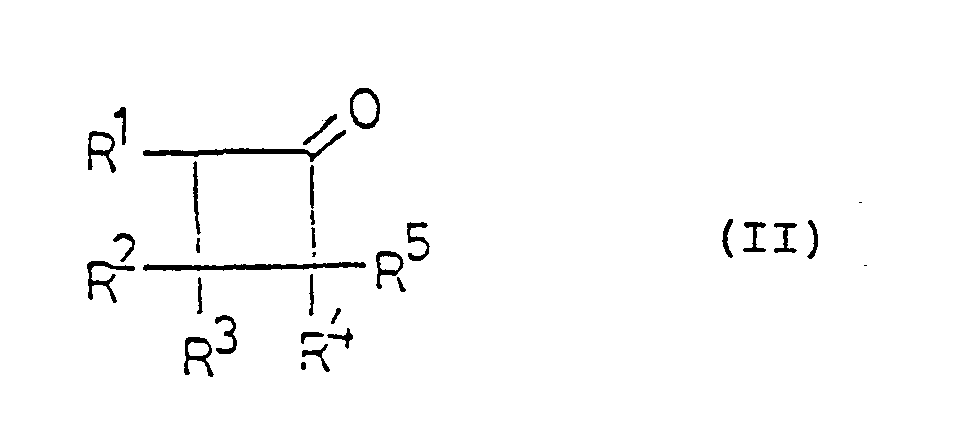
worin R' bis R5 die in der Beschreibung angegebene Bedeutung besitzen, das dadurch gekennzeichnet ist, daß ein Cyclobutanon der allgemeinen Formel (II)
in einem aprotischen Verdünnungsmittel, mit einem substituierten, gegebenenfalls in situ erzeugten, Ammoniumperhalogenid bei Temperaturen von -20°C bis +60°C, gegebenenfalls in Anwesenheit eines Katalysators umgesetzt wird.
Description
- Gegenstand der Erfindung ist ein Verfahren zur Herstellung von α -Halogencyclobutanonen durch Halogenierung von Cyclobutanonen mit substituierten Ammoniumperhalogeniden.
- Zur Herstellung von α-Halogencyclobutanonen sind verschiedene Verfahren bekannt.
- So bilden sich d-Halogencyclobutanone durch Cycloaddition von ci-Halogenketenen, z.B. α-Chlorketenen, an Olefine. Hierbei ist es zur Erzielung guter Ausbeuten notwendig, das α-Chlorketen in situ zu erzeugen (DE-OS 2 539 048 und 2 813 337). Ein anderes Verfahren bedient sich der bekannten α-Halogenierung cyclischer Ketone. Danach werden beispielsweise Cyclobutanon und seine methylierten Derivate durch Bromierung in Chloroform in Gegenwart von Bromwasserstoff in die entsprechenden α-Bromcyclobutanone übergeführt (Bull. Soc. Chim. Fr. 1964, 1957; 773). Nachteil dieser Umsetzung ist die Bildung von α,α-Dibromcyclobutanonen, deren Anteil im Reaktionsprodukt beträchtlich sein kann. Da solche α, α -dihalogenierten Cyclobutanone mit Alkalilaugen bzw. -alkoholaten unter Ringöffnung reagieren, sind sie für die Herstellung von Cyclopropancarbonsäuren ungeeignet.
- Nachteilig bei der Umsetzung von vinylsubstituierten Cyclobutanonen mit Halogenen kann ferner sein, daß das Halogen bevorzugt mit der Vinylgruppe reagiert und die erwünschte α-Halogenierung zurückgedrängt oder sogar unterdrückt wird. Ein solcher Fall tritt bei einem Cyclobutanon mit einer durch drei Halogenatome substituierten Vinylgruppe naturgemäß mit einer erheblich geringeren Wahrscheinlichkeit ein, kann aber bei der Umsetzung eines (Monochlor)-vinyl-substituierten Cyclobutanons zur dominierenden Reaktion werden.
- Die Verwendung anderer, üblicher Halogenierungsmittel, wie beispielsweise N-Bromsuccinimid oder Sulfurylchlorid, führt bei vinylsubstituierten Cyclobutanonen zu einer unerwünschten Allylhalogenierung.
- Die vorliegende Erfindung betrifft ein Verfahren zur Herstellung von α-Halogencyclobutanonen der allgemeinen Formel (I)
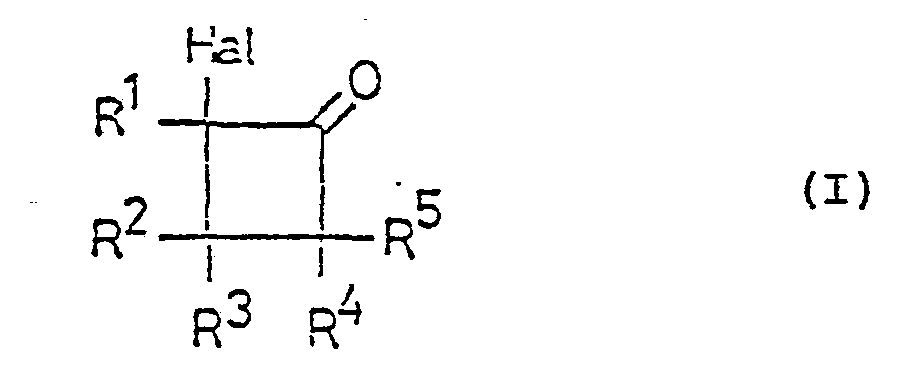
- R1-R5 gleich oder verschieden sind und Wasserstoff, jeweils gegebenenfalls substituiertes Alkyl, Cycloalkyl, Aryl, Aralkyl und Alkenyl bedeuten oder ferner
- R 2 und R 3 und/oder R4 und R5 mit den Atomen, mit denen sie verbunden sind, einen gegebenenfalls substituierten carbocyclischen Ring mit 3-6 C-Atomen bilden und
- Hal für Chlor oder Brom steht,
- das dadurch gekennzeichnet ist, daß ein Cyclobutanon der allgemeinen Formel (II)

- R1-R5 und Hal die voranstehend genannte Bedeutung haben,
- Die α-Halogencyclobutanone werden nach dem erfindungsgemäßen Verfahren in guter Ausbeute und hoher Reinheit erhalten. Die Halogenierung der Doppelbindung, Allylhalogenierung sowie Bildung des α,α-Dihalogenids werden zurückgedrängt bzw. sogar unterdrückt. Dies war überraschend.
- Die für die Halogenierung nach dem erfindungsgemäßen Verfahren geeigneten Cyclobutanone der Formel (II) sind bekannt oder werden nach bekannten Verfahren erhalten. (s. D. Seebach in Houben-Weyl, Methoden der Organischen Chemie, Vol. 4/4, G. Thieme, Stuttgart 1971; J. Am. Chem. Soc. 94, 2870 (1972); Angew. Chem. 86, 272 (1974); Angew. Chem. 87, 552 (1975); DOS 2 654 062; DOS 2 813 337).
- Bevorzugt werden Verbindungen der Formel (II) im erfindungsgemäßen Verfahren eingesetzt, in denen die Reste R 1- R 5 für gegebenenfalls substituiertes geradkettiges oder verzweigtes Alkyl mit bis zu 12, bevorzugt bis zu 8, insbesondere 1 und 2 C-Atomen steht, für gegebenenfalls substituiertes Alkenyl mit 2-12, bevorzugt 2-6 C-Atomen, insbesondere der Vinyl-und Allylrest ferner für gegebenenfalls substituiertes Aryl mit bis zu 14 C-Atomen, insbesondere der Phenylrest,sowie für Aralkyl,insbesondere Benzyl- und Phenylethyl,sowie für gegebenenfalls substituiertes Styryl.
- Als Substituenten der gegebenenfalls substituierten Reste R1 bis R5 seien beispielsweise genannt: Cyan, Halogen, insbesondere Chlor oder Brom, Alkoxyreste, Alkylsulfonyl, Phenyl, das gegebenenfalls durch Halogen substituiert ist.
- Besonders bevorzugte Cyclobutanone der Formel (II) sind:
- 2,2,3,3-Tetramethylcyclobutanon
- 2,2,3-Trimethylcyclobutanon
- 2,2-Dimethylcyclobutanon
- 2,2,3-Trimethyl-3-phenylcyclobutanon
- 2,2,3-Trimethyl-3-(2-chlorphenyl)-cyclobutanon
- 2,2-Diphenylcyclobutanon
- 2,2-Dimethyl-3-vinyl-cyclobutanon
- 2,2-Diethylcyclobutanon
- 2,2-Diethyl-3-vinyl-cyclobutanon
- Spiro[3,5]nonanon-2
- Spiro[3,4]octanon-2
- Spiro[3,3]heptanon-2
- Spirohexanon-4
- 4-(ß,ß-Dichlorvinyl)-spiroZ3,47octanon-2
- 4-(ß,ß-Dichlorvinyl)-spiro[3,3]heptanon-2
- 2-Ethyl-2-methyl-cyclobutanon
- 2-(ß,ß-Dichlorvinyl)-3,3-dimethyl-cyclobutanon
- 2,2-Dimethyl-3-(α-methyl-ß;ß-dichlorvinyl)-cyclobutanon
- 2,2-Diethyl-3-(α,ß-dichlorvinyl)-cyclobutanon
- 2,2-Dimethyl-3-(α,ß,ß-trifluorvinyl)-cyclobutanon
- 2,2-Diethyl-3-( α,ß,ß-trichlorvinyl)-cyclobutanon
- 2,2-Dimethyl-3-( α,ß-dichlorvinyl)-cyclobutanon
- 2,2-Dimethyl-3-(ß,ß-dibromvinyl)-cyclobutanon
- 2,2-Dimethyl-3-(α-fluor-ß,ß-dichlorvinyl)-cyclobutanon
- 2,2-Dimethyl-3-(ß-chlorvinyl)-cyclobutanon
- 2,2,3-Trimethyl-3-(α,ß,ß-trifluorvinyl)-cyclobutanon
- 2,2-Dimethyl-3-(ß,ß-difluorvinyl)-cyclobutanon
- 2-Ethyl-2-methyl-3-(ß,ß-dichlorvinyl)-cyclobutanon
- 2-Ethyl-2-methyl-3-(oC,ß,ß-trichlorvinyl)-cyclobutanon
- 2-Ethyl-2,3-dimethyl-3-(α,ß,ß-trichlorvinyl)-cyclobutanon
- 2,2-Diethyl-3-(ß,ß-dibromvinyl)-cyclobutanon
- 2-Ethyl-2-methyl-3-(ß,ß-dibromvinyl)-cyclobutanon
- 2-Ethyl-2-methyl-3-(α-fluor-ß,ß-dichlorvinyl)-cyclobutanon
- 2,2-Dimethyl-3-(α-ethyl-ß,ß-dichlorvinyl)-cyclobutanon
- 2-Ethyl-2,3-dimethyl-3-(ß,ß-dichlorvinyl)-cyclobutanon
- 4-(ß,ß-Dichlorvinyl)-spiroL3,5%-nonanon-2
- 2,2-Dimethyl-3-(α,ß-dibromvinyl)-cyclobutanon
- 4-(α,ß,ß-Trichlorvinyl)-spiro[3,5]-nonanon-2
- 4-(ß,ß-Dibromvinyl)-spiro[3,5]-nonanon-2
- 2,2-Dimethyl-3-(ß-brom-ß-chlorvinyl)-cyclobutanon
- 2,2-Dimethyl-4-ethyl-3-(ß,ß-dichlorvinyl)-cyclobutanon
- 2,2,4-Trimethyl-3-(α,ß-dibromvinyl)-cyclobutanon
- 2,2-Dimethyl-4-n-butyl-3-(ß,ß-dichlorvinyl)-cyclobutanon
- 2-Methyl-3-(α,ß,ß-trichlorvinyl)-cyclobutanon
- Die als Halogenierungsmittel verwendeten Ammoniumperhalogenide sind bekannt. Besonders bevorzugt sind Pyridiniumperbromid (Pyridinhydrobromidperbromid); Phenyl-trimethylammoniumperbromid; Benzyl-trimethylammoniumperbromid; Chinoliniumperbromid; ein Perbromid aus Pyrrolidon,Bromwasserstoff und Brom (J. Org. Chem. 28, 573 (1963); ein mit einem Polymer verknüpftes Benzyl-trimethylammoniumperbromid (Synthesis 1979, 64) Pyridiniumchlorid/Chlor; Pyridiniumchlorid/Brom.
- Als bevorzugte Verdünnungsmittel für die Durchführung der erfindungsgemäßen Reaktion seien folgende inerte aprotische organische Lösungsmittel genannt: Ester von Mono- und Dicarbonsäuren, wie z.B. Essigsäureethylester, Essigsäuremethylester, Propionsäuremethylester, Bernsteinsäurediethylester, Ameisensäure-n-butylester, Ameisensäuremethylester, Ameisensäureethylester, Dimethylcarbonat, Bernsteinsäuredimethylester oder Ether, wie z.B. Diethylether, Di-iso-propylether, Dioxan, Tetrahydrofuran, Dimethylether, Methylbutyl- ether,oder Amide, wie z.B. Dimethylacetamid.
- Als Katalysatoren die zur Durchführung der erfindungsgemäßen Reaktion gegebenenfalls verwendet werden können seien bevorzugt Halogenwasserstoffsäuren wie Bromwasserstoff, Chlorwasserstoff; Tetrabutylammoniumbromid, Pyridiniumbromid, Pyridiniumchlorid genannt.
- Die Reaktionstemperatur der Halogenierung ist in einem relativ Bereich wählbar. Als präparativ nützlich erweist sich ein Temperaturbereich von -20° bis +60°, vorzugsweise 20 bis 50 0.
- Die erfindungsgemäße Reaktion wird bevorzugt so durchgeführt, daß das Cyclobutanon in einem Verdünnungsmittel gegebenenfalls zusammen mit einem Katalysator vorgelegt wird und das Halogenierungsmittel portionsweise in die Lösung eingetragen wird, wobei die Geschwindigkeit der Zugabe sich nach dem Umsatz des Halogenierungsmittels richtet, d.h. erst wenn zuvor eingetragenes Halogenierungsmittel umgesetzt ist, erfolgt die Zugabe einer weiteren Menge Halogenierungsmittel. Eine andere Methode besteht darin, daß man die Reaktanden (Cyclobutanonderivat und Halogenierungsmittel, Lösungsmittel und gegebenenfalls Katalysator) zusammengibt und bei 20 bis 50° reagieren läßt. Eine weitere Variante besteht darin, daß ein Teil des sich während der Reaktion bildenden Halogenwasserstoffs mit Stickstoff aus der Reaktionslösung ausgetrieben oder durch Umsetzung mit einer basischen Verbindung, . wie z.B. Calciumcarbonat oder Soda, entfernt wird. Schließlich kann die Halogenierung auch so durchgeführt werden, daß das Cyclobutanon und ein substituiertes Ammoniumhalogenid in einem geeigneten Verdünnungsmittel vorgelegt und das Perhalogenid in situ durch Zugabe des Halogens erzeugt wird.
- Die Aufarbeitung der Reaktionslösung kann so erfolgen, daß der Halogenwasserstoff mit Stickstoff oder Luft ausgetrieben wird und die Reaktionslösung gegebenenfalls nach Entfernen des überschüssigen Halogenierungsmittels sowie des ausgeschiedenen Hydrohalogenids der tertiären Stickstoffbase direkt in die Umsetzung mit einer wäßrigen Alkalibase zu der entsprechenden Cyclopropancarbonsäureester dieses niederen Alkohols eingesetzt wird. Das rohe α-Halogenketon läßt sich durch Waschen der Reaktionslösung mit Wasser, gegebenenfalls unter Zusatz eines mit Wasser nicht mischbaren Lösungsmittels, halogenwasserstofffrei erhalten und durch Kristallisieren oder Destillieren in reiner Form isolieren.
- Das bei der Umsetzung nach dem erfindungsgemäßen Verfahren gebildete,oftmals in der Lösung nicht oder schwerlösliche Hydrohalogenid des tert. Amins läßt sich einfach abfiltrieren und nach Halogenierung (L.F. Fieser und M. Fieser, Reagents for Organic Synthesis, 1967, 967) wieder in das Perhalogenid (z.B. Pyridiniumperbromid) umwandeln. Ebenso lassen sich die tetrasubstituierten Ammoniumhalogenide nach Abtrennen durch Halogenierung, insbesondere Bromierung, in die tetrasubstituierten Ammoniumperhalogenide (insbesondere Bromide) überführen.
- Die nach dem erfindungsgemäßen Verfahren leicht zugänglichen lÖ-Halogencyclobutanone, insbesondere die α-Bromcyclobutanone der allgemeinen Formel (I) sind Zwischenprodukte zur Herstellung insektizider Wirkstoffe. So läßt sich z.B. das 4-Brom-2,2-dimethyl-3-(ß,ß-dichlor- vinyl)-cyclobutanon mit dem Natriumsalz des m-Phenoxybenzylalkohols in Toluol glatt zum m-Phenoxybenzylester der 2,2-Dimethyl-3-(ß,ß-dichlorvinyl)-cyclopropancarbonsäure (Permethrin) umsetzen.
- In einem 250 ml Dreihalskolben, versehen mit Innenthermometer, Gaseinleitungsrohr, Rührer und Rückflußkühler, werden 9,65 g (0,05 mol) 2,2-Dimethyl-3-(ß,ß-dichlor- vinyl)-cyclobutanon in 150 ml Essigsäureethylester gelöst. Unter Durchleiten von Stickstoff werden bei 20° portionsweise insgesamt 16,0 g (0,05 mol) Pyridiniumperbromid (Pyridinhydrobromidperbromid) zugegeben. Nach 12 h Rühren filtriert man das abgeschiedene, schwerlösliche Pyridinhydrobromid ab, dampft die Lösung im Vakuum ein und destilliert den Rückstand. 12,0 g hellgelbes Öl vom Sdp.0,25 80 82°. Die gaschromatographische Analyse liefert folgende Zusammensetzung: 86,2 % 4-Brom-2,2-dimethyl-3-(ß,ß-dichlorvinyl)-cyclobutanon, 10,7 % 2,2-Dimethyl-3-(ß,ß-dichlorvinyl)-cyclobutanon, 3,1 % 4,4 Dibrom-2,2-dimethyl-3-(ß,ß-dichlorvinyl)-cyclobutanon. Durch fraktionierende Destillation an einer Ringspaltkolonne lassen sich die drei Komponenten trennen. 4-Brom-2,2-dimethyl-3-(ß,ß-dichlorvinyl)-cyclobutanon Sdp.0,6 950 (Isomerengemisch: trans:cis = 81:19).
- Zum Vergleich wurde die aus (Bull. Soc. Chim. Fr. 1'964, 1976) bekannte Halogenierung von 2,2-Dimethylcyclobutanon nach dem dort angegebenen Verfahren durchgeführt:
- Die Lösung von 61,0 g (0,62 mol) 2,2-Dimethylcyclobutanon in 250 ml Tetrachlorkohlenstoff, der ca. 5 % Bromwasserstoff enthält, wird bei 20° tropfenweise so mit insgesamt 100,0 g (0,62 mol) Brom in 250 ml Tetrachlorkohlenstoff versetzt, daß die Lösung vor erneuter Bromzugabe jeweils entfärbt ist. Nach Zugabe der gesamten Menge Brom wird 30 Minuten nachgerührt und gelöster Bromwasserstoff durch Einleiten von Stickstoff ausgetrieben. Aus dem NMR-Spektrum der Lösung läßt sich entnehmen, daß im Verhältnis von ca. 2:1:2.2 2,2-Dimethylcyclobutanon, sein α-mono-und sein α,α-dibromiertes Derivat vorliegen. Man wäscht die Lösung 3 mal mit je 50 ml gesättigter wäßriger Kochsalzlösung und destilliert fraktionierend an einer Ringspaltkolonne:
- 25,7 g 2,2-Dimethylcyclobutanon (Sdp. 100 51-54°)
- 23,3 g 4-Brom-2,2-dimethylcyclobutanon (Sdp.14 74-750)
- 47,3 g 4,4-Dibrom-2,2-dimethylcyclobutanon (Sdp.14 90-91°, Schmp. 41,5 - 42°)
- Zu der Lösung von 9,65 g (0,05 mol) 2,2-Dimethyl-3-(ß,ß-dichlorvinyl)-cyclobutanon in 150 ml Essigsäureethylester werden 8,8 g (0,05 mol) Pyridinhydrobromid gegeben. Innerhalb von 2 h tropft man bei 20° 8,0 g (0,05 mol) Brom in die Suspension und rührt anschließend 12 h nach. Aufarbeitung, wie unter Beispiel 1 beschrieben, liefert 11,8 g eines gelbbraunen Öls, dessen Zusammensetzung gaschromatographisch bestimmt wurde:
- 85-86 % 4-Brom-2,2-dimethyl-3-(ß,ß-dichlorvinyl)-cyclobutanon
- 10-11 % 2,2-Dimethyl-3-(ß,ß-dichlorvinyl)-cyclobutanon
- 3-4 % 4,4-Dibrom-2,2-dimethyl-3-(ß,ß-dichlorvinyl)-cyclobutanon.
- 9,8 g (0,1 mol) 2,2-Dimethylcyclobutanon werden in 300 ml Essigsäureethylester bei 20° mit 32,0 g (0,1 mol) Pyridiniumperbromid, wie in Beispiel-1 beschrieben, umgesetzt. Durch Destillation werden 12,9 g farbloses Öl vom Sdp.9 68-720 erhalten, das laut gaschromatographischer Analyse zu 90 % aus 4-Brom-2,2-dimethylcyclobutanon sowie zu 10 % aus 4,4-Dibrom-2,2-dimethylcyclobutanon besteht. Das Destillat enthält kein 2,2-Dimethylcyclobutanon.
- 7,9 g (0,05 mol) 2,2-Dimethyl-3-(ß-chlorvinyl)-cyclobutanon werden in 180 ml Essigsäureethylester bei 20° mit 16,0 g (0,05 mol) Pyridiniumperbromid, wie in Beispiel 1 beschrieben, umgesetzt. Man erhält durch fraktionierende Destillation 9,5 g gelbliches Öl vom Sdp.0,05 65-70°.
- Gaschromatographische Analyse:
- 73 % 4-Brom-2,2-dimethyl-trans-3-(ß-chlorvinyl)-cyclobutanon
- 13 % 4-Brom-2,2-dimethyl-cis-3-(ß-chlorvinyl)-cyclobutanon
- 9 % 2,2-Dimethyl-3-(ß-chlorvinyl)-cyclobutanon
- 5 % höher bromierte Produkte.
- 11,8 g (0,05 mol) 2,2-Dimethyl-3-(2'-(4',4'-dichlor-2'-methyl-but-3'-enyl)-cyclobutanon werden in 150 ml Essigsäureethylester bei 20° mit 16,0 g (0,05 mol) Pyridiniumperbromid, wie in Beispiel 1 beschrieben, umgesetzt. Es werden 13,0 g farbloses öl vom Sdp.0,02 84° erhalten. Gaschromatographische Analyse:
- 88,6 % 4-Brom-2,2-dimethyl-3-(2'(4',4'-dichlor-2'-methyl- but-3'-enyl))-cyclobutanon
- 7,5 % 2,2-Dimethyl-3-(2'-(4',4'-dichlor-2'-methyl-but-3'-enyl))-cyclobutanon
- 2,9 % höher bromierte Produkte.
- 2,2-Dimethyl-3-(2'-(4',4'-dichlor-2'-methyl-but-3'-enyl)).-cyclobutanon wird in Anlehnung an das aus DE-OS 2 654 062 bekannte Verfahren durch Cycloaddition von Dimethylketenimoniumchlorid an 1,1-Dichlor-3,3-dimethyl-penta-1,4-dien in Gegenwart von wasserfreiem Zinkchlorid und folgender Hydrolyse hergestellt (Sdp.0,05 740).
- 34,23 g (0,126 mol) 4-Brom-2,2-dimethyl-3-(ß,ß-dichlor- vinyl)-cyclobutanon werden bei 10° unter Zusatz von 5 ml Methylenchlorid in 200 ml 2n NaOH 24 h gerührt. Extrahieren der wäßrig alkalischen Lösung mit Ether liefert 0,25 g Neutralprodukt. Man säuert die wäßrige Lösung unter Kühlen mit konzentrierter Salzsäure an und extrahiert sie anschließend 3 mal mit je 100 ml Ether. Die Etherphase wird 1 mal mit 50 ml gesättigter Kochsalzlösung gewaschen, über wasserfreiem Natriumsulfat getrocknet und eingedampft. Man erhält 25,67 g kristalline 2,2-Dimethyl-3-(ß,ß-dichlorvinyl)-cyclopropancarbonsäure als Isomerengemisch (trans:cis = 82:18).
- Zu der Lösung von 2,3 g (0,1 mol) Natrium in 80 ml abs. Ethanol gibt man unter Stickstoff 20,0 g (0,1 mol) m-Phenoxybenzylalkohol und destilliert bei 40°/20 Torr Ethanol ab. Den Rückstand versetzt man 2 mal mit je 80 ml abs. Toluol und dampft bei 500/20 Torr zur Trockne ein. Nach Zugabe von 150 ml abs. Toluol tropft-man bei 15-20° in die Suspension die Lösung von 30,0 g (0,11 mol) 4-Brom-2,2-dimethyl-3-(ß,ß-dichlorvinyl)-cyclobutanon in 120 ml abs. Toluol und rührt 6 h nach. Anschließend erhitzt man 30 Minuten zum Rückfluß und gibt darauf den Reaktionsansatz auf Eis/10 % Salzsäure. Die organische Phase wird abgetrennt, bis zur Neutralreaktion mit gesättigter Natriumbicarbonatlösung und Wasser gewaschen, getrocknet und eingedampft. Den öligen Rückstand (37,1 g) chromatographiert man an 600 g Kieselgel und erhält neben geringen Mengen Permethrinsäureethylester 31,2 g Permethrinsäure-m-phenoxybenzylester.
- Gemäß Beispiel 1 werden 11,06 g (0,05 mol) 2,2-Diethyl-3-(ß,ß-dichlorvinyl)-cyclobutanon in 150 ml Ameisensäureethylester mit 16,0 g (0,05 mol) Pyridiniumperbromid bei 200 umgesetzt. Aufarbeitung liefert 16,2 g gelbliches Öl vom Siedebereich 90-950/0,3-0,4 Torr. Die gaschromatographische Analyse des Destillats ergibt einen Gehalt von 92 % 2,2-Diethyl-3-(ß,ß-dichlor- vinyl)-4-bromcyclobutanon-Isomerengemisch.
- 15,0 g (0,08 mol) 2,2,3-Trimethyl-3-phenylcyclobutanon werden, wie in Beispiel 1 beschrieben, in 200 ml Essigsäure-n-butylester mit 25,6 g (0,08 mol) Pyridiniumperbromid bei 20° umgesetzt. Aufarbeitung liefert 20,72 g hellbraunes öl, dessen NMR-spektroskopische Analyse (CDC13 als Lösungsmittel) hinweist, daß 2,2,3-Trimethyl-3-phenyl-4-brom-cyclobutanon (Isomerengemisch) als Hauptprodukt vorliegt.
- Ber. % Br 79,92
- Gef. 79,0
- 5,18 g (0,025 Mol) 2,2,3-Trimethyl-3-(ß,ß-dichlorvinyl)-cyclobutanon werden in 70 ml Essigsäureethylester bei 20° mit 8,0 g (0,025 mol) Pyridiniumperbromid umgesetzt. Aufarbeitung, wie in Beispiel 1 beschrieben, liefert 8,7 g hellbraunes öl vom Sdp.0,9 110-115°. Der Anteil an 2,2,3-Trimethyl-3-(ß,ß-dichlorvinyl)-4-brom-cyclobutanon (Isomerengemisch) im Destillat beträgt 84 %.
- 11,66 g (0,05 mol) 4-(ß,ß-Dichlorvinyl)-spiro[3,5]nonanon-2 in 170 ml Essigsäuremethylester werden bei 20° mit 16,0 g (0,05 mol) Pyridiniumperbromid, wie in Beispiel 1 beschrieben, umgesetzt. Aufarbeitung liefert 17,8 g rohes Bromketon mit einem Gehalt von 91 % 4-(ß,ß-Dichlorvinyl)-3-brom-spiro[3,5]nonanon-2 (Isomerengemisch).
- Gemäß Beispiel 1 werden 9,65 g (0,05 mol) 2,2-Dimethyl-3-(ß,ß-dichlorvinyl)-cyclobutanon in 180 ml Essigsäuremethylester bei 20° mit 18,8 g (0,05 mol) Phenyl-trimethylammoniumperbromid umgesetzt. Man erhält 12,6 g hellgelbes Öl von Sdp.0,3 80°, das zu über 95 % aus 4-Brom-2,2-dimethyl-3-(ß,ß-dichlorvinyl)-cyclobutanon besteht.
- Gemäß Beispiel 1 werden 9,65 g (0,05 mol) 2,2-Dimethyl-3-(ß,ß-dichlorvinyl)-cyclobutanon in 150 ml Essigsäureethylester bei 20° mit 21,3 g (0,043 mol) des Perbromids, hergestellt aus 3 mol Pyrrolidon,1 mol Brom und 1 mol Bromwasserstoff, umgesetzt. Man erhält 11,6 g hellgelbes öl, das folgende Komponenten enthält:
- 9 % 2,2-Dimethyl-3-(ß,ß-dichlorvinyl)-cyclobutanon
- 62 % 4-Brom-2,2-dimethyl-3-(ß,ß-dichlorvinyl)-cyclobutanon
- 29 % 4,4-Dibrom-2,2-dimethyl-3-(ß,ß-dichlorvinyl)-cyclobutanon.
- Gemäß Beispiel 1 werden 9,65 g (0,05 mol) 2,.2-Dimethyl-3-(ß,ß-dichlorvinyl)-cyclobutanon in 180 ml Diethylcarbonat mit 16,0 g (0,05 mol) Pyridiniumperbromid umgesetzt. Man erhält 11,8 g farbloses öl vom Sdp.0,2-0,3 70-78°, das aus 85 % 4-Brom-2,2-dimethyl-3-(ß,ß-dichlor- vinyl)-cyclobutanon und 15 % 4,4-Dibrom-2,2-dimethyl-3-(ß,ß-dichlorvinyl)-cyclobutanon enthält.
- Wird anstelle des Diethylcarbonats Ameisensäureethylester (180 ml) als Verdünnungsmittel verwendet und die Umsetzung unter sonst gleichen Bedingungen durchgeführt, so erhält man 11,77 g schwach gelb gefärbtes Öl vom Sdp.0,2 750, das nur das gesuchte 4-Brom-2,2-dimethyl-3-(ß,ß-dichlorvinyl)-cyclobutanon enthält.
Claims (3)
1. Verfahren zur Herstellung von α-Halogencyclobutanonen der allgemeinen Formel (I)

in welcher
in welcher
R1-R5 gleich oder verschieden sind und Wasserstoff, jeweils gegebenenfalls substituiertes Alkyl, Cycloalkyl, Aryl, Aralkyl und Alkenyl bedeuten oder ferner
R 2 und R 3 und/oder R4 und R 5 mit den Atomen, mit denen sie verbunden sind, einen gegebenenfalls substituierten carbocyclischen Ring mit 3-6 C-Atomen bilden und
Hal für Chlor oder Brom steht,
dadurch gekennzeichnet, daß ein Cyclobutanon der allgemeinen Formel (II)
R 1- R 5 und Hal die voranstehend genannte Bedeutung haben,
in einem aprotischen Verdünnungsmittel, mit einem substituierten, gegebenenfalls in situ erzeugten Ammoniumperhalogenid bei Temperaturen von -20° bis +600, gegebenenfalls in Gegenwart eines Katalysators umgesetzt wird.2. Verfahren nach Anspruch 1, dadurch gekennzeichnet, daß als Cyclobutanon ein 2,2-Dimethyl-3-(ß,ß-di- halovinyl)-cyclobutanon, als Halogenierungsmittel Pyridiniumperbromid und als Verdünnungsmittel Ameisen- oder Essigsäureethylester verwendet wird.
3. Verfahren nach Anspruch 1, dadurch gekennzeichnet, daß als Cyclobutanon ein 2,2-Dimethyl-3-(ß-halo- vinyl)-cyclobutanon, als Halogenierungsmittel Pyridiniumperbromid und als Verdünnungsmittel Ameisen- oder Essigsäureethylester verwendet wird.
Applications Claiming Priority (2)
| Application Number | Priority Date | Filing Date | Title |
|---|---|---|---|
| DE2918468 | 1979-05-08 | ||
| DE19792918468 DE2918468A1 (de) | 1979-05-08 | 1979-05-08 | Verfahren zur herstellung von alpha -halogencyclobutanonen |
Publications (1)
| Publication Number | Publication Date |
|---|---|
| EP0019132A1 true EP0019132A1 (de) | 1980-11-26 |
Family
ID=6070197
Family Applications (1)
| Application Number | Title | Priority Date | Filing Date |
|---|---|---|---|
| EP80102291A Withdrawn EP0019132A1 (de) | 1979-05-08 | 1980-04-28 | Verfahren zur Herstellung von alpha-Halogencyclobutanonen |
Country Status (6)
| Country | Link |
|---|---|
| EP (1) | EP0019132A1 (de) |
| JP (1) | JPS55149221A (de) |
| BR (1) | BR8002808A (de) |
| DE (1) | DE2918468A1 (de) |
| DK (1) | DK200080A (de) |
| IL (1) | IL59989A0 (de) |
Families Citing this family (1)
| Publication number | Priority date | Publication date | Assignee | Title |
|---|---|---|---|---|
| US4691052A (en) * | 1983-12-12 | 1987-09-01 | S.C. Johnson & Son, Inc. | Process for the preparation of pyrethroid acids |
Citations (1)
| Publication number | Priority date | Publication date | Assignee | Title |
|---|---|---|---|---|
| DE2654062A1 (de) * | 1976-08-26 | 1978-03-23 | Bayer Ag | Verfahren zur herstellung vinylsubstituierter cyclopropancarbonsaeuren |
-
1979
- 1979-05-08 DE DE19792918468 patent/DE2918468A1/de not_active Withdrawn
-
1980
- 1980-04-28 EP EP80102291A patent/EP0019132A1/de not_active Withdrawn
- 1980-05-05 IL IL59989A patent/IL59989A0/xx unknown
- 1980-05-06 JP JP5878180A patent/JPS55149221A/ja active Pending
- 1980-05-07 DK DK200080A patent/DK200080A/da unknown
- 1980-05-07 BR BR8002808A patent/BR8002808A/pt unknown
Patent Citations (1)
| Publication number | Priority date | Publication date | Assignee | Title |
|---|---|---|---|---|
| DE2654062A1 (de) * | 1976-08-26 | 1978-03-23 | Bayer Ag | Verfahren zur herstellung vinylsubstituierter cyclopropancarbonsaeuren |
Non-Patent Citations (3)
| Title |
|---|
| BULLETIN OF THE CHEMICAL SOCIETY OF JAPAN, Band 52, Nr. 2, Februar 1979 Tokio N.J. REDDY et al. "Synthesis and Reduction of 3-Bromoflavanones" Seiten 647 bis 648. * |
| CHEMICAL ABSTRACTS Band 70 Nr. 13, 31. Marz 1969 Columbus, Ohio, USA D.V.C. AWANG et al. "Pyrrolidinone hydrotribromide: brominating agent with selectivity for ketones" Seite 273, Spalte 1, Abstract Nr. 56890c & Can. J. Chem. Band 47, Nr. 4, 1969, Seiten 706 bis 709 (Eng). * |
| THE JOURNAL OF ORGANIC CHEMISTRY, Band 42, Nr. 6, 18. Marz 1977 Columbus, Ohio, USA W.K. ANDERSON et al. "Synthesis of 6,9-Bisnormethyl-8-Methoxy-12,13-Epoxy-6,8,10-Trichothecatriene" Seiten 1045 bis 1050. * Seiten 1048 und 1050 * * |
Also Published As
| Publication number | Publication date |
|---|---|
| DK200080A (da) | 1980-11-09 |
| JPS55149221A (en) | 1980-11-20 |
| BR8002808A (pt) | 1980-12-16 |
| DE2918468A1 (de) | 1980-11-13 |
| IL59989A0 (en) | 1980-07-31 |
Similar Documents
| Publication | Publication Date | Title |
|---|---|---|
| EP0718279B1 (de) | Verfahren zur Herstellung von o-substituierten Benzoylcyaniden | |
| EP0633258A1 (de) | Verbessertes Verfahren zur Herstellung von Astaxanthin, neue Zwischenprodukte hierfür sowie ein Verfahren zu deren Herstellung | |
| CH631427A5 (de) | Verfahren zur herstellung von alpha-halogencyclobutanonen. | |
| DE2726064A1 (de) | Verfahren zur herstellung von 2-phenyl-aethanol-derivaten | |
| EP0004621B1 (de) | Verfahren zur mehrstufigen Synthese von Zeaxanthin und Alloxanthin über Cyclohexanon- und Cyclohexanolderivate; Cyclohexanon- und Cyclohexanolderivate | |
| CH636073A5 (en) | Process for the preparation of substituted cyclopropanecarboxylates | |
| EP1197483A2 (de) | Verfahren zur katalytischen Reduktion von Alkinverbindungen | |
| DE2710174A1 (de) | Verfahren zur herstellung von dihalogenvinyl-cyclopropancarbonsaeuren und deren ester | |
| DE69410318T2 (de) | Verfahren zur Herstellung eines Chinonderivates und Zwischenprodukt bei dessen Herstellung | |
| EP1153909A2 (de) | Ortho-substituierte Benzaldehyde, Verfahren zu ihrer Herstellung und ihre Verwendung | |
| EP0001089B1 (de) | Verfahren zur Herstellung von halogenvinylsubstituierten Tetrahydrofuran-2-onen, bestimmte halogenvinylsubstituierte Tetrahydrofuran-2-one | |
| DE2952719A1 (de) | Verfahren zur herstellung von p-substituierten phenylpropanolen und deren estern | |
| EP0619300B1 (de) | Verfahren zur Herstellung von Halogenmethylbenzoylcyaniden und neue Halogenmethyl-benzoylcyanide | |
| DE2726393C2 (de) | Verfahren zur Herstellung von 5-(quartär-Alkyl)resorcinen | |
| EP0031875B1 (de) | Verfahren zur Herstellung von Cyclohexenderivaten | |
| EP0095047A1 (de) | Verfahren zur Herstellung von 3-vinylsubstituierten 2,2-Dimethylcyclopropan-1-carbonsäuren bzw. ihren Estern und neue Zwischenprodukte dafür | |
| DE2918468A1 (de) | Verfahren zur herstellung von alpha -halogencyclobutanonen | |
| EP0131130B1 (de) | Verfahren zur Herstellung von Cycloalkenylalkinen | |
| EP0120341A2 (de) | Verfahren zur Herstellung von Pentadienol-Derivaten | |
| EP0347693B1 (de) | Neue Benzonitrile, Benzaldehyde und Benzylalkohole sowie Verfahren zu ihrer Herstellung | |
| DE2708382A1 (de) | Verfahren zur herstellung von 3-cyanomethylcyclopentanon-derivaten | |
| EP0024588A1 (de) | Verfahren zur Herstellung von substituierten Cyclopropyl-carbonsäure-(alpha-cyano-3-phenoxy-benzyl)-estern | |
| DE2654062A1 (de) | Verfahren zur herstellung vinylsubstituierter cyclopropancarbonsaeuren | |
| EP0051791A1 (de) | 2,2-Dimethylcyclobutanone und Verfahren zu ihrer Herstellung | |
| DE2727613A1 (de) | Cyanosubstituierte cyclopropanderivate und verfahren zu ihrer herstellung |
Legal Events
| Date | Code | Title | Description |
|---|---|---|---|
| PUAI | Public reference made under article 153(3) epc to a published international application that has entered the european phase |
Free format text: ORIGINAL CODE: 0009012 |
|
| 17P | Request for examination filed | ||
| AK | Designated contracting states |
Designated state(s): BE CH DE FR GB IT NL |
|
| STAA | Information on the status of an ep patent application or granted ep patent |
Free format text: STATUS: THE APPLICATION HAS BEEN WITHDRAWN |
|
| 18W | Application withdrawn |
Withdrawal date: 19820118 |
|
| RIN1 | Information on inventor provided before grant (corrected) |
Inventor name: HUEBNER, ARMIN, DR. Inventor name: HARTMANN, WILLY, DR. Inventor name: HEINE, HANS-GEORG, DR. |