EP0019190A2 - Verwendung von Hydroxyalkyl-imidazolen als Fungizide - Google Patents
Verwendung von Hydroxyalkyl-imidazolen als Fungizide Download PDFInfo
- Publication number
- EP0019190A2 EP0019190A2 EP80102451A EP80102451A EP0019190A2 EP 0019190 A2 EP0019190 A2 EP 0019190A2 EP 80102451 A EP80102451 A EP 80102451A EP 80102451 A EP80102451 A EP 80102451A EP 0019190 A2 EP0019190 A2 EP 0019190A2
- Authority
- EP
- European Patent Office
- Prior art keywords
- formula
- acid
- hydroxyalkyl
- mol
- imidazoles
- Prior art date
- Legal status (The legal status is an assumption and is not a legal conclusion. Google has not performed a legal analysis and makes no representation as to the accuracy of the status listed.)
- Granted
Links
- 0 CC(CC1)*CC1c1ccccc1 Chemical compound CC(CC1)*CC1c1ccccc1 0.000 description 1
- UHOVQNZJYSORNB-UHFFFAOYSA-N c1ccccc1 Chemical compound c1ccccc1 UHOVQNZJYSORNB-UHFFFAOYSA-N 0.000 description 1
Classifications
-
- C—CHEMISTRY; METALLURGY
- C07—ORGANIC CHEMISTRY
- C07D—HETEROCYCLIC COMPOUNDS
- C07D231/00—Heterocyclic compounds containing 1,2-diazole or hydrogenated 1,2-diazole rings
- C07D231/02—Heterocyclic compounds containing 1,2-diazole or hydrogenated 1,2-diazole rings not condensed with other rings
- C07D231/10—Heterocyclic compounds containing 1,2-diazole or hydrogenated 1,2-diazole rings not condensed with other rings having two or three double bonds between ring members or between ring members and non-ring members
- C07D231/12—Heterocyclic compounds containing 1,2-diazole or hydrogenated 1,2-diazole rings not condensed with other rings having two or three double bonds between ring members or between ring members and non-ring members with only hydrogen atoms, hydrocarbon or substituted hydrocarbon radicals, directly attached to ring carbon atoms
-
- A—HUMAN NECESSITIES
- A01—AGRICULTURE; FORESTRY; ANIMAL HUSBANDRY; HUNTING; TRAPPING; FISHING
- A01N—PRESERVATION OF BODIES OF HUMANS OR ANIMALS OR PLANTS OR PARTS THEREOF; BIOCIDES, e.g. AS DISINFECTANTS, AS PESTICIDES OR AS HERBICIDES; PEST REPELLANTS OR ATTRACTANTS; PLANT GROWTH REGULATORS
- A01N43/00—Biocides, pest repellants or attractants, or plant growth regulators containing heterocyclic compounds
- A01N43/48—Biocides, pest repellants or attractants, or plant growth regulators containing heterocyclic compounds having rings with two nitrogen atoms as the only ring hetero atoms
- A01N43/50—1,3-Diazoles; Hydrogenated 1,3-diazoles
-
- A—HUMAN NECESSITIES
- A61—MEDICAL OR VETERINARY SCIENCE; HYGIENE
- A61P—SPECIFIC THERAPEUTIC ACTIVITY OF CHEMICAL COMPOUNDS OR MEDICINAL PREPARATIONS
- A61P31/00—Antiinfectives, i.e. antibiotics, antiseptics, chemotherapeutics
- A61P31/04—Antibacterial agents
-
- C—CHEMISTRY; METALLURGY
- C07—ORGANIC CHEMISTRY
- C07C—ACYCLIC OR CARBOCYCLIC COMPOUNDS
- C07C29/00—Preparation of compounds having hydroxy or O-metal groups bound to a carbon atom not belonging to a six-membered aromatic ring
- C07C29/36—Preparation of compounds having hydroxy or O-metal groups bound to a carbon atom not belonging to a six-membered aromatic ring increasing the number of carbon atoms by reactions with formation of hydroxy groups, which may occur via intermediates being derivatives of hydroxy, e.g. O-metal
- C07C29/38—Preparation of compounds having hydroxy or O-metal groups bound to a carbon atom not belonging to a six-membered aromatic ring increasing the number of carbon atoms by reactions with formation of hydroxy groups, which may occur via intermediates being derivatives of hydroxy, e.g. O-metal by reaction with aldehydes or ketones
- C07C29/40—Preparation of compounds having hydroxy or O-metal groups bound to a carbon atom not belonging to a six-membered aromatic ring increasing the number of carbon atoms by reactions with formation of hydroxy groups, which may occur via intermediates being derivatives of hydroxy, e.g. O-metal by reaction with aldehydes or ketones with compounds containing carbon-to-metal bonds
-
- C—CHEMISTRY; METALLURGY
- C07—ORGANIC CHEMISTRY
- C07D—HETEROCYCLIC COMPOUNDS
- C07D249/00—Heterocyclic compounds containing five-membered rings having three nitrogen atoms as the only ring hetero atoms
- C07D249/02—Heterocyclic compounds containing five-membered rings having three nitrogen atoms as the only ring hetero atoms not condensed with other rings
- C07D249/08—1,2,4-Triazoles; Hydrogenated 1,2,4-triazoles
-
- C—CHEMISTRY; METALLURGY
- C07—ORGANIC CHEMISTRY
- C07D—HETEROCYCLIC COMPOUNDS
- C07D303/00—Compounds containing three-membered rings having one oxygen atom as the only ring hetero atom
- C07D303/02—Compounds containing oxirane rings
- C07D303/08—Compounds containing oxirane rings with hydrocarbon radicals, substituted by halogen atoms, nitro radicals or nitroso radicals
-
- C—CHEMISTRY; METALLURGY
- C07—ORGANIC CHEMISTRY
- C07C—ACYCLIC OR CARBOCYCLIC COMPOUNDS
- C07C2601/00—Systems containing only non-condensed rings
- C07C2601/12—Systems containing only non-condensed rings with a six-membered ring
- C07C2601/14—The ring being saturated
Definitions
- the present invention relates to the use of hydroxyalkyl imidazoles as fungicides.
- the HydroxyalKyi-imidazoles of the formula (I) which can be used according to the invention show a better fungicidal activity than the 1-halophenyl-2-imidazolyl-1-ethanols known from the prior art, which are chemically obvious compounds.
- the substances that can be used according to the invention thus represent an enrichment of technology.
- R represents optionally substituted phenyl, naphthyl or tetrahydronaphthyl, the preferred substituents being: halogen, in particular fluorine, chlorine and bromine, straight-chain or branched alkyl and Alkoxy each having 1 to 4 carbon atoms, and haloalkyl having 1 to 4 carbon atoms and up to 5 halogen atoms, in particular having 1 or 2 carbon atoms and up to 3 identical or different halogen atoms, fluorine and chlorine in particular being, for example, trifluoromethyl called;
- R 1 represents optionally substituted phenyl or cycloalkyl having 3 to 7 carbon atoms, the following may preferably be mentioned as substituents: halogen, in particular fluorine, chlorine or bromine, alkyl with 1 to 4, in particular with 1 to 2 carbon atoms, and alkenyl
- R represents phenyl which is optionally mono- or disubstituted, identically or differently by chlorine, fluorine or methyl
- R 1 represents phenyl, cyclopentyl or cyclohexyl, these radicals can optionally be substituted once or twice by chlorine, bromine, fluorine, methyl, ethyl, isopropyl or isopropenyl
- R Z represents hydrogen, or R 1 and R 2 together in the ortho position to one another represent a tri, tetra or pentamethylene bridge which is optionally substituted by chlorine or methyl, or together with the phenyl ring stand for naphthyl
- R 3 represents chlorine, fluorine or methyl
- n represents 0 or 1
- m represents 0 or 1.
- the imidazolylmethylphenyl ketones of the formula (II) are not yet known. However, they can be prepared in a generally customary and known manner by adding appropriate phenacyl halides (that is, ⁇ -halo-acetophenone derivatives) with imidazole in the presence of a diluent, such as, for example, dimethylformamide, and in the presence of an acid-binding agent, in particular an excess Imidazole, at temperatures between 20 and 80 ° C.
- a diluent such as, for example, dimethylformamide
- the Grignard compounds of the formula (III) are generally known compounds of organic chemistry.
- the 1-haloalkyl alcohols of the formula (IV) are not yet known. However, they can be prepared in a generally customary and known manner by reacting appropriate phenacyl halides with Grignard compounds of the formula (III) according to process variant (a).
- the oxiranes of the formula (V) are not yet known. They too are the subject of the aforementioned prior own application, (compare German patent application P 29 12 288.1 / Le A 19 52? 7 dated March 28, 1979) and can be obtained by corresponding ketones either with dimethyloxosulfonium methylide in a manner known per se in the presence of a diluent, such as dimethyl sulfoxide, at temperatures between 20 and 80 ° C; or with trimethylsulfonium methyl sulfate in a manner known per se in the presence of a two-phase system and, if appropriate, in the presence of a phase transfer catalyst at temperatures between 0 and 100.degree.
- a diluent such as dimethyl sulfoxide
- All physiologically compatible acids are suitable for the preparation of acid addition salts of the compounds of the formula (I).
- These preferably include the hydrohalic acids, e.g. hydrochloric acid and hydrobromic acid, especially hydrochloric acid, also phosphoric acid, nitric acid, sulfuric acid, mono- and bifunctional carboxylic acids and hydroxycarboxylic acids, e.g. Acetic acid, maleic acid, succinic acid, fumaric acid, tartaric acid, citric acid, salicylic acid, sorbic acid, lactic acid and sulfonic acids, e.g. p-toluenesulfonic acid and 1,5-naphthalenedisulfonic acid.
- hydrohalic acids e.g. hydrochloric acid and hydrobromic acid, especially hydrochloric acid, also phosphoric acid, nitric acid, sulfuric acid, mono- and bifunctional carboxylic acids and hydroxycarboxylic acids, e.g. Acetic acid, maleic acid, succ
- the salts of the compounds of formula (I) can be easily prepared by conventional salt formation methods, e.g. by dissolving a compound of formula (I) in a suitable inert solvent and adding the acid, e.g. Hydrochloric acid can be obtained and in a known manner, e.g. by filtration, isolated and, if necessary, cleaned by washing with an inert organic solvent.
- a suitable inert solvent e.g. Hydrochloric acid
- Hydrochloric acid can be obtained and in a known manner, e.g. by filtration, isolated and, if necessary, cleaned by washing with an inert organic solvent.
- the active compounds according to the invention have a strong microbicidal action and can be used practically to combat unwanted microorganisms.
- the active ingredients are suitable for use as pesticides.
- Fungicidal agents in crop protection are used to control Plasmodiophoromycetes, Oomycetes, Chytridiomycetes, Zygomycetes, Ascomycetes, Basidiomycetes, Deuteromycetes.
- the active compounds according to the invention can be used with particularly good success in combating Podosphaera and Erysiphe species, such as against the pathogen of the real powdery mildew (Podosphaera leucotricha) and against the pathogen of the real cucumber powdery mildew (Erysiphe cichoracearum): Good results are also achieved achieved in combating cereal diseases.
- the active compounds according to the invention also show a growth-regulating effect.
- the active ingredients can be converted into the customary formulations, such as solutions, emulsions, suspensions, powders, foams, pastes, granules, aerosols, active ingredient-impregnated natural and synthetic substances, very fine encapsulations in polymeric substances and in coating compositions for seeds, and also in formulations with Fuel sets, such as smoking cartridges, cans, spirals, etc., as well as ULV cold and warm mist formulations.
- customary formulations such as solutions, emulsions, suspensions, powders, foams, pastes, granules, aerosols, active ingredient-impregnated natural and synthetic substances, very fine encapsulations in polymeric substances and in coating compositions for seeds, and also in formulations with Fuel sets, such as smoking cartridges, cans, spirals, etc., as well as ULV cold and warm mist formulations.
- formulations are prepared in a known manner, for example by mixing the active ingredients with extenders, that is to say liquid solvents, pressurized liquefied gases and / or solid carriers, optionally using surface-active agents, that is to say emulsifiers and / or dispersants and / or foam-generating agents. If water is used as an extender, organic solvents can, for example, also be used as auxiliary solvents.
- extenders that is to say liquid solvents, pressurized liquefied gases and / or solid carriers, optionally using surface-active agents, that is to say emulsifiers and / or dispersants and / or foam-generating agents.
- surface-active agents that is to say emulsifiers and / or dispersants and / or foam-generating agents.
- organic solvents can, for example, also be used as auxiliary solvents.
- liquid solvents aromatics, such as xylene, toluene, or alkylnaphthalene, chlorinated aromatics or chlorinated aliphatic hydrocarbons, such as chlorobenzenes, chloroethylene or methylene chloride, aliphatic hydrocarbons, such as cyclohexane or paraffins, for example petroleum fractions, alcohols, such as butanol or glycol and their ethers and esters, ketones such as acetone, methyl ethyl ketone, methyl isobutyl ketone or cyclohexanone, strongly polar solvents such as dimethylformamide and dimethyl sulfoxide, and water;
- Liquefied gaseous extenders or carriers mean liquids which are gaseous at normal temperature and under normal pressure, for example aerosol propellant, such as halogenated hydrocarbons and butane, propane, nitrogen and carbon dioxide;
- Solid carrier materials are suitable: for example natural rock powders such as kaolin
- Adhesives such as carboxymethyl cellulose, natural and synthetic powdery, granular and latex-shaped polymers, such as gum arabic, polyvinyl alcohol and polyvinyl acetate, can be used in the formulations.
- Dyes such as inorganic pigments, e.g. Iron oxide, titanium oxide, ferrocyan blue and organic dyes such as alizarin, azole-metal phthalocyanine dyes and trace nutrients such as salts of iron, manganese, boron, copper, cobalt, molybdenum and zinc can be used.
- the formulations generally contain between 0.1 and 95 percent by weight of active compound, preferably between 0.5 and 90 % . :
- the active compounds according to the invention can be present in the formulations or in the various use forms in a mixture with other known active compounds, such as fungicides, bactericides, insecticides, acaricides, nematicides, herbicides, bird repellants, growth agents, plant nutrients and agents which improve soil structure.
- active compounds such as fungicides, bactericides, insecticides, acaricides, nematicides, herbicides, bird repellants, growth agents, plant nutrients and agents which improve soil structure.
- the active compounds can be used as such, in the form of their formulations or in the use forms prepared therefrom by further dilution, such as ready-to-use solutions, emulsions, suspensions, powders, pastes and granules. They are used in the usual way, e.g. by pouring, dipping, spraying, spraying, atomizing, evaporating, injecting, slurrying, spreading, dusting, scattering, dry pickling, wet pickling, wet pickling, slurry pickling or incrusting.
- the active compound concentrations in the use forms can be varied within a substantial range. They are generally between 1 and 0.0001% by weight, preferably between 0.5 and 0.001%.
- amounts of active ingredient of 0.001 to 50 g per kilogram of seed, preferably 0.01 to 10 g, are generally required.
- active ingredient concentrations of 0.00001 to 0.1% by weight, preferably 0.0001 to 0.02%, are required at the site of action.
- the amount of active ingredient required for the desired active ingredient concentration in the spray liquid is mixed with the stated amount of solvent and the concentrate is diluted with the stated amount of water which contains the additives mentioned.
- the spray liquid is used to spray young apple seedlings, which are in the 4- to 6-leaf stage, until they drip wet.
- the plants remain in the greenhouse for 24 hours at 20 ° C. and a relative humidity of 70%. They are then inoculated by dusting with conidia of the powdery mildew pathogen (Podosphaera leucotricha) and used in a greenhouse with a temperature of 21 to 23 ° C and a relative humidity of 70%.
- the powdery mildew pathogen Podosphaera leucotricha
- the infestation of the seedlings is determined 10 days after the inoculation.
- the rating values received are converted into percent infestation. 0% means no infection, 100% means that the plants are completely infected.
- the amount of active ingredient required for the desired active ingredient concentration in the spray liquid is mixed with the stated amount of solvent and the concentrate is diluted with the stated amount of water which contains the additives mentioned.
- the spray liquid is used to spray young cucumber plants with about three leaves to the point of dripping wet.
- the cucumber plants remain in the greenhouse for drying for 24 hours. Then they are dusted with conidia of the fungus Erysiphe cichoracearum for inoculation. The plants are then placed in a greenhouse at 23 to 24 ° C and at a relative humidity of about 75%.
- the infestation of the cucumber plants is determined after 12 hours.
- the rating values received are converted into percent infestation. 0% means no infection, 100% means that the plants are completely infected.
- the amount of active ingredient required for the desired active ingredient concentration in the nutrient medium is mixed with the stated amount of the solvent mixture.
- the concentrate is thoroughly mixed with the liquid nutrient medium cooled to 42 ° C. in the stated ratio and poured into Petri dishes with a diameter of 9 cm. Control plates are also set up without admixture.
- the plates are inoculated with the fungus species listed in the table and incubated at about 21 ° C.
- the evaluation takes place after 4-10 days depending on the growth rate of the fungi.
- the radial mycelial growth on the treated culture media is compared with the growth on the control culture media. Mushroom growth is rated using the following indicators:
Landscapes
- Chemical & Material Sciences (AREA)
- Organic Chemistry (AREA)
- Health & Medical Sciences (AREA)
- Life Sciences & Earth Sciences (AREA)
- Chemical Kinetics & Catalysis (AREA)
- General Health & Medical Sciences (AREA)
- Medicinal Chemistry (AREA)
- Agronomy & Crop Science (AREA)
- General Chemical & Material Sciences (AREA)
- Pharmacology & Pharmacy (AREA)
- Oncology (AREA)
- Animal Behavior & Ethology (AREA)
- Communicable Diseases (AREA)
- Public Health (AREA)
- Veterinary Medicine (AREA)
- Nuclear Medicine, Radiotherapy & Molecular Imaging (AREA)
- Pest Control & Pesticides (AREA)
- Plant Pathology (AREA)
- Engineering & Computer Science (AREA)
- Dentistry (AREA)
- Wood Science & Technology (AREA)
- Zoology (AREA)
- Environmental Sciences (AREA)
- Agricultural Chemicals And Associated Chemicals (AREA)
- Pharmaceuticals Containing Other Organic And Inorganic Compounds (AREA)
- Plural Heterocyclic Compounds (AREA)
Abstract

in welcher R, R1, R2, R3, m und n die in der Beschreibung angegebene Bedeutung besitzen,
sind für den Gebrauch als Pflanzenschutzmittel geeignet und können mit besonders gutem Erfolg zur Bekämpfung von Podosphaera- u. Erysiphe-Arten eingesetzt werden, wie gegen den Erreger des echten Apfelmehltaus (Podosphaera leucotricha) und gegen den Erreger des echten Gurkenmehltaus (Erysiphe cichoracearum). Gute Erfolge werden auch bei der Bekämpfung von Getreidekrankheiten erzielt.
Description
- Die vorliegende Erfindung betrifft die Verwendung von Hydroxyalkyl .-imidazolen als Fungizide.
- Es ist bereits bekannt geworden, daß substituierte l-Phenyl-2-imidazolyl-l-ethanole, wie z.B. 1-Halogenphenyl-2-imidazolyl-1-ethanole, zur Herstellung vor fungizid wirksamen l-(ß-Phenyl)-ethyl-imidazol- ethern verwendet werden können (vergleiche US-Patentschrift 3 717 655). Die fungizide Wirksamkeit dieser Zwischenprodukte ist jedoch, insbesondere bei niedrigen Aufwandmengen und -konzentrationen, nicht immer befriedigend.
- Es wurde gefunden, daß die Hydroxvalkyl-imidazole der allgemeinen Formel

- R für gegebenenfalls substituiertes Phenyl, Naphthyl oder Tetrahydronaphthyl steht,
- R1 für gegebenenfalls substituiertes Phenyl oder Cycloalkyl steht und
- R2 für Wasserstoff steht oder
- R1 und R2 gemeinsam in o-Stellung zueinander für eine gegebenenfalls substituierte, mehrgliedrige Methylenbrücke oder zusammen mit dem Phenylring für Naphthyl stehen,
- R3 für Halogen, Alkyl, Alkoxy oder Halogenalkyl steht,
- n für 0, 1, 2 oder 3 steht und
- m für 0 oder 1 steht,
- Ueberraschenderweise zeigen die erfindungsgemäß verwendbaren HydroxyalKyi-imidazole der Formel (I) eine bessere fungizide Wirksamkeit als die aus dem Stand der Technik bekannten 1-Halogenphenyl-2-imidazolyl-1-ethanole, welche chemisch naheliegende Verbindungen sind. Die erfindungsgemäß verwendbaren Stoffe stellen somit eine Bereicherung der Techik dar.
- Von den erfindungsgemäß verwendbaren Hydroxyalkyl-imidazolen der Formel (I) sind diejenigen bevorzugt, in denen R für gegebenenfalls substituiertes Phenyl, Naphthyl oder Tetrahydronaphthyl steht, wobei als Substituenten vorzugsweise genannt seien: Halogen, insbesondere Fluor, Chlor und Brom, geradkettiges oder verzweigtes Alkyl und Alkoxy mit jeweils 1 bis 4 Kohlenstoffatomen, sowie Halogenalkyl mit 1 bis 4 Kohlenstoff- und bis zu 5 Halogenatomen, insbesondere mit 1 oder 2 Kohlenstoff- und bis zu 3 gleichen oder verschiedenen Halogenatomen, wobei als Halogene insbesondere Fluor und Chlor stehen, beispielsweise sei Trifluormethyl genannt; R1 für gegebenenfalls substituiertes Phenyl oder Cycloalkyl mit 3 bis 7 Kohlenstoffatomen steht, wobei als Substituenten vorzugsweise genannt seien: Halogen, insbesondere Fluor, Chlor oder Brom, Alkyl mit 1 bis 4, insbesondere mit 1 bis 2 Kohlenstoffatomen, sowie Alkenyl mit 2 bis 4 Kohlenstoffatomen und R2 für Wasserstoff steht, oder R 1 und R2 gemeinsam in ortho-Stellung zueinander für eine gegebenenfalls einfach oder mehrfach substituierte Methylenbrücke mit 3 bis 5 Methylengruppen stehen, wobei als Substituenten vorzugsweise genannt seien: Halogen, insbesondere Fluor, Chlor oder Brom, sowie Alkyl mit 1 bis 4, insbesondere mit 1 bis 2 Kohlenstoffatomen; oder zusammen mit dem Phenylring für Naphthyl stehen; R3 für Halogen, insbesondere Fluor,
- Chlor oder Brom, geradkettiges oder verzweigtes Alkyl und Alkoxy mit jeweils 1 bis 4 Kohlenstoffatomen sowie Halogenalkyl mit 1 bis 4 Kohlenstoffatomen und bis zu 5 Halogenatomen, insbesondere mit 1 oder 2 Kohlenstoff- und bis zu 3 gleichen oder verschiedenen Halogenatomen, wobei als Halogene insbesondere Fluor und Chlor stehen, beispielsweise sei Trifluormethyl genannt, steht; der Index n für die Zahlen 0, 1 oder 2 steht und der Index m für die Zahlen 0 oder 1 steht.
- Ganz besonders bevorzugt sind diejenigen Verbindungen der Formel (I), in denen R für Phenyl, das gegebenenfalls einfach oder zweifach, gleich oder verschieden durch Chlor, Fluor oder Methyl substituiert ist, für Naphthyl und Tetrahydronaphthyl steht; R1 für Phenyl, Cyclopentyl oder Cyclohexyl steht, diese Reste können gegebenenfalls einfach oder zweifach durch Chlor, Brom, Fluor,Methyl, Ethyl, Isopropyl oder Isopropenyl substituiert sein; und RZ für Wasserstoff steht, oder R1 und R2 gemeinsam in ortho-Stellung zueinander für eine Tri-, Tetra- oder Pentamethylenbrücke, die gegebenenfalls durch Chlor oder Methyl substituiert ist, oder zusammen mit dem Phenylring für Naphthyl stehen; R3 für Chlor, Fluor oder Methyl steht, n für 0 oder 1 steht und m für 0 oder 1 steht.
- Im Einzelnen seien außer den bei den Herstellungsbeispielen genannten Verbindungen die folgenden Verbindungen der allgemeinen Formel (I) genannt:


- Die erfindungsgemäß zu verwendenden Wirkstoffen und deren Säureadditionssalze sind noch nicht beschrieben. Die Stoffe und deren Herstellung sind jedoch Gegenstand von eigenen älteren Anmeldungen (vergleiche die deutschen Patentanmeldungen P 2 820 489 [Le A 18 853/ vom 10.5.1978, P 28 32 677 [Le A 19 035] vom 26.7.1978 und P 28 51 116 [Le A 19 273] vom 25.11.1978); und können nach den dort beschriebenen Verfahren hergestellt werden, indem man
- a) Imidazolylmethyl-phenyl-ketone der Formel

in welcher- R1, R2 , R3 und n die oben angegebene Bedeutung haben,
mit einer Grignard-Verbindung der Formel
in welcher- R und m die oben angegebene Bedeutung haben und
- X für Halogen, insbesondere Chlor oder Brom steht,
- b) 1-Halogen-alkylalkohole der Formel

- R, R1 ,R2 ,R3 , n und m die oben angegebene Bedeutung haben und
- Y für Halogen, insbesondere Chlor oder Brom, steht,
- Die erfindungsgemäß zu verwendenden Wirkstoffe, in denen der Index m für 0 steht, können auch nach einem weiteren Verfahren erhalten werden, welches jedoch ebenfalls noch nicht beschrieben ist (vergleiche die vorgängige deutsche Patentanmeldung P 29 12 288.1 [Le A 19 527/ vom 28.3.1979), indem man
- c) Oxirane der Formel

- R,R1 ,R2 , R3und n die oben angegebene Bedeutung haben,
- Die Imidazolylmethyl-phenyl-ketone der Formel (II) sind noch nicht bekannt. Sie lassen sich jedoch in allgemein üblicher und bekannter Weise herstellen, indem man entsprechende Phenacylhalogenide (das sind α -Halogen-acetophenon-Derivate) mit Imidazol in Gegenwart eines Verdünnungsmittels, wie beispielsweise Dimethylformamid, und in Gegenwart eines säurebindenden Mittels, wie insbesondere einem Überschuß an Imidazol, bei Temperaturen zwischen 20 und 80°C umsetzt.
- Die Grignard-Verbindungen der Formel (III) sind allgemein bekannte Verbindungen der organischen Chemie.
- Die 1-Halogen-alkylalkohole der Formel (IV) sind noch nicht bekannt. Sie lassen sich jedoch in allgemein üblicher und bekannter Weise herstellen, indem man entsprechende Phenacylhalogenide mit Grignard-Verbindungen der Formel (III) nach Verfahrensvariante (a) umsetzt.
- Die Oxirane der Formel (V) sind noch nicht bekannt. Auch sie sind Gegenstand der erwähnten vorgängigen eigenen Anmeldung, (vergleiche die deutsche Patenanmeldung P 29 12 288.1 /Le A 19 52?7 vom 28.3.1979) und können erhalten werden, indem man entsprechende Ketone entweder mit Dimethyloxosulfonium-methylid in an sich bekannter Weise in Gegenwart eines Verdünnungsmittels, wie beispielsweise Dimethylsulfoxid, bei Temperaturen zwischen 20 und 80°C umsetzt; oder mit Trimethylsulfoniummethylsulfat in an sich bekannter Weise in Gegenwart eines Zweiphasensystems und gegebenenfalls in Gegenwart eines Phasentransferkatalysators bei Temperaturen zwischen 0 und 100°C umsetzt.
- Zur Herstellung von Säureadditionssalzen der Verbindungen der Formel (I) kommen alle physiologisch verträglichen Säuren infrage, Hierzu gehören vorzugsweise die Halogenwasserstoffsäuren, wie z.B. die Chlorwasserstoffsäure und die Bromwasserstoffsäure, insbesondere die Chlorwasserstoffsäure, ferner Phosphorsäure, Salpetersäure, Schwefelsäure, mono- und bifunktionelle Carbonsäuren und Hydroxycarbonsäuren, wie z.B. Essigsäure, Maleinsäure, Bernsteinsäure, Fumarsäure, Weinsäure, Zitronensäure, Salizylsäure, Sorbinsäure, Milchsäure sowie Sulfonsäuren, wie z.B. p-Toluolsulfonsäure und 1,5-Naphthalindisulfonsäure.
- Die Salze der Verbindungen der Formel (I) können in einfacher Weise nach üblichen Salzbildungsmethoden, z.B. durch Lösen einer Verbindung der Formel (I) in einem geeigneten inerten Lösungsmittel und Hinzufügen der Säure, z.B. Chlorwasserstoffsäure, erhalten werden und in bekannter Weise, z.B. durch Abfiltrieren, isoliert und gegebenenfalls durch Waschen mit einem inerten organischen Lösungsmittel gereinigt werden.
- Die erfindungsgemäßen Wirkstoffe weisen eine starke mikrobizide Wirkung auf und können zur Bekämpfung von unerwünschten Mikroorganismen praktisch eingesetzt werden. Die Wirkstoffe sind für den Gebrauch als Pflanzenschutzmittel geeignet.
- Fungizide Mittel im Pflanzenschutz werden eingesetzt zur Bekämpfung von Plasmodiophoromycetes, Oomycetes, Chytridiomycetes, Zygomycetes, Ascomycetes, Basidiomycetes, Deuteromycetes.
- Die gute Pflanzenverträglichkeit der Wirkstoffe in den zur Bekämpfung von Pflanzenkrankheiten notwendigen Konzentrationen erlaubt eine Behandlung von oberirdischen Pflanzenteilen, von Pflanz- und Saatgut, und des Bodens.
- Als Pflanzenschutzmittel können die erfindungsgemäßen Wirkstoffe mit besonders gutem Erfolg zur Bekämpfung von Podosphaera- u.Erysiphe-Arten eingesetzt werden, wie gegen den Erreger des echten Apfelmehltaus (Podosphaera leucotricha) und gegen den Erreger des echten Gurkenmehltaus (Erysiphe cichoracearum): Gute Erfolge werden auch bei der Bekämpfung von Getreidekrankheiten erzielt.
- In bestimmten Aufwandmengen zeigen die erfindungsgemäßen Wirkstoffe auch eine wachstumsregulierende Wirkung.
- Die Wirkstoffe können in die üblichen Formulierungen übergeführt werden, wie Lösungen, Emulsionen, Suspensionen, Pulver, Schäume, Pasten, Granulate, Aerosole, Wirkstoff-imprägnierte Natur- und synthetische Stoffe, Feinstverkapselungen in polymeren Stoffen und in Hüllmassen für Saatgut, ferner in Formulierungen mit Brennsätzen, wie Räucherpatronen, -dosen, -spiralen u.ä., sowie ULV-Kalt- und Warmnebel-Formulierungen.
- Diese Formulierungen werden in bekannter Weise hergestellt, z.B. durch Vermischen der Wirkstoffe mit Streckmitteln, also flüssigen Lösungsmitteln, unter Druck stehenden verflüssigten Gasen und/oder festen Trägerstoffen, gegebenenfalls unter Verwendung von oberflächenaktiven Mitteln, also Emulgiermitteln und/oder Dispergiermitteln und/oder schaumerzeugenden Mitteln. Im Falle der Benutzung von Wasser als Streckmittel können z.B. auch organische Lösungsmittel als Hilfslösungsmittel verwendet werden. Als flüssige Lösungsmittel kommen im wesentlichen in Frage: Aromaten, wie Xylol, Toluol, oder Alkylnaphthalinc, chlorierte Aromaten oder chlorierte aliphatische Kohlenwasserstoffe, wie Chlorbenzole, Chloräthylene oder Methylenchlorid, aliphatische Kohlenwasserstoffe, wie Cyclohexan oder Paraffine, z.B. Erdölfraktionen, Alkohole, wie Butanol oder Glycol sowie deren Äther und Ester, Ketone, wie Aceton, Methyläthylketon, Methylisobutylketon oder Cyclohexanon, stark polare Lösungsmittel, wie Dimethylformamid und Dimethylsulfoxid, sowie Wasser; mit verflüssigten gasförmigen Streckmitteln oder Trägerstoffen sind solche Flüssigkeiten gemeint, welche bei normaler Temperatur und unter Normaldruck gasförmig sind, z.B. Aerosol-Treibgas, wie Halogenkohlenwasserstoffe sowie Butan, Propan, Stickstoff und Kohlendioxid; als feste Trägerstoffe kommen in Frage: z.B. natürliche Gesteinsmehle, wie Kaoline, Tonerden, Talkum, Kreide, Quarz, Attapulgit, Montmorillonit oder Diatomeenerde und synthetische Gesteinsmehle, wie hochdisperse Kieselsäure, Aluminiumoxid und Silikate; als feste Trägerstoffe für Granulate kommen in Frage: z.B. gebrochene und fraktionierte natürliche Gesteine wie Calcit, Marmor, Bims, Sepiolith, Dolomit sowie synthetische Granulate aus anorganischen und organischen Mehlen sowie Granulate aus organischem Material wie Sägemehl, Kokosnußschalen, Maiskolben und Tabakstengel; als Emulgier-und/oder schaumerzeugende Mittel kommen in Frage: z.B. nichtionogene und anionische Emulgatoren, wie Polyoxyäthylen-Fettsäure-Ester, Polyoxyäthylen-Fettalkohol- Äther, z.B. Alkylarygpolyglykol-äther, Alkylsulfonate, Alkylsulfate, Arylsulfonate sowie Eiweißhydrolysate; als Dispergiermittel kommen in Frage: z.B. Lignin-Sulfitablaugen und Methylcellulose.
- Es können in den Formulierungen Haftmittel wie Carboxymethylcellulose, natürliche und synthetische pulverige, körnige und latexförmige Polymere verwendet werden, wie Gummiarabicum, Polyvinylalkohol, Polyvinylacetat.
- Es können Farbstoffe wie anorganische Pigmente, z.B. Eisenoxid, Titanoxid, Ferrocyanblau und organische Farbstoffe, wie Alizarin-, Azol-Metallphthalocyaninfarbstoffe und Spurennährstoffe wie Salze von Eisen, Mangan, Bor, Kupfer, Kobalt, Molybdän und Zink verwendet werden.
- Die Formulierungen enthalten im allgemeinen zwischen 0,1 und 95 Gewichtsprozent Wirkstoff, vorzugsweise zwischen 0,5 und 90 %. :
- )ie erfindungsgemäßen Wirkstoffe können in den FormuLierungen oder in den verschiedenen Anwendungsformen in Mischung mit anderen bekannten Wirkstoffen vorliegen, wie Fungiziden, Bakteriziden, Insektiziden, Akariziden, Nematiziden, Herbiziden, Schutzstoffen gegen vogelfraß, Wuchsstoffen, Pflanzennährstoffen und Bodenstrukturverbesserungsmitteln.
- Die Wirkstoffe können als solche,in Form ihrer Formulierungen oder der daraus durch weiteres Verdünnen bereiteten Anwendungsformen, wie gebrauchsfertige Lösungen, Emulsionen, Suspensionen, Pulver, Pasten und Granulate angewendet werden. Die Anwendung geschieht in üblicher Weise, z.B. durch Gießen, Tauchen, Spritzen, Sprühen, Vernebeln, Verdampfen, Injizieren, Verschlämmen, Verstreichen, Stäuben, Streuen, Trockenbeizen, Feuchtbeizen, Naßbeizen, Schlämmbeizen oder Inkrustieren.
- Bei der Behandlung von Pflanzenteilen können die Wirkstoffkonzentrationen in den Anwendungsformen in einem größeren Bereich variiert werden. Sie liegen im allgemeinen zwischen 1 und 0,0001 Gew.-%, vorzugsweise zwischen 0,5 und 0,001 %.
- Bei der Saatgutbehandlung werden im allgemeinen Wirkstoffmengen von 0,001 bis 50 g je Kilogramm Saatgut, vorzugsweise 0,01 bis 10 g, benötigt.
- Bei Behandlung des Bodens sind Wirkstoffkonzentrationen von 0,00001 bis 0,1 Gew.-%, vorzugsweise von 0,0001 bis 0,02 %, am Wirkungsort erforderlich.
- In den nachfolgenden Beispielen werden die nachstehend angegebenen Verbindungen als Vergleichssubstanzen eingesetzt:


-

- Mit der Spritzflüssigkeit bespritzt man junge Apfelsämlinge, die sich im 4- bis 6-Blattstadium befinden, bis zur Tropfnässe. Die Pflanzen verbleiben 24 Stunden bei 20°C und einer relativen Luftfeuchtigkeit von 70 % im Gewächshaus. Anschließend werden sie durch Bestäuben mit Konidien des Apfelmehltauerregers (Podosphaera leucotricha) inokuliert und in ein Gewächshaus mit einer Temperatur von 21 bis 23 °C und einer relativen Luftfeuchtigkeit von 70 % gebraucht.
- 10 Tage nach der Inokulation wird der Befall der Sämlinge bestimmt. Die erhaltenen Boniturwerte werden in Prozent Befall umgerechnet. 0 % bedeutet keinen Befall, 100 % bedeutet, daß die Pflanzen vollständig befallen sind.
- In diesem Test zeigen z.B. folgende Verbindungen eine sehr gute Wirkung, die derjenigen der aus dem Stand der Technik bekannten Verbindung( A) deutlich überlegen ist:
- Verbindungen gemäß Herstellungsbeispielen 5, 6 und 8.
-

- Mit der Spritzflüssigkeit bespritzt man junge Gurkenpflanzen mit etwa drei Laubblättern bis zur Tropfnässe. Die Gurkenpflanzen verbleiben zur Trocknung 24 Stunden im Gewächshaus. Dann werden sie zur Inokulation mit Konidien des Pilzes Erysiphe cichoracearum bestäubt. Die Pflanzen werden anschließend bei 23 bis 24°C und bei einer relativen Luftfeuchtigkeit von ca 75 % im Gewächshaus aufgestellt.
- Nach 12 Stunden wird der Befall der Gurkenpflanzen bestimmt. Die erhaltenen Boniturwerte werden in Prozent Befall umgerechnet. 0 % bedeutet keinen Befall, 100 % bedeutet, daß die Pflanzen vollständig befallen sind.
- Bei diesem Test zeigen z.B. die folgenden Verbindungen eine sehr gute Wirkung, die derjenigen der aus dem Stand der Technik bekannten Verbindung (B) deutlich überlegen ist:
- Verbindung gemäß Herstellungsbeispiel 5.
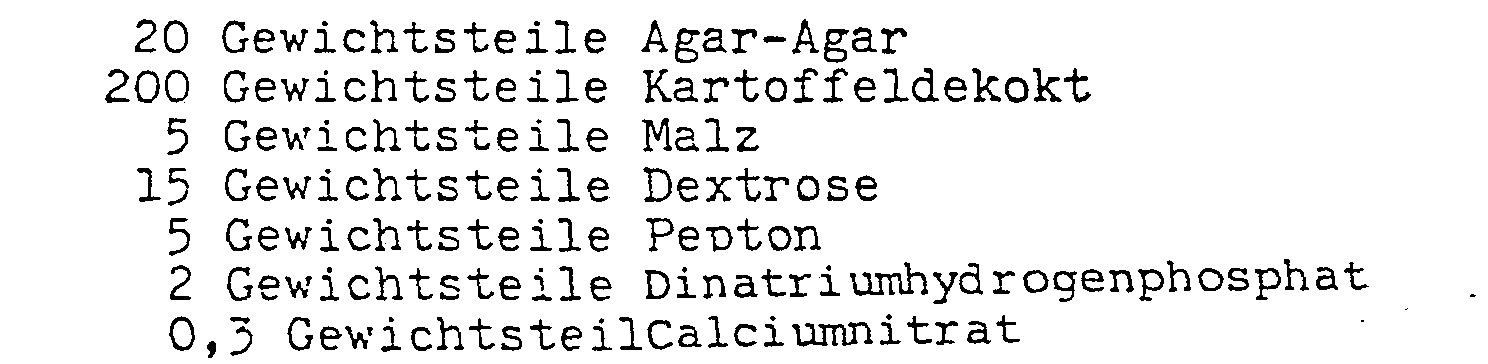
- Verwendeter Nährboden:
- Verhältnis von Lösungsmittelgemisch zum Nährboden:

- Man vermischt die für die gewünschte Wirkstoffkonzentration im Nährboden nötige Wirkstoffmenge mit der angegebenen Menge des Lösungsmittelgemisches. Das Konzentrat wird im genannten Mengenverhältnis mit dem flüssigen, auf 42°C abgekühlten Nährboden gründlich vermischt und in Petrischalen mit einem Durchmesser von 9 cm gegossen. Ferner werden Kontrollplatten ohne Präparatbeimischung aufgestellt.
- Ist der Nährboden erkaltet und fest, werden die Platten mit den in der Tabelle angegebenen Pilzarten beimpft und bei etwa 21°C inkubiert.
- Die Auswertung erfolgt je nach Wachstumsgeschwindigkeit der Pilze nach 4-10 Tagen. Bei der Auswertung wird das radiale Myzelwachstum auf den behandelten Nährböden mit dem Wachstum auf dem Kontrollnährboden verglichen. Die Bonitierung des Pilzwachstums geschieht mit folgenden Kennzahlen:

- Bei diesem Test zeigen z.B, die folgenden Verbindungen eine sehr gute Wirkung, die derjenigen der aus dem Stand der Technik bekannten Verbindung (A) deutlich überlegen ist:
- Verbindungen gemäß Herstellungsbeispielen 6, 14, 12, 5 und 9.
- Folgende Pilze wurden zu diesem Versuch verwendet:

-

Eine Lösung von 9,5g (0,175 Mol) Natriummethylat in 49 ml Methylalkohol wird mit 20,2 g (0,297 Mol) Imidazol versetzt. Anschließend wird eine Lösung von 44,3g (0,135 Mol) 1-(4-Biphenylyl)-2-chlor-1-(4-fluorphenyl)-ethanol in 103 ml Dimethylformamid zugetropft und 90 Minuten auf 60°C erhitzt. Die Reaktionsmischung wird durch Abdestillieren der Lösungsmittel im Vakuum eingeengt und der Rückstand mit Wasser verrührt. Die verbleibenden Kristalle werden mit Acetonitril gewaschen und aus Ethylalkohol umkristallisiert. Man erhält 13,5g (28 % der Theorie) 1-(4-Biphenylyl)-1-(4-fluorphenyl)-2-(imidazol-1-yl)-ethanol vom Schmelzpunkt 220°C. -

- Lösung gegossen. Die abgetrennte Etherphase wird mit Wasser gewaschen, über Natriumsulfat getrocknet und eingedampft. Man erhält 44,3 g 1-(4-Biphenylyl)-2-chlor-1-(4-fluorphenyl)-ethanol.

- Zu 21,6g (0,1 Mol) 3-Chlorphenylmagnesiumbromid in 70 ml Ether (hergestellt aus 2,4g (0,1 Mol) Magnesium und 19,1g (0,1 Mol) 3-Bromchlorbenzol) werden portionsweise 13,lg (0,05 Mol) 4-Biphenylyl-(imidazol-1-yl-methyl)-keton gegeben. Nach Zugabe von 500 ml trockenem Toluol wird der Ether abdestilliert und die entstehende Suspension mit wässriger Ammoniumchloridlösung behandelt. Die Toluolphase wird abgetrennt, filtriert und über Natriumsulfat getrocknet. Man engt durch Abdestillieren des Toluols im Vakuum ein und verrührt den kristallinen Rückstand mit Acetonitril. Nach Umkristallisieren aus Ethanol erhält man 9,4 g (50 % der Theorie) 1-(4-Biphenylyl)-1-(3-chlorphenyl)-2-(imidazol-1-yl)-ethanol vom Schmelzpunkt 202°C.

- 3,5g(0,065 Mol) Natriummethylat werden in 20 ml Methanol gelöst und mit 7,5g (0,11 Mol) Imidazol versetzt. Dazu wird eine Lösung von 15g (0,05 Mol) 2-(4-Biphenylyl)-2-(2-chlorphenyl)-oxiran in 75 ml Dimethylformamid getropft und das Reaktionsgemisoh 1,5 Stunden auf 80°C erhitzt. Danach wird das Reaktionsgemisch auf Wasser gegossen, die entstehenden Kristalle werden abfiltriert und getrocknet. Man erhält 14,7g (79 % der Theorie) 1-(h-Biphenylyl)-1-(2-chlorphenyl)-2-imidazol-1-yl-ethanol vom Schmelzpunkt 222°C.
-

- 2,7g (0,09 Mol) 80%-iges Natriumhydrid und 19,8 g (0,09 Mol) Trimethyloxosulfoniumjodid werden innerhalb 20 Minuten mit 90 ml Dimethylsulfoxid versetzt. Nach beendeter Wasserstoffentwicklung wird eine Lösung von 22g (0,075 Mol) 2-Chlor-4'-phenylbenzophenon in 60 ml Dimethylsulfoxid zugetropft und 1 Stunde bei 50°C nachgerührt. Das erkaltete Reaktionsgemisch wird mit 200 ml Wasser versetzt und mit Ether ausgeschüttelt.-Die Etherlösung wird mit Wasser gewaschen, über Natriumsulfat getrocknet und durch Abdestillieren des Lösungsmittels im Vakuum eingeengt. Der Rückstand wird aus Diisopropylether umkristallisiert. Man erhält 15g (65 % der Theorie) 2-(4-Biphenylyl)-2-(2-chlorphenyl)-oxiran vom Schmelzpunkt 70°C.

- Zu einer Suspension von 3,6g (0,12 Mol) Natriumhydrid und 8,2g (0,12 Mol) Imidazol in 200 ml Acetonitril wird eine Lösung von 39,8g (0,1 Mol) 2-(4-Cyclohexyl- phenyl)-3-chlor-l-(2,4-dichlorphenyl)-propan-2-ol in 200 ml Acetonitril zugetropft. Nach dreistündigem Erhitzen auf 80°C wird filtriert, die Kristallmasse mit Wasser gewaschen und aus Acetonitril umkristallisiert. Man erhält 24,9g (58 % der Theorie) 2-(4-Cylohexylphenyl)-1-(2,4-dichlorphenyl)-3-(imidazol-1-yl)-propan-2-ol vom Schmelzpunkt 142°C.
-

- Zu einer Lösung von 0,4 Mol 2,4-Dichlorbenzylmagnesiumchlorid, erhalten aus 10,6 g (0,44 Mol) Magnesium und 70 g (0,4 Mol) 2,4-Dichlorbenzylchlorid in 150 ml Ether, wird eine Lösung von 47,3g (0,2 Mol) 4-Cyclohexylphenacylchlorid in 200 ml Ether getropft. Das Reaktionsgemisch wird auf wässrige AmmoniumchloridLösung gegossen, die Ether-Phase wird abgetrennt, mit Wasser gewaschen, über Natriumsulfat getrocknet und eingedampft. Man erhält 79,5g (99 % der Theorie) 2-(4-Cyclohexyl)-3-chlor-1-(2,4-dichlorphenyl)-propan-2-ol vom Brechungsindex

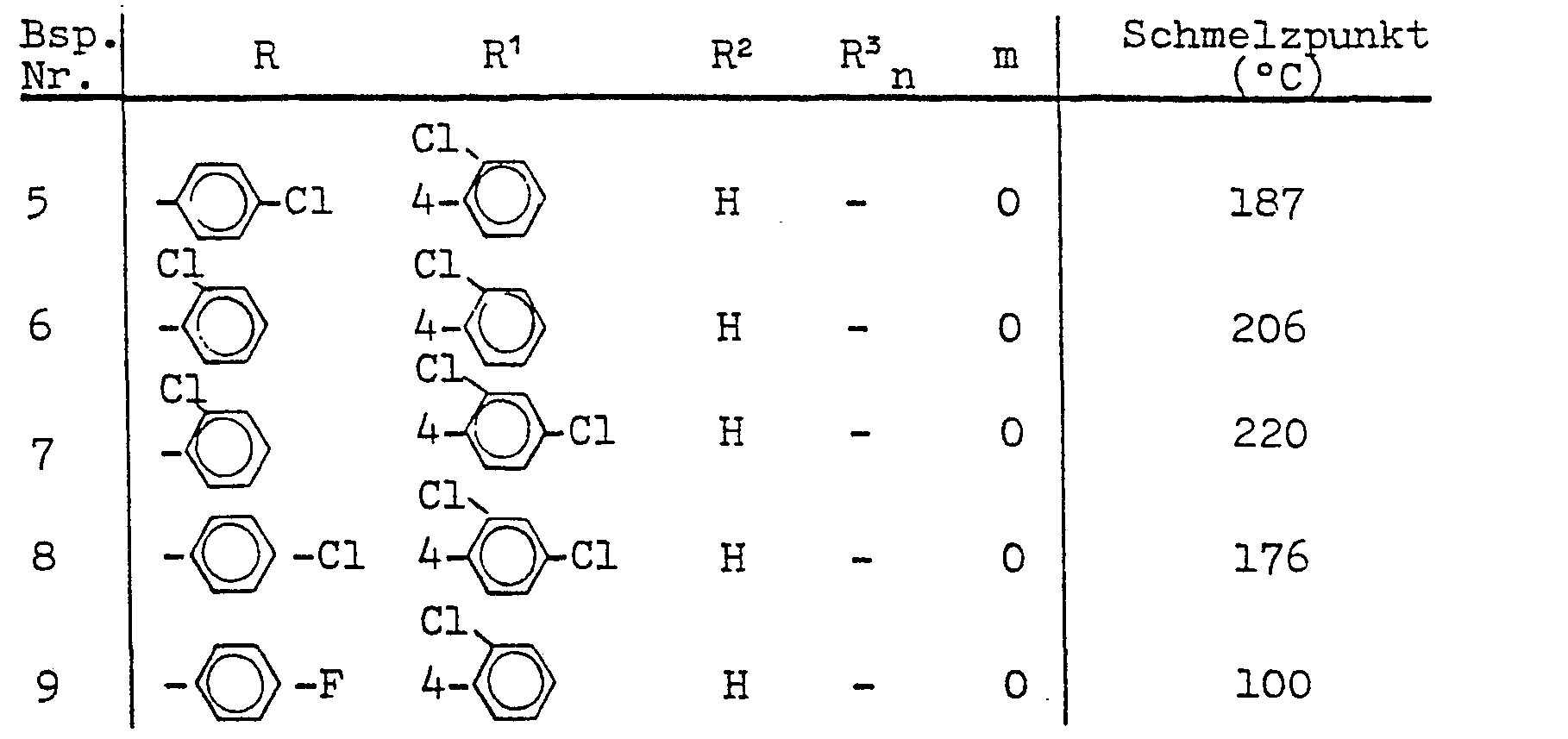
- In den,Beispielen 1 bis4 werden in entsprechender Weise folgende Verbindungen der allgemeinen Formel



Claims (4)

Applications Claiming Priority (2)
| Application Number | Priority Date | Filing Date | Title |
|---|---|---|---|
| DE2920375 | 1979-05-19 | ||
| DE19792920375 DE2920375A1 (de) | 1979-05-19 | 1979-05-19 | Fungizide mittel, verfahren zu ihrer herstellung sowie ihre verwendung als fungizide |
Publications (3)
| Publication Number | Publication Date |
|---|---|
| EP0019190A2 true EP0019190A2 (de) | 1980-11-26 |
| EP0019190A3 EP0019190A3 (en) | 1980-12-10 |
| EP0019190B1 EP0019190B1 (de) | 1983-03-30 |
Family
ID=6071214
Family Applications (1)
| Application Number | Title | Priority Date | Filing Date |
|---|---|---|---|
| EP80102451A Expired EP0019190B1 (de) | 1979-05-19 | 1980-05-06 | Verwendung von Hydroxyalkyl-imidazolen als Fungizide |
Country Status (6)
| Country | Link |
|---|---|
| EP (1) | EP0019190B1 (de) |
| JP (1) | JPS55154959A (de) |
| BR (1) | BR8003094A (de) |
| DE (2) | DE2920375A1 (de) |
| DK (1) | DK216180A (de) |
| IL (1) | IL60096A0 (de) |
Cited By (1)
| Publication number | Priority date | Publication date | Assignee | Title |
|---|---|---|---|---|
| EP0072623A1 (de) * | 1981-07-18 | 1983-02-23 | Pfizer Limited | Fungizide Imidazole |
Families Citing this family (2)
| Publication number | Priority date | Publication date | Assignee | Title |
|---|---|---|---|---|
| US4859693A (en) * | 1988-08-10 | 1989-08-22 | E. I. Du Pont De Nemours And Company | Antiinflammatory carbinoloimidazoles |
| US5049570A (en) * | 1990-01-23 | 1991-09-17 | Du Pont Merck Pharmaceutical Company | Pyridylphenyl nitrogen heterocycle-substituted carbinols and derivatives thereof with anti-inflammatory activity |
Family Cites Families (2)
| Publication number | Priority date | Publication date | Assignee | Title |
|---|---|---|---|---|
| DE2736122A1 (de) * | 1977-08-11 | 1979-02-22 | Basf Ag | Fungizide |
| US4246274A (en) * | 1978-05-10 | 1981-01-20 | Bayer Aktiengesellschaft | Antimycotic hydroxypropyl-imidazoles |
-
1979
- 1979-05-19 DE DE19792920375 patent/DE2920375A1/de not_active Withdrawn
-
1980
- 1980-05-06 DE DE8080102451T patent/DE3062507D1/de not_active Expired
- 1980-05-06 EP EP80102451A patent/EP0019190B1/de not_active Expired
- 1980-05-16 JP JP6417580A patent/JPS55154959A/ja active Pending
- 1980-05-16 IL IL60096A patent/IL60096A0/xx unknown
- 1980-05-16 DK DK216180A patent/DK216180A/da unknown
- 1980-05-16 BR BR8003094A patent/BR8003094A/pt unknown
Cited By (1)
| Publication number | Priority date | Publication date | Assignee | Title |
|---|---|---|---|---|
| EP0072623A1 (de) * | 1981-07-18 | 1983-02-23 | Pfizer Limited | Fungizide Imidazole |
Also Published As
| Publication number | Publication date |
|---|---|
| DE2920375A1 (de) | 1980-11-20 |
| EP0019190A3 (en) | 1980-12-10 |
| IL60096A0 (en) | 1980-07-31 |
| BR8003094A (pt) | 1980-12-23 |
| DE3062507D1 (en) | 1983-05-05 |
| JPS55154959A (en) | 1980-12-02 |
| EP0019190B1 (de) | 1983-03-30 |
| DK216180A (da) | 1980-11-20 |
Similar Documents
| Publication | Publication Date | Title |
|---|---|---|
| EP0110048A2 (de) | Substituierte 1-Hydroxyethyl-triazolyl-Derivate | |
| EP0019189B1 (de) | Fungizide Mittel, Verfahren zu ihrer Herstellung sowie ihre Verwendung als Fungizide | |
| EP0019131B1 (de) | Fluorierte 1-Triazolyl-butan-Derivate, Verfahren zu ihrer Herstellung und ihre Verwendung als Fungizide | |
| EP0054865A1 (de) | Substituierte 1-Azolyl-butan-2-one, Verfahren zu ihrer Herstellung und ihre Verwendung als Fungizide sowie als Zwischenprodukte | |
| EP0131845A2 (de) | Verwendung von substituierten Diazolyl-alkyl-carbinolen zur Bekämpfung von Pilzen im Pflanzenschutz | |
| EP0111234A2 (de) | Fungizide Mittel, deren Herstellung und Verwendung | |
| EP0032561B1 (de) | Triazolylphenacyl-pyridyl-ether-Derivate, Verfahren zu ihrer Herstellung sowie ihre Verwendung als Fungizide | |
| EP0121888A2 (de) | 1-Azolyl-3-pyrazolyl-2-propanol-Derivate, Verfahren zu ihrer Herstellung und ihre Verwendung als Fungizide | |
| EP0016974A1 (de) | 3-Substituierte Pyridin-Derivate, Verfahren zu ihrer Herstellung, ihre Verwendung als Fungizide und Zwischenprodukte | |
| EP0029542B1 (de) | Hydroxybutyl-imidazol-Derivate, Verfahren zu ihrer Herstellung, zu letzterer benötigte Zwischenprodukte sowie ihre Verwendung als Fungizide | |
| EP0022975A1 (de) | Triazolyl-alken-Derivate, Verfahren zu ihrer Herstellung und ihre Verwendung als Fungizide | |
| EP0047405A2 (de) | Azolylalkyl-Derivate, Verfahren zu ihrer Herstellung und ihre Verwendung als Fungizide | |
| DE2632603C2 (de) | ||
| EP0023286B1 (de) | Azolyl-alkenole, Verfahren zu ihrer Herstellung sowie ihre Verwendung als Fungizide | |
| EP0042980A2 (de) | 4-Substituierte 1-Azolyl-l-phenoxy-3,3-dimethyl-butan-2-one und -ole, Verfahren zu ihrer Herstellung und ihre Verwendung als Fungizide | |
| EP0108995A1 (de) | Hydroxyalkinyl-azolyl-Derivate | |
| EP0118069B1 (de) | Fungizide Mittel 1,3-Diazolyl-propanole enthaltend | |
| EP0057864B1 (de) | 2-Azolylmethyl-1,3-dioxolan- und -dioxan-Derivate, Verfahren zu ihrer Herstellung und ihre Verwendung als Fungizide | |
| EP0040366B1 (de) | Imidazolyl-vinyl-ketone und -carbinole, Verfahren zu ihrer Herstellung sowie ihre Verwendung als Fungizide | |
| EP0019190B1 (de) | Verwendung von Hydroxyalkyl-imidazolen als Fungizide | |
| EP0040368A1 (de) | Triazolyl-vinyl-ketone und -carbinole, Verfahren zu ihrer Herstellung sowie ihre Verwendung als Fungizide | |
| EP0102517B1 (de) | Fungizide Mittel | |
| EP0040367A1 (de) | Substituierte Phenyl-triazolyl-vinyl-ketone, Verfahren zu ihrer Herstellung sowie ihre Verwendung als Fungizide | |
| EP0073331B1 (de) | 5-Aryloxy-5-azolyl-3,3-dimethyl-1-penten-4-one und -ole, Verfahren zu ihrer Herstellung sowie ihre Verwendung als Fungizide | |
| EP0024538B1 (de) | 1,2,4-Triazolyl-enolether, Verfahren zu ihrer Herstellung und ihre Verwendung als Fungizide |
Legal Events
| Date | Code | Title | Description |
|---|---|---|---|
| PUAI | Public reference made under article 153(3) epc to a published international application that has entered the european phase |
Free format text: ORIGINAL CODE: 0009012 |
|
| PUAL | Search report despatched |
Free format text: ORIGINAL CODE: 0009013 |
|
| 17P | Request for examination filed | ||
| AK | Designated contracting states |
Designated state(s): BE CH DE FR GB IT NL |
|
| AK | Designated contracting states |
Designated state(s): BE CH DE FR GB IT NL |
|
| ITF | It: translation for a ep patent filed | ||
| GRAA | (expected) grant |
Free format text: ORIGINAL CODE: 0009210 |
|
| AK | Designated contracting states |
Designated state(s): BE CH DE FR GB IT LI NL |
|
| PGFP | Annual fee paid to national office [announced via postgrant information from national office to epo] |
Ref country code: DE Payment date: 19830427 Year of fee payment: 4 |
|
| REF | Corresponds to: |
Ref document number: 3062507 Country of ref document: DE Date of ref document: 19830505 |
|
| ET | Fr: translation filed | ||
| PGFP | Annual fee paid to national office [announced via postgrant information from national office to epo] |
Ref country code: CH Payment date: 19830518 Year of fee payment: 4 |
|
| PGFP | Annual fee paid to national office [announced via postgrant information from national office to epo] |
Ref country code: FR Payment date: 19830530 Year of fee payment: 4 |
|
| PGFP | Annual fee paid to national office [announced via postgrant information from national office to epo] |
Ref country code: NL Payment date: 19830531 Year of fee payment: 4 |
|
| PGFP | Annual fee paid to national office [announced via postgrant information from national office to epo] |
Ref country code: BE Payment date: 19830630 Year of fee payment: 4 |
|
| PG25 | Lapsed in a contracting state [announced via postgrant information from national office to epo] |
Ref country code: LI Effective date: 19840531 Ref country code: CH Effective date: 19840531 Ref country code: BE Effective date: 19840531 |
|
| BERE | Be: lapsed |
Owner name: BAYER A.G. Effective date: 19840506 |
|
| PG25 | Lapsed in a contracting state [announced via postgrant information from national office to epo] |
Ref country code: NL Effective date: 19841201 |
|
| GBPC | Gb: european patent ceased through non-payment of renewal fee | ||
| NLV4 | Nl: lapsed or anulled due to non-payment of the annual fee | ||
| PG25 | Lapsed in a contracting state [announced via postgrant information from national office to epo] |
Ref country code: FR Free format text: LAPSE BECAUSE OF NON-PAYMENT OF DUE FEES Effective date: 19850131 |
|
| REG | Reference to a national code |
Ref country code: CH Ref legal event code: PL |
|
| PG25 | Lapsed in a contracting state [announced via postgrant information from national office to epo] |
Ref country code: DE Effective date: 19850201 |
|
| REG | Reference to a national code |
Ref country code: FR Ref legal event code: ST |
|
| PG25 | Lapsed in a contracting state [announced via postgrant information from national office to epo] |
Ref country code: GB Effective date: 19881118 |
|
| PLBE | No opposition filed within time limit |
Free format text: ORIGINAL CODE: 0009261 |
|
| STAA | Information on the status of an ep patent application or granted ep patent |
Free format text: STATUS: NO OPPOSITION FILED WITHIN TIME LIMIT |