EP0019263B2 - Système optique pour microscopes - Google Patents
Système optique pour microscopes Download PDFInfo
- Publication number
- EP0019263B2 EP0019263B2 EP80102638A EP80102638A EP0019263B2 EP 0019263 B2 EP0019263 B2 EP 0019263B2 EP 80102638 A EP80102638 A EP 80102638A EP 80102638 A EP80102638 A EP 80102638A EP 0019263 B2 EP0019263 B2 EP 0019263B2
- Authority
- EP
- European Patent Office
- Prior art keywords
- objectives
- lens
- dispersive
- tube lens
- adapters
- Prior art date
- Legal status (The legal status is an assumption and is not a legal conclusion. Google has not performed a legal analysis and makes no representation as to the accuracy of the status listed.)
- Expired
Links
- 238000012937 correction Methods 0.000 claims abstract description 33
- 230000004075 alteration Effects 0.000 claims abstract description 23
- 230000003287 optical effect Effects 0.000 claims abstract description 18
- 239000006185 dispersion Substances 0.000 claims description 17
- 210000001747 pupil Anatomy 0.000 claims description 9
- 239000011521 glass Substances 0.000 claims description 7
- 230000007704 transition Effects 0.000 abstract description 4
- 230000000694 effects Effects 0.000 description 8
- 238000003384 imaging method Methods 0.000 description 4
- 238000006073 displacement reaction Methods 0.000 description 3
- 201000009310 astigmatism Diseases 0.000 description 2
- 230000008030 elimination Effects 0.000 description 2
- 238000003379 elimination reaction Methods 0.000 description 2
- 238000004519 manufacturing process Methods 0.000 description 2
- 238000009420 retrofitting Methods 0.000 description 2
- 206010010071 Coma Diseases 0.000 description 1
- 230000006978 adaptation Effects 0.000 description 1
- 230000007547 defect Effects 0.000 description 1
- 238000003702 image correction Methods 0.000 description 1
- 239000000463 material Substances 0.000 description 1
- 229910052724 xenon Inorganic materials 0.000 description 1
- FHNFHKCVQCLJFQ-UHFFFAOYSA-N xenon atom Chemical compound [Xe] FHNFHKCVQCLJFQ-UHFFFAOYSA-N 0.000 description 1
Images




Classifications
-
- G—PHYSICS
- G02—OPTICS
- G02B—OPTICAL ELEMENTS, SYSTEMS OR APPARATUS
- G02B21/00—Microscopes
- G02B21/02—Objectives
Definitions
- the invention relates to a microscope optical system which makes it possible to make the objectives of different microscope systems interchangeable.
- the chromatic transverse deviation is not fully corrected for microscope objectives with finite focal lengths - which are referred to below as objectives of the first type.
- the degree of correction varies from manufacturer to manufacturer.
- the remaining chromatic cross deviation in the intermediate image is compensated for by special eyepieces.
- microscope lenses with infinite focal lengths have been developed. In these there is a parallel beam path behind the lens, so that the introduction of additional optics (beam splitter, filter, etc.) is easily possible.
- additional optics beam splitter, filter, etc.
- the intermediate image is generated by means of an additional lens system, the so-called tube lens system.
- Microscope objectives with infinite focal lengths are also known, which are corrected so that an aberration-free intermediate image is created in connection with the tube lens system.
- a reference to this can be found in the Yearbook for Optics and Precision Engineering 1978 ".
- DE-C-2 047 673 describes a likewise fixed correction element which, with a correction effect similar to that proposed in DE-B-1 472 082, shifts the initial focal length of the interchangeable lenses to infinity.
- a positive single lens which is also provided in the tube, corrects the chromatic aberration of the lenses and creates an aberration-free intermediate image. This correction element also changes the imaging scale of the interchangeable lenses.
- a device is known from the company publication "Microprojector with Xenon Burner” from Ernst Leitz Wetzlar GmbH, on whose lens slider not only lenses with an infinite focal length, but also a lens with a finite focal length can be used.
- an achromatic negative putty is used, which extends the focal length of the finite lens to infinity.
- both types of lens are here in terms of chromatic Aberrations corrected in the same way.
- microscope objectives of the first and second types make it possible to use microscope objectives with finite focal lengths and chromatic transverse effects in the intermediate image on microscopes designed for objectives with infinite focal lengths and color-free intermediate images; at the same time, these microscope objectives with an infinite focal length should be able to be used in microscopes designed for objectives with a finite focal length.
- the correction state of the microscope objectives of the first and second type with regard to the chromatic magnification difference in the intermediate image is therefore different when using the new optical system.
- dispersive adapters with negative refractive power for attachment to the lenses with finite focal lengths for operation in connection with the dispersive tube lens and dispersive adapters with positive refractive power for attachment to the lenses with infinite focal lengths are provided,
- the dispersions and the refractive powers of the adapters with positive refractive powers are mutually the same and correspond to the corresponding values for the dispersive tube lens and the dispersions and the refractive powers of the adapters with negative refractive powers are identical to one another and, in terms of amount, correspond to the corresponding value for the dispersive tube lens and essentially the condition when dimensioning the tube lens and the adapter is observed, whereby v d - the Abbe number of the glasses used in the lenses or cemented component, f - the focal length of the respective lenses or cemented component, L - the distance of its main plane from the exit pupil of the lenses used in connection with the tube lens and CHV - is the cross-color error to be compensated for these lenses.
- the task is solved by that to achieve mutual compatibility of the two lens types, the negative link of the telanlin system is removed from the tube and is designed in the form of an achromatic adapter for attachment to the lens with a finite back focal length, the chromatic correction state of the lenses with an infinite focal length is chosen so that the color-free intermediate image can be generated by a dispersive tube lens that is undercorrected with respect to the CHL, dispersive adapter with negative refractive power for attachment to the lenses with finite focal length for operation in conjunction with the dispersive tube lens and dispersive adapter with refractive power 0 (afocal adapter) for attachment to the lenses with infinite focal length for operation in conjunction with the positive achromatic member the Telanlinensystem are provided, the dispersion of the
- v d the Abbe number of the glasses used for the lenses or cemented component
- f - the focal length of the respective lenses or cemented component
- L - the distance of its main plane from the exit pupil of the lenses used in connection with the tube lens
- CHV - is the cross-color error to be compensated for these lenses.
- the manufacturer has the advantage of not having to manufacture and keep the lenses of both types when changing the system in the transition phase, since the lens series of one type are always compatible with the lens series of the second type by combination with the appropriate adapter .
- the manufacturer can supply the user of the first type of lens series of the second type together with the corresponding adapters, which also can already be built into the lens housing.
- the user can easily make the transition to the lens system of the second type while maintaining his interchangeable lenses of the first type, since these need only be equipped with the adapters provided for this.
- the adapters can be framed so that an easily replaceable attachment to the lens housing is made possible. In this case, the user himself is able to provide the lenses that he wants to make available for other use with the necessary adapter.
- the adapters and the tube lens of the new system are the same with regard to the amount of refractive power and their dispersion, on the one hand it is achieved that the imaging scale of lenses of the first type does not change when used on new tubes.
- the chromatic aberrations in the intermediate image depend quite simply on the system parameters, which can then be easily optimized with regard to a color-free intermediate image.
- the tube lenses of the devices of the second type with their main planes at a distance from the object plane that corresponds to 0.5 to 1.3 times their focal length.
- the influence of the position of the tube lens on the transverse color error in the intermediate image can easily be compensated for in this area on the basis of the currently customary values for the color magnification error of lenses of the first type with the aid of the dispersion of the adapter or the tube lens. It is then possible by suitable selection of available types of glass with regard to their dispersion to design the tube lens and the adapter as individual lenses, avoiding cemented elements, in order to achieve the mutual chromatic correction of the intermediate image.
- the dispersive afocal adapter is integrated into the tube, then in connection with the remaining positive achromatic tube lens, it is possible to easily generate a color-free intermediate image.
- the dependency of the transverse color error in the intermediate image on the position of the dispersive link furthermore offers the possibility of individually realizing the desire for complete elimination of the transverse color error for all lenses.
- the displacement of the adjustment element also has no influence on the monochromatic aberrations and the chromatic longitudinal errors.
- lenses of the first type can also be easily adapted to the tube with the remaining achromatic tube lens system, the chromatic correction of which was carried out without taking into account the afocal correction element.
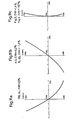
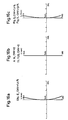
- FIGS. 10-16 show examples of the normalized course of the chromatic longitudinal deviation as a function of the wavelength for the lenses, adapters and tube lenses in the arrangement according to FIGS. 1-9.
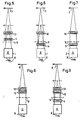
- a lens 1 of finite focal length from the object produces an intermediate image 7 with a color transverse error in the finite area and thus corresponds to a system of the first type.
- 9 denotes the mechanical limitation of the lens housing.
- a tube lens system 20 with an undercorrected chromatic longitudinal deviation produces the color-free intermediate image 8 without influencing the monochromatic image errors which have already been corrected in the objective 2.
- the refractive power of the tube lens system 20 is selected so that an adapter 4 with the amount of the same but negative refractive power and the same dispersion can replace the objective 2 in FIG. 2 with a conventional objective 1 to whose housing it is attached (FIG. 4 ).
- an adapter 4 which moves the focal length of conventional lenses 1 to infinity, they can be used on microscope tubes of the second type without changing their imaging scale.
- the intermediate image is colorless.
- an objective 2 with an infinite focal length is provided with an adapter 3 which corresponds to the adapter 7 (FIG. 4) except for the sign of the refractive power and thus has the same refractive power as the tube lens system 20, then With this combination, a lens of finite output focal length can also be replaced without changing the imaging scale.
- the intermediate image 7 has the same transverse color error as that in FIG. 1, which, in contrast to the longitudinal color error, depends on the position of the adapter 3 (distance from the objective pupil).
- the number of free parameters is manageable. Since it is assumed that both lens classes U and E are corrected for the monochromatic image errors and that the focal length of the adapters 3 and 4 and the tube lens system 20 is in the decimeter range in accordance with the common values for optical tube lengths used, it is possible to consider the lens shapes ( Radii), which have no influence on the chromatic aberrations, are omitted in the adapters or in the tube optics. Rather, the radii can be chosen so that the main planes of the adapters in the various lenses always take the position that is required to achieve the desired chromatic correction, without bringing the adapters themselves into these positions.
- v d the Abbe number of the glasses used for the lenses or cemented component
- f the focal length of the respective lenses or cemented component
- L - the distance of their main planes from the exit pupil of the lenses used in connection with the tube lens system
- CHV - is the cross-color error to be compensated for these lenses.
- FIG. 10 shows the normalized course of the chromatic longitudinal deviation (CHL) for an objective E of the first kind (achromatic with 10x magnification, aperture 0.22, initial focal length 160 mm), the intermediate image of which has a color magnification error (CHV) of 1.4%.
- the adapter and the tube lens are e.g. B. dimensioned as putty so that the desired dispersive behavior results.
- FIG. 14 describes the chromatic correction of the system shown in FIG. 4.
- the color transverse error (CHV) in the intermediate image according to FIG. 14c becomes zero, since the small contribution of the adapter 4, which is attached in the vicinity of the objective pupil, to the CHV compared with the positive adapter 3 in FIG CHV of both lens types E and U is compensated.
- CHV color transverse error
- the values for the CHV in FIGS. 11-14 can all be calculated from equation 1 if it is taken into account that the adapters 3 and 4 are approximately 10 mm away from the objective pupil.
- FIGS. 5-7 outline the achievement of mutual compatibility of the systems described above with the aid of an achromatic negative adapter 14 and a further afocal adapter 5, it being assumed that the system of the first type contains a so-called telan system which Adjust the image distance to the tripod dimensions using a positive (10) and negative (11) achromatic link. Since the use of lenses E on new tubes of the second type has already been outlined with the aid of the negative adapter 4 in FIG. 4, only the interchangeability of the two lens types E and U on tubes of the system of the first type is shown.
- a lens of the second type can be combined using an afocal adapter 5 (FIG. 7), which has the same dispersive behavior as the adapter 3 in FIG. 3.
- an intermediate image 7 with transverse color errors is obtained again.
- FIGS. 8 and 9 A further sensible possibility of adapting the objectives E and U to such a tube is shown in FIGS. 8 and 9.
- the afocal member 15 with the dispersive properties of the adapter 5 is arranged in the tube in the vicinity of the achromatic member 10.
- This system has the same structure in terms of its optical effect as that outlined in FIGS. 2 and 4 and differs only in that refractive power and dispersion of the tube lens 20 in FIGS. 2 and 4 are applied by the separate members 10 and 15.
- the transverse color error in the intermediate image 8 can be completely compensated for in a simple manner, as a result of which small differences in the correction state of different lenses or manufacturing tolerances can be compensated for without adjusting the plane of focus.
- adjustment elements are provided on the tube, with which the said longitudinal displacement of the link 15 can be carried out reproducibly and continuously.
- the use of such an element is not only possible in connection with the optical system outlined above. Even without providing an adapter with which lenses of the first and second type are made compatible (e.g. for incompatible special microscopes), the use of adjustment elements for the complete elimination of the color cross-error in the intermediate image is conceivable and sensible.
- FIG. 16a again shows the course of the CHL of the objective E as in FIG. 10.
- the achromatic tube optics 11, 10 or the adapter 14 sketched in FIGS. 5 and 6 remain almost without influence on the transverse color error (FIG. 16b), so that for both cases the course of the CHL shown in FIG. 16c results, which essentially corresponds to FIG. 16a.
- FIG. 15 shows the compensation of the color errors of the lens U according to an arrangement according to FIG. 7 by the adapter 5 (FIG. 15b), the adapter 3 in FIG. 3 with the same position and with the same dispersive behavior (see FIG. 12b ) gives the result shown in FIG. 15c with a transverse color error of 1.4%.
Landscapes
- Physics & Mathematics (AREA)
- Chemical & Material Sciences (AREA)
- Analytical Chemistry (AREA)
- General Physics & Mathematics (AREA)
- Optics & Photonics (AREA)
- Lenses (AREA)
- Microscoopes, Condenser (AREA)
Claims (7)
caractérisé en ce que, pour créer la compatibilité réciproque des deux types d'objectifs,

CHV = l'aberration chromatique transversale à compenser de ces objectifs.
caractérisé en ce que, pour créer la compatibilité réciproque des deux types d'objectifs (1, 2),

Priority Applications (1)
| Application Number | Priority Date | Filing Date | Title |
|---|---|---|---|
| AT80102638T ATE937T1 (de) | 1979-05-17 | 1980-05-13 | Optiksystem fuer mikroskope. |
Applications Claiming Priority (2)
| Application Number | Priority Date | Filing Date | Title |
|---|---|---|---|
| DE2919924 | 1979-05-17 | ||
| DE2919924A DE2919924C2 (de) | 1979-05-17 | 1979-05-17 | Optiksystem für Mikroskope |
Publications (3)
| Publication Number | Publication Date |
|---|---|
| EP0019263A1 EP0019263A1 (fr) | 1980-11-26 |
| EP0019263B1 EP0019263B1 (fr) | 1982-04-28 |
| EP0019263B2 true EP0019263B2 (fr) | 1988-08-31 |
Family
ID=6070959
Family Applications (1)
| Application Number | Title | Priority Date | Filing Date |
|---|---|---|---|
| EP80102638A Expired EP0019263B2 (fr) | 1979-05-17 | 1980-05-13 | Système optique pour microscopes |
Country Status (6)
| Country | Link |
|---|---|
| US (1) | US4365871A (fr) |
| EP (1) | EP0019263B2 (fr) |
| JP (1) | JPS55155319A (fr) |
| AT (1) | ATE937T1 (fr) |
| BR (1) | BR8003053A (fr) |
| DE (1) | DE2919924C2 (fr) |
Families Citing this family (15)
| Publication number | Priority date | Publication date | Assignee | Title |
|---|---|---|---|---|
| JPS58102207A (ja) * | 1981-12-14 | 1983-06-17 | Nippon Kogaku Kk <Nikon> | テレセントリツクリアコンバ−タ− |
| JPH01154016A (ja) * | 1987-12-10 | 1989-06-16 | Nikon Corp | 顕微鏡 |
| US5002376A (en) * | 1989-05-15 | 1991-03-26 | Edward Weck Incorporated | Dual stereomicroscope |
| US5307203A (en) * | 1990-12-06 | 1994-04-26 | Tandem Scanning Corporation | Confocal tandem scanning reflected light microscope |
| US5161052A (en) * | 1991-03-29 | 1992-11-03 | Tandem Scanning Corporation | Steroscopic tandem scanning reflected light confocal microscope |
| US5239416A (en) * | 1992-06-29 | 1993-08-24 | Optical Designs, Inc. | Variable power zoom stand magnifier |
| DE19513870C2 (de) * | 1995-04-12 | 2001-05-10 | Zeiss Carl Jena Gmbh | Binokularmikroskop |
| JP3123457B2 (ja) * | 1996-05-13 | 2001-01-09 | 株式会社ニコン | 顕微鏡 |
| JPH1195118A (ja) | 1997-09-22 | 1999-04-09 | Olympus Optical Co Ltd | 変換光学系 |
| DE10130621B4 (de) * | 2001-06-26 | 2005-07-28 | Carl Zeiss Jena Gmbh | Mikroskoptubus |
| AR045370A1 (es) * | 2003-08-15 | 2005-10-26 | E Vision Llc | Sistema de lente electro-activo |
| DE102004009848A1 (de) * | 2004-02-28 | 2005-09-15 | Carl Zeiss Jena Gmbh | Tubuslinseneinheit mit chromatisch kompensierender Wirkung |
| DE102014005501A1 (de) * | 2013-10-08 | 2015-04-09 | Carl Zeiss Microscopy Gmbh | Tubuslinseneinheit |
| CN104122661B (zh) * | 2014-08-19 | 2017-03-01 | 重庆奥特光学仪器有限责任公司 | 显微镜光学物像无穷远齐焦校正装置及校正方法 |
| DE102019211360A1 (de) * | 2019-07-30 | 2021-02-04 | Carl Zeiss Microscopy Gmbh | Tubussystem |
Family Cites Families (9)
| Publication number | Priority date | Publication date | Assignee | Title |
|---|---|---|---|---|
| US1446634A (en) * | 1921-01-04 | 1923-02-27 | Bell Louis | Photographic lens |
| SU122304A1 (ru) * | 1954-01-21 | 1958-11-30 | Б.Л. Нефедов | Афокальна система |
| US3132200A (en) * | 1961-06-05 | 1964-05-05 | American Optical Corp | Microscope optical system |
| US3437398A (en) * | 1964-02-10 | 1969-04-08 | American Optical Corp | Plural microscope objective used with a common telescope objective |
| GB1102385A (en) * | 1964-11-04 | 1968-02-07 | Bausch & Lomb | Optical system for microscopes |
| US3481665A (en) * | 1968-05-02 | 1969-12-02 | Bausch & Lomb | Multi-powered micro-objective group having common aberration correcting means |
| DE1910550A1 (de) * | 1969-03-01 | 1970-09-17 | Leitz Ernst Gmbh | Stereomikroskop |
| US3790255A (en) * | 1972-09-11 | 1974-02-05 | American Optical Corp | Zoom lens system |
| LU79603A1 (fr) | 1978-05-05 | 1979-12-06 | Angenieux P Ets | Dispositif pour le reglage de la valeur des aberrations de chromatismo d'un systeme optique et procede comportant l'application d'un tel dispositif pour le reglage de cameras de television en couleur en utilisant un diascope |
-
1979
- 1979-05-17 DE DE2919924A patent/DE2919924C2/de not_active Expired
-
1980
- 1980-05-12 US US06/148,820 patent/US4365871A/en not_active Expired - Lifetime
- 1980-05-13 AT AT80102638T patent/ATE937T1/de not_active IP Right Cessation
- 1980-05-13 EP EP80102638A patent/EP0019263B2/fr not_active Expired
- 1980-05-16 BR BR8003053A patent/BR8003053A/pt unknown
- 1980-05-16 JP JP6418480A patent/JPS55155319A/ja active Granted
Also Published As
| Publication number | Publication date |
|---|---|
| BR8003053A (pt) | 1980-12-23 |
| JPS6217723B2 (fr) | 1987-04-20 |
| US4365871A (en) | 1982-12-28 |
| ATE937T1 (de) | 1982-05-15 |
| JPS55155319A (en) | 1980-12-03 |
| DE2919924C2 (de) | 1982-11-11 |
| EP0019263A1 (fr) | 1980-11-26 |
| DE2919924A1 (de) | 1980-11-20 |
| EP0019263B1 (fr) | 1982-04-28 |
Similar Documents
| Publication | Publication Date | Title |
|---|---|---|
| EP0019263B2 (fr) | Système optique pour microscopes | |
| DE19837135C5 (de) | Afokales Zoomsystem | |
| DE4417489A1 (de) | Höchstaperturiges katadioptrisches Reduktionsobjektiv für die Miktrolithographie | |
| DE102014112199B4 (de) | Mikroskopisches Abbildungssystem | |
| DE3318011C2 (de) | Zusatzeinrichtung für Stereomikroskope | |
| DE102015103707A1 (de) | Projektionsobjektiv und Projektionstyp-Anzeigevorrichtung | |
| DE4344366C2 (de) | Optisches System mit variablem Abbildungsmaßstab | |
| DE102012006749B4 (de) | Stereomikroskop | |
| EP2853933B1 (fr) | Système d'imagerie optique | |
| EP1025460B1 (fr) | OCULAIRE DE MICROSCOPE A GROSSISSEMENT 10x | |
| DE102015225641A1 (de) | Zoomobjektiv | |
| EP2894507B1 (fr) | Télescope avec système d'inversion à prismes | |
| DE2336823C2 (de) | Vario-Objektiv | |
| EP2916161A1 (fr) | Prolongateur de distance focale | |
| DE2310474A1 (de) | Makroobjektiv | |
| DE10036309A1 (de) | Kompaktes katadioptrisches Objektiv hoher Bildgüte | |
| DE2144941A1 (de) | Vario-Objektiv | |
| EP2616867B1 (fr) | Objectif de microscope à grande distance de travail | |
| WO2005088378A1 (fr) | Unite de lentilles tubulaires a effet de compensation chromatique | |
| DE4107070A1 (de) | Zweiteiliger, farbfehlerfreier planachromat | |
| DE2954055C2 (de) | Abbildendes optisches System für Mikroskope mit einem Justierelement zur Einstellung des Farbquerfehlers | |
| DE2300742C3 (de) | Einrichtung zur Vergrößerung eines Teiles des Gesichtsfeldes optischer Geräte | |
| EP2853934A1 (fr) | Système d'imagerie optique | |
| DE2556890B2 (de) | Vergrößerungsobjektiv, insbesondere für Kopierzwecke | |
| DE102004033967B3 (de) | Mikroskop mit Bildhelligkeitsabgleich |
Legal Events
| Date | Code | Title | Description |
|---|---|---|---|
| PUAI | Public reference made under article 153(3) epc to a published international application that has entered the european phase |
Free format text: ORIGINAL CODE: 0009012 |
|
| 17P | Request for examination filed | ||
| AK | Designated contracting states |
Designated state(s): AT CH FR GB |
|
| GRAA | (expected) grant |
Free format text: ORIGINAL CODE: 0009210 |
|
| AK | Designated contracting states |
Designated state(s): AT CH FR GB |
|
| REF | Corresponds to: |
Ref document number: 937 Country of ref document: AT Date of ref document: 19820515 Kind code of ref document: T |
|
| PLBI | Opposition filed |
Free format text: ORIGINAL CODE: 0009260 |
|
| 26 | Opposition filed |
Opponent name: ERNST LEITZ WETZLAR GMBH Effective date: 19830127 |
|
| PGFP | Annual fee paid to national office [announced via postgrant information from national office to epo] |
Ref country code: FR Payment date: 19840517 Year of fee payment: 5 |
|
| PLAB | Opposition data, opponent's data or that of the opponent's representative modified |
Free format text: ORIGINAL CODE: 0009299OPPO |
|
| R26 | Opposition filed (corrected) |
Opponent name: ERNST LEITZ WETZLAR GMBH Effective date: 19830127 |
|
| PG25 | Lapsed in a contracting state [announced via postgrant information from national office to epo] |
Ref country code: GB Effective date: 19880513 |
|
| PUAH | Patent maintained in amended form |
Free format text: ORIGINAL CODE: 0009272 |
|
| STAA | Information on the status of an ep patent application or granted ep patent |
Free format text: STATUS: PATENT MAINTAINED AS AMENDED |
|
| 27A | Patent maintained in amended form |
Effective date: 19880831 |
|
| AK | Designated contracting states |
Kind code of ref document: B2 Designated state(s): AT CH FR GB |
|
| EN3 | Fr: translation not filed ** decision concerning opposition | ||
| PG25 | Lapsed in a contracting state [announced via postgrant information from national office to epo] |
Ref country code: FR Free format text: LAPSE BECAUSE OF NON-PAYMENT OF DUE FEES Effective date: 19890131 |
|
| GBPC | Gb: european patent ceased through non-payment of renewal fee | ||
| REG | Reference to a national code |
Ref country code: FR Ref legal event code: ST |
|
| PGFP | Annual fee paid to national office [announced via postgrant information from national office to epo] |
Ref country code: AT Payment date: 19920525 Year of fee payment: 13 |
|
| PG25 | Lapsed in a contracting state [announced via postgrant information from national office to epo] |
Ref country code: AT Effective date: 19930513 |
|
| PGFP | Annual fee paid to national office [announced via postgrant information from national office to epo] |
Ref country code: CH Payment date: 19940420 Year of fee payment: 15 |
|
| PG25 | Lapsed in a contracting state [announced via postgrant information from national office to epo] |
Ref country code: LI Effective date: 19950531 Ref country code: CH Effective date: 19950531 |
|
| REG | Reference to a national code |
Ref country code: CH Ref legal event code: PL |
|
| APAH | Appeal reference modified |
Free format text: ORIGINAL CODE: EPIDOSCREFNO |