EP0019787A2 - 2-Phenylalken-1-yl-cyclopropane-carboxylic acid esters, process for their preparation and their use as insecticides and acaricides; intermediates in their preparation - Google Patents
2-Phenylalken-1-yl-cyclopropane-carboxylic acid esters, process for their preparation and their use as insecticides and acaricides; intermediates in their preparation Download PDFInfo
- Publication number
- EP0019787A2 EP0019787A2 EP80102618A EP80102618A EP0019787A2 EP 0019787 A2 EP0019787 A2 EP 0019787A2 EP 80102618 A EP80102618 A EP 80102618A EP 80102618 A EP80102618 A EP 80102618A EP 0019787 A2 EP0019787 A2 EP 0019787A2
- Authority
- EP
- European Patent Office
- Prior art keywords
- formula
- phenyl
- alkyl
- cyclopropane
- preparation
- Prior art date
- Legal status (The legal status is an assumption and is not a legal conclusion. Google has not performed a legal analysis and makes no representation as to the accuracy of the status listed.)
- Granted
Links
- 0 CC1*C(C2)C2C1 Chemical compound CC1*C(C2)C2C1 0.000 description 7
- LGFPCWPBBXAKRW-SGAXSIHGSA-N C/C=N\C1C2=C3CC1=C2C3 Chemical compound C/C=N\C1C2=C3CC1=C2C3 LGFPCWPBBXAKRW-SGAXSIHGSA-N 0.000 description 1
- RQXPGOCXZHCXDG-UHFFFAOYSA-N C=C(C(F)(F)F)c1ccccc1 Chemical compound C=C(C(F)(F)F)c1ccccc1 RQXPGOCXZHCXDG-UHFFFAOYSA-N 0.000 description 1
- YPRWFNJXYNYQLY-ACCUITESSA-N CC/C(/c1ccccc1)=C\C1C(C)(C)C1C Chemical compound CC/C(/c1ccccc1)=C\C1C(C)(C)C1C YPRWFNJXYNYQLY-ACCUITESSA-N 0.000 description 1
- DBGPPQXPQLTION-ZROIWOOFSA-N CC1C(C)(C)C1/C=C(\C(F)(F)F)/c(cc1)ccc1[ClH]C Chemical compound CC1C(C)(C)C1/C=C(\C(F)(F)F)/c(cc1)ccc1[ClH]C DBGPPQXPQLTION-ZROIWOOFSA-N 0.000 description 1
- IIEWJVIFRVWJOD-UHFFFAOYSA-N CCC1CCCCC1 Chemical compound CCC1CCCCC1 IIEWJVIFRVWJOD-UHFFFAOYSA-N 0.000 description 1
Classifications
-
- A—HUMAN NECESSITIES
- A01—AGRICULTURE; FORESTRY; ANIMAL HUSBANDRY; HUNTING; TRAPPING; FISHING
- A01N—PRESERVATION OF BODIES OF HUMANS OR ANIMALS OR PLANTS OR PARTS THEREOF; BIOCIDES, e.g. AS DISINFECTANTS, AS PESTICIDES OR AS HERBICIDES; PEST REPELLANTS OR ATTRACTANTS; PLANT GROWTH REGULATORS
- A01N53/00—Biocides, pest repellants or attractants, or plant growth regulators containing cyclopropane carboxylic acids or derivatives thereof
Definitions
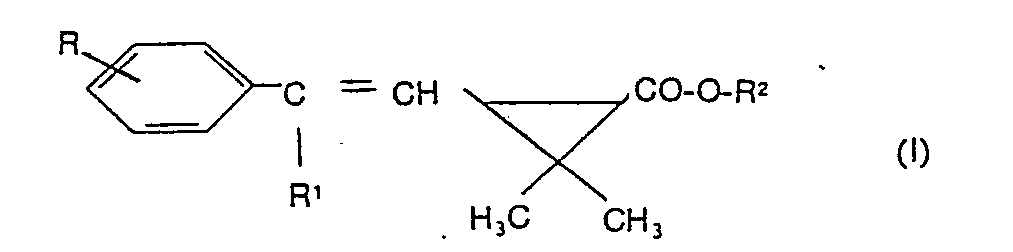
- the invention relates to new 2-phenyl-alken-1-yl-cyclopropane-carboxylic acid esters, a process for their preparation, their use as insecticides and acaricides and intermediates for their preparation.
- the new 2-phenyl-alken-1-yl-cyclopropane-carboxylic acid esters of the formula (I) are notable for high insecticidal and acaricidal activity.
- the 2-phenyl-alken-1-yl-cyclopropane-carboxylic acid esters according to the invention have a considerably higher insecticidal and acaricidal activity than compounds of analogous constitution and the same direction of action known from the prior art.
- the general formula (I) includes the various possible stereoisomers and optically active isomers and mixtures thereof.
- a particularly preferred variant (b) of process (2) for the preparation of compounds of the formula (I), in which R 2 stands for optionally halogen-substituted 3-phenoxy- ⁇ -cyano-benzyl, is characterized in that carboxylic acid chlorides Formula (II a) with optionally halogen-substituted 3-phenoxy-benzaldehydes of the formula IV in which R 4 and R 5 have the meanings given above, and at least the equimolar amount of alkali metal cyanide (preferably sodium cyanide or potassium cyanide), optionally in the presence of a catalyst and using diluents.
- alkali metal cyanide preferably sodium cyanide or potassium cyanide
- the starting materials for the preparation of the compounds of the formula (I) according to the invention are defined by the formulas (II), (II a), (III) and (IV).
- the R to R 5 radicals therein preferably represent those radicals which were mentioned as preferred in the definition of the R to R 5 radicals in formula (I).
- Carboxylic acid chlorides of the formula (II a) can be obtained from the corresponding carboxylic acids of the formula (II) by customary methods, for example by reaction with a chlorinating agent, e.g. Thionyl chloride, optionally using a diluent such as e.g. Carbon tetrachloride, can be produced at temperatures between lo and loo ° C.
- a chlorinating agent e.g. Thionyl chloride
- a diluent such as e.g. Carbon tetrachloride
- Formula (v) defines the 1-phenylalkane-phosphonic acid esters to be used as intermediates.
- R and R preferably represent those radicals which were mentioned as preferred in the definition of the radicals R and R 1 in formula (I), and R7 represents methyl, ethyl, phenyl or both radicals R 7 together represent 2.2 -Dimethyl-propane-1,3-diyl.
- the 2,2-dimethyl-3-formyl-cyclopropane-1-carboxylic acid esters of the formula (VI) to be used as intermediates are known (compare DE-OS 2 615 160). Examples include 2,2-dimethyl-3-formyl-cyclopropane-1-carboxylic acid methyl ester and ethyl ester.
- R and R preferably represent those radicals which were mentioned as preferred in the definition of the radicals R and R in formula (I).
- the new dienes of the formula (VII) are obtained by processes known per se, for example by reacting alkylphenyl-ketones of the formula XI in which R and R have the meanings given under (1), with 3-methyl-buten-2-yl-triphenyl-phosphonium bromide of the formula XII in the presence of a strong base, such as butyllithium and optionally using diluents such as tetrahydrofuran and hexane, at temperatures between -7o and + 100 ° C, preferably between -2o and + 50 ° C.
- a strong base such as butyllithium
- diluents such as tetrahydrofuran and hexane
- radicals R 2 and d / o of the R 3 , R 4 and R 5 preferably have those in the definition of the radicals R 2 , R3, R 4 and R 5 in formula (I) meanings given as preferred.
- Examples include:
- Tetrahydrophthalimidomethyl alcohol pentafluorobenzyl alcohol, pentachlorobenzyl alcohol, 5-benzyl-3-furyl alcohol, 3-phenoxy-benzyl alcohol, 3 - phenoxy-benzaldehyde, 3- (3-fluorophenoxy) -, 3- (4-fluorophenoxy) -, 3-phenoxy-4-fluoro-, 3- (3-fluorophenoxy) -4-fluoro- and 3- (4-fluorophenoxy-4-fluoro-benzyl alcohol, 3- (3-fluoro-phenoxy) -, 3- (4-fluorophenoxy) -, 3-phenoxy-4-fluoro-, 3- (3-fluoro-phenoxy) -4-fluoro- and 3- (4-fluorophenoxy ⁇ -4-fluoro- ⁇ -cyano-benzyl alcohol, 3- (3-fluoro-phenoxy-), 3- (4-fluoro-phenoxy) -, 3-phenoxy-4-fluoro, 3- (3-fluoro
- the process specified under (2) for the preparation of the new 2-phenyl-alken-1-yl-cyclopropanecarboxylic acid esters of the formula (I) is preferably carried out in all variants using suitable solvents or diluents. Practically all inert organic solvents can be considered as such.
- aliphatic and aromatic optionally chlorinated hydrocarbons, such as pentane, hexane, heptane, benzene, toluene, xylene, methylene chloride, chloroform, carbon tetrachloride, chlorobenzene and o-dichlorobenzene, ethers such as diethyl and dibutyl ether, tetrahydrofuran and dioxane, ketones such as acetone , Methyl ethyl, methyl isopropyl and methyl isobutyl ketone and nitriles such as acetonitrile and propionitrile.
- chlorinated hydrocarbons such as pentane, hexane, heptane, benzene, toluene, xylene, methylene chloride, chloroform, carbon tetrachloride, chlorobenzene and o-dichlorobenzene,
- water is used as the second solvent component.
- Alkali carbonates and alcoholates such as sodium and potassium carbonate, sodium and potassium methylate or ethylate, and also aliphatic, aromatic or heterocyclic amines, for example triethylamine, trimethylamine, dimethylaniline, dimethylbenzylamine and pyridine, have proven particularly useful.
- compounds are used as catalysts which usually serve as auxiliaries for the phase transfer of reactants in reactions in multiphase media.
- Be particular Tetraalkyl and trialkylaralkyl ammonium salts such as tetrabutylammonium bromide and trimethyl-benzylammonium chloride called.
- reaction temperature can be varied within a wide range.
- the process is carried out between 0 and 100 ° C., in process variant (a) preferably between 10 and 50 ° C., in variant (b) preferably between 10 and 30 ° C.
- the starting materials are usually used in equimolar amounts.
- An excess of one or the other reaction component has no significant advantages.
- the reaction is generally carried out in one or more diluents in the presence of an acid acceptor or a catalyst and the reaction mixture is stirred at the required temperature for several hours. The reaction mixture is then shaken with toluene / water, the organic phase is separated off, washed with water and dried.
- the new compounds are generally obtained in the form of oils, some of which cannot be distilled without decomposing, but by so-called “distillation”, ie by prolonged heating under reduced pressure to moderately elevated temperatures from the last volatile constituents freed and cleaned in this way.
- the refractive index is used to characterize them.
- the new 2-phenyl-alken-1-yl-cyclopropane-carboxylic acid esters (I) are notable for high insecticidal and acaricidal activity. They can be used against plant-damaging insects and mites in agriculture and forestry, in the protection of stored products and in the hygiene sector, and against ectoparasites in the veterinary-medical field.
- the active ingredients are suitable for good plant tolerance and favorable warm-blood toxicity for combating animal pests, especially insects, arachnids, which are used in agriculture. occur in forests, in the protection of stocks and materials, and in the hygiene sector. They are effective against normally sensitive and resistant species as well as against all or individual stages of development.
- the pests mentioned above include:
- Isopoda e.g. Oniscus asellus, Armadillidium vulgare, Porcellio scaber.
- Thysanura e.g. Lepisma saccharina.
- Thysanoptera e.g. Hercinothrips feaoralis, Thrips tabaci.
- From the order of the Homoptera for example, Aleurodes brassicae, Bemisia tabaci, Trialeurodes vaporariorum, Aphis gossypii, Brevicoryne brassicae, Cryptomyzus ribis, Doralis fabae, Doralis pomi, Eriosoma lanigerum, Hyalopterus arundinis, Macrosiphum avenae, Phusoponosum., Myzus sppas spp., Euscelis bilobatus, Nephotettix cincticeps, Lecanium corni, Saissetia oleae, Laodelphax striatellus, Nilaparvata lugens, Aonidiella aurantii, Aspidiotus'hederae, Pseudococcus spp.
- Psylla spp From the order of the Lepidoptera, for example Pectinophora gossypiella, Bupalus piniarius, Cheimatobia brumata, Lithocolletis blancardella, Hyponomeuta padella, Plutella maculipennis, Malacosoma neustria, Euproctis chrysorrhoea, Lymantria spp. Bucculatrix thurberiella, Phyllocnistis citrella, Agrotis spp., Euxoa spp., Feltia spp.
- Punctatum From the order of the Coleoptera for example Anobium, R hizopertha dominica, Bruchidius obtectus, Acanthoscelides obtectus, Hylotrupes bajulus, Agelastica alni, Leptinotarsa decemlineata, cochleariae Phaedon, Diabrotica spp., Spp Psylliodes chrysocephala, E p ilachna varivestis, Atomaria., Oryzaephilus surinamensis, Anthonomus spp., Sitophilus spp., Otiorrhynchus sulcatus, Cosmopolites sordidus, Ceuthorrhynchus assimilis, Hypera postica, Dermestes spp., Trogoderma spp., Anthrenus spp., Attagenus spp., Lyctus spp., Me
- Gibbium psylloides Tribolium spp., Tenebrio molitor, Agriotes spp., Conoderus spp., Melolontha melolontha, Amphimallon solstitialis, Costelytra zealandica.
- Hymenoptera From the order of the Hymenoptera, for example Diprion spp., Hoplocampa spp., Lasius spp., Monomorium pharaonis, Vespa spp. From the order of the Diptera, for example Aedes spp., Anopheles spp., Culex spp., Drosophila melanogaster, Musca spp., Fannia spp., Calliphora erythrocephala, Lucilia spp., Chrysomyia spp., Cuterebra spp., Gastrophilus spp., Hyppobosca ., Stomoxys spp., Oestrus spp., Hypoderma spp., J Tabanus spp., Tannia spp., Bibio hortulanus, Oscinella frit, Phorbia spp., Pegomyia hyoscyami, Ceratitis capita
- Acarina e.g. Acarus siro, Argas spp., Ornithodoros spp., Dermanyssus gallinae, Eriophyes ribis, Phyllocoptruta oleivora, Boophilus spp., Rhipicephalus spp., Amblyomma spp., Hyalomma spp., Ixodes spp., Psoroptes spp.,. Chori ., Tarsonemus spp., Bryobia praetiosa, Panonychus spp., Tetranychus spp ..
- the active ingredients can be converted into the customary formulations, such as solutions, emulsions, suspensions, powders, foams, pastes, granules, aerosols, active ingredient-impregnated natural and synthetic substances, very fine encapsulations in polymeric substances and in coating compositions for seeds, and also in formulations with Fuel sets, such as smoking cartridges, cans, spirals, etc., as well as ULV cold and warm mist formulations.
- customary formulations such as solutions, emulsions, suspensions, powders, foams, pastes, granules, aerosols, active ingredient-impregnated natural and synthetic substances, very fine encapsulations in polymeric substances and in coating compositions for seeds, and also in formulations with Fuel sets, such as smoking cartridges, cans, spirals, etc., as well as ULV cold and warm mist formulations.
- formulations are prepared in a known manner, for example by mixing the active ingredients with extenders, that is to say liquid solvents, pressurized liquefied gases and / or solid carriers, optionally using surface-active agents, that is to say emulsifiers and / or dispersants and / or foam-generating agents. If water is used as an extender, organic solvents can, for example, also be used as auxiliary solvents.
- extenders that is to say liquid solvents, pressurized liquefied gases and / or solid carriers, optionally using surface-active agents, that is to say emulsifiers and / or dispersants and / or foam-generating agents.
- surface-active agents that is to say emulsifiers and / or dispersants and / or foam-generating agents.
- organic solvents can, for example, also be used as auxiliary solvents.
- Suitable liquid solvents are essentially: aromatics, such as xylene, toluene or alkylnaphthalenes, chlorinated aromatics or chlorinated aliphatic hydrocarbons, such as chlorobenzenes, chloroethylenes or methylene chloride, aliphatic hydrocarbons such as cyclohexane or paraffins, 'for example mineral oil fractions, alcohols, such as butanol or Glycol and their ethers and esters, ketones, such as acetone, Methyl ethyl ketone, methyl isobutyl ketone or cyclohexanone, strongly polar solvents, such as dimethylformamide and dimethyl sulfoxide, and water;
- Liquefied gaseous extenders or carriers mean those liquids which are gaseous at normal temperature and under normal pressure, for example aerosol propellant, such as halogenated hydrocarbons and butane, propane, nitrogen and carbon dioxide;
- Solid carrier materials are suitable
- Adhesives such as carboxymethyl cellulose and natural and synthetic polymers in the form of powders, granules or latices, such as gum arabic, polyvinyl alcohol and polyvinyl acetate, can be used in the formulations.
- Dyes such as inorganic pigments, e.g. Iron oxide, titanium oxide, ferrocyan blue and organic dyes such as alizarin, azole-metal phthalocyanine dyes and trace nutrients such as salts of iron, manganese, boron, copper, cobalt, molybdenum and zinc can be used.
- the formulations generally contain between 0.1 and 95 percent by weight of active compound, preferably between 0.5 and 90%.
- the active compounds according to the invention are used in the form of their commercially available formulations and / or the use forms prepared from these formulations.
- the active substance content of the use forms prepared from the commercially available formulations can vary within wide ranges.
- the active substance concentration of the use forms can be from 0.0000001 to 100% by weight of active substance, preferably between 0.01 and 10% by weight.
- the application takes place in a customary manner adapted to the application forms.
- the active ingredients When used against hygiene pests and pests of stored products, the active ingredients are distinguished by an excellent residual action on wood and clay and by a good stability to alkali on limed substrates.
- the active compounds according to the invention are also suitable for combating ectoparasites and endoparasites in the veterinary field.
- the active compounds according to the invention are used in the veterinary sector in a known manner, such as by oral use in the form of, for example, tablets, capsules, drinkers, granules, by dermal use in the form of, for example, dipping (dipping), spraying (spraying), pouring on ( pour-on and spot-on) and the pump and by parenteral use in the form of, for example, injection.
- Emulsifier 1 part by weight of alkylaryl polyglycol ether
- active compound 1 part by weight of active compound is mixed with the stated amount of solvent and the stated amount of emulsifier, and the concentrate is diluted with water to the desired concentration.
- Cabbage leaves (Brassica oleracea) are treated by being dipped into the preparation of active compound of the desired concentration and populated with horseradish leaf beetle larvae (Phaedon cochleariae) while the leaves are still moist.
- the kill is determined in%. 100% means that all beetle larvae have been killed; 0% means that no beetle larvae have been killed.
- Emulsifier 1 part by weight of alkylaryl polyglycol ether
- active compound 1 part by weight of active compound is mixed with the stated amount of solvent and the stated amount of emulsifier, and the concentrate is diluted with water to the desired concentration.
- Cabbage leaves (Brassica oleracea), which are heavily infested with peach aphids (Myzus persicae), are treated by being dipped into the preparation of active compound of the desired concentration.
- the kill is determined in%. 100% means that all aphids have been killed; 0% means that no aphids have been killed.
- Emulsifier 1 part by weight of A lkylarylpolyglykolöher
- active compound 1 part by weight of active compound is mixed with the stated amount of solvent and the stated amount of emulsifier, and the concentrate is diluted with water to the desired concentration.
- Bean plants Phaseolus vulgaris
- Bean plants which are severely affected by all stages of development of the common spider mite or bean spider mite (Tetranychus urticae)
- the kill is determined in%. 100% means that all spider mites have been killed; 0% means that no spider mites have been killed.
- Test insect Phorbia antiqua maggots in the soil
- Emulsifier 1 part by weight of alkylaryl polyglycol ether
- active compound 1 part by weight of active compound is mixed with the stated amount of solvent, the stated amount of emulsifier is added and the concentrate is diluted with water to the desired concentration.
- the active ingredient preparation is intimately mixed with the soil.
- test animals After 24 hours, the test animals are added to the treated soil and after a further 2 to 7 days, the degree of effectiveness of the active ingredient is determined in% by counting the dead and live test insects. The efficiency is 100% when all test insects have been killed, it is 0% when as many test insects are still alive as in the untreated control.
- Test insect Agrotis segetum larvae in the soil
- Emulsifier 1 part by weight of alkylaryl polyglycol ether
- active compound 1 part by weight of active compound is mixed with the stated amount of solvent, the stated amount of emulsifier is added and the concentrate is diluted with water to the desired concentration.
- the active ingredient preparation is intimately mixed with the soil.
- test animals After 24 hours, the test animals are placed in the treated soil and after a further 2 to 7 days, the effectiveness of the active ingredient is determined in% by counting the dead and live test insects. The efficiency is 100% when all test insects have been killed, it is 0% when as many test insects are still alive as in the untreated control.
- Emulsifier 35 parts by weight of ethylene glycol monomethyl ether 35 parts by weight of nonylphenol polyglycol ether
- Solvent 35 parts by weight of ethylene glycol monomethyl ether 35 parts by weight of nonylphenol polyglycol ether
- reaction mixture is poured into 150 ml of water, to which 5 ml of concentrated hydrochloric acid are added, the organic phase is separated off and washed again with 100 ml of water.
- the toluene phase is then dried over sodium sulfate and the solvent is distilled off in a water jet vacuum. The last solvent residues are removed by briefly distilling at 6o ° C / 1 Torr bath temperature.
- Boiling point 141-145 ° C / 2 torr
- Boiling point 125 ° C / 2 Torr 21 g (0, 0 67 mol) of 2,2-dimethyl-3- (2-trifluoromethyl-2-phenyl vinyl) -cyclopropanecarboxylic acid ethyl ester are dissolved in loo ml of ethanol, then with a solution of 3.1 g of sodium hydroxide in 75 ml of water are added and 4 hours heated to reflux with stirring. The ethanol is then distilled off in a water jet vacuum, the residue is taken up in 3oo ml of water and extracted once with 3oo ml of methylene chloride.
- the aqueous phase is separated off, acidified with concentrated hydrochloric acid and then extracted with 2 times 300 ml of methylene chloride.
- the organic phase is then separated off over magnesium sulfate, dried and the solvent is distilled off in a water jet vacuum.
- the last solvent residues are removed by brief distillation at 2 mbar / 60 ° C bath temperature. 7 g (36.8% of theory) of 2,2-dimethyl-3- (2-trifluoromethyl-2-phenyl-vinyl) -cyclopropanecarboxylic acid are then obtained as a very viscous, light yellow oil.
- reaction mixture is then mixed with 6 00 ml of water and extracted 5 times with 2oo ml of petroleum ether.
- the petroleum ether phases are dried over magnesium sulfate and then the solvent is removed on a rotary evaporator in a water jet vacuum.
- the residue is mixed with 150 ml of n-hexane and the remaining triphenylphosphine oxide is then filtered.
- the solvent is then distilled off from the filtrate at normal pressure and the oily residue is then distilled in vacuo.
Landscapes
- Life Sciences & Earth Sciences (AREA)
- Agronomy & Crop Science (AREA)
- Pest Control & Pesticides (AREA)
- Plant Pathology (AREA)
- Health & Medical Sciences (AREA)
- Engineering & Computer Science (AREA)
- Dentistry (AREA)
- General Health & Medical Sciences (AREA)
- Wood Science & Technology (AREA)
- Zoology (AREA)
- Environmental Sciences (AREA)
- Organic Low-Molecular-Weight Compounds And Preparation Thereof (AREA)
- Agricultural Chemicals And Associated Chemicals (AREA)
Abstract
Gegenstand der vorliegenden Erfindung sind
- (1) neue 2-Phenyl-alken-1-yl-cyclopropan-carbonsäureester der Formel (I)
- (2) 2-Phenyl-alken-1-yl-cyclopropan-carbonsäuren der Formel (II)

- (1) new 2-phenyl-alken-1-yl-cyclopropane-carboxylic acid esters of the formula (I)
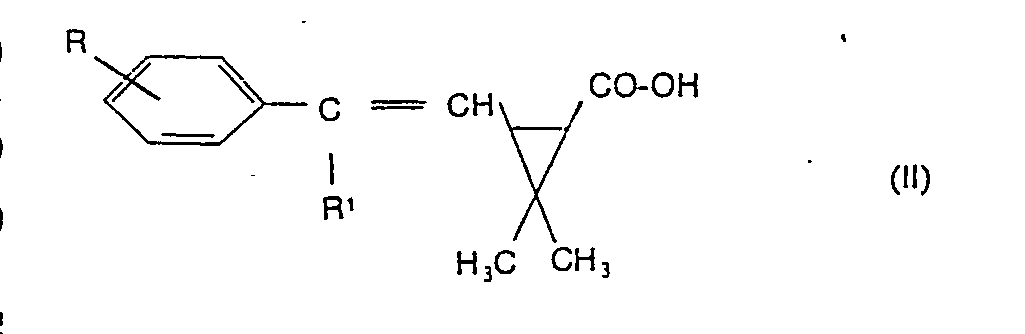
- (2) 2-phenylalken-1-yl-cyclopropanecarboxylic acids of the formula (II)
Description
Die Erfindung betrifft neue 2-Phenyl-alken-1-yl-cyclopropan-carbonsäureester, ein Verfahren zu ihrer Herstellung, ihre Verwendung als Insektizide und Akarizide und Zwischenprodukte zu ihrer Herstellung.The invention relates to new 2-phenyl-alken-1-yl-cyclopropane-carboxylic acid esters, a process for their preparation, their use as insecticides and acaricides and intermediates for their preparation.
Es ist bekannt, daß bestimmte 2-Phenyl-alken-1-yl-cyclopropan-carbonsäureester, wie z.B. 3-(2-Phenyl-vinyl)-2,2-dimethyl-cyclopropan-1-carbonsäure-(3-phenoxy-benzyl)-ester und 3-(2-(4-Chlor-phenyl)-vinyl)-2,2-dimethyl- cyclopropan-l-carbonsäure-(3-phenoxy- f-cyano-benzyl)-ester, insektizid und akarizid wirksam sind (vergleiche DE-OS' 2 7o6 184, 2 738 15o und 2 73o 515).It is known that certain 2-phenyl-alkene-1-yl-cyclopropane-carboxylic acid esters, e.g. 3- (2-phenyl-vinyl) -2,2-dimethyl-cyclopropane-1-carboxylic acid (3-phenoxy-benzyl) ester and 3- (2- (4-chlorophenyl) vinyl) -2, 2-dimethyl-cyclopropane-l-carboxylic acid (3-phenoxy-f-cyano-benzyl) ester, insecticide and acaricide are effective (compare DE-OS '2 7o6 184, 2 738 15o and 2 73o 515).
Die Wirkung dieser Verbindungen ist jedoch, insbesondere bei niedrigen Wirkstoffkonzentrationen und Aufwandmengen, nicht immer zufriedenstellend.However, the action of these compounds is not always satisfactory, especially when the active substance concentrations are low and the amounts are applied.
Gegenstand der vorliegenden Erfindung sind
- (1) neue 2-Phenyl-alken-1-yl-cyclopropan-carbonsäureester der Formel I

- R für Wasserstoff oder für einen oder mehrere, gleiche oder verschiedene Substituenten aus der Reihe Halogen, Cyano, Nitro, jeweils gegebenenfalls halogen-substituiertes Alkyl, Alkoxy, Alkylendioxy oder Alkylthio, steht,
- R1 für gegebenenfalls halogen-substituiertes Alkyl steht und
- R2 für einen im Alkoholteil von Pyrethroiden üblichen Rest steht;
- (2) ein Verfahren zur Herstellung von 2-Phenyl-alken-1-yl-cyclopropan-carbonsäureestern der Formel (I), dadurch gekennzeichnet, daß man 2-Phenyl-alken-1-yl-cyclopropan-carbonsäuren der Formel II

- R und R1 die oben angegebenen Bedeutungen haben,
oder reaktionsfähige Derivate derselben,
mit Alkoholen der Formel III
- R2 die oben angegebene Bedeutung hat,
oder mit reaktionsfähigen Derivaten derselben, gegebenenfalls in Gegenwart eines Säureakzeptors und gegebenenfalls unter Verwendung von Verdünnungsmitteln umsetzt; - R und R1 die oben angegebenen Bedeutungen haben,
- (3) neue 2-Phenyl-alken-1-yl-cyclopropan-carbonsäuren der Formel II

R und R1 die unter (1) angegebenen Bedeutungen haben; - (4) ein Verfahren zur Herstellung von 2- Phenyl-alken-1-yl- cyclopropancarbonsäuren der Formel II, das dadurch gekennzeichnet ist, daß man Alkylester der Formel II b

R und R1 die unter (1) angegebenen Bedeutungen haben und R6 für C1-C4-Alkyl steht,
verseift; - (5) neue 2-Phenyl-alken-l-yl-cyclopropancarbonsäurealkylester der Formel II b

R und R1 die unter (1) angegebenen Bedeutungen haben und R6 für C1-C4-Alkyl steht; - (6) Verfahren zur Herstellung der 2-Phenyl-alken-1-yl-cyclopropan-carbonsäurealkylester der Formel (II b ), dadurch gekennzeichnet, daß man
- a) 1-Phenyl-alkan-phosphonsäureester der Formel V -

- R und R1 die unter (1) angegebenen Bedeutungen haben und
- R7 für C1-C4-Alkyl, Phenyl oder C2-C5-Alkandiyl steht,
mit 2,2-Dimethyl-3-formyl-cyclopropan-1-carbonsäure- alkylestern der Formel VI
- R6 für C1-C4-Alkyl steht,
in Gegenwart einer Base und gegebenenfalls in Gegenwart eines Verdünnungsmittels bei Temperaturen zwischen 0 und 100°C umsetzt oder - b) Diene der Formel VII

- R und R1 die unter (1) angegebenen Bedeutungen haben, mit Diazoessigsäureestern der Formel VIII

- R6 für C1-C4-Alkyl steht,
in Gegenwart eines Katalysators bei Temperaturen zwischen 50 und 200°C umsetzt - R und R1 die unter (1) angegebenen Bedeutungen haben, mit Diazoessigsäureestern der Formel VIII
- (7) neue 1-Phenyl-alkanphos'phbrsäüreester der Formel V

- R und R1 die unter (1) angegebenen Bedeutungen haben und
- R7 für C1-C4-Alkyl, Phenyl oder C2-C5-Alkandiyl steht ;
- (8) ein Verfahren zur Herstellung der 1-Phenyl-alkan-phosphonsäureester der Formel (V), das dadurch gekennzeichnet ist, daß man Phosphorigsäureester der Formel IX

- R7 die oben angegebene Bedeutung hat und
- R8 für Wasserstoff oder C1-C4-Alkyl steht,
mit Halogen-1-phenyl-alkanen der Formel X
- R und R1 die unter (1) angegebenen Bedeutungen haben und
- X für Chlor, Brom oder Jod steht,
gegebenenfalls in Gegenwart einer Base und gegebenenfalls unter Verwendung eines Verdünnungsmittels zwischen 20 und 150°C umsetzt , - (9) neue Diene der Formel VII

R und R1 die unter (1) angegebenen Bedeutungen haben; - (10) ein Verfahren zur Herstellung der Diene der Formel (VII), das dadurch gekennzeichnet ist, daß man Alkyl-phenyl-ketone der Formel XI

R und R1 die unter (1) angegebenen Bedeutungen haben,
mit 3-Methyl-buten-2-yl-triphenyl-phosphoniumbromid
- a) 1-Phenyl-alkan-phosphonsäureester der Formel V -
- (1) new 2-phenyl-alken-1-yl-cyclopropane-carboxylic acid esters of the formula I.
- R represents hydrogen or one or more, identical or different substituents from the series halogen, cyano, nitro, in each case optionally halogen-substituted alkyl, alkoxy, alkylenedioxy or alkylthio,
- R 1 represents optionally halogen-substituted alkyl and
- R 2 represents a radical customary in the alcohol part of pyrethroids;
- (2) a process for the preparation of 2-phenyl-alkene-1-yl-cyclopropane-carboxylic acid esters of the formula (I), characterized in that 2-phenyl-alkene-1-yl-cyclopropane-carboxylic acids of the formula II
- R and R 1 have the meanings given above,
or reactive derivatives thereof,
with alcohols of the formula III - R 2 has the meaning given above,
or with reactive derivatives thereof, if appropriate in the presence of an acid acceptor and if appropriate using diluents; - R and R 1 have the meanings given above,
- (3) new 2-phenyl-alken-1-yl-cyclopropane-carboxylic acids of the formula II
R and R 1 have the meanings given under (1); - (4) a process for the preparation of 2-phenyl-alken-1-yl-cyclopropanecarboxylic acids of the formula II, which is characterized in that alkyl esters of the formula II b
R and R 1 have the meanings given under (1) and R 6 represents C 1 -C 4 alkyl,
saponified; - (5) new 2-phenyl-alkene-l-yl-cyclopropanecarboxylic acid alkyl esters of the formula II b
R and R 1 have the meanings given under (1) and R 6 represents C 1 -C 4 alkyl; - (6) Process for the preparation of the 2-phenyl-alkene-1-yl-cyclopropane-carboxylic acid alkyl esters of the formula (II b), characterized in that
- a) 1-phenylalkane - phosphonic acid ester of the formula V -
- R and R 1 have the meanings given under (1) and
- R 7 represents C 1 -C 4 alkyl, phenyl or C 2 -C 5 alkanediyl,
with 2,2-dimethyl-3-formyl-cyclopropane-1-carboxylic acid alkyl esters of the formula VI - R 6 represents C 1 -C 4 alkyl,
in the presence of a base and optionally in the presence of a diluent at temperatures between 0 and 100 ° C or - b) dienes of formula VII
- R and R 1 have the meanings given under (1), with diazoacetic acid esters of the formula VIII
- R 6 represents C 1 -C 4 alkyl,
in the presence of a catalyst at temperatures between 50 and 200 ° C. - R and R 1 have the meanings given under (1), with diazoacetic acid esters of the formula VIII
- (7) new 1-phenylalkanphos'phbr acid esters of the formula V
- R and R 1 have the meanings given under (1) and
- R 7 represents C 1 -C 4 alkyl, phenyl or C 2 -C 5 alkanediyl;
- (8) a process for the preparation of the 1-phenylalkane-phosphonic acid esters of the formula (V), which is characterized in that phosphorous acid esters of the formula IX
- R 7 has the meaning given above and
- R 8 represents hydrogen or C 1 -C 4 alkyl,
with halogen-1-phenylalkanes of the formula X - R and R 1 have the meanings given under (1) and
- X represents chlorine, bromine or iodine,
if appropriate in the presence of a base and if appropriate using a diluent between 20 and 150 ° C., - (9) new dienes of Formula VII
R and R 1 have the meanings given under (1); - (10) a process for the preparation of the dienes of the formula (VII), which is characterized in that alkyl-phenyl-ketones of the formula XI
R and R 1 have the meanings given under (1),
with 3-methyl-buten-2-yl-triphenyl-phosphonium bromide
- a) 1-phenylalkane - phosphonic acid ester of the formula V -
Die neuen 2-Phenyl-alken-1-yl-cyclopropan-carbonsäureester der Formel (I) zeichnen sich durch hohe insektizide und akarizide Wirksamkeit aus.The new 2-phenyl-alken-1-yl-cyclopropane-carboxylic acid esters of the formula (I) are notable for high insecticidal and acaricidal activity.
Überraschenderweise zeigen die erfindungsgemäßen 2-Phenyl-alken-1-yl-cyclopropan-carbonsäureester eine erheblich höhere insektizide und akarizide Wirkung als aus dem Stand der Technik bekannte Verbindungen analoger Konstitution und gleicher Wirkungsrichtung.Surprisingly, the 2-phenyl-alken-1-yl-cyclopropane-carboxylic acid esters according to the invention have a considerably higher insecticidal and acaricidal activity than compounds of analogous constitution and the same direction of action known from the prior art.
Gegenstand der Erfindung sind vorzugsweise Verbindungen der Formel (I), in welcher
- R für Wasserstoff, für einen oder zwei Reste aus der Gruppe Fluor, Chlor, Brom, C1-C4-Alkyl, C1-C2-Fluoralkyl, -Chloralkyl- oder -Chlorfluoralkyl, C1-C4-Alkoxy- oder-Alkylthio, C1-C2-Fluor- alkoxy- oder -Chlorfluor-alkoxy, für C1-C2-Alkylen- dioxy oder C1-C2-Fluoralkylendioxy steht,
- R1 für C1-C4-Alkyl oder für C1-C2-Fluor- oder Chlorfluor-alkyl steht, und
- R2 für einen der nachstehenden, in der Alkoholkomponente von Pyrethroiden üblichen Rest steht,


- R3 für Wasserstoff, Cyano, Ethinyl, Methyl oder Ethyl steht und
- R 4 und R5, welche gleich oder verschieden sein können, für Wasserstoff, Fluor, Chlor oder Brom stehen.
- R represents hydrogen, one or two radicals from the group consisting of fluorine, chlorine, bromine, C1-C4-alkyl, C 1 -C 2 fluoroalkyl, chloroalkyl or chlorofluoroalkyl, C 1 -C 4 alkoxy or alkylthio , C 1 -C 2 fluoroalkoxy- or chlorofluoroalkoxy, represents C 1 -C 2 alkylene diox y or C 1 -C 2 fluoroalkylenedioxy,
- R 1 represents C 1 -C 4 alkyl or C 1 -C 2 fluoro or chlorofluoroalkyl, and
- R 2 represents one of the following radicals which are customary in the alcohol component of pyrethroids,
- R 3 represents hydrogen, cyano, ethynyl, methyl or ethyl and
- R 4 and R 5 , which may be the same or different, represent hydrogen, fluorine, chlorine or bromine.
Die allgemeine Formel (I) schließt die verschiedenen möglichen Stereoisomeren und optisch aktiven Isomeren sowie deren Mischungen mit ein.The general formula (I) includes the various possible stereoisomers and optically active isomers and mixtures thereof.
In einer bevorzugten Variante (a) von Verfahren (2) zur Herstellung der neuen Verbindungen der Formel (I) werden als reaktionsfähige Derivate der Carbonsäuren der Formel (II) die entsprechenden Carbonsäurechloride der Formel II a

R und R die unter (1) angegebenen Bedeutungen haben, mit Alkoholen der Formel (III), in Gegenwart eines Säureakzeptors und unter Verwendung eines Verdünnungsmittels umgesetzt.In a preferred variant (a) of process (2) for the preparation of the new compounds of the formula (I) are used as reactive derivatives of the carboxylic acids of the formula (II) the corresponding carboxylic acid chlorides of the formula II a
R and R have the meanings given under (1), with alcohols of the formula (III), in the presence of an acid acceptor and using a diluent.
Eine besonders bevorzugte Variante (b) von Verfahren (2) zur Herstellung von Verbindungen der Formel (I), in welcher R2 für gegebenenfalls halogen-substituiertes 3-Phenoxy- α-cyano-benzyl steht, ist dadurch gekennzeichnet, daß man Carbonsäurechloride der Formel (II a) mit gegebenenfalls halogen-substituierten 3-Phenoxy-benzaldehyden der Formel IV

R 4 und R5 die oben angegebenen Bedeutungen haben, und wenigstens der äquimolaren Menge Alkalicyanid (vorzugsweise Natriumcyanid oder Kaliumcyanid), gegebenenfalls in Gegenwart eines Katalysators und unter Verwendung von Verdünnungsmitteln umsetzt.A particularly preferred variant (b) of process (2) for the preparation of compounds of the formula (I), in which R 2 stands for optionally halogen-substituted 3-phenoxy-α-cyano-benzyl, is characterized in that carboxylic acid chlorides Formula (II a) with optionally halogen-substituted 3-phenoxy-benzaldehydes of the formula IV
R 4 and R 5 have the meanings given above, and at least the equimolar amount of alkali metal cyanide (preferably sodium cyanide or potassium cyanide), optionally in the presence of a catalyst and using diluents.
Verwendet man als Ausgangsstoffe bei der Verfahrensvariante (a) beispielsweise 3-(2-(4-Fluor-phenyl)-3,3,3-trifluor-propen-1-yl)-2,2-dimethyl-cyclopropan-1-carbonsäurechlorid und 3-Phenoxy-benzylalkohol, und bei Variante (b) 3-(2-(4-Methoxy-phenyl)-penten-1-yl)-2,2-dimethyl-cyclopropan-1-carbonsäurechlorid, Natriumcyanid und 4-Fluor-3-phenoxy-benzaldehyd, so können die entsprechenden Reaktionen durch folgende Formelschemata skizziert werden:


Die Ausgangsstoffe für die Herstellung der erfindungsgemäßen Verbindungen der Formel (I) sind durch die Formeln (II), (II a), (III) und(IV) definiert. Vorzugsweise stehen darin die Reste R bis R5 für diejenigen Reste, welche bei der Definition der Reste R bis R5 in Formel (I) als bevorzugt genannt wurden.The starting materials for the preparation of the compounds of the formula (I) according to the invention are defined by the formulas (II), (II a), (III) and (IV). The R to R 5 radicals therein preferably represent those radicals which were mentioned as preferred in the definition of the R to R 5 radicals in formula (I).
Die als Ausgangsverbindungen zu verwendenden 2-Phenyl-alken-1-yl-cyclopropan-carbonsäuren (II) bzw. die entsprechenden Säurechloride (II a) als deren reaktionsfähige Derivate sind neu.The 2-phenyl-alkene-1-yl-cyclopropane-carboxylic acids (II) to be used as starting compounds and the corresponding acid chlorides (II a) as their reactive derivatives are new.
Carbonsäurechloride der Formel (II a) können aus den entsprechenden Carbonsäuren der Formel (II) nach üblichen Methoden, beispielsweise durch Umsetzung mit einem Chlorierungsmittel wie z.B. Thionylchlorid, gegebenenfalls unter Verwendung eines Verdünnungsmittels wie z.B. Tetrachlorkohlenstoff, bei Temperaturen zwischen lo und loo°C hergestellt werden.Carboxylic acid chlorides of the formula (II a) can be obtained from the corresponding carboxylic acids of the formula (II) by customary methods, for example by reaction with a chlorinating agent, e.g. Thionyl chloride, optionally using a diluent such as e.g. Carbon tetrachloride, can be produced at temperatures between lo and loo ° C.
Carbonsäuren der Formel (II) erhält man aus den entsprechenden Alkylestern der Formel II b

- R und R1 die unter (1) angegebenen Bedeutungen haben und
- R 6 für C1-C4-A1kyl steht,
nach üblichen Verseifungsmethoden, beispielsweise durch mehrstündiges Erhitzen mit wässrig-alkoholischer Natronlauge auf Temperaturen zwischen 5o und 15o°C. Die Aufarbeitung erfolgt nach üblichen Methoden, beispielsweise durch Abdestillieren des Alkohols, Verdünnen mit Wasser, Ansäuern, Extrahieren mit Methylenchlorid, Trocknen der organischen Extrakte und Abdestillieren des Lösungsmittels.Carboxylic acids of the formula (II) are obtained from the corresponding alkyl esters of the formula II b
- R and R 1 have the meanings given under (1) and
- R 6 represents C 1 -C 4 alkyl,
according to customary saponification methods, for example by heating for several hours with aqueous-alcoholic sodium hydroxide solution to temperatures between 5o and 15o ° C. Working up is carried out by customary methods, for example by distilling off the alcohol, diluting with water, acidifying, extracting with methylene chloride, drying the organic extracts and distilling off the solvent.
Als Beispiele für die Carbonsäuren der Formel (II), die entsprechenden Säurechloride (II a) und Ester (II b) seien genannt:
- 3-(2-phenyl-propen-1-yl)-, 3-(2-Phenyl-buten-1-yl), 3-(2-Phenyl-3,3,3-trifluor-propen-1-yl)-, 3-(2-(4-Fluor-phenyl)-propen-1-yl)-, 3-(2-(4-Fluor-phenyl)-buten-1-yl)-, 3-(2-(4-Fluor-phenyl)-3,3,3-trifluor-propen-1-yl)-, 3-(2-(3-Chlor-phenyl)-propen-1-yl)-, 3-(2-(4-Chlor-phenyl)-propen-1-yl)-, 3-(2-(4-Chlor-phenyl)-buten-1-yl)-, 3-(2-(4-Chlor- - phenyl)-3,3,3-trifluor-propen-1-yl)-, 3-(2-(3-Methylphenyl)-propen-1-yl)-, 3-(2-(4-Methyl-phenyl)-propen-1-yl)-, 3-(2-(4-Methyl-phenyl)-buten-1-yl)-, 3-(2-(4-Methylphenyl)-3,3,3-trifluor-propen-1-yl)-, 3-(2-(4-Methoxyphenyl)-propen-1-yl)-, 3-(2-(4-Methoxy-phenyl)-buten-1-yl)-, 3-(2-(4-Methoxy-phenyl)-3,3,3-trifluor-propen-l-yl)-, 3-(2-(3,4-Methylendioxy-phenyl)-propen-1-yl)-, 3-(2-(3,4-Methylendioxy-phenyl)-buten-1-yl)- und 3-(2-(3,4-Methylendioxy-phenyl)-3,3,3-trifluor-propen-1-yl--2,2-dimethyl-cyclopropan-l-carbonsäure sowie die entsprechenden Säurechloride, die Methylester und die Ethylester.
- 3- (2-phenyl-prop en- 1-yl) -, 3- (2-phenyl-buten-1-yl), 3- (2-phenyl-3,3,3-trifluoro - propen-1-yl ) -, 3- (2- (4-fluorophenyl) propen-1-yl) -, 3- (2- (4-fluorophenyl) buten-1-yl) -, 3- (2- (4-fluorophenyl) -3,3,3-trifluoropropen-1-yl) -, 3- (2- (3-chlorophenyl) propen-1-yl) -, 3- (2- (4-chlorophenyl) propen-1-yl), 3- (2- (4-chlorophenyl) buten-1-yl) -, 3- (2- (4-chloro - phenyl) -3,3,3-trifluoropropen-1-yl) -, 3- (2- (3-methyl phenyl) propen-1-yl), 3- (2- (4-methylphenyl) propen-1-yl), 3- (2- (4-methylphenyl) buten-1-yl ) -, 3- (2- (4-methylphenyl) -3,3,3-trifluoropropen-1-yl) -, 3- (2- (4-methoxyphenyl) propen-1-yl) -, 3rd - (2- (4-methoxyphenyl) buten-1-yl) -, 3- (2- (4-methoxyphenyl) -3,3,3-trifluoropropen-l-yl) -, 3rd - (2- (3,4-methylenedioxy-phenyl) -propen-1-yl) -, 3- (2- (3,4-methylenedioxy-phenyl) -buten-1-yl) - and 3- (2- (3,4-methylenedioxy-phenyl) -3,3,3-trifluoropropen-1-yl - 2,2-dimethyl-cyclopropan-l-carboxylic acid and the corresponding acid chlorides, the methyl esters and the ethyl esters.
2-Phenyl-alken-l-yl-cyclopropancarbonsäure-alkylester der Formel (II b) sind, wie die entsprechenden Säuren (II) und Säurechloride (II a) noch nicht in der Literatur beschrieben.2-phenyl-alkene-l-yl-cyclopropanecarboxylic acid alkyl esters of the formula (II b), like the corresponding acids (II) and acid chlorides (II a), have not yet been described in the literature.
Man erhält 2-Phenyl-alken-1-yl-cyclopropan-carbonsäureester der Formel (II b)
- (a) durch Umsetzung von 1-Phenyl-alkan-phosphonsäureestern der Formel V

- R und R1 die unter (1) angegebenen Bedeutungen haben und
- R7 für C1-C4-Alkyl, Phenyl oder C2-C5-Alkandiyl steht,
mit 2,2-Dimethyl-3-formyl-cyclopropan-l-carbonsäurealkyl- estern der Formel VI
- R6 für C1-C4-Alkyl steht,
in Gegenwart einer Base, wie z.B. Kalium-tert.-butylat, und gegebenenfalls in Gegenwart eines Verdünnungsmittels, wie z.B. Tetrahydrofuran, bei Temperaturen zwischen 0 und 100°C, vorzugsweise zwischen lo und 8o°C. Die Aufarbeitung kann auf übliche Weise durchgeführt werden, beispielsweise, indem man mit Wasser verdünnt, mit Methylenchlorid extrahiert, die organische Phase trocknet, das Lösungsmittel abzieht und das zurückbleibende Produkt durch Vakuumdestillation reinigt.
Ester der Formel (II b) erhält man auch - (b) durch Umsetzung von Dienen der Formel VII

- R und R die unter (1) angegebenen Bedeutungen haben,
mit Diazoessigsäureestern der Formel VIII
- R 6 für C1-C4-Alkyl steht,
in Gegenwart eines Katalysators, wie z.B. Kupferpulver und Kupfersulfat, bei Temperaturen zwischen 5o und 200°C, vorzugsweise zwischen 8o und 15o°C. - R und R die unter (1) angegebenen Bedeutungen haben,
- (a) by reacting 1-phenylalkane-phosphonic acid esters of the formula V
- R and R 1 have the meanings given under (1) and
- R 7 represents C 1 -C 4 alkyl, phenyl or C 2 -C 5 alkanediyl,
with 2,2-dimethyl-3-formyl-cyclopropane-l-carboxylic acid alkyl esters of the formula VI - R 6 represents C 1 -C 4 alkyl,
in the presence of a base, such as potassium tert-butoxide, and optionally in the presence of a diluent, such as tetrahydrofuran, at temperatures between 0 and 100 ° C, preferably between lo and 80 ° C. The work-up can be carried out in a customary manner, for example by diluting with water, extracting with methylene chloride, drying the organic phase, removing the solvent and cleaning the remaining product by vacuum distillation.
Esters of the formula (II b) are also obtained - (b) by reacting dienes of the formula VII
- R and R have the meanings given under (1),
with diazoacetic acid esters of formula VIII - R 6 represents C 1 -C 4 alkyl,
in the presence of a catalyst, such as copper powder and copper sulfate, at temperatures between 5o and 200 ° C, preferably between 8o and 15o ° C. - R and R have the meanings given under (1),
Zur Aufarbeitung wird mit Methylenchlorid verdünnt und filtriert. Vom Filtrat wird nach Waschen mit Wasser und Trocknen das Lösungsmittel abgezogen und das zurückbleibende Rohprodukt gegebenenfalls durch Vakuumdestillation gereinigt.For working up, it is diluted with methylene chloride and filtered. After washing with water and drying, the solvent is drawn off from the filtrate and the crude product which remains is optionally purified by vacuum distillation.
Die als Zwischenprodukte zu verwendenden 1-Phenyl-alkan- phosphonsäureester sind durch Formel (v) definiert. Vorzugsweise stehen darin R und R für diejenigen Reste, welche bei der Definition der Reste R und R1 in Formel (I) als bevorzugt genannt wurden, und R7 steht für Methyl, Ethyl, Phenyl oder beide Reste R7 stehen zusammen für 2,2-Dimethyl-propan-1,3-diyl.Formula (v) defines the 1-phenylalkane-phosphonic acid esters to be used as intermediates. R and R preferably represent those radicals which were mentioned as preferred in the definition of the radicals R and R 1 in formula (I), and R7 represents methyl, ethyl, phenyl or both radicals R 7 together represent 2.2 -Dimethyl-propane-1,3-diyl.
Als Beispiele seien genannt:
- 1-Phenyl-, 1-(4-Fluor-phenyl)-, 1-(3-Chlor-phenyl)-,
- 1-(4-Chlor-phenyl)-, 1-(3-Methyl-phenyl)-, 1-(4-Methylphenyl)-, 1-(4-Methoxy-phenyl)- und 1-(3,4-Methylendioxyphenyl)--ethan-phosphonsäure-dimethylester und -diethylester;
- 1-Phenyl-, 1-(4-Fluor-phenyl)-, 1-(3-Chlor-phenyl)-,
- 1-(4-Chlor-phenyl)-, 1-(3-Methyl-phenyl)-, 1-(4-Methylphenyl)-, 1-(4-Methoxy-phenyl)- und 1-(3,4-Methylen- dioxy-phenyl)--propan-phosphonsäure-dimethylester und -diethylester.
- 1-phenyl-, 1- (4-fluorophenyl) -, 1- (3-chlorophenyl) -,
- 1- (4-chlorophenyl) -, 1- (3-methylphenyl) -, 1- (4-methylphenyl) -, 1- (4-methoxyphenyl) - and 1- (3,4-methylenedioxyphenyl ) - Ethane-phosphonic acid dimethyl ester and diethyl ester;
- 1- phenyl-, 1- (4-fluorophenyl) -, 1- (3-chlorophenyl) -,
- 1- (4-chlorophenyl) -, 1- (3-methylphenyl) -, 1- (4-methylphenyl) -, 1- (4-methoxyphenyl) - and 1- (3,4-methylene - Dioxy-phenyl) propane-phosphonic acid dimethyl ester and diethyl ester.
Man erhält die neuen 1-Phenyl-alkan-phosphonsäureester der Formel (V) nach an sich bekannten Verfahren, beispielsweise durch Umsetzung von Phosphorigsäureestern der Formel IX

- R7 die oben angegebene Bedeutung hat und
- R8 für Wasserstoff oder C1-C4-Alkyl steht, mit 1-Halogen-1-phenyl-alkanen der Formel X

- R und R die unter (1) angegebenen Bedeutungen haben und
- X für Chlor, Brom oder Jod steht,
gegebenenfalls in Gegenwart einer Base, wie z.B. Natriummethylat, und gegebenenfalls unter Verwendung eines Verdünnungsmittels, wie z.B. Methanol, bei Temperaturen zwischen 2o und 150°C.The new 1-phenylalkane-phosphonic acid esters of the formula (V) are obtained by processes known per se, for example by reacting phosphorous acid esters of the formula IX
- R 7 has the meaning given above and
- R 8 represents hydrogen or C 1 -C 4 alkyl, with 1-halo-1-phenylalkanes of the formula X.
- R and R have the meanings given under (1) and
- X represents chlorine, bromine or iodine,
optionally in the presence of a base, such as sodium methylate, and optionally using a diluent, such as methanol, at temperatures between 20 ° and 150 ° C.
Ausgangsverbindungen der Formeln (IX) und (X) sind bekannt.Starting compounds of the formulas (IX) and (X) are known.
Die weiter als Zwischenprodukte zu verwendenden 2,2-Dimethyl-3-formyl-cyclopropan-l-carbonsäureester der Formel (VI) sind bekannt (vergleiche DE-OS 2 615 160). Als Beispiele seien 2,2-Dimethyl-3-formyl-cyclopropan-1-carbonsäure-methylester und -ethylester genannt.The 2,2-dimethyl-3-formyl-cyclopropane-1-carboxylic acid esters of the formula (VI) to be used as intermediates are known (compare DE-OS 2 615 160). Examples include 2,2-dimethyl-3-formyl-cyclopropane-1-carboxylic acid methyl ester and ethyl ester.
Die weiter als Zwischenprodukte zu verwendenden Diene sind durch Formel (VII) definiert. Vorzugsweise stehen darin R und R für diejenigen Reste, welche bei der Definition der Reste R und R in Formel (I) als bevorzugt genannt wurden.The dienes to be further used as intermediates are defined by formula (VII). R and R preferably represent those radicals which were mentioned as preferred in the definition of the radicals R and R in formula (I).
Als Beispiele seien genannt:
- 2-Phenyl-, 2-(4-Fluor-phenyl)-, 2-(3-Chlor-phenyl)-,
- 2-(4-Chlor-phenyl)-, 2-(3-Methyl-phenyl)-, 2-(4-Methylphenyl)-, 2-(4-Methoxy-phenyl)- und 2-(3,4-Methylendioxyphenyl)--1,1,1-trifluor-5-methyl-hexa-2,4-dien.
- 2-phenyl-, 2- (4-fluorophenyl) -, 2- (3-chlorophenyl) -,
- 2- (4-chlorophenyl) -, 2- (3-methylphenyl) -, 2- (4-methylphenyl) -, 2- (4-methoxyphenyl) - and 2- (3,4-methylenedioxyphenyl ) - 1,1,1-trifluoro-5-methyl-hexa-2,4-diene.
Man erhält die neuen Diene der Formel (VII) nach an sich bekannten Verfahren, beispielsweise durch Umsetzung von Alkyl-phenyl-ketonen der Formel XI

R und R die unter (1) angegebenen Bedeutungen haben, mit 3-Methyl-buten-2-yl-triphenyl-phosphoniumbromid der Formel XII

R and R have the meanings given under (1), with 3-methyl-buten-2-yl-triphenyl-phosphonium bromide of the formula XII
Ausgangsverbindungen der Formeln (XI) und (XII) sind bekannt.Starting compounds of the formulas (XI) and (XII) are known.
Alkohole der Formel (III) bzw. Aldehyde der Formel (IV) als davon abzuleitende Verbindungen, welche bei dem oben unter (2) angegebenen Verfahren zur Herstellung der neuen 2-Phenyl-alken-1-yl-cyclopropan-carbonsäureester der Formel (I) als Reaktionskomponenten verwendet werden, sind bekannt (vergleiche DE-OS' 2 oo5 489, 2 326 o77, 2 7o9 264; GB-PS 1 o78 511).Alcohols of the formula (III) or aldehydes of the formula (IV) as compounds to be derived therefrom which are used in the process for the preparation of the new 2-phenyl-alken-1-yl-cyclopropane-carboxylic acid esters of the formula (I ) are used as reaction components are known (compare DE-OS '2 oo5 489, 2 326 o77, 2 7o9 264; GB-PS 1 o78 511).
Vorzugsweise haben bei den Ausgangsverbindungen der Formel (III) bzw. der Formel (IV) die Reste R2 und/oder R 3, R 4 und R5 die bei der Definition der Reste R2, R3, R4 und R5 in Formel (I) als bevorzugt angegebenen Bedeutungen.In the case of the starting compounds of the formula (III) or of the formula (IV), the radicals R 2 and d / o of the R 3 , R 4 and R 5 preferably have those in the definition of the radicals R 2 , R3, R 4 and R 5 in formula (I) meanings given as preferred.
Als Beispiele seien genannt:Examples include:
Tetrahydrophthalimidomethylalkohol, Pentafluorbenzylalkohol, Pentachlorbenzylalkohol, 5-Benzyl-3-furyl- alkohol, 3-Phenoxy-benzylalkohol, 3-Phenoxy-benzaldehyd, 3-(3-Fluoro-phenoxy)-, 3-(4-Fluoro-phenoxy)-, 3-Phenoxy-4-fluoro-, 3-(3-Fluoro-phenoxy)-4-fluoro- und 3-(4-Fluoro- phenoxy-4-fluoro-benzylalkohol, 3-(3-Fluoro-phenoxy)-, 3-(4-Fluoro-phenoxy)-, 3-Phenoxy-4-fluoro-, 3-(3-Fluoro-phenoxy)-4-fluoro- und 3-(4-Fluoro- phenoxy}-4-fluoro-α-cyano-benzylalkohol, 3-(3-Fluoro-phenoxy-,) 3-(4-Fluoro-phenoxy)-, 3-Phenoxy-4-fluoro-, 3-(3-Fluoro-phenoxy)-4-fluoro- und 3-(4-Fluoro- phenoxy)-4-fluoro- α-äthienyl-benzylalkohol, 3-Phenoxy-4-fluoro-α-methyl-benzylalkohol sowie 3-(3-Fluoro-phenoxy)-, 3-(4-Fluoro-phenoxy)-, 3-Phenoxy-4-fluoro-, 3-(3-Fluoro-phenoxy)-4-fluoro- und 3-(4-Fluoro- phenoxy)-4-fluoro-benzaldehyd.Tetrahydrophthalimidomethyl alcohol, pentafluorobenzyl alcohol, pentachlorobenzyl alcohol, 5-benzyl-3-furyl alcohol, 3-phenoxy-benzyl alcohol, 3 - phenoxy-benzaldehyde, 3- (3-fluorophenoxy) -, 3- (4-fluorophenoxy) -, 3-phenoxy-4-fluoro-, 3- (3-fluorophenoxy) -4-fluoro- and 3- (4-fluorophenoxy-4-fluoro-benzyl alcohol, 3- (3-fluoro-phenoxy) -, 3- (4-fluorophenoxy) -, 3-phenoxy-4-fluoro-, 3- (3-fluoro-phenoxy) -4-fluoro- and 3- (4-fluorophenoxy} -4-fluoro-α -cyano-benzyl alcohol, 3- (3-fluoro-phenoxy-), 3- (4-fluoro-phenoxy) -, 3-phenoxy-4-fluoro, 3- (3-fluoro-phenoxy) -4-fluoro and 3- (4-fluorophenoxy) -4-fluoro-α-ethienyl-benzyl alcohol, 3-phenoxy-4-fluoro-α-methyl-benzyl alcohol and 3- (3-fluoro-phenoxy) -, 3- (4th -Fluorophenoxy) -, 3-phenoxy-4-fluoro-, 3- (3-fluorophenoxy) -4-fluoro- and 3- (4-fluorophenoxy) -4-fluoro-benzaldehyde.
Das unter (2) angegebene Verfahren zur Herstellung der neuen 2-Phenyl-alken-1-yl-cyclopropancarbonsäureester der Formel (I) wird in allen Varianten bevorzugt unter Verwendung geeigneter Lösungs- oder Verdünnungsmittel durchgeführt. Als solche kommen praktisch alle inerten organischen Solventien infrage. Hierzu gehören insbesondere aliphatische und aromatische, gegebenenfalls chlorierte Kohlenwasserstoffe, wie Pentan, Hexan, Heptan, Benzol, Toluol, Xylol, Methylenchlorid, Chloroform, Tetrachlorkohlenstoff, Chlorbenzol und o-Dichlorbenzol, Ether wie Diethyl- und Dibutylether, Tetrahydrofuran und Dioxan, Ketone wie Aceton, Methylethyl-, Methyl-isopropyl- und Methylisobutylketon sowie Nitrile wie Acetonitril und Propionitril.The process specified under (2) for the preparation of the new 2-phenyl-alken-1-yl-cyclopropanecarboxylic acid esters of the formula (I) is preferably carried out in all variants using suitable solvents or diluents. Practically all inert organic solvents can be considered as such. These include in particular aliphatic and aromatic, optionally chlorinated hydrocarbons, such as pentane, hexane, heptane, benzene, toluene, xylene, methylene chloride, chloroform, carbon tetrachloride, chlorobenzene and o-dichlorobenzene, ethers such as diethyl and dibutyl ether, tetrahydrofuran and dioxane, ketones such as acetone , Methyl ethyl, methyl isopropyl and methyl isobutyl ketone and nitriles such as acetonitrile and propionitrile.
Beim Arbeiten im Zweiphasenmedium wird Wasser als zweite Solvenskomponente verwendet.When working in a two-phase medium, water is used as the second solvent component.
Bei der Variante (a) des unter (2) beschriebenen Herstellungsverfahrens können als Säureakzeptoren alle üblichen Säurebindemittel Verwendung finden.In variant (a) of the production process described under (2), all customary acid binders can be used as acid acceptors.
Besonders bewährt haben sich Alkalicarbonate und -alkoholate, wie Natrium- und Kaliumcarbonat, Natrium- und Kaliummethylat bzw. -äthylat, ferner aliphatische, aromatische oder heterocyclische Amine, beispielsweise Triethylamin, Trimethylamin, Dimethylanilin, Dimethylbenzylamin und Pyridin.Alkali carbonates and alcoholates, such as sodium and potassium carbonate, sodium and potassium methylate or ethylate, and also aliphatic, aromatic or heterocyclic amines, for example triethylamine, trimethylamine, dimethylaniline, dimethylbenzylamine and pyridine, have proven particularly useful.
Bei der Variante (b) von Verfahren (2) werden als Katalysatoren Verbindungen verwendet, welche gewöhnlich bei Reaktionen in mehrphasigen Medien als Hilfsmittel zum Phasentransfer von Reaktanden dienen. Insbesondere seien Tetraalkyl- und Trialkylaralkyl-ammoniumsalze wie z.B. Tetrabutylammoniumbromid und Trimethyl-benzylammoniumchlorid genannt.In variant (b) of process (2), compounds are used as catalysts which usually serve as auxiliaries for the phase transfer of reactants in reactions in multiphase media. Be particular Tetraalkyl and trialkylaralkyl ammonium salts such as tetrabutylammonium bromide and trimethyl-benzylammonium chloride called.
Die Reaktionstemperatur kann innerhalb eines größeren Bereichs variiert werden. Im allgemeinen arbeitet man zwischen 0 und loo°C, bei Verfahrensvariante (a) vorzugsweise zwischen lo und 50°C, bei Variante (b) vorzugsweise zwischen lo und 30°C.The reaction temperature can be varied within a wide range. In general, the process is carried out between 0 and 100 ° C., in process variant (a) preferably between 10 and 50 ° C., in variant (b) preferably between 10 and 30 ° C.
Alle Varianten des erfindungsgemäßen Verfahrens werden im allgemeinen bei Normaldruck durchgeführt.All variants of the method according to the invention are generally carried out at normal pressure.
Zur Durchführung des erfindungsgemäßen Verfahrens (2) werden die Ausgangsstoffe gewöhnlich in äquimolaren Mengen eingesetzt. Ein Überschuß der einen oder anderen Reaktionskomponente bringt keine wesentlichen Vorteile. Die Umsetzung wird im allgemeinen in einem oder mehreren Verdünnungsmitteln in Gegenwart eines Säureakzeptors oder eines Katalysators durchgeführt und das Reaktionsgemisch wird mehrere Stunden bei der erforderlichen Temperatur gerührt. Anschließend wird das Reaktionsgemisch mit Toluol/Wasser geschüttelt, die organische Phase abgetrennt, mit Wasser gewaschen und getrocknet.To carry out process (2) according to the invention, the starting materials are usually used in equimolar amounts. An excess of one or the other reaction component has no significant advantages. The reaction is generally carried out in one or more diluents in the presence of an acid acceptor or a catalyst and the reaction mixture is stirred at the required temperature for several hours. The reaction mixture is then shaken with toluene / water, the organic phase is separated off, washed with water and dried.
Nach Abdestillieren des Lösungsmittels im Vakuum fallen im allgemeinen die neuen Verbindungen in Form von Ölen an, die sich zum Teil nicht unzersetzt destillieren lassen, jedoch durch sogenanntes "Andestillieren", d.h. durch längeres Erhitzen unter vermindertem Druck auf mäßig erhöhte Temperaturen von den letzten flüchtigen Anteilen befreit und auf diese Weise gereinigt werden. Zu ihrer Charakterisierung dient der Brechungsindex.After the solvent has been distilled off in vacuo, the new compounds are generally obtained in the form of oils, some of which cannot be distilled without decomposing, but by so-called "distillation", ie by prolonged heating under reduced pressure to moderately elevated temperatures from the last volatile constituents freed and cleaned in this way. The refractive index is used to characterize them.
Die neuen 2-Phenyl-alken-1-yl-cyclopropan-carbonsäureester (I) zeichnen sich, wie bereits erwähnt, durch hohe insektizide und akarizide Wirksamkeit aus. Sie können gegen pflanzenschädigende Insekten und Milben in Land-und Forstwirtschaft, im Vorratsschutz und Hygienebereich sowie gegen Ektoparasiten im veterinär-medizinischen Bereich eingesetzt werden.As already mentioned, the new 2-phenyl-alken-1-yl-cyclopropane-carboxylic acid esters (I) are notable for high insecticidal and acaricidal activity. They can be used against plant-damaging insects and mites in agriculture and forestry, in the protection of stored products and in the hygiene sector, and against ectoparasites in the veterinary-medical field.
Die Wirkstoffe eignen sich bei guter Pflanzenverträglichkeit und günstiger Warmblütertoxizität zur Bekämpfung von tierischen Schädlingen, insbesondere Insekten, Spinnentieren, die in der Landwirtschaft,. in Forsten, im Vorrats- und Materialschutz sowie auf dem Hygienesektor vorkommen. Sie sind gegen normal sensible und resistente Arten sowie gegen alle oder einzelne Entwicklungsstadien wirksam. Zu den oben erwähnten Schädlingen gehören:The active ingredients are suitable for good plant tolerance and favorable warm-blood toxicity for combating animal pests, especially insects, arachnids, which are used in agriculture. occur in forests, in the protection of stocks and materials, and in the hygiene sector. They are effective against normally sensitive and resistant species as well as against all or individual stages of development. The pests mentioned above include:
Aus der Ordnung der Isopoda z.B. Oniscus asellus, Armadillidium vulgare, Porcellio scaber.From the order of the Isopoda e.g. Oniscus asellus, Armadillidium vulgare, Porcellio scaber.
Aus der Ordnung der Diplopoda z.B. Blaniulus guttulatus.From the order of the Diplopoda e.g. Blaniulus guttulatus.
Aus der Ordnung der Chilopoda z.B. Geophilus carpophagus, Scutigera spec.From the order of the Chilopoda e.g. Geophilus carpophagus, Scutigera spec.
Aus der Ordnung der Symphyla z.B. Scutigerella immaculata.From the order of the Symphyla e.g. Scutigerella immaculata.
Aus der Ordnung der Thysanura z.B. Lepisma saccharina.From the order of the Thysanura e.g. Lepisma saccharina.
Aus der Ordnung der Collembola z.B. Onychiurus armatus.From the order of the Collembola e.g. Onychiurus armatus.
Aus der Ordnung der Orthoptera z.B. Blatta orientalis, Periplaneta americana', Leucophaea maderae, Blattella germanica, Acheta domesticus, Gryllotalpa spp., Locusta migratoria migratorioides, Melanoplus differentialis, Schistocerca gregaria.From the order of the Orthoptera e.g. Blatta orientalis, Periplaneta americana ', Leucophaea maderae, Blattella germanica, Acheta domesticus, Gryllotalpa spp., Locusta migratoria migratorioides, Melanoplus differentialis, Schistocerca gregaria.
Aus der Ordnung der Dermaptera z.B. Forficula auricularia.From the order of the Derma p tera, for example, Forficula auricularia.
Aus der Ordnung der Isoptera z.B. Reticulitermes spp..From the order of the Isoptera e.g. Reticulitermes spp ..
Aus der Ordnung der Anoplura z.B. Phylloxera vastatrix, Pemphigus spp., Pediculus humanus corporis, Haematopinus spp., Linognathus spp.From the order of the anoplura e.g. Phylloxera vastatrix, Pemphigus spp., Pediculus humanus corporis, Haematopinus spp., Linognathus spp.
Aus der Ordnung der Mallophaga z.B. Trichodectes spp., Damalinea spp.From the order of the Mallophaga e.g. Trichodectes spp., Damalinea spp.
Aus der Ordnung der Thysanoptera z.B. Hercinothrips feaoralis, Thrips tabaci.From the order of the Thysanoptera e.g. Hercinothrips feaoralis, Thrips tabaci.
Aus der Ordnung der Heteroptera z.B. Eurygaster spp., Dysdercus intermedius, Piesma quadrata, Cimex lectularius, Rhodnius prolixus, Triatoma spp.From the order of the Heteroptera e.g. Eurygaster spp., Dysdercus intermedius, Piesma quadrata, Cimex lectularius, Rhodnius prolixus, Triatoma spp.
Aus der Ordnung der Homoptera z.B. Aleurodes brassicae, Bemisia tabaci, Trialeurodes vaporariorum, Aphis gossypii, Brevicoryne brassicae, Cryptomyzus ribis, Doralis fabae, Doralis pomi, Eriosoma lanigerum, Hyalopterus arundinis, Macrosiphum avenae, Myzus spp.,Phorodon humuli, Rhopalosiphum padi, Empoasca spp., Euscelis bilobatus, Nephotettix cincticeps, Lecanium corni, Saissetia oleae, Laodelphax striatellus, Nilaparvata lugens, Aonidiella aurantii, Aspidiotus'hederae, Pseudococcus spp. Psylla spp. Aus der Ordnung der Lepidoptera z.B. Pectinophora gossypiella, Bupalus piniarius, Cheimatobia brumata, Lithocolletis blancardella, Hyponomeuta padella, Plutella maculipennis, Malacosoma neustria, Euproctis chrysorrhoea, Lymantria spp. Bucculatrix thurberiella, Phyllocnistis citrella, Agrotis spp., Euxoa spp., Feltia spp. Earias insulana, Heliothis spp., Laphygma exigua, Mamestra brassicae, Panolis flammea, Prodenia litura, Spodoptera spp., Trichoplusia ni, Carpocapsa pomonella, Pieris spp., Chilo spp., Pyrausta nubilalis, Ephestia kuehniella, Galleria mellonella, Cacoecia podana, Capua reticulana, Choristoneura fumiferana, Clysia ambiguella, Homona magnanima, Tortrix viridana.From the order of the Homoptera, for example, Aleurodes brassicae, Bemisia tabaci, Trialeurodes vaporariorum, Aphis gossypii, Brevicoryne brassicae, Cryptomyzus ribis, Doralis fabae, Doralis pomi, Eriosoma lanigerum, Hyalopterus arundinis, Macrosiphum avenae, Phusoponosum., Myzus sppas spp., Euscelis bilobatus, Nephotettix cincticeps, Lecanium corni, Saissetia oleae, Laodelphax striatellus, Nilaparvata lugens, Aonidiella aurantii, Aspidiotus'hederae, Pseudococcus spp. Psylla spp. From the order of the Lepidoptera, for example Pectinophora gossypiella, Bupalus piniarius, Cheimatobia brumata, Lithocolletis blancardella, Hyponomeuta padella, Plutella maculipennis, Malacosoma neustria, Euproctis chrysorrhoea, Lymantria spp. Bucculatrix thurberiella, Phyllocnistis citrella, Agrotis spp., Euxoa spp., Feltia spp. Earias insulana, Heliothis spp., Laphygma exigua, Mamestra brassicae, Panolis flammea, Prodenia litura, Spodoptera spp., Trichoplusia ni, Carpocapsa pomonella, Pieris spp., Chilo spp., Pyrausta nubilalis, Ephestia kuehniella, Galleria mellonella, Cacoecia podana, Capua reticulana, Choristoneura fumiferana, Clysia ambiguella, Homona magnanima, Tortrix viridana.
Aus der Ordnung der Coleoptera z.B. Anobium punctatum, Rhizopertha dominica, Bruchidius obtectus, Acanthoscelides obtectus, Hylotrupes bajulus, Agelastica alni, Leptinotarsa decemlineata, Phaedon cochleariae, Diabrotica spp., Psylliodes chrysocephala, Epilachna varivestis, Atomaria spp.,Oryzaephilus surinamensis, Anthonomus spp., Sitophilus spp., Otiorrhynchus sulcatus, Cosmopolites sordidus, Ceuthorrhynchus assimilis, Hypera postica, Dermestes spp., Trogoderma spp., Anthrenus spp., Attagenus spp., Lyctus spp., Meligethes aeneus, Ptinus spp., Niptus hololeucus, Gibbium psylloides, Tribolium spp., Tenebrio molitor, Agriotes spp., Conoderus spp., Melolontha melolontha, Amphimallon solstitialis, Costelytra zealandica.Punctatum From the order of the Coleoptera, for example Anobium, R hizopertha dominica, Bruchidius obtectus, Acanthoscelides obtectus, Hylotrupes bajulus, Agelastica alni, Leptinotarsa decemlineata, cochleariae Phaedon, Diabrotica spp., Spp Psylliodes chrysocephala, E p ilachna varivestis, Atomaria., Oryzaephilus surinamensis, Anthonomus spp., Sitophilus spp., Otiorrhynchus sulcatus, Cosmopolites sordidus, Ceuthorrhynchus assimilis, Hypera postica, Dermestes spp., Trogoderma spp., Anthrenus spp., Attagenus spp., Lyctus spp., Meliginusus seneus. Gibbium psylloides, Tribolium spp., Tenebrio molitor, Agriotes spp., Conoderus spp., Melolontha melolontha, Amphimallon solstitialis, Costelytra zealandica.
Aus der Ordnung der Hymenoptera z.B. Diprion spp., Hoplocampa spp., Lasius spp., Monomorium pharaonis, Vespa spp. Aus der Ordnung der Diptera z.B. Aedes spp., Anopheles spp., Culex spp., Drosophila melanogaster, Musca spp., Fannia spp., Calliphora erythrocephala, Lucilia spp., Chrysomyia spp., Cuterebra spp., Gastrophilus spp., Hyppobosca spp., Stomoxys spp., Oestrus spp., Hypoderma spp., j Tabanus spp., Tannia spp., Bibio hortulanus, Oscinella frit, Phorbia spp., Pegomyia hyoscyami, Ceratitis capitata, Dacus oleae, Tipula paludosa.From the order of the Hymenoptera, for example Diprion spp., Hoplocampa spp., Lasius spp., Monomorium pharaonis, Vespa spp. From the order of the Diptera, for example Aedes spp., Anopheles spp., Culex spp., Drosophila melanogaster, Musca spp., Fannia spp., Calliphora erythrocephala, Lucilia spp., Chrysomyia spp., Cuterebra spp., Gastrophilus spp., Hyppobosca ., Stomoxys spp., Oestrus spp., Hypoderma spp., J Tabanus spp., Tannia spp., Bibio hortulanus, Oscinella frit, Phorbia spp., Pegomyia hyoscyami, Ceratitis capitata, D acus oleae, Tipula paludosa.
Aus der Ordnung der Siphonaptera z.B. Xenopsylla cheopis, Ceratophyllus spp..From the order of the Siphonaptera e.g. Xenopsylla cheopis, Ceratophyllus spp ..
Aus der Ordnung der Arachnida z.B. Scorpio maurus, Latrodectus mactans.From the order of the Arachnida e.g. Scorpio maurus, Latrodectus mactans.
Aus der Ordnung der Acarina z.B. Acarus siro, Argas spp., Ornithodoros spp., Dermanyssus gallinae, Eriophyes ribis, Phyllocoptruta oleivora, Boophilus spp., Rhipicephalus spp., Amblyomma spp., Hyalomma spp., Ixodes spp., Psoroptes spp., Chorioptes spp., Sarcoptes spp., Tarsonemus spp., Bryobia praetiosa, Panonychus spp., Tetranychus spp..From the order of the Acarina e.g. Acarus siro, Argas spp., Ornithodoros spp., Dermanyssus gallinae, Eriophyes ribis, Phyllocoptruta oleivora, Boophilus spp., Rhipicephalus spp., Amblyomma spp., Hyalomma spp., Ixodes spp., Psoroptes spp.,. Chori ., Tarsonemus spp., Bryobia praetiosa, Panonychus spp., Tetranychus spp ..
Die Wirkstoffe können in die üblichen Formulierungen übergeführt werden, wie Lösungen, Emulsionen, Suspensionen, Pulver, Schäume, Pasten, Granulate, Aerosole, Wirkstoff-imprägnierte Natur- und synthetische Stoffe, Feinstverkapselungen in polymeren Stoffen und in Hüllmassen für Saatgut, ferner in Formulierungen mit Brennsätzen, wie Räucherpatronen, -dosen, -spiralen u.ä.,sowie ULV-Kalt- und Warmnebel-Formulierungen.The active ingredients can be converted into the customary formulations, such as solutions, emulsions, suspensions, powders, foams, pastes, granules, aerosols, active ingredient-impregnated natural and synthetic substances, very fine encapsulations in polymeric substances and in coating compositions for seeds, and also in formulations with Fuel sets, such as smoking cartridges, cans, spirals, etc., as well as ULV cold and warm mist formulations.
Diese Formulierungen werden in bekannter Weise hergestellt, z.B. durch Vermischen der Wirkstoffe mit Streckmitteln, also flüssigen Lösungsmitteln, unter Druck stehenden verflüssigten Gasen und/oder festen Trägerstoffen, gegebenenfalls unter Verwendung von oberflächenaktiven Mitteln, also Emulgiermitteln und/oder Dispergiermitteln und/oder schaumerzeugenden Mitteln. Im Falle der Benutzung von Wasser als Streckmittel können z.B. auch organische Lösungsmittel als Hilfslösungsmittel verwendet werden. Als flüssige Lösungsmittel kommen im wesentlichen in Frage: Aromaten, wie Xylol, Toluol, oder Alkylnaphthaline, chlorierte Aromaten oder chlorierte aliphatische Kohlenwasserstoffe, wie Chlorbenzole, Chloräthylene oder Methylenchlorid, aliphatische Kohlenwasserstoffe, wie Cyclohexan oder Paraffine,'z.B. Erdölfraktionen, Alkohole, wie Butanol oder Glycol sowie deren Äther und Ester, Ketone, wie Aceton, Methyläthylketon, Methylisobutylketon oder Cyclohexanon, stark polare Lösungsmittel, wie Dimethylformamid und Dimethylsulfoxid, sowie Wasser; mit verflüssigten gasförmigen Streckmitteln oder Trägerstoffen sind solche Flüssigkeiten gemeint, welche bei normaler Temperatur und unter Normaldruck gasförmig sind, z.B. Aerosol-Treibgas, wie Halogenkohlenwasserstoffe sowie Butan, Propan, Stickstoff und Kohlendioxid; als feste Trägerstoffe kommen in Frage: z.B. natürliche Gesteinsmehle, wie Kaoline, Tonerden, Talkum, Kreide, Quarz, Attapulgit, Montmorillonit oder Diatomeenerde und synthetische Gesteinsmehle, wie hochdisperse Kieselsäure, Aluminiumoxid und Silikate; als feste Trägerstoffe für Granulate kommen in Frage: z.B. gebrochene und fraktionierte natürliche Gesteine wie Calcit, Marmor, Bims, Sepiolith, Dolomit sowie synthetische Granulate aus anorganischen und organischen Mehlen sowie Granulate aus organischem Material wie Sägemehl, Kokosnußschalen, Maiskolben und Tabakstengel; als Emulgier- und/oder schaumerzeugende Mittel kommen in Frage: z.B. nichtionogene und anionische Emulgatoren, wie Polyoxyäthylen-FettsäureEster, Polyoxyäthylen-Fettalkohol-Äther, z.B. Alkylarylpolyglykol-äther, Alkylsulfonate, Alkylsulfate, Arylsulfonate sowie Eiweißhydrolysate; als Dispergiermittel kommen in Frage: z.B. Lignin-Sulfitablaugen und Methylcellulose.These formulations are prepared in a known manner, for example by mixing the active ingredients with extenders, that is to say liquid solvents, pressurized liquefied gases and / or solid carriers, optionally using surface-active agents, that is to say emulsifiers and / or dispersants and / or foam-generating agents. If water is used as an extender, organic solvents can, for example, also be used as auxiliary solvents. Suitable liquid solvents are essentially: aromatics, such as xylene, toluene or alkylnaphthalenes, chlorinated aromatics or chlorinated aliphatic hydrocarbons, such as chlorobenzenes, chloroethylenes or methylene chloride, aliphatic hydrocarbons such as cyclohexane or paraffins, 'for example mineral oil fractions, alcohols, such as butanol or Glycol and their ethers and esters, ketones, such as acetone, Methyl ethyl ketone, methyl isobutyl ketone or cyclohexanone, strongly polar solvents, such as dimethylformamide and dimethyl sulfoxide, and water; Liquefied gaseous extenders or carriers mean those liquids which are gaseous at normal temperature and under normal pressure, for example aerosol propellant, such as halogenated hydrocarbons and butane, propane, nitrogen and carbon dioxide; Solid carrier materials are suitable: for example natural rock powders such as kaolins, clays, talc, chalk, quartz, attapulgite, montmorillonite or diatomaceous earth and synthetic rock powders such as highly disperse silica, aluminum oxide and silicates; Possible solid carriers for granules are: broken and fractionated natural rocks such as calcite, marble, pumice, sepiolite, dolomite and synthetic granules made from inorganic and organic flours as well as granules made from organic materials such as sawdust, coconut shells, corn cobs and tobacco stalks; suitable emulsifying and / or foam-generating agents are: for example nonionic and anionic emulsifiers, such as polyoxyethylene fatty acid esters, polyoxyethylene fatty alcohol ethers, for example alkylarylpolyglycol ether, alkyl sulfonates, alkyl sulfates, aryl sulfonates and protein hydrolyzates; The following may be used as dispersants: for example lignin sulfite waste liquor and methyl cellulose.
Es können in den Formulierungen Haftmittel wie Carboxymethylcellulose, natürliche und synthetische pulverige, körnige oder latexförmige Polymere verwendet werden, wie Gummiarabicum, Polyvinylalkohol, Polyvinylacetat.Adhesives such as carboxymethyl cellulose and natural and synthetic polymers in the form of powders, granules or latices, such as gum arabic, polyvinyl alcohol and polyvinyl acetate, can be used in the formulations.
Es können Farbstoffe wie anorganische Pigmente, z.B. Eisenoxid, Titanoxid, Ferrocyanblau und organische Farbstoffe, wie Alizarin-, Azol-Metallphthalocyaninfarbstoffe und Spurennährstoffe wie Salze von Eisen, Mangan, Bor, Kupfer, Kobalt, Molybdän und Zink verwendet werden.Dyes such as inorganic pigments, e.g. Iron oxide, titanium oxide, ferrocyan blue and organic dyes such as alizarin, azole-metal phthalocyanine dyes and trace nutrients such as salts of iron, manganese, boron, copper, cobalt, molybdenum and zinc can be used.
Die Formulierungen enthalten im allgemeinen zwischen 0,1 und 95 Gewichtsprozent Wirkstoff, vorzugsweise zwischen 0,5 und 90 %.The formulations generally contain between 0.1 and 95 percent by weight of active compound, preferably between 0.5 and 90%.
Die Anwendung der erfindungsgemäßen Wirkstoffe erfolgt in Form ihrer handelsüblichen Formulierungen und/oder den aus diesen Formulierungen bereiteten Anwendungsformen.The active compounds according to the invention are used in the form of their commercially available formulations and / or the use forms prepared from these formulations.
Der Wirkstoffgehalt der aus den handelsüblichen Formulierungen bereiteten Anwendungsformen kann in weiten Bereichen variieren. Die Wirkstoffkonzentration der Anwendungsformen kann von 0,0000001 bis zu 100 Gew.-% Wirkstoff, vorzugsweise zwischen 0,01 und 10 Gew.-% liegen.The active substance content of the use forms prepared from the commercially available formulations can vary within wide ranges. The active substance concentration of the use forms can be from 0.0000001 to 100% by weight of active substance, preferably between 0.01 and 10% by weight.
Die Anwendung geschieht in einer den Anwendungsformen angepaßten üblichen Weise.The application takes place in a customary manner adapted to the application forms.
Bei der Anwendung gegen Hygiene- und Vorratsschädlinge zeichnen sich die Wirkstoffe durch eine hervorragende Residualwirkung auf Holz und Ton sowie durch eine gute Alkalistabilität auf gekälkten Unterlagen aus.When used against hygiene pests and pests of stored products, the active ingredients are distinguished by an excellent residual action on wood and clay and by a good stability to alkali on limed substrates.
Die erfindungsgemäßen Wirkstoffe eignen sich auch zur Bekämpfung von Ekto- und Endoparasiten auf dem veterinärmedizinischen Gebiet.The active compounds according to the invention are also suitable for combating ectoparasites and endoparasites in the veterinary field.
Die Anwendung der erfindungsgemäßen Wirkstoffe ge--schieht im Veterinärsektor in bekannter Weise, wie durch orale Anwendung in Form von beispielsweise Tabletten, Kapseln, Tränken, Granulaten, durch dermale Anwendung in Form beispielsweise des Tauchens (Dippen), Sprühens (Sprayen), Aufgießens (pour-on and spot-on) und des Einpudems sowie durch parenterale Anwendung in Form beispielsweise der Injektion.The active compounds according to the invention are used in the veterinary sector in a known manner, such as by oral use in the form of, for example, tablets, capsules, drinkers, granules, by dermal use in the form of, for example, dipping (dipping), spraying (spraying), pouring on ( pour-on and spot-on) and the pump and by parenteral use in the form of, for example, injection.
Phaedon-Larven-TestPhaedon larval test
Lösungsmittel: 3 Gewichtsteile AcetonSolvent: 3 parts by weight of acetone
Emulgator: 1 Gewichtsteil AlkylarylpolyglykolätherEmulsifier: 1 part by weight of alkylaryl polyglycol ether
Zur Herstellung einer zweckmäßigen Wirkstoffzubereitung vermischt man 1 Gewichtsteil Wirkstoff mit der angegebenen Menge Lösungsmittel und der angegebenen Menge Emulgator und verdünnt das Konzentrat mit Wasser auf die gewünschte Konzentration.To produce a suitable preparation of active compound, 1 part by weight of active compound is mixed with the stated amount of solvent and the stated amount of emulsifier, and the concentrate is diluted with water to the desired concentration.
Kohlblätter (Brassica oleracea) werden durch Tauchen in die Wirkstoffzubereitung der gewünschten Konzentration behandelt und mit Meerrettichblattkäfer-Larven (Phaedon cochleariae) besetzt, solange die Blätter noch feucht sind.Cabbage leaves (Brassica oleracea) are treated by being dipped into the preparation of active compound of the desired concentration and populated with horseradish leaf beetle larvae (Phaedon cochleariae) while the leaves are still moist.
Nach der gewünschten Zeit wird die Abtötung in % bestimmt. Dabei bedeutet 100 %, daß alle Käfer-Larven abgetötet wurden; 0 % bedeutet, daß keine Käfer-Larven abgetötet wurden.After the desired time, the kill is determined in%. 100% means that all beetle larvae have been killed; 0% means that no beetle larvae have been killed.
Bei diesem Test zeigen z.B. die folgenden Verbindungen der Herstellungsbeispiele überlegene Wirksamkeit gegenüber dem . Stand der Technik: 9, 8, 3, 1In this test, e.g. the following compounds of the preparation examples superior activity over that. State of the art: 9, 8, 3, 1
Myzus-TestMyzus test
Lösungsmittel: 3 Gewichtsteile AcetonSolvent: 3 parts by weight of acetone
Emulgator: 1 Gewichtsteil AlkylarylpolyglykolätherEmulsifier: 1 part by weight of alkylaryl polyglycol ether
Zur Herstellung einer zweckmäßigen Wirkstoffzubereitung vermischt man 1 Gewichtsteil Wirkstoff mit der angegebenen Menge Lösungsmittel und der angegebenen Menge Emulgator und verdünnt das Konzentrat mit Wasser auf die gewünschte Konzentration.To produce a suitable preparation of active compound, 1 part by weight of active compound is mixed with the stated amount of solvent and the stated amount of emulsifier, and the concentrate is diluted with water to the desired concentration.
Kohlblätter (Brassica oleracea), die stark von der Pfirsichblattlaus (Myzus persicae) befallen sind, werden durch Tauchen in die Wirkstoffzubereitung der gewünschten Konzentration behandelt.Cabbage leaves (Brassica oleracea), which are heavily infested with peach aphids (Myzus persicae), are treated by being dipped into the preparation of active compound of the desired concentration.
Nach der gewünschten Zeit wird die Abtötung in % bestimmt. Dabei bedeutet 100 %, daß alle Blattläuse abgetötet wurden; 0 % bedeutet, daß keine Blattläuse abgetötet wurden.After the desired time, the kill is determined in%. 100% means that all aphids have been killed; 0% means that no aphids have been killed.
Bei diesem Test zeigen z.B. die folgenden Verbindungen der Herstellungsbeispiele überlegene Wirksamkeit gegenüber dem Stand der Technik: 4, 6, 2, 3.In this test, e.g. the following compounds of the preparation examples superior activity over the prior art: 4, 6, 2, 3.
Tetranychus-Test (resistent)Tetranychus test (resistant)
Lösungsmittel: 3 Gewichtsteile AcetonSolvent: 3 parts by weight of acetone
Emulgator: 1 Gewichtsteil AlkylarylpolyglykolätherEmulsifier: 1 part by weight of A lkylarylpolyglykoläther
Zur Herstellung einer zweckmäßigen Wirkstoffzubereitung vermischt man 1 Gewichtsteil Wirkstoff mit der angegebenen Menge Lösungsmittel und der angegebenen Menge Emulgator und verdünnt das Konzentrat mit Wasser auf die gewünschte Konzentration.To produce a suitable preparation of active compound, 1 part by weight of active compound is mixed with the stated amount of solvent and the stated amount of emulsifier, and the concentrate is diluted with water to the desired concentration.
Bohnenpflanzen (Phaseolus vulgaris),die stark von allen Entwicklungsstadien der gemeinen Spinnmilbe oder Bohnenspinnmilbe (Tetranychus urticae) befallen sind, werden durch Tauchen in die Wirkstoffzubereitung der gewünschten Konzentration behandelt.Bean plants (Phaseolus vulgaris), which are severely affected by all stages of development of the common spider mite or bean spider mite (Tetranychus urticae), are treated by being dipped into the preparation of active compound of the desired concentration.
Nach der gewünschten Zeit wird die Abtötung in % bestimmt. Dabei bedeutet 100 %, daß alle Spinnmilben abgetötet wurden; 0 % bedeutet, daß keine Spinnmilben abgetötet wurden.After the desired time, the kill is determined in%. 100% means that all spider mites have been killed; 0% means that no spider mites have been killed.
Bei diesem Test zeigen z.B. die folgenden Verbindungen der Herstellungsbeispiele überlegene Wirksamkeit gegenüber dem Stand der Technik: 4, 9, 8, 6, 2, 3, 1, 5.In this test, e.g. the following compounds of the preparation examples superior activity over the prior art: 4, 9, 8, 6, 2, 3, 1, 5.
Grenzkonzentrations-Test / BodeninsektenLimit concentration test / soil insects
Testinsekt: Phorbia antiqua-Maden im BodenTest insect: Phorbia antiqua maggots in the soil
Lösungsmittel: 3 Gewichtsteile AcetonSolvent: 3 parts by weight of acetone
Emulgator: 1 Gewichtsteil AlkylarylpolyglykolätherEmulsifier: 1 part by weight of alkylaryl polyglycol ether
Zur Herstellung einer zweckmäßigen Wirkstoffzubereitung vermischt man 1 Gewichtsteil Wirkstoff mit der angegebenen Menge Lösungsmittel, gibt die angegebene Menge Emulgator zu und verdünnt das Konzentrat mit Wasser auf die gewünschte Konzentration.To produce a suitable preparation of active compound, 1 part by weight of active compound is mixed with the stated amount of solvent, the stated amount of emulsifier is added and the concentrate is diluted with water to the desired concentration.
Die Wirkstoffzubereitung wird innig mit dem Boden vermischt. Dabei spielt die Konzentration des Wirkstoffs in der Zubereitung praktisch keine Rolle, entscheidend ist allein die Wirkstoffgewichtsmenge pro Volumeneinheit Boden, welche in ppm (= mg/1) angegeben wird. Man füllt den Boden in Töpfe und läßt diese bei Raumtemperatur stehen.The active ingredient preparation is intimately mixed with the soil. The concentration of the active ingredient in the preparation is practically irrelevant, the only decisive factor is the amount of active ingredient per unit volume of soil, which is given in ppm (= mg / 1). You fill the bottom in pots and leave them at room temperature.
Nach 24 Stunden werden die Testtiere in den behandelten Boden gegeben und nach weiteren 2 bis 7 Tagen wird der Wirkkungsgrad des Wirkstoffs durch Auszählen der toten und lebenden Testinsekten in % bestimmt. Der Wirkungsgrad ist 100 %, wenn alle Testinsekten abgetötet worden sind, er ist 0 %, wenn noch genau so viele Testinsekten leben wie bei der unbehandelten Kontrolle.After 24 hours, the test animals are added to the treated soil and after a further 2 to 7 days, the degree of effectiveness of the active ingredient is determined in% by counting the dead and live test insects. The efficiency is 100% when all test insects have been killed, it is 0% when as many test insects are still alive as in the untreated control.
Bei diesem Test zeigen z.B. die folgenden Verbindungen der Herstellungsbeispiele überlegene Wirksamkeit gegenüber dem Stand der Technik: 1, 4, 8, 9In this test, e.g. the following compounds of the preparation examples superior activity over the prior art: 1, 4, 8, 9
Grenzkonzentrations-Test / BodeninsektenLimit concentration test / soil insects
Testinsekt: Agrotis segetum-Larven im BodenTest insect: Agrotis segetum larvae in the soil
Lösungsmittel: 3 Gewichtsteile AcetonSolvent: 3 parts by weight of acetone
Emulgator: 1 Gewichtsteil AlkylarylpolyglykolätherEmulsifier: 1 part by weight of alkylaryl polyglycol ether
Zur Herstellung einer zweckmäßigen Wirkstoffzubereitung vermischt man 1 Gewichtsteil Wirkstoff mit der angegebenen Menge Lösungsmittel, gibt die angegebene Menge Emulgator zu und verdünnt das Konzentrat mit Wasser auf die gewünschte Konzentration.To produce a suitable preparation of active compound, 1 part by weight of active compound is mixed with the stated amount of solvent, the stated amount of emulsifier is added and the concentrate is diluted with water to the desired concentration.
Die Wirkstoffzubereitung wird innig mit dem Boden vermischt. Dabei spielt die Konzentration des Wirkstoffs in der Zubereitung praktisch keine Rolle, entscheidend ist allein die Wirkstoffgewichtsmenge pro Volumeneinheit Boden, welche in ppm (= mg/1) angegeben wird. Man füllt den Boden in Töpfe und läßt diese bei Raumtemperatur stehen.The active ingredient preparation is intimately mixed with the soil. The concentration of the active ingredient in the preparation is practically irrelevant, the only decisive factor is the amount of active ingredient per unit volume of soil, which is given in ppm (= mg / 1). You fill the bottom in pots and leave them at room temperature.
Nach 24 Stunden werden die Testtiere in den behandelten Boden gegeben und nach weiteren 2 bis 7 Tagen wird der Wirkungsgrad des Wirkstoffs durch Auszählen der toten und lebenden Testinsekten in % bestimmt. Der Wirkungsgrad ist 100 %, wenn alle Testinsekten abgetötet worden sind, er ist 0 %, wenn noch genau so viele Testinsekten leben wie bei der unbehandelten Kontrolle.After 24 hours, the test animals are placed in the treated soil and after a further 2 to 7 days, the effectiveness of the active ingredient is determined in% by counting the dead and live test insects. The efficiency is 100% when all test insects have been killed, it is 0% when as many test insects are still alive as in the untreated control.
Bei diesem Test zeigen z.B. die folgenden Verbindungen der Herstellungsbeispiele überlegene Wirksamkeit gegenüber dem Stand der Technik: 3, 4, 8In this test, e.g. the following compounds of the preparation examples superior activity over the prior art: 3, 4, 8
Test mit Lucilia cuprina res.-LarvenTest with Lucilia cuprina res. Larvae
Emulgator: 35 Gewichtsteile Ethylenglykolmonomethylether 35 Gewichtsteile NonylphenolpolyglykoletherEmulsifier: 35 parts by weight of ethylene glycol monomethyl ether 35 parts by weight of nonylphenol polyglycol ether
Zur Herstellung einer zweckmäßigen Wirkstoffzubereitung vermischt man drei Gewichtsteile Wirkstoff mit sieben Gewichtsteilen des oben angegebenen Lösungsmittel-Gemisches und verdünnt das so erhaltene Konzentrat mit Wasser auf die jeweils gewünschte Konzentration.To produce a suitable preparation of active compound, three parts by weight of active compound are mixed with seven parts by weight of the above-mentioned solvent mixture and the concentrate thus obtained is diluted with water to the desired concentration.
Etwa 20 Lucilia cuprina res.-Larven werden in ein Teströhrchen gebracht, welches ca. 1 cm2 Pferdefleisch und 0,5 ml der Wirkstoffzubereitung enthält. Nach 24 Stunden wird der Abtötungsgrad bestimmt.About 20 Lucilia cuprina res. Larvae are placed in a test tube that contains approx. 1 cm 2 horse meat and 0.5 ml of the active ingredient preparation. The degree of destruction is determined after 24 hours.
Bei diesem.Test zeigen z.B. die folgenden Verbindungen der Herstellungsbeispiele überlegene Wirkung gegenüber dem Stand der Technik: 3, 4, 6, 7, 8, 9, 1In this test, for example, the following compounds of the preparation examples show a superior action compared to the prior art: 3, 4, 6, 7, 8, 9, 1
Test mit Boophilus microplus resistentTest with Boophilus microplus resistant
Lösungsmittel: 35 Gewichtsteile Ethylenglykolmonomethylether 35 Gewichtsteile NonylphenolpolyglykoletherSolvent: 35 parts by weight of ethylene glycol monomethyl ether 35 parts by weight of nonylphenol polyglycol ether
Zur Herstellung einer zweckmäßigen Wirkstoffzubereitung vermischt man drei Gewichtsteile Wirkstoff mit sieben Gewichtsteilen des oben angegebenen Lösungsmittel-Gemisches und verdünnt das so erhaltene Konzentrat mit Wasser auf die gewünschte Konzentration.To produce a suitable preparation of active compound, three parts by weight of active compound are mixed with seven parts by weight of the above-mentioned solvent mixture and the concentrate thus obtained is diluted with water to the desired concentration.
10 adulte Boophilus microplus res. werden in die zu testende Wirkstoffzubereitung 1 Minute getaucht. Nach Überführung in Plastikbecher und Aufbewahrung in einem klimatisierten Raum wird der Abtötungsgrad bestimmt.10 adult Boophilus microplus res. are immersed in the drug preparation to be tested for 1 minute. After transfer to a plastic cup and storage in an air-conditioned room, the degree of killing is determined.
Bei diesem Test zeigen z.B. die folgenden Verbindungen der Herstellungsbeispiele überlegene Wirkung gegenüber dem Stand der Technik: 1 bis 9In this test, for example, the following compounds of the preparation examples show a superior action compared to the prior art: 1 to 9


1H - NMR - Spektrum (CDC13/TMS) aromatische - H: 2,3-3,17τ(m/14 H), vinyl - H: 3,17-3,5 und 3,78-4,07 τ(m/1 H), benzyl-H: 3,6-3,75 τ(m/1 H), cyclopropan-H: 7,67-8,38τ(m/2 H) und dimethyl-H: 8,5-9,0τ. (m/6 H). 1 H - NMR - spectrum (CDC1 3 / TMS) aromatic - H: 2,3-3,17τ (m / 14 H), vinyl - H: 3.17 to 3.5 and from 3.78 to 4, 0 7 τ (m / 1 H), benzyl-H: 3.6-3.75 τ (m / 1 H), cyclopropane-H: 7.67-8.38τ (m / 2 H) and dimethyl-H: 8 , 5-9.0τ. (m / 6 H).
Analog Beispiel 1 oder 2 können folgende Verbindungen hergestellt werden:


Beispiele zur Herstellung von Ausgangsverbindungen:

7,1 g (o,o25 Mol) 2,2-Dimethyl-3-(2-trifluormethyl-2-phenyl -vinyl)-cyclopropancarbonsäure werden in loo ml Tetrachlorkohlenstoff gelöst und bei 25°C langsam unter Rühren 9 g Thionylchlorid zugetropft. Anschließend wird 4 Stunden zum Rückfluß erhitzt. Nach beendeter Reaktionszeit werden überschüssiges Thionylchlorid sowie Tetrachlorkohlenstoff im Wasserstrahlvakuum abdestilliert. Das verbleibende Öl wird durch kurzes Andestillieren bei 4o°C/2 Torr Badtemperatur von letzten Lösungsmittelresten befreit. Man erhält 7 g (92,7% der Theorie) 2,2-Dimethyl-3-(2-trifluormethyl-2-phenyl-vinyl)-cyclopropan- carbonsäurechlorid. Die Struktur wird durch das 1H-NMR-Spektrum bestätigt.7.1 g (o, o25 mol) of 2,2-dimethyl-3- (2-trifluoromethyl-2-phenyl-vinyl) -cyclopropanecarboxylic acid are dissolved in 100 ml of carbon tetrachloride and 9 g of thionyl chloride are slowly added dropwise at 25 ° C. while stirring. The mixture is then heated to reflux for 4 hours. When the reaction time has ended, excess thionyl chloride and carbon tetrachloride are distilled off in a water jet vacuum. The remaining oil is freed from the last solvent residues by briefly distilling at 40 ° C / 2 Torr bath temperature. 7 g (92.7% of theory) of 2,2-dimethyl-3- (2-trifluoromethyl-2-phenyl-vinyl) -cyclopropanecarboxylic acid chloride are obtained. The structure is confirmed by the 1 H-NMR spectrum.
1H-NMR-Spektrum (CDC13/T 11τ):
- aromatische-H: 2,4-2,9 τ(m/5 H), vinyl-H: 3,28-3,6 und 3?76-4,05τ(m/l H), cyclopropan-H: 7,5-8,33τ(m/2 H) und dimethyl-H: 8,5-8,9τ(m/6 H).
- aromatic H: 2.4-2.9 τ (m / 5 H), vinyl H: 3.28-3.6 and 3? 76-4.05τ (m / l H), cyclopropane H: 7 , 5-8.33τ (m / 2 H) and dimethyl-H: 8.5-8.9τ (m / 6 H).
Analog erhält man:


Analog erhält man:


Zu einer Mischung von 24 g (0,214 Mol) Kalium-tert.-butylat und 300 ml wasserfreiem Tetrahydrofuran werden bei 2o-25°C und unter Rühren 51,2 g (o,2 Mol) 1-Phenylpropyl-phosphonsäurediethylester, gelöst in 3o ml wasserfreiem Tetrahydrofuran, zugetropft. Nachdem noch 2 Stun- den bei 20-25°C nachgerührt wurde, werden 34 g (0,2 Mol) cis/trans-2,2-Dimethyl-3-formyl-cyclopropancarbonsäure- ethylester, gelöst in 5o ml wasserfreiem Tetrahydrofuran, unter Rühren bei 25°C zugetropft. Anschließend wird noch 6 Stunden bei 6o°C nachgerührt. Die Reaktionsmischung wird dann mit 500 ml Wasser versetzt und 2 mal mit je 300 ml Methylenchlorid extrahiert. Die organische Phase wird abgetrennt, über Magnesiumsulfat getrocknet, das Lösungsmittel im Wasserstrahlvakuum abdestilliert und der Rückstand im Vakuum destilliert. Man erhält 28,3 g (52% der Theorie) 2,2-Dimethyl-3-(2-ethyl-2-phenyl- vinyl)-cyclopropancarbonsäureethylester (Isomerengemisch) als gelbes Öl mit dem Siedepunkt von 142-150°C/2 mbar.To a mixture of 24 g (0, 214 mol) potassium tert-butylate and 300 ml of anhydrous tetrahydrofuran at 2O-25 ° C and with stirring, 51.2 g (o, 2 mol) of 1-phenylpropyl phosphonic acid diethyl ester dissolved in 30 ml of anhydrous tetrahydrofuran, added dropwise. After a further 2 hours - at 20-25 ° C, 34 g (0.2 mol) of cis / trans-2,2-dimethyl-3-formyl-cyclopropanecarboxylic acid ethyl ester, dissolved in 50 ml of anhydrous tetrahydrofuran, are added Stir added dropwise at 25 ° C. The mixture is then stirred for a further 6 hours at 60 ° C. The reaction mixture is then mixed with 500 ml of water and extracted twice with 300 ml of methylene chloride. The organic phase is separated off, dried over magnesium sulfate, the solvent is distilled off in a water jet vacuum and the residue is distilled in vacuo. 28.3 g are obtained (52% of theory) 2,2-dimethyl-3- (2-ethyl-2-phenyl-vinyl) -cyclopropanecarboxylic acid ethyl ester (mixture of isomers) as a yellow oil with a boiling point of 142-150 ° C / 2 mbar.
Analog erhält man:


Eine Mischung von 32 g (o,133 Mol) 1,1,1-Trifluor-2-(4-methyl-phenyl)-5-methyl-2,4-hexadien,- 1,2 g Kupferpulver und 1,5 g Kupfersulfat (wasserfrei) wird auf llo-12o°C erhitzt und dann unter Rühren ebenfalls bei llo-12o°C eine Mischung von 16 g (0,067 Mol) 1,1,1-Trifluor-(4 - methyl-phenyl)-5-methyl-2,4-hexadien und 22,8 g (o,2 Mol) Diazoessigsäureethylester, sehr langsam, innerhalb von 4 Stunden, zugetropft. Nach beendeter Stickstoffentwicklung wird die Mischung abgekühlt, mit 300 ml Metlylenchlorid verdünnt und dann filtriert. Das Filtrat wird mit 5oo ml Wasser ausgeschüttelt, anschließend wird die organische Phase abgetrennt, über Magnesiumsulfat getrocknet und dann das Lösungsmittel im Wasserstrahlvakuum abdestilliert. Der ölige Rückstand wird im Vakuum destilliert. Man erhält dabei zwei Fraktionen:
- Fraktion 1: Siedepunkt 8o-93°C/2 mbar;
- Fraktion 2: Siedepunkt 95-145°C/2 mbar.
- Fraction 1: boiling point 8o-93 ° C / 2 mbar;
- Fraction 2: boiling point 95-145 ° C / 2 mbar.
Fraktion 1 erweist sich als nicht umgesetztes 1,1,1-Trifluor-2-(4-methyl-phenyl)-5-methyl-2,4-hexadien.Fraction 1 turns out to be unreacted 1,1,1-trifluoro-2- (4-methylphenyl) -5-methyl-2,4-hexadiene.
Fraktion 2 wird nochmals destilliert.Fraction 2 is distilled again.
Man erhält dann 12,2 g (18,7 % der Theorie) 2,2-Dimethyl-3-(2-trifluormethyl-2-(4-methyl-phenyl -vinyl)-cyclopropancarbonsäure-ethylester als gelbes Öl mit dem Siedepunkt 122-145°C/2 mbar.12.2 g (18.7% of theory) of 2,2-dimethyl-3- (2-trifluoromethyl-2- (4-methylphenyl-vinyl) -cyclopropanecarboxylic acid) ethyl ester are then obtained as a yellow oil with a boiling point of 122 -145 ° C / 2 mbar.
Analog erhält man:


Zu einer Suspension von 41,1 g (o,l Mol) trockenem 3,3-Dimethylallyl-triphenylphosphoniumbromid in 300 ml wasserfreiem Tetrahydrofuran werden unter Stickstoff bei 0°C und unter Rühren, 65 ml einer 15%igen Lösung von n-Butyllithium in Hexan zugetropft. Die so erhaltene tiefrote Lösung wird noch 15 Minuten bei 0°C gerührt und dann bei 0-lo°C 17,4 g (o,1 Mol)ω,ω,ω,-Trifluoraceto- phenon zugetropft. Anschließend wird solange bei Raumtemperatur gerührt, bis Entfärbung eingetreten ist (ca. 12 Stunden). Das Reaktionsgemisch wird dann mit 600 ml Wasser versetzt und 5 mal mit je 2oo ml Petroläther extrahiert. Die Petrolätherphasen werden über Magnesiumsulfat getrocknet und dann das Lösungsmittel am Rotationsverdampfer im Wasserstrahlvakuum abgezogen. Der Rückstand wird mit 15o ml n-Hexan versetzt und dann restliches Triphenylphosphinoxid filtriert. Anschließend wird vom Filtrat bei Normaldruck das Lösungsmittel abdestilliert und der ölige Rückstand dann im Vakuum destilliert. Man erhält 12,8 g (56,6 % der Theorie) 1,1,1-Trifluor-2-phenyl-5-methyl-hexa-2,4-dien als leicht rötliche Flüssigkeit mit dem Siedepunkt 8o-85°C bei 3 mbar.65 ml of a 15% solution of n-butyllithium are added to a suspension of 41.1 g (0.1 mol) of dry 3,3-dimethylallyl-triphenylphosphonium bromide in 300 ml of anhydrous tetrahydrofuran under nitrogen at 0 ° C. and with stirring Dropped hexane. The deep red solution obtained in this way is stirred for a further 15 minutes at 0 ° C. and then 17.4 g (0.1 mol) ω, ω, ω, -trifluoroacetophenone is added dropwise at 0-lo ° C. The mixture is then stirred at room temperature until decolorization has occurred (approx. 12 hours). The reaction mixture is then mixed with 6 00 ml of water and extracted 5 times with 2oo ml of petroleum ether. The petroleum ether phases are dried over magnesium sulfate and then the solvent is removed on a rotary evaporator in a water jet vacuum. The residue is mixed with 150 ml of n-hexane and the remaining triphenylphosphine oxide is then filtered. The solvent is then distilled off from the filtrate at normal pressure and the oily residue is then distilled in vacuo. 12.8 g (56.6% of theory) of 1,1,1-trifluoro-2-phenyl-5-methyl-hexa-2,4-diene are obtained as a slightly reddish liquid with a boiling point of 80 ° -85 ° C. 3 mbar.
Analog erhält man:


Claims (12)


oder reaktionsfähige Derivate derselben,
mit Alkoholen der Formel III

oder mit reaktionsfähigen Derivaten derselben, gegebenenfalls in Gegenwart eines Säureakzeptors und gegebenenfalls unter Verwendung von Verdünnungsmitteln umsetzt.2) Process for the preparation of 2-phenyl-alkene-1-yl-cyclopropane-carboxylic acid esters of the formula (I), characterized in that 2-phenyl-alkene-1-yl-cyclopropane-carboxylic acids of the formula II
or reactive derivatives thereof,
with alcohols of the formula III
or with reactive derivatives thereof, if appropriate in the presence of an acid acceptor and if appropriate using diluents.

R und R1 die unter (1) angegebenen Bedeutungen haben.3) 2-phenyl-alken-1-yl-cyclopropane-carboxylic acids of the formula II
R and R 1 have the meanings given under (1).

verseift.4) Process for the preparation of 2-phenyl-alken-1-yl-cyclopropanecarboxylic acids of the formula (II), characterized in that alkyl esters of the formula II b
saponified.


mit 2,2-Dimethyl-3-formyl-cyclopropan-1-carbonsäure- alkylestern der Formel VI

in Gegenwart einer Base und gegebenenfalls in Gegenwart eines Verdünnungsmittels bei Temperaturen zwischen 0 und 100°C umsetzt, oder

haben, mit Diazoessigsäureestern der Formel VIII

in Gegenwart eines Katalysators,bei Temperaturen zwischen 50 und 200°C, umsetzt.
with 2,2-dimethyl-3-formyl-cyclopropane-1-carboxylic acid alkyl esters of the formula VI
in the presence of a base and optionally in the presence of a diluent at temperatures between 0 and 100 ° C, or
have with diazoacetic acid esters of formula VIII
in the presence of a catalyst, at temperatures between 50 and 200 ° C.


mit 1-Halogen-1-phenyl-alkanen der Formel X

gegebenenfalls in Gegenwart einer Base und gegebenenfalls unter Verwendung eines Verdünnungsmittels, zwischen 20 und 150°C, umsetzt.8) Process for the preparation of the 1-phenylalkane-phosphonic acid esters of the formula (V), characterized in that phosphorous acid esters of the formula IX
with 1-halo-1-phenylalkanes of the formula X
if appropriate in the presence of a base and if appropriate using a diluent, between 20 and 150 ° C.

R und R1 die unter (1) angegebenen Bedeutungen haben.9) Serves of formula VII
R and R 1 have the meanings given under (1).

R und R1 die unter (1) angegebenen Bedeutungen
haben, mit 3-Methyl-buten-2-yl-triphenyl-phosphonium- bromid der Formel XII

R and R 1 have the meanings given under (1)
have with 3-methyl-buten-2-yl-triphenyl-phosphonium bromide of the formula XII
Applications Claiming Priority (2)
| Application Number | Priority Date | Filing Date | Title |
|---|---|---|---|
| DE2920947 | 1979-05-23 | ||
| DE19792920947 DE2920947A1 (en) | 1979-05-23 | 1979-05-23 | 2-PHENYL-ALKEN-1-YL-CYCLOPROPANE-CARBONIC ACID ESTER, METHOD FOR THE PRODUCTION THEREOF AND THEIR USE AS INSECTICIDES AND ACARICIDES AND INTERMEDIATE PRODUCTS FOR THEIR PRODUCTION |
Publications (3)
| Publication Number | Publication Date |
|---|---|
| EP0019787A2 true EP0019787A2 (en) | 1980-12-10 |
| EP0019787A3 EP0019787A3 (en) | 1981-02-18 |
| EP0019787B1 EP0019787B1 (en) | 1984-03-14 |
Family
ID=6071552
Family Applications (1)
| Application Number | Title | Priority Date | Filing Date |
|---|---|---|---|
| EP80102618A Expired EP0019787B1 (en) | 1979-05-23 | 1980-05-12 | 2-phenylalken-1-yl-cyclopropane-carboxylic acid esters, process for their preparation and their use as insecticides and acaricides; intermediates in their preparation |
Country Status (9)
| Country | Link |
|---|---|
| US (2) | US4344963A (en) |
| EP (1) | EP0019787B1 (en) |
| JP (1) | JPS55154943A (en) |
| AU (1) | AU5874080A (en) |
| BR (1) | BR8003173A (en) |
| DE (2) | DE2920947A1 (en) |
| DK (1) | DK224480A (en) |
| IL (1) | IL60127A (en) |
| ZA (1) | ZA803052B (en) |
Cited By (2)
| Publication number | Priority date | Publication date | Assignee | Title |
|---|---|---|---|---|
| EP0070464A1 (en) * | 1981-07-18 | 1983-01-26 | Bayer Ag | Substituted phenylcyclopropanecarboxylic-acid esters, process for their preparation and their use as insecticides |
| FR2629452A1 (en) * | 1988-03-31 | 1989-10-06 | Roussel Uclaf | NOVEL PROCESS FOR PREPARING TRIFLUOROMETHYLVINYL DERIVATIVES FROM CORRESPONDING HALOGENOVINYL DERIVATIVES |
Families Citing this family (19)
| Publication number | Priority date | Publication date | Assignee | Title |
|---|---|---|---|---|
| US5264578A (en) | 1987-03-20 | 1993-11-23 | Allergan, Inc. | Disubstituted acetylenes bearing heterobicyclic groups and heteroaromatic or phenyl groups having retinoid like activity |
| DE3907069A1 (en) * | 1989-03-04 | 1990-09-06 | Basf Ag | SUBSTITUTED 2-PHENYL-ALK (EN) YL-1-YL-CYCLOPROPANCARBONIC ACID LEBYL ESTER, METHOD FOR THE PRODUCTION THEREOF AND THEIR USE FOR CONTROLLING Pests |
| US5534641A (en) * | 1994-12-29 | 1996-07-09 | Allergan | Acetylenes disubstituted with 2-tetrahydropyranoxyaryl and aryl or heteroaryl groups having retinoid-like biological activity |
| US5648514A (en) * | 1994-12-29 | 1997-07-15 | Allergan | Substituted acetylenes having retinoid-like biological activity |
| US5675033A (en) * | 1995-06-06 | 1997-10-07 | Allergan | 2,4-pentadienoic acid derivatives having retinoid-like biological activity |
| US5917082A (en) * | 1995-06-06 | 1999-06-29 | Allergan Sales, Inc. | 2,4-pentadienoic acid derivatives having retinoid-like biological activity |
| US5952345A (en) * | 1995-09-01 | 1999-09-14 | Allergan Sales, Inc. | Synthesis and use of retinoid compounds having negative hormone and/or antagonist activities |
| US6942980B1 (en) | 1995-09-01 | 2005-09-13 | Allergan, Inc. | Methods of identifying compounds having nuclear receptor negative hormone and/or antagonist activities |
| US5958954A (en) * | 1995-09-01 | 1999-09-28 | Allergan Sales, Inc. | Synthesis and use of retinoid compounds having negative hormone and/or antagonist activities |
| US6218128B1 (en) | 1997-09-12 | 2001-04-17 | Allergan Sales, Inc. | Methods of identifying compounds having nuclear receptor negative hormone and/or antagonist activities |
| US6008204A (en) | 1995-09-01 | 1999-12-28 | Allergan Sales, Inc. | Synthesis and use of retinoid compounds having negative hormone and/or antagonist activities |
| US5675024A (en) | 1995-11-22 | 1997-10-07 | Allergan | Aryl or heteroaryl amides of tetrahydronaphthalene, chroman, thiochroman and 1,2,3,4,-tetrahydroquinoline carboxylic acids, having an electron withdrawing substituent in the aromatic or heteroaromatic moiety, having retinoid-like biological activity |
| US6290992B1 (en) | 1996-02-13 | 2001-09-18 | Shelby J. Magnuson-Hawkins | Foam formulation for termite control and method of application therefor |
| US20030219832A1 (en) * | 1996-03-11 | 2003-11-27 | Klein Elliott S. | Synthesis and use of retinoid compounds having negative hormone and/or antagonist activities |
| US5763635A (en) * | 1996-06-21 | 1998-06-09 | Allergan | Tetrahydronaphthalene derivatives substituted in the 8 position with alkyhidene groups having retinoid and/or retinoid antagonist-like biological activity |
| US5773594A (en) | 1996-06-21 | 1998-06-30 | Allergan | Alkyl or aryl substituted dihydronaphthalene derivatives having retinoid and/or retinoid antagonist-like biological activity |
| US6555690B2 (en) | 1996-06-21 | 2003-04-29 | Allergan, Inc. | Alkyl or aryl substituted dihydronaphthalene derivatives having retinoid and/or retinoid antagonist-like biological activity |
| US5741896A (en) | 1996-06-21 | 1998-04-21 | Allergan | O- or S- substituted tetrahydronaphthalene derivatives having retinoid and/or retinoid antagonist-like biological activity |
| US5728846A (en) | 1996-12-12 | 1998-03-17 | Allergan | Benzo 1,2-g!-chrom-3-ene and benzo 1,2-g!-thiochrom-3-ene derivatives |
Family Cites Families (5)
| Publication number | Priority date | Publication date | Assignee | Title |
|---|---|---|---|---|
| NL7701321A (en) * | 1976-02-17 | 1977-08-19 | Ciba Geigy | PROCESS FOR PREPARING AN ESTER. |
| CA1260486A (en) * | 1976-08-27 | 1989-09-26 | John F. Engel | Insecticidal styryl- and substituted- styrylcyclopropanecarboxylates |
| ZA775160B (en) * | 1976-08-27 | 1978-07-26 | Fmc Corp | Insecticidal styryl- and substituted-styrylcyclopropanecarboxylates |
| US4183942A (en) * | 1976-08-27 | 1980-01-15 | Fmc Corporation | Insecticidal (β-phenyl-β-substituted-vinyl)cyclopropanecarboxylates |
| DE2730515A1 (en) * | 1977-07-06 | 1979-01-18 | Bayer Ag | SUBSTITUTED PHENOXYBENZYLOXYCARBONYL DERIVATIVES, METHOD FOR THE PRODUCTION THEREOF AND THEIR USE AS INSECTICIDES AND ACARICIDES |
-
1979
- 1979-05-23 DE DE19792920947 patent/DE2920947A1/en not_active Withdrawn
-
1980
- 1980-04-25 US US06/143,958 patent/US4344963A/en not_active Expired - Lifetime
- 1980-05-12 DE DE8080102618T patent/DE3066930D1/en not_active Expired
- 1980-05-12 EP EP80102618A patent/EP0019787B1/en not_active Expired
- 1980-05-20 IL IL60127A patent/IL60127A/en unknown
- 1980-05-21 BR BR8003173A patent/BR8003173A/en unknown
- 1980-05-22 ZA ZA00803052A patent/ZA803052B/en unknown
- 1980-05-22 DK DK224480A patent/DK224480A/en not_active Application Discontinuation
- 1980-05-22 JP JP6720480A patent/JPS55154943A/en active Granted
- 1980-05-23 AU AU58740/80A patent/AU5874080A/en not_active Abandoned
-
1982
- 1982-05-05 US US06/375,061 patent/US4485252A/en not_active Expired - Fee Related
Cited By (5)
| Publication number | Priority date | Publication date | Assignee | Title |
|---|---|---|---|---|
| EP0070464A1 (en) * | 1981-07-18 | 1983-01-26 | Bayer Ag | Substituted phenylcyclopropanecarboxylic-acid esters, process for their preparation and their use as insecticides |
| US4529557A (en) * | 1981-07-18 | 1985-07-16 | Bayer Aktiengesellschaft | Combating pests with novel substituted phenylcyclopropanecarboxylic acid esters |
| FR2629452A1 (en) * | 1988-03-31 | 1989-10-06 | Roussel Uclaf | NOVEL PROCESS FOR PREPARING TRIFLUOROMETHYLVINYL DERIVATIVES FROM CORRESPONDING HALOGENOVINYL DERIVATIVES |
| EP0335801A3 (en) * | 1988-03-31 | 1989-12-06 | Roussel-Uclaf | Process for the preparation of trifluoromethylvinyl derivatives from the corresponding halovinyl derivatives |
| EP0476708A1 (en) * | 1988-03-31 | 1992-03-25 | Roussel Uclaf | (Trifluoromethyl)vinyl pyrethroid derivatives, their use as pesticides, process for their preparation, and intermediates of that process |
Also Published As
| Publication number | Publication date |
|---|---|
| AU5874080A (en) | 1980-11-27 |
| EP0019787A3 (en) | 1981-02-18 |
| JPS6316377B2 (en) | 1988-04-08 |
| BR8003173A (en) | 1980-12-30 |
| US4485252A (en) | 1984-11-27 |
| ZA803052B (en) | 1981-06-24 |
| DK224480A (en) | 1980-11-24 |
| DE2920947A1 (en) | 1980-12-04 |
| IL60127A (en) | 1985-06-30 |
| US4344963A (en) | 1982-08-17 |
| IL60127A0 (en) | 1980-07-31 |
| JPS55154943A (en) | 1980-12-02 |
| DE3066930D1 (en) | 1984-04-19 |
| EP0019787B1 (en) | 1984-03-14 |
Similar Documents
| Publication | Publication Date | Title |
|---|---|---|
| EP0019787B1 (en) | 2-phenylalken-1-yl-cyclopropane-carboxylic acid esters, process for their preparation and their use as insecticides and acaricides; intermediates in their preparation | |
| EP0007576B1 (en) | Esters of stilbene derivatives, process for their preparation, stilbene-alcohols as intermediate products, use of the esters as insecticides | |
| DE2615435A1 (en) | SUBSTITUTED PHENOXYBENZYLOXYCARBONYL DERIVATIVES, METHOD FOR THEIR PRODUCTION AND USE AS INSECTICIDES AND ACARICIDES | |
| EP0001064B1 (en) | Fluorosubstituted phenoxybenzyl-oxycarbonylderivatives, -alcohols and -halides, processes for their preparation and their application | |
| EP0004022B1 (en) | Pentafluorobenzyloxycarbonyl derivatives, method for their preparation and their use as insecticides and acaricides | |
| EP0022970A2 (en) | Stereoisomers of alpha-cyano-3-phenoxy-4-fluor-benzyl esters of 2,2-dimethyl-3-(2,2-dichloro-vinyl)-cyclopropane carboxylic acid, process for their preparation and their application as insecticides and acaricides | |
| EP0043492B1 (en) | 1-aryl-cyclopropane-1-carboxylic-acid esters, their preparation and their use as insecticides | |
| EP0121847B1 (en) | 2,2-dimethyl-3-(2-halovinyl)cyclopropane carboxylates, process for their preparation and their use as pesticides | |
| EP0033160B1 (en) | Substituted 3-(1,2-dibromo-alkyl)-2,2-dimethyl-cyclopropan-1-carboxylic acid esters, their preparation and intermediates, and their application as insecticides | |
| EP0019090B1 (en) | Substituted styryl-cyclopropanecarboxylic acid derivatives, a process for their production, their use, insecticidal and acaricidal compositions, their production and process for combating insects | |
| EP0061053A1 (en) | 3-Alkene-1-yl-2,2-dimethyl-cyclopropanecarboxylic acid 4-fluoro-3-phenoxy-benzylesters, process for their preparation and their use in pesticides | |
| EP0029515B1 (en) | Fluoro-substituted 2,2,3,3-tetramethylcyclopropane-1-carboxylic acid benzyl esters, process for their preparation and their use in pesticides | |
| EP0057384B1 (en) | 4-fluoro-3-halophenoxy-benzyl esters, process for their preparation and their use in pesticides, also intermediate products and process for their preparation | |
| EP0040742B1 (en) | 3-(chloro-3,3,4,4,4-pentafluoro-1-butenyl)-2,2-dimethylcyclopropanecarboxylic acid esters, process for their preparation and their use in insecticides | |
| EP0009708B1 (en) | Substituted m-phenoxy-benzyl bromostyryl-cyclopropane carboxylates (i), processes for their preparation, intermediates obtained thereby and their preparation, compositions containing the esters (i), the use of the esters (i) and methods for the production of insecticidal and/or acaricidal compositions | |
| EP0020954A1 (en) | Fluoro-substituted oxyalkenyl-cyclopropane-carboxylic acid esters, process for their production, intermediates therefor, their production, insecticides and acaricides that contain the final products, their preparation and use | |
| EP0076961A1 (en) | Substituted vinylcyclopropanecarboxylic acid (6-phenoxy-2-pyridinyl)methyl esters, process for their preparation and their use as pesticides | |
| DE2939913A1 (en) | 3- (2,3-DICHLOR-3,3-DIFLUOR-PROP-1-EN-1-YL) -2,2-DIMETHYL-CYCLOPROPANCARBONIC ACID FLUOR-BENZYL ESTER, METHOD FOR THE PRODUCTION THEREOF AND THEIR USE IN PEST CONTROL | |
| EP0061114A1 (en) | Phenoxypyridylmethyl esters, process for their preparation and their use in pesticidal compositions | |
| DE2947209A1 (en) | FLUORINE-SUBSTITUTED SPIROCARBOXYL ACID-BENZYL ESTER, METHOD FOR THE PRODUCTION AND THEIR USE IN PEST CONTROL | |
| DE2939661A1 (en) | Substd. alpha-phenylalkanoic 3-phenoxy-benzyl ester derivs. - prepd. by esterification of a 3-halo-4-alkoxy or alkylthio-phenylalkanoic acid with an opt. alpha-substd. 3-phenoxy-benzyl alcohol | |
| DE2825314A1 (en) | SUBSTITUTED SPIROPENTANE CARBON ACID ESTERS, PROCESS FOR THEIR PRODUCTION AND USE AS INSECTICIDES AND ACARICIDES |
Legal Events
| Date | Code | Title | Description |
|---|---|---|---|
| PUAI | Public reference made under article 153(3) epc to a published international application that has entered the european phase |
Free format text: ORIGINAL CODE: 0009012 |
|
| 17P | Request for examination filed | ||
| AK | Designated contracting states |
Designated state(s): BE CH DE FR GB IT NL |
|
| PUAL | Search report despatched |
Free format text: ORIGINAL CODE: 0009013 |
|
| AK | Designated contracting states |
Designated state(s): BE CH DE FR GB IT NL |
|
| ITF | It: translation for a ep patent filed | ||
| GRAA | (expected) grant |
Free format text: ORIGINAL CODE: 0009210 |
|
| AK | Designated contracting states |
Designated state(s): BE CH DE FR GB IT LI NL |
|
| REF | Corresponds to: |
Ref document number: 3066930 Country of ref document: DE Date of ref document: 19840419 |
|
| ET | Fr: translation filed | ||
| PGFP | Annual fee paid to national office [announced via postgrant information from national office to epo] |
Ref country code: DE Payment date: 19840425 Year of fee payment: 5 |
|
| PGFP | Annual fee paid to national office [announced via postgrant information from national office to epo] |
Ref country code: FR Payment date: 19840601 Year of fee payment: 5 |
|
| PGFP | Annual fee paid to national office [announced via postgrant information from national office to epo] |
Ref country code: BE Payment date: 19840630 Year of fee payment: 5 |
|
| PGFP | Annual fee paid to national office [announced via postgrant information from national office to epo] |
Ref country code: CH Payment date: 19840711 Year of fee payment: 5 |
|
| PLBE | No opposition filed within time limit |
Free format text: ORIGINAL CODE: 0009261 |
|
| STAA | Information on the status of an ep patent application or granted ep patent |
Free format text: STATUS: NO OPPOSITION FILED WITHIN TIME LIMIT |
|
| 26N | No opposition filed | ||
| PGFP | Annual fee paid to national office [announced via postgrant information from national office to epo] |
Ref country code: NL Payment date: 19870531 Year of fee payment: 8 |
|
| PG25 | Lapsed in a contracting state [announced via postgrant information from national office to epo] |
Ref country code: GB Effective date: 19880512 |
|
| PG25 | Lapsed in a contracting state [announced via postgrant information from national office to epo] |
Ref country code: LI Effective date: 19880531 Ref country code: CH Effective date: 19880531 |
|
| BERE | Be: lapsed |
Owner name: BAYER A.G. Effective date: 19880531 |
|
| PG25 | Lapsed in a contracting state [announced via postgrant information from national office to epo] |
Ref country code: NL Effective date: 19881201 |
|
| NLV4 | Nl: lapsed or anulled due to non-payment of the annual fee | ||
| PG25 | Lapsed in a contracting state [announced via postgrant information from national office to epo] |
Ref country code: FR Free format text: LAPSE BECAUSE OF NON-PAYMENT OF DUE FEES Effective date: 19890131 |
|
| REG | Reference to a national code |
Ref country code: CH Ref legal event code: PL |
|
| GBPC | Gb: european patent ceased through non-payment of renewal fee | ||
| PG25 | Lapsed in a contracting state [announced via postgrant information from national office to epo] |
Ref country code: DE Effective date: 19890201 |
|
| REG | Reference to a national code |
Ref country code: FR Ref legal event code: ST |
|
| PG25 | Lapsed in a contracting state [announced via postgrant information from national office to epo] |
Ref country code: BE Effective date: 19890531 |