EP0019790A2 - Technetium-99m-markierte Acetanilidoiminodiacetate zur Leberfunktionsdiagnostik und Verfahren zu ihrer Herstellung - Google Patents
Technetium-99m-markierte Acetanilidoiminodiacetate zur Leberfunktionsdiagnostik und Verfahren zu ihrer Herstellung Download PDFInfo
- Publication number
- EP0019790A2 EP0019790A2 EP80102623A EP80102623A EP0019790A2 EP 0019790 A2 EP0019790 A2 EP 0019790A2 EP 80102623 A EP80102623 A EP 80102623A EP 80102623 A EP80102623 A EP 80102623A EP 0019790 A2 EP0019790 A2 EP 0019790A2
- Authority
- EP
- European Patent Office
- Prior art keywords
- iminodiacetate
- preparation
- chloroacetic acid
- tin
- salt
- Prior art date
- Legal status (The legal status is an assumption and is not a legal conclusion. Google has not performed a legal analysis and makes no representation as to the accuracy of the status listed.)
- Granted
Links
- 0 CC(C(*)=C1)=C(*)CC1=C Chemical compound CC(C(*)=C1)=C(*)CC1=C 0.000 description 1
- YZDYPFIXYFKHAP-UHFFFAOYSA-N Cc(c(C)c1C)c(C)c(C)c1F Chemical compound Cc(c(C)c1C)c(C)c(C)c1F YZDYPFIXYFKHAP-UHFFFAOYSA-N 0.000 description 1
- NOXLGCOSAFGMDV-UHFFFAOYSA-N Nc(c(F)c(c(F)c1F)F)c1F Chemical compound Nc(c(F)c(c(F)c1F)F)c1F NOXLGCOSAFGMDV-UHFFFAOYSA-N 0.000 description 1
Classifications
-
- A—HUMAN NECESSITIES
- A61—MEDICAL OR VETERINARY SCIENCE; HYGIENE
- A61K—PREPARATIONS FOR MEDICAL, DENTAL OR TOILETRY PURPOSES
- A61K51/00—Preparations containing radioactive substances for use in therapy or testing in vivo
- A61K51/02—Preparations containing radioactive substances for use in therapy or testing in vivo characterised by the carrier, i.e. characterised by the agent or material covalently linked or complexing the radioactive nucleus
-
- A—HUMAN NECESSITIES
- A61—MEDICAL OR VETERINARY SCIENCE; HYGIENE
- A61K—PREPARATIONS FOR MEDICAL, DENTAL OR TOILETRY PURPOSES
- A61K51/00—Preparations containing radioactive substances for use in therapy or testing in vivo
- A61K51/02—Preparations containing radioactive substances for use in therapy or testing in vivo characterised by the carrier, i.e. characterised by the agent or material covalently linked or complexing the radioactive nucleus
- A61K51/04—Organic compounds
-
- A—HUMAN NECESSITIES
- A61—MEDICAL OR VETERINARY SCIENCE; HYGIENE
- A61K—PREPARATIONS FOR MEDICAL, DENTAL OR TOILETRY PURPOSES
- A61K2123/00—Preparations for testing in vivo
Definitions
- the present invention relates to a new preparation for the scintigraphic representation of the hepato-biliary system (liver, gallbladder, intra- and extrahepatic biliary tract).
- the preparation is particularly suitable for dynamic examinations.
- Technetium-99m has been used in nuclear medicine diagnostics in recent years because of its favorable physical parameters (no corpuscular radiation, y-energy of 14o keV, half-life of 6 h) and the associated low radiation exposure for patients and staff, as well as because of the simple extraction largely enforced with the help of nuclide generators.
- the Technetium-99m obtained from such generators is initially available as pertechnetate and is in this form e.g. E. Suitable for thyroid and brain scans.
- organ-specific transport substances have been developed that can be labeled well with Tc-99m and are thus a good scintigra Allow phic representation of the most diverse organs. So you can z. B. with labeled colloids represent the RES-containing organs such as liver and spleen; certain marked phosphorus compounds and so on are suitable for bone scintigraphy.
- the very inert pertechnetate (Tc0 4 ) is generally first reduced to a lower oxidation level. In this form, technetium is then reactive and forms a relatively stable complex with the corresponding transport substance.
- the reduction of the TcO can be carried out by chemical reducing agents or electrolytically; the reduction with tin (II) salts is the most widespread today.
- the reduction with tin (II) has the advantage that the reducing agent and the organ-specific transport substance - generally in freeze-dried form - can be stored together in an injection bottle, so that only the generator eluate has to be added in the clinic for the production of the ready-to-use preparation , which contains the 99m Tc pertechnetate.
- liver-labeled substances labeled with J-131 such as e.g. B. 131 J-Rose Bengal or 131 J-Bromosulfan. Because of the relatively high radiation exposure and because of the comparatively slow liver passage with these compounds, which is disadvantageous for reasons of examination technology, ways were sought to find a diagnostic with Technetium-99m markable diagnostic agent with faster liver passage for these examinations.
- DOS 27 23 6o5 are the compounds of the formula described, "in which at least two of the symbols R 1 , R 2 and R 3 represent lower alkyl groups having 1 to 4 carbon atoms and the three symbols represent a total of at least three carbon atoms".
- the compounds (2,6-diethyl-acetanilido) -iminodiacerate, (2,6-diisopropylacetanilido) -iminodiacetate and (2, 4, 6-trimethylacetanilido) -iminodiacetate are specifically emphasized.
- the object of the present invention is the production of a liver function diagnostic with as little kidney excretion as possible, because in patients with impaired liver function, sufficient intake of the diagnostic agent into the liver can only be expected if the compensatory excretion via the kidneys can be largely suppressed.
- the invention relates to a method for producing a liver function diagnostic with extremely low renal excretion, characterized in that (2,3,4,5,6-pentafluoroacetanilido) -iminodiacetate (PFIDA) or (4-n-pentyl acetanilido) -iminodiacetate (PIDA ) in aqueous solution with a tin (II) salt in a molar ratio between 10: 1 and 200: 1, the solution to a pH between 4 and 9, preferably between 5.5 and 6.5 and then depending on Intended use 0.1 - 100 mCi Tc-99m pertechnetate in physiological saline solution.
- concentrations of PFIDA or PIDA are expediently between 0.1 and 200 mg / ml, preferably between 10 and 50 mg / ml.
- the concentration of tin (II) salt is advantageously between 0.01 and 5 mg / ml, preferably between 0.1 and 0.5 mg / ml solution.
- SnF 2 , SnS0 4 , Sn-tartrate, SnO, Sn-oxalate or another tin (II) salt can be used as the tin (II) salt; the chloride, in particular SnCl 2 2H 2 0, is preferred.
- the (2,3,4,5,6-pentafluoroacetanilido) iminodisig acid is dissolved in water with the addition of aqueous sodium hydroxide solution. As much NaOH is added as is necessary to completely dissolve the compound. After dissolving, the pH is between 7 and 10; it is then adjusted to about 5 with HCl. The appropriate amount of Sn (II) salt (dissolved in 0.1N HCl) is then added and the mixture is stirred for 30 minutes under a protective gas atmosphere and the pH is adjusted to 6.
- This solution can be converted into ready-to-use diagnostics within 24 hours by adding technetium-99m pertechnetate. However, it can also be frozen or freeze-dried for stabilization.
- the freeze-dried preparation is stable for at least 8 months under a nitrogen blanket.
- the solution prepared by the process according to the invention is not immediately combined with technetium-99m pertechnetate. It is then advisable to separate the solution by pouring it into suitable containers, e.g. fills glass crimp neck bottles, e.g. in 1 or 2 milliliter portions. The solution is frozen or freeze-dried in these vessels. A marking unit is thus obtained in a vessel.
- This contains 1 - 200 mg, preferably 10 - 50 mg PFIDA or PIDA, and in addition 0.01 - 5 mg, preferably 0.1 - 0.5 mg tin (II) salt.
- the labeling unit is mixed with 0.1-100 mCi, preferably 1-10 mCi in expediently 1-10 ml pertechnetate solution per patient.
- a patient is injected intravenously with a fifth to a whole marked unit (i.e., finished diagnostic).
- the invention thus also relates to a diagnostic agent for displaying the hepato-biliary system, characterized in that it is labeled with technetium-99m Contains (2,3,4,5,6-pentafluoroacetanilido) -iminodiacetate or (4-n-pentylacetanilido) -iminodiacetate in physiological saline.
- the marking unit After a storage period of between 1 day and 15 months, the marking unit is made ready for injection in accordance with Example 3 and rats are applied (typical test results can be found in the table on p. 6).
Landscapes
- Health & Medical Sciences (AREA)
- Life Sciences & Earth Sciences (AREA)
- Animal Behavior & Ethology (AREA)
- General Health & Medical Sciences (AREA)
- Optics & Photonics (AREA)
- Pharmacology & Pharmacy (AREA)
- Epidemiology (AREA)
- Chemical & Material Sciences (AREA)
- Physics & Mathematics (AREA)
- Medicinal Chemistry (AREA)
- Public Health (AREA)
- Veterinary Medicine (AREA)
- Proteomics, Peptides & Aminoacids (AREA)
- Medicines Containing Antibodies Or Antigens For Use As Internal Diagnostic Agents (AREA)
- Measuring Or Testing Involving Enzymes Or Micro-Organisms (AREA)
- Organic Low-Molecular-Weight Compounds And Preparation Thereof (AREA)
Abstract

Description
- Die vorliegende Erfindung bezieht sich auf ein neues Präparat zur szintigraphischen Darstellung des hepato-biliären Systems (Leber, Gallenblase, intra- und extrahepatische Gallenwege). Das Präparat ist vor allem für dynamische Untersuchungen geeignet.
- Für die nuklearmedizinische Diagnostik hat sich in den letzten Jahren Technetium-99m wegen seiner günstigen physikalischen Parameter (keine Korpuskularstrahlung, y-Energie von 14o keV, Halbwertszeit von 6 h) und der damit verbundenen geringen Strahlenbelastung für Patienten und Personal, sowie wegen der einfachen Gewinnung mit Hilfe von Nuklidgeneratoren weitgehend durchgesetzt.
- Das aus solchen Generatoren gewonnene Technetium-99m liegt zunächst als Pertechnetat vor und ist in dieser Form z. E. für die Schilddrüsen- und Hirnszintigraphie geeignet. Um auch andere Organe der Diagnostik mit Tc-99m zugänglich zu machen, wurden organspezifische Transportsubstanzen entwickelt, die gut mit Tc-99m markiert werden können und die so eine gute szintigraphische Darstellung der verschiedensten Organe zulassen. So kann man z. B. mit markierten Kolloiden die RES-haltigen Organe wie Leber und Milz darstellen; für die Knochenszintigraphie eignen sich bestimmte markierte Phosphorverbindungen und so weiter.
- Für die Markierung der Transportsubstanzen mit Tc-99m wird im allgemeinen das sehr reaktionsträge Pertechnetat (Tc04 ) zunächst in eine niedrigere Oxidationsstufe reduziert. In dieser Form ist Technetium dann reaktionsfreudig und bildet mit der entsprechenden Transportsubstanz einen relativ stabilen Komplex.
- Die Reduktion des TcO kann durch chemische Reduktionsmittel oder elektrolytisch durchgeführt werden; die Reduktion mit Zinn(II)-salzen ist heute am weitesten verbreitet.
- Die Reduktion mit Zinn(II) hat den Vorteil, daß man das Reduktionsmittel und die organspezifische Transportsubstanz - im allgemeinen in gefriergetrockneter Form - in einer Injektionsflasche gemeinsam aufbewahren kann, so daß für die Herstellung des anwendungsfertigen Präparats in der Klinik lediglich das Generatoreluat zugegeben werden muß, welches das 99mTc-Pertechnetat enthält.
- Durch die zur Verfügung stehenden Detektoren war die nuklearmedizinische Diagnostik lange Zeit weitgehend auf die Lokalisation bestimmter Organe und die Feststellung von Veränderungen an ihnen beschränkt. Durch die Weiterentwicklung der y-Kamera und ihre Kopplung mit elektronischen Datenverarbeitungsanlagen ist es möglich geworden, Szintigramme in Sekundenabständen aufzunehmen und zu speichern. Mit Hilfe solcher Szintigramm-Sequenzen kann man neben der bildlichen Darstellung eines bestimmten Organs, z. B. der Leber, auch Aussagen über dessen Funktion machen. Man spricht dann von "Funktionsszintigraphie".
- Für Leberfunktionsuntersuchungen verwendete man zunächst mit J-131 markierte lebergängige Substanzen wie z. B. 131 J-Bengalrosa oder 131 J-Bromsulfan. Wegen der relativ hohen Strahlenbelastung und wegen der bei diesen Verbindungen vergleichsweise langsamen Leberpassage, die aus untersuchungstechnischen Gründen unvorteilhaft ist, wurde nach Wegen gesucht, für diese Untersuchungen ein mit Technetium-99m markierbares Diagnostikum mit schnellerer Leberpassage zu finden.
- In der Literatur wurden hauptsächlich drei verschiedene Substanzen bzw. Substanzklassen für solche Untersuchungen vorgeschlagen:
- 1. 99mTc-Penicillamin (z. B. G.T. Krishnamurathy, M. Tubis, J.S. Endow et al.: J. Nucl. Med. 13, 447 (1972))
- 2. 99mTc-Pyridoxalaminosäuren, insbesondere 99mTc-Pyridoxalglutamat (z. B. R.J. Baker, J.C. Bellen, P.M. Ronai: J. Nucl. Med. 16, 72o (1975))
- 3. 99m Tc-Acetanilido-iminodiacetate (z. B. E. Harvey, M. Loberg, M. Cooper: J. Nucl. Med. 16, 533 (1975))
- Bei den 99mTc-Acetanilido-iminodiacetaten kamen zunächst die beiden Derivate (2,6-Dimethylacetanilido)-iminodiacetat (HIDA) und (2,6-Diäthylacetanilido)-iminodiacetat (EHIDA) zur Anwendung.
- In der DOS 27 23 6o5 sind die Verbindungen der Formel

- Alle bisher beschriebenen Derivate des Acetanilido-iminodiacetats werden zu einem bestimmten Anteil über die Niere ausgeschieden, so daß bei der Anwendung auch die Niere dargestellt wird.
- Aufgabe der vorliegenden Erfindung ist die Herstellung eines Leberfunktionsdiagnostikums mit möglichst geringer Nierenausscheidung, weil bei Patienten mit eingeschränkter Leberfunktion nur dann noch eine ausreichende Aufnahme des Diagnostikums in die Leber erwartet werden kann, wenn die kompensatorische Ausscheidung über die Nieren weitgehend zurückgedrängt werden kann.
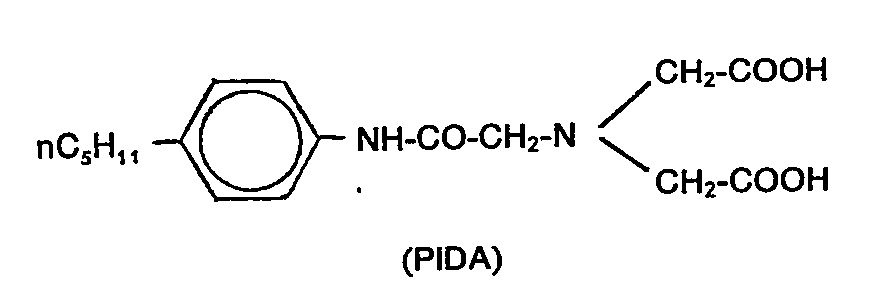
- Gegenstand der Erfindung ist ein Verfahren zur Herstellung eines Leberfunktionsdiagnostikums mit extrem geringer Nierenausscheidung, dadurch gekennzeichnet, daß man (2,3,4,5,6-Pentafluoracetanilido)-iminodiacetat (PFIDA) oder (4-n-Pentylacetanilido)-iminodiacetat (PIDA) in wäßriger Lösung mit einem Zinn(II)-Salz im Molverhältnis zwischen 10 : 1 und 200 : 1 mischt, die Lösung auf einen pH-Wert zwischen 4 und 9, vorzugsweise zwischen 5,5 und 6,5 einstellt und anschließend je nach Verwendungszweck 0,1 - 100 mCi Tc-99m-Pertechnetat in physiologischer Kochsalzlösung zugibt. Die Konzentrationen von PFIDA bzw. PIDA liegen zweckmäßig zwischen 0,1 und 200 mg/ml, vorzugsweise zwischen 10 und 50 mg/ml.
- Die Konzentration an Zinn(II)-Salz liegt zweckmäßig zwischen 0,01 und 5 mg/ml, vorzugsweise zwischen 0,1 und 0,5 mg/ml Lösung.
- Als Zinn(II)-Salz kann SnF2, SnS04, Sn-tartrat, SnO, Sn-oxalat oder ein anderes Zinn(II)-Salz verwendet werden; bevorzugt ist das Chlorid, insbes. SnCl2 2H20.
- Für die Herstellung des Diagnostikums ist es von Vorteil, wenn die (2,3,4,5,6-Pentafluoracetanilido)-iminodiessigsäure unter Zugabe von wäßriger Natronlauge in Wasser gelöst wird. Es wird dabei soviel NaOH zugegeben, wie zum vollständigen Lösen der Verbindung erforderlich ist. Der pH-Wert liegt nach dem Lösen zwischen 7 und 10; er wird dann mit HCl auf ca. 5 eingestellt. Danach wird die entsprechende Menge Sn(II)-Salz (in 0,1 n HCl gelöst) zugegeben und 30 Minuten unter Schutzgasatmosphäre gerührt und der pH auf 6 eingestellt.
- Diese Lösung kann innerhalb von 24 Stunden durch Zugabe von Technetium-99m-Pertechnetat zum gebrauchsfertigen Diagnostikum umgesetzt werden. Sie kann aber auch zur Stabilisierung eingefroren oder gefriergetrocknet werden. Das gefriergetrocknete Präparat ist unter Stickstoff-Schutzgas mindestens 8 Monate stabil.
- Oft wird die nach dem Verfahren gemäß der Erfindung hergestellte Lösung nicht sogleich mit Technetium-99m-Pertechnetat vereinigt. Es ist dann zweckmäßig, die Lösung zu vereinzeln, indem man sie portionsweise in geeignete Gefäße, z.B. gläserne Rollrandflaschen abfüllt, z.B. in Portionen von 1 oder 2 Millilitern. In diesen Gefäßen wird die Lösung eingefroren oder gefriergetrocknet. Man erhält so in einem Gefäß eine Markierungseinheit. Diese enthält 1 - 200 mg, vorzugsweise 10 - 50 mg PFIDA bzw. PIDA, und daneben 0,01 - 5 mg, vorzugsweise 0,1 - 0,5 mg Zinn(II)-Salz. Zum Gebrauch wird die Markierungseinheit mit 0,1 - 100 mCi, vorzugsweise 1 - 10 mCi in zweckmäßig 1 - 10 ml Pertechnetatlösung pro Patient versetzt.
- Im Regelfall erhält ein Patient eine fünftel bis eine ganze markierte Einheit (d.h. fertiges Diagnostikum) intravenös injiziert.
- Gegenstand der Erfindung ist somit auch ein Diagnostikum zur Darstellung des hepato-biliären Systems, dadurch gekennzeichnet, daß es mit Technetium-99m markiertes (2,3,4,5,6-Pentafluoracetanilido)-iminodiacetat bzw. (4-n-Pentylacetanilido)-iminodiacetat in pysiologischer Kochsalzlösung enthält.
- Das neue Diagnostikum zeichnet sich gegenüber den bisher bekannten Verbindungen durch eine wesentlich geringere Anreicherung von Aktivität in den Nieren und eine geringere Ausscheidung in die Harnblase aus. Dieser Vorteil geht aus den im folgenden beschriebenen Tierexperimenten hervor:
- 1. Einem Kaninchen werden 0,5 mCi des jeweiligen markierten Diagnostikums in die Ohrvene injiziert und die Verteilung der Aktivität mit Hilfe einer γ-Kamera, die an eine Datenverarbeitungsanlage angeschlossen ist, in ihrem zeitlichen Verlauf verfolgt, Während bei den bisher bekannten Präparaten immer auch die Nieren mit dargestellt werden, sind sie bei den neuen Diagnostika PFIDA und PIDA praktisch nicht zu lokalisieren.
- 2. Gruppen von jeweils 12 Ratten, denen zuvor zur Bestimmung der Blasenaktivität die abführenden Harnwege abgebunden wurden, werden je 30 µCi des jeweiligen Diagnostikums in die Oberschenkelvene injiziert. Dann werden je 3 Tiere nach 5, 10, 20 und 30 Minuten getötet und die Organverteilung der Radioaktivität bestimmt. In der folgenden Tabelle sind die Ergebnisse zusammengefaßt:

- Vor allem bei der Verbindung PIDA wird kaum eine Aktivitätsausscheidung in die Harnblase beobachtet.
-

- a) 18,31 g (o,1 mol) 2,3,4,5,6-Pentafluoranilin werden in 80 ml Eisessig gelöst. Die Lösung wird auf lo °C gekühlt, mit 12,4 g (o,11 mol) Chlcressigsäurechlorid versetzt und kräftig durchmischt. Dann werden unter starkem Rühren loo ml halb gesättigte wäßrige Natriumacetat-Lösung und loo ml Wasser zugegeben und 3o Minuten gerührt. Das ausgefallene Chloressigsäure-(2,3,4,5,6-Pentafluoranilid) wird abgesaugt und aus Methanol umkristallisiert.

- b) 4,o g (22 mmol) Iminodiessigsäure-Dinatriumsalz, 5,7 g (2o mmol) Na2SO3 10H2O und 5,2 g (2o mmol) Chloressigsäure-(2,3,4,5,6-Pentafluoranilid) werden in 60 ml Wasser und 3o ml Äthanol aufgenommen und 24 Stunden am Rückfluß gekocht. Nach dem Abkühlen wird das Lösungsmittel abgezogen und der Rückstand in ca. 15o ml Wasser gelöst. Diese wäßrige Lösung wird 4 x mit ca. 5o ml Äther gewaschen und anschließend mit HCl langsam auf pH 2 gebracht. Das angefallene Produkt wird abgesaugt, wieder in Wasser gelöst, wobei soviel NaOH zugegeben wird, wie zum vollständigen Lösen der Substanz erforderlich ist. Nach Filtrieren wird (2,3,4,5,6-Pentafluoracetanilido)-iminodiessigsäure durch Zugabe von HC1 bis pH 2 wieder ausgefällt, abgesaugt und getrocknet.


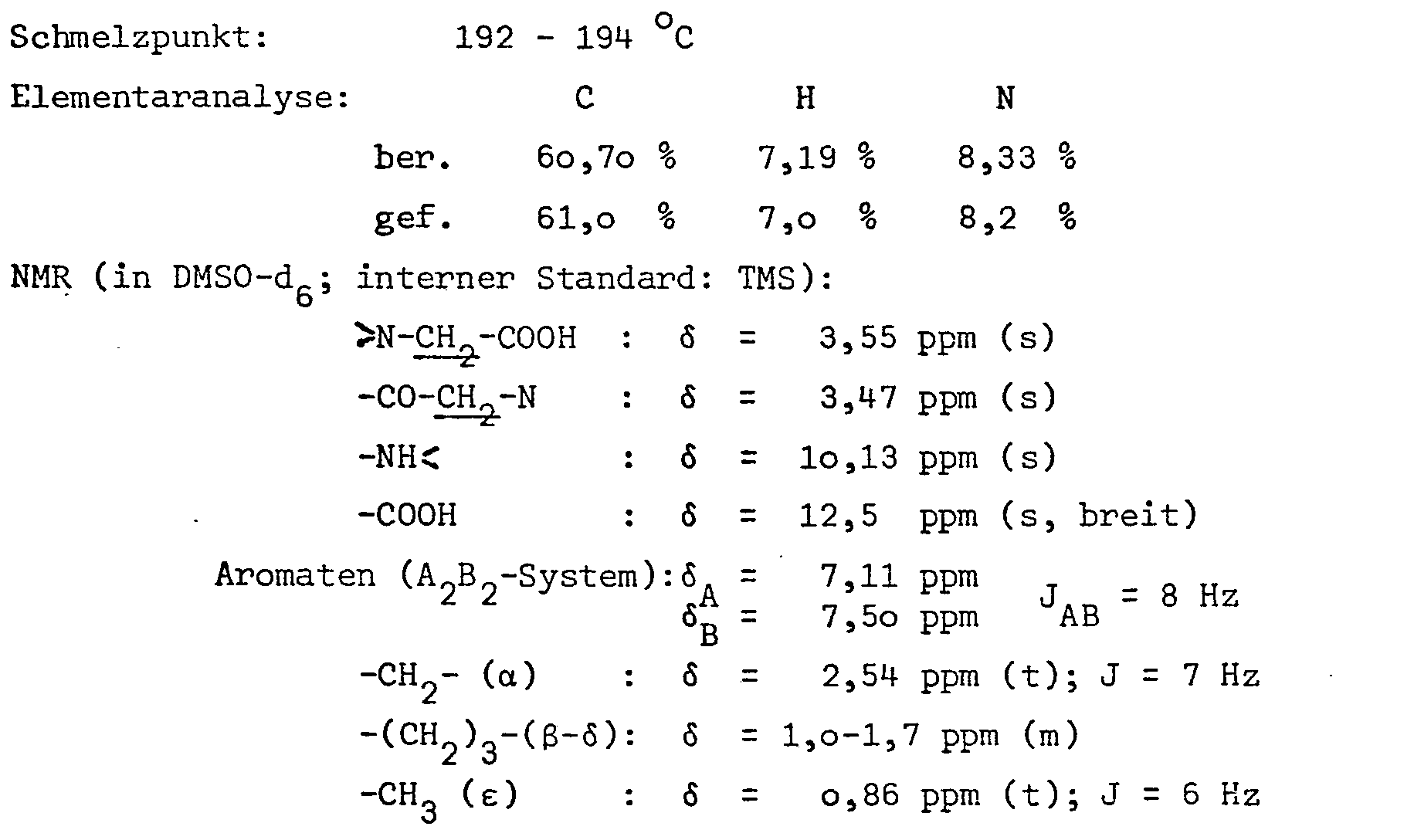
- Die Synthese von (4-n-Pentylacetanilido)-iminodiessigsäure erfolgt analog Beispiel 1 aus 4-n-Pentylanilin über Chloressigsäure-(4-n-Pentylanilid). Man erhält folgende physikalischen Parameter:
- 7 g (2,3,4,5,6-Pentafluoracetanilido)-iminodiessigsäure werden in loo ml 1 N Natronlauge gelöst und mit 7o mg SnCl2 2H20 (gelöst in 7 ml o,1 N Salzsäure) versetzt. Nach 5 Minuten Rühren wird der pH-Wert mit Salzsäure auf 6 eingestellt, auf 233 ml aufgefüllt, in 1 ml-Portionen in Rollrandflaschen abgefüllt und mit flüssigem Stickstoff eingefroren. Anschließend wird das Präparat gefriergetrocknet, die Flaschen werden mit Stickstoff gefüllt und verschlossen.
- Nach einer Lagerzeit von 6o Tagen werden in die verschlossenen Flaschen o,3 mCi Tc-99m-Pertechnetat in lo ml physiologischer Kochsalzlösung injiziert. Nach ca. 3o Minuten Reaktionszeit werden je 0,5 ml des so gewonnenen Diagnostikums Ratten intravenös appliziert (typische Versuchsergebnisse können der Tabelle auf S. 6 entnommen werden).
- 3 g (4-n-Pentylacetanilido)-iminodiessigsäure werden unter Zusatz von soviel 1 n NaOH, wie zum vollständigen Lösen der Substanz erforderlich ist, in ca. 60 ml Wasser gelöst und mit 2o mg SnF2 (gelöst in 5 ml o,1 N Salzsäure) versetzt. Nach ca. 16 Minuten Rühren wird auf pH 6 eingestellt und auf loo ml aufgefüllt. Die Lösung wird in 1 ml-Portionen in Rollrandflaschen abgefüllt und mit flüssigem Stickstoff eingefroren. Das Präparat wird anschließend gefriergetrocknet, die Flaschen werden mit Stickstoff gefüllt und verschlossen.
- Nach einer Lagerzeit zwischen 1 Tag und 15 Monaten wird die Markierungseinheit entsprechend Beispiel 3 injektionsfertig gemacht und Ratten appliziert (typische Versuchsergebnisse können der Tabelle auf S. 6 entnommen werden).
Claims (15)
Priority Applications (1)
| Application Number | Priority Date | Filing Date | Title |
|---|---|---|---|
| AT80102623T ATE3752T1 (de) | 1979-05-18 | 1980-05-12 | Technetium-99m-markierte acetanilidoiminodiacetate zur leberfunktionsdiagnostik und verfahren zu ihrer herstellung. |
Applications Claiming Priority (2)
| Application Number | Priority Date | Filing Date | Title |
|---|---|---|---|
| DE2920174 | 1979-05-18 | ||
| DE19792920174 DE2920174A1 (de) | 1979-05-18 | 1979-05-18 | Technetium-99m-markierte acetanilidoiminodiacetate zur leberfunktionsdiagnostik |
Publications (3)
| Publication Number | Publication Date |
|---|---|
| EP0019790A2 true EP0019790A2 (de) | 1980-12-10 |
| EP0019790A3 EP0019790A3 (en) | 1981-01-14 |
| EP0019790B1 EP0019790B1 (de) | 1983-06-15 |
Family
ID=6071129
Family Applications (1)
| Application Number | Title | Priority Date | Filing Date |
|---|---|---|---|
| EP80102623A Expired EP0019790B1 (de) | 1979-05-18 | 1980-05-12 | Technetium-99m-markierte Acetanilidoiminodiacetate zur Leberfunktionsdiagnostik und Verfahren zu ihrer Herstellung |
Country Status (5)
| Country | Link |
|---|---|
| US (1) | US4350674A (de) |
| EP (1) | EP0019790B1 (de) |
| JP (1) | JPS5636438A (de) |
| AT (1) | ATE3752T1 (de) |
| DE (2) | DE2920174A1 (de) |
Cited By (2)
| Publication number | Priority date | Publication date | Assignee | Title |
|---|---|---|---|---|
| FR2497197A1 (fr) * | 1980-12-29 | 1982-07-02 | Squibb & Sons Inc | Acides iminodiacetiques n-substitues, utilisables pour la visualisation externe du systeme hepatobiliaire |
| WO2012013247A1 (de) | 2010-07-30 | 2012-02-02 | Pulsion Medical Systems Ag | Messverfahren zur bestimmung einer organfunktion |
Families Citing this family (3)
| Publication number | Priority date | Publication date | Assignee | Title |
|---|---|---|---|---|
| US4454107A (en) * | 1982-08-30 | 1984-06-12 | Merck & Co., Inc. | Tc99m-Phenida, radioscintigraphic agent for diagnosis of hepatoniliary disease |
| US4574079A (en) * | 1983-05-27 | 1986-03-04 | Gavras Haralambos P | Radiolabeled angiotensin converting enzyme inhibitors for radiolabeling mammalian organ sites |
| US5342925A (en) * | 1991-01-30 | 1994-08-30 | The Dow Chemical Company | Radioactive compositions for soft tissue tumors |
Family Cites Families (6)
| Publication number | Priority date | Publication date | Assignee | Title |
|---|---|---|---|---|
| US3740418A (en) * | 1970-07-01 | 1973-06-19 | Squibb & Sons Inc | Radioactive scanning preparation |
| FR2223361B1 (de) * | 1973-03-27 | 1977-04-29 | Philagro Sa | |
| US4017596A (en) * | 1975-03-03 | 1977-04-12 | Research Corporation | Radiopharmaceutical chelates and method of external imaging |
| CA1070695A (en) * | 1975-09-02 | 1980-01-29 | Michael D. Loberg | Iminodiacetic acid pharmaceutical |
| US4058557A (en) * | 1976-03-30 | 1977-11-15 | William H. Rorer, Inc. | Amidinoureas |
| CH607920A5 (de) * | 1976-05-31 | 1978-12-15 | Solco Basel Ag |
-
1979
- 1979-05-18 DE DE19792920174 patent/DE2920174A1/de not_active Withdrawn
-
1980
- 1980-05-12 DE DE8080102623T patent/DE3063755D1/de not_active Expired
- 1980-05-12 AT AT80102623T patent/ATE3752T1/de not_active IP Right Cessation
- 1980-05-12 EP EP80102623A patent/EP0019790B1/de not_active Expired
- 1980-05-16 US US06/150,573 patent/US4350674A/en not_active Expired - Lifetime
- 1980-05-17 JP JP6469880A patent/JPS5636438A/ja active Pending
Cited By (3)
| Publication number | Priority date | Publication date | Assignee | Title |
|---|---|---|---|---|
| FR2497197A1 (fr) * | 1980-12-29 | 1982-07-02 | Squibb & Sons Inc | Acides iminodiacetiques n-substitues, utilisables pour la visualisation externe du systeme hepatobiliaire |
| WO2012013247A1 (de) | 2010-07-30 | 2012-02-02 | Pulsion Medical Systems Ag | Messverfahren zur bestimmung einer organfunktion |
| US9671340B2 (en) | 2010-07-30 | 2017-06-06 | Smartdyelivery Gmbh | Measurement method for determining an organ function |
Also Published As
| Publication number | Publication date |
|---|---|
| EP0019790B1 (de) | 1983-06-15 |
| DE2920174A1 (de) | 1980-11-20 |
| JPS5636438A (en) | 1981-04-09 |
| EP0019790A3 (en) | 1981-01-14 |
| DE3063755D1 (en) | 1983-07-21 |
| ATE3752T1 (de) | 1983-06-15 |
| US4350674A (en) | 1982-09-21 |
Similar Documents
| Publication | Publication Date | Title |
|---|---|---|
| DE69320481T2 (de) | Tetraazamakrocyclische metallkomplexe | |
| EP0108253B1 (de) | Technetium-99m-Tetraphosphonate zur szintigraphischen Darstellung RES-haltiger Organe und der Lymphgefässe und Verfahren zu deren Herstellung | |
| DE69109235T2 (de) | Verfahren zur Herstellung einer radiopharmazeutischer Zubereitung. | |
| DE2723605C2 (de) | Radioaktive Technetiumkomplexe, Verfahren zu deren Herstellung und deren Verwendung zur szintigraphischen Darstellung des hepatobilären Systems | |
| DE2538388A1 (de) | Verfahren zur herstellung eines stabilen, nicht-radioaktiven traegermaterials und seine verwendung zur herstellung von tc-99m-markierten diagnosemitteln | |
| DE69914748T2 (de) | Radiojodierte phenole für brachytherapie | |
| DE2737932A1 (de) | Mittel zur herstellung einer radiodiagnostischen loesung | |
| DE69116637T2 (de) | Mittel zur magnetischen Resonanzabbildung | |
| DE2423167C2 (de) | Radiodiagnostikum, Verfahren zu dessen Herstellung und dessen Verwendung als intravenöse Injektionslösung | |
| EP0012967B1 (de) | (2,4,5-Trimethylacetanilido)-imino-diacetat, Technetium-99m-markiertes (2,4,5-Trimethylacetanilido)-iminodiacetat zur Leberfunktionsdiagnostik und Verfahren zu deren Herstellung | |
| DE2947500A1 (de) | Radiojodierte (omega) -phenylfettsaeuren, ihre herstellung und praeparate zur szintigraphischen untersuchung desherzmuskels und der leber | |
| DE69002627T2 (de) | 99 m Tc (III) herzmuskelbildende Mittel, wirksam beim Menschen. | |
| EP0019790B1 (de) | Technetium-99m-markierte Acetanilidoiminodiacetate zur Leberfunktionsdiagnostik und Verfahren zu ihrer Herstellung | |
| DE60014375T2 (de) | Uebergangsmetallkomplexe der vii-nebengruppe mit multidentaten aminopolycarboxylat-liganden und ein kit zu deren herstellung | |
| DE2551480C3 (de) | Technetium-99m-markiertes Nierendiagnostikum und Verfahren zu seiner Herstellung | |
| EP0141100A2 (de) | N-(4-Aminobenzoyl)-aminodicarbonsäuren zur Stabilisierung von Technetium-99m-Präparaten, stabilisierte Injektionspräparate und Verfahren zu ihrer Herstellung | |
| DE69428554T2 (de) | Mittel zum Vermeiden des Verklebens von Thallium 201 zu einer Container | |
| DE2419310C3 (de) | Verwendung von Tc-99m-Komplexen | |
| Budny | Metabolism and blood pressure effects of disodium nitrilotriacetate (Na2NTA) in dogs | |
| DE3151686C2 (de) | ||
| EP0003041B1 (de) | Technetium-99m-markiertes Diagnostikum zur Darstellung des retikuloendothelialen Systems (RES) und Verfahren zu seiner Herstellung | |
| DE2638657A1 (de) | Radioaktiv markiertes orgotein | |
| DE3216026A1 (de) | Technetium(99m)-markiertes isonicotinsaeurehydrazid, verfahren zu dessen herstellung und ein pharmazeutisches mittel, das diese verbindung enthaelt | |
| DE69824147T2 (de) | Technetium-99m markierte Diäthylentriaminpentaessigsäure-Diester und Verfahren zu deren Herstellung | |
| Molter et al. | 99m technetium-labelled acetanilidoimino-diacetate to diagnose the functioning of the liver |
Legal Events
| Date | Code | Title | Description |
|---|---|---|---|
| PUAI | Public reference made under article 153(3) epc to a published international application that has entered the european phase |
Free format text: ORIGINAL CODE: 0009012 |
|
| PUAL | Search report despatched |
Free format text: ORIGINAL CODE: 0009013 |
|
| AK | Designated contracting states |
Designated state(s): AT BE CH DE FR GB IT LU NL SE |
|
| AK | Designated contracting states |
Designated state(s): AT BE CH DE FR GB IT LU NL SE |
|
| 17P | Request for examination filed |
Effective date: 19810227 |
|
| ITF | It: translation for a ep patent filed | ||
| GRAA | (expected) grant |
Free format text: ORIGINAL CODE: 0009210 |
|
| AK | Designated contracting states |
Designated state(s): AT BE CH DE FR GB IT LI LU NL SE |
|
| REF | Corresponds to: |
Ref document number: 3752 Country of ref document: AT Date of ref document: 19830615 Kind code of ref document: T |
|
| REF | Corresponds to: |
Ref document number: 3063755 Country of ref document: DE Date of ref document: 19830721 |
|
| ET | Fr: translation filed | ||
| PLBE | No opposition filed within time limit |
Free format text: ORIGINAL CODE: 0009261 |
|
| STAA | Information on the status of an ep patent application or granted ep patent |
Free format text: STATUS: NO OPPOSITION FILED WITHIN TIME LIMIT |
|
| PG25 | Lapsed in a contracting state [announced via postgrant information from national office to epo] |
Ref country code: AT Effective date: 19840512 |
|
| PG25 | Lapsed in a contracting state [announced via postgrant information from national office to epo] |
Ref country code: SE Effective date: 19840513 |
|
| PG25 | Lapsed in a contracting state [announced via postgrant information from national office to epo] |
Ref country code: LU Free format text: LAPSE BECAUSE OF NON-PAYMENT OF DUE FEES Effective date: 19840531 Ref country code: LI Effective date: 19840531 Ref country code: CH Effective date: 19840531 Ref country code: BE Effective date: 19840531 |
|
| PGFP | Annual fee paid to national office [announced via postgrant information from national office to epo] |
Ref country code: DE Payment date: 19840620 Year of fee payment: 5 |
|
| 26N | No opposition filed | ||
| BERE | Be: lapsed |
Owner name: HOECHST A.G. Effective date: 19840512 |
|
| PG25 | Lapsed in a contracting state [announced via postgrant information from national office to epo] |
Ref country code: NL Effective date: 19841201 |
|
| GBPC | Gb: european patent ceased through non-payment of renewal fee | ||
| NLV4 | Nl: lapsed or anulled due to non-payment of the annual fee | ||
| PG25 | Lapsed in a contracting state [announced via postgrant information from national office to epo] |
Ref country code: FR Free format text: LAPSE BECAUSE OF NON-PAYMENT OF DUE FEES Effective date: 19850131 |
|
| REG | Reference to a national code |
Ref country code: CH Ref legal event code: PL |
|
| REG | Reference to a national code |
Ref country code: FR Ref legal event code: ST |
|
| PG25 | Lapsed in a contracting state [announced via postgrant information from national office to epo] |
Ref country code: DE Effective date: 19880202 |
|
| PG25 | Lapsed in a contracting state [announced via postgrant information from national office to epo] |
Ref country code: GB Effective date: 19881118 |
|
| EUG | Se: european patent has lapsed |
Ref document number: 80102623.8 Effective date: 19850417 |