EP0020011A2 - Emballage d'oeufs durs pelés et appareil à cet effet - Google Patents
Emballage d'oeufs durs pelés et appareil à cet effet Download PDFInfo
- Publication number
- EP0020011A2 EP0020011A2 EP80301285A EP80301285A EP0020011A2 EP 0020011 A2 EP0020011 A2 EP 0020011A2 EP 80301285 A EP80301285 A EP 80301285A EP 80301285 A EP80301285 A EP 80301285A EP 0020011 A2 EP0020011 A2 EP 0020011A2
- Authority
- EP
- European Patent Office
- Prior art keywords
- eggs
- hardboiled
- shelled
- drum
- shelling
- Prior art date
- Legal status (The legal status is an assumption and is not a legal conclusion. Google has not performed a legal analysis and makes no representation as to the accuracy of the status listed.)
- Withdrawn
Links
Images

Classifications
-
- A—HUMAN NECESSITIES
- A23—FOODS OR FOODSTUFFS; TREATMENT THEREOF, NOT COVERED BY OTHER CLASSES
- A23B—PRESERVATION OF FOODS, FOODSTUFFS OR NON-ALCOHOLIC BEVERAGES; CHEMICAL RIPENING OF FRUIT OR VEGETABLES
- A23B5/00—Preservation of eggs or egg products
- A23B5/08—Preserving with chemicals
- A23B5/12—Preserving with chemicals in the form of liquids or solids
- A23B5/14—Organic compounds; Microorganisms; Enzymes
-
- A—HUMAN NECESSITIES
- A01—AGRICULTURE; FORESTRY; ANIMAL HUSBANDRY; HUNTING; TRAPPING; FISHING
- A01K—ANIMAL HUSBANDRY; AVICULTURE; APICULTURE; PISCICULTURE; FISHING; REARING OR BREEDING ANIMALS, NOT OTHERWISE PROVIDED FOR; NEW BREEDS OF ANIMALS
- A01K43/00—Testing, sorting or cleaning eggs ; Conveying devices ; Pick-up devices
-
- A—HUMAN NECESSITIES
- A23—FOODS OR FOODSTUFFS; TREATMENT THEREOF, NOT COVERED BY OTHER CLASSES
- A23B—PRESERVATION OF FOODS, FOODSTUFFS OR NON-ALCOHOLIC BEVERAGES; CHEMICAL RIPENING OF FRUIT OR VEGETABLES
- A23B5/00—Preservation of eggs or egg products
- A23B5/005—Preserving by heating
- A23B5/0055—Preserving by heating without the shell
- A23B5/0057—Preserving by heating without the shell with packages
Definitions
- the present invention relates to packaging of shelled hard boiled eggs.
- the present invention aims to provide a process for packaging shelled hardboiled eggs whereby the packaged hardboiled eggs remain in an edible condition for several weeks without impairing the taste of the eggs and inhibits the formation of a dark ring surrounding the yolk.
- the present invention provides a process for packaging shelled hardboiled eggs including the steps of cooking fresh eggs to produce hardboiled eggs, shelling the hardboiled eggs to produce shelled hardboiled eggs, treating the eggs so as to lower the pH at the interface between the white and yolk of each egg so as to inhibit formation of a dark colouration around the yolk, and enclosing the eggs in a hermetically sealable container which is subsequently sealed and sterilised by a heat treatment.
- fresh eggs are preheated prior to being cooked by boiling in water.
- Preheating of the eggs is performed in order to reduce thermal shock when the eggs are immersed in boiling water and thereby reducing the likelihood of shells cracking. This is important as it is desirable for the eggs to reach maximum cooking temperature as quickly as possible without cracking of the shells.
- the preheating step is performed so as to raise the temperature of the eggs to the maximum temperature possible without adversely affecting the eggs such as causing coagulation of the egg white or adversely affecting processing of the eggs.
- the length of time for which eggs are exposed to the preheating step is chosen so as to be sufficient for the eggs to reach a constant temperature.
- the eggs are preferably received in pocketed trays which permit eggs to be closely spaced to one another whilst permitting water to circulate therebetween and also permit trays to be stacked one above the other.
- closely spaced rows of stacked trays are supported by a carrying frame which enables the stacked eggs to be transported from a preheating water tank to a cooking water tank wherein water is maintained in a boiling condition. Close packing of eggs in the boiling tank is desirable since it helps to reduce thermal shock to the eggs on initial immersion in the tank.
- the eggs remain in the boiling tank for a sufficient time for cooking to take place and they are then subsequently transferred to a cooling tank wherein they are quickly cooled by immersion in cold water in order to achieve a temperature of about 10°C at the centre of the yolk, preferably within 20 minutes to reduce the intensity or likelihood of the formation of a dark ring at the yolk/white interface.
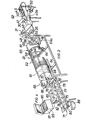
- the cooled eggs are then transferred to the de-shelling apparatus illustrated in Figure 3.
- the eggs are initially deposited in a storage and feed means 30 which operates to store a quantity of cooked eggs and feed them to a feed conveyor 31 which then transfers the fed eggs to a de-shelling device 33.
- the storage and feed means 30 comprises a tank 40 filled with water.
- the tank includes a partition wall 41 and three water jets 42, 43 and 44 which are arranged to cause a flow of water in the direction of arrows A about the partition wall 41.
- downwardly directed jets 45 are provided which cause jets of water to hit the bottom of the tank and thereby cause uplifting currents to be created.
- Eggs contained in tank 40 are continuously urged toward a collection area 46 whereat they amass.
- Blades (not shown) of a conveyor 31 pass through the collection area 46 and each carry an egg from collection area 46 to a chute 48 which guides the eggs into the de-shelling device 33.
- the rate of feed of conveyor 31 may be varied to suit the rate of throughput through the de-shelling device 33 without affecting rate of pick-up of eggs from the collection area 46.
- Conveniently conveyor 31 is driven by a variable motor 35 which is controllable for varying the rate of feed of the conveyor.
- a pump 50 is provided which draws in water from the collection area 46 and expels the drawn-in water through jets 42, 43, 44 and 45.
- jet 44 is arranged to direct a jet of water directly toward the collection area 46 so as to ensure eggs are urged into contact with the conveyor.
- the partition wall 41 encloses a central area 52 which is filled with water and may be used to store additional eggs. Conveniently water is supplied to the central area 52 by maintaining the water level within tank 40 above the partition wall 41.
- a grill 40a is provided in order to enable circulation of water to occur completely around the - partition wall 41.
- the de-shelling device 33 includes a rotatable drum 60 having solid walled end portions 61 separated by a plurality of circumferentially spaced rods 62 which extend therebetween.
- the spacing between adjacent rods 62 is sufficient to prevent eggs to fall therebetween and is preferably chosen to be as large as possible without permitting eggs to fall therebetween.
- the drum 60 is rotatably supported on two pairs of rollers 64 which are mounted on a support frame 64a.
- a drive shaft 65 extends along the length of the drum 60 and is supported in journals 66. Radial arms 68 extend between each end portion 61 and the shaft 65 in order to connect shaft 65 to the drum.
- the shaft 65 is driven by a motor 69 in order to rotate drum 60.
- the rotational axis of drum 60 is inclined downwardly from the end to which eggs are delivered by conveyor 31 so that during rotation of drum 60 eggs are induced to move slowly along the drum to be discharged from its lowermost end.
- Eggs emerging from the de-shelling device 33 are fed onto a chute 70 which delivers eggs into a collection trough 71.
- the trough 71 is partitioned by walls 74, 75 to define three channels 76, 77 and 78. Water is circulated along channels 76 and 77 in the direction of arrows B which has the affect of moving the eggs deposited from the de-shelling device 33 along channels 76 and 77 in the same direction as the water flow.
- the partition wall 75 is provided with a recess 79 which defines a wier permitting an overflow of water to run along channel 78 to exit through an opening 80.
- the eggs being deposited into channel 77 by the de-shelling device 33 are either partially or completely shelled.
- an operative picks up eggs from channel 77, removes any remaining shell on the egg and deposits the egg onto chute 82 which directs the egg into a tank 85.
- the removed shell is deposited into channel 78 and is carried through opening 80 to be deposited into a basket 89 by the stream of water running along channel 78.
- the de-shelled eggs contained in tank 85 are then immersed in an acidic dipping solution which serves the purpose of lowering the pH value at the interface between the egg yolk and egg white. It is appreciated that lowering of pH at the yolk/white interface depends upon the rate of diffusion of the acidic solution through the egg white. Accordingly, the strength of acidic solution used and length of immersion is chosen so that the pH value at the yolk/white interface stabilisers at an acidic value preferably between 4.5 to 7, more preferably between 6.5 to 6.95.
- the acidic dipping solution into which the shelled eggs are immersed is a citric acid solution which contains between 0.5% to 10% by weight citric acid.
- the concentration does not exceed about 5% by weight of citric acid, more preferably the concentration is about 3-4% by weight citric acid.
- the length of time for which the eggs are immersed in the dipping solution varies with the concentration of the solution. Typically, the length of immersion varies from 5 to 30 minutes and is at least about 15 minutes with a concentration of 3-4% by weight citric acid. However these times can be varied depending on the intensity of the dark ring formation which may be determined by cutting open sample cooked eggs.
- the eggs After immersion in the dipping solution, the eggs are packaged in a sealable container.
- the eggs whilst still moist with the dipping solution are placed between two sheets of plastics material which are heat sealed to one another in an evacuated chamber so as to define a container enclosing the eggs.
- the plastics material may either be in the form of bags into which the eggs are placed prior to sealing or it may be in sheet form of which is wrapped about the eggs.
- the plastics material is impervious to air and may withstand heat sterilisation temperatures.
- Suitable plastics material may be a polythene/nylon laminate or polypropylene.
- the plastics material is flexible enough not to distort the shape of the eggs when ⁇ forming said container.
- the eggs are preferably arranged within the container so that they are spaced from one another. This is conveniently achieved by using a former 90 as shown in Figure 4 which includes a series of depressions 9.1. A layer of plastics material is laid onto the former 90 and individual eggs are placed on the plastics material above each depression. A further layer of plastics material is laid on top of the eggs and the former is heated in an evacuated chamber 9.5 to effect heat sealing of the layers of plastics material.
- the container After production of the container enclosing the eggs, the container is subjected to heat treatment which in combination with the citric acid present kills bacteria within the container to provide a sterilised environment. Additionally, the presence of the citric acid solution within the sterile container ensures that stabilisation of the pH at the yolk/white interface occurs and also helps reduce growth of new bacteria.
- the heat treatment comprises immersioning each container in boiling water for a sufficient length of time to achieve sterilisation. Immersion for 1 to 3 minutes has been found sufficient in practice.
- eggs packaged in accordance with the present invention have a shelf life of at least 21 days, do not have a dark ring formation about the yolk, do not have an impaired taste and have a white consistency which is similar to that of a freshly cooked hardboiled egg.
- an alternative way of cooking of the eggs may be achieved by boiling them in an acidic solution.
- fresh eggs may be cooked by boiling in a weak acidic boiling solution which partially dissolves the shell during cooking and facilatates removal of the shell.
- the acidic solution preferably contains between 0.5 to 2.5% by weight citric/boric acid.
- a strong acid such as sulphuric acid which removes calcium ions from the solution as a calcium sulphate precipitate.
- concentration of sulphuric acid present is 0.005 - 0.1% by weight, more preferably about 0.025% by weight.
- weak acids other than citric acid may be used in the boiling solution.
- glycerine is added at intervals at a rate of .25 to 1% to aid shelling.
Landscapes
- Life Sciences & Earth Sciences (AREA)
- Engineering & Computer Science (AREA)
- Chemical & Material Sciences (AREA)
- Polymers & Plastics (AREA)
- Zoology (AREA)
- Food Science & Technology (AREA)
- Wood Science & Technology (AREA)
- Environmental Sciences (AREA)
- Microbiology (AREA)
- Chemical Kinetics & Catalysis (AREA)
- General Chemical & Material Sciences (AREA)
- Animal Husbandry (AREA)
- Biodiversity & Conservation Biology (AREA)
- Meat, Egg Or Seafood Products (AREA)
Applications Claiming Priority (2)
| Application Number | Priority Date | Filing Date | Title |
|---|---|---|---|
| GB7914353 | 1979-04-25 | ||
| GB7914353 | 1979-04-25 |
Publications (2)
| Publication Number | Publication Date |
|---|---|
| EP0020011A2 true EP0020011A2 (fr) | 1980-12-10 |
| EP0020011A3 EP0020011A3 (fr) | 1981-05-13 |
Family
ID=10504760
Family Applications (1)
| Application Number | Title | Priority Date | Filing Date |
|---|---|---|---|
| EP80301285A Withdrawn EP0020011A3 (fr) | 1979-04-25 | 1980-04-22 | Emballage d'oeufs durs pelés et appareil à cet effet |
Country Status (1)
| Country | Link |
|---|---|
| EP (1) | EP0020011A3 (fr) |
Cited By (5)
| Publication number | Priority date | Publication date | Assignee | Title |
|---|---|---|---|---|
| FR2565787A1 (fr) * | 1984-06-13 | 1985-12-20 | Rebours Ets | Procede de conservation d'oeufs cuits durs et ecales |
| ES2124181A1 (es) * | 1996-12-12 | 1999-01-16 | Bastardas Jose Martinez | Procedimiento para envasar y conservar huevos duros pelados. |
| CN110269204A (zh) * | 2019-07-19 | 2019-09-24 | 福建鸭嫂食品有限公司 | 皮蛋裹糠装置 |
| JP2020092638A (ja) * | 2018-12-12 | 2020-06-18 | 株式会社理想実業 | ゆで卵用卵殻罅裂生成装置 |
| US20230148636A1 (en) * | 2020-04-27 | 2023-05-18 | Societe Des Produits Nestle S.A. | Food composition comprising heat treated algae |
Family Cites Families (8)
| Publication number | Priority date | Publication date | Assignee | Title |
|---|---|---|---|---|
| US2575608A (en) * | 1947-07-17 | 1951-11-20 | Sr Russell A Williams | Machine for hard boiling and shelling of eggs |
| US2593223A (en) * | 1948-11-03 | 1952-04-15 | American Can Co | Canning of hard boiled eggs |
| US2561137A (en) * | 1950-08-31 | 1951-07-17 | Ross Charles | Method of preserving eggs |
| US3216828A (en) * | 1963-02-01 | 1965-11-09 | Swift & Co | Removing shells from cooked eggs |
| US3552458A (en) * | 1968-03-25 | 1971-01-05 | Agway Inc | Apparatus for de-shelling hard-cooked eggs |
| US3843813A (en) * | 1970-07-15 | 1974-10-22 | Nutrionics Machine Corp | Method and apparatus for treating eggs |
| US3764714A (en) * | 1970-07-15 | 1973-10-09 | Nutronics Machine Corp | Method of peeling eggs |
| DE7610506U1 (de) * | 1976-04-05 | 1976-10-21 | Poelkemann, Alfred, 4931 Pivitsheide | Vorrichtung fuer das entschalen von hartgekochten eiern |
-
1980
- 1980-04-22 EP EP80301285A patent/EP0020011A3/fr not_active Withdrawn
Cited By (7)
| Publication number | Priority date | Publication date | Assignee | Title |
|---|---|---|---|---|
| FR2565787A1 (fr) * | 1984-06-13 | 1985-12-20 | Rebours Ets | Procede de conservation d'oeufs cuits durs et ecales |
| EP0169158A3 (en) * | 1984-06-13 | 1986-06-04 | Rebours Ets Sa | Preservation process for peeled hard-boiled poultry eggs |
| ES2124181A1 (es) * | 1996-12-12 | 1999-01-16 | Bastardas Jose Martinez | Procedimiento para envasar y conservar huevos duros pelados. |
| JP2020092638A (ja) * | 2018-12-12 | 2020-06-18 | 株式会社理想実業 | ゆで卵用卵殻罅裂生成装置 |
| CN110269204A (zh) * | 2019-07-19 | 2019-09-24 | 福建鸭嫂食品有限公司 | 皮蛋裹糠装置 |
| CN110269204B (zh) * | 2019-07-19 | 2024-02-20 | 河北白洋淀生态食品开发有限公司 | 皮蛋裹糠装置 |
| US20230148636A1 (en) * | 2020-04-27 | 2023-05-18 | Societe Des Produits Nestle S.A. | Food composition comprising heat treated algae |
Also Published As
| Publication number | Publication date |
|---|---|
| EP0020011A3 (fr) | 1981-05-13 |
Similar Documents
| Publication | Publication Date | Title |
|---|---|---|
| US3843810A (en) | Process of air evacuation of foods under ultra-low pressure | |
| EP0242183B2 (fr) | Procédé de traitement et d'empaquetage de moules ou d'autres fruits de mer bivalves | |
| US5009150A (en) | Device for the heating or cooling of food-stuffs | |
| WO1987005782A2 (fr) | Procede de conservation de produits alimentaires | |
| US20180064124A1 (en) | Apparatus and method for extending shelf life of a food product comprising water and soft tissue | |
| US3261694A (en) | Method for dehydration of moisture containing materials of cellular structure | |
| EP0020011A2 (fr) | Emballage d'oeufs durs pelés et appareil à cet effet | |
| US3434410A (en) | Bottom feed quench dryer apparatus | |
| CN112425742A (zh) | 一种蔬菜料包、蔬菜料包的制作方法及加工设备 | |
| KR20160118724A (ko) | 냉동 군고구마의 제조방법 및 그 냉동 군고구마 말랭이 제조방법 | |
| JPWO2002074108A1 (ja) | 加熱加工用皮付き生栗、剥き栗の製法、栗の皮遊離方法、及び栗皮切り込み装置 | |
| EP0847236B8 (fr) | Procede de traitement des poissons depuis leur prise en compte jusqu'a leur evisceration | |
| US2479171A (en) | Preparing foods for quick freezing | |
| US2622034A (en) | Methods of processing raw shrimp meat for market | |
| GB2307394A (en) | Egg processing | |
| US4793072A (en) | Dehydration method and dehydration system | |
| CN1049559C (zh) | 五香熟咸蛋的制作方法 | |
| JP2022154613A (ja) | 凍結乾燥エビの製造方法 | |
| KR101684926B1 (ko) | 선지묵의 가공방법 및 이 가공방법에 의해 가공된 선지묵 | |
| US4867996A (en) | Method of preparing green beans | |
| US1677364A (en) | Method of treating fish | |
| JPH04132527A (ja) | 連続真空フライヤー装置 | |
| US20200315193A1 (en) | Method and system for packaging live clams in a container | |
| JPS60164470A (ja) | 密封包装された食品の冷却装置 | |
| JPH0731435A (ja) | 通電加熱食品の製造方法およびその装置 |
Legal Events
| Date | Code | Title | Description |
|---|---|---|---|
| PUAI | Public reference made under article 153(3) epc to a published international application that has entered the european phase |
Free format text: ORIGINAL CODE: 0009012 |
|
| AK | Designated contracting states |
Designated state(s): DE FR GB IT NL |
|
| PUAL | Search report despatched |
Free format text: ORIGINAL CODE: 0009013 |
|
| AK | Designated contracting states |
Designated state(s): DE FR GB IT NL |
|
| STAA | Information on the status of an ep patent application or granted ep patent |
Free format text: STATUS: THE APPLICATION IS DEEMED TO BE WITHDRAWN |
|
| 18D | Application deemed to be withdrawn |
Effective date: 19820415 |
|
| RIN1 | Information on inventor provided before grant (corrected) |
Inventor name: ADAMS, ROGER ERNEST |