EP0021068B1 - Funknetz mit Zellenstruktur - Google Patents
Funknetz mit Zellenstruktur Download PDFInfo
- Publication number
- EP0021068B1 EP0021068B1 EP80102925A EP80102925A EP0021068B1 EP 0021068 B1 EP0021068 B1 EP 0021068B1 EP 80102925 A EP80102925 A EP 80102925A EP 80102925 A EP80102925 A EP 80102925A EP 0021068 B1 EP0021068 B1 EP 0021068B1
- Authority
- EP
- European Patent Office
- Prior art keywords
- cells
- network
- small
- small cells
- cell
- Prior art date
- Legal status (The legal status is an assumption and is not a legal conclusion. Google has not performed a legal analysis and makes no representation as to the accuracy of the status listed.)
- Expired
Links
- 210000003850 cellular structure Anatomy 0.000 title 1
- 230000005855 radiation Effects 0.000 claims description 6
- 238000010586 diagram Methods 0.000 claims description 2
- 241001656823 Ornithostaphylos Species 0.000 claims 1
- 230000001413 cellular effect Effects 0.000 abstract description 2
- 230000000694 effects Effects 0.000 description 2
- 230000005540 biological transmission Effects 0.000 description 1
- 230000015572 biosynthetic process Effects 0.000 description 1
- 230000007423 decrease Effects 0.000 description 1
- 230000001771 impaired effect Effects 0.000 description 1
- 230000002093 peripheral effect Effects 0.000 description 1
- 238000006467 substitution reaction Methods 0.000 description 1
Images


Classifications
-
- H—ELECTRICITY
- H04—ELECTRIC COMMUNICATION TECHNIQUE
- H04W—WIRELESS COMMUNICATION NETWORKS
- H04W16/00—Network planning, e.g. coverage or traffic planning tools; Network deployment, e.g. resource partitioning or cells structures
- H04W16/02—Resource partitioning among network components, e.g. reuse partitioning
- H04W16/12—Fixed resource partitioning
-
- H—ELECTRICITY
- H04—ELECTRIC COMMUNICATION TECHNIQUE
- H04W—WIRELESS COMMUNICATION NETWORKS
- H04W16/00—Network planning, e.g. coverage or traffic planning tools; Network deployment, e.g. resource partitioning or cells structures
- H04W16/02—Resource partitioning among network components, e.g. reuse partitioning
-
- H—ELECTRICITY
- H04—ELECTRIC COMMUNICATION TECHNIQUE
- H04W—WIRELESS COMMUNICATION NETWORKS
- H04W16/00—Network planning, e.g. coverage or traffic planning tools; Network deployment, e.g. resource partitioning or cells structures
- H04W16/24—Cell structures
Definitions
- the invention relates to a radio network with network cells, consisting of hexagonal small cells, for which frequency groups and transmitting and receiving antennas are provided and which form a honeycomb pattern, a small cell, the central small cell, in the center of which is its transmitting and receiving antenna, from an inner Ring of six other small cells is immediately surrounded and these six small cells are immediately surrounded by one or more outer rings of twelve, eighteen, etc. small cells.
- Mobile automatic telephony systems are preferably designed as radio networks with a cell structure.
- This radio network consists of regular hexagons, the small cells that are assembled into a honeycomb pattern.
- Each small cell is assigned a fixed radio station and a series of channels on which the radio traffic between the fixed radio station and mobile radio stations, e.g. vehicles equipped with car phones.
- Either the center points of the hexagonal small cells or three of their corner points are provided as locations for the transmitting and receiving antennas of the fixed radio stations.
- Antennas in the center of a small cell have an omnidirectional radiation pattern, so they emit and receive in all directions with the same field strength. Lines of the same field strength are therefore concentric circles with the antenna location as the common center.
- the three transmit antennas at the corner points are directional antennas, each radiating at an angle of 120 ° to the cell center.
- the further considerations relate to the known radio network with the cell centers as antenna locations, since in the present invention the antennas for a small cell are set up at one location and are not distributed over three corner points of a small cell as just described.
- the distance ratio D / R is a measure of the field strength ratio of two adjacent small cells of the same frequency group, measured at the point on the edge of a small cell that is the closest to the center and thus to the antennas of the adjacent small cell.
- a mobile radio station is received there by the transmitting antenna of the associated small cell with the lowest field strength, but is disturbed by the neighboring small cell with the strongest field strength. In the opposite direction, the mobile radio station will interfere most severely with the reception in the fixed radio station of the neighboring small cell if it transmits from this critical point.
- the invention solves this problem in a network cell for a radio network consisting of hexagonal small cells, for which frequency groups are used repeatedly, for the transmitters. and receiving antennas are provided and which form a honeycomb pattern in that a small cell, the central small cell, in the center of which is its transmitting and receiving antenna, is enclosed by an inner ring made of six further Kletn cells and these six small cells in turn by one or more outer rings twelve, eighteen, etc.
- the transmitting and receiving antennas of the enclosing hexagonal small cells are at those intersections of their circles with the connecting straight lines leading from the center of the central small cell to their centers, which are the smallest distance from the center of the central small cell and that these transmit and receive antennas with one approximate cos 2- shaped radiation diagram are directed outwards in the direction of the connecting straight line.
- Antennas with an exactly cos 2 -shaped radiation pattern cannot be realized in practice, although this would be the cheapest radiation pattern.
- Annoying sidelobes and back lobes cannot be avoided entirely, but they can be made sufficiently small so that the function of the invention is not impaired.
- FIG. 1 shows an advantageous exemplary embodiment of a network cell with nineteen hexagonal small cells K, their circles U, the locations and main beam directions of the antennas A and with the main diagonals H and side bisectors S as connecting straight lines and with the center Z of the central small cell.
- Another advantageous embodiment of the invention provides five different frequency groups for the network cell, which, as shown in FIG. 2, are distributed among the individual small cells.
- a frequency group 1 is assigned to the middle small cell, the six small cells immediately surrounding it are assigned three further frequency groups 2, 3, 4 symmetrically to the cell center Z.
- a fifth frequency group 5 is assigned to the small cells at the corner points, while the three ' frequency groups 2, 3 and 4, which are already assigned to the small cells surrounding the central small cell, are also assigned to the small cells between the corners.
- the frequency groups 2, 3 and 4 used twice are distributed symmetrically to the center Z of the central small cell in such a way that the centers of small cells of the same frequency group lie on diagonals H and bisectors S of the central small cell, which enclose a right angle.
- FIG. 3 shows the section indicated in FIG. 2 with two adjacent corner cells E1 and E2 of the same frequency group 5.
- the greatest possible co-channel interference occurs in two adjacent corner cells, since the main beam directions of their antennas are lower Include angles than is the case with all other neighboring small cells of the same frequency group.
- the circled areas of the individual small cells shown as hexagons are approximately lines of the same field strength, because the transmit and receive antennas of the fixed radio stations have a cos 2- shaped radiation pattern with the exception of those of the central small cell.
- a mobile radio station that e.g. on the circumference of the corner cell E2, a line of approximately the same field strength, the associated fixed radio station is received everywhere on the circle with the same field strength. Likewise, the mobile radio station is received from all points in the vicinity by the fixed radio station with almost the same field strength.
- the edge of a small cell where the greatest field strength of the neighboring small cell of the same frequency group is measured. It is the point P at which the periphery of the small cell E2 and another circle B touch, which passes through the antenna location of the small cell E1 and whose center M lies on the main beam of the antenna from small cell E1. For reasons of symmetry, it is sufficient to determine the field strength ratio for this one point P, because it is the most unfavorable that can ever occur.
- a mobile radio station at point P is received by the corresponding fixed radio station in the small cell E2 with the smallest possible field strength, whereas the fixed radio station of the small cell E1 with the greatest possible field strength interferes with it.
- this mobile radio station in the small cell E1 interferes with the reception of another mobile radio station, which moves most strongly on the edge, the periphery, of the small cell E1.
- the field strength ratio can be easily calculated because of the inverse proportionality to the second power of the distances: At point P the field strength from the small cell E2 is inversely proportional to the second power of the double cell radius 2R, the field strength from small cell E1 is inversely proportional to the second power of the double radius 2D of the touching circle B. The field strength ratio is then D 2 / R 2 and can easily be calculated using the drawn-in auxiliary lines, if one also takes into account the honeycomb structure of the network cell.
- each frequency group consists of ten different frequencies, 750 frequencies are required in accordance with the prior art, which, however, must be distributed to only five groups in the invention, so that one frequency group in the invention is 1'5 times more, namely 150 frequencies, having.
- Another advantageous embodiment of the invention which is specified in claim 4, consists in distributing seven frequency groups in a manner known per se over the nineteen small cells.
- a network cell is suitable for areas in which the subscriber density decreases from a center to the outside, as is the case e.g. is often the case in big cities. Many frequencies are required in the city center, but only a few in the peripheral areas. For this reason, larger areas on the edge of the urban area, i.e. on the edge of a network cell, can be assigned the same frequency groups as would be possible in the center. In the invention, this is achieved in that at least two adjacent small cells are assigned the same frequency groups to one or more outer rings.
- One of many such possible exemplary embodiments provides that, in the case of at least two outer rings, at least two corresponding small cells, that is to say the small cells at and between the corners, have the same frequency groups.
- the central small cell is surrounded by an inner and two outer rings made of small cells, for which a total of five different frequency groups are provided. As shown in FIG. 5, the same frequency groups are assigned to corresponding small cells of the two outer rings.
- devices can be provided for adjacent small cells of the same frequency group, which have the effect that the same frequency is only ever used in one of these small cells.
- Other devices ensure that the radio traffic of a mobile radio station always takes place with the fixed radio station in whose small cell the mobile radio station is actually located.
- a radio network which is composed of honeycomb cells from network cells according to claim 3, is conceivable, in which the five frequency groups 1, 2, 3, 4 and 5 assigned to the small cells of a network cell are interchanged from network cell to network cell in such a way that on only small cells of different frequency groups collide with each other.
- the small cells do not need to have a strictly geometrical hexagonal shape. Some small cells can also be simply omitted. However, this will hardly be the case in areas with a high number of subscribers, for which the radio network according to the invention is particularly suitable.
- a particularly advantageous embodiment of a radio network in which co-channel interference is sufficiently small regardless of the formation of the terrain is specified in claim 8.
- the radio network is composed of network cells according to claim 3 or 4 in a honeycomb shape.
- the five or seven frequency groups of a network cell form an upper frequency group, of which four different I, II, III and IV are provided for the entire system.
- the four upper frequency groups I, II, III, IV, each with five different frequency groups, are distributed over the entire radio network in such a way that network cells of the same upper frequency group do not adjoin one another.
- the upper frequency groups I, II, III and IV are evenly distributed over the entire radio network symmetrically to the centers of the network cells.
- co-channel interference can be reduced in that, by exchanging the frequency groups, the outer small cells, which are located opposite one another on the side of network cells of the same upper frequency group, have no frequency group in common.
- 8 shows the corresponding distribution of the frequency groups for two network cells III. In the other network cells I, II and IV, the frequency groups are distributed accordingly to the small cells.
- Example of the invention are provided for the network cells, according to claim 3 or 4 with five or seven frequency groups, seven frequency upper groups I, II, III, IV, V, VI and VII, which in a conventional manner, as shown in Fig. 9 to which network cells are distributed.
Landscapes
- Engineering & Computer Science (AREA)
- Computer Networks & Wireless Communication (AREA)
- Signal Processing (AREA)
- Mobile Radio Communication Systems (AREA)
- Variable-Direction Aerials And Aerial Arrays (AREA)
- Radio Relay Systems (AREA)
Description
- Die Erfindung betrifft ein Funknetz mit Netzzellen, bestehend aus sechseckigen Kleinzellen, für die Frequenzgruppen sowie Sende- und Empfangsantennen vorgesehen sind und die ein Wabenmuster bilden, wobei eine Kleinzelle, die zentrale Kleinzelle, in deren Mittelpunkt ihre Sende- und Empfangsantenne steht, von einem inneren Ring aus sechs weiteren Kleinzellen unmittelbar umgeben ist und diese sechs Kleinzellen von einem oder mehreren äuseren Ringen aus zwölf, achtzehn usw. Kleinzellen unmittelbar umschlossen werden.
- Bevorzugt werden mobile automatische Telefoniesysteme als Funknetze mit Zellenstruktur ausgebildet.
- Ein derartiges Funknetz ist in The Bell System Technical Journal, Jan. 1979, auf den Seiten 15-41 in dem Aufsatz «The Cellular Concept» beschrieben.
- Dieses Funknetz besteht aus regelmässigen Sechsecken, den Kleinzellen, die zu einem Wabenmuster zusammengesetzt sind. Jeder Kleinzelle sind eine feste Funkstation sowie eine Reihe von Kanälen zugeordnet, auf denen sich der Funkverkehr zwischen der festen Funkstation und beweglichen Funkstationen, z.B. mit Autotelefonen ausgerüstete Fahrzeuge, abspielen soll. Als Standorte für die Sende- und Empfangsantennen der festen Funkstationen sind entweder die Mittelpunkte der sechseckigen Kleinzellen oder je drei ihrer Eckpunkte vorgesehen. Antennen im Mittelpunkt einer Kleinzelle haben ein Rundstrahlungsdiagramm, sie strahlen und empfangen also nach allen Richtungen mit der gleichen Feldstärke. Linien gleicher Feldstärke sind demnach konzentrische Kreise mit dem Antennenstandort als gemeinsamen Mittelpunkt.
- Die drei Sendeantennen an den Eckpunkten sind Richtantennen, die jeweils mit einem Winkel von 120° zum Zellenmittelpunkt hin strahlen. Die Empfangsantennen, an den gleichen Punkten aufgestellt, haben selbstverständlich die gleiche Richtcharakteristik.
- Die weiteren Betrachtungen beziehen sich auf das bekannte Funknetz mit den Zellenmittelpunkten als Antennenstandorte, da bei der vorhegenden Erfindung die Antennen für eine Kleinzelle an einem Ort aufgestellt sind und nicht wie eben geschildert auf drei Eckpunkte einer Kleinzelle verteilt sind.
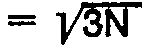
- Grössere Schwierigkeiten treten z.B. in Grossstädten auf, wo sich auf engem Raum viele bewegliche Funkstationen drängen, da einerseits viele Kanäle nötig sind, um eine hohe Teilnehmerkapazität zu erzielen, andererseits aber nur in beschränktem Umfang Frequenzen und damit Kanäle zur Verfügung stehen. Indem man anstatt grösserer Netzzellen kleine Zellen wählt, kann man zwar solchen Kleinzellen, die genügend weit voneinander entfernt sind, die gleichen Frequenzgruppen zuteilen, so dass durch die Wiederholung von Frequenzgruppen der gleiche Effekt erzielt wird wie bei der Verwendung von mehr aber verschiedenen Frequenzen, jedoch treten dadurch gleichzeitig unerwünschte Gleichkanalstörungen auf. Auf Seite 22 des erwähnten Aufsatzes ist abgegeben, wie Anzahl N der Frequenzgruppen, Zellenradius R und Abstand D zweier benachbarter Kleinzellen mit gleicher Frequenzgruppe voneinander abhängen:

- Das Abstandsverhältnis D/R ist ein Mass für das Feldstärkeverhältnis zweier benachbarter Kleinzellen gleicher Frequenzgruppe, gemessen in dem Punkt auf dem Rand einer Kleinzelle, der die geringste Entfernung zum Mittelpunkt und somit zu den Antennen der benachbarten Kleinzelle hat. Eine bewegliche Funkstation wird dort von der Sendeantenne der zugehörenden Kleinzelle mit der geringsten Feldstärke empfangen, dagegen von der benachbarten Kleinzelle mit der stärksten Feldstärke gestört werden. In entgegengesetzter Richtung wird die bewegliche Funkstation den Empfang in der festen Funkstation der benachbarten Kleinzelle am stärksten stören, wenn sie von diesem kritischen Punkt aus sendet.
- Aus den Seiten 30 und 31 der genannten Literaturstelle geht hervor, dass einerseits zur Erhöhung der Teilnehmerkapazität der Abstand D zwischen Kleinzellen mit gleichen Frequenzgruppen möglichst klein sein soll, dass aber andererseits D möglichst gross gewählt werden soll, um Gleichkanalstörungen gering zu halten. Sollen beide Forderungen ausreichend erfüllt werden, so ist ein Kompromiss nötig, dessen Spielraum allerdings durch die Beziehung D/R
- Aufgabe der Erfindung ist es deshalb, bei vorgegebener Anzahl der Frequenzgruppen wesentlich geringere Gleichkanalstörungen zu erzielen, als es nach dem Stand der Technik möglich ist.
- Die Erfindung löst diese Aufgabe bei einer Netzzelle für ein Funknetz, bestehend aus sechseckigen Kleinzellen, für die Frequenzgruppen wiederholt verwendet werden, für die Sende- . und Empfangsantennen vorgesehen sind und die ein Wabenmuster bilden, indem eine Kleinzelle, die zentrale Kleinzelle, in deren Mittelpunkt ihre Sende- und Empfangsantenne steht, von einem inneren Ring aus sechs weiteren Kletnzellen umschlossen wird und diese sechs Kleinzellen wiederum von einem oder mehreren äusseren Ringen aus zwölf, achtzehn usw. Kleinzellen umschlossen werden, dadurch, dass die Sende- und Empfangsantennen der umschliessenden sechseckigen Kleinzellen an denjenigen Schnittpunkten ihrer Umkreise mit den vom Mittelpunkt der zentralen Kleinzelle zu ihren Mittelpunkten führenden Verbindungsgeraden stehen, die den geringsten Abstand vom Mittelpunkt der zentralen Kleinzelle haben und dass diese Sende- und Empfangsantennen mit einem angenähert cos2-förmigen Strahlungsdiagramm in Richtung der Verbindungsgeraden nach aussen gerichtet sind. Antennen mit einem exakt cos2- -förmigen Strahlungsdiagramm lassen sich praktisch nicht realisieren, obwohl dies das günstigste Strahlungsdiagramm wäre. Auch störende Neben- und Rückkeulen sind nicht ganz zu vermeiden, wohl aber können sie genügend klein gemacht werden, so dass die Erfindung nicht in ihrer Funktion beeinträchtigt wird.
- Die Figur 1 zeigt ein vorteilhaftes Ausführungsbeispiel einer Netzzelle mit neunzehn sechseckigen Kleinzellen K, ihren Umkreisen U, den Standorten und Hauptstrahlrichtungen der Antennen A sowie mit den Hauptdiagonalen H und Seitenhalbierenden S als Verbindungsgeraden und mit dem Mittelpunkt Z der zentralen Kleinzelle.
- Eine weitere vorteilhafte Ausgestaltung der Erfindung sieht fünf verschiedene Frequenzgruppen für die Netzzelle vor, die, wie in Fig. 2 gezeigt, auf die einzelnen Kleinzellen verteilt sind. Eine Frequenzgruppe 1 ist der mittleren Kleinzelle zugeordnet, den sie unmittelbar umschliessenden sechs Kleinzellen sind drei weitere Frequenzgruppen 2, 3, 4 symmetrisch zum Zellenmittelpunkt Z zugeordnet. Eine fünfte Frequenzgruppe 5 ist den Kleinzellen an den Eckpunkten zugeordnet, während die drei 'Frequenzgruppen 2, 3 und 4, die bereits den die zentrale Kleinzelle umschliessenden Kleinzellen zugeordnet sind, auch den Kleinzellen zwischen den Ecken zugeordnet werden. Dabei sind die zweimal verwendeten Frequenzgruppen 2, 3 und 4 symmetrisch zum Mittelpunkt Z der zentralen Kleinzelle so verteilt, dass die Mittelpunkte von Kleinzellen gleicher Frequenzgruppen auf Diagonalen H und Seitenhalbierenden S der zentralen Kleinzelle liegen, die einen rechten Winkel einschliessen.
- Anhand dieses Ausführungsbeispiels mit fünf verschiedenen Frequenzgruppen sollen die Vorteile der Erfindung - geringere Gleichkanalstörungen bei gleichzeitig weniger Frequenzgruppen - gegenüber dem bekannten Funknetz aufgezeigt werden.
- Die Fig. 3 zeigt den in Fig. 2 angedeuteten Ausschnitt mit zwei benachbarten Eckzellen E1 und E2 der gleichen Frequenzgruppe 5. Wie aus Fig. 2 zu erkennen ist, treten die grösstmöglichen Gleichkanalstörungen bei zwei benachbarten Eckzellen auf, da die Hauptstrahlrichtungen ihrer Antennen einen geringeren Winkel einschliessen als es bei allen anderen benachbarten Kleinzellen gleicher Frequenzgruppe der Fall ist.
- Die eingezeichneten Umkreise der einzelnen als Sechsecke dargestellten Kleinzellen sind annähernd Linien gleicher 'Feldstärke, denn die Sende und Empfangsantennen der festen Funkstationen haben mit Ausnahme derjenigen der zentralen Kleinzelle ein cos2-förmiges Strahlungsdiagramm.
- Eine bewegliche Funkstation, die z.B. auf dem Umkreis der Eckzelle E2, einer Linie annähernd gleicher Feldstärke, fährt, wird die zugehörende feste Funkstation, überall auf dem Kreis mit der gleichen Feldstärke empfangen. Ebenso wird die bewegliche Funkstation von allen Punkten des Umkreises aus von der festen Funkstation mit nahezu der gleichen Feldstärke empfangen.
- Die grössten Gleichkanalstörungen sind nun immer dort auf dem Umkreis. dem Rand einer Kleinzelle also, zu erwarten: wo die grösste Feldstärke der benachbarten Kleinzelle gleicher Frequenzgruppe gemessen wird. Es ist der Punkt P, in dem sich der Umkreis der Kleinzelle E2 und ein weiterer Kreis B berühren, der durch den Antennenstandort der Kleinzelle E1 geht und dessen Mittelpunkt M auf dem Hauptstrahl der Antenne von Kleinzelle E1 liegt. Aus Symmetriegründen genügt es, für diesen einen Punkt P das Feldstärkeverhältnis zu bestimmen, denn es ist das ungünstigste, das überhaupt vorkommen kann.
- Eine bewegliche Funkstation im Punkt P wird von der entsprechenden festen Funkstation in der Kleinzelle E2 mit der kleinstmöglichen Feldstärke empfangen, dagegen von der festen 'Funkstation der Kleinzelle E1 mit der gröstmöglichen Feldstärke gestört werden. In entgegengesetzter Senderichtung stört diese bewegliche Funkstation in der Kleinzelle E1 den Empfang einer anderen beweglichen Funkstation, die sich auf dem Rand, dem Umkreis, der Kleinzelle E1 bewegt, am stärksten.
- Das Feldstärkeverhältnis lässt sich wegen der umgekehrten Proportionalität zur zweiten Potenz der Abstände leicht berechnen: Im Punkt P ist die Feldstärke von der Kleinzelle E2 umgekehrt proportional zur zweiten Potenz des doppelten Zellenradius 2R, die Feldstärke von Kleinzelle E1 umgekehrt proportional zur zweiten Potenz des doppelten Radius 2D des berührenden Kreises B. Das 'Feldstärkeverhältnis ist dann D2/R2 und leicht mittels der eingezeichneten Hilfslinien zu berechnen, wenn man zusätzlich die wabenförmige Struktur der Netzzelle beachtet.
- Aus der Gleichung

- Ein Vergleich mit dem bekannten Funknetz verdeutlicht die Vorteile der Erfindung: Um ein solches Feldstärkeverhältnis zu erzielen, wären nach der Beziehung


- Man kann aber z.B. auch aöf die Ersparnis an Frequenzen bei der Erfindung vollständig verzichten und statt dessen die Teilnehmerkapazität um den Faktor 1'5 erhöhen, ohne grössere Gleichkanalstörungen dafür in Kauf nehmen zu müssen. Angenommen jede Frequenzgruppe besteht aus zehn verschiedenen Frequenzen, so werden dem Stand der Technik entsprechend 750 Frequenzen benötigt, die bei der Erfindung allerdings auf nur fünf Gruppen verteilt werden müssen, so dass eine Frequenzgruppe bei der Erfindung 1'5 x mehr, nämlich 150 Frequenzen, aufweist.
- Eine weitere vorteilhafte Ausgestaltung der Erfindung, die im Patentanspruch 4 angegeben ist, besteht darin, sieben Frequenzgruppen in an sich bekannter Weise auf die neunzehn Kleinzellen zu verteilen.
- Aus der in Fig. 4 gezeichneten Verteilung der sieben Frequenzgruppen 1, 2, 3, 4, 5, 6 und 7 lässt sich leicht erkennen, dass bei diesem Ausführungsbeispiel der Erfindung theoretisch Gleichkanalstörungen nicht mehr möglich sind.
- Eine andere vorteilhafte Ausgestaltung einer Netzzelle ist für Gebiete geeignet, in denen die Teilnehmerdichte von einem Zentrum nach aussen hin abnimmt, wie es z.B. in Grossstädten häufig der Fall ist. Im Zentrum der Stadt werden viele Frequenzen benötigt, dagegen in den Randgebieten nur wenige. Aus diesem Grund kann man am Rand des Stadtgebietes, also am Rand einer Netzzelle, grösseren Flächen die gleichen Frequenzgruppen zuordnen als es im Zentrum möglich wäre. Bei der Erfindung erreicht man dies dadurch, dass bei einem oder mehreren äusseren Ringen jeweils mindestens zwei benachbarten Kleinzellen gleiche Frequenzgruppen zugeordnet sind.
- Eines von vielen solch möglicher Ausführungsbeispiele sieht vor, dass bei mindestens zwei äusseren Ringen jeweils mindestens zwei einander entsprechende Kleinzellen, das sind die Kleinzellen an und zwischen den Ecken, gleiche Frequenzgruppen haben.
- Anhand einer Netzzelle, bestehend aus siebenunddreisstg Kieinzellen, sei diese vorteilhafte Ausgestaltung der Erfindung näher erläutert.
- Die zentrale Kleinzelle ist von einem inneren und zwei äusseren Ringen aus Kleinzellen umgeben, für die insgesamt fünf verschiedene Frequenzgruppen vorgesehen sind. Wie in Fig. 5 gezeigt, sind einander entsprechenden Kleinzellen der beiden äusseren Ringe gleiche Frequenzgruppen zugeordnet.
- Ferner können für benachbarte Kleinzellen gleicher Frequenzgruppe Vorrichtungen vorgesehen sein, die bewirken, dass ein und dieselbe Frequenz immer nur in einer dieser Kleinzellen verwendet wird. Andere Vorrichtungen sorgen dafür, dass sich der Funkverkehr einer beweglichen Funkstation stets mit der festen Funkstation abspielt, in deren Kleinzelle sich die bewegliche Funkstation tatsächlich aufhält.
- Selbstverständlich lassen sich mehrere erfindungsgemässe Netzzellen zu einem beliebig grossen Funknetz zusammensetzen. Von den vielen sich bietenden Möglichkeiten der Frequenzgruppenvertetlung seien nur einige besonders vorteilhafte erwähnt.
- Unter bestimmten Bedingungen ist z.B.. ein Funknetz, das wabenförmig aus Netzzellen nach Anspruch 3 zusammengesetzt ist, denkbar, in dem die fünf den Kleinzellen einer Netzzelle zugeordneten Frequenzgruppen 1, 2, 3, 4 und 5 von Netzzelle zu Netzzelle so vertauscht sind, dass an den Netzzellengrenzen nur Kleinzellen verschiedener Frequenzgruppen aneinanderstossen.
- Wie die Fig. 6 zeigt, treten trotz dem Vertauschen der Frequenzgruppen 1, 2, 3, 4 und 5 an den Netzzellengrenzen erheblich Gleichkanalstörungen auf, die aber unter Umständen durch geschicktes Ausnutzen des Geländes, indem z.B. Grösse und Form der Kleinzellen leicht variiert und so der Beschaffenheit des Geländes angepasst werden, genügend kleingehalten werden können.
- Die Kleinzellen brauchen keineswegs eine streng geometrisch sechseckige Form aufweisen. Es können ferner auch einige Kleinzellen einfach weggelassen werden. Jedoch wird dies in Gebieten mit hoher Teilnehmerzahl, für die das erfindungsgemässe Funknetz besonders geeignet ist, kaum der Fall sein.
- Eine besonders vorteilhafte Ausgestaltung eines Funknetzes, bei dem Gleichkanalstörungen unabhängig von der Formation des Geländes hinreichend klein sind, ist im Patentanspruch 8 angegeben. Das Funknetz ist aus Netzzellen gemäss Anspruch 3 oder 4 wabenförmig zusammengesetzt. Die fünf bzw. sieben Frequenzgruppen einer Netzzelle bilden eine Frequenzobergruppe, von denen vier verschiedene I, II, III und IV für das gesamte System vorgesehen sind.
- Die vier Frequenzobergruppen I, II, III, IV mit jeweils fünf verschiedenen Frequenzgruppen sind auf das gesamte Funknetz so verteilt, dass Netzzellen gleicher Frequenzobergruppe nicht aneinander grenzen. Wie der neulich erfolgte Beweis des bekannten Vierfarbenproblems zeigt, gibt es mindestens eine Verteilung bei vier Frequenzobergruppen, die die geforderte Bedingung, dass Netzzellen gleicher Frequenzobergruppe nicht aneinender grenzen, erfüllt.
- Eine Möglichkeit, die vier 'Frequenzobergruppen I, II, III, IV unter dieser Bedingung auf das Funknetz zu verteilen, ist im Patentanspruch 9 angegeben und in Fig. 7 gezeigt.
- Die Frequenzobergruppen I, II, III und IV sind gleichmässig auf das gesamte Funknetz symmetrisch zu den Mittelpunkten der Netzzellen verteilt.
- Gleichkanalstörungen lassen sich bei diesem Ausführungsbeispiel dadurch verringern, dass durch Vertauschen der Frequenzgruppen die äusseren Kleinzellen, die sich auf den Seiten von Netzzellen gleicher Frequenzobergruppe gegenüberliegen, keine Frequenzgruppe gemeinsam haben. In Fig. 8 ist die entsprechende Verteilung der Frequenzgruppen für zwei Netzzellen III eingezeichnet. Bei den anderen Netzzellen I, II und IV sind die Frequenzgruppen entsprechend auf die Kleinzellen verteilt.
- Bei einem weiteren vorteilhaften Ausführungsbeispiel der Erfindung sind für die Netzzellen, entsprechend Anspruch 3 oder 4 mit fünf bzw. sieben Frequenzgruppen, sieben Frequenzobergruppen I, II, III, IV, V, VI und VII vorgesehen, die in an sich bekannter Weise, wie in Fig. 9 gezeigt, auf die Netzzellen verteilt sind.
Claims (11)
- '1. 'Funknetz mit Netzzellen, bestehend aus sechseckigen Kleinzellen, für die Frequenzgruppen wiederholt verwendet werden, für die Sende- und Empfangsantennen vorgesehen sind und die ein Wabenmuster bilden, indem eine Klein- zetle,die zentrale Kleinzelle, in deren Mittelpunkt ihre Sende- und Empfangsantenne steht, von einem inneren Ring aus sechs weiteren Kleinzellen umschlossen wird und diese sechs Kleinzellen wiederum von einem oder mehreren äusseren Ringen aus zwölf, achtzehn usw. Kleinzeilen umschlossen werden, dadurch gekennzeichnet, dass die Sende- und Empfangsantennen aller umschliessenden sechseckigen Kleinzellen an denjenigen Schnittpunkten ihrer Umkreise mit den vom Mittelpunkt der zentralen Kleinzelle zu ihren Mittelpunkten führenden Verbindungsgeraden stehen, die den geringsten Abstand vom Mittelpunkt der zentralen Kleinzelle haben und dass diese Sende- und Empfangsantennen mit einem angenähert cos2-förmigen Strahlungsdiagramm in Richtung der Verbindungsgeraden nach aussen gerichtet sind.
- 2. Funknetz mit Netzzellen nach Anspruch 1, gekennzeichnet durch neunzehn Kleinzellen.
- 3. Funknetz mit Netzzellen nach Anspruch 2, dadurch gekennzeichnet, dass der zentralen Kleinzelle eine Frequenzgruppe (1) zugeordnet ist, dass den sie umschliessenden sechs Kleinzellen symmetrisch zum Mittelpunkt drei weitere Frequenzgruppen (2, 3, 4) zugeordnet sind, dass den äusseren Kleinzellen an den Ecken eine fünfte Frequenzgruppe (5) zugeordnet ist und dass die bereits den sechs Kleinzellen, welche die zentrale Kleinzelle unmittelbar umschliessen, zugeordneten Frequenzgruppen (2, 3, 4) bei den Kleinzellen zwischen den Ecken- wieder verwendet werden und symmetrisch zum Mittelpunkt (Z) so verteilt sind, dass die Mittelpunkte von Kleinzellen gleicher Frequenzgruppen auf Diagonalen (H) und Seitenhalbierenden (S) der zentralen Kleinzelle liegen, die einen rechten Winkel einschliessen.
- 4. Funknetz mit Netzzellen nach Anspruch 2, dadurch gekennzeichnet, dass sieben Frequenzgruppen (1, 2, 3, 4, 5, 6, 7) gleichmässig in bekannter Weise auf die zentrale Kleinzelle und die sie unmittelbar umschliessenden sechs Kleinzellen verteilt sind und dass die sechs Frequenzgruppen (2, 3, 4, 5, 6, 7) dieser Kleinzellen bei den äusseren umschliessenden zwölf Kleinzellen wieder verwendet werden.
- 5. 'Funknetz mit Netzzellen nach Anspruch 1, dadurch gekennzeichnet, dass bei einem oder mehreren äusseren Ringen mindestens zwei benachbarten Kleinzellen die gleiche Frequenzgruppe zugeordnet ist.
- 6. Funknetz mit Netzzellen nach Anspruch 5, dadurch gekennzeichnet, dass bei mindestens zwei äusseren Ringen jeweils mindestens zwei einander entsprechende Kleinzellen, das sind die Kleinzellen an und zwischen den Ecken, gleiche Frequenzgruppen zugeordnet sind.
- 7. Funknetz, aus Netzzellen; nach Anspruch 3 ein Wabenmuster bildend, dadurch gekennzeichnet, dass die vier Frequenzgruppen der umschliessenden Kleinzellen von Netzzelle zu Netzzelle so vertauscht sind, dass an den Netzzellengrenzen nur Kleinzellen verschiedener Frequenzgruppen aneinanderstossen.
- 8. Funknetz, aus Netzzellen nach Anspruch 3 oder 4 ein Wabenmuster bildend, dadurch gekennzeichnet, dass die Frequenzgruppen einer Netzzelle eine 'Frequenzobergruppe bilden und dass vier verschiedene Frequenzobergruppen (I, II, III, IV) vorgesehen sind, die so auf das gesamte Funknetz verteilt sind, dass Netzzellen gleicher Frequenzobergruppe nicht aneinander grenzen.
- 9. Funknetz nach Anspruch 8, dadurch gekennzeichnet, dass die vier verschiedenen Frequenzobergruppen (I, II, 111, IV) gleichmässig auf die Netzzellen symmetrisch zu ihren Mittelpunkten verteilt sind.
- 10. Funknetz nach Anspruch 8 oder 9, dadurch gekennzeichnet, dass durch Vertauschen der Frequenzgruppen diejenigen Kleinzellen am Rande von Netzzellen mit gleicher Frequenzobergruppe, die sich gegenüberliegen, keine Frequenzgruppe gemeinsam haben.
- 11. Funknetz aus Netzzellen nach Anspruch 3 oder 4 ein Wabenmuster bildend, dadurch gekennzeichnet, dass die Frequenzgruppen einer Netzzelle eine Frequenzobergruppe bilden, dass sieben verschiedene Frequenzobergruppen (1, II, III, IV, V, VI, VII) vorgesehen und in an sich bekannter Weise auf die Netzzellen verteilt sind.
Priority Applications (1)
| Application Number | Priority Date | Filing Date | Title |
|---|---|---|---|
| AT80102925T ATE1795T1 (de) | 1979-06-07 | 1980-05-24 | Funknetz mit zellenstruktur. |
Applications Claiming Priority (2)
| Application Number | Priority Date | Filing Date | Title |
|---|---|---|---|
| DE19792923088 DE2923088A1 (de) | 1979-06-07 | 1979-06-07 | Funknetz mit zellenstruktur |
| DE2923088 | 1979-06-07 |
Publications (2)
| Publication Number | Publication Date |
|---|---|
| EP0021068A1 EP0021068A1 (de) | 1981-01-07 |
| EP0021068B1 true EP0021068B1 (de) | 1982-11-10 |
Family
ID=6072688
Family Applications (1)
| Application Number | Title | Priority Date | Filing Date |
|---|---|---|---|
| EP80102925A Expired EP0021068B1 (de) | 1979-06-07 | 1980-05-24 | Funknetz mit Zellenstruktur |
Country Status (5)
| Country | Link |
|---|---|
| US (1) | US4352110A (de) |
| EP (1) | EP0021068B1 (de) |
| JP (1) | JPS5628537A (de) |
| AT (1) | ATE1795T1 (de) |
| DE (2) | DE2923088A1 (de) |
Families Citing this family (10)
| Publication number | Priority date | Publication date | Assignee | Title |
|---|---|---|---|---|
| DE3049011A1 (de) * | 1980-12-24 | 1982-07-08 | TE KA DE Felten & Guilleaume Fernmeldeanlagen GmbH, 8500 Nürnberg | Funknetz mit zellenstruktur |
| DE3130153A1 (de) * | 1981-07-30 | 1983-02-17 | Siemens AG, 1000 Berlin und 8000 München | System zur reduzierung von gleichkanalstoerungen in zellularen mobilfunknetzen mit extrem unterschiedlich grossen nachbar-funkbereichen |
| US4617573A (en) * | 1984-12-19 | 1986-10-14 | Motorola, Inc. | Method for obtaining a linear cellular array employing cosine-squared antenna patterns |
| US4797682A (en) * | 1987-06-08 | 1989-01-10 | Hughes Aircraft Company | Deterministic thinned aperture phased antenna array |
| RU2180979C2 (ru) * | 1993-04-01 | 2002-03-27 | Кузнецов Виталий Борисович | Антенная решетка, подрешетка |
| GB2292865B (en) * | 1994-08-04 | 1998-05-27 | Northern Telecom Ltd | Cellular communications system |
| JP4808013B2 (ja) * | 2005-12-15 | 2011-11-02 | 富士通株式会社 | 動的セル再構成方法及び,これを適用するセルラーネットワークシステム |
| US7710346B2 (en) * | 2007-06-26 | 2010-05-04 | The Aerospace Corporation | Heptagonal antenna array system |
| US11437731B2 (en) * | 2017-09-13 | 2022-09-06 | Metawave Corporation | Method and apparatus for a passive radiating and feed structure |
| DE102020102033A1 (de) * | 2020-01-28 | 2021-07-29 | Krohne Messtechnik Gmbh | Radar-Antennenanordnung |
Family Cites Families (3)
| Publication number | Priority date | Publication date | Assignee | Title |
|---|---|---|---|---|
| US3898390A (en) * | 1973-05-15 | 1975-08-05 | Martin Marietta Corp | Multiple zone communications system and method |
| US3906166A (en) * | 1973-10-17 | 1975-09-16 | Motorola Inc | Radio telephone system |
| US4128740A (en) * | 1977-02-14 | 1978-12-05 | Motorola, Inc. | Antenna array for a cellular RF communications system |
-
1979
- 1979-06-07 DE DE19792923088 patent/DE2923088A1/de not_active Withdrawn
-
1980
- 1980-05-24 EP EP80102925A patent/EP0021068B1/de not_active Expired
- 1980-05-24 DE DE8080102925T patent/DE3061062D1/de not_active Expired
- 1980-05-24 AT AT80102925T patent/ATE1795T1/de not_active IP Right Cessation
- 1980-06-02 US US06/155,483 patent/US4352110A/en not_active Expired - Lifetime
- 1980-06-04 JP JP7443680A patent/JPS5628537A/ja active Granted
Also Published As
| Publication number | Publication date |
|---|---|
| DE3061062D1 (en) | 1982-12-16 |
| JPS5628537A (en) | 1981-03-20 |
| DE2923088A1 (de) | 1980-12-18 |
| JPS6333743B2 (de) | 1988-07-06 |
| EP0021068A1 (de) | 1981-01-07 |
| ATE1795T1 (de) | 1982-11-15 |
| US4352110A (en) | 1982-09-28 |
Similar Documents
| Publication | Publication Date | Title |
|---|---|---|
| DE69024339T2 (de) | Antennensystem zur Reduzierung gegenseitiger Störungen bei Benutzung gleicher Kanäle | |
| DE2806178C3 (de) | Zellenförmig aufgebautes HF-Nachrichtensystem mit einer Mehrzahl von Antennen | |
| DE69931102T2 (de) | Zellulares Layout mit gleichzeitiger Sektor- und Zeitschlitzauswahl | |
| DE69322197T2 (de) | Zugriffsverfahren für verteilte dynamische Kanalzuweisung in Mikrozellen | |
| DE69019961T2 (de) | Plan für radiozellen. | |
| DE69925223T2 (de) | Interferenz Verwaltung eines Kommunikationssatellit mit Datenverarbeitung | |
| DE4319521C2 (de) | Verfahren zur Verkleinerung und Vergrößerung von randausgeleuchteten Funkzellen in Mobilfunknetzen mit Mehrfachversorgung | |
| DE4026432A1 (de) | Planarantenne | |
| DE4432174A1 (de) | Frequenzselektive Oberfläche mit einem sich wiederholenden Muster konzentrischer, geschlossener Leiterpfade, und Antenne, die eine solche Oberfläche besitzt | |
| DE69611600T2 (de) | Multifunktionales zellulares fernsehsystem kleiner leistung | |
| DE3879383T2 (de) | Deterministisch verduennte, phasengesteuerte antennengruppe mit strahloeffnungen. | |
| DE69426160T2 (de) | Kanalteilung in einem gemischten makro/mikrozellularen system | |
| WO1994005096A1 (de) | Mobiles funknetz | |
| EP0021068A1 (de) | Funknetz mit Zellenstruktur | |
| DE3441722C2 (de) | ||
| EP0212113B1 (de) | Funktelefonnetz für ein in Funkzellen aufgeteiltes Funkgebiet | |
| EP0654201B1 (de) | Verfahren und vorrichtung für ein mikrozellulares gleichkanalfunksystem | |
| DE2659570C2 (de) | Fernsprech- und Datennetz für ortsfeste und mobile Teilnehmerstationen | |
| DE2139216A1 (de) | Richtantennenanordnung | |
| DE3049011C2 (de) | ||
| EP0284897B1 (de) | Zweireflektor-Microwellen-Richtantenne | |
| DE69518391T2 (de) | Kommunikationssystem | |
| EP0640260A1 (de) | Mobiles funknetz mit zentraler ausleuchtung der zellen. | |
| DE2150434C2 (de) | Peilantennensystem zur Peilung bei Mehrwelleneinfall mit Hilfe eines Rechners | |
| DE69620446T2 (de) | Zellulares kommunikationssystem und wiederholungsmuster dafür |
Legal Events
| Date | Code | Title | Description |
|---|---|---|---|
| PUAI | Public reference made under article 153(3) epc to a published international application that has entered the european phase |
Free format text: ORIGINAL CODE: 0009012 |
|
| AK | Designated contracting states |
Designated state(s): AT CH DE FR GB NL SE |
|
| 17P | Request for examination filed |
Effective date: 19810331 |
|
| GRAA | (expected) grant |
Free format text: ORIGINAL CODE: 0009210 |
|
| AK | Designated contracting states |
Designated state(s): AT CH DE FR GB LI NL SE |
|
| REF | Corresponds to: |
Ref document number: 1795 Country of ref document: AT Date of ref document: 19821115 Kind code of ref document: T |
|
| REF | Corresponds to: |
Ref document number: 3061062 Country of ref document: DE Date of ref document: 19821216 |
|
| ET | Fr: translation filed | ||
| RAP2 | Party data changed (patent owner data changed or rights of a patent transferred) |
Owner name: FELTEN & GUILLEAUME FERNMELDEANLAGEN GMBH |
|
| PGFP | Annual fee paid to national office [announced via postgrant information from national office to epo] |
Ref country code: NL Payment date: 19850531 Year of fee payment: 6 |
|
| PG25 | Lapsed in a contracting state [announced via postgrant information from national office to epo] |
Ref country code: NL Effective date: 19861201 |
|
| NLV4 | Nl: lapsed or anulled due to non-payment of the annual fee | ||
| PGFP | Annual fee paid to national office [announced via postgrant information from national office to epo] |
Ref country code: DE Payment date: 19900725 Year of fee payment: 11 |
|
| PGFP | Annual fee paid to national office [announced via postgrant information from national office to epo] |
Ref country code: CH Payment date: 19900824 Year of fee payment: 11 |
|
| PGFP | Annual fee paid to national office [announced via postgrant information from national office to epo] |
Ref country code: GB Payment date: 19910501 Year of fee payment: 12 |
|
| PGFP | Annual fee paid to national office [announced via postgrant information from national office to epo] |
Ref country code: FR Payment date: 19910522 Year of fee payment: 12 |
|
| PGFP | Annual fee paid to national office [announced via postgrant information from national office to epo] |
Ref country code: AT Payment date: 19910523 Year of fee payment: 12 |
|
| PGFP | Annual fee paid to national office [announced via postgrant information from national office to epo] |
Ref country code: SE Payment date: 19910524 Year of fee payment: 12 |
|
| PG25 | Lapsed in a contracting state [announced via postgrant information from national office to epo] |
Ref country code: LI Effective date: 19910531 Ref country code: CH Effective date: 19910531 |
|
| REG | Reference to a national code |
Ref country code: CH Ref legal event code: PL |
|
| PG25 | Lapsed in a contracting state [announced via postgrant information from national office to epo] |
Ref country code: DE Effective date: 19920303 |
|
| PG25 | Lapsed in a contracting state [announced via postgrant information from national office to epo] |
Ref country code: GB Effective date: 19920524 Ref country code: AT Effective date: 19920524 |
|
| PG25 | Lapsed in a contracting state [announced via postgrant information from national office to epo] |
Ref country code: SE Effective date: 19920525 |
|
| GBPC | Gb: european patent ceased through non-payment of renewal fee |
Effective date: 19920524 |
|
| PG25 | Lapsed in a contracting state [announced via postgrant information from national office to epo] |
Ref country code: FR Effective date: 19930129 |
|
| REG | Reference to a national code |
Ref country code: FR Ref legal event code: ST |
|
| EUG | Se: european patent has lapsed |
Ref document number: 80102925.7 Effective date: 19921204 |
|
| PLBE | No opposition filed within time limit |
Free format text: ORIGINAL CODE: 0009261 |
|
| STAA | Information on the status of an ep patent application or granted ep patent |
Free format text: STATUS: NO OPPOSITION FILED WITHIN TIME LIMIT |