EP0021103A1 - Theophyllin-Derivate, Verfahren zu ihrer Herstellung und diese Verbindungen enthaltende Arzneimittel - Google Patents
Theophyllin-Derivate, Verfahren zu ihrer Herstellung und diese Verbindungen enthaltende Arzneimittel Download PDFInfo
- Publication number
- EP0021103A1 EP0021103A1 EP80103002A EP80103002A EP0021103A1 EP 0021103 A1 EP0021103 A1 EP 0021103A1 EP 80103002 A EP80103002 A EP 80103002A EP 80103002 A EP80103002 A EP 80103002A EP 0021103 A1 EP0021103 A1 EP 0021103A1
- Authority
- EP
- European Patent Office
- Prior art keywords
- general formula
- group
- compounds
- compound
- radical
- Prior art date
- Legal status (The legal status is an assumption and is not a legal conclusion. Google has not performed a legal analysis and makes no representation as to the accuracy of the status listed.)
- Granted
Links
Classifications
-
- C—CHEMISTRY; METALLURGY
- C07—ORGANIC CHEMISTRY
- C07D—HETEROCYCLIC COMPOUNDS
- C07D473/00—Heterocyclic compounds containing purine ring systems
- C07D473/02—Heterocyclic compounds containing purine ring systems with oxygen, sulphur, or nitrogen atoms directly attached in positions 2 and 6
- C07D473/04—Heterocyclic compounds containing purine ring systems with oxygen, sulphur, or nitrogen atoms directly attached in positions 2 and 6 two oxygen atoms
- C07D473/06—Heterocyclic compounds containing purine ring systems with oxygen, sulphur, or nitrogen atoms directly attached in positions 2 and 6 two oxygen atoms with radicals containing only hydrogen and carbon atoms, attached in position 1 or 3
- C07D473/08—Heterocyclic compounds containing purine ring systems with oxygen, sulphur, or nitrogen atoms directly attached in positions 2 and 6 two oxygen atoms with radicals containing only hydrogen and carbon atoms, attached in position 1 or 3 with methyl radicals in positions 1 and 3, e.g. theophylline
-
- A—HUMAN NECESSITIES
- A61—MEDICAL OR VETERINARY SCIENCE; HYGIENE
- A61P—SPECIFIC THERAPEUTIC ACTIVITY OF CHEMICAL COMPOUNDS OR MEDICINAL PREPARATIONS
- A61P11/00—Drugs for disorders of the respiratory system
- A61P11/08—Bronchodilators
-
- A—HUMAN NECESSITIES
- A61—MEDICAL OR VETERINARY SCIENCE; HYGIENE
- A61P—SPECIFIC THERAPEUTIC ACTIVITY OF CHEMICAL COMPOUNDS OR MEDICINAL PREPARATIONS
- A61P37/00—Drugs for immunological or allergic disorders
- A61P37/08—Antiallergic agents
-
- C—CHEMISTRY; METALLURGY
- C07—ORGANIC CHEMISTRY
- C07D—HETEROCYCLIC COMPOUNDS
- C07D473/00—Heterocyclic compounds containing purine ring systems
- C07D473/02—Heterocyclic compounds containing purine ring systems with oxygen, sulphur, or nitrogen atoms directly attached in positions 2 and 6
- C07D473/04—Heterocyclic compounds containing purine ring systems with oxygen, sulphur, or nitrogen atoms directly attached in positions 2 and 6 two oxygen atoms
- C07D473/06—Heterocyclic compounds containing purine ring systems with oxygen, sulphur, or nitrogen atoms directly attached in positions 2 and 6 two oxygen atoms with radicals containing only hydrogen and carbon atoms, attached in position 1 or 3
- C07D473/10—Heterocyclic compounds containing purine ring systems with oxygen, sulphur, or nitrogen atoms directly attached in positions 2 and 6 two oxygen atoms with radicals containing only hydrogen and carbon atoms, attached in position 1 or 3 with methyl radicals in positions 3 and 7, e.g. theobromine
Definitions
- DE-OS 28 04 416 describes purine derivatives with antiallergic, anti-inflammatory and antioedematous activity, which are derived from adenine or adenine derivatives substituted on the nitrogen atom in the 6-position. It has now been found that similar derivatives of xanthine inhibit allergic bronchial obstructions in low doses, reduce allergic skin reactions even after oral administration and show antihistamine effects.
- the invention further relates to pharmaceutical preparations containing compounds of the general formula I and the use of compounds of the general formula I for the preparation of such preparations.
- the acyl groups of the substituent R 3 can mean lower alkanoyl groups, which are optionally mono- or polysubstituted by halogen or by aryl, by aryl-substituted lower alkenoyl groups, preferably the cinnamoyl group or carbocyclic or heterocyclic aroyl groups if can be substituted by halogen, hydroxyl, lower alkyl, nideraloxy, lower alkoxycarbonyl, lower acyloxy, carboxyl, nitro, amino, nitrile, trifluoromethyl, carbamoyl or benzyl.
- lower alkanoyl, lower alkenoyl, lower alkyl, lower alkoxycarbonyl and lower acyloxy mean radicals with 1-8, preferably 1-6, in particular 1-4 carbon atoms, where the radicals can be straight-chain or branched.
- Heterocyclic aroyl groups are, for example, the furancarbonyl, the thiophene carbonyl and the pyridinecarbonyl radical, carbocyclic aroyl groups for example the benzoyl radical.
- R 3 can represent the acid residue of a cycloalkyl carboxylic acid, cycloalkyl preferably being understood to mean the cyclopropyl, cyclobutyl, cyclopentyl, cyclohexyl and cycloheptyl residue.
- R 3 acyl also acid residues of sulfonic acids such. B. to understand benzenesulfonic acid and methylsulfonic acid.
- aryl in the definition of the substituent R 3 preferably means phenyl or naphthyl.
- Halogen atoms are fluorine, chlorine and bromine.
- the present invention relates in particular to all substances which have any possible combination of the substituents mentioned in the examples.
- a nitro group is converted into an amino group by hydrogenation
- reaction product obtained obtained into a pharmacologically acceptable salt.
- the reactive radicals X and Y of the compounds of the general formula III are chlorine, bromine, mesyloxy and tosyloxy.
- Reactive residues Z can be all residues which are used in peptide chemistry for activating carboxylic acids, for example halogen atoms, the azido group, alkyloxy, aryloxy and acyloxy groups.
- the process according to the invention is carried out, for example, by first condensing compounds of the general formula III with compounds of the general formula IV and isolating the reaction product obtained. This intermediate is then reacted with a compound of the general formula II.
- the reaction is conveniently carried out in an alkaline medium, preferably in a lower alcohol such as. B. in isopropanol in the presence of sodium isopropoxide.
- Another variant consists in first reacting compounds of the general formula II with compounds of the general formula III; the reaction mixture obtained is then reacted with compounds of the general formula IV to give the desired end product of the general formula I.
- a subsequent conversion of the group R 3 in the general formula I into another group R 3 takes place, for example, as an exchange of an acyl group R 3 for another radical R 3 .
- compounds of the formula I are first saponified in an acidic medium and the intermediate products obtained are preferably acylated in the presence of an acid-binding agent by known methods.
- the [3- (4-aminopiperidino) propyl] xanthine derivatives obtained as an intermediate are also new compounds.
- the nitro group can be converted into an amino group by known methods, for. B. by catalytic hydrogenation.
- the pharmacologically acceptable salts are obtained in the usual way, e.g. B. by neutralizing the compounds of formula 1 with non-toxic inorganic or organic acids such as. B. hydrochloric acid, sulfuric acid, phosphoric acid, hydrobromic acid, acetic acid, lactic acid, citric acid, malic acid, salicylic acid, malonic acid, maleic acid or succinic acid.
- non-toxic inorganic or organic acids such as. B. hydrochloric acid, sulfuric acid, phosphoric acid, hydrobromic acid, acetic acid, lactic acid, citric acid, malic acid, salicylic acid, malonic acid, maleic acid or succinic acid.
- the new substances of the formula I according to the invention and their salts can be administered enterally and parenterally in liquid or solid form. All usual forms of application come into question here, for example tablets, capsules, dragees, syrups, solutions, suspensions etc.
- Water is preferably used as the injection medium, which contains the additives which are customary for injection solutions, such as stabilizers, solubilizers and buffers. Such additions are e.g. B. tartrate and citrate buffers, ethanol, complexing agents (such as ethylenediaminetetraacetic acid and its non-toxic salts), high molecular weight polymers (such as liquid polyethylene oxide) for viscosity control.
- Liquid carriers for injection solutions must be sterile and are preferably filled into ampoules.
- Solid carrier materials are e.g. B. starch, lactose, mannitol, methyl cellulose, talc, highly disperse silica, high molecular weight fatty acids (such as stearic acid), gelatin, agar agar, calcium phosphate, magnesium stearate,
- Preparations suitable for oral administration can optionally contain flavorings and sweeteners.
- the dosage administered depends on the age, health and weight of the recipient, the extent of the disease, the type of further treatments which may be carried out at the same time, the frequency of the treatments and the type of effect desired.
- the daily dose of the active compound is usually from about 0.1 to 50 mg / kg of body weight. Normally from 0.5 to 40 and preferably from 1.0 to 20 mg / kg / day are effective in one or more applications per day to achieve the desired results.
- the substances I are granulated with the aqueous solution from II, dried and sieved.
- the granulate is mixed with the substances under III to form the tabletting compound. Tableting takes place into tablets 7 mm in diameter and 140 mg in weight.
- the experimental arrangement for measuring the bronchospasm basically corresponded to that of KONZETT and R ⁇ SSLER (1940) in the modification according to COLLIER et al. (1960).
- Animals in anesthesia induced with ip 40 mg / kg pentobarbital sodium were integrated with a Y cannula in the trachea and a venous cannula in the jugular vein.
- a cannula embedded in the carotid artery led to a measuring chamber and the arterial pressure was recorded via a DC voltage measuring bridge.
- the rats were given an air volume of 1-2 ml 64 times per minute, depending on the size of the animals, and 72 to 72 ml per minute for the guinea pigs.
- Bronchospasm was obtained by disconnecting the ventilation tube from the animal so that all of the air supplied flowed out through the valve.
- the antigen is 2 x crystallized ovalbumin. Equal amounts of a solution of the antigen in physiological saline and complete Freund's adjuvant are emulsified and 2 x 0.15 ml i.m. injected into male guinea pigs. The animals are bled and the pooled serum is stored at -20 ° C. For passive sensitization, guinea pigs are diluted 0.5 ml of the antiserum 1:50 24 - 48 hours before the bronchospasm is triggered i.v. injected.
Landscapes
- Chemical & Material Sciences (AREA)
- Organic Chemistry (AREA)
- Health & Medical Sciences (AREA)
- Life Sciences & Earth Sciences (AREA)
- Engineering & Computer Science (AREA)
- Bioinformatics & Cheminformatics (AREA)
- Chemical Kinetics & Catalysis (AREA)
- General Chemical & Material Sciences (AREA)
- Medicinal Chemistry (AREA)
- Nuclear Medicine, Radiotherapy & Molecular Imaging (AREA)
- Veterinary Medicine (AREA)
- Pharmacology & Pharmacy (AREA)
- Pulmonology (AREA)
- Animal Behavior & Ethology (AREA)
- General Health & Medical Sciences (AREA)
- Public Health (AREA)
- Immunology (AREA)
- Pharmaceuticals Containing Other Organic And Inorganic Compounds (AREA)
- Organic Low-Molecular-Weight Compounds And Preparation Thereof (AREA)
Abstract
Description
- In der DE-OS 28 04 416 sind Purin-Derivate mit antiallergischer, entzuendungswidriger und antioedematoeser Wirkung beschrieben, die sich von Adenin bzw. am in 6-Stellung befindlichen Stickstoffatom substituierten Adeninderivaten ableiten. Es wurde nun gefunden, daß aehnliche Derivate des Xanthins allergische Bronchialobstruktionen in niedrigen Dosen hemmen, allergische Hautreaktionen auch nach oraler Gabe abschwaechen und Antihistamineffekte zeigen.
- Die vorliegende Erfindung betrifft daher Piperidinoalkyl-Derivate des Xanthins der allgemeinen Formel I

- einer der Reste R1 und R2 die Methylgruppe und der andere den Rest

- Weiterhin betrifft die Erfindung pharmazeutische Praeparate mit einem Gehalt an Verbindungen der allgemeinen Formel I sowie die Verwendung von Verbindungen der allgemeinen Formel I zur Herstellung solcher Praenarate.
- Die Acyl-Gruppen des Substituenten R3 koennen Niederalkanoyl-Gruppen, die gegebenenfalls ein- oder mehrfach durch Halogen oder durch Aryl substituiert sind, durch Aryl substituierte Niederalkenoyl-Gruppen, vorzugsweise die Cinnamoyl-Gruppe oder carbocyclische oder heterocyclische Aroyl-Gruppen bedeuten, die gegebenenfalls durch Halogen, Hydroxyl, Niederalkyl, Nideraloxy, Niederalkoxycarbonyl, Niederacyloxy, Carboxyl, Nitro, Amino, Nitril, Trifluormethyl, Carbamoyl oder Benzyl substituiert sein koennen, bedeuten.
- Die Bezeichnung "Nieder" in den Ausdrücken Niederalkanoyl, Niederalkenoyl, Niederalkyl, Niederalkoxycarbonyl und Niederacyloxy bedeuten Reste mit 1 - 8 vorzugsweise 1 - 6, insbesondere 1 - 4 Kohlenstoffatomen, wobei die Reste geradkettig oder verzweigt sein können.
- Heterocyclische Aroyl-Gruppen sind beispielsweise der Furancarbonyl-, der Thiophencarbonyl- und der Pyridincarbonyl-Rest, carbocyclische Aroyl-Gruppen beispielsweise der Benzoyl-Rest.
- Des weiteren kann R3 den Saeurerest einer Cycloalkylcarbonsseure darstellen, wobei unter Cycloalkyl vorzugsweise der Cyclopropyl-, Cyclobutyl-, Cyclopentyl-, Cyclohexyl und Cycloheptyl-Rest verstanden wird.
- Ferner sind unter R3 = Acyl auch Saeurereste von Sulfonsaeuren wie z. B. Benzolsulfonsaeure und Methylsulfonsaeure zu verstehen. Der Ausdruck Aryl in der Definition des Substituenten R3 bedeutet vorzugsweise Phenyl- oder Naphthyl.
- Als Halogenatome kommen Fluor, Chlor und Brom in Frage.
- Außer den in den Beispielen genannten Verbindungen sind Gegenstand der vorliegenden Erfindung insbesondere alle Substanzen, die jede moegliche Kombination der in den Beispielen genannten Substituenten aufweisen.
- Das erfindungsgemaeße Verfahren zur Herstellung der Verbindungen der Formel I ist dadurch gekennzeichnet, daß man in an sich bekannter Weise eine Verbindung der allgemeinen Formel II

- einer der Reste R'1 und R'2 die Methylgruppe und der andere ein Wasserstoffatom bedeutet,
- mit einer Verbindung der allgemeinen Formel III

- X und Y reaktive Reste bedeuten
- und einer Verbindung der allgemeinen Formel IV

- R3 die obengenannte Bedeutung hat,
- gegebenenfalls eine Nitrogruppe durch Hydrierung in eine Amino-gruppe ueberfuehrt
- und anschließend das erhaltene Reaktionsprodukt gewuenschtenfalls in ein pharmakologisch vertraegliches Salz ueberfuehrt.
- Als reaktive Reste X und Y der Verbindungen der allgemeinen Formel III kommen Chlor, Brom, Mesyloxy und Tosyloxy in Frage.
- Reaktive Reste Z koennen alle Reste sein, die in der Peptid-Chemie zur Aktivierung von Carbonsaeuren Verwendung finden, beispielsweise Halogenatome, die Azido-Gruppe, Alkyloxy-, Aryloxy- und Acyloxy-Gruppen.
- Das erfindungsgemaeße Verfahren fuehrt man beispielsweise so durch, daß man zunaechst Verbindungen der allgemeinen Formel III mit Verbindungen der allgemeinen Formel IV kondensiert und das erhaltene Reaktionsprodukt isoliert. Dieses Zwischenprodukt wird dann mit einer Verbindung der allgemeinen Formel II zur Reaktion gebracht. Die Reaktion erfolgt zweckmaeßig in alkalischem Medium, vorzugsweise in einem niederen Alkohol wie z. B. in Isopropanol in Anwesenheit von Natriumisopropanolat.
- Eine andere Variante besteht darin, zunaechst Verbindungen der allgemeinen Formel II mit Verbindungen der allgemeinen Formel III zur Reaktion zu bringen; anschließend wird das erhaltene Reaktionsgemisch mit Verbindungen der allgemeinen Formel IV zum gewuenschten Endprodukt der allgemeinen Formel I umgesetzt.
- Eine nachtraegliche Umwandlung der Gruppe R3 in der allgemeinen Formel I in eine andere Gruppe R3 erfolgt beispielsweise als Austausch eines Acylrastes R3 gegen einen anderen Rest R3. Hierzu werden Verbindungen der Formel I zunaechst in saurem Milieu verseift und die erhaltenen Zwischenprodukte vorzugsweise in Gegenwart eines saeurebindenden Mittels nach bekannten Methoden acyliert. Die als Zwischenprodukt erhaltenen [3-(4-Amino-piperidino)-propyl]-xanthin-Derivate sind ebenfalls neue Verbindungen.
- Des weiteren kann in Verbindungen der Formel I, in denen der Acylrest R3 eine Nitro-Gruppe enthaelt, die Nitro-Gruppe durch bekannte Methoden in eine Amino-Gruppe umgewandelt werden, z. B. durch katalytische Hydrierung.
- Die Verbindungen der Formeln II, III und IV sind aus der Literatur bekannt oder koennen von bekannten Verbindungen ausgehend nach trivialen Methoden leicht hergestellt werden.
- Die pharmakologisch vertraeglichen Salze erhaelt man in ueblicher Weise, z. B. durch Neutralisation der Verbindungen der Formel 1 mit nichttoxischen anorganischen oder organischen Saeuren wie z. B. Salzsaeure, Schwefelsaeure, Phosphorsaeure, Bromwasserstoffsaeure, Essigsaeure, Milchsaeure, Zitronensaeure, Aepfelsaeure, Salicylsaeure, Malonsaeure, Maleinsaeure oder Bernsteinsaeure.
- Die erfindungsgemaeßen neuen Substanzen der Formel I und ihre Salze koennen in fluessiger oder fester Form enteral und parenteral appliziert werden. Hierbei kommen alle ueblichen Applikationsformen in Frage, beispielsweise Tabletten, Kapseln, Dragees, Sirupe, Loesungen, Suspensionen etc.. Als Injektionsmedium kommt vorzugsweise Wasser zur Anwendung, welches die bei Injektionsloesungen ueblichen Zusaetze wie Stabilisierungsmittel, Loesungsvermittler und Puffer enthaelt. Derartige Zusaetze sind z. B. Tartrat- und Citrat-Puffer, Aethanol, Komplexbildner (wie Aethylendiamintetraessigsaeure und deren nichttoxische Salze), hochmolekulare Polymere (wie fluessiges Polyaethylenoxid) zur Viskositaetsregelung. Fluessige Traegerstoffe fuer Injektionsloesungen muessen steril sein und werden vorzugsweise in Ampullen abgefuellt. Feste Traegerstoffe sind z. B. Staerke, Lactose, Mannit, Methylcellulose, Talkum, hochdisperse Kieselsaeuren, hoehermolekulare Fettsaeuren (wie Stearinsaeure), Gelatine, Agar-Agar, Calciumphosphat, Magnesiumstearat,
- tierische und pflanzliche Fette, feste hochmolekulare Polymere (wie Polyaethylenglykole); fuer orale Applikation geeignete Zubereitungen koennen gewuenschtenfalls Geschmacks- und Sueßstoffe enthalten.
- Die verabreichte Dosierung hängt vom Alter, der Gesundheit und dem Gewicht des Empfängers, dem Ausmaß der Krankheit, der Art gleichzeitiger gegebenenfalls durchgeführter weiterer Behandlungen, der Häufigkeit der Behandlungen und der Art der gewünschten Wirkung ab. Üblicherweise beträgt die tägliche Dosis der aktiven Verbindung von etwa 0,1 bis 50 mg/kg Körpergewicht. Normalerweise sind von 0,5 bis 40 und vorzugsweise 1,0 bis 20 mg/kg/Tag in einer oder mehreren Anwendungen pro Tag wirksam, um die gewünschten Resultate zu erhalten.
- In den folgenden Beispielen wird die Herstellung der erfindungsgemaeßen Verbindungen sowie einer pharmazeutischen Zubereitungsform naeher beschrieben.
- Zu der Loesung von 0,46 g (0,02 mol) Natrium in 100 ml Isopropanol gibt man 3,6 g (0,02 mol) Theophyllin, erhitzt 10 min zum Rueckfluß, kuehlt ab und fuegt 6,5 g (0,022 mol) 3-[4-(4-Fluor-benzamido)-piteri-dino]-propylchlorid zu. Nach 6 Stunden Ruehren unter Rueckfluß laeßt man abkuehlen, filtriert, waescht den Niederschlag mit 2 N Natronlauge und Wasser und kristallisiert aus Ethylacetat um. Man erhaelt 5,8 g 7-<3-14-(4-Fluor-benzamido)-piperidino]-propyl>- theophyllin (66 % d. Th.) vom Schmp. 192-193°C.
- In analoger Weise wie in Beispiel 1 beschrieben erhaelt man:


- Zu einer Mischung aus 8,0 g (0,025 mol) 7-[3-(4-Amino- piperidino)-propyl]-theophyllin und 100 ml 1 N Natronlauge sowie 50 ml Tetrahydrofuran tropft man die Loesung von 7,8 g (0,06 mol) Furan-2-carbonylchlorid in 30 ml Tetrahydrofuran, ruehrt 5 Stunden bei Raumtemperatur, filtriert und kristallisiert aus Methanol um.
- Man erhaelt 5,0 g 7-(3-[4-(Furan-2-carbonylamido)-piperidino]-propyl)-theophyllin (49 % d. Th.) vom Schmp. 195-196°C.
- Das als Reaktionskomponente verwendete 7-[3-(4-Amino- piperidino)-propyl]-theophyllin kann wie folgt erhalten werden:
- Eine Mischung aus 15,0 g (0,1 mol) 4-Oximinopiperidin-Hydrochlorid, 55 ml (0,4 mpl) Triethylamin und 11 ml (0,11 mol) 1-Brom-3-chlor-propan wird 16 Stunden zum Rueckfluß erhitzt, abgekuehlt, filtriert und das Filtrat eingeengt. Es verbleiben 15,8 g 3-(4-0ximino-piperidino)-propychlorid (84 % d. Th.) als Oel.
- Zu der Loesung von 3,4 g (0,15 mol) Natrium in 350 ml Isopropanol fuegt man 26,6 g (0,15 mol) Theophyllin, erhitzt 10 min zum Rueckfluß, fuegt 28,0 g (0,15 mol) 3-(4-0ximino-piperidino)-propylchlorid zu, erhitzt 16 Stunden zum Rueckfluß, engt ein, nimmt den Rueckstand in Methylenchlorid auf, waescht mit Wasser und engt ein. Nach Verreiben mit Ether verbleiben 28,5 g 7-[3-(4-Oximino-piperidino)-propyl]-theophyllin (57 % d. Th.) vom Schmp. 167-170°C.
- Eine Loesung von 6,7 g (0,02 mol) der vorstehend genannten Verbindung in 150 ml Methanol und 150 ml Tetrahydrofuran hydriert man unter Zusatz von 5 ml Raney-Nickel bei Raumtemperatur und 1 bar Wasserstoffdruck. Nach Beendigung der Wasserstoffaufnahme wird filtriert und eingeengt. Es verbleiben 6,3 g 7-[3-(4-Amino-piperidino)-propyl]-theophyllin (90 % d. Th.) als Oel.
- In analoger Weise wie in Beispiel 3 beschrieben erhaelt man:

- Eine Mischung aus 4,8 g (0,01 mol) 7-<3-[4-(4-Nitro-benzamido)-piperidino]-propyl>-theophyllin (Beispiel 4 c), 150 ml Methanol, 150 ml Tetrahydrofuran und 3 ml Raney-Nickel wird bei Raumtemperatur und 1 bar Wasserstoffdruck hydriert. Danach wird filtriert, eingeengt, der Ruackstand in verd. Salzsaeure aufgenommen, mit Ether extrahiert, alkalisch gestellt und filtriert. Es verbleiben nach Umkristallisation aus Methanol 2,7 g 7-<3-[4-(4-Amino-benzamido)-piperidino]-propy>-theophyllin (60 % d. Th.) vom Schmp. 203-205°C.
- Eine Loesung von 1,0 g 7-[3-(4-Benzamido-piperidino)-propyl]-theophyllin (Beispiel 2 a) in 20 ml Ethylacetat versetzt man mit ueberschuessiger etherischer Chlorwasserstoffloesung, filtriert und waescht den Niederschlag mit Aceton und Ether. Man erhaelt 0,95 g 7-[3-(4-Benzamido-piperidino)-propyl]-theophyllin-hydrochlorid (88 % d. Th.) vom Schmp. oberhalb 290°C.
-

- Herstellung: Die Substanzen I werden mit der wäßrigen Lösung aus II granuliert, getrocknet und gesiebt. Das Granulat wird mit den Substanzen unter III zur Tablettiermasse gemischt. Die Tablettierung erfolgt zu Tabletten von 7 mm Durchmesser und 140 mg Gewicht.
- Die Versuchsanordnung zur Messung des Bronchospasmus entsprach im Prinzip der von KONZETT und RÖSSLER (1940) in der Modifikation nach COLLIER u.a. (1960). Tieren in mit 40 mg/kg Pentobarbital-Natrium i.p. herbeigeführter Narkose wurde eine Y-Kanüle in die Trachea und eine Venenkanüle in die V. jugularis eingebunden. Eine in die A. carotis eingebundene Kanüle führte zu einer Meßkammer und der arterielle Druck wurde über eine Gleichspannungsmeßbrücke aufgezeichnet. Mit der Atempumpe wurde den Ratten ein Luftvolumen von je nach Größe der Tiere 1 - 2 ml 64 mal, den Meerschweinchen von 7 - 15 ml 72 mal pro Minute zugeführt. Die Narkose mußte so tief sein, daß eine spontane Gegenatmung vonseiten der Tiere nicht auftrat. Bei Auftreten eines Bronchospasmus konnte bei gleichbleibendem Beatmungsvolumen das gesamte angebotene Luftvolumen nicht mehr in die Lunge strömen und floß teilweise durch einen Seitenarm über ein Ventil ab. Die von der Firma BASILE entwickelte Methode weicht insofern von der ursprünglichen von KONZETT und RÖSSLER beschriebenen Methode ab, als dieses Luftvolumen indirekt als Strömungsgeschwindigkeit mit Hilfe eines Thermoelementes gemessen wird. Jeder Bronchospasmus konnte dann als prozentuale Abnahme des verfügbaren Bronchialvolumens beschrieben werden. Den theoretisch maximal möglichen
- Bronchospasmus erhielt man durch Abklemmen des Beatmungsschlauches am Tier, so daß die gesamte zugeführte Luft durch das Ventil abströmte.
- Alle 30 sec wurde durch ein Relais das Ventil für 8 sec geschlossen und das gesamte Volumen in die Lunge gepumpt, um die Bronchen und Alveolen wieder zu entfalten und so einen ausreichenden Gasaustausch zu ermöglichen. Die prozentuale Abnahme des verfügbaren Bronchialvolumens (X) wurde nach folgender Formel errechnet:

- a) = Ausschlag des Schreibers bei Versuchsbeginn in mm.
- b) = Höhe des Ausschlages zu einem bestimmten Zeitpunkt in mm.
- m) = Maximaler Ausschlag in mm nach Abklemmen des Beatmungsschlauches am Tier.
- COLLIER, H.O.J., J.A. HOLGATE, M. SCHACHTER: THE BRONCHOCONSTRICTOR ACTION OF BRADYKININ IN THE GUINEA-PIG. Brit. J. Pharmacol. 15, 290 (1960).
- KONZETT, H. und R. RÖSSLER:
- Versuchsanordnung zu Untersuchungen an der Bronchialmuskulatur Naunyn-Schmiedebergs Arch. exp. Path. Pharmak. 195, 71 - 74 (1940).
- Das Antigen ist 2 x kristallisiertes Ovalbumin. Gleiche Mengen einer Lösung des Antigens in physiologischer Kochsalzlösung und komplettem Freund'schen Adjuvans werden emulsiert und 2 x 0,15 ml i.m. bei männlichen Meerschweinchen injiziert. Die Tiere werden entblutet und das gepoolte Serum bei -20° C aufbewahrt. Zur passiven Sensibilisierung werden Meerschweinchen 0,5 ml des Antiserum 1 : 50 verdünnt 24 - 48 Stunden vor Auslösen des Bronchospasmus i.v. injiziert.
- (DAVIES und JOHNSON:
- Int. Arch. Allergy 41, 648 - 654 (1971))
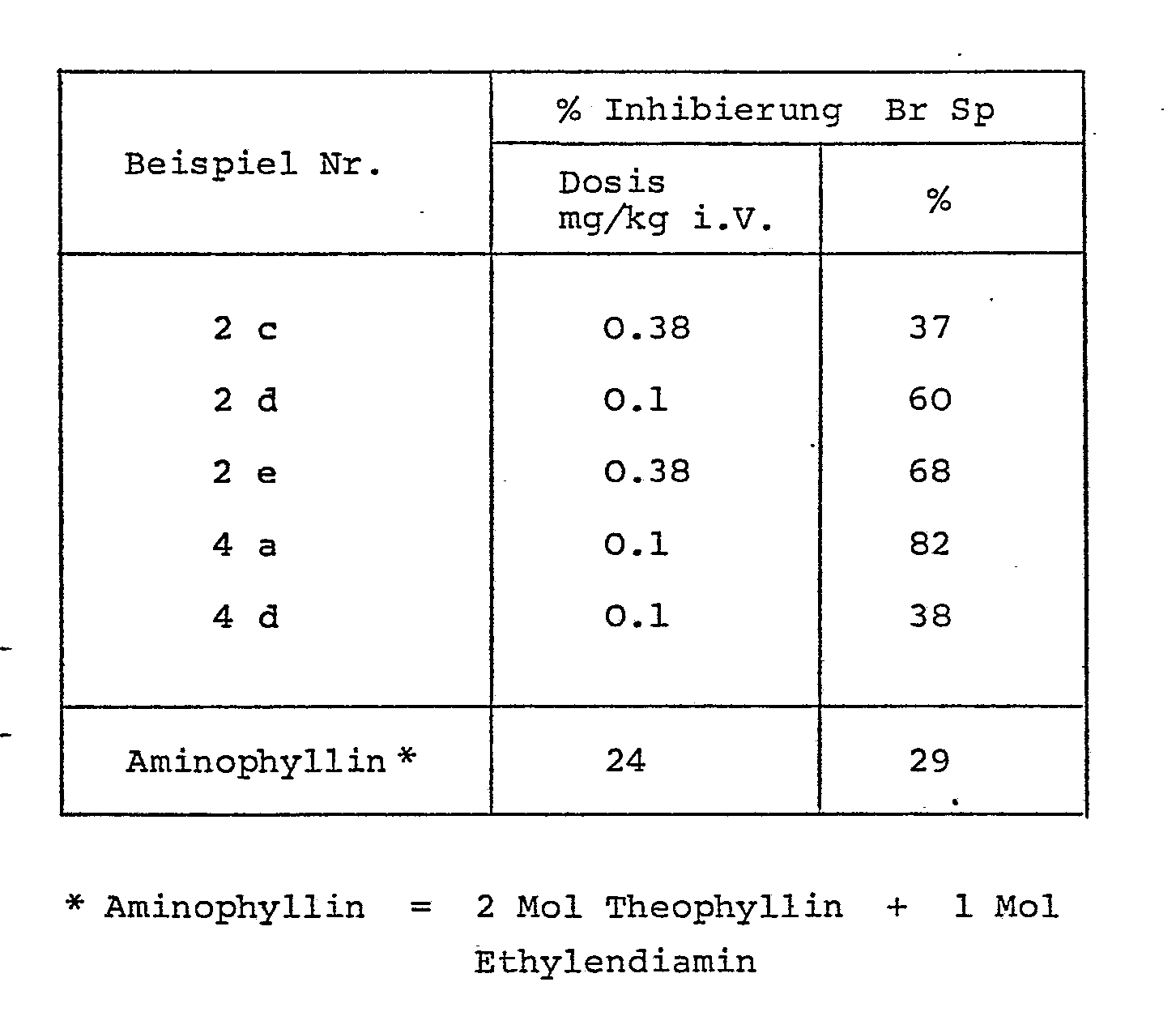
- Inhibierung der antigen-induzierten Bronchospasmen (Br Sp) in passiv sensibilisierten Meerschweinchen
umsetzt, anschließend gewuenschtenfalls die Gruppe R3 durch Verseifung und/ oder folgende Acylierung mit einer Verbindung R3-Z, wobei Z einen reaktiven Rest bedeutet, gegen eine andere Gruppe R3 austauscht,
Claims (4)


dadurch gekennzeichnet, daß man in an sich bekannter Weise eine Verbindung der allgemeinen Formel II



umsetzt,
Priority Applications (1)
| Application Number | Priority Date | Filing Date | Title |
|---|---|---|---|
| AT80103002T ATE3549T1 (de) | 1979-05-31 | 1980-05-29 | Theophyllin-derivate, verfahren zu ihrer herstellung und diese verbindungen enthaltende arzneimittel. |
Applications Claiming Priority (2)
| Application Number | Priority Date | Filing Date | Title |
|---|---|---|---|
| DE2922159 | 1979-05-31 | ||
| DE19792922159 DE2922159A1 (de) | 1979-05-31 | 1979-05-31 | Neue xanthin-derivate, verfahren zu ihrer herstellung und diese verbindungen enthaltende arzneimittel |
Publications (2)
| Publication Number | Publication Date |
|---|---|
| EP0021103A1 true EP0021103A1 (de) | 1981-01-07 |
| EP0021103B1 EP0021103B1 (de) | 1983-05-25 |
Family
ID=6072153
Family Applications (1)
| Application Number | Title | Priority Date | Filing Date |
|---|---|---|---|
| EP80103002A Expired EP0021103B1 (de) | 1979-05-31 | 1980-05-29 | Theophyllin-Derivate, Verfahren zu ihrer Herstellung und diese Verbindungen enthaltende Arzneimittel |
Country Status (13)
| Country | Link |
|---|---|
| US (1) | US4284633A (de) |
| EP (1) | EP0021103B1 (de) |
| JP (1) | JPS55162785A (de) |
| AT (1) | ATE3549T1 (de) |
| AU (1) | AU529812B2 (de) |
| CA (1) | CA1128040A (de) |
| DD (1) | DD151168A5 (de) |
| DE (2) | DE2922159A1 (de) |
| ES (1) | ES491915A0 (de) |
| HU (1) | HU184291B (de) |
| IL (1) | IL60176A (de) |
| SU (1) | SU1079176A3 (de) |
| ZA (1) | ZA803245B (de) |
Cited By (2)
| Publication number | Priority date | Publication date | Assignee | Title |
|---|---|---|---|---|
| EP0071738A1 (de) * | 1981-07-20 | 1983-02-16 | Siegfried Aktiengesellschaft | Neue Theophyllinderivate und Verfahren zu deren Herstellung |
| FR2558162A1 (fr) * | 1984-01-17 | 1985-07-19 | Adir | Nouveaux derives de la xanthine, leurs procedes de preparation et les compositions pharmaceutiques les renfermant |
Families Citing this family (3)
| Publication number | Priority date | Publication date | Assignee | Title |
|---|---|---|---|---|
| US4426383A (en) | 1980-09-04 | 1984-01-17 | Eisai Co., Ltd. | Theophylline and theobromine derivatives |
| US4548939A (en) * | 1984-10-01 | 1985-10-22 | Janssen Pharmaceutica N. V. | 1H-Indol-3-yl containing 1,3-dimethyl-1H-purine-2,6-diones |
| US7550468B2 (en) * | 2000-07-28 | 2009-06-23 | Ing-Jun Chen | Theophylline and 3-isobutyl-1 methylxanthine based N-7 substituted derivatives displaying inhibitory activities on PDE-5 phospodiesterase |
Citations (3)
| Publication number | Priority date | Publication date | Assignee | Title |
|---|---|---|---|---|
| DE2550000A1 (de) * | 1975-11-07 | 1977-05-12 | Boehringer Mannheim Gmbh | Neue purin-derivate und verfahren zu ihrer herstellung |
| DE2804416A1 (de) * | 1978-02-02 | 1979-08-09 | Boehringer Mannheim Gmbh | Neue purin-derivate, verfahren zu deren herstellung sowie diese verbindungen enthaltende arzneimittel |
| EP0011399A1 (de) * | 1978-11-11 | 1980-05-28 | FISONS plc | N-Substituierte Theophylline, Verfahren zu ihrer Herstellung und diese enthaltende pharmazeutische Präparate |
Family Cites Families (3)
| Publication number | Priority date | Publication date | Assignee | Title |
|---|---|---|---|---|
| GB1133989A (en) * | 1964-12-08 | 1968-11-20 | Chugai Pharmaceutical Co Ltd | Theophylline derivatives, their salts and process for preparing the same |
| DE2401254A1 (de) * | 1974-01-11 | 1975-11-27 | Boehringer Mannheim Gmbh | Neue derivate von n hoch 6-substituierten adeninen |
| US4061753A (en) * | 1976-02-06 | 1977-12-06 | Interx Research Corporation | Treating psoriasis with transient pro-drug forms of xanthine derivatives |
-
1979
- 1979-05-31 DE DE19792922159 patent/DE2922159A1/de not_active Withdrawn
-
1980
- 1980-05-12 US US06/148,870 patent/US4284633A/en not_active Expired - Lifetime
- 1980-05-16 CA CA352,091A patent/CA1128040A/en not_active Expired
- 1980-05-26 SU SU802925604A patent/SU1079176A3/ru active
- 1980-05-27 AU AU58787/80A patent/AU529812B2/en not_active Ceased
- 1980-05-28 IL IL60176A patent/IL60176A/xx unknown
- 1980-05-28 ES ES491915A patent/ES491915A0/es active Granted
- 1980-05-28 DD DD80221417A patent/DD151168A5/de unknown
- 1980-05-29 EP EP80103002A patent/EP0021103B1/de not_active Expired
- 1980-05-29 AT AT80103002T patent/ATE3549T1/de not_active IP Right Cessation
- 1980-05-29 DE DE8080103002T patent/DE3063450D1/de not_active Expired
- 1980-05-30 HU HU801374A patent/HU184291B/hu unknown
- 1980-05-30 ZA ZA00803245A patent/ZA803245B/xx unknown
- 1980-05-30 JP JP7164780A patent/JPS55162785A/ja active Pending
Patent Citations (3)
| Publication number | Priority date | Publication date | Assignee | Title |
|---|---|---|---|---|
| DE2550000A1 (de) * | 1975-11-07 | 1977-05-12 | Boehringer Mannheim Gmbh | Neue purin-derivate und verfahren zu ihrer herstellung |
| DE2804416A1 (de) * | 1978-02-02 | 1979-08-09 | Boehringer Mannheim Gmbh | Neue purin-derivate, verfahren zu deren herstellung sowie diese verbindungen enthaltende arzneimittel |
| EP0011399A1 (de) * | 1978-11-11 | 1980-05-28 | FISONS plc | N-Substituierte Theophylline, Verfahren zu ihrer Herstellung und diese enthaltende pharmazeutische Präparate |
Cited By (4)
| Publication number | Priority date | Publication date | Assignee | Title |
|---|---|---|---|---|
| EP0071738A1 (de) * | 1981-07-20 | 1983-02-16 | Siegfried Aktiengesellschaft | Neue Theophyllinderivate und Verfahren zu deren Herstellung |
| WO1987000841A1 (en) * | 1981-07-20 | 1987-02-12 | Kurt Thiele | New theophylline derivatives and method for the production thereof |
| FR2558162A1 (fr) * | 1984-01-17 | 1985-07-19 | Adir | Nouveaux derives de la xanthine, leurs procedes de preparation et les compositions pharmaceutiques les renfermant |
| EP0149578A3 (en) * | 1984-01-17 | 1985-09-18 | Adir | Xanthine derivatives, processes for their preparation and pharmaceutical compositions containing them |
Also Published As
| Publication number | Publication date |
|---|---|
| AU529812B2 (en) | 1983-06-23 |
| DD151168A5 (de) | 1981-10-08 |
| DE2922159A1 (de) | 1980-12-04 |
| DE3063450D1 (en) | 1983-07-07 |
| ATE3549T1 (de) | 1983-06-15 |
| EP0021103B1 (de) | 1983-05-25 |
| IL60176A (en) | 1983-06-15 |
| HU184291B (en) | 1984-07-30 |
| ES8101074A1 (es) | 1980-12-16 |
| ES491915A0 (es) | 1980-12-16 |
| ZA803245B (en) | 1981-06-24 |
| SU1079176A3 (ru) | 1984-03-07 |
| JPS55162785A (en) | 1980-12-18 |
| CA1128040A (en) | 1982-07-20 |
| AU5878780A (en) | 1980-12-04 |
| IL60176A0 (en) | 1980-07-31 |
| US4284633A (en) | 1981-08-18 |
Similar Documents
| Publication | Publication Date | Title |
|---|---|---|
| EP0287907B1 (de) | Pyrazolo[3,4-d]pyrimidine, Verfahren zu ihrer Herstellung und Verwendung als Arzneimittel | |
| DE2011806C3 (de) | Tricyclische Verbindungen, Verfahren zu deren Herstellung und diese enthaltende pharmazeutische Zubereitungen | |
| EP0026876B1 (de) | N-Phenoxyalkylpiperidin-Derivate, Verfahren zu deren Herstellung sowie diese Verbindungen enthaltende Arzneimittel | |
| EP0013894B1 (de) | Neue Arylether, Verfahren zu deren Herstellung sowie diese Verbindungen enthaltende Arzneimittel | |
| DE2164058C3 (de) | Basisch substituierte Benzylphthalazinon-Derivate, ihre Salze, Verfahren zu ihrer Herstellung und diese Produkte enthaltende pharmazeutische Präparate | |
| DE3026534A1 (de) | 3,1-benzoxazin-2-one, ihre herstellung und verwendung | |
| EP0105210B1 (de) | Isochinolinderivate, Verfahren zu ihrer Herstellung, pharmazeutische Präparate auf Basis dieser Verbindungen und ihre Verwendung | |
| EP0021103B1 (de) | Theophyllin-Derivate, Verfahren zu ihrer Herstellung und diese Verbindungen enthaltende Arzneimittel | |
| EP0665228B1 (de) | Neue 3-Phenylsulfonyl-3,7-diazabicyclo(3,3,1)nonan-Verbindungen enthaltende Arzneimittel | |
| DE1518452C3 (de) | 4 substituierte 2 Benzhydryl 2 butanol Derivate und Verfahren zu ihrer Herstellung | |
| DE3326724A1 (de) | In 1-stellung substituierte 4-hydroxymethyl-pyrrolidinone, verfahren zu ihrer herstellung, pharmazeutische zusammensetzungen und zwischenprodukte | |
| DE2523103A1 (de) | Neue propargyl-2-phenylamino-imidazoline-(2), deren saeureadditionssalze, diese enthaltende arzneimittel und verfahren zur herstellung derselben | |
| CH630925A5 (de) | Verfahren zur herstellung von neuen imidazothiazinen. | |
| DE2334009A1 (de) | Purin-derivate sowie verfahren zu ihrer herstellung | |
| EP0064255A1 (de) | Benzopyranylether, Verfahren zu deren Herstellung sowie diese Verbindungen enthaltende Arzneimittel und Zwischenprodukte | |
| DE1470194B2 (de) | 1,3,3-trisubstituierte 4-(Omega-Aminoalkyl)-2-pyrrolidinoneund-2-thiopyrrolidinone Ausscheidung aus: 1470176 | |
| DD219642A5 (de) | Verfahren zur herstellung von bis-(piperazinyl- bzw. homopiperazinyl)alkanen | |
| EP0171689A1 (de) | Neue Aminoalkohole, Verfahren zu deren Herstellung sowie diese Verbindungen enthaltende Arzneimittel und Zwischenprodukte | |
| DE69005904T2 (de) | Phenylpyrimidonderivate. | |
| EP0003558B1 (de) | 9-(3-Piperidinopropyl)-purin-Derivate, Verfahren zu deren Herstellung, deren Verwendung sowie diese Verbindungen enthaltende Arzneimittel | |
| DE2206385C2 (de) | 2-Amino-4,5,7,8-tetrahydro-6H-oxazolo-[4,5-d]azepinderivate | |
| DE2942065A1 (de) | Neue 1,6-naphthyridinderivate, verfahren zu ihrer herstellung sowie mittel gegen schwindel und zur verbesserung der zerebralen zirkulation, die diese derivate enthalten | |
| DE3030047A1 (de) | Neue aminopropanol-derivate, verfahren zu ihrer herstellung und diese verbindungen enthaltende arzneimittel | |
| DE2134880B2 (de) | Thieno-pyrimidine, verfahren zu ihrer herstellung und diese enthaltende arzneimittel | |
| CH635314A5 (de) | Verfahren zur herstellung von 2-(phenylalkylhydrazono)-propionsaeurederivaten. |
Legal Events
| Date | Code | Title | Description |
|---|---|---|---|
| PUAI | Public reference made under article 153(3) epc to a published international application that has entered the european phase |
Free format text: ORIGINAL CODE: 0009012 |
|
| AK | Designated contracting states |
Designated state(s): AT BE CH DE FR GB IT LU NL SE |
|
| 17P | Request for examination filed |
Effective date: 19810126 |
|
| ITF | It: translation for a ep patent filed | ||
| GRAA | (expected) grant |
Free format text: ORIGINAL CODE: 0009210 |
|
| AK | Designated contracting states |
Designated state(s): AT BE CH DE FR GB IT LI LU NL SE |
|
| REF | Corresponds to: |
Ref document number: 3549 Country of ref document: AT Date of ref document: 19830615 Kind code of ref document: T |
|
| PG25 | Lapsed in a contracting state [announced via postgrant information from national office to epo] |
Ref country code: LU Free format text: LAPSE BECAUSE OF NON-PAYMENT OF DUE FEES Effective date: 19830531 |
|
| REF | Corresponds to: |
Ref document number: 3063450 Country of ref document: DE Date of ref document: 19830707 |
|
| ET | Fr: translation filed | ||
| PLBE | No opposition filed within time limit |
Free format text: ORIGINAL CODE: 0009261 |
|
| STAA | Information on the status of an ep patent application or granted ep patent |
Free format text: STATUS: NO OPPOSITION FILED WITHIN TIME LIMIT |
|
| 26N | No opposition filed | ||
| PGFP | Annual fee paid to national office [announced via postgrant information from national office to epo] |
Ref country code: DE Payment date: 19890505 Year of fee payment: 10 |
|
| PGFP | Annual fee paid to national office [announced via postgrant information from national office to epo] |
Ref country code: AT Payment date: 19890512 Year of fee payment: 10 |
|
| PGFP | Annual fee paid to national office [announced via postgrant information from national office to epo] |
Ref country code: SE Payment date: 19890517 Year of fee payment: 10 Ref country code: FR Payment date: 19890517 Year of fee payment: 10 |
|
| ITTA | It: last paid annual fee | ||
| PGFP | Annual fee paid to national office [announced via postgrant information from national office to epo] |
Ref country code: NL Payment date: 19890531 Year of fee payment: 10 Ref country code: GB Payment date: 19890531 Year of fee payment: 10 |
|
| PGFP | Annual fee paid to national office [announced via postgrant information from national office to epo] |
Ref country code: LU Payment date: 19890606 Year of fee payment: 10 |
|
| PGFP | Annual fee paid to national office [announced via postgrant information from national office to epo] |
Ref country code: CH Payment date: 19890614 Year of fee payment: 10 |
|
| PGFP | Annual fee paid to national office [announced via postgrant information from national office to epo] |
Ref country code: BE Payment date: 19890703 Year of fee payment: 10 |
|
| PG25 | Lapsed in a contracting state [announced via postgrant information from national office to epo] |
Ref country code: GB Effective date: 19900529 Ref country code: AT Effective date: 19900529 |
|
| PG25 | Lapsed in a contracting state [announced via postgrant information from national office to epo] |
Ref country code: SE Effective date: 19900530 |
|
| PG25 | Lapsed in a contracting state [announced via postgrant information from national office to epo] |
Ref country code: LI Effective date: 19900531 Ref country code: CH Effective date: 19900531 Ref country code: BE Effective date: 19900531 |
|
| BERE | Be: lapsed |
Owner name: BOEHRINGER MANNHEIM G.M.B.H. Effective date: 19900531 |
|
| PG25 | Lapsed in a contracting state [announced via postgrant information from national office to epo] |
Ref country code: NL Effective date: 19901201 |
|
| NLV4 | Nl: lapsed or anulled due to non-payment of the annual fee | ||
| GBPC | Gb: european patent ceased through non-payment of renewal fee | ||
| PG25 | Lapsed in a contracting state [announced via postgrant information from national office to epo] |
Ref country code: FR Effective date: 19910131 |
|
| REG | Reference to a national code |
Ref country code: CH Ref legal event code: PL |
|
| PG25 | Lapsed in a contracting state [announced via postgrant information from national office to epo] |
Ref country code: DE Effective date: 19910201 |
|
| REG | Reference to a national code |
Ref country code: FR Ref legal event code: ST |
|
| EUG | Se: european patent has lapsed |
Ref document number: 80103002.4 Effective date: 19910114 |