EP0021365A2 - Système de traitement de données avec calculateur auxiliaire - Google Patents
Système de traitement de données avec calculateur auxiliaire Download PDFInfo
- Publication number
- EP0021365A2 EP0021365A2 EP80103457A EP80103457A EP0021365A2 EP 0021365 A2 EP0021365 A2 EP 0021365A2 EP 80103457 A EP80103457 A EP 80103457A EP 80103457 A EP80103457 A EP 80103457A EP 0021365 A2 EP0021365 A2 EP 0021365A2
- Authority
- EP
- European Patent Office
- Prior art keywords
- main memory
- memory
- microprogram
- host main
- address
- Prior art date
- Legal status (The legal status is an assumption and is not a legal conclusion. Google has not performed a legal analysis and makes no representation as to the accuracy of the status listed.)
- Granted
Links
Images




Classifications
-
- G—PHYSICS
- G06—COMPUTING OR CALCULATING; COUNTING
- G06T—IMAGE DATA PROCESSING OR GENERATION, IN GENERAL
- G06T12/00—Tomographic reconstruction from projections
- G06T12/20—Inverse problem, i.e. transformations from projection space into object space
-
- G—PHYSICS
- G06—COMPUTING OR CALCULATING; COUNTING
- G06F—ELECTRIC DIGITAL DATA PROCESSING
- G06F15/00—Digital computers in general; Data processing equipment in general
- G06F15/16—Combinations of two or more digital computers each having at least an arithmetic unit, a program unit and a register, e.g. for a simultaneous processing of several programs
- G06F15/161—Computing infrastructure, e.g. computer clusters, blade chassis or hardware partitioning
-
- G—PHYSICS
- G06—COMPUTING OR CALCULATING; COUNTING
- G06F—ELECTRIC DIGITAL DATA PROCESSING
- G06F9/00—Arrangements for program control, e.g. control units
- G06F9/06—Arrangements for program control, e.g. control units using stored programs, i.e. using an internal store of processing equipment to receive or retain programs
- G06F9/30—Arrangements for executing machine instructions, e.g. instruction decode
- G06F9/38—Concurrent instruction execution, e.g. pipeline or look ahead
- G06F9/3877—Concurrent instruction execution, e.g. pipeline or look ahead using a secondary processor, e.g. coprocessor
- G06F9/3879—Concurrent instruction execution, e.g. pipeline or look ahead using a secondary processor, e.g. coprocessor for non-native instruction execution, e.g. executing a command; for Java instruction set
-
- G—PHYSICS
- G06—COMPUTING OR CALCULATING; COUNTING
- G06T—IMAGE DATA PROCESSING OR GENERATION, IN GENERAL
- G06T2211/00—Image generation
- G06T2211/40—Computed tomography
- G06T2211/428—Real-time
Definitions
- the present invention relates to an electronic computer system and more particularly to a computer system which is the combination of an ordinary computer system and an auxiliary computer system whereby the process of which the execution by the ordinary computer is made merely at a low speed is carried out by the auxiliary computer additionally used and therefore the computer system operates at a high speed.
- a slave processor By convention, the computation as an excessive task for the host computer is frequently assigned to an additionally used computer system, or a slave processor, appropriate for the computation.
- a slave computer system is commercially available now.
- a typical example of such is an array processor which executes the computation of array type data at high speed, such as an array processor (AP 120B) by Floating Point Systems Inc. in USA and AP 400 by Analogic Inc. in USA.
- the detail of the AP 400 is discussed in US Patent No. 4,135,247 granted to Gordon et al on January 16, 1979. Each of those systems has a high speed memory and an arithmetic logic unit.
- the computation data is fetched from a main memory of a host computer and the fetched data is loaded into the high speed memory and then is computed by an arithmetic logic unit.
- the computed data is loaded into the high speed memory and afterwards is transferred to the main memory. In this way, a sequence of the data processing operation is completed.
- This type apparatus is effective for an operation having many intermediate results of computation such as a First Fourier Transform but is improper for a relatively simple processing in which the data in the main memory is subjected to a simple computation with little production of the intermediate computation result.
- the high speed memory holds the intermediate computation results and the results are accessed many times, the high speed feature is effectively used; however, with respect to the processing requiring no intermediate computation results, it operates merely as a buffer - between the main memory and the arithmetic logic unit. Thus, it is ineffective in utilizing the high speed feature thereof.
- the array data ai is read out from an address, which is generally needed at the time of the set-up and given in some way, and is transferred to the memory of the slave processor. This step is performed in a section a. The necessary address computation in this case is performed by the slave processor.
- the array data b i is likewise fetched from the main memory. This is performed in a section ⁇ .
- the slave processor reads out the array data ai and bi from the internal memory, adds those and loads again the result ci into the internal memory by using the internal arithmetic logic unit.
- the internal memory and the arithmetic logic unit of the slave computer are higher than the host computer, and thus processing in this section is at high speed.
- This operation is performed in a section y.
- the computation (the addition in this case) of all of the array data are completed, the result of ci is transferred (loaded) from the internal memory to the main memory of the host computer.
- This operation is performed in a section y. Assuming that an access time of the main memory is Tam , and a processing time of the arithmetic logic unit is ⁇ pr , the total of the computation time (provided that the main memory could be accessed exclusively), is given
- an object of the present invention is to provide a computer system with a good performance cost.
- Another object of the present invention is to provide a computer system with a slave computer having no internal memory.
- a data processing system with a slave computer connecting to a host central processing unit and a host main memory characterized in that the slave computer comprising: arithmetic logic operating means of which the operation cycle is higher than the memory cycle of the host main memory, and computes the address of the host main memory; DMA interface means which is connected to the host main memory and the arithmetic logic operating means, directly makes an access to the host main memory in accordance with the address of the host main memory computed by the arithmetic logic operating means, and directly store the operation result of the arithmetic logic operating means in the host main memory; microprogram control means connected to the arithmetic logic operating means and the DMA interface means for controlling those means; input/output interface means connected to the host central processing unit and the microprogram control means to apply command information received from the host central processing unit to the microprogram control means; and clock circuit means connected to the arithmetic logic operating means, the microprogram control means and the DMA interface means for generating system
- a slave computer system with no internal memory, which is expensive, used for the array data computation is connected to a host computer.
- the slave computer computes the data obtained by directly making an access to the main memory of the host computer system through an interface, and loads the result of the computation to the main memory through the interface, again.
- the slave computer has an arithmetic logic, unit with a processing speed several times the memory cycle of the main memory, which the arithmetic logic unit is controlled by a microprogram control unit.
- the microprogram control unit has a number of microprogram routines corresponding to the computations.
- the host computer system drives the slave computer system to perform the computation having an extremely long time when it is made by the host CPU. Specifically, the host CPU gives a microprogram routine to be executed and information to indicate where operand data is stored in the main memory as well, to the slave computer. Afterwards it gives a computation start command signal to the slave computer, so that the slave computer starts the processing related.
- the arithmetic logic unit executes a plurality of steps of the processing including the address computations of the data to be read from or written in the main memory, as well as the normal computation.
- a great amount of data in the main memory is accordingly processed in a pipeline manner.
- the slave computer must be synchronized with the main memory.
- the slave computer has an internal clock generator and means for inhibiting the oscillation of the internal clock for synchronizing with the memory cycle of the main memory.
- Fig. 2 illustrating a construction of a slave computer comprising an I/O interface 21, a DMA interface 23, an arithmetic logic section 25, a microprogram control unit 27 and a clock circuit 29.
- the slave computer is connected through an I/O bus 33 to a host CPU 31 and through a memory bus 37 to a host main memory 35.
- a host computer system used in the present embodiment is a conventional ordinary mini-computer.
- the I/O interface 21 provides an interface between the slave computer and the host computer through the I/O bus 33 and gives a microinstruction (start address) to the slave computer and an interruption to the host CPU 31.
- the data fed from the host CPU 31 is stored in an IDTA register 39.
- the I/O interface 21 has a flip-flop GO 41 and a flip-flop DR 43 for indicating a state of the I/O interface 21.
- a DMA interface 23 fetches computation data from a main memory 35 or loads the result of computation by the arithmetic logic section 25 to the main memory 35, which the interface 23 has a DMA controller 47, and various registers such as MAR 49, MDR 51 and MSR 53.
- the MAR 49 holds an address to fetch data from the main memory 35 or an address to store data into the main memory 35.
- the MDR 51 holds the computation result to be stored into the main memory 35.
- the MSR 53 holds the computation data fetched from the main memory 35.
- the DMA controller 47 is comprised of an RS flip-flop 48 and a D flip-flop 50, as shown in Fig. 3.
- the RS flip-flop 48 holds a memory request signal for the host main memory 35.
- the D flip-flop 50 holds a read/write signal for the host main memory 35.
- the RS flip-flop 48 is set by the memory request signal and reset by an acknowledge signal derived from the host main memory 35.
- the D flip-flop 50 is set by the acknowledge signal.
- the acknowledge signal when the memory request signal and the read/write signal are supplied to the host main memory 35, is an answer back signal outputted from the host main memory 35 to the DMA controller 47.
- the memory request signal and the read/write signal are produced from a pipeline register 63 of a microprogram control unit 27 to be described later.
- the DMA controller 47 bypasses the acknowledge signal to a clock circuit 29 to be described later.
- An arithmetic logic section 25 has an ALU 55 and a register file 57 which executes the computation directed by a microprogram control section 27.
- the embodiment uses four 4-bit slice bipolar microprocessors (Am 2901) manufactured by AMD Co., USA, an ALU of 16 bits and 16 registers.
- a microprogram control section 27 comprises a microprogram sequencer 59, a microprogram memory (ROM) 61, a pipeline register 63 and a branch condition circuit 65.
- a microprogram sequencer 59 such as a microprogram sequencer (Am 2910) manufactured by AMD Co., USA, has an address register 67 therein.
- the microprogram memory (ROM) 61 holds an operation routine performed by the arithmetic logic section 25 and a set-up routine to be described later.
- ROM microprogram memory
- the arithmetic logic section 25, a DMA interface 23 and the various registers are controlled in accordance with the microinstruction.
- the branch condition circuit 65 provides a branch command to the microprogram sequencer 59 to branch the microprogram in accordance with various flip-flop states within the arithmetic logic section 25 and the I/O interface 21.
- the clock circuit 29 has a function as a synchronizing circuit with respect to the memory access, as described later, as well as a function to send a clock signal CP to various sections of the slave computer.
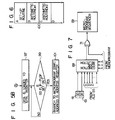
- Figs. 5A and 5B a flow chart of a set-up sequence is illustrated.
- the set-up sequence starts in response to an initialize command delivered through the I/O interface 21 from the host CPU 31.
- the initialize command initializes the various flip-flops (including those not shown) within the slave computer and the microprograms as well.
- the set-up routine and various arithmetic routines are stored as shown in Fig. 6.
- the set-up routine starts.
- the I/O interface 21 checks if the data (8-bit data of 16 bits) delivered from the host CPU 31 is present or not and, if not present, holds the wait loop till the data appears. If the data is present, the I/O interface 21 loads the data into the IDTAU register 39 1 (block 83). Then, in a block 85, the I/O interface 21 checks if the next data (the remaining 8-bit data of the 16 bits) is present or not. If it is absent, the interface 21 holds a wait loop till the data appears. If the data is present, the interface 21 loads the data into the IDTAL register 39 2 (block 87).
- the DR flip-flop 43 is set and the set-up routine loads the contents of the IDTA register 39 into the address register AR 67, when the DR flip-flop 43 detects the set (block 89).
- the I/O interface 21 checks if the host CPU 31 has transferred the table address (8 bits of the 16 bits) or not. If the address is transferred from the host CPU 31, the I/O interface 21 receives and loads it into the IDTAU register 39 1 (block 93). The I/O interface 21 receives the table address of the remaining 8 bits from the host CPU 31 and loads it into the IDTAL register 39 2 (blocks 95 and 99).
- the table address indicates location in which a table representing the first addresses of the data a i , bi and c i (addresses 1000, 2000 and 3000) and the number (1000) of the data, is stored in the main memory 35.
- the data "500" is loaded as a table address into the IDTA register 39.
- the data in the IDTA register 39 is defined by the table handled in the microprogram, so that the contents of the table changes as the kind of the operation to be executed changes.
- the data necessary to start the operation are set up and therefore the host CPU 31 sends a GO command to the I/O interface 21.
- the GO flip-flop 41 is set by the GO command.
- a state of the GO flip-flop 41 has been supplied to the branch condition circuit 65.
- the set-up routine detects this, the microprogram is branched to an address held in the address register 67 and the execution of the arithmetic routine #2 starts (block 101).
- the branching condition circuit 65 will briefly be described referring to Fig. 7.
- the branch condition circuit 65 is comprised of a condition code selector 69 and an polarity control exclusive OR 71.
- the selector 69 which has been supplied with the information of the flip-flops, selects the contents of any of the flip-flops.
- the exclusive OR 71 supplies a signal to direct the branch to the microprogram sequencer 59.
- "100" set in the pipeline register 63 is supplied to the ROM 61 through a selector (not shown) and a branch to the address 100 takes place.
- the address 100 is related to the microprogram and not to the main memory.
- the arithmetic routine #2 starting at the address 100 is performed as shown in Fig. 8, for example.
- the central portion of such a program, or an addition loop, is of the usual type.
- the contents of the IDTA register 39 is loaded into the arithmetic logic section 25.
- the first address of a table necessary for starting the operation as previously stated has been prestored in the IDTA register 39.
- an address "500" is loaded into the arithmetic logic section 25.
- the arithmetic logic section 25 transfers the address "500" to the MAR 49 to give a Read command to the main memory 35 through the DMA interface 23.
- Read indicates a direction for the slave computer to read (data flows main memory to slave processor).
- the DMA interface 23 reads the contents of the address 500 of the main memory 35 (1000 of the start address of the array air in this example,) and sets the read one into the MSR 53 (block 105).
- the arithmetic logic section 25 loads the first address of the array air or the contents of the MSR 53, into the internal register. Similarly, while incrementing the address, the first address of the bi array, the first address of the ci array, and the number of the operations are sequentially loaded into the register of the arithmetic logic section 25 (blocks 107, 109 and 111).
- a pointer K is incremented by one.
- the pointer K is compared with the number of data N. In the comparison, when the value of the pointer K fails to reach the N, the control is returned to the block 115 where similar process and computation are performed.
- the operation loop of the blocks 115 to 125 performs an ordinary operation in the flow chart shown in Fig. 8. In the slave computer, however, the fetch and the addition of the data are overlapped in a pipeline manner and all of the operations are completed within the access time of the main memory 35.
- TABLE 1 An example of the addition program is illustrated in TABLE 1.
- the operation of the arithmetic logic section 25 and the memory request are described in the microprogram of the ROM 61.
- the basic cycle of the slave computer is 200 ns, for example, and the cycle time of the main memory is 800 ns, for example. Therefore, the slave computer can perform one step of the program for one memory cycle.
- Each microinstruction of the arithmetic routine has a memory control section and an arithmetic control section, as shown in Fig. 9.
- the arithmetic section indicates the operations described in the arithmetic control section and the memory request/synchronize indicates the operations described in the table.
- the arithmetic control section has an OP code, a source address, and a destination address, which are usually used. The description of those will be omitted, however.
- the memory control section has three bits REQ, R/W and MSYN, as illustrated enlarged in Fig. 9.
- the REQ bit is a bit to direct the request to the main memory 35
- the R/W bit is a bit to direct if the request is the read or the write for the main memory 35
- the MSYN bit indicates the synchronization with the memory cycle.
- the contents of the REQ bit and R/W bit are supplied to the DMA controller 47 and the contents of the MSYN bit is supplied to the clock circuit 29.
- the DMA controller 47 produces a request signal and an R/W signal to the main memory 35 in accordance with the contents of the REQ bit and the R/W bit.
- REQ(R) indicates that the REQ bit and the R/W bit are set (to Read).
- REQ(W) indicates that REQ bit and R/W bit are set (to Write).
- the memory cycle of the main memory 35 starts.
- the memory cycle is so programmed as to start delayed by two steps from the step which issued the memory request. In other words, after approximately 400 ns since the memory request is issued, an actual memory cycle starts corresponding to the memory request.
- symbols k, AA, BA, N, R 1 , R 2 and CA are names assigned to specific registers in the register file 57.
- k designates counters corresponding to the number of operations; AA an address of the array data a; BA an address of the array data b; CA an address of the array data c; N the number of operations (the number of data) previously given by the table; R 1 and R 2 working registers.
- the MAR 49 and MDR.51 are connected to the Y output port of the AM 2901, and the MSR 53 is connected to the D input port. Accordingly, the loading and the fetching operations of the contents of these registers are possible by the microprogram.
- the addresses from a to a+12 indicate an initializing step since it is impossible to process those addresses from the first data in the pipeline manner.
- the steps from the address (a+13) to the address (a+24) indicates a loop in a normal state.
- ai and bi (a and b represent "Read") are read such as (a 1 , b l ), (a 2 , b2, c 1 ), (a3, b 3 , c 2 ), (a 4 , b 4l c 3 ) ..: and c i-1 obtained in the previous cycle is written.
- the process of four internal cycles is possible within one memory cycle. Accordingly, the address control of DMA and the count of the loop, and the like are overlapped with the memory cycle, as shown in the program, so that the computation is pipelined and all of the computations are completed within the access time to the memory.
- the microprogram in TABLE 1 will again be described with relation to the operation of the host main memory 35.
- One memory cycle of the host main memory 35 corresponds to four steps of the microprogram.
- MSYN of the address (a+1) the step of the address (a+2) is synchronized with the memory cycle.
- the memory cycle starts after two steps since the memory request is issued. Therefore, the time taken from the address (a+2) to the address (a+5) correspond to one memory cycle and here the array data a l is Read.
- the addresses (a+b) to (a+9) correspond to one memory cycle and here the array data b l is Read.
- the addresses (a+10) to (a+13) are for Read of a 2 ; the addresses (a+14) to (a+17) for Read of b i ; the addresses (a+18) to (a+21) for Write of c i-1; the addresses (a+22) to (a+24) for Read of a i+1 .
- the memory cycle starts immediately (after approximately 400 ns).
- the actual host main memory 35 is commonly used by the C P U 31, the slave computer and DMA devices such as a magnetic disc and a magnetic tape.
- the devices individually request services for the host main memory 35 and exclusively use the memory cycle only when the request is accepted. Also during a period that the program shown in this example runs, it is impossible for the slave computer to continuously use the memory cycle. In this case, it must operate using the memory with any other device.
- the synchronizing circuit is provided in the slave computer so that from an instant that the access request to the host main memory 35 is issued till an acknowledge signal representing the request is accepted is received, the internal clock is stopped and the slave computer is operated always to synchronize with the memory cycle of the main memory assigned thereto.
- the operation timing diagram for taking such a synchronization is illustrated in Figs. 10A to 10J.
- An example of the circuit construction of the clock circuit 29 which also serves as a synchronizing circuit is shown in Fig. 11.
- MCLK in Fig. 10B designates a clock signal generated by the oscillating circuit 81.
- the clock signal is frequency-divided by the flip-flops 83 and 85 thereby to form clock signals SCLK1 and SCLK2.
- These signals SCLK1, SCLK2 are supplied to a disable flip-flop 87 through a logic multiplying circuit 88.
- the machine cycle is determined by the clock signal SCLKI.
- the memory synchronizing operation is performed by the microprogram as shown in Fig. 12, for example. That is at address b, an access request to the memory is issued and the machine cycle at the address b+1 should be elongated till the memory cycle is assigned to synchronize therewith. Accordingly, the memory synchronizing operation is specified (M, SYNC command).
- M SYNC command
- the execution of the program will be described using the timing chart.
- the M and SYNC commands cause the MSYN signal to synchronize with the SCLKl thereby to be active.
- the DISA flip-flop 87 is set by the timing pulse TP formed by the SCLKl and SCLK2, so that the output Q of the DISA flip-flop 54 resets the flip-flops 83 and 85. Under this condition, the clock signals SCLKl and SCLK2 are halted. Then, the main memory returns a signal ACT to accept the access to the memory, to the circuit. At the leading edge of the ACT signal, the ACT latch 89 is set. Since the ACT signal is of asynchronous, the ACT latch 89 is made to be synchronized with the MCLK and the DISA flip-flop 87 is reset by the output Q of the SYNC flip-flop 91.
- the slave computer has no internal memory to hold a large amount of data. Accordingly, a large amount of data may be processed at a high speed by using an inexpensive slave computer, so that the computer system of the invention has a high performance/cost ratio.
- a space to occupy the slave computer on a single print substrate of 12 x 12 inches is almost same compared with the conventional one.
- the additional use of the slave computer never interfere the host computer system but takes charge of processing the picture data, and the array data, which are not well processed by the host computer thereby to improve the data processing speed of the whole system.
- the operation for the host computer to start the slave computer is simplified and this indicates that the computer system is easy to use from the host computer side.
- a preferable application of the invention is a computed tomography (CT) which irradiates the X ray beam onto the exterior of a patient to collect the data transmitted therethrough and to obtain a tomogram of the diseased part of the patient by processing the transmitted data by means of a computer.
- CT computed tomography
- the amount of the data used in the back projection ranges from several tens thousand to several hundreds thousand. Such an enormous amount of data may be processed for a short time by the computer system of the present invention.
- the CT apparatus includes a computer system generally and has an extremely expensive. The use of the computer system of the invention reduces the cost of the CT apparatus.
Landscapes
- Engineering & Computer Science (AREA)
- Theoretical Computer Science (AREA)
- Physics & Mathematics (AREA)
- Software Systems (AREA)
- General Physics & Mathematics (AREA)
- Computer Hardware Design (AREA)
- General Engineering & Computer Science (AREA)
- Mathematical Physics (AREA)
- Advance Control (AREA)
- Multi Processors (AREA)
Applications Claiming Priority (2)
| Application Number | Priority Date | Filing Date | Title |
|---|---|---|---|
| JP54079662A JPS5840214B2 (ja) | 1979-06-26 | 1979-06-26 | 計算機システム |
| JP79662/79 | 1979-06-26 |
Publications (3)
| Publication Number | Publication Date |
|---|---|
| EP0021365A2 true EP0021365A2 (fr) | 1981-01-07 |
| EP0021365A3 EP0021365A3 (en) | 1981-08-05 |
| EP0021365B1 EP0021365B1 (fr) | 1986-11-12 |
Family
ID=13696358
Family Applications (1)
| Application Number | Title | Priority Date | Filing Date |
|---|---|---|---|
| EP80103457A Expired EP0021365B1 (fr) | 1979-06-26 | 1980-06-20 | Système de traitement de données avec calculateur auxiliaire |
Country Status (4)
| Country | Link |
|---|---|
| US (1) | US4438488A (fr) |
| EP (1) | EP0021365B1 (fr) |
| JP (1) | JPS5840214B2 (fr) |
| DE (1) | DE3071832D1 (fr) |
Cited By (12)
| Publication number | Priority date | Publication date | Assignee | Title |
|---|---|---|---|---|
| FR2503420A1 (fr) * | 1981-03-31 | 1982-10-08 | Triumph Adler Buero Inf | Systeme decentralise modulaire de traitement de l'information |
| US4694398A (en) * | 1984-09-25 | 1987-09-15 | Baird Corporation | Digital image frame processor |
| EP0139254A3 (fr) * | 1983-10-18 | 1988-06-08 | International Business Machines Corporation | Appareil et méthode pour un transfert direct de données de mémoire vers un dispositif périphérique et du dispositif périphérique vers la mémoire |
| US4814977A (en) * | 1983-10-18 | 1989-03-21 | S&C Electric Company | Apparatus and method for direct memory to peripheral and peripheral to memory data transfers |
| EP0261685A3 (fr) * | 1986-09-24 | 1991-04-24 | Hitachi, Ltd. | Système microprocesseur |
| EP0369396A3 (fr) * | 1988-11-14 | 1992-10-07 | Nec Corporation | Unité arithmétique de traitement de données pouvant effectuer le traitement de vecteurs/ matrices |
| US5193159A (en) * | 1986-09-24 | 1993-03-09 | Hitachi, Ltd. | Microprocessor system |
| EP0278263B1 (fr) * | 1987-02-13 | 1996-03-27 | International Business Machines Corporation | Appareil de commande d'accès direct de mémoire à bus multiple |
| EP1061438A1 (fr) * | 1999-06-15 | 2000-12-20 | Hewlett-Packard Company | Architecture d' ordinateur à processeur et coprocesseur |
| US6321310B1 (en) | 1997-01-09 | 2001-11-20 | Hewlett-Packard Company | Memory architecture for a computer system |
| US6782445B1 (en) | 1999-06-15 | 2004-08-24 | Hewlett-Packard Development Company, L.P. | Memory and instructions in computer architecture containing processor and coprocessor |
| US7383424B1 (en) | 2000-06-15 | 2008-06-03 | Hewlett-Packard Development Company, L.P. | Computer architecture containing processor and decoupled coprocessor |
Families Citing this family (25)
| Publication number | Priority date | Publication date | Assignee | Title |
|---|---|---|---|---|
| JPS56140459A (en) * | 1980-04-04 | 1981-11-02 | Hitachi Ltd | Data processing system |
| HU184537B (en) * | 1982-03-31 | 1984-09-28 | Elektroakusztikai Gyar | Fast fourier-analizator with multiprocessor |
| US4583190A (en) * | 1982-04-21 | 1986-04-15 | Neuroscience, Inc. | Microcomputer based system for performing fast Fourier transforms |
| JPS59154564A (ja) * | 1983-02-24 | 1984-09-03 | Hitachi Ltd | プログラマブルコントロ−ラ |
| US5146608A (en) * | 1983-05-31 | 1992-09-08 | Hillis W Daniel | Parallel processor array system controlled in response to composition status signal |
| US4727491A (en) * | 1984-06-27 | 1988-02-23 | Compaq Computer Corporation | Personal computer having normal and high speed execution modes |
| US4835681A (en) * | 1984-06-27 | 1989-05-30 | Compaq Computer Corporation | Personal computer having normal and high speed execution modes |
| US4683547A (en) * | 1984-10-25 | 1987-07-28 | International Business Machines Corporation | Special accumulate instruction for multiple floating point arithmetic units which use a putaway bus to enhance performance |
| JPS61147303A (ja) * | 1984-12-20 | 1986-07-05 | Mitsubishi Electric Corp | 特殊ユニツトのアクセス方法 |
| CA1250667A (fr) | 1985-04-15 | 1989-02-28 | Larry D. Larsen | Controle des branchements dans un processeur de signaux pipeline triphase |
| JP2564805B2 (ja) * | 1985-08-08 | 1996-12-18 | 日本電気株式会社 | 情報処理装置 |
| JP2530829B2 (ja) * | 1987-01-16 | 1996-09-04 | 株式会社日立製作所 | 直接メモリアクセス制御装置とマルチマイクロコンピュ―タシステム内におけるデ―タ転送方法 |
| JPH0821013B2 (ja) * | 1987-05-13 | 1996-03-04 | 株式会社日立製作所 | ダイレクトメモリアクセスオ−ダ競合制御方式 |
| JPH0719204B2 (ja) * | 1987-09-17 | 1995-03-06 | 筑波大学長 | 浮動小数点演算方式 |
| US4943915A (en) * | 1987-09-29 | 1990-07-24 | Digital Equipment Corporation | Apparatus and method for synchronization of a coprocessor unit in a pipelined central processing unit |
| US5305452A (en) * | 1987-10-23 | 1994-04-19 | Chips And Technologies, Inc. | Bus controller with different microprocessor and bus clocks and emulation of different microprocessor command sequences |
| GB2217058A (en) * | 1988-03-23 | 1989-10-18 | Benchmark Technologies | Processing integral transform operations |
| US4974146A (en) * | 1988-05-06 | 1990-11-27 | Science Applications International Corporation | Array processor |
| JP3055999B2 (ja) * | 1992-03-16 | 2000-06-26 | 日本電気株式会社 | マイクロプログラム制御装置群 |
| WO1997006490A1 (fr) * | 1995-08-09 | 1997-02-20 | Cirrus Logic, Inc. | Interface parasite de micro-ordinateur |
| US6112294A (en) * | 1998-07-09 | 2000-08-29 | Advanced Micro Devices, Inc. | Concurrent execution of multiple instructions in cyclic counter based logic component operation stages |
| CN1437724A (zh) * | 2000-03-03 | 2003-08-20 | 坦诺网络公司 | 使用内部处理器存储空间的高速数据处理 |
| GB0320167D0 (en) * | 2003-08-28 | 2003-10-01 | Univ Leeds | An on-line data processing EIT system |
| US8688799B2 (en) * | 2011-06-30 | 2014-04-01 | Nokia Corporation | Methods, apparatuses and computer program products for reducing memory copy overhead by indicating a location of requested data for direct access |
| US9582287B2 (en) * | 2012-09-27 | 2017-02-28 | Intel Corporation | Processor having multiple cores, shared core extension logic, and shared core extension utilization instructions |
Family Cites Families (17)
| Publication number | Priority date | Publication date | Assignee | Title |
|---|---|---|---|---|
| US3611300A (en) | 1966-02-25 | 1971-10-05 | Honeywell Inf Systems | Multicomputer system for real-time environment |
| IT993428B (it) * | 1973-09-26 | 1975-09-30 | Honeywell Inf Systems | Unita di controllo di calcolatore microprogrammato con microprogram mi residenti in memoria e sovrap posizioni delle fasi interpretati ve di una microistruzione con la fase esecutiva della precedente microistruzione |
| US4107773A (en) | 1974-05-13 | 1978-08-15 | Texas Instruments Incorporated | Advanced array transform processor with fixed/floating point formats |
| JPS516440A (en) * | 1974-07-04 | 1976-01-20 | Nippon Electric Co | Konpyuuta konpyuutaintafueisu |
| US4044240A (en) | 1975-11-28 | 1977-08-23 | Picker Corporation | Tomography system having an ultra high speed processing unit |
| US4149248A (en) | 1975-12-23 | 1979-04-10 | Varian Associates, Inc. | Apparatus and method for reconstructing data |
| US4050097A (en) | 1976-09-27 | 1977-09-20 | Honeywell Information Systems, Inc. | Synchronization technique for data transfers over an asynchronous common bus network coupling data processing apparatus |
| US4135347A (en) | 1976-10-15 | 1979-01-23 | International Paper Co. | Method and apparatus for producing a dispensing tube |
| US4128876A (en) | 1977-04-28 | 1978-12-05 | International Business Machines Corporation | Synchronous microcode generated interface for system of microcoded data processors |
| US4099236A (en) | 1977-05-20 | 1978-07-04 | Intel Corporation | Slave microprocessor for operation with a master microprocessor and a direct memory access controller |
| FR2422205A1 (fr) * | 1978-04-05 | 1979-11-02 | Renault | Operateur de calcul universel microprogrammable |
| US4258420A (en) | 1979-01-03 | 1981-03-24 | Honeywell Information Systems Inc. | Control file apparatus for a data processing system |
| US4259725A (en) | 1979-03-01 | 1981-03-31 | General Electric Company | Cursor generator for use in computerized tomography and other image display systems |
| US4302818A (en) | 1979-07-10 | 1981-11-24 | Texas Instruments Incorporated | Micro-vector processor |
| JPS6042970B2 (ja) | 1979-07-11 | 1985-09-26 | 日本電気株式会社 | 並列処理システム |
| US4368514A (en) | 1980-04-25 | 1983-01-11 | Timeplex, Inc. | Multi-processor system |
| US4393457A (en) | 1981-03-26 | 1983-07-12 | Advanced Micro Devices, Inc. | Method and apparatus for sequencing addresses of a fast Fourier transform array |
-
1979
- 1979-06-26 JP JP54079662A patent/JPS5840214B2/ja not_active Expired
-
1980
- 1980-06-18 US US06/160,490 patent/US4438488A/en not_active Expired - Lifetime
- 1980-06-20 DE DE8080103457T patent/DE3071832D1/de not_active Expired
- 1980-06-20 EP EP80103457A patent/EP0021365B1/fr not_active Expired
Cited By (14)
| Publication number | Priority date | Publication date | Assignee | Title |
|---|---|---|---|---|
| FR2503420A1 (fr) * | 1981-03-31 | 1982-10-08 | Triumph Adler Buero Inf | Systeme decentralise modulaire de traitement de l'information |
| EP0139254A3 (fr) * | 1983-10-18 | 1988-06-08 | International Business Machines Corporation | Appareil et méthode pour un transfert direct de données de mémoire vers un dispositif périphérique et du dispositif périphérique vers la mémoire |
| US4814977A (en) * | 1983-10-18 | 1989-03-21 | S&C Electric Company | Apparatus and method for direct memory to peripheral and peripheral to memory data transfers |
| US4694398A (en) * | 1984-09-25 | 1987-09-15 | Baird Corporation | Digital image frame processor |
| US5193159A (en) * | 1986-09-24 | 1993-03-09 | Hitachi, Ltd. | Microprocessor system |
| EP0261685A3 (fr) * | 1986-09-24 | 1991-04-24 | Hitachi, Ltd. | Système microprocesseur |
| EP0278263B1 (fr) * | 1987-02-13 | 1996-03-27 | International Business Machines Corporation | Appareil de commande d'accès direct de mémoire à bus multiple |
| EP0369396A3 (fr) * | 1988-11-14 | 1992-10-07 | Nec Corporation | Unité arithmétique de traitement de données pouvant effectuer le traitement de vecteurs/ matrices |
| US6321310B1 (en) | 1997-01-09 | 2001-11-20 | Hewlett-Packard Company | Memory architecture for a computer system |
| US6336154B1 (en) | 1997-01-09 | 2002-01-01 | Hewlett-Packard Company | Method of operating a computer system by identifying source code computational elements in main memory |
| EP1061438A1 (fr) * | 1999-06-15 | 2000-12-20 | Hewlett-Packard Company | Architecture d' ordinateur à processeur et coprocesseur |
| WO2000077626A1 (fr) * | 1999-06-15 | 2000-12-21 | Hewlett-Packard Company | Architecture d'ordinateur comprenant un processeur et un co-processeur |
| US6782445B1 (en) | 1999-06-15 | 2004-08-24 | Hewlett-Packard Development Company, L.P. | Memory and instructions in computer architecture containing processor and coprocessor |
| US7383424B1 (en) | 2000-06-15 | 2008-06-03 | Hewlett-Packard Development Company, L.P. | Computer architecture containing processor and decoupled coprocessor |
Also Published As
| Publication number | Publication date |
|---|---|
| JPS5840214B2 (ja) | 1983-09-03 |
| US4438488A (en) | 1984-03-20 |
| DE3071832D1 (en) | 1987-01-02 |
| JPS564862A (en) | 1981-01-19 |
| EP0021365B1 (fr) | 1986-11-12 |
| EP0021365A3 (en) | 1981-08-05 |
Similar Documents
| Publication | Publication Date | Title |
|---|---|---|
| EP0021365A2 (fr) | Système de traitement de données avec calculateur auxiliaire | |
| EP0666541B1 (fr) | Dispositif et méthode d'opération synchrone de puces, à des vitesses dépassant la vitesse du bus | |
| US4523274A (en) | Data processing system with processors having different processing speeds sharing a common bus | |
| US5036453A (en) | Master/slave sequencing processor | |
| EP0127508A2 (fr) | Processeur de calcul vectoriel à virgule flottante complète | |
| JPS6029402B2 (ja) | クロツク制御信号発生装置 | |
| KR880001170B1 (ko) | 마이크로 프로세서 | |
| EP0025087B1 (fr) | Dispositif de controle de pipeline pour engendrer des instructions dans un ordinateur numérique | |
| US4172281A (en) | Microprogrammable control processor for a minicomputer or the like | |
| US4443848A (en) | Two-level priority circuit | |
| JP3312317B2 (ja) | 補間プロセツサ | |
| JPS6258028B2 (fr) | ||
| JPS6319854Y2 (fr) | ||
| US4757444A (en) | Vector processor capable of performing iterative processing | |
| EP0378071B1 (fr) | Multiprocesseur de commande avec mémoire de commande partagée | |
| US4225921A (en) | Transfer control technique between two units included in a data processing system | |
| EP0355961A2 (fr) | Processeur horloge à microprogramme | |
| US4217639A (en) | Logic for generating multiple clock pulses within a single clock cycle | |
| US5276822A (en) | System with enhanced execution of address-conflicting instructions using immediate data latch for holding immediate data of a preceding instruction | |
| US4236210A (en) | Architecture for a control store included in a data processing system | |
| US4901236A (en) | Pipeline controlling system to increase effective address calculation performance | |
| US3426330A (en) | Central data processor | |
| US4396981A (en) | Control store apparatus having dual mode operation handling mechanism | |
| JPS5896345A (ja) | 階層型演算方式 | |
| JPS58146952A (ja) | 並列計算機方式 |
Legal Events
| Date | Code | Title | Description |
|---|---|---|---|
| PUAI | Public reference made under article 153(3) epc to a published international application that has entered the european phase |
Free format text: ORIGINAL CODE: 0009012 |
|
| 17P | Request for examination filed |
Effective date: 19800620 |
|
| AK | Designated contracting states |
Designated state(s): DE FR GB NL |
|
| PUAL | Search report despatched |
Free format text: ORIGINAL CODE: 0009013 |
|
| AK | Designated contracting states |
Designated state(s): DE FR GB NL |
|
| RAP1 | Party data changed (applicant data changed or rights of an application transferred) |
Owner name: KABUSHIKI KAISHA TOSHIBA |
|
| RBV | Designated contracting states (corrected) |
Designated state(s): DE GB NL |
|
| GRAA | (expected) grant |
Free format text: ORIGINAL CODE: 0009210 |
|
| AK | Designated contracting states |
Kind code of ref document: B1 Designated state(s): DE GB NL |
|
| REF | Corresponds to: |
Ref document number: 3071832 Country of ref document: DE Date of ref document: 19870102 |
|
| PLBE | No opposition filed within time limit |
Free format text: ORIGINAL CODE: 0009261 |
|
| STAA | Information on the status of an ep patent application or granted ep patent |
Free format text: STATUS: NO OPPOSITION FILED WITHIN TIME LIMIT |
|
| 26N | No opposition filed | ||
| PGFP | Annual fee paid to national office [announced via postgrant information from national office to epo] |
Ref country code: GB Payment date: 19940610 Year of fee payment: 15 |
|
| PGFP | Annual fee paid to national office [announced via postgrant information from national office to epo] |
Ref country code: DE Payment date: 19940622 Year of fee payment: 15 |
|
| PGFP | Annual fee paid to national office [announced via postgrant information from national office to epo] |
Ref country code: NL Payment date: 19940630 Year of fee payment: 15 |
|
| PG25 | Lapsed in a contracting state [announced via postgrant information from national office to epo] |
Ref country code: GB Effective date: 19950620 |
|
| PG25 | Lapsed in a contracting state [announced via postgrant information from national office to epo] |
Ref country code: NL Effective date: 19960101 |
|
| GBPC | Gb: european patent ceased through non-payment of renewal fee |
Effective date: 19950620 |
|
| NLV4 | Nl: lapsed or anulled due to non-payment of the annual fee |
Effective date: 19960101 |
|
| PG25 | Lapsed in a contracting state [announced via postgrant information from national office to epo] |
Ref country code: DE Effective date: 19960301 |