EP0021401A1 - Procédé et dispositif de vérification de transaction et d'identité - Google Patents
Procédé et dispositif de vérification de transaction et d'identité Download PDFInfo
- Publication number
- EP0021401A1 EP0021401A1 EP80103552A EP80103552A EP0021401A1 EP 0021401 A1 EP0021401 A1 EP 0021401A1 EP 80103552 A EP80103552 A EP 80103552A EP 80103552 A EP80103552 A EP 80103552A EP 0021401 A1 EP0021401 A1 EP 0021401A1
- Authority
- EP
- European Patent Office
- Prior art keywords
- message
- signature
- key
- user
- terminal
- Prior art date
- Legal status (The legal status is an assumption and is not a legal conclusion. Google has not performed a legal analysis and makes no representation as to the accuracy of the status listed.)
- Granted
Links
Images




Classifications
-
- H—ELECTRICITY
- H04—ELECTRIC COMMUNICATION TECHNIQUE
- H04L—TRANSMISSION OF DIGITAL INFORMATION, e.g. TELEGRAPHIC COMMUNICATION
- H04L9/00—Cryptographic mechanisms or cryptographic arrangements for secret or secure communications; Network security protocols
- H04L9/32—Cryptographic mechanisms or cryptographic arrangements for secret or secure communications; Network security protocols including means for verifying the identity or authority of a user of the system or for message authentication, e.g. authorization, entity authentication, data integrity or data verification, non-repudiation, key authentication or verification of credentials
- H04L9/3247—Cryptographic mechanisms or cryptographic arrangements for secret or secure communications; Network security protocols including means for verifying the identity or authority of a user of the system or for message authentication, e.g. authorization, entity authentication, data integrity or data verification, non-repudiation, key authentication or verification of credentials involving digital signatures
-
- G—PHYSICS
- G06—COMPUTING OR CALCULATING; COUNTING
- G06Q—INFORMATION AND COMMUNICATION TECHNOLOGY [ICT] SPECIALLY ADAPTED FOR ADMINISTRATIVE, COMMERCIAL, FINANCIAL, MANAGERIAL OR SUPERVISORY PURPOSES; SYSTEMS OR METHODS SPECIALLY ADAPTED FOR ADMINISTRATIVE, COMMERCIAL, FINANCIAL, MANAGERIAL OR SUPERVISORY PURPOSES, NOT OTHERWISE PROVIDED FOR
- G06Q20/00—Payment architectures, schemes or protocols
- G06Q20/38—Payment protocols; Details thereof
- G06Q20/40—Authorisation, e.g. identification of payer or payee, verification of customer or shop credentials; Review and approval of payers, e.g. check credit lines or negative lists
- G06Q20/401—Transaction verification
-
- G—PHYSICS
- G07—CHECKING-DEVICES
- G07B—TICKET-ISSUING APPARATUS; FARE-REGISTERING APPARATUS; FRANKING APPARATUS
- G07B17/00—Franking apparatus
- G07B17/00733—Cryptography or similar special procedures in a franking system
-
- G—PHYSICS
- G07—CHECKING-DEVICES
- G07F—COIN-FREED OR LIKE APPARATUS
- G07F7/00—Mechanisms actuated by objects other than coins to free or to actuate vending, hiring, coin or paper currency dispensing or refunding apparatus
- G07F7/08—Mechanisms actuated by objects other than coins to free or to actuate vending, hiring, coin or paper currency dispensing or refunding apparatus by coded identity card or credit card or other personal identification means
- G07F7/10—Mechanisms actuated by objects other than coins to free or to actuate vending, hiring, coin or paper currency dispensing or refunding apparatus by coded identity card or credit card or other personal identification means together with a coded signal, e.g. in the form of personal identification information, like personal identification number [PIN] or biometric data
- G07F7/1016—Devices or methods for securing the PIN and other transaction-data, e.g. by encryption
-
- H—ELECTRICITY
- H04—ELECTRIC COMMUNICATION TECHNIQUE
- H04L—TRANSMISSION OF DIGITAL INFORMATION, e.g. TELEGRAPHIC COMMUNICATION
- H04L9/00—Cryptographic mechanisms or cryptographic arrangements for secret or secure communications; Network security protocols
- H04L9/06—Cryptographic mechanisms or cryptographic arrangements for secret or secure communications; Network security protocols the encryption apparatus using shift registers or memories for block-wise or stream coding, e.g. DES systems or RC4; Hash functions; Pseudorandom sequence generators
- H04L9/0618—Block ciphers, i.e. encrypting groups of characters of a plain text message using fixed encryption transformation
- H04L9/0625—Block ciphers, i.e. encrypting groups of characters of a plain text message using fixed encryption transformation with splitting of the data block into left and right halves, e.g. Feistel based algorithms, DES, FEAL, IDEA or KASUMI
-
- H—ELECTRICITY
- H04—ELECTRIC COMMUNICATION TECHNIQUE
- H04L—TRANSMISSION OF DIGITAL INFORMATION, e.g. TELEGRAPHIC COMMUNICATION
- H04L9/00—Cryptographic mechanisms or cryptographic arrangements for secret or secure communications; Network security protocols
- H04L9/32—Cryptographic mechanisms or cryptographic arrangements for secret or secure communications; Network security protocols including means for verifying the identity or authority of a user of the system or for message authentication, e.g. authorization, entity authentication, data integrity or data verification, non-repudiation, key authentication or verification of credentials
- H04L9/3271—Cryptographic mechanisms or cryptographic arrangements for secret or secure communications; Network security protocols including means for verifying the identity or authority of a user of the system or for message authentication, e.g. authorization, entity authentication, data integrity or data verification, non-repudiation, key authentication or verification of credentials using challenge-response
-
- G—PHYSICS
- G07—CHECKING-DEVICES
- G07B—TICKET-ISSUING APPARATUS; FARE-REGISTERING APPARATUS; FRANKING APPARATUS
- G07B17/00—Franking apparatus
- G07B17/00733—Cryptography or similar special procedures in a franking system
- G07B2017/00741—Cryptography or similar special procedures in a franking system using specific cryptographic algorithms or functions
-
- G—PHYSICS
- G07—CHECKING-DEVICES
- G07B—TICKET-ISSUING APPARATUS; FARE-REGISTERING APPARATUS; FRANKING APPARATUS
- G07B17/00—Franking apparatus
- G07B17/00733—Cryptography or similar special procedures in a franking system
- G07B2017/00741—Cryptography or similar special procedures in a franking system using specific cryptographic algorithms or functions
- G07B2017/00758—Asymmetric, public-key algorithms, e.g. RSA, Elgamal
- G07B2017/00766—Digital signature, e.g. DSA, DSS, ECDSA, ESIGN
-
- H—ELECTRICITY
- H04—ELECTRIC COMMUNICATION TECHNIQUE
- H04L—TRANSMISSION OF DIGITAL INFORMATION, e.g. TELEGRAPHIC COMMUNICATION
- H04L2209/00—Additional information or applications relating to cryptographic mechanisms or cryptographic arrangements for secret or secure communication H04L9/00
- H04L2209/56—Financial cryptography, e.g. electronic payment or e-cash
Definitions
- the present invention relates to a high security communication system including a plurality of users or terminals connected to each other via a common communication link which is in turn connectod to a Host CPU.
- the first threat is reneging, wherein the sender engages in a transaction with a receiver sending data which he may subsequently attempt to disown.
- the receiver must know with certainty that the sender sent the specific message which fact may be proven subsequently.
- a second possible threat to such a system is forgery, wherein the receiver may allege that he received a message from a given sender, which message is a fabrication; thus, it must be possible for the sender to prove that the supposed message was in fact a forgery.
- a third threat is similar to forgery namely that of alteration, wherein the receiver might alter the message in a material way which would do some financial or other harm to the alleged sender. Thus, any alteration of such a message must be identifiable by the alleged sender.
- a still further threat is where a sender or other person by penetrating the communication system would attempt to fool a receiver into accepting a transaction as valid from some sender by manipulation of the operating system, such as by eavesdropping and the capture and resending of stale messages or the fabrication of "approval" signals from the CPU, etc.
- the system must thereby guarantee B that such penetration is not possible.
- a final threat is masquerading, wherein a user on the system would attempt to masquerade as a different user to a third party. This would normally be done by means of a combination of the above threats.
- a transaction verification system having a high degree of integrity or security must incorporate a number of particular features.
- a User A the originator of the transaction
- a User B the recipient of the transaction
- the architectural requirements of the transaction verification system and the protocols which said system must follow must include the following features.
- the User A must provide with the message D some information, which is referred to herein as the signature (S), which signature must be dependent both on the data and the particular user.
- S some information
- the system must be such that a valid signature S based on data D by User A must be essentially impossible for User B to construct. Similarly, no other person having access to the system should be able to construct said signature.
- the system must include a mechanism whereby the User B can verify that S is a proper signature for the data D by the User A.
- the system must also provide a mechanism whereby the data content of a message validly received by B cannot subsequently be denied by the originator A.
- the verification process must be unaffected by penetration of the operating system.
- the verification process must have some time dependence to prevent the reuse of stale messages obtained validly by, for example, the recipient B, or by some third party eavesdropping on the system.
- the present system utilizes a key-controlled block-cipher cryptographic system referred to hereinafter as DES and in the formulas and drawings by the symbol x.
- a preferred embodiment of such an encryption device is that set forth in the National Bureau of Standards Federal Information Processing Standard entitled, "Encryption Algorithm for Computer Data Protection.” The standard together with a cam- plete technical description is contained in the publication, "Data Encryption Standard,” Federal Information Processing Standard (FIPS), Publication 46, National Bureau of Standards, U.S. Department of Commerce (January 1977). While other key-controlled block-cipher cryptographic systems could be utilized in the invention, the abovereferenced system is preferred.
- FIG. 1 may be referred to.
- the overall system shows a number of terminals or users connected over a data communication network to a Host CPU.
- the Host CPU is partitioned into the Host and a Verify Unit which is a high security device accessible only to the operating system and high security personnel who would be authorized to handle the various User Keys K X as well as the master Verify Unit key which will be denoted subsequently as K HV .
- the Host operating system enciphers each user key according to the following formula:
- symbol K refers to User A's personal key
- K HV is the Verify Unit master key as indicated above.
- the results of all computations are stored in the regular Host CPU's memory in the following format: In the above * Table and in the system it is assumed that an address into the * Table may be derived from the User's ID, i.e. A through Z.
- the signature for data D by any User A which is denoted by the symbol S(K A ,D) is the final 8 bytes of the encipherment of the message D by the DES encryption system using chaining with the key K A .
- the data D is a composite of a number of different items including both user ID's, the date, both user time stamps and the message in a predetermined format which will be set forth more fully subsequently.
- each terminal is fitted with a DES encipherment box. Also, each terminal has a programmable timer or "clock" which continuously increments for at least a 24 hour period.
- the verification device which is denoted herein as the Verify Unit is located in the Host CPU and is equipped with the specific functional units shown in FIGS. 3A and 3B which consist essentially of a number of special registers for holding signatures and user keys, as well as a DES encipherment box.
- a transaction from User A (the originator) to User B (the recipient) proceeds in the following manner. It should first be noted, however, that the following description of the transaction presumes the existence of the above-referenced date stamp mechanisms, counters, etc. A much less secure system could be built without the use of same; however, the use of previously verified or stale messages would be impossible to detect without these features. Proceeding now with a description of a typical transaction.
- the actual message data is prefixed by the sequence of parameter values which are the identity (ID) of the originator and the recipient of the transaction, i.e., A and B; the date of the transaction, i.e., 2/28/77; the current counter value CT . at User A's terminal and the received counter value CT from User B's rec terminal.
- ID identity
- the recipient of the transaction i.e., A and B
- the date of the transaction i.e., 2/28/77
- CT current counter value
- the message pair which A sends to B denoted by the above formula (D,S(K A ,D)) will be referred to subsequently as the message pair (X,Y).
- value X corresponds to the data message D as defined above
- value Y corresponds to the Signature S(K A , D ).
- the User B receives a pair (X,Y) which is presumptively equal to the previous message (D,S (K A ,D)). At this point, the User B examines the prefix portion of the message (X,Y) denoted by X. As will be remembered, this prefix portion contains the User A and B identities, the date, and the two counter values, CT . and CT . The verification procesa will continue only under the following conditions.
- User B After enciphering the message U, User B transmits same to the Host together with the names A and B of the originator and recipient of the transaction.
- the special purpose verify hardware resident in the CPU when supplied with the parameters A, B and U which have just been received from the User B will proceed to perform the following operations.
- U 1 is the first n bytes which correspond to the data portion of the message X as originally transmitted and the portion U 2 is equal to the last eight bytes of the message U which it will be remembered corresponds to the signature portion Y.
- the operation of the Verify Unit is shown as performing a comparison of signatures to determine whether a successful or correct signature has been received from the User A.
- a further decision is made by the User B based on the message V returned to the User B by the CPU and the Verify Unit.
- the Verify Unit will derive a signature V based on (U 1 ,U 2 ) utilizing DES and the key K B .
- the resulting verify message V will be returned to User B.
- User B using the verify message V, can now determine if the message (X,Y) from User A (presumptively equal to (D,S(K . ,D)) was properly signed.
- the signatures V and V' are the last 8 bytes of the total encryption of the indicated data contents of said signatures under the key K B .
- FIG. 1 comprises a broad functional block diagram of the overall system wherein a plurality of terminals are shown connected via a data communication system to a centrally located Host CPU.
- a Verify Unit (VAULT) is directly connected to the Host CPU and may in fact be embedded therein. It is referred to as the VAULT to indicate the very high security nature of the hardware contained therein, it being clearly understood that only the system manager with special authorization should ever have access to any of the internal information stored in said VAULT and that the security of the system is limited by the security of the personnel having access thereto.
- FIG. 2 shows the structure of a typical remote terminal suitable for use with the present system.
- the majority of the blocks of the terminal are completely conventional in nature and operate in a straightforward way.
- the MODEM block is a modulator/demodulator well known in the art for connecting the terminal to the data bus.
- the CRT Display and Display Controller perform the obvious function of displaying information keyed into the terminal via the keyboard, accessed from the system memory, or received from the CPU.
- the keyboard is a conventional unit for entering alphanumeric data and for purposes of the present invention it should be understood that the user keys K A or K B could either be entered via the keyboard or could be stored in the System Memory uniquely accessible via a special code enterable at the keyboard by a particular user.
- a number of different users having different user keys K x could utilize a single terminal in accordance with the teachings of the present invention it being understood that their particular keys would either have to be entered at the keyboard or suitably accessed from the System Memory.
- the unique devices required of the terminal for practicing the present invention are a Programmable Timer which would be utilized to produce the counter values CT and CT . mentioned in the previous description of the present trans- rec ori action verification system.
- the DES Data Security Module shown in the terminal is identical to that shown as the DES unit in FIGS. 3A and 3B and comprises a standard key controlled block cipher encryption box with chaining. The best known example being the previously referenced U.S. Patent No. 4,078,152, of L.B. Tuckerman.
- the encryption system denoted herein by the symbol ( ⁇ ) in the formulas of FIGS. 5A through 5G, operates in a straightforward manner when provided with an encryption key K and a data block to be encrypted. Given this data, the DES block will automatically produce encrypted ( ⁇ ) or decrypted (r-1) data in its output.
- the System Memory Controls are so configured that when the particular data message D is being encrypted, the last 8 bytes thereof may be automatically accessed as they comprise the unique digital signatures of the present system as described in detail previously.
- the block marked File Controller is a back up storage device associated with the terminal unit and would be used for example to store messages when the terminal is used as an originator, i.e., User A, or as a recipient, i.e., User B. In this case it should be clearly understood that User A and User B in the present description, refer to the originator and recipient of a particular transaction respectively.
- the S-Register stores derived signatures generated in the Verify Unit.
- the contents of the S-Register may be sent to the Comparator or to the Host CPU as the case requires.
- the DES Unit as stated previously with respect to the description of FIG. 2, is a key controlled block cipher encryption device with chaining of the type described previously with respect to the DES Module of FIG. 2. This unit receives three data items, namely an encryption key, the data, either to be encrypted or decrypted, and finally, an indication of whether an encryption or decryption cycle is required.
- Control lines C13, C14 and C15 control the loading of key data, message data, select the mode of operation and initiate the cryptographic conversion process.
- the A-Register is for the purpose of specifically storing the originator's key, either in clear (K ) form or in encrypted (K A ) form.
- the B-Register stores the receiver's (User B) key in either clear or encrypted form.
- the block entitled, Read Write Memory (RWM), essentially stores the received complete messages transmitted by the system.
- the K HV Register stores the Verify Unit's master key under which all of the user keys K X are stored in the Host CPU's master memory, in encrypted form in the previously described * Table. When these encrypted keys are sent to the Verify Unit they are decrypted utilizing the master encryption key K HV to access the actual keys, i.e., K A and K B in the present illustration.
- the Comparator block performs the exclusive function of comparing signatures on demand and will produce a one (1) or a zero (0) on its output line, depending upon whether or not the comparison is successive.
- the Verify Unit Controller shown at the bottom of FIG. 3B controls the operation of the Verify Unit wherein the various signals utilized are shown on the left side of the block and the handshake output signals, both to the Host and to its own circuitry, are shown emanating from the right side of the block. No commands as such are received by the Verify Unit Controller from the outside.
- the only signals received by the Verify Unit Controller are two status signals (Sl, S2) and five handshake signals (RQVRF,...,URDY).
- the Verify Unit is under control of the command structure set up in the microprogram memory (FIG. 4A) and is independent of external commands thereby precluding any external attempts to modify the operating sequences of the hardware resources within the Verify Unit.
- the Verify Unit Controller is shown in more detailed form in FIGS. 4A and 4B.
- the functional units in the Verify Unit designated as CP1 through CP18 are referred to by digital design engineers as control points. Their operational sequences are quite complex in that they may perform both a gating function and a multiplexing or demultiplexing operation depending upon whether they are gating byte serial data into the various registers or out of said registers. From a functional standpoint, however, they may be simply considered as gate circuits having the multiplexing function indicated by the bit configurations entering and emanating from each control point. Each of the control points CP1 through CP18 are indicated as being controlled by control line Cl through C18.
- control point CP2 takes seven consecutive 8 bit bytes and places them in seven consecutive 8 bit storage registers in the functional unit denoted as the A-Register (a total of 56 bits).
- control point CP6 does just the opposite. That is, it takes 7 consecutive 8 bit bytes from the A-Register and recon- verts them into a series of seven 8 bit bytes which it places serially on the CD bus.
- the two control points designated as CP5 and CP17 convert from 8 bits to 64 bits since the S-Register utilizes an 8 byte signature. It will be remembered that, by definition, the signature is the last 8 bytes of the appropriately encoded message.
- the control point CP10 is a selective inverter.
- Control point CPll merely performs a gating function. It will be noted that the Read/Write Memory (RWM) is organized in 8 bit storage locations, accordingly the control points, CP4, CP10 and CPU need not perform any multiplexing/demultiplexing functions as described previously.
- RWM Read/Write Memory
- Control Point Units are not specifically shown as they would be obvious to a digital design engineer and moreover, could take a number of different design forms and still perform the required function.
- the controller follows the well known architecture of a small microprogrammed controller, such as is well known in the art. Part of the controller is of course the Micro Program Memory wherein the various operational sequences are stored. Particular addresses in the Micro Program Memory selected for particular operations are determined, as will be well understood, by the Micro Program Controller 12. As a given sequence is running the next address to the Micro Program Memory 10 comes from an internal microprogram counter which is incremented unless a branch to another location in the microprogram memory is required whereupon the branch address is loaded into the microprogram controller from the branch address field of the Control Word Register.
- the various conditions which control operation of the Micro Program Controller are received from the Input Multiplexer wherein the various status and/or handshaking control signals will allow a particular sequence to proceed or be terminated.
- the particular line of the Input Multiplexor 14 utilized for controlling a given sequence is selected by the 3 bit IMPX Address field in the Control Word Register which is connected to the IMPX 14 address input port.
- the Control Word Register clearly indicates the format of the instructions stored in Micro Program Memory and utilized by the system.
- the six specified fields are believed to be self-explanatory.
- the next address select, IMPX address, and branch address have just been described.
- the handshake control field comprises six bits, three of which address the five bit addressable latch 16.
- the 3 bit address lines select an output line; "data” line is supplied with a binary value (0 or 1) that is desired at the selected output line; the "enable” line causes the binary value on the "data line” to be “latched” and thereby appear on the selected output line.
- the "clear” line clears all output lines to zero.
- RQU is associated with output line 3 of the 5-bit addressable latch.
- the 3 "address” lines are set to "011" (binary 3)
- the "data” line is set to 1
- the "enable” line is set to 1 (momentarily) thereby causing output line 3 to take on the binary value of 1.
- RQU 1, informing the Host CPU of a request for U data.
- the Data Path control field of the Control Word Register controls the various Control Point Units described previously. These signals are used to either control the data flow paths between the various registers or to control the operation of functional units such as the RWM and the DES unit of the Verify Unit as will be well understood. It will be noted on FIG. 3 that 18 Data Path Control Lines are indicated. This is in essence a functional number of the Control Point Units requiring a plurality of inputs.
- the R/W Memory Address Generation field has a five bit field which controls the R/W Memory Address Generator block 18. This block actually contains two functional units, a twelve bit bidirectional counter and a storage register for saving desired counter settings or addresses.
- the counter supplies an ascending sequence of memory addresses to the RWM unit to enable it to store the remaining string of message bytes making up a particular message which are received by the Verify Unit.
- the upper input to the generator 18, from the clock generator, produces a pulse each time a data byte is received by the system.
- the five bits coming from R/W Memory Address generation field of the Control Word Register perform selectively the following functions.
- the "reset” line causes the counter to be reset to all zeros.
- the "load” line causes the current contents of the storage register mentioned previously to be loaded into the counter.
- the “count” line is essentially an enable line which allows the clock pulses to increment or decrement the counter as determined by the "up/down” line which controls whether, depending on the given operational sequence the counter is being incremented or decremented respectively.
- the save line When the save line is actuated it causes the contents of the counter to be stored into the register.
- the 12 bit output R/W Memory Address cable emanating from the generator 18 comes directly from the counter stages. It is these consecutive addresses which cause a given message to be stored in consecutive storage locations in the R/W Memory shown in FIG. 3B of the Verify Unit.
- the two units designated 3 state buffers 20 are in effect gate circuits which will selectively gate to the Micro Program Controller either the data on the 12 bit cable emanating from the branch address field of the Control Word Register or from the R/W Memory Address Generator 18.
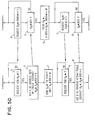
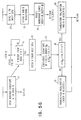
- FIG. 5 is an organizational diagram for FIGS. 5A through 5G.
- FIG. 5B is an organizational diagram for FIGS. 5A through 5G.
- User A wishes to initiate a transaction utilizing the present transaction verification system.
- User A's terminal begins operation as indicated in block 1 and a determination is made as to whether a transaction is being initiated. If not, the system proceeds to block 2 where a test is made as to whether a transaction request has been received, and if so the operation sequence would branch downwardly into the "receiver" mode. It will be noted, as indicated in the figure, that the operational procedure would be the same from this point on, as is shown for User B. Thus, the "originator"/"receiver" modes are both present in every terminal although only one would be operative during any given transaction.
- the system proceeds to block 9 wherein the user key K B is provided to User B's DES Module which is a key-controlled block cipher cryptographic unit as described previously and similarly the message pair (X,Y) is made available to the encryption unit as the data to be encrypted, and the entire message pair (X,Y) is encrypted under User B's key to produce the message U, which is defined in line 10 of the Definition Table.
- the system then proceeds to block 10 wherein User B transmits to the Host CPU the message A, B, U.
- the portion of the message defined as A, B defines the originator and recipient of the message which is being sent to the CPU for verification.
- the data A and B provide entries to the * Table where the keys * * K A and K B are stored.
- a test is made of the "busy" status of Verify Unit and if "busy” the system will wait until it is not busy and can proceed to block 4 wherein a request for a new transaction verification operation (RQVRF) is sent to the Verify Unit. Control then transfers to the Verify Unit, specifically, block 2. It will be assumed that the start block causes the requisite handshake control output lines to be appropriately set to zero. Upon the receipt of a "request verification” signal the system proceeds to block 3 in the Verify Unit sequence wherein the "busy" flag at the Verify Unit handshake control outputs is set to a "1" which will advise the CPU that the Verify Unit is "busy” in case it should attempt to request a further transaction verification operation.
- RQVRF transaction verification operation
- the previously received value A identifying the originator of the transaction, is used as an address into the * Table and * the data referred to as K A is accessed and KA * RDY handshake line proceeding to the Verify Unit input handshake control is set to a one, indicating * * to the Verify Unit, that the K A data is ready.
- the K A data is transmitted to the Verify Unit and the KA * RDY handshake line is reset to a zero. At this point control transfers back to block 5 of the Verify Unit sequence.
- Block 5 acknowledges the signal, which causes K A to be read into the A register of the Verify Unit and at this point the RQKA * handshake control output line is reset to zero.
- blocks 7, 8 and 9 of the Verify Unit are essentially identical functionally to blocks 4, 5 and 6 of the Verify Unit with the exception that at the end of * this sequence the data K B is now loaded in the B register of the Verify Unit.
- blocks 8, 9 and 10 in the Host CPU sequence are essentially identical to blocks 5, 6 and 7 thereof with the exception that in * this case the data K B is extracted from the * Table and sent to the Verify Unit.
- the system will proceed to block 10 of the Verify Unit sequence wherein a request is made for the data U which has been stored in the Host CPU memory.
- the handshake control RQU is set to a "1" in the output from the Verify Unit and control transfers back to block 11 of the Host CPU which receives the request.
- the Verify Unit waits until the CPU is ready to send U. When the CPU is ready, it then sets URDY line to 1. In the meanwhile the Verify Unit is waiting and monitoring the URDY line. It is assumed here that U is available and accordingly the handshake control indicated as URDY is set to a one which informs the Verify Unit that the message segment U is available for transmission.
- Block 13 of the Host CPU sequence the message segment U is sent to the Verify Unit and the URDY handshake input line to the Verify Unit is reset to a "zero".
- Block 12 of the Verify Unit the message segment U is read from the Host CPU and stored in the RWM of the Verify Unit and the handshake control output line RQU is reset to a "zero”.
- Block 13 of the Verify Unit causes the originator key K A to be deciphered from the * * value K A currently stored in the A register by transmitting K A plus the system master key K HV to the DES Unit whereby User A's encryption key K A is decrypted and stored in the A register for further verification operations.
- the system then proceeds to block 14 where precisely the same operation is * performed for the value K to produce the User B's key, K B , which is stored in the B register.
- the Verify Unit sequence proceeds to block 15 wherein the message U is deciphered under the user key K B and the results are stored in the RWM as U.
- the definition or specification of the data content of the deciphered message U is shown in block 15A and is indicated as U 1 and U 2 which are the first n bytes of the deciphered message and the last 8 bytes of the deciphered message respectively. As will be remembered from the prior definition of the signature, these last 8 bytes or U 2 , are presumptively equal to the signature of User A.
- the Verify Unit now causes the signature of User A under key K A to be constructed at this time utilizing the value U 1 as the data source for the signature.
- blocks 18 and 19 cause a complex message defined as the signature V of U or of ⁇ U under the key k B to be generated.
- the signature V is derived utilizing ⁇ U, the logical complement of U or U as the data source.
- the VRDY handshake line from the handshake control outputs of the Verify Unit is set to a "1" which when detected by the Host CPU activates block 14 of the Host CPU which is informed that the signature V is now ready in the Verify Unit.
- V is requested by setting the handshake control input line RQV to a "1" which actuates block 21 in the Verify Unit.
- the message V is sent from the Verify Unit to the CPU and in block 17 of the CPU's sequence the derived signature V is transmitted directly to User B. This terminates the Host CPU operational sequence for this particular verification request and in effect returns same to the state of block 1.
- block 23 and block 24 are merely clearing and resetting operations for removing stale data from the operational registers and resetting the various handshake lines to their standby or wait condition in block 2.
- RWM Read/Write Memory
- RWMAG Read/Write Memory Address Generator
- IMPX Input Multiplexer DES Unit: Data Encryption Standard Unit (Ci): i-th Control Point, activation of RESET: RWMAG set to zero
- LOAD Contents of internal storage register are loaded into
- RWMAG COUNT Enables RWMAG to count
- U/D Up (1)/down(O) count-mode control for RWMAG
- SAVE Contents of RWMAG are saved in internal storage register
- CLEAR All handshake control output lines are cleared to zero
- Steps 16.8 and 16.9 are repeated as necessary until a total of N bytes of data (U 1 ) have been processed from RWM. (A short block, if one occurs, and chaining linkages are handled internally by the DES Unit).
- Steps 18.8 and 18.9 are repeated as necessary until N-3 bytes of U data have been processed. (A short block, if one occurs, and chaining linkages are handled internally by the DES Unit).
- Steps 19.8 and 19.9 are repeated as necessary until N+8 bytes of U data have been processed. (A short block, if one occurs, and chaining linkages are handled internally by the DES Unit).
- the system assures virtually a foolproof method of guaranteeing both the identity of the sender or originator of a message insofar as a receiver is concerned, while at the same time guaranteeing the i tegrity of the message to the original sender.
- This allows the utilization of long distance telecommunications facilities for the real time completion of transactions which could only be performed in the past utiJizing much more time consuming and conventional methods, such as electronic mail or by actually having people meet to consummate various transactions.
- legally binding contracts could be effected by having both parties to the contract send an additional data or message portion to the other, each having his own unique signature appended thereto, plus each party to the transaction would have his own resident copy of the contract, electronically signed by the other party and wherein the actual wording of the contract would be verifiable at any time in the future, if a conflict arose and allegations were made that the wordings were at variance.
- the system could also have applicability for such a commercial purpose as telephone ordering (i.e., local terminal) by an individual from a large, centrally located store, wherein both ordering and funds transfer could be handled in a highly reliable manner utilizing various aspects of the presently disclosed system.
- telephone ordering i.e., local terminal
- both ordering and funds transfer could be handled in a highly reliable manner utilizing various aspects of the presently disclosed system.
- the present system prevents masquerading by any party (not having access to the secret keys) even though he has access to eavesdropping equipment over the line. It also prevents the gathering of any useful information via eavesdropping which could be subsequently used to bypass the present security system.
- the only actual data which could be obtained by eavesdropper which might or might not prove useful would be the actual message content of the unencrypted portions of the message, i.e., from User A to the Host CPU during the initialization portion of the procedure. It will be readily understood that this could be easily avoided by utilizing further cryptographic transmission security via the system hardware already present in the system.
Landscapes
- Engineering & Computer Science (AREA)
- Computer Security & Cryptography (AREA)
- Computer Networks & Wireless Communication (AREA)
- Signal Processing (AREA)
- Physics & Mathematics (AREA)
- General Physics & Mathematics (AREA)
- Theoretical Computer Science (AREA)
- Business, Economics & Management (AREA)
- Accounting & Taxation (AREA)
- Finance (AREA)
- Strategic Management (AREA)
- General Business, Economics & Management (AREA)
- Computer And Data Communications (AREA)
- Data Exchanges In Wide-Area Networks (AREA)
- Communication Control (AREA)
Applications Claiming Priority (2)
| Application Number | Priority Date | Filing Date | Title |
|---|---|---|---|
| US53589 | 1979-06-29 | ||
| US06/053,589 US4264782A (en) | 1979-06-29 | 1979-06-29 | Method and apparatus for transaction and identity verification |
Publications (2)
| Publication Number | Publication Date |
|---|---|
| EP0021401A1 true EP0021401A1 (fr) | 1981-01-07 |
| EP0021401B1 EP0021401B1 (fr) | 1984-03-14 |
Family
ID=21985284
Family Applications (1)
| Application Number | Title | Priority Date | Filing Date |
|---|---|---|---|
| EP80103552A Expired EP0021401B1 (fr) | 1979-06-29 | 1980-06-24 | Procédé et dispositif de vérification de transaction et d'identité |
Country Status (6)
| Country | Link |
|---|---|
| US (1) | US4264782A (fr) |
| EP (1) | EP0021401B1 (fr) |
| JP (1) | JPS567163A (fr) |
| CA (1) | CA1121014A (fr) |
| DE (1) | DE3066956D1 (fr) |
| IT (1) | IT1149970B (fr) |
Cited By (4)
| Publication number | Priority date | Publication date | Assignee | Title |
|---|---|---|---|---|
| EP0043027A1 (fr) * | 1980-07-02 | 1982-01-06 | International Business Machines Corporation | Procédé et système électronique de vérification d'une signature |
| FR2514593A1 (fr) * | 1981-10-09 | 1983-04-15 | Cii Honeywell Bull | Procede et dispositif pour authentifier la signature d'un message signe |
| DE3439120A1 (de) * | 1984-10-25 | 1986-05-07 | Philips Kommunikations Industrie AG, 8500 Nürnberg | Verfahren zur identifizierung einer teilnehmerstation eines fernmeldenetzes |
| US4720859A (en) * | 1981-04-08 | 1988-01-19 | U.S. Philips Corporation | Method and system for the mutual encyphered indentification between data communicating stations and stations for use with such method and system |
Families Citing this family (152)
| Publication number | Priority date | Publication date | Assignee | Title |
|---|---|---|---|---|
| FR2477344B1 (fr) * | 1980-03-03 | 1986-09-19 | Bull Sa | Procede et systeme de transmission d'informations confidentielles |
| US4411017A (en) * | 1980-03-14 | 1983-10-18 | Harris Corporation | Secure mobile telephone system |
| FR2480539B1 (fr) * | 1980-04-09 | 1985-09-13 | Cii Honeywell Bull | Procede et systeme de transmission de messages signes |
| US4386233A (en) * | 1980-09-29 | 1983-05-31 | Smid Miles E | Crytographic key notarization methods and apparatus |
| US4393269A (en) * | 1981-01-29 | 1983-07-12 | International Business Machines Corporation | Method and apparatus incorporating a one-way sequence for transaction and identity verification |
| US5007083A (en) * | 1981-03-17 | 1991-04-09 | Constant James N | Secure computer |
| US4438824A (en) * | 1981-04-22 | 1984-03-27 | Siemens Corporation | Apparatus and method for cryptographic identity verification |
| JPS57176475A (en) * | 1981-04-24 | 1982-10-29 | Hitachi Ltd | Transaction processing system |
| US4654792A (en) * | 1981-05-26 | 1987-03-31 | Corban International, Ltd. | Data processing system including data input authorization |
| US4433207A (en) * | 1981-09-10 | 1984-02-21 | Best Robert M | Cryptographic decoder for computer programs |
| US4458109A (en) * | 1982-02-05 | 1984-07-03 | Siemens Corporation | Method and apparatus providing registered mail features in an electronic communication system |
| EP0118995A1 (fr) * | 1983-02-22 | 1984-09-19 | BRITISH TELECOMMUNICATIONS public limited company | Production de clés d'identification |
| JPS59226935A (ja) * | 1983-06-01 | 1984-12-20 | アメリカン・エクスプレス・カンパニ− | 携帯用情報カ−ドの保護装置 |
| US4658093A (en) * | 1983-07-11 | 1987-04-14 | Hellman Martin E | Software distribution system |
| US4641347A (en) * | 1983-07-18 | 1987-02-03 | Pitney Bowes Inc. | System for printing encrypted messages with a character generator and bar-code representation |
| US4637051A (en) * | 1983-07-18 | 1987-01-13 | Pitney Bowes Inc. | System having a character generator for printing encrypted messages |
| US4641346A (en) * | 1983-07-21 | 1987-02-03 | Pitney Bowes Inc. | System for the printing and reading of encrypted messages |
| US4660221A (en) * | 1983-07-18 | 1987-04-21 | Pitney Bowes Inc. | System for printing encrypted messages with bar-code representation |
| DE3485609D1 (de) * | 1983-07-18 | 1992-04-30 | Pitney Bowes Inc | Vorrichtung zum drucken und lesen von verschluesselten mitteilungen. |
| US4926480A (en) * | 1983-08-22 | 1990-05-15 | David Chaum | Card-computer moderated systems |
| US4652990A (en) * | 1983-10-27 | 1987-03-24 | Remote Systems, Inc. | Protected software access control apparatus and method |
| US4980826A (en) * | 1983-11-03 | 1990-12-25 | World Energy Exchange Corporation | Voice actuated automated futures trading exchange |
| US4903201A (en) * | 1983-11-03 | 1990-02-20 | World Energy Exchange Corporation | Automated futures trading exchange |
| US4598367A (en) * | 1983-11-09 | 1986-07-01 | Financial Design Systems, Inc. | Financial quotation system using synthesized speech |
| US4649266A (en) * | 1984-03-12 | 1987-03-10 | Pitney Bowes Inc. | Method and apparatus for verifying postage |
| US4672572A (en) * | 1984-05-21 | 1987-06-09 | Gould Inc. | Protector system for computer access and use |
| JPS619052A (ja) * | 1984-06-25 | 1986-01-16 | Toshiba Corp | 通信ネツトワ−クシステム |
| US4652698A (en) * | 1984-08-13 | 1987-03-24 | Ncr Corporation | Method and system for providing system security in a remote terminal environment |
| US5136648A (en) * | 1985-02-19 | 1992-08-04 | Octel Communications Corporation | Message storage security system |
| GB8524455D0 (en) * | 1985-10-03 | 1985-11-06 | Isolation Systems Ltd | Monitoring activity of peripheral devices |
| US4638356A (en) * | 1985-03-27 | 1987-01-20 | General Instrument Corporation | Apparatus and method for restricting access to a communication network |
| US4775246A (en) * | 1985-04-17 | 1988-10-04 | Pitney Bowes Inc. | System for detecting unaccounted for printing in a value printing system |
| US4733345A (en) * | 1985-07-29 | 1988-03-22 | Anderson Paul D | Computer-telephone security device |
| US4885777A (en) * | 1985-09-04 | 1989-12-05 | Hitachi, Ltd. | Electronic transaction system |
| US4891838A (en) * | 1985-11-04 | 1990-01-02 | Dental Data Service, Inc. | Computer accessing system |
| US4780828A (en) * | 1985-12-26 | 1988-10-25 | Pitney Bowes Inc. | Mailing system with random sampling of postage |
| US4850018A (en) * | 1986-07-01 | 1989-07-18 | Baker Industries, Inc. | Security system with enhanced protection against compromising |
| US4916738A (en) * | 1986-11-05 | 1990-04-10 | International Business Machines Corp. | Remote access terminal security |
| US4797920A (en) * | 1987-05-01 | 1989-01-10 | Mastercard International, Inc. | Electronic funds transfer system with means for verifying a personal identification number without pre-established secret keys |
| US4853961A (en) * | 1987-12-18 | 1989-08-01 | Pitney Bowes Inc. | Reliable document authentication system |
| US4994985A (en) * | 1987-12-23 | 1991-02-19 | International Business Machines Corporation | Methods of appending a reply in an electronic mail system |
| AU3560989A (en) * | 1988-03-16 | 1989-10-05 | David Chaum | One-show blind signature systems |
| US4914698A (en) * | 1988-03-16 | 1990-04-03 | David Chaum | One-show blind signature systems |
| AU3594189A (en) * | 1988-06-21 | 1990-01-04 | Amdahl Corporation | Controlling the initiation of logical systems in a data processing system with logical processor facility |
| US4926481A (en) * | 1988-12-05 | 1990-05-15 | The United States Of America As Represented By The Administrator Of The National Aeronautics And Space Administration | Computer access security code system |
| US5093918A (en) * | 1988-12-22 | 1992-03-03 | International Business Machines Corporation | System using independent attribute lists to show status of shared mail object among respective users |
| US5095421A (en) * | 1989-08-17 | 1992-03-10 | International Business Machines Corporation | Transaction processing facility within an operating system environment |
| US5001752A (en) * | 1989-10-13 | 1991-03-19 | Fischer Addison M | Public/key date-time notary facility |
| US5136643A (en) * | 1989-10-13 | 1992-08-04 | Fischer Addison M | Public/key date-time notary facility |
| CA2076366C (fr) * | 1990-03-02 | 1998-05-26 | Michel J. Remion | Appareil et methode d'interface pour les telecommunications |
| US5163098A (en) * | 1990-09-06 | 1992-11-10 | Dahbura Abbud S | System for preventing fraudulent use of credit card |
| DE69022424T2 (de) * | 1990-11-09 | 1996-03-28 | Ibm | Nichtablehnung in Rechnernetzwerken. |
| US5191613A (en) * | 1990-11-16 | 1993-03-02 | Graziano James M | Knowledge based system for document authentication |
| US5231570A (en) * | 1990-12-11 | 1993-07-27 | Lee Gerritt S K | Credit verification system |
| US5182554A (en) * | 1990-12-18 | 1993-01-26 | International Business Machines Corporation | Third party evavesdropping for bus control |
| JPH0553150U (ja) * | 1991-12-19 | 1993-07-13 | ヒロセ電機株式会社 | 電気コネクタ構造 |
| US10361802B1 (en) | 1999-02-01 | 2019-07-23 | Blanding Hovenweep, Llc | Adaptive pattern recognition based control system and method |
| DE59305159D1 (de) * | 1992-04-09 | 1997-02-27 | Siemens Ag | Verfahren zum erkennen einer unberechtigten wiedereinspielung beliebiger von einem sender zu einem empfänger übertragener daten |
| US5276735A (en) * | 1992-04-17 | 1994-01-04 | Secure Computing Corporation | Data enclave and trusted path system |
| JPH07507891A (ja) * | 1992-06-12 | 1995-08-31 | ザ、ダウ、ケミカル、カンパニー | インテリジェントプロセス制御通信システムおよび方法 |
| ES2162659T3 (es) * | 1992-06-12 | 2002-01-01 | Dow Chemical Co | Sistema de comunicacion cabeza-cola seguro y metodo para el procedimiento en ordenadores de control. |
| US5596718A (en) * | 1992-07-10 | 1997-01-21 | Secure Computing Corporation | Secure computer network using trusted path subsystem which encrypts/decrypts and communicates with user through local workstation user I/O devices without utilizing workstation processor |
| US5267314A (en) * | 1992-11-17 | 1993-11-30 | Leon Stambler | Secure transaction system and method utilized therein |
| US5964835A (en) * | 1992-12-17 | 1999-10-12 | Tandem Computers Incorporated | Storage access validation to data messages using partial storage address data indexed entries containing permissible address range validation for message source |
| JP3218776B2 (ja) * | 1993-03-03 | 2001-10-15 | 松下電器産業株式会社 | 電子レジスタ |
| US5491752A (en) * | 1993-03-18 | 1996-02-13 | Digital Equipment Corporation, Patent Law Group | System for increasing the difficulty of password guessing attacks in a distributed authentication scheme employing authentication tokens |
| AU1674795A (en) * | 1993-12-17 | 1995-07-03 | Quintet, Incorporated | Method of automated signature verification |
| DE4406602C2 (de) * | 1994-03-01 | 2000-06-29 | Deutsche Telekom Ag | Sicherheitssystem zum Identifizieren und Authentisieren von Kommunikationspartnern |
| US20080200225A1 (en) * | 1994-03-11 | 2008-08-21 | Walker Jay S | Methods and apparatus for facilitating game play and generating an authenticatable audit-trail |
| RU95103479A (ru) * | 1994-03-11 | 1996-12-27 | Уолкер Эссет Мэнеджмент Лимитед Партнершип (US) | Игровая система, игровой компьютер, способ проведения игры, лотереи с участием игрока |
| US5694546A (en) * | 1994-05-31 | 1997-12-02 | Reisman; Richard R. | System for automatic unattended electronic information transport between a server and a client by a vendor provided transport software with a manifest list |
| US5734819A (en) * | 1994-10-12 | 1998-03-31 | International Business Machines Corporation | Method and apparatus for validating system operation |
| US7743248B2 (en) * | 1995-01-17 | 2010-06-22 | Eoriginal, Inc. | System and method for a remote access service enabling trust and interoperability when retrieving certificate status from multiple certification authority reporting components |
| US5644710A (en) * | 1995-02-13 | 1997-07-01 | Eta Technologies Corporation | Personal access management system |
| US5805810A (en) * | 1995-04-27 | 1998-09-08 | Maxwell; Robert L. | Apparatus and methods for converting an electronic mail to a postal mail at the receiving station |
| US5884277A (en) * | 1995-05-01 | 1999-03-16 | Vinod Khosla | Process for issuing coupons for goods or services to purchasers at non-secure terminals |
| CA2175406C (fr) † | 1995-05-02 | 2002-04-09 | Leon A. Pintsov | Systeme en boucle fermee de facturation et de paiement par courrier a base de transactions avec paiement du service de livraison par l'intermediaire d'une tierce partie active parl'envoi d'un avis |
| US5887060A (en) * | 1995-06-07 | 1999-03-23 | Digital River, Inc. | Central database system for automatic software program sales |
| US5872917A (en) * | 1995-06-07 | 1999-02-16 | America Online, Inc. | Authentication using random challenges |
| US5883954A (en) * | 1995-06-07 | 1999-03-16 | Digital River, Inc. | Self-launching encrypted try before you buy software distribution system |
| US5903647A (en) * | 1995-06-07 | 1999-05-11 | Digital River, Inc. | Self-launching encrypted digital information distribution system |
| US5883955A (en) * | 1995-06-07 | 1999-03-16 | Digital River, Inc. | On-line try before you buy software distribution system |
| US5870543A (en) * | 1995-06-07 | 1999-02-09 | Digital River, Inc. | System for preventing unauthorized copying of active software |
| WO1996041449A1 (fr) * | 1995-06-07 | 1996-12-19 | Digital River, Inc. | Systeme de distribution et de vente a l'essai de logiciels |
| US5671283A (en) * | 1995-06-08 | 1997-09-23 | Wave Systems Corp. | Secure communication system with cross linked cryptographic codes |
| US6023619A (en) * | 1995-12-22 | 2000-02-08 | Airtouch Communications, Inc. | Method and apparatus for exchanging RF signatures between cellular telephone systems |
| AU1690597A (en) * | 1996-01-11 | 1997-08-01 | Mitre Corporation, The | System for controlling access and distribution of digital property |
| US5956409A (en) * | 1996-04-29 | 1999-09-21 | Quintet, Inc. | Secure application of seals |
| US20030195846A1 (en) | 1996-06-05 | 2003-10-16 | David Felger | Method of billing a purchase made over a computer network |
| US7555458B1 (en) | 1996-06-05 | 2009-06-30 | Fraud Control System.Com Corporation | Method of billing a purchase made over a computer network |
| US8229844B2 (en) | 1996-06-05 | 2012-07-24 | Fraud Control Systems.Com Corporation | Method of billing a purchase made over a computer network |
| JP3540511B2 (ja) * | 1996-06-18 | 2004-07-07 | 株式会社東芝 | 電子署名検証装置 |
| US6058301A (en) | 1996-11-27 | 2000-05-02 | Airtouch Communications, Inc. | Cellular fraud prevention using selective roaming |
| US6145004A (en) * | 1996-12-02 | 2000-11-07 | Walsh; Stephen Kelly | Intranet network system |
| US5991401A (en) * | 1996-12-06 | 1999-11-23 | International Business Machines Corporation | Method and system for checking security of data received by a computer system within a network environment |
| US5903878A (en) * | 1997-08-20 | 1999-05-11 | Talati; Kirit K. | Method and apparatus for electronic commerce |
| US6213391B1 (en) * | 1997-09-10 | 2001-04-10 | William H. Lewis | Portable system for personal identification based upon distinctive characteristics of the user |
| FR2768534B1 (fr) * | 1997-09-18 | 1999-12-10 | Neopost Ind | Procede et dispositif de securisation de donnees postales |
| RU2141169C1 (ru) * | 1997-10-30 | 1999-11-10 | Центральный Научно-Исследовательский Институт Связи | Способ передачи и приема с обеспечением подлинности сообщения |
| US7039805B1 (en) * | 1998-05-20 | 2006-05-02 | Messing John H | Electronic signature method |
| US6442692B1 (en) | 1998-07-21 | 2002-08-27 | Arkady G. Zilberman | Security method and apparatus employing authentication by keystroke dynamics |
| US6085321A (en) * | 1998-08-14 | 2000-07-04 | Omnipoint Corporation | Unique digital signature |
| RU2153191C2 (ru) | 1998-09-29 | 2000-07-20 | Закрытое акционерное общество "Алкорсофт" | Способ изготовления вслепую цифровой rsa-подписи и устройство для его реализации (варианты) |
| WO2000025246A1 (fr) * | 1998-10-27 | 2000-05-04 | Receipt.Com, Inc. | Procede et appareil pour effectuer des transactions electroniques |
| RU2157001C2 (ru) | 1998-11-25 | 2000-09-27 | Закрытое акционерное общество "Алкорсофт" | Способ проведения платежей (варианты) |
| AUPP728398A0 (en) * | 1998-11-25 | 1998-12-17 | Commonwealth Of Australia, The | High assurance digital signatures |
| US7617124B1 (en) * | 1998-12-04 | 2009-11-10 | Digital River, Inc. | Apparatus and method for secure downloading of files |
| US7058597B1 (en) * | 1998-12-04 | 2006-06-06 | Digital River, Inc. | Apparatus and method for adaptive fraud screening for electronic commerce transactions |
| US20030195974A1 (en) | 1998-12-04 | 2003-10-16 | Ronning Joel A. | Apparatus and method for scheduling of search for updates or downloads of a file |
| RU2140713C1 (ru) * | 1998-12-28 | 1999-10-27 | Государственное унитарное предприятие Специализированный центр программных систем "Спектр" | Способ блочного криптографического преобразования двоичной информации |
| US6477645B1 (en) | 1999-02-03 | 2002-11-05 | Intel Corporation | Authority and integrity check in systems lacking a public key |
| WO2000051283A1 (fr) | 1999-02-23 | 2000-08-31 | Chao Liu | Procede de chiffrage d'informations de videotexte et de transmission securisee de ces informations via un reseau de communication |
| EP1159799B1 (fr) * | 1999-02-26 | 2006-07-26 | Bitwise Designs, Inc. | Systeme et procédé de gestion de fichiers numeriques et d'imagerie incluant le marquage sécurisé de fichiers |
| FI991134A7 (fi) * | 1999-05-18 | 2000-11-19 | Smarttrust Systems Oy | Ohjelmiston testaus |
| EP1531383A3 (fr) * | 1999-07-30 | 2005-07-27 | Intertrust Technologies Corp. | Procédés et systèmes de fourniture de données de transactions enregistrées au moyen de seuils et de protocole à plusieurs étages |
| WO2001022319A1 (fr) * | 1999-09-20 | 2001-03-29 | Ethentica, Inc. | Arbitrage de confiance dans le domaine de l'authentification cryptographique |
| US6760440B1 (en) * | 1999-12-11 | 2004-07-06 | Honeywell International Inc. | One's complement cryptographic combiner |
| US20010039530A1 (en) * | 2000-01-18 | 2001-11-08 | Annunziata Vincent P. | Trading simulation |
| US8554659B2 (en) | 2000-01-21 | 2013-10-08 | Tradecapture Otc Corp. | System for trading commodities and the like |
| US20080215477A1 (en) | 2000-01-21 | 2008-09-04 | Annunziata Vincent P | System for trading commodities and the like |
| US20040186996A1 (en) * | 2000-03-29 | 2004-09-23 | Gibbs Benjamin K. | Unique digital signature |
| US6678666B1 (en) * | 2000-06-05 | 2004-01-13 | Van W. Boulware | Method of conducting anti-fraud electronic bank security transactions having price-date-time variables and calculating apparatus thereof |
| AU7182701A (en) | 2000-07-06 | 2002-01-21 | David Paul Felsher | Information record infrastructure, system and method |
| US6427912B1 (en) | 2000-08-16 | 2002-08-06 | Coin Acceptors, Inc. | Off-line credit card transaction system and method for vending machines |
| US6725459B2 (en) * | 2001-02-09 | 2004-04-20 | Scientific-Atlanta, Inc. | Descrambling device for use in a conditional access system |
| US7181017B1 (en) | 2001-03-23 | 2007-02-20 | David Felsher | System and method for secure three-party communications |
| US20040197761A1 (en) * | 2001-05-01 | 2004-10-07 | Boehmer Daniel R. | Method for communicating confidential educational information |
| WO2003021476A1 (fr) * | 2001-08-31 | 2003-03-13 | Trac Medical Solutions, Inc. | Systeme pour le traitement interactif de formulaires |
| US20040008368A1 (en) * | 2001-09-07 | 2004-01-15 | Plunkett Michael K | Mailing online operation flow |
| US8005743B2 (en) | 2001-11-13 | 2011-08-23 | Intercontinentalexchange, Inc. | Electronic trading confirmation system |
| US7376235B2 (en) * | 2002-04-30 | 2008-05-20 | Microsoft Corporation | Methods and systems for frustrating statistical attacks by injecting pseudo data into a data system |
| US20030231766A1 (en) * | 2002-05-30 | 2003-12-18 | Bedros Hanounik | Shared control and information bit representing encryption key position selection or new encryption key value |
| US7752116B2 (en) * | 2002-10-30 | 2010-07-06 | Nasdaq Liffe Markets, Llc | Liquidity engine for futures trading exchange |
| US20040103003A1 (en) * | 2002-11-22 | 2004-05-27 | E-Comm Connect, Llc | Method and system for insuring users of electronic trading systems or exchanges and traditional established commodity exchanges against weather-related risks and hazards |
| US9818136B1 (en) | 2003-02-05 | 2017-11-14 | Steven M. Hoffberg | System and method for determining contingent relevance |
| DE10311634A1 (de) * | 2003-03-14 | 2004-09-30 | Authentidate International Ag | Elektronisches Übermitteln von Dokumenten |
| US7853525B2 (en) * | 2003-07-15 | 2010-12-14 | Microsoft Corporation | Electronic draft capture |
| JP2006035849A (ja) * | 2004-06-25 | 2006-02-09 | Ricoh Co Ltd | ネットワーク装置 |
| US8065525B2 (en) * | 2004-09-22 | 2011-11-22 | Bekad Mgmt. Ii, Llc | Device with built-in user authentication and method for user authentication and identity theft protection |
| US8874477B2 (en) | 2005-10-04 | 2014-10-28 | Steven Mark Hoffberg | Multifactorial optimization system and method |
| US7448008B2 (en) * | 2006-08-29 | 2008-11-04 | International Business Machines Corporation | Method, system, and program product for automated verification of gating logic using formal verification |
| US7669100B2 (en) * | 2007-03-08 | 2010-02-23 | Freescale Semiconductor, Inc. | System and method for testing and providing an integrated circuit having multiple modules or submodules |
| US8200959B2 (en) * | 2007-06-28 | 2012-06-12 | Cisco Technology, Inc. | Verifying cryptographic identity during media session initialization |
| US8417942B2 (en) * | 2007-08-31 | 2013-04-09 | Cisco Technology, Inc. | System and method for identifying encrypted conference media traffic |
| US20090076904A1 (en) * | 2007-09-17 | 2009-03-19 | Frank David Serena | Embedding digital values for digital exchange |
| US20090169001A1 (en) * | 2007-12-28 | 2009-07-02 | Cisco Technology, Inc. | System and Method for Encryption and Secure Transmission of Compressed Media |
| US8837598B2 (en) * | 2007-12-28 | 2014-09-16 | Cisco Technology, Inc. | System and method for securely transmitting video over a network |
| US8924733B2 (en) * | 2010-06-14 | 2014-12-30 | International Business Machines Corporation | Enabling access to removable hard disk drives |
| US10503888B2 (en) | 2012-03-16 | 2019-12-10 | Traitware, Inc. | Authentication system |
| US10164974B2 (en) | 2013-03-19 | 2018-12-25 | Traitware, Inc. | Authentication system |
| US11341573B1 (en) * | 2016-02-04 | 2022-05-24 | United Services Automobile Association (Usaa) | Using voice biometrics for trade of financial instruments |
| US10713348B2 (en) * | 2017-04-14 | 2020-07-14 | Microchip Technology Incorporated | System, method, and apparatus for touch panel security |
Citations (1)
| Publication number | Priority date | Publication date | Assignee | Title |
|---|---|---|---|---|
| GB2008363A (en) * | 1977-11-17 | 1979-05-31 | Burroughs Corp | Communications line authentication device |
Family Cites Families (3)
| Publication number | Priority date | Publication date | Assignee | Title |
|---|---|---|---|---|
| US4182933A (en) * | 1969-02-14 | 1980-01-08 | The United States Of America As Represented By The Secretary Of The Army | Secure communication system with remote key setting |
| US4123747A (en) * | 1977-05-20 | 1978-10-31 | International Business Machines Corporation | Identity verification method and apparatus |
| US4186871A (en) * | 1978-03-01 | 1980-02-05 | International Business Machines Corporation | Transaction execution system with secure encryption key storage and communications |
-
1979
- 1979-06-29 US US06/053,589 patent/US4264782A/en not_active Expired - Lifetime
-
1980
- 1980-04-14 CA CA000349762A patent/CA1121014A/fr not_active Expired
- 1980-05-20 JP JP6604380A patent/JPS567163A/ja active Granted
- 1980-06-03 IT IT22510/80A patent/IT1149970B/it active
- 1980-06-24 EP EP80103552A patent/EP0021401B1/fr not_active Expired
- 1980-06-24 DE DE8080103552T patent/DE3066956D1/de not_active Expired
Patent Citations (1)
| Publication number | Priority date | Publication date | Assignee | Title |
|---|---|---|---|---|
| GB2008363A (en) * | 1977-11-17 | 1979-05-31 | Burroughs Corp | Communications line authentication device |
Non-Patent Citations (3)
| Title |
|---|
| 1979 NATIONAL COMPUTER CONFERENCE, AFIPS Conference Proceedings, Vol. 48, June 4-7, 1979 New York, USA KLINE et al. "Public key vs.conventional key encryption", pages 831-837 * Page 834, left-hand column, lines 37-47; page 835, left-hand column, line 52 to right-hand column, line 2; page 836, right-hand column, lines 16-20 * * |
| ERICSSON TECHNICS, Vol. 34, No. 2, 1978 Stockholm, SE BLOM et al. "Encryption methods in data networks", pages 74-105. * Page 85, lines 1-9; page 87, lines 2-5; lines 8-20 * * |
| SEVENTEENTH IEEE COMPUTER SOCIETY INTERNATIONAL CONFERENCE; Proceedings Computer Communications Networks; September 5-8, 1978, New York, USA SENDROW: "Key management in EFT networks", pages 351-354. * Page 351, right-hand column, lines 6-32; page 353, left-hand column, lines 10-37 * * |
Cited By (6)
| Publication number | Priority date | Publication date | Assignee | Title |
|---|---|---|---|---|
| EP0043027A1 (fr) * | 1980-07-02 | 1982-01-06 | International Business Machines Corporation | Procédé et système électronique de vérification d'une signature |
| US4720859A (en) * | 1981-04-08 | 1988-01-19 | U.S. Philips Corporation | Method and system for the mutual encyphered indentification between data communicating stations and stations for use with such method and system |
| FR2514593A1 (fr) * | 1981-10-09 | 1983-04-15 | Cii Honeywell Bull | Procede et dispositif pour authentifier la signature d'un message signe |
| EP0077238A1 (fr) * | 1981-10-09 | 1983-04-20 | Bull S.A. | Procédé et dispositif pour authentifier la signature d'un message signé |
| US4656474A (en) * | 1981-10-09 | 1987-04-07 | Compagnie Internationale Pour L'informatique Cii-Honeywell Bull (Societe Anonyme) | Process and apparatus for authenticating the signature of a signed message |
| DE3439120A1 (de) * | 1984-10-25 | 1986-05-07 | Philips Kommunikations Industrie AG, 8500 Nürnberg | Verfahren zur identifizierung einer teilnehmerstation eines fernmeldenetzes |
Also Published As
| Publication number | Publication date |
|---|---|
| JPS619783B2 (fr) | 1986-03-26 |
| JPS567163A (en) | 1981-01-24 |
| CA1121014A (fr) | 1982-03-30 |
| US4264782A (en) | 1981-04-28 |
| DE3066956D1 (en) | 1984-04-19 |
| EP0021401B1 (fr) | 1984-03-14 |
| IT1149970B (it) | 1986-12-10 |
| IT8022510A0 (it) | 1980-06-03 |
Similar Documents
| Publication | Publication Date | Title |
|---|---|---|
| EP0021401B1 (fr) | Procédé et dispositif de vérification de transaction et d'identité | |
| US4326098A (en) | High security system for electronic signature verification | |
| EP0482371B1 (fr) | Procédé et dispositif de commande de l'usage d'une clé publique basé sur le degré d'intégrité de la clé | |
| US5164988A (en) | Method to establish and enforce a network cryptographic security policy in a public key cryptosystem | |
| EP0292790B1 (fr) | Commande de l'utilisation de clés cryptographiques par des valeurs de commande établies dans une station de génération | |
| JP2746352B2 (ja) | 遠隔位置に設置したコンピュータによる通信のための機密防護通信システム及び方法 | |
| EP4465588A1 (fr) | Procédé, dispositif et système de transmission de clé quantique | |
| US5935248A (en) | Security level control apparatus and method for a network securing communications between parties without presetting the security level | |
| US4393269A (en) | Method and apparatus incorporating a one-way sequence for transaction and identity verification | |
| CN107172056A (zh) | 一种信道安全确定方法、装置、系统、客户端及服务器 | |
| JPS584476A (ja) | 端末接続暗号方法およびその装置 | |
| CN1954308A (zh) | 安全信息传输的系统和方法 | |
| CN103714642A (zh) | 密钥下载方法、管理方法、下载管理方法及装置和系统 | |
| CN101815091A (zh) | 密码提供设备、密码认证系统和密码认证方法 | |
| CN113014380B (zh) | 文件数据的密码管理方法、装置、计算机设备及存储介质 | |
| CN108323230B (zh) | 一种传输密钥的方法、接收终端和分发终端 | |
| CN111583482A (zh) | 一种基于二维码的门禁控制系统及其控制方法 | |
| US20100005519A1 (en) | System and method for authenticating one-time virtual secret information | |
| CN112422280A (zh) | 人机控制交互方法、交互系统、计算机设备及存储介质 | |
| CN201717885U (zh) | 密码提供设备和密码认证系统 | |
| CN110912683B (zh) | 密码存储方法及装置、密码验证方法及装置 | |
| CN114500064A (zh) | 一种通信安全验证方法、装置、存储介质及电子设备 | |
| JPS63161745A (ja) | 暗号化通信用端末装置 | |
| JP3176610B2 (ja) | パスワード管理方式 | |
| CN114172692A (zh) | 一种终端接入物联网的安全认证方法 |
Legal Events
| Date | Code | Title | Description |
|---|---|---|---|
| PUAI | Public reference made under article 153(3) epc to a published international application that has entered the european phase |
Free format text: ORIGINAL CODE: 0009012 |
|
| AK | Designated contracting states |
Designated state(s): DE FR GB |
|
| 17P | Request for examination filed |
Effective date: 19810616 |
|
| GRAA | (expected) grant |
Free format text: ORIGINAL CODE: 0009210 |
|
| AK | Designated contracting states |
Designated state(s): DE FR GB |
|
| REF | Corresponds to: |
Ref document number: 3066956 Country of ref document: DE Date of ref document: 19840419 |
|
| ET | Fr: translation filed | ||
| PLBE | No opposition filed within time limit |
Free format text: ORIGINAL CODE: 0009261 |
|
| PLAA | Information modified related to event that no opposition was filed |
Free format text: ORIGINAL CODE: 0009299DELT |
|
| STAA | Information on the status of an ep patent application or granted ep patent |
Free format text: STATUS: NO OPPOSITION FILED WITHIN TIME LIMIT |
|
| 26N | No opposition filed | ||
| PGFP | Annual fee paid to national office [announced via postgrant information from national office to epo] |
Ref country code: FR Payment date: 19900529 Year of fee payment: 11 |
|
| PGFP | Annual fee paid to national office [announced via postgrant information from national office to epo] |
Ref country code: DE Payment date: 19900707 Year of fee payment: 11 |
|
| PGFP | Annual fee paid to national office [announced via postgrant information from national office to epo] |
Ref country code: GB Payment date: 19910528 Year of fee payment: 12 |
|
| PG25 | Lapsed in a contracting state [announced via postgrant information from national office to epo] |
Ref country code: FR Effective date: 19920228 |
|
| PG25 | Lapsed in a contracting state [announced via postgrant information from national office to epo] |
Ref country code: DE Effective date: 19920401 |
|
| REG | Reference to a national code |
Ref country code: FR Ref legal event code: ST |
|
| PG25 | Lapsed in a contracting state [announced via postgrant information from national office to epo] |
Ref country code: GB Effective date: 19920624 |
|
| GBPC | Gb: european patent ceased through non-payment of renewal fee |
Effective date: 19920624 |