EP0022332A1 - Industrieroboter - Google Patents
Industrieroboter Download PDFInfo
- Publication number
- EP0022332A1 EP0022332A1 EP80302143A EP80302143A EP0022332A1 EP 0022332 A1 EP0022332 A1 EP 0022332A1 EP 80302143 A EP80302143 A EP 80302143A EP 80302143 A EP80302143 A EP 80302143A EP 0022332 A1 EP0022332 A1 EP 0022332A1
- Authority
- EP
- European Patent Office
- Prior art keywords
- arm
- rotative
- industrial robot
- finger
- robot according
- Prior art date
- Legal status (The legal status is an assumption and is not a legal conclusion. Google has not performed a legal analysis and makes no representation as to the accuracy of the status listed.)
- Granted
Links
Images


Classifications
-
- B—PERFORMING OPERATIONS; TRANSPORTING
- B23—MACHINE TOOLS; METAL-WORKING NOT OTHERWISE PROVIDED FOR
- B23Q—DETAILS, COMPONENTS, OR ACCESSORIES FOR MACHINE TOOLS, e.g. ARRANGEMENTS FOR COPYING OR CONTROLLING; MACHINE TOOLS IN GENERAL CHARACTERISED BY THE CONSTRUCTION OF PARTICULAR DETAILS OR COMPONENTS; COMBINATIONS OR ASSOCIATIONS OF METAL-WORKING MACHINES, NOT DIRECTED TO A PARTICULAR RESULT
- B23Q7/00—Arrangements for handling work specially combined with or arranged in, or specially adapted for use in connection with, machine tools, e.g. for conveying, loading, positioning, discharging, sorting
- B23Q7/04—Arrangements for handling work specially combined with or arranged in, or specially adapted for use in connection with, machine tools, e.g. for conveying, loading, positioning, discharging, sorting by means of grippers
- B23Q7/046—Handling workpieces or tools
-
- B—PERFORMING OPERATIONS; TRANSPORTING
- B25—HAND TOOLS; PORTABLE POWER-DRIVEN TOOLS; MANIPULATORS
- B25J—MANIPULATORS; CHAMBERS PROVIDED WITH MANIPULATION DEVICES
- B25J9/00—Program-controlled manipulators
-
- B—PERFORMING OPERATIONS; TRANSPORTING
- B25—HAND TOOLS; PORTABLE POWER-DRIVEN TOOLS; MANIPULATORS
- B25J—MANIPULATORS; CHAMBERS PROVIDED WITH MANIPULATION DEVICES
- B25J9/00—Program-controlled manipulators
- B25J9/02—Program-controlled manipulators characterised by movement of the arms, e.g. cartesian coordinate type
- B25J9/04—Program-controlled manipulators characterised by movement of the arms, e.g. cartesian coordinate type by rotating at least one arm, excluding the head movement itself, e.g. cylindrical coordinate type or polar coordinate type
- B25J9/045—Polar coordinate type
Definitions
- This invention relates to industrial robots.
- Industrial robots are often employed in machine tool operation and are adapted to exchange tools and workpieces so that the machining operation can proceed in a fully automatic manner.
- Industrial robots employed in such automated operation must meet a number of important requirements: they should permit a task to be performed quickly; they should be installable even where space is limited; and they should possess freedom of movement along a straight line as required to mount and dismount a workpiece.
- Hitherto disclosed industrial robots used in the automation of machine tool operation have been designed on the basis of cylindrical and polar coordinate systems or the like.
- an elongated, rod-like arm having a manipulator attached at one end is rotated about a fixed position which serves as the center of rotation, and the arm is extended or retracted to vary the distance between the manipulator and the center of rotation.
- Such an arrangement results in a large distance between the handling position of a workpiece mounted in a machine tool, such as the position of a chuck in a lathe, and the center of rotation of the robot.
- the arm projects rearwardly of the center of rotation to a great extent.
- an industrial robot which comprises:
- An embodiment of the present invention can provide an industrial robot which is capable of performing all necessary operations, even with a limited degree of freedom, by providing perpendicularly intersecting rotative mechanisms and making effective utilization of linear motion.
- an embodiment of the present invention can provide an industrial robot which employs a servo mechanism in a drive mechanism for driving finger and arm mechanisms.
- an industrial robot is provided with first and second rotative mechanisms adapted to support an arm. That is, the rotative mechanisms are linked together.
- the second rotative mechanism which cooperates in supporting the arm intersects the arm at right angles. That is, the axis of rotational movement caused by the second rotative mechanism is at right angles to the direction of the linkage.
- the first rotative mechanism is perpendicularly disposed with respect to the second rotative mechanism and supports the second rotative mechanism such that the attitude thereof can be changed. That is the axes of rotational movements which can be caused by the first and second mechanisms respectively are perpendicular to one another.
- the arm or linkage provides a 90° bend so that the axis of rotational movement of the first rotative mechanism and the second rotative mechanism are at 90° to one another.
- the first rotative mechanism is aligned with the arm or linkage and the second rotative mechanism is at right angles to the arm or linkage.
- the end of the second rotative mechanism not connected to the arm may be provided with a finger mechanism.
- the finger mechanism may be connected to the second rotative mechanism by way of a second arm or linkage.
- a transversely movable member, for moving the finger mechanism at right angles to the longitudinal direction thereof, may be provided, for example by arranging it to move the second arm at right angles to its longitudinal axis.
- the industrial robot comprises a first rotative mechanism having a first arm or link and a second arm or link provided at opposite ends thereof.
- the first arm is fixedly secured of a base.
- a second rotative mechanism is coupled at one end thereof to the second arm or link of the first rotative mechanism and has a third arm or link secured to the other end thereof.
- the second rotative mechanism is arranged such that the longitudinal axis thereof (i.e. the axis of rotation caused by the second rotative mechanism) crosses the longitudinal axis of the first rotative mechanism (i.e. the axis of rotation caused by the first rotative mechanism) at right angles.
- a finger mechanism is mounted on the arm of the second rotative mechanism (i.e. is linked to-that mechanism).
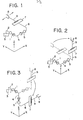
- Figs. 1 to 3 The basic structure of the arm mechanism belonging to a robot embodying the present invention is shown in Figs. 1 to 3, wherein Fig. 1 shows the arm mechanism at the beginning of an operational sequence, Fig. 2 during the course of the operational sequence, and Fig. 3 at the end of the operational sequence.
- a first rotative mechanism 1 is interposed between a pair of arms 2, 4 and is adapted to rotate the arm 4 relative to the arm 2 about the longitudinal axis of the first rotative mechanism 1 as seen in the Figures.
- the latter is secured at one end, as seen in the Figure, to a base 3 through the arm 2, which has a 90° bend, and is connected at the other end to the arm 4 which also has a 90° bend.
- a second rotative mechanism 5 is coupled at one end to the arm 4, and is connected at the other end to an arm 6.
- the arm 6 is configured to extend slightly from the second rotative mechanism 5 in the direction of the positive X-axis (as indicated in the Figure), then a short distance in the direction of the positive Z-axis (as indicated in the Figure), and finally over a major portion of its length in the direction of the positive Y-axis (as indicated in the Figure), this end of the arm being coupled to a transversally movable member 7.
- An arm 9 connects the transversally movable member 7 with a finger mechanism 8. It will be appreciated from Fig. 1 that the longitudinal axes of the respective rotative mechanism are arranged so as to cross each other at right angles.
- the robot arm mechanism described above is capable of being operated in the following manner.
- the transversally movable member 7 is actuated to move the finger mechanism 8 in directions along the X-axis (as indicated by arrows) from the position it is shown occupying in Fig. 1, with the arm 6 being held stationary.
- This causes the finger mechanism 8 to abut against and grip a machined workpiece held by, for example, a chuck in a machine tool.
- the member 7 is then reactuated to move the finger mechanism 8 back to the position it originally occupied in Fig. 1, whereby the finger mechanism extracts the workpiece from the chuck and continues to grip it firmly.
- the three degrees of freedom provided by the first rotative mechanism, the second rotative mechanism and the transversally movable member allow the finger mechanism 8 to be moved along two perpendicular side walls of a machine tool frame, and also permit the workpiece, after having been removed from the chuck, to be rotated by 90° and placed on the workpiece feeder without relying upon the twisting action of a wrist portion.
- the transversally movable member 7 can be actuated to raise the finger mechanism 8, after which the second rotative mechanism 5 is rotated to swing the finger mechanism 8.to a position above the - unmachined workpiece.
- the transversally movable member 7 is then reactuated so as to lower the finger mechanism 8 and permit it to grasp the unmachined workpiece.
- the latter is then fitted into the chuck by commanding the robot to reverse the foregoing sequence.
- FIG. 7 The external configuration of a robot in accordance with the second embodiment of the invention described above is shown in a perspective view in Fig. 7, in which reference numeral 11 denotes a machine tool, 12 a chuck provided on the machine tool, 13 a workpiece feeder, and 14 a workpiece. Like or corresponding component parts bear the same reference numerals as those used in Figs. 1 to 6.
- the robot shown in Fig. 7 operates as follows. First, the transversally movable member 7 is actuated to bring the finger mechanism 8 to the vicinity of the chuck 12 so that the finger mechanism can grasp a machined workpiece which is being held by the chuck. Following this the transversally movable member 7 is driven in the opposite direction to remove the workpiece from the chuck. Next the second rotative mechanism 5 is actuated to swing the finger mechanism 8 in a plane which is parallel to the Y-Z plane and move the finger mechanism to the position designated by numeral 8'.
- the first rotative mechanism 1 is actuated to swing the finger mechanism 8 in a plane which is parallel to the X-Z plane and move the finger member to the position designated by numeral 8", and the extendible shaft 10 is actuated to extend the arm 9.
- This operation positions the finger mechanism 8, which is still grasping the workpiece, over the workpiece feeder 13, so that the workpiece 14 can be set on the feeder by causing the finger mechanism 8 to release its grasp. Mounting an unmachined workpiece in the chuck of the machine tool can be carried out by the robot hand mechanism merely by reversing the foregoing sequence.
- the transversally movable member 7 includes a motor 15, a timing belt 16, a ball bearing feed screw 17, a bracket 18 and a ball bearing spline 19.
- the motor 15 is adapted to rotate the feed screw 17 through the timing belt 16.
- the bracket 18 for supporting the finger mechanism 8 is mounted on the ball bearing spline 19 and is fixed against rotational movement thereby.
- Fixedly secured to the bracket 18 is a nut 18a which is screwed onto the feed screw 17. To move the bracket 18 the motor 15 is driven to rotate the feed screw 17 via the timing belt 16.
- the nut 18a travels along the screw 17 as the latter rotates and causes-the bracket 18 to slide . along the ball bearing spline 19.
- the second rotative mechanism 5 includes a motor 20, a reduction gear 21, and a shaft 22 coupled to the reduction gear 21.
- Running the motor 20 rotatably drives the shaft 22 through the reduction gear 21 to swing the transversally movable member 7 which is connected to the shaft 22 through the arm 6.
- Fig. 8 While the robot embodied by the arrangement of Fig. 8 employs motors to drive the respective arms, it is also possible to substitute other actuators for the motors, such as air cylinders, hydraulic motors or hydraulic cylinders.
- a rotative mechanism can be considered to comprise a primary component, a secondary component and drive means operable to establish relative rotational movement between the primary and secondary components.
- the rotary shaft 27 for example, provides the primary component
- the motor 27 and associated means e.g. gear 24, belt 25
- the drive means and parts mounting the motor on the base 27-1 provide the secondary component.
- One end of the first rotative mechanism is provided in the coupling of the rotary shaft 27 to the bracket and this is the rotating end
- the other (stationary) end of the first rotative mechanism is provided in the mounting of the motor on the base 27-1.
- the ends of a rotative mechanism are parts thereof between which the mechanism can produce relative rotational movement and which are coupled or linked to other members not of the mechanism.
- an "arm" as shown schematically and symbolically in Figs. 1 to 6 can be identified with any effective mechanical coupling or link, for example, the bracket 26.
- the arm mechanism of a robot can be moved along the two perpendicular side walls of,a machine tool frame so that the space required for the robot to operate can be reduced markedly over the conventional robots that are based on polar or cylindrical coordinate systems.
- operation of the arm mechanism is quicker since smaller anglesare covered by the arms.
- the attitude of a workpiece is shifted by 90° at the same time that the workpiece is moved along the perpendicular side walls of the machine tool frame, it is no longer required that a wrist be twisted to align a horizontally disposed surface of the workpiece with the vertically disposed surface of the chuck prior to mounting of the workpiece.
- the hand can be furnished with an additional degree of freedom by providing the transversally movable member on the shaft connected to the finger mechanism, thereby facilitating such delicate operations as attaching and detaching a workpiece to and from the chuck. Still another degree of freedom is obtained by providing an arm with an extendible shaft to further enhance operation of the arm mechanism.
- the second rotative mechanism is linked to a movable gripping member
- the robot having a hand or manipulative member of the foregoing construction permits gripping member to be moved in a plane which is parallel to an X-Z plane, and then in a plane which is parallel to a Y-Z plane so that a workpiece or tool replacement can be moved along the perpendicular side walls of a machine tool frame.
- the end result is a quicker operating speed and a reduced floor space requirement for installation.
- the degrees of freedom can be increased by providing the robot arms or links with additional mechanisms, particularly between the second rotative mechanism and the gripping member, such as a rotative mechanism for rotating the gripping member about the arm or link, an extendible shaft for extending the arm or link, or a linear drive mechanism for moving the gripping member at right angles to the longitudinal axis of the arm or link.
- additional mechanisms particularly between the second rotative mechanism and the gripping member, such as a rotative mechanism for rotating the gripping member about the arm or link, an extendible shaft for extending the arm or link, or a linear drive mechanism for moving the gripping member at right angles to the longitudinal axis of the arm or link.
- - Servo mechanisms may constitute the means for driving the rotative mechanisms the extendible shaft and the linear drive mechanism.
Landscapes
- Engineering & Computer Science (AREA)
- Mechanical Engineering (AREA)
- Robotics (AREA)
- Manipulator (AREA)
- Feeding Of Workpieces (AREA)
Applications Claiming Priority (2)
| Application Number | Priority Date | Filing Date | Title |
|---|---|---|---|
| JP54082782A JPS5950474B2 (ja) | 1979-06-30 | 1979-06-30 | 産業用ロボツト |
| JP82782/79 | 1979-06-30 |
Publications (3)
| Publication Number | Publication Date |
|---|---|
| EP0022332A1 true EP0022332A1 (de) | 1981-01-14 |
| EP0022332B1 EP0022332B1 (de) | 1984-03-21 |
| EP0022332B2 EP0022332B2 (de) | 1988-12-14 |
Family
ID=13783979
Family Applications (1)
| Application Number | Title | Priority Date | Filing Date |
|---|---|---|---|
| EP80302143A Expired EP0022332B2 (de) | 1979-06-30 | 1980-06-26 | Industrieroboter |
Country Status (5)
| Country | Link |
|---|---|
| US (1) | US4352620A (de) |
| EP (1) | EP0022332B2 (de) |
| JP (1) | JPS5950474B2 (de) |
| DE (1) | DE3067122D1 (de) |
| SU (1) | SU1279521A1 (de) |
Cited By (4)
| Publication number | Priority date | Publication date | Assignee | Title |
|---|---|---|---|---|
| EP0104891A3 (de) * | 1982-09-22 | 1985-11-21 | Fanuc Ltd. | Industrieroboter |
| US4589816A (en) * | 1983-04-06 | 1986-05-20 | Mantec Gesellschaft fur Automatisierungs-und Handhabungssysteme mbH | Robot joint |
| US4738576A (en) * | 1983-04-06 | 1988-04-19 | Mantec Gesellschaft fur Automatisierungs-und Handhabungssysteme mbH | Robot joint |
| ES2245900A1 (es) * | 2004-07-15 | 2006-01-16 | Abb Sistemas Industriales, S.A. | Dispositivo para la manipulacion de piezas y manipulador industrial dotado de dicho dispositivo. |
Families Citing this family (16)
| Publication number | Priority date | Publication date | Assignee | Title |
|---|---|---|---|---|
| JPS5821665Y2 (ja) * | 1980-10-08 | 1983-05-09 | ファナック株式会社 | 貫通形ダブルハンド |
| JPS57156180A (en) * | 1981-03-18 | 1982-09-27 | Ii Toroiyaa Ueido | Manipulator for processed good |
| JPS61260990A (ja) * | 1985-05-13 | 1986-11-19 | 水野鉄工株式会社 | 産業用ロボツト |
| US4766775A (en) * | 1986-05-02 | 1988-08-30 | Hodge Steven W | Modular robot manipulator |
| US4816730A (en) * | 1986-12-22 | 1989-03-28 | E. I. Du Pont De Nemours And Company | Autosampler |
| JP2652880B2 (ja) * | 1988-08-31 | 1997-09-10 | ファナック株式会社 | 垂直多関節形ロボット |
| US5105367A (en) * | 1988-10-19 | 1992-04-14 | Hitachi, Ltd. | Master slave manipulator system |
| DE4242667C2 (de) * | 1992-12-17 | 1996-04-04 | Paul Lingen | An einem fahrbaren Arbeitsgerät vorn lösbar anbringbares mehrteiliges Manipuliergerät |
| IT1290642B1 (it) * | 1997-01-17 | 1998-12-10 | Gd Spa | Macchina e metodo per la composizione di mazzette di foglietti, in particolare banconote. |
| US6198247B1 (en) * | 1999-04-20 | 2001-03-06 | Steven Barr | Servo-articulated modules and robotic assemblies incorporating them |
| US6356337B1 (en) * | 2000-03-08 | 2002-03-12 | Anvik Corporation | Two-sided substrate imaging using single-approach projection optics |
| US7274463B2 (en) * | 2003-12-30 | 2007-09-25 | Sensory Analytics | Anodizing system with a coating thickness monitor and an anodized product |
| US6674533B2 (en) * | 2000-12-21 | 2004-01-06 | Joseph K. Price | Anodizing system with a coating thickness monitor and an anodized product |
| US7365860B2 (en) * | 2000-12-21 | 2008-04-29 | Sensory Analytics | System capable of determining applied and anodized coating thickness of a coated-anodized product |
| WO2007103304A2 (en) * | 2006-03-07 | 2007-09-13 | Sensory Analytics | A mobile apparatus capable of surface measurements of a coating thickness |
| US20090088912A1 (en) * | 2007-09-28 | 2009-04-02 | Anorad Corporation | Linear driven x-z robot |
Citations (4)
| Publication number | Priority date | Publication date | Assignee | Title |
|---|---|---|---|---|
| US3406836A (en) * | 1966-09-09 | 1968-10-22 | Simplex Corp | Transfer device |
| US3841499A (en) * | 1973-10-31 | 1974-10-15 | Armflex Inc | Work transfer apparatus |
| US3849668A (en) * | 1973-10-04 | 1974-11-19 | Nasa | Orthotic arm joint |
| US4034867A (en) * | 1974-11-26 | 1977-07-12 | Kabushiki Kaisha Daini Seikosha | Handling device |
Family Cites Families (9)
| Publication number | Priority date | Publication date | Assignee | Title |
|---|---|---|---|---|
| US3451224A (en) * | 1967-06-20 | 1969-06-24 | Gen Dynamics Corp | Stowable underwater manipulator |
| US3850313A (en) * | 1969-04-09 | 1974-11-26 | Martin P | Palletizing apparatus |
| US3954188A (en) * | 1973-12-26 | 1976-05-04 | Prab Conveyors, Inc. | Universal transfer device |
| US3884365A (en) * | 1974-03-19 | 1975-05-20 | Thomson Ind Inc | Workpiece manipulator |
| US3922930A (en) * | 1974-12-23 | 1975-12-02 | Nasa | Remotely operable articulated manipulator |
| US4042122A (en) * | 1975-05-27 | 1977-08-16 | The Bendix Corporation | Reorientation device for an object manipulator |
| US4062455A (en) * | 1976-11-22 | 1977-12-13 | Flatau Carl R | Remote manipulator |
| US4177002A (en) * | 1977-06-08 | 1979-12-04 | Motoda Denshi Kogyo Kabushiki Kaisha | Cooperative drive robot |
| FR2434685A1 (fr) * | 1978-09-04 | 1980-03-28 | Commissariat Energie Atomique | Manipulateur motorise |
-
1979
- 1979-06-30 JP JP54082782A patent/JPS5950474B2/ja not_active Expired
-
1980
- 1980-06-25 US US06/162,878 patent/US4352620A/en not_active Expired - Lifetime
- 1980-06-26 EP EP80302143A patent/EP0022332B2/de not_active Expired
- 1980-06-26 DE DE8080302143T patent/DE3067122D1/de not_active Expired
- 1980-06-27 SU SU802938052A patent/SU1279521A1/ru active
Patent Citations (4)
| Publication number | Priority date | Publication date | Assignee | Title |
|---|---|---|---|---|
| US3406836A (en) * | 1966-09-09 | 1968-10-22 | Simplex Corp | Transfer device |
| US3849668A (en) * | 1973-10-04 | 1974-11-19 | Nasa | Orthotic arm joint |
| US3841499A (en) * | 1973-10-31 | 1974-10-15 | Armflex Inc | Work transfer apparatus |
| US4034867A (en) * | 1974-11-26 | 1977-07-12 | Kabushiki Kaisha Daini Seikosha | Handling device |
Cited By (8)
| Publication number | Priority date | Publication date | Assignee | Title |
|---|---|---|---|---|
| EP0104891A3 (de) * | 1982-09-22 | 1985-11-21 | Fanuc Ltd. | Industrieroboter |
| US4628778A (en) * | 1982-09-22 | 1986-12-16 | Fanuc Ltd | Industrial robot |
| US4589816A (en) * | 1983-04-06 | 1986-05-20 | Mantec Gesellschaft fur Automatisierungs-und Handhabungssysteme mbH | Robot joint |
| US4738576A (en) * | 1983-04-06 | 1988-04-19 | Mantec Gesellschaft fur Automatisierungs-und Handhabungssysteme mbH | Robot joint |
| ES2245900A1 (es) * | 2004-07-15 | 2006-01-16 | Abb Sistemas Industriales, S.A. | Dispositivo para la manipulacion de piezas y manipulador industrial dotado de dicho dispositivo. |
| WO2006018459A1 (es) * | 2004-07-15 | 2006-02-23 | Asea Brown Boveri, S.A. | Dispositivo para la manipulación de piezas y manipulador industrial dotado de dicho dispositivo |
| ES2245900B1 (es) * | 2004-07-15 | 2007-07-16 | Asea Brown Boveri, S.A. | Dispositivo para la manipulacion de piezas y manipulador industrial dotado de dicho dispositivo. |
| CN100473491C (zh) * | 2004-07-15 | 2009-04-01 | Abb公司 | 零件装卸设备及包含所述设备的工业装卸机 |
Also Published As
| Publication number | Publication date |
|---|---|
| DE3067122D1 (en) | 1984-04-26 |
| SU1279521A3 (ru) | 1986-12-23 |
| US4352620A (en) | 1982-10-05 |
| EP0022332B1 (de) | 1984-03-21 |
| JPS569184A (en) | 1981-01-30 |
| SU1279521A1 (ru) | 1986-12-23 |
| EP0022332B2 (de) | 1988-12-14 |
| JPS5950474B2 (ja) | 1984-12-08 |
Similar Documents
| Publication | Publication Date | Title |
|---|---|---|
| EP0022332B1 (de) | Industrieroboter | |
| JP3640087B2 (ja) | 工作機械 | |
| US5438647A (en) | Multi-manipulator robot apparatus | |
| KR850000125Y1 (ko) | 공업용 로보트 | |
| EP0210490B1 (de) | Zahngetriebe für Roboterhand mit drei Freiheitsgraden | |
| US11731265B2 (en) | Parallel-kinematic machine with versatile tool orientation | |
| SE8800567L (sv) | Foreliggande uppfinning avser en ledmekanism som er spec lempad att anvendas i robotstyrapparater, exv for automatisk farklippning | |
| US5267483A (en) | High-density installation type robot | |
| JP2001054889A (ja) | 組立用垂直多関節型ロボット | |
| CN110480762B (zh) | 一种模组式三自由度加工机器人 | |
| JP2018069354A (ja) | リンク式多関節ロボット | |
| JPH11156769A (ja) | 双腕型スカラロボット | |
| EP0511394A1 (de) | Industrieroboter mit mitteln zum montieren eines werkstückes auf ein maschinengerät und zum entfernen des werkstückes davon | |
| KR830002368B1 (ko) | 산업용 로봇 | |
| US4628778A (en) | Industrial robot | |
| JP3367797B2 (ja) | マニプレータ | |
| JPS60193B2 (ja) | 産業用ロボット | |
| SU1142270A1 (ru) | Промышленный робот | |
| JPH08323661A (ja) | 自動組付機 | |
| RU2022785C1 (ru) | Манипулятор | |
| SU1756142A1 (ru) | Промышленный робот | |
| US12350824B2 (en) | Parallel-kinematic machine with versatile tool orientation | |
| SU1281401A1 (ru) | Промышленный робот | |
| CN121670726A (zh) | 一种机械手及人形机器人 | |
| KR830000961Y1 (ko) | 자동조작기구 |
Legal Events
| Date | Code | Title | Description |
|---|---|---|---|
| PUAI | Public reference made under article 153(3) epc to a published international application that has entered the european phase |
Free format text: ORIGINAL CODE: 0009012 |
|
| AK | Designated contracting states |
Designated state(s): DE FR GB |
|
| 17P | Request for examination filed |
Effective date: 19810626 |
|
| RAP1 | Party data changed (applicant data changed or rights of an application transferred) |
Owner name: FANUC LIMITED |
|
| GRAA | (expected) grant |
Free format text: ORIGINAL CODE: 0009210 |
|
| AK | Designated contracting states |
Designated state(s): DE FR GB |
|
| REF | Corresponds to: |
Ref document number: 3067122 Country of ref document: DE Date of ref document: 19840426 |
|
| ET | Fr: translation filed | ||
| PGFP | Annual fee paid to national office [announced via postgrant information from national office to epo] |
Ref country code: FR Payment date: 19840627 Year of fee payment: 5 |
|
| PLBI | Opposition filed |
Free format text: ORIGINAL CODE: 0009260 |
|
| 26 | Opposition filed |
Opponent name: ASEA AKTIEBOLAG Effective date: 19841220 |
|
| PUAH | Patent maintained in amended form |
Free format text: ORIGINAL CODE: 0009272 |
|
| STAA | Information on the status of an ep patent application or granted ep patent |
Free format text: STATUS: PATENT MAINTAINED AS AMENDED |
|
| 27A | Patent maintained in amended form |
Effective date: 19881214 |
|
| AK | Designated contracting states |
Kind code of ref document: B2 Designated state(s): DE FR GB |
|
| ET3 | Fr: translation filed ** decision concerning opposition | ||
| PG25 | Lapsed in a contracting state [announced via postgrant information from national office to epo] |
Ref country code: FR Free format text: LAPSE BECAUSE OF NON-PAYMENT OF DUE FEES Effective date: 19890228 |
|
| REG | Reference to a national code |
Ref country code: FR Ref legal event code: ST |
|
| PGFP | Annual fee paid to national office [announced via postgrant information from national office to epo] |
Ref country code: DE Payment date: 19910611 Year of fee payment: 12 |
|
| PGFP | Annual fee paid to national office [announced via postgrant information from national office to epo] |
Ref country code: GB Payment date: 19910614 Year of fee payment: 12 |
|
| PG25 | Lapsed in a contracting state [announced via postgrant information from national office to epo] |
Ref country code: GB Effective date: 19920626 |
|
| GBPC | Gb: european patent ceased through non-payment of renewal fee |
Effective date: 19920626 |
|
| PG25 | Lapsed in a contracting state [announced via postgrant information from national office to epo] |
Ref country code: DE Effective date: 19930302 |