EP0022984B1 - Verfahren zur Herstellung von 3-(2,2-Dichlor-vinyl)-2,2-dimethyl-cyclopropan-1-carbonsäurederivaten - Google Patents
Verfahren zur Herstellung von 3-(2,2-Dichlor-vinyl)-2,2-dimethyl-cyclopropan-1-carbonsäurederivaten Download PDFInfo
- Publication number
- EP0022984B1 EP0022984B1 EP80103925A EP80103925A EP0022984B1 EP 0022984 B1 EP0022984 B1 EP 0022984B1 EP 80103925 A EP80103925 A EP 80103925A EP 80103925 A EP80103925 A EP 80103925A EP 0022984 B1 EP0022984 B1 EP 0022984B1
- Authority
- EP
- European Patent Office
- Prior art keywords
- dimethyl
- formula
- cyclopropane
- carboxylic acid
- und
- Prior art date
- Legal status (The legal status is an assumption and is not a legal conclusion. Google has not performed a legal analysis and makes no representation as to the accuracy of the status listed.)
- Expired
Links
- 0 C*(C(C1C)[C@]1(C=*=C)N)*=O Chemical compound C*(C(C1C)[C@]1(C=*=C)N)*=O 0.000 description 2
- CEDWAOSIRMDRKP-UHFFFAOYSA-N CC(C1OO)(C1[Mn])N Chemical compound CC(C1OO)(C1[Mn])N CEDWAOSIRMDRKP-UHFFFAOYSA-N 0.000 description 1
Classifications
-
- C—CHEMISTRY; METALLURGY
- C07—ORGANIC CHEMISTRY
- C07F—ACYCLIC, CARBOCYCLIC OR HETEROCYCLIC COMPOUNDS CONTAINING ELEMENTS OTHER THAN CARBON, HYDROGEN, HALOGEN, OXYGEN, NITROGEN, SULFUR, SELENIUM OR TELLURIUM
- C07F9/00—Compounds containing elements of Groups 5 or 15 of the Periodic Table
- C07F9/02—Phosphorus compounds
- C07F9/28—Phosphorus compounds with one or more P—C bonds
- C07F9/38—Phosphonic acids [RP(=O)(OH)2]; Thiophosphonic acids ; [RP(=X1)(X2H)2(X1, X2 are each independently O, S or Se)]
- C07F9/42—Halides thereof
-
- C—CHEMISTRY; METALLURGY
- C07—ORGANIC CHEMISTRY
- C07F—ACYCLIC, CARBOCYCLIC OR HETEROCYCLIC COMPOUNDS CONTAINING ELEMENTS OTHER THAN CARBON, HYDROGEN, HALOGEN, OXYGEN, NITROGEN, SULFUR, SELENIUM OR TELLURIUM
- C07F9/00—Compounds containing elements of Groups 5 or 15 of the Periodic Table
- C07F9/02—Phosphorus compounds
- C07F9/28—Phosphorus compounds with one or more P—C bonds
- C07F9/38—Phosphonic acids [RP(=O)(OH)2]; Thiophosphonic acids ; [RP(=X1)(X2H)2(X1, X2 are each independently O, S or Se)]
- C07F9/40—Esters thereof
- C07F9/4003—Esters thereof the acid moiety containing a substituent or a structure which is considered as characteristic
- C07F9/4006—Esters of acyclic acids which can have further substituents on alkyl
-
- C—CHEMISTRY; METALLURGY
- C07—ORGANIC CHEMISTRY
- C07F—ACYCLIC, CARBOCYCLIC OR HETEROCYCLIC COMPOUNDS CONTAINING ELEMENTS OTHER THAN CARBON, HYDROGEN, HALOGEN, OXYGEN, NITROGEN, SULFUR, SELENIUM OR TELLURIUM
- C07F9/00—Compounds containing elements of Groups 5 or 15 of the Periodic Table
- C07F9/02—Phosphorus compounds
- C07F9/28—Phosphorus compounds with one or more P—C bonds
- C07F9/38—Phosphonic acids [RP(=O)(OH)2]; Thiophosphonic acids ; [RP(=X1)(X2H)2(X1, X2 are each independently O, S or Se)]
- C07F9/40—Esters thereof
- C07F9/4003—Esters thereof the acid moiety containing a substituent or a structure which is considered as characteristic
- C07F9/4018—Esters of cycloaliphatic acids
-
- C—CHEMISTRY; METALLURGY
- C07—ORGANIC CHEMISTRY
- C07F—ACYCLIC, CARBOCYCLIC OR HETEROCYCLIC COMPOUNDS CONTAINING ELEMENTS OTHER THAN CARBON, HYDROGEN, HALOGEN, OXYGEN, NITROGEN, SULFUR, SELENIUM OR TELLURIUM
- C07F9/00—Compounds containing elements of Groups 5 or 15 of the Periodic Table
- C07F9/02—Phosphorus compounds
- C07F9/28—Phosphorus compounds with one or more P—C bonds
- C07F9/38—Phosphonic acids [RP(=O)(OH)2]; Thiophosphonic acids ; [RP(=X1)(X2H)2(X1, X2 are each independently O, S or Se)]
- C07F9/40—Esters thereof
- C07F9/4003—Esters thereof the acid moiety containing a substituent or a structure which is considered as characteristic
- C07F9/4062—Esters of acids containing the structure -C(=X)-P(=X)(XR)2 or NC-P(=X)(XR)2, (X = O, S, Se)
- C07F9/4065—Esters of acids containing the structure -C(=X)-P(=X)(XR)2, (X = O, S, Se)
Definitions
- the invention relates to a new process for the preparation of partially known 3- (2,2-dichlorovinyl) -2,2-dimethyl-cyclopropane-1-carboxylic acid derivatives.
- the products can be cleaned by vacuum distillation.
- the as yet unknown carboxylic acid chlorides of the formula (V) are obtained according to the following reaction scheme from known cyclopropane-carboxylic acid esters (see J. Am. Chem. Soc. 89 (1967), 3912-3914; J. Org. Chem. 32 (1967), 3351-3355; Tetrahedron Lett. 1978, 1847-1850; Bull. Soc. Chim. Belg.
- Examples include dichloromethane-phosphonic acid dimethyl ester, diethyl ester and diphenyl ester.
- the compounds of formula (III) are known or can be prepared by processes known per se (see Synthesis 1975, 535-536; Tetrahedron Letters 1975, 609-610; ibid. 1975, 4409-4410).
- Dichloromethane-phosphonic acid ester of the formula (III) is obtained, for example, by reacting dichloromethane-phosphonic acid dichloride (cf. GB-PS 707 961) with sodium or potassium salts of hydroxy compounds, such as e.g. with sodium or potassium methylate, ethylate, -n- and -isopropylate, -n-, iso-, -sec.- and -tert.-butylate, optionally in the presence of a diluent, e.g. Toluene, at temperatures between 0 and 50 ° C. To clean the products, distillation is optionally carried out after filtration.
- a diluent e.g. Toluene
- the process according to the invention is preferably carried out using diluents.
- ethers such as Glycol dimethyl ether, diglycol dimethyl ether, tetrahydrofuran and dioxane
- carboxamides e.g. Dimethylformamide, dimethylacetamide and N-methyl-pyrrolidone
- sulfoxides and sulfones e.g. Dimethyl sulfoxide and tetramethylene sulfone
- phosphoric acid amides such as e.g. Hexamethyl-phosphoric acid triamide, as well as nitriles, e.g. Acetonitrile and propionitrile.
- the bases customary in organic chemical synthesis can be used in the process according to the invention.
- These include in particular alkali hydroxides, e.g. Sodium and potassium hydroxide, alkali alcoholates, e.g. Sodium and potassium methylate, sodium and potassium ethylate, sodium and potassium isopropylate, sodium and potassium tert-butoxide, alkali metal hydrides, e.g. Sodium and potassium hydride, alkali amides such as e.g. Sodium and potassium amide, alkyl lithium compounds such as e.g. Butyllithium, as well as amines, e.g. Diazabicyclononane and diazabicycloundecene. Alcoholates are particularly preferred as bases.
- the reaction temperature is kept between - 100 and + 100 ° C, preferably between - 80 and + 50 ° C.
- the process according to the invention is generally carried out at normal pressure.
- the starting materials of the formulas (11) and (III) are initially introduced in one of the diluents specified above at temperatures between -80 and 0 ° C. and a solution of a base in one of the diluents specified above is added dropwise. Then the reaction mixture is allowed to come to room temperature and stirred for a few hours. Working up is carried out in the usual way: it is diluted Reaction mixture with water and extracted with a water-immiscible solvent, such as diethyl ether or methylene chloride. The extracts are washed with water, dried and filtered. The solvent is removed from the filtrate and the product remaining as a residue is purified by vacuum distillation. The boiling point is used for characterization.
- the process according to the invention relates to the preparation of compounds of the formula (I) which are obtained either in the form of the individual stereoisomers or as mixtures of stereoisomers.
- the 2,2-dimethyl-3- (2,2-dichloro-vinyl) -cyciopropane-1-carboxylic acid esters to be prepared by the process according to the invention can be used as intermediates for the preparation of pyrethroids which have an insecticidal and acaricidal action (cf. DE-OS 2326077).
- ⁇ -Hydroxyphosphonic acid esters of the formula (II) to be used as starting materials can be prepared, for example, as follows:
- ⁇ -Oxophosphonic esters of the formula (IV) to be used as starting materials can be prepared, for example, as follows:
- Dichloromethane-phosphonic acid esters of the formula (III) to be used as starting materials can be prepared, for example, as follows:
Landscapes
- Chemical & Material Sciences (AREA)
- Organic Chemistry (AREA)
- Health & Medical Sciences (AREA)
- Life Sciences & Earth Sciences (AREA)
- Biochemistry (AREA)
- General Health & Medical Sciences (AREA)
- Molecular Biology (AREA)
- Crystallography & Structural Chemistry (AREA)
- Organic Low-Molecular-Weight Compounds And Preparation Thereof (AREA)
Description
- Die Erfindung betrifft ein neues Verfahren zur Herstellung von teilweise bekannten 3-(2,2-Dichlor- vinyl)-2,2-dimethyl-cyclopropan-1-carbonsäurederivaten.
- Es ist bekannt, daß man 3-(2,2-Dichlor-vinyl)-2,2-dimethyl-cyclopropan-1-carbonsäureester erhält, wenn man 3-Formyl-2,2-dimethyl-cyclopropan-1-carbonsäureester mit Triphenylphosphin in Tetrachlorkohlenstoff umsetzt (vergleiche DE-OS 2326077). Nach dieser Synthesemethode erhält man die gewünschten Produkte jedoch nur in mäßigen Ausbeuten.
- Es ist weiter bekannt, daß man 1,1-Dichlor-alkene erhält, wenn man Lithiumsalze von Dichlormethanphosphonsäureestern mit Aldehyden oder Ketonen umsetzt (vergleiche Synthesis 1975, 535-536). Die Herstellung der Lithiumsalze von Dichlormethanphosphonsäureestern ist jedoch relativ aufwendig : man erhält sie aus Chlormethan-phosphonsäureestern durch Umsetzung mit Butyllithium und Tetrachlorkohlenstoff bei - 75 °C, wobei sorgfältig getrocknete Lösungsmittel zu verwenden sind und eine Inertgasatmosphäre erforderlich ist.
- Es wurde nun gefunden, daß man 3-(2,2-Dichlor-vinyl)-2,2-dimethyl-cyclopropan-1-carbonsäurederivate der Formel I

- Z für Acetyl, Cyano, Carbamoyl, Alkoxycarbonyl oder für einen Rest -OOZ1, wobei Z1 für einen im Alkoholteil von Pyrethroiden üblichen Rest steht,
- erhält, wenn man a-Hydroxy-phosphonsäureester der Formel II

- Z die oben angegebene Bedeutung hat und
- R für Alkyl oder Phenyl steht oder die beiden Reste R zusammen für geradkettiges oder verzweigtes Alkandiyl (Alkylen) stehen,
- mit Dichlormethan-derivaten der Formel III

- Rl und R2 einzeln für Alkyl, Phenyl, Alkoxy oder Phenoxy oder zusammen für Alkandioxy(Alkylendioxy) stehen,
- in Gegenwart einer Base und gegebenenfalls unter Verwendung eines Verdünnungsmittels bei Temperaturen zwischen - 100 und + 100 °C umsetzt.
- Es ist als überraschend anzusehen, daß man nach dem erfindungsgemäßen Verfahren 3-(2,2-Dichlor- vinyl)-2,2-dimethyl-cyclopropan-1-carbonsäurederivate wesentlich einfacher und kostengünstiger in guten Ausbeuten erhält als man in Anbetracht des Standes der Technik erwarten konnte.
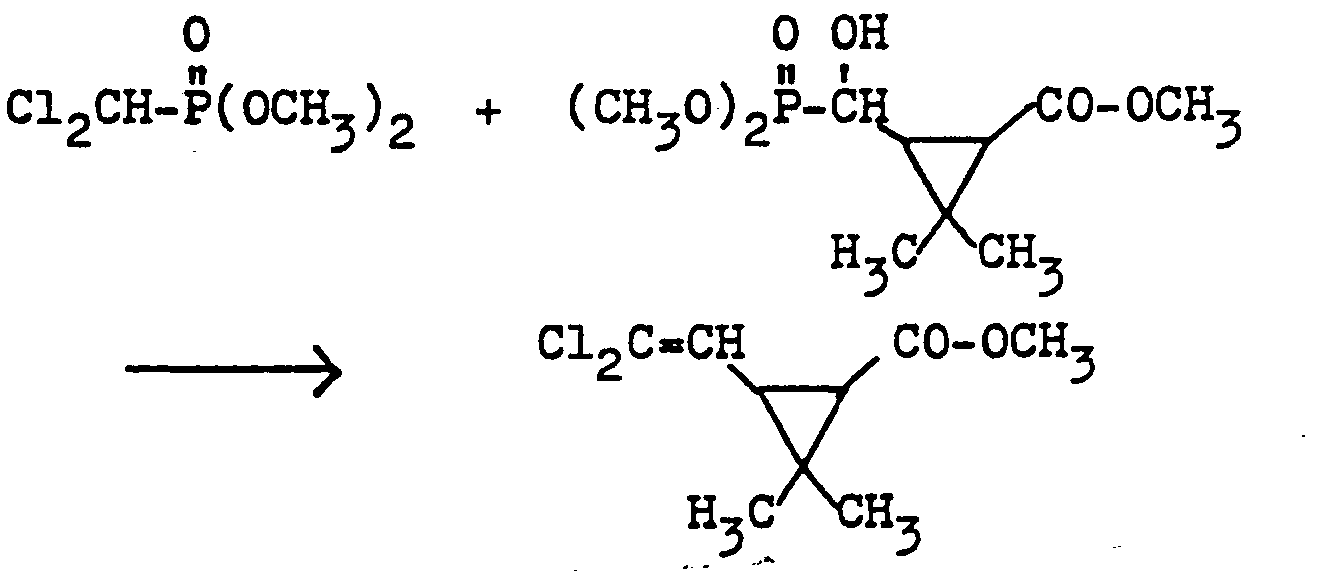
- Verwendet man als Ausgangsstoffe beispielsweise α-Hydroxy-α-(3-methoxycarbonyl-2,2-dimethyl- cycloprop-1-yl)-methanphosphonsäure-dimethylester und Dichlormethan-phosphonsäure-dimethylester, so kann die Reaktion dieser Verbindungen durch folgendes Formelschema skizziert werden :
- Die als Ausgangsverbindungen zu verwendenden a-Hydroxy-phosphonsäureester sind durch Formel (II) definiert. Vorzugsweise stehen darin
- Z für Acetyl, Cyano, Carbamoyl, oder C1-C4-Alkoxycarbonyl, und
- R für C1-C4-Alkyl oder Phenyl, oder beide Reste R stehen zusammen für 2,2-Dimethyl-propan-1,3-diyl.
- Als Beispiele seien genannt:
- α-Hydroxy-α-(3-methoxycarbonyl-2,2-dimethyl-cycloprop-1-yl)-methanphosphonsäure-dimethylester und -diethylester, α-Hydroxy-α-(3-ethoxycarbonyl-2,2-dimethyl-cycloprop-1-yl)-methan-phosphonsäure-dimethylester und -diethylester, α-Hydroxy-α-(3-acetyl-2,2-dimethyl-cycloprop-1-yl)-methanphosphonsäure-dimethylester und -diethylester sowie a-Hydroxy-a-(3-cyano-2,2-dimethyl-cycloprop-1-yl)-methanphosphonsäure-dimethylester und -diethylester.
- Die a-Hydroxy-phosphonsäureester der Formel (II) und deren Herstellung sind Gegenstand einer noch nicht veröffentlichten Patentanmeldung (vgl. P 29 17 620.3).
- Man erhält die Ausgangsverbindungen der Formel (II), indem man a-Oxo-phosphonsäureester der Formel IV

- Z und R die oben angegebenen Bedeutungen haben,
- Die α-Oxo-phosphonsäureester der Formel (IV) sind noch nicht in der Literatur beschrieben. Man erhält diese Verbindungen durch Umsetzung von Carbonsäurechloriden der Formel V

- Z die oben angegebene Bedeutung hat,
- mit Phosphorigsäureestern der Formel VI

- R die oben angegebene Bedeutung hat und
- R3 für Alkyl, insbesondere für Methyl oder Ethyl steht, bei Temperaturen zwischen - 20 und + 150 °C, vorzugsweise zwischen 0 und 120 °C (vergleiche J. Am. Chem. Soc. 86 (1964), 3862-3866 und Methoden der organischen Chemie (Houben-Weyl-Müller), 4. Aufl., Band 12/1, S. 453, Georg-Thieme-Verlag, Stuttgart 1963).
- Die Produkte können durch Vakuumdestillation gereinigt werden.
- Die noch nicht bekannten Carbonsäurechloride der Formel (V) erhält man gemäß nachstehendem Reaktionsschema aus bekannten Cyclopropan-carbonsäureestern (vergleiche J. Am. Chem. Soc. 89 (1967), 3912-3914 ; J. Org. Chem. 32 (1967), 3351-3355 ; Tetrahedron Lett. 1978, 1847-1850 ; Bull. Soc. Chim. Belg. 87 (1978), 721-732) nach an sich bekannten Methoden, imdem man zunächst durch Hydrolyse, beispielsweise durch Umsetzung mit wässrig-alkoholischer Kalilauge bei Temperaturen zwischen 20 und 100 °C und anschließendes Ansäuern die entsprechenden Cyclopropancarbonsäuren herstellt und diese mit Halogenierungsmitteln, wie z.B. Thionylchlorid, bei Temperaturen zwischen 10 und 100 °C umsetzt.

- Die weiter als Ausgangsverbindungen zu verwendenden Dichlormethan-derivate sind durch Formel (III) definiert. Vozzugsweise stehen darin
- RI und R2 einzeln für Alkoxy mit 1 bis 4 Kohlenstoffatomen oder für Phenoxy oder beide Reste.
- Rl und R2 stehen zusammen für geradkettiges oder verzweigtes Alkandioxy (Alkylendioxy) mit 2 bis 5 Kohlenstoffatomen.
- Als Beispiele seien Dichlormethan-phosphonsäure-dimethylester, -diethylester und -diphenylester genannt.
- Die Verbindungen der Formel (III) sind bekannt oder können nach an sich bekannten Verfahren hergestellt werden (vergleiche Synthesis 1975, 535-536 ; Tetrahedron Letters 1975, 609-610 ; ibid. 1975, 4409-4410).
- Man erhält Dichlormethan-phosphonsäureester der Formel (III) beispielsweise durch Umsetzung von Dichlormethan-phosphonsäuredichlorid (vergleiche GB-PS 707 961) mit Natrium- oder Kalium-salzen von Hydroxyverbindungen, wie z.B. mit Natrium- oder Kalium-methylat, -ethylat, -n- und -iso-propylat, -n-, iso-, -sek.- und -tert.-butylat, gegebenenfalls in Gegenwart eines Verdünnungsmittels, wie z.B. Toluol, bei Temperaturen zwischen 0 und 50 °C. Zur Reinigung der Produkte wird gegebenenfalls nach Filtration destilliert.
- Das erfindungsgemäße Verfahren wird vorzugsweise unter Verwendung von Verdünnungsmitteln durchgeführt. Als solche kommen praktisch alle inerten organischen Lösungsmittel, insbesondere aprotisch polare Solventien in Frage. Hierzu gehören Ether, wie z.B. Glycol-dimethylether, Diglycoldimethylether, Tetrahydrofuran und Dioxan, Carbonsäureamide, wie z.B. Dimethylformamid, Dimethylacetamid und N-Methyl-pyrrolidon, Sulfoxide und Sulfone, wie z.B. Dimethylsulfoxid und Tetramethylensulfon, Phosphorsäureamide, wie z.B. Hexamethyl-phosphorsäuretriamid, sowie Nitrile, wie z.B. Acetonitril und Propionitril.
- Beim erfindungsgemäßen Verfahren können die in der organisch-chemischen Synthese üblichen Basen verwendet werden. Hierzu gehören insbesondere Alkalihydroxide, wie z.B. Natrium- und Kaliumhydroxid, Alkalialkoholate, wie z.B. Natrium- und Kalium-methylat, Natrium- und Kalium-ethylat, Natrium-und Kalium-iso-propylat, Natrium- und Kalium-tert.-butylat, Alkalihydride, wie z.B. Natrium- und Kaliumhydrid, Alkaliamide, wie z.B. Natrium- und Kalium-amid, Alkyllithiumverbindungen, wie z.B. Butyllithium, sowie Amine, wie z.B. Diazabicyclononan und Diazabicycloundecen. Alkoholate werden als Basen besonders bevorzugt.
- Die Reaktionstemperatur wird zwischen - 100 und + 100 °C, vorzugsweise zwischen - 80 und + 50 °C gehalten. Das erfindungsgemäße Verfahren wird im allgemeinen bei Normaldruck durchgeführt.
- Je Mol a-Hydroxy-phosphonsäureester der Formel (11) werden 1 bis 3 Mol, vorzugsweise 1 bis 2 Mol Dichlormethan-phosphonsäureester der Formel (111) eingesetzt.
- In einer bevorzugten Ausführungsform des erfindungsgemäßen Verfahrens werden die Ausgangsstoffe der Formeln (11) und (III) in einem der oben angegebenen Verdünnungsmittel bei Temperaturen zwischen - 80 und 0°C vorgelegt und mit der Lösung einer Base in einem der oben angegebenen Verdünnungsmittel tropfenweise versetzt. Dann läßt man das Reaktionsgemisch auf Raumtemperatur kommen und rührt einige Stunden nach. Die Aufarbeitung erfolgt auf übliche Weise : man verdünnt das Reaktionsgemisch mit Wasser und extrahiert mit einem mit Wasser nicht mischbaren Lösungsmittel, wie z.B. Diethylether oder Methylenchlorid. Die Extrakte werden mit Wasser gewaschen, getrocknet und filtriert. Vom Filtrat wird das Lösungsmittel abgezogen und das als Rückstand verbleibende Produkt durch Vakuumdestillation gereinigt. Zur Charakterisierung dient der Siedepunkt.
- Da die als Ausgangsverbindungen eingesetzten 3-Formyl-2,2-dimethyl-cyclopropan-1-carbonsäureester der Formel (II) wie auch die erfindungsgemäß herzustellenden 3-(2,2-Dichlor-vinyl)-2,2-dimethyl- cyclopropan-1-carbonsäureester der Formel (I) jeweils asymmetrische Kohlenstoffatome aufweisen, können die Verbindungen der Formeln (I) und (II) in einer entsprechenden Anzahl von stereoisomeren Formen auftreten.
- Das erfindungsgemäße Verfahren bezieht sich auf die Herstellung von Verbindungen der Formel (I), die entweder in Form der einzelnen Stereoisomeren oder als Gemische von Stereoisomeren erhalten werden.
- Die nach dem erfindungsgemäßen Verfahren herzustellenden 2,2-Dimethyl-3-(2,2-dichlor-vinyl)-cyciopropan-1-carbonsäureester können als Zwischenprodukte zur Herstellung von insektizid und akarizid wirksamen Pyrethroiden verwendet werden (vergleiche DE-OS 2326077).
-

- Zu einer Lösung von 31 g (0,1 Mol) α-Hydroxy-α-(3-ethoxycarbonyl-2,2-dimethyl-cycloprop-1-yl)-methan-phosphonsäure-diethylester und 44 g (0,2 Mol) Dichlormethanphosphonsäure-diethylester in 100 ml Tetrahydrofuran wird bei - 50 bis - 60 °C eine Lösung von 22,5 g Kalium-tert.-butylat in 150 ml Tetrahydrofuran tropfenweise gegeben. Man läßt die Temperatur langsam auf ca. 20 °C ansteigen und rührt das Gemisch weitere 35 Stunden bei dieser Temperatur. Das Reaktionsgemisch wird in 500 ml Diethylether aufgenommen und 4 mal mit je 300 ml Wasser gewaschen. Die organische Phase wird über Natriumsulfat getrocknet, filtriert und eingeengt. Der Rückstand wird zweimal destilliert.
- 1. Destillation : Siedetemperatur 100-140 °C/15 mbar ;
- 2. Destillation : Siedetemperatur 114-118 °C/15 mbar.
- Man erhält so 21 g (89 % der Theorie) 2,2-Dimethyl-3-(2,2-dichlor-vinyl)-cyclopropan-1-carbonsäure- ethylester in Form einer farblosen Flüssigkeit, nach gaschromatographischer Analyse mit einem Gehalt von 76 % des trans-Isomeren.
- Analog vorstehendem Beispiel erhält man

- Als Ausgangsstoffe zu verwendende a-Hydroxy-phosphonsäureester der Formel (II) können beispielsweise wie folgt hergestellt werden :

- Zu einer intensiv gerührten Lösung von 1,2 g Natriumtetrahydridoborat in 75 ml Wasser wird innerhalb von 30 Minuten bei ca. 0 °C eine Lösung von 31 g (0,1 Mol) α-Oxo-α-(3-ethoxycarbonyl-2,2-dimethylcycloprop-1-yl)-methanphosphonsäure-diethylester in 50 mi Methylenchlorid tropfenweise gegeben. Das Reaktionsgemisch wird 90 Minuten bei 0°C gerührt. Dann trennt man die organische Phase ab, schüttelt die wässrige Phase mit 100 ml Methylenchlorid aus, vereinigt die Methylenchlorid-Lösungen, trocknet sie über Natriumsulfat, filtriert und engt ein. Der Rückstand wird aus 30 ml Ligroin umkristallisiert, abgesaugt und auf Ton getrocknet. Man erhält 19 g (62 % der Theorie) a-Hydroxy-a-(3- ethoxycarbonyl-2,2-dimethyl-cycloprop-1-yl)-methanphosphonsäure-diethylester vom Schmelzpunkt 58 °C.
- Elementaranalyse :

- Analog vorstehendem Beispiel erhält man

- Als Ausgangsstoffe zu verwendende a-Oxo-phosphonsäureester der Formel (IV) können beispielsweise wie folgt hergestellt werden :

- 25 g (0,2 Mol) Trimethylphosphit werden zu einer auf 30 bis 35 °C erwärmten Lösung von 39 g (0,2 Mol) 3-Methoxycarbonyl-2,2-dimethyl-cyclopropan-1-carbonsäure-chlorid in 200 ml Methylenchlorid tropfenweise gegeben und das Reaktionsgemisch wird 3 Stunden gerührt. Nach Abdestillieren des Lösungsmittels im Vakuum erhält man 48 g (91 % der Theorie) α-Oxo-α-(3-methoxycarbonyl-2,2-dimethyl- cycloprop-1-yl)-methanphosphonsäure-dimethylester.
-

- Analog vorstehenden Beispiel erhält man
-

-

- Als Ausgangsstoffe zu verwendende Dichlormethan-phosphonsäureester der Formel (III) können beispielsweise wie folgt hergestellt werden :

- In eine Mischung aus 720 g (6 Mol) Chloroform und 274 g (2 Mol) Phosphortrichlorid werden portionsweise 266 g (2 Mol) Aluminiumchlorid gegeben. Das Reaktionsgemisch wird dann 12 Stunden unter Rückfluß zum Sieden erhitzt. Anschließend wird das Lösungsmittel im Vakuum abgezogen und der Rückstand wird in 2 1 Methylenchlorid aufgenommen. Dazu werden bei 0°C 440 ml konz. Salzsäure getropft und es wird etwa zwei Stunden bei dieser Temperatur nachgerührt. Die organische Phase wird abgetrennt, über Natriumsulfat getrocknet und eingeengt. Der Rückstand wird fraktioniert destilliert. Man erhält 258 g (64,5 % der Theorie) Dichlormethan-phosphonsäuredichlorid in Form eines farblosen Öls vom Siedepunkt 48-50 °C/l mbar.

- Zu einer Lösung von 227,5 g (1,13 Mol) Dichlormethan-phosphonsäuredichlorid in 800 ml Toluol werden bei 5-10°C 153,5 g (2,26 Mol) Natriummethylat in 800 ml Ethanol getropft. Das Reaktionsgemisch wird fünf Stunden bei 20 °C nachgerührt. Dann wird abgesaugt, das Filtrat eingeengt und der Rückstand fraktioniert destilliert. Man erhält 195 g (78 % der Theorie) Dichlormethan-phosphonsäurediethylester in Form eines farblosen Öls vom Siedepunkt 84°C/I mbar.
mit einem Reduktionsmittel, wie z.B. Natriumtetrahydridoborat (Natriumboranat), gegebenenfalls unter Verwendung von Verdünnungsmitteln, wie z.B. Wasser und/oder Methanol und/oder Methylenchlorid, bei Temperaturen zwischen - 20 und + 50 °C, vorzugsweise zwischen - 10 und + 30 °C, umsetzt (vergleiche Chem. Ber. 103 (1970), 2984-2986). Zur Aufarbeitung und Isolierung der Produkte extrahiert man mit einem mit Wasser nicht mischbaren Lösungsmittel, wie z.B. Methylenchlorid, trocknet die nicht-wässrige Phase, filtriert und destilliert das Lösungsmittel unter vermindertem Druck ab.
Claims (1)


Applications Claiming Priority (2)
| Application Number | Priority Date | Filing Date | Title |
|---|---|---|---|
| DE2929670 | 1979-07-21 | ||
| DE19792929670 DE2929670A1 (de) | 1979-07-21 | 1979-07-21 | Verfahren zur herstellung von 3-(2,2-dichlor-vinyl)-2,2-dimethyl-cyclopropan-1-carbonsaeurederivaten |
Publications (2)
| Publication Number | Publication Date |
|---|---|
| EP0022984A1 EP0022984A1 (de) | 1981-01-28 |
| EP0022984B1 true EP0022984B1 (de) | 1982-01-13 |
Family
ID=6076441
Family Applications (1)
| Application Number | Title | Priority Date | Filing Date |
|---|---|---|---|
| EP80103925A Expired EP0022984B1 (de) | 1979-07-21 | 1980-07-09 | Verfahren zur Herstellung von 3-(2,2-Dichlor-vinyl)-2,2-dimethyl-cyclopropan-1-carbonsäurederivaten |
Country Status (9)
| Country | Link |
|---|---|
| US (1) | US4356127A (de) |
| EP (1) | EP0022984B1 (de) |
| JP (1) | JPS5616444A (de) |
| BR (1) | BR8004485A (de) |
| DD (1) | DD152124A5 (de) |
| DE (2) | DE2929670A1 (de) |
| DK (1) | DK311780A (de) |
| HU (1) | HU183180B (de) |
| IL (1) | IL60632A (de) |
Family Cites Families (5)
| Publication number | Priority date | Publication date | Assignee | Title |
|---|---|---|---|---|
| US3247265A (en) * | 1962-02-12 | 1966-04-19 | Monsanto Co | 1, 1-dichloroolefins |
| US3139377A (en) * | 1963-02-18 | 1964-06-30 | Monsanto Co | 1, 1-dihalo-butadiene-1, 3 nematocides |
| CH563362A5 (de) * | 1969-07-04 | 1975-06-30 | Hoffmann La Roche | |
| US3737450A (en) * | 1971-11-22 | 1973-06-05 | Zoecon Corp | Insect control agents |
| DE2326077C2 (de) | 1972-05-25 | 1985-12-12 | National Research Development Corp., London | Ungesättigte Cyclopropancarbonsäuren und deren Derivate, deren Herstellung und diese enthaltende Insektizide |
-
1979
- 1979-07-21 DE DE19792929670 patent/DE2929670A1/de not_active Withdrawn
-
1980
- 1980-07-02 US US06/165,928 patent/US4356127A/en not_active Expired - Lifetime
- 1980-07-09 DE DE8080103925T patent/DE3060141D1/de not_active Expired
- 1980-07-09 EP EP80103925A patent/EP0022984B1/de not_active Expired
- 1980-07-17 HU HU801789A patent/HU183180B/hu unknown
- 1980-07-18 IL IL60632A patent/IL60632A/xx unknown
- 1980-07-18 DD DD80222734A patent/DD152124A5/de unknown
- 1980-07-18 BR BR8004485A patent/BR8004485A/pt unknown
- 1980-07-18 DK DK311780A patent/DK311780A/da not_active Application Discontinuation
- 1980-07-19 JP JP9819680A patent/JPS5616444A/ja active Pending
Also Published As
| Publication number | Publication date |
|---|---|
| DD152124A5 (de) | 1981-11-18 |
| EP0022984A1 (de) | 1981-01-28 |
| US4356127A (en) | 1982-10-26 |
| BR8004485A (pt) | 1981-01-27 |
| JPS5616444A (en) | 1981-02-17 |
| DE3060141D1 (en) | 1982-02-25 |
| IL60632A (en) | 1983-11-30 |
| DK311780A (da) | 1981-01-22 |
| HU183180B (en) | 1984-04-28 |
| IL60632A0 (en) | 1980-09-16 |
| DE2929670A1 (de) | 1981-02-12 |
Similar Documents
| Publication | Publication Date | Title |
|---|---|---|
| DE3805534A1 (de) | Verfahren zur herstellung von perfluoralkylverbindungen sowie das pentafluoraethyl-trimethylsilan | |
| EP0006205B1 (de) | Verfahren zur Herstellung von Chloro-styryl-cyclopropan-carbonsäure-derivaten | |
| EP0023598B1 (de) | Verfahren zur Herstellung von 1,1-Dichloralkenen | |
| EP0022971B1 (de) | Verfahren zur Herstellung von 3-(2,2-Dichlor-vinyl)-2,2-dimethyl-cyclopropan-1-carbonsäure-derivaten | |
| EP0024611B1 (de) | Verfahren zur Herstellung von substituierten Benzaldehyden | |
| EP0019719B1 (de) | Verfahren zur Herstellung von Alkenen, neue Zwischenprodukte zu ihrer Herstellung und Verfahren zu deren Herstellung | |
| EP0024018B1 (de) | Verfahren zur Herstellung von alpha-Oxo-alpha-(3-alkoxycarbonyl-2,2-dimethyl-cycloprop-1-yl)-methan-phosphonsäureestern, neue Zwischenprodukte hierfür und Verfahren zu deren Herstellung | |
| EP0019090A1 (de) | Substituierte Styrylcyclopropancarbonsäurederivate, Verfahren zu ihrer Herstellung, ihre Verwendung, insektizide und akarizide Mittel, deren Herstellung und Verfahren zur Bekämpfung von Insekten | |
| EP0031915B1 (de) | Verfahren zur Herstellung von Halogenalkenen | |
| EP0022984A1 (de) | Verfahren zur Herstellung von 3-(2,2-Dichlor-vinyl)-2,2-dimethyl-cyclopropan-1-carbonsäurederivaten | |
| EP0035754B1 (de) | Verfahren zur Herstellung von 1,1-Dichlor-alkenen | |
| EP0010859A1 (de) | Verfahren zum Herstellen von Cyclopropancarbonsäure-Estern | |
| EP0035753B1 (de) | Verfahren zur Herstellung von 1,1-Dichlor-alkenen | |
| EP0008333A1 (de) | Alpha-Prop-1-inyl-3-phenoxybenzylalkohole, ihre Herstellung und Verwendung als Zwischenprodukte zur Herstellung von Schädlingsbekämpfungsmitteln | |
| DE2929725A1 (de) | Verfahren zur herstellung von 3-(2,2-dichlor-vinyl)-2,2-dimethylcyclopropan-1-carbonsaeureestern | |
| EP0035724B1 (de) | Verfahren zur Herstellung von 1,1-Dihalogen-alkenen | |
| DE3009242A1 (de) | Verfahren zur herstellung von 3-(2,2-dichlor-vinyl)-2,2-dimethyl-cyclopropan-1-carbonsaeure-derivaten4 | |
| EP0021382A1 (de) | Verfahren zur Herstellung von Cyclopropan-carbonsäure-derivaten sowie neue Zwischenprodukte hierfür und Verfahren zu deren Herstellung | |
| EP0021115A1 (de) | Verfahren zur Herstellung von 3,3-Dimethyl-cyclopropan-1,1,2-tricarbonsäurederivaten sowie Alpha-Halogen-nitrile als neue Zwischenprodukte hierfür und Verfahren zu deren Herstellung | |
| AT375912B (de) | Verfahren zur herstellung von 3-alkyl-7,11 -dimethyl-2,4-dodekadiensaeure-derivaten | |
| DE2917620A1 (de) | Verfahren zur herstellung von alkenen | |
| EP0020988A2 (de) | Verfahren zur Herstellung von Alpha-Cyano-benzylestern und Zwischenprodukte dafür sowie deren Herstellung | |
| EP0673945A1 (de) | Herstellung eines Wittigestersalzes | |
| EP0071126B1 (de) | Verfahren zur Herstellung von Aldehyden | |
| DE2929636A1 (de) | Verfahren zur herstellung von alkenen, neue alkene, deren verwendung und zwischenprodukte zu ihrer herstellung |
Legal Events
| Date | Code | Title | Description |
|---|---|---|---|
| PUAI | Public reference made under article 153(3) epc to a published international application that has entered the european phase |
Free format text: ORIGINAL CODE: 0009012 |
|
| 17P | Request for examination filed |
Effective date: 19800709 |
|
| AK | Designated contracting states |
Designated state(s): BE CH DE FR GB IT NL |
|
| ITF | It: translation for a ep patent filed | ||
| GRAA | (expected) grant |
Free format text: ORIGINAL CODE: 0009210 |
|
| AK | Designated contracting states |
Designated state(s): BE CH DE FR GB IT NL |
|
| REF | Corresponds to: |
Ref document number: 3060141 Country of ref document: DE Date of ref document: 19820225 |
|
| PGFP | Annual fee paid to national office [announced via postgrant information from national office to epo] |
Ref country code: BE Payment date: 19840630 Year of fee payment: 5 |
|
| PGFP | Annual fee paid to national office [announced via postgrant information from national office to epo] |
Ref country code: FR Payment date: 19840702 Year of fee payment: 5 |
|
| PGFP | Annual fee paid to national office [announced via postgrant information from national office to epo] |
Ref country code: DE Payment date: 19840703 Year of fee payment: 5 |
|
| PGFP | Annual fee paid to national office [announced via postgrant information from national office to epo] |
Ref country code: CH Payment date: 19840905 Year of fee payment: 5 |
|
| PGFP | Annual fee paid to national office [announced via postgrant information from national office to epo] |
Ref country code: NL Payment date: 19850731 Year of fee payment: 6 |
|
| PG25 | Lapsed in a contracting state [announced via postgrant information from national office to epo] |
Ref country code: LI Effective date: 19860731 Ref country code: CH Effective date: 19860731 Ref country code: BE Effective date: 19860731 |
|
| BERE | Be: lapsed |
Owner name: BAYER A.G. Effective date: 19860731 |
|
| PG25 | Lapsed in a contracting state [announced via postgrant information from national office to epo] |
Ref country code: NL Effective date: 19870201 |
|
| NLV4 | Nl: lapsed or anulled due to non-payment of the annual fee | ||
| PG25 | Lapsed in a contracting state [announced via postgrant information from national office to epo] |
Ref country code: FR Free format text: LAPSE BECAUSE OF NON-PAYMENT OF DUE FEES Effective date: 19870331 |
|
| REG | Reference to a national code |
Ref country code: CH Ref legal event code: PL |
|
| PG25 | Lapsed in a contracting state [announced via postgrant information from national office to epo] |
Ref country code: DE Effective date: 19870401 |
|
| GBPC | Gb: european patent ceased through non-payment of renewal fee | ||
| REG | Reference to a national code |
Ref country code: FR Ref legal event code: ST |
|
| PG25 | Lapsed in a contracting state [announced via postgrant information from national office to epo] |
Ref country code: GB Free format text: LAPSE BECAUSE OF NON-PAYMENT OF DUE FEES Effective date: 19881118 |
|
| PLBE | No opposition filed within time limit |
Free format text: ORIGINAL CODE: 0009261 |
|
| STAA | Information on the status of an ep patent application or granted ep patent |
Free format text: STATUS: NO OPPOSITION FILED WITHIN TIME LIMIT |