EP0023624A2 - Système de damage ou de frappe à masses compensées - Google Patents
Système de damage ou de frappe à masses compensées Download PDFInfo
- Publication number
- EP0023624A2 EP0023624A2 EP80104120A EP80104120A EP0023624A2 EP 0023624 A2 EP0023624 A2 EP 0023624A2 EP 80104120 A EP80104120 A EP 80104120A EP 80104120 A EP80104120 A EP 80104120A EP 0023624 A2 EP0023624 A2 EP 0023624A2
- Authority
- EP
- European Patent Office
- Prior art keywords
- tool
- mass
- piston
- tools
- tool carrier
- Prior art date
- Legal status (The legal status is an assumption and is not a legal conclusion. Google has not performed a legal analysis and makes no representation as to the accuracy of the status listed.)
- Granted
Links
Images



Classifications
-
- E—FIXED CONSTRUCTIONS
- E02—HYDRAULIC ENGINEERING; FOUNDATIONS; SOIL SHIFTING
- E02D—FOUNDATIONS; EXCAVATIONS; EMBANKMENTS; UNDERGROUND OR UNDERWATER STRUCTURES
- E02D3/00—Improving or preserving soil or rock, e.g. preserving permafrost soil
- E02D3/02—Improving by compacting
- E02D3/046—Improving by compacting by tamping or vibrating, e.g. with auxiliary watering of the soil
Definitions
- the invention relates to a mass-compensated ramming and / or beating system with at least one pair of tools from two ramming or striking tools, which are connected to a common tool carrier and oscillate in push-pull.
- the resonance behavior of the system can cause uncontrollable oscillatory movements and forces, which must be avoided in these areas.
- the object of the invention is to provide a mass-compensated ramming and / or impact system with which an optimal compensation of the forces and moments transmitted to the tool carrier or machine frame is achieved, in particular even when a large number of tools are provided on a common tool carrier is.
- a mass-compensated ramming and / or striking system of the type mentioned at the outset which is characterized according to the invention in that each ramming or striking tool is assigned to a two-mass vibration exciter system, the oscillating masses of which are essentially positively guided in a linear manner without suspension and that the phase relationship of the vibrating masses is chosen so that the resultant of all mass forces at least is approaching zero.
- Each two-mass vibration excitation system is balanced so that the product of the individual mass and the associated amplitude of its linear oscillation movement is equal to the corresponding product of the opposite side, the tools of a pair of tools oscillating in push-pull.
- Each individual two-mass vibration excitation system is therefore mass-compensated in itself.
- the products from the respective mass and the associated vibration path amplitude are always the same size in relation to a fixed overall system focus. If one wanted to make full use of the effect of self-compensation of the mass forces of a two-mass system, then one would have to make the suspension in the main focus of the system.
- the tool can be a soil compaction tool or an excavation tool, while the dual mass vibration exciter system can be rigidly attached to the common tool carrier or can be suspended in a spring-loaded manner.
- each vibration excitation system contains a double-acting piston / cylinder device with a piston, the two end faces of which can preferably be acted upon by a hydraulic fluid.
- This piston drives one vibrating mass and the associated cylinder drives the other vibrating mass ner linear movement.
- An arrangement with two eccentric masses can also be provided as the drive of the vibration exciter system, each rotating in opposite directions about an axis and arranged parallel next to one another, as a result of which they set the housing surrounding them with attached tools into linear vibrations.
- Each individual two-mass vibration exciter system can be suspended on the common tool carrier or machine frame in a rigid, springy manner or also via a hydraulic or pneumatic lifting and compensating device with a piston / cylinder arrangement.
- the latter embodiment is particularly favorable because it enables the height of each individual tool to be adjusted and the forces transmitted from a two-mass system to the tool carrier to be compensated for by a second two-mass system, which is paired with the former system and oscillates in opposite phase to it.
- the piston / cylinder arrangements are double-acting and the corresponding cylinder chambers are connected to one another. The piston movements effective in the direction of the tool carrier then cause a displacement of the hydraulic fluid in each case to the corresponding cylinder chamber of the other system, so that these forces are kept away from the tool carrier.
- the pairing of three dual mass systems is provided.
- the phase shift of the vibration amplitudes to each other is 120 °, because with this arrangement the addition of the instantaneous values for sinusoidal vibration movement becomes zero.
- an anti-rotation device which according to one embodiment is one at the factory Tool carrier attached guide rod and a tool attached, slidably mounted on the guide rod bushing.
- the tool carrier is designed as a processing head of a compaction or ablation machine on which the tool pairs e.g. Axially symmetrical or rotationally symmetrical are arranged, wherein the tools themselves can swing in a direction inclined to the vertical, on the plane of the tool carrier.
- a number of tools can be arranged in a circle on the circumference of the machining head, while the machining head itself can be designed to be rotatable.
- At least two tool pairs are arranged on a common mobile machine frame in a straight row, the tool pairs being arranged one behind the other in the direction of travel, for example three tool pairs can be provided.
- the tool is in the form of a roller, with a roller drum being rotatably mounted on the one vibrating mass of the vibration exciter system.
- the roller drum can be provided with tool rings for material removal.
- the embodiment of the mass-compensated ramming system shown in FIG. 1 contains a tool holder designed as a machine frame 10, on which a plurality of ramming tools are suspended, of which a pair of tools 12, 14 is shown in FIG. 1.
- Each tool 12, 14 is assigned a dual mass vibration exciter system, generally designated 16 and 18, respectively.
- This essentially consists of a double-acting hydraulic piston / cylinder device with a cylinder 20, 22 and a piston 24, 26. Both end faces 24A, 24B and 26A, 26B of the piston 24 and 26 can be acted upon by a hydraulic fluid.
- the two pistons 24, 26 are at 180 ° Phase shift driven linearly.
- the ramming tools 12, 14 are thereby driven with a linear oscillating movement, which is used to solidify or compact the underlying soil.
- Each tool and the associated vibration exciter are suspended by means of a hydraulic piston / cylinder arrangement 28 or 30.
- Each piston / cylinder arrangement 28, 30 contains a cylinder 32 or 34 which is fixedly connected to the machine frame 10 and a piston 36 or 38 which slides therein.
- the two piston / cylinder arrangements 28, 30 are also double-acting; the piston 36 and 38 thus has two end faces 36A, 36B and 38 A , 38b on which the hydraulic fluid can act.
- the two cylinder chambers 32B, 34B facing the tool are connected to one another via a line 40 or 42 and an electromagnetically operated shut-off valve 44 or 46; they are also connected via a directional valve 48 with three positions and via an adjustable pressure relief valve 50 to a pressure source 53 which is designed as a pump which is driven by a motor.
- the two other cylinder chambers 32A, 34A are connected to one another via lines 52 and 54 and shut-off valves 56 and 58 and can also be connected directly to the pressure source 53 via the directional valve 48.
- FIG. 1 shows the middle position of the directional control valve 48, in which the cylinder chambers are shut off from the pressure source 53, but an internal compensation of the cylinder chambers 32A, 34A or 32B, 34B via the opened valves 44, 46 or 56, 58 is possible.
- the hydraulic system for controlling the piston / cylinder arrangements 28, 30 can be controlled differently.
- a defined pressure is supplied to the cylinder chambers 32A, 34A, while the cylinder chambers 32B, 34B are relieved. This creates a defined load under which the tool masses vibrate. The tools act on the ground due to the constant load.
- the pistons 36, 38 are first brought to the desired level by suitable control of the various valves, and then the directional control valve 48 is closed, that is to say into the middle position in FIG. 1 brought.
- valves 44, 46, 56, 58 serve primarily to position a single piston / cylinder arrangement 28 or 30, because by closing the valves 44 and 56 e.g. the unit 28 can be excluded from the positioning process (by switching the directional valve 48).
- An overpressure safety device can be provided in the hydraulic system to make suddenly occurring forces harmless, e.g. in the event of sudden, uneven floors.
- the directional control valve 48 can also be designed as a control valve with appropriate control, e.g. to keep a certain vibration center of the tools constant, or to grant a certain tracking rate.
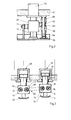
- the vibration exciter systems are preferably equipped with an anti-rotation device if the tool is not rotationally symmetrical.
- an anti-rotation device is shown in FIG. 2.
- Fig. 2 shows only the essential parts of a single tool, the associated vibration exciter and the machine frame.
- a connector 60 acts laterally, which is rigidly connected to a guide bush 62.
- the guide bush 62 is slidably mounted on a shaft 64 which is rigidly connected to the machine frame 10 at its upper end and is guided at its lower end in a bush 66 rigidly attached to the tool 12.
- Bellows 66, 68 which enclose the free part of the shaft 64, serve to seal against the ingress of dirt and the like.
- an embodiment with a push-elastic rubber element 17 is shown on the left in FIG. 2.
- the spring stiffness in the direction of vibration is chosen to be low so that the restoring forces are negligible.
- FIG. 3 shows, similar to FIG. 1, two ramming tools 12, 14 with the associated vibration exciters 16, 18 and piston / cylinder arrangements 28, 30 for suspending the tools on the machine frame 10.
- the vibration exciters are different from the embodiment according to FIG 1 not designed as a linear drive, but as an eccentric drive.
- Each vibration exciter contains two mutually parallel shafts 70, 72 or 74, 76, on each of which an eccentric mass 78, 80 or 82, 84 is mounted.
- the rotary movements of the eccentric masses are synchronized with each other and he follow in opposite directions within a vibration system with different directions of rotation.
- neighboring systems also vibrate with a 180 ° phase shift.
- the synchronization between two adjacent vibration exciters can take place, for example, by means of a toothed belt 86 or the like, which connects two adjacent shafts 72, 74 of two adjacent vibration exciters 16, 18 to one another. This ensures that the tools 14, 12 swing in push-pull.
- the piston / cylinder arrangements 28, 30 are controlled in the same way as in FIG. 1.
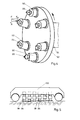
- ablation tools 88 with the associated vibration exciters 90 are arranged on a common, circular disk-shaped tool carrier 92, which is also referred to as a shield.
- This tool carrier is attached to the end of a rotatable cantilever arm 94.
- the formation of the vibration exciter 90 corresponds to that of FIGS. 1 and 2 and therefore need not be explained further.
- the tools 88 are chisel-shaped and are used for material removal for tunnel or shaft driving in mining.
- the tools and associated vibration exciters are arranged on the circumference of the tool carrier 92 in such a way that their axes are inclined to the axis of the rotatable cantilever arm 94.
- This inclination causes a division of the impact force F in a Axialkompo- ne nth FA and a Radialkömponente F R 'Components F R support the rotational movement of the tool carrier and thus cause uniform ablation of the rock.
- a series of ramming tools 96 with the associated vibration exciters 98 are suspended in a straight line one behind the other on a common mobile machine frame 100.
- six ramming tools are provided, which are designed as in the embodiment shown in FIG. 1.
- the schematic representation shows the tools one behind the other in the direction of travel; Of course, several tools can also be arranged side by side. Two neighboring tools and vibration exciters can form a pair. the. However, it is also possible to couple non-adjacent tools in pairs.
- An inclination of the tool axes to the vertical can also be provided here, e.g. to support locomotion.
- FIG. 6 shows an embodiment with a rolling, vibrating tool in the form of a drum casing 102.
- a drum casing 102 with a smooth surface serves, for example, to solidify bulk goods.
- tool rings 106, 108 are also shown in dashed lines, which can be provided instead of a smooth drum surface and are used, for example, to remove rock or the like.
- the drum jacket 102 is mounted at two diametrically opposite points on roller bearings 104 on a yoke 110, which is rigidly connected to an end face of a piston 112.
- the piston 112 is slidably fitted in a cylinder 114 which is formed in the interior of an axis 116 in the radial direction.
- the axis 116 is rotatably mounted in a frame 120 attached to the machine frame 118.
- a crank 122 is firmly closed on one end of the axle 116, to which a piston rod 124 is articulated.
- This piston rod 124 is connected to the piston 126 of a double-acting adjusting cylinder 128 which is articulated on a holder 130 which is rigidly connected to the machine room 118.
- axis 116 can be pivoted through an angle 2S.
- the direction of oscillation of the piston 112 is also pivoted, so that it forms an angle ⁇ with respect to the vertical. In this way, a propulsion component is obtained from the impact force.
- the one mass of the vibration system namely the axis 116 and the cylinder 114, is rigidly mounted on the machine frame 118.
- the full reaction forces of the oscillating movement of the piston 112 and the parts driven thereby are therefore transmitted to the machine frame 118.
- At least two such tools are therefore provided on the same machine frame 118, which oscillate with a 180 ° phase shift.
- the machine frame 118 then processes the reaction forces as internal forces so that no external forces arise.
- the remaining moments which have the tendency to pivot the machine frame 118, are eliminated by arranging a further pair of tools on the same machine frame 118, the arrangement of the tool pairs taking place in mirror image.
- the tools of a pair are preferably arranged close to one another or one behind the other on the machine frame 118.
- Two axes 116 of a pair of tools can then be pivoted simultaneously by an adjusting cylinder 128.
- the two cranks 122 can be coupled by a push rod or the two axles can be coupled long and pivoted with a common crank.
- several pairs of tools are arranged on the tunneling shield of a tunnel boring machine or the like, similar to the embodiment according to FIG. 4.
- an anti-rotation device is provided, which is realized by a rod 132 connecting the two yokes 110, which is slidably mounted in a cylindrical bore 134 of the axis 116.
- sealing elements 136 are provided which close the end of the rolling tool.
- Hydraulic lines 138, 140 are fed through the axis 116 in the form of axial bores to feed the cylinder 114.
- Rolling tools are also provided in the embodiments shown in FIGS. 8 and 9.
- a roller-shaped tool 142 which can be provided with tool rings 144, is rotatably mounted on an axis 148 via slide or roller bearings 146.
- the axis 148 is rigidly mounted in a fork-shaped holder 150.
- the holder 150 is rigidly connected to the piston 152 of a double-acting hydraulic cylinder 154, which represents the linear drive of the tool.
- the cylinder 154 is rigidly connected to the tool carrier 156.
- a yoke 158 is rigidly connected to the piston 152 and has at its opposite ends guide bolts 160 directed towards the tool carrier 156, which are slidably guided in bushings 162 which are fastened to the tool carrier 156.
- This anti-rotation lock can be omitted if a rotationally symmetrical tool is used.
- the arrangement of elastic rubber elements between the frame 156 and the yoke 158 similar to the embodiment according to FIG. 2 is conceivable as a further protection against rotation.
- the embodiment according to FIG. 9 differs from that according to FIG. 8 in that two rolling tools 164 are provided which are rotatably mounted on the outer ends of an axle shaft 166 which is supported in its central region by a rod-shaped holder 168.
- reaction forces are transmitted to the machine frame 156. Therefore, at least two tools are always paired and arranged on the tool carrier 156 with a 180 ° phase shift. To eliminate the remaining moments, two pairs of tools with a mirror-image arrangement are preferably provided.
- a rigid suspension of the vibration exciter system on the machine frame has the advantage that the entire piston stroke is available for the tool movement.
- an elastic suspension of the vibration exciter and the tool driven by it on the machine frame is advantageous.
- Corresponding embodiments are shown in FIGS. 10 and 11.
- the embodiment according to FIG. 10 is the same as that according to FIG. 6, so that only the different features compared to FIG. 6 are explained.
- the yoke 110 is connected on both end faces to an annular suspension plate 168, on the end face of which a likewise annular fastening plate 170 is fastened.
- a corresponding mounting plate 172 is connected in parallel to the machine frame 174.
- a vulcanized, ring-shaped, elastic suspension element 176 by means of which the tool with the associated vibration exciter is suspended on the machine frame. Due to the ring-shaped suspension element 176, the interior of the tool is simultaneously turned outwards sealed and thus protected against the ingress of contaminants.
- rolling compaction tools on compaction machines for earthworks and road construction are provided with rotating unbalances for generating vibrations. These unbalances cause a so-called non-directional swinging movement of the cylindrical tool, ie the swing path amplitude is all around a center.
- the vibration movement is not only perpendicular to the surface to be compacted, but also parallel to it, ie in the direction of travel of the machine. Since the compaction tools of such machines usually also have to perform drive and steering functions, the horizontal components of the swinging movement have an unfavorable effect on the suspension in the machine frame. On the one hand, the elastic elements for suspension should have as little spring stiffness as possible so that the machine frame is largely spared dynamic vibrating forces. On the other hand, the drive and steering function of the rolling tool requires a relatively hard suspension in the horizontal direction so that instabilities in traction and cornering behavior are prevented, which in turn results in a higher vibration load on the machine frame and thus on the entire device, including the operator.
- the solution to the problem according to the invention i.e. To a large extent keep the machine frame free from dynamic forces from the tool movement - is achieved in the embodiments according to FIGS. 10 and 11 in that the two-mass linear excitation system used generates vibrations in one direction only.
- the spring stiffness of the suspension elements 176 can be designed differently in the main axes. For example, a relatively low spring stiffness is provided in the direction of the vibration, but a relatively large spring stiffness in the direction perpendicular to the vibration, and the disadvantages described are thus avoided.
- the embodiment according to FIG. 11 essentially differs from that according to FIG. 10 in that the vibration exciter of the tool is rotatably mounted on the machine frame.
- the two outer fastening plates 172 are connected to a flange 178 of a bearing hub 180, which is mounted on roller bearings 182 in a cylindrical bore in the machine frame 174.
- the anti-rotation device 132, 134 of the embodiments according to FIGS. 6 and 10 is not shown for the sake of simplicity, but is preferably also present.
- the direction of oscillation of the tool can be adjusted by pivoting the axis 116, whereby a pivoting mechanism similar to that in the embodiment according to FIGS. 6 and 7 can be provided, which is attached to one of the bearing hubs 180 attacks.
- two lateral guide columns 184, 186 are provided instead of an elastic suspension on the machine frame.
- a piston 112 is mounted with a tool foot 188, which forms the lower mass.
- the cylinder spaces 114A, 114B are acted on alternately, and both masses oscillate against one another in accordance with the law of maintaining the center of gravity of the system, the relatively heavier upper mass carrying out the lower oscillation amplitude.
- a directional control valve 190 which is fed by a pressure source 192, the chambers 184A, 184B and 186A, 186B of the two guide cylinders 184, 186 are connected to one another, so that the upper mass oscillates freely with respect to the machine frame 194 without generating support forces can.
- the guide cylinders 184, 186 are with their jackets on the machine frame 194 and with theirs Piston rods attached to the upper mass.
- An anti-rotation device according to FIG. 2 can be arranged between the upper mass and the tool foot 188.
- the entire unit can be raised or lowered, or if valve 190 is used as a control valve, a specific load or tracking rate can be specified (see page 101).
- FIG. 13 shows an embodiment in which a ramming system comprising a cylinder 196 and piston 198 with a ramming tool 200 attached to it is articulated on a machine frame 206 via two trailing arms 202, 204.
- the articulation point 208 of the trailing arm 202 on the machine frame 206 is fixed, while the trailing arm 204 is articulated on the machine frame via a horizontally displaceable bearing 210, which can be moved or blocked by means of an adjusting cylinder 212. This allows the tool axis to be inclined towards the floor as required.
- the adjusting cylinder 212 can be driven periodically, the frequency being adjustable in such a way that a horizontal component is superimposed on the tool movement, which compensates for the relative movement of a movable tool carrier to the ground in the contact area between the tool and the ground . This ensures that, when the tool hits the ground, the tool has only a vertical component in its movement relative to the ground and thus the surface of the processed ground is not stressed in the horizontal direction. This ensures that even with very shear sensitive surfaces, no cracks can occur due to horizontal movement components of the tools during compaction.
Landscapes
- Engineering & Computer Science (AREA)
- Structural Engineering (AREA)
- Life Sciences & Earth Sciences (AREA)
- General Engineering & Computer Science (AREA)
- Soil Sciences (AREA)
- Environmental & Geological Engineering (AREA)
- General Life Sciences & Earth Sciences (AREA)
- Mining & Mineral Resources (AREA)
- Paleontology (AREA)
- Civil Engineering (AREA)
- Agronomy & Crop Science (AREA)
- Road Paving Machines (AREA)
- Investigation Of Foundation Soil And Reinforcement Of Foundation Soil By Compacting Or Drainage (AREA)
- Percussive Tools And Related Accessories (AREA)
- Diaphragms For Electromechanical Transducers (AREA)
- Curing Cements, Concrete, And Artificial Stone (AREA)
- Disintegrating Or Milling (AREA)
- Apparatuses For Generation Of Mechanical Vibrations (AREA)
- Presses And Accessory Devices Thereof (AREA)
- Perforating, Stamping-Out Or Severing By Means Other Than Cutting (AREA)
Priority Applications (1)
| Application Number | Priority Date | Filing Date | Title |
|---|---|---|---|
| AT80104120T ATE2855T1 (de) | 1979-07-17 | 1980-07-15 | Massenkompensiertes stampf- oder schlagsystem. |
Applications Claiming Priority (2)
| Application Number | Priority Date | Filing Date | Title |
|---|---|---|---|
| DE2928870 | 1979-07-17 | ||
| DE19792928870 DE2928870A1 (de) | 1979-07-17 | 1979-07-17 | Massenkompensiertes stampf- und/oder schlagsystem |
Publications (3)
| Publication Number | Publication Date |
|---|---|
| EP0023624A2 true EP0023624A2 (fr) | 1981-02-11 |
| EP0023624A3 EP0023624A3 (en) | 1981-05-13 |
| EP0023624B1 EP0023624B1 (fr) | 1983-03-23 |
Family
ID=6075954
Family Applications (1)
| Application Number | Title | Priority Date | Filing Date |
|---|---|---|---|
| EP80104120A Expired EP0023624B1 (fr) | 1979-07-17 | 1980-07-15 | Système de damage ou de frappe à masses compensées |
Country Status (5)
| Country | Link |
|---|---|
| US (1) | US4382715A (fr) |
| EP (1) | EP0023624B1 (fr) |
| JP (1) | JPS5620204A (fr) |
| AT (1) | ATE2855T1 (fr) |
| DE (1) | DE2928870A1 (fr) |
Cited By (4)
| Publication number | Priority date | Publication date | Assignee | Title |
|---|---|---|---|---|
| DE29500811U1 (de) * | 1995-01-19 | 1995-03-02 | Humme, Thomas, 52385 Nideggen | Erdverdichter |
| DE4340699A1 (de) * | 1993-11-30 | 1995-06-01 | Linz Albert Dipl Ing | Vorrichtung zur dynamischen Bodenverdichtung |
| EP0662544A1 (fr) * | 1994-01-07 | 1995-07-12 | Inco Limited | Dispositif de profilage d'une couche de base d'une route |
| CN116856381A (zh) * | 2023-07-14 | 2023-10-10 | 江苏宁翔建设工程有限公司 | 一种房建工程地基基础夯实施工装置 |
Families Citing this family (20)
| Publication number | Priority date | Publication date | Assignee | Title |
|---|---|---|---|---|
| NL8303676A (nl) * | 1983-10-25 | 1985-05-17 | Ballast Nedam Groep Nv | Werkwijze en inrichting voor het verdichten van grond. |
| US4698926A (en) * | 1986-05-22 | 1987-10-13 | Felco Industries, Ltd. | Hydraulic excavator and compactor bucket therefor |
| JPH02236056A (ja) * | 1988-04-22 | 1990-09-18 | Kobe Steel Ltd | 車両の制動装置 |
| JP2551927Y2 (ja) * | 1991-06-17 | 1997-10-27 | 村上 鑛治 | 振動式ランマーにおける突き固めシュー |
| DE19714555C2 (de) * | 1997-04-09 | 2001-06-21 | Wacker Werke Kg | Arbeitsgerät, insbesondere Stampfgerät zur Bodenverdichtung oder Hammer |
| DE19739743C2 (de) * | 1997-09-10 | 1999-07-08 | Wacker Werke Kg | Arbeitsgerät mit reduzierten Obermassenschwingungen |
| DE10019806B4 (de) * | 2000-04-20 | 2005-10-20 | Wacker Construction Equipment | Bodenverdichtungsvorrichtung mit Schwingungsdetektion |
| DE20019823U1 (de) * | 2000-11-22 | 2001-02-08 | Wacker-Werke GmbH & Co KG, 80809 München | Vorrichtung zur stufenlosen Unwuchtverstellung bei lenkbaren Vibrationsplatten |
| US6742960B2 (en) * | 2002-07-09 | 2004-06-01 | Caterpillar Inc. | Vibratory compactor and method of using same |
| US7354221B2 (en) * | 2005-02-28 | 2008-04-08 | Caterpillar Inc. | Self-propelled plate compactor having linear excitation |
| US20060285924A1 (en) * | 2005-05-20 | 2006-12-21 | Mccoskey William D | Asphalt compaction device with pneumatic wheels |
| DE102005029434A1 (de) * | 2005-06-24 | 2006-12-28 | Wacker Construction Equipment Ag | Vibrationsplatte mit individuell einstellbaren Schwingungserregern |
| EP2366832B1 (fr) * | 2010-03-18 | 2015-09-23 | Joseph Vögele AG | Procédé et finisseuse de route destinés à la réalisation d'une couche de revêtement compactée |
| US9328472B2 (en) * | 2013-08-07 | 2016-05-03 | R&B Leasing, Llc | System and method for determining optimal design conditions for structures incorporating geosynthetically confined soils |
| AT517385B1 (de) * | 2015-06-15 | 2019-02-15 | Fill Gmbh | Vorrichtung zum Entkernen |
| GB2545702B (en) * | 2015-12-22 | 2020-01-15 | Gately Pearse | Pipe laying apparatus |
| US11293147B2 (en) | 2017-03-21 | 2022-04-05 | Volvo Construction Equipment Ab | Vibratory compaction machines providing coordinated impacts from first and second drums and related control systems and methods |
| CN106948518B (zh) * | 2017-04-16 | 2018-02-02 | 湖北晨昱晖农业科技股份有限公司 | 一种建筑用土坯夯实装置 |
| CN113373766B (zh) * | 2021-08-12 | 2021-11-05 | 新沂市盛翔节能保温工程有限公司 | 一种斜坡道路滚压式路面夯实机械及夯实施工方法 |
| GB2624654A (en) * | 2022-11-24 | 2024-05-29 | Ekin Engineering Ltd | A floor levelling device |
Family Cites Families (18)
| Publication number | Priority date | Publication date | Assignee | Title |
|---|---|---|---|---|
| DE1100356B (de) * | 1954-11-09 | 1961-02-23 | Jaroslav Ruzicka | Schwingendes System mit mindestens drei aneinandergereihten, frei schwingenden Massen und Verfahren zu seiner Inbetriebsetzung |
| US2903948A (en) * | 1956-01-13 | 1959-09-15 | John H Lucas | Multiple ram compactor |
| DE1095753B (de) * | 1956-06-15 | 1960-12-22 | Robel & Co G | Stampfverdichter, insbesondere zum Verdichten des Erdbodens, mit mehreren, in der Bewegungsrichtung hintereinander liegenden Stampfeinheiten |
| US3075436A (en) * | 1960-05-06 | 1963-01-29 | Engineering Dev Co Inc | Soil compaction machine |
| FR1355517A (fr) * | 1961-12-30 | 1964-03-20 | Inst Francais Du Petrole | Système d'asservissement pour vibrateurs |
| DE1484513A1 (de) * | 1962-03-19 | 1969-04-03 | Master Cons Inc | Stampf- oder Verdichtungsgeraet |
| DE2024168A1 (de) * | 1970-05-16 | 1971-12-02 | H Sieke | Auf Eisenbahnschienen verfahrbare Gleisstopfmaschine |
| US3923412A (en) * | 1970-09-23 | 1975-12-02 | Albert Linz | Drive means for vehicle mounted vibratory compactor |
| US3705747A (en) * | 1970-12-28 | 1972-12-12 | Leonard John Blackburn | Structure demolition apparatus |
| DE2231404A1 (de) * | 1971-11-01 | 1973-05-03 | Allied Steel Tractor Prod Inc | Vibrations-verdichtungsvorrichtung |
| GB1429332A (en) * | 1972-03-21 | 1976-03-24 | Sieke H | Method of compaction of bulk materials |
| DE2231023A1 (de) * | 1972-06-24 | 1974-01-10 | Bopparder Maschinenbau Gmbh | Vibrationsverdichter |
| DE2554013C3 (de) * | 1975-12-01 | 1984-10-25 | Koehring Gmbh - Bomag Division, 5407 Boppard | Verfahren zur dynamischen Bodenverdichtung |
| US4082471A (en) * | 1976-01-02 | 1978-04-04 | Imperial-Eastman Corporation | Universal hydraulic impact tool |
| US4088077A (en) * | 1976-03-15 | 1978-05-09 | Canron, Inc. | Continuous tamping device |
| US4105356A (en) * | 1977-05-19 | 1978-08-08 | Koehring Corporation | Vibratory roller |
| FR2407799A1 (fr) * | 1977-11-07 | 1979-06-01 | Sautereau & Cie Ets | Perfectionnement apporte aux mortaiseuses a outil vibrant |
| US4176983A (en) * | 1978-07-17 | 1979-12-04 | Ingersoll-Rand Company | Variable eccentric device |
-
1979
- 1979-07-17 DE DE19792928870 patent/DE2928870A1/de not_active Withdrawn
-
1980
- 1980-07-15 EP EP80104120A patent/EP0023624B1/fr not_active Expired
- 1980-07-15 AT AT80104120T patent/ATE2855T1/de not_active IP Right Cessation
- 1980-07-17 JP JP9813680A patent/JPS5620204A/ja active Pending
- 1980-07-17 US US06/169,592 patent/US4382715A/en not_active Expired - Lifetime
Cited By (4)
| Publication number | Priority date | Publication date | Assignee | Title |
|---|---|---|---|---|
| DE4340699A1 (de) * | 1993-11-30 | 1995-06-01 | Linz Albert Dipl Ing | Vorrichtung zur dynamischen Bodenverdichtung |
| EP0662544A1 (fr) * | 1994-01-07 | 1995-07-12 | Inco Limited | Dispositif de profilage d'une couche de base d'une route |
| DE29500811U1 (de) * | 1995-01-19 | 1995-03-02 | Humme, Thomas, 52385 Nideggen | Erdverdichter |
| CN116856381A (zh) * | 2023-07-14 | 2023-10-10 | 江苏宁翔建设工程有限公司 | 一种房建工程地基基础夯实施工装置 |
Also Published As
| Publication number | Publication date |
|---|---|
| EP0023624B1 (fr) | 1983-03-23 |
| JPS5620204A (en) | 1981-02-25 |
| EP0023624A3 (en) | 1981-05-13 |
| US4382715A (en) | 1983-05-10 |
| ATE2855T1 (de) | 1983-04-15 |
| DE2928870A1 (de) | 1981-02-12 |
Similar Documents
| Publication | Publication Date | Title |
|---|---|---|
| EP0023624B1 (fr) | Système de damage ou de frappe à masses compensées | |
| DE3239266C2 (fr) | ||
| EP0975839B1 (fr) | Compacteur destine au compactage du sol | |
| DE19504495A1 (de) | Maschine zur Erneuerung von Fahrbahnen | |
| EP3092341B1 (fr) | Bandage de compactage du sol, rouleau compresseur avec un tel bandage de compactage du sol et procédé de compactage du sol | |
| WO2002044475A1 (fr) | Appareil de compactage | |
| EP3237681A1 (fr) | Unité de bourrage destinée à une bourreuse de traverses | |
| DE2304942A1 (de) | Vibrationswalze | |
| DE3149335A1 (de) | "maschine zum verlegen von asphalt" | |
| DE69934696T2 (de) | Verstellbarer exzenterschwinghammer | |
| DE69826949T2 (de) | Fräsmaschine mit vibrierender Fräswalze | |
| DE19547698C2 (de) | Vorrichtung und Verfahren zum Abfräsen von harten Oberflächen, insbesondere von Straßenbelägen | |
| AT389723B (de) | Einrichtung zur erzeugung von vibrationen | |
| EP3587668B1 (fr) | Engin de construction automoteur et procédé de traitement des revêtements de sol | |
| DE10147957B4 (de) | Schwingungserreger für eine Bodenverdichtungsvorrichtung | |
| EP2242590B1 (fr) | Excitateur à balourds comprenant un ou plusieurs balourds rotatifs | |
| DE9312846U1 (de) | Vibrationsbär zum Rammen und/oder Ziehen von Rammgütern | |
| WO2004022250A1 (fr) | Oscillateur destine a des engins de compactage du sol | |
| EP1342849B1 (fr) | Rouleau de compactage | |
| DE10147046C2 (de) | Antriebssystem für ein Walzwerk | |
| DE102008017058B4 (de) | Seitensteuerung für eine Vibrationsplatte | |
| CH658220A5 (de) | Fahrbare beton- oder gesteinsfraesmaschine. | |
| DE3642487C2 (de) | Einrichtung zum Ausgleich von Wechselmomenten | |
| DE4340699A1 (de) | Vorrichtung zur dynamischen Bodenverdichtung | |
| DE19631991B4 (de) | Vibrator, insbesondere für einen Vibrationsbären |
Legal Events
| Date | Code | Title | Description |
|---|---|---|---|
| PUAI | Public reference made under article 153(3) epc to a published international application that has entered the european phase |
Free format text: ORIGINAL CODE: 0009012 |
|
| AK | Designated contracting states |
Designated state(s): AT BE CH FR GB IT NL SE |
|
| PUAL | Search report despatched |
Free format text: ORIGINAL CODE: 0009013 |
|
| AK | Designated contracting states |
Designated state(s): AT BE CH FR GB IT NL SE |
|
| 17P | Request for examination filed |
Effective date: 19810428 |
|
| ITF | It: translation for a ep patent filed | ||
| GRAA | (expected) grant |
Free format text: ORIGINAL CODE: 0009210 |
|
| AK | Designated contracting states |
Designated state(s): AT BE CH FR GB IT LI NL SE |
|
| REF | Corresponds to: |
Ref document number: 2855 Country of ref document: AT Date of ref document: 19830415 Kind code of ref document: T |
|
| ITPR | It: changes in ownership of a european patent |
Owner name: CAMBIO RAGIONE SOCIALE;BOMAG - MENCK GMBH |
|
| ET | Fr: translation filed | ||
| PGFP | Annual fee paid to national office [announced via postgrant information from national office to epo] |
Ref country code: FR Payment date: 19840601 Year of fee payment: 5 |
|
| PGFP | Annual fee paid to national office [announced via postgrant information from national office to epo] |
Ref country code: SE Payment date: 19840630 Year of fee payment: 5 Ref country code: BE Payment date: 19840630 Year of fee payment: 5 |
|
| PGFP | Annual fee paid to national office [announced via postgrant information from national office to epo] |
Ref country code: CH Payment date: 19841010 Year of fee payment: 5 |
|
| PLBE | No opposition filed within time limit |
Free format text: ORIGINAL CODE: 0009261 |
|
| STAA | Information on the status of an ep patent application or granted ep patent |
Free format text: STATUS: NO OPPOSITION FILED WITHIN TIME LIMIT |
|
| 26N | No opposition filed | ||
| PGFP | Annual fee paid to national office [announced via postgrant information from national office to epo] |
Ref country code: AT Payment date: 19860701 Year of fee payment: 7 |
|
| PGFP | Annual fee paid to national office [announced via postgrant information from national office to epo] |
Ref country code: NL Payment date: 19870731 Year of fee payment: 8 |
|
| PG25 | Lapsed in a contracting state [announced via postgrant information from national office to epo] |
Ref country code: GB Effective date: 19880715 Ref country code: AT Effective date: 19880715 |
|
| PG25 | Lapsed in a contracting state [announced via postgrant information from national office to epo] |
Ref country code: SE Effective date: 19880716 |
|
| PG25 | Lapsed in a contracting state [announced via postgrant information from national office to epo] |
Ref country code: LI Effective date: 19880731 Ref country code: CH Effective date: 19880731 Ref country code: BE Effective date: 19880731 |
|
| BERE | Be: lapsed |
Owner name: BOMAG - MENCK G.M.B.H. Effective date: 19880731 |
|
| PG25 | Lapsed in a contracting state [announced via postgrant information from national office to epo] |
Ref country code: NL Effective date: 19890201 |
|
| NLV4 | Nl: lapsed or anulled due to non-payment of the annual fee | ||
| GBPC | Gb: european patent ceased through non-payment of renewal fee | ||
| PG25 | Lapsed in a contracting state [announced via postgrant information from national office to epo] |
Ref country code: FR Free format text: LAPSE BECAUSE OF NON-PAYMENT OF DUE FEES Effective date: 19890331 |
|
| REG | Reference to a national code |
Ref country code: CH Ref legal event code: PL |
|
| REG | Reference to a national code |
Ref country code: FR Ref legal event code: ST |
|
| EUG | Se: european patent has lapsed |
Ref document number: 80104120.3 Effective date: 19890510 |