EP0023636A1 - Pyrazolin-5-on-yl-methyl-(di)thiophosphorsäureester, Verfahren zu ihrer Herstellung und ihre Verwendung zur Bekämpfung von Schädlingen - Google Patents
Pyrazolin-5-on-yl-methyl-(di)thiophosphorsäureester, Verfahren zu ihrer Herstellung und ihre Verwendung zur Bekämpfung von Schädlingen Download PDFInfo
- Publication number
- EP0023636A1 EP0023636A1 EP80104189A EP80104189A EP0023636A1 EP 0023636 A1 EP0023636 A1 EP 0023636A1 EP 80104189 A EP80104189 A EP 80104189A EP 80104189 A EP80104189 A EP 80104189A EP 0023636 A1 EP0023636 A1 EP 0023636A1
- Authority
- EP
- European Patent Office
- Prior art keywords
- methyl
- formula
- pyrazolin
- carbon atoms
- thiophosphoric
- Prior art date
- Legal status (The legal status is an assumption and is not a legal conclusion. Google has not performed a legal analysis and makes no representation as to the accuracy of the status listed.)
- Granted
Links
- 150000003580 thiophosphoric acid esters Chemical class 0.000 title claims abstract description 17
- 238000000034 method Methods 0.000 title claims description 10
- 238000002360 preparation method Methods 0.000 title claims description 10
- 239000000575 pesticide Substances 0.000 title claims description 7
- -1 methoxycarbonylmethyl Chemical group 0.000 claims abstract description 29
- 125000002496 methyl group Chemical group [H]C([H])([H])* 0.000 claims abstract description 21
- 125000004432 carbon atom Chemical group C* 0.000 claims abstract description 20
- NINIDFKCEFEMDL-UHFFFAOYSA-N Sulfur Chemical compound [S] NINIDFKCEFEMDL-UHFFFAOYSA-N 0.000 claims abstract description 14
- 125000000217 alkyl group Chemical group 0.000 claims abstract description 13
- UFHFLCQGNIYNRP-UHFFFAOYSA-N Hydrogen Chemical compound [H][H] UFHFLCQGNIYNRP-UHFFFAOYSA-N 0.000 claims abstract description 12
- 229910052760 oxygen Inorganic materials 0.000 claims abstract description 12
- 239000001301 oxygen Substances 0.000 claims abstract description 12
- 229910052717 sulfur Inorganic materials 0.000 claims abstract description 12
- 239000011593 sulfur Substances 0.000 claims abstract description 12
- QVGXLLKOCUKJST-UHFFFAOYSA-N atomic oxygen Chemical compound [O] QVGXLLKOCUKJST-UHFFFAOYSA-N 0.000 claims abstract description 10
- 229910052739 hydrogen Inorganic materials 0.000 claims abstract description 10
- 239000001257 hydrogen Substances 0.000 claims abstract description 10
- 125000001495 ethyl group Chemical group [H]C([H])([H])C([H])([H])* 0.000 claims abstract description 8
- 125000001997 phenyl group Chemical group [H]C1=C([H])C([H])=C(*)C([H])=C1[H] 0.000 claims abstract description 7
- 125000003903 2-propenyl group Chemical group [H]C([*])([H])C([H])=C([H])[H] 0.000 claims abstract description 6
- 229910052736 halogen Inorganic materials 0.000 claims abstract description 5
- XBYRMPXUBGMOJC-UHFFFAOYSA-N 1,2-dihydropyrazol-3-one Chemical class OC=1C=CNN=1 XBYRMPXUBGMOJC-UHFFFAOYSA-N 0.000 claims description 9
- 241000607479 Yersinia pestis Species 0.000 claims description 7
- 239000002253 acid Substances 0.000 claims description 6
- 239000011230 binding agent Substances 0.000 claims description 5
- 239000003795 chemical substances by application Substances 0.000 claims description 5
- 150000003839 salts Chemical class 0.000 claims description 5
- 239000007787 solid Substances 0.000 claims description 5
- 150000003582 thiophosphoric acids Chemical class 0.000 claims description 5
- 125000004453 alkoxycarbonyl group Chemical group 0.000 claims description 4
- 239000003085 diluting agent Substances 0.000 claims description 3
- 150000002367 halogens Chemical group 0.000 claims description 3
- 239000003960 organic solvent Substances 0.000 claims description 3
- 150000003014 phosphoric acid esters Chemical class 0.000 claims description 3
- 230000000895 acaricidal effect Effects 0.000 claims 1
- 230000000749 insecticidal effect Effects 0.000 claims 1
- 239000007788 liquid Substances 0.000 claims 1
- 125000005843 halogen group Chemical group 0.000 abstract 2
- YXFVVABEGXRONW-UHFFFAOYSA-N Toluene Chemical compound CC1=CC=CC=C1 YXFVVABEGXRONW-UHFFFAOYSA-N 0.000 description 24
- 241000254173 Coleoptera Species 0.000 description 16
- 150000001875 compounds Chemical class 0.000 description 15
- 239000004480 active ingredient Substances 0.000 description 13
- 239000000203 mixture Substances 0.000 description 13
- 239000000243 solution Substances 0.000 description 12
- 239000002904 solvent Substances 0.000 description 11
- WEVYAHXRMPXWCK-UHFFFAOYSA-N Acetonitrile Chemical compound CC#N WEVYAHXRMPXWCK-UHFFFAOYSA-N 0.000 description 10
- 239000003921 oil Substances 0.000 description 10
- 235000019198 oils Nutrition 0.000 description 10
- XLYOFNOQVPJJNP-UHFFFAOYSA-N water Substances O XLYOFNOQVPJJNP-UHFFFAOYSA-N 0.000 description 10
- CSCPPACGZOOCGX-UHFFFAOYSA-N Acetone Chemical compound CC(C)=O CSCPPACGZOOCGX-UHFFFAOYSA-N 0.000 description 9
- LFQSCWFLJHTTHZ-UHFFFAOYSA-N Ethanol Chemical compound CCO LFQSCWFLJHTTHZ-UHFFFAOYSA-N 0.000 description 9
- 239000006185 dispersion Substances 0.000 description 9
- 150000002148 esters Chemical class 0.000 description 8
- FYSNRJHAOHDILO-UHFFFAOYSA-N thionyl chloride Chemical compound ClS(Cl)=O FYSNRJHAOHDILO-UHFFFAOYSA-N 0.000 description 8
- RTZKZFJDLAIYFH-UHFFFAOYSA-N Diethyl ether Chemical compound CCOCC RTZKZFJDLAIYFH-UHFFFAOYSA-N 0.000 description 7
- VYPSYNLAJGMNEJ-UHFFFAOYSA-N Silicium dioxide Chemical compound O=[Si]=O VYPSYNLAJGMNEJ-UHFFFAOYSA-N 0.000 description 7
- YMWUJEATGCHHMB-UHFFFAOYSA-N Dichloromethane Chemical compound ClCCl YMWUJEATGCHHMB-UHFFFAOYSA-N 0.000 description 6
- 241000255925 Diptera Species 0.000 description 6
- 230000000694 effects Effects 0.000 description 6
- 241000238876 Acari Species 0.000 description 5
- 241001124076 Aphididae Species 0.000 description 5
- 241001425390 Aphis fabae Species 0.000 description 5
- 235000013339 cereals Nutrition 0.000 description 5
- JHIVVAPYMSGYDF-UHFFFAOYSA-N cyclohexanone Chemical compound O=C1CCCCC1 JHIVVAPYMSGYDF-UHFFFAOYSA-N 0.000 description 5
- 239000000839 emulsion Substances 0.000 description 5
- 238000009472 formulation Methods 0.000 description 5
- IAYPIBMASNFSPL-UHFFFAOYSA-N Ethylene oxide Chemical compound C1CO1 IAYPIBMASNFSPL-UHFFFAOYSA-N 0.000 description 4
- 241000238631 Hexapoda Species 0.000 description 4
- 235000008331 Pinus X rigitaeda Nutrition 0.000 description 4
- 235000011613 Pinus brutia Nutrition 0.000 description 4
- 241000018646 Pinus brutia Species 0.000 description 4
- 240000001987 Pyrus communis Species 0.000 description 4
- 229910052784 alkaline earth metal Inorganic materials 0.000 description 4
- 239000008187 granular material Substances 0.000 description 4
- ZXEKIIBDNHEJCQ-UHFFFAOYSA-N isobutanol Chemical compound CC(C)CO ZXEKIIBDNHEJCQ-UHFFFAOYSA-N 0.000 description 4
- 239000000843 powder Substances 0.000 description 4
- XLOPRKKSAJMMEW-SFYZADRCSA-M (R,R)-chrysanthemate Chemical compound CC(C)=C[C@@H]1[C@@H](C([O-])=O)C1(C)C XLOPRKKSAJMMEW-SFYZADRCSA-M 0.000 description 3
- NFAOATPOYUWEHM-UHFFFAOYSA-N 2-(6-methylheptyl)phenol Chemical class CC(C)CCCCCC1=CC=CC=C1O NFAOATPOYUWEHM-UHFFFAOYSA-N 0.000 description 3
- 241000254032 Acrididae Species 0.000 description 3
- 241001136249 Agriotes lineatus Species 0.000 description 3
- 239000005995 Aluminium silicate Substances 0.000 description 3
- UHOVQNZJYSORNB-UHFFFAOYSA-N Benzene Chemical compound C1=CC=CC=C1 UHOVQNZJYSORNB-UHFFFAOYSA-N 0.000 description 3
- 240000007124 Brassica oleracea Species 0.000 description 3
- 235000003899 Brassica oleracea var acephala Nutrition 0.000 description 3
- 235000011301 Brassica oleracea var capitata Nutrition 0.000 description 3
- 235000001169 Brassica oleracea var oleracea Nutrition 0.000 description 3
- 229920000742 Cotton Polymers 0.000 description 3
- 241000254171 Curculionidae Species 0.000 description 3
- OKKJLVBELUTLKV-UHFFFAOYSA-N Methanol Chemical compound OC OKKJLVBELUTLKV-UHFFFAOYSA-N 0.000 description 3
- 241000257159 Musca domestica Species 0.000 description 3
- ZMXDDKWLCZADIW-UHFFFAOYSA-N N,N-Dimethylformamide Chemical compound CN(C)C=O ZMXDDKWLCZADIW-UHFFFAOYSA-N 0.000 description 3
- CTQNGGLPUBDAKN-UHFFFAOYSA-N O-Xylene Chemical compound CC1=CC=CC=C1C CTQNGGLPUBDAKN-UHFFFAOYSA-N 0.000 description 3
- 241001147398 Ostrinia nubilalis Species 0.000 description 3
- 229930040373 Paraformaldehyde Natural products 0.000 description 3
- 241000256682 Peregrinus maidis Species 0.000 description 3
- 235000014443 Pyrus communis Nutrition 0.000 description 3
- 235000002595 Solanum tuberosum Nutrition 0.000 description 3
- 244000061456 Solanum tuberosum Species 0.000 description 3
- 239000013543 active substance Substances 0.000 description 3
- 239000000853 adhesive Substances 0.000 description 3
- 230000001070 adhesive effect Effects 0.000 description 3
- 229910052783 alkali metal Inorganic materials 0.000 description 3
- 235000012211 aluminium silicate Nutrition 0.000 description 3
- 239000000969 carrier Substances 0.000 description 3
- 239000004359 castor oil Substances 0.000 description 3
- 235000019438 castor oil Nutrition 0.000 description 3
- 235000021186 dishes Nutrition 0.000 description 3
- ZEMPKEQAKRGZGQ-XOQCFJPHSA-N glycerol triricinoleate Natural products CCCCCC[C@@H](O)CC=CCCCCCCCC(=O)OC[C@@H](COC(=O)CCCCCCCC=CC[C@@H](O)CCCCCC)OC(=O)CCCCCCCC=CC[C@H](O)CCCCCC ZEMPKEQAKRGZGQ-XOQCFJPHSA-N 0.000 description 3
- NLYAJNPCOHFWQQ-UHFFFAOYSA-N kaolin Chemical compound O.O.O=[Al]O[Si](=O)O[Si](=O)O[Al]=O NLYAJNPCOHFWQQ-UHFFFAOYSA-N 0.000 description 3
- 238000002844 melting Methods 0.000 description 3
- 230000008018 melting Effects 0.000 description 3
- WSFSSNUMVMOOMR-NJFSPNSNSA-N methanone Chemical compound O=[14CH2] WSFSSNUMVMOOMR-NJFSPNSNSA-N 0.000 description 3
- 150000002790 naphthalenes Chemical class 0.000 description 3
- 229920002866 paraformaldehyde Polymers 0.000 description 3
- 239000000741 silica gel Substances 0.000 description 3
- 229910002027 silica gel Inorganic materials 0.000 description 3
- 238000012360 testing method Methods 0.000 description 3
- 229920002554 vinyl polymer Polymers 0.000 description 3
- NWZSZGALRFJKBT-KNIFDHDWSA-N (2s)-2,6-diaminohexanoic acid;(2s)-2-hydroxybutanedioic acid Chemical compound OC(=O)[C@@H](O)CC(O)=O.NCCCC[C@H](N)C(O)=O NWZSZGALRFJKBT-KNIFDHDWSA-N 0.000 description 2
- UOORRWUZONOOLO-OWOJBTEDSA-N (E)-1,3-dichloropropene Chemical compound ClC\C=C\Cl UOORRWUZONOOLO-OWOJBTEDSA-N 0.000 description 2
- 0 *C(*)C1(*)C(N)=**C1=O Chemical compound *C(*)C1(*)C(N)=**C1=O 0.000 description 2
- PIRURPXSSVLPGK-UHFFFAOYSA-N 2-(chloromethyl)-4,4-dimethylpyrazol-3-one Chemical compound CC1(C)C=NN(CCl)C1=O PIRURPXSSVLPGK-UHFFFAOYSA-N 0.000 description 2
- WBIQQQGBSDOWNP-UHFFFAOYSA-N 2-dodecylbenzenesulfonic acid Chemical compound CCCCCCCCCCCCC1=CC=CC=C1S(O)(=O)=O WBIQQQGBSDOWNP-UHFFFAOYSA-N 0.000 description 2
- LLRXJBAZMDODAN-UHFFFAOYSA-N 4,4-dimethyl-1h-pyrazol-5-one Chemical compound CC1(C)C=NNC1=O LLRXJBAZMDODAN-UHFFFAOYSA-N 0.000 description 2
- 241000238818 Acheta domesticus Species 0.000 description 2
- 241000256118 Aedes aegypti Species 0.000 description 2
- NLXLAEXVIDQMFP-UHFFFAOYSA-N Ammonia chloride Chemical compound [NH4+].[Cl-] NLXLAEXVIDQMFP-UHFFFAOYSA-N 0.000 description 2
- 241000663922 Anasa tristis Species 0.000 description 2
- 241001136525 Anastrepha ludens Species 0.000 description 2
- 241000569145 Aphis nasturtii Species 0.000 description 2
- 241001095118 Aphis pomi Species 0.000 description 2
- 241000239223 Arachnida Species 0.000 description 2
- 241001367053 Autographa gamma Species 0.000 description 2
- 241001490249 Bactrocera oleae Species 0.000 description 2
- 241000238657 Blattella germanica Species 0.000 description 2
- 241001674044 Blattodea Species 0.000 description 2
- 240000002791 Brassica napus Species 0.000 description 2
- 241001414201 Bruchus pisorum Species 0.000 description 2
- 241000776777 Cacopsylla mali Species 0.000 description 2
- 241000426497 Chilo suppressalis Species 0.000 description 2
- HEDRZPFGACZZDS-UHFFFAOYSA-N Chloroform Chemical compound ClC(Cl)Cl HEDRZPFGACZZDS-UHFFFAOYSA-N 0.000 description 2
- 241001327638 Cimex lectularius Species 0.000 description 2
- XDTMQSROBMDMFD-UHFFFAOYSA-N Cyclohexane Chemical compound C1CCCCC1 XDTMQSROBMDMFD-UHFFFAOYSA-N 0.000 description 2
- 241000084475 Delia antiqua Species 0.000 description 2
- 241001631712 Dendrolimus pini Species 0.000 description 2
- 241000586568 Diaspidiotus perniciosus Species 0.000 description 2
- IAZDPXIOMUYVGZ-UHFFFAOYSA-N Dimethylsulphoxide Chemical compound CS(C)=O IAZDPXIOMUYVGZ-UHFFFAOYSA-N 0.000 description 2
- MYMOFIZGZYHOMD-UHFFFAOYSA-N Dioxygen Chemical compound O=O MYMOFIZGZYHOMD-UHFFFAOYSA-N 0.000 description 2
- 241001425477 Dysdercus Species 0.000 description 2
- 241000122098 Ephestia kuehniella Species 0.000 description 2
- 241000720914 Forficula auricularia Species 0.000 description 2
- 241000287828 Gallus gallus Species 0.000 description 2
- 241000241125 Gryllotalpa gryllotalpa Species 0.000 description 2
- 241000258937 Hemiptera Species 0.000 description 2
- 241000257303 Hymenoptera Species 0.000 description 2
- 241000256602 Isoptera Species 0.000 description 2
- 241000258916 Leptinotarsa decemlineata Species 0.000 description 2
- 241000180172 Macrosiphum rosae Species 0.000 description 2
- CSNNHWWHGAXBCP-UHFFFAOYSA-L Magnesium sulfate Chemical compound [Mg+2].[O-][S+2]([O-])([O-])[O-] CSNNHWWHGAXBCP-UHFFFAOYSA-L 0.000 description 2
- 241001422926 Mayetiola hordei Species 0.000 description 2
- 241001478965 Melanoplus femurrubrum Species 0.000 description 2
- 241001465754 Metazoa Species 0.000 description 2
- 241000952627 Monomorium pharaonis Species 0.000 description 2
- 241001477931 Mythimna unipuncta Species 0.000 description 2
- LRHPLDYGYMQRHN-UHFFFAOYSA-N N-Butanol Chemical compound CCCCO LRHPLDYGYMQRHN-UHFFFAOYSA-N 0.000 description 2
- UFWIBTONFRDIAS-UHFFFAOYSA-N Naphthalene Chemical compound C1=CC=CC2=CC=CC=C21 UFWIBTONFRDIAS-UHFFFAOYSA-N 0.000 description 2
- 241001472103 Neoaliturus tenellus Species 0.000 description 2
- 241000238887 Ornithodoros Species 0.000 description 2
- 241000975417 Oscinella frit Species 0.000 description 2
- 229910019142 PO4 Inorganic materials 0.000 description 2
- 241000486438 Panolis flammea Species 0.000 description 2
- 241000517307 Pediculus humanus Species 0.000 description 2
- 241000562493 Pegomya Species 0.000 description 2
- 241001253326 Perkinsiella saccharicida Species 0.000 description 2
- 244000046052 Phaseolus vulgaris Species 0.000 description 2
- ISWSIDIOOBJBQZ-UHFFFAOYSA-N Phenol Chemical compound OC1=CC=CC=C1 ISWSIDIOOBJBQZ-UHFFFAOYSA-N 0.000 description 2
- 241001401861 Phorodon humuli Species 0.000 description 2
- 241001674048 Phthiraptera Species 0.000 description 2
- 241000255969 Pieris brassicae Species 0.000 description 2
- 241000718000 Pulex irritans Species 0.000 description 2
- 241001136903 Rhagoletis pomonella Species 0.000 description 2
- 241001402070 Sappaphis piri Species 0.000 description 2
- 241000270295 Serpentes Species 0.000 description 2
- 241000258242 Siphonaptera Species 0.000 description 2
- PMZURENOXWZQFD-UHFFFAOYSA-L Sodium Sulfate Chemical compound [Na+].[Na+].[O-]S([O-])(=O)=O PMZURENOXWZQFD-UHFFFAOYSA-L 0.000 description 2
- 241000256247 Spodoptera exigua Species 0.000 description 2
- 241001240492 Tipula oleracea Species 0.000 description 2
- 240000006677 Vicia faba Species 0.000 description 2
- 241001136529 Zeugodacus cucurbitae Species 0.000 description 2
- 239000000654 additive Substances 0.000 description 2
- 239000003513 alkali Substances 0.000 description 2
- 150000001340 alkali metals Chemical class 0.000 description 2
- 150000003863 ammonium salts Chemical class 0.000 description 2
- MVPPADPHJFYWMZ-UHFFFAOYSA-N chlorobenzene Chemical compound ClC1=CC=CC=C1 MVPPADPHJFYWMZ-UHFFFAOYSA-N 0.000 description 2
- 239000012141 concentrate Substances 0.000 description 2
- 235000008504 concentrate Nutrition 0.000 description 2
- 239000002270 dispersing agent Substances 0.000 description 2
- 239000003995 emulsifying agent Substances 0.000 description 2
- 235000013312 flour Nutrition 0.000 description 2
- IKDUDTNKRLTJSI-UHFFFAOYSA-N hydrazine monohydrate Substances O.NN IKDUDTNKRLTJSI-UHFFFAOYSA-N 0.000 description 2
- 125000000959 isobutyl group Chemical group [H]C([H])([H])C([H])(C([H])([H])[H])C([H])([H])* 0.000 description 2
- HJOVHMDZYOCNQW-UHFFFAOYSA-N isophorone Chemical compound CC1=CC(=O)CC(C)(C)C1 HJOVHMDZYOCNQW-UHFFFAOYSA-N 0.000 description 2
- 125000001449 isopropyl group Chemical group [H]C([H])([H])C([H])(*)C([H])([H])[H] 0.000 description 2
- 125000004123 n-propyl group Chemical group [H]C([H])([H])C([H])([H])C([H])([H])* 0.000 description 2
- PSZYNBSKGUBXEH-UHFFFAOYSA-N naphthalene-1-sulfonic acid Chemical class C1=CC=C2C(S(=O)(=O)O)=CC=CC2=C1 PSZYNBSKGUBXEH-UHFFFAOYSA-N 0.000 description 2
- 239000012074 organic phase Substances 0.000 description 2
- 239000006072 paste Substances 0.000 description 2
- 239000003208 petroleum Substances 0.000 description 2
- 239000010452 phosphate Substances 0.000 description 2
- NBIIXXVUZAFLBC-UHFFFAOYSA-K phosphate Chemical compound [O-]P([O-])([O-])=O NBIIXXVUZAFLBC-UHFFFAOYSA-K 0.000 description 2
- 229920003023 plastic Polymers 0.000 description 2
- 239000004033 plastic Substances 0.000 description 2
- 229920000151 polyglycol Polymers 0.000 description 2
- 239000010695 polyglycol Substances 0.000 description 2
- 125000002914 sec-butyl group Chemical group [H]C([H])([H])C([H])([H])C([H])(*)C([H])([H])[H] 0.000 description 2
- 229910052938 sodium sulfate Inorganic materials 0.000 description 2
- 235000011152 sodium sulphate Nutrition 0.000 description 2
- 239000007921 spray Substances 0.000 description 2
- 239000007858 starting material Substances 0.000 description 2
- 239000000725 suspension Substances 0.000 description 2
- UOORRWUZONOOLO-UHFFFAOYSA-N telone II Natural products ClCC=CCl UOORRWUZONOOLO-UHFFFAOYSA-N 0.000 description 2
- VZGDMQKNWNREIO-UHFFFAOYSA-N tetrachloromethane Chemical compound ClC(Cl)(Cl)Cl VZGDMQKNWNREIO-UHFFFAOYSA-N 0.000 description 2
- 235000013311 vegetables Nutrition 0.000 description 2
- 125000000391 vinyl group Chemical group [H]C([*])=C([H])[H] 0.000 description 2
- 239000000080 wetting agent Substances 0.000 description 2
- 239000002023 wood Substances 0.000 description 2
- 239000008096 xylene Substances 0.000 description 2
- LLMLSUSAKZVFOA-UJURSFKZSA-N (1S,3R)-3-(2,2-dichlorovinyl)-2,2-dimethylcyclopropanecarboxylic acid Chemical compound CC1(C)[C@@H](C=C(Cl)Cl)[C@@H]1C(O)=O LLMLSUSAKZVFOA-UJURSFKZSA-N 0.000 description 1
- YOSCIBHNIINXGQ-UHFFFAOYSA-N (2,2-dimethyl-3H-1-benzofuran-7-yl) N-methylcarbamate Chemical compound CNC(=O)OC1=CC=CC2=C1OC(C)(C)C2.CNC(=O)OC1=CC=CC2=C1OC(C)(C)C2 YOSCIBHNIINXGQ-UHFFFAOYSA-N 0.000 description 1
- ZAGNMMRDHSEOPE-UHFFFAOYSA-N (2-chlorophenyl) n-methylcarbamate Chemical compound CNC(=O)OC1=CC=CC=C1Cl ZAGNMMRDHSEOPE-UHFFFAOYSA-N 0.000 description 1
- WHOZNOZYMBRCBL-OUKQBFOZSA-N (2E)-2-Tetradecenal Chemical class CCCCCCCCCCC\C=C\C=O WHOZNOZYMBRCBL-OUKQBFOZSA-N 0.000 description 1
- IAKOZHOLGAGEJT-UHFFFAOYSA-N 1,1,1-trichloro-2,2-bis(p-methoxyphenyl)-Ethane Chemical compound C1=CC(OC)=CC=C1C(C(Cl)(Cl)Cl)C1=CC=C(OC)C=C1 IAKOZHOLGAGEJT-UHFFFAOYSA-N 0.000 description 1
- WBEJYOJJBDISQU-UHFFFAOYSA-N 1,2-Dibromo-3-chloropropane Chemical compound ClCC(Br)CBr WBEJYOJJBDISQU-UHFFFAOYSA-N 0.000 description 1
- 229940100682 1,2-dibromo-3-chloropropane Drugs 0.000 description 1
- PAAZPARNPHGIKF-UHFFFAOYSA-N 1,2-dibromoethane Chemical compound BrCCBr PAAZPARNPHGIKF-UHFFFAOYSA-N 0.000 description 1
- KNKRKFALVUDBJE-UHFFFAOYSA-N 1,2-dichloropropane Chemical compound CC(Cl)CCl KNKRKFALVUDBJE-UHFFFAOYSA-N 0.000 description 1
- FKKAGFLIPSSCHT-UHFFFAOYSA-N 1-dodecoxydodecane;sulfuric acid Chemical compound OS(O)(=O)=O.CCCCCCCCCCCCOCCCCCCCCCCCC FKKAGFLIPSSCHT-UHFFFAOYSA-N 0.000 description 1
- XUJLWPFSUCHPQL-UHFFFAOYSA-N 11-methyldodecan-1-ol Chemical compound CC(C)CCCCCCCCCCO XUJLWPFSUCHPQL-UHFFFAOYSA-N 0.000 description 1
- DMSSTTLDFWKBSX-UHFFFAOYSA-N 1h-1,2,3-benzotriazin-4-one Chemical compound C1=CC=C2C(=O)N=NNC2=C1 DMSSTTLDFWKBSX-UHFFFAOYSA-N 0.000 description 1
- WZXXZHONLFRKGG-UHFFFAOYSA-N 2,3,4,5-tetrachlorothiophene Chemical compound ClC=1SC(Cl)=C(Cl)C=1Cl WZXXZHONLFRKGG-UHFFFAOYSA-N 0.000 description 1
- PAWQVTBBRAZDMG-UHFFFAOYSA-N 2-(3-bromo-2-fluorophenyl)acetic acid Chemical compound OC(=O)CC1=CC=CC(Br)=C1F PAWQVTBBRAZDMG-UHFFFAOYSA-N 0.000 description 1
- FOGYNLXERPKEGN-UHFFFAOYSA-N 3-(2-hydroxy-3-methoxyphenyl)-2-[2-methoxy-4-(3-sulfopropyl)phenoxy]propane-1-sulfonic acid Chemical class COC1=CC=CC(CC(CS(O)(=O)=O)OC=2C(=CC(CCCS(O)(=O)=O)=CC=2)OC)=C1O FOGYNLXERPKEGN-UHFFFAOYSA-N 0.000 description 1
- 241000253988 Acyrthosiphon Species 0.000 description 1
- 241000253994 Acyrthosiphon pisum Species 0.000 description 1
- 241000917225 Adelges laricis Species 0.000 description 1
- 241000256176 Aedes vexans Species 0.000 description 1
- 241000403976 Aelia acuminata Species 0.000 description 1
- 241001470785 Agrilus sinuatus Species 0.000 description 1
- 241000218473 Agrotis Species 0.000 description 1
- 244000291564 Allium cepa Species 0.000 description 1
- 235000002732 Allium cepa var. cepa Nutrition 0.000 description 1
- 241000238682 Amblyomma americanum Species 0.000 description 1
- 239000004254 Ammonium phosphate Substances 0.000 description 1
- 244000144730 Amygdalus persica Species 0.000 description 1
- 241001256085 Anisandrus dispar Species 0.000 description 1
- 241001010981 Anomis erosa Species 0.000 description 1
- 241000254175 Anthonomus grandis Species 0.000 description 1
- 241001414828 Aonidiella aurantii Species 0.000 description 1
- 241001600408 Aphis gossypii Species 0.000 description 1
- 241000626569 Aporia crataegi Species 0.000 description 1
- 241000239290 Araneae Species 0.000 description 1
- 241001340598 Argyresthia conjugella Species 0.000 description 1
- 235000011330 Armoracia rusticana Nutrition 0.000 description 1
- 240000003291 Armoracia rusticana Species 0.000 description 1
- 235000005340 Asparagus officinalis Nutrition 0.000 description 1
- 241001503477 Athalia rosae Species 0.000 description 1
- 241001174347 Atomaria Species 0.000 description 1
- 241000219307 Atriplex rosea Species 0.000 description 1
- 241000908426 Atta sexdens Species 0.000 description 1
- 241001166626 Aulacorthum solani Species 0.000 description 1
- 241000254127 Bemisia tabaci Species 0.000 description 1
- 235000016068 Berberis vulgaris Nutrition 0.000 description 1
- 241000335053 Beta vulgaris Species 0.000 description 1
- 241000238662 Blatta orientalis Species 0.000 description 1
- 241001629132 Blissus leucopterus Species 0.000 description 1
- 241000283690 Bos taurus Species 0.000 description 1
- 241000273318 Brachycaudus cardui Species 0.000 description 1
- 241000310266 Brachycaudus helichrysi Species 0.000 description 1
- 241000256593 Brachycaudus schwartzi Species 0.000 description 1
- 235000011293 Brassica napus Nutrition 0.000 description 1
- 235000000540 Brassica rapa subsp rapa Nutrition 0.000 description 1
- 235000004977 Brassica sinapistrum Nutrition 0.000 description 1
- 241000982105 Brevicoryne brassicae Species 0.000 description 1
- 241001414203 Bruchus lentis Species 0.000 description 1
- 241000488564 Bryobia Species 0.000 description 1
- 241001491664 Bupalus Species 0.000 description 1
- AMNZUZCJPDVFDX-UHFFFAOYSA-N C(=O)N(C(=O)C[P])C Chemical compound C(=O)N(C(=O)C[P])C AMNZUZCJPDVFDX-UHFFFAOYSA-N 0.000 description 1
- OYPRJOBELJOOCE-UHFFFAOYSA-N Calcium Chemical compound [Ca] OYPRJOBELJOOCE-UHFFFAOYSA-N 0.000 description 1
- 241000812989 Caliothrips fasciatus Species 0.000 description 1
- 241001350371 Capua Species 0.000 description 1
- 241001130355 Cassida nebulosa Species 0.000 description 1
- 241000259759 Cassida nobilis Species 0.000 description 1
- 235000003301 Ceiba pentandra Nutrition 0.000 description 1
- 244000146553 Ceiba pentandra Species 0.000 description 1
- 241000255579 Ceratitis capitata Species 0.000 description 1
- 241001414824 Cercopidae Species 0.000 description 1
- 241000738549 Chaetocnema concinna Species 0.000 description 1
- 241001087583 Chaetocnema tibialis Species 0.000 description 1
- 241000604356 Chamaepsila rosae Species 0.000 description 1
- 241001525905 Choristoneura murinana Species 0.000 description 1
- 235000007516 Chrysanthemum Nutrition 0.000 description 1
- 244000189548 Chrysanthemum x morifolium Species 0.000 description 1
- 241001124134 Chrysomelidae Species 0.000 description 1
- 241001414720 Cicadellidae Species 0.000 description 1
- 241000207199 Citrus Species 0.000 description 1
- 235000008733 Citrus aurantifolia Nutrition 0.000 description 1
- DBPRUZCKPFOVDV-UHFFFAOYSA-N Clorprenaline hydrochloride Chemical compound O.Cl.CC(C)NCC(O)C1=CC=CC=C1Cl DBPRUZCKPFOVDV-UHFFFAOYSA-N 0.000 description 1
- 241001415288 Coccidae Species 0.000 description 1
- 241001510491 Coccotrypes dactyliperda Species 0.000 description 1
- 241001478240 Coccus Species 0.000 description 1
- 241001663470 Contarinia <gall midge> Species 0.000 description 1
- 241000084473 Contarinia nasturtii Species 0.000 description 1
- 241001663467 Contarinia tritici Species 0.000 description 1
- 241000700133 Cryptomys Species 0.000 description 1
- 240000008067 Cucumis sativus Species 0.000 description 1
- 235000010799 Cucumis sativus var sativus Nutrition 0.000 description 1
- 241000256059 Culex pipiens Species 0.000 description 1
- 235000003392 Curcuma domestica Nutrition 0.000 description 1
- 244000008991 Curcuma longa Species 0.000 description 1
- 241001635274 Cydia pomonella Species 0.000 description 1
- FBPFZTCFMRRESA-FSIIMWSLSA-N D-Glucitol Natural products OC[C@H](O)[C@H](O)[C@@H](O)[C@H](O)CO FBPFZTCFMRRESA-FSIIMWSLSA-N 0.000 description 1
- 241001259996 Dalbulus maidis Species 0.000 description 1
- 241000969022 Dasineura Species 0.000 description 1
- 241000627010 Delia brassica Species 0.000 description 1
- 241001585354 Delia coarctata Species 0.000 description 1
- 241001414892 Delia radicum Species 0.000 description 1
- 241000119571 Dermacentor silvarum Species 0.000 description 1
- 241001480349 Diestrammena asynamora Species 0.000 description 1
- PGJBQBDNXAZHBP-UHFFFAOYSA-N Dimefox Chemical compound CN(C)P(F)(=O)N(C)C PGJBQBDNXAZHBP-UHFFFAOYSA-N 0.000 description 1
- SDKQRNRRDYRQKY-UHFFFAOYSA-N Dioxacarb Chemical compound CNC(=O)OC1=CC=CC=C1C1OCCO1 SDKQRNRRDYRQKY-UHFFFAOYSA-N 0.000 description 1
- 241001274799 Dreyfusia nordmannianae Species 0.000 description 1
- 241001581006 Dysaphis plantaginea Species 0.000 description 1
- 241001088941 Dysaphis radicola Species 0.000 description 1
- 241001425472 Dysdercus cingulatus Species 0.000 description 1
- 241000353522 Earias insulana Species 0.000 description 1
- 241001301805 Epilachna Species 0.000 description 1
- 241000462639 Epilachna varivestis Species 0.000 description 1
- 241000738498 Epitrix pubescens Species 0.000 description 1
- 241001491690 Erannis defoliaria Species 0.000 description 1
- 241000060469 Eupoecilia ambiguella Species 0.000 description 1
- 241000515837 Eurygaster integriceps Species 0.000 description 1
- 241001181621 Eurygaster maura Species 0.000 description 1
- PEDCQBHIVMGVHV-UHFFFAOYSA-N Glycerine Chemical compound OCC(O)CO PEDCQBHIVMGVHV-UHFFFAOYSA-N 0.000 description 1
- 241001232715 Granaria Species 0.000 description 1
- 241000923682 Grapholita funebrana Species 0.000 description 1
- 241001441330 Grapholita molesta Species 0.000 description 1
- 241000589186 Helops Species 0.000 description 1
- 241001659688 Hercinothrips femoralis Species 0.000 description 1
- 241000291719 Hoplocampa minuta Species 0.000 description 1
- 241001251909 Hyalopterus pruni Species 0.000 description 1
- 241001531327 Hyphantria cunea Species 0.000 description 1
- 241001058150 Icerya purchasi Species 0.000 description 1
- 241001595207 Idioscopus clypealis Species 0.000 description 1
- 241000546120 Ips typographus Species 0.000 description 1
- 241001480843 Ixodes ricinus Species 0.000 description 1
- 241000057747 Jacobiasca lybica Species 0.000 description 1
- 241000896293 Kakothrips robustus Species 0.000 description 1
- 239000005909 Kieselgur Substances 0.000 description 1
- 241000255777 Lepidoptera Species 0.000 description 1
- 241000661348 Leptocorisa acuta Species 0.000 description 1
- 241000540210 Leucoptera coffeella Species 0.000 description 1
- 235000019738 Limestone Nutrition 0.000 description 1
- 241000673175 Limonius californicus Species 0.000 description 1
- 241001261104 Lobesia botrana Species 0.000 description 1
- 241000254022 Locusta migratoria Species 0.000 description 1
- 241000193981 Loxostege sticticalis Species 0.000 description 1
- 241001414823 Lygus hesperus Species 0.000 description 1
- 241000501345 Lygus lineolaris Species 0.000 description 1
- 241001492180 Lygus pratensis Species 0.000 description 1
- 241000721703 Lymantria dispar Species 0.000 description 1
- 241000721715 Macrosiphum Species 0.000 description 1
- 241001319246 Macrosteles laevis Species 0.000 description 1
- 241000555303 Mamestra brassicae Species 0.000 description 1
- 241000171293 Megoura viciae Species 0.000 description 1
- 241001051646 Melanoplus spretus Species 0.000 description 1
- 241001394950 Melanotus communis (Gyllenhal, 1817) Species 0.000 description 1
- 241000254071 Melolontha Species 0.000 description 1
- 241000660261 Merodon equestris Species 0.000 description 1
- YNEVBPNZHBAYOA-UHFFFAOYSA-N Mexacarbate Chemical compound CNC(=O)OC1=CC(C)=C(N(C)C)C(C)=C1 YNEVBPNZHBAYOA-UHFFFAOYSA-N 0.000 description 1
- 241000287076 Monacha Species 0.000 description 1
- 241000257226 Muscidae Species 0.000 description 1
- 241000721623 Myzus Species 0.000 description 1
- 241000512856 Myzus ascalonicus Species 0.000 description 1
- 241000332345 Myzus cerasi Species 0.000 description 1
- SECXISVLQFMRJM-UHFFFAOYSA-N N-Methylpyrrolidone Chemical compound CN1CCCC1=O SECXISVLQFMRJM-UHFFFAOYSA-N 0.000 description 1
- 244000230712 Narcissus tazetta Species 0.000 description 1
- 241000961933 Nephotettix virescens Species 0.000 description 1
- 241001671709 Nezara viridula Species 0.000 description 1
- 241000916006 Nomadacris septemfasciata Species 0.000 description 1
- 241001036422 Nosopsyllus fasciatus Species 0.000 description 1
- OCUYQIMSCNHYRW-UHFFFAOYSA-N OP(OC(CCl)N(C(C1=CC=CC=C11)=O)C1=O)(S)=S Chemical compound OP(OC(CCl)N(C(C1=CC=CC=C11)=O)C1=O)(S)=S OCUYQIMSCNHYRW-UHFFFAOYSA-N 0.000 description 1
- 241001012098 Omiodes indicata Species 0.000 description 1
- 241001163134 Omocestus petraeus Species 0.000 description 1
- 241000219830 Onobrychis Species 0.000 description 1
- 241001491877 Operophtera brumata Species 0.000 description 1
- 235000019502 Orange oil Nutrition 0.000 description 1
- 241000238814 Orthoptera Species 0.000 description 1
- 240000007594 Oryza sativa Species 0.000 description 1
- 235000007164 Oryza sativa Nutrition 0.000 description 1
- 241000131102 Oryzaephilus Species 0.000 description 1
- 241001133219 Otiorhynchus armatus Species 0.000 description 1
- 241001160353 Oulema melanopus Species 0.000 description 1
- 241000604373 Ovatus Species 0.000 description 1
- 241001504519 Papio ursinus Species 0.000 description 1
- 239000005662 Paraffin oil Substances 0.000 description 1
- 241001548358 Parapiesma quadratum Species 0.000 description 1
- 241001450657 Parthenolecanium corni Species 0.000 description 1
- 241000238675 Periplaneta americana Species 0.000 description 1
- 241001608567 Phaedon cochleariae Species 0.000 description 1
- 241001579681 Phalera bucephala Species 0.000 description 1
- 241001227717 Phyllopertha horticola Species 0.000 description 1
- 241000517946 Phyllotreta nemorum Species 0.000 description 1
- 241001516577 Phylloxera Species 0.000 description 1
- 241000218596 Picea rubens Species 0.000 description 1
- 241000218595 Picea sitchensis Species 0.000 description 1
- 241000690748 Piesma Species 0.000 description 1
- 241000500437 Plutella xylostella Species 0.000 description 1
- 229920003171 Poly (ethylene oxide) Polymers 0.000 description 1
- 241000254101 Popillia japonica Species 0.000 description 1
- DTAPQAJKAFRNJB-UHFFFAOYSA-N Promecarb Chemical compound CNC(=O)OC1=CC(C)=CC(C(C)C)=C1 DTAPQAJKAFRNJB-UHFFFAOYSA-N 0.000 description 1
- 235000006040 Prunus persica var persica Nutrition 0.000 description 1
- 241000722234 Pseudococcus Species 0.000 description 1
- 241000287531 Psittacidae Species 0.000 description 1
- 241000526145 Psylla Species 0.000 description 1
- 241000590363 Reticulitermes lucifugus Species 0.000 description 1
- 241000157279 Rhagoletis cerasi Species 0.000 description 1
- 241000238680 Rhipicephalus microplus Species 0.000 description 1
- 241000722249 Rhodnius prolixus Species 0.000 description 1
- 241000167882 Rhopalosiphum maidis Species 0.000 description 1
- 241001350474 Rhopalosiphum nymphaeae Species 0.000 description 1
- 241001198112 Rhyacionia buoliana Species 0.000 description 1
- 241000983742 Saccharina Species 0.000 description 1
- 240000000111 Saccharum officinarum Species 0.000 description 1
- 235000007201 Saccharum officinarum Nutrition 0.000 description 1
- 241001274805 Sacchiphantes abietis Species 0.000 description 1
- 241000914334 Sahlbergella singularis Species 0.000 description 1
- 241001450674 Saissetia coffeae Species 0.000 description 1
- SZKKRCSOSQAJDE-UHFFFAOYSA-N Schradan Chemical compound CN(C)P(=O)(N(C)C)OP(=O)(N(C)C)N(C)C SZKKRCSOSQAJDE-UHFFFAOYSA-N 0.000 description 1
- 241000545593 Scolytinae Species 0.000 description 1
- 241000298323 Selenothrips rubrocinctus Species 0.000 description 1
- 241001168723 Sitona lineatus Species 0.000 description 1
- 241000254181 Sitophilus Species 0.000 description 1
- 241000753145 Sitotroga cerealella Species 0.000 description 1
- 241000517830 Solenopsis geminata Species 0.000 description 1
- 241000277984 Sparganothis pilleriana Species 0.000 description 1
- 241000985245 Spodoptera litura Species 0.000 description 1
- 241000255626 Tabanus <genus> Species 0.000 description 1
- 241000897276 Termes Species 0.000 description 1
- 241000488530 Tetranychus pacificus Species 0.000 description 1
- 241000916142 Tetranychus turkestani Species 0.000 description 1
- 241001454293 Tetranychus urticae Species 0.000 description 1
- 241001231950 Thaumetopoea pityocampa Species 0.000 description 1
- 244000299461 Theobroma cacao Species 0.000 description 1
- 235000009470 Theobroma cacao Nutrition 0.000 description 1
- RYYWUUFWQRZTIU-UHFFFAOYSA-N Thiophosphoric acid Chemical compound OP(O)(S)=O RYYWUUFWQRZTIU-UHFFFAOYSA-N 0.000 description 1
- 241000339374 Thrips tabaci Species 0.000 description 1
- 241001414989 Thysanoptera Species 0.000 description 1
- 235000011941 Tilia x europaea Nutrition 0.000 description 1
- 241000511627 Tipula paludosa Species 0.000 description 1
- 241001432111 Tomaspis Species 0.000 description 1
- 241001238451 Tortrix viridana Species 0.000 description 1
- 241000271862 Toxoptera Species 0.000 description 1
- 241000018135 Trialeurodes Species 0.000 description 1
- 241001414833 Triatoma Species 0.000 description 1
- 235000021307 Triticum Nutrition 0.000 description 1
- 244000098338 Triticum aestivum Species 0.000 description 1
- 241001584775 Tunga penetrans Species 0.000 description 1
- 241000841223 Typhlocyba Species 0.000 description 1
- 241001147416 Ursus maritimus Species 0.000 description 1
- 241000256862 Vespa crabro Species 0.000 description 1
- 241000219873 Vicia Species 0.000 description 1
- 235000010749 Vicia faba Nutrition 0.000 description 1
- 235000002096 Vicia faba var. equina Nutrition 0.000 description 1
- XTXRWKRVRITETP-UHFFFAOYSA-N Vinyl acetate Chemical compound CC(=O)OC=C XTXRWKRVRITETP-UHFFFAOYSA-N 0.000 description 1
- 241000353223 Xenopsylla cheopis Species 0.000 description 1
- 241001466330 Yponomeuta malinellus Species 0.000 description 1
- 240000008042 Zea mays Species 0.000 description 1
- 235000005824 Zea mays ssp. parviglumis Nutrition 0.000 description 1
- 235000002017 Zea mays subsp mays Nutrition 0.000 description 1
- VXSIXFKKSNGRRO-MXOVTSAMSA-N [(1s)-2-methyl-4-oxo-3-[(2z)-penta-2,4-dienyl]cyclopent-2-en-1-yl] (1r,3r)-2,2-dimethyl-3-(2-methylprop-1-enyl)cyclopropane-1-carboxylate;[(1s)-2-methyl-4-oxo-3-[(2z)-penta-2,4-dienyl]cyclopent-2-en-1-yl] (1r,3r)-3-[(e)-3-methoxy-2-methyl-3-oxoprop-1-enyl Chemical class CC1(C)[C@H](C=C(C)C)[C@H]1C(=O)O[C@@H]1C(C)=C(C\C=C/C=C)C(=O)C1.CC1(C)[C@H](/C=C(\C)C(=O)OC)[C@H]1C(=O)O[C@@H]1C(C)=C(C\C=C/C=C)C(=O)C1 VXSIXFKKSNGRRO-MXOVTSAMSA-N 0.000 description 1
- HDBMPCNVMJEGQI-YSOHJTORSA-N [2H]C(C1=CC(=CC=C1)OC2=CC=CC=C2)C3=C(C=CC(=C3)Cl)C(C#N)(C(C)C)C(=O)O Chemical compound [2H]C(C1=CC(=CC=C1)OC2=CC=CC=C2)C3=C(C=CC(=C3)Cl)C(C#N)(C(C)C)C(=O)O HDBMPCNVMJEGQI-YSOHJTORSA-N 0.000 description 1
- YASYVMFAVPKPKE-UHFFFAOYSA-N acephate Chemical compound COP(=O)(SC)NC(C)=O YASYVMFAVPKPKE-UHFFFAOYSA-N 0.000 description 1
- DHKHKXVYLBGOIT-UHFFFAOYSA-N acetaldehyde Diethyl Acetal Natural products CCOC(C)OCC DHKHKXVYLBGOIT-UHFFFAOYSA-N 0.000 description 1
- 230000000996 additive effect Effects 0.000 description 1
- 244000193174 agave Species 0.000 description 1
- 125000001931 aliphatic group Chemical group 0.000 description 1
- 150000001342 alkaline earth metals Chemical class 0.000 description 1
- 150000008055 alkyl aryl sulfonates Chemical class 0.000 description 1
- 150000005215 alkyl ethers Chemical class 0.000 description 1
- 150000008051 alkyl sulfates Chemical class 0.000 description 1
- 229940045714 alkyl sulfonate alkylating agent Drugs 0.000 description 1
- 150000008052 alkyl sulfonates Chemical class 0.000 description 1
- 235000019270 ammonium chloride Nutrition 0.000 description 1
- 229910000148 ammonium phosphate Inorganic materials 0.000 description 1
- 235000019289 ammonium phosphates Nutrition 0.000 description 1
- BFNBIHQBYMNNAN-UHFFFAOYSA-N ammonium sulfate Chemical compound N.N.OS(O)(=O)=O BFNBIHQBYMNNAN-UHFFFAOYSA-N 0.000 description 1
- 229910052921 ammonium sulfate Inorganic materials 0.000 description 1
- 235000011130 ammonium sulphate Nutrition 0.000 description 1
- 230000000844 anti-bacterial effect Effects 0.000 description 1
- 210000000576 arachnoid Anatomy 0.000 description 1
- 150000004945 aromatic hydrocarbons Chemical class 0.000 description 1
- 239000003899 bactericide agent Substances 0.000 description 1
- 239000002585 base Substances 0.000 description 1
- XEGGRYVFLWGFHI-UHFFFAOYSA-N bendiocarb Chemical compound CNC(=O)OC1=CC=CC2=C1OC(C)(C)O2 XEGGRYVFLWGFHI-UHFFFAOYSA-N 0.000 description 1
- 230000004071 biological effect Effects 0.000 description 1
- 239000008280 blood Substances 0.000 description 1
- 210000004369 blood Anatomy 0.000 description 1
- 238000009835 boiling Methods 0.000 description 1
- 125000005997 bromomethyl group Chemical group 0.000 description 1
- 239000011575 calcium Substances 0.000 description 1
- 159000000007 calcium salts Chemical class 0.000 description 1
- OSGAYBCDTDRGGQ-UHFFFAOYSA-L calcium sulfate Inorganic materials [Ca+2].[O-]S([O-])(=O)=O OSGAYBCDTDRGGQ-UHFFFAOYSA-L 0.000 description 1
- 239000002775 capsule Substances 0.000 description 1
- 235000013877 carbamide Nutrition 0.000 description 1
- BVKZGUZCCUSVTD-UHFFFAOYSA-N carbonic acid Chemical class OC(O)=O BVKZGUZCCUSVTD-UHFFFAOYSA-N 0.000 description 1
- 150000004649 carbonic acid derivatives Chemical class 0.000 description 1
- 238000005266 casting Methods 0.000 description 1
- 239000003054 catalyst Substances 0.000 description 1
- 238000006243 chemical reaction Methods 0.000 description 1
- 239000012320 chlorinating reagent Substances 0.000 description 1
- 125000004218 chloromethyl group Chemical group [H]C([H])(Cl)* 0.000 description 1
- 238000007265 chloromethylation reaction Methods 0.000 description 1
- 235000020971 citrus fruits Nutrition 0.000 description 1
- 239000004927 clay Substances 0.000 description 1
- 239000003245 coal Substances 0.000 description 1
- 239000011280 coal tar Substances 0.000 description 1
- 239000007931 coated granule Substances 0.000 description 1
- 230000000052 comparative effect Effects 0.000 description 1
- 239000002361 compost Substances 0.000 description 1
- 239000007859 condensation product Substances 0.000 description 1
- 235000005822 corn Nutrition 0.000 description 1
- 239000012043 crude product Substances 0.000 description 1
- 239000013078 crystal Substances 0.000 description 1
- 235000003373 curcuma longa Nutrition 0.000 description 1
- 125000004122 cyclic group Chemical group 0.000 description 1
- HPXRVTGHNJAIIH-UHFFFAOYSA-N cyclohexanol Chemical compound OC1CCCCC1 HPXRVTGHNJAIIH-UHFFFAOYSA-N 0.000 description 1
- MXCPYJZDGPQDRA-UHFFFAOYSA-N dialuminum;2-acetyloxybenzoic acid;oxygen(2-) Chemical compound [O-2].[O-2].[O-2].[Al+3].[Al+3].CC(=O)OC1=CC=CC=C1C(O)=O MXCPYJZDGPQDRA-UHFFFAOYSA-N 0.000 description 1
- MNNHAPBLZZVQHP-UHFFFAOYSA-N diammonium hydrogen phosphate Chemical compound [NH4+].[NH4+].OP([O-])([O-])=O MNNHAPBLZZVQHP-UHFFFAOYSA-N 0.000 description 1
- OEBRKCOSUFCWJD-UHFFFAOYSA-N dichlorvos Chemical compound COP(=O)(OC)OC=C(Cl)Cl OEBRKCOSUFCWJD-UHFFFAOYSA-N 0.000 description 1
- 239000002283 diesel fuel Substances 0.000 description 1
- 235000014113 dietary fatty acids Nutrition 0.000 description 1
- QQQYTWIFVNKMRW-UHFFFAOYSA-N diflubenzuron Chemical compound FC1=CC=CC(F)=C1C(=O)NC(=O)NC1=CC=C(Cl)C=C1 QQQYTWIFVNKMRW-UHFFFAOYSA-N 0.000 description 1
- HVRIZZTVVUMQCW-UHFFFAOYSA-N dihydroxy-sulfanyl-sulfanylidene-lambda5-phosphane ethyl acetate Chemical compound P(O)(O)(=S)S.C(C)(=O)OCC HVRIZZTVVUMQCW-UHFFFAOYSA-N 0.000 description 1
- 238000010790 dilution Methods 0.000 description 1
- 239000012895 dilution Substances 0.000 description 1
- 238000009826 distribution Methods 0.000 description 1
- LQZZUXJYWNFBMV-UHFFFAOYSA-N dodecan-1-ol Chemical compound CCCCCCCCCCCCO LQZZUXJYWNFBMV-UHFFFAOYSA-N 0.000 description 1
- 229940060296 dodecylbenzenesulfonic acid Drugs 0.000 description 1
- 239000010459 dolomite Substances 0.000 description 1
- 229910000514 dolomite Inorganic materials 0.000 description 1
- 238000010410 dusting Methods 0.000 description 1
- BNKAXGCRDYRABM-UHFFFAOYSA-N ethenyl dihydrogen phosphate Chemical compound OP(O)(=O)OC=C BNKAXGCRDYRABM-UHFFFAOYSA-N 0.000 description 1
- 125000003754 ethoxycarbonyl group Chemical group C(=O)(OCC)* 0.000 description 1
- LYCAIKOWRPUZTN-UHFFFAOYSA-N ethylene glycol Natural products OCCO LYCAIKOWRPUZTN-UHFFFAOYSA-N 0.000 description 1
- 238000011156 evaluation Methods 0.000 description 1
- 239000000194 fatty acid Substances 0.000 description 1
- 229930195729 fatty acid Natural products 0.000 description 1
- 150000004665 fatty acids Chemical class 0.000 description 1
- 239000003337 fertilizer Substances 0.000 description 1
- 239000000417 fungicide Substances 0.000 description 1
- 239000000499 gel Substances 0.000 description 1
- 238000000227 grinding Methods 0.000 description 1
- 125000004970 halomethyl group Chemical group 0.000 description 1
- GOQYKNQRPGWPLP-UHFFFAOYSA-N heptadecan-1-ol Chemical class CCCCCCCCCCCCCCCCCO GOQYKNQRPGWPLP-UHFFFAOYSA-N 0.000 description 1
- 239000004009 herbicide Substances 0.000 description 1
- BXWNKGSJHAJOGX-UHFFFAOYSA-N hexadecan-1-ol Chemical class CCCCCCCCCCCCCCCCO BXWNKGSJHAJOGX-UHFFFAOYSA-N 0.000 description 1
- 239000003864 humus Substances 0.000 description 1
- 150000004679 hydroxides Chemical class 0.000 description 1
- WGCNASOHLSPBMP-UHFFFAOYSA-N hydroxyacetaldehyde Natural products OCC=O WGCNASOHLSPBMP-UHFFFAOYSA-N 0.000 description 1
- 229910052500 inorganic mineral Inorganic materials 0.000 description 1
- 239000002917 insecticide Substances 0.000 description 1
- 125000001972 isopentyl group Chemical group [H]C([H])([H])C([H])(C([H])([H])[H])C([H])([H])C([H])([H])* 0.000 description 1
- 239000003350 kerosene Substances 0.000 description 1
- 230000001418 larval effect Effects 0.000 description 1
- 229920005610 lignin Polymers 0.000 description 1
- 239000004571 lime Substances 0.000 description 1
- 239000006028 limestone Substances 0.000 description 1
- 229960002809 lindane Drugs 0.000 description 1
- 239000000395 magnesium oxide Substances 0.000 description 1
- CPLXHLVBOLITMK-UHFFFAOYSA-N magnesium oxide Inorganic materials [Mg]=O CPLXHLVBOLITMK-UHFFFAOYSA-N 0.000 description 1
- 229910052943 magnesium sulfate Inorganic materials 0.000 description 1
- 235000019341 magnesium sulphate Nutrition 0.000 description 1
- AXZKOIWUVFPNLO-UHFFFAOYSA-N magnesium;oxygen(2-) Chemical compound [O-2].[Mg+2] AXZKOIWUVFPNLO-UHFFFAOYSA-N 0.000 description 1
- 201000004792 malaria Diseases 0.000 description 1
- 238000004519 manufacturing process Methods 0.000 description 1
- 239000000463 material Substances 0.000 description 1
- 150000002730 mercury Chemical class 0.000 description 1
- NNKVPIKMPCQWCG-UHFFFAOYSA-N methamidophos Chemical compound COP(N)(=O)SC NNKVPIKMPCQWCG-UHFFFAOYSA-N 0.000 description 1
- UHXUZOCRWCRNSJ-QPJJXVBHSA-N methomyl Chemical compound CNC(=O)O\N=C(/C)SC UHXUZOCRWCRNSJ-QPJJXVBHSA-N 0.000 description 1
- 125000001160 methoxycarbonyl group Chemical group [H]C([H])([H])OC(*)=O 0.000 description 1
- XFKYUMYFILZJGG-UHFFFAOYSA-N methyl 2,2-dimethyl-3-oxopropanoate Chemical compound COC(=O)C(C)(C)C=O XFKYUMYFILZJGG-UHFFFAOYSA-N 0.000 description 1
- AFIHBEYUOMPMGA-UHFFFAOYSA-N methyl 2,4,4-trimethyl-5-oxopent-2-enoate Chemical compound COC(=O)C(C)=CC(C)(C)C=O AFIHBEYUOMPMGA-UHFFFAOYSA-N 0.000 description 1
- 229920000609 methyl cellulose Polymers 0.000 description 1
- 239000001923 methylcellulose Substances 0.000 description 1
- 235000010981 methylcellulose Nutrition 0.000 description 1
- 125000002816 methylsulfanyl group Chemical group [H]C([H])([H])S[*] 0.000 description 1
- 239000010445 mica Substances 0.000 description 1
- 229910052618 mica group Inorganic materials 0.000 description 1
- 239000011707 mineral Substances 0.000 description 1
- 235000010755 mineral Nutrition 0.000 description 1
- 239000002480 mineral oil Substances 0.000 description 1
- 235000010446 mineral oil Nutrition 0.000 description 1
- 238000002156 mixing Methods 0.000 description 1
- 229910052754 neon Inorganic materials 0.000 description 1
- GKAOGPIIYCISHV-UHFFFAOYSA-N neon atom Chemical compound [Ne] GKAOGPIIYCISHV-UHFFFAOYSA-N 0.000 description 1
- ZQPPMHVWECSIRJ-KTKRTIGZSA-N oleic acid group Chemical group C(CCCCCCC\C=C/CCCCCCCC)(=O)O ZQPPMHVWECSIRJ-KTKRTIGZSA-N 0.000 description 1
- 239000010502 orange oil Substances 0.000 description 1
- 150000002923 oximes Chemical class 0.000 description 1
- 239000012188 paraffin wax Substances 0.000 description 1
- 229940044654 phenolsulfonic acid Drugs 0.000 description 1
- SCWKRWCUMCMVPW-UHFFFAOYSA-N phenyl n-methylcarbamate Chemical compound CNC(=O)OC1=CC=CC=C1 SCWKRWCUMCMVPW-UHFFFAOYSA-N 0.000 description 1
- UHZYTMXLRWXGPK-UHFFFAOYSA-N phosphorus pentachloride Chemical compound ClP(Cl)(Cl)(Cl)Cl UHZYTMXLRWXGPK-UHFFFAOYSA-N 0.000 description 1
- YFGYUFNIOHWBOB-UHFFFAOYSA-N pirimicarb Chemical compound CN(C)C(=O)OC1=NC(N(C)C)=NC(C)=C1C YFGYUFNIOHWBOB-UHFFFAOYSA-N 0.000 description 1
- 239000002798 polar solvent Substances 0.000 description 1
- XAEFZNCEHLXOMS-UHFFFAOYSA-M potassium benzoate Chemical compound [K+].[O-]C(=O)C1=CC=CC=C1 XAEFZNCEHLXOMS-UHFFFAOYSA-M 0.000 description 1
- 239000000047 product Substances 0.000 description 1
- BDERNNFJNOPAEC-UHFFFAOYSA-N propan-1-ol Chemical compound CCCO BDERNNFJNOPAEC-UHFFFAOYSA-N 0.000 description 1
- 238000000746 purification Methods 0.000 description 1
- HYJYGLGUBUDSLJ-UHFFFAOYSA-N pyrethrin Natural products CCC(=O)OC1CC(=C)C2CC3OC3(C)C2C2OC(=O)C(=C)C12 HYJYGLGUBUDSLJ-UHFFFAOYSA-N 0.000 description 1
- 229940070846 pyrethrins Drugs 0.000 description 1
- 239000002728 pyrethroid Substances 0.000 description 1
- 238000010992 reflux Methods 0.000 description 1
- 235000009566 rice Nutrition 0.000 description 1
- 239000004576 sand Substances 0.000 description 1
- 125000005930 sec-butyloxycarbonyl group Chemical group [H]C([H])([H])C([H])([H])C([H])(OC(*)=O)C([H])([H])[H] 0.000 description 1
- 150000004760 silicates Chemical class 0.000 description 1
- 239000000377 silicon dioxide Substances 0.000 description 1
- 239000000600 sorbitol Substances 0.000 description 1
- 241000894007 species Species 0.000 description 1
- 238000005507 spraying Methods 0.000 description 1
- 238000003860 storage Methods 0.000 description 1
- 239000000126 substance Substances 0.000 description 1
- 239000004094 surface-active agent Substances 0.000 description 1
- 230000009885 systemic effect Effects 0.000 description 1
- 239000000454 talc Substances 0.000 description 1
- 229910052623 talc Inorganic materials 0.000 description 1
- CXWXQJXEFPUFDZ-UHFFFAOYSA-N tetralin Chemical compound C1=CC=C2CCCCC2=C1 CXWXQJXEFPUFDZ-UHFFFAOYSA-N 0.000 description 1
- RYYWUUFWQRZTIU-UHFFFAOYSA-K thiophosphate Chemical compound [O-]P([O-])([O-])=S RYYWUUFWQRZTIU-UHFFFAOYSA-K 0.000 description 1
- 235000013976 turmeric Nutrition 0.000 description 1
- 150000003672 ureas Chemical class 0.000 description 1
Classifications
-
- A—HUMAN NECESSITIES
- A01—AGRICULTURE; FORESTRY; ANIMAL HUSBANDRY; HUNTING; TRAPPING; FISHING
- A01N—PRESERVATION OF BODIES OF HUMANS OR ANIMALS OR PLANTS OR PARTS THEREOF; BIOCIDES, e.g. AS DISINFECTANTS, AS PESTICIDES OR AS HERBICIDES; PEST REPELLANTS OR ATTRACTANTS; PLANT GROWTH REGULATORS
- A01N57/00—Biocides, pest repellants or attractants, or plant growth regulators containing organic phosphorus compounds
- A01N57/10—Biocides, pest repellants or attractants, or plant growth regulators containing organic phosphorus compounds having phosphorus-to-oxygen bonds or phosphorus-to-sulfur bonds
- A01N57/16—Biocides, pest repellants or attractants, or plant growth regulators containing organic phosphorus compounds having phosphorus-to-oxygen bonds or phosphorus-to-sulfur bonds containing heterocyclic radicals
-
- C—CHEMISTRY; METALLURGY
- C07—ORGANIC CHEMISTRY
- C07D—HETEROCYCLIC COMPOUNDS
- C07D231/00—Heterocyclic compounds containing 1,2-diazole or hydrogenated 1,2-diazole rings
- C07D231/02—Heterocyclic compounds containing 1,2-diazole or hydrogenated 1,2-diazole rings not condensed with other rings
- C07D231/10—Heterocyclic compounds containing 1,2-diazole or hydrogenated 1,2-diazole rings not condensed with other rings having two or three double bonds between ring members or between ring members and non-ring members
- C07D231/14—Heterocyclic compounds containing 1,2-diazole or hydrogenated 1,2-diazole rings not condensed with other rings having two or three double bonds between ring members or between ring members and non-ring members with hetero atoms or with carbon atoms having three bonds to hetero atoms with at the most one bond to halogen, e.g. ester or nitrile radicals, directly attached to ring carbon atoms
- C07D231/18—One oxygen or sulfur atom
- C07D231/20—One oxygen atom attached in position 3 or 5
-
- C—CHEMISTRY; METALLURGY
- C07—ORGANIC CHEMISTRY
- C07F—ACYCLIC, CARBOCYCLIC OR HETEROCYCLIC COMPOUNDS CONTAINING ELEMENTS OTHER THAN CARBON, HYDROGEN, HALOGEN, OXYGEN, NITROGEN, SULFUR, SELENIUM OR TELLURIUM
- C07F9/00—Compounds containing elements of Groups 5 or 15 of the Periodic Table
- C07F9/02—Phosphorus compounds
- C07F9/547—Heterocyclic compounds, e.g. containing phosphorus as a ring hetero atom
- C07F9/645—Heterocyclic compounds, e.g. containing phosphorus as a ring hetero atom having two nitrogen atoms as the only ring hetero atoms
- C07F9/6503—Five-membered rings
- C07F9/65031—Five-membered rings having the nitrogen atoms in the positions 1 and 2
Definitions
- the present invention relates to new pyrazolin-5-one-yl-methyl- (di) thiophosphoric acid esters, a process for their preparation and pesticides which contain these phosphoric acid esters as active ingredients.
- R 1 and R 2 are the same or different and represent unbranched or branched alkyl groups having 1 to 5 carbon atoms, such as methyl, ethyl, n-propyl, isopropyl, isobutyl, sec-butyl, isopentyl, in particular methyl Allyl, phenyl or alkoxycarbonyl with 2 to 8 carbon atoms, in particular 2 to 5 carbon atoms, such as methoxycarbonyl, ethoxycarbonyl, sec-butoxycarbonyl, i-butoxycarbonyl.
- R 3 in formula I represents hydrogen or an optionally halogen-substituted methyl group, such as chloromethyl or bromomethyl.
- R 5 in formula I denotes an unbranched or branched alkyl group with 1 to 5 carbon atoms, such as methyl, ethyl, n-propyl, i-propyl, sec-butyl, i-butyl, 1-methyl-n-butyl.
- Preferred compounds of the formula I are those in which R 1 and R 2 are methyl, R 3 is hydrogen and R 5 is alkyl having 1 to 4 carbon atoms.
- a pyrazolinone of the formula II can also be reacted directly with a salt of a (di) thiophosphoric acid of the formula III, it being possible to dispense with the addition of an acid-binding agent.
- Alkali metal salts for example the potassium salt, or the ammonium salt of the ester are preferably used.
- Both reactions can be carried out in the presence of an organic solvent or diluent, such as acetone, acetonitrile or toluene, at a temperature in the range between 20 and 100 ° C.
- an organic solvent or diluent such as acetone, acetonitrile or toluene
- Suitable acid-binding agents for the first-mentioned process variant are bases, such as alkali and alkaline earth carbonates, hydroxides and hydrogen carbonates.
- the starting materials of the formula II in which R 3 is hydrogen can be obtained from compounds of the formula IV by chloromethylation in which R 1 and R 2 have the meanings given above, produce.
- the compound of the formula IV can be reacted with paraformaldehyde and thionyl chloride in a solvent such as dichloromethane or toluene in one step to give the pyrazolinone of the formula II or else hydroxymethylated with formaldehyde, after which the N-hydroxy-methyl compound thus prepared is then reacted with chlorinating agents such as thionyl chloride or phosphorus pentachloride, in a solvent, for example dichloromethane or toluene, into which pyrazolinone of the formula II is converted.
- chlorinating agents such as thionyl chloride or phosphorus pentachloride
- the starting materials of the formula II in which R 3 is halomethyl can also be prepared from compounds of the formula IV.
- a pyrazolinone of the formula IV is reacted with known vinyl acetate, optionally in the presence of catalysts, such as mercury salts, to give the N-vinyl compound, which can be halogenated to the pyrazolinone of the formula II.
- the compounds of formula IV can be prepared based on known methods (Rec. Trav. Chim. 45, 82 ff (1926)).
- the (di) thiophosphoric esters of the formula III are known and can be obtained by known processes.
- the following compounds of the formula I can be prepared analogously:
- the pyrazolin-5-one-methyl- (di) thiophosphoric acid esters of the formula I are suitable for effectively controlling pests from the class of the insects and arachnids (arachnoidea). They can be used in crop protection as well as in the hygiene, storage protection and veterinary sectors.
- insects from the order of the butterflies I gpidoptera
- Plutella maculipennis cockroach
- Leucoptera coffeella coffee moth
- Hyponomeutamalinellus apple spider moth
- Argyresthia conjugella apple moth
- Sitotroga cerealella cereal moth opera
- Phthororima mothella Capua reticulana (apple peel wrapper), Sparganothis pilleriana (springworm), Cacoecia murinana (pine shoot winder), Tortrix viridana (oak wrapper), Clysia ambiguella (hay and sour worm), Evetria buoliana (pine shoot winder), Polychrosis botrana (Bekraella) botrana (Botchella pollen) Obstmade), Laspeyresia molesta (peach shoots), Laspeyresia funebrana (plum wrappers), Ostrini
- Diaptera from the order of the two-winged species (Diptera), for example Lycoria pectoralis, Mayetiola destructor (Hessenfliege), L Dasineura brassicae (cabbage gall gnat), Contarinia tritici (yellow wheat gall mosquito), Contarinia nasturtii (turmeric mosquito), Contarinia pyrivora (pear gall mosquito), Haplodiplosis equestris (saddle mosquito), Tipula paludosa (meadow snake), Tipula oleracea (Tipula oleracea) maculipennis, Culex pipiens, Aedes aegypti (yellow fever mosquito), Aedes vexans, Tabanus bovinus (cattle brake), Merodon equestris (large daffodil fly), Dacus cucurbitae (melon fly), Dacus oleae (
- Hymenoptera from the order of the hymenoptera (Hymenoptera), for example Athalia rosae (turnip wasp), Hoplocampa minuta (plum saw wasp), Monomorium pharaonis (pharaoh ant), Solenopris germinata (fire ant), atta sexdens (leaf cutter ant), Vespa crabro (horn snake ant)
- Rhynchota for example Aelia acuminata (grain spike bug), Nezara viridula (green rice bug), Antestia faceta (brown coffee bug), Eurygaster integriceps (grain bug), Eurygaster maura (broad-bellied bug), Anasa tristis (squash bug), Bliss leucopterus (chinch bug), dysdercus cingulatus (kapok bug), dysdercus intermedius (cotton bug), piesma quadrata (beet bug), lygus hesperus (tarnished plant bug), lygus pratensis (meadow bug), sahlbergella singularis (cocoa bark bug), helop ), Cimex lectularius (bed bug), Triatoma megista, Rhodnius prolixus, ⁇ Perkinsiella saccharicida (sugar cane leafhopper), Peregrinus maidis (
- Orthoptera straight winged wing
- Orthoptera straight winged wing
- Forficula auricularia common earwig
- Acheta domestica Heimchen
- Gryllotalpa gryllotalpa mofetil
- Tachycines asynamorus greenhouse insect
- Locusta migratoria wandering grasshopper
- Stauronocerican maroc Grasshopper
- Nomadacris septemfasciata grasshopper
- Melanoplus spretus rock grasshopper
- Melanoplus femur-rubrum red-legged grasshopper
- Blatta orientalis cockroach
- Blattella germanica German cockroach
- Periplaneta americana American baboon
- Thysanoptera for example Heliothrips fasciatus, Heliothrips femoralis, Heiolthrips haemorrhoidalis, Selenothrips rubrocinctus, Frankiniella fusca, Frankiniella tritici, Kakothrips robustus, Thrips tabaci;
- s from the order of the fleas (Siphonaptera), for example Pulex irritans (human flea), Sarcopsylla penetrans (sand flea), Xenopsylla cheopis (rat flea).
- Pulex irritans human flea
- Sarcopsylla penetrans sand flea
- Xenopsylla cheopis rat flea
- the mite L belongs to the arachnoid class and ticks (Acarina), for example Ixodes ricinus (wooden trestle), Ornithodorus moubata, Amblyomma americanum, Dermacentor silvarum, Boophilus microplus, Tetranychus telarius, Tetranychus atlanticus, Tetranychus pacificus, Paratetranychus pilaetiosa, Bryobia.
- Acarina arachnoid class and ticks
- the active ingredients as such in the form of their formulations or the uses prepared therefrom, for example in the form of directly sprayable solutions, powders, suspensions or dispersions, emulsions, oil dispersions, pastes, dusts, scattering agents, granules by spraying, atomizing, dusting, scattering or Pouring can be applied.
- the application forms depend entirely on the purposes; in any case, they should ensure the finest possible distribution of the active compounds according to the invention.
- emulsions, pastes or oil dispersions mineral oil fractions from medium to high boiling points, such as kerosene or diesel oil, furthermore coal tar oils as well as oils of vegetable or animal origin, aliphatic, cyclic and aromatic hydrocarbons, e.g. Benzene, toluene, xylene, paraffin, tetrahydronaphthalene, alkylated naphthalenes or their derivatives, e.g.
- Aqueous use forms can be prepared from emulsion concentrates, pastes or wettable powders (wettable powders, oil dispersions) by adding water.
- emulsions, pastes or oil dispersions the substances as such or dissolved in an oil or solvent, by means of wetting agents, adhesives, dispersants or emulsifiers.
- Suitable surfactants are alkali metal, alkaline earth metal and ammonium salts of lignosulfonic acid, naphthalenesulfonic acid, phenolsulfonic acid, alkylarylsulfonates, alkyl sulfates, alkyl sulfonates, alkali metal and alkaline earth metal salts of dibutylnaphthalenesulfonic acid, lauryl ether sulfate, fatty alcohol sulfates, fatty acid alkali and alkaline earth metal salts, salts of sulfated hexadecanols, heptadecanols, and octadecanols , salts of sulfated fatty alcohol glycol ethers, condensates of sulfonated naphthalene and naphthalene derivatives with formaldehyde, condensation products of naphthalene or naphthalenesulfonic
- Powders, materials for broadcasting and dusts can be prepared by mixing or grinding the active substances together with a solid carrier.
- Granules for example coated granules, impregnated granules and homogeneous granules, can be bound to the solid by binding the active ingredients "Carriers are produced.
- Solid carriers are, for example, mineral earths, such as silica gel, silicas, silica gels, silicates, talc, kaolin, Attaclay, limestone, lime, chalk, bolus, loess, clay, dolomite, diatomaceous earth, calcium and magnesium sulfate, magnesium oxide, ground Plastics, fertilizers, such as ammonium sulfate, ammonium phosphate, ammonium nitrate, ureas and vegetable products, such as cereal flour, tree bark, wood and nutshell flour, cellulose powder and other solid carriers.
- mineral earths such as silica gel, silicas, silica gels, silicates, talc, kaolin, Attaclay, limestone, lime, chalk, bolus, lo
- the formulations generally contain between 0.1 and 95% by weight of active compound, preferably between 0.5 and 90% by weight.
- the active compounds can be used in the form of these formulations or else in the form of ready-to-use preparations which can be prepared therefrom.
- the active substance concentrations in the ready-to-use preparations can be varied within a wide range. In general, they are between 0.0001 and 10%, preferably between 0.01 and 10%.
- the active ingredients can also be used with great success in the ultra-low-volume process (ULV). It is possible to apply formulations with over 95% by weight of active ingredient or even the active ingredient without additives.
- UUV ultra-low-volume process
- Oils of various types, herbicides, fungicides, other insecticides, bactericides can be added to the active compounds, if appropriate also only immediately before use (tank mix). These agents can be added to the agents according to the invention in a weight ratio of 1:10 to 10: 1.
- the following agents can be mixed in: 1,2-dibromo-3-chloropropane, 1,3-dichloropropene, 1,3-dichloropropene + 1,2-dichloropropane, 1,2-dibromoethane, 2-sec.-butyl- L phenyl-N-methyl carbamate, o-chlorophenyl-N-methyl carbamate, 3-isopropyl-5-methylphenyl-N-methyl carbamate, o-isopropox y- phenyl-N-methyl carbamate, 3.5 " dimethyl-4-methylmercapto-phenyl-N -methylcarbamate, 4-dimethylamino-3,5-xylyl-N-methylcarbamate, 2- (1,3-dioxolan-2-yl) -phenyl-N-methylcarbamate, 1-naphthalene-N-methylcarbamate, 2,3-dihydro -2,2-dimethyl
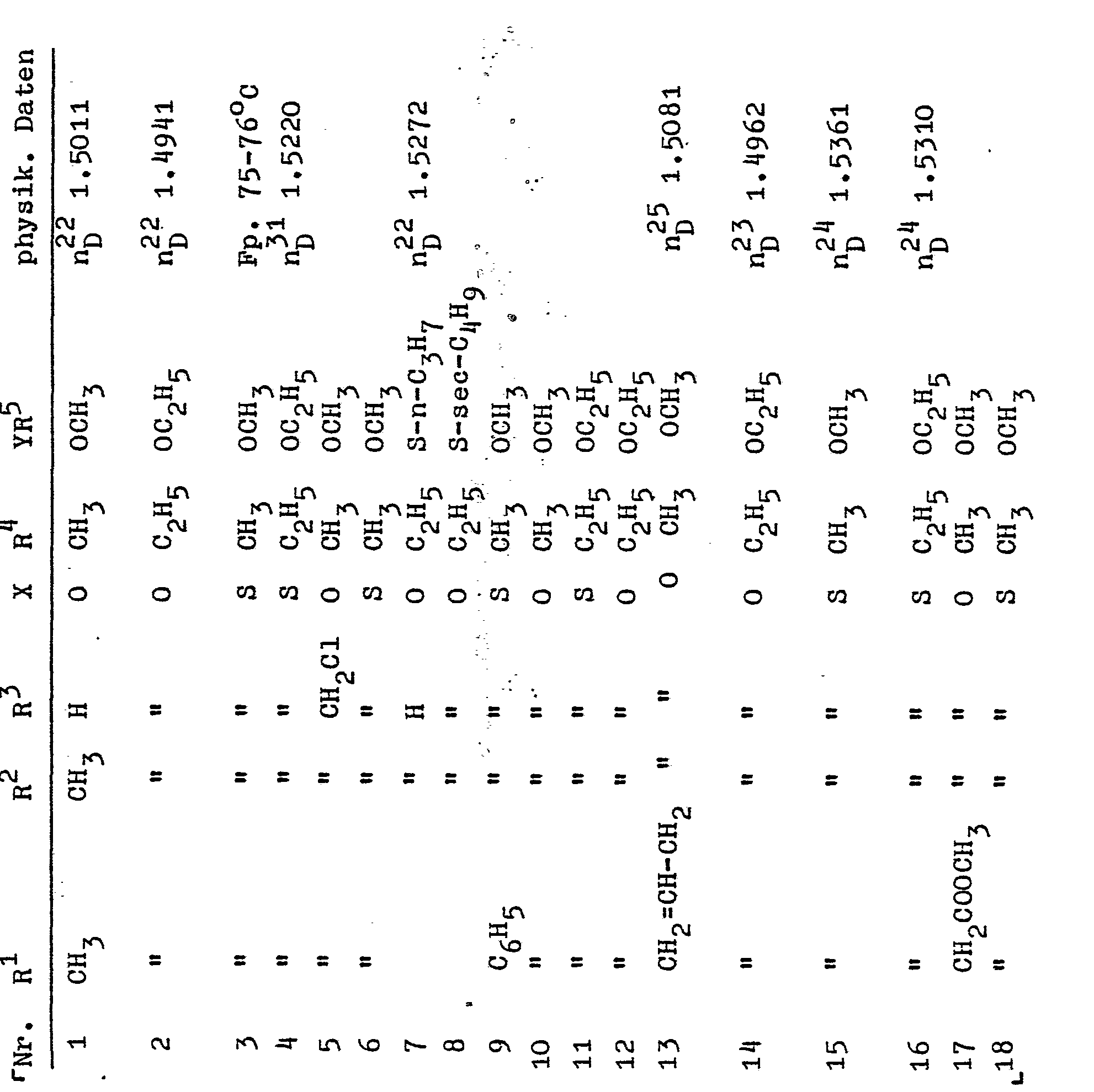
- the numbering of the active compounds according to the invention corresponds to the table.
- Both parts of a 10 cm diameter petri dish are lined with a total of 2 ml of the acetone active ingredient solution. After the solvent has evaporated (approx. 30 minutes), 10 flies are placed in each of the dishes. The mortality rate is determined after 4 hours.
- Petri dishes with a diameter of 10 cm are lined with 1 ml of the acetone solution. After the solvent has evaporated, the dishes are populated with 20 larvae of the penultimate stage and the effect is registered after 24 hours.
- Potted bean plants (Vicia faba) with strong aphid colonies are sprayed to runoff point in the spray chamber with the aqueous active ingredient preparations. The evaluation takes place after 24 hours.
- Bean plants which are in 8 cm diameter plastic pots filled with 300 g compost and are heavily infected with aphids (Aphis fabae), are watered with 20 ml of the aqueous preparation of the active ingredients.
- the mortality rate is determined after 48 hours.
- Testing is carried out with ticks in the 3rd larval stage. To do this, immerse the animals in a paper bag in the test emulsion for 3 seconds. The bags are then hung freely. The effect on the ticks is assessed after 48 hours.
Landscapes
- Chemical & Material Sciences (AREA)
- Organic Chemistry (AREA)
- Life Sciences & Earth Sciences (AREA)
- Health & Medical Sciences (AREA)
- General Health & Medical Sciences (AREA)
- Dentistry (AREA)
- Plant Pathology (AREA)
- Engineering & Computer Science (AREA)
- Pest Control & Pesticides (AREA)
- Agronomy & Crop Science (AREA)
- Wood Science & Technology (AREA)
- Zoology (AREA)
- Environmental Sciences (AREA)
- Biochemistry (AREA)
- Molecular Biology (AREA)
- Agricultural Chemicals And Associated Chemicals (AREA)
Abstract
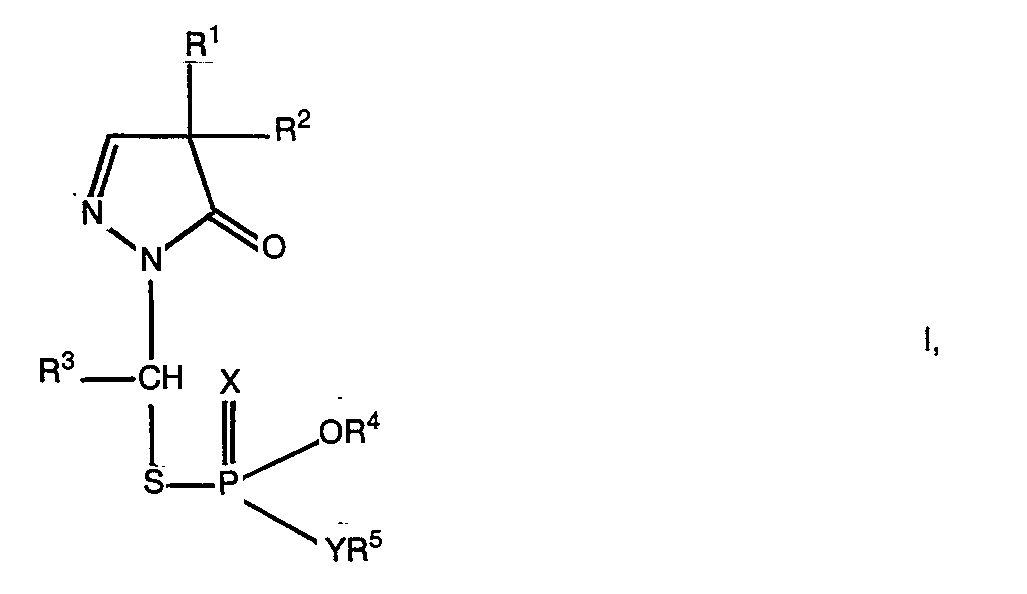
- R und R2 gleich oder verschieden sind und eine Alkylgruppe mit 1 bis 5 Kohlenstoffatomen, Allyl oder Phenyl oder eine Alkoxycarbonylgruppe mit 2 bis 8 Kohlenstoffatomen,
- R3 Wasserstoff oder eine gegebenenfalls durch Halogen substituierte Methylgruppe,
- R 4 Methyl oder Äthyl,
- R5 eine Alkylgruppe mit 1 bis 5 Kohlenstoffatomen,
- X Sauerstoff oder Schwefel und
- Y Sauerstoff oder Schwefel bedeuten.
Die Wirkstoffe eignen sich insbesondere zur Bekämpfung von Insekten und Spinnentieren.
Description
- Die vorliegende Erfindung betrifft neue Pyrazolin-5-on-yl- methyl-(di)thiophosphorsäureester, ein Verfahren zu ihrer Herstellung und Schädlingsbekämpfungsmittel, die diese Phosphorsäureester als Wirkstoffe enthalten.
- (3,4,4-Trimethyl-2-pyrazolin-S-on-yl)-methyl-(di)thiophosphorsäureester sind aus Helv. Chim. Acta 56, 2188, 2189 (1973) bekannt, haben jedoch bisher keine Bedeutung als Schädlingsbekämpfungsmittel erlangt.
- Es wurde nun gefunden, daß Pyrazolin-5-on-yl -methyl--(di)thiophosphorsäureester der Formel I

- R1 und R2 gleich oder verschieden sind und eine Alkylgruppe mit 1 bis 5 Kohlenstoffatomen, Allyl oder Phenyl oder eine Alkoxycarbonylgruppe mit 2 bis 8 Kohlenstoffatomen,
- ┌R3 Wasserstoff oder eine gegebenenfalls durch Halo- ' gen substituierte Methylgruppe,
- R4 Methyl oder Äthyl,
- R5 eine Alkylgruppe mit 1 bis 5 Kohlenstoffatomen,
- X Sauerstoff oder Schwefel und
- Y Sauerstoff oder Schwefel bedeuten,
- In der Formel I sind R1 und R2 gleich oder verschieden und stehen für unverzweigte oder verzweigte Alkylgruppen mit 1 bis 5 Kohlenstoffatomen, wie Methyl, Äthyl, n-Propyl, Isopropyl, Isobutyl, sec.-Butyl, Isopentyl, insbesondere Methyl, für Allyl, Phenyl oder Alkoxycarbonyl mit 2 bis 8 Kohlenstoffatomen, insbesondere 2 bis 5 Kohlenstoffatomen, wie Methoxycarbonyl, Äthoxycarbonyl, sec.-Butoxycarbonyl, i-Butoxycarbonyl. R3 in Formel I steht für Wasserstoff oder eine gegebenenfalls halogensubstituierte Methylgruppe, wie Chlormethyl oder Brommethyl. R5 in Formel I bedeutet eine unverzweigte oder verzweigte Alkylgruppe mit 1 bis 5 Kohlenstoffatomen, wie Methyl, Äthyl, n-Propyl, i-Propyl, sec.-Butyl, i-Butyl, 1-Methyl-n-butyl.
- Bevorzugte Verbindungen der Formel I sind solche, bei denen R1 und R2 Methyl, R3 Wasserstoff und Rund R5 Alkyl mit 1 bis 4 Kohlenstoffatomen, bedeuten.
- ┌Die Pyrazolin-5-on-yl-methyl-(di)thiophosphorsäureester der Formel I können durch Umsetzung von Pyrazolinonen der Formel II

- R 1, R 2 und R3 die obengenannten Bedeutungen haben, mit (Di)Thiophosphorsäuren der Formel III

- R4, R5, X und Y die obengenannten Bedeutungen haben, in Gegenwart eines säurebindenden Mittels erhalten werden.
- Ebenso kann auch ein Pyrazolinon der Formel II mit einem Salz einer (Di)Thiophosphorsäure der Formel III direkt umgesetzt werden, wobei auf den Zusatz eines säurebindenden Mittels verzichtet werden kann. Vorzugsweise verwendet man dabei Alkalimetallsalze, beispielsweise das Kaliumsalz, oder das Ammoniumsalz des Esters.
- Beide Umsetzungen können in Gegenwart eines organischen Lösungs- oder Verdünnungsmittels, wie Aceton, Acetonitril oder Toluol, bei einer Temperatur im Bereich zwischen 20 und 1000C durchgeführt werden.
- "Geeignete säurebindende Mittel für die zuerst genannte Verfahrensvariante sind Basen, wie Alkali- und Erdalkalicarbonate, -hydroxide und -hydrogencarbonate.
- Die Ausgangsstoffe der Formel II, bei denen R3 Wasserstoff bedeutet, lassen sich durch Chlormethylierung aus Verbindungen der Formel IV

- Dabei kann die Verbindung der Formel IV mit Paraformaldehyd und Thionylchlorid in einem Lösungsmittel, wie Dichlormethan oder Toluol, einstufig zum Pyrazolinon der Formel II umgesetzt oder aber mit Formaldehyd hydroxymethyliert werden, wonach die so hergestellte N-Hydroxy--methylverbindung dann mit Chlorierungsmitteln, wie Thionylchlorid oder Phosphorpentachlorid, in einem Lösungsmittel, beispielsweise Dichlormethan oder Toluol, in das Pyrazolinon der Formel II überführt wird.
- Die Ausgangsstoffe der Formel II, bei denen R3 Halogenmethyl bedeutet, lassen sich ebenfalls aus Verbindungen der Formel IV herstellen. Dabei wird ein Pyrazolinon der Formel IV in Anlehnung an bekannte Verfahren mit Vinylacetat gegebenenfalls in Anwesenheit von Katalysatoren, wie Quecksilbersalzen, zur N-Vinylverbindung umgesetzt, die sich zum Pyrazolinon der Formel II halogenieren läßt.
- Die Verbindungen der Formel IV lassen sich in Anlehnung an bekannte Verfahren herstellen (Rec. Trav. Chim. 45, 82 ff (1926)).
- Die (Di)Thiophosphorsäureester der Formel III sind bekannt und können nach bekannten Verfahren erhalten werden.
- Die folgenden Beispiele erläutern die Herstellung der erfindungsgemäßen Verbindungen.
- Zu 19,5 g 2-Formyl-2-methyl-propionsäuremethylester in 300 ml Äthanol gibt man 7,5 g Hydrazinhydrat; die Lösung erwärmt sich dabei schwach. Danach wird noch 5 Stunden unter Rückfluß erhitzt. Die Lösung wird eingeengt, das zurückbleibende rohe Produkt wird aus Cyclohexan umkristallisiert. Man erhält 15 g 4,4-Dimethyl-2-pyrazolin--5-on vom Schmelzpunkt 97 bis 98°C.
- Zu einer Suspension von 11,2 g des so hergestellten 4,4-Dimethyl-2-pyrazolin-5-on in 50 ml Toluol und 3,3 g Para--formaldehyd tropft man unter Rühren 13,1 g Thionylchlorid. Die entstehende Lösung läßt man zwei Tage lang bei 20°C stehen und entfernt danach unter vermindertem Druck das Lösungsmittel. Der Rückstand (14,8 g) ist ein öl vom Brechungsindex

- Zu 12,9 g 1-Chlormethyl-4,4-dimethyl-2-pyrazolin-5-on in 100 ml Acetonitril gibt man in mehreren Portionen 14 g Ammonium-0,0-dimethyldithiophosphat. Unter Temperaturanstieg von 20 auf 400C beginnt Ammoniumchlorid auszu-Tallen. Man rührt 4 Stunden bei Raumtemperatur nach und ┐ destilliert das Lösungsmittel unter vermindertem Druck ab. Der Rückstand wird mit 300 ml Toluol versetzt und mit Wasser gewaschen. Die organische Phase wird abgetrennt und über Natriumsulfat getrocknet. Nach Abziehen des Lösungsmittels wird der Rückstand mit Petroläther versetzt, die entstandenen Kristalle werden abgesaugt und mit Petroläther gewaschen. Man erhält 15,3 g Dithiophosphorsäure-0,0-dimethyl-S-(4,4-dimethyl-2-pyra- zolin-5-on-yl-methyl)-ester vom Schmelzpunkt 75 bis 76°C.
- Zu 23,4 g 2-Methyl-2-formyl-penten-4-carbonsäuremethylester in 300 ml Äthanol gibt man 7,5 g Hydrazinhydrat. Man erhitzt 8 Stunden unter Rückfluß, engt die Lösung ein und kristallisiert den Rückstand aus Cyclohexan um. Man erhält 4-Methyl-3-allyl-2-pyrazolin-5-on vom Schmelzpunkt 47°C.
- Zu 13,8 g 4-Methyl-4-allyl-2-pyrazolin-5-on, gelöst in 50 ml Toluol, gibt man 3,3 g Paraformaldehyd und 13,1 g Thionylchlorid. Man läßt 2 Tage lang stehen und entfernt das Lösungsmittel unter vermindertem Druck. Es verbleiben 15 g 1-Chlormethyl-4-methyl-4-allyl-2-pyrazolin-5-on als orangefarbenes öl.
- 5,95 g 1-Chlormethyl-4-methyl-4-allyl-2-pyrazolin-5-on werden mit 12,29 g Ammonium-0,0-diäthyl-monothiophos- phat in 50 ml Acetonitril 5 Stunden bei 20°C und 1 Stunde bei 50°C gerührt. Dann wird unter vermindertem Druck eingeengt, der Rückstand wird mit Toluol versetzt und mit Wasser gewaschen. Die organische Phase wird abgetrennt und über Natriumsulfat getrocknet. Nach Entfernen des Lösungsmittels unter vermindertem Druck erhält man 8,5 g Thiophosphorsäure-0,0-diäthyl-S-(4-methyl-4-allyl-2-py- razolin-5-on-yl-methyl)-ester;

- Analog lassen sich beispielsweise folgende Verbindungen der Formel I herstellen:

- Zu diesen Schädlingen gehören Insekten aus der Ordnung der Schmetterlinge (Igpidoptera), beispielsweise Plutella maculipennis (Kohlschabe), Leucoptera coffeella (Kaffeemotte), Hyponomeutamalinellus (Apfelbaumgespinstmotte), Argyresthia conjugella (Apfelmotte), Sitotroga cerealella (Getreidemotte), Phthorimaea operculella (Kartoffelmotte), Capua reticulana (Apfelschalenwickler), Sparganothis pilleriana (Springwurm), Cacoecia murinana (Tannentriebwickler), Tortrix viridana (Eichenwickler), Clysia ambiguella (Heu-und Sauerwurm), Evetria buoliana (Kieferntriebwickler), Polychrosis botrana (Bekreuzter Traubenwickler), Cydia pomonella (Obstmade), Laspeyresia molesta (Pfirsichtriebbohrer), Laspeyresia funebrana (Pflaumenwickler), Ostrinia nubilalis (Maiszünsler), Loxostege sticticalis (Rübenzünsler), Ephestia kuehniella (Mehlmotte), Chilo suppressalis (Reisstengelbohrer), Galleria Mellonella (Wachsmotte), Malacosoma neustria (Ringelspinner), Dendrolimus pini (Kiefernspinner), Thaumatopoea pityocampa (Pinienprozessionsspinner), Phalera bucephala (Mondfleck), Cheimatobia brumata (Kleiner Frostspanner), Hibernia defoliaria (Großer Frostspanner), Bupalus piniarus (Kiefernspanner), Hyphantria cunea (Weißer Bärenspinner), Agrotis segetum (Wintersaateule), Agrotis ypsilon (Ypsiloneule), Barathra brassicae (Kohleule), Cirphis unipuncta (Heerwurm), Prodenia litura (Baumwollraupe), Laphygma exigua (Rüben-Heerwurm), Panolis flammea (Forleule), Earias insulana (Baumwollkapselwurm), Plusia gamma (Gammaeule), Alabama argillacea (Baumwollblattwurm), Lymantria dispar (Schwammspinner), Lyman- ┌tria monacha (Nonne), Pieris brassicae (Kohlweißling), ' Aporia crataegi (Baumweißling);
- aus der Ordnung der Käfer (Coleoptera),beispielsweise Blitophaga undata (Schwarzer Rübenaaskäfer), Melanotus communis (Drahtwurm), Limonius californicus (Drahtwurm), Agriotes lineatus (Saatschnellkäfer), Agricotes obscurus (Humusschnellkäfer), Agrilus sinuatus (Birnbaum-Prachtkäfer), Meligethes aeneus (Rapsglanzkäfer), Atomaria linearis (Moosknopfkäfer), Epilachna varicestris (Mexikanischer Bohnenkäfer), Phyllopertha horticola (Junikäfer), Popillia japonica (Japankäfer), Melolontha melolontha (Feldmaikäfer), Melolontha hippocastani (Waldmaikäfer), Amphimallus solstitialis (Brachkäfer), Crioceris asparagi (Spargelhähnchen), Lema melanopus (Getreidehähnchen), Leptinotarsa decemlineata (Kartoffelkäfer), Phaedon cochleariae (Meerrettich-Blattkäfer), Phyllotreta nemorum (Kohlerdfloh), Chaetocnema tibialis (Rübenflohkäfer), Phylloides chrysocephala (Raps-Flohkäfer), Diabrotica 12-punctata (Südlicher Maiswurzelwurm), Cassida nebulosa (Nebliger Schildkäfer), Bruchus lentis (Linsenkäfer), Bruchus rufimanus (Pferdebohnenkäfer), Bruchus pisorum (Erbsenkäfer), Sitona lineatus (Linierter Blattrandkäfer), Otiorrhynchus sulcatus (Gefurchter Lappenrüßler), Otiorrhynchus ovatus (Erdbeerwurzelrüßler), Hylobies abietis (Großer Brauner Rüsselkäfer), Byctiscus betulae (Rebenstecher), Anthonomus pomorum (Apfelblütenstecher), Anthonomus grandis (Kapselkäfer), Ceuthorrhynchus assimilis (Kohlschotenrüßler), Ceuthorrhynchus napi (Großer Kohltriebrüßler), Sitophilus granaria (Kornkäfer), Anisandrus dispar (Ungleicher Holzborkenkäfer), Ips typographus (Buchdrucker), Blastophagus piniperda (Gefurchter Waldgärtner);
- aus der Ordnung der Zweiflügler (Diptera),beispielsweise Lycoria pectoralis, Mayetiola destructor (Hessenfliege), L Dasineura brassicae (Kohlschoten-Gallmücke), Contarinia tritici (Gelbe Weizen-Gallmücke), Contarinia nasturtii (Drehherzmücke), Contarinia pyrivora (Birnen-Gallmücke), Haplodiplosis equestris (Sattelmücke), Tipula paludosa (Wiesenschnake), Tipula oleracea (Kohlschnake), Anopheles maculipennis, Culex pipiens, Aedes aegypti (Gelbfiebermücke), Aedes vexans, Tabanus bovinus (Rinderbremse), Merodon equestris (Große Narzissenfliege), Dacus cucurbitae (Melonenfliege), Dacus oleae (Olivenfliege), Ceratitis capitata (Mittelmeer-Fruchtfliege), Rhagoletis cerasi (Kirschfruchtfliege), Rhagoletis pomonella (Apfelmade), Anastrepha ludens (Mexikanische Fruchtfliege), Oscinella frit (Fritfliege), Phorbia coarctata (Brachfliege), Phorbia antiqua (Zwiebelfliege), Phorbia brassicae (Kleine Kohlfliege), Pegomya hyoscyami (Rübenfliege), Psila rosae (Möhrenfliege), Musca domestica (Stubenfliege);
- aus der Ordnung der Hautflügler (Hymenoptera),beispielsweise Athalia rosae (Rübenblattwespe), Hoplocampa minuta (Pflaumensägewespe), Monomorium pharaonis (Pharaoameise), Solenopris germinata (Feuerameise), atta sexdens (Blattschneiderameise), Vespa crabro (Hornisse);
- aus der Ordnung der Schnabelkerfen (Rhynchota),beispielsweise Aelia acuminata (Getreidespitzwanze), Nezara viridula (Grüne Reiswanze), Antestia faceta (Braune Kaffeewanze), Eurygaster integriceps (Getreidewanze), Eurygaster maura (Breitbauchwanze), Anasa tristis (Squash bug), Blissus leucopterus (Chinch bug), Dysdercus cingulatus (Kapok-Wanze), Dysdercus intermedius (Baumwollwanze), Piesma quadrata (Rübenwanze), Lygus hesperus (Tarnished plant bug), Lygus pratensis (Wiesenwanze), Sahlbergella singularis (Kakaorindenwanze), Helopeltis antonii (Teewanze), Cimex lectularius (Bettwanze), Triatoma megista, Rhodnius prolixus, ┘ Perkinsiella saccharicida (Zuckerrohrzikade), Peregrinus maidis (Corn leafhopper), Nilapervata lugens (Braune Zikade), Nilapervata cryzae, Tomaspis saccharina (Sugar cane froghopper), Iocerus clypealis (Mangohopper), Typhlocyba frogathi (Apple leaf Jassid), Empoasca fabae Kartoffelzikade), Empoasca lybica, Circulifer tenellus (Beet leafhopper), Nephotettix bipunctatus (Green rice liefhopper), Macrosteles laevis, Dalbulus maidis (Corn leafhopper), Psylla mali (Apfelblattsauger), Psylla piri (Birnblattsauger), Trialeurodes vaporariorum (Weiße Fliege), Bemisia tabaci (Cotton white-fly), Hyalopterus pruni (Mehlige Pflaumenblattlaus), Aphis fabae (Schwarze Bohnenlaus), Aphis pomi (Grüne Apfellaus), Rhopalasiphon maidis (Maisblattlaus), Aphidula nasturtii (Kreuzdornblattlaus), Cerosipha gossypii (Gurkenblattlaus), Toxoptera aurantii (Black orange aphid), Sappaphis mali (Rosige Apfellaus), Sappaphis mala (Mehlige Birnenblattlaus), Dysaphis radicola (Mehlige Apfelfaltenlaus), Brachycaudus helichrysi (Kleine Pflaumenlaus), Brachycaudus cardui (Große Pflaumenlaus), Brevicoryme brassocae (Kohlblattlaus), Phorodon humuli (Hopfenblattlaus), Rhopalomyzus ascalonicus (Zwiebellaus), Myzus persica (Pfirsichblattlaus), Myzus cerasi (Schwarze Sauerkirschenlaus), Cryptomyzus ribis (Johannisbeerblasenlaus), Dysaulacorthum pseudosolani (Gefleckte Kartoffellaus), Acyrthosiphon onobrychis (Grüne Erbsenlaus), Macrosiphon rosae (Große Rosenblattlaus), Macrosiphon solani (Gestreifte Kartoffellaus), Megoura viciae (Wickenlaus), Schizoneura lanuginosa (Birnenblutlaus), Eriosoma lanigerum (Blutlaus), Pemphigius bursarius (Salatwurzellaus), Dreyfusia nordmannianae (Tannentrieblaus), Adelges laricis (Rote Fichtengallenlaus), Sacchiphantes abietis (Gelbe Fichtengallenlaus), Victus vitifolii (Reblaus), Icerya purchasi (Australische Wollschildlaus), Pseudococcus aonidum (Longtailed mealybug), Planococcus citri (Citrus-Schmierlaus), Coccus L J hesperidum (Soft scale), Eulecanium corni (Napfschild- laus), Saissetia coffeae, Aspidiotus perniciosus (San Jose-Schildlaus), Aonidiella aurantii (Red scale);
- aus der Ordnung der Geradflügler (Orthoptera),beispielsweise Forficula auricularia (Gemeiner Ohrwurm), Acheta domestica (Heimchen), Gryllotalpa gryllotalpa (Maulwurfsgrille), Tachycines asynamorus (Gewächshausschrecke), Locusta migratoria (Wanderheuschrecke), Stauronotus maroccanus (Marokkanische Wanderheuschrecke), Schistocerca peregrina (Wanderheuschrecke), Nomadacris septemfasciata (Wanderheuschrekke), Melanoplus spretus (Felsengebirgsheuschrecke), Melanoplus femur-rubrum (Rotbeinige Heuschrecke), Blatta orientalis (Küchenschabe), Blattella germanica (Deutsche Schabe), Periplaneta americana (Amerikanische Schabe), Blabera gigantea (Riesenschabe);
- aus der Ordnung der Termiten (Isoptera),beispielsweise Calotermes flavicollis, Leucotermes flavipes, Reticulitermes lucifugus, Termes natalensis;
- aus der Ordnung der Fransenflügler (Thysanoptera), beispielsweise Heliothrips fasciatus, Heliothrips femoralis, Heiolthrips haemorrhoidalis, Selenothrips rubrocinctus, Frankiniella fusca, Frankiniella tritici, Kakothrips robustus, Thrips tabaci;
- aus der Ordnung der Tierläuse (Phthiraptera),beispielsweise Pediculus humanus (Menschenlaus),und
- aus der Ordnung der Flöhe (Siphonaptera), beispielsweise Pulex irritans (Menschenfloh), Sarcopsylla penetrans (Sandfloh), Xenopsylla cheopis (Rattenfloh).
- Zur Klasse der Spinnentiere (Arachnoidea) gehören Milben L und Zecken (Acarina), beispielsweise Ixodes ricinus (Holzbock), Ornithodorus moubata, Amblyomma americanum, Dermacentor silvarum, Boophilus microplus, Tetranychus telarius, Tetranychus atlanticus, Tetranychus pacificus, Paratetranychus pilosus, Bryobia praetiosa.
Die Wirkstoffe können als solche, in Form ihrer Formulierungen oder den daraus bereiteten Anwendungsmöglichkeiten, z.B. in Form von direkt versprühbaren Lösungen, Pulvern, Suspensionen oder Dispersionen, Emulsionen, öldispersionen, Pasten, Stäubemitteln, Streumitteln, Granulaten durch Versprühen, Vernebeln, Verstäuben, Verstreuen oder Gießen angewendet werden. Die Anwendungsformen richten sich ganz nach den Verwendungszwecken; sie sollten in jedem Fall möglichst die feinste Verteilung der erfindungsgemäßen Wirkstoffe gewährleisten. - Zur Herstellung von direkt versprühbaren Lösungen, Emulsionen, Pasten oder öldispersionen kommen Mineralölfraktionen von mittlerem bis hohem Siedepunkt, wie Kerosin oder Dieselöl, ferner Kohlenteeröle sowie Öle,pflanzlichen oder tierischen Ursprungs, aliphatische, cyclische und aromatische Kohlenwasserstoffe, z.B. Benzol, Toluol, Xylol, Paraffin, Tetrahydronaphthalin, alkylierte Naphthaline oder deren Derivate, z.B. Methanol, Äthanol, Propanol, Butanol, Chloroform, Tetrachlorkohlenstoff, Cyclohexanol, Cyclohexanon, Chlorbenzol, Isophoron, stark polare Lösungsmittel, z.B. Dimethylformamid, Dimethylsulfoxid, N-Methylpyrrolidon, Wasser, in Betracht.
- Wäßrige Anwendungsformen können aus Emulsionskonzentraten, Pasten oder netzbaren Pulvern (Spritzpulvern, öldispersionen) durch Zusatz von Wasser bereitet werden. Zur Herstellung von Emulsionen, Pasten oder öldispersionen können die Substanzen als solche oder in einem öl oder Lösungsmittel gelöst, mittels Netz-, Haft-, Dispergier- oder Emulgier-I.
- mittel in Wasser homogenisiert werden. Es können aber auch aus wirksamer Substanz Netz-, Haft-, Dispergier- oder Emulgiermittel und eventuell Lösungsmittel oder Öl bestehende Konzentrate hergestellt werden, die zur Verdünnung mit Wasser geeignet sind.
- Als oberflächenaktive Stoffe kommen Alkali-, Erdalkali-, Ammoniumsalze von Ligninsulfonsäure, Naphthalinsulfonsäure, Phenolsulfonsäure, Alkylarylsulfonate, Alkylsulfate, Alkyl- sulfonate, Alkali- und Erdalkalisalze der Dibutylnaphthalinsulfonsäure, Lauryläthersulfat, Fettalkoholsulfate, fettsaure Alkali- und Erdalkalisalze, Salze sulfatierter Hexadecanole, Heptadecanole, Octadecanole, Salze von sulfatiertem Fettalkoholglykoläther, Kondensationsprodukte von sulfoniertem Naphthalin und Naphthalinderivaten mit Formaldehyd, Kondensationsprodukte des Naphthalins bzw. der Naphthalinsulfonsäuren mit Phenol und Formaldehyd, Polyoxyäthylenoctylphenoläther, äthoxyliertes Isooctylphenol, Octylphenol, Nonylphenon, Alkylphenolpolyglykoläther, Tributylphenylpolyglykoläther, Alkylarylpolyätheralkohole, Isotridecylalkohol, Fettalkoholäthylenoxid-Kondensate, äthoxyliertes Rizinusöl, Polyoxyäthylenalkyläther, äthoxyliertes Polyoxypropylen, Laurylalkoholpolyglykolätheracetal, Sorbitester, Lignin, Sulfitablaugen und Methylcellulose in Betracht.
- Pulver-, Streu- und Stäubemittel können durch Mischen oder gemeinsames Vermahlen der wirksamen Substanzen mit einem festen Trägerstoff hergestellt werden.
- Beispiele für Formulierungen sind:
- I. 3 Gewichtsteile Dithiophosphorsäure-0,0-dimethyl-S--[4,4-dimethyl-2-pyrazolin-5-on-yl-methyl]-ester werden mit 97 Gewichtsteilen feinteiligem Kaolin innig vermischt. Man erhält auf diese Weise ein Stäube- L mittel, das 3 Gew.% des Wirkstoffs enthält.
- II. 30 Gewichtsteile Thiophosphorsäure-0,0-dimethyl-S--[4,4-dimethyl-2-pyrazolin-5-on-yl-methyl]-ester werden mit einer Mischung aus 92 Gewichtsteilen pulverförmigem Kieselsäuregel und 8 Gewichtsteilen Paraffinöl, das auf die Oberfläche dieses Kieselsäuregels gesprüht wurde, innig vermischt. Man erhält auf 'diese Weise eine Aufbereitung des Wirkstoffs mit guter Haftfestigkeit.
- III. 20 Gewichtsteile Dithiophosphorsäure-0-äthyl-S-n--propyl-S-[4,4-dimethyl-2-pyrazolin-5-on-yl-methyl]--ester werden in einer Mischung gelöst, die aus 80 Gewichtsteilen Xylol, 10 Gewichtsteilen des Anlagerungsproduktes von 8 bis 10 Mol Äthylenoxid an 1 Mol ölsäure-N-monoäthanolamid, 5 Gewichtsteilen Calciumsalz der Dodecylbenzolsulfonsäure und 5 Gewichtsteilen des Anlagerungsproduktes von 40 Mol Äthylenoxid an 1 Mol Ricinusöl besteht. Durch Ausgießen und feines Verteilen der Lösung in 100 000 Gewichtsteilen Wasser erhält man eine wäßrige Dispersion, die 0,02 Gew.% des Wirkstoffs enthält.
- IV. 20 Gewichtsteile Thiophosphorsäure-0,0-dimethyl-S--[4-methyl-4-allyl-2-pyrazolin-5-on-yl-methyl]-ester werden in einer Mischung gelöst, die aus 40 Gewichtsteilen Cyclohexanon, 30 Gewichtsteilen Isobutanol, 20 Gewichtsteilen des Anlagerungsproduktes von 7 Mol Äthylenoxid an 1 Mol Isooctylphenol und 10 'Gewichtsteilen des Anlagerungsproduktes von 40 Mol Äthylenoxid an 1 Mol Ricinusöl besteht. Durch Eingießen und feines Verteilen der Lösung in 100 000 Gewichtsteilen Wasser erhält man eine wäßrige Dispersion, die 0,02 Gewichtsprozent des Wirkstoffs enthält.
- Granulate, z.B. Umhüllungs-, Imprägnierungs- und Homogengranulate, können durch Bindung der Wirkstoffe an feste "Trägerstoffe hergestellt werden. Feste Trägerstoffe sind z.B. Mineralerden, wie Silicagel, Kieselsäuren, Kieselgele, Silikate, Talkum, Kaolin, Attaclay, Kalkstein, Kalk, Kreide, Bolus, Löß, Ton, Dolomit, Diatomeenerde, Calcium- und Magnesiumsulfat, Magnesiumoxid, gemahlene Kunststoffe, Düngemittel, wie z.B. Ammoniumsulfat, Ammoniumphosphat, Ammoniumnitrat, Harnstoffe und pflanzliche Produkte, wie Getreidemehl, Baumrinden-, Holz- und Nußschalenmehl, Cellulosepulver und andere feste Trägerstoffe.
- Die Formulierungen enthalten im allgemeinen zwischen 0,1 und 95 Gew.% Wirkstoff, vorzugsweise zwischen 0,5 und 90 Gew.%. Die Wirkstoffe können in Form dieser Formulierungen oder aber in Form daraus herstellbarer anwendungsfertiger Zubereitungen eingesetzt werden. Die Wirkstoffkonzentrationen in den anwendungsfertigen Zubereitungen können in weiten Bereichen variiert werden. Im allgemeinen liegen sie zwischen 0,0001 und 10 %, vorzugsweise zwischen 0,01 und 10 %.
- Die Wirkstoffe können auch mit gutem Erfolg im Ultra-Low-Volume-Verfahren (ULV) verwendet werden. Dabei ist es möglich, Formulierungen mit über 95 Gew.% Wirkstoff oder sogar den Wirkstoff ohne Zusätze auszubringen.
- Zu den Wirkstoffen können Öle verschiedenen Typs, Herbizide, Fungizide, andere Insektizide, Bakterizide, gegebenenfalls auch erst unmittelbar vor der Anwendung (Tankmix), zugesetzt werden. Diese Mittel können zu den erfindungsgemäßen Mitteln im Gewichtsverhältnis 1 : 10 bis 10 : 1 zugemischt werden.
- Beispielsweise können folgende Mittel zugemischt werden: 1,2-Dibrom-3-chlorpropan, 1,3-Dichlorpropen, 1,3-Dichlorpropen + 1,2-Dichlorpropan, 1,2-Dibrom-äthan, 2-sec.-Butyl- L phenyl-N-methylcarbamat, o-Chlorphenyl-N-methylcarbamat, 3-Isopropyl-5-methylphenyl-N-methylcarbamat, o-Isopropoxy- phenyl-N-methylcarbamat, 3,5"Dimethyl-4-methylmercapto-phenyl-N-methylcarbamat, 4-Dimethylamino-3,5-xylyl-N-methylcarbamat, 2-(1,3-Dioxolan-2-yl)-phenyl-N-methylcarbamat, 1-Naphthal-N-methylcarbamat, 2,3-Dihydro-2,2-dimethyl-benzo- furan-7-yl-N-methylcarbamat, 2,2-Dimethyl-1,3-benzodioxol-4--yl-N-methylcarbamat, 2-Dimethylamino-5,6-dimethyl-4-pyrimidinyl-dimethylcarbamat, 2-Methyl-2-(methylthio)-propionaldehyd-0-(methylcarbamoyl)-oxim, S-Methyl-N-[(methylcarbamoyl)-oxy]-thio-acetimidat, Methyl-N',N'-dimethyl-N--[(methylcarbamoyl)oxy]-1-thiooxamidat, N-(2-Methyl-4--chlor-phenyl)-N',N'-dimethylformamidin, Tetrachlorthiophen, 1-(2,6-Difluor-benzoyl)-3-(4-chlor-phenyl)-harnstoff, 0,0-Dimethyl-0-(p-nitrophenyl)-phosphorthioat, 0,0-Diäthyl--0-(p-nitrophenyl)-phosphorthioat, 0-Äthyl-0-(p-nitrophenyl)-phenyl-phosphonothioat, 0,0-Dimethyl-0-(3-methyl-4--nitrophenyl)-phosphorthioat, 0,0-Diäthyl-0-(2,4-dichlor--phenyl)-phosphorthioat, 0-Äthyl-0-(2,4-dichlorphenyl)-phenyl-phosphonothioat, 0,0-Dimethyl-0-(2,4,5-trichlorphenyl)--phosphorthioat, 0-Äthyl-0-(2,4,5-trichlorphenyl)-äthyl--phosphonothioat, 0,0-Dimethyl-0-(4-brom-2,5-dichlorphenyl)--phosphorthioat, 0,0-Dimethyl-0-(2,5-dichlor-4-jodphenyl)--phosphorthioat, 0,0-Dimethyl-0-(3-methyl-4-methylthiophenyl)-phosphorthioat, 0-Äthyl-0-(3-methyl-4-methylthiophenyl)-isopropyl-phosphoramidat, 0,0-Diäthyl-0-[p-(methylsulfinyl)phenyl]-phosphorthioat, 0-Äthyl-S-phenyl-äthyl-phosphonodithioat, 0,0-Diäthyl-[2-chlor-1-(2,4-dichlorphenyl)--vinyl]-phosphat, 0,0-Dimethyl-[-2-chlor-1-(2,4,5-trichlorphenyl)]-vinyl-phosphat, 0,0-Dimethyl-S-(1'-phenyl)-äthylacetat-phosphordithioat, Bis-(dimethylamino)-fluorphosphin- oxid, Octamethyl-pyrophosphoramid, 0,0,0,0-Tetraäthyldithio-pyrophosphat, S-Chlormethyl-0,0-diäthyl-phosphordi- thioat, 0-Äthyl-S,S-dipropyl-phosphordithioat, 0,0-Dimethyl-0-2,2-dichlorvinyl-phosphat, 0,0-Dimethyl-1,2-di-J brom-2,2-dichloräthylphosphar, 0,0-Dimethyl-2,2,2-trichlor-1-hydroxy-äthylphosphonat, 0,0-Dimethyl-S- [1,2-biscarb- äthoxy-äthyl-(1)]-phosphordithioat, 0,0-Dimethyl-0-(1-methyl-2-carbmethoxy-vinyl)-phosphat, 0,0-Dimethyl-S-(N-methyl-carbamoyl-methyl)-phosphordithioat, 0,0-Dimethyl-S--(N-methyl-carbamoyl-methyl)-phosphorthioat, 0,0-Dimethyl--S-(N-methoxyäthyl-carbamoyl-methyl)-phosphordithioat, 0,0--Dimethyl-S-(N-formyl-N-methyl-carbamoylmethyl-phosphor- dithioat, 0,0-Dimethyl-0-[1-methyl-2-(methyl-carbamoyl)-vinyl]-phosphat, 0,0-Dimethyl-0-[(1-methyl-2-dimethylcarba- moyl)-vinyl]-phosphat, 0,0-Dimethyl-0-[(1-methyl-2-chlor--2-diäthylcarbamoyl)-vinyl]-phosphat, 0,0-Diäthyl-S-(äthyl- thio-methyl)-phosphordithioat, 0,0-Diäthyl-S-[(p-chlor- phenylthio)-methyl]-phosphordithioat, 0,0-Dimethyl-S-(2--äthylthioäthyl)-phosphorthioat, 0,0-Dimethyl-S-(2-äthyl- thioäthyl)-phosphordithioat, 0,0-Dimethyl-S-(2-äthylsul- finyl-äthyl)-phosphorthioat, 0,0-Diäthyl-S-(2-äthylthio--äthyl)-phosphordithioat, 0,0-Diäthyl-S-(2-äthylsulfinyl--äthyl)-phosphorthioat, 0,0-Diäthyl-thiophosphoryliminophenyl-acetonitril, 0,0-Diäthyl-S-(2-chlor-1-phthalimidoäthyl)--phosphordithioat, 0,0-Diäthyl-S-[6-chlor-benzoxazplon-(2)--yl(3)]-methyldithiophosphat, 0,0-Dimethyl-S-[2-methoxy--1,3,4-thiadiazol-5-[4H]-onyl-(4)-methyl]-phosphordithioat, 0,0-Diäthyl-0-[3,5,6-trichlor-pyridyl-(2)]-phosphorthioat, 0,0-Diäthyl-0-(2-pyrazinyl)-phosphorthioat, 0,0-Diäthyl-0--[2-isopropyl-4-methyl-pyrimidinyl(6)]-phosphorthioat, 0,0-Diäthyl-0-[2-(diäthylamino)-6-methyl-4-pyrimidinyl]--thionophosphat, 0,0-Dimethyl-S-(4-oxo-1,2,3-benzotriazin--3-[4H]-yl-methyl)-phosphordithioat, 0,0-Dimethyl-S-[(4,6--diamino-1,3,5-triazin-2-yl)-methyl]-phosphordithioat, 0,0-Diäthyl-(1-phenyl-1,2,4-triazol-3-yl)-thionophosphat, O,S-Dimethyl-phosphor-amido-thioat, O,S-Dimethyl-N-acetyl--phosphoramidothioat, r-Hexachlorcyclohexan, 1,1-Di-(p-methoxyphenyl)-2,2,2-trichlor-äthan, 6,7,8,9,10,10-Hexachloro--1,5,5a,6,9,9a-hexahydro-6,9-methano-2,4,3-benzodioxa-thi- epin-3-oxid, Pyrethrine, DL-2-Allyl-3-methyl-cyclopenten--(2)-on-(1)-yl-(4)-DL-cis,trans-chrysanthemat, 5-Benzyl-fu- ryl-(3)-methyl-DL-cis,trans-chrysanthemat, 3-Phenoxyben- zyl(+)-cis,trans-2,2-dimethyl-3-(2,2-dichlorvinyl)-cyclo- propancarboxylat, α-Cyano-3-phenoxybenzyl(+)-cis, trans-2,2--dimethyl-3-(2,2-dichlorvinyl)-cyclopropancarboxylat, (s)-α-Cyano-3-phenoxybenzyl-cis(1R,3R)-2,2-dimethyl-3--(2,2-dibromvinyl)-cyclopropancarboxylat, 3,4,5,6-Tetrahy- drophthalimidoäthyl-DL-cis,trans-chrysanthemat, 2-Methyl--5-(2-propinyl)-3-fürylmethyl-chrysanthemat, α-Cyano-3-phen- oxybenzyl-d-isopropyl-4-chlorphenylacetat.
- Die folgenden Beispiele belegen die biologische Wirkung der neuen Verbindungen. Vergleichsmittel sind die aus Helv. Chim. Acta 56, 2189 (1973) bekannten Verbindungen


- Die Numerierung der erfindungsgemäßen Wirkstoffe entspricht der tabellarischen Auflistung.
- Kontaktwirkung auf Stubenfliegen (Musca domestica); Dauerkontakt
- Beide Teile einer Petrischale von 10 cm Durchmesser werden mit insgesamt 2 ml der acetonischen Wirkstofflösung ausgekleidet. Nach Verdunsten des Lösungsmittels (ca. 30 Minuten) bringt man je 10 Fliegen in die Schalen. Die Mortalitätsrate wird nach 4 Stunden festgestellt.

- Kontaktwirkung auf Baumwollwanzen (Dysdercus intermedius)
- Petrischalen von 10 cm Durchmesser werden mit 1 ml der acetonischen Wirkstofflösung ausgekleidet. Nach dem Verdunsten des Lösungsmittels besetzt man die Schalen mit je 20 Larven des vorletzten Stadiums und registriert die Wirkung nach 24 Stunden.

- Kontaktwirkung auf Blattläuse (Aphis fabae); Spritzversuch
- Getopfte Bohnenpflanzen (Vicia faba) mit starken Blattlauskolonien werden in der Spritzkammer mit den wäßrigen Wirkstoffaufbereitungen tropfnaß gespritzt. Die Auswertung erfolgt nach 24 Stunden.

- Systemische Wirkung auf Blattläuse (Aphis fabae); Gießversuch
- Bohnenpflanzen, die in Plastiktöpfen von 8 cm Durchmesser, gefüllt mit 300 g Komposterde, stehen und stark mit Blattläusen (Aphis fabae) infiziert sind, werden mit 20 ml der wäßrigen Aufbereitung der Wirkstoffe angegossen.
- Die Mortalitätsrate wird nach 48 Stunden ermittelt.

- Kontaktwirkung auf Zecken (Ornithodorus moubata)
- Geprüft wird mit Zecken im 3. Larvenstadium. Dazu taucht man die Tiere, die sich in einem Papierbeutel befinden, für 3 Sekunden in die Prüfemulsion. Die Beutel werden dann frei aufgehängt. Nach 48 Stunden wird die Wirkung auf die Zecken beurteilt.

Schädlinge, insbesondere aus der Klasse der Insekten und Spinnentiere, wirksam bekämpfen und überraschenderweise den bekannten Verbindungen, die in 3-Stellung am Pyrazolinonring eine Methylgruppe tragen, in ihrer Wirkung überlegen sind.
Claims (11)





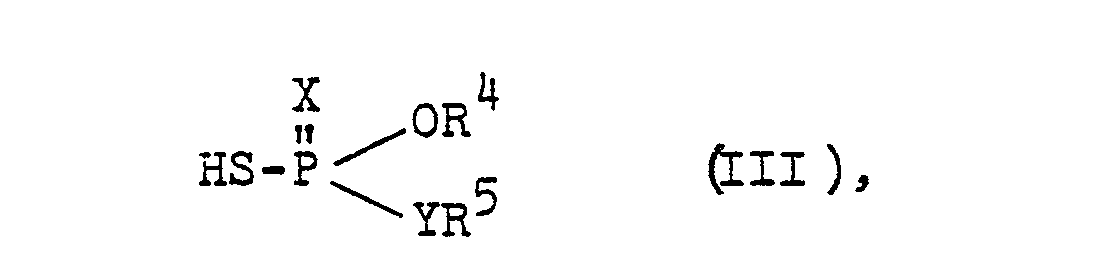
Priority Applications (1)
| Application Number | Priority Date | Filing Date | Title |
|---|---|---|---|
| AT80104189T ATE1816T1 (de) | 1979-08-04 | 1980-07-17 | Pyrazolin-5-on-yl-methyl(di)thiophosphors[ureester, verfahren zu ihrer herstellung und ihre verwendung zur bekaempfung von schaedlingen. |
Applications Claiming Priority (2)
| Application Number | Priority Date | Filing Date | Title |
|---|---|---|---|
| DE2931673 | 1979-08-04 | ||
| DE19792931673 DE2931673A1 (de) | 1979-08-04 | 1979-08-04 | Pyrazolin-5-on-yl-methyl-(di)thiophosphorsaeureester, verfahren zu ihrer herstellung und ihre verwendung zur bekaempfung von schaedlingen |
Publications (2)
| Publication Number | Publication Date |
|---|---|
| EP0023636A1 true EP0023636A1 (de) | 1981-02-11 |
| EP0023636B1 EP0023636B1 (de) | 1982-11-17 |
Family
ID=6077626
Family Applications (1)
| Application Number | Title | Priority Date | Filing Date |
|---|---|---|---|
| EP80104189A Expired EP0023636B1 (de) | 1979-08-04 | 1980-07-17 | Pyrazolin-5-on-yl-methyl-(di)thiophosphorsäureester, Verfahren zu ihrer Herstellung und ihre Verwendung zur Bekämpfung von Schädlingen |
Country Status (3)
| Country | Link |
|---|---|
| EP (1) | EP0023636B1 (de) |
| AT (1) | ATE1816T1 (de) |
| DE (2) | DE2931673A1 (de) |
Cited By (2)
| Publication number | Priority date | Publication date | Assignee | Title |
|---|---|---|---|---|
| US4716232A (en) * | 1985-04-30 | 1987-12-29 | Eli Lilly And Company | 1-(vinyl phosphonate adduct) pyrazolidinones |
| EP0751130A4 (de) * | 1995-01-12 | 1998-07-08 | Otsuka Kagaku Kk | 4,5-dihydropyrazole-5-thion-derivate und diese enthaltende akarizide |
Citations (2)
| Publication number | Priority date | Publication date | Assignee | Title |
|---|---|---|---|---|
| FR1331721A (fr) * | 1961-08-10 | 1963-07-05 | Geigy Ag J R | Nouveaux dérivés de l'acide thiophosphorique et leur préparation |
| FR2100109A5 (de) * | 1970-07-02 | 1972-03-17 | Agripat Sa |
-
1979
- 1979-08-04 DE DE19792931673 patent/DE2931673A1/de not_active Withdrawn
-
1980
- 1980-07-17 EP EP80104189A patent/EP0023636B1/de not_active Expired
- 1980-07-17 DE DE8080104189T patent/DE3061105D1/de not_active Expired
- 1980-07-17 AT AT80104189T patent/ATE1816T1/de not_active IP Right Cessation
Patent Citations (2)
| Publication number | Priority date | Publication date | Assignee | Title |
|---|---|---|---|---|
| FR1331721A (fr) * | 1961-08-10 | 1963-07-05 | Geigy Ag J R | Nouveaux dérivés de l'acide thiophosphorique et leur préparation |
| FR2100109A5 (de) * | 1970-07-02 | 1972-03-17 | Agripat Sa |
Non-Patent Citations (1)
| Title |
|---|
| HELVETICA CHIMICA ACTA, Band 56, Fasciculis 7, 7. November 1973 K. RUFENACHT: "Arbeiten uber Phosphorsaure- und Thiophosphorsaureester mit einem heterocyclischen Substituenten. Thio- und Dithiophosphorsaureester von der Art des GS 13005 mit einem analogen oder homologen heterocyclischen Ring", Seiten 2186-2204. * Seite 2188, unter bis Seite 2189, oben * * |
Cited By (3)
| Publication number | Priority date | Publication date | Assignee | Title |
|---|---|---|---|---|
| US4716232A (en) * | 1985-04-30 | 1987-12-29 | Eli Lilly And Company | 1-(vinyl phosphonate adduct) pyrazolidinones |
| US4795815A (en) * | 1985-04-30 | 1989-01-03 | Eli Lilly And Company | 1,2,4-trisubstituted diazolidinones |
| EP0751130A4 (de) * | 1995-01-12 | 1998-07-08 | Otsuka Kagaku Kk | 4,5-dihydropyrazole-5-thion-derivate und diese enthaltende akarizide |
Also Published As
| Publication number | Publication date |
|---|---|
| EP0023636B1 (de) | 1982-11-17 |
| DE3061105D1 (en) | 1982-12-23 |
| ATE1816T1 (de) | 1982-12-15 |
| DE2931673A1 (de) | 1981-02-26 |
Similar Documents
| Publication | Publication Date | Title |
|---|---|---|
| EP0044410A1 (de) | Substituierte N-Benzoyl-N'-phenoxyphenylharnstoffe, Verfahren zu ihrer Herstellung und ihre Verwendung zur Bekämpfung von Insekten | |
| EP0008768A1 (de) | Aroylharnstoffe, Verfahren zu ihrer Herstellung sowie ihre Verwendung in insektiziden und akariziden Mitteln | |
| EP0023637B1 (de) | Substituierte 2,3-Dihydrobenzofurylmethyl-cyclopropancarbonsäure ester, Verfahren zu ihrer Herstellung und Verfahren zur Bekämpfung von Schädlingen und Mittel dafür | |
| EP0074074A2 (de) | N-Benzoyl-N'-phenoxyphenylharnstoffe, Verfahren zu ihrer Herstellung und ihre Verwendung zur Bekämpfung von Insekten | |
| EP0021041B1 (de) | 6-Fluorpyridyl-(di)(thio)phosphorsäureester, Verfahren zu ihrer Herstellung und ihre Verwendung zur Bekämpfung von Schädlingen | |
| EP0062832A1 (de) | 1,3,4-Thiadiazolylmethyl-thiolphosphorsäurederivate, Verfahren zu ihrer Herstellung und ihre Verwendung zur Bekämpfung von Schädlingen | |
| EP0016383B1 (de) | Oxadiazolylmethylthiolphosphate, Verfahren zu ihrer Herstellung und ihre Verwendung zur Bekämpfung von Schädlingen | |
| EP0022954B1 (de) | O,S-Dialkyl-O-(4-fluor-phenyl)-(di)thiophosphorsäureester, ihre Herstellung, ihre Verwendung zur Bekämpfung von Schädlingen und Mittel dafür | |
| EP0023636B1 (de) | Pyrazolin-5-on-yl-methyl-(di)thiophosphorsäureester, Verfahren zu ihrer Herstellung und ihre Verwendung zur Bekämpfung von Schädlingen | |
| EP0033456B1 (de) | Heterocyclische Phosphorsäurederivate, Verfahren zu ihrer Herstellung und ihre Verwendung zur Bekämpfung von Schädlingen | |
| EP0001753B1 (de) | Thiophosphor(phosphon)-säureester, Verfahren zu ihrer Herstellung und Verwendung als Schädlingsbekämpfungsmittel | |
| EP0050219B1 (de) | 2-Fluorphenyl-(di)thiophosphorsäureester, Verfahren zu ihrer Herstellung und ihre Verwendung zur Bekämpfung von Schädlingen | |
| EP0073986B1 (de) | 3-Fluorphenyl-(di)thiophosphorsäureester, Verfahren zu ihrer Herstellung und ihre Verwendung zur Bekämpfung von Schädlingen | |
| EP0084652B1 (de) | Oxadiazindione, Verfahren zu ihrer Herstellung und ihre Verwendung zur Bekämpfung von Insekten und Spinnentieren | |
| EP0049383B1 (de) | 4-Trifluormethylphenyl-(di)thiophosphorsäureester, Verfahren zu ihrer Herstellung und ihre Verwendung zur Bekämpfung von Schädlingen | |
| EP0008098B1 (de) | 1-Phenyl-3,3-dichlor-2-propenyl-(di)(thio)-phosphorsäure-ester, Verfahren zu ihrer Herstellung und ihre Verwendung als Schädlingsbekämpfungsmittel | |
| EP0037497B1 (de) | Pyrazol-5-yl-(thio)(thiol)phosphor(phosphon)säureester, Verfahren zu ihrer Herstellung und ihre Verwendung zur Bekämpfung von Schädlingen | |
| DE2743349A1 (de) | Halogenalkyldithiophosphorsaeureester | |
| EP0054149A1 (de) | Trifluormethoxyphenyl-(di)thiophosphorsäureester, Verfahren zu ihrer Herstellung und ihre Verwendung zur Bekämpfung von Schädlingen | |
| EP0084136B1 (de) | 2-Trifluormethylphenyl-(di)thiophosphorsäureester, Verfahren zu ihrer Herstellung und ihre Verwendung zur Bekämpfung von Schädlingen | |
| EP0041143B1 (de) | Phosphorsäureester, ihre Herstellung und ihre Verwendung zur Bekämpfung von Schädlingen und Mittel dafür | |
| EP0007544B1 (de) | Thienyl-dithiophosphorsäureester, Verfahren zu ihrer Herstellung, ihre Verwendung als Schädlingsbekämpfungsmittel, Verfahren zu deren Herstellung und Verfahren zur Bekämpfung von Schädlingen | |
| EP0105415B1 (de) | Cyclopropyl-methyl-(thio)-phosphorsäureamide, Verfahren zu ihrer Herstellung und ihre Verwendung zur Bekämpfung von Schädlingen | |
| EP0069288A1 (de) | N-Benzoyl-N'-pyridylharnstoffe, Verfahren zu ihrer Herstellung und ihre Verwendung zur Bekämpfung von Schädlingen | |
| EP0101973B1 (de) | 4-Trifluormethylphenyl(thio)phosphorsäureamide, Verfahren zu ihrer Herstellung und ihre Verwendung zur Bekämpfung von Schädlingen |
Legal Events
| Date | Code | Title | Description |
|---|---|---|---|
| PUAI | Public reference made under article 153(3) epc to a published international application that has entered the european phase |
Free format text: ORIGINAL CODE: 0009012 |
|
| AK | Designated contracting states |
Designated state(s): AT BE CH DE FR GB IT NL SE |
|
| 17P | Request for examination filed |
Effective date: 19810225 |
|
| ITF | It: translation for a ep patent filed | ||
| GRAA | (expected) grant |
Free format text: ORIGINAL CODE: 0009210 |
|
| AK | Designated contracting states |
Designated state(s): AT BE CH DE FR GB IT NL SE |
|
| PG25 | Lapsed in a contracting state [announced via postgrant information from national office to epo] |
Ref country code: SE Free format text: THE PATENT HAS BEEN ANNULLED BY A DECISION OF A NATIONAL AUTHORITY Effective date: 19821117 |
|
| REF | Corresponds to: |
Ref document number: 1816 Country of ref document: AT Date of ref document: 19821215 Kind code of ref document: T |
|
| REF | Corresponds to: |
Ref document number: 3061105 Country of ref document: DE Date of ref document: 19821223 |
|
| ET | Fr: translation filed | ||
| PG25 | Lapsed in a contracting state [announced via postgrant information from national office to epo] |
Ref country code: BE Effective date: 19830717 Ref country code: AT Effective date: 19830717 |
|
| PG25 | Lapsed in a contracting state [announced via postgrant information from national office to epo] |
Ref country code: DE Effective date: 19830723 |
|
| PG25 | Lapsed in a contracting state [announced via postgrant information from national office to epo] |
Ref country code: LI Effective date: 19830731 Ref country code: CH Effective date: 19830731 |
|
| PG25 | Lapsed in a contracting state [announced via postgrant information from national office to epo] |
Ref country code: NL Effective date: 19840201 |
|
| NLV4 | Nl: lapsed or anulled due to non-payment of the annual fee | ||
| PG25 | Lapsed in a contracting state [announced via postgrant information from national office to epo] |
Ref country code: FR Free format text: LAPSE BECAUSE OF NON-PAYMENT OF DUE FEES Effective date: 19840330 |
|
| REG | Reference to a national code |
Ref country code: CH Ref legal event code: PL |
|
| REG | Reference to a national code |
Ref country code: FR Ref legal event code: ST |
|
| GBPC | Gb: european patent ceased through non-payment of renewal fee | ||
| PG25 | Lapsed in a contracting state [announced via postgrant information from national office to epo] |
Ref country code: GB Effective date: 19881118 |
|
| EUG | Se: european patent has lapsed |
Ref document number: 80104189.8 Effective date: 19850610 |
|
| PLBE | No opposition filed within time limit |
Free format text: ORIGINAL CODE: 0009261 |
|
| STAA | Information on the status of an ep patent application or granted ep patent |
Free format text: STATUS: NO OPPOSITION FILED WITHIN TIME LIMIT |