EP0023760B1 - Procédé et dispositif pour l'alimentation de porcs - Google Patents
Procédé et dispositif pour l'alimentation de porcs Download PDFInfo
- Publication number
- EP0023760B1 EP0023760B1 EP80302110A EP80302110A EP0023760B1 EP 0023760 B1 EP0023760 B1 EP 0023760B1 EP 80302110 A EP80302110 A EP 80302110A EP 80302110 A EP80302110 A EP 80302110A EP 0023760 B1 EP0023760 B1 EP 0023760B1
- Authority
- EP
- European Patent Office
- Prior art keywords
- hogs
- feed
- feeding
- water
- periods
- Prior art date
- Legal status (The legal status is an assumption and is not a legal conclusion. Google has not performed a legal analysis and makes no representation as to the accuracy of the status listed.)
- Expired
Links
Images

Classifications
-
- A—HUMAN NECESSITIES
- A01—AGRICULTURE; FORESTRY; ANIMAL HUSBANDRY; HUNTING; TRAPPING; FISHING
- A01K—ANIMAL HUSBANDRY; AVICULTURE; APICULTURE; PISCICULTURE; FISHING; REARING OR BREEDING ANIMALS, NOT OTHERWISE PROVIDED FOR; NEW BREEDS OF ANIMALS
- A01K5/00—Feeding devices for stock or game ; Feeding wagons; Feeding stacks
- A01K5/02—Automatic devices
- A01K5/0291—Automatic devices with timing mechanisms, e.g. pet feeders
-
- A—HUMAN NECESSITIES
- A01—AGRICULTURE; FORESTRY; ANIMAL HUSBANDRY; HUNTING; TRAPPING; FISHING
- A01K—ANIMAL HUSBANDRY; AVICULTURE; APICULTURE; PISCICULTURE; FISHING; REARING OR BREEDING ANIMALS, NOT OTHERWISE PROVIDED FOR; NEW BREEDS OF ANIMALS
- A01K7/00—Watering equipment for stock or game
- A01K7/02—Automatic devices
Definitions
- This invention relates generally to methods and apparatus for feeding hogs, and more particularly concerns methods and apparatus for feeding hogs which provide improvements in hog growth rate, while also improving the yield; that is, improving the ratio of feed delivered to hog weight added.
- hog feeding plans can be divided into three general classes. These include:
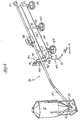
- this apparatus 10 includes a large storage bin 11, which here is carried by legs 12 upon a suitable foundation 13. At the bottom of this bin 11 is a boot 14, and extending from the boot 14 is a header conveyor 1 5.
- the conveyor 15 can be of the type which carries a rotatable auger member 1 5a ( Figure 2) within a hollow conveyor tube.
- this auger 15a is driven by an electric motor 16 or other suitable power source.
- Feed which is drawn from the bin 11 by the header conveyor 15 is delivered to drop tubes 17, 18 and 19.
- a box mechanism 22 can be provided to control feed flow over relatively long stretches of the conveyor 15.
- this feed delivery system has a high capacity so as to deliver at least as much feed to the feed troughs 27-29 as the hogs can consume from the troughs in a given period of time.
- this feed is delivered to the consumption troughs 27, 28, 29 on a predetermined time schedule.
- a feed delivery and delivery shut-off system 30 is interposed between the feed troughs 27-29 and the feed delivery conveyor 15 for alternately permitting and preventing delivery of feed to the feed troughs 27-29.
- the shut-off system 30 includes a timer 31 connected, as by wires 32, to an electric motor 33.
- the electric motor 33 drives a wind-up shaft 34.
- a cone-shaped feed delivery stop valve member 37-39 is provided, and is attached to the wind-up shaft 34 by a flexible rope or cord 41, 42 and 43.
- cords 41, 42 and 43 are routed from the stop valve members through small apertures in the drop tubes 17, 18 and 19 to the shaft 34.
- the cords 41, 42 and 43 are simultaneously unwound off the shaft 34 and the stop members 37, 38 and 39 are taken away from the respective discharge openings 47, 48, 49 provided at the bottom of each of the drop tubes 17, 18 and 19.
- the feed F in the conveyor 15 and drop tubes 17-19 is rapidly discharged to the respective troughs 27-29 at a predetermined time.
- the motor motion is reversed to pull the feed flow shut-off stopper 37-39 back to their closed positions.
- the valve cords 41, 42 and 43 could be attached to a master pull cord operated by a motor or other pull and release mechanism. Other convienient shut-off devices could be used.
- the conveyor motor 16 is first energized, and feed is drawn along the conveyor 15. Usually their action causes the upstream drop tube 17 to first fill with feed, and the second most upstream drop tube 18 next fills with feed.
- the downstream tube 19 is the last to be filled. It will be understood that this sereatum-order tube filling usually occurs regardless of the number of drop tubes to be filled by the conveyor, the filling order progressing from the first upstream tube to the last downstream tube.
- the timer 31 operates the tube valve motor 33. All the cone valves 37, 38 and 39 open simultaneously and feed is thus delivered to all the pans or troughs 27-29 simultaneously. In this way, the hogs are discouraged from rushing to the first or upstream pan 27 when feed delivery begins.
- an interrelated hog watering system 50 is included to still further improve hog development performance.
- the illustrated watering system includes a water delivery pipe 51 which is sized so as to deliver at least as much water to the hogs as the hogs can consume.
- a water shut-off system 52 is interposed within this pipeline 51.
- the shut-off system 52 includes a timer 53 connected, as by wires 54, to a valve 55 interposed in the pipeline 51 so as to operate the shut-off valve 55 at predetermined times.
- the shut-off valve 55 is operated to begin delivery of water before feed delivery starts, and to halt water delivery after feed delivery ends.
- Water passing the valve 55 is routed to a downstream header pipe 56 and thence to drop tubes 57, 58 and 59. Water travelling down each of these drop tubes 57-59 flows to an endless ring 62, 63 and 64 and to nozzles 66.
- these nozzles 66 are mounted directly above the feed pans or troughs 27-29. In this way, water from each nozzle falls into the subjacent trough to mix with the feed contained there.
- This water and feed mixing action provides a number of benefits. First, it inhibits loss of feed by bored hogs who might otherwise be tempted to play with the feed and throw feed out of the troughs. Second, this gruel mixture of feed and water may improve hog gain characteristics. Third, water which emanates from the nozzles 66 and is not consumed directly by the hogs is not wasted, as might be the case if the described nozzle trough relationships were not provided. Fourth, water spillage and consequent mess is minimized.
- these nozzles 66 can be of the spray-head variety so as to deliver a spray of water directly to the hogs and to the feed.during the entire time period when water is being provided through the shut-off-valve 55.
- the nozzles 66 can be of the demand variety which permit delivery of water directly into the hog's mouth only when the hog actuates the valve.
- the described apparatus can be used to provide a novel method of hog feeding and watering. This method encourages maximum feed utilization and more rapid hog weight gain than was heretofore believed possible.
- all the hogs are provided with all the feed they care to consume for a limited feeding period of time, and thereafter all the hogs are denied all access to any feed for a limited feedless period of time.
- three feeding periods are alternated with three feedless periods each day until the weaner hogs have reached an approximate gross weight of 45.5 kg (100 pounds), and thereafter two feeding periods are alternated with two feedless periods each day until the hogs reach their finished or market weight.
- feed is delivered through the system so that all the hogs may eat as much feed as they wish to consume for about two hours.
- feed delivery through the system to the hogs is terminated.
- the hogs After the hogs have consumed any minor amount of feed remaining in the troughs, they can obtain no further feed for some six hours.
- feed is again provided for about two hours.
- a second feedless period of about six hours leads to a two hour feeding period.
- a last feedless period of six hours completes the day.
- all the hogs are provided with all the water they care to consume during each feeding period. All the hogs are denied any water during each feedless period.
- the first trial test compared the performance of hogs fed on a three-feeding-per-day schedule versus the performance of hogs fed on a two-feedings-per-day schedule versus the performance of hogs fed on an ad libitum schedule.
- the performance of hogs fed with dry feed only was also compared to the performance of hogs to which water was made available to wet the feed. Results are shown in Tables I to IV.
- the results of the first trial test indicated a five percent faster gain using the two-feedings-per-day-with-wetted-feed regimen than with the ad libitum feeding regimen, as the hogs grew from 100 pounds to 200 pounds.
- the hogs fed on the two-a-day-wet-feed program added each pound of weight gain with ten percent less feed.
- the second trial test compared a wetted two-per-day feeding program with ad libitum feedings as hogs grew from 45 pounds to 210 pounds.
- the results are shown in Tables V and VI.
- Some comparisons of cumulative average daily gains between the regimen or programs are set out in Table VII.
- Feed Efficiency is the number of pounds of feed consumed by the average hog in order to gain one pound of weight.
- Feed Efficiency is the number of pounds of feed consumed by the average hog in order to gain one pound of weight.
- the third test utilized modified equipment for more accurate testing.
- a programmed feed regimen was compared to an ad libitum program.
- hogs were fed three times per day until they weighed 100 pounds, and then were fed two times per day until they reached market weight. Results are shown in Table VIII.
- the wet, twice-daily feeding program showed a three percent improvement in rate of gain over the ad libitum regime.
- the wet, twice daily feeding program showed a feed conversion rate three percent poorer than the ad libitum program. This poorer feed conversion rate was attributed to feed wastage from the programmed feed trough and other equipment problems. There was some indication of better results at heavier hog weights than at lighter weights.
- the programmed feeding regime resulted in a six percent faster rate of weight gain and a six percent better feed conversion rate than did the control ad libitum feeding plan.
- a fourth trial test utilized automated equipment and the same feeding regime. A control group was fed on an ad libitum regime. Results are shown in Table X.
Landscapes
- Life Sciences & Earth Sciences (AREA)
- Environmental Sciences (AREA)
- Animal Husbandry (AREA)
- Biodiversity & Conservation Biology (AREA)
- Birds (AREA)
- Feeding And Watering For Cattle Raising And Animal Husbandry (AREA)
- Apparatuses For Bulk Treatment Of Fruits And Vegetables And Apparatuses For Preparing Feeds (AREA)
- Fodder In General (AREA)
Claims (16)
Applications Claiming Priority (2)
| Application Number | Priority Date | Filing Date | Title |
|---|---|---|---|
| US6342579A | 1979-08-03 | 1979-08-03 | |
| US63425 | 1998-04-20 |
Publications (3)
| Publication Number | Publication Date |
|---|---|
| EP0023760A2 EP0023760A2 (fr) | 1981-02-11 |
| EP0023760A3 EP0023760A3 (en) | 1981-06-17 |
| EP0023760B1 true EP0023760B1 (fr) | 1984-02-29 |
Family
ID=22049111
Family Applications (1)
| Application Number | Title | Priority Date | Filing Date |
|---|---|---|---|
| EP80302110A Expired EP0023760B1 (fr) | 1979-08-03 | 1980-06-24 | Procédé et dispositif pour l'alimentation de porcs |
Country Status (9)
| Country | Link |
|---|---|
| EP (1) | EP0023760B1 (fr) |
| JP (1) | JPS5623821A (fr) |
| AU (1) | AU537329B2 (fr) |
| CA (1) | CA1135578A (fr) |
| DE (1) | DE3066746D1 (fr) |
| DK (1) | DK327980A (fr) |
| ES (1) | ES8101844A1 (fr) |
| GR (1) | GR69891B (fr) |
| PT (1) | PT71561A (fr) |
Families Citing this family (15)
| Publication number | Priority date | Publication date | Assignee | Title |
|---|---|---|---|---|
| US4401057A (en) * | 1981-10-05 | 1983-08-30 | Chore-Time Equipment, Inc. | Hog feeder |
| KR840006121A (ko) * | 1982-09-30 | 1984-11-22 | 원본미기재 | 동물 사육방법 |
| CA1202840A (fr) * | 1985-06-10 | 1986-04-08 | Jonathan R. Kleinsasser | Auge combinee pour fournir des aliments secs ou humides aux animaux |
| FR2586894B1 (fr) * | 1985-09-12 | 1988-11-25 | Champalaune Daniel | Nourrisseur pour animaux d'elevage |
| JPS6283459U (fr) * | 1985-11-14 | 1987-05-28 | ||
| JPS6417156U (fr) * | 1987-07-23 | 1989-01-27 | ||
| GB9108515D0 (en) * | 1991-04-20 | 1991-06-05 | Bp Nutrition | Improvements in animal husbandry |
| US5570656A (en) * | 1995-04-04 | 1996-11-05 | King Systems, Incorporated | Animal feeder with locking adjustable gate |
| ES2142710B1 (es) * | 1997-01-07 | 2000-12-01 | Parraga Mateo Marin | Instalacion para la alimentacion de animales diversos. |
| WO2008052555A2 (fr) * | 2006-11-03 | 2008-05-08 | Knud Christensen | Procédé pour l'alimentation d'animaux et système de dosage d'aliments pour alimenter des animaux et utilisation du procédé et du système de dosage des aliments |
| CN105145389A (zh) * | 2015-07-04 | 2015-12-16 | 王梦莹 | 育肥猪自动定时定量给料装置 |
| CN113557976A (zh) * | 2021-05-28 | 2021-10-29 | 陈卓 | 一种自动喂猪饲料装置 |
| CN114342822B (zh) * | 2022-01-17 | 2023-03-10 | 安徽省农业科学院畜牧兽医研究所 | 一种猪群饮水量控制系统 |
| CN117461569B (zh) * | 2023-12-27 | 2024-03-19 | 福建永诚农牧科技集团有限公司 | 一种智能幼猪饲喂器 |
| CN118020658B (zh) * | 2024-04-10 | 2024-07-05 | 山东恒基农牧机械有限公司 | 一种畜牧养殖用饲喂装置 |
Family Cites Families (6)
| Publication number | Priority date | Publication date | Assignee | Title |
|---|---|---|---|---|
| DE614137C (de) * | 1933-10-06 | 1935-06-01 | Wilhelm Bennuehr | Durch ein Uhrwerk ausgeloeste Futterausgabe- und -befeuchtungsvorrichtung |
| US3026845A (en) * | 1960-12-20 | 1962-03-27 | Billy B Winter | Stock feeding device |
| US3150798A (en) * | 1961-08-23 | 1964-09-29 | William H Sutton | Automatic periodic animal feeder |
| DE1924124C3 (de) * | 1969-05-12 | 1981-05-07 | Siegfried 8580 Bayreuth Duchstein | Vorrichtung zur Schweinefütterung |
| JPS51102992A (ja) * | 1975-03-06 | 1976-09-10 | Yoshimori Nukaga | Kachikuhiikuyojidokyujihoshiki |
| DE2509954B2 (de) * | 1975-03-07 | 1976-11-18 | Eichholz, Heinz, 4441 Schapen | Einrichtung zur befuellung von futterstellen |
-
1980
- 1980-06-12 CA CA000353894A patent/CA1135578A/fr not_active Expired
- 1980-06-20 AU AU59469/80A patent/AU537329B2/en not_active Ceased
- 1980-06-24 DE DE8080302110T patent/DE3066746D1/de not_active Expired
- 1980-06-24 EP EP80302110A patent/EP0023760B1/fr not_active Expired
- 1980-07-01 ES ES492978A patent/ES8101844A1/es not_active Expired
- 1980-07-16 PT PT71561A patent/PT71561A/pt unknown
- 1980-07-30 DK DK327980A patent/DK327980A/da not_active Application Discontinuation
- 1980-07-31 JP JP10631680A patent/JPS5623821A/ja active Pending
- 1980-08-01 GR GR62584A patent/GR69891B/el unknown
Also Published As
| Publication number | Publication date |
|---|---|
| EP0023760A2 (fr) | 1981-02-11 |
| EP0023760A3 (en) | 1981-06-17 |
| DE3066746D1 (en) | 1984-04-05 |
| ES492978A0 (es) | 1980-12-16 |
| AU5946980A (en) | 1981-02-05 |
| PT71561A (en) | 1980-08-01 |
| JPS5623821A (en) | 1981-03-06 |
| DK327980A (da) | 1981-02-04 |
| GR69891B (fr) | 1982-07-20 |
| CA1135578A (fr) | 1982-11-16 |
| AU537329B2 (en) | 1984-06-21 |
| ES8101844A1 (es) | 1980-12-16 |
Similar Documents
| Publication | Publication Date | Title |
|---|---|---|
| US4337728A (en) | Programmed hog feeder and process | |
| EP0023760A2 (fr) | Procédé et dispositif pour l'alimentation de porcs | |
| US5355833A (en) | Computer aided feed distribution equipment for young animals | |
| Coppock et al. | From feeding to feeding systems | |
| US4401057A (en) | Hog feeder | |
| US5551374A (en) | Automated nipple livestock feeder and method of operation | |
| PL184194B1 (pl) | Urządzenie do karmienia zwierząt domowych, zwłaszcza świń | |
| US2929356A (en) | Method for dispensing slurried animal feed | |
| EP0373147B1 (fr) | Procédé pour la préparation, le dosage et la distribution d'un mélange alimentaire dans des récipients différents et installation pour le procédé | |
| CN207201678U (zh) | 多种饲料共用的猪自动饲喂设备和系统 | |
| Cumby | Design requirements of liquid feeding systems for pigs: A review | |
| US3433205A (en) | Automatic poultry feeding device with water sprayed feed mix | |
| WO1992003920A1 (fr) | Systeme de commande d'alimentation pour animaux d'elevage | |
| DE4137387A1 (de) | Verfahren und vorrichtung zum automatischen fuettern von vieh mit fliessfaehigem oder rieselfaehigem futtermittel | |
| US5718188A (en) | Animal feed management system | |
| Owen | Complete diets for dairy cattle | |
| CN211671846U (zh) | 一种养猪饲料输送系统 | |
| US3326187A (en) | Animal feeding system | |
| DE102013102568A1 (de) | System und Vorrichtung zum Füttern von Ferkeln | |
| Pompe et al. | Automatic individual feeding systems for dairy cows: observations of facility utilization | |
| EP0760203A1 (fr) | Silo regulateur pour l'alimentation du betail | |
| Latvietis et al. | Problems of cow feeding in robotic milking and loose handling conditions | |
| AT391585B (de) | Verfahren und vorrichtung zur aufbereitung und zur dosierten abgabe von aus fluessigen und trockenen bestandteilen bestehendem mischfutter | |
| US3279433A (en) | Apparatus for rearing piglets | |
| Fiorotto et al. | A semiautomatic device for feeding liquid milk-replacer diets to infant pigs |
Legal Events
| Date | Code | Title | Description |
|---|---|---|---|
| PUAI | Public reference made under article 153(3) epc to a published international application that has entered the european phase |
Free format text: ORIGINAL CODE: 0009012 |
|
| AK | Designated contracting states |
Designated state(s): BE DE FR GB IT NL SE |
|
| PUAL | Search report despatched |
Free format text: ORIGINAL CODE: 0009013 |
|
| AK | Designated contracting states |
Designated state(s): BE DE FR GB IT NL SE |
|
| 17P | Request for examination filed |
Effective date: 19810811 |
|
| ITF | It: translation for a ep patent filed | ||
| GRAA | (expected) grant |
Free format text: ORIGINAL CODE: 0009210 |
|
| AK | Designated contracting states |
Designated state(s): BE DE FR GB IT NL SE |
|
| REF | Corresponds to: |
Ref document number: 3066746 Country of ref document: DE Date of ref document: 19840405 |
|
| ET | Fr: translation filed | ||
| PLBE | No opposition filed within time limit |
Free format text: ORIGINAL CODE: 0009261 |
|
| STAA | Information on the status of an ep patent application or granted ep patent |
Free format text: STATUS: NO OPPOSITION FILED WITHIN TIME LIMIT |
|
| 26N | No opposition filed | ||
| PGFP | Annual fee paid to national office [announced via postgrant information from national office to epo] |
Ref country code: BE Payment date: 19900509 Year of fee payment: 11 |
|
| PGFP | Annual fee paid to national office [announced via postgrant information from national office to epo] |
Ref country code: FR Payment date: 19900518 Year of fee payment: 11 |
|
| PGFP | Annual fee paid to national office [announced via postgrant information from national office to epo] |
Ref country code: GB Payment date: 19900530 Year of fee payment: 11 |
|
| PGFP | Annual fee paid to national office [announced via postgrant information from national office to epo] |
Ref country code: SE Payment date: 19900618 Year of fee payment: 11 |
|
| PGFP | Annual fee paid to national office [announced via postgrant information from national office to epo] |
Ref country code: DE Payment date: 19900627 Year of fee payment: 11 |
|
| ITTA | It: last paid annual fee | ||
| PGFP | Annual fee paid to national office [announced via postgrant information from national office to epo] |
Ref country code: NL Payment date: 19900630 Year of fee payment: 11 |
|
| PG25 | Lapsed in a contracting state [announced via postgrant information from national office to epo] |
Ref country code: GB Effective date: 19910624 |
|
| PG25 | Lapsed in a contracting state [announced via postgrant information from national office to epo] |
Ref country code: SE Effective date: 19910625 |
|
| PG25 | Lapsed in a contracting state [announced via postgrant information from national office to epo] |
Ref country code: BE Effective date: 19910630 |
|
| BERE | Be: lapsed |
Owner name: CHORE-TIME EQUIPMENT INC. Effective date: 19910630 |
|
| PG25 | Lapsed in a contracting state [announced via postgrant information from national office to epo] |
Ref country code: NL Effective date: 19920101 |
|
| NLV4 | Nl: lapsed or anulled due to non-payment of the annual fee | ||
| GBPC | Gb: european patent ceased through non-payment of renewal fee | ||
| PG25 | Lapsed in a contracting state [announced via postgrant information from national office to epo] |
Ref country code: FR Effective date: 19920228 |
|
| PG25 | Lapsed in a contracting state [announced via postgrant information from national office to epo] |
Ref country code: DE Effective date: 19920401 |
|
| REG | Reference to a national code |
Ref country code: FR Ref legal event code: ST |
|
| EUG | Se: european patent has lapsed |
Ref document number: 80302110.4 Effective date: 19920109 |