EP0023834A2 - Wandler mit optischen Fasern - Google Patents
Wandler mit optischen Fasern Download PDFInfo
- Publication number
- EP0023834A2 EP0023834A2 EP80302654A EP80302654A EP0023834A2 EP 0023834 A2 EP0023834 A2 EP 0023834A2 EP 80302654 A EP80302654 A EP 80302654A EP 80302654 A EP80302654 A EP 80302654A EP 0023834 A2 EP0023834 A2 EP 0023834A2
- Authority
- EP
- European Patent Office
- Prior art keywords
- angle
- optical
- fiber optic
- end faces
- face
- Prior art date
- Legal status (The legal status is an assumption and is not a legal conclusion. Google has not performed a legal analysis and makes no representation as to the accuracy of the status listed.)
- Withdrawn
Links
Images


Classifications
-
- G—PHYSICS
- G02—OPTICS
- G02F—OPTICAL DEVICES OR ARRANGEMENTS FOR THE CONTROL OF LIGHT BY MODIFICATION OF THE OPTICAL PROPERTIES OF THE MEDIA OF THE ELEMENTS INVOLVED THEREIN; NON-LINEAR OPTICS; FREQUENCY-CHANGING OF LIGHT; OPTICAL LOGIC ELEMENTS; OPTICAL ANALOGUE/DIGITAL CONVERTERS
- G02F1/00—Devices or arrangements for the control of the intensity, colour, phase, polarisation or direction of light arriving from an independent light source, e.g. switching, gating or modulating; Non-linear optics
- G02F1/01—Devices or arrangements for the control of the intensity, colour, phase, polarisation or direction of light arriving from an independent light source, e.g. switching, gating or modulating; Non-linear optics for the control of the intensity, phase, polarisation or colour
- G02F1/21—Devices or arrangements for the control of the intensity, colour, phase, polarisation or direction of light arriving from an independent light source, e.g. switching, gating or modulating; Non-linear optics for the control of the intensity, phase, polarisation or colour by interference
-
- G—PHYSICS
- G01—MEASURING; TESTING
- G01H—MEASUREMENT OF MECHANICAL VIBRATIONS OR ULTRASONIC, SONIC OR INFRASONIC WAVES
- G01H9/00—Measuring mechanical vibrations or ultrasonic, sonic or infrasonic waves by using radiation-sensitive means, e.g. optical means
- G01H9/004—Measuring mechanical vibrations or ultrasonic, sonic or infrasonic waves by using radiation-sensitive means, e.g. optical means using fibre optic sensors
- G01H9/006—Measuring mechanical vibrations or ultrasonic, sonic or infrasonic waves by using radiation-sensitive means, e.g. optical means using fibre optic sensors the vibrations causing a variation in the relative position of the end of a fibre and another element
Definitions
- the present invention relates to transducers and more particularly, to a transducer which converts small displacements into light intensity variations.
- Underwater target locating systems may utilize active acoustic devices, which comprise a radiation source and a receiver to detect reflected sound energy, or passive devices which detect sound energy radiated from distant sources.
- active and passive systems The information obtained with active and passive systems is the same; mainly they determine the relative position of a multiplicity of dispersed discrete targets in a quiescent water ambient.
- Passive underwater locating systems are generally preferred for military applications. Since target position cannot be determined passively with a single acoustic receiver (hydroplane), a passive system requires a multiplicity of hydrophones, the minimum number to determine the position in one plane being three, one at each position at the vertices of an equiangular triangle.
- These systems determine the relative position of a target by frequency filtering the target signal received at each sensor from the background noise, determining the relative phases of the filtered signal between sensors, and processing this phase information to obtain the relative range and angle location.
- Large numbers of hydrophones, 100 and 1000, are typically utilized in a one or two dimensional array to provide sufficient systems signal sensitivity in the presence of noise and to provide a desired angular resolution over a broad acoustic frequency band.
- Acoustic transducers of the prior art utilize piezoelectric crystals or ferroelectric ceramics to transform acoustic signals into electrical signals by converting pressure variations into corresponding voltage variations across electrodes positioned on opposite sides of the material. These transducers typically supply very small voltages at very high impedance levels. Generally the transducer is coupled to an amplifier via a long wire or coaxial cable, the capacitance of which is charged by the voltage across the output terminals of the crystal, causing the voltage response, due to a given pressure wave, to be greatly reduced.
- This ⁇ duction in sensitivity may be eliminated by positioning a transimpedance amplifier in close proximity to the transducer which amplifies the signal and transforms the high output impedance of the transducer to a low impedance which is coupled to the input terminals of the transmission line.
- the transimpedance amplifier eliminates the decreased signal caused by the capacitance of the transmission line, thus permitting the amplified signal to be transmitted with little loss over long lengths of line.
- single mode interferometric systems exhibit relatively high sensitivity to ambient pressure head and temperature variations.
- reduction of phase variations caused by the sensitivity of the single mode fiber to the same pressure head and temperature variations is the most severe.
- Ambient phase variations produced in , the fiber optic cable may be minimized by increasing the length of the fiber at the transducer. This increase, however, creates more severe pressure head and temperature induced phase variations in the transducer for which compensation via electrically active feed back control systems may be required.
- the limitations of single mode interferometric sensor systems are overcome with the present invention by utilizing multimode fibers and devising an intensity modulation technique that is compatible therewith.
- a preferred fiber optic transducer constructed according to the principles of the present invention includes two optical fibers with the end faces thereof cut and polished at an angle with respect to their axes such that the light propagating in the fiber is incident to the end face at angles that are greater than the critical angle for the interface between the fiber medium and free space such that total internal reflection takes place at the interface.
- the axes of the two fibers are positioned on a common line with the canted end faces thereof in close proximity. This arrangement causes light propagating in the input fiber to be totally internally reflected by the canted end face if the spacing between the end faces is large compared to the free space wavelength of the propagating light. When the separation is less than approximately one wavelength, coupling between the fibers is realized with the coupled intensity increasing with decreasing separation.
- Ambient condition changes such as pressure variations resulting from acoustic waves propagating in the vicinity of the pressure sensing device cause the pressure sensing device to create variations in the fiber end separations, thus producing an intensity modulation of the light coupled from the input through to the output optical fiber.
- a fiber optic transducer may include an optical fiber, one end of which is cut and polished at two angles of 45 0 with respect to the axis of the fiber, creating two end faces which form an apex angle on the axis that reflects light, after two reflections, back towards the input end of the fiber.
- An optical material, with a refractive index substantially equal to refractive index of the fiber, is positioned such that one surface is substantially parallel to one of the end faces with a separation therebetween. When the separation between the one end face and the surface of the optical material is greater than a wavelength of the optical signals propagating within the fiber, the optical signals incident to the one end face will be totally reflected therefrom towards the second end face and therefrom towards the input end of the fiber.
- the separation between the one end face and the optical material is less than a wavelength of the propagating signals, light energy is coupled to the optical material, the percentage of the incident energy coupled increasing with decreasing separation, thus reducing the intensity of the light returned to the input end.
- Placing the optical fiber and the optical material in a device that causes variations in the distance between the one end face and the optical material as a result of ambient condition changes will cause a variation in the intensity of the light beam that is reflected towards the input end.
- FIG. 1 schematically shows the structure of a junction 10 that may be utilised as a central component of the invention
- two optical fibers 11 and 12 each with an index of refraction n 1 are cut and polished at their ends to establish end faces 13 and 14 at an acute angle ⁇ with the respective fiber axis.
- the fibers are positioned with the end faces 13 and 14 spaced a small distance d apart and the axes desirably located along a common line.
- the spacing "d" is large compared to a wave length and the angle 8 is selected such that the minimum incident angle ⁇ m , relative to the normal line 13a, of an optical signal to the end face 13, along for example, the propagation path 15, is greater than the critical angle, all optical signals propagating within the fiber 11 will be internally reflected. If the distance d is decreased to be less than a wavelength, some fraction of the light will be transmitted through the gap to enter and propagate in the optical fiber 12. The percentage of light transmitted to the optical fiber 12, for each angle of incidence greater than the minimum angle ⁇ m , may be determined from:
- a fiber optic sonar transducer 20 may comprise an input optical fiber 21 coupled at the input end to an optical source 22 and an output optical fiber 23 coupled at the output end thereof to an optical detector 24.
- the output end face 26 of input fiber 21 and the input end face 27 of output fiber 23 are cut and polished at an angle for total internal reflection as previously described.
- Fibers 21 and 23 may extend through a cable 25 respectively to plates 31 and 32 of a sensor 28, which may, for example, be a two plate pressure sensing device, whereat the end faces 26 and 27 are held flush with the edges 33 and 34 of the plates 31 and 32 respectively.
- Edges 33 and 34 are held parallel while the distance therebetween is allowed to vary, as a function of pressure from very small fractions of a free space wavelength to approximately one wavelength by compliance members 35 and 36.
- an acoustic wave incident to the pressure sensor 28 causes a variation in the distance between the surfaces 33 and 34 of the plates 31 and 32, thereby varying the total light energy transmitted from the end space 26 of the input optical fiber 21 through the end face 27 of the output optical fiber 23, thus causing the light signals incident to the optical detector 24 to be amplitude modulated.
- FIG. 3 Another embodiment of the invention is shown in Figure 3.
- An input optical fiber 41 and an output optical fiber 42 may be inserted into brass ferrules 43 and 44 and along the entire length of cantilevered extensions 4 3a and 44a thereof respectively and bonded therein, as for example with Torr Seal Epoxy.
- the ends of the cantilevered extensions 43a and 44a may then be cut and polished such that end faces 45 and 46 of the fibers 41 and 42 respectfully form a desired acute angle with the fiber axis as previously described.
- Ferrule 43 may be secured in a holder 47 which in turn may be bonded to a base plate 48, while ferrule 44 may be secured in a holder 51 which in turn may be attached near one end of a spring 52.
- Spring 52 may be secured at the other end to a spacing block 53, the height of which is adjusted to obtain proper alignment of the end faces 45 and 46 and positioned on the base plate 48 to obtain a desired spacing between end faces 45 and 46.
- Base plate 48 may be placed in a housing 54 on adjusting screws 55 extending through the base of the housing 54.
- Holder 51 may be coupled to a diaphram 56 via plunger 57.
- Diaphram 56 may be sealed to the housing 54 , with a retaining ring 58. Maximum sensitivity to the diaphram pressure may be obtained by adjusting the screws 55 in the base of the housing 54.
- optical signals are caused to propagate through input fiber 41 towards the end face 45 thereof. Variations in ambient conditions, as for example, pressure applied through the diaphram 56 cause variations in the spacings between the end faces 45 and 46 thus resulting in the propagation of an amplitude modulated optical signal in the output fiber 42 as previsouly described.
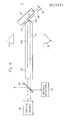
- a single fiber acousto-optic transducer in accordance with the present invention is shown schematically in Figure 4.
- Optical signals from an optical source 61 are coupled through a beam splitter 62 and caused to propagate in an optical fiber 63 along a path 64, for example.
- Optical fiber 63 is cut and polished to establish end faces 65 and 66 which form angles of 90° with respect to each other and 45 0 with respect to the axis of the optical fiber 63.
- the numerical aperture of the fiber is limited to a value such that the angle of incidence to the end faces 65 and 66 for substantially all permissible propagation paths within the optical fiber 63 are greater than the critical angle for the interface between a medium having an index of refraction of fiber 63 and air.
- a block of optical material 67 having an index of refraction approximately equal to or greater than the index and refraction of the fiber core 63 is positioned such that a flat surface 68 thereof is substantially parallel to an end face of the optical fiber 63, as for example, end face 65, with a spacing d therebetween.
- the spacing d is less than a wavelength of the optical signal propagating within the optical fiber 63, light incident to the end face 65, as for example along the optical path 64, is reflected therefrom to be incident to the end face 66, and reflected from the end face 66 towards the input end of the fiber, as for example along the path 71. Reflected light emerging from the optical fiber 63 is then incident to the beam splitter 62 and a portion thereof is reflected towards an optical detector 72.
Landscapes
- Physics & Mathematics (AREA)
- Nonlinear Science (AREA)
- General Physics & Mathematics (AREA)
- Optics & Photonics (AREA)
- Measurement Of Mechanical Vibrations Or Ultrasonic Waves (AREA)
- Length Measuring Devices By Optical Means (AREA)
Applications Claiming Priority (2)
| Application Number | Priority Date | Filing Date | Title |
|---|---|---|---|
| US6350479A | 1979-08-03 | 1979-08-03 | |
| US63504 | 1979-08-03 |
Publications (2)
| Publication Number | Publication Date |
|---|---|
| EP0023834A2 true EP0023834A2 (de) | 1981-02-11 |
| EP0023834A3 EP0023834A3 (de) | 1981-07-15 |
Family
ID=22049644
Family Applications (1)
| Application Number | Title | Priority Date | Filing Date |
|---|---|---|---|
| EP80302654A Withdrawn EP0023834A3 (de) | 1979-08-03 | 1980-08-04 | Wandler mit optischen Fasern |
Country Status (2)
| Country | Link |
|---|---|
| EP (1) | EP0023834A3 (de) |
| GB (1) | GB2060165A (de) |
Cited By (2)
| Publication number | Priority date | Publication date | Assignee | Title |
|---|---|---|---|---|
| DE3733549A1 (de) * | 1987-10-03 | 1989-04-20 | Messerschmitt Boelkow Blohm | Faseroptischer sensor |
| GB2387448A (en) * | 2002-04-12 | 2003-10-15 | Point Source Ltd | Optic fibre having inclined planar end face |
Families Citing this family (1)
| Publication number | Priority date | Publication date | Assignee | Title |
|---|---|---|---|---|
| DE3737846A1 (de) * | 1987-11-04 | 1989-05-18 | Peters Tim | Mikrofon mit optischen fasern, nichtelektrischem und nichtmetallischem aufnehmer |
Family Cites Families (1)
| Publication number | Priority date | Publication date | Assignee | Title |
|---|---|---|---|---|
| US4071753A (en) * | 1975-03-31 | 1978-01-31 | Gte Laboratories Incorporated | Transducer for converting acoustic energy directly into optical energy |
-
1980
- 1980-08-04 EP EP80302654A patent/EP0023834A3/de not_active Withdrawn
- 1980-08-04 GB GB8025380A patent/GB2060165A/en not_active Withdrawn
Cited By (4)
| Publication number | Priority date | Publication date | Assignee | Title |
|---|---|---|---|---|
| DE3733549A1 (de) * | 1987-10-03 | 1989-04-20 | Messerschmitt Boelkow Blohm | Faseroptischer sensor |
| GB2387448A (en) * | 2002-04-12 | 2003-10-15 | Point Source Ltd | Optic fibre having inclined planar end face |
| GB2387448B (en) * | 2002-04-12 | 2004-09-01 | Point Source Ltd | Optical fibre having angled planar end face |
| US7006724B2 (en) | 2002-04-12 | 2006-02-28 | Point Source Limited | Optical fibers |
Also Published As
| Publication number | Publication date |
|---|---|
| GB2060165A (en) | 1981-04-29 |
| EP0023834A3 (de) | 1981-07-15 |
Similar Documents
| Publication | Publication Date | Title |
|---|---|---|
| US4421384A (en) | Fiber optic transducer | |
| US4300813A (en) | Fiber optic transducer and method of manufacture therefor | |
| US4414471A (en) | Fiber optic acoustic signal transducer using reflector | |
| US4293188A (en) | Fiber optic small displacement sensor | |
| US4649529A (en) | Multi-channel fiber optic sensor system | |
| US4545253A (en) | Fiber optical modulator and data multiplexer | |
| Parsons et al. | Cost-effective assembly of a basic fiber-optic hydrophone for measurement of high-amplitude therapeutic ultrasound fields | |
| US4235113A (en) | Optical fiber acoustical sensors | |
| US4688200A (en) | Optical system for detecting acoustic wave energy in a fluid medium | |
| US4443700A (en) | Optical sensing apparatus and method | |
| US4297887A (en) | High-sensitivity, low-noise, remote optical fiber | |
| US4530078A (en) | Microbending fiber optic acoustic sensor | |
| US5177805A (en) | Optical sensors utilizing multiple reflection | |
| US4313185A (en) | Acoustic vibration sensor and sensing system | |
| US4471474A (en) | Coupled waveguide acousto-optic hydrophone | |
| US4313192A (en) | Optical transducer array system | |
| EP0763192B1 (de) | Ultraschalldetektor mit oberflächenemittierenden lasern mit vertikalen resonatoren | |
| US4286468A (en) | Frustrated total internal reflection fiber-optic small-motion sensor for hydrophone use | |
| US5359445A (en) | Fiber optic sensor | |
| US5574699A (en) | Fiber optic lever towed array | |
| EP0027540A2 (de) | Optischer Sensor und Wandlergruppierungssystem | |
| CN209055632U (zh) | 一种用于监测液固复合绝缘电力设备局部放电的空间全角度超声波光纤法-珀传感器 | |
| US4067643A (en) | Input and output devices for optical fiber | |
| CN111829645B (zh) | 一种基于光纤传感器的声学/振动监测系统 | |
| US4354735A (en) | Optical transducer |
Legal Events
| Date | Code | Title | Description |
|---|---|---|---|
| PUAI | Public reference made under article 153(3) epc to a published international application that has entered the european phase |
Free format text: ORIGINAL CODE: 0009012 |
|
| AK | Designated contracting states |
Designated state(s): DE FR |
|
| PUAL | Search report despatched |
Free format text: ORIGINAL CODE: 0009013 |
|
| AK | Designated contracting states |
Designated state(s): DE FR |
|
| RAP1 | Party data changed (applicant data changed or rights of an application transferred) |
Owner name: SPERRY CORPORATION |
|
| STAA | Information on the status of an ep patent application or granted ep patent |
Free format text: STATUS: THE APPLICATION IS DEEMED TO BE WITHDRAWN |
|
| 18D | Application deemed to be withdrawn |
Effective date: 19820618 |
|
| RIN1 | Information on inventor provided before grant (corrected) |
Inventor name: MCMAHON, DONALD HOWLAND |