EP0023979A1 - Wasserlösliche, lufttrocknende Alkydharze, Verfahren zu ihrer Herstellung und ihre Verwendung als Grundlage für vergilbungsarme Lacke - Google Patents
Wasserlösliche, lufttrocknende Alkydharze, Verfahren zu ihrer Herstellung und ihre Verwendung als Grundlage für vergilbungsarme Lacke Download PDFInfo
- Publication number
- EP0023979A1 EP0023979A1 EP80104061A EP80104061A EP0023979A1 EP 0023979 A1 EP0023979 A1 EP 0023979A1 EP 80104061 A EP80104061 A EP 80104061A EP 80104061 A EP80104061 A EP 80104061A EP 0023979 A1 EP0023979 A1 EP 0023979A1
- Authority
- EP
- European Patent Office
- Prior art keywords
- alkyd resins
- acid
- acids
- fatty acids
- resins according
- Prior art date
- Legal status (The legal status is an assumption and is not a legal conclusion. Google has not performed a legal analysis and makes no representation as to the accuracy of the status listed.)
- Granted
Links
- 229920000180 alkyd Polymers 0.000 title claims abstract description 47
- 238000007605 air drying Methods 0.000 title claims abstract description 5
- 238000004383 yellowing Methods 0.000 title claims abstract description 5
- 238000000034 method Methods 0.000 title claims description 8
- 239000004922 lacquer Substances 0.000 title description 6
- 238000004519 manufacturing process Methods 0.000 title description 4
- 150000004665 fatty acids Chemical class 0.000 claims description 47
- 235000014113 dietary fatty acids Nutrition 0.000 claims description 46
- 239000000194 fatty acid Substances 0.000 claims description 46
- 229930195729 fatty acid Natural products 0.000 claims description 46
- 239000002253 acid Substances 0.000 claims description 17
- MUTGBJKUEZFXGO-OLQVQODUSA-N (3as,7ar)-3a,4,5,6,7,7a-hexahydro-2-benzofuran-1,3-dione Chemical group C1CCC[C@@H]2C(=O)OC(=O)[C@@H]21 MUTGBJKUEZFXGO-OLQVQODUSA-N 0.000 claims description 12
- QQVIHTHCMHWDBS-UHFFFAOYSA-N isophthalic acid Chemical compound OC(=O)C1=CC=CC(C(O)=O)=C1 QQVIHTHCMHWDBS-UHFFFAOYSA-N 0.000 claims description 12
- 239000003973 paint Substances 0.000 claims description 11
- QGZKDVFQNNGYKY-UHFFFAOYSA-N Ammonia Chemical compound N QGZKDVFQNNGYKY-UHFFFAOYSA-N 0.000 claims description 10
- 125000002887 hydroxy group Chemical group [H]O* 0.000 claims description 10
- 150000001298 alcohols Chemical class 0.000 claims description 8
- 150000001412 amines Chemical class 0.000 claims description 8
- 150000002148 esters Chemical class 0.000 claims description 8
- 238000002360 preparation method Methods 0.000 claims description 8
- 239000002904 solvent Substances 0.000 claims description 7
- 150000005846 sugar alcohols Polymers 0.000 claims description 7
- LGRFSURHDFAFJT-UHFFFAOYSA-N Phthalic anhydride Natural products C1=CC=C2C(=O)OC(=O)C2=C1 LGRFSURHDFAFJT-UHFFFAOYSA-N 0.000 claims description 6
- JHIWVOJDXOSYLW-UHFFFAOYSA-N butyl 2,2-difluorocyclopropane-1-carboxylate Chemical compound CCCCOC(=O)C1CC1(F)F JHIWVOJDXOSYLW-UHFFFAOYSA-N 0.000 claims description 6
- 229910021529 ammonia Inorganic materials 0.000 claims description 5
- 235000010233 benzoic acid Nutrition 0.000 claims description 5
- WXZMFSXDPGVJKK-UHFFFAOYSA-N pentaerythritol Chemical compound OCC(CO)(CO)CO WXZMFSXDPGVJKK-UHFFFAOYSA-N 0.000 claims description 5
- OFOBLEOULBTSOW-UHFFFAOYSA-N Malonic acid Chemical compound OC(=O)CC(O)=O OFOBLEOULBTSOW-UHFFFAOYSA-N 0.000 claims description 4
- 150000008064 anhydrides Chemical class 0.000 claims description 4
- 150000001991 dicarboxylic acids Chemical class 0.000 claims description 4
- 239000003549 soybean oil Substances 0.000 claims description 4
- 235000012424 soybean oil Nutrition 0.000 claims description 4
- OYHQOLUKZRVURQ-HZJYTTRNSA-N Linoleic acid Chemical compound CCCCC\C=C/C\C=C/CCCCCCCC(O)=O OYHQOLUKZRVURQ-HZJYTTRNSA-N 0.000 claims description 3
- 235000020661 alpha-linolenic acid Nutrition 0.000 claims description 3
- 235000020778 linoleic acid Nutrition 0.000 claims description 3
- 125000005481 linolenic acid group Chemical group 0.000 claims description 3
- 150000002763 monocarboxylic acids Chemical class 0.000 claims description 3
- WRIDQFICGBMAFQ-UHFFFAOYSA-N (E)-8-Octadecenoic acid Natural products CCCCCCCCCC=CCCCCCCC(O)=O WRIDQFICGBMAFQ-UHFFFAOYSA-N 0.000 claims description 2
- LQJBNNIYVWPHFW-UHFFFAOYSA-N 20:1omega9c fatty acid Natural products CCCCCCCCCCC=CCCCCCCCC(O)=O LQJBNNIYVWPHFW-UHFFFAOYSA-N 0.000 claims description 2
- QSBYPNXLFMSGKH-UHFFFAOYSA-N 9-Heptadecensaeure Natural products CCCCCCCC=CCCCCCCCC(O)=O QSBYPNXLFMSGKH-UHFFFAOYSA-N 0.000 claims description 2
- 239000005642 Oleic acid Substances 0.000 claims description 2
- ZQPPMHVWECSIRJ-UHFFFAOYSA-N Oleic acid Natural products CCCCCCCCC=CCCCCCCCC(O)=O ZQPPMHVWECSIRJ-UHFFFAOYSA-N 0.000 claims description 2
- QXJSBBXBKPUZAA-UHFFFAOYSA-N isooleic acid Natural products CCCCCCCC=CCCCCCCCCC(O)=O QXJSBBXBKPUZAA-UHFFFAOYSA-N 0.000 claims description 2
- ZQPPMHVWECSIRJ-KTKRTIGZSA-N oleic acid Chemical compound CCCCCCCC\C=C/CCCCCCCC(O)=O ZQPPMHVWECSIRJ-KTKRTIGZSA-N 0.000 claims description 2
- OYHQOLUKZRVURQ-IXWMQOLASA-N linoleic acid Natural products CCCCC\C=C/C\C=C\CCCCCCCC(O)=O OYHQOLUKZRVURQ-IXWMQOLASA-N 0.000 claims 2
- 150000001559 benzoic acids Chemical class 0.000 claims 1
- 238000000576 coating method Methods 0.000 abstract description 6
- MUTGBJKUEZFXGO-UHFFFAOYSA-N hexahydrophthalic anhydride Chemical compound C1CCCC2C(=O)OC(=O)C21 MUTGBJKUEZFXGO-UHFFFAOYSA-N 0.000 abstract 1
- 239000000203 mixture Substances 0.000 description 11
- ZMXDDKWLCZADIW-UHFFFAOYSA-N N,N-Dimethylformamide Chemical compound CN(C)C=O ZMXDDKWLCZADIW-UHFFFAOYSA-N 0.000 description 9
- WPYMKLBDIGXBTP-UHFFFAOYSA-N benzoic acid Chemical compound OC(=O)C1=CC=CC=C1 WPYMKLBDIGXBTP-UHFFFAOYSA-N 0.000 description 8
- -1 amine salts Chemical class 0.000 description 7
- ZMANZCXQSJIPKH-UHFFFAOYSA-N Triethylamine Chemical compound CCN(CC)CC ZMANZCXQSJIPKH-UHFFFAOYSA-N 0.000 description 6
- 238000001035 drying Methods 0.000 description 6
- LYCAIKOWRPUZTN-UHFFFAOYSA-N Ethylene glycol Chemical compound OCCO LYCAIKOWRPUZTN-UHFFFAOYSA-N 0.000 description 5
- 230000015572 biosynthetic process Effects 0.000 description 5
- XLYOFNOQVPJJNP-UHFFFAOYSA-N water Substances O XLYOFNOQVPJJNP-UHFFFAOYSA-N 0.000 description 5
- KMOUUZVZFBCRAM-OLQVQODUSA-N (3as,7ar)-3a,4,7,7a-tetrahydro-2-benzofuran-1,3-dione Chemical compound C1C=CC[C@@H]2C(=O)OC(=O)[C@@H]21 KMOUUZVZFBCRAM-OLQVQODUSA-N 0.000 description 4
- 239000005711 Benzoic acid Substances 0.000 description 4
- 238000006317 isomerization reaction Methods 0.000 description 4
- FALRKNHUBBKYCC-UHFFFAOYSA-N 2-(chloromethyl)pyridine-3-carbonitrile Chemical compound ClCC1=NC=CC=C1C#N FALRKNHUBBKYCC-UHFFFAOYSA-N 0.000 description 3
- WVDDGKGOMKODPV-UHFFFAOYSA-N Benzyl alcohol Chemical compound OCC1=CC=CC=C1 WVDDGKGOMKODPV-UHFFFAOYSA-N 0.000 description 3
- PEDCQBHIVMGVHV-UHFFFAOYSA-N Glycerine Chemical compound OCC(O)CO PEDCQBHIVMGVHV-UHFFFAOYSA-N 0.000 description 3
- DNIAPMSPPWPWGF-UHFFFAOYSA-N Propylene glycol Chemical compound CC(O)CO DNIAPMSPPWPWGF-UHFFFAOYSA-N 0.000 description 3
- 125000004432 carbon atom Chemical group C* 0.000 description 3
- 150000001735 carboxylic acids Chemical class 0.000 description 3
- 101150038956 cup-4 gene Proteins 0.000 description 3
- FPYJFEHAWHCUMM-UHFFFAOYSA-N maleic anhydride Chemical compound O=C1OC(=O)C=C1 FPYJFEHAWHCUMM-UHFFFAOYSA-N 0.000 description 3
- 229920005989 resin Polymers 0.000 description 3
- 239000011347 resin Substances 0.000 description 3
- 239000000243 solution Substances 0.000 description 3
- 229940014800 succinic anhydride Drugs 0.000 description 3
- OBETXYAYXDNJHR-UHFFFAOYSA-N 2-Ethylhexanoic acid Chemical compound CCCCC(CC)C(O)=O OBETXYAYXDNJHR-UHFFFAOYSA-N 0.000 description 2
- ZNQVEEAIQZEUHB-UHFFFAOYSA-N 2-ethoxyethanol Chemical compound CCOCCO ZNQVEEAIQZEUHB-UHFFFAOYSA-N 0.000 description 2
- IJGRMHOSHXDMSA-UHFFFAOYSA-N Atomic nitrogen Chemical compound N#N IJGRMHOSHXDMSA-UHFFFAOYSA-N 0.000 description 2
- QUSNBJAOOMFDIB-UHFFFAOYSA-N Ethylamine Chemical compound CCN QUSNBJAOOMFDIB-UHFFFAOYSA-N 0.000 description 2
- 235000010469 Glycine max Nutrition 0.000 description 2
- LRHPLDYGYMQRHN-UHFFFAOYSA-N N-Butanol Chemical compound CCCCO LRHPLDYGYMQRHN-UHFFFAOYSA-N 0.000 description 2
- ATUOYWHBWRKTHZ-UHFFFAOYSA-N Propane Chemical compound CCC ATUOYWHBWRKTHZ-UHFFFAOYSA-N 0.000 description 2
- KKEYFWRCBNTPAC-UHFFFAOYSA-N Terephthalic acid Chemical compound OC(=O)C1=CC=C(C(O)=O)C=C1 KKEYFWRCBNTPAC-UHFFFAOYSA-N 0.000 description 2
- WNLRTRBMVRJNCN-UHFFFAOYSA-N adipic acid Chemical compound OC(=O)CCCCC(O)=O WNLRTRBMVRJNCN-UHFFFAOYSA-N 0.000 description 2
- 230000032683 aging Effects 0.000 description 2
- 125000001931 aliphatic group Chemical group 0.000 description 2
- 229920003180 amino resin Polymers 0.000 description 2
- 239000007795 chemical reaction product Substances 0.000 description 2
- 239000003795 chemical substances by application Substances 0.000 description 2
- 239000011248 coating agent Substances 0.000 description 2
- NZNMSOFKMUBTKW-UHFFFAOYSA-N cyclohexanecarboxylic acid Chemical compound OC(=O)C1CCCCC1 NZNMSOFKMUBTKW-UHFFFAOYSA-N 0.000 description 2
- 230000003472 neutralizing effect Effects 0.000 description 2
- 229920000728 polyester Polymers 0.000 description 2
- 239000002994 raw material Substances 0.000 description 2
- SRPWOOOHEPICQU-UHFFFAOYSA-N trimellitic anhydride Chemical compound OC(=O)C1=CC=C2C(=O)OC(=O)C2=C1 SRPWOOOHEPICQU-UHFFFAOYSA-N 0.000 description 2
- 239000002966 varnish Substances 0.000 description 2
- DURPTKYDGMDSBL-UHFFFAOYSA-N 1-butoxybutane Chemical compound CCCCOCCCC DURPTKYDGMDSBL-UHFFFAOYSA-N 0.000 description 1
- XNWFRZJHXBZDAG-UHFFFAOYSA-N 2-METHOXYETHANOL Chemical group COCCO XNWFRZJHXBZDAG-UHFFFAOYSA-N 0.000 description 1
- TXBCBTDQIULDIA-UHFFFAOYSA-N 2-[[3-hydroxy-2,2-bis(hydroxymethyl)propoxy]methyl]-2-(hydroxymethyl)propane-1,3-diol Chemical compound OCC(CO)(CO)COCC(CO)(CO)CO TXBCBTDQIULDIA-UHFFFAOYSA-N 0.000 description 1
- PTJWCLYPVFJWMP-UHFFFAOYSA-N 2-[[3-hydroxy-2-[[3-hydroxy-2,2-bis(hydroxymethyl)propoxy]methyl]-2-(hydroxymethyl)propoxy]methyl]-2-(hydroxymethyl)propane-1,3-diol Chemical compound OCC(CO)(CO)COCC(CO)(CO)COCC(CO)(CO)CO PTJWCLYPVFJWMP-UHFFFAOYSA-N 0.000 description 1
- IKCLCGXPQILATA-UHFFFAOYSA-N 2-chlorobenzoic acid Chemical class OC(=O)C1=CC=CC=C1Cl IKCLCGXPQILATA-UHFFFAOYSA-N 0.000 description 1
- PYSGFFTXMUWEOT-UHFFFAOYSA-N 3-(dimethylamino)propan-1-ol Chemical compound CN(C)CCCO PYSGFFTXMUWEOT-UHFFFAOYSA-N 0.000 description 1
- KDVYCTOWXSLNNI-UHFFFAOYSA-N 4-t-Butylbenzoic acid Chemical compound CC(C)(C)C1=CC=C(C(O)=O)C=C1 KDVYCTOWXSLNNI-UHFFFAOYSA-N 0.000 description 1
- XZOYHFBNQHPJRQ-UHFFFAOYSA-N 7-methyloctanoic acid Chemical compound CC(C)CCCCCC(O)=O XZOYHFBNQHPJRQ-UHFFFAOYSA-N 0.000 description 1
- 235000017060 Arachis glabrata Nutrition 0.000 description 1
- 244000105624 Arachis hypogaea Species 0.000 description 1
- 235000010777 Arachis hypogaea Nutrition 0.000 description 1
- 235000018262 Arachis monticola Nutrition 0.000 description 1
- 240000002791 Brassica napus Species 0.000 description 1
- 235000004977 Brassica sinapistrum Nutrition 0.000 description 1
- 244000020518 Carthamus tinctorius Species 0.000 description 1
- 235000003255 Carthamus tinctorius Nutrition 0.000 description 1
- 244000060011 Cocos nucifera Species 0.000 description 1
- 235000013162 Cocos nucifera Nutrition 0.000 description 1
- FBPFZTCFMRRESA-FSIIMWSLSA-N D-Glucitol Natural products OC[C@H](O)[C@H](O)[C@@H](O)[C@H](O)CO FBPFZTCFMRRESA-FSIIMWSLSA-N 0.000 description 1
- FBPFZTCFMRRESA-KVTDHHQDSA-N D-Mannitol Chemical compound OC[C@@H](O)[C@@H](O)[C@H](O)[C@H](O)CO FBPFZTCFMRRESA-KVTDHHQDSA-N 0.000 description 1
- FBPFZTCFMRRESA-JGWLITMVSA-N D-glucitol Chemical compound OC[C@H](O)[C@@H](O)[C@H](O)[C@H](O)CO FBPFZTCFMRRESA-JGWLITMVSA-N 0.000 description 1
- LFQSCWFLJHTTHZ-UHFFFAOYSA-N Ethanol Chemical compound CCO LFQSCWFLJHTTHZ-UHFFFAOYSA-N 0.000 description 1
- 244000068988 Glycine max Species 0.000 description 1
- 244000020551 Helianthus annuus Species 0.000 description 1
- 235000003222 Helianthus annuus Nutrition 0.000 description 1
- 229930194542 Keto Natural products 0.000 description 1
- 229930195725 Mannitol Natural products 0.000 description 1
- 229920000877 Melamine resin Polymers 0.000 description 1
- UEEJHVSXFDXPFK-UHFFFAOYSA-N N-dimethylaminoethanol Chemical compound CN(C)CCO UEEJHVSXFDXPFK-UHFFFAOYSA-N 0.000 description 1
- CTQNGGLPUBDAKN-UHFFFAOYSA-N O-Xylene Chemical compound CC1=CC=CC=C1C CTQNGGLPUBDAKN-UHFFFAOYSA-N 0.000 description 1
- GSEJCLTVZPLZKY-UHFFFAOYSA-N Triethanolamine Chemical compound OCCN(CCO)CCO GSEJCLTVZPLZKY-UHFFFAOYSA-N 0.000 description 1
- ZJCCRDAZUWHFQH-UHFFFAOYSA-N Trimethylolpropane Chemical compound CCC(CO)(CO)CO ZJCCRDAZUWHFQH-UHFFFAOYSA-N 0.000 description 1
- 240000008042 Zea mays Species 0.000 description 1
- 235000005824 Zea mays ssp. parviglumis Nutrition 0.000 description 1
- 235000002017 Zea mays subsp mays Nutrition 0.000 description 1
- 230000002378 acidificating effect Effects 0.000 description 1
- 150000007513 acids Chemical class 0.000 description 1
- 235000011037 adipic acid Nutrition 0.000 description 1
- 239000001361 adipic acid Substances 0.000 description 1
- 150000001279 adipic acids Chemical class 0.000 description 1
- 125000003158 alcohol group Chemical group 0.000 description 1
- 239000003513 alkali Substances 0.000 description 1
- 125000000217 alkyl group Chemical group 0.000 description 1
- 239000010775 animal oil Substances 0.000 description 1
- 239000007864 aqueous solution Substances 0.000 description 1
- 125000003118 aryl group Chemical group 0.000 description 1
- 235000019445 benzyl alcohol Nutrition 0.000 description 1
- 239000011230 binding agent Substances 0.000 description 1
- CDQSJQSWAWPGKG-UHFFFAOYSA-N butane-1,1-diol Chemical class CCCC(O)O CDQSJQSWAWPGKG-UHFFFAOYSA-N 0.000 description 1
- 125000003178 carboxy group Chemical group [H]OC(*)=O 0.000 description 1
- 150000001732 carboxylic acid derivatives Chemical class 0.000 description 1
- 239000004359 castor oil Substances 0.000 description 1
- 235000019438 castor oil Nutrition 0.000 description 1
- 230000003197 catalytic effect Effects 0.000 description 1
- 230000000052 comparative effect Effects 0.000 description 1
- 230000021615 conjugation Effects 0.000 description 1
- 235000005822 corn Nutrition 0.000 description 1
- 235000012343 cottonseed oil Nutrition 0.000 description 1
- 238000004132 cross linking Methods 0.000 description 1
- HPXRVTGHNJAIIH-UHFFFAOYSA-N cyclohexanol Chemical compound OC1CCCCC1 HPXRVTGHNJAIIH-UHFFFAOYSA-N 0.000 description 1
- 229960002887 deanol Drugs 0.000 description 1
- 230000003111 delayed effect Effects 0.000 description 1
- 239000002274 desiccant Substances 0.000 description 1
- 125000001142 dicarboxylic acid group Chemical group 0.000 description 1
- HPNMFZURTQLUMO-UHFFFAOYSA-N diethylamine Chemical compound CCNCC HPNMFZURTQLUMO-UHFFFAOYSA-N 0.000 description 1
- 239000012972 dimethylethanolamine Substances 0.000 description 1
- 238000002845 discoloration Methods 0.000 description 1
- 238000004821 distillation Methods 0.000 description 1
- RTZKZFJDLAIYFH-UHFFFAOYSA-N ether Substances CCOCC RTZKZFJDLAIYFH-UHFFFAOYSA-N 0.000 description 1
- 125000001495 ethyl group Chemical group [H]C([H])([H])C([H])([H])* 0.000 description 1
- 239000010685 fatty oil Substances 0.000 description 1
- 239000000945 filler Substances 0.000 description 1
- 238000009472 formulation Methods 0.000 description 1
- ANSXAPJVJOKRDJ-UHFFFAOYSA-N furo[3,4-f][2]benzofuran-1,3,5,7-tetrone Chemical compound C1=C2C(=O)OC(=O)C2=CC2=C1C(=O)OC2=O ANSXAPJVJOKRDJ-UHFFFAOYSA-N 0.000 description 1
- 229940083124 ganglion-blocking antiadrenergic secondary and tertiary amines Drugs 0.000 description 1
- ZEMPKEQAKRGZGQ-XOQCFJPHSA-N glycerol triricinoleate Natural products CCCCCC[C@@H](O)CC=CCCCCCCCC(=O)OC[C@@H](COC(=O)CCCCCCCC=CC[C@@H](O)CCCCCC)OC(=O)CCCCCCCC=CC[C@H](O)CCCCCC ZEMPKEQAKRGZGQ-XOQCFJPHSA-N 0.000 description 1
- 150000002334 glycols Chemical class 0.000 description 1
- 238000010438 heat treatment Methods 0.000 description 1
- 238000010348 incorporation Methods 0.000 description 1
- 150000002576 ketones Chemical class 0.000 description 1
- 238000011068 loading method Methods 0.000 description 1
- 239000000594 mannitol Substances 0.000 description 1
- 235000010355 mannitol Nutrition 0.000 description 1
- 239000012528 membrane Substances 0.000 description 1
- 150000004702 methyl esters Chemical class 0.000 description 1
- SLCVBVWXLSEKPL-UHFFFAOYSA-N neopentyl glycol Chemical compound OCC(C)(C)CO SLCVBVWXLSEKPL-UHFFFAOYSA-N 0.000 description 1
- 238000006386 neutralization reaction Methods 0.000 description 1
- 229910052757 nitrogen Inorganic materials 0.000 description 1
- 239000003921 oil Substances 0.000 description 1
- 235000019198 oils Nutrition 0.000 description 1
- 235000014593 oils and fats Nutrition 0.000 description 1
- 239000004006 olive oil Substances 0.000 description 1
- 235000008390 olive oil Nutrition 0.000 description 1
- 238000002103 osmometry Methods 0.000 description 1
- 235000020232 peanut Nutrition 0.000 description 1
- XNGIFLGASWRNHJ-UHFFFAOYSA-N phthalic acid group Chemical group C(C=1C(C(=O)O)=CC=CC1)(=O)O XNGIFLGASWRNHJ-UHFFFAOYSA-N 0.000 description 1
- 239000000049 pigment Substances 0.000 description 1
- 235000020777 polyunsaturated fatty acids Nutrition 0.000 description 1
- 239000002244 precipitate Substances 0.000 description 1
- 150000003141 primary amines Chemical class 0.000 description 1
- 239000000047 product Substances 0.000 description 1
- BDERNNFJNOPAEC-UHFFFAOYSA-N propan-1-ol Chemical compound CCCO BDERNNFJNOPAEC-UHFFFAOYSA-N 0.000 description 1
- 239000001294 propane Substances 0.000 description 1
- 229920006395 saturated elastomer Polymers 0.000 description 1
- 150000004671 saturated fatty acids Chemical class 0.000 description 1
- 235000003441 saturated fatty acids Nutrition 0.000 description 1
- 239000000600 sorbitol Substances 0.000 description 1
- 239000007858 starting material Substances 0.000 description 1
- 238000003860 storage Methods 0.000 description 1
- 238000003786 synthesis reaction Methods 0.000 description 1
- 150000000000 tetracarboxylic acids Chemical class 0.000 description 1
- 150000003628 tricarboxylic acids Chemical class 0.000 description 1
- ZIBGPFATKBEMQZ-UHFFFAOYSA-N triethylene glycol Chemical class OCCOCCOCCO ZIBGPFATKBEMQZ-UHFFFAOYSA-N 0.000 description 1
- UFTFJSFQGQCHQW-UHFFFAOYSA-N triformin Chemical compound O=COCC(OC=O)COC=O UFTFJSFQGQCHQW-UHFFFAOYSA-N 0.000 description 1
- QXJQHYBHAIHNGG-UHFFFAOYSA-N trimethylolethane Chemical compound OCC(C)(CO)CO QXJQHYBHAIHNGG-UHFFFAOYSA-N 0.000 description 1
- 235000021122 unsaturated fatty acids Nutrition 0.000 description 1
- 150000004670 unsaturated fatty acids Chemical class 0.000 description 1
- 238000000214 vapour pressure osmometry Methods 0.000 description 1
- 238000010626 work up procedure Methods 0.000 description 1
- 239000008096 xylene Substances 0.000 description 1
Classifications
-
- C—CHEMISTRY; METALLURGY
- C08—ORGANIC MACROMOLECULAR COMPOUNDS; THEIR PREPARATION OR CHEMICAL WORKING-UP; COMPOSITIONS BASED THEREON
- C08G—MACROMOLECULAR COMPOUNDS OBTAINED OTHERWISE THAN BY REACTIONS ONLY INVOLVING UNSATURATED CARBON-TO-CARBON BONDS
- C08G63/00—Macromolecular compounds obtained by reactions forming a carboxylic ester link in the main chain of the macromolecule
- C08G63/02—Polyesters derived from hydroxycarboxylic acids or from polycarboxylic acids and polyhydroxy compounds
- C08G63/12—Polyesters derived from hydroxycarboxylic acids or from polycarboxylic acids and polyhydroxy compounds derived from polycarboxylic acids and polyhydroxy compounds
- C08G63/46—Polyesters chemically modified by esterification
- C08G63/48—Polyesters chemically modified by esterification by unsaturated higher fatty oils or their acids; by resin acids
-
- C—CHEMISTRY; METALLURGY
- C08—ORGANIC MACROMOLECULAR COMPOUNDS; THEIR PREPARATION OR CHEMICAL WORKING-UP; COMPOSITIONS BASED THEREON
- C08G—MACROMOLECULAR COMPOUNDS OBTAINED OTHERWISE THAN BY REACTIONS ONLY INVOLVING UNSATURATED CARBON-TO-CARBON BONDS
- C08G63/00—Macromolecular compounds obtained by reactions forming a carboxylic ester link in the main chain of the macromolecule
- C08G63/02—Polyesters derived from hydroxycarboxylic acids or from polycarboxylic acids and polyhydroxy compounds
- C08G63/12—Polyesters derived from hydroxycarboxylic acids or from polycarboxylic acids and polyhydroxy compounds derived from polycarboxylic acids and polyhydroxy compounds
- C08G63/16—Dicarboxylic acids and dihydroxy compounds
- C08G63/20—Polyesters having been prepared in the presence of compounds having one reactive group or more than two reactive groups
Definitions
- the invention relates to alkyd resins which contain residues of fatty acids with conjugated double bonds and whose carboxyl groups are at least partially neutralized, a process for the preparation of these alkyd resins and their use as a basis for low-yellowing paints.
- Aqueous stoving lacquers based on amine salts of half-esters of hydroxyl-containing, fatty acid-modified alkyd resins are known (DE-AS 15 19 146). According to this document, the water-insoluble alkyd resins are reacted with tetrahydrophthalic anhydride, and the half-esters thus obtained are neutralized.
- the choice of tetrahydrophthalic anhydride is of crucial importance for the gloss that can be achieved, since according to column 1, lines 53-59 of DE-AS 15 19 146, the reaction products obtained with phthalic anhydride, maleic anhydride, hexahydrophthalic anhydride, trimellitic anhydride or succinic anhydride mat to reaction products Deliver paint jobs.
- alkyd resins which contain condensed drying fatty acids with conjugated double bonds and which are present as half-esters of hexahydrophthalic anhydride neutralized with ammonia or amines form an excellent basis for paints which hardly yellow and which, even with heat aging, also have a previously neutralized amine unsaturated fatty acid-modified alkyd resins show unknown color constancy.
- amines in the following includes ammonia.
- the invention thus relates to water-soluble, air-drying amine-neutralized alkyd resins with fatty acid contents of 20-60% from dicarboxylic acid or its ester-forming derivatives, polyhydric alcohols, fatty acids, semi-ester-forming dicarboxylic acid anhydrides, optionally monocarboxylic acids and / or monohydric alcohols, characterized in that that the fatty acids consist of 10-80, preferably 25-40 wt .-%, of fatty acids with conjugated double bonds and the semi-ester-forming dicarboxylic anhydride is hexahydrophthalic anhydride.
- Water-soluble in the sense of the invention means that in solvents which consist predominantly of water, the alkyd resin does not precipitate out, but rather a transparent or non-transparent "solution” is formed; the use of so-called solubilizers is not excluded by the expression “water-soluble”.
- the fatty acid contents are calculated as triglyceride, based on non-neutralized alkyl resin half-esters; the dimension is% by weight.
- alkyd resins are understood to mean fatty acid or oil-modified polyesters.
- Polyesters are understood to be polycondensates of the type produced from alcohols and carboxylic acids, e.g. in Römpp's Chemielexikon, Vol. 1, p. 202, Frankh'sche Verlagsbuch Kunststoff, Stuttgart 1966, or at D.H. Solomon, The Chemistry of Organic Filmformers, pp. 75-101, John Wiley & Sons, Inc., New York 1967.
- Preferred alcohols for the synthesis of the alkyd resins are aliphatic, cycloaliphatic and / or araliphatic alcohols with 1-6, preferably 1-4, OH groups bound to non-aromatic C atoms and 1-24 C atoms per molecule, for example glycols such as Ethylene glycol, propylene glycol, butanediols, neopentyl glycol, Ether alcohols such as di- and triethylene glycols or bis (trimethylolpropane); trihydric and higher alcohols such as glycerol, trimethylolethane and propane, pentaerythritol, dipentaerythritol, tripentaerythritol; Sugar alcohols such as mannitol and sorbitol; monohydric, chain-terminating alcohols such as propanol, butanol, cyclohexanol and benzyl alcohol.
- glycols such as Ethy
- the choice of alcohol components depends, among other things, on the desired content of free hydroxyl groups in the alkyd resin, on the amount of monocarboxylic acids used, and on desired criteria such as solubility and dilutability of the alkyd resins.
- the preferred polyhydric alcohol is pentaerythritol.
- Preferred acid components for the preparation of the alkyd resins are aliphatic, cycloaliphatic and / or aromatic polybasic carboxylic acids, preferably di-, tri- and tetracarboxylic acids with 4-12 carbon atoms per molecule or their esterifiable derivatives (for example anhydrides or esters), for example phthalic anhydride, Iso- and terephthalic acid, tetra- and hexahydrophthalic anhydride, trimellitic anhydride, pyromellitic anhydride, maleic anhydride, adipic acid and succinic anhydride, the higher and lower homologues and the alkyl-substituted derivatives of adipic acid.
- the most preferred polybasic carboxylic acid components are isophthalic acid and phthalic anhydride.
- Suitable processes are known for the production of the fatty acid mixtures which are to serve as starting products for the alkyd resins according to the invention, for example the catalytic isomerization of natural fatty acid mixtures, optionally in the form of their methyl esters.
- the fatty acid mixtures are advantageously selected so that - taking into account the degree of isomerization that can be achieved - they already have the proportion of monounsaturated and saturated carboxylic acids required for the preparation of the alkyd resins according to the invention before the isomerization.
- the preferred fatty acid mixtures are those which can be obtained from soybean, sunflower, safflower, peanut, cottonseed, rapeseed, corn, olive oil, but also certain - possibly pretreated - animal oils and fats.
- Fatty acid mixtures which can also be prepared by dehydrating castor oil fatty acids - optionally in combination with isomerization, distillation or other work-up processes - are preferred starting materials for the preparation of the alkyd resins according to the invention.
- further fatty acid mixtures possibly also those that do not contain conjugated fatty acids
- pure synthetic fatty acids e.g. d - Add ethylhexanoic acid or isononanoic acid in order to obtain the composition required according to the invention.
- the fatty acid content of the alkyd resins depends on the planned application sector. For particularly fastzende coatings fatty acid levels are 20-40% loading I vorzugt. For particularly smooth-running coatings, the fatty acid content can be 40-60%.
- saturated fatty acids e.g. coconut fatty acids
- Preferred aromatic carboxylic acids which can be used to increase the hardness in amounts of 5-15% by weight, based on the alkyd resin after the half-ester formation, are benzoic acid, alkylbenzoic acids with 1-4 C atoms per alkyl radical, such as e.g. p-tert-butylbenzoic acid, chlorobenzoic acids and hexahydrobenzoic acid.
- the alkyd resin half esters can be prepared in a manner known per se in such a way that the hydroxyl group-containing alkyd resin is reacted with the dicarboxylic acid anhydride at elevated temperature, preferably at 100-160 ° C., until the acid number indicates the end of the half ester formation.
- the alkyd resins Before the half-ester formation, the alkyd resins generally have acid numbers below 20, preferably below 10, and hydroxyl numbers from 50 to 250.
- the alkyd resin half-esters generally have acid numbers from 30-70, preferably from 35-50.
- the molecular weight, determined as the number average M n , of the non-neutralized alkyd resin half-esters is 200 to 10,000 (up to molecular weights of 5000 by vapor pressure osmometry, in the case of molecular weights above 5000 by membrane osmometry - in each case dissolved in xylene - determined).
- the alkyd resin half-esters in water-miscible organic solubilizers such as in ethylene glycol monoalkyl ethers, for example ethylene glycol monomethyl, ethyl and butyl ether, in alcohols, Esters, ketones, keto alcohols and lower esters are pre-dissolved.
- the proportion of solubilizers, based on the finished paint, is usually 5 to 30% by weight. However, you may also be able to do without solution brokers entirely.
- the water content, based on the total of solubilizer + water in the finished lacquer, is generally 50 to 95% by weight.
- Ammonia, primary, secondary and tertiary amines such as ethylamine, di- and triethylamine, mono-, di- and triethanolamine, dimethylethanolamine and dimethylaminopropanol can be mentioned as preferred neutralizing agents.
- the amount of the amines is determined by the acid number: At low acid numbers of the Neutralisatons should be rad g 100%; with higher acid numbers, sufficient solubility in water can be obtained in many cases with a degree of neutralization of 70-90%.
- auxiliaries, desiccants, fillers, pigments, etc. can be added to produce the lacquers. It is advisable to add skin preventing agents to the delivery forms.
- Another object of the invention is a process for the preparation of water-soluble, air-drying amine-neutralized alkyd resins with fatty acid contents of 20-60%, characterized in that an alkyd resin from dicarboxylic acids or their ester-forming derivatives, polyhydric alcohols and fatty acids, the fatty acids being 10-80% by weight. -% containing fatty acids with conjugated double bonds, with acid numbers below 20 and hydroxyl numbers. From 50 to 250 with hexahydrophthalic anhydride at elevated temperature, preferably at 100-160 ° C., until an acid number of 30-70 is reached, the half-ester obtained, if appropriate, in dissolved in a solubilizer and at least partially neutralized with ammonia or amines.
- Another object of the invention is the use of its neutralized alkyd resin half ester as the basis for aqueous low-yellowing lacquers. These can be used with particular advantage where paintwork is exposed to heat aging, e.g. for radiators and heating pipes.
- Particularly preferred alkyd resins according to the invention contain pentaerythritol residues as polyvalent alcohol residues, isophthalic acid or phthalic acid residues as dicarboxylic acid residues, and conjugated fatty acid residues as Residues of conjugated soybean oil fatty acid with 29-33, preferably about 31% by weight of oleic acid, 46-55, preferably about 51% by weight of linoleic acids, and 8-12, preferably about 10% by weight of linolenic acids, the linole - and linolenic acids are conjugated to 42-48%, and have fatty acid contents of 32-38% by weight, a condensed benzoic acid content of 10-14% by weight, acid numbers of the non-neutralized half ester from 38-44 and hydroxyl numbers of 70 - 100.
- alkyd resin half-ester with an acid number of 41 and a viscosity corresponding to an expiry time of 145 sec (DIN 53 211, DIN cup 4, 50% in dimethylformamide).
- This alkyd resin with a fatty acid content of 36%, a benzoic acid content of 8.5% and a hydroxyl number of 150 is dissolved 63% in ethylene glycol monoethyl ether.
- aqueous lacquer is produced from this solution by adjusting the above delivery form to 60% with further ethylene glycol monoethyl ether and neutralizing the acidic groups with triethylamine.
- the paint formulation for this and the following examples has the following composition:
- This white varnish has a drying time of 1 hour until non-stickiness, is completely dry after 24 hours and then has a pendulum hardness of 32 sec (according to König), a gloss value (according to Gardner, 20 ° measuring angle) of 80, an initial degree of whiteness (according to Berger) of 84.2, after 5 days of storage at 50 ° C still a value of 71.6, after 17 hours at 130 ° C still a white value of 45.3 and a gloss value (according to Gardner, 20 ° measuring angle) of 50 at also good values in water resistance (according to DIN 53 209) of m 4 / g 2.
Landscapes
- Chemical & Material Sciences (AREA)
- Health & Medical Sciences (AREA)
- Chemical Kinetics & Catalysis (AREA)
- Medicinal Chemistry (AREA)
- Polymers & Plastics (AREA)
- Organic Chemistry (AREA)
- Oil, Petroleum & Natural Gas (AREA)
- General Chemical & Material Sciences (AREA)
- Polyesters Or Polycarbonates (AREA)
- Paints Or Removers (AREA)
- Compounds Of Unknown Constitution (AREA)
- Phenolic Resins Or Amino Resins (AREA)
- Addition Polymer Or Copolymer, Post-Treatments, Or Chemical Modifications (AREA)
Abstract
Description
- Die Erfindung betrifft Alkydharze, die Reste von Fettsäuren mit konjugierten Doppelbindungen enthalten und deren Carboxylgruppen mindestens teilweise neutralisiert sind, ein Verfahren zur Herstellung dieser Alkydharze und ihre Verwendung als Grundlage für vergilbungsarme Lacke.
- Wäßrige Einbrennlacke auf der Grundlage von Aminsalzen von Halbestern hydroxylgruppenhaltiger, fettsäuremodifizierter Alkydharze sind bekannt (DE-AS 15 19 146). Die wasserunlöslichen Alkydharze werden nach dieser Druckschrift mit Tetrahydrophthalsäureanhydrid umgesetzt, und die so erhaltenen Halbester werden neutralisiert. Dabei kommt der Auswahl des Tetrahydrophthalsäureanhydrids für den erreichbaren Glanz eine entscheidende Bedeutung zu, da nach Sp. 1, Z. 53-59 der DE-AS 15 19 146 die mit Phthalsäureanhydrid, Maleinsäureanhydrid, Hexahydrophthalsäureanhydrid, Trimellithsäureanhydrid oder Bernsteinsäureanhydrid erhaltenen Umsetzungsprodukte matte bis mäßig glänzende Lackierungen liefern.
- Von nicht-wäßrigen Lacksystemen ist bekannt, daß der Einbau ungesättigter Fettsäuren mit konjugierten Doppelbindungen zu guten Trocknungseigenschaften führt (DE-OS 27 42 584). Allerdings weiß man auch, daß Amine Verfärbungen von Lackierungen auf Basis oxidativ trockender Lacke fördern (R. Dhein, Farbe und Lacke 84, 680-684 (1978)). Andererseits führten Versuche, die Amine durch Alkali zu ersetzen, zu einer deutlich verzögerten Trocknung (Paint Manufacture, Vol. 36, No. 5, S. 49, Mai 1966).
- Überraschenderweise wurde nun gefunden, daß Alkydharze, die trocknende Fettsäuren mit konjugierten Doppelbindungen einkondensiert enthalten und als mit Ammoniak oder Aminen neutralisierte Halbester von Hexahydrophthalsäureanhydrid vorliegen, eine hervorragende Basis für Lackierungen bilden, die kaum vergilben und auch bei Wärmealterung eine bislang von Amin-neutralisierten, mit ungesättigten Fettsäuremodifizierten Alkydharzen unbekannte Farbkonstanz zeigen.
- Der Ausdruck "Amine" schließt im folgenden Ammoniak ein.
- Gegenstand der Erfindung sind also wasserlösliche, lufttrocknende Amin-neutralisierte Alkydharze mit Fettsäuregehalten von 20-60 % aus Dicarbonsäure bzw. deren esterbildenden Derivaten, mehrwertigen Alkoholen, Fettsäuren, Halbester-bildenden Dicarbonsäureanhydriden, gegebenenfalls Monocarbonsäuren und/ oder einwertigen Alkoholen, dadurch gekennzeichnet, daß die Fettsäuren zu 10-80, vorzugsweise 25-40 Gew.-%, aus Fettsäuren mit konjugierten Doppelbindungen bestehen und das Halbester-bildende Dicarbonsäureanhydrid Hexahydrophthalsäureanhydrid ist.
- "Wasserlöslich" im Sinne der Erfindung bedeutet, daß in Lösungsmitteln, die zum überwiegenden Teil aus Wasser bestehen, das Alkydharz nicht ausfällt, sondern eine transparente oder nicht-transparente "Lösung" entsteht; die Mitverwendung sog. Lösungsvermittler wird durch den Ausdruck "wasserlöslich" nicht ausgeschlossen.
- Die Fettsäuregehalte werden als Triglycerid, bezogen auf nicht neutralisierten Alkyldharz-Halbester, berechnet; die Dimension ist Gew.-%.
- Im folgenden werden unter "Alkydharzen" fettsäure-oder ölmodifizierte Polyester verstanden. Unter Polyestern versteht man aus Alkoholen und Carbonsäuren hergestellte Polykondensate der Art, wie sie z.B. in Römpp's Chemielexikon, Bd. 1, S. 202, Frankh'sche Verlagsbuchhandlung, Stuttgart 1966, definiert oder bei D.H. Solomon, The Chemistry of Organic Filmformers, S. 75-101, John Wiley & Sons, Inc., New York 1967, beschrieben sind.
- Für die Synthese der Alkydharze bevorzugte Alkohole sind aliphatische, cycloaliphatische und/oder araliphatische Alkohole mit 1-6, vorzugsweise 1-4, an nicht-aromatische C-Atome gebundenen OH-Gruppen und 1-24 C-Atomen pro Molekül, z.B. Glykole wie Ethylenglykol, Propylenglykol, Butandiole, Neopentylglykol, Etheralkohole wie Di- und Triethylenglykole oder Bis-(trimethylolpropan); drei- und höherwertige Alkohole wie Glycerin, Trimethylolethan und -propan, Pentaerythrit, Dipentaerythrit, Tripentaerythrit; Zuckeralkohole wie Mannit und Sorbit; einwertige, kettenabbrechende Alkohole wie Propanol, Butanol, Cyclohexanol und Benzylalkohol. Die Auswahl der Alkoholkomponenten richtet sich u.a. nach dem gewünschten Gehalt freier Hydroxylgruppen im Alkydharz, nach der Menge eingesetzter Monocarbonsäuren, nach gewünschten Kriterien wie Löslichkeit und Verdünnbarkeit der Alkydharze.Der bevorzugte mehrwertige Alkohol ist Pentaerythrit. Für die Herstellung der Alkydharze bevorzugte Säurekomponenten sind aliphatische, cycloaliphatische und/oder aromatische mehrbasische Carbonsäuren, vorzugsweise Di-, Tri- und Tetracarbonsäuren, mit 4-12 C-Atomen pro Molekül oder deren veresterungsfähige Derivate (z.B. Anhydride oder Ester), z.B. Phthalsäureanhydrid, Iso- und Terephthalsäure, Tetra- und Hexahydrophthalsäureanhydrid, Trimellithsäureanhydrid, Pyromellithsäureanhydrid, Maleinsäureanhydrid, Adipinsäure und Bernsteinsäureanhydrid, die höheren und niederen Homologen sowie die alkylsubstituierten Derivate der Adipinsäure. Die bevorzugtesten mehrbasischen Carbonsäurekomponenten sind Isophthalsäure und Phthalsäureanhydrid.
- Für die Herstellung der Fettsäuregemische, die als Ausgangsprodukte für die erfindungsgemäßen Alkydharze dienen sollen, sind geeignete Verfahren bekannt, z.B. die katalytische Isomerisierung natürlicher Fettsäuregemische, gegebenenfalls in Form ihrer Methylester.
- Dabei wählt man die Fettsäuregemische vorteilhafterweise so aus, daß sie - unter Berücksichtigung des erreichbaren Isomerisierungsgrades - bereits vor der Isomerisierung den für die Herstellung der erfindungsgemäßen Alkydharze erforderlichen Anteil einfach ungesättigter und gesättigter Carbonsäuren aufweisen. Als bevorzugte Fettsäuregemische sind jene zu nennen, die aus Soja-, Sonnenblumen-, Safflor-, Erdnuß-, Baumwollsaat-, Raps-, Mais-, Olivenöl, aber auch bestimmten - evtl. vorbehandelten - tierischen ölen und Fetten gewonnen werden können.
- Es ist gegebenenfalls auch möglich, an Stelle der konjugierten Fettsäuren die entsprechenden konjugierten Öle einzusetzen.
- Auch durch Dehydratisierung von Ricinusölfettsäuren - gegebenenfalls in Kombination mit Isomerisierung, Destillation oder anderen Aufarbeitungsverfahren - herstellbare Fettsäuregemische sind bevorzugte Ausgangsmaterialien für die Herstellung der erfindungsgemäßen Alkydharze. Je nach Zusammensetzung der Fettsäuregemische kann es auch erforderlich sein, weitere Fettsäuregemische (evtl. auch solche, die keine konjugierten Fettsäuren enthalten) oder reine synthetische Fettsäuren, wie z.B. d--Ethylhexansäure oder Isononansäure zuzusetzen, um die erfindungsgemäß notwendige Zusammensetzung zu erhalten.
- Die Fettsäuregehalte der Alkydharze richten sich nach dem geplanten Anwendungssektor. Für besonders schnell trockende Beschichtungen werden Fettsäuregehalte von 20-40 % be- I vorzugt. Für besonders gut verlaufende Beschichtungen können die Fettsäuregehalte 40-60 % betragen.
- Neben trocknenden Fettsäuren können auch gesättigte Fettsäuren, wie z.B. Cocosfettsäuren, eingesetzt werden. Bevorzugte aromatische Carbonsäuren, die zur Steigung der Härte in Mengen von 5-15 Gew.-%, bezogen auf das Alkydharz nach der Halbesterbildung, eingesetzt werden können, sind Benzoesäure, Alkylbenzoesäuren mit 1-4 C-Atomen pro Alkylrest, wie z.B. p-tert.-Butylbenzoesäure, Chlorbenzoesäuren und Hexahydrobenzoesäure.
- Die Herstellung der Alkydharz-Halbester kann auf an sich bekannte Weise derart erfolgen, daß das Hydroxylgruppen-haltige Alkydharz bei erhöhter Temperatur, vorzugsweise bei 100-160°C, solange mit dem Dicarbonsäureanhydrid umgesetzt wird, bis die Säurezahl das Ende der Halbesterbildung anzeigt. Die Alkydharze besitzen vor der Halbesterbildung im allgemeinen Säurezahlen unter 20, vorzugsweise unter 10, und Hydroxylzahlen von 50 bis 250. Die Alkydharz-Halbester haben dagegen in der Regel Säurezahlen von 30-70, vorzugsweise von 35-50. Das als Zahlenmittel Mn bestimmte Molekulargewicht der nicht-neutralisierten Alkydharz- Halbester beträgt 200 bis 10 000 (bis zu Molekulargewichten von 5000 dampfdruckosmometrisch, bei Molekulargewichten über 5000 membranosmometrisch - jeweils in Xylol gelöst - bestimmt). Für die Herstellung wäßriger Lösungen können die Alkydharz-Halbester in wassermischbaren organischen Lösungsvermittlern, wie etwa in Ethylenglykolmonoalkylethern, z.B. Ethylenglykolmonomethyl-, -ethyl- und -butylether, in Alkoholen, Estern, Ketonen, Ketoalkoholen und niederen Estern vorgelöst werden. Der Anteil an Lösungsvermittler, bezogen auf den fertigen Lack, liegt meistens bei 5 bis 30 Gew.-%. Eventuell kann man aber auf Lösungsvermittler auch ganz verzichten. Der Wassergehalt, bezogen auf die Summe Lösungsvermittler + Wasser im fertigen Lack, beträgt in der Regel 50 bis 95 Gew.-%.
- Als bevorzugte Neutralisationsmittel sind Ammoniak, primäre, sekundäre und tertiäre Amine wie Ethylamin, Di- und Triethylamin, Mono-, Di- und Triethanolamin, Dimethylethanolamin und Dimethylaminopropanol zu nennen. Die Menge der Amine richtet sich nach der Säurezahl: Bei niedrigen Säurezahlen sollte der Neutralisatonsgrad 100 % betragen; bei höheren Säurezahlen kann in vielen Fällen bereits mit einem Neutralisationsgrad von 70-90 % eine ausreichende Wasserlöslichkeit erhalten werden.
- Zur Herstellung der Lacke können - wie üblich - Hilfsmittel, Sikkative, Füllstoffe, Pigmente etc. zugesetzt werden. Es ist empfehlenswert, bereits den Lieferformen Hautverhinderungsmittel zuzusetzen.
- Auch weitere Harze, wie Melaminharze oder andere vernetzende Aminoplasten (vgl. FR 943 411; D.H. Solomon, The Chemistry of Organic Filmformers, 235-240, John Wiley &Sons, Inc., New York 1967; "Methoden der Organischen Chemie" (Houben-Weyl), Bd. 14/2, Teil 2, 4. Aufl., Georg Thieme Verlag, Stuttgart 1963, S. 319 ff.), können zugemischt werden. Man erhält dann Lacke, die bei kurzzeitiger Erwärmung sowohl oxidativ trocknen als auch gleichzeitig durch das Aminoplastharz vernetzt werden.
- Weiterer Gegenstand der Erfindung ist ein Verfahren zur Herstellung wasserlöslicher, lufttrocknender Aminneutralisierter Alkydharze mit Fettsäuregehalten von 20-60 %, dadurch gekennzeichnet, daß man ein Alkydharz aus Dicarbonsäuren bzw. ihren esterbildenden Derivaten, mehrwertigen Alkoholen und Fettsäuren, wobei die Fettsäuren 10-80 Gew.-% Fettsäuren mit konjugierten Doppelbindungen enthalten, mit Säurezahlen von unter 20 und Hydroxylzahlen.von 50 bis 250 mit Hexahydrophthalsäureanhydrid bei erhöhter Temperatur, vorzugsweise bei 100 - 160°C, bis zum Erreichen einer Säurezahl von 30-70 umsetzt, den erhaltenen Halbester gegebebenenfalls in einem Lösungsvermittler verlöst und mit Ammoniak oder Aminen mindestens teilweise neutralisiert.
- Ein weiterer Gegenstand der Erfindung ist die Verwendung deser neutralisierten Alkydharz-Halbester als Grundlage für wäßrige vergilbungsarme Lacke. Diese können insbesondere dort mit Vorteil eingesetzt werden, wo Lackierungen einer Wärmealterung ausgesetzt sind, z.B. bei Heizkörpern und Heizungsrohren.
- Besonders bevorzugte erfindungsgemäße Alkydharze enthalten als mehrwertige Alkoholreste Pentaerythritreste, als Dicarbonsäurereste Isophthalsäure- oder Phthalsäurereste, als konjugierte Fettsäurereste die Reste konjugierter Sojaölfettsäure mit 29-33, vorzugsweise ca. 31 Gew.-% Ölsäure, 46-55, vorzugsweise ca. 51 Gew.-% Linolsäuren, und 8-12, vorzugsweise ca. 10 Gew.-% Linolensäuren, wobei die Linol- und Linolensäuren zu 42-48 % konjugiert sind, und besitzen Fettsäuregehalte von 32-38 Gew.-%, einen Gehalt einkondensierter Benzoesäuren von 10-14 Gew.-%, Säurezahlen des nicht-neutralisierten Halbesters von 38 - 44 und Hydroxyzahlen von 70 - 100.
- Die in den folgenden Beispielen genannten Teile sind Gewichtsteile; Prozentangaben bedeuten Gewichtsprozente.
- Aus 1360 Teilen Pentaerythrit, 1808 Teilen einer konjugierten Sojafettsäure mit einem Konjugationsgrad der 2- und mehrfach ungesättigten Fettsäureanteile von 51 %, 427 Teilen Benzoesäure und 1078 Teilen Isophthalsäure wird unter Stickstoffatmosphäre bei 220°C ein Alkydharz mit einer Säurezahl von 5,5 und einer Viskosität entsprechend einer Auslaufzeit von 33 sec. (gemessen 60 %ig in Dimethylformamid nach DIN 53 211, DIN-Becher 4) hergestellt. 3463 Teile dieses Alkydharzes werden mit 638 Teilen Hexahydrophthalsäureanhydrid umgesetzt und bei 140°C zum Alkydharzhalbester einer Säurezahl von 41 und einer Viskosität entsprechend einer Auslaufzeit von 145 sec (DIN 53 211, DIN-Becher 4, 50 %ig in Dimethylformamid) umgesetzt. Dieses Alkydharz mit einem Fettsäuregehalt von 36 %, einem Benzoesäuregehalt von 8,5 % und einer Hydroxylzahl von 150 wird 63 %ig in Ethylenglykolmonoethylether gelöst.
- Aus dieser Lösung wird ein wäßriger Lack hergestellt, indem die obige Lieferform mit weiterem Ethylenglykolmonoethylether auf 60 % eingestellt und die sauren Gruppen mit Triethylamin neutralisiert werden. Die Lackrezeptur für dieses und die folgenden Beispiele hat folgende Zusammensetzung:
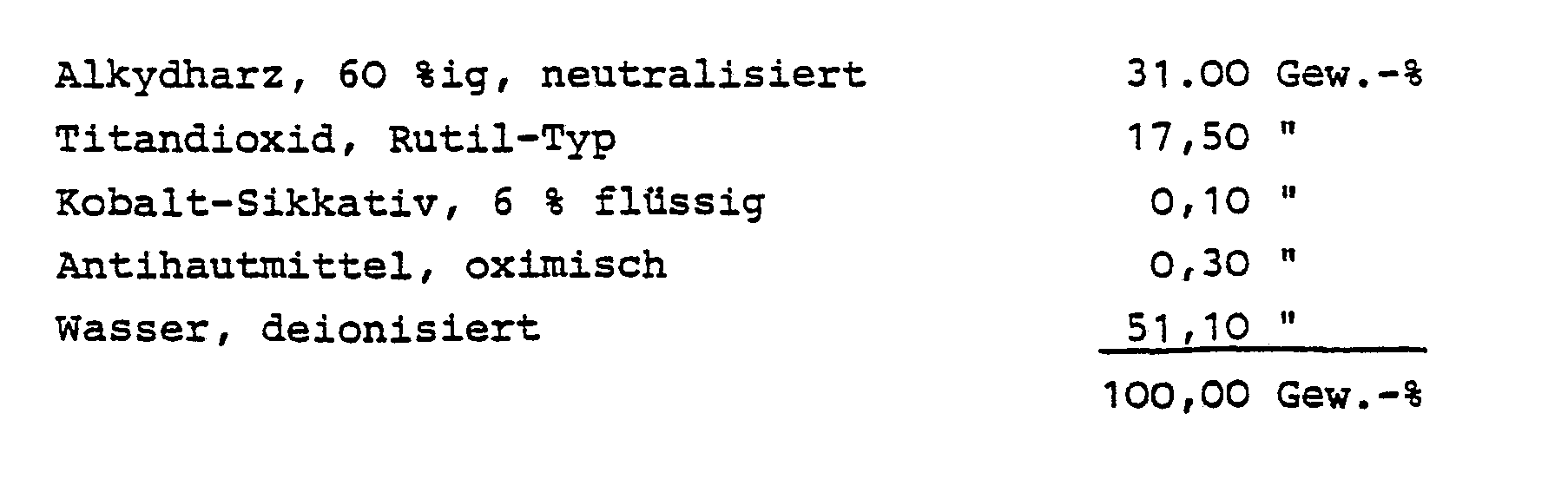
- Dieser Weißlack hat eine Trocknungszeit von 1 Stunde bis zur Klebfreiheit, ist nach 24 Stunden vollständig durchgetrocknet und hat dann eine Pendelhärte von 32 sec (nach König), einen Glanzwert (nach Gardner, 20° Meßwinkel) von 80, einen Anfangsweißgrad (nach Berger) von 84,2, nach 5 Tagen Lagerung bei 50°C immer noch einen Wert von 71,6, nach 17 Stunden bei 130°C noch einen Weißtonwert von 45,3 und einen Glanzwert (nach Gardner, 20° Meßwinkel) von 50 bei ebenfalls guten Werten in Wasserfestigkeit (nach DIN 53 209) von m 4/g 2.
- Der folgende Vergleich zeigt ein weiteres Beispiel und die überraschenden lacktechnischen Vorteile der erfindungsgemäßen Alkydharze im Vergleich zu Bindemitteln, die nicht der erfindungsgemäßen Kombination entsprechen, wobei die Herstellung der im Beispiel 1 angegebenen Fahrweise entspricht und die erfindungsgemäßen Rohstoffe durch äquivalente Anteile nicht erfindungsgemäßer Rohstoffe ersetzt werden.
- Ein Alkydharz entsprechend Beispiel 1, jedoch aus 1214 Teilen Phthalsäureanhydrid anstelle von Isophthalsäure hergestellt und wie dort mit Hexahydrophthalsäureanhydrid umgesetzt, hat eine Säurezahl von 43 und eine Viskosität entsprechend einer Auslaufzeit von 173 sec (50 %ig in Dimethylformamid, DIN 53211, DIN-Becher 4).
-
- a) mit natürlicher Sojaölfettsäure anstelle der konjungierten Sojaölfettsäure
- b) mit Tetrahydrophthalsäureanhydrid anstelle von Hexahydrophthalsäureanhydrid
- c) mit Phthalsäureanhydrid anstelle von Hexahydrophthalsäureanyhdrid
- d) mit Bernsteinsäureanhydrid anstelle von Hexahydrcphthalsäureanhydrid
- e) mit Maleinsäureanhydrid anstelle von Hexahydrophthalsäureanhydrid. Der Vergleich e) wurde lacktechnisch nicht geprüft, weil bereits bei der Lackherstellung eine starke Gelbildung einsetzte.
- Die folgende Tabelle gibt den Überblick über die lacktechnischen Vorteile der erfindungsgemäßen Systeme.

- Da in der Beurteilung von Überzügen eine einzelne Eigenschaft häufig nicht alleine betrachtet werden kann, wertet die folgende Tabelle die Unterschiede zu erfindungsgemäßen Lacksystemen:
- O = gleichwertig mit dem erfindungsgemäßen System
- + = besser als das erfindungsgemäße System
- - = schlechter als das erfindungsgemäße System

Claims (10)
Priority Applications (1)
| Application Number | Priority Date | Filing Date | Title |
|---|---|---|---|
| AT80104061T ATE4722T1 (de) | 1979-07-28 | 1980-07-14 | Wasserloesliche, lufttrocknende alkydharze, verfahren zu ihrer herstellung und ihre verwendung als grundlage fuer vergilbungsarme lacke. |
Applications Claiming Priority (2)
| Application Number | Priority Date | Filing Date | Title |
|---|---|---|---|
| DE19792930734 DE2930734A1 (de) | 1979-07-28 | 1979-07-28 | Wasserloesliche, lufttrocknende alkydharze, verfahren zu ihrer herstellung und ihre verwendung als grundlage fuer vergilbungsarme lacke |
| DE2930734 | 1979-07-28 |
Publications (2)
| Publication Number | Publication Date |
|---|---|
| EP0023979A1 true EP0023979A1 (de) | 1981-02-18 |
| EP0023979B1 EP0023979B1 (de) | 1983-09-21 |
Family
ID=6077063
Family Applications (1)
| Application Number | Title | Priority Date | Filing Date |
|---|---|---|---|
| EP80104061A Expired EP0023979B1 (de) | 1979-07-28 | 1980-07-14 | Wasserlösliche, lufttrocknende Alkydharze, Verfahren zu ihrer Herstellung und ihre Verwendung als Grundlage für vergilbungsarme Lacke |
Country Status (7)
| Country | Link |
|---|---|
| US (1) | US4346044A (de) |
| EP (1) | EP0023979B1 (de) |
| JP (1) | JPS5622322A (de) |
| AT (1) | ATE4722T1 (de) |
| CA (1) | CA1149995A (de) |
| DE (2) | DE2930734A1 (de) |
| ES (1) | ES493772A0 (de) |
Cited By (1)
| Publication number | Priority date | Publication date | Assignee | Title |
|---|---|---|---|---|
| WO1995009880A1 (en) * | 1993-10-04 | 1995-04-13 | Ppg Industries, Inc. | Waterborne polyesters having improved saponification resistance |
Families Citing this family (11)
| Publication number | Priority date | Publication date | Assignee | Title |
|---|---|---|---|---|
| US4557870A (en) * | 1980-10-23 | 1985-12-10 | Battelle Development Corporation | Non-emissive, flame-retardant coating compositions |
| US4555366A (en) * | 1980-10-23 | 1985-11-26 | Battelle Development Corporation | Non-emissive, flame-retardant coating compositions |
| DE3115072A1 (de) * | 1981-04-14 | 1982-11-04 | Bayer Ag, 5090 Leverkusen | Verfahren zur herstellung von polyestern bzw. alkydharzen, nach diesem verfahren erhaeltliche harze und deren verwendung als lackbindemittel |
| US4740567A (en) * | 1985-09-27 | 1988-04-26 | Cargill, Incorporated | Water reducible phenolic modified alkyd resin |
| US4649173A (en) * | 1985-09-27 | 1987-03-10 | Cargill, Incorporated | Water reducible phenolic modified alkyd resin |
| US5137965A (en) * | 1990-07-16 | 1992-08-11 | Westvaco Corporation | Water-borne alkyd resin compositions |
| US5096960A (en) * | 1990-07-16 | 1992-03-17 | Westvaco Corporation | Water-borne alkyd resin compositions |
| US5164191A (en) * | 1991-02-12 | 1992-11-17 | Micro Vesicular Systems, Inc. | Lipid vesicles having an alkyd as a wall-forming material |
| WO2002013999A1 (fr) * | 2000-08-11 | 2002-02-21 | Ishihara Sangyo Kaisha, Ltd. | Solution metallique colloidale, procede de production de cette solution et materiau de revetement contenant cette solution |
| GB0025214D0 (en) | 2000-10-14 | 2000-11-29 | Avecia Bv | Polyurethane Polymer compositions |
| FI20065150A7 (fi) * | 2006-03-06 | 2007-09-07 | Valtion Teknillinen Tutkimuskeskus | Modifioitu luonnonrasvahappopohjainen hybridihartsi ja menetelmä sen valmistamiseksi |
Citations (3)
| Publication number | Priority date | Publication date | Assignee | Title |
|---|---|---|---|---|
| DE2059352A1 (de) * | 1969-12-03 | 1971-06-09 | Kansai Paint Co Ltd | Verfahren zur Herstellung von UEberzuegen auf der Grundlage von Alkydharzen und waessrige Alkydharz-Dispersionen |
| DE2304550A1 (de) * | 1973-01-31 | 1974-08-08 | Bayer Ag | Bindemittel fuer loesungsmittelarme lacksysteme |
| DE2637167A1 (de) * | 1975-10-21 | 1977-05-05 | Schenectady Chemical | In wasser dispergierbare polyester |
Family Cites Families (8)
| Publication number | Priority date | Publication date | Assignee | Title |
|---|---|---|---|---|
| US3055869A (en) * | 1959-12-21 | 1962-09-25 | Eastman Kodak Co | Process for preparing polyesters using free acids |
| US3196119A (en) * | 1964-06-24 | 1965-07-20 | Archer Daniels Midland Co | Modified alkyd resin compositions and process of preparing the same |
| DE1519146A1 (de) | 1965-06-24 | 1969-12-11 | Bayer Ag | Waessrige Einbrennlacke |
| US3480575A (en) * | 1967-03-30 | 1969-11-25 | Ashland Oil Inc | Process for producing monocarboxylic acid modified alkyd resins |
| US3928265A (en) * | 1972-10-31 | 1975-12-23 | Bayer Ag | Lacquer systems which are harmless to the environment |
| CA1033487A (en) * | 1972-10-31 | 1978-06-20 | Rolf Dhein | Binders for low-solvent lacquer systems |
| CA1056545A (en) * | 1973-04-18 | 1979-06-12 | Bernd-Ulrich Kaiser | Environmentally harmless stoving lacquer systems based on alkyd resins containing condensed monohydric alcohols |
| DE2742584A1 (de) | 1977-09-22 | 1979-04-05 | Bayer Ag | Lufttrocknende alkydharze |
-
1979
- 1979-07-28 DE DE19792930734 patent/DE2930734A1/de not_active Withdrawn
-
1980
- 1980-07-11 US US06/167,558 patent/US4346044A/en not_active Expired - Lifetime
- 1980-07-14 AT AT80104061T patent/ATE4722T1/de active
- 1980-07-14 EP EP80104061A patent/EP0023979B1/de not_active Expired
- 1980-07-14 DE DE8080104061T patent/DE3064925D1/de not_active Expired
- 1980-07-25 JP JP10141180A patent/JPS5622322A/ja active Pending
- 1980-07-25 CA CA000357044A patent/CA1149995A/en not_active Expired
- 1980-07-28 ES ES493772A patent/ES493772A0/es active Granted
Patent Citations (3)
| Publication number | Priority date | Publication date | Assignee | Title |
|---|---|---|---|---|
| DE2059352A1 (de) * | 1969-12-03 | 1971-06-09 | Kansai Paint Co Ltd | Verfahren zur Herstellung von UEberzuegen auf der Grundlage von Alkydharzen und waessrige Alkydharz-Dispersionen |
| DE2304550A1 (de) * | 1973-01-31 | 1974-08-08 | Bayer Ag | Bindemittel fuer loesungsmittelarme lacksysteme |
| DE2637167A1 (de) * | 1975-10-21 | 1977-05-05 | Schenectady Chemical | In wasser dispergierbare polyester |
Cited By (2)
| Publication number | Priority date | Publication date | Assignee | Title |
|---|---|---|---|---|
| WO1995009880A1 (en) * | 1993-10-04 | 1995-04-13 | Ppg Industries, Inc. | Waterborne polyesters having improved saponification resistance |
| US5552475A (en) * | 1993-10-04 | 1996-09-03 | Ppg Industries, Inc. | Waterborne polyesters having improved saponification resistance |
Also Published As
| Publication number | Publication date |
|---|---|
| DE2930734A1 (de) | 1981-02-12 |
| CA1149995A (en) | 1983-07-12 |
| ES8106164A1 (es) | 1981-07-16 |
| US4346044A (en) | 1982-08-24 |
| ATE4722T1 (de) | 1983-10-15 |
| ES493772A0 (es) | 1981-07-16 |
| DE3064925D1 (en) | 1983-10-27 |
| JPS5622322A (en) | 1981-03-02 |
| EP0023979B1 (de) | 1983-09-21 |
Similar Documents
| Publication | Publication Date | Title |
|---|---|---|
| DE1595278C3 (de) | Verfahren zur Herstellung von wasserdispergierbaren Alkydharzen und deren Verwendung | |
| EP0062866B1 (de) | Verfahren zur Herstellung von Polyestern unter Verwendung von Mannit- bzw. Sorbitderivaten, Mischungen aus Polyestern und diesen Mannit- bzw. Sorbitderivaten und ihre Verwendung zur Herstellung wässriger Einbrennlacke | |
| EP0054105B1 (de) | Verfahren zur Herstellung von (meth)acrylsäuremodifizierten Polyestern | |
| DE2416658A1 (de) | Mit acryl- oder methacrylsaeure modifizierte alkydharze fuer wasserfarben | |
| DE69025635T2 (de) | Pulverfarbe und Polyesterharz für Pulverfarben | |
| EP0023979B1 (de) | Wasserlösliche, lufttrocknende Alkydharze, Verfahren zu ihrer Herstellung und ihre Verwendung als Grundlage für vergilbungsarme Lacke | |
| DE2637167C2 (de) | ||
| DE1917162C3 (de) | Für wäßrige Lacke geeignete Bindemittel auf Basis wasserverdünnbarer Salze von Alkydharzen und Verfahren zur Herstellung der Bindemittel | |
| EP0083016A1 (de) | Bindemittel für wässrige Einbrennlacke auf Basis von Polyestern und Verfahren zu ihrer Herstellung | |
| EP0063292B1 (de) | Verfahren zur Herstellung von Polyestern bzw. Alkydharzen, nach diesem Verfahren erhältliche Harze und deren Verwendung als Lackbindemittel | |
| EP0126404B1 (de) | Verfahren zur Herstellung von hydroxylgruppenhaltigen Alkydharzen und deren wässrigen Zubereitungen | |
| EP0113797B1 (de) | Alkydharze, enthaltend Ringöffnungsprodukte epoxidierter Fettalkohole oder Fettsäurederivate als Hydroxylverbindungen | |
| EP0167962B1 (de) | Ungesättigte Polyester | |
| EP0113800B1 (de) | Polyol-modifizierte Alkydharze zur Verwendung in Wasserlacken | |
| DE2225646A1 (de) | Wasserverduennbare einbrennlacke | |
| DE1669141C3 (de) | Wäßrige Einbrennlacke auf der Grundlage von Aminsalzen von Halbestern hydroxylgruppenhaltiger, fettsäuremodifizierter Alkydharze | |
| DE1519146A1 (de) | Waessrige Einbrennlacke | |
| DE69511175T2 (de) | Harzzusammensetzung auf Basis von Alkydharz und Reaktivverdünner | |
| DE1905057C3 (de) | Verfahren zur Herstellung wasserlöslicher lufttrocknender Umsetzungsprodukte auf der Basis von Fettsäuren sowie deren Verwendung | |
| EP0056155A1 (de) | Wässrige Dispersionen auf Basis von Cellulosenitraten, Polyestern bzw. Alkydharzen und Aminoplastharzen, Verfahren zu ihrer Herstellung und ihre Verwendung zur Herstellung von Überzügen | |
| DE2161253A1 (de) | Verfahren zur herstellung von alkydharzen | |
| DE1520669B2 (de) | Verfahren zum herstellen von modifizierten alkydharzen | |
| DE2348678B2 (de) | Lufttrocknende, Monoalkohol einkondensiert enthaltende Alkydharzbindemittel | |
| EP0028020A1 (de) | Verfahren zur Herstellung verbesserter lufttrocknender Alkydharze | |
| AT205744B (de) | Verfahren zur Herstellung von Kunstharzen |
Legal Events
| Date | Code | Title | Description |
|---|---|---|---|
| PUAI | Public reference made under article 153(3) epc to a published international application that has entered the european phase |
Free format text: ORIGINAL CODE: 0009012 |
|
| 17P | Request for examination filed |
Effective date: 19800714 |
|
| AK | Designated contracting states |
Designated state(s): AT DE FR GB IT NL SE |
|
| ITF | It: translation for a ep patent filed | ||
| GRAA | (expected) grant |
Free format text: ORIGINAL CODE: 0009210 |
|
| AK | Designated contracting states |
Designated state(s): AT DE FR GB IT NL SE |
|
| REF | Corresponds to: |
Ref document number: 4722 Country of ref document: AT Date of ref document: 19831015 Kind code of ref document: T |
|
| REF | Corresponds to: |
Ref document number: 3064925 Country of ref document: DE Date of ref document: 19831027 |
|
| ET | Fr: translation filed | ||
| PGFP | Annual fee paid to national office [announced via postgrant information from national office to epo] |
Ref country code: SE Payment date: 19840630 Year of fee payment: 5 |
|
| PGFP | Annual fee paid to national office [announced via postgrant information from national office to epo] |
Ref country code: DE Payment date: 19840703 Year of fee payment: 5 |
|
| PGFP | Annual fee paid to national office [announced via postgrant information from national office to epo] |
Ref country code: FR Payment date: 19840709 Year of fee payment: 5 |
|
| PLBE | No opposition filed within time limit |
Free format text: ORIGINAL CODE: 0009261 |
|
| STAA | Information on the status of an ep patent application or granted ep patent |
Free format text: STATUS: NO OPPOSITION FILED WITHIN TIME LIMIT |
|
| 26N | No opposition filed | ||
| PGFP | Annual fee paid to national office [announced via postgrant information from national office to epo] |
Ref country code: AT Payment date: 19850708 Year of fee payment: 6 |
|
| PGFP | Annual fee paid to national office [announced via postgrant information from national office to epo] |
Ref country code: NL Payment date: 19850731 Year of fee payment: 6 |
|
| PG25 | Lapsed in a contracting state [announced via postgrant information from national office to epo] |
Ref country code: AT Effective date: 19860714 |
|
| PG25 | Lapsed in a contracting state [announced via postgrant information from national office to epo] |
Ref country code: SE Effective date: 19860715 |
|
| PG25 | Lapsed in a contracting state [announced via postgrant information from national office to epo] |
Ref country code: NL Effective date: 19870201 |
|
| NLV4 | Nl: lapsed or anulled due to non-payment of the annual fee | ||
| PG25 | Lapsed in a contracting state [announced via postgrant information from national office to epo] |
Ref country code: FR Free format text: LAPSE BECAUSE OF NON-PAYMENT OF DUE FEES Effective date: 19870331 |
|
| PG25 | Lapsed in a contracting state [announced via postgrant information from national office to epo] |
Ref country code: DE Effective date: 19870401 |
|
| GBPC | Gb: european patent ceased through non-payment of renewal fee | ||
| REG | Reference to a national code |
Ref country code: FR Ref legal event code: ST |
|
| PG25 | Lapsed in a contracting state [announced via postgrant information from national office to epo] |
Ref country code: GB Effective date: 19881118 |
|
| EUG | Se: european patent has lapsed |
Ref document number: 80104061.9 Effective date: 19870505 |